




Abstract
Green marketing in the hotel industry is no longer just an option. As awareness of environmental issues has increased, more consumers have began to prefer eco-friendly products, the so-called “green option” in relation to their behavioral intentions despite higher cost. Previous literatures focused on the relationship from green marketing to value, belief, and norm separately. However, this research applied green marketing to VBN simultaneously. The purpose of the study is to clarify whether hotels’ green marketing activities have a significant effect on the actual behavioral intentions and decision making. The eleven 5-star hotels located in Seoul, South Korea were selected for the survey. The survey was via online due to COVID-19 (coronavirus disease) from August 15, 2020 to August 30, 2020. A total of 318 responses were used for analysis. This study conducted an empirical analysis using SPSS 22 and Amos 22. The result shows that hotels’ green marketing has a positive impact via the VBN theory at large, though the relationships from recycling to norm and pro-environmental programs to value are less significant. In other words, variables such as recycling and energy saving as they pertain to direct behavioral intentions influence hotel customers’ value and belief in psychological perspectives and indirect variables such as pro-environmental programs also influence customer’s belief and norm but not as significantly for value. The results of this study are expected to help us understand which attributes affect behavioral intentions, especially in the hotel industry which is conducting green marketing.
Keywords
Introduction
Climate change is increasingly recognized as the main problem to be solved worldwide. According to UN (2022), the current greenhouse gas emissions are at the highest levels in 2 million years. In addition, climate change is known to cause environmental problems, such as severe drought, water shortages, serious fires, rising sea levels, flooding, melting polarice, catastrophic storms, and decreased biodiversity, etc. In relation to this environmental crisis, sustainability has also become an important task in the business sector. As awareness of environmental issues increased, more consumers began to prefer eco-friendly products, the so-called “green option” in relation to their behavioral intentions despite higher cost (Chung, 2020). Accordingly, companies are also increasingly interested in “green marketing” (GM) that communicates with consumers with the aim of minimizing negative impacts on the environment, as well as improving the quality that is provided to the consumers (Mercade Mele et al., 2019). Companies can reduce, restore, recycle, and dispose of waste by achieving innovative solutions with educating users. Companies have carried out supporting the environment and encouraging sustainable carbon emissions by diminishing them. The company also reuse and recycling (Farooq et al., 2022).
Especially, as the hotel industry is one of the industries that affects the environment the most, the application of green marketing is essential. According to Moscado, there is general agreement that people use more resources when they stay in tourist accommodations than when they stay at home (Moscardo, 2019). From 2010 to 2050, the hotel industry is expected to increase energy use and gas-emission, despite improved energy efficiency. In addition, water use is expected to double from about 138 to 265 km3 (Gössling & Peeters, 2015; Moscardo, 2019). That is the reason green marketing is not optional in the hotel industry. Hotels lead the industry environmental, social, and governance (ESG) criteria today (Ricaurte & Jagarajan, 2021). Therefore, an increasing number of hotels are applying environmentally friendly practices into their operation than before. For example, Sustainable Hospitality Alliance introduced the Hotel Carbon Measurement Initiative (HCMI), Hotel Water Measurement Initiative (HWMI), and Hotel Waste Measurement Methodology (HWMM) as a green marketing practice. HCMI is a tool to measure carbon footprints discharged from hotels, and HWMI is a tool to measure the amount of water used in hotels. Lastly, HWMM is an approach to measure waste data (Sustainable Hospitality Alliance, 2022). In addition, when the Korea tourism association determines the ranking of hotels in South Korea, the “energy saving management” is included as an additional point item among the on-site evaluation items (Korea Tourism Association, 2022). Detailed “energy saving management” evaluation item includes a green card system, energy efficiency certification, carbon-footprint grade certification, green building certification, and energy management system certification, etc.
Green marketing highlights how this process changes behavioral intentions (Gössling & Peeters, 2015; Moscardo, 2019). As climate change becomes a global issue, it is necessary to understand behavioral intentions as to whether consumers’ eco-friendly perception affects actual visit intentions. In particular, millennials born between 1979 and 1994 make up a large proportion of the population, so they are recognized as an important demographic to be considered in research. Studies have shown that millennials are the most ethical generation. Deloitte’s study suggests that in 2017 more than 50% of 8,000 millennials said “environmental protection,”“social equality,”“corporate social responsibility (CSR)” were the important factors (Deloitte, 2022a). And in 2021, although interest in medical/disease prevention increased noticeably after the outbreak of the coronavirus disease (COVID-19), millennials still value donations for charities (55%), social media activities on social issues such as the environment and human rights, thus indicating high interest in ethical activities to solve social problems (Deloitte, 2022b). After pandemic, millennials sympathized more with other people’s difficulties and increased their willingness to act to positively affect the community. Also, as far as the behavioral intentions of millennials, price is not the most important, and instead they focus more on authenticity (Chatzopoulou & de Kiewiet, 2021).
The first worldwide conference to discuss ways to respond to climate change in tourism was held in Djerba, Tunisia in 2003 with more than 140 representatives which included governments, tourism industries, universities, NGOs, and experts from 45 countries. At this conference, responses to climate change in the global tourism sector were discussed and the Djerba Declaration was announced to promise cooperation between countries (UNWTO, 2022a). Then in May 2021, following the outbreak of COVID-19, the G20 tourism ministers promised to implement pro-environmental strategies and policies for better tourism for people, earth and prosperity based on a one planet vision for responsible recovery in the tourism sector (UNWTO, 2022b). Of course, pro-environmental strategies and policies at the government levels are important, but changes in consumer awareness and behavioral intentions are also important. There is a role for marketing in sustainable waste management companies. It was reviewed in the article from “Sustainable waste companies with innovative smart solutions: A systematic review and conceptual model” which showed that companies like Intel, Estree Lauder have attained a rate of waste recycling of over 75% and their priority is the management of waste (Farooq et al., 2022). Accordingly, there have been studies on green marketing conducted in the hotel industry (Chan, 2013, 2014; Chung, 2020; Dief & Font, 2010; K. Lee & Yoon, 2014; Mercade Mele et al., 2019). However, there have been limited studies applying the value-belief-norm (VBN) theory to green marketing in the hotel industry.
The purpose of the study is to find out whether the hotel’s green marketing activities have a significant effect on the actual behavioral intention decision process based on the value-belief-norm (VBN) theory. The results expected to help us understand which attributes affect consumers’ behavioral intentions, especially in the hotel industry that is conducting green marketing. Prior research has demonstrated value, belief, and norm to be separate attributes and has concentrated on the connection between them independently. However, there is lack of studies especially about connecting VBN as a whole variable from green marketing to customer intentions. Thus, this research tried uncommon methods using VBN theory as a whole structure in hotel’s green marketing activities. All in all, the results of this study are expected to be used as basic data for marketing strategies based on understanding behavioral intentions in the hotel industry and the government.
Literature Background
Green Marketing in Hotels
The green marketing concept began in the late 1980s (Peattie & Crane, 2005). According to the American Marketing Association, “green marketing is defined as the development and marketing of products that are presumed to be environmentally safe. This term may also be used to describe efforts to produce, promote, package, and reclaim goods in a manner that is sensitive or responsive to ecological concerns (American Marketing Association, 2022).” Green marketing also entails a social responsibility not only to focus on making profits, but as an organization it challenges environmental policies and fosters positive reactions (S. Wang et al., 2018; Widyastuti et al., 2019). In the hotel industry, Dief and Font (2010) state that a hotel needs to consider the impact of green marketing on branding, segmenting, targeting, and product positioning while green product opportunities must be incorporated into the management of the marketing mix.
The hotel industry is associated with a high volume of consumption and it is responsible for 5% of global greenhouse-gas emission (Groening et al., 2018), and The Proactive Green hotel is voluntarily practicing green marketing strategies to distance itself from social criticism and to relieve guilt. Green marketing is most common in international chain hotels, and mainly consists of creating an ethical environment through formal activities such as codes of conduct and training (Dief & Font, 2010). The main purpose of considering the sustainable development of tourism are recycling, reusing, and energy efficiency (Popescu et al., 2022). Consequently, in green marketing recycling, reusing, and energy savings are inseparable relationships. Comparably, in an article entitled “Sustainable Urban Tourism: Understanding and Developing Visitor pro-Environmental Behaviors” distinguished four types of environmentally friendly tourism behaviors. Specifically, in urban destinations Australia are recycling, green energy, green transportation, and sustainable consumption. The data shows how green marketing affect recycling and energy saving in particular. Especially, the tourism has unique practices which affect the recycling and disposition of waste (Kizanlikli et al., 2023). The higher the ranking of a hotel the higher they save energy. The achievement of energy saving in green marketing can be greatly refined depends on the effort that the industry make (X. Wang et al., 2018). Additionally, there are circular economy theory and low-carbon economy theory that can explain about how energy efficiency and recycling are important circulation of economy in green marketing (Shanshan et al., 2023). Internationally, energy efficiency of tourism and hospitality research has been extremely active and reached a high level However, countries like Ghana lack the sustainable energy system (Appiah et al., 2023). In consequence, systems including green marketing can support and resolve the problems.
Research on green marketing in the hotel industry can be largely divided into three perspectives which are managers’ perspectives, consumers’ perspectives, and perspectives of both groups. Regarding the perspective of managers, there was a study on deriving determinants of hotel marketing managers’ green marketing behavior in Dief and Font (2010). This is of utmost importance for green marketing since the education of managers and users saves the environment. As far as the consumer perspective study, there were studies on consumer perception of hotels’ green marketing strategy in Chan (2014), a study on the effect of hotels’ green marketing activities on consumer satisfaction and revisit intention in K. Lee and Yoon (2014), a study on the effect of hotels’ green marketing on green word of mouth in Mercade Mele et al. (2019), and a study on the effect of hotels’ green marketing on consumers’ purchasing behavioral intentions in Chung (2020). Finally, there was a study conducted on two subjects, managers and consumers. The gap in perception of hotels’ green marketing-related activities was analyzed for hotel managers and hotel consumers in Chan (2013).
In the hotel industry, hotels acquire ISO 14001, which is an international standard for environmental management systems, and promote their green products and green services, such as green attributes in guestrooms, energy saving, recycling, and green awards on their websites (Chan, 2014; K. Lee & Yoon, 2014). In order to understand the hotels’ green marketing activities, it is necessary to understand attributes such as eco-friendly products and services in the hotels.
In order to derive hotels’ green marketing attributes, first, it is necessary to look at the research on green marketing as a higher ordinary concept. Prior research has noted that green marketing can be classified into four categories: (1) green products, (2) recycling, (3) green promotions, and (4) attachment of environmental policy managers (Mathur & Mathur, 2000). In this regard, DeFranco and Weatherspoon classified efficient management in pro-environmental hotels into energy, solid waste, and water conservation (DeFran, 1996). Based on this, they divided hotels’ green marketing into six components: hotel rooms and bathrooms, electricity, room environment, saving supplies, recycling, and environmental policies, while K. Lee and Yoon (2014) divided hotels’ green marketing activities into three components: energy saving, recycling, and pro-environmental program. Therefore, in this study, energy saving, recycling, and pro-environmental programs were classified by referring to previous studies on hotel green marketing activities. Detailed green marketing activity items are summarized as below in Table 1.
Green Marketing Activities in Hotel Industry.

Value-Belief-Norm (VBN) Theory
The main components of VBN theory are value, belief, and norm. From the perspectives of customer’s value and norm, VBN theory explains the changes of attitude caused by social activity (Verma et al., 2019). Prior research has confirmed that VBN theory includes environmental activities, the process of moral obligation toward behavioral intentions, and the process from value to belief and to norm (Choi et al., 2015; Stern et al., 1999). According to the VBN frame, customers follow green behavior because they feel a norm-based moral obligation and responsibility to embody green behavior (Fornara et al., 2016; Ghazali et al., 2019; Riper & Kyle, 2014). Norm can judge behavior and evaluate claims. Stern (2000) simplified Schwartz’s (1992) concept of factors that affect behavior through value. Hotels’ green marketing amplifies value since tourists’ motivation is based upon individual value (M. Kim, 2020). Therefore, VBN theory is an appropriate model as part of hotels’ green marketing strategy. In order to understand behavioral intentions, it is important to understand VBN theory (Youn et al, 2020). People think green marketing makes it worth it to spend more even though customers could possibly pay more for a green experience in the hotel (Dos Santos et al., 2017). Therefore, this study chooses VBN theory to predict and strengthen behavioral intentions based on evidence in the literature.
Word of Mouth
Word-of-mouth (WOM) communication is a favorable behavioral intention, where two or more customers exchange their thoughts, ideas, or comments, including their satisfaction or dissatisfaction with products or services (Ranaei Kordshouli et al., 2015). For decades the importance of WOM communication has been well-known to both academics and practitioners. Since 1950 researchers have insisted that in-person conversations and informal exchange of information among acquaintances both influence customers’ decisions and shape their expectations, pre or post usage attitudes and perceptions of a product or service. WOM is believed to be an extension of advertising, extending its effect (Ranaei Kordshouli et al., 2015). For instance, initial marketing activities trigger initial purchases, and that purchase experience eventually triggers the spread of WOM, as customers share their experiences. Furthermore, the perception of being environmentally friendly is the best way to spread the importance of WOM communication skills (Ranaei Kordshouli et al., 2015).
One positive aspect of WOM is that information is available from others, making it easier to avoid substandard products, but a negative aspect is you also get information when you choose products. Accordingly, positive WOM leads to a positive purchase intention (Magali et al., 2012). In sum, WOM designs the way of expressing behavioral intentions in marketing.
Revisit Intention
Revisit intention encounters power of intention to spread positive WOM. It occurs when customers are satisfied and willing to visit again due to the quality of services or products (De Cannière et al., 2010).
Repurchase intention of the product is a tool to understand the measurement of behavioral intentions (Robinson & Chandran, 2016). Scholars have analyzed purchase and repurchase behaviors worldwide. Repurchase intention is the intention among customers to purchase or use again in the future products or services that they are currently using (Suki & Azman, 2016). In addition, cultivating repurchase intention encourages the purchase of some products or services on a regular basis, resulting in a consistent pool of customers and the eventual development of loyalty to the product or service (R. L. Oliver, 1999).
Often repurchase intention develops revisit intention in the hotel industry. Previous literature has referred to customer satisfaction and repurchase intention directly from evaluating customers’ usage of products and services. Hence, hotels’ service quality has a positive impact on satisfaction and revisit intention. Customer satisfaction is especially important for revisit intention, and more important than service quality. Hotel green marketing has a positive impact on revisit intention through customer satisfaction and trust (Joshi & Rahman, 2015). Consequently, customer satisfaction is the primary source of revisit intention in practice. In conclusion, service quality, relationship quality, and revisit intention are positively correlated.
Research Hypotheses Development
Green marketing is defined as a form of marketing that emphasizes the prevention of environmental pollution and the protection of nature (Prakash, 2002). It involves developing solutions for saving energy, using devices to control contamination, decomposing, recycling, packaging materials (Braga et al., 2019; Kardos et al., 2019; J. D. Oliver, 2013). The shortcomings of previous studies include lack of research in experimental methods, limited measurement of tools and samples, and inaccuracy of statistical analysis. In addition, in hospitality literature little is known about VBN theory using Structural Equation Modeling (SEM) and this study related green marketing to VBN theory. With this, the marketing activities focus not only on improving customers’“quality of life” at a larger scale, but also on understanding their desires, needs, and demands (Ullah, 2018). In addition, it was found through meta-analysis that the correlation between hotel green marketing and VBN theory was significant. Given these, the study has set the following hypotheses:
H1a: Energy saving has a positive effect on value.
H1b: Energy saving has a positive effect on belief.
H1c: Energy saving has a positive effect on norm.
H2a: Recycling has a positive effect on value.
H2b: Recycling has a positive effect on belief.
H2c: Recycling has a positive effect on norm.
H3a: Pro-environmental program has a positive effect on value.
H3b: Pro-environmental program has a positive effect on belief.
H3c: Pro-environmental program has a positive effect on norm.
VBN theory can be defined as the faith in one’s capacity required to attain the goals assigned to an individual (Han, 2015). Many existing studies have concluded that value, belief, and norm are the determining factors of behavioral changes and an important predictor of various forms of behavioral intentions (Han, 2015; Liu et al., 2019). Specifically, value, belief, and norm refer to positive word of mouth and revisit intention. These results indicate that higher faith among customers leads to feelings of higher satisfaction toward hotel visits (Mercade Mele et al, 2019). Accordingly, this study has apply VBN theory to customer behavior with the following hypotheses:
H4a: Value has a positive effect on word of mouth.
H4b: Value has a positive effect on revisit intention.
H5a: Belief has a positive effect on word of mouth.
H5b: Belief has a positive effect on revisit intention.
H6a: Norm has a positive effect on word of mouth.
H6b: Norm has a positive effect on revisit intention.
Research Design
Based on the evidence presented by the existing literature, this study has proposed 15 hypotheses that pertain to the study’s purpose. The 15 hypotheses and proposed study model are shown in Figure 1.

Proposed research model.
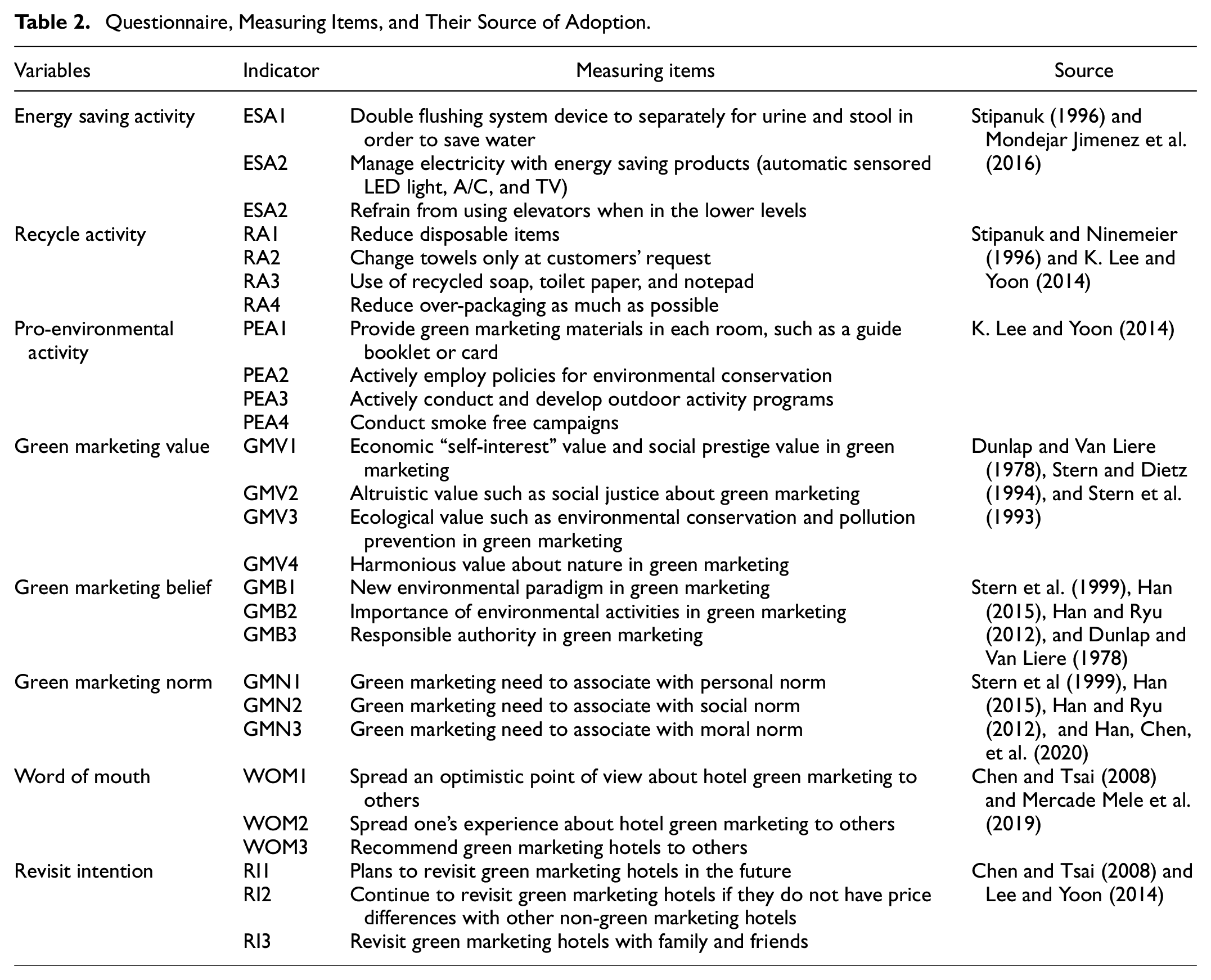
The survey questions of this study were largely divided into three sections. The first section is composed of details on the study, presenting the definition of green marketing. The second section discusses questions regarding variables. The third section discussed demographic information. From previous literature we collected valid determinants. All measurement items had proven validity in previous literature and the 7-point Likert scale was used to measure variables in this research. Specifically, among the 11 questions with proven validity from existing studies, three items pertained to energy saving, four items pertained to recycling, and four items pertained to pro-environmental programs. Among the 10 questions pertaining to VBN theory, four items relating to value, three items to belief, and three items to norm were utilized. Additionally, three items were used for word of mouth and revisit intention each. A total of 50 pre-tests were conducted with 5-star hotel customers in Seoul and survey items were modified based on the results. Detailed measurement items are summarized as below in Table 2.
Questionnaire, Measuring Items, and Their Source of Adoption.
Findings
Sample Profile
A self-reported questionnaire survey was conducted to collect data for the empirical analysis. The eleven 5-star hotels located in Seoul, South Korea were selected for the survey. The survey was conducted online due to COVID-19 from August 15, 2020 to August 30, 2020. All participants in this survey agreed on the statistical use of the data. A total of 400 questionnaires were made available to customers at the hotels. A total of 328 responses (response rate = 82%) were collected, and 10 outliers were excluded so 318 responses were used for analysis. A total of 48.1% (153) of the respondents were male and 51.9% (165) were female. The majority of the respondents (73.3%, 233) were in their 30s and 40s, while the remainder (26.7%, 85) were in their 20s and 50s or over. Expressed in terms of the U.S. currency, converted from the Korean currency, the salary range with the highest proportion was $30,000 to 49,999 (36.8%), followed by $50,000 to 69,999 (24.5%), $20,000 to 29,999 (23.6%), and more than $70,000 (15.1%). The majority of the respondents were married (57.5%), and 42.1% of the respondents were single. Lastly, in terms of highest level of education attained, 168 respondents had college degrees (52.8%), with 92 respondents having community college degrees (28.9%).
Measurement Validation
For method analysis, SPSS 22 and Amos 22 were used to conduct the empirical analysis through a research model and hypothesis test in this study. An advantage of the VBN theory is to examine green behavior by taking into account elements like values and ecological worldview (Stern, 2000). Specifically, VBN theory has been useful in approaching pro-social motives of individuals by analyzing how motives of self-interest associate with green behavioral intentions in diverse circumstances (De Groot & Steg, 2009, 2010; Han, 2015; Y. Kim & Han, 2010). The first method is to proceed with frequency analysis in order to discern respondent’s general trait and demographic trait and to implement descriptive statistics for normality test of metrics prior to hypothesis test. Second method is to process reliability analysis using Cronbach’s α coefficient for understanding internal consistency of metrics. Third method is to perform Confirmatory Factor Analysis (CFA) to evaluate a set validity for each construction. Feasibility study to find out standardized coefficient, Average Variance Extracted, and construct reliability of each loaded factor and to confirm discriminant validity through comparison of construct between correlation coefficient and average variance extracted. Last method is to verify the structural relation of the construct which guarantees feasibility through using CFA to practice SEM analysis. CFA, an analytical method used most effectively to test the reliability and validity of the scale (Anderson & Gerbing, 1988; Han & Ryu, 2012) was carried out using maximum likelihood estimation to test the unidimensionality of the scale and validity of the measurement model. The results of the analysis are: goodness-of-fit of the model was statistically acceptable (χ2 = 497.891 (df = 296, p < 0.001), RMSEA = 0.046, CFI = 0.968, IFI = 0.969). Convergent validity holds if AVE, testing for convergent validity, is higher than 0.5 and if CR, testing internal consistency, is higher than 0.7 (Fornell & Larcker, 1981). The results of the empirical analysis showed that AVE ranged from 0.618 to 0.794, and CR ranged from 0.860 to 0.950. This shows that internal consistency and convergent validity hold for the variables used in the empirical analysis. In addition, the correlation coefficients in Table 3 were no higher than 0.8, with those associated with latent variables being less than AVE, implying that there were no issues with discriminant validity (Fornell & Larcker, 1981).
Descriptive Statistics and Associated Measures (n = 318).
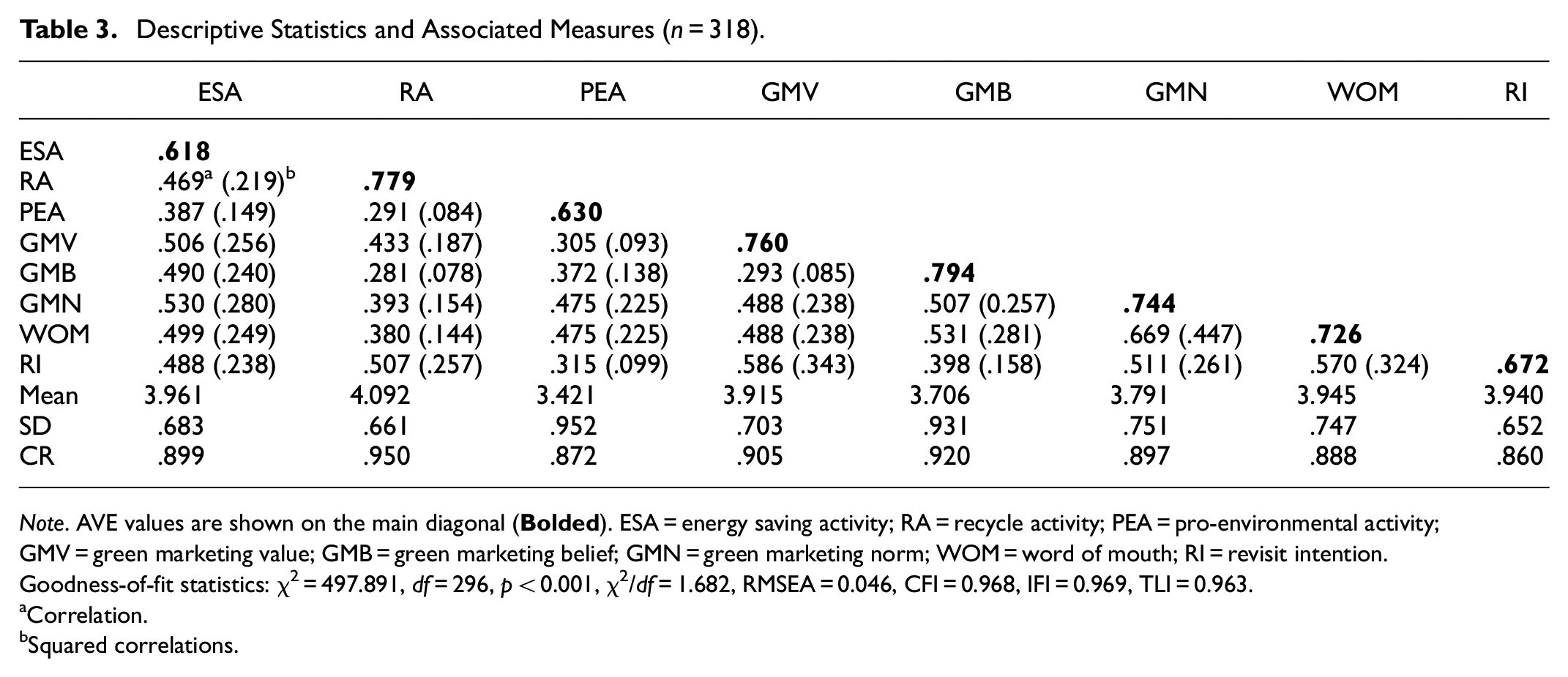
Note. AVE values are shown on the main diagonal (
Goodness-of-fit statistics: χ2 = 497.891, df = 296, p < 0.001, χ2/df = 1.682, RMSEA = 0.046, CFI = 0.968, IFI = 0.969, TLI = 0.963.
Correlation.
Squared correlations.
Model and Hypothesis Testing
The fit of the proposed model was verified using maximum likelihood estimation; the results were satisfactory, with χ2 = 563.108, df = 305, p < 0.000, χ2/df = 1.846, RMSEA = 0.052, CFI = 0.960, IFI = 0.960, TLI = 0.953. In addition, the variables of green marketing value (R2 = 0.702), green marketing belief (R2 = 0.702), green marketing norm (R2 = 0.821), WOM (R2 = 0.855), and RI (R2 = 0.859) were seen to have appropriate explanatory power the theoretical framework; our conclusion is therefore that our model is very appropriate for predicting behavioral intentions. The detailed results are presented in Table 4 and Figure 2.
SEM Results (n = 318).

Note. ESA = energy saving activity; RA = recycle activity; PEA = pro-environmental activity; GMV = green marketing value; GMB = green marketing belief; GMN = green marketing norm; WOM = word of mouth; RI = revisit intention.
Goodness-of-fit statistics: χ2 = 563.108, df = 305, p < 0.000, χ2/df = 1.846, RMSEA = 0.052, CFI = 0.960, IFI = 0.960, and TLI = 0.953
p < 0.05. **p < 0.01.

Results of the structural model.
Hypotheses 1a to 3c were tested. The results indicated that energy saving (H1a: β = 0.484, p < 0.01) and recycling (H2a: β = 0.313, p < 0.01) had a significant influence on value, energy saving (H1b: β = 0.856, p < 0.01), recycling (H2b: β = 0.206, p < 0.05) and pro-environmental programs (H3b: β = 0.182, p < 0.05) had significant influence on belief, and energy saving (H1c: β = 0.620, p < 0.01) and pro-environmental programs (H3c: β = 0.343, p < 0.01) had significant influence on norm, while recycling (H2c: β = 0.017, p > 0.05) did not have a significant influence on norm and pro-environmental programs (H3a: β = 0.113, p > 0.05) did not have a significant influence on value. Therefore, hypotheses 1a, 1b, 1c, 2a, 2b, 3b, and 3c were accepted, and hypothesis 2c and 3a were rejected. This result also rejected null hypotheses 1a, 1b, 1c, 2a, 2b, 3b, and 3c, but failed to reject null hypothesis 2c and 3a. Then, the relationships of VBN with WOM and revisit intention (Hypotheses 4a–6b) were tested. The results indicated that value (H4a: β = 0.136, p < 0.05), belief (H5a: β = 0.208, p < 0.01), and norm (H6a: β = 0.705, p < 0.01) had a significant influence on word of mouth and value (H4b: β = 0.671, p < 0.01) and norm (H6b: β = 0.218, p < 0.01) had significant influence on revisit intention, while belief (H5b: β = 0.114, p > 0.05) did not have a significant influence on revisit intention. Therefore, hypothesis 4a, 4b, 5a, 6a, and 6b were accepted and hypothesis 5b is rejected. This result also rejected null hypotheses 4a, 4b, 5a, 6a, and 6b, but failed to reject null hypothesis 5b.
It is generally known that the complex relationships proposed by the study structures can be better understood by using a mediating framework within the theoretical model. We conducted a verification of the indirect effects of the green-marketing sub factors (i.e., energy saving, recycle, and pro-environmental programs) on word of mouth and revisit intention. The results indicated that energy saving (βES–V–B–N–WOM = .681, p < 0.01; βES–V–B–N–RI = 0.557, p < 0.01) had significant indirect influences on word of mouth and revisit intention. The results show that value, beliefs and norm exhibit important mediating effects within the conceptual framework that we propose.
Discussion and Research Implications
Theoretical Implications
Consistent with the previous findings, the main contribution of our study is that hotels’ green marketing has a positive impact via the VBN theory at large, though the relationships from recycling and pro-environmental programs are partially significant to norm and value while energy savings are significant to all. In other words, variables such as recycle and energy saving of direct behavioral intentions influence hotel customers’ value and belief in psychological perspective and indirect variables such as pro-environmental programs positively significant to belief and norm but partially insignificant to value. Accordingly, pro-environmental programs are considered as a stereotypical factor that will not attract hotel customers. On the other hand, recycling reacts to hotel customers’ spontaneous behavioral intentions, hence, it acts with customers’ value and belief but not with norm. The VBN theory also influenced hotel customers’ behavioral intentions such as word of mouth and intention to revisit. In addition, hotel customers’ behavioral intentions are based on their value and norm, but belief had an insignificant impact on revisit intention. Nevertheless, all of VBN had significant impact on word of mouth. According to review on waste management in both industrial and academic part, recycling, reduction, and recovery process has been greatly enhanced. In the future, green companies can get advantage among masses through popularity (Farooq et al., 2022). Consequently, green marketing produced positive economic circulation. As a result, the VBN theory is an important variable in order to analyze hotel customers’ behavioral intentions (Choi et al., 2015; Stern et al., 1999).
According to the data, hotels’ green marketing was found to have a significant influence on behavioral intentions through value, beliefs, and norm as mediating variables (M. Kim, 2020; Schwartz, 1992; Stern et al., 1999). Nonetheless, some variables did not have a significant influence on dependent variables. The largest effect on revisit intention was from energy savings and the largest effect on word of mouth was from energy saving, belief, and norm. As a matter of fact, hotel customers had great influence on energy saving, value, and norm of behavioral intentions in hotel green marketing. These results are especially notable in that 47.9% of the participants in the study are aged 30 to 39. In Korea, this age group has been referred to as a “new generation,” having developed in an environment characterized by a higher degree of economic prosperity, thanks to economic growth, internationalization, and the development of information technology (Berg & Jay 2022). This results in a tendency to have a higher degree of concern for the environment. People in their 20 to 30 generation who are rising as the main customers of Hocance (hotel & vacation) are luxury hotel users and they were beneficiaries of the rapid growth of the South Korean economy (S. Lee, 2021). Therefore, they are highly internationalized and educated. Luxury hotel usage has shifted from business customers to the family unit, that is, families with young children who will take the environment into consideration deeply for their children. Consequently, willingness to participate in hotel green marketing can be maximized. Yet, the hypothesis predicted that the H2c recycle on hotel green marketing would have a significant effect on norm, but the effect was found to be insignificant so this hypothesis was rejected. It can be seen that hotel customers’ voluntary actions are based on values and beliefs in relation to recycling, but that they did not apply to the fixed components such as norm. This is interpreted as an antipathy toward hotel’s green marketing, which is regulated by more stringent norm, and this contrasts with existing studies on hotel green marketing behavioral intentions based on existing fixed norm. Namely, it can be seen that the current hotel customers have a high level of environmental awareness (Mercade Mele et al., 2019). These results indicate that hotel customers are committed to voluntary participation for a better environment. In the end, it is necessary to spur hotel customers through spontaneous green marketing, but not green marketing based upon norm. In addition, hypothesis H3a said that the pro-environmental program, which is an element of hotel green marketing, has a positive effect on belief and norm, but it rejected in the case of value where it showed insignificant results. From the information above, we can conclude that the hotel companies are lacking in eco-friendly publicity and campaigns. Further, regarding the influence on behavioral intentions by the VBN theory, hypothesis H5b predicted that belief would have a significant effect on revisit intention, but the hypothesis was rejected and the result projected insignificant. In other words, the customer’s faith was not meaningful in revisiting intention. Yet, for hotel customers, value, belief, and norm were all meaningful in relation to word of mouth. From these results it can be concluded that hotel customers examine about value more than norm, so they did not have confidence in norm for revisit intention.
Managerial Implications
Hotel customers imply participation of their behavioral intentions through value, belief, and norm in hotel industry and they are well-aware of the significance of hotel’s green marketing (Mercade Mele et al., 2019). From a business standpoint, attempting to gain the trust of hotel customers through promotion of hotel green marketing, facility management and programs is essential (Kardos et al., 2019; R. L. Oliver, 1999; Ranaei Kordshouli et al., 2015; Suki & Azman, 2016; Widyastuti et al., 2019). This results in positive circulation in economy as well. Thereupon, the results can have practical implications for behavioral intentions with regards to customer trust and revisit intention through word of mouth from hotel green marketing (Braga et al., 2019; Korea Tourism Association, 2022; Mercade Mele et al., 2019; Ranaei Kordshouli et al., 2015; Robinson & Chandran, 2016; Ullah, 2018). Firstly, in hotel green marketing, hotel companies must continue to put their efforts into energy saving. In short, current hotel customers’ trust has a positive impact on hotels in value, belief, and norm and the relationship must be maintained constantly for the business. Secondly, value and belief are relevant for recycling and reuse, but hotel customers are reluctant to apply norm because they felt forced, so it should be set aside. It is particularly necessary to conceive and make available voluntary programs for hotel customers, for example, replacing warning text with an eco-friendly story, eco-friendly recycling design packaging. Thus, voluntary programs for hotel customers is the most effective method. Thirdly, a recent trend has been found that hotel customers do not perceive the value of hotel green marketing programs, indicating that hotels are not able to catch the eco-friendly consciousness of hotel customers. They recognize belief and norm, but do not discern value which means that there is a complication with hotel companies’ eco-friendly marketing programs. The solution is more active programs such as coupons, mileage accrual and other eco-friendly incentives can be presented to customers to encourage active participation.
Managerial Implications
Today hotels are faced with global environmental problems, for this reason, hotel’s green marketing participation leads to positive results in hotels’ revenue. These meaningful result satisfy both hotels and customers (Han, Chen, et al., 2020; Han, Quan, et al., 2020). Two main tasks of the hotels industry which are green marketing and economy are solved. In previous studies, the VBN theory mainly studied the relationship between value and belief and norm interchangeably, however, this study has newly attempted to try academic significance in deriving the results of value, belief, and norm as a structural model.
Limitations and Future Research Direction
The results of this study confirmed that the VBN theory for hotel green marketing by hotel customers provided several important clues for decision-making on behavioral intentions. However, there are limitations in this study. First, 47% of respondents are in their 30s and hotel green marketing can be perceived differently depending on generation, thus it will be necessary to examine hotels’ green marketing in relation to various other generations’ behavioral intentions. Second, the data collection in this study targeted Korean customers. Hence, the results are not necessarily applicable for hotel customers in other countries. It is necessary to expand the sampling range. Third, the participants in this study were 5-star hotel customers located in Seoul. This may need to be extended to other types of hotel users and segments of the population for further research. Last, researchers found data’s reliability and validity from appropriate methods using SEM and did not use robustness test. Future studies could indicate all of the above limitations to create better research.
Footnotes
Declaration of Conflicting Interests
The author(s) declared no potential conflicts of interest with respect to the research, authorship, and/or publication of this article.
Funding
The author(s) received no financial support for the research, authorship, and/or publication of this article.

Data Availability Statement
Data sharing not applicable to this article as no datasets were generated or analyzed during the current study.