




Abstract
This study aims to investigate the relationships of narrative role, empathy, host identification, spatial distance, and purchase intention. This study conducts three experiments with 460 participants to analyze the influencing mechanism of narrative role (in-group vs. out-group) on consumers’ purchase intentions from the perspective of empathy and host identification through three experiments in different spatial distances (distant vs. close). (a) The study found that in the context of agricultural product live stream, hosts taking an in-group character are more likely to trigger consumers’ purchase intentions than hosts taking an out-group character. (b) Empathy and host identification play a mediating role in the impact of the narrative role on consumers’ purchase intentions. (c) The impact of the host’s narrative role on purchase intention does not significantly differ in a spatially distant location. Compared to the host as an out-group character, the host as an in-group character is more likely to promote consumers’ purchase intention when the spatial distance is close.
Plain Language Summary
The problem of food waste is getting worse. The emergence of agricultural product live stream has found a new solution to food waste. In China, the development of agricultural product live stream has been rapid and has achieved amazing sales results. The host’s role is very important in the agricultural product live stream, which runs through the whole process of the broadcast and is an important feature of the anchor’s narrative. This study aims to explore the effect of host’s narrative identity on consumers’ purchase intention. This study aims to investigate the relationships between narrative role, empathy, host identification, spatial distance, and purchase intention. This study conducts three experiments with 460 participants to analyze the influencing mechanism of narrative role (in-group vs. out-group) on consumers’ purchase intentions from the perspective of empathy and host identification through three experiments in different spatial distances (distant vs. close). (a) The study found that in the context of agricultural product live stream, hosts taking an in-group character are more likely to trigger consumers’ purchase intentions than hosts taking an out-group character. (b) Empathy and host identification play a mediating role in the impact of the narrative role on consumers’ purchase intentions. (c) The impact of the host’s narrative role on purchase intention does not significantly differ in a spatially distant location. Compared to the host as an out-group character, the host as an in-group character is more likely to promote consumers’ purchase intention when the spatial distance is close. This study explores the boundary effects of the theory of perspective taking, the study found that the persuasive effect of the narrative, based on the theory of perspective taking, is different under the moderating role of spatial distance
Introduction
According to the Food and Agriculture Organization of the United Nations (FAOUN) data, approximately 1.6 billion tons of food is lost or wasted each year, and more than 6 billion pounds of fresh produce is unsold (H. Liu et al., 2018). One of the most important reasons is that the way of harvesting agricultural products for the consumers is obstructed, so it is urgent to alleviate the sales dilemma of agricultural products as well as food waste (X. Li et al., 2023).
The advent of the pandemic has had a profound impact on consumer behavior, fundamentally altering the way people shop. Instead of traditional brick-and-mortar stores, individuals have increasingly turned to mobile devices for their purchasing needs (Akram et al., 2021). This paradigm shift has fueled the rapid growth of agricultural live streaming, a novel platform that has gained significant traction in recent times. Notably, during the COVID-19 period, Alibaba’s agricultural product live stream engaged over 600 county heads, resulting in a staggering increase in transaction volume of more than 6 billion yuan in China (Xiong et al., 2021). Furthermore, the “Mayor’s and County Mayor’s Agricultural Product Live Stream” on Temu garnered an impressive viewership of over 150 million people, driving more than 11 million purchases (Shang & Xu, 2022). Beyond the involvement of government officials, agricultural live streaming has also attracted the active participation of celebrities, top hosts, and farmers. In agricultural product live streams, the hosts introduce product features or narrate stories related to the products. For example, the host told the story of a farmer who grew fruit. The farmer grew up in the countryside and had a deep affection for growing fruit. He took good care of the trees and carefully nurtured the fruits. However, the outcomes of the narrative are completely different depending on whether the narrative host is a “farmer” or an ordinary host. The narrative role assumed by these individuals plays a crucial and pervasive part throughout the live streaming process, underscoring its indispensable nature. Surprisingly, despite its evident importance, the effectiveness and rationale behind the storyteller’s role in this context remain unexplored (Hamby et al., 2024). Consequently, there is a compelling need to investigate the optimal design of narrative roles in agricultural product live streaming, adopting a scientific and strategic approach to impress consumers and foster positive purchase intentions toward agricultural products. This research endeavor holds significant practical implications for live streaming platforms and hosts, as it seeks to address a pertinent challenge in the industry.
While research has shown that who disseminates a message plays a critical role in persuasion, prior research has conceptualized the message source in a simplistic manner, conflating the protagonist of the story and the storyteller (Hamby et al., 2024). Current research only focuses on the differences between the storyteller and the story subject (Van Laer et al., 2012), the author’s identity (Gosline et al., 2017), and the consistency between the storyteller and the story subject (L. Xu et al., 2020) to explore the persuasive effect of narration, while ignoring the differences in the storyteller’s identity. In contrast, in the context of agricultural live streaming, there is little difference between the story subjects (i.e., farmers’ stories), and the differences lie in the storytellers’ identities, such as celebrities, internet celebrities, officials, and farmers. Narration identity is a basic narrative feature that determines the identity of the plot spreader and largely affects the persuasive effect of narration. However, previous studies have not provided valid empirical evidence for this point of view. Therefore, conducting relevant research can help fill the research gap in related fields. Although some studies have found that different narrative identities have a significant impact on advertising persuasion, the specific impact mechanism is not yet clear, and there may also be interference from other additional information (De Graaf et al., 2011; Hoeken et al., 2016; Kim et al., 2019). In addition, current research lacks a refined understanding of the unique characteristics of agricultural live streaming, and therefore, the exploration of how to utilize narrative role to influence the narrative’s effect is not sufficiently in-depth. Based on the research gap mentioned above, this study attempts to explore the impact mechanism of the host’s narrative role on consumers’ purchase intention from the perspective of the theory of perspective taking, using empathy and host identification as intermediaries. In the sections that follow, we introduce our hypotheses and test them in three experiments. We then discuss the contributions of our work.
Theoretical Basis and Conceptual Definition
The Theory of Perspective Taking
Perspective taking originated from role adoption and refers to the psychological process of individuals adopting others’ viewpoints and imagining or guessing their viewpoints and intentions from others’ perspectives and situations (Galinsky et al., 2005). For stereotyping and prejudice, compared to an internal perspective, when one takes the perspective of a member of an external group, perspective-taking differs (Galinsky et al., 2005). The role of the target person affects the effectiveness of perspective taking (Zhong et al., 2015). Perspective taking can increase the overlap between the self-representation and the other-representation (Galinsky & Moskowitz, 2000). The self-other overlap is the degree to which individuals accept others’ ideas during the communication process (Aron et al., 1991). The self-other overlap leads to a series of consequences, such as empathy (Cialdini et al., 1997; Hoffman, 2001) and identification (Aguiar et al., 2008). Underwood et al. (1973) and Zhong et al. (2015) pointed out that perspective taking is an important influencing factor in altruistic behavior. Hoffman (2001) suggested that perspective taking can make individuals tend to sacrifice themselves, thus inducing empathy and ultimately displaying altruistic behavior. Gaesser and Schacter (2014) found that individuals help others because they can understand others’ thoughts or feelings through imagining helping situations or recalling their experiences of helping others.
Narrative Role
There are multiple perspectives for classifying narrative roles, such as cultural groups (Kim et al., 2019), character (Hoeken et al., 2016), and beliefs and values (McGarty et al., 2009). Among them, the classification based on cultural groups and relevance to interests is relatively common, such as Kim et al. (2019) dividing them into “insiders” and “outsiders” based on cultural groups in his study, and McGarty et al. (2009) classifying them into “parties involved” and “observers” based on whether they have relevance to their interests. Referring to the classification methods of Kim et al. (2019) and McGarty et al. (2009), this paper classifies the narrative role in the context of agricultural live streaming. Being an involved party refers to someone who belongs to the same cultural group as the farmers, has similar or identical lifestyles, habits, and experiences, and is represented by local villagers and officials. Being an observer refers to someone outside the agricultural culture group who has no affiliation with the assisted farming group and has no similar life experiences. Observers understand and speculate about the behavior and thoughts of the assisted farming group through external observation and listening, and are represented by ordinary platform hosts and celebrity hosts.
Empathy
Empathy refers to the recognition and differentiation of others’ emotional states, understanding others’ feelings and needs from their perspective, and thus experiencing similar or equivalent emotional experiences and behavioral responses to others (Davis, 1983). Empathy is usually associated with prosocial behavior (Batson, 1987; Clark et al., 2018; Roberts et al., 2014). Batson (1987) viewed it as the main factor of altruism. Batson’s empathy-altruism hypothesis states that empathy leads to helping behavior when others are in distress. This hypothesis explains the reasons for the altruistic behavior of selfish individuals, such as relieving personal pain, alleviating sadness, and making oneself happy. Xiao et al. (2014) explained the prosocial behavior triggered by empathy from the perspective of cognitive neuroscience. Their research indicated that when individuals witness the pain and suffering of others, areas such as the dorsolateral prefrontal cortex and the insula in the brain are stimulated, leading to the same pain sensation as others. At this time, helping others can alleviate negative feelings. In this study, combined with the context of live streaming for agricultural assistance, empathy is defined as consumers identifying and recognizing others’ emotions, viewing problems from others’ perspectives, and evoking similar emotional responses as others in the context of live streaming for agricultural assistance.
Spatial Distance
Spatial distance refers to the perception of the distance between events and oneself, which indicates the distance between events and oneself (Trope & Liberman, 2010; F. Xu et al., 2016). Spatial distance is one of the dimensions of psychological distance, which is relatively stable and controllable. Previous studies have found that spatial distance affects the impact and value assigned to events. Fujita et al. (2008) found that the closer the distance between individuals and events, the greater the influence of events on individuals’ evaluation. Perrings and Hannon (2001) found that individuals assigned relatively less value to events at a spatially distant location, and relatively more value to events that are close spatially. Similar examples also occur in daily life, where people want their homes to be close to supermarkets and schools, but far away from nuclear power plants and prisons (Jiang & He, 2017). Combining Trope and Liberman (2010), F. Xu et al. (2016), and other studies on spatial distance, this study defines spatial distance as the perception of consumers’ spatial distance to the location of agricultural assistance, which refers to the distance between the origin of agricultural products and consumers.
Host Identification
From the perspective of identity identification, host identification refers to the identification of the identity of the host (Fan et al., 2021). Identity identification is an imaginative experience in which individuals give up their identity consciousness and experience the world through the views of others (Cohen, 2001; Fan et al., 2021; Igartua & Barrios, 2012). Oatley (1999) conceptualizes this experience as the goal and plan of the audience accepting the role. The audience simulates or imagines events happening to characters and experiences similar emotions (Zillmann, 2006). In other words, the audience imagines what it is like to be a character and can produce an illusion of being a character (Cohen, 2001; Tan, 1995). Cohen (2001) pointed out that identity identification is a psychological state caused by narrative, mainly including two obvious characteristics: sharing emotions, views, and goals with the role, and loss of self-awareness. After identity identification occurs, media audiences will experience events from the perspective of specific role characters and internalize the goals and emotions of the role (Hoeken & Sinkeldam, 2014; Zheng et al., 2020).
Research Hypotheses
The Impact of the Narrative Role on Consumers’ Purchase Intention
Characteristics of communicators can affect persuasive effects (Hamby et al., 2024; L. Huang, 2020). The narrative role, as an important characteristic of communicators, influences persuasion through different roles, thereby affecting the audience’s perspective taking. The theory of perspective taking refers to the process of individuals imagining and guessing others’ opinions and attitudes from others’ contexts. Its meaning is similar to “role adoption” in social psychology. According to the theory of perspective taking, audiences distinguish between their own and other people’s perspectives and judge and respond to perspectives based on relevant information. Evidence from some studies supports this view. De Graaf et al. (2011) found that different storyteller identities (disability applicant vs. programmer) affect identification, and participants identified more strongly with the story told by the disability applicant. Past studies have found that identification with an in-group character is higher than with an out-group character (Hoeken et al., 2016). Hoeken et al. (2016) used a story about a murder court case to demonstrate that the effect of changes in narrative role (lawyer and victim’s widow) on persuasion was different. Hamby et al. (2024) demonstrate that the group membership of the storyteller influences an audience’s willingness to advocate for social causes.
Different from general live streaming, agricultural product live stream has a certain public welfare attribute, and purchasing agricultural products is a way to help farmers. In the agricultural product live stream, the host’s narrative role allows consumers to imagine the host’s perspective, and speculate on the host’s opinions and attitudes. When the narrative role is that of an in-group character, consumers will use the perspective of the farmers to imagine and understand the host’s narrative content, which is more likely to generate consumers’ positive willingness to help, that is, to purchase agricultural products. According to the theory of perspective taking, when the host’s narrative role is that of an out-group character, consumers will imagine and speculate from the perspective of an out-group character rather than that of the farmers, thus causing a relatively weak impact on consumers’ purchase intention. Based on this, the following hypothesis is proposed:
Hypothesis 1: In the agricultural product live stream, compared to the host’s narrative role as an out-group character, the host’s narrative role as an in-group character is more likely to trigger consumers’ purchase intention.
The Mediating Role of Empathy
Empathy refers to the degree to which an individual adopts the emotions of others, and is able to understand others’ feelings by putting themselves in their shoes, generating similar emotional reactions to theirs (Davis, 1983). Emotional reactions play a mediating role in the relationship between external stimuli and consumer behavioral responses (Fan & Wu, 2021; Fülöp et al., 2023). In the agricultural product live stream, the host’s narrative role as an important contextual variable can influence consumers’ purchase intention through empathy. The research of Sassenrath et al. (2022) shows that the theory of perspective taking can explain the mechanism of empathy. Goldstein et al.’s (2014) perspective taking tends to lead to empathic feelings toward the target. Empathy makes the audience more concerned about others’ feelings and needs, thus generating helpful behavior toward others (Batson, 1987; Ding & Lu, 2016). In an agricultural product live stream, the host’s narrative role can influence consumers’ perspectives on the issue. When consumers view the issue from the host’s perspective, they are more likely to understand the farmers’ feelings, thereby triggering their willingness to help the farmers. Purchasing agricultural products in the agricultural product live stream is a way to help farmers. According to the empathy-altruism hypothesis, under the function of empathy, consumers will have emotional reactions such as compassion and sympathy, thereby promoting their willingness to purchase to help farmers. Based on this, the hypothesis is proposed that the host’s narrative role can trigger different degrees of empathy in consumers.
Hypothesis 2: Empathy plays a mediating role in the impact of the host’s narrative role on consumers’ purchase intention.
The Mediating Role of Host Identification
Host identification refers to an imaginative experience in which individuals abandon their identity consciousness and experience the world through the host’s perspective (Cohen, 2001). Hoeken and Sinkeldam (2014) showed that the influence of role manipulation on attitudes is continuously mediated by identification-emotion links. In agricultural product live stream, the host’s narrative role as an important external contextual variable can also affect consumers’ purchase intention by influencing their host identification. Moreover, according to the theory of perspective taking, consumers will adopt the host’s perspective, imagine or speculate on the host’s intentions or opinions from the host’s perspective, increase the overlap between consumers’ psychological representations and the host’s psychological representations, and thus produce identification. De Graaf et al. (2011), as well as Hoeken and Fikkers (2014) and Hoeken et al. (2016) pointed out that perspective manipulation affects identification, leading participants to adopt the attitudes expressed by the roles they identify with. Identification is an important mechanism for persuasion (L. Huang, 2020; Igartua & Guerrero-Martín, 2022). When the audience has an identification with a certain identity, they will accept this identity and accept information through this identity, thus achieving the effect of persuasion (Cohen, 2018; K. Y. Huang et al., 2023). In agricultural product live stream, the host tells the story of farmers, and consumers can imagine themselves as a member of the farmer’s group or associate themselves with the story of the farmer’s group. When consumers abandon their identity consciousness and experience the world through the host’s perspective, they generate host identification (Cohen, 2001). Therefore, the descriptions of the “in-group” and “out-group” characters can increase the relevance of consumers’ identity, thereby enhancing their sense of identification and ultimately affecting their behavioral intentions, that is, consumers’ willingness to purchase agricultural products. Based on this, the hypothesis is proposed that:
Hypothesis 3: Host identification plays a mediating role in the impact of the host’s narrative role on consumers’ purchase intention.
The Moderating Role of Spatial Distance
Due to the existence of psychological discounting, psychological distance can affect people’s evaluation of decision outcomes (Jiang & He, 2017; Kirshner & Moritz, 2023). Empirical evidence from some studies confirms the impact of spatial discounting. Perrings and Hannon (2001) explored spatial discounting and showed that individuals often assign less value to events at a spatially distant location than to events at a spatially close location. Spence et al. (2012) found that spatial distance can change individuals’ assessment of climate change, and when the spatial distance is close, the severity assessment of climate change will increase. Scholars have also observed a distance decay effect wherein travel demand decreases as the distance from the destination increases (Park et al., 2019). Such examples are also common in daily life. Compared to being told about pollution in the Yangtze River, being told about pollution in the Qiantang River is more serious for individuals living in Hangzhou. In agricultural product live stream, spatial discounting also exists. Consumers assign less value to spatially distant agricultural assistance events than they do to spatially close ones. When the spatial distance is distant, consumers assign a lower value and therefore do not invest too much cognitive effort in agricultural product live stream. At this time, the host’s narrative role does not attract too much attention from consumers, and its impact on purchase intention is not significant. When the spatial distance is closer, consumers assign a higher value and pay more attention to the live streaming. At this time, compared to the host as an out-group character (e.g., a regular platform host), when the host is an in-group character (e.g., a local farmer or official), consumers are more likely to generate empathy and identification with the host, thus triggering more positive purchase intentions. Based on this, the following hypotheses are proposed:
Hypothesis 4: Spatial distance plays a moderating role in the impact of the host’s narrative role on consumers’ purchase intention.
Hypothesis 4a: When the spatial location is distant, the impact of the host’s narrative role on purchase intention does not significantly differ.
Hypothesis 4b: When the spatial distance is close, compared to the host as an out-group character, the host as an in-group character is more likely to promote consumers’ purchase intention.
Based on the above research hypotheses, the conceptual model of this study is constructed.
Overview of the Studies
Regarding the research of De Graaf et al. (2011), Hoeken et al., (2016), Kim et al. (2019), and Hamby et al. (2024), we test these hypotheses across three experiments using professionally produced and edited video materials. We operationalize narrative roles (out-group character vs. in-group character) to provide support for the hypothesized main effect of narrative roles (H1). The second experiment replicates these findings and investigates the role of empathy and identification as the key drivers of narrative roles on customer purchase intention (H2 and H3). The third experiment provides further evidence that narrative roles influence customer purchase intention by using spatial distance as the moderation (H4). Overall, we show how the narrator’s narrative role (out-group character vs. in-group character) impacts consumers’ purchase intentions in agricultural live streaming. (Figure 1).

Conceptual model.
Experiment 1
The purpose of Experiment 1 is to examine the impact of the narrator’s narrative role (out-group character vs. in-group character) on consumers’ purchase intentions in agricultural live streaming.
Method
Materials
Dried bamboo shoots were selected as the live streaming product. Two live video materials were recorded using the same live streaming software for the formal experiment, and the playback time was controlled to be around 1.5 min. Referring to the research of L. Huang (2020), the content of the narration, such as product information, pricing, and background, mainly relied on the content of agricultural product sales and e-commerce live streaming and was obtained from online media. To prevent familiarity with the agricultural location from affecting the results, this study used the fictional county name “Linyao County” as the agricultural place of origin. The narrative role was manipulated using different verbal cues. Narrations such as “from my hometown,”“our county,” and “my fellow villagers” indicated that the narrator’s narrative role was an in-group character, while “Linyao County” and “farmers” were used when the narrator’s narrative role was an out-group character. In Video Material 1, the narrator introduced herself as Xiaoyun, the host of the live streaming (i.e., an out-group character). In Video Material 2, the narrator explained that the agricultural product came from her hometown (i.e., an in-group character). Except for the difference in the narrator’s narrative role, the two video materials were completely identical in terms of duration, pixels, resolution, background, and other elements. The videos were recorded using the same host, the same filter, and the same background, and the recording location and host position remained fixed. The scene and the products were arranged to simulate a real e-commerce live streaming scenario. A common agricultural product, dried bamboo shoots, was selected as the experimental material. The recorded videos were edited using the iMovie software, and the volume and aspect ratio of the two video materials were the same, without any information such as the live streaming platform’s logo or time.
Manipulation Check of Narrative Role
Thirty university students participated in a pretest to ensure that the manipulation of the narrator’s narrative role was successful. To ensure smooth playback of the live video materials, the videos were uploaded to a third-party video playback website without ads (www.bilibili.com). Then, the videos were embedded into the questionnaire, and the participants watched the videos and subjectively judged the narrator’s narrative role using a Likert 7-point scale. The result showed that the manipulation of the narrative role was successful (p < .01).
Participants and Procedure
Experiment 1 adopted a single-factor (narrative role: out-group character vs. in-group character) between-subjects design. A survey questionnaire was posted on the largest professional data collection website in China, Wenjuanxing (https://www.wjx.cn/). Every day, more than one million participants answer the survey, and professional survey collection services are provided. Specifically, the experimental video materials were uploaded to a video playback platform without ads (www.bilibili.com) and embedded into the beginning of an online questionnaire. The questionnaire was designed to be completed after watching the experimental video. The survey questionnaire had two questions to determine invalid answers: one of the questions was set as a reverse question (if the participant’s answers to these two questions were the same, the questionnaire was considered invalid), and the other had to be answered as “normal.” Ninety participants were recruited to participate in the experiment. After excluding invalid questionnaires with short answer times and logical errors, 75 valid questionnaires were obtained. Among the valid questionnaires, 53.3% (n = 40) were completed by females, and 46.7% (n = 35) were completed by males. The participants were randomly assigned to two experimental groups, the out-group character group (n = 37) and the in-group character group (n = 38). The participants were required to start the experiment after watching the experimental video.
Questionnaire
A Likert 7-point scale was used to measure consumers’ purchase intentions, mainly referring to Gilly et al. (1998) and combining the context of live streaming. The following three items were used to measure consumers’ purchase intentions (Cronbach’s α = 0.862): “If I want to buy dried bamboo shoots, I will buy the dried bamboo shoots shown in the live streaming,”“I have the intention to buy this dried bamboo shoots,” and “I am willing to recommend this dried bamboo shoots to others.”
Result
The analysis results showed a significant main effect of the narrator’s narrative role on consumers’ purchase intentions (F = 2.185, p < .01). Further analysis was conducted to examine the impact of different narrative roles (in-group character vs. out-group character) on consumers’ purchase intentions. The narrative role was used as the grouping variable (0 for in-group character, 1 for out-group character), and consumers’ purchase intentions were the dependent variable. An independent samples t-test was employed to verify the difference in the impact of the narrative role on consumers’ purchase intentions. As shown in Table 1, compared to the out-group character narrative role, the in-group character narrative role of hosts was more likely to trigger consumers’ purchase intentions (M_in-group = 5.05, M_out-group = 4.05, p = .013 < .05), thus supporting Hypothesis H1.
The Impact of Narrative Role on Consumers’ Purchase Intention (Experiment 1).
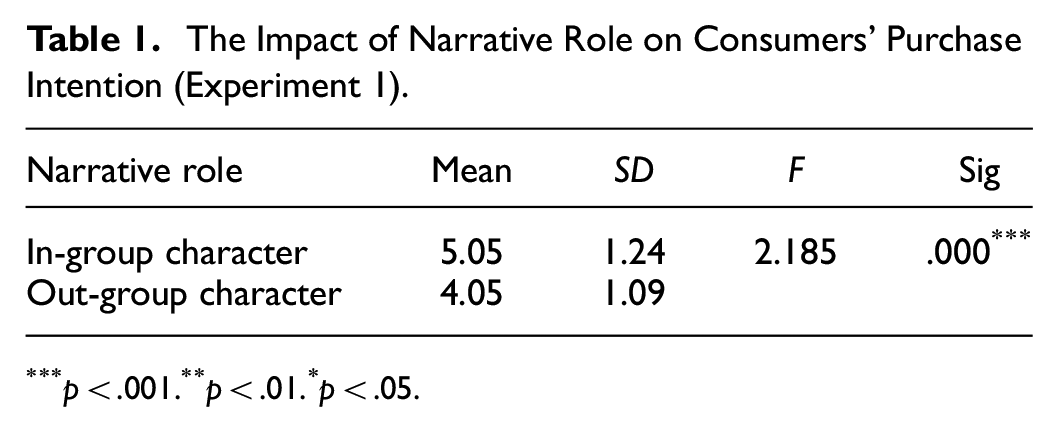
p < .001.**p < .01.*p < .05.
Experiment 2
The purpose of Experiment 2 is to examine the mediating roles of empathy and host identification in the relationship between narrative role (out-group character vs. in-group character) and consumer purchase intention.
Method
Materials
In order to enhance the external validity of the experiment, Experiment 2 used lilii bulbus, an agricultural product for assistance, and designed two new online live videos as experimental materials. In Video 1, the host narrated that she was Xiaoyun, the host of this agricultural product live stream (i.e., out-group character). In Video 2, the host explained that the agricultural products for assistance were from her hometown (i.e., in-group character). Except for the host’s narrative role, Video 1 and Video 2 were identical in terms of recording elements and editing methods (referring to Experiment 1), and the playing time was also controlled to about 1.5 min.
Manipulation Check of Narrative Role
Experiment 2 invited 30 participants to participate in the pre-test, using the same test method and design as Experiment 1. The results showed that the manipulation of the narrative role was successful (p < .01).
Participants and Procedure
Experiment 2 adopted a single-factor (narrative role: in-group character vs. out-group character) between-subjects design. Ninety participants were recruited on Questionnaire Star to participate in the experiment and were randomly assigned to two experimental groups. The experimental procedures and methods were identical to those of Experiment 1. A total of 90 questionnaires were distributed in Experiment 2, and 72 valid questionnaires were obtained after excluding invalid ones. Among the valid questionnaires, 50.0% were female (n = 36) and 50.0% were male (n = 36). Like Experiment 1, the participants were randomly assigned to two experimental groups, with 36 participants in the out-group and 36 participants in the in-group, and were required to start the experiment after watching the experimental video.
Questionnaire
The measurement of empathy drew mainly on the research of Bagozzi and Moore (1994) and Huang (2020), and combined with the live streaming scene, used the following six items to measure (Cronbach’s α = 0.975): I feel sympathy for the farmers in the live streaming; I can understand the sales difficulties of the farmers described in the live streaming; watching this live streaming, I seem to imagine the scene of lilies being unsold; I feel the same anxiety as the farmers for the unsold lilies; the live streaming wants to arouse my desire to help or protect the farmers. The measurement of host identification mainly drew on the research of Shamir et al. (1998), Liu et al. (2015), and Fan et al. (2021), and used the following three items to measure (Cronbach’s α = 0.935): My personality is similar to that of the host; the information conveyed by the host is useful to me; the values of the host are very similar to mine. The measurement scale of consumer purchase intention was the same as that of Experiment 1 (Cronbach’s α = 0.939).
Result
The results showed that the main effect of the host’s narrative role on consumer purchase intention was significant (F = 1.572, p < .01). Further analysis was conducted on the influence of different narrative roles (in-group character vs. out-group character) on consumer purchase intention. Using the host’s narrative role as the grouping variable (0 for in-group character and 1 for out-group character), and consumer purchase intention as the dependent variable, an independent sample t-test was used to verify the difference in the influence of the host’s narrative role on consumer purchase intention. The results showed (see Table 2) that compared with the out-group character, the in-group character of the host was more likely to trigger consumer purchase intention (M_in-group character = 5.27, M_out-group character = 3.72, p < .01), and Hypothesis 1 was effectively verified.
The Effect of Different Narrative Roles on Consumer Purchase Intention (Experiment 2).
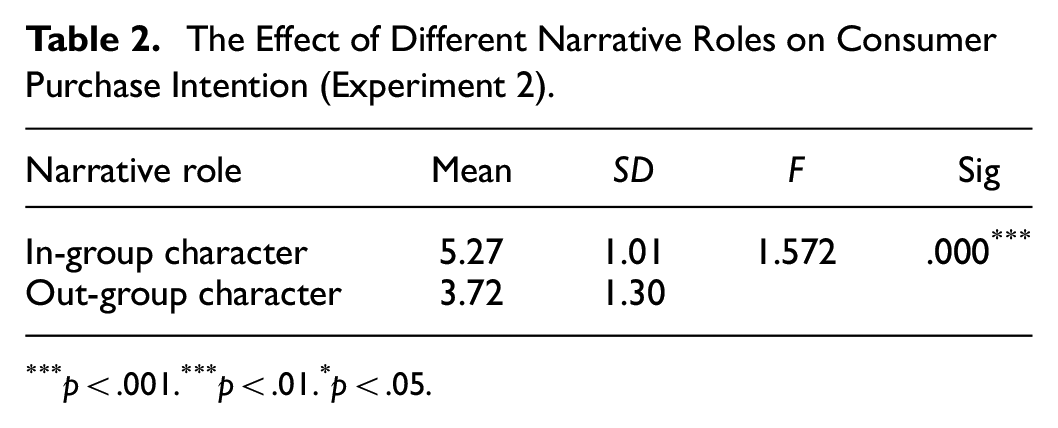
p < .001.***p < .01.*p < .05.
Based on the mediating effect analysis procedure proposed by R. Chen et al. (2013), the multiple parallel mediating variable test methods proposed by Preacher and Hayes (2008) and using bootstrapping in the process, the mediating effect of empathy and host identification was evaluated. A mediation analysis was performed using PROCESS (Model 4 with 5,000 iterations; Preacher and Hayes (2008) with narrative role as the independent variable, empathy and host identification as the mediators, and purchase intention as the dependent variable. Gender, age, and education level were included as covariates.
The co-mediation effect was significant (LLCI = −1.6682, ULCI = −0.8051), and the effect size was −1.1977. Of the two mediating pathways, empathy (LLCI = −1.3457, ULCI = −0.4412) and host identification (LLCI = −0.6558, ULCI = −0.0428) had significant mediating effects, with effect sizes of −0.8812 and −0.3165. These results show that H2 and H3 are all supported.
Experiment 3
The purpose of Experiment 3 is to examine the moderating role of spatial distance (distant vs. close) on the relationship between narrative role (in-group character vs. out-group character) and consumer purchase intention.
Method
Materials
In order to enhance external validity, Experiment 3 used honey as an agricultural product and designed four new online live videos as experimental materials. The manipulation of the narrative role was the same as in Experiment 1 and Experiment 2. Regarding the manipulation of spatial distance, referring to the studies by Trope and Liberman (2010), Zhejiang and Tibet, which are 3,000 km apart, were used as the manipulation conditions, and a virtual place name, “Linyao County,” was used as the place of origin of the agricultural product. Four host scripts were written according to the manipulation method of the above experimental content. In Video Material 1, the host explained to the consumer that this honey comes from Linyao County, my hometown in Tibet, which is 3,000 km away from Zhejiang (in-group character, distant); in Video Material 2, the honey comes from Linyao County, my hometown in Zhejiang (in-group character, close); in Video Material 3, the host introduces the honey as an ordinary host with only out-group character identity, and explains that the honey comes from Linyao County, Tibet, which is 3,000 km away from Zhejiang (out-group character, close); in Video Material 4, the host introduces the honey as an ordinary host with only out-group character identity, and explains that the product in this live streaming comes from Linyao County, Zhejiang (i.e., close). Except for the differences in narrative role and spatial distance, the remaining product information, recording elements, and editing methods of the four experimental materials were completely consistent (referencing Experiment 1), and the playing time was controlled to be around 1.5 min.
Manipulation Check of Narrative Role and Spatial Distance
Experiment 3 invited 60 Zhejiang subjects to participate in a pre-test, and the testing method and design of the narrative role were the same as in Experiment 1. The manipulation check results showed that the manipulation of the narrative role was successful. Regarding the manipulation of spatial distance, referring to the definition of distant spatial distance in previous literature, Tibet was used as the distant spatial distance, and Zhejiang was used as the close spatial distance. The manipulation of spatial distance was carried out in the host’s verbal content, by introducing the place of origin of the agricultural product (“Tibet” or “Zhejiang”) to manipulate the distance between them. The measurement scale was adapted from the scales of Freitas et al. (2008). After the subject watched the experimental video, they were asked to fill in the question “How distant do you think the place of origin of the agricultural product in this live streaming video is from you? Please rate the distance, and select the appropriate option on the Likert 7-point scale below based on your actual feeling.” 1 indicates “very close” and 7 indicates “very far.” Independent sample t-tests were used to process the data, and the results showed that (M Zhejiang = 1.67, M Tibet = 5.33, F = 6.717, p = .000 < .01), indicating a significant difference in spatial distance, and the manipulation was successful, proceeding to the formal experiment.
Participants and Procedure
Experiment 3 used a between-group experimental design with two factors, with the narrative role (in-group character vs. out-group character) and spatial distance (distant vs. close) as the factors. A total of 160 subjects were recruited on Wenjuanxing to participate in the experiment, and the subjects were randomly assigned to four experimental groups. The experimental process and method were completely similar to Experiment 1. A total of 121 valid questionnaires were obtained after invalid questionnaires were eliminated. In the valid questionnaires, there were 32 people in Group 1 (in-group character + close), 31 people in Group 2 (in-group character + distant), 25 people in Group 3 (out-group character + close), and 33 people in Group 4 (out-group character + distant). In Experiment 1, the subjects were asked to fill in the experimental questionnaire after watching the experimental video.
Questionnaire
The measurement scales for empathy (Cronbach’s α = 0.971), host identification (Cronbach’s α = 0.916), and purchase intention (Cronbach’s α = 0.910).
Result
Moderating Effect Test
The analysis results indicate a significant main effect of the narrative role of the anchor on consumers’ purchase intention (M_in-group character = 5.25, M_out-group character = 4.75, F = 0.228, p = .049 < .05). Further, a two-factor ANOVA was conducted to test the moderating role of spatial distance on purchase intention, with the narrative role (in-group character vs. out-group character) and spatial distance (distant vs. near) as independent variables. The results show that the effect of spatial distance on purchase intention is not significant (F = 0.249, p = .062 > .05), but the interaction between the two has a significant effect on purchase intention (F = 4.042, p = .047 < .05). To test the effect of different narrative roles on purchase intention under different spatial distances, independent sample t-tests were conducted for the data of the near and distant spatial distance groups, respectively. The data of both groups were grouped by the narrative role of the anchor (0 for in-group character and 1 for out-group character), and consumers’ purchase intention was used as the dependent variable. The results show that there is a significant difference in the effect of the narrative role of the anchor on consumers’ purchase intention. As shown in Figure 2, in the near spatial distance group, when the anchor’s narrative role is in-group character, consumers showed a higher purchase intention compared to when the anchor’s narrative role is out-group character (M_in-group character = 5.44, M_out-group character = 4.32, F = 3.228, p = .01 < .05). In the distant spatial distance group, there is no significant difference in the effect of the anchor’s narrative role on consumers’ purchase intention (M_in-group character = 5.03, M_out-group character = 4.99, F = 0.967, p = .904 > .05). This finding supports Hypothesis 1 and verifies Hypotheses 4a and 4b as well.
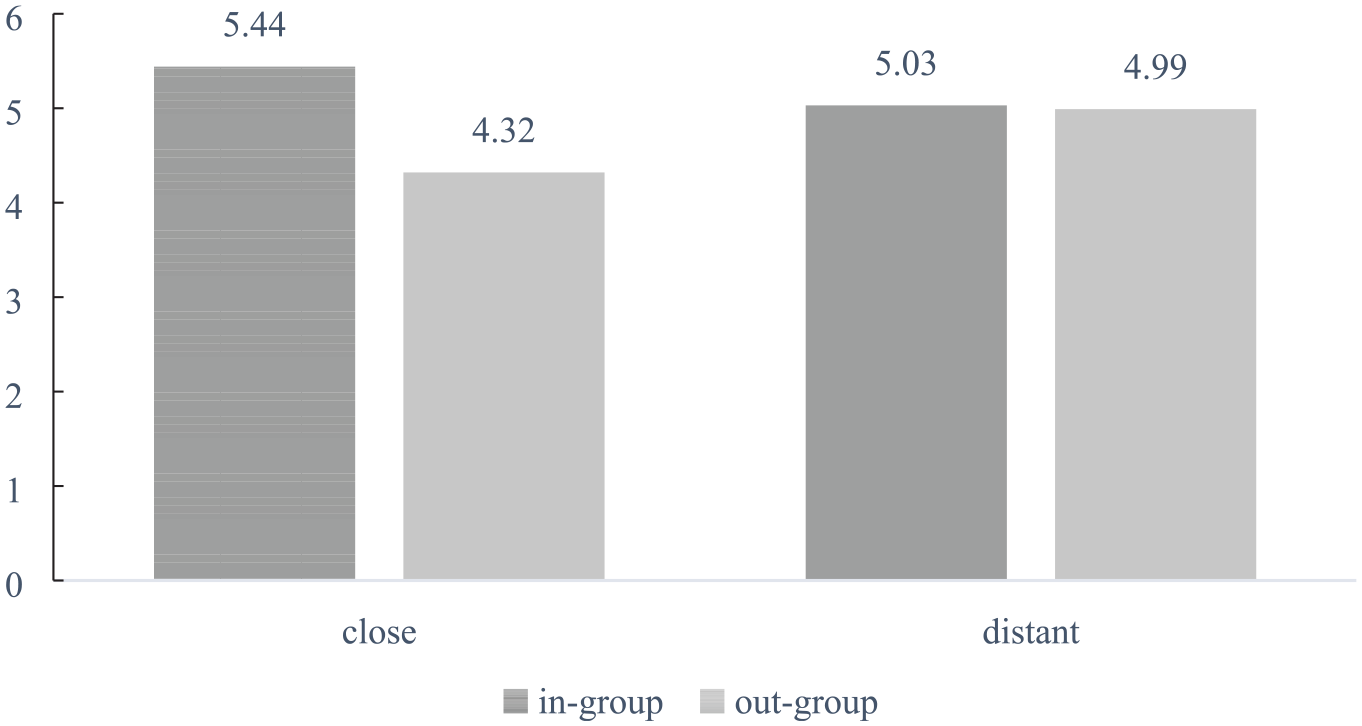
The results of purchase intention in experiment 3.
Mediation Analysis
Based on the mediation analysis procedure proposed by Zhao et al. (2010) and D. Li and Zhang (2018), the Bootstrap method in the Process plugin was used to test the mediating role of empathy and host identification. Narrative role (0 for in-group character, 1 for out-group character) was used as the independent variable, empathy and host identification were used as the mediator variables, and purchase intention was used as the dependent variable.
Refer to experiment 2 for the mediating effect test. The analysis results show that using process model 4, the sample size is 5,000. Under the 95% confidence interval, the co-mediation effect is significant (LLCI = −0.9474, ULCI = −0.0590), with an effect size of −0.4760. Of the two mediating pathways, empathy (LLCI = −0.6010, ULCI = −0.0140) and host identification (LLCI = −0.4628, ULCI = −0.0187) played significant mediating roles, with effect sizes of −0.2813 and −0.1947, respectively. Therefore, Hypotheses 2 and 3 were effectively validated again.
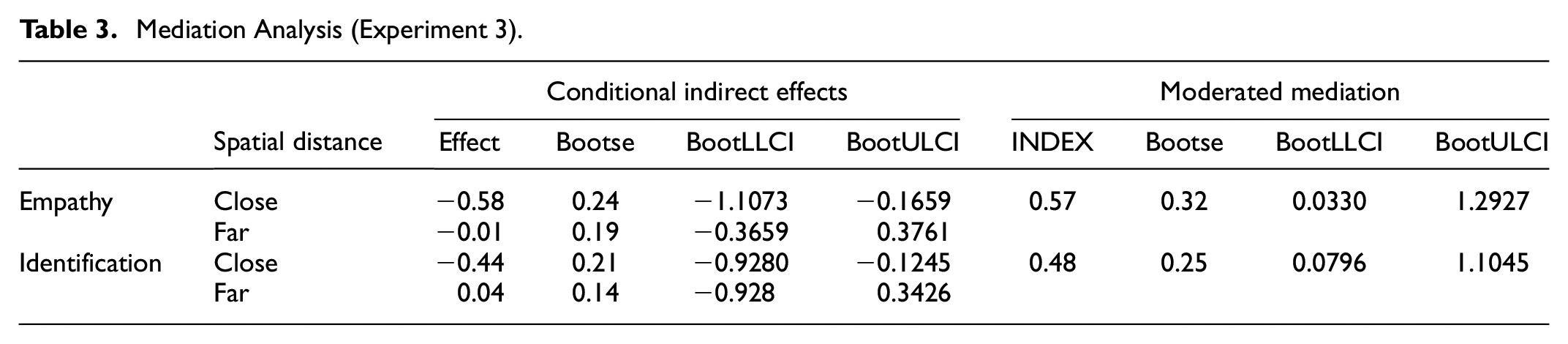
Further clarification is needed on the mediating effects of empathy and host identification at different spatial distances. Preacher et al. (2007) and D. Chen and Wang (2015) suggested that when a significant and an insignificant value of a moderating variable appear in the conditional indirect effect reported by Process, a moderating effect exists. Following the analysis procedures and parameter settings of D. Chen and Wang (2015) and D. Li and Zhang (2018), model 7 was selected for testing the moderated mediation effect. Narrative role (0 for in-group character, 1 for out-group character), empathy, and host identification were used as mediator variables, purchase intention was used as the dependent variable, and spatial distance (0 for close spatial distance, 1 for distant spatial distance) was used as the moderating variable. The results showed that the interaction between narrative role and spatial distance had a significant effect on empathy and host identification (p < .05) in Process Model 7 with a sample size of 5,000 and a 95% confidence interval. Table 3 shows that the mediating effect of empathy was −0.58 with a confidence interval of (LLCI = −1.1073, ULCI = −0.1659) and did not contain 0 when the spatial distance was close, while the confidence interval of empathy as a mediator contained 0 when the spatial distance was distant. The mediating effect of host identification was −0.44 with a confidence interval of (LLCI = −0.9280, ULCI = −0.1245), which did not contain 0 when the spatial distance was close, while the confidence interval of host identification as a mediator contained 0 when the spatial distance was distant. When the mediator was empathy, the index was 0.57, the boot SE was 0.32, and the confidence interval was (LLCI = 0.0330, ULCI = 1.2927). When the mediator was host identification, the index was 0.48, the boot SE was 0.25, and the confidence interval was (LLCI = 0.0796, ULCI = 1.1045). These results indicate that empathy and host identification played a mediating role in the effect of the narrative role on consumer purchase intention at different spatial distances, supporting Hypotheses 2 and 3.
Mediation Analysis (Experiment 3).
Discussion and Conclusion
Research Conclusions
This study draws the following conclusions: In the context of agricultural live streaming, compared with adopting an out-group character narrative role, adopting an in-group character narrative role is more likely to trigger consumers’ positive purchase intentions. When the host adopts an in-group character narrative role, consumers will use the host’s perspective to imagine and understand the content of the narrative, thereby triggering a positive intention to support agriculture. This finding is consistent with past work from the perspective taking literature showing that perspective taking differs when takes the perspective of from different groups (Gaesser & Schacter, 2014; Galinsky et al., 2005). The research shows that who disseminates a message plays a critical role in persuasion (Hamby et al., 2024). Empathy and host identification play a mediating role in the relationship between the host’s narrative role and consumers’ purchase intentions. Consumers adopt the host’s perspective, imagine or speculate the host’s intentions or views, generate identification and sympathy, and ultimately influence consumers’ purchase intentions for agricultural products. Our findings cohere with prior research showing that perspective taking leads to a series of consequences, such as empathy (Cialdini et al., 1997; Hoffman, 2001) and identification (Aguiar et al., 2008), and empathy is usually associated with prosocial behavior (Batson, 1987; Ding & Lu, 2016; Goldstein et al., 2014). When the spatial distance is close, compared with adopting an out-group character narrative role, adopting an in-group character narrative role is more likely to trigger consumers’ positive purchase intentions. When a spatially distant location, the host’s narrative role does not significantly influence consumers’ purchase intentions. Spatial discounting affects value evaluation, and consumers’ perception of the value of supporting agriculture events with distant spatial distances is often smaller than those with close spatial distances. The results of this study show that boundary conditions exist for the effect of perspective-taking, and spatial distance moderates the effect of narrative roles on consumers’ purchase intentions. The conclusions of Perrings and Hannon (2001) and others have been further verified in the context of agricultural live streaming.
Theoretical Contributions
First, this study provides new insights into the role of livestreaming platforms in stimulating consumer purchase intentions. This offers an innovative approach to poverty alleviation by harnessing the power of livestreaming platforms to promote agricultural product sales and improve farmers’ income. This study conducted a more in-depth theoretical exploration and empirical research on the key issue of the impact of consumers’ purchase intentions on poverty alleviation, which fills in the gaps in existing theories and further expands the research in the field of online marketing. Second, different from previous research, which only explored the persuasive effect of the narrative role from the perspective of the story narrator, this study focused on the persuasive effect of the narrative role from the perspective of the storyteller in the context of agricultural live streaming, enriching the narrative-related research in agricultural live streaming. Third, the theory of perspective taking in psychology was applied to the field of marketing and agriculture live streaming scenes, further expanding the application scope of the theory of perspective taking and providing a reference for follow-up research in agricultural live streaming, and promoting the research of relevant theories. Fourth, exploring the boundary effects of the theory of perspective taking, the study found that the persuasive effect of narrative, based on the theory of perspective taking, is different under the moderating role of spatial distance. This further expands the application boundaries of the theory and provides a reference and basis for subsequent research on relevant theories.
Management Implications
First, it is important to use the narrative role skillfully to stimulate consumers’ purchase intentions. For shopping live streaming platforms and hosts, consumers’ purchase intentions are an important source of income and will have an impact on the survival and development of shopping live streaming platforms to some extent. The host is the soul of agricultural live streaming, and the narrative runs through the entire process of live streaming, affecting the marketing effect of products. However, it is worth noting that a large number of hosts in agricultural live streaming come from poverty-stricken areas, and most of them are self-taught without professional and systematic skills training, have relatively simple narrative skills, lack design and innovation, and other characteristics. Therefore, based on bringing high-quality agricultural products to consumers, agricultural live streaming should choose scientific and clever narrative role design according to specific live streaming scene features and product characteristics, in order to optimize consumers’ emotional experience and social cognition, and stimulate consumers’ purchase intentions for supporting agriculture products.
Second, it is necessary to continuously enhance consumers’ empathy and host identification. In addition to the strategies adopted in the previous text, hosts in agricultural live streaming can also take various ways to continuously enhance consumers’ empathy and host identification, such as enhancing the host’s business ability, sharing and discussing experiences related to supporting agriculture with consumers, establishing a positive and active value system for hosts and strengthening the vividness and authenticity of story narrative, setting certain reward mechanisms, guiding consumers and hosts to interact in storytelling, etc. In the live streaming process, attention should also be paid to the simplicity and directness of the narrative content, avoiding using storytelling methods that are too difficult to understand and use popular and easy-to-understand stories that are more likely to be understood and accepted by consumers, generating emotional resonance and imaginative experiences, and thus making consumers more likely to help farmers and purchase supporting agriculture products.
Third, according to different spatial distances, reasonably choose the corresponding narrative role. For the live streaming platform, improve the user portrait to help consumers to carry out accurate marketing. For example, the use of different spatial distances for the live user’s sub-group portrait can improve the marketing effect. In practice, the anchor can be based on the data of the live background, for the audience group is located in the region, to develop the corresponding marketing strategy. For example, when consumers are mainly from various regions, the anchor can reduce the description of their own identity and also reduce the description of the specific geographical location, the narrative focus on product promotion, and other marketing strategies.
Limitations and Future Prospects
This study has the following limitations. Firstly, the factors affecting consumers’ purchase intention in the context of live-streaming for agricultural products are diverse, such as the public welfare nature of the agricultural aid activities, consumers’ preferences, personality traits, types and quality of agricultural products, and brand reputation. Ignoring the influence of these factors in the study may limit the generalizability of the conclusions. Secondly, the research design is limited. There may be discrepancies between the experimental materials and the real live-streaming scenarios, which may affect the generalizability of the experimental findings to real-world settings. Combining qualitative research will be more comprehensive. Thirdly, the research results are limited. Although purchase intention is a valuable predictor of purchase behavior, it is not always a reliable indicator of actual purchase behavior, as it can be influenced by other factors such as consumers’ purchasing power and cultural background. Therefore, future research should fully consider these issues and conduct more in-depth and systematic theoretical and empirical studies on live-streaming for agricultural products.
Footnotes
Acknowledgements
The authors thank the SAGE Open review team for their excellent guidance throughout the review process.
Declaration of Conflicting Interests
The author(s) declared no potential conflicts of interest with respect to the research, authorship, and/or publication of this article.
Funding
The author(s) disclosed receipt of the following financial support for the research, authorship, and/or publication of this article: The study was supported by the Major Humanities and Social Sciences Research Projects in Zhejiang higher education institutions, (Grant/Award Number: 2023QN125) and National Office for Philosophy and Social Science (Grant Numbers: 20AGL019) and General Planning project of Zhejiang Provincial Education Science Planning (Grant/Award Number: 2023SCG032) and research project achievements of Zhejiang Federation of Humanities and Social Sciences Circles (Grant/Award Number: 2024B067).
Ethical Approval
The study was conducted according to the guidelines of the Declaration of Helsinki, and approved by the Institutional Review Board of Hangzhou Vocational & Technical College. Informed consent was obtained from all survey subjects participating in this study.

Data Availability Statement
The raw data supporting the conclusions of this article will be made available by the authors upon request, with undue reservation.