



Abstract
Bullying in school has become a public health problem. Among the various bullying’s risk factors, the vulnerabilities associated with socio-emotional skills stand out. The present study aims to explore the relationship between bullying, victimization, self-concept, and empathy; to test differences in victimization and bullying between boys and girls; and to study predictors of victimization and bullying. Participated 107 adolescents from 12 to 17 years old characterized by multiple family, social, and economic vulnerabilities. Three measures were used to assess empathy, self-concept, and bullying/victimization experience. The results show a significant negative correlation between victimization and all dimensions of self-concept. Bullying is only associated to popularity. There is no association between empathy and bullying or victimization. Girls significantly experienced more victimization than boys. Boys performed more bullying than girls. Self-concept is a significant predictor of victimization and bullying. Results are discussed in light of the socio-emotional skills paradigm and its power in preventing bullying.
Introduction
Bullying and Social and Emotional Skills
UNICEF (2018) found that half of students (about 150 million) worldwide have experienced bullying, particularly during adolescence (Gonçalves et al., 2019; Midgett et al., 2015). Bullying compromises students’ learning and healthy interpersonal relationships; and is associated to depressive and anxiety symptoms, suicidal ideation and effective occurrence of suicide attempts in victims (Moore et al., 2017; Pimentel et al., 2020). These symptoms can often prevail in the victim, even after the end of aggressive behavior (Arseneault, 2017). In this sense, it is essential to explore the risk and protective factors that underly bullying. Several studies (e.g., Carney & Merrel, 2001; Gomes et al., 2020; Ruiz-Hernández et al., 2019) reveal that bullying is associated with individual, family and school risk factors. In terms of individual factors, impulsivity, social isolation and lower levels of empathy, self-esteem and self-concept stand out, as well as the belief in the effectiveness of aggression as a solution to solve problems (Del Rey et al., 2016; Gomes et al., 2020; Montero-Carretero et al., 2021; Zych, Baldry, et al., 2019). Bullying seems to be a global phenomenon, affecting both girls and boys. However, results of recent studies (Gomes et al., 2022; Sousa et al., 2021) reveal that aggressive behavior is more prevalent in males and in young people with low social skills; girls are more often the victims. Results from several studies are consistent (e.g., Espelage & Colbert, 2016; Zych & Llorent, 2018): young people involved in bullying has less emotional and social skills and more difficulties to interact in an appropriate and healthy way with their peers and respond adaptively to situations of greater vulnerability; and adolescents with multiple family and school vulnerabilities are more likely to display weaknesses in socio-emotional competences and bullying involvement.
Bullying, Self-Concept, and Empathy
Self-concept has been identified as a predictor of bullying (e. g., Soetikno & Arimurti, 2019). According to the literature (e.g., Donnellan et al., 2005; Trzesniewski et al., 2006), a low self-concept is a risk factor considering that adolescents with high devaluation and negative self-esteem are more likely to adopt disruptive practices or tend to isolate themselves more often. This evidence is in line with the study by Soetikno and Arimurti (2019), which demonstrated that the higher the self-concept of adolescents, the lower tendency to adopt aggressive behavior or to become involved in bullying; a high self-concept seems to be a protective factor against bullying.
Empathy has also been highlighted by several authors as one of the predictors of bullying (Del Rey et al., 2016; Montero-Carretero et al., 2021; Zych & Llorent, 2018; Zych, Ttofi, & Farrington, 2019). According to Pavarino et al. (2015), low levels of empathy are associated with difficulties in self-regulation and emotion management, which, in turn, can contribute to the adoption of aggressive behaviors. Literature (e.g., Jenkins et al., 2016) also reveals that bullies show low levels of empathy and that they tend to adopt manipulative behaviors towards victims. Del Rey at al. (2016) showed, in a sample of 564 adolescents, that higher levels of empathy, both in its cognitive and affective dimensions, negatively predict bullying. In addition, a meta-analysis developed by Zych, Ttofi, and Farrington (2019) highlights several studies that also identify that empathy is negatively associated with the perpetuation of bullying. Thus, is important to include empathy in predictive models that try to analyze the relationship between different variables to explain the occurrence of bullying in different populations (Del Rey et al., 2016; Zych, Ttofi, & Farrington, 2019). Therefore, the general objective of this exploratory study is to include socioemotional skills such as empathy and self-concept for a deeper understanding of bullying phenomena in vulnerable young people.
Method
Objectives
This study had the following specific objectives:
(1) To explore the relationship between bullying, victimization, self-concept and empathy.
(2) To test differences in victimization and bullying between boys and girls.
(3) To test the predictive power of self-concept and empathy on victimization and bullying behaviors.
Participants
This study was developed within the ACT Project, a socio-educational research and intervention project implemented in a Priority Educational Intervention Territory school with the aim of promoting school success and preventing early school drop-out, by implementing and reinforcing measures that favor equal access to education. The study included 107 participants (46.7% female) with a mean age of 14.07 years (SD = 1.46, range 12–17 years). Participants attended a high-risk public school in the northern of Portugal: 25 (23.3%) from 7th grade, 47 (43.8%) from 8th grade and 35 (32.7%) from 9th grade. Participants have multiple family, social, and economic vulnerabilities (e.g., poverty, drug addiction, prostitution, low school engagement). All the 7th, 8th, and 9th graders of ACT Project universe were involved.
Measures
Revised Olweus Bully/Victim Questionnaire (Olweus, 1996; adapted to Portuguese by Coelho & Sousa, 2018—short version)
Revised Olweus Bully/Victim Questionnaire is a self-report questionnaire with 20 items. This measure has two sub-scales: bullying (e.g., “I have set aside, ignored or excluded another student from activities”) and victimization (e.g., “They hit me, kicked me, assaulted me, pushed me violently”), that evaluate the frequency of bullying and victimization experienced in the last year. The Portuguese version of Revised Olweus Bully/Victim Questionnaire showed high overall internal consistency for the two subscales (Cronbach’s α = .82; and α = .79, respectively). Participants can choose from: 1—Didn’t happen to me; 2—Only once or twice a year; 3—Two to three times a month; 4—Once a week; 5—several times a week.
Basic Empathy Scale (BES-A; Jolliffe & Farrington, 2006; adapted for Portuguese by Pechorro et al., 2018—short version)
Basic Empathy Scale is a self-report measure with seven items that assesses two empathy dimensions in adolescents: affective empathy and cognitive empathy. Participants can respond in a 5 point-Likert scale, from I totally disagree to I totally agree. Portuguese version evidenced good psychometric properties: Alpha Cronbach = .80 for total scale; .71 and .80 for affective empathy and cognitive empathy, respectively in the Portuguese version.
Piers-Harris Children’s Self-Concept Scale (PHCSCS-2) (short version of Piers & Hertzberg, 2002; adapted for Portuguese by Veiga, 2006)
The PHCSCS-2 evaluates self-concept in six different dimensions: Behavioral Adjustment (BA) (e.g., “I am well behaved in school”), Intellectual and School Status (ISS) (e.g., “I am smart”), Physical Appearance and Attributes (PAA) (e.g., “I have nice hair”), Anxiety (AN) (e.g., “I am often afraid”), Popularity (PO) (e.g., “I have many friends”), and Happiness and Satisfaction (SF) (e.g., “I am cheerful”). Internal consistency values were satisfactory: Behavioral Adjustment, α = .74; Intellectual and School Status, α = .75; Physical Appearance and Attributes, α = .72; Anxiety, α = .62; Popularity, α = .70; Happiness and Satisfaction, α = .67; Total Scale, α = .85.
Data Collection Procedures
This study is part of a larger project “ACT.” Then, data collection procedure complied with legal and ethical requirements. In addition, the study obtained approval in the Scientific Council of the Faculty considering all ethical issues related to research with human subjects. Parents’ written consent was obtained. Students’ anonymity was assured by using codes for each participant. Data collection occurred in a collective way in the classroom.
Data Analysis Procedures
Data analysis was performed with IBM SPSS—Statistical Package for the Social Sciences—27.0 using Pearson correlation, t-test for independent samples, and Linear regression analysis for the different analysis.
Results
Relationship Among Victimization, Bullying, and Self-Concept
Victimization is negatively correlated with all self-concept subscales (see Table 1), which indicates that a higher positive level of perceived self-concept is associated with a lower victimization experience.
Correlation Between Victimization, Bullying, and Self-Concept.

*p < .05. **p < .01.
Regarding bullying behaviors, only popularity showed significant correlation (r = .27, p = .012), which reveals that a higher manifestation of bullying behaviors is associated with a higher level of popularity (see Table 1).
Relationship Among Victimization, Bullying, and Empathy
Both experienced victimization (r = .13, p = .170; r = .14, p = .168) and bullying behaviors (r = −.06, p = .547) (r = −.13, p = .194) are not significantly correlated with the affective empathy and cognitive empathy subscales (see Table 2).
Correlation Between Victimization, Bullying, and Empathy.

**p < .01.
Gender Differences in Victimization and Bullying
Results evidenced differences in the level of victimization between female students and male students [F(103.8) = 5.55, p = .032]—girls have a significantly higher level of victimization compared to boys.
Regarding the differences between boys and girls in bullying, there are significant differences between female and male students [F(101.8) = 12.13, p = .002]. In this sense, boys tend to perform more bullying behaviors when compared to girls (Table 3).
Differences in Victimization and Bullying According to Gender.

*p < .05; **p < .01.
Predictors of Victimization and Bullying Behaviors
The regression model indicated Satisfaction/Happiness as a negative predictor of victimization (Table 4). The model explained 36% of the variance in victimization experience [F(6, 60) = 7.23, p < .001].
Regression Analysis for Self-Concept Prediction of Victimization.

**p < .001.
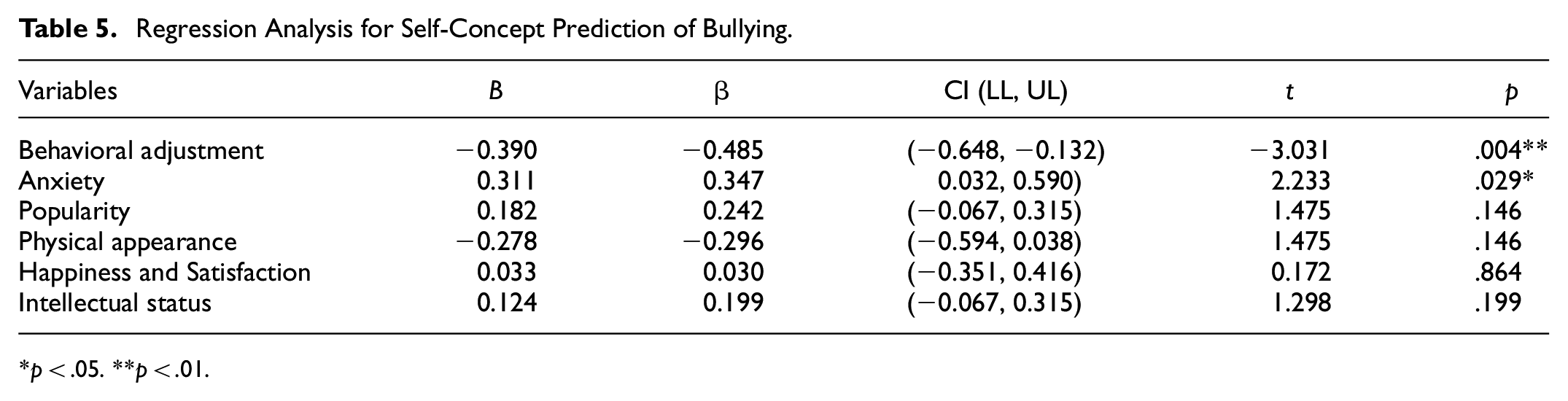
The predicting model of Bullying indicated Behavioral Adjustment and Anxiety (Table 5) as negative predictors of bullying. The low perceptions of behavioral and anxiety self-concept negatively predict the occurrence of bullying behaviors. This model only explain 14% of the bullying [F(6,58) = 2.72, p = .021).
Regression Analysis for Self-Concept Prediction of Bullying.
*p < .05. **p < .01.
Discussion
The present study provides an exploratory but comprehensive analysis of the association between bullying, victimization and self-concept and empathy in youth from vulnerable contexts. First of all, results showed that victimization is negatively correlated with self-concept. Thus, a high perception of self-concept is associated with a lower experience of victimization. Similar results were found by Marsh et al. (2001), which investigated the relationship among self-concept, aggression and victimization and confirmed that adolescents had simultaneously the condition of bullie and victim revealed an unfavorable self-concept. According to these authors, low self-concept can trigger and maintain aggressive behavior. In the same line of these findings, O’Moore and Kirkham (2001), in a sample of children and adolescents aged between 8 and 18 years old, concluded that both the bullies and victims had a lower perception of themselves than their peers who were not involved in bullying behaviors. These results highlight the self-concept as a protective factor regarding the perpetration of victimization behaviors.
Regarding bullying, only popularity is significantly correlated, which indicated that higher expression of bullying is associated with a higher level of popularity. This association between popularity and being a bully can be explained by control theory of Hawley (1999). Hawley proposes that bullying and prosocial behavior are two competitive strategies that share the same function—the acquisition of resources. However, prosocial rather than aggressive strategies help maintain bonds of friendship and promote access to resources in the future (Hawley, 2002, 2011). Thus, bullies have access to certain resources through aggression, among which may be the position of visibility and power within the social group, which corroborates the results obtained. Similarly, Garrett (2003) reports that bullies may have greater popularity, which facilitates group approval of aggressions and minimizes the risk of social punishment of peers. In addition, Garandeau et al. (2014) pointed out that the identification of bullies considered most popular is of great importance for three reasons: (1) bullies considered popular receive social rewards for their behavior; (2) bullying behavior is facilitated by a position of power in the peer group; and (3) bystanders are less motivated to intervene in bullying situations when it is initiated by more popular bullies.
Secondly, in the present study, results showed that the victimization and bullying behaviors do not correlate with affective empathy, nor with cognitive empathy. However, the empirical evidence is not in line with these results, since several investigations (e.g., Garaigordobil & Maganto, 2011; Sánchez-Queija et al., 2006) showed empathy as a strong predictor of positive social conduct, or prosocial behavior. At least, it would be expected a negative correlation between empathy and bullying behaviors. This unexpected result can be explained in several ways. First of all, this result can be explained for methodological reasons, since it was used a short version of the Basic Empathy Scale. Considering that the short version only includes seven items, it may not have been sensitive enough to assess such a complex skill as empathy.
In addition, it is also possible that these participants having already experienced various situations of mistreatment and abuse, have difficulty in activating empathy mechanisms to control bullying behavior or to solve situations of victimization. Probably, aggressive reactions to adversity, or accommodation to another experience of victimization are normalized and legitimized in the school context by these adolescents. Moreover, these young people may be perpetuating intergenerational cycles of abuse (e.g., Robboy & Anderson, 2011). However, this completely unexpected result should be considered with caution and demands more longitudinal research with vulnerable young people, in order to confirm this pattern, and if so, to deeply understand why empathy mechanisms seems are not activated in vulnerable youth.
Results also suggested that males are more involved in bullying, such as bullies, while females are more involved in bullying episodes, but as victims. Several studies (e.g., Craig et al., 2000; Haynie et al., 2001; Kim et al., 2004; Nansel et al., 2001; Seals & Young, 2003) found that the male is more involved in episodes of bullying, either as bullies or as victims, when compared to the female participants. However, Melim and Pereira (2013) concluded in a study with young people that boys are more involved in physical aggression than girls, which was confirmed by the results of the present study. Considering typical gender differences in violence patterns (e.g., Paim & Falcke, 2018; Sitnik-Warchulska & Izydorczyk, 2018), this result emphasizes the early established approach to gender differences in patterns of abuse.
Finally, the regression models showed that some dimensions of self-concept can predict the experience of bullying or victimization; the perception pf Happiness and Satisfaction seems to be a protective factor to victimization experience since high levels of Happiness and Satisfaction predicts low experience of victimization. In contrast, low perceptions of behavioral and anxiety self-concept predict the occurrence of bullying behaviors. These results are also in line with the study by Soetikno and Arimurti (2019)—the higher the self-concept of adolescents, the lower tendency to adopt aggressive behavior or to become involved in bullying. These results are particularly important in vulnerable youth whereas it identifies protective factors and risk factors that should be considered in the prevention of bullying. Although it seems that empathy mechanisms are not activated in vulnerable youth, promoting self-concept seems to be a way of controlling situations of bullying/victimization and an important channel for positive behavior.
Conclusions
Since empathy was not associated with bullying/victimization, empathy was not included in the regression model in the present study. Future studies should include different measures to evaluate adolescents’ empathy in order to better explore the relations between empathy and bullying in vulnerable youth populations.
Despite the relevant contributions of the present study, there are some limitations that should be considered. Since only self-report measures were used and considering the small and specific sample size, there are potential biases what could limit the generalizability of the findings.
The results highlight the importance of self-concept and the need to promote this socioemotional skills to contribute to bullying prevention. Therefore, several educational implications must be considered. First of all, the remedial approach to bullying should be replaced by a preventive and comprehensive approach that considers the results of scientific evidence. The identified protective factors should be seriously considered in this preventive approach, and in this sense, the promotion of socioemotional skills is the way most reinforced by literature to promote greater psychological well-being and prevent various maladaptive behaviors (e.g., Durlak et al., 2011). The promotion in schools of socio-emotional development as recommended by CASEL model (CASEL, 2020) and positive behavior as recommended by PBIS model (Algozzine et al., 2019) based on evidence should be reinforced. The implementation of programs to promote socioemotional skills, such as positive self-concept, should be universal. Specifically, this study reinforces the importance of a positive self-concept as the basis of healthy interpersonal relationships. In particular, the perception of happiness and satisfaction with life seems to trigger in young people a greater resilience that inhibits experiences of victimization. This study is part of a larger project which main objective is to promote school success and prevent early school dropout in young people with multiple vulnerabilities (e.g., unsupportive families, economic difficulties, drug trafficking, neighborhoods characterized by high violence, learning difficulties, and school failure). In these groups of young people, the prevention of bullying is even more critical, as is the urgent need to develop socio-emotional skills to be able to deal with adversities. The implementation of bullying prevention programs with young people with a history of mistreatment, abuse, poverty, or school failure must be even more tailored and careful. Parents and other educators should also understand the central role of self-concept and focus on its’ promotion. The approach of family intervention and the promotion of positive parenting should also be a way of curbing experiences of bullying/victimization based on parenting practices that are more supportive of adjusted psychological trajectories. Therefore, it is important to create structures for support families so that their vulnerabilities do not become a factor in maintaining the consequences of bullying.
Footnotes
Declaration of Conflicting Interests
The author(s) declared no potential conflicts of interest with respect to the research, authorship, and/or publication of this article.
Funding
The author(s) disclosed receipt of the following financial support for the research, authorship, and/or publication of this article: This publication was funded by Norte 2020 and Fundo Social Europeu (Grant number: NORTE-07-4740-FSE-000637).
Ethical Approval
The study was conducted after approval by Scientific Council of the Faculty of Education and Psychology—Catholic University of Portugal (ATA/CC-09/2020). Informed consent was obtained from all participants and students’ parents involved in the study.

Data Availability Statement
Data sharing not applicable to this article as no datasets were generated or analyzed during the current study.