




Abstract
The study aims were to define the psychometric properties of the Albanian Jefferson Scale of Empathy–Health Professional Students’ version, compare empathy levels among Albanian Health Professional students, and explore any relationship among students’ characteristics and their empathy levels. To achieve these aims, a comparative cross-sectional study was conducted. A preliminary exploratory factor analysis was conducted to determine the factor structure of the scale, while group comparisons of empathy scores were examined using t-test and ANOVA F-test. A total of 1,240 students were enrolled in the study. Psychometric properties of the scale were confirmed. Midwifery, physiotherapy, and female students showed higher levels of empathy than other groups. Similarly, third-year students showed higher empathy than first- and second-year students. Monitoring empathy levels is fundamental to the adoption of useful educational strategies by faculties to improve empathy skills in Health Professional students and guarantee better care of patients, especially those in need of psychological support.
Background
Empathy is a personality trait defined as the ability to understand the experience and point of view of others and connect with their feelings (Christov-Moore et al., 2014). Empathy is considered a cornerstone of health care professional–patient relationship and can lead to beneficial clinical outcomes (Del Canale et al., 2012; Derksen et al., 2013; Fields et al., 2011). In fact, communication based on high levels of empathy makes it possible for professionals to effectively respond to patients’ needs, with benefits for both health care professionals and patients (Howick et al., 2018). Furthermore, empathic relations seem to empower patients by improving their adherence to therapy and self-concept; they also reduce psychological distress, anxiety, and depression, and enhance the accuracy of a professional’s diagnoses (Del Canale et al., 2012; Derksen et al., 2013). Empathy includes cognitive, emotional, and behavioral components that can evolve during the Health Professional (HP) students’ educational path and be improved through specific training courses (Cunico et al., 2012; Levett-Jones et al., 2019; van Berkhout & Malouff, 2016). The promotion of HP students’ empathy levels during their undergraduate studies contributes to the graduation of students who can better respond to patients’ needs. However, due to the possible lack of positive role models, or negative experiences lived in the clinical learning environment, as well as the study workload, the risk of a decline in empathy levels is higher as HP students progress in their educational path (Ferri et al., 2015; Nunes et al., 2011). This aspect should therefore be taken into greater consideration by the educational institutions. Considering the relevance of empathy in health care settings, monitoring its levels among HP students would allow educational institutions to design study programs aimed at improving students’ empathy skills (Williams, Brown, Boyle, et al., 2014).
Much research on empathy has been conducted in the medical (Ferreira-Valente et al., 2017; Quince et al., 2016) and nursing fields (Bas-Sarmiento et al., 2019; Cunico et al., 2012; Ferri et al., 2019; Montanari et al., 2015; Yang et al., 2020). However, as regards other HP fields, little evidence is available (Petrucci et al., 2016; Williams, Brown, McKenna, et al., 2014), particularly about the use of the Jefferson Scale of Empathy–Health Professional Students’ version (JSE–HPS) (Hojat, 2007), making it difficult to use the findings for comparison at an international level. Comparing results from two studies aimed at confronting HP students’ empathy levels yielded substantial differences: in an Italian context, Nursing students showed a higher level of empathy when compared to other HP students (Petrucci et al., 2016), while in an Australian context, higher levels of empathy were found in Physiotherapy students (Williams, Brown, McKenna, et al., 2014).
Considering this contrasting evidence among countries across the world, and even though the importance of empathy in the health care context is widely recognized, a validated instrument to measure empathy levels among HP students and data on this topic are lacking in some emerging countries, such as Albania. In addition, the availability of evidence in this field could, on one hand, contribute to the international debate concerning empathy in HP students and, on the other hand, help Albanian academic institutions in choosing the best strategies to sustain students’ empathy levels. This study was conducted to fill these gaps; it answers the following research questions: (a) Is the JSE–HPS a reliable and psychometrically sound tool for the measurement of empathy levels in Albanian HP students? (b) Are there differences in the empathy levels of Albanian HP undergraduate students? (c) Is there a relationship among HP undergraduate students’ characteristics and their empathy levels?
Therefore, the study aims were to (a) define the psychometric properties of the Albanian Jefferson Scale of Empathy–HP Students’ version (JES–HPS); (b) compare empathy levels among Albanian HP undergraduate students; and (c) explore any relationship between HP undergraduate students’ characteristics and their empathy levels.
Method
Study Design and Setting
To achieve the aims of this research, a comparative cross-sectional study was conducted in an Albanian University that offers some HP courses at the undergraduate level, namely, Nursing Science, Midwifery, Physiotherapy, Speech Therapy, Technicians of Imaging, and Biomedical Laboratory Technicians. According to Albanian law and the Bologna Process, these courses take 3 years to complete, and their curricula offer theoretical courses and clinical practice experience mainly in teaching hospitals (Minister of Education, 2016/2017). Every year, in the above-mentioned courses, approximately 550 HP students get matriculated.
Population and Sampling
All students in their first, second, or third year of any of the HP undergraduate courses were considered eligible, and all of them who gave their consent to participate were enrolled. Considering that a preliminary validation analysis of the tool used to measure empathy was essential to carry out sound comparisons, an adequate sample size was required. In accordance with Pett and colleagues, a minimum of 10 to 15 students for each item of the JSE–HPS were considered appropriate (Pett et al., 2003). However, to obtain excellent sample adequacy for the validation process of the JSE–HPS Albanian version, a minimum of 1,000 participants was expected (Comrey & Lee, 1992).
Variables
The empathy levels of the HP students were evaluated. Socio-demographic data were also collected: gender (female/male), age (years), course of study (Nursing, Midwifery, Physiotherapy, Speech Therapy, Technicians of Imaging, and Biomedical Laboratory Technicians), year of study (first, second, third), upper-secondary diploma grade (from 5 to 10), has a pet (yes/no), and has volunteered in a health care field in the past year (yes/no).
Instruments and Procedures
The students’ empathy levels were measured using the Albanian version of the JSE–HPS which comprises twenty 7-point Likert-type items (1 = strongly disagree to 7 = strongly agree). Permission to use the JSE–HPS was obtained from the Center for Research in Medical Education and Health Care of the Jefferson Medical College of Thomas Jefferson University, USA. Preliminarily, a cross-cultural adaptation process was undertaken according to Beaton’s guidelines (Beaton et al., 2000) to ensure the attainment of semantic, idiomatic, experiential, and conceptual equivalence between the original JSE–HPS and its Albanian versions. In the first step of the validation process, two translators with different backgrounds (a psychology researcher and a physician) independently undertook a forward translation. The two Albanian versions were compared and discussed with the contribution of an English lecturer and were synthesized in a commonly accepted version (Sousa & Rojjanasrirat, 2011). To check this accepted version’s validity, a blinded back translation into the original language was undertaken by an English mother-tongue teacher (Beaton et al., 2000; Gjersing et al., 2010). The final version of the tool was tested in a pilot study involving 30 HP students to probe the understandability and meaning of each item. Afterwards, in a conclusive audit involving the researchers and a group of students, the understandability, pertinence, and face and content validity of the Albanian version were confirmed.
The final score of the instrument, like the original version, ranged from a minimum of 20 to a maximum of 140 points. The higher the score obtained, the greater the empathic level of each student. No cut-off scores were established (Fields et al., 2011; Hojat, 2007).
Data Collection
Before data collection, a researcher briefed the students on the aims of the study, the content of the scale, and the modalities to ensure correct completion of the socio-demographic tool. Before the students’ participation, their informed consent was obtained. Data collection took place in a dedicated room on two scheduled days. At the time of data collection, the first-year students had no clinical experience and were novices in the health care context. The second- and third-year students, on their part, had already gained 6 to 12 weeks of clinical experience during their academic year. The questionnaires were collected immediately after they were filled out to ensure the confidentiality of the data.
Bias
To minimize selection bias, all the students enrolled in the undergraduate courses were deemed eligible. Also, information bias was minimized through a cross-cultural adaptation of the JSE–HPS (Beaton et al., 2000) that was completed with a pilot test of the measurement instrument.
Statistical Analyses
Descriptive data analysis was performed to document the sample characteristics. Student’s t-test, ANOVA, and Tukey’s post hoc tests were used to compare the continuous variables, after the normal distribution was explored with the Kolmogorov–Smirnov test. Correlation analyses were performed using the Pearson coefficient (r) test.
According to the JSE–HPS guidelines for data analysis (Hojat et al., 2001), only the participants who had completed at least 16 items (80%) were considered for the analyses, and the missing values (max 4) were replaced with the mean score of the completed items. The total score (level of empathy) was computed as the sum of all the items.
The item–total score correlations were calculated to examine correlations between each item score and the total score of the JSE–HPS. The overall internal consistency of the JSE–HPS, as well as the internal consistency after removal of each item, was evaluated by Cronbach’s alpha (α) coefficient (Pett et al., 2003). The internal consistency of each factor extracted was also explored.
After exploring the sampling adequacy with the Kaiser–Meyer–Olkin (KMO) test (adequate if > 0.30) and the sphericity (exploring if the intercorrelation matrix was factorable) with Bartlett’s test (adequate if p < .05), exploratory factor analysis (EFA) of the data using an Oblimin rotation was performed. The scree plot test was conducted to identify the number of factors to retain before rotation (eigenvalues > 1). However, to make the findings comparable to the previously reported results, three fixed factors were extracted in accordance with the original JSE–HPS theoretical framework (Hojat & LaNoue, 2014). Loading coefficients ≥ 0.40 were considered for the interpretation of the factor structure (Tavakol et al., 2011). Data were analyzed using the IBM SPSS software version 19.0 (IBM Corp., Armonk, NY, USA).
Ethics Approval and Consent to Participate
This study complied with current ethical considerations, since the research conformed to the provisions of the Declaration of Helsinki. In accordance with the local law, the study was approved by the Internal Committee of the University of Elbasan (No. 1883/2018). Students voluntarily participated after being informed that their participation would not affect their academic pathway. Furthermore, the confidentiality of collected data was guaranteed. All participants provided written informed consent.
Results
Participants
Overall, 1,240 out of 1,630 eligible students (Table 1) completed the questionnaire, showing a response rate of 76.1%. Participants were mainly females (82.1%) and had a mean age of 19.3 (SD = 1.2) years (median = 19.0; IQR = 2). Nursing and Midwifery were the courses with the highest number of students (33.4% and 19.8%, respectively). Most students enrolled in this study were in the first year (40.5%), and the average of upper-secondary school grades was 7.3 out of 10 (SD = 0.9). About 53.5% of the participants had a pet and 36.3% had volunteered in the health care field in the past year.
Participants’ Characteristics.

Missing data.
Psychometric Properties of the JSE–HPS
Extraction of the principal components with Oblimin rotation was used to explore the factor structure of the Albanian version of the JSE–HPS scale (Table 2). The required criteria for performing EFA were met (KMO = 0.81; Bartlett’s test p < .001). The eigenvalues for the three retained factors before rotation were 3.56, 1.49, and 1.38 (Figure 1), accounting for 17.80, 7.44, and 6.90% of the total variance, respectively (Table 2). Therefore, the three factors extracted, namely, “compassionate care,” “standing in the patient’s shoes,” and “perspective taking,” showed a cumulative variance of 32.1%. Items No. 9 “Health care providers should try to stand in their patients’ shoes when providing care to them,” No. 17 “Health care providers should try to think like their patients to render better care,” and No. 19 “I do not enjoy reading non-medical literature or the arts” did not reach the 0.40 cut-off, but, in any case, they assumed a value >0.3. The internal consistency of the JSE–HPS was satisfactory, since Cronbach’s alpha (α) coefficient was .728, while α with each item removed ranged from .693 to .737. The α related to “compassionate care,” “standing in the patient’s shoes,” and “perspective taking” was .728, .372, and .428, respectively.
Rotated Factor Loadings and Item Statistics.

Note. Factor 1 = compassionate care; Factor 2 = standing in patient’s shoes; Factor 3 = perspective taking. Values in bold = Loading coefficients ≥ 0.40.
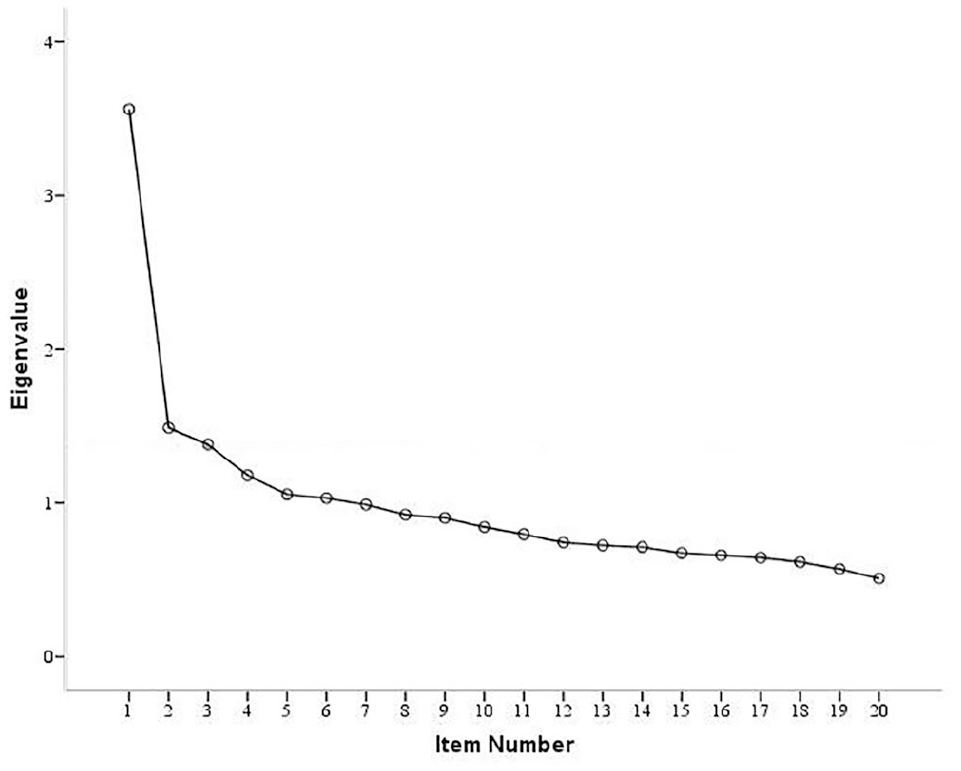
Scree plot resulting from the exploratory factor analysis.
The item-total score correlation were all positive, ranging from r = .070 for the item “Because people are different, it is difficult to see things from patients” perspectives’ to r = .435 for the item “I believe that emotions have no place in the treatment of medical illness.”
Empathy Levels in Albanian Health Professional Students
Table 3 shows that the empathy levels of HP students ranged between 65.0 and 140.0, with a mean value of 105.6 (SD = 12.8) and a median of 106.0 (IQR = 18). Female students showed a significantly higher level of empathy (p < .001) compared with males. Significant differences also emerged among the investigated courses (p < .001), showing that Midwifery and Physiotherapy students had higher levels of empathy than other students (p < .001), and third-year students had stronger empathy than their first- and second-year colleagues (p < .001). Finally, having a pet and having volunteered in a health care field in the past year were not associated with empathy (p = .238 and p = .136, respectively), and age and upper-secondary school diploma grade did not correlate with empathy (r = .009, p = .765 and r = .047, p = .102, respectively).
Participants’ Empathy Levels.

t-test. bANOVA F-test.
Table 4 shows levels of empathy stratified based on both gender and course of study. The same table also shows the levels of students’ empathy classified by year of study. Only for the females’ empathy levels stratified by course of study could post hoc analysis be performed (Table 5).
Participants’ Empathy Levels: Data Stratified by Gender, Course, and Academic Year.
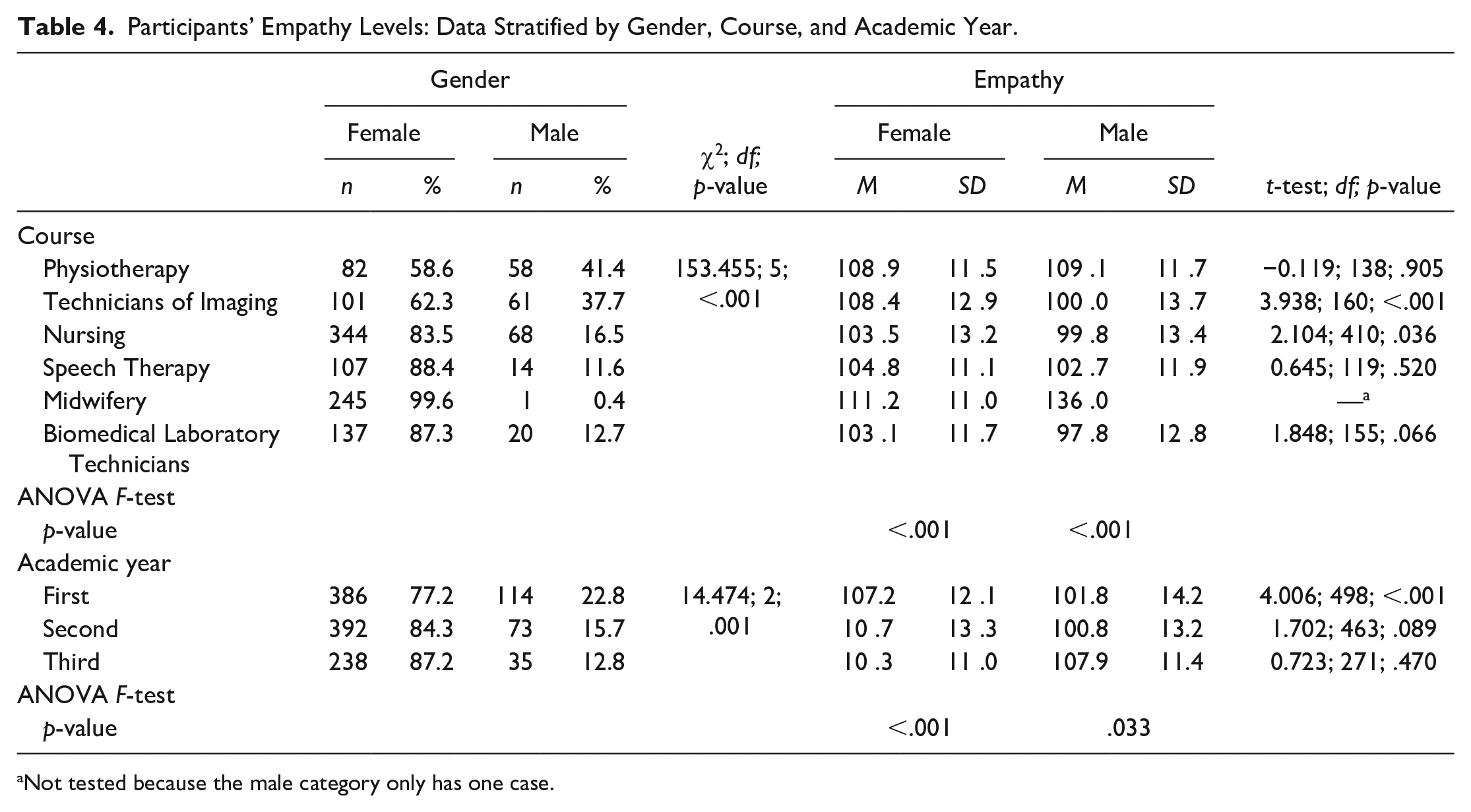
Not tested because the male category only has one case.
Tukey’s Post Hoc Test on the Mean Empathy Level of Female Students.

Discussion
Participants
This study is the first conducted on a large sample of HP students in an emerging country such as Albania. Efforts undertaken to maximize the response rate ensured that nonresponse bias did not affect the reliability and validity of the findings of this study (Draugalis et al., 2008; Fincham, 2008). The gender distribution and mean age of the participants were similar to the overall population of HP students in Albania (Minister of Education, 2016/2017), and the data reflected the traditional gender division in health professions (Shannon et al., 2019), which, apart from medicine and dentistry, are historically female-dominated (Kantrowitz-Gordon et al., 2014; Litosseliti & Leadbeater, 2013).
Psychometric Properties of the Albanian JSE–HPS
This study was also conducted to make a psychometrically sound instrument available to measure empathy in Albanian HP students. Similar to other contexts (Montanari et al., 2015; Paro et al., 2012), the EFA of the Albanian scale showed an inverted factor structure when compared with the original tool (Hojat, 2007). However, the conceptual framework and the construct validity of the instrument remained consistent with the multidimensional framework of empathy. Interestingly, the highest level of variance detected for “compassionate care,” which, differently from the original scale, was identified as the first factor in the Albanian JSE–HPS version, is probably justified by the different bioethical and cultural perspectives of Albanian and U.S. students regarding the health professional–patient relationship (Hojat, 2007). These perspectives could also explain the low-factor loading (<0.40) obtained in Item No. 9 “Health care providers should try to stand in their patients’ shoes when providing care to them” and No. 17 “Health care providers should try to think like their patients to render better care.” These items, together with Item No. 19 “I do not enjoy reading non-medical literature or the arts,” could be excluded from the Albanian version of the scale. However, in accordance with Hojat and LaNoue (2014), to guarantee cross-cultural equivalence and not compromise the psychometric structure of the tool, the use of the translated 20-item scale is recommended. The reliability measures revealed in the Albanian instrument were close to those of other authors (Fields et al., 2011; Montanari et al., 2015; Ward et al., 2009). In addition, all the item–total correlations were positive, showing that all items contributed positively to the total score of the instrument (Hojat, 2016). Therefore, in response to the first research question, the results confirmed that the JSE–HPS is a reliable and psychometrically sound tool for the measurement of empathy levels in HP students. Consequently, it can be used in Albanian health care education settings.
Empathy Levels in Albanian Health Professional Students
The lack of prior research on empathy levels of Albanian HP students makes it difficult to benchmark the results. However, the overall level of empathy detected in this study was similar to those documented in other international contexts (Petrucci et al., 2016; Williams, Brown, Boyle, et al., 2014). In this study, a significant relationship between female gender and empathy levels was detected. Midwifery and Physiotherapy students showed significantly higher levels of empathy than other students, while third-year students reported higher levels of empathy than their first- and second-year colleagues. The differences in empathy levels between the genders reflect the findings of previous research (Ferri et al., 2019; Hsiao et al., 2013; Montanari et al., 2015; Petrucci et al., 2016; Williams, Brown, Boyle, et al., 2014). According to some authors (Christov-Moore et al., 2014), the traditional and evolutionary role of women in the society, the higher level of empathy detected in female students, and their orientation to choose a typically female-dominated course (Shannon et al., 2019) are probably due to the innate predisposition of females to care. However, taking into account disaggregated data such as gender within courses, the highest levels of empathy were shown in Physiotherapy (109.1) and Midwifery (136.0) male students, so, in this case, the female proportion did not seem to affect the average empathy levels. Moreover, considering only the female part of the sample, the post hoc analysis showed that Midwifery, Physiotherapy and Technicians of Imaging students had the highest levels of empathy compared to their colleagues in Speech Therapy, Nursing, and Biomedical Laboratory Technicians.
Midwifery and Physiotherapy students showed average higher levels of empathy when compared to other HP students (Williams, Brown, Boyle, et al., 2014), and this result, as explained above, did not depend on gender composition of the courses. In any case, this result is in contrast with other studies in which higher levels of empathy were found in Nursing students (Nunes et al., 2011; Petrucci et al., 2016).
It is widely accepted that empathy plays a pivotal role in the relationship between HPs and patients, as it creates a non-defensive climate for patients to express their health needs and HPs to be understanding, provide comfort, support, and adequate care (Williams, Brown, Boyle, et al., 2014). For all these reasons, some authors affirm that it is necessary to improve the empathy levels of Nursing students over time through the adoption of adequate educational strategies and promotion of positive attitudes, effective communication styles, and behaviors that can make nursing care effective and holistic (Ferri et al., 2019; Williams, Brown, McKenna, et al., 2014). More generally, incorporating the development of empathic skills in HP curricula is needed to achieve higher levels of empathy and exhibit empathic behaviors appropriately (Cunico et al., 2012; Levett-Jones et al., 2019; Yang et al., 2020).
Even though some authors reported a decline in empathy levels in students as they progress through their studies (Nunes et al., 2011; Ward et al., 2012), a higher level of empathy in third-year students was found in this study, in accordance with other authors (Williams, Brown, Boyle, et al., 2014), making it possible to hypothesize that the level of empathy could improve over time, although a minor mean level of empathy for all second-year students was detected.
In this study, considering aggregated data referring to each year of study, the proportion of female students increased over the 3 years, in contrast to that of male students, which decreased; also, the average level of empathy of the female students was higher compared to that of the male students, even though there was no statistical difference between the two groups except for the first year. In any case, to better understand how HP students’ empathy levels change over time, longitudinal studies are needed.
Limitations
This is the first study to include a large sample of HP students in an emerging country, such as Albania, and even if this ensured that reliable results were obtained, some limits were detected. In this regard, since the study was based on a monocentric approach, generalization of the results should be done cautiously. Furthermore, considering that empathy is not a stable personality trait and can change over time through educational interventions, this cross-sectional approach did not allow detecting its evolution over time. Future research can overcome such limitation through longitudinal study designs. In addition, the low availability of similar studies did not allow making deep comparisons with other international contexts; thus, worldwide collaborations should be considered in the future. Finally, to confirm the reported factor structure of the Albanian JSE–HPS, confirmatory factor analysis is needed. In this regard, further studies involving other Albanian HP students should be undertaken.
Conclusion
The results of this study show that the Albanian version of the JSE–HPS is a reliable and psychometrically sound tool for the measurement of empathy levels. The psychometric differences detected could be influenced by the different bioethical and cultural perspectives about health care professional–patient relationship between Albanian and U.S. students.
With regard to the different levels of empathy detected in students of different courses, further investigations are required to make explanatory and deep comparison about the higher levels of empathy reported by Midwifery and Physiotherapy students. The innate predisposition of women to care could be a pull-factor to matriculate into academic HP courses, which are typically female-dominated. Finally, longitudinal studies are necessary to document the change in empathy levels among HP students over time, and further investigations are needed to provide a valid conceptual framework for all HP students.
Considering that empathy is the cornerstone of the relationship between health care professionals and patients, understanding its evolution along academic paths could allow universities implement better strategies to improve and sustain empathy levels among students.
Footnotes
Acknowledgements
The authors would like to thank the Albanian University of Elbasan for approving this study and all the Albanian students who participated in this study for sharing their personal experiences.
Declaration of Conflicting Interests
The author(s) declared no potential conflicts of interest with respect to the research, authorship, and/or publication of this article.
Funding
The author(s) disclosed receipt of the following financial support for the research, authorship, and/or publication of this article: This study was supported by the RIA Funds (Research and Innovation Action), Department of Life, Health, and Environmental Sciences, University of L’Aquila, 2018.
Research Data
The datasets used and/or analyzed during the current study are available from the corresponding author on reasonable request.
Ethics Approval and Consent to Participate
The study complied with current ethical considerations, since the research conformed to the provisions of the Declaration of Helsinki. In accordance with the local law, the study was approved by the Internal Committee of the University of Elbasan–Albania (No. 1883/2018). Students voluntarily participated after being informed that their participation would not affect their academic pathway. Furthermore, the confidentiality of collected data was guaranteed. All participants provided written informed consent.
