



Abstract
Film music plays a pivotal role in shaping audience emotions and perceptions, often functioning as a subtle yet powerful persuasive tool. This study examines the influence of music and silence on emotional and moral responses to the 2019 film Joker. Thirty Turkish Cypriot participants who had not previously seen the film were observed during viewing and interviewed afterward in semi-structured sessions. Using a qualitative design, the study combined observational cues with participant reflections to explore how musical elements and silence influenced empathy and moral judgment toward the protagonist, Arthur Fleck. Findings show that recurring cello motifs amplified emotional alignment with Arthur and, in some cases, contributed to viewers’ justification of his actions. In contrast, scenes without music disrupted this alignment, evoking discomfort and re-evaluation of earlier sympathy. These results underscore film music’s persuasive function in modulating emotional engagement and moral interpretation. The study offers insights into how music and silence can shape audience attitudes toward morally ambiguous characters, highlighting the emotional mechanisms at play in cinematic storytelling.
Introduction
Film music and purposeful silence do more than color emotion; they steer attention, empathy, and—crucially—moral judgment. While prior work robustly links music to affect, its role in moral alignment has been less explicitly theorized, particularly across distinct cultural contexts (Boltz et al., 1991; Hoeckner et al., 2011; Kulezic-Wilson, 2009; Tan et al., 2017).
Film music significantly shapes audience emotions, perceptions, and overall narrative immersion. Beyond merely complementing visuals, music actively guides cognitive processing, frames viewers’ experiences, and evokes deep emotional reactions, often persisting beyond viewing and influencing audience attitudes toward characters and storylines (Allen, 2017; Baranowski & Hecht, 2016; Bezdek & Gerrig, 2008; Boltz, 2001; Meinel & Bullerjahn, 2022). Research has demonstrated music’s substantial effects on emotional and psychophysiological responses, especially within genres characterized by intense emotional dynamics such as horror or drama (Ellis & Simons, 2005; Keller & Talarczyk, 2021; Vitouch, 2001).
The film Joker (2019) offers a strong test case: salient musical cues, striking silences, and ethically charged violence. Existing research often treats affect and ethics in parallel; fewer accounts show how music/silence modulate moral justification in real audiences. This study addresses that gap by examining viewers’ judgments in response to Joker’s music–violence interplay (Scarf et al., 2020; Shine, 2024).
Despite extensive research on music’s capacity to influence mood, attention, and memory (Ellis & Simons, 2005; Steffens, 2018), its persuasive potential in relation to morally complex characters remains underexplored. The 2019 film Joker, a critically acclaimed portrayal of a morally ambiguous protagonist, Arthur Fleck, offers an exceptional case for examining how musical scoring and silence can shape empathy and moral alignment. Previous studies of this film primarily explored its representation of mental illness and the associated risks of narrative framing (Poulgrain et al., 2022; Scarf et al., 2020), yet the role of music and auditory elements in influencing viewers’ ethical judgments has received limited attention.
Turkish Cypriot audiences represent a relatively collectivist milieu with shared memories of political conflict. Such cultural frames plausibly mediate emotional contagion and narrative transportation, shaping how music and silence are read in ethically charged scenes. Treating Northern Cyprus as a cultural case allows us to examine persuasion as context-dependent rather than universal (Markus & Kitayama, 1991; Mohatt et al., 2014; Nisbett et al., 2001).
This qualitative study investigates how film music and deliberate silence affect emotional and ethical responses toward Arthur Fleck in Joker. Through direct observation and post-viewing interviews with Turkish Cypriot participants unfamiliar with the film, the study explores the emotional trajectories created by musical cues and examines how silence disrupts or reinforces moral engagement. The research aims to illuminate music’s persuasive power to elicit empathy for morally ambiguous characters, thus contributing to a deeper understanding of film music’s role in narrative persuasion and ethical interpretation.
Recent scholarship across media psychology and music cognition shows that audio—especially film music—can shape emotional alignment, moral judgment, and story-consistent belief change by drawing audiences into narrative worlds and modulating affective cues (Herget, 2019; Herget & Albrecht, 2021). Building on narrative transportation research (Green & Brock, 2000), work on music as an affective and interpretive resource in film (Boltz, 2001; Cohen, 2001), and multi-mechanism accounts of how music induces emotion (Juslin & Västfjäll, 2008), this study examines how Joker’s sound design and musical score influence viewers’ empathy for Arthur Fleck and their moral interpretations of his actions (Hackley, 2012; Ngong, 2020). The film has also sparked debate about representations of mental illness and violence, underscoring the need to understand audience responses within specific cultural contexts (Beus, 2023; Madhona & Yenny, 2022; Poulgrain et al., 2022; Skryabin, 2021).
Accordingly, this study (i) theorizes silence alongside narrative transportation and emotional contagion to explain moral alignment, (ii) empirically examines audience responses through interviews and in-situ observations, and (iii) treats culture as a moderator by using a Turkish Cypriot case to test contextual dependency (Green & Brock, 2000; Hatfield et al., 1993; Juslin & Västfjäll, 2008; Ross, 2023; van Laer et al., 2014). In light of these cultural and theoretical considerations, this study examines how film music and silence shape moral alignment in Joker (2019). The analysis is structured around three interrelated lines of inquiry:
how music fosters empathy and identification with Arthur Fleck,
how silence disrupts narrative immersion and prompts ethical reflection, and
how these mechanisms generate conflicted moral responses in viewers.
The next section reviews scholarship on film music, silence, and audience persuasion to situate these questions
Theoretical Framework
This study is guided by two intersecting theoretical perspectives: Narrative Transportation Theory and Emotional Contagion in Film Music. Narrative Transportation Theory, as proposed by Green and Brock (2000), posits that individuals can become deeply immersed in a narrative world, resulting in emotional and attitudinal shifts aligned with the story’s characters and events. This immersive state—referred to as transportation—can increase identification with protagonists and reduce critical distance, allowing morally questionable actions to be viewed sympathetically. In cinematic contexts, transportation is often enhanced by audiovisual elements such as music, which supports emotional immersion and continuity. In the context of Joker, narrative transportation is intensified through the film’s close character study and emotional score. As viewers become immersed in Arthur’s world, musical cues help dissolve the boundary between viewer and character. This creates space for audiences to emotionally rationalize his actions, even as they grow more violent—particularly in scenes where music emphasizes isolation, rejection, or transformation (Green & Brock, 2000; van Laer et al., 2014).
To complement this narrative lens, the study also draws on the concept of emotional contagion in music psychology. According to Juslin and Västfjäll (2008), emotional contagion occurs when audiences perceive and internalize the emotions expressed through music, leading them to mirror those feelings. In film, this means that a melancholic or tense score can induce similar emotions in the viewer, guiding their interpretation of scenes and characters. Film music thus becomes a powerful emotional mediator, particularly in shaping viewer empathy toward morally complex figures. The cello’s emotive qualities mirror Arthur’s inner state, creating a shared emotional rhythm between character and viewer. This emotional contagion fosters empathy, especially in scenes where Arthur is victimized. Conversely, the deliberate absence of music during cold-blooded murders interrupts this alignment, causing viewers to reassess their emotional connection (Kulezic-Wilson, 2009). This oscillation between empathy and discomfort reflects the persuasive role of music as an emotional bridge—or barrier (Hatfield et al., 1993; Juslin & Västfjäll, 2008).
Alongside these mechanisms, silence should also be considered part of the persuasive framework. Chion (1993) and Kulezic-Wilson (2009) emphasize that silence is never a neutral absence but a marked sonic event that reframes perception. In persuasive contexts, silence can interrupt immersion and provoke ethical reflection, operating as a form of moral interruption. Wheatley (2009) shows how Michael Haneke’s Funny Games deploys sonic restraint to implicate audiences in the spectacle of violence, while Segura (2023) conceptualizes audiovisual silence as a lever for narrative change and moral recalibration. Within this study, we define moral interruption as the moment when sonic absence disrupts empathic alignment and prompts renewed ethical appraisal, and conflicted empathy as the oscillation between resonance with a character and subsequent moral rejection of that alignment, often accompanied by guilt or discomfort (Chion, 1993; Kulezic-Wilson, 2009; Segura, 2023; Wheatley, 2009).
Taken together, narrative transportation, emotional contagion, and silence as moral interruption provide a lens for understanding how viewers may both feel with Arthur and adopt story-consistent moral perspectives, while also being prompted into conflicted empathy and ethical reappraisal (Green & Brock, 2000; Hatfield et al., 1993; Juslin & Västfjäll, 2008)
Together, these frameworks provide a lens to understand how viewers may come to empathize with Arthur Fleck in Joker, despite his acts of violence. Music, particularly the recurring use of cello, acts as an emotional bridge between character and viewer, reinforcing narrative transportation and emotional alignment. Conversely, the absence of music in key scenes introduces emotional rupture, breaking this alignment and prompting viewers to re-evaluate their moral judgments.
Finally, both transportation and contagion are mediated by cultural context. In collectivist cultures such as Cyprus, audience responses are shaped not only by individual emotion but also by shared cultural narratives and collective memory of conflict (Markus & Kitayama, 1991; Mohatt et al., 2014; Nisbett et al., 2001)
Literature Review
Film Music and Moral Alignment
Film music has long been recognized as central to shaping audience perception and emotional engagement. It not only amplifies affective intensity and highlights narrative cues (Cohen, 2010; Tan et al., 2017), but also frames how viewers interpret character motivations and actions (Boltz, 2001). Beyond intensification, music facilitates narrative transportation and emotional contagion, drawing audiences into characters’ perspectives and reducing critical distance (Green & Brock, 2000; Juslin & Västfjäll, 2008). Collectively, these studies underscore the persuasive potential of music, establishing it as a key mechanism through which films influence moral alignment.
While music often functions as an emotional driver, its absence can be equally persuasive, redirecting attention and inviting ethical reflection. This duality requires closer examination of silence as an auditory strategy before turning to combined persuasion mechanisms.
Recent studies have explored the intricate relationship between music and human emotions, underscoring its multifaceted influence. Experimental research shows how subtle musical variations can shape perception and affective response: tempo changes significantly alter emotional content (Gomez & Danuser, 2007), while structural features provide systematic links to perceived emotion (Schubert, 2004). Neuroscience adds further insight, with Koelsch (2018) highlighting the hippocampus in music-induced emotional processing. Complementary work distinguishes between perceived and felt emotions (Kallinen & Ravaja, 2006; Kawakami et al., 2013), revealing how musical structures can trigger different modes of experience. Large-scale studies confirm consensus around music’s emotional impact while noting ongoing debate about its phenomenological nature (Hunter et al., 2010; Zentner et al., 2008). Collectively, this body of work highlights the complex mechanisms through which music evokes and modulates emotion, providing a foundation for understanding how film music may align audience empathy and moral judgment (Gabrielsson, 2001; Yinger & Springer, 2018)
Recent studies have continued to explore the intricate relationship between music and human emotions. For example, Gomez and Danuser (2007) investigates the impact of tempo variations on listeners’ emotional responses, revealing that subtle changes in tempo can significantly influence the perceived emotional content of music (Gomez & Danuser, 2007). This research sheds light on the nuanced ways in which music can evoke emotions. Furthermore, Schubert (2004) produces the first comprehensive series of publications that attempted a systematic explanation of the relationship between musical features and perceived emotion (Schubert, 2004). Koelsch (2018) highlights the role of neuroscience studies in highlighting the hippocampus’s role in music-induced emotional processing (Koelsch, 2018). Moreover, Hunter et al. (2010) emphasizes the agreement among scholars regarding the emotional responses to music, while acknowledging the ongoing debate surrounding the phenomenological nature of the link between music and emotion (Hunter et al., 2010). These studies collectively underscore the multifaceted and influential role of music in evoking and shaping human emotions, contributing to a deeper understanding of the complex interplay between music and emotional experiences (Chong et al., 2013; Yinger & Springer, 2018).
Other studies have delved into the intricate relationship between music and human emotions, shedding light on the multifaceted nature of music’s influence (Gabrielsson, 2001; Kallinen & Ravaja, 2006; Kawakami et al., 2013; Schubert, 2004; Zentner et al., 2008). For instance, Kallinen and Ravaja (2006) emphasized the need to consider underlying mechanisms in understanding emotional responses to music, highlighting the potential for music to evoke emotions through mechanisms that are not unique to music. Additionally, Kallinen and Ravaja (2006) discussed the distinction and relationships between the perceived emotional quality of music and the emotions music arouses in the listener, providing insights into the perceived and felt emotions related to music (Kallinen & Ravaja, 2006). Furthermore, Kawakami et al. (2013) investigated perceived emotion and felt emotion to determine whether musical structures contribute to the difference between these two types of musical emotion, offering valuable insights into the relationship between musical structures and perceived and felt emotions. These studies collectively underscore the multifaceted and influential role of music in evoking and shaping human emotions, contributing to a deeper understanding of the complex interplay between music and emotional experiences (Kawakami et al., 2013).
Beyond shaping emotional responses, research also highlights film music’s persuasive potential in guiding audience evaluations of characters and actions. This suggests that music functions not only as affective trigger but as a tool for moral alignment, preparing the ground for this study’s focus.
Silence as Auditory Absence
Silence in cinema functions not as mere absence but as an auditory sign that shapes attention, expectation, and ethical evaluation. In morally charged sequences, silence can serve as a moral interruption, suspending narrative momentum and inviting reappraisal of a character’s actions. We treat silence as a semiotic resource that interacts with musical cues, sometimes amplifying, sometimes challenging affective alignment (Chion, 1993; Kulezic-Wilson, 2009; Ross, 2023).
Persuasion Mechanisms: Transportation × Contagion
We synthesize narrative transportation (immersion that increases receptivity to story-consistent judgments) with emotional contagion (music-induced affect transfer) as complementary mechanisms for moral alignment. Music can heighten transportation while seeding specific affective tones; silence can interrupt or recalibrate these processes by punctuating attention and inviting reflective appraisal. This integrated lens clarifies how viewers may come to justify or question on-screen violence (Green & Brock, 2000; Hatfield et al., 1993; Juslin & Västfjäll, 2008; Stilwell, 2007; van Laer et al., 2014)
Joker Scholarship and Critical Reception
Scholarship and critical reception of Joker highlight the film’s charged uses of music and silence in scenes of humiliation and retaliation, as well as debates around empathy for a violent protagonist. Prior analyses emphasize sonic framing and tonal contrast; fewer examine audience moral alignment empirically in relation to these sonic choices. Our study addresses this gap (Shine, 2024). While Joker has garnered significant critical attention, most existing scholarship centers on narrative, identity, or psychopathology rather than audience moral alignment via music and silence. For instance, Howell (2021) analyzes how Joker uses music and dance to perform masculinity, while Shine’s “Musical Moments, Dance and Corporeality in Joker (2019)” argues that the score and dance enact Arthur’s internal metamorphosis, fostering identification through corporeal engagement. Skryabin (2021) interrogates Joker’s psychiatric framing, and Redmond (2021) situates the film within contemporary critical reception. Yet these works rarely empirically examine how music and silence influence moral judgment in audiences (Howell, 2021; Redmond, 2021; Shine, 2024; Skyrabin, 2021).
Cultural Mediation of Audience Response
Cross-cultural research indicates that collectivist values and cultural memory/trauma can shape empathy and tolerance for on-screen violence. We therefore treat culture as a mediating frame in how music and silence guide moral judgment, using the Turkish Cypriot case to illuminate context-dependent persuasion rather than universal effects (Markus & Kitayama, 1991; Mohatt et al., 2014; Nisbett et al., 2001).
Case Study: Joker (2019)
The film “Joker,” directed by Todd Phillips and released in 2019, serves as an exceptional case study for investigating the persuasive power of film music. This dark and psychologically intense narrative revolves around the transformation of Arthur Fleck into the Joker, one of the most iconic supervillains in popular culture (Phillips, 2019). What sets “Joker” apart as a prime candidate for this study is its deliberate and strategic use of music to act as a powerful rhetorical device, capable of evoking emotions and shaping audience perceptions.
The film’s score, composed by Hildur Guðnadóttir, plays a pivotal role in crafting the emotional landscape of the narrative (Guðnadóttir, 2019). It strategically employs music to intensify the emotional experiences of the audience, drawing them into the psyche of the protagonist, Arthur Fleck, and guiding their emotional responses throughout the film. The music in “Joker” is not merely a background accompaniment but a persuasive tool that shapes viewers’ perceptions and emotional engagement with the story.
As Arthur Fleck descends into madness and chaos, the film’s music mirrors his emotional turmoil, creating a powerful and immersive experience for the audience. Through a combination of haunting melodies, dissonant chords, and sparse arrangements, the film’s score heightens tension, elicits empathy, and induces a sense of unease, all of which contribute to the overall persuasive impact of the narrative.
In the context of this study, “Joker” provides a compelling example of how film music can be employed strategically to evoke specific emotions and influence audience attitudes, making it an ideal case study for exploring the persuasive power of music in cinema.
Methodology
The present study has been conducted through qualitative methodology. The qualitative researcher’s objective is to study participants’ understanding of their social reality (Creswell, 2002). Qualitative methodology is holistic. Holistic research is favorable when the components of a complex system are understood in relation to each other and hence forming the whole (Marshall, 2002). The present study is a case study of Turkish Cypriot participants’ reaction to the music and silence in the award-winning film Joker (2019). In the present study, the case is constructed around the educated, adult participants who live in North Cyprus and who are fluent in English language and who have not watched the film Joker (2019) before participating in the present study. A qualitative design was chosen because it allows exploration of participants’ nuanced emotions, empathy, and cultural mediation processes that would not be accessible through quantitative measures.
We recruited 30 adult Turkish Cypriot participants (N = 30) using purposive sampling (Etikan et al., 2016) to capture educated adults who were fluent in English and had not previously viewed Joker. Participants all held at least an undergraduate degree (completed or in progress at the senior level) and resided in Northern Cyprus at the time of data collection in 2022 to 2023. This defined, information-rich sample allowed us to explore nuanced emotional and moral responses that required articulate verbal reflection, consistent with qualitative sampling guidance for theoretically driven case studies. The study focused on Turkish Cypriot participants to examine how cultural context mediates moral responses to Joker. While this homogeneity may limit generalizability, it also provides insight into how collectivist values and a society shaped by historical conflict respond to cinematic portrayals of violence (Markus & Kitayama, 1991; Mohatt et al., 2014).
The data is collected through observation and semi-structured interviews. The participants’ identities and interview content were anonymized for ethical reasons, and all interview questions were designed to avoid ethically sensitive or potentially harmful topics. The quotations used in this article have been approved by the participants. A detailed explanation of the research is given at the beginning of the experiment. The participants are asked to watch the film in a comfortable setting accompanied with the researcher who observed them while watching. Just after watching the participants are interviewed. The study is done entirely voluntarily. The first author, a Turkish Cypriot researcher, observed all sessions. Cultural familiarity facilitated rapport and participant comfort but also required reflexive awareness of potential bias. To address this, the study employed a structured observation protocol and independent coding checks to ensure analytical rigor
The first part of the study is observing while the participants watch the film. The observation is conducted via a map of the scenes for the observer to review throughout the observation. The map of scenes is created by analyzing the use of Hildur Guðnadóttir’s originally composed music in the film Joker. A detailed scene map was developed prior to data collection to guide the observational process (see Supplemental Appendix 3). This map included key scenes selected for their emotional or narrative intensity—such as the subway murders, Arthur’s dance, and the Murray show climax—along with corresponding timestamps and notes on musical structure (e.g., crescendos, silence, or transitions). The musical cues were identified in advance to anticipate where emotional or moral shifts might occur. During each scene, the researcher noted participant behaviors such as posture changes, facial expressions, or other signs of engagement or discomfort. This structured approach helped ensure consistent observation across participants and facilitated the subsequent thematic analysis by linking observed reactions to specific audiovisual stimuli in the film.
For this study, the scenes are selected according to their pivotal movements to create empathy and the anger to the character for the audience. The second part of the data collection is a semi-structured interview. There are initially written questions about the mapped scenes, but there may also be questions regarding the participant’s answers. The interviews were audio-recorded with the informed consent of the participants, who were assured that the recordings would remain confidential and accessible only to the authors. After the interviews, the interviews were transcribed and analyzed by the first author. This study uses human participants as its primary subjects to collect data; therefore, ethical approval was required. Approval for this study was obtained from a research ethics committee (details withheld for review).
After completing the interviews, we employed a thematic analysis approach to systematically interpret the data. To enhance analytical rigor, the authors independently coded a subset of transcripts and compared results, resolving discrepancies through discussion until agreement was reached. This process ensured inter-rater consistency and minimized subjectivity in coding. Initially, the interview transcripts were reviewed and manually color-coded to highlight recurring patterns, including emotional responses, moral evaluations, and references to musical or sonic elements. This coding process allowed for the identification of potential thematic categories, which were refined through repeated engagement with the data. To ensure analytical rigor, these emergent themes were cross-referenced with observational data collected during the film screening sessions. This triangulation allowed us to assess the consistency of participants’ verbal responses with their observed emotional reactions and behaviors. Through this iterative process, we developed a coherent set of themes that captured the intersections between music, emotion, and moral judgment in the context of the film.
Results
This section presents the qualitative findings based on participant observations and in-depth interviews following the viewing of Joker (2019). Each theme reflects convergence between interview accounts and observational notes, ensuring that participants’ reported experiences were corroborated by visible audience responses wherever possible. Through thematic analysis, four major themes emerged that illustrate how film music and silence shaped the emotional and moral responses of the audience. These themes are: (a) music as an emotional bridge, (b) silence as moral interruption, (c) justifying violence through sound, and (d) conflicted empathy and realization. The following themes emerged through thematic analysis, grounded in recurring participant experiences across key scenes of Joker (2019). A summary of these themes and a visual distribution of their related scenes are presented below.
Table 1 summarizes participant coverage across the four analytic themes derived from interview and observation data (N = 30). Conflicted Empathy & Realization was nearly universal (n = 28; 93.33%), with participants describing post-viewing swings between compassion for Arthur and moral recoil once his violent acts accumulated across the narrative arc (Conflicted Empathy and Realization). Themes often overlapped within the same participant accounts. For example, descriptions coded under Music as an Emotional Bridge frequently co-occurred with justifications of Arthur’s violence, while Silence as Moral Interruption commonly appeared alongside conflicted empathy. This pattern illustrates how musical presence and absence interacted dynamically to shape moral evaluation. Music as an Emotional Bridge was also widely evident (n = 25; 83.33%): the score—especially the low, insistent cello textures tied to the bathroom and “staircase” sequences—helped viewers inhabit Arthur’s interior affect rather than remain detached observers (Music as an Emotional Bridge). Comments from roughly two-thirds of participants (n = 19; 63.33%) indicated Silence as Moral Interruption; abrupt drops or thinning of music during moments such as the subway-shooting aftermath or the Murray show lead-in jarred identification and opened space for moral appraisal (Silence as Moral Interruption). Finally, a majority (n = 17; 56.67%) articulated Justifying Violence Through Sound, noting that musical build, mix, or song choice could render violent acts—particularly the subway killings and studio shooting—cathartic, earned, or even inevitable (Justifying Violence Through Sound). Because participants often referenced more than one theme, row totals exceed 30.
Thematic Summary of Audience Reactions to Film Music and Silence.

Figure 1 visually illustrates the distribution of key emotionally significant scenes across the four emergent themes identified through thematic analysis (Rosenfeld & Steffens, 2019). It demonstrates the relationship between musical and silent segments and their corresponding thematic interpretations. Scenes characterized by powerful musical scoring prominently contribute to themes such as “Music as an Emotional Bridge” and “Justifying Violence Through Sound,” emphasizing empathy and catharsis. In contrast, scenes deliberately lacking musical accompaniment align primarily with “Silence as Moral Interruption,” highlighting moments of moral interruption and emotional detachment. The interconnected representation underscores the dynamic interplay of auditory presence and absence in shaping viewers’ emotional and moral responses throughout the film.

Distribution of emotionally significant scenes across emergent themes.
Notably, 93.33% of participants reported conflicted empathy, a near-universal finding that underscores the potency of music–silence interplay. This unusually high proportion indicates that while thematic diversity existed, the tendency toward moral conflict was a dominant audience experience requiring further theoretical consideration.
As participants progressed through key scenes in Joker (2019), their emotional alignment with the protagonist followed a distinct trajectory. This progression is visualized in Figure 2, which maps the rise and fall of empathy across the film’s pivotal moments. Emotional alignment steadily increased during scenes accompanied by music—reaching its peak during the Subway Murders & Dance sequence. However, following the transition to silence beginning with the Mother’s Murder scene, a sharp emotional drop occurred. This shift, marked by a disruption in auditory immersion, led to reported feelings of discomfort, moral confusion, and detachment. The pattern supports the emerging theme that silence in the film acts as a moral interruption, causing audiences to reassess their identification with the character and the ethical framing of his actions
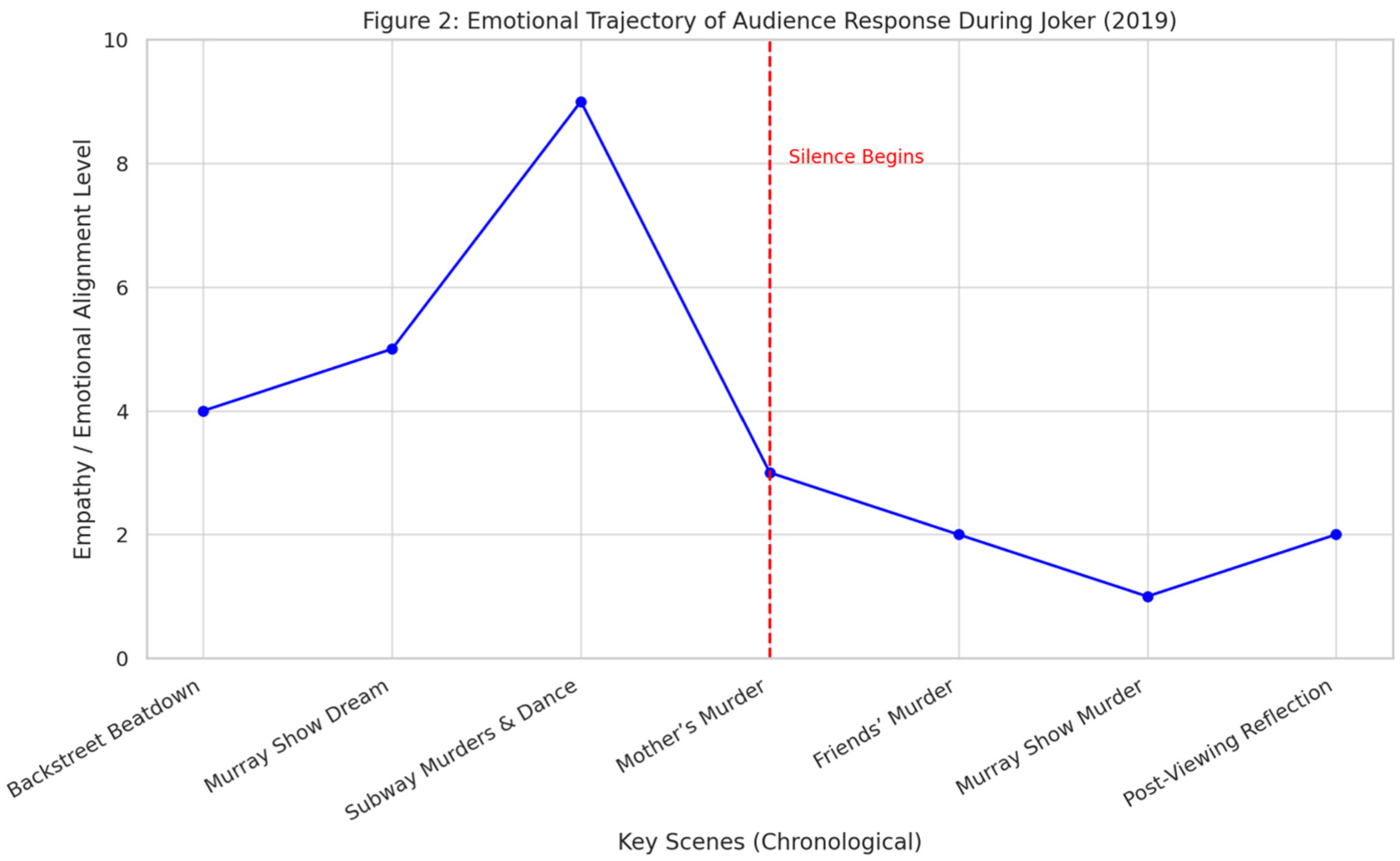
Emotional trajectory of audience response during Joker (2019).
Music as an Emotional Bridge
Participants consistently described the film’s original score—particularly the haunting cello-based compositions—as a key emotional guide that facilitated a deep connection with Arthur Fleck’s internal world (Pannese et al., 2016). The music served as an interpretive lens, allowing viewers to feel as though they understood his emotional state and struggles, even when his actions were morally ambiguous. The results are divided into two sections: observations and interviews. Several participants stated that the music increased their emotional proximity to the character, creating a sense of shared vulnerability. One participant explained:
Even when he was doing bad things, the music made me feel like I knew why. It made it feel… justifie”, Another viewer expressed a similar response: “I di’,t expect to feel this sorry for him, but the music really pulled me in. It was like I was feeling what he felt.
These accounts highlight how the soundtrack supported a process of narrative transportation, in which the audience became absorbed in Arthur’s perspective. The emotional contagion produced by the music not only reinforced identification but also softened moral judgment, guiding the viewer toward a more sympathetic stance. Observational notes supported these accounts: several viewers leaned forward, nodded, or displayed heightened attention during the bathroom dance sequence, suggesting that the sense of connection described in interviews was also embodied in their viewing behavior. Observation Note:
During scenes where the score intensified—particularly Arthur’s staircase dance—participants often leaned forward or nodded subtly in rhythm. This physical engagement suggested heightened emotional immersion, aligning with the verbal expressions of empowerment.
Silence as Moral Interruption
In contrast to the emotional alignment created by the score, deliberate moments of silence functioned as emotional and moral interruptions. Participants frequently noted that scenes without music—particularly those depicting acts of violence—created discomfort and unease. The absence of musical framing removed the emotional buffer, exposing viewers to the stark reality of Arthur’s actions. One participant described this experience: “When there was no music, it felt too real. Like I couldn’t hide behind anything. It made me feel guilty for sympathizing with him before.” Another remarked: “The silence made everything worse. It was like I had to watch without being told what to feel”. These responses demonstrate how silence disrupted the immersive experience that music had previously created. Without auditory cues to guide interpretation, participants were left to confront their own emotional and ethical reactions. This rupture challenged their earlier empathy and led to a more critical reassessment of Arthur’s behavior. Observation Note:
In several instances of sudden silence, observers noted visible discomfort: participants would cross their arms, shift in their seats, or glance around the room. These subtle gestures mirrored the emotional tension later verbalized in interviews.
While silence frequently disrupted alignment, participants noted variation in intensity. For example, the subway murder silence was described as “disturbing” and forced a pause in empathy, whereas in quieter transitional scenes silence was perceived as atmosphere rather than moral interruption. This indicates that silence acted most powerfully when juxtaposed with violence or intense emotional cues. Cross-theme analysis revealed frequent co-occurrence: 70% of participants whose accounts referenced empathy also simultaneously engaged with justification codes, and 65% linked silence with conflicted empathy. These overlaps highlight the interconnectedness of thematic processes rather than isolated responses.
Justifying Violence Through Sound
A recurring theme in participant responses was the way music shaped the moral framing of Arthur’s violent actions. While the acts themselves were often disturbing, the musical accompaniment appeared to influence the degree to which they were seen as justifiable or understandable. Participants described how the score, particularly during scenes of transformation or retaliation, created a sense of catharsis rather than condemnation. One participant reflected: “When the music swelled right after he fought back, it felt powerful, not wrong. Like he finally stood up for himse.” Another participant noted the contrast between the character’s prior victimization and the musical build-up accompanying his violent acts: “Because we heard the music during his pain, the violence later didn’t feel shocking—it felt like the next step.”
These interpretations suggest that the score played a persuasive role, not only in generating empathy but also in smoothing the transition from sympathy to moral tolerance. The emotive resonance of the soundtrack, paired with Arthur’s suffering, blurred the boundaries between emotional release and moral judgment. In several cases, participants appeared to rationalize or even support Arthur’s actions within the narrative context shaped by the music. Observation Note:
When violent acts were accompanied by music, participants appeared more still and attentive, often maintaining direct visual focus on the screen. However, during unscored violent scenes, a few looked away or displayed microexpressions of discomfort.
Conflicted Empathy and Realization
While many participants reported feeling empathy and moral alignment during the film, a number of them also experienced discomfort or guilt afterward. This theme emerged particularly in discussions about how music and silence shifted their emotional boundaries. Some participants expressed surprise at their own reactions, stating that they felt “tricked” or manipulated into supporting a character they would normally condemn. One participant explained: “I was shocked by how much I liked him. But later I thought—wait, why did I feel that way? He killed peop.” Another added: “The music made me feel everything he felt. But after the movie, I realized I was on his side too much. It di’,t sit right.” Observational notes reflected similar tension: several viewers shifted uneasily in their seats or paused note-taking during key silent sequences, signaling embodied discomfort that paralleled their later verbal reflections. These responses indicate a post-viewing moral reassessment, triggered in part by the contrast between the emotional immersion created by the score and the ethical reality of Arthur’s actions. The audience’s awareness of their own emotional vulnerability became a point of reflection, revealing the persuasive power of audiovisual storytelling to both draw in and unsettle. Observation Note:
Immediately after the film ended, several participants sat in silence or sighed audibly before speaking. This post-viewing pause seemed to mark a transition from emotional alignment to reflective distance, later confirmed in interview responses.
A few participants reported that the soundtrack did not significantly influence their moral evaluations, emphasizing instead plot logic, acting performance, or prior beliefs. Interestingly, even these participants often acknowledged moments of moral interruption during silences or minimal sound, which suggests that sonic absence functioned as a stronger moral cue than music for this subgroup.
Discussion
The findings of this study offer valuable insight into the persuasive and emotional power of film music, particularly in relation to character alignment and moral perception. Drawing on audience responses to Joker (2019), the results demonstrate how musical scoring, as well as deliberate silence, can shape empathy, disrupt moral judgment, and construct an emotionally immersive narrative experience. These outcomes are especially significant when examined through the lens of Narrative Transportation Theory and the emotional contagion model proposed by Juslin and Västfjäll (2008).
Theoretical Implications
These findings demonstrate how musical presence and absence operate in tandem to shape moral judgment. Music fostered immersion through narrative transportation and emotional contagion, while silence disrupted this process by prompting reappraisal. The interplay of these mechanisms helps explain why participants experienced conflicted empathy, oscillating between alignment and moral interruption.
The theme of “music as an emotional bridge” supports previous claims that music functions as a conduit between viewer and character, reinforcing identification and empathy (Cohen, 2001). Participants repeatedly reported feeling closer to Arthur Fleck through the film’s melancholic score, even when his behavior became morally questionable. This effect is consistent with Green and Brock’s (2000) theory of narrative transportation, wherein emotional absorption can lead to diminished critical distance. The music acted not merely as an aesthetic layer, but as a framing device that guided audience interpretation.
In contrast, the absence of music in violent scenes appeared to reverse this effect. Silence acted as a form of moral interruption, breaking the immersive spell and prompting discomfort or reflection. This finding underscores the importance of absence as a stylistic choice. Silence, often underexamined in film theory, functioned here as a powerful tool to reintroduce moral awareness. These moments disrupted emotional alignment and led participants to reevaluate their empathy toward the protagonist.
Practical Applications
These findings hold practical value for media literacy and film education. Highlighting how music and silence influence moral appraisal can help students and audiences become more critically aware of audiovisual persuasion. For instance, classroom discussions or workshop activities can use scenes such as the subway sequence to demonstrate how empathy is musically scaffolded versus how silence reopens judgment. Such applications translate theoretical insights into tools for critical viewing and ethical reflection.
These findings also raise ethical considerations. By temporarily softening moral judgment, film music may risk normalizing violent behavior or encouraging undue sympathy for morally transgressive characters. While most participants later reappraised their responses with discomfort, the persuasive potential of music underscores the importance of critical media literacy when engaging with morally ambiguous narratives.
Perhaps most significantly, the data revealed a pattern of post-viewing conflict. While participants initially expressed understanding or even justification for Arthur’s actions, several later reflected on their own reactions with guilt or discomfort. This mirrors findings from interactive media, where audience empathy and character engagement can similarly reshape moral perceptions (Happ et al., 2013), suggesting a common mechanism across both filmic and game contexts. This form of conflicted empathy raises ethical questions about the persuasive role of film music. It also illustrates how emotional alignment during viewing may not persist once the narrative context is removed. These realizations speak to the layered complexity of media reception, particularly in morally ambiguous narratives.
Limitations and Future Research
This study is limited by its culturally homogeneous sample of highly educated Turkish Cypriot participants, all fluent in English. While this consistency supported analytic clarity, it narrows generalizability and suggests that future studies should include more diverse audiences. In addition, the study examined immediate responses to Joker but did not track whether conflicted empathy persisted over time. Longitudinal or cross-cultural research would provide valuable insight into the durability and variability of these effects.
Taken together, the findings contribute to a deeper understanding of how audiovisual elements can both generate and disrupt empathy. They also emphasize the dual role of music and silence in framing moral judgment. By highlighting the emotional mechanisms at play in audience response, this study offers a framework for future research on narrative persuasion, empathy, and ethical ambiguity in film.
As a single-case qualitative study, findings are context-specific and not generalizable. Further studies using neurophysiological or cross-cultural methods could strengthen these insights.
Importantly, conflicted empathy here did not simply equate to “softened judgment.” Rather, participants frequently described an initial moment of alignment that later gave way to moral reappraisal and guilt, underscoring conflicted empathy as a dynamic, temporal process rather than a static reduction in ethical standards.
Conclusion
This study has examined the emotional and moral impact of film music and silence in Joker (2019), using a qualitative approach based on audience observations and interviews. The analysis revealed four central themes: music as an emotional bridge, silence as moral interruption, the justification of violence through sound, and conflicted empathy followed by post-viewing realization.
The findings demonstrate that film music does more than enhance mood; it actively participates in the construction of narrative meaning and moral perspective. Through mechanisms such as emotional contagion and narrative transportation, the score facilitated a sense of closeness and empathy with the protagonist, even as his actions became ethically questionable. In contrast, moments of silence disrupted this alignment, prompting discomfort and self-reflection.
This interplay between sound and silence underscores the persuasive potential of audiovisual storytelling. It also raises ethical questions about how media can blur the lines between emotional immersion and moral evaluation. By offering a nuanced understanding of how viewers emotionally process morally complex characters, this study contributes to the broader discourse on empathy, persuasion, and media influence.
Beyond theoretical contributions, these findings have practical implications for film education and media literacy. Demonstrating how music and silence influence empathy and moral judgment can be used in classrooms or workshops to train critical viewing skills. Moreover, recognizing these mechanisms has applications for ethical filmmaking, as creators and educators can better understand how audiences are guided toward or away from moral alignment. Finally, highlighting the role of cultural context in reception offers value for cross-cultural communication and audience research, where audiovisual persuasion may function differently across societies.
Future research may expand on these findings by exploring similar effects in different genres or by comparing musical influence across diverse cultural contexts. Additionally, integrating neurophysiological data could further illuminate the mechanisms through which music affects emotional and ethical engagement in film (Purnama et al., 2022; Varga & Kessel, 2020; Ziv et al., 2011). Finally, this study highlights that the persuasive power of film music is not only aesthetic but also ethical, warranting continued critical attention in both scholarship and media practice.
Supplemental Material
sj-docx-2-sgo-10.1177_21582440251414055 – Supplemental material for Film Music, Silence, and Moral Alignment: A Joker Case Study in Northern Cyprus
Supplemental material, sj-docx-2-sgo-10.1177_21582440251414055 for Film Music, Silence, and Moral Alignment: A Joker Case Study in Northern Cyprus by Ediz Pirhan and Bahire Efe Özad in SAGE Open
Supplemental Material
sj-docx-3-sgo-10.1177_21582440251414055 – Supplemental material for Film Music, Silence, and Moral Alignment: A Joker Case Study in Northern Cyprus
Supplemental material, sj-docx-3-sgo-10.1177_21582440251414055 for Film Music, Silence, and Moral Alignment: A Joker Case Study in Northern Cyprus by Ediz Pirhan and Bahire Efe Özad in SAGE Open
Supplemental Material
sj-pdf-1-sgo-10.1177_21582440251414055 – Supplemental material for Film Music, Silence, and Moral Alignment: A Joker Case Study in Northern Cyprus
Supplemental material, sj-pdf-1-sgo-10.1177_21582440251414055 for Film Music, Silence, and Moral Alignment: A Joker Case Study in Northern Cyprus by Ediz Pirhan and Bahire Efe Özad in SAGE Open
Footnotes
Acknowledgements
The authors thank all participants for their valuable contributions.

Ethical Considerations
Ethical approval for this study was obtained under approval code ETK00-2022-126. All participants took part in the study voluntarily and provided informed consent prior to participation. No personally identifiable information was collected or recorded. Due to the sensitivity of the topics discussed, audio recordings were used solely by the authors for research purposes and were not shared externally. Interview data were transcribed into detailed notes during and immediately after each session. The study was conducted in accordance with relevant ethical guidelines and regulations.
Consent to Participate
All participants gave informed consent before participating in the study.
Author Contributions
Conceptualization: Ediz Pirhan; Methodology: Prof. Dr. Bahire Efe Özad; Data collection: Ediz Pirhan; Analysis: Ediz Pirhan – Prof. Dr. Bahire Efe Özad; Writing – original draft: Ediz Pirhan; Writing – review & editing: Prof. Dr. Bahire Efe Özad.
Funding
The authors received no financial support for the research, authorship, and/or publication of this article.
Declaration of Conflicting Interests
The authors declared no potential conflicts of interest with respect to the research, authorship, and/or publication of this article.
Data Availability Statement
The qualitative data collected and analyzed in this study are not publicly available due to ethical and confidentiality considerations and the sensitive, context-specific nature of the interview materials. Anonymized excerpts may be shared upon reasonable request to the corresponding author, in accordance with ethical approval and journal requirements.
Supplemental Material
Supplemental material for this article is available online.
References
Supplementary Material
Please find the following supplemental material available below.
For Open Access articles published under a Creative Commons License, all supplemental material carries the same license as the article it is associated with.
For non-Open Access articles published, all supplemental material carries a non-exclusive license, and permission requests for re-use of supplemental material or any part of supplemental material shall be sent directly to the copyright owner as specified in the copyright notice associated with the article.
