




Abstract
The telecommunications industry is highly competitive, as operators engage in fierce attacks, especially in bundled services, to acquire new customers originating high churn rate. The objective of this paper is to gain a comprehensive understanding of the factors influencing the switching of operators for bundled services among telecom operators. The paper includes a quantitative study with 3,004 customers utilizing bundled services from a Portuguese telecom operator. Employing covariance-based structural equation modeling and logit regression, the research shows that internet service, television service, and the service provided by the contact center exert the greatest impact on loyalty to the operator. In contrast, landline service has an insignificant effect, while loyalty has a negative influence on customer churn. This study offers telecommunications managers insights for identifying the main factors to retain customers and curbing customer defection. Additionally, it provides a framework for assessing customer experience within bundled telecom services, which is useful for researchers, managers and marketing practitioners alike.
Introduction
The intensity of competition in the telecommunications industry is growing in due to factors such as globalization, deregulation, heightened global, and local rivalry and the emergence of novel technologies. Customers are becoming increasingly difficult to please and demanding, as in the mobile telecommunications industry (Moreira et al., 2016). Within this sector, companies are in a constant battle to attract and retain customers, seize market dominance, and ensure their enduring viability (Kyei & Bayoh, 2017). However, they also face the persistent threat of high customer churn, with customers repeatedly switching operators (V. Kumar et al., 2018). Customer churn denotes the decision of a customer to terminate or leave business with a service company (Bilal et al., 2022; Edwine et al., 2022; Eshghi et al., 2007; Prince & Greenstein, 2014; Zhang et al., 2022). Moreover, engaging new customers has become increasingly challenging and costly. Therefore, prioritizing the retention of the most valuable existing customers is crucial over the pursuit of new ones (Hadden et al., 2007; Saha et al., 2023; Zhang et al., 2022).
Mahajan et al. (2017) conducted a study that revealed switching costs, service quality, loyalty, and customer satisfaction as the most extensively explored determinants in the literature concerning operator switching within the mobile telecommunications industry. Furthermore, the characteristics of consumers themselves, whether behavioral in terms of service usage or demographic, were also highlighted as significant factors. Similarly, Ribeiro et al. (2022) identified two major lines of research, with different objectives, in their bibliometric review on churn in services. The first line of research aimed to comprehend the factors leading to churn and to define important factors such as satisfaction, service quality, and service attributes. The second line of research focused on enhancing predictive models using large samples and algorithms. These studies did not seek to identify the causes behind operator abandonment, but rather to recognize the profiles of those most expected to engage in such behavior. It is worth noting that historically several studies often emphasized predictive analytics, often overlooking the business context (Pinheiro & Cavique, 2022).
While churn, the dependent variable most commonly used in studies using algorithms and predictive models, is a binary variable that reveals actual consumer behavior, in studies related to customer retention, satisfaction, loyalty, customer relationship management, and service quality, churn, or rather the intention to churn, tends to be measured using a question asking respondents whether they will terminate their contract with their telecommunications operator as soon as possible (Gerpott et al., 2001). A research opportunity is identified here, using actual churn in a study where the independent variables relate to customer experience.
It is worth noting that most of the studies conducted in this field focus on mobile telecommunications services, while relatively few studies that have examined customer churn in the provision of bundled telecommunications services (e.g., Moreira et al., 2017; Prince & Greenstein, 2014). Bundled services, also known as multiple telecommunications services, have emerged as the prevailing type of service in the telecommunications industry (de Matos et al., 2018). Bundled services involve combining two or more separate services into a unified package with a single price (Prince & Greenstein, 2014), frequently offered at a reduced rate (Lee, 2017). By offering bundled services, service providers can increase competitiveness by reducing churn rates (Uner et al., 2015). As far as the authors are aware, this article represents the first attempt to provide evidence on the influence of various bundled components on loyalty and churn, drawing on data from thousands of telecommunications services consumers.
Understanding the determinants of churn is crucial for companies as it enables them to identify the factors that influence customers’ decisions to switch operators and take proactive measures to address them. Hence, the main objective of this study is to enhance our comprehension of consumer behavior within the context of bundled telecommunications services by investigating the variables that influence customer loyalty and churn. The article contributes to the field in several ways. First, it addresses the substantial gap in the existing literature by focusing on customer loyalty and churn in the realm of bundled communications services, which reign supreme in the market, but have been subject to limited scrutiny in previous research. The paper introduces an inclusive tool that combines several variables related to customer experience, furnishing valuable information for future studies on customer behavior. The model empowers managers to pinpoint the services that wield the most significant influence on the telcos’ customer experience, thereby helping them prioritize management indicators and customer retention efforts. Supported by a robust sample size, the results of this paper offer valued insights into the Portuguese market and highlight services that exert a strong effect on loyalty. The study also contributes to the discussion of the influence of loyalty contracts on customer churn.
The paper is structured in six sections. The introduction provides an overview of the problem and outlines the objectives of the article. Section 2 discusses the main determinants of churn identified in the literature, presents the research hypotheses, and describes the conceptual model to be tested. Section 3 outlines the organization of the study, including details about the scales and items used, the target population, the sample, and the design of the study. Section 4 reports and analyzes the main findings. Section 5 discusses the key outcomes and presents the conclusions, and finally, section 6 outlines the constraints and suggests further research.
Churn Determinants
Customer Experience and Satisfaction
In the realm of customer relations, individuals who have engaged with a mobile phone service or tried to claim a discount or navigated a call center have likely encountered a notable lack of concern on the part of the company, disregarding what should be their primary focus: the customer’s overall satisfaction or dissatisfaction, which can ultimately lead to disappointment and defection (Meyer & Schwager, 2007). Customer experience covers all aspects of a firm’s offering, such as the caliber of customer service, product and service attributes, packaging, advertising, user-friendliness and reliability (Meyer & Schwager, 2007). From the perspective of experiential marketing, customer experiences involve personal actions that arise as a reply to stimuli and result from engaging, living or experiencing specific situations (Schmitt, 1999). The concept of consumer experience can be understood as all encounters a consumer has with the service, organization and installation process, as well as their interactions with service company representatives and other customers (Sundbo & Darmer, 2008). These contacts significantly influence a customer’s perceptions, emotions, and the strength of their relationship with a brand (Sirapracha & Tocquer, 2012).
Due to the varied nature of customer experiences and their contextual factors, assessing their components remains a significant challenge (Belabbes & Oubrich, 2018). The measurement of consumer experience plays a vital role in translating perceptions into operational strategies (Lemon & Verhoef, 2016). Ideally, an array of validated metrics should be available to measure customer experience at every phase of the customer journey and across all touchpoints. However, regarding metrics, research and practice is characterized by a huge fragmentation. Companies tend to rely on simple measures that are easily comprehensible by senior management and can be incorporated into marketing dashboards. Customer feedback metrics are frequently employed to gauge customer experience, with customer satisfaction emerging as the predominant metric within this realm (Lemon & Verhoef, 2016; Maklan & Klaus, 2011).
Several authors have observed that customer experience influence satisfaction (e.g., Khan & Rahman, 2015; Lin, 2015; Martin et al., 2015; Morgan-Thomas & Veloutsou, 2013) and loyalty (e.g., Bilgihan et al., 2014; Nysveen et al., 2013). In this study, we investigated customer satisfaction in the telecommunications service industry, specifically focusing on fixed internet service, television service, mobile service and fixed telephone service. The literature has explored different antecedents of satisfaction and churn, in relation to different telecommunications services. For example, Jacobs (1995) studied the impact of the number of channels offered on the overall satisfaction of cable television service subscribers, Mbarek and Baeshen (2019) studied the reliability of the mobile network and its impact on churn, Dey et al. (2020) analyzed the impact that mobile internet speed and call quality had on consumers’ satisfaction and switching intention. Kim et al. (2007) studied the impact of network performance on the satisfaction and loyalty of high-speed internet service customers, Li et al. (2021), in turn, studied the impact of using the traditional television service on consumer loyalty.
Additionally, we examined satisfaction with the with the contact center which serves as the primary point of contact with the company, and satisfaction with billing-related matters, as these often drive customer interactions. These evaluations were a result of customers’ experiences with these service components. To gain a comprehensive perspective of the phenomenon, we aimed to adopt a broad perspective by capturing the multidimensional nature of the customer experience. This encompassed different service dimensions that have distinct impacts on the overall brand experience. Specifically, this study centers on the post-purchase phase of the customer journey, emphasizing aspects such as service usage, customer service interactions and invoicing.
It is possible to conceptualize customer satisfaction as an assessment based on the customer’s experience of how their expectations about a product or service have been met (Gerpott et al., 2001). It represents a global evaluation based on a good or service’s total purchases and consumption experiences over time (Fornell, 1992; Johnson & Fornell, 1991). Previous instances of satisfaction exert an influence on customer satisfaction (Ekinci et al., 2008). Numerous studies have indicated that satisfaction is the main driver of loyalty in telecommunication services, both in general and in bundled service packages (e.g., Calvo-Porral et al., 2017; Dey et al., 2020; Gao et al., 2023; García-Mariñoso & Suárez, 2019; Jin, 2022; Quoquab et al., 2018). Moreover, satisfaction has been identified as the key variable of customers’ inclination to shift to a new telecom service provider (e.g., Calvo-Porral et al., 2017; Dey et al., 2020; Eshghi et al., 2007; García-Mariñoso & Suárez, 2019; Izogo, 2015; Quoquab et al., 2018) and the main determinant of customer loyalty in bundled services (Moreira et al., 2017). Considering all the services offered in a bundled service, the following hypotheses are postulated:
Hypothesis 1: There is a positive association between satisfaction with the mobile service and loyalty to the telecom service provider.
Hypothesis 2: There is a positive association between satisfaction with the television service and loyalty to the telecom service provider.
Hypothesis 3: There is a positive association between satisfaction with internet service and loyalty to the telecom service provider.
Hypothesis 4: There is a positive association between satisfaction with landline phone service and loyalty to the telecom service provider.
Furthermore, besides the services encompassed within the telecommunications package, there are other notable factors associated with customer satisfaction in this industry. Monthly billing holds significant importance as a primary touchpoint between customers and service providers. According to the Portuguese telecommunications regulator, billing-related issues and the bill itself are prominent sources of consumer complaints (ANACOM, 2021). Moreover, previous research has also demonstrated that billing-related satisfaction influences customer switching behavior among telecommunications service providers (e.g., Lunn & Lyons, 2018; Maicas et al., 2009). Therefore, we postulate the following hypothesis:
Hypothesis 5: There is a positive association between satisfaction with billing-related issues and loyalty to the telecom service provider.
Contact centers serve as crucial channels for customer-company interactions, accounting for approximately 80% of a company’s customer interactions. Remarkably, 92% of customers shape their perceptions of a company as a result of their encounters with call centers (van der Aa et al., 2015). Although contact centers aim to provide a proper customer service and satisfaction, several studies have evidenced high levels of discontentment with these services (Jaiswal, 2008) leading to disappointment and customer defection (Meyer & Schwager, 2007). Recognizing the significant impact of perceived quality on customer relationships (van der Aa et al., 2015; van Dun et al., 2011), the effective management of contact center quality emerges as a potential success factor for companies. Additionally, overall satisfaction can be considered as a result of past specific experiences (Jones & Suh, 2000; Keiningham et al., 2014). Overall satisfaction refers to “the consumer’s overall dis/satisfaction with the organization based on all encounters and experiences with that particular organization” (Bitner & Hubbert, 1994, pp. 76–77). It represents the cumulative satisfaction derived from all previous transactions (Parasuraman et al., 1994; Teas, 1993). Therefore, we propose the following hypothesis:
Hypothesis 6: There is a positive association between satisfaction with customer service interactions and loyalty to the telecom service provider.
Loyalty
Loyalty refers to the customers’ behavior of repurchasing the same products/services from the same company or brand, recommending it to others and increasing consumption of the product/service (Zeithaml et al., 1996). In services marketing, one may define loyalty as the customers’ willingness to create a long-term association with a certain brand and recommend it to others (Lovelock, 2000). Loyalty is an outcome of positive service experiences (Brakus et al., 2009; Mahajan et al., 2017), which instill trust in customers toward their service providers, encourage consistent service usage, and deter consumers from switching to competitors. Customer loyalty, therefore, significantly contributes to profitability by fostering recurring transactions, generating positive (WOM) word-of-mouth, and cultivating a disposition among customers to be more willing to pay higher prices (Wirtz & Lovelock, 2021).
In their literature review on churn determinants within the telecommunications industry, Mahajan et al. (2017) identified loyalty as a significant variable for explaining the service experience. Their findings indicate that customer loyalty stems from a positive service experience, instilling confidence in the service provider and encouraging consistent usage, thereby preventing customers from shifting their allegiance to competitors. Consequently, loyal customers demonstrate a decreased propensity to switch to alternative service providers (Baldinger & Rubinson, 1996), leading to a remarkably low rate of customer churn (Bilal et al., 2022). The authors refer an inverse relationship between customer loyalty and customer switching behavior. In contrast, according to a literature review on the relationship between customer experience and loyalty (Brun et al. (2017), no findings have specifically addressed the package telecommunications area or explored the relationship between loyalty and churn. Since there is limited availability of data on loyalty and churn and organizations normally do not disclose them, it is understandable that previous research on loyalty did not extensively study its relationship with churn. Hence, the following hypothesis is put forward:
Hypothesis 7: Churn is negatively impacted by loyalty to the telecom operator.
The model shown in Figure 1 was elaborated based on the hypotheses presented above.

Conceptual model.
Method
Materials
The literature review presented in the previous section enabled the formulation of a set of hypotheses that consider the satisfaction with the different services included in bundled telecommunications as key independent variables that explain customer loyalty, which in turn explains customer churn. To test the hypotheses formulated in this article, an online self-completion questionnaire, with multiple sections, was conducted. The first part encompassed socio-demographic information and details regarding service usage. The second section encompassed various service attributes such as landline phone service, mobile service, TV service, internet service, recent interactions with the contact center responsible for customer service, and invoice-related issues. These variables were chosen as they constitute the core of the consumer experience in telecommunications companies, as demonstrated in the previous section, and comprise the services that are usually subscribed in a bundled telecommunications services (e.g., mobile, tv, internet). A literature review on telecom churn by Ribeiro et al. (2023b) shows that many of these variables are known in prior studies (e.g., Belabbes & Oubrich, 2018; Lunn & Lyons, 2018; Madden et al., 1999; Mannan et al., 2017; Mbarek & Baeshen, 2019; Miranda-Gumucio et al., 2013) assessing different components of telco services, representing essential determinants of customer loyalty. The third section of the questionnaire evaluated customer loyalty to the operator. Finally, an internal variable from the database of the company under study was used, where it was observed whether the customer had switched to another operator or not in the 6 months after having answered the questionnaire.
An adjusted form of the items from the American Customer Satisfaction Index (ACSI) was utilized to gauge the service attributes (Fornell et al., 1996). These indicators stand out for their adaptability to studies of both researchers and practitioners. They have been adopted to evaluate the telecom customer experience using robust samples and annual data collection since 2019 in US telco sector, demonstrating their robustness and reliability. Loyalty was measured using the multi-item scale of the European Customer Satisfaction Index (ECSI), as defined by the Committee (Committee, 1998). Similar scales have been utilized before (e.g., Bayol et al., 2000; Eurico et al., 2018; Revilla-Camacho et al., 2017), also demonstrating their adaptability to both scientific and business strategy purposes. Lastly, respondents were also given the possibility to choose “Not applicable/Do not know” in case they found a particular question inapplicable.
To standardize the measurements, a 10-point Likert scale was employed to evaluate the aforementioned variables. A 10-point scale was used because it is quite usual for service companies in Portugal to survey their customers in studies with this type of scale, thus existing a greater familiarity of the respondents with it. This scale is usually used in the ECSI mentioned above and ASCI (Coelho & Esteves, 2007). Moreover, the literature supports the use of 10-point Likert scales, as they have demonstrated similar results to scales employing different intervals (Coelho & Esteves, 2007; Dawes, 2008; Kalburan et al., 2019). Additionally, Preston and Colman (2000) suggest that scales with a higher number of response categories exhibit higher levels of reliability, validity and discriminant power.
Finally, the variable for churn was collected from the company’s internal systems. The variable format is binary, representing 0, a customer who remained with the company, and 1, a customer who left the company.
Taking into account the common method bias (CMB), in which all data are collected using the same method, thus increasing artificial inflation of the relations between constructs (Podsakoff & Organ, 1986), in this study, we followed some strategies to reduce this bias. Jordan and Troth (2020), in their research on the CMB, noted that the problem arose when the independent and dependent variables were obtained simultaneously in a similar format. This research collected the dependent variable 6 months after the dependent variables were collected. The temporal separation between data collection of the predictor variables and the explanatory variables is a valuable and preferred way to control the CMB (Podsakoff et al., 2012). The dependent variable was obtained through a distinct source (internal company records) and in a distinct format (binary). Obtaining measures from various sources is considered a reliable approach, often referred to as a “gold standard,” to effectively control CMB (Jordan & Troth, 2020, p. 8).
Additional strategies were also implemented (Jordan and Troth (2020): (1) Prior to administering the questionnaire, respondents were contextualized about the research and given clear instructions on how to complete the questionnaire; (2) all indicators of the dependent variables were configured randomly; (3) To minimize potential ambiguities and multiple interpretations, the items comprising all scales were meticulously reviewed by multiple experts in the fields of marketing research and telecommunications; (4) A pre-test was also conducted with a sample of 100 individuals to verify the questionnaire’s comprehensibility and identify any difficulties in interpreting the model’s items. Minor adjustments were introduced to certain words based on the pre-test feedback, aiming to improve clarity and understanding.
Participants
The study population was all 4P service customers of a Portuguese telecommunication operator. Knowing that in Portugal, loyalty contracts are used as switching barriers, and the penalties for non-compliance with the loyalty contract 1 are high, for this study, only customers who had no loyalty contract or who had 5 months or less to finish this period were included in the sample. This way, we considered those customers who could change operators within 6 months without incurring any penalty.
A stratified proportional sampling was used, using the following strata: customer tenure, mobile data plan, type of television service box, internet speed, cable modem, payment method (direct debit or other), invoice format (electronic invoice or other), and geographical location. This approach ensured that the sample accurately represent the population. Data collection took place between July 2017 and January 2022, allowing for a more robust sample. This enabled the analysis of individual constructs and the analysis of customer behavior both with and without loyalty. Table 1 presents the sample’s characteristics.
Sample Characteristics.

Procedures
In this study, structural equation modeling (SEM) was employed to test all hypotheses, specifically focusing on a dependent binary variable (1 for churn and 0 for non-churn). The statistical software Mplus 28 (L. K. Muthén & Muthén, 2004) was used, employing the with WLSMV (weighted least squares with mean- and variance-adjusted chi-square test) estimator for data analysis. When dependent variables are binary, when using SEM, the WLSMV estimator is considered robust (Beauducel & Herzberg, 2006; Flora & Curran, 2004; B. O. Muthén et al., 1997; Nussbeck et al., 2006) and used widely. The same algorithm was employed to perform probit regression for predicting the dependent binary variable. IBM SPSS 28 was utilized to obtain preliminary descriptive statistics.
Results
Measurement Model
The outcomes of the confirmatory factor analysis demonstrate that all indicators present factor loadings surpassing the established threshold value of 0.7 (Hair et al., 2005). As depicted in Table 2, all variables display average variance extracted (AVE) and composite reliability (CR) values exceeding the minimum threshold values of 0.5 and 0.7, respectively, as recommended by Hair et al. (2005). Therefore, the outputs indicate satisfactory convergent validity.
Factor Loadings, AVE and Composite Reliability.
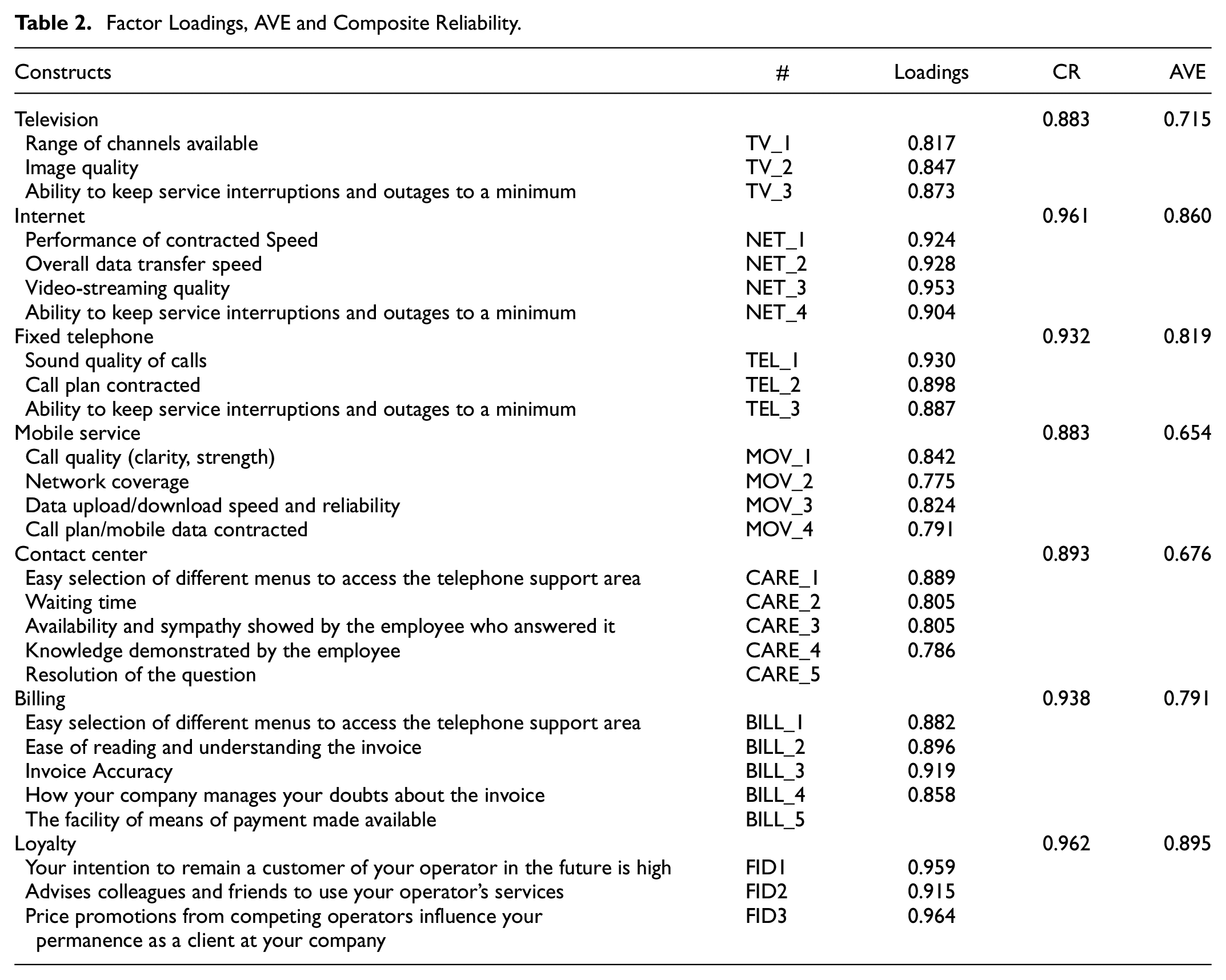
In line with Fornell and Larcker (1981), the evaluation of discriminant validity involved assessing the Average Variance Extracted (AVE) for each factor in relation to the squared correlation between the factors. The findings reveal that the AVE for each factor exceeded the corresponding squared correlation, signifying satisfactory discriminant validity (Table 3). These results indicate that the model exhibits acceptable levels of convergence and discriminant validity.
Discriminant Validity.

Note. N = 3,004. Diagonal elements exhibit the square root of the AVE of each construct. All correlations are significant at 1%.
The adequacy of the structural model was assessed using the following indices: (a) Tucker-Lewis index (TLI); (b) Comparative Fit Index (CFI); (c) the root mean square error of approximation (RMSEA); and (d) Weighted Root Mean Square Residual (WRMR). The results show that the measurement model presents a fit within limits considered satisfactory, with χ2 (264) = 1,237, p < .01, showing significant values, RMSEA = 0.035, lower than 0.07, CFI = 0.924 and TLI = 0.907, above 0.90 (Hair et al., 2014) and WRMR = 0.804, below 1 (DiStefano et al., 2018).
Evaluating the Validity of Hypotheses
Once the measurement model was validated, an assessment of the relationships between the variables and the hypotheses depicted in Figure 1 was conducted. Figure 2 presents the defined model alongside the obtained results. The scrutiny of standardized paths took place to test all relationships. The bootstrap resampling technique with 2,000 interactions was used to appraise significance levels (Henseler et al., 2009). The findings, as depicted in Figure 2, indicate that the proposed model accounts for 77.7% of the variance in loyalty.
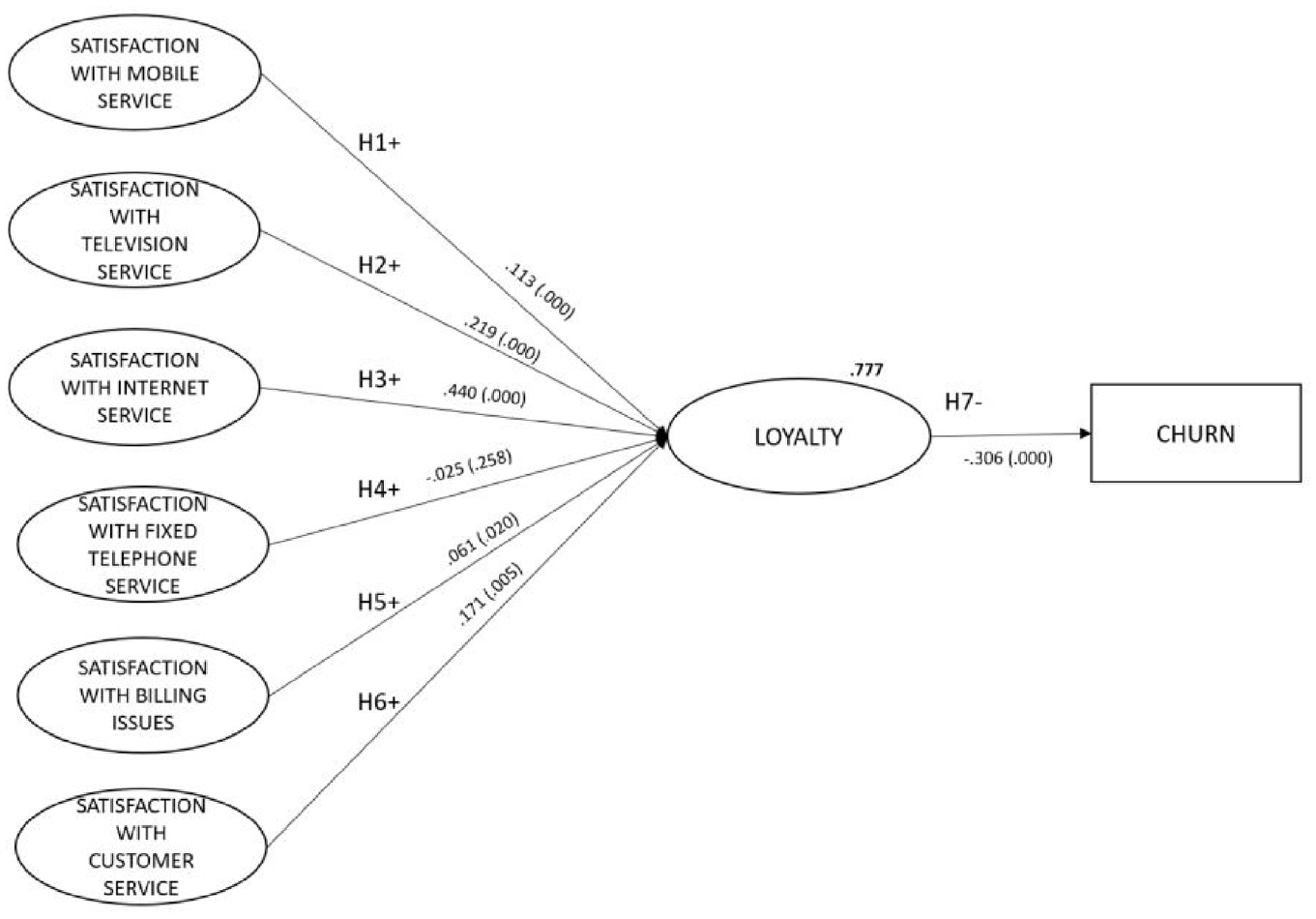
Results of the conceptual model.
The outcomes of the model tested in this study are presented in Table 4. The results reveal significant positive correlations between several factors and loyalty to a telecom operator. The results indicate a statistically significant relation between loyalty and internet service (β = .440, p < .001), television service (β = .219, p < .001), contact center interactions (β = .171, p < .005), mobile service (β = .113, p < .001) and billing (β = .061, p < .05). These findings provide substantial evidence in support of hypotheses H1, H2, H3, H5, and H6. However, in contrast, landline phone service does not have a statistically significant impact on loyalty. Consequently, hypothesis H4 is not supported.
Validation of Hypotheses.

Note. p-Values were estimated using bootstrapping (2,000 interactions).
Loyalty (β = −.306, p < .001) shows a negative correlation with churn, indicating that as customer loyalty toward the telecom operator increases, churn decreases. Therefore, the findings provide support of hypothesis H7. This outcome is consistent with previous research in the context of telecommunication services conducted by Sirapracha and Tocquer (2012).
In the regression of loyalty on churn, a probit regression coefficient was estimated to predict the dependent variable. The probability of churn given loyalty can be calculated using the following formula (L. K. Muthén & Muthén, 1998, p. 552):


where F represents the standard normal distribution function; a represents the probit regression intercept; b represents the probit regression slope; t represents the probit threshold where t = -a, and P (churn = 0|loyalty) =1-P (churn = 1|loyalty).
Using the formula shown above, the probability of churn = 1 and loyalty = 1 is computed as follows:


Using the z table, the value 1.158 corresponds to a probability of approximately .876 or 87.6%. This means that the probability of churn = 1 at loyalty = 1 is 87.6%.
Figure 3 shows a graphical representation of the probability of churn according to loyalty. The probability of churn decreases following the increase in loyalty, with the highest levels (9 and 10) where the probability of churn is quite low.
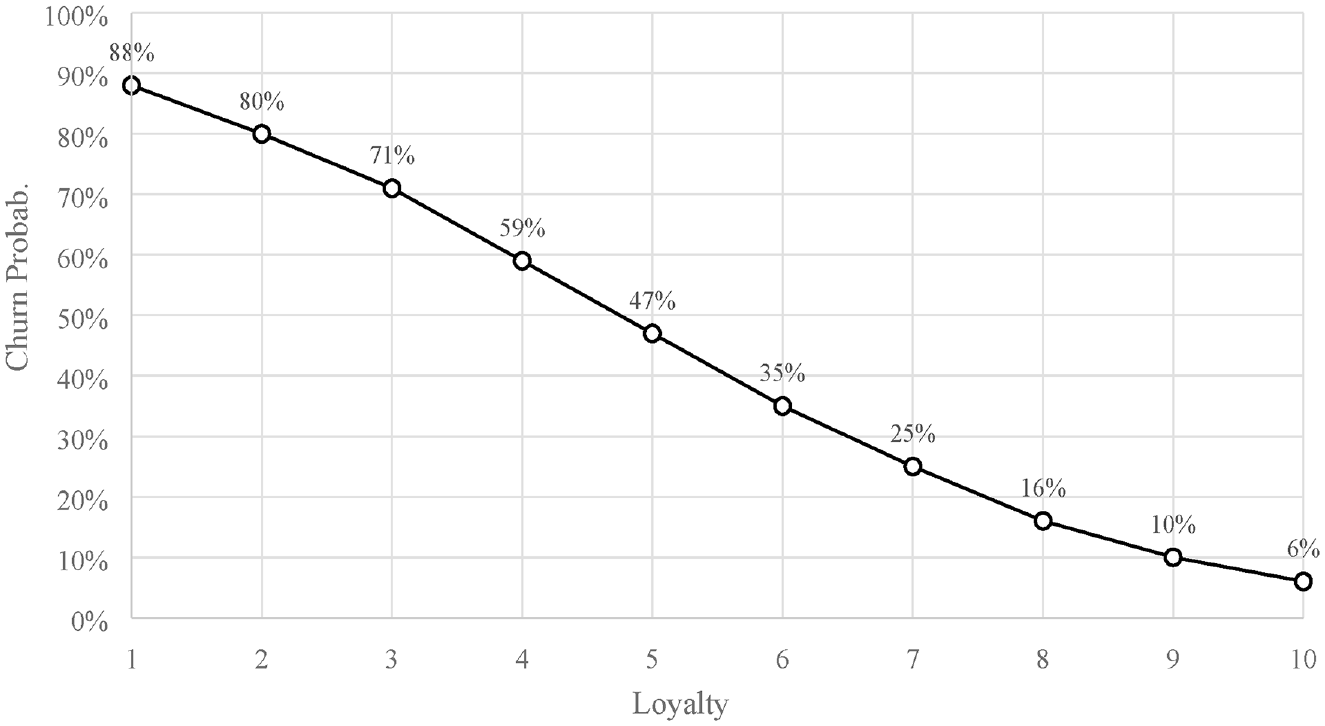
Churn probability according to loyalty (Logit Regression).
As previously mentioned, this study considered only customers who either did not have a loyalty contract with the telecom company or had a loyalty contract ending in the next 5 months or less. To determine if this variable resulted in distinct churn probabilities, two additional probit regressions were conducted. The results are presented in Figure 4.

Churn probability according to loyalty, segmented by loyalty contract existence (Logit Regression).
The results indicate that customers without loyalty contracts are more likely to churns, experiencing a churn probability that is 10% to 18% higher compared to customers with loyalty contracts. The specific difference within this range depends on the level of loyalty to the operator. For example, when comparing customers without loyalty contracts to customers with loyalty contracts, those with a loyalty score of 9 have a difference is of 13 points (20%−7%). Similarly, for a loyalty score of 10, the difference is of 10 points (13%−3%).
Discussion and Conclusion
Telecommunications service providers hold a crucial role in the digital realm. In recent years, these services have evolved far beyond basic offerings, now encompassing a wide range of value-added and entertainment services. Considering the growing need for such services, providers face escalating consumer expectations for enhanced customer experience. Notably, a positive customer experience has been found to significantly reduce the likelihood of brand switching (Sirapracha & Tocquer, 2012). Experiences, as perceived by customers, can be regarded as the “impressions” left in customers’ minds resulting from holistic interrelationship with a products/services (Iglesias et al., 2011). These encounters culminate in either satisfaction or disappointment, leading to customer retention or defection (Meyer & Schwager, 2007). A positive experience can foster an emotional customer-brand bond, ultimately driving customer loyalty (Gentile et al., 2007). While the literature delves into the concept of bundling, empirical evidence regarding its impact on consumer behavior remains scarce. This research aimed to investigate the customer experience with bundled telecommunication services, with a specific focus on assessing satisfaction across different service components and touchpoints, such as the contact centers. According to the findings, customer loyalty is primarily influenced by internet service, with television service ranking second. Interactions with the contact center, mobile services and invoice-related issues follow in order of decreasing impact. Remarkably, these results are very similar to those reported by Ribeiro et al. (2023a) in their study of the customer experience and the switching intention in bundled telecommunications customers.
Results confirm the significant effect of loyalty on churn. This result also confirms what Ribeiro et al. (2023a), found in their systematic literature review. Additionally, it was possible to conclude that customers without loyalty contracts have a higher likelihood of churning than customers with loyalty contracts. Customers who are administratively tied to a particular service provider are less likely to consider competing offers, as they are subjected to penalties if they try to switch operators (Becker et al., 2015; Calvo-Porral et al., 2017; Gao et al., 2023; García-Mariñoso & Suárez, 2019; D. P. Kumar et al., 2017; Quoquab et al., 2018; Seo et al., 2008; Svendsen & Prebensen, 2013; Yang et al., 2020). Still, it is also recognized as a factor that hampers innovation and competitiveness in the sector, making consumers less likely to exercise their freedom of choice and discouraging them from switching operators (Calvo-Porral et al., 2017; Klemperer, 1987, 1995).
As access to technology and content becomes more widespread, it is no longer the primary factor that sets companies apart from one another. Instead, service quality, satisfaction, and customer experience have emerged as the supports of decision-making. These factors play a crucial role in two key aspects: first, in the initial selection of a telecommunications service provider, and second, in the decision to stay, loyalty, and fostering word of mouth (e.g., Eshghi et al., 2007; Quoquab et al., 2018; Svendsen & Prebensen, 2013; Sweeney & Swait, 2008). Therefore, service providers must be able to exceed their customers’ expectations, keeping them satisfied and loyal, and consequently reducing the likelihood of clients switching operators (Becker et al., 2015).
Theoretical Contributions
This study provides a comprehensive perspective on the customer experience in the unified telecommunications service, providing a wide-ranging framework to comprehend the factors that influence customer loyalty and churn. This paper provides notable academic contributions, primarily by addressing a research gap and focusing on the specific services offered within telecommunications bundles. By examining the interactions between different telco customer experience components, loyalty and customer churn, this study provides a comprehensive framework for explaining these behaviors. The findings also make a valuable theoretical contribution to the debate on the relations among the variables used in the conceptual model. The antecedents of loyalty, identified through diverse indicators, explain 77.7% of the variance observed in customer loyalty.
This study offers new perspectives on the influence of loyalty contracts on customer churn, unveiling a consistent negative effect that aligns with previous research conducted in the telecommunications industry (e.g., Gao et al., 2023; García-Mariñoso & Suárez, 2019; Martins et al., 2013; Pinheiro & Cavique, 2022).
Managerial Implications
Managers can derive meaningful insights from this study, in particular concerning the impact of bundled telecommunications services on customer loyalty. The findings highlight that the fixed internet service holds the highest influence on customer loyalty compared to other bundled services. This service has, over the years, gained greater penetration into our lifestyle. According to the latest data 19 out of 38 OECD countries have high-speed fiber as the main fixed broadband technology (OCDE, 2023). A large part of the services we have in our home requires internet, be it a video streaming service (Netflix, HBO, Amazon Prime), be it a video conferencing service to ensure teleworking, a modality so recurrent in recent times due to the COVID-19 pandemic, or any other equipment (e.g., hoover, scales, fridge, digital picture frame) that needs to communicate with the internet. In fact, in the first half of 2020, “working from home” has become a globally shared experience. While many developed markets have been fortunate enough to have broadband internet with fiber optic access, many have experienced the challenge of simultaneous facilitating learning and working at home applications in home environments with low-performance internet access connections. As such, operators must ensure that this service meets customer expectations by leveraging the entire telecoms service experience. This has allowed operators to upgrade broadband infrastructures and their consequent quality, as well as promote some pre-existing solutions to improve indoor Wi-Fi coverage.
Regarding the fixed telephone service, it is curious to note that although the number of subscribers to this service in Portugal increased by 20% in 10 years (ANACOM, 2021b), in terms of minutes traffic, it fell 50% in the same period. This is partly because telecommunication companies always try to put the full service in the package, where the fixed telephone service is included. However, in our opinion, this service will tend to be discontinued in the medium-term, as it is a service that no longer meets the needs of the market, thus challenging the operators to invest in innovation and development of new products/services, reinforcing the value perceived by the customer, thus providing the development of competitive advantages. Telecommunications service providers should prioritize delivering an outstanding customer experience by delivering exceptional services that have the greatest impact on loyalty, enhancing service quality and offering additional value-added services. Operators should pay particular attention to the quality of service provided in their contact centers, as it represents the third most influential factor affecting loyalty to the operator and is frequently a source of complaints within the telecommunications sector (ANACOM, 2021a).
Public Policy Implications
The issue of locking periods has gained renewed attention in various countries such as the United Kingdom, Canada, and Denmark, sparking a renewed debate. Many regulatory bodies are currently contemplating the possibility of further reducing these periods (Yang et al., 2020). In the telecommunications industry, there has been a global regulatory effort to shorten the duration of lock-in periods since 2011. In the European Union, the Telecommunications Law establishes a maximum lock-in period of 24 months (European Union, 2009).
The current practice in the sector, including Portuguese telcos, is impose a 24-month lock-periods on consumers. This reduces uncertainty for the company, but it also restricts customer’s freedom of choice and market competitiveness. During the loyalty periods, consumers are subject to financial penalties for contract infringement. In Portugal, the cancellation of services is one of the primary factors for complaining to official entities, underscoring the criticality of the theme.
There are also several opinions from several entities, including the competition authority, about abolishing the loyalty period. We think this issue will be a central piece for the development of the sector, moving the markets toward negotiation models without artificial or contractual costs, where the customer will be the center of attention, and the fulfilment of his expectations will be the main goal of the operators. Supporting this view, the Portuguese National regulatory authority for communications (ANACOM) has recently sent the government a proposal for legislative amendment in which it states that “the maximum duration of the loyalty period should be reduced from 24 to 6 months, given the clear benefits that this will provide consumers, who will benefit from greater power of choice and change, encouraging providers of electronic communications services to review and adapt their commercial strategies in favour of greater competition” (ANACOM, 2023).
The purpose of this policy recommendation is to address concerns and limitations related to long-term contracts in the telecommunications industry. Acknowledging the evolution of the telecommunications market and the need for greater flexibility and empowerment of consumers, the proposal advocates for the abolition of long-term contracts. This policy aims to foster consumer-oriented competition, encourage innovation and improve the overall quality of services through by fostering a more competitive and consumer-centered telecommunications market.
Limitations and Future Research Directions
While this research supports with new knowledge on churn in the provision of bundled services, it is important to acknowledge and address several shortcomings as well as identify potential avenues for future research.
In the service industry context, usage habits, the level of innovation in the market, and purchasing power, among other factors, can influence consumer assessments. Cultural differences are also at the root of many differences in consumer behavior. Thus, one of the study’s limitations is that it was carried out in only one market. We suggest replicating the same model in other countries and cultures to understand whether it is applicable and to what extent it explains loyalty and churn. Hence, future research should explore if the drivers of customer experience of a telecommunication service have the same impact in different cultures. Also, according to the results, it was observed that loyalty contracts have an impact on the probability of churn. Does the model behave the same when applied to markets that no longer have loyalty contracts in place?
One limitation identified in this study is the reliance on customer satisfaction as the primary metric to assess customer experience. While customer satisfaction has been widely used as a primary feedback measure, considering the overall nature of the customer experience, which encompasses affective, cognitive, emotional, social and physical responses, we suggest exploring alternative research methodologies, such as incorporating neuroscience, to effectively measure the consumer experience in the telecommunications industry.
Customer experience encompasses subjective responses that encompass all interactions with a company, irrespective of whether they are direct or indirect (Meyer & Schwager, 2007). Direct contacts typically occur during customer-initiated activities such as purchase, usage, and service interactions. On the other hand, indirect contacts comprise unplanned encounters with the company’s products, services or brands and can be expressed in various forms, including recommendations, word-of-mouth, reviews, advertising, and news (Meyer & Schwager, 2007). Therefore, we recommend that future research endeavors consider assessing some of these indirect contacts and their potential influence on customer churn. To gain a comprehensive understanding of the customer experience within the telecommunications sector and assess the impact of the customer journey on customer loyalty and churn, it is crucial to thoroughly examine all touchpoints.
Footnotes
Declaration of Conflicting Interests
The author(s) declared no potential conflicts of interest with respect to the research, authorship, and/or publication of this article.
Funding
The author(s) disclosed receipt of the following financial support for the research, authorship, and/or publication of this article: NECE-UBI, Research Centre for Business Sciences, Research Centre and this work are funded by FCT Fundação para a Ciência e a Tecnologia, IP, project UIDB/04630/2020 and DOI identifier 10.54499/UIDB/04630/2020

Data Availability Statement
Data sharing not applicable to this article as no datasets were generated or analyzed during the current study.