




Abstract
This study analyzed the impact of various aspects of social media marketing (beneficial promotions, relevant content, popular content, and presence on multiple platforms) on brand loyalty through the mediating factor of customer satisfaction in travel and tourism offices in Jordan. The study’s sample consisted of 350 followers of at least one travel and tourism office on social media, with a response rate of 86% obtained via a self-administered questionnaire. The results supported the significance of social media marketing drives on brand loyalty, with customer satisfaction playing a crucial mediating role. All the factors that engage customers in social media marketing (i.e., beneficial promotions, relevant content, popular content, and presence on multiple platforms) were found to have a simultaneous impact on brand loyalty. This study is the first of its kind in the Jordanian business setting to examine the effect of social media marketing on brand loyalty through customer satisfaction. Most prior research in this field has been conducted in Western countries.
Introduction
The importance of social media tools and techniques in the business world, particularly in marketing, has become increasingly evident. These tools allow for direct and unfiltered communication between service providers and clients, as well as among clients themselves, providing a new and effective marketing approach for products and services. In recent years, the use of social media as a marketing channel in the travel and tourism industry has received significant attention (Asongu & Odhiambo, 2019; Bilgin, 2018). For example, Asongu and Odhiambo (2019) found that Facebook, as a social media tool, positively affects tourist arrivals and promotes tourism. This might be due to four factors: the transformation of travel research, the increase in social sharing, improved customer service, and the restructuring of travel agencies (Icoz et al., 2018). Travel and tourism agencies use social media to generate interest in their offerings, announce promotions, attract media attention, and promote their brands (Alalwan et al., 2017). Murphy et al. (2016) and Icoz et al. (2018) emphasized the importance of considering how consumers assess the information and booking features available on various digital platforms for enhancing and maintaining customer satisfaction and brand loyalty.
Customer satisfaction is a crucial factor in successful tourism marketing as it drives loyal behavior, trust, and brand evaluations (Harrigan et al., 2017). Studies have confirmed the positive association between satisfaction and loyal behavior, such as revisit intentions and word-of-mouth publicity (Prayag et al., 2013). For instance, the level of satisfaction of foreign tourists in Bangkok has a significant impact on their likelihood of recommending it (Prayag et al., 2013). Furthermore, overall satisfaction has been found to be a significant influencer of word-of-mouth publicity (Hui et al., 2007). Social media marketing has become an essential strategy for companies worldwide to establish strong customer relationships and communicate their messages effectively. With the growing use of smartphones, laptops, and the internet for socializing, the corporate marketing techniques and strategies have evolved (Abuhashesh et al., 2019; Icoz et al., 2018; Singh et al., 2020). As of January 2020, 6.78 million (71%) of Jordan’s 10.20 million population are internet users, 5.7 million (56%) are active social media users, and 8.1 million (79%) are mobile social media users (Digital 2020 Jordan). This widespread usage of social networks may be due to the increasing availability of internet networks, especially mobile, broadband, third, and fourth-generation ones, as well as the low prices of smartphones.
In the tourism industry, it’s important to understand how technologies change the distribution of information (Icoz et al., 2018). Social media provides customers with greater access to information, such as blogs and tweets, which may have both positive and negative impacts on the product’s reputation. Research shows that customers are more likely to trust information from private sources over commercial sources (Ly & Ly, 2020). According to Alalwan et al. (2017), Facebook has a more significant impact on brand awareness than affiliate marketing and online word-of-mouth. Literature suggests that social media marketing, customer satisfaction, and brand loyalty are inter-connected (Bulut & Karabulut, 2018; Kanapathipillai & Mahbob, 2021; Narangajavana et al., 2019). Travel and tourism marketers have long been interested in brand loyalty because it measures the attachment a customer has to a brand, leading to repeat business and word-of-mouth referrals (Abbasi et al., 2022). Social media marketing is regarded as one of the most effective techniques in the travel sector, as people trust the platform based on the reviews, experiences, and feedback of other users (Hua et al., 2017). The way travelers conduct their research has evolved, and this has had a significant impact on how the tourism industry markets itself on social media. Effective social media marketing strategies that highlight a travel agency or business’s creativity and uniqueness can have a significant impact on how clients feel (Azam et al., 2018).
The impact of social media marketing on customer satisfaction and brand loyalty in Jordan’s tourism industry is under-researched despite its widespread use in marketing and its impact on customer satisfaction and brand loyalty in other countries. The Jordanian tourism sector is rapidly evolving and the full potential of using social media as a marketing tool has yet to be realized. This study aims to address the gap in research on the impact of social media marketing on customer loyalty and satisfaction in the Jordanian tourism industry. It will provide empirical evidence of the effect of social media marketing on customer loyalty and satisfaction and contribute to the development of the tourism industry in Jordan by filling the information gap about tourism destinations.
To build a successful service-based brand in the tourism industry, it is essential to offer unique customer experiences that differentiate the brand from competitors. Tourists seek reliable sources of information to reduce uncertainty and create expectations about their travel experiences (Živković et al., 2014; Ly & Ly, 2020). This study aims to contribute to filling the knowledge gap and providing insights into the impact of social media on brand loyalty and satisfaction in the Jordanian tourism industry.
Tourism Sector in Jordan
Jordan’s tourism field has many advantages and prospects to add to its rapid growth: the full range of tourist sites in urban, rural and remote areas, promoting the sustainability of certain fundamental cultural aspects such as traditions and crafts, the great diversity of Jordan’s natural and cultural resources and destinations. In fact Jordan is well known throughout the world as a tourism destination with a positive image, pleasant weather with high potential to provide locations that meet the needs of various tourist markets throughout the year, a high level of safety and security relative to some other countries in the region suffering from political instability, the accessibility of visitor hotels and services, the provision of accessible and exclusive attractions, such as the Dead Sea, Petra, Jesus Baptism Site, and the Madaba Mosaic Route, as well as the availability of health and recreation amenities, such as hot springs and the Dead Sea (Magatef, 2015). Despite all these advantages, the tourism field faces some problems and threats, such as trips to Jordan being treated as an extension of surrounding countries’ tours and trade bundles. The concentration of tourism growth and amenities in certain tourist attractions and the absence of advertising strategies and international marketing leaders are among the barriers to achieving more success and flourishment in the Jordanian tourism field (Alghizzawi et al., 2018; Mustafa, 2012).
The Jordan Tourism and Travel Agents Association was established in 1965. Its main center is in the city of Amman. It contributes distinctively to the national economic income, not to mention its active contribution through its participation in conferences and seminars and cooperation with the Ministry of Tourism as well as formal and informal entities locally and internationally to enrich the amount of income derived from the tourism industry in its various forms. It cooperates with members and tourist agencies, such as the Tourism Promotion Authority and local associations, in events related to the tourism industry. The Association also works to raise the level of practicing the profession and spreading tourist awareness among its members, developing tourism and improving the performance of tourism agencies and the members working in them by raising their efficiency and skills through setting up almost free training courses. The performance of tourism and travel agents is subject to close monitoring, so that incoming and outgoing trips, ticket sales and other activities are arranged through disciplined and organized contracts that reserve the rights of dealers. There is no cause for fear of the functional performance of tourism agents in the current stage.
The increasing rivalry among tourism agents with around 748 licensed travel and tourism agents in Jordan, where 612 of these agents are in Amman, makes it necessary to investigate and evaluate advertising strategies and techniques of these service providers (Ministry of Tourism and Antiques, 2019). According to the Tourism Statistical Bulletin for the third quarter of 2019 published by the Jordanian Ministry of Tourism and Antiques on 25/11/2019, the number of employees in tourism and travel agencies in 2019 was 4,793 employees. The number of tourism activities for travel and tourism agencies in 2019 was 896 activities, including 683 in Amman only, while the number of Jordanians leaving the country for tourism at the end of September 2019 was 106,665 people and the total number of international visitors during the period January-September 2019 was 4,107,219 visitors, whereas the number of visitors to tourist sites during the period January-September 2019 was 2,012,155 visitors (Ministry of Tourism and Antiques, 2019). When we talk about tourism service providers in Jordan, several well-known names come to our minds, such as Dallas Travel and Tours, Mawakeb Travel and Tourism, Al- Jazeera Tourism and Travel and Holiday Travel and Tourism. What distinguishes a tourism service provider from the others? How could the customer differentiate between these agents? How do these agents employ social media to market their services and build customer loyalty? These are essential questions that require being researched and answered.
Literature Review and Hypotheses Development
The study is based on the Social Response Theory, which originated from the idea of computers as social actors. According to Ngai et al. (2015), social cues in information technology trigger human-like reactions from users. The theory also recognizes the tendency of people to anthropomorphize inanimate objects, such as social media websites, leading to the use of replies in online interactions. In the tourism industry, social media platforms offer valuable information about destinations, properties, and services through customer experiences and reviews. Social media enables companies to engage directly with customers through various online channels. Huang et al. (2016) note that the presence of social media platforms provides tourists with the ability to research destinations, assess the quality of products, facilities, and services, and make informed decisions about visiting. According to Mehrabi et al. (2014), there are five aspects within social media marketing, which are advertising campaigns, updating content, providing relevant content, providing popular content among friends, providing applicable programs. Lee (2017) arranged these activities into communication, providing information, support for daily life, promotion and selling and social response. In their research on the airline industry, Seo and Park (2018) defined these elements as entertainment, interaction, trendiness, customization, and perceived risk.
Social Media Marketing Drivers and Brand Loyalty
The impact of marketing through social media on brand loyalty was explored in previous studies by Erdoğmuş and Cicek (2012), Murtiningsih and Murad (2016), and Abbasi et al. (2022). These studies revealed that social media can contribute to consumer brand loyalty if: (1) the brand provides useful and advantageous campaigns on social media platforms, (2) the content is relevant and appropriate, (3) the content is popular or favored among social media users, and (4) the brand is accessible and present on various social media platforms and applications. The popularity of social media and its content among consumers is critical for successful engagement with brands on these platforms.
Social media marketing, offering advantageous campaigns, relevant content, and accessible content, appearing on various platforms and applications on social media, positively affect brand loyalty of customers (Rayat et al., 2017). Brand loyalty can be determined by customer trust (Ebrahim, 2020). The immersive aspect of social media (capacity of engaging people, businesses in sellers “and consumers” groups, as well as involving consumers in product and value generation) has motivated practitioners to serve clients better and meet their needs (Sashi, 2012). Sashi (2012) argued that “the evolution of interaction between buyers and sellers has captured the interest of managers seeking to understand better and serve their buyers using these technologies and tools.” The growing enthusiasm in pursuing this strategic approach may be partly attributed to its ability to increase a company’s measures of performance. Customer loyalty derives from a significant entry barrier to rivals, an improvement in the business’s capacity to respond to competitive challenges, higher sales and profits, as well as a low-cost brand to competitor marketing efforts (Khan et al., 2020). Marketing via e-mail is most efficient when it is used as a means of customer retention to create interactions for the existing customer list or permission-based “home list” (Öz, 2015). Providing relevant and updated content of social media platforms is considered one of the most important factors that influence brand loyalty. Relevant content is a collection of material with carefully selected and studied keywords designed to highlight the search engine result pages on social media platforms.
Relevant material of e-marketers is presented in a form that adds value to their products or services, thus increasing growing their bottom line (Erdoğmuş & Cicek, 2012). The popularity of the social media platform and the content among friends are other important reasons for customers to be engaged with brands on social media. Accessible content, also known as “trendy,” content, is the focus of social media marketers everywhere. It can be achieved by making the brand content a great source of information for customers and their friends (Erdoğmuş & Cicek, 2012). Marketer, who are faced with a variety of social media platforms should analyze their target audience and decide which platforms are the most effective to communicate with them. Furthermore, providing mobile applications allows customers to engage with the brand every day and create brand loyalty (Kim & Ko, 2012; van der Bank & van der Bank, 2014). Social media platforms are online stands where individuals and companies could interact and post their content. They also could advertise their products and services and share their ideas and beliefs. Social media platforms represent a fully open space, where the sky is the limit. On the other hand, social media applications are the “mobile phone-friendly” versions of these platforms (Rahim et al., 2018). Companies can increase the influence of social media marketing by appearing on various platforms and offering applications on social media by using mobile applications to increase brand awareness, customer engagement, and brand compliance (Murtiningsih & Murad, 2016).
Because there are many social media channels and it is difficult to include all of them, advertisers must evaluate their target audience and choose to engage in the most powerful way to interact with them. According to van Asperen et al. (2018), the level of customer engagement with the company’s social media activities is positively related to their degree of loyalty. Erdoğmuş and Cicek (2012) reported that building and maintaining loyalty is the primary goal of marketing and marketers utilize a variety of tools to maintain customer loyalty. Given that social media-based marketing is one of the latest tools for doing so, they identified the impact of social media-based marketing on brand loyalty. Schivinski and Dabrowski (2015) showed that social media brand communication influence brand loyalty and perceived brand quality. Hosseinabadi (2013) also concluded that social media-based brand communities were positively associated with the characteristics shared by communities (shared consciousness, shared rituals, and traditions and moral responsibility to society). He reported that such communities could enhance loyalty through brand activities, social networking, social interactions, and emotion management. Social media platforms often help users share information about the labels of products and services with their peers; these peer-to-peer interactions provide a cost-effective way for companies to raise brand awareness, improve brand recognition and retention and boost brand loyalty (Gunelius, 2011; Harrigan et al., 2017). Social media can, therefore, be said to help companies create brand loyalty by networking, communication, and community building. In this sense, soical media can serve as a cost -effective way of increasing brand awareness, boosting brand recognition, and increasing brand loyalty. Thus, it can be said that social media helps companies build brand loyalty through networking, connecting, and community building (McKee, 2010; Situmorang et al., 2020).
Accordingly, the following hypothesis is suggested:
H1. Social media marketing drives positively influence brand loyalty of customers in the tourism field in Jordan.
Social Media Marketing and Customer Satisfaction
There is a positive relationship between the entertainment features of the site, the perceived enjoyment of users, customer satisfaction, and customer intentions to repurchase and use (El-Adly, 2019). Ramsaran-Fowdar and Fowdar (2013) pointed out that social media marketing represents a useful tool to manage existing customer relationships as well as creating new ones. It facilitates online exchange and communication, which supports the assumption that social media channels are to be used to increase customer satisfaction and retention. Anjum et al. (2012) stated that social media marketing is imperative for companies that aim to attract and retain customers. Clark et al. (2013) found that the use of social media as a marketing channel increases customer satisfaction and retention. Customer satisfaction results when the total benefits gained from the company are more significant than the losses that the customer incurred during the process of the trade-in terms of time, effort, and money (Ganiyu, 2017). Ebrahim (2020) argued that the company’s high quality of services leads to customer satisfaction and, hence, increases loyalty to the company and to the brand. Sano (2014) stated that there is a statistically significant effect of marketing campaigns (target group, company efforts, and time) on customer satisfaction, and there is a statistically significant effect of social media on customer satisfaction. Therefore, the following hypothesis is suggested:
H2. Social media marketing drives positively influence customer satisfaction in the tourism field in Jordan.
Customer satisfaction with online shopping is a significant concern. Satisfaction may affect the acquisition of new clients by word - of- mouth or contrary feedback from clients that may affect the company’s business market (Yeh et al., 2019). The company’s clients should be treated as assets of the company, including their requirements, their preferences, and the nature of their purchasing behavior (Xiang et al., 2016). Customer satisfaction usually means buying more. Besides, customer satisfaction creates a network to reach other potential customers by sharing experiences and knowledge (Hague & Hague, 2016).
Raising the level of customer satisfaction achieves enormous benefits for the company, such as customer loyalty, increasing the customer’s life cycle, which increases the life of the goods that the customer buys and improves the positive oral communication with customers. When a customer is satisfied with the product or service that the company provides, this can make the customer buy frequently and recommend products or services to potential customers. A business cannot grow if the company ignores the needs and preferences of customers (Tao, 2014). Accordingly, the following hypotheses are suggested:
H3. Customer satisfaction positively influence brand loyalty of customers in the tourism field in Jordan.
H4. Customer satisfaction is significantly mediating the relationship between social media marketing drives and brand loyalty of customers in the tourism field in Jordan.
The Study Model
Drawing from the literature and Social Response Theory, the study considers social media marketing drives as independent variables (advantageous campaigns, relevant content, popular content, and presence on multiple social media platforms and applications) and brand loyalty as the dependent variable, with customer satisfaction serving as a mediating factor in the travel and tourism industry. The model aims to capture the essential aspects of social media marketing and conceptualize the relationships between these marketing drives, customer satisfaction, and brand loyalty (Figure 1).

The study model.
Research Methodology
Sampling and Research Procedures
The target population for this study were Jordanian travelers who have made a decision to use or purchase travel-related services through social media. A convenience sample of 350 travelers was selected and participated in the study through an online self-administered questionnaire with a response rate of 86%. The sample consisted of 51% female and 49% male participants, with an average age of 30 years. About 70% of the sample had an undergraduate or graduate level of education, while 30% were still students.
The convenience sampling method was chosen for this study as it allowed for many participants to be reached due to their availability and willingness to participate. Participants were identified and approached through online advertisements and were given the option to complete the questionnaire at their convenience. To approach the respondents, an online ad was placed on social media platforms and relevant travel websites, inviting travellers who have used social media to make travel-related decisions to participate in the survey. The online ad provided a link to the self-administered questionnaire and explained the purpose and confidentiality of the study.
Research Instrument, Reliability, and Validity
The questionnaire’s content (measures) was mainly selected and adopted from relevant previous studies. The independent variables “social media marketing drives” were measured using a 5-point Likert scale developed by Roque and Raposo (2016), Leung et al. (2013), Chen and Edwards (2015), Erdoğmuş and Cicek (2012), Murtiningsih and Murad (2016), Almeida-Santana and Moreno-Gil (2018), and Es-Safi and Sağlam (2021) with a Cronbach’s alpha of .85. These factors included advantageous campaigns, the relevancy of the content, the frequency with which the content was updated, the popularity of the content among other users and friends, and the range of platforms and applications available on social media. The dependent variable “brand loyalty” was measured using a 5-point Likert scale developed by Erdoğmuş and Cicek (2012) and So et al. (2014, 2016) with a Cronbach’s alpha of .88 The mandating variable “customer satisfaction” was measured by a Likert scale developed by Anjum et al. (2012), Hague and Hague (2016), and Antón et al. (2017) with a Cronbach’s alpha of .84.
To ensure face validity of the questionnaire, the researchers consulted a jury of five experts in the field to review the questionnaire. The experts commented on the wording, clarity, and comprehensiveness of the questionnaire items and whether each item was relevant to the study’s aims and objectives. The researchers used the experts’ feedback to refine the questionnaire.
Data Analysis
Descriptive Analysis
To determine the normality of the study questionnaire, means, standard deviations, skewness, and kurtosis were calculated. The descriptive statistics presented in Table 1 The results of means indicate a positive attitude toward the measured items. The standard deviation (SD) values ranged from 0.673 to 1.111, which states a small spread around the means. The mean values of all items were larger than the midpoint (3.000) and ranged from 3.25 to 4.40, showing that the respondents have relatively medium responses to the study’s questions. The data was confirmed to be normally distributed using skewness and kurtosis. Skewness and kurtosis were also normally distributed, with most of the values falling within the acceptable range of normality (from −1.000 to +1.000 for skewness and less than 10 for kurtosis; Hair et al., 2010).
Descriptive Analysis Results.

Factor Analysis
The study utilizes exploratory factor analysis (EFA) techniques to reduce the large number of variables underpinning social media marketing drives into orthogonal indices for further analysis by stepwise regression analysis and hypotheses testing. Furthermore, by using exploratory component analysis (EFA) techniques, it is possible to explore the patterns of factors that underlie each primary construct. It was considered a suitable method to minimize the potential problems of multicollinearity among the variables that relate to each construct. A pre-analysis was performed to ensure that the data was suitable for exploratory factor analysis. Multiple criteria were used to evaluate the factor analysis results, including eigenvalues, interpretability, and internal consistency (Tables 2 and 3).
KMO and Bartlett’s test.

Total Variance Explained.

Therefore, variables determined to have eigenvalues of significance more than one and factor loadings less than 0.40 had small or no correlation with each other; subsequently they were removed (Hair et al., 2010). An inspection of the correlation matrix indicated that the correlations were all above the acceptable level of .40.
Discriminant validity refers to the extent to which factors are distinct and uncorrelated. Before assessing the discriminant validity, KMO, and Bartlett’s tests were performed. The subsequent KMO and Bartlet’s test results revealed in a significant level of probability (p > .000) and a high KMO statistic of (0.86) indicating that factor analysis is interpreting a percentage of (86.0%) of the variance in the data through the study explained by these variables.
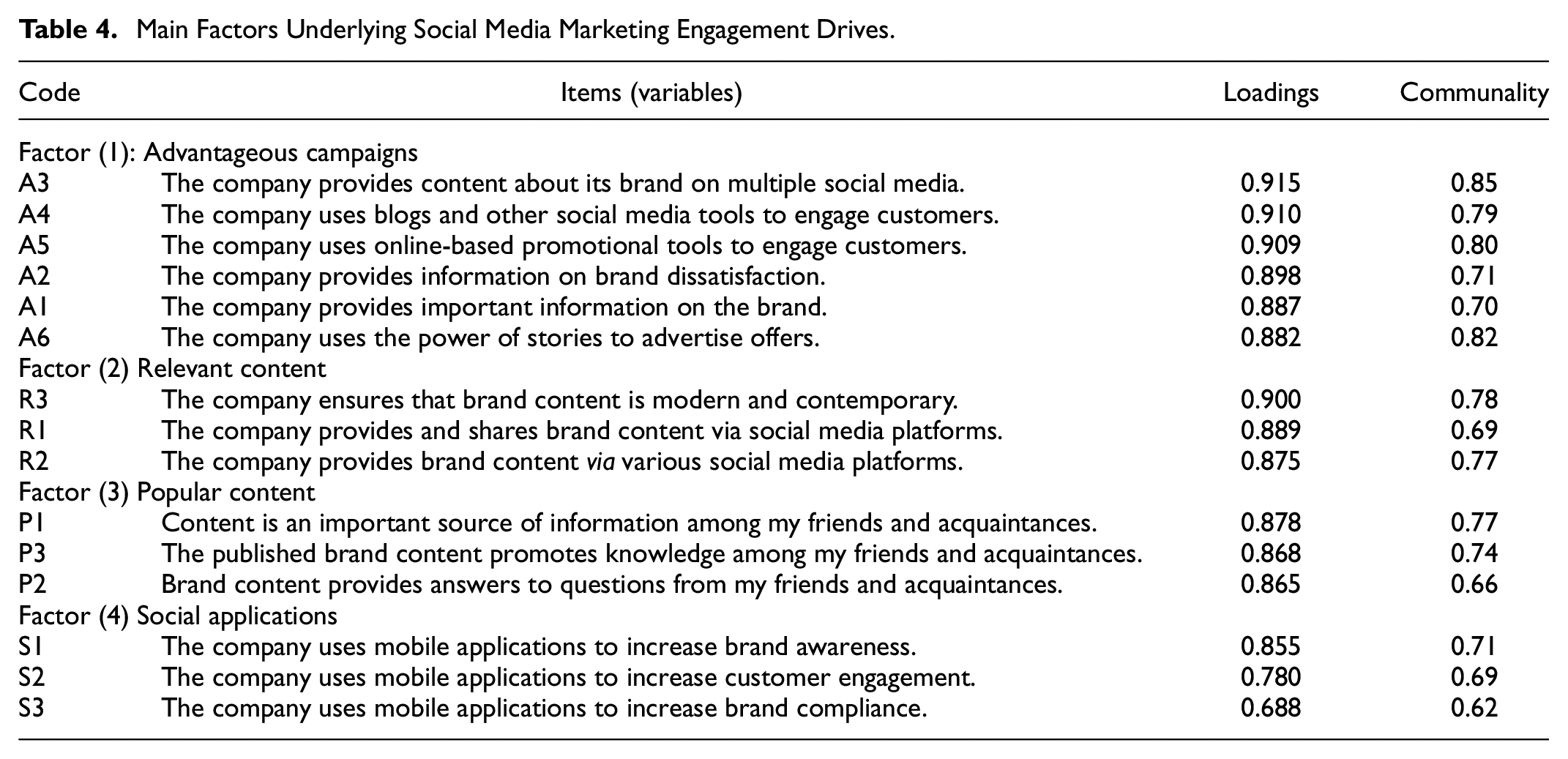
The findings of PCA indicated that four factors/drivers could be extracted from social media marketing drives. These four factors are: The first factor, which accounts for (34.379%) of the variance with loadings ranging from .571 to .85, can be identified as
Main Factors Underlying Social Media Marketing Engagement Drives.
Hypothesis Testing
To test the study hypotheses (H1, H2, and H3), a multiple regression analysis was applied
The results of multiple regression analyses were summarized in Table 5, with the F-ratio test, for the study hypotheses (H1, H2, and H3). The results indicate that each of these hypotheses is accepted at a ≤ 0.000. Accordingly, it may be concluded that there are significant relationships between the social media marketing drive factors (advantageous campaigns, relevant content, accessible content and appearing on various platforms, and applications on social media) and brand loyalty, between social media marketing drive factors and customer satisfaction and between customer satisfaction and brand loyalty. These results empirically supported that social media marketing drive factors have a positive direct impact, not only on brand loyalty, but also on customer satisfaction. These results are supported by previous studies, such as Erdoğmuş and Cicek (2012), Murtiningsih and Murad (2016), and Kiiru (2018).
A Summary of Multiple Regression Results for the First Three Hypotheses.

A stepwise multiple regression method was used to identify the relative importance of each factor of social media marketing drives associated positively with brand loyalty.
The components that are highly connected with the dependent variable (i.e., brand loyalty) are predicted to enter the regression equation when using this strategy. The “goodness of fit” for the regression equation is determined using the F-value at the 0.00 level of significance. The F-value is the regression equation’s account for the ratio of explained to unexplained variance. When the total variance accounted for is small, the meaning of the individual beta coefficient is irrelevant (Wagner, 2019). When the adjusted R2 is around .10 or higher and the F-value of the regression equation approaches the .05 level of significance, the individual beta weight interprets the results of the multiple regression analysis. Stepwise regression study shows that the extracted components from the leading social media marketing drives (all four factors) are significantly associated to brand loyalty. The direction of this relationship is positive. These four factors in terms of their order of importance are: (1) “advantageous campaigns” (2) “popular content,” (3) “relevant content,” and (4) “social media applications” (see Table 6).
Results of Stepwise Multiple Regression Analysis.

Constant factor; Dependent variable: Brand loyalty.
This indicates that the higher the importance of social media marketing drive factors, the higher the level of brand loyalty.
A combination of basic and multiple regression analyses was employed to assess the fourth hypothesis (H4). The regression testing results are shown in Table 7. The emphasis of the Pardo and Roman (2013) model of mediation is on the unstandardized regression coefficients; hence, the coefficients indicated in the table below represent the unstandardized betas. To determine whether customer satisfaction functions as a mediator in the relationship between social media marketing characteristics and brand loyalty, apply the following rule. Some type of mediation is supported if the effect of the intended mediator remains significant after controlling the independent variable. The finding suggests full mediation if the independent variable remains significant after controlling for the expected mediator.
Regression Analysis for Mediation of Customer Satisfaction Between Social Media Marketing Drive Factors and Brand Loyalty.

p ≤ .00.
Brand loyalty is significantly predicted by social media marketing factors and consumer satisfaction (p = .000). To justify partial mediation, the strength of the independent variable in predicting the dependent variable should be lowered in the presence of the mediator variable. The partial mediation condition was supported by a reduction in the unstandardized beta for social media marketing drives from .382 to .078. This indicates that the independent variable (social media marketing drive factors) and the dependent variable are mediated (brand loyalty) The results show that include the mediator (customer happiness) in the model considerably reduces the link between the independent variables (social media marketing drive factors) and the dependent variable (brand loyalty). The results indicate that the association between the independent variables (social media marketing drive factors) and the dependent variable (brand loyalty) is significantly reduced by the inclusion of the mediator (customer satisfaction) in the model. In other words, there is evidence of partial mediation.
Result Discussion
This study focuses on the impact of social media marketing drives on brand loyalty through customer satisfaction as a mediating variable from the consumers’ perspective in the tourism sector in Jordan. The research involves three key constructs: social media marketing drives, customer satisfaction, and brand loyalty. Factor analysis findings revealed that four factors could be extracted from social media marketing drives as factors affecting brand loyalty and customer satisfaction in the Jordanian tourism market. These factors were classified as (1) advantageous campaigns (Erdoğmuş & Cicek, 2012), (2) relevant content (Murtiningsih & Murad, 2016), (3) popular content (Kiiru, 2018) and (4) presence on various social media platforms and applications.
Revised: The results of a stepwise multiple regression analysis showed that advantageous campaigns on social media were the most significant factor affecting brand loyalty, followed by content relevancy, popularity among friends, and presence on various platforms and apps. This supports previous research, such as Erdoğmuş and Cicek (2012) who found that advantageous campaigns have a significant impact on brand loyalty, and Kapoor et al. (2018) who found that relevant content is critical to customer satisfaction. This aligns with the findings of Appel et al. (2020), and Matikiti-Manyevere et al. (2019) who emphasized the importance of advantageous campaigns and relevant content in determining brand loyalty and customer satisfaction. Ko et al. (2017) found that social media influencer endorsement, user-generated content, and personalization play a crucial role in social media marketing in the tourism industry. Tourists are more likely to engage and make travel choices based on content promoted by influencers and created by their peers, and tailoring recommendations to their interests and past travels is vital for retaining and attracting customers. Zhang et al. (2020) and Fang et al. (2020) investigated the impact of social media on the travel decision-making process and discovered that tourists are heavily influenced by recommendations from loved ones and evaluations and ratings from fellow travelers. The researchers also noted that visually appealing content, like images and videos, can spark interest and encourage tourists to gather more information about a destination or tourism service.
Based on multiple regression analysis and hypothesis testing, the findings provided empirical support for the contention that brand loyalty is positively and significantly affected by social media marketing drive factors. Also, the empirical results indicate that social marketing drives factors have a positive and statistically significant effect on customer satisfaction. Consequently, customer satisfaction has a positive and statistically significant effect on brand loyalty. This result is supported by previous studies, such as Rayat et al. (2017), Antón et al. (2017), Rosenberg and Czepiel (2017), Kiiru (2018).
Finally, the results reveal that customer satisfaction acts as a partially mediating factor in the relationship between social media marketing drives and brand loyalty among consumers in the Jordanian tourism industry. While previous studies have explored the impact of social media on brand loyalty, this study provides the first empirical examination of the relationship between social media marketing drives and brand loyalty via customer satisfaction in the context of the tourism industry in Jordan. However, additional research and validation of these findings is needed to establish a more robust understanding of this relationship in the Jordanian tourism market
Contribution and Implications
This study provides new insights into the relationship between social media marketing drives and brand loyalty in the tourism sector in Jordan. By analyzing the effect of social media campaigns on customer loyalty and satisfaction, this study offers valuable information for tourism companies and agents operating in the Jordanian market. The results of this study suggest that social media marketing drives, such as advantageous campaigns and relevant content, have a significant positive impact on customer satisfaction and, in turn, on brand loyalty. Furthermore, the findings of this study are unique in the sense that they examine the mediating effect of customer satisfaction in the relationship between social media marketing drives and brand loyalty in a Jordanian business context, filling a gap in the existing literature that has primarily focused on Western countries. Overall, these results highlight the importance of utilizing social media effectively in the tourism industry and the potential for companies to increase customer loyalty and satisfaction through well-designed and executed social media marketing strategies. The findings of this study have important implications for the tourism industry in Jordan, a developing country. Travel and tourism agents can leverage the research to improve their customer brand loyalty and customer satisfaction through effective utilization of social media marketing. To achieve this, agents should:
- Analyze the benefits, values, and advantages they offer to consumers in their campaigns and what motivates customer loyalty.
- Stay updated on their clients’ interests, hobbies, and lifestyles. Conducting research on their consumers’ lives and sharing the information on social media platforms can help
- Encourage social media users to share their campaigns and content.
- Develop user-friendly and easily accessible social media applications that focus on customer satisfaction.
By offering engaging and participative social media platforms and applications, travel and tourism agents can enhance customer brand loyalty. However, they should also ensure that their social media marketing policies and strategies do not deceive or manipulate consumers and maintain the credibility of the tourism industry in Jordan. The study also highlights the preferred types of content shared on social media, including music, humor, unusual things, technical knowledge, and instructive content.
Limitations and Future Studies
This study focuses on exploring the impact of social media marketing efforts on customer satisfaction and brand loyalty. However, the results of this study are subject to certain limitations. Firstly, this study is a snapshot survey, meaning that the relationships identified may vary across regions and countries, or even become irrelevant over time. Further research with a longitudinal design, incorporating a wider range of industries and measures, is needed to validate these findings. Additionally, future studies can examine the effects of different types of social media marketing platforms on buying intention, brand recognition, corporate image, behavioral loyalty, and the influence of word-of-mouth. It is also important to extend the duration of future studies to get a more comprehensive understanding of the impact of social media marketing on customers in the tourism industry in Jordan. Finally, future research should consider using a larger sample size to better represent the general population of customers in the tourism sector in Jordan.
Footnotes
Declaration of Conflicting Interests
The author(s) declared no potential conflicts of interest with respect to the research, authorship, and/or publication of this article.
Funding
The author(s) received no financial support for the research, authorship, and/or publication of this article.
