




Abstract
Excessive and persistent use of plastic bags has caused severe environmental impact in many developing countries and the significance of biodegradable plastic bags as an alternative solution is uncertain. Bandar Baru Bangi, the second township in the Selangor state in Peninsular Malaysia, has also been plagued with problems of plastic bag use where plastic bags cover 56% of the household waste. Selangor has introduced a plastic bag fee of MYR 0.20 to shoppers who requested for it, albeit the effectiveness of such policy in changing consumer behavior is still unknown. The objectives of the study were to assess consumers’ plastic bags consumption behavior in Bandar Baru Bangi, and determine factors influencing their willingness to pay (WTP) for an increase fee in using biodegradable plastic bags. A questionnaire survey incorporating Contingent Valuation Method was conducted to elicit the consumers’ WTP. The results indicate that majority of the respondents (83%) requested one to three plastic bags per shopping trip. They moderately agreed that their tendency for plastic bag use was influenced by other consumers in the surrounding and highly agreed on the impact of environmental campaigns. The WTP for biodegradable plastic bags was estimated at MYR 0.43 which was influenced by their age and education level. The findings suggest there is a need to revisit the effectiveness of the policy and revise proper intervention measures to reduce plastic bag use.
Introduction
Plastic was invented 70 years ago, and now it is widely used in the manufacturing and packaging processes of varieties of products. Hence, it is not surprising that the production of plastics has increased tremendously. It was recorded that 335 megatonnes (Mt) of plastic were produced in 2016 compared to 1.5 Mt in 1950 (Macintosh et al., 2020). One of the plastic products that has been widely used is the plastic bag owing to its durability and lightweight (Madigele et al., 2017), readily available (Chang & Chou, 2018). Plastic bags are also cheap and reusable, making them the most popular choice of packing, containing, and transporting among consumers (O’Brien & Thondhlana, 2019). The high consumption of plastic bags is also partly attributed to the growth of the retail sector (Madigele et al., 2017).
While the use of plastics as carrier bags and packaging materials may be appealing, their excessive use has caused severe environmental impact. Plastics contain chemicals such as polychlorinated biphenyls (PCBs), nonylphenol (NP), and also organic pesticides such as dichlorodiphenyltrichloroethane (DDT), which are known to be toxic (Khan et al., 2019). Apart from its toxic chemical content, the production of plastics is reported to consume enormous energy. For instance, the energy needed to produce 12 pieces of plastic bags is equal to petroleum burned as energy for 1.6 km of driving (Muralidharan & Sheehan, 2016). In response to global issues of plastic waste, environmental degradation, and resource sustainability, the emergence of bio-based energy and products over the past decade seems to be promising yet many uncertainties remain, which include determining socio-economic indicator (D’Adamo et al., 2020, 2022) via consumers’ acceptance level (Kirchherr et al., 2018; Kymäläinen et al., 2022; Morone et al., 2021) as well as the transitional process required from using conventional raw fossil to bio-based products (Falcone et al., 2019). In line with moving toward circular economy and bioeconomy, many studies pertaining to consumers’ behavior toward bio-based products have been made in global north (e.g., Gaffey et al., 2021; Kirchherr et al., 2018; Kymäläinen et al., 2022; Morone et al., 2021) rather than global south (Hao et al., 2019; Ruf et al., 2022).
In Malaysia, the negative environmental impacts of plastic waste are of a significant concern and the country had been ranked eighth in the mismanagement of plastic waste in the world (Jambeck et al., 2015). It was estimated that 1 Mt of plastic waste in the country was mismanaged. Around 0.15 to 0.41 Mt of plastic waste may have been washed into the oceans in 2010. It was also reported that the waste generation had increased steadily at 0.25 Mt per year from the year 2013 to 2017, where 20% of the waste was classified as plastics (Jasmin & Kin, 2019). In Bandar Baru Bangi, specifically, the amount of plastic waste generated was reported at a much higher percentage, that is, 55.6% of the total amount of waste generated was plastics (Rahman & Rahman, 2010).
Several efforts have been undertaken by both the state and federal government of Malaysia in managing the matter, considering the significance of this issue. The Penang state government made the first effort to reduce the consumption of plastic bags in Malaysia in 2009, where they had banned plastic bags in malls and convenience stores every Monday. In 2010, the Selangor state government had followed such initiative by banning plastic bag use every Saturday (Asmuni et al., 2015) and plastic bags can only be given upon request for the price of MYR0.20. In 2017, the Selangor state government extended the enforcement of such a rule to all days of the week. However, the plastic bag fee is waived to purchase raw meat, plant or roots covered in soil, flowers, unwrapped loose seeds, poisonous substances, and aquatic products. Selangor has also aimed to totally ban the use of plastic bags by 2030, in line with Malaysia’s Roadmap toward Zero Single-Use Plastic 2018 to 2030 (Ministry of Energy, Science, Technology, Environment, & Climate Change, 2019). The banning of plastic bag usage is expected to lead to the substitution of plastic bags with environmentally friendly carrier bags, such as reusable shopping bags and biodegradable plastic bags (Chen & Yang, 2019).
Similar to Malaysia, South Africa had also introduced a plastic bag levy policy in 2003. The legislation has successfully reduced plastic bag consumption amongst consumers sharply. However, after a few years, the demand for plastic bags has slowly risen. This is because consumers have become accustomed to the plastic bag price, and they are willing to pay the stipulated levy (Dikgang et al., 2012). Like South Africa, the Penang state government has also revised the plastic bag price from MYR 0.20 to MYR 1.00 recently, besides making plastic bags available only from Thursday to Sunday. The price increase was due to the initial plastic bag price, which was ineffective in reducing plastic bag consumption amongst consumers (Buletin Mutiara, 2020). This scenario highlights the imperative need to assess whether the fee of MYR0.20 would effectively reduce the consumption of plastic bags amongst consumers. A proper economic analysis is required in deciding the effective plastic bag price. As Selangor will implement the total ban on plastic bags in 2030, it is also essential to evaluate the consumers’ willingness to pay (WTP) of any replacement material for plastic bags.
Therefore, this study aimed to (1) assess consumers’ plastic bag use behavior in Bandar Baru Bangi as a town that produces a significant amount of plastic waste; (2) and determine factors that influence consumers WTP decision and estimate consumers’ WTP for an increase in biodegradable plastic bag fee. This research also explored other factors that might be contributing to consumers’ WTP decisions, such as the influence of social factors and environmental campaigns, as adapted from the Technology Acceptance Model introduced by Davis (1992).
Materials and Methods
Contingent Valuation Method (CVM)
CVM is a valuation based on questionnaire that offers respondents an opportunity to make decisions on goods which is no market exist (Rahmatian, 2005). CVM is capable to directly reported consumers’ WTP for obtain a specified good. In comparison to a price-based revealed preference model, CVM is referred to as a stated preference model. Consumers are presented with a hypothetical purchasing scenario in which they must answer how much money they are willing to pay for a good, or whether they are willing to pay a certain premium expressed as a dollar amount or a percentage above the reference price (Carmona-Torres & Calatrava-Requena, 2006).
Out of the elicitation techniques namely open ended, dichotomous choice, iterative bidding, and payment card, payment card was chosen in this research.
The payment card method involves displaying a range of monetary values for the products in issue on a card and asking respondents to select the amount that best indicates their greatest willingness to pay. Using this method, the respondent simply has to bid once within the specified range of prices, and their decision is definitive. “Based on the prices stated on this card, would you kindly tick the top amount that you would be ready to pay?” is a sample of a question.
According to Mitchell and Carson (1989), some researchers tend the PC format for two reasons: (1) to maintain a direct method for eliciting respondents’ WTP and (2) to boost response rates. Furthermore, when compared to other information gathering formats, the PC technique may eliminate beginning point bias and lower the number of outliers (Bateman et al., 2002). One problem of this format is that it becomes susceptible to bias in regard to the range of the numbers displayed on the card, that is, the lowest and/or maximum price influences the outcome (Heinzen & Bridges, 2008). Furthermore, respondents tend to limit their declared WTP to the value on the card (Alberini & Cooper, 2000). In addition, the technique consider all bids posted to them and therefore there is no need to subdivide these samples further (Afroz et al., 2005). Notwithstanding the technique has a disadvantage where, there could be biases resulting from the values the researcher sets for the cards. Hence, the research carefully set the values by getting through experts’ opinion as well based on the values frequently observed in the pilot study.
Study Area
The study was conducted in Bandar Baru Bangi (Figure 1), located in the Hulu Langat district of Selangor. It lies at the coordinates of 2.9619°N, 101.7571°E, approximately 30 km toward the south of Kuala Lumpur, Malaysia’s capital city. Bandar Baru Bangi is the second planned township in Malaysia after Shah Alam. It comprises 16 sections, and there are 1118 shop lots with 999 shops in operation in Bandar Baru Bangi city center. Since it was reported that 55.6% of the waste generated in Bandar Baru Bangi consists of plastic waste, and Bandar Baru Bangi is in Selangor, it was chosen as the study area for this research. This research has aimed to provide the decision-makers with information on the effectiveness of the existing plastic bag policy. It is also hoped that this study’s findings can be used as a reference for the decision-makers in their efforts to improve the existing policy.
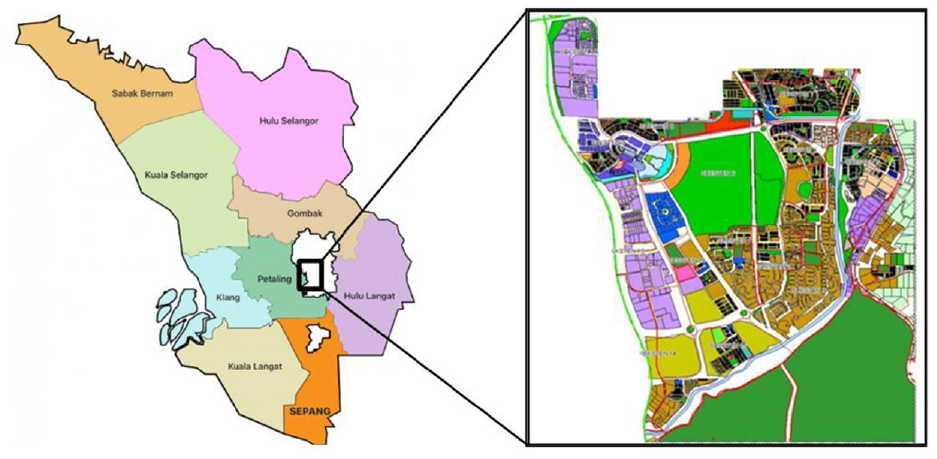
Bandar Baru Bangi, Selangor.
Sample Size
The total population of Bandar Baru Bangi was reported to be approximately 30,861 (Kajang Municipal Council, 2014). Therefore, with a 95% level of confidence, the minimum sample size required for the study was 379 respondents. It was calculated based on Krejcie and Morgan’s (1970) approach.
Data Collection
The study was conducted using an online survey where the targeted respondents were Bandar Baru Bangi residents aged 21 years old and above, currently working or employed. The characteristics were chosen as a WTP study requires respondents to understand the hypothetical scenario of an environmental problem for the correct estimation of WTP. The other reason was a WTP study is related to valuing a non-marketable item that requires a person to be employed. A questionnaire survey method was employed in this study. The questionnaires were designed using Google Form and were distributed through social media platforms, mainly Facebook. The data collection process started from April 1st to 23rd, 2021. This method is considered appropriate in WTP estimation since there are no differences between face-to-face interviews and internet surveys as reported by Lindhjem and Navrud (2011). Due to the unavailability of statistical data for eligible respondents, the samples were selected based on a convenience sampling approach instead of random sampling. The same sampling approaches were also used by O’Brien and Thondhlana (2019) to study plastic bag use in South Africa. Since the targeted respondents were living in Bandar Baru Bangi, the questionnaires were distributed through several Bandar Baru Bangi community groups available on Facebook.
Before the data collection, the questionnaire was validated by four experts from the environment and social sciences. The average content validity index for the scales (S-CVI) were found at 1.00 for the consumers’ plastic bag consumption behavior section, 0.96 for the WTP section, and 0.84 for the social and campaign influence section. Based on the results, all instruments achieved more than 80% agreement by all expert reviewers (Davis, 1992), which indicated that the data collection instrument was acceptable. It was then pilot tested by obtaining responses from 31 eligible respondents. The reliability test (Cronbach’s alpha) was then analyzed for all relevant items to ensure that the variables used could measure the intended scope of the study. Cronbach’s alpha coefficient of scales were found to be above .7 (Pallant, 2011) for all scales (Social = 0.839; campaign = 0.886).
The questionnaire started with an introduction which was followed by three screening questions. This was to ensure that the respondents were eligible to participate in this study. Ineligible respondents were directed to the end of the questionnaire, whilst the eligible respondents were directed to the next section, which consisted of the respondents’ demographic background questions. This was followed by the second section which asked questions on the respondents’ plastic bag consumption behaviors.
The third section was related to the respondents’ WTP for biodegradable plastic bags (Table 1).
Consumers’ Willingness to Pay for Plastic Bags and Biodegradable Plastic Bags.

This section started with an introduction on environmental problems associated to plastic bag disposal, the plastic bag levy, biodegradable plastic bags, and the purpose of asking the WTP question. It was followed by “yes” or “no” questions on the consumers’ WTP for biodegradable plastic bags. The respondents were then asked on their WTP for biodegradable plastic bags based on the payment card method. They were given 10 monetary values as options, starting from MYR 0.30 to MYR 4.50. This was due to the cost of producing a single biodegradable plastic bag is approximately at MYR 0.15 to MYR 0.25 (Ravindran, 2019).
To assess social and campaign influence on consumers’ WTP decisions, eight questions, on a 5-point Likert scale ranging from 1 to 5, were asked in the following section. The questions were divided into two, where four questions represented the social influence variable whilst the remaining questions represented the “No Plastic Bag” campaign variable. The scale used ranged from “Strongly disagree = 1,”“Disagree = 2,”“Neutral = 3,”“Agree = 4,” to “Strongly agree = 5.” The operationalization of the variables used is as tabulated in Table 2.
Definitions of the Multi-Item Constructs for Social and Campaign Influence.

Model Specification for Consumers’ Willingness to Pay
Factors influencing the respondents’ WTP decisions for plastic bags were determined using the model as presented below. The variables were identified from the literature review as well as the research gap. The respondents’ WTP decisions based on the monetary value that they were willing to pay for a single plastic bag were used as the dependent variable (DV).
In determining the factors influencing the respondents’ WTP decisions for biodegradable plastic bags, the model as presented below was used.

where,
WTP biodegradable plastic bags = dependent variable (1 = MYR 0.30 to 10 = MYR 4.50)
Age = age of the respondent (1 = 21–29 years old to 5 = >than 60 years old)
Education = education level of the respondent (1 = primary school to 7 = doctorate degree)
Income = monthly income of the respondent (1 = <MYR 2,501 to 5 = >15,000)
Social = Social influence to stop using plastic bags (1 = strongly disagree to 5 = strongly agree)
Campaign = “No Plastic Bag” campaign (1 = strongly disagree to 5 = strongly agree)
Frequency of plastic bag request = Likert scale (1 = never to 5 = always)
Frequency of using shopping bags = Likert scale (1 = never to 5 = always)
Importance of plastic bags = Likert scale (1 = not important to 5 = very important)
Perceived ease of use = Likert scale (1 = strongly disagree to 5 = strongly agree)
Perceived usefulness = Likert scale (1 = strongly disagree to 5 = strongly agree)
ε = random error
Data Analysis
All data collected were recorded in an excel spreadsheet and were then transferred into the Statistical Package for the Social Sciences (SPSS) version 25. Using SPSS, descriptive statistics (frequencies, percentages, and means) were performed to analyze the frequencies of the responses for consumers’ demographic background, consumers’ plastic bag consumption behaviors, and social and campaign influence. For the estimation of consumers’ WTP, this study has adopted the lower bound mean (LBM) formula (Turnbull, 1976).

Where π i are the percentages of support for a given amount of pi, p0 is the initial bid, and k is the number of bids offered. The relationships of the independent variables with consumers’ WTP decisions were tested using ordered probit regression. This analysis was performed by using STATA 16 software.
Results and Discussion
Socio-Demographics of the Respondents
A total of 488 respondents’ completed the questionnaires (Table 3), out of which about 63% were females and 37% were males. Although the distributions of gender were not in line with the Department of Statistics Malaysia (2020), where males cover 52% of the country’s population, this figure seems to be consistent with the previous online studies on WTP for a plastic bag (Dunn et al., 2014; O’Brien & Thondhlana, 2019). In these studies, females were found to represent 69% of the total sample. Most of the respondents were in the range of 30 to 39 years old (43%), followed by people in the range of 40 to 49 years old (29%). This finding showed that most of the respondents were at the young age group. In terms of marital status, 80% of the respondents were married, and 19% were single.
Socio-Demographic Profiles of the Respondents (n = 488).
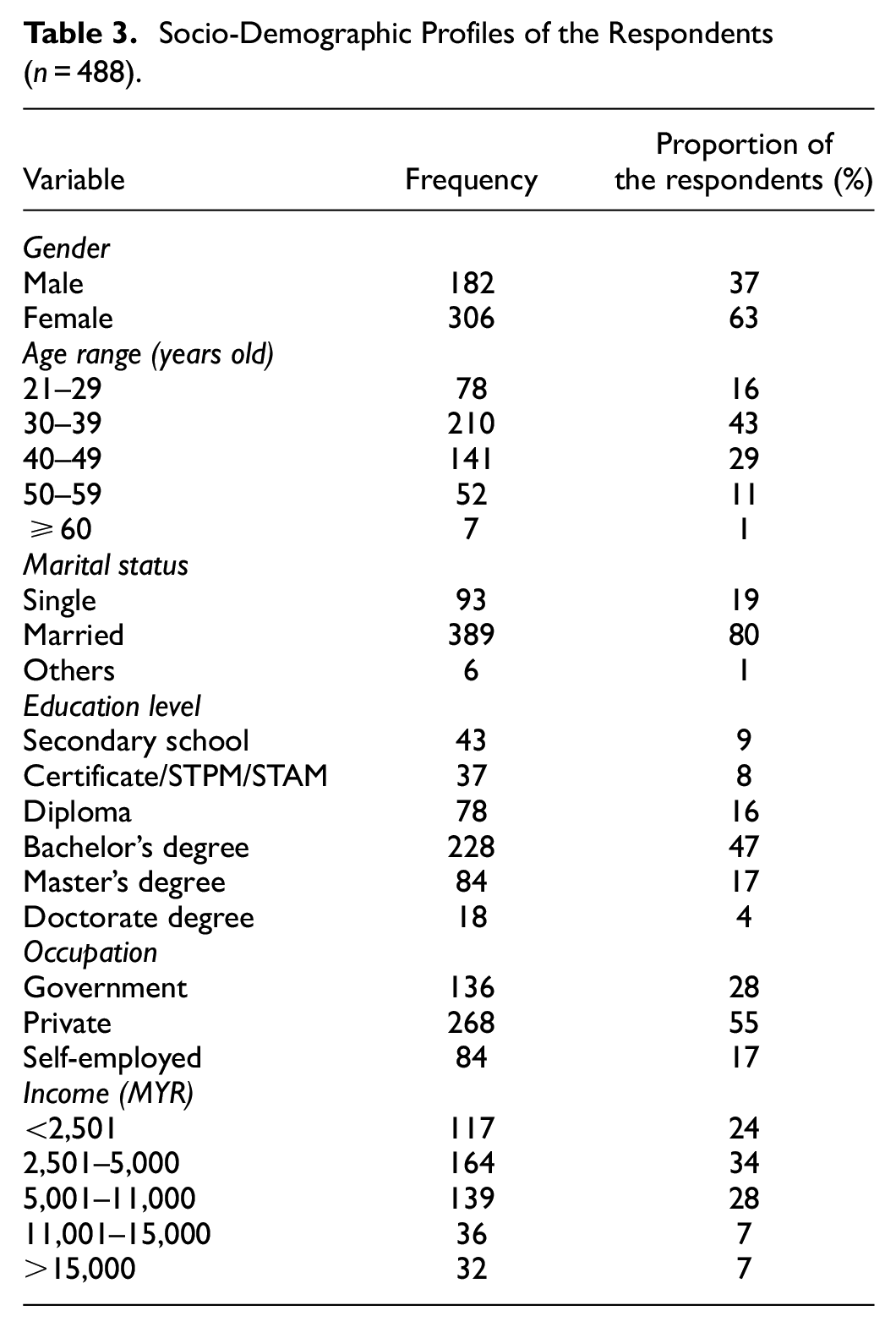
Generally, most of the respondents in this study were highly educated, as 47% of them had completed at least a bachelor’s degree followed by 17% with a master’s degree. More than 90% of the respondents had completed their tertiary education which is considered higher than the country’s distribution of educational level, that is, 24% of the population received tertiary education (Goh & Tey, 2018). As for the monthly income of the respondents, 33% of the respondents earned MYR 2,501 to MYR 5,000 per month, followed by 28% with the monthly income of MYR 5,001 to MYR 11,000 per month. The median income was found at MYR 2,501 to MYR 5,000 per month, which was higher than the country’s median (MYR 1,500 per month per individual) (Goh & Tey, 2018). The data also indicated that 55% of the respondents were employees in the private sector while 28% were government servants. There were also respondents who were self-employed (17% of the total sample).
Consumers’ Plastic Bag Consumption Behaviors
We investigated their habits of requesting plastic bags during shopping trips to assess the consumers’ plastic bag consumption behaviors. We found that there was a high number of requests for plastic bags with 28% of the respondents answering “often” and 13% answering “always.” In contrast, only 2% of the respondents answered “never” and 26% answered “seldom.” The mean score for the question was found to be 3.23 (Table 4). A similar study conducted by Poortinga et al. (2016) in England, Wales, and Scotland found that only 10% of the consumers were either “often” or “always” requesting plastic bags after the introduction of the plastic bag levy. This finding may indicate that while the current plastic bag price has somehow induced the reduction of plastic bag consumption, the price is still too low to change the consumers’ habits. With 41% of the respondents still requesting plastic bags during their shopping trips, the government’s move against the plastic bags through a levy/tax has been shown to be ineffective. We then examined the percentages for each socio-demographic category variable regarding the habits of requesting plastic bags during shopping. The results showed that 49% of the respondents with no tertiary education always requested plastic bags. Similar results were also found for the respondents with low (45%) and high income (46%). It could be possible that a high tendency to request for plastic bags for the low-income group was due to the low education level. For respondents with higher education levels, it is believed that the high frequency of plastic bag requests was due to the low plastic bag price. Although people with high educational levels tend to have higher environmental awareness (Aminrad et al., 2011), they may unconsciously request plastic bags as they have a higher purchasing power. Thus, it is not surprising that the existing plastic bag price being imposed seemed to be effective in changing the behavior of the middle-income group alone (28%).
Consumers’ Plastic Bag Consumption Behaviors.

In this study, we also found that only 29% of the respondents were either “often” or “always” bringing their shopping bags when they shopped. The rest indicated that they either “never” or “seldom” brought their shopping bag. The mean score was found to be 2.79 implying the frequency of plastic bags requested and the trends of bringing their own shopping bags may go hand in hand. It was also found that the trend of “bringing your shopping bags” increased with the rising of the educational level. This was indicated by the low mean value (M = 2.60) recorded for people without tertiary education level. The highest mean was found to be 3.11, representing the respondents with at least a master’s degree level. Similarly, in terms of percentage, only 21% of the respondents with no tertiary education level either “often” or “always” brought their shopping bags as compared to the respondents with higher education levels (Certificate/STPM/STAM = 22%, diploma = 28%, bachelor’s degree = 29%, and master’s degree = 37%). Our result was corroborated with that of Asmuni et al. (2015) who found only 29% of the consumers brought along their shopping bags while shopping. This somewhat implies there was possibly no difference in the consumers’ plastic bag consumption behavior from 2014 to 2021. Compared to England, Wales, and Scotland, where the plastic bag levy has increased the use of reusable shopping bags from 70% to 93% of the consumers (Poortinga et al., 2016). This indicates that their plastic bag price is efficient in changing consumers’ plastic bag consumption behaviors. Therefore, there is an imperative need to revise our plastic bag price to change the consumers’ plastic bag consumption behavior in Malaysia.
In terms of respondents’ perceptions on the number of plastic bags used, the mean was found at 2.45 which indicated that in general, the respondents perceived that their plastic bag consumption was relatively small. We found that only 10% of the respondents believed that the number of plastic bags that they used was either “excessive” or “very excessive.” In fact, almost half of them (48 %) considered their consumption as either “small” or “very small.” The majority of the respondents (83%) answered that they requested one to three plastic bags per shopping trip, where the mean score lies at 2.10. The respondents who always requested for four to six plastic bags perceived that their plastic bag consumption was sufficient while those who always requested for seven to nine plastic bags per shopping trip perceived it as excessive. The respondents who requested for more than nine plastic bags per shopping trip perceived their plastic bag consumption as very excessive. The observed trend showed that despite using plastic bags, the respondents were aware on the number of plastic bags that they used, which reflected a positive sign of the respondents’ environmental awareness (as emphasized by Ruf et al., 2022, but see Hao et al., 2019).
Ironically, 28% of the respondents still requested plastic bags no matter how small the item they bought. Only 27% of them indicated the vital role of plastic bags in carrying merchandise. Almost half of them (46%) perceived plastic bags as the least important. Similarly, the mean score was found at 2.79, indicating that plastic bags were moderately important for the respondents when they shopped. This finding may imply that the respondents were open to any other alternative for a plastic bag if it could function the same way.
We further performed a descriptive analysis on the respondents’ perceptions on the existing plastic bag price. The result indicated that 40% of the respondents supported the policy while it was slightly higher as compared to those who were against it (32%). However, the mean value of 3.10 obtained for the question indicated that the respondents did not strongly support the current plastic bag price policy.
Social Influence and Campaigns
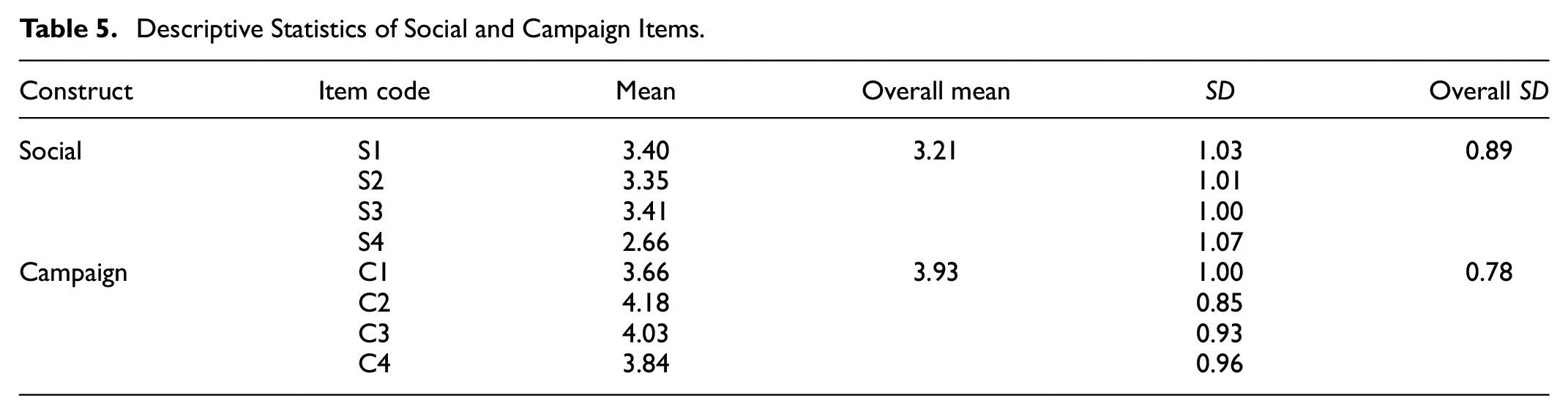
To assess social influence and impact of environmental campaigns on consumers’ WTP decisions, the respondents moderately agreed that their plastic bag consumption was influenced by their social environment in which they live (Table 5). It was found that the respondents’ decisions in reducing their plastic bag consumption was influenced by people who were important to them (M = 3.40), people who could influence their behaviors (M = 3.35), and people of whom they valued their opinions (M = 3.41). It was also found that the respondents moderately agreed that they would be perceived as outdated if they were still using plastic bags (M = 2.66). On the “No Plastic Bag” campaigns, the respondents agreed that the campaign helped in protecting the environment by reducing plastic bag usage (M = 4.18). It was also found that the respondents agreed that the campaigns have successfully delivered the message of the adverse environmental effects from the consumption of plastic bags (M = 4.03) and it was found to be informative (M = 3.66) and helpful in helping the respondents to reduce their plastic bag consumption (M = 3.84).
Descriptive Statistics of Social and Campaign Items.
Willingness to Pay for Biodegradable Plastic Bags
In the case of a biodegradable plastic bag as an alternative for the plastic bag, we found that 90% of the respondents were willing to pay for a single biodegradable plastic bag. This showed a high acceptance of respondents for the biodegradable plastic bag as an alternative to the plastic bag. Similarly, the respondents were also asked to value how much money they were willing to pay for a single biodegradable plastic bag based on the payment card method ranging from MYR 0.30 to MYR 4.50. Table 6 provides the cumulative percentages of the consumers’ WTP based on the payment card.
Cumulative Percentages of Consumers’ Willingness to Pay for a Single Biodegradable Plastic Bag (n = 488).
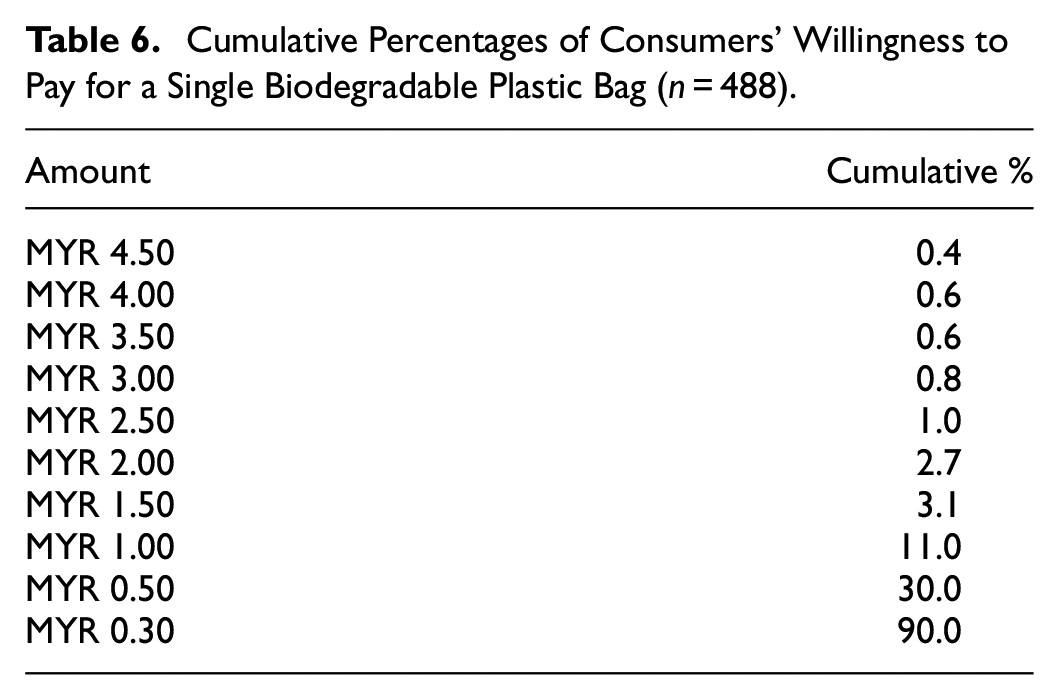
Based on the result, the majority of the respondents were willing to pay at least MYR 0.30 for a single biodegradable plastic bag while 30% were willing to pay more. Like the WTP for plastic bags, the consumers’ mean WTP for biodegradable plastic bags was estimated using the LBM formula. The estimated consumers’ WTP for a single biodegradable plastic bag was:

Based on the equation above, the mean willingness to pay for a single biodegradable plastic bag was estimated at MYR 0.43, which indicated that the fair price to promote the use of biodegradable plastic bags ranges from MYR 0.30 to MYR 0.40. The minimum price was based on the cost of producing a single biodegradable plastic bag that is approximately at MYR 0.15 to MYR 0.25 (Ravindran, 2019).
Factors Influence Consumers’ Willingness to Pay Decisions
Based on probit regression model, only age, education level, and environmental campaign were significant with consumers’ WTP decisions for biodegradable plastic bags (Table 7). It was observed that the consumers’ WTP decisions for biodegradable plastic bags were influenced by respondents’ age (p = .003, ß = −.158), education level (p = .001, ß = .136), and “No Plastic Bag” campaign (p = <.001, ß = .251). Furthermore, we found that the consumers’ WTP for biodegradable plastic bags was influenced by perceived usefulness (p = .048, ß = .138) of biodegradable plastic bags.
Ordered Probit Regression Result for the Respondents’ WTP Decisions.

Significant result at p < .001. **Significant result at p < .05 level. *Significant result at p < .1.
Such findings are consistent with that of Madigele et al. (2017), where the age of the respondents was found to have impacted their WTP decisions. The role of age on consumers’ decisions on conventional plastic bags and biodegradable plastic bag prices was noted as being the younger age group of respondents were willing to pay more compared to the older age group. This possibly indicated that there was a gap in environmental awareness across ages. This finding is in line with Song et al. (2012) who found that the younger age group demonstrated more pro-environmental behavior compared to the older age group regarding plastic bag usage. Therefore, this implies that the reason for the higher WTP of the younger age group was likely due to their concern for the environmental impact of the disposal of plastic bags. Gaffey et al. (2021) also found similar results depending on the country involved in their study.
Regarding the influence of education level on consumers’ WTP, the trend indicated that the respondents with higher education levels also valued the price of conventional plastic bags and biodegradable plastic bags based on their negative perception of the plastic bags toward the environment. This finding is supported by Aminrad et al. (2011) who also found that environmental awareness was also influenced by the level of education of an individual. The findings also showed that the “No Plastic Bag” campaign had successfully influenced people to value plastic bags at a higher price. Similarly, O’Brien and Thondhlana (2019) also found that education and environmental consciousness contributed to people’s WTP even though the relationships were generally weak. Another study by Subahir (2014) on WTP for biodegradable plastic bags in Selangor also showed that consumers’ decisions were influenced by the price, age, gender, and income, although little emphasis was given on consumers’ behavior on plastic bag usage.
In regard to consumers’ willingness to pay for plastic bags, the consumers’ perceived usefulness of biodegradable plastic bags was found to be significant in valuing its price. It was found that the respondents who perceived biodegradable plastic bags as useful, beneficial, easier to use than reusable bags, and able to facilitate their shopping activities tended to value the biodegradable bag price higher. The results also demonstrated that the consumers’ WTP decisions were not influenced by income and social surroundings. This finding is inconsistent with the studies conducted by Madigele et al. (2017) and O’Brien and Thondhlana (2019), where the income of the respondents was found to have impacted their WTP decisions.
Conclusion
This study indicated that the overall plastic bag consumption among the working-class consumers in Bandar Baru Bangi is still high. This study revealed the reason for the continued usage of plastic bags was because of the respondents had become accustomed to such carrying bags. Moreover, since the plastic bags are readily available at the checkout counter, they did not mind paying for them. In terms of the life cycle of plastic bags, the study indicated that most of the plastic bags end up as garbage after secondary use. This is a good indication of the sustainable behavior of the respondents where the plastic bags were not disposed of after only a single use. However, the reuse of plastic bags for shopping was found to be low among the respondents as only 14% of the respondents reused plastic bags for their shopping. It should be stressed that if the country intends to shift toward circular economy and bioeconomy, it is still best to promote the reuse of plastic bags for shopping as they can be reused more before ending up as garbage.
On the consumers’ WTP for biodegradable plastic bags, the mean WTP were found at MYR 0.43. It was also found that the consumers’ WTP decisions for biodegradable plastic bags were influenced by their age and education as well as respondents coming from the younger age group and those with higher education levels. Our findings support the fact that the “No Plastic Bag” campaign played a vital role in influencing consumers’ WTP decisions.
It is suggested that an option be given to the consumer as to whether they want conventional plastic bags or biodegradable plastic bags. One of the reasons for using plastic bags is due to them being readily available for shopping. As there was a high acceptance and intention to use biodegradable plastic bags, as well as the majority of the respondents being willing to pay for biodegradable bag at the mean price of MYR 0.43, it is suggested that all shopping malls and shops should provide biodegradable plastic bags for shoppers as another attempt to support bioeconomy. Although, it was reported that the cost to produce a biodegradable plastic bag is approximately at MYR 0.15 to MYR 0.25, and the retailers might have a problem to sell the biodegradable plastic bags due to its high production cost and based on the mean WTP of biodegradable plastic bags, it can be sold at the price of MYR 0.40 per bag. Since the “No Plastic Bag” campaign had a significant influence on consumers’ WTP, it is also suggested that a similar campaign be conducted to further reduce the plastic bag consumption. More focus should be given to those who have low environmental awareness such as people with education lower than tertiary education as well as the older age group. These strategies are believed to be effective in changing consumers’ behaviors toward sustainable behaviors in preparing the community to achieve Malaysia’s Roadmap toward Zero Single-Use Plastics 2018 to 2030.
On the limitations of the study, our survey was conducted based on convenience sampling method only in Bandar Baru Bangi, one of the towns in Malaysia, which might not be the actual representation of the entire country. This might lead to under or over representation of certain groups in the study. Nonetheless, we believe our study had captured a portion of opinion of the general public considering the socio-economic demographics of the respondents.
Policy Implications
Being a country with rich terrestrial and marine biodiversity which are vulnerable to plastic waste pollution, in addition to abundant of natural resources that can support circular and bioeconomy of the country, Malaysia should implement more effective policy in response to problem dealing with plastic waste. In line with the movement toward achieving bioeconomy, the country is the second in Asia and the first in Southeast Asia to establish its own national bioeconomy initiative with a National Bioeconomy Blueprint developed with provision of fiscal incentives and grants to support such initiative. This study certainly serves as an initiate step to determine socio-economic indicator of bio-based products as indicated by high level of consumers’ acceptance toward biodegradable plastics. With the success of limiting the use of conventional plastic bags, the country should take a step ahead to implement the nationwide ban of conventional plastic bags within the next decade. As compared to developed countries, it is expected that the challenges would be greater in terms of changing consumers’ behavior and transitional use of conventional raw fossil to bio-based products in the near future. Further understanding and intervention with respect to technological development of bio-based products as part of social innovation as well as environmental protection goals should be explored and improved in the country. This would certainly create more job opportunities and require more expertise in multidiscipline research and development. More research collaborations into these aspects among academicians and bio-based industrial players should further promote achievement of these goals in the long run.
Footnotes
Acknowledgements
The authors would like to thank the five validators for their assistance in validating the questionnaire of this research.
Declaration of Conflicting Interests
The author(s) declared no potential conflicts of interest with respect to the research, authorship, and/or publication of this article.
Funding
The author(s) disclosed receipt of the following financial support for the research, authorship, and/or publication of this article: The publication fee for the article was funded by the Research Management Centre, Universiti Putra Malaysia.

Data Availability Statement
Data available on request due to privacy/ethical restrictions.