




Abstract
The purpose of this study is to analyse the structural relations between L2 learners’ mindsets, L2 grit and the L2 motivational self-system (L2MSS). The main driving force behind the study is the observation that mindsets have emerged as a significant variable in language-teaching research over the past years. The study was conducted with 403 L2 learners. To see the structural relations between and among the variables in the study, a structural equation model was used. The revised model showed that a growth mindset affects both the perseverance of effort (POE) and the consistency of interest (COI), which are the components that make up grit. Moreover, POE and COI mediate the relationship between the growth mindset and L2MSS, with the highest mediating impact between growth mindset and ideal L2 self. The study discovered that a fixed mindset only predicted ought-to L2 self/others. Finally, several theoretical and pedagogical implications are proposed based on the findings of the study.
Introduction
L2 mindsets have received considerable attention over the last decade (Derakhshan, Fathi et al., 2022; Khajavy, MacIntyre, & Hariri, 2021; H. Wei et al., 2019). Existing research links mindsets (Mouratidis et al., 2017), to grit (Akos & Kretchmar, 2017) and L2MSS to academic performance (Yousefi & Mahmoodi, 2022), ideal L2 self being the most influential factor in success (Papi et al., 2020). Similarly, some studies discovered a link between grit and mindsets (Khajavy, MacIntyre, & Hariri, 2021). Researchers have also investigated the link between language mindset and L2 success (Khajavy, 2021). Although some of these studies partially supported the link between mindsets and the other variables mentioned above, most point out the role of mindsets in a number of variables. Hence, working on mindsets could shed light on significant issues (e.g., Lou & Noels, 2019). Depending on the complexity theory in analyzing affective factors (Hiver & Papi, 2019; Larsen-Freeman, 2011), it can be suggested that rather than stand-alone factors, mindsets work well with in tandem with other factors, including motivational variables. A huge body of research supports this proposition (Khajavy, MacIntyre, & Hariri, 2021; Mercer & Ryan, 2010; Papi, Rios et al., 2019; Sato, 2022). For instance, Zarrinabadi et al. (2021) indicated that growth mindset acted as a mediator between autonomy and support on communicative competence. Several experimental studies found a link between mastery goals and a growth mindset (Lou & Noels, 2017). Similarly, Papi, Rios et al. (2019) proved that learners with a growth mindset were better at soliciting feedback. In this study, we, therefore, propose that language mindsets could be linked to L2 grit and L2MSS.
Over the past decades, the advent of positive psychology triggered the “emotional turn”, representing a significant line of research in SLA (Derakhshan, 2022; Prior, 2019) after the long pre-eminence of the cognitive approach in SLA practices and research. This intense focus on emotions, which culminated in the rise of the concept of Positive Psychology (PosPsy), paved the way for the investigation of positive aspects (such as grit, hardiness, buoyancy, grit and mindsets), rather than negative ones (such as anxiety) in SLA. This shift generated a huge amount of interest among researchers who wanted to foreground positive aspects such as grit, willingness to communicate, and enjoyment in language learning (Alamer, 2021a; MacIntyre et al., 2019). In line with this interest, the present paper focuses on L2 learners’ grit, their mindsets and their relation to L2MSS.
Several reasons motivated the present study. First, individual differences (IDs) such as emotions along with elements of student psychology, including L2 grit and L2MSS, have been shown to be vital in the L2 learning process (Dewaele & Li, 2020; Larsen-Freeman, 2018; Oxford & Khajavy, 2021; Pawlak, 2020; Tu, 2021). The significance of positive psychology for L2 learning has been underlined by leading researchers who emphasized the complex network of emotions at work during L2 learning rather than handling each variable as a stand-alone factor. (Dewaele et al., 2019; MacIntyre, 2021; Plonsky et al., 2022). The second reason that motivated the present study is the explosion of research on positive psychology components and the rising trend to re-conceptualize some mainstay variable in SLA research (e.g., motivation or aptitutde). Third, with their domain-specific nature of mindsets (Ryan & Mercer, 2012), researchers assume that they should be studied in language teaching as they have the potential to provide more insight into in the language learning process (Lou & Noels, 2019). Fourth, few studies worked the interrelations between mindsets, grit, and L2MSS in the context of Turkish educational system. Finally, according to Yang et al. (2022), most studies on L2 grit come from Western contexts and more studies should cover the non-western ones. Hence, we believe that identifying the structural relations between L2 learners’ language mindsets, grit and L2MSS is important for language-teaching contexts, for the practices of language teachers, and for better theoretical evaluation of the interrelation between positive psychology constructs.
Theoretical Background
Language Mindsets
Language mindsets are commonly defined as “domain-specific beliefs about whether the ability to learn languages is malleable or not” (Lou & Noels, 2019, p. 2). Focusing more on the affective and emotional side of learning, mindsets are different from beliefs or cognitions and hence are thought to play a significant role in motivation (Lou & Noels, 2017, 2019). While growth mindsets signal that language learning ability is cultivable, fixed mindsets signal that language learning abilities are fixed and cannot be changed despite effort.
Recently, a substantial body of research focused on L2 mindsets (Derakhshan, Fathi et al., 2022; Dong, 2022; Lou & Noels, 2019). Growth mindsets are linked to motivation (e.g., Lou & Noels, 2017) engagement (Sadoughi & Hejazi, 2023), academic achievement (Khajavy, MacIntyre, & Hariri, 2021), or ideal L2-self (e.g., Sadoughi et al., 2023). Other studies associated growth mindset to higher motivation (Waller & Papi, 2017), increased feedback-seeking behavior (Papi, Rios et al., 2019), lower L2 anxiety (Lou & Noels, 2020b; Sadoughi & Hejazi, 2023), L2 speaking self-confidence (Ozdemir & Papi, 2022) and higher motivation (e.g., Lou et al., 2017; Lou & Noels, 2017). Moreover, the literature suggests that a growth mindset significantly predicts L2 grit (Teimouri et al., 2022). In particular, Zarrinabadi et al. (2022) pointed out the impact of a growth mindset on the ideal L2 self.
In addition, learners with a growth language mindset may be more adaptable and diligent (Ryan & Mercer, 2012). Moreover, learners with a strong growth mindset could counter hurdles and react positively to failures than learners with a strong fixed mindset. Some studies have identified a relationship between mindsets and academic success (e.g., Mouratidis et al., 2017) whereas others failed to find any link between mindsets and success (e.g., Eren & Rakıcıoğlu-Söylemez, 2023). Growth mindsets are critical for students’ tenacity and long-term success (Yeager & Dweck, 2012). Context can help learners to build growth mindsets, and teachers can help them to improve their mindsets (Haimovitz & Dweck, 2017; Lou & Noels, 2017). Dong (2022) recently reported that a growth mindset prevents the emergence of negative emotions for young learners. Additionally, previous research has indicated that educating students about growth mindset leads to moderate increases in academic success (Rattan et al., 2015; Shoshani, 2021; Yeager, Romero et al., 2016). In addition, it has been shown that mindset interventions lead to more sustainable mindsets (Schmidt et al., 2015).
On the other hand, learners with a fixed mindset feel that their abilities or talents are fixed and hence difficult to modify or develop. A number of negative aspects have been linked to a fixed mindset. Dong (2022) found that a fixed mindset correlated with anger, shame, hopelessness, boredom and anxiety. Wang, Shirvan et al. (2021) stated that learners with a fixed mindset suffered more from boredom. Furthermore, learners with a fixed mindset also avoid challenging jobs assuming that their efforts will not be up to the task (Papi, Bondarenko et al., 2019). What is more, those with a fixed language mindset suffer from a lack of control in their learning process (Lou & Noels, 2019). Following this line of research, we hypothesize that a fixed mindset in this study will predict ought-to L2 self/others as studies have suggested that language mindsets could be related to students’ L2 learning motivation (e.g., Lou & Noels, 2017).
A fixed mindset also indicates that language acquisition is a fixed and intrinsic talent, and that learners must depend on their aptitude to become competent language learners (Ryan & Mercer, 2012). Failure indicates that someone lacks the required skills to be successful in a fixed mindset; however, failure in a growth mindset indicates the need for additional effort to be put into learning (Ryan & Mercer, 2012). Similarly, Teimouri et al. (2022) found a negative link between the two sub-dimensions of L2 grit and fixed mindset. In the present study, we tested this relation in addition to measuring the mediating role of L2 grit between mindsets and L2MSS.
The good news is that growth mindsets are thought to be cultivable provided that teachers help learners to enhance their abilities and encourage them to create learning objectives (Lou & Noels, 2019). Learners who are given more assistance in the learning context could be more likely to acquire a growth mindset (Lou & Noels, 2017). Although studies on mindsets abound, to the best of our knowledge, there is only one which has dealt with the correlation between grit and mindsets (Khajavy, 2021), and no study has been conducted specifically to look for a link between mindsets, grit, and L2MSS. Any potential correlation between L2 grit and L2MSS could offer significant insights into the motivational aspects of L2 learning and opportunities for the betterment of the instruction process. Hence, this paper was designed to investigate the link between mindsets, grit and L2MSS.
Grit
Defined as a combination of “perseverance and passion for longterm goals” by A. L. Duckworth et al. (2007, p. 1087), grit consists of two major components which are perseverance of effort (POE) and consistency of effort (COI). POE indicates a person’s proclivity to devote long-term energy whereas COI indicates a person’s consistency in pursuing a higher-order objective despite problems, hurdles, or setbacks. Recent studies have underlined the role of grit as a crucial predictor of positive outcomes on the part of learners (Alamer, 2021a; Credé et al., 2017; A. Duckworth & Gross, 2014; Khajavy & Aghaee, 2022; Teimouri et al., 2022). Although evidence as to the relationship between grit and academic success does not seem to be conclusive, grit has been related to several psychological factors such as self-efficacy (Usher et al., 2019), L2 engagement (Khajavy, 2021), commitment (Hodge et al., 2018), and willingness to communicate (Cheng, 2021; Teimouri et al., 2022), including L2 motivation (Alamer, 2021b; Feng & Papi, 2020), and mindset (Teimouri et al., 2022). Furthermore, research has shown that gritty learners outperform less gritty learners on achievement assessments and course grades (Keegan, 2017). Grittier learners were found to have higher educational goals and better grades at high school (Eskreis-Winkler et al., 2014). Grit was also linked to ideal L2 selves (Feng & Papi, 2020), which is also tested in the present study.
COI, one of the sub-dimensions of L2 grit, is believed to be related with L2MSS given that both constructs are crucial to future success in the learning process. According to Alamer (2021a), ascertaining the relationship between both concepts could improve the construct validity of COI. Given that grit has been positively connected to many factors, we hypothesized that it could also predict L2 learners’ L2MSS and moreover it could mediate the relationship between mindsets and L2MSS. The potential relationship between grit and growth mindset has already been underlined by A. L. Duckworth (2016). Given the significance of grit in sustaining long-term goals, in the present study, we hypothesize that L2 grit could affect L2MSS, especially the ideal L2 self.
L2 Motivational Self System
In the present study, we proposed L2MSS as the outcome variable depending previous reports (e.g., Feng & Papi, 2020; Lou & Noels, 2017, 2019). For example, Lou et al. (2017) reported that language mindsets are strongly connected to language learners’ internal motivation, the growh mindset being more influential. Hence, in the present study, we aim to see whether the direct relations between mindsets and L2MSS are mediated by L2 grit. As was stated, grit emerged as a significant person-based trait over the last years impacting a number of other variables. Therefore, it is hypothesized that it could also mediate the relation between mindsets and L2MSS.
Over the last decade, L2MSS has emerged as a significant way of accounting for the multi-faceted nature of L2 motivation and has received considerable attention (e.g., Al-Hoorie, 2018; Khany & Amiri, 2016; Safdari, 2021) with its strong theoretical basis in explaining learner motivation. Several meta-analyses and review studies have shown that L2MSS is the most viable and capable framework for studying learner motivation (e.g., Al-Hoorie, 2018; Boo et al., 2015; Mahmoodi & Yousefi, 2022).
Dörnyei (2009) proposed three core components of L2MSS: “the ideal L2 self,”“the ought-to L2 self,” and “the L2 learning experience.” The ideal L2 self is the desirable self-image of an L2 leaner projected for the future. The ought-to L2 self concerns the traits which learners think they should have to be good language learners. Finally, the L2 learning experience is about the extent to which Dörnyei’s (2009)“ideal self/own” and “ought-to self/others” merge into L2MSS, leaving out the others. The rationale for this omission appears to be specifically to avoid any misunderstandings about the difference between the students’ ideal L2 self and ought-to L2 self (Dörnyei, 2009). However, Teimouri (2017) bifurcated the ought-to L2 self into ought-to L2 self/own and ought-to L2 self/others. Such a distinction was thought to be significant for this study given that we focused on the relations between growth mindset, fixed mindset, POE, COI and L2MSS. The effort variable here matches well with the underlying component in Teimouri’s (2017) tripartite model, which was mainly based on intended effort.
The differentiation of future L2 selves as own versus other provided a new research pathway (Safdari, 2021). Moreover, the addition of “self” to the motivating factors of second language acquisition changed the previous conceptualization of integrativeness (Safdari, 2021). Dornyei et al. (2006) ascertained that integrativeness was not a strong predictor of motivation; instead, what drove L2 learners were more self-related factors. Given these new conceptualizations, in this study, it is suggested that the ideal L2 self will be more influenced by growth mindset and POE given that these two variables are more personal and more development-based.
The Present Study
On the basis of the review of literature, several hypotheses on the relationship between language mindset grit, and L2MSS were developed. Recent research has indicated that language mindsets tend to determine L2 learners’ motivation (Feng & Papi, 2020; Lou & Noels, 2017, 2019), growth mindset contributing to motivation while fixed minsets hindering motivation (Teimouri et al., 2022) According to Y. Liu (2022), learners’ mindsets and grit levels are contingent on their perseverance level rather than intellectual factors. One interesting finding regarding the sub-components of grit is that POE was found to be more prominent in predicting a number of other variables (e.g., Elahi Shirvan & Alamer, 2022; Schmidt et al., 2018). Hence, it is hypothesized that POE will be a more prominent predictor of L2MSS components, especially the ideal L2 self. A substantial body of research has been conducted on the relationship between learners’ mindsets and L2 grit. Yeager and Dweck (2012) found that there are relations between language mindsets and grit. Positive correlations were also reported between grit, growth mindset, hope and self-directed learning by C. S. Lee and Jang (2018).
Additionally, Khajavy, MacIntyre, and Hariri (2021) stated that there was a strong correlation between growth mindset and POE, and that fixed mindset did not predict POE and predicted COI negatively. Language mindsets were associated with students’ L2 learning motivation (e.g., Lou et al., 2017; Lou & Noels, 2017. Regarding the relationship between L2 grit and motivation, Gyamfi and Lai (2020) suggested that there is a considerable level of relation between L2 grit and motivation. In a meta-analysis conducted by Al-Hoorie (2018), it was concluded that the components of L2MSS were highly influential on the subjective efforts of learners. Hence, we propose that L2MSS is affected by the sub-dimensions of L2 grit. We, therefore, propose that it is possible to draw potential connections between learners’ mindsets, L2 grit, and their motivational intensity. The current study is predicated on an essential insight that language mindsets do not work as single components but rather in conjunction with other variables (Dweck & Yeager, 2019; Lou et al., 2022). Based on the discussion above, the following two research questions were formulated:
How do the mindsets, grit, and L2MSS components interact with each other?
To what extent are growth or fixed mindsets predictors of L2MSS?
Does grit act as a mediator between mindsets and L2MSS?
Methodology
Participants
Four hundred three (274 females and 129 males) freshmen students taking English classes at the English Language and Literature (ELL) Department of a state university in Türkiye participated the study. All the participants, chosen through convenience sampling, were Turkish. The participants’ ages ranged from 18 to 22 (M = 18.53, SD = 2.53). The data were gathered using online surveys throughout the spring semester of the 2021 to 2022 academic year. Participants were given notice that their responses would be kept confidential and anonymous.
Instruments
To collect data, three different scales were used. Since the participants were undergraduate students in an ELL Department, the scales were used in their original form. Detailed information about the scales is as follows:
Language Mindset Inventory (LMI)
The LMI scale consists of 18 items that reflect growth language and fixed language mindset factors (Lou & Noels, 2017), including “the beliefs about general language intelligence (GLB),”“second-language aptitude (L2B),” and “beliefs about age sensitivity (ASB)” in relation to language-acquisition issues. The LMI is a six-point Likert scale that ranges from 1 to 6 (“Strongly disagree” to “Strongly agree”). GLB explores whether or not L2 learners view language intelligence as fixed or incremental. L2B explores whether they view language learning as a fixed or an incremental capacity. Finally, ASB is related to whether L2 learners view age-related factors as fixed or changeable. Each of these three sub-dimensions is measured through six items. Three of the items in each category are about growth mindsets and three are related to fixed ones.
Foreign Language Grit Scale (FLGS)
The L2 grit scale used in our study was developed by Teimouri et al. (2022). FLGS comprises two factors with nine items, namely “perseverance of effort (POE)” and “consistency of interests (COI).” The participants were asked to respond on a five-point Likert-type scale ranging from 1—“Not at all like me” to 5—“Very much like me.” POE was measured through five items whereas COI was measured through four items. Teimouri et al. (2022) reported strong correlations between language-specific grit and L2 achievement (r = 0.27–0.35), which was relatively lower in domain-specific grit (rc = 0.06–0.21). In our study, we used Teimouri et al.’s (2022) two-dimensional scale because Teimouri et al. (2022) reported a high level of construct validity and internal consistency for the sub-scales (0.66 for CI and 0.86 for PE). Another reason for using that grit scale was that it was the first domain-specific scale. The factor structure and discriminant power of Teimouri et al.’s (2022) grit scale was validated by Mikami (2023).
Teimouri et al.’s (2022) scale was used in several studies with positive outcomes. First, Zawodniak et al. (2021) made use of the Polish translation of the scale and discovered significant differences between learners. Sudina and Plonsky (2021) also utilized this scale and found that grit was different from buoyancy and the industriousness aspect of conscientiousness. Longitudinal studies were also conducted using Teimouri et al.’s (2022) scale.
L2 Future Selves Scale
The L2 future selves scale used in the present study was prepared by Teimouri (2017). It is a six-point Likert-type scale containing 16 items. Responses range from “strongly disagree” to “strongly agree.” It encompasses three factors, “ideal L2 self, ought-to L2 self/own, and ought-to L2 self/others.” Ideal L2 self was assessed using eight items, four items were used for ought-to L2 self/own and four for ought-to L2 self/others.
Data Collection
The data collection process lasted throughout the spring semester of 2021–2022 academic year. The surveys were distributed as an online version. The data were collected from one state university in Türkiye and the lecturers who were recruited to help with the data collection process were informed about how to manage the data. Completion of the survey lasted around 40 mins.
Data Analyses
SPSS 24.0, JAMOVI 2.2.5 and MPLUS 7.4 were used to analyse the data. First, the data for outliers, normality of the data and missing values were checked by SPSS after negatively-worded items were reverse-coded. Second, the Cronbach alpha coefficient and coefficient omega (composite reliability) for each scale were calculated to check reliability through JAMOVI. Third, first-order confirmatory factor analysis for the FLGS and L2 future selves scales and second-order (hierarchical) confirmatory factor analysis for LMI were conducted to measure the structural validity. Finally, path analysis using the maximum likelihood assumption was used to measure both direct and indirect effects. To assess model-data fit, measures such as the Tucker-Lewis index (TLI), chi-square divided by degree of freedom (2/df), comparative fit index (CFI) and root mean square error of approximation (RMSEA) were applied. For the CFA and path analysis models, Hu and Bentler (1999) and Kline (2016) suggested that 2 ≤χ2/df ≤3, 0.05 ≤ RMSEA ≤ 0.08, 0.90 ≤ TLI ≤ 0.95, and 0.90 ≤ CFI ≤ 0.95 indicate an acceptable fit whilst 0 ≤χ2/df ≤2, 0 ≤ RMSEA ≤ 0.05, TLI ≥ 0.95, and CFI ≥ 0.95 show a good fit.
Results
Preliminary Analyses
CFA model types, goodness-of-fit indices and the item factor loadings of FLGS, L2 future selves and LMI scales are presented in Table 1.
Model Fit for Confirmatory Factor Analysis.
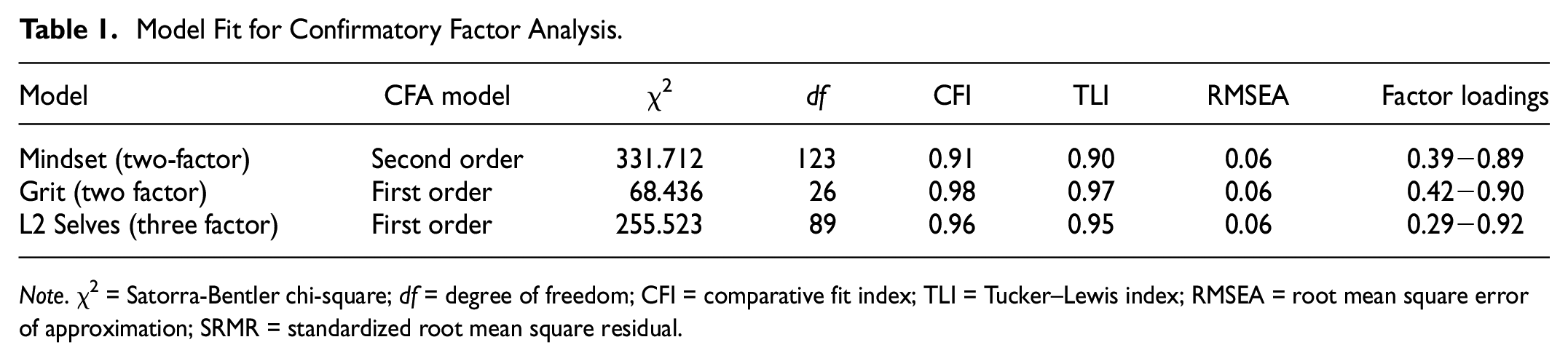
Note. χ2 = Satorra-Bentler chi-square; df = degree of freedom; CFI = comparative fit index; TLI = Tucker–Lewis index; RMSEA = root mean square error of approximation; SRMR = standardized root mean square residual.
Table 1 shows that the goodness-of-fit indices of the FLGS, L2 future selves and LMI scales reached the acceptable fit thresholds (Mindset: χ2/df = 2.70, CFI = 0.91, TLI = 0.90, RMSEA = 0.06; Grit: χ2/df = 2.63, CFI = 0.98, TLI = 0.94, RMSEA = 0.06; L2 Selves: χ2/df = 2.87, CFI = 0.96, TLI = 0.95, RMSEA = 0.06). Table 1 also shows the factor loadings of items for each scale. Although one item of the mindset scale (from the age sensitivity beliefs subscale: “How well a person speaks a foreign language depends on how early in life he/she learned it”) and one item of L2 selves (from ought-to L2 self/own: “I must learn English otherwise I will be considered as an illiterate in society”) were below 0.40, the whole CFA model was found to be acceptable, which supports the theoretical evidence, which is the highly recommended method in CFA (Kline, 2016). So, these two items were retained in the model.
Table 2 presents descriptive statistics (SDs, means, kurtosis, skewness and Cronbach’s alpha values/Composite reliability values-ω) and correlations of the constructs in SEM.
Descriptive Statistics and Bivariate Correlations.

Note. The findings showed that the normality assumptions were met since the skewness and kurtosis measures for each sub-scale were within the acceptable range of ±1.5 (Tabachnick & Fidell, 2013). CR = composite reliability (also termed ω); POE = perseverance of effort; COI = consistence of interest; Ideal = ideal L2 self; AVE = average variance extracted.
p < .05. **p < .001.
Path Analysis
Table 2 indicates that all the sub-scales are reliable because the reliability indices are above 0.07 (Dörnyei, 2007). To confirm convergent validity, the average variance extracted (AVE) values of the reflective constructs of fixed, growth, POE, COI, ideal, ought-to L2 self/own, and ought-to L2 self/others were calculated. Except for the construct of ought-to L2 self/own, all the variables were found to be above 0.50, confirming the convergent validity of these constructs. Previous studies have shown that if the AVE is below 0.5 with a composite reliability greater than 0.6, the convergent validity of the “ought” concept is still appropriate (Fornell & Larcker, 1981; Lam, 2012).
The hypothesized model was tested using MPLUS 7.4, depending on the maximum likelihood estimation. Figure 1 presents the initial model involving all possible paths.

The hypothesized model.
After removing the non-significant paths, the model was re-tested, as shown in Figure 2, which is the revised model. The adjusted model provided an adequate fit (χ2/df = 2.60; CFI = 0.91; TLI = 0.90; RMSEA = 0.05).

The corrected model.
Table 3 displays standardized estimates and confidence ranges for the factors’ significant direct and indirect impacts.
Estimates for Direct and Indirect Effects.

Note. β = standardized beta; CI = confidence interval.
As the findings of the direct effects in Figure 2 and Table 3 indicate, fixed mindset and POE significantly predicted ought-to L2 self/others (βfixed = 0.27, p < .05; βPOE = 0.19, p < .05). Moreover, growth significantly predicted POE (βgrowth = 0.32, p < .001) and POE significantly predicted ought-to L2 self/own (βPOE = 0.23, p < .001). In addition, POE significantly and positively predicted ideal (βPOE = 0.56, p < .001) whereas COI significantly and negatively predicted ideal (βCOI = − .17, p < .001).
Figure 2 and Table 3 also indicated that growth mindset positively predicted ideal, ought-to L2 self/own, and ought-to L2 self/others indirectly through the mediation of POE (βgrowth-POE-ideal = 0.18, p < .001; βgrowth-POE-ought-to L2 self/own = 0.08, p < .05; βgrowth-POE-ought-to-others = 0.06, p < .017).
Discussion
The aim of this study was to further our knowledge regarding the potential structural relations between mindsets, grit and L2MSS. Structural equation modeling was implemented as an analytical tool. The main driving force behind the study was that mindsets have emerged as a new area of interest in language-teaching research over the last years with promising results (Haimovitz & Dweck, 2017; Khajavy, 2021; Lou & Noels, 2017, 2020a; Teimouri et al., 2022; H. Wei et al., 2019).
A significant finding of the study is that a growth mindset does not directly affect any of the sub-dimensions of L2MSS; however, a growth mindset does affect ideal L2 selves and ought-to self/own through POE. This finding underlines the significance of POE and the motivational systems of L2 learners and their relation to mindsets. Similar findings about the link between growth mindset and positive aspects of the language-learning process or learner psychology have also been reported in the relevant literature. That is to say, a growth mindset tends to predict positive beliefs or positive traits (Ozdemir & Papi, 2022; Papi, Bondarenko et al., 2019) along with more effort in language learning (Lou & Noels, 2017) whilst studies have also reported that a fixed mindset leads to more anxiety on the part of students (e.g., Lou & Noels, 2017, 2019). Language mindsets have also been found to be associated with motivation and participation ( e.g., Lou et al., 2017). Such findings underline the role of a growth mindset in positive psychological constructs. Some studies have supported the view that a growth mindset is an essential factor in facilitating the foreign-language teaching and learning process (Zarrinabadi et al., 2021). Nevertheless, Zarrinabadi et al. (2021) did not underline L2 self. The present study could be said to provide this missing link by combining growth mindset with ideal L2 selves through POE.
A fixed mindset, on the other hand, is the assumption that mental ability is a fixed attribute that cannot be improved. Students with a fixed mindset think that language acquisition is a fixed and intrinsic skill and that success in language learning necessitates a so-called gift or “natural talent” that cannot be improved. The findings of the present study justify this view, indicating that a fixed mindset does not predict POE or COI, nor does it affect ideal L2 selves or ought-to L2 self/own. A fixed mindset only influenced ought-to self/others in the present study.
One essential hypothesis in this study, which we formulated based on the relevant literature (e.g., Feng & Papi, 2020; Khajavy, MacIntyre, & Hariri, 2021), is that a growth mindset predicts more positive aspects of the language-learning process like grit. The findings confirmed this hypothesis. In particular, a growth mindset was found to strongly predict POE but not COI. This finding corroborates previous findings (e.g., Khajavy, MacIntyre, & Hariri, 2021; Teimouri et al., 2022). In contrast, a fixed mindset was not found to affect any of the sub-dimensions of L2 grit. Considering that POE is about how hard one works and how persistent one is in maintaining effort in the face of hardships, this finding should be interpreted positively. It can be seen that if learners are diligent enough and do not give up on hard work, they can see themselves having a more admirable knowledge of English, with more communicative proficiency as well as in other areas of language, and consequently with better career prospects.
Nevertheless, although there are studies which have identified connections between a growth mindset and motivation in general (e.g., Lou et al., 2017; Lou & Noels, 2017) and ideal L2 self in particular (Zarrinabadi et al., 2022), the findings of the current study failed to show a direct relationship between a growth mindset and the L2 ideal self. This connection was mediated through POE. This could support the view that various constellations of factors could have varying levels of impact on motivational aspects. More research is, therefore, needed in that regard.
One argument about L2 grit is whether it should be viewed as a single construct or as a two-dimensional construct, with most studies supporting a two-factor structure (Credé et al., 2017). Grit has been used as an overall construct in some studies (e.g., example, Luthans et al., 2019) whereas in others it was viewed as a two-factor construct (Steinmayr et al., 2018; Wolters & Hussain, 2015). Recently, Credé et al. (2017) found out that the existence of high correlation signals that L2 grit is a higher-order construct based on their meta-analysis of 584 effect sizes. They suggested that grit best performs as a two-factor construct, which means that the sub-dimensions can be examined separately. Similarly, Khajavy, MacIntyre, and Hariri (2021) also recommended that a two-factor analysis of grit would be more viable and our study also confirmed that L2 grit could be best categorized as a two-factor construct, comprising POE and COI.
One significant finding of the study is that POE strongly predicts ideal L2 selves. Given the fact that the ideal L2 self is connected to learners’ aspirations in terms of the language learning process and is recognized to be one of the most significant motivating variables (e.g., Csizér & Lukács, 2010). Indirectly, this finding can be linked to a general motivational system of learners because prior research indicates that the ideal L2 self is a potent indicator of learner motivation and learning experience (J. S. Lee, 2022; Papi, Bondarenko et al., 2019; Papi & Teimouri, 2012). These findings complement the self-determination theory of Deci and Ryan (1985), which emphasizes the importance of more internalized motivations in the learning process.
Another significant result of the present study was that COI negatively predicted ought-to L2 self/own. This finding also assumes importance. It means that if L2 learners fail to maintain their interest over time or lose it, they automatically lose their desire to have a high level of L2 proficiency, and do not want to be respected or admired by their friends or family in terms of their L2 proficiency. These findings corroborate the findings discussed above, namely the fact that POE strongly predicts ought-to L2 self/own. The good news is that grit is a dynamic construct, indicating that it can be changed through classroom interventions (Shafiee Rad & Jafarpour, 2023; H. Wei et al., 2019). In that regard, Keegan (2017, p. 8) suggested that “integrating more learner reflection with all [L2] classroom activities or assessments can help build grit.” This means that L2 teachers should work to foster their students’ grit so that they can overcome potential challenges or failures more effectively.
Methodologically speaking, an important point to mention is that our study used a language-specific grit scale (Teimouri et al., 2022), like some other studies (e.g., Khajavy, 2021; Sudina & Plonsky, 2021; R. Wei et al., 2020). Some studies employed a more general grit scale (e.g., Khajavy & Aghaee, 2022; H. Wei et al., 2019). According to Sudina and Plonsky (2021), research that employ a language-specific grit scale provide more consistent findings. As a result, the current study’s findings are more direct and consistent with language-related characteristics.
In addition, although grit as a psychological and personal trait seems to impact ideal L2 selves to a large extent and ought-to L2 self/own to some extent, most recent research has questioned the predictive power of grit in terms of academic achievement (Alamer, 2021b; Khajavy, MacIntyre, & Hariri, 2021; Oxford & Khajavy, 2021; Shirvan & Alamer, 2022; Wang, Derakhshan et al., 2021). Instead, the concept of Autonomous Single-Language Interest (ASLI) was put forward by Alamer (2022) as a more developed form of COI. With this concept, Alamer (2022, p. 107) suggested that learners who manage to “narrow the scope of their interests/projects to be only around language study in an autonomous manner are likely to achieve the language.” Current study found out that academic achievement was not the main point, but future research exploring the relations between psychological aspects and success in L2 could focus on ASLI as a new psychological construct.
In the present study, POE emerged as a more important predictor of L2MSS, affecting all the three sub-dimensions of L2MSS, ideal L2 self being the strongest while only a weak connection was found between COI and Ideal L2 selves. This finding was also reached in previous studies based on other but similar constructs such as willingness to communicate, motivational intensity, or success (e.g., Elahi Shirvan & Alamer, 2022; J. S. Lee, 2022; Schmidt et al., 2018). Such findings foreground POE as an important predictor. Given that POE is related to the capacity to sustain effort over time despite difficulties or failure, language teachers should cultivate effort on the part of students. J. S. Lee (2022) reasoned that POE may be related to EFL learning contexts given that EFL learners are expected to tackle difficult tasks such as oral presentations and performance-based L2 activities.
Given that ought-to L2 self/others stems from a combination of factors coming from outside the individual and is related to what others expect us to do, it is reasonable to see that ought-to L2 self/others does not correlate with POE, which is a more personal attribute. The results and findings of this paper confirm this view. In this study, neither a growth mindset nor POE or COI predicted ought-to L2 self/others. This shows that L2 learners internalize their language-learning motivational attributes as long as they have a growth mindset and POE. However, considering the role of ought-to L2 self/others in language learning, Dörnyei and Chan (2013) suggested that ought-to L2 self/others might be one of the components of the L2MSS; however, it fails to provide “… the energizing force to make a difference in actually motivating learner behaviors by themselves” (p. 454). This could explain why only fixed mindset predicted ought-to L2 self/others in the present study.
Pedagogical Implications
It is possible to draw several pedagogical implications from the findings set out and discussed above. First, the findings showed that a growth mindset predicts POE strongly. This finding is important because this research study has indicated that growth mindsets can be cultivated (Rattan et al., 2015; Yeager, Walton et al., 2016). Teachers can intentionally incorporate scientific findings which show that language-learning abilities or skills can be enhanced through explicit and implicit instruction (J. S. Lee, 2022) and can thus be made part of the teaching process.
Moreover, concerning L2MSS, it is well-accepted that a strong ideal L2 self brings about more engagement and success regarding language learning and that a strong ought-to L2 self/others implies a passive self, shaped by external sources, leading to potential negative consequences or failure. The findings confirmed that a growth mindset predicts L2MSS through POE. Hence, EFL teachers’ ought-to L2 self/own could improve learners’ growth mindset and POE, and they should not endorse the idea that language learning is a matter of special talent or aptitude. Second, the study emphasized the significance of POE as a sub-dimension of grit. Previous studies conducted so far have shown that teachers play a significant role in enhancing L2 learners’ grit (e.g., Hejazi & Sadoughi, 2023). Hence, POE can be made part of the EFL classroom as a powerful psychological tool which strongly predicts ideal L2 selves. Teachers could do this explicitly through short lectures on the importance of POE by referring to the existing literature or could provide learners with cases which foreground POE as an important variable. Positive reinforcement instils a sense of POE in students. In addition, teachers could also show life stories of some gritty individuals or as was suggested by J. S. Lee (2022), learners can be asked to find and interview gritty EFL learners in their own social environments.
Conclusion
This study aimed to investigate the structural relation between L2 learners’ mindsets, grit, and L2MSS. The results showed that a growth mindset predicted L2MSS through POE, that a fixed mindset only predicted ought-to L2 self/others, and that a growth mindset directly predicted POE. Another significant finding of the study was that POE directly and positively predicted ideal L2 self and ought-to L2 self/own but negatively predicted ought-to L2 self/others. From a positive psychology standpoint, the findings demonstrate that positive aspects such as a growth mindset predict positive variables such as POE and ideal L2 selves. Theoretically speaking, then, the findings give support to the emerging role which positive psychology could play in SLA. This new area of study, namely mindsets and their related variables, is still in its infancy, and it is expected that future research will shed more light on such important aspects of positive psychology.
Limitations
Despite all the efforts made by the researchers, the present study has some limitations. First, it failed to consider the participants’ academic success since it was unable to establish a credible assessment of academic success for all participants. Future studies could therefore consider academic success as an important variable. Another limitation is that being a self-reported cross-sectional study, this study failed to see the dynamic structure of the variables such as mindsets or grit. It is therefore suggested that qualitative studies be designed to see why POE tends to be a stronger predictor for such variables. Third, in the present study we adopted Teimouri’s (2017) tripartite model of L2MSS assuming that intended effort is an important component of grit sub-dimensions. Future studies could consider using Papi, Bondarenko et al.’s (2019) 2 × 2 model of self-guides. Finally, in this study we used Teimouri et al.’s (2022) model containing two sub-dimensions, POE and COI. There are other grit scales which contain the same sub-dimensions with 12 items. One was developed by Alamer (2021a). Future studies could also use this scale to measure grit.
Footnotes
Declaration of Conflicting Interests
The author(s) declared no potential conflicts of interest with respect to the research, authorship, and/or publication of this article.
Funding
The author(s) received no financial support for the research, authorship, and/or publication of this article.
Ethical Approval
The authors declare that the ethical considerations were taken into account. The study was approved by the Social Sciences Ethical Committee of Karabuk University.
Informed Consent
The researcher read out the Informed Consent Form in the classroom setting.

Data Availability Statement
All data sets created and/or analyzed within this current research are accessible upon a reasonable request from the corresponding author.