




Abstract
As the manufacturing industry is the foundation of the national economy, many countries have made concerted efforts to promote the transition upgrading of manufacturing enterprises from political, industrial, and academic circles. This study employed content analysis to explore the transition upgrading factors for manufacturing enterprises from an energy source perspective. With the help of FsQCA (Fuzzy-sets qualitative comparative analysis), which can mine multivariate combination relationships using a small number of samples, this study quantitatively calculated the transition paths and energy source combinations of manufacturing enterprises. Three transition upgrading paths were proposed, including an innovation-oriented path, a business-oriented path, and an efficiency-oriented path. The results indicate that manufacturing enterprises can realize transition upgrading based on three key methods, including innovation resources and innovation activities, strategic layout, and production operation + network relationship (peripheral). Such a finding validated the rationality of the theoretical path design and improved the research depth and precision. Multiple case analyses of Huawei, Haier, and Lenovo reveal that manufacturing enterprises used three ways to promote transition upgrading: the joint action of innovation activities and innovation resources; the uni-directional causal effect of strategic layout adjustment to increase market value; and the coordination and matching role of network relations dominated by production and operation. We conclude that this study provides an effective decision-making basis and management reference for manufacturing enterprises, so that enterprises can choose an appropriate energy accumulation method and scientifically realize the transition upgrading.
Introduction
The manufacturing industry is the foundation of a country, the cornerstone of economic development, and the carrier of high-tech development, which determines national comprehensive competitiveness. More recently, the development of the manufacturing industry has become a prioritized task for different countries around the world. For example, Germany has introduced “industry 4.0,” the United States has put forward a national strategic plan for the advanced manufacturing industry, Japan has developed an intelligent manufacturing system, and India carried out the manufacturing movement. Meanwhile, China has put forward “Made in China 2025,” which shows a great determination to further develop the manufacturing industry. However, with fierce competition for international manufacturing and the rise of trade protectionism in some countries, how to achieve environmentally-friendly manufacturing development in a changing environment has become an important strategic task for Chinese enterprises.
Manufacturing enterprises may utilize different development models, such as sequential growth, corner overtaking, and transition upgrading (Sun & Zhu, 2018). Transition upgrading refers to changing the essence of enterprise developing impetus under the guidance of long-term strategic planning, which can help manufacturing enterprises achieve high-level, high-quality, and high-efficiency development based on staged leapfrogging. Compared with the sequential growth model which emphasizes routine, stable, and gradual change, transition upgrading accelerates the development and speeds up the chasing of manufacturing enterprises. Corner overtaking, in contrast, emphasizes getting rid of an existing track and quickly surpassing the competitors at key nodes. Transition upgrading has fewer requirements on turning timing judgment capability and overtaking ability on complex roads. Therefore, the transition upgrading is more in line with the requirements of the orderly, healthy, and rapid development of manufacturing enterprises in China, which has more universal promotion value, and accordingly has become a strategic choice for the development of manufacturing enterprises.
From an energy-level transition theory perspective, specific energy source absorption and accumulation are needed for a particle to jump a higher level in condition obtaining enough excitation energy. Furthermore, the absorption ability and the preferences of energy resources are different for diverse particles. Therefore, it is necessary to choose a reasonable way to accelerate the particle energy-level transition. At present, energy level transition theory is widely used in the fields of knowledge management (Niekurzak & Mikulik, 2023), technological innovation (Gebreeyesus & Mohnen, 2013), and industrial upgrading (Dendler et al., 2012). Due to the different state characteristics of manufacturing enterprise knowledge, technology, customers, and channels; the processing capability and advantages in technology innovation; market response and production operation are different for manufacturing enterprises, which display different growth rules and orders in the development processes. Therefore, understanding how to achieve effective energy accumulation and transition upgrading based on energy sources is crucial for orderly and efficient development. Some scholars (e.g., Z. Liu & Gai, 2017) have carried out a series of studies on the development and transition of manufacturing enterprises and achieved promising progress. However, there are still the following shortcomings. First, most of the current studies (e.g., Z. Liu & Gai, 2017) have explored the mechanism of enterprise transition upgrading from a single perspective of a single. These studies have ignored the important perspective of strategic orientation, failed to clarify the combinational effect of energy sources required for the development of manufacturing enterprises, or did not reveal the uniqueness of the combination of core energy sources and auxiliary energy sources under different strategic orientations. In addition, only a few studies analyzed the transition upgrading paths of manufacturing enterprises from an energy resource perspective. But the limited research on path design lacks a triangulated test of theoretical demonstration, quantitative calculation, and practical analysis, thus negatively affecting the reliability and validity of the research. Thirdly, most previous studies in transition upgrading paths have explored the subject from a single-element viewpoint, which ignores the combination effect of key elements.
Given these gaps, this study is designed to conduct a sound and robust method by following a three-step procedure—theoretical demonstration, quantitative measurement, and case analysis to explore the transition upgrading paths for manufacturing enterprises from an energy source perspective. The findings of this study together identified the factors helping enterprises achieve transition and provided a basis for manufacturing enterprises to clarify their key management measures. It also expanded the application scope of energy-level transition theory. We believe that this study has significant theoretical and practical contributions to enriching the management research scope of manufacturing enterprises and expanding the application of energy level transition theory to guide manufacturing enterprises to achieve enhanced development effectively.
Literature Review
A Proposed Development Model of Manufacturing Enterprises
Manufacturing enterprises can adopt stable, progressive sequential growth, or gradual development models (Uddin, 2006), which prompts manufacturing enterprises’ development in a relatively stable state and with low risk in operation and reform, but with a slower developing speed (Ji, 2017). Another choice for manufacturing enterprises is the corner overtaking model, which is a shortcut to gaining a competitive advantage by surpassing competitors at key corner positions (Illiashenko, 2014). However, it can be difficult for manufacturing enterprises to recognize passing locations and capture opportunities in complex corner positions, which require higher prediction, driving, and controlling capability (Gao & Zheng, 2018). Manufacturing enterprises can also adopt a transition upgrading model. In this model, manufacturing enterprises need to accumulate a certain amount of energy, allowing them to “jump” after reaching a certain momentum, move to a higher level, and achieve continuous competitiveness improvements by continuous fast jumping (Smith, 2003). After years of development, manufacturing enterprises of China have accumulated technical resources, commercial channels, operation experience, etc., as well as a certain anti-risk capability, and consequently, the transition upgrading model is more in line with China’s future-oriented, robust transcendence development plan, which underlines self-accumulation, opportunity recognition, developmental processes, and staged results, and can realize both internal and external integration and the unification between process and results. Accordingly, this can make large contributions to the healthy development of China’s manufacturing enterprises. While some scholars have put forward the basic concept of the transition upgrading of manufacturing enterprises, specific studies are still needed to determine how to achieve the transition utilizing proper models and pathways.
Energy Source of Transition Upgrading of Manufacturing Enterprise
There are qualitative differences in the core energy sources which drive enterprises to achieve transition upgrading under different strategic orientations. Determining the strategic orientation for the long-term development of manufacturing enterprises is an important factor to achieve high-quality development (Hu & Ma, 2020). Some scholars have classified enterprise strategic orientation into three types: novelty orientation, efficiency orientation, and flexibility orientation (e.g., Xiang, 2014). Other scholars (e.g., Chen et al., 2021) based on the capability to classify enterprise strategic orientation into three different types: controllable ability, flexibility, and innovation ability. The first type is an efficient-oriented enterprise, which focuses on how to utilize information and resources to minimize the cost of the whole operation (Payne & Peters, 2004). The second is a flexible/responsive-oriented enterprise, emphasizing response speed and flexibility (Roh et al., 2014). The last is an innovative-oriented enterprise, which incorporates transition upgrading ideas and knowledge into new operation concepts, new products, and new business models (Mazzola et al., 2015).
Energy level transition mainly depends on the supply and accumulation of energy sources. When choosing different energy sources to accumulate, enterprises will present different development tracks and paths. At present, many scholars have explored energy sources. N. Liu and Guan (2015) have claimed that enterprises can achieve position transition from heterogeneous cooperation, which mainly relies on cooperation capabilities, network capabilities, and collaboration capabilities among enterprises; thus it is the social network relations that determine enterprise energy acquisition. With strong external resource acquisition and utilization capabilities, manufacturing enterprises can find more matching production partners and can complete production tasks more efficiently, can notice product requirements, and launch products more quickly according to customers’ new needs, which makes it easier to achieve competitiveness (Schütz & Tomasgard, 2011). Some scholars have pointed out the problems existing in the current cost control methods for manufacturing enterprises. According to H. Liu (2020), the utilization of computer-aided technology in cost analysis which can facilitate more scientific and rational cost control and management. Others (Bicocchi et al., 2019) have pointed out that through some methods (e.g., automatic analysis of machine and production process data, online monitoring of external resource networks, and connecting data platforms, and business platforms), heterogeneous data of consumers can be used in production and manufacturing to achieve flexible manufacturing characterized by punctuality, dynamics, flexibility, and precision. Network relations and production operation optimization can improve enterprises’ existing operation characteristics and quality to promote high-efficiency transition development.
In addition, as digital technology combines with physical components and continues to infiltrate the technological innovation process, products or technologies integrate new features or capabilities over time, thus continuously injecting energy sources for enterprise transition and upgrading (Usai et al., 2021). In research conducted by Meng and Mei (2011), it was shown that manufacturing enterprises can obtain knowledge transfer from external interaction, which is beneficial for enterprises to obtain knowledge potential energy and enhance enterprise competitiveness. de Vries et al. (2014) have argued that the knowledge attributes of enterprises determine the direction of development. Therefore, it is key that manufacturing enterprises transition to establish a knowledge management system, which needs to be highly consistent with the transition upgrading track of the manufacturing enterprises and can cover different stages of the transition. Tormay (2015) also posits that technology transfer, which occurs during research & development, and innovation, can provide power and energy for the breakthrough growth of enterprises. In short, manufacturing enterprises can influence talents, information, and products and further influence the high-quality transition development of enterprises by improving the knowledge system and exerting the diffusion effect of R&D (research and development) and innovation activities, such as knowledge acquisition and transfer (Hitt et al., 2001).
Furthermore, Porter and Heppelmann (2014), CEOs of American Parameter Technology Company, have argued in the Harvard Business Review that the emergence of the internet and intelligent products has destroyed the traditional value chain. The user demand presents complex characteristics such as the long tail effect, high volatility, and fuzziness. A model that focuses on products following consumer demand and strives to meet demand effectively is challenging to drive the effective transition upgrading of manufacturing enterprises (Coskun-Setirek & Tanrikulu, 2021). Thus, enterprises must rethink how to maintain competitive advantages. However, whether enterprises can achieve breakthroughs and upgrades primarily depends on the strategic analysis and corresponding decision-making capabilities of enterprises. Research by Jian and Zhang (2017) also showed that strategic transition upgrading and business model innovation helped manufacturing enterprises realize the transition upgrading from exploiting potentialities to extending the value chain and finally forming the value network. Jian and Zhang (2017) explicitly claimed that business model innovation plays a vital role in enterprise upgrading as well, and enterprises need to promote higher transition development by exploiting new customer value concepts, integrating customer resources, and innovating service profit patterns.
As with enterprise transition upgrading, different models were proposed, including single energy source accumulation and energy source combination accumulation. Some researchers insist that enterprise energy accumulation needs to rest on various combinations of energy sources. For example, Carosio (2009) posited that the transformation and transition upgrading in labor-intensive manufacturing enterprises needs the transformation to a demand-driven and knowledge-based high-tech mode, resulting from comprehensive interaction. Based on the perspective of technology innovation and process innovation, some researchers (Eggers et al., 2020) posit that the lynchpin to triggering the transition upgrade is the modular layered integration of production processes around core technologies. Guo et al. (2019) further argue that Huawei’s leapfrog upgrading mainly relies on its bidirectional combination of technological innovation and market exploitation. As proposed by Kang et al. (2016), “market + production” is a transition combination, and they consider that manufacturing enterprises can achieve transformation and upgrades by exploiting personalized requirements and developing intelligent personalized production combinations. In the same vein, some researchers also maintain that only by-product value co-creation based on market customers can manufacturing enterprises achieve market value gains based on potential customers’ efficient co-sharing technological innovations with low cost. Therefore, it is the mutual assistance process—“market value + technological innovation + market value” which determines a promotion for enterprises as transition upgrading (Yang et al., 2017).
In summary, many studies have been conducted to describe how enterprises achieve transition and upgrading under different strategic orientations. However, whether there are differences in specific development paths of manufacturing enterprises with different strategic orientations and how developers choose paths suitable for strategic orientations needs to be further explored to provide refined support for the transformation of manufacturing enterprises. In addition, questions about how to rationally design the transition path, how to objectively extract energy sources in the process of designing the transition path based on the energy sources required by the transition, and how to scientifically clarify the specific combination of energy sources are needed to be resolved. Therefore, this paper aims to objectively identify the energy source combination of different strategic orientations and determine the path differences through the Trigonometric test of literature analysis—quantitative measurement—case analysis, to provide effective management and decision support for the development of manufacturing enterprises.
Methods
The following methods were used to identify manufacturing enterprise transition upgrading paths.
Literature Extraction and Word Frequency Calculation
Seeking a reliable energy source for the transition upgrading of manufacturing enterprises is the basis of ensuring a rational design of the transition upgrading path. Therefore, we have first focused on condensing the relevant literature using the literature extraction method. The article abstracts are retrieved from SCI, EI, core, CSSCI, and CSCD journals in CNKI, which include the key words “manufacturing enterprise + transition,”“manufacturing enterprise + transformation and upgrading,” and “manufacturing enterprise + leapfrog,” and subsequently the word frequency statistical analysis software, ROST, was used to deal with segmentation and count word frequency. The words lacking real semantic value were deleted under the word segmentation function, and the words related to the energy sources of manufacturing enterprises transition upgrading were reserved.
Category System Construction
The content analysis method can convert non-quantitative literature into quantitative data, from which we can make factual judgments and inferences about the content of the literature. Furthermore, its analysis of the literature structure is more detailed and programmatic. Therefore, the content analysis method was adopted to establish a category system in this paper. The analysis units are classified to form a rational category system and each category should have integrity, mutual exclusion, and independence. Specifically, “integrity” means all units can all be classified into corresponding categories, and “mutual exclusion and independence” means that the category system meets the requirements of high cohesion and low coupling, where one analysis unit can only correspond to one category. When constructing a category system, new problems can be designed independently based on the research content. To enhance the objectivity of category construction, researchers who are familiar with this field can be invited to encode the category separately. Compared with the results of their classifications, the discrepancy of analysis units can be further reviewed to make the classification confirmation. Through discussion, we can get the energy source category system.
Reliability of Category System Construction
Reliability tests were used to ensure the consistency, stability, and accuracy of the constructed categories. Category classification was designed independently by several coders in the process of category construction; therefore, reliability tests are needed to validate the results of each other. The higher the consistency of the design results, the higher the reliability of the category construction.
The horizontal reliability test is used to examine the consistency of results among coders, and the “rater reliability” method was utilized in reliability coefficient calculation. The reliability calculation formulas are as follows:

Where R is the reliability coefficient, k is the mutual agreement degree, M is the number of categories with the same coding, and N1 and N2 are the numbers of categories coded by two coders.
Energy Source Combination Identification by FsQCA
FsQCA was selected for path exploration to further determine different energy sources or energy source combinations under the transition upgrade path of manufacturing enterprises, and test the validity of the theoretical path. FsQCA mainly determines path combinations through small sample analysis and it can combine qualitative and quantitative analyzing methods, which can break through a single-factor path analysis and turn into a multi-factor combination. The specific analysis steps are as follows:
Step 1. Indicator design. To effectively reflect the transition upgrading the status of manufacturing enterprises, samples are selected from the list of China’s top 500 manufacturing enterprises, and their ranks were used as a criterion to reflect the transition upgrading status. To further collect the status of manufacturing enterprises on different energy sources, and scientifically refine the factors influencing paths of transition upgrading through the FsQCA method, the specific measurement indicators of different energy sources should be designed first.
Step 2. Sample selection. The optimal sample size of this method is 15 to 25, and it can be expanded appropriately. In this method, the fuzzy variables require assigning and encoding according to sample information. Finally, the variables were divided into three levels and assigned by the K-Means method using SPSS statistical software.
Step 3. Data calibration and calculation. Through variable calibration, data were converted into membership scores between 0 and 1. First, the anchor points were set as the upper quartile, the mean, and the lower quartile.
Step 4. Necessity test. The necessity test can reflect whether the explanatory conditions and the negative conditions are sufficient or unnecessary conditions of result variables, which highlights the necessity of multi-condition combinations. The necessity test standard requires that the coverage value of each variable is between 0 and 1.
Step 5. Form a truth table and set the threshold. In the truth table, there is a set of sample values that the software converts the original coded data into a set cleaning membership relationship, which are all the logical combinations between condition variables and result variables.
Step 6. Calculation based on the set conditions. Finally, we can get the results of the combination of energy sources for the manufacturing enterprise’s transition upgrading.
Case Study
To check the rationality of the upgrading paths we obtained above, Huawei, Haier, and Lenovo as the typical enterprises with prominent advantages of core energy sources under different strategic orientations were selected in this paper.
Results
Identifying Manufacturing Enterprises’ Transition Upgrading Paths by FsQCA
Using the literature extraction method, 100 relevant research materials were collected from 2018 to 2022; Using ROST software to calculate word frequency, based on further processing and integrating, 39 energy source keywords with a frequency of more than 300 were eventually collected, as shown in Table 1.
Descriptive Analysis of Keywords and Word Frequency of Energy Source of Manufacturing Enterprises Transition Upgrading.

To enhance the accuracy of energy source classification, five researchers who are familiar with this field were invited to encode the category separately. Through discussion, it was found that the energy sources of manufacturing enterprises’ transition upgrading mainly emerged from innovation activities, innovation resources, strategic layout, market value, network relations, and production operation, as shown in Table 2.
Classification of Energy Sources of Manufacturing Enterprises Transition Upgrading.

In light of the classification coding process, the paired reliability tests were conducted, and the results can be seen in Table 3.
Paired Reliability Test of Coder Classification.

According to Bos and Tarnai (1999), when the reliability is validated based on agreement, if the ratio is above 85%, the consistency of the classification of the analysis unit is relatively reliable, and follow-up research can be carried out. Since all the reliability ratios were above 85% through the pairwise comparison, the results are deemed reliable.
Then we used the FsQCA to identify the energy source combinations by following the six steps.
Step 1. Indicator design. The specific measurement indicators of different energy sources are designed as shown in Table 4.
Step 2. Sample selection. In this study, 25 enterprises are randomly selected with complete indicator data in the top 500 manufacturing enterprises list; and then are ranked in the light of the normalized value of the indicator data. If the average value of the innovation orientation indicator data is higher than the other two categories, it will be classified as innovation-oriented enterprises. After the calculation, 10 innovation-oriented manufacturing enterprises, 10 business-oriented manufacturing enterprises, and 5 efficiency-oriented manufacturing enterprises were determined. To maintain the sample balance, three additional efficiency-oriented manufacturing enterprises were added. Therefore, a total of 28 manufacturing enterprises were used to analyze the transition upgrading paths.
Step 3. FsQCA was used to carry out data calibration, and the post-calibration data are shown in Table 5.
Step 4. Necessity test. All items in this study passed the necessity test, as shown in Table 6.
Step 5. Form a truth table and set the threshold. It is necessary to set the threshold value for the truth table data selection. On the one hand, it must yield samples from the generated combination of conditions. We set the sampling frequency to be more than 1. On the other hand, the combination of condition variables should effectively explain the result variables. We set the consistency value to be higher than 0.8.
Step 6. Calculation based on the set conditions. Table 7 presents the concise transition upgrading paths of manufacturing enterprises, which include four paths. Since the consistency scores are all over 0.8, it can explain the result variables well. Table 8 reveals the complex paths and condition interactions, which form three main paths and five sub-paths. The consistency is above 0.8.
Measurement Indicators of Manufacturing Enterprises’ Energy Sources.

Assignment Table.

Necessary Condition Test of Energy Source of Transition Upgrading for Manufacturing Enterprises.

Concise Transition Upgrading Paths of Manufacturing Enterprise.

Complex Transition Upgrading Paths of Manufacturing Enterprises.
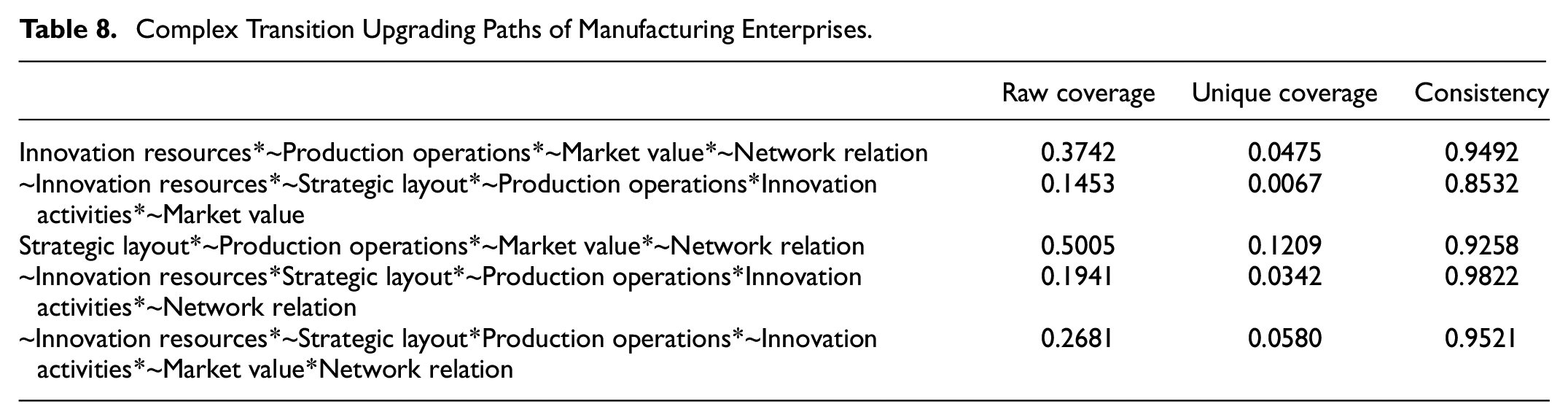
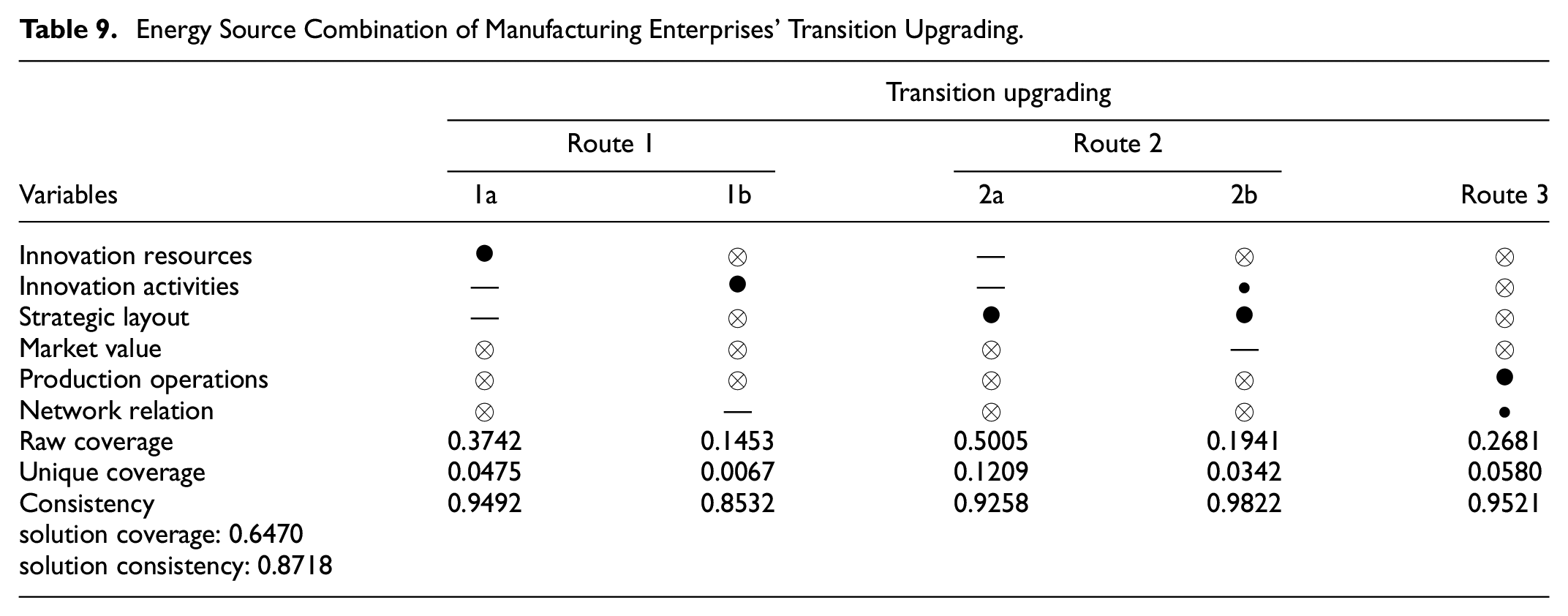
According to the tables of complex transition upgrading paths and concise transition upgrading paths of manufacturing enterprises, and combined with the corresponding symbol usage specification, the energy source combination can be established (Table 9), where • represents the positive core condition, ⊗ represents the non-core condition, • represents the positive peripheral condition, and ⊗ represents the non-peripheral condition.
Energy Source Combination of Manufacturing Enterprises’ Transition Upgrading.
Case Study Analysis
The theoretical results of the content analysis and the quantitative measurement results based on the FsQCA method showed that there were three main paths for manufacturing enterprises to realize transition upgrading. To further examinethe paths and the inter-relationships of energy sources, Huawei, Haier, and Lenovo were selected as cases to analyze how these three manufacturing enterprises achieved the transition upgrading during the practical operation process. The China Manufacturing Enterprise Association has released the 2023 Top 200 Enterprises in the Manufacturing Industry with Comprehensive Strength, among which Huawei ranks 4th, Lenovo ranks 11th, and Haier ranks 15th. The competitive advantages of the three enterprises are reflected in technological innovation, intelligent manufacturing, and business models, which make them the representatives and learning objects of different types of manufacturing enterprises in China.
First the corporate annual reports, news, and other related information for the three enterprises were first obtained. Then, based on the collection and collation of relevant texts, 19 people (including managers and front-line employees) from each enterprise were selected for an interview, to verify contradictory descriptions such as “How to view the development stage of the enterprise” and obtain relevant information. The interviews formed the interview reports and expression results, with final revisions and confirmations made with the interviewers through E-mail. The key findings were reported case by case.
The Case of Huawei
Huawei, the world’s leading information and communication technology (ICT) solution provider, is in third position in the TOP 50 of China’s most innovative and potential intelligent manufacturing enterprises list. Huawei’s R&D investment in 2022 reached RMB 161.5 billion, accounting for 25.1% of the annual revenue. The cumulative R&D investment over the past decade exceeded RMB 977.3 billion. In the field of research and development, Huawei focuses on three areas: hardware development, software development, and chip development. Huawei created tools and completed the replacement of 78 software/hardware development tools, breaking through the international technology blockade and becoming a model for technology innovation strategy-oriented enterprises in China. Huawei has experienced three stages to achieve transition upgrading, including the growth of technological capability, the breakthrough of technological innovation, and the leading technological innovation.
Initially, Huawei established different joint ventures with Siemens, 3Com, and others to achieve more innovative resources for enterprise development and set up R&D centers in the United States, Bangalore, and Stockholm (among other regions), to actively carry out R&D and innovation activities with the help of external talents and technical resources. Furthermore, through continuous and in-depth advancement of innovative behaviors, Huawei has achieved breakthroughs in the quantity and quality of innovation resources, which has enabled it to upgrade to the second stage.
Since then, Huawei has made breakthroughs in many key technologies, and the number of PCT patent applications remains high. With the improvement of the quantity and quality of innovation resources, Huawei was able to actively deploy its business globally. After signing the Global Framework Agreement with Vodafone, Huawei has become the partner of all the top operators in Europe. Based on realizing the economic value creation of innovation resources, Huawei tracks the customers’ technical requirements and technological development trends. Huawei uses the recovery of economic benefits to support more advanced technology research and innovation activities, continuously upgrades the quality of innovation resources such as technological achievements, and expands the users and installation bases of products, which has helped Huawei upgrade to the third stage.
Finally, the increase of high-quality technical resources and the improvement of technology research and development capabilities have allowed Huawei to join 177 standards and open-source organizations and hold 183 important positions. Huawei has contributed 20% of the passed core standard proposals from 3GPP LTE in the world. Meanwhile, Huawei sets out to integrate high-quality innovation resources globally and, forms a patent pool in the original technology field, and actively builds a 5G global ecosystem on a broad installation foundation and enriched cooperative relations. At the same time, with its own technological position and innovation resource advantages, Huawei provides insights into future technological development and strives to develop intelligence, cloud computing, and other emerging fields, also cooperating with more than 60 partners to offer digital urban rail and smart airport solutions, and with more than 100 merchants to develop smart homes, which certifies over 300 products by HI Link. All these strategies provided Huawei with the foundation for technology/product innovation and market leadership in new fields.
Huawei has made significant strides in the cloud computing industry in the past 2 years. One of their notable achievements is the establishment of the Huawei Cloud Business Unit (BU) and the subsequent launch of the Huawei Cloud Joint Innovation Center. This move has attracted numerous partners, including Yunding Technology, Gouli Technology, and Shandong Energy. In addition, Huawei has proposed a “platform + ecosystem” strategy, which extensively bridges key innovative entities through the platform and jointly builds a cloud ecosystem. By leveraging its platform, Huawei bridges various key innovative entities and collaboratively builds a robust cloud ecosystem. This strategy focuses on the “cloud management end” and promotes forward-looking growth. Huawei has recently released the Huawei Hybrid Cloud Stack 8.0, based on the Qingtian architecture, which has addressed the challenges faced by traditional hybrid clouds, which often struggle with compatibility issues. Huawei’s commitment to research and development is also evident in its investment in intelligent foundations through Ascend AI and digital foundations through Kunpeng. Through these efforts, Huawei has developed cutting-edge technologies and introduced the concept of “application-centered” cloud native 2.0 panoramic image. This innovative approach enables a seamless transition from “ON CLOUD” to “IN CLOUD,” empowering Huawei to lead the transformation from a software and hardware manufacturer to a cloud computing service provider.
In summary, Huawei focuses on innovation resources and innovation activities to accumulate energy. Through “absorbing all kinds of innovation resources and establishing research and development center to promote technological innovation activities → generating a large number of high-quality patents, improving technological innovation capabilities → forming technical standards and arranging technology research and development activities in new fields in advance,” Huawei has continuously achieved the cyclic upgrade and mutual development of innovation resources and innovation activities to promote the transition upgrading.
The Case of Haier
Haier is guided by user needs and places users at the center of innovation. The user-driven model helps Haier maintain close contact with consumers and adjust its direction in a timely manner to meet constantly changing market demands. Haier has established an open platform. The platform helps Haier gather the wisdom of all parties and improve the flexibility of innovation and operation. Haier focuses on the integration and optimized utilization of resources. Haier is based on a flexible organizational structure, quickly responding to market changes and investing resources in the most valuable areas. Therefore, it has become the typical flexibility-oriented enterprise in China.
Haier’s global brand strategy is to enhance the competitiveness of products and business operations. Since 2009, Haier has been selected as “Euromonitor International,” the world’s first brand of home appliances, for 10 consecutive years. In June 2019, Haier was selected as the Brand Z Top 100 Most Valuable Global Brand and created a new category—“Internet of Things” (IOT)—as an ecological brand, which has made Haier become an example of business mode innovation and brand building in China. Haier adjusts the business strategy mode and layout and continuously enhances the influence of the brand market to achieve the transition upgrading. It has also gone through three key stages: brand promotion, brand upgrade, and brand leadership.
Initially, Haier promoted its multi-field and multi-region operations by building an extensive marketing network. Haier first merged 18 enterprises with a low-cost strategy and initiated a diversified business model. To expand further into foreign markets, Haier and its foreign enterprises became each other’s brand agencies and exchanged market resources. Meanwhile, Haier actively attracted overseas distributors to join its marketing network, which formed trinity localized marketing in Europe. Additionally, Haier actively carried out overseas marketing and publicity, making it become the first Chinese enterprise advertisements in Ginza of Tokyo and the first one naming the overseas sports club. In brief, with various strategic business layouts and different marketing models, Haier has spared no effort to promote brand-building and enhance enterprise market value. As the brand influence expanded, Haier leapfrogged to the second stage.
Moreover, Haier has launched strategic concepts such as responsibility, service, and green to enhance brand influence. Firstly, Haier put forward the idea, “cultivate talents first, then build the brand,” which highlights the responsibility of enterprises to cultivate employees, and become the most valuable enterprise for employee growth. Secondly, on behalf of the industry, Haier planned to standardize household appliance service, proposed services to meet user needs, emphasized service and a win-win situation, and accelerated the process of service transformation. Thirdly, Haier passed the environmental management system audit and became the white household appliances sponsor of the Beijing Olympic Games and the first domestic white household appliances modular enterprise. At the same time, Haier introduced leading green technologies to realize their strategic layout through technological innovation. Lastly, Haier put forward the strategies of high-end brand and market globalization, designed variable temperature three-door and French four-door refrigerators in response to the needs of European and American users, which rapidly improved the brand image in the international market. With the strategic transformation and new concept innovation, Haier’s brand status and image have been continuously upgraded, helping it leap to the third stage.
In addition, Haier used the Internet, a broader international platform, to carry out an open and cooperative strategic layout, which subverted the traditional business model, and became the leading brand. At first, Haier proposed an innovation system with an open R&D platform as its core. As for users, it set up an open R&D model by co-creating and transferring value. Recently, Haier has implemented various strategies to facilitate its transition to an upgraded business model. By leveraging interactive platforms like cloud crowdsourcing and the Haier Smart Home APP, Haier effectively integrates a vast amount of customer demand information from the community. They employ advanced technologies such as AIoT and big data analysis, along with algorithms like Apriori, to collect customer data organically and proactively explore user demand across multiple sectors such as clothing, food, housing, transportation, entertainment, and medicine.
Building upon this foundation, Haier collaborates with three major platforms: HOPE, Kaos, and Haichuanghui. Through these partnerships, Haier brings together a diverse range of stakeholders, including universities, research institutions, Internet of Things providers, product service providers, and global entrepreneurs. This collaborative approach creates an open innovation system that effectively integrates global innovation resources.
Meanwhile, Haier is committed to pushing the boundaries of technology. They have achieved remarkable breakthroughs in household appliances, such as developing self-cleaning washing machines and integrated washing and drying machines. Additionally, Haier is expanding its business by establishing a presence in various sectors, including food and clothing. By crossing boundaries between industries like clothing and home textiles, Haier is gradually accumulating resources and expanding its business coverage.
In summary, Haier’s transition and upgrading process revolves around strategic business model layout and conceptual innovations. Through building a marketing network, strengthening publicity, enhancing brand influence → undertaking more responsibilities, innovating business models, establishing an excellent brand image → opening up extensive cooperation, subverting traditional business models, and forming a leading brand based on the Internet, Haier constantly uses strategic layout adjustments and business model innovation to enhance market brand value and promote the transition upgrading of the enterprise. By proactively adapting to changing market dynamics and embracing innovative approaches, Haier is positioning itself for success in the ever-evolving business landscape.
The Case of Lenovo
According to a global PC shipment report released by Canalys on January 12, 2022, Lenovo once again achieved the world’s largest shipment volume, occupying 24.1% of the global market; while Lenovo lacks standard core patents, and the core research content of Lenovo’s R&D center is mold design, product optimization, feature design, and other aspects, rarely involving core technologies such as chip level and CPU. Lenovo’s processors, graphics cards, hard drives, and operating systems have not achieved breakthroughs, and the enterprise focuses on efficiency and intelligent PC manufacturing and production. Therefore, it has become the typical efficiency-oriented enterprise in China. Lenovo’s transition upgrading and development mainly underwent three stages: self-growth, rapid expansion, and high-level development.
Lenovo first released its flagship products, promoted informatization development, and increased its market share. After the advent of the MFC laser all-in-one machine, Lenovo introduced the Happy Home, and computers with a one-click Internet access function to its flagship products. To improve operation efficiency, Lenovo built a flexible production line in Beijing and started automated production. In addition, to raise the circulation efficiency of raw materials and products, Lenovo integrated Supply Chain Management (SCM) and Enterprise Resource Planning (ERP) and established overseas delivery warehouses and distribution centers, which made up the enterprise supply network chain. The upgrades of digitalization and informatization strengthened efficient multi-party connections and raised resource scheduling efficiency. At the same time, Lenovo laid out the associated application technology strategy to ensure efficient circulation of supply chain resources, which supported the organic integration of partner technology. They further set the collaborative service standards for sharing information equipment resources so that its members can reach a consensus and criteria in terms of technology, information resources, service methods, and so on. These actions have improved the operational efficiency of the enterprise and helped it leap to the second stage.
Aiming to expand its scale, Lenovo further acquired the personal computer business of IBM and entered the global PC market. First, they held a global supply chain communication meeting attended by more than 260 global supply chain partners to facilitate standardized global cooperation, which made Lenovo become the second-largest PC manufacturer. Second, a North Asia production and operation center was established, which supports the supply chain to be more agile, more efficient, and faster. Third, to optimize the external network, product lifecycle management was launched to ensure that the product can be recycled, which improves the efficiency of resource utilization. Finally, by further optimizing production line and inventory management, and improving internal production operations, Lenovo’s efficiency has been increased by 32%, costs reduced by 18%, cycles shortened by 30%, and the energy utilization rates increased by 15%. The enterprise competitiveness has been further increased, which pushes Lenovo into the third stage of development.
When it comes to lean, green, and intelligence development at a high-level stage, Lenovo’s leading energy-saving technique was in line with international standards and gained recognition. Lenovo has continuously raised environmental awareness, made technical breakthroughs, and consequently, energy consumption per unit output value has constantly been reduced. Lenovo Group’s headquarters building in Beijing has accomplished a remarkable feat by achieving carbon neutrality in 2022, with an energy efficiency of up to 35% and carbon emission has been reduced by 35%. In addition, Lenovo has explored new fields of environmental protection, ensured products are recyclable and re-manufacturable, and promoted the green utilization of resources. Each of these innovations has supported Lenovo’s leap to the top of the global environmental protection ranking of electronic product manufacturers. LeapHD, the big data platform of Lenovo Group, is revolutionizing the supply chain through various ways. By focusing on the entire lifecycle of data, LeapHD leverages intelligent control towers, user order visualization systems, digital order execution systems, and more to lay the groundwork for the digital transformation of the supply chain. To support its digital transformation efforts, Lenovo has launched LenovoxCloud, a cutting-edge cloud platform built upon a new IT technology architecture known as “end-edge-cloud-network-intelligence.” This architecture brings together data from various endpoints, edge devices, cloud systems, and intelligent networks, enabling Lenovo to optimize operations, enhance efficiency, and drive innovation across the supply chain. Lenovo won the Lean Management Excellent Project Award, and implemented the smart order management, digital board management, which has pushed the upgrade of Lenovo intelligent manufacturing and helped other manufacturing enterprises improve efficiency. Now that ThinkPad production has been fully automated, the highest level of automation of Lenovo’s manufacturing base. After the construction of the Southern Intelligent Manufacturing Base of Lenovo Group in the future, the current time required for the preparation of every 100 computers, which typically takes around 6 hr, will be reduced to just one-third of that duration so the production efficiency will be greatly improved.
During the transition upgrading process, Lenovo has primarily focused on production process automation, production line layout, production operation, and supply chain. This suggests that informatization and automation management promote the sharing of supply chain equipment and resources → absorbing supply chain network partners and continuously optimize the production line layout → promoting lean management, green production, and intelligent manufacturing. Lenovo continuously optimizes production operations and upgrades the supply chain, and network cooperation to achieve the leapfrog development of enterprises.
Discussion
Based on the results of the theoretical analysis, it is evident that manufacturing enterprises have three transition upgrading paths. The first is innovation orientation. Manufacturing enterprises can form leading technical advantages and achieve high-quality transition upgrading through innovation resources and innovation activities. The second is business orientation. Manufacturing enterprises can improve their competitive competence by paying attention to the market and customers and enhancing environmental adaptability by mode innovation, adjustment of strategic orientation, and unbounded organization and structure. Ultimately, on this path, enterprises can steadily transit to a higher level. The third path is efficiency orientation. Manufacturing enterprises can enhance their resource acquisition capabilities and strengthen their responding capabilities to deal with the changes in production plans through expanding network relations. Moreover, it can also improve resource utilization and production operation efficiency through automation and intelligence, thereby achieving high-efficiency transition upgrading.
The results of FsQCA revealed three main paths in manufacturing enterprise transition upgrading. Comparing the types of manufacturing enterprises with the sample enterprises under each path, the consistency was more than 80%, which proves the validation of the theoretical paths. In addition, the results presented a specific energy source combination. The innovation-oriented manufacturing enterprise transition upgrading paths depend on innovation resources or activities. The efficiency-oriented path is “production operation + network relation (peripheral),” which means that external resource utilization and acquisition play a subsidiary role, and the highly efficient internal production operation is the main impetus for its transition upgrading. Finally, the business-oriented manufacturing enterprise mainly relies on the strategic layout to achieve energy accumulation and some of these enterprises achieve strategic layout goals through innovation activities, thus accelerating energy accumulation. The market value does not appear in the process of energy accumulation—that is, this kind of manufacturing enterprise is required to set up its brands and meet its personalized needs through strategic layout adjustments such as business model innovation, structural adjustment, service transformation, and internet and information application, to realize the market value increase.
Through analysis of case studies, we have demonstrated three main paths for upgrading manufacturing enterprise transition, which is consistent with the results of theoretical path design and quantitative calculations. The results of the case studies further support the idea that the innovation-oriented manufacturing enterprise transition process is “innovation resources support the development of innovation activities → innovation activities support the output of innovation resources,” which means innovation activities and innovation resources support each other to promote enterprise transition upgrading. Business-oriented manufacturing enterprises achieve the transition upgrading by a one-way causal effect, “adjusting strategic layout optimizes market value,” sometimes, with the assistance of innovative activities. Efficiency-oriented manufacturing enterprises realize the development of transition through the domination of production operations and the dynamic matching and adjustment of network relations. These are shown in Figure 1.

Energy source combination and function relationship of the manufacturing enterprises’ transition upgrading paths: (a) innovation orientation, (b) business orientation, and (c) efficiency orientation.
Conclusion
Transition upgrading has become a strategic choice for the positive development of manufacturing enterprises, while how to effectively accumulate energy and realize transition upgrading has become an important research area. In this study, analysis of relevant literature and content analyses were used to elicit transition upgrading paths. Three paths—namely innovation orientation, business orientation, and efficiency orientation—were proposed. K-means assignment and qualitative comparative analysis were used to validate the rationality of the theoretical paths and confirm the states of the energy source combinations corresponding to the transition paths. Our results reveal that innovation-oriented manufacturing enterprises mainly rely on innovation activities and innovation resources to obtain transition energy; business-oriented manufacturing enterprises mainly depend on the strategic layout or “strategic layout + innovation activities (peripheral)” to realize the transition; and efficiency-oriented manufacturing enterprises focus on the “production operations + network relations (peripheral)” to accumulate transition energy. In addition, case analyses of Huawei, Haier, and Lenovo further reveal the relationships between transition upgrading and energy source combinations. In summary, different manufacturing enterprises need to choose a scientific energy source and energy source combination to achieve energy accumulation and transition upgrading more efficiently.
Government departments can judge the dominant energy source of enterprise transition according to the manufacturing enterprise strategy orientation. When providing key supporting policies for innovation, business, and efficiency, government departments should consider policies that significantly promote the accumulation of energy sources for the transition development of enterprises, to improve the effect of policy-leading support. In addition, leading energy sources and auxiliary energy sources work jointly to promote the transition of manufacturing enterprises. Therefore, policy support should focus on policy combinations to ensure systematic policy support for different energy source combinations of manufacturing enterprises to realize the transition development effectively.
In this study, three effective paths for manufacturing enterprise transition upgrading are detailed, energy source combinations and energy source interactions under different paths are discussed, and a clear energy accumulation process for manufacturing enterprises is described. This study provides empirical support for the transition of Chinese manufacturing enterprises and decision-making reference for the transition of manufacturing enterprises in other regions. Manufacturing enterprises in other regions can adjust the internal detailed composition of energy sources according to their respective scenarios, which is helpful for them to achieve an effective transition. Considering the key findings and some limitations in the current study, we would like to make some suggestions for further studies along this line. First, it is suggested that the sample size be extended to generate more convincing results about the upgrading paths for the transition of manufacturing enterprises. Second, the strategic orientation and transition types of manufacturing enterprises could be further quantified to strengthen further measurement. Third, it is interesting to further explore the relationship and intensity of energy sources to provide more accurate management support for the transition of manufacturing enterprises.
Footnotes
Declaration of Conflicting Interests
The author(s) declared no potential conflicts of interest with respect to the research, authorship, and/or publication of this article.
Funding
The author(s) disclosed receipt of the following financial support for the research, authorship, and/or publication of this article: This study was funded by Jiangsu Postdoctoral Science Fund (2019k273).

Data Availability Statement
Data sharing not applicable to this article as no datasets were generated or analyzed during the current study.