




Abstract
Technology entrepreneurship involves creating sustainable value through capitalization and commercialization of innovative new technology, accelerates the growth of firms, and helps in promoting the sustainability of the economy. However, the literature on the business model innovation (BMI) for technology entrepreneurship has no clarity yet. Therefore, this article aims to build a business model innovation for technology entrepreneurship (BMIfTE) toward economic sustainability. To meet this aim, various publications on the subject matter have been reviewed and synthesized and I compared the logic and arguments of various scholars to draw conclusions and develop BMIfTE. The article structures the BMI for technology entrepreneurship as obtained through experimentation, generating, renewing, designing, changing, and implementation, backed by inputs such as value migration, opportunity and risk assessment, dynamic capability, stakeholders networking, firms’ strategies, and institutional ontology that contribute to sustainable economic development. In this sense, the BMI improves the current delivery system by creating a new offering system, which leads to a reconfiguration of the model by integrating with the technological ecosystem’s capabilities in creating and exploiting new business opportunities.
Introduction
The new economic context of globalization, knowledge, innovation, and technological entrepreneurship contributes to the rise of the novel entrepreneurial ecosystem (Roja & Năstase, 2014). These developments play a role in changing the sense of balance between various stakeholders (Teece, 2010) by allowing firms to involve differently in economic exchange (Mendelson, 2010; Zott & Amit, 2007). Previously, firms innovate products, processes, and technology in creating and achieving sustainable values (Hansen et al., 2009). However, the route toward sustainability requires a change in the purpose and strategies of business (Bocken et al., 2014). These methods were not adequate and need to be complemented with business model innovation (BMI) to bring more sustainable value to the organizations (Hansen et al., 2009; Schaltegger et al., 2012). This is because no equivalent ontology is available to describe the strong sustainable business model (Upward & Jones, 2016). Therefore, firms should find novelty in performing activities that help to achieve the novel business model advancement (Ireland et al., 2001).
Business models expose the way enterprises are linked to various stakeholders and are involved in economic exchange with these stakeholders in creating value for the partners (Zott & Amit, 2007), as well as contribute to the successful commercialization of disruptive technologies (DaSilva et al., 2013). The value of technology alone will be less as values are emerged through commercializing using a business model (Chesbrough & Rosenbloom, 2002; DaSilva et al., 2013). That is, technological innovation requires business models in creating and bringing innovations to the market and creating an opportunity that satisfies the unsatisfied customer’s need (Teece, 2010). Accordingly, looking for integrations among the economy and technology arises to be important to identify the most appropriate strategies (Roja & Năstase, 2014). Moreover, the intention should be tended to gain technological capability and personnel skills in developing innovation and being competitive (Khefacha & Belkacem, 2016). Therefore, it is crucial to look at the existing challenges and business model cases in improving performance (Kim & Min, 2015; Sabatier et al., 2010; Santos et al., 2015; Snihur & Tarzijan, 2018).
Theoretically, problems with business model research continue to hinder theory development (Fjeldstad & Snow, 2018); still, the concept is ill-defined (Roome & Louche, 2016) and there is no clarity in purposes and concepts (Cosenz & Noto, 2018). In addition, the study lacked academically enquiring about the complexity of a multi-business model setting (Nickerson & Zenger, 2004; Snihur & Tarzijan, 2018). Practically, it is still a serious challenge in developing a feasible business model (DaSilva et al., 2013). Among these challenges, the most important is designing a business that creates economic achievement (Abdelkafi & Täuscher, 2016; Schaltegger et al., 2012). However, innovating a novel business model will not always be the root to success (Teece, 2016) because of the complexity associated with the new business environment. Therefore, managers should creatively handle the interaction between business models and innovativeness (Baden-Fuller & Mangematin, 2013). Generally, a BMI leads to the higher complexity of how the business model is understood and improved to make the business successful.
By reviewing the various papers collected, logic and arguments of various scholars were compared and conclusions were drawn based on the synthesized arguments. As we understand from the existing literature, some scholars focus on the science-based factors’ impact on the BMI, while others elucidate the institutional factors’ impact on the BMI. Moreover, various authors studied BMI and technology entrepreneurship separately. To fill this gap, this study conceptualizes BMI for technology entrepreneurship as a single concept. To summarize, this study first links BMI to technology entrepreneurship and tries to evaluate and build an all-inclusive BMI for technology entrepreneurship. That is, the impetus of this study is to redesign the new business model that senses the wider importance of BMI in technology entrepreneurship toward the successfulness of ventures. Second, it links this innovative business model to the firm’s performance and economic sustainability. In this sense, the study uncovers a specific relationship of the business model innovation for technology entrepreneurship (BMIfTE) to specific a variable of economic sustainability. Therefore, the article tends to address the following questions:
How the construct BMIfTE is conceptualized?
What are the components of a comprehensive BMIfTE?
Is BMIfTE contributed to economic sustainability?
Theoretical Foundations
Conceptual Linkage Between BMI and Technology Entrepreneurship
Arguments about technology entrepreneurship are lying around establishing and developing firms (Bailetti, 2012), and facilitating novel business models (Baden-Fuller & Mangematin, 2013). The necessary evidence, facts, and knowledge should be collected using technology in answering significant issues of the business model, new undertaking, and markets (Roja & Năstase, 2014). However, the value of technology alone will be less as values are emerged through commercializing using a business model (Chesbrough & Rosenbloom, 2002). Commercialized technology provides a variety of results and firms are requiring better values from launching a new and innovative business model and technology (Chesbrough, 2010). Besides, technology innovation requires a business model in bringing innovations to the market and satisfying unsatisfied customer needs (Teece, 2010). In this sense, a business model is an integration of elements and activities that are performed to satisfy the unrequited market needs (Cosenz & Noto, 2018). Combining the two, opportunities can be thought of as technically visible latent demand (Eckhardt, 2013). Therefore, a feasible business model helps in successfully commercializing the disruptive technologies (DaSilva et al., 2013) and is integrated into the technology innovation (Baden-Fuller & Haefliger, 2013) particularly and technology entrepreneurship in general.
Elements of BMI for Technology Entrepreneurship
For technology entrepreneurship, the four core characteristics of business models that emerge from the literature, such as value proposition, value network, value capture, and value creation and delivery (Roome & Louche, 2016), need a considerable improvement to commercialize technological innovation. Attention also needs to be paid to the concepts of configuring, creating, and capturing the value and designing (Amit & Zott, 2001; Baden-Fuller & Mangematin, 2013; Teece, 2010), and interaction with technology (Baden-Fuller & Haefliger, 2013; Chesbrough & Rosenbloom, 2002; Roome & Louche, 2016). Recently, Foss and Saebi (2017) state that the alignment of a proposed value, segmented targets, revenue mechanisms, value chains, and the internal structures is necessary. Hence, BMI establishes innovative modifications of such complementary relationships that are imposed to capture the innovation (Cosenz & Noto, 2018). Therefore, the business model needs modification and improvement with technology advancement.
Technology entrepreneurship encompasses the practices of identifying and capitalizing human resources and commercial opportunities related to technology (Dorf & Byers, 2005). Accordingly, the entrepreneurial resources, including financial resources and human resources, help entrepreneurs engage in the discovery, evaluation, and exploitation of opportunities (Kosa & Mohammad, 2017). These resources are critical in improving the existing business models or introducing new ones (Fjeldstad & Snow, 2018) or in modifying at least one of the stated elements (Abdelkafi et al., 2013). Similarly, taking out the BMI helps to clarify the main strategies of the business model (Hacklin, 2018). As the business model is more about how is it being done (Santos et al., 2015), it depends more on the strategies employed than its components. The operational aspects of business model indicate the way firms are doing their business (Fjeldstad & Snow, 2018) and investigate the factors that affect firm performance (Chebo et al., 2018).
Developments on business model focus on the dynamic outlook speaks about the innovativeness in the business model (Bjorkdahl & Holmen, 2013; Chesbrough, 2010; Massa et al., 2017; Zott et al., 2011). Therefore, a classic BMI represents discrepancies around a configuration of values (Fjeldstad & Snow, 2018). Although innovating at least one element in BMI is necessary, the successively changing business models core logic is the sufficient condition (Futterer, 2014; Futterer et al., 2018; Spieth & Schneider, 2016). Based on these logics, creating or modifying the existing business model through changing at least one element can be considered as a BMI (Futterer, 2014; Futterer et al., 2018; Spieth & Schneider, 2016). Furthermore, the argument that BMI is key to firm performance has gained momentum (Futterer et al., 2018) and focused as spring for competitiveness and performance (Kim & Min, 2015; Visnjic et al., 2016). The innovativeness identifies and exploits business opportunities through engagement in new ideas, products, processes, and markets; as a result, the overall performance of ventures will be improved (Chebo & Kute, 2018).
Method
Search Strategy
This systematic review was conducted to analyze the existing literature on BMI and link it with technology entrepreneurship by synthesizing their determinants and outcomes toward economic sustainability. Before the study was started, the presence of an existing systematic review on the construct of BMIfTE as a single concept was checked to avoid duplication. To establish the BMI for technology entrepreneurship as a new single construct, the literature was identified primarily from Google Scholar (GS). As the concept is multidisciplinary and many unrelated publications were identified, a comprehensive traditional literature review was established to establish the parameters for a consequent systematic review (Jesson, 2011). Together, they enable the origination of the framework (Upward & Jones, 2016). Moreover, to retrieve additional articles, the traditional literature reviews were conducted with key references from the identified papers. To meet this, the following search terms were used: Business model innovation, technology entrepreneurship, and economic sustainability. The search terms were predefined to allow an all-inclusive search strategy that included all important articles.
Study Selection and Eligibility Criteria
The major sources of citation data were Web of Science (WoS), GS, and Scopus. The coverage of WoS and Scopus was different among different disciplines. For instance, their coverage is not good in social sciences and humanities (Mahdi et al., 2008). Comparatively, GS is advantageous by searching all citations from several sources. The coverage of research output is higher in GS and also does not differ among subject matters (Amara & Landry, 2012).
In general, although the data quality and reliability were poor in GS, WoS and Scopus were weak in nonscience subjects. This makes GS comparatively advantageous over these subject matters. Currently, many indicators were established to measure the quality of journals. Some of them are h-index and SJR (SCImago Journal Rank). For this specific research, after data were obtained from GS, the selected articles’ quality was checked using the journal impact factor (JIF) for journals published in Thompson Reuter’s WoS, and SJR of Scopus. JIF is important in using GS as it ignores the lower down papers. Similarly, SJR is important, its value is normalized, and its current version in Scopus has a refinement that considers the relatedness of the citing journal (Guerrero-Bote & Moya-Anegón, 2012).
In collecting data, several procedures were followed: First, I checked for suitability of peer-reviewed scholarly works by identifying works related to BMI, technology entrepreneurship, and economic sustainability. This formulates a comprehensive BMI that works for technology entrepreneurship and also has a contribution to the firm’s performance and economic development. In this sense, the framework has the inputs for BMIfTE and its processes that may bring better outcomes (individual firm’s performance and sustainable economic development).
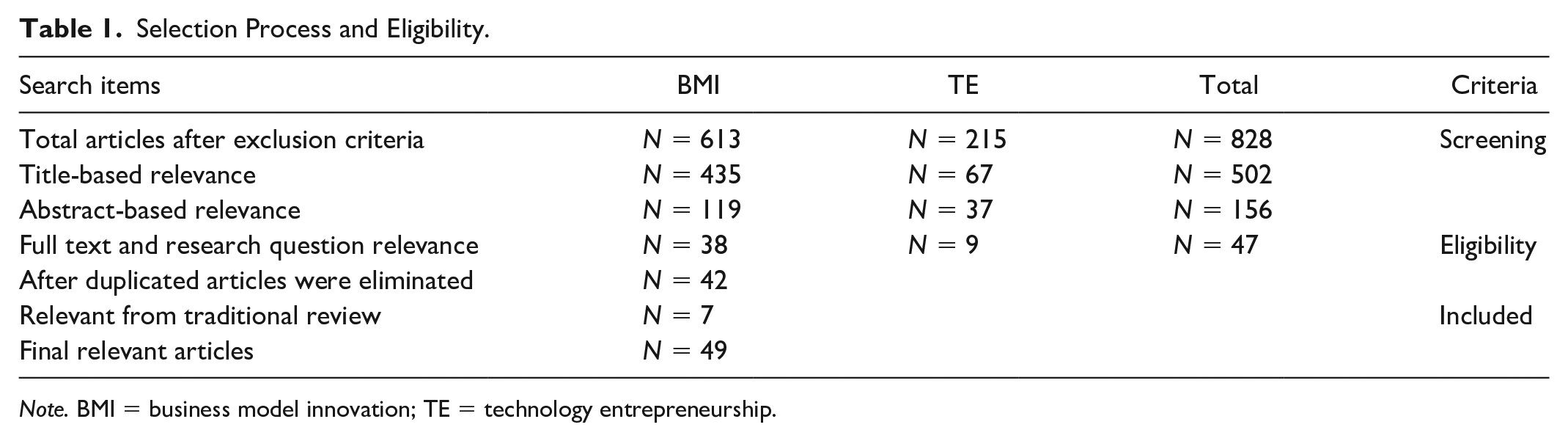
It was targeted in collecting data from articles published on the subject matter. Accordingly, GS was used as a primary database in accessing peer-reviewed reputable journals to obtain a wide coverage of literature on the subject matter. In addition, the special issues of long-range planning and organization and environment journals were reviewed. First, these concepts are reviewed separately and later linked to establishing a general concept of BMI for technology entrepreneurship. The selection process and eligibility were summarized in Table 1.
Selection Process and Eligibility.
Note. BMI = business model innovation; TE = technology entrepreneurship.
Although there are many papers with the search term, some articles that give a highly different meaning and are far from the topic of study have been removed through the screening process. In general, the following procedures were followed. First, by focusing on the framework used to create BMIfTE toward economic sustainability, a total of 828 articles were recorded after the exclusion criteria. Next, by analyzing titles, 326 articles were excluded. After abstract and keywords were analyzed, 346 nonrelevant articles were excluded. The items that are not suitable for the research question are excluded from the review and focus on the framework used to create the BMI for technology entrepreneurship with the analysis of full paper, and 146 articles were eliminated. Finally, duplicated articles were removed and articles relevant from the traditional review were added. Accordingly, only 49 articles were verified and analyzed.
Data Analysis and Synthesis
The synthesis was made to find the relevant findings and summarize essential knowledge of the research domain, to understand the big picture of a particular domain by reducing the irrelevant ideas. Business plans, business cases, working papers, and articles not written in English were excluded. A qualitative research method is chosen to analyze the data collected from existing literature. Using this approach, the theoretical aspects of BMI in technology entrepreneurship were described and interpreted. For this qualitative research, a systematic review process was undertaken because a systematic review is used to identify, evaluate, and synthesize the available literature as its comprehensive, explicit, and reproducible approach (Fink, 2005). It also includes systematically searching the literature. Moreover, Rousseau et al. (2008) argue that systematic literature review has importance in analysis transparency and avoiding implicit biases. In general, the systematic review covers plan and searching strategy derived to lessen bias by finding, scrutinizing, and synthesizing the relevant studies (Uman, 2011).
Based on the research question, the selected articles were organized based on the themes of inputs, processes, and outputs of business model innovation. The analysis is focused on the concept, processes, and frameworks. Accordingly, the logic and arguments of various scholars were compared and a conclusion was drawn based on the synthesized arguments.
Quality Assessment and Data Extraction
To assure the quality of the research, the researcher has to document literature findings, the selection of keywords, and the evaluation of the result (Brocke, 2019). After these have been done, data were extracted by two independent reviewers. A disagreement between reviewers was discussed with the reviewer and reached consensus. Moreover, duplicate articles were manually identified and removed. In case a full-text article was not accessed, the authors were communicated, and if no reply was received, the article was excluded from the study.
The articles for review were identified from GS and checked for paper’s quality using the JIF of WoS and SJR of Scopus. Accordingly, from a total of 49 reviewed journals, 44 (89.80) classified as Q1 as a ranking of SJR quartile. Only five articles from four journals each categorized under Q2 and Q3, respectively, were added because of their relevance. This is done to include concepts from technology entrepreneurship as it is not adequate. Some journal articles have been removed due to not being indexed and ranked by JIF or SJR.
Selected Journals Impact Factor and Rankings.

Note. JIF = journal impact factor; WoS = Web of Science; IF = impact factor; SJR = SCImago Journal Rank.
Source: Compiled by authors, 2020
Analysis and Discussion
Orchestrating the BMI for Technology Entrepreneurship
To change the existing business model, entrepreneurs are looking to the other companies’ practice, searching for new markets, and a new way of doing things. Accordingly, the techno-entrepreneurs will be involved in R&D, experiment, generating, designing, renewing, changing, and implementation. These processes may not be successful without having an appropriate strategy that leads to better performance and further to a firm’s economic sustainability. The first step for innovative firms is recognizing the existence of unrequited customer needs (Teece, 2016). This will be done by conducting R&D and networking. In doing this, the consideration of value creation and migration is an essential activity. Moreover, the assessment of dynamic capability and financial requirements, as well as opportunity and risk assessment, will be done in this regard. Therefore, the entrepreneurs should effectively integrate the above elements in experimenting, designing, renewing, and changing the business model. By orchestrating the above elements and components of the business model, it may be modified or fully changed. Theoretically, these processes are studied by various scholars as summarized in Table 3.
Processes, Inputs, and Outcomes of BMI for Technology Entrepreneurship.

Note. BMI = business model innovation.
To sum up the above processes, the newly developed and experimented business model needs modification, renewal, configuration, and later implementation. These elements will be considered as the processes following and supporting each other, rather than independent elements. Accordingly, the above elements should be integrated as the improvement or change in one component affects the other. However, there is a predicament to decide the best tool for BMI as it depends on the nature of the business and competition. On the contrary, the suitability will be determined by the simplicity and capacity of the firms. For instance, for firms that lack important resources, developing and experimenting with a new business model is challenging, whereas alignment and replication may not be fruitful in a highly competitive market.
The continuous assessment of opportunities to innovate new technology and commercializing them and the firm’s dynamic capability and their ability to use a firm’s assets were linked to BMIfTE. Moreover, to successfully improve the business model, the firm should think of how the value will be captured by establishing a network with all stakeholders. Therefore, it is important to consider the long-term objectives to link these elements of BMIfTE to economic sustainability. In summary, the BMIfTE was backed by several factors that contribute to performance and growth. These various inputs were indicated in Table 3.
To improve and modify the existing business model, organizational resources and capabilities are highly required. This capability helps in creating and capturing value in technology entrepreneurship. It is impossible to develop a successful business model without resources. Therefore, the value of the firm is created through the deployment of human capital and financial resources. In addition, networking with different actors plays a crucial role in modifying the existing business model as it helps to obtain various inputs used for modifying the existing business model. Moreover, there must be a strong relation and collaboration between supplier organizations, distributors, and other stakeholders to build a successful network-based business model.
Modeling BMI for Technology Entrepreneurship
Technology entrepreneurship assembles and deploys manpower and existing assets to create and capture value (Bailetti, 2012). The methods of creating and capturing values were central to technology entrepreneurship and the foundation for a business model (Muegge, 2012). According to Khefacha and Belkacem (2016), technology entrepreneurship resides in creating and exploiting technologies, recognition/matching technologies, development of technology applications, and business creation. Therefore, the integration between technology entrepreneurship and business model is proven by value creation and value capturing is established (Muegge, 2012). By taking into consideration this integration, BMI is characterized by value networking (Roome & Louche, 2016) and creating entrepreneurial opportunities (Markides, 2006) using technological entrepreneurship.
In general, among the conceptual relationships, many authors relate BMI with opportunity exploitation (e.g., Khefacha & Belkacem, 2016), value migration (e.g., Hacklin et al., 2018; Jabłonski, 2018), dynamic capability (e.g., Ritter & Lettl, 2018; Teece, 2018), and networking (e.g., Ritter & Lettl, 2018; Snihur & Tarzijan, 2018). In all this practice, the adoption of new technologies through a dynamic process of creative destruction contributes to long-term economic growth (Khefacha & Belkacem, 2016). To summarize, business models are used to create (Chesbrough & Rosenbloom, 2002) and capture values (Teece, 2010) through developing (e.g., Fjeldstad & Snow, 2018; Futterer et al., 2018), experimenting (e.g., Bojovic et al., 2018), renewing (e.g., Foss & Saebi, 2017), and commercializing (e.g., DaSilva et al., 2013) the business model.
The entrepreneurial activities create and capture economic values from exploiting new or existing technologies (Roja & Năstase, 2014). The business model was linked to firm performance (Trimi & Berbegal-Mirabent, 2012) and considered as drivers of firm performance (Rajgopal et al., 2003). Networks are positively associated with innovativeness and performance (Pittaway et al., 2004; van Wijk et al., 2008). Particularly BMI determines the firm’s performance (Zott & Amit, 2007), whereas in the long, the dynamic role of entrepreneurial activity in the technology sector promotes economic growth (Khefacha & Belkacem, 2016). That is, technology entrepreneurship is a driver of economic progress (Roja & Năstase, 2014). Moreover, the critical success factors for BMI should be considered. Particularly, Brem (2008) found that the number of years of working experience and willingness to take risks, business plan, clear strategy, innovation, network, advisory board, and active marketing are success factors for a starting firm. Most of these critical factors were included under the inputs stated in Figure 1.

The structure of BMI for technology entrepreneurship.
To be sustainable, business models must be innovative and capture new technological progress. That is, entrepreneurs are involved in innovating products/services, technologies, markets, and methods through experimentation and risk-taking to create sustainable value. More specifically, the journey toward economic sustainability considers a firm’s capture values. Sustainable business development can contribute not only to the firm’s growth but also for society and the economy as a whole. Sustainability can also occur from technology entrepreneurship. Therefore, there must be an improvement in networking, stakeholder analysis, and customer interfaces to create sustainable value that will further fulfill society’s demand. The innovativeness of the business model will help to overcome the problem associated with sustainable development by integrating the financial and economic values from the business model. Figure 1 depicts the overall structure of BMI for technology entrepreneurship.
The development and selection of the appropriate strategy will lead to value creation from different aspects. The strategies in technological entrepreneurship may consider both financial resources, the varied skills, and techniques in consideration to customers and their value. These strategies are contributed to better financial performance and in the long run to economic performance because the strategies focus on how the values created and captured by getting to a new market, develop new products and processes that will entice the customers.
The efficient combination of BMIfTE elements will lead to better performance. This happened through the exploitation of opportunities by minimizing risks, efficient use of a firm’s assets, value capturing through networking, and value migration. When the values started to be captured through institutional ontology, sustainability will be ensured. Finally, the innovation in a business model which is provoked by dynamic capability, value migration, exploitation of opportunity, and stakeholder networking was associated with sustainability.
Technology entrepreneurship involves combined experimentation and production of products in consideration of the technological and scientific advancement (Bailetti, 2012), which many technology firms belong to. That is, the value creation and capturing through the business model of technological entrepreneurship are useful and practicable among firms that need to innovate and adopt technological advancements. However, the existing framework of value configuration and partnership structuring from the network-based business model is poorer (Lund & Nielsen, 2014). Therefore, developing BMIfTE is crucial from the viewpoint of its concepts; technology entrepreneurship searches solutions for problems (Groenewegen & de Langen, 2012), through opportunity exploitation from emerging technologies, organization, management, and risk bearing (Bailetti, 2012). This is based on value creation and capture, target organizations, mechanism of delivery, and the interdependence of these mechanisms (Bailetti, 2012), which are interrelated through the business model. Accordingly, BMIfTE needs to be applied by many ventures to cope with the advancement of science and technology.
Conclusion, Contribution, and Implications for Future Research
Conclusion
This study draws a BMI for techno-entrepreneurship that leads to economic sustainability. It gives clues on the necessity to reinvent and reshape the business models in consideration of factors such as dynamic capability, existing opportunity and risks, value migration, and networking with stakeholders. The study overviews the various elements of BMI for technology entrepreneurship and revealed the relations of strategic decision and institutional ontology with resources, activities, and processes. Accordingly, the values captured from networking and relationships with different stakeholders and organizations help to create adequate value from the collaboration. In addition, the discovery and exploitation of new technological opportunities have to be continuous for the economic sustainability of BMIfTE. In general, the BMI for technology entrepreneurship can be operationalized as the process in which the new business activities are experimented, designed, generated, renewed, and implemented to create and capture value from constellations of firm’s institutional strategies (such as opportunity assessment, value migration, dynamic capability, and stakeholders networking) and environmental factors.
Contributions
Regardless of the deep conceptual link between business models and technology entrepreneurship, still little is recognized as how technology entrepreneurship produces a fruitful business model (Muegge, 2012). This study contributes to the discipline of BMI and technology entrepreneurship by bringing the subject matter under one umbrella. In addition, it covers the various elements, components, and processes in BMIfTE. Furthermore, it shows these elements and processes accomplishment with the strategy and institutional ontology toward the firm’s performance and economic sustainability. In this sense, the article identifies the important inputs, processes, and outcomes of BMI for technology entrepreneurship.
The developed model linked the drivers of BMIfTE at the back and the outcomes of successful BMI at the front with the processes at the center. More specifically, the model structured the BMIfTE as obtained through experimentation, designing, generating, renewing, changing, and implementation, backed by inputs such as value migration, opportunity and risk assessment, dynamic capability, stakeholders networking, firms’ strategy, and institutional ontology. Most of the previous studies did not include the assessment of existing opportunities and threats in developing an innovative business model. This study tries to include the contribution of opportunity and risk assessment.
Regarding the components of business model, first, the study tried to connect the business model with technological aspects logically and coherently. From this, BMI for technology entrepreneurship has been conceptualized and defined. Second, it considers the relationship between BMIfTE and the firm’s performance and economic sustainability. Third, the study recognized the nontriviality of BMIfTE by sensing the underpinning of BMIfTE components. Moreover, the various aspects of BMI were summarized under a few specific variables and a new model for technology entrepreneurs has been orchestrated. The stakeholder networking, for instance, associated with several factors, simultaneously including the key partners and customers and their channels. The capabilities of firms are associated with key resources (i.e., financial and human capital), through which values have been obtained, while the value migration covers the issues of value proposition, configuration, and customer value creation and value capture. Finally, by considering the premises of several scholars, an all-inclusive business model with different aspects that contribute to the successfulness of the firm was developed.
Limitations and Future Research Avenue
It is known that the scientific value of the study will be strong when it is supported by empirical data such as data obtained through interviews. However, this study has a limitation of not considering the empirical data that support in integrating theoretical outputs with the managerial practices. The variables covered under this study may not be comprehensive, mainly from the external environment. Moreover, the specific technological sector for the application of the model needs to be indicated. Regarding the data’s limitation, many irrelevant articles that appeared from GS were removed manually. The data quality and reliability also were poor in GS.
Based on the reviews, the study recommends the following implications for future research. The future research might study the specific activities in social and environmental factors that highly integrated with the BMI for technology entrepreneurs. The study of BMI for technology entrepreneurship is less in general and very weak in sub-Saharan Africa. Therefore, we propose a direction for further research to focus on this region on the stated topic. Several papers were reviewed theoretically from literature and case studies; however, it was not tested whether it is suitable for developing economies. Therefore, an experimental research design has been suggested for further research conducted on the subject matter.
One of the challenges among technology entrepreneurship is linking their business model with sustainability, which is not considered widely with previous researches. This is another area that needs consideration for researchers interested in the area of technology entrepreneurship. The technology innovation is meaningless unless commercialized through an appropriate business model. This means technology entrepreneurship and BMI are dependent on each other. While some authors consider BMI after technology entrepreneurship, the others bring the BMI before technology entrepreneurship. Therefore, future researchers should clarify and strengthen the variable BMIfTE. In addition, rather than testing multiple variables simultaneously, it is crucial to know the level of their impact independently.
Most of the previous studies forget the assessment of existing opportunities and threats separately as a variable in the business model. This study gives a clue for future researches on the way opportunity and risk assessment are affected in the BMI for technology entrepreneurship. In addition, several studies have shown the importance of technology entrepreneurship for wealth and job creation; however, the specific contributing variables were discussed in a nutshell. The underpinning for BMIfTE was recognized in this study, but it needs a more in-depth study for each particular variable. Finally, the practice of BMIfTE may not be successful similarly in all sectors. Therefore, identifying and differentiating the industries that are suitable for commercialization of technology entrepreneurship is another issue that needs clarification. Moreover, future researchers should consider the commercialization of technology-based innovations through digitization and online marketing.
Footnotes
Declaration of Conflicting Interests
The author(s) declared no potential conflicts of interest with respect to the research, authorship, and/or publication of this article.
Funding
The author(s) received no financial support for the research, authorship, and/or publication of this article.
Submission Declaration and Verification
The authors declare that the article has not been published previously in any form and in any language.
