




Abstract
Enhancing the organizational commitment of hospital nurses is crucial for providing high-quality nursing services in hospital environments and for personal development. This study aimed to identify the effects of hospital nurses’ resilience, emotional exhaustion, and communication competency on organizational commitment. A cross-sectional study with a self-rated questionnaire survey tool was used. The study was conducted at a tertiary hospital in South Korea. Convenience sampling was used to recruit participants from nursing services (N = 144). Collected data were analyzed using descriptive statistics, a t-test, ANOVA, Scheffé’s test, Pearson’s correlation, and hierarchical multiple regression analysis using SPSS/WIN 23.0. The significant factors affecting the organizational commitment of hospital nurses included emotional exhaustion, working department, religious affiliation, and age. The explanatory power of these factors on organizational commitment was 49.8%. Our findings recommend that special consideration should include tailored intervention strategies regarding emotional exhaustion and the working department’s characteristics, an interventional factor, to enhance the hospital nurses’ organizational commitment. This study provides practice-based theoretical evidence and a practical approach for hospital and nursing administrators to formulate strategies to improve organizational commitment.
Plain Language Summary
This article explores how resilience, emotional exhaustion, and communication competency affect nurses’ organizational commitment. The study was conducted among hospital nurses at a tertiary hospital in South Korea. The significant factors affecting the organizational commitment of hospital nurses revealed emotional exhaustion, working department, religious affiliation, and age. The findings highlight that the promotion of organizational commitment of hospital nurses should include tailored intervention strategies considering emotional exhaustion and the working department’s characteristics. This has important implications for healthcare organizations aiming to enhance nurses’ organizational commitment. Additionally, this study informs healthcare organizations in other countries regarding the organizational commitment traits of Korean hospital nurses.
Keywords
Introduction
The rapid advancement of healthcare technologies, increasing patient care complexity, and growing hospital system specialization are transforming the medical environment. Key changes include Artificial intelligence (AI)-driven technologies, the expansion of mobile-Health (m-Health), and the rise of multidisciplinary teams to manage chronic and acute conditions (Panda et al., 2022). Amid these shifts, hospital nurses need to efficiently perform their roles while navigating complex inter-professional relationships (Gavya & Subashini, 2024; J. Kang et al., 2021). Given the critical nature of hospital nurses’ responsibilities, enhancing organizational commitment has become a pivotal goal in healthcare system management (Jeon et al., 2024). Organizational commitment reflects the psychological state of an individual toward an organization, encompassing identification with the organization or allegiance to it through the internalization of its values (Akgerman & Sönmez, 2020). Sepahvand et al. (2020) emphasized the significant role of psychological commitment in shaping both professional identity and organizational dedication among nurses. Specifically, they suggested that active involvement in performance appraisal processes contributes to enhancing nurses’ sense of value and professional recognition, thereby strengthening their commitment to the organization. This is a crucial factor for healthcare organizations, as it predicts job satisfaction, organizational efficiency, absenteeism, and turnover among health professionals (P. Tang et al., 2022). Nurses’ organizational commitment significantly impacts medical service outcomes, such as improved patient care quality, reduced mortality rates, and enhanced patient satisfaction, and is a key indicator of organizational effectiveness (Baek & Kim, 2023).
Despite extensive studies on organizational commitment, most research has been fragmented, examining isolated factors. This study prioritizes resilience, emotional exhaustion, and communication competency due to their interconnected impact on nurses’ psychological well-being and organizational dynamics (Fantahun et al., 2023). Resilience mitigates stress and enhances adaptability in challenging work environments (J. E. Park & Song, 2023), emotional exhaustion directly threatens productivity and job satisfaction (Moon & Lee, 2021), and communication competency promotes teamwork and reduces conflicts in high-stress work settings (Chae & Kim, 2022). This study endeavors to comprehensively examine the key factors influencing nurses’ organizational commitment, thereby contributing to the development of evidence-based strategies for improving nursing practices and healthcare management.
Literature Review
Organizational commitment in the nursing sector has been globally studied since its inception in the 1970s. Organizational commitment refers to the degree to which individuals identify with and feel attached to their organization (Gavya & Subashini, 2024; Wang et al., 2023). Recent studies emphasize the role of leadership styles, particularly transformational and servant leadership, in enhancing nurses’ organizational commitment (Gavya & Subashini, 2024; Uslu Sahan & Terzioglu, 2022). Additionally, with the rise of digital health technologies, AI-driven support is increasingly recognized as a crucial factor in shaping commitment levels within healthcare environments (Liu & Song, 2022).
Hospital nursing organizations based on inter-professional relationships and interactions should not only explore the relationships between related variables suggested in previous studies on organizational commitment but also continuously strive to maximize the organizational commitment of hospital nurses based on the influencing factors of organizational commitment by considering various related variables. When examining studies that identified variables related to the organizational commitment of nurses, it was confirmed that workplace spirituality (Abazari & Amirianzadeh, 2016), professional competency (Farokhzadian & Foroughameri, 2017), resilience, and social support (J. S. Lee, 2018; Meng et al., 2019), job satisfaction and nursing work environment (Dinc et al., 2018; Han, 2022; Seren Intepeler et al., 2019), communication competency (J. Park & Park, 2022), work engagement (P. Tang et al., 2022; Zhai et al., 2023) job embeddedness (Back & Kim, 2023) were positively correlated with organizational commitment, while their organizational commitment was inversely associated with workplace bullying and job stress (H. J. Lee & Jung, 2020), emotional labor (Moon & Lee, 2021), and turnover intention (Choi & Cho, 2022; Stewart et al., 2020).
The literature indicates that resilience enables nurses to adapt to workplace challenges, thereby enhancing organizational commitment. Conversely, emotional exhaustion has been shown to diminish job satisfaction and organizational efficiency, leading to decreased commitment. Effective communication competency is also highlighted as essential for fostering collaboration and reducing conflicts within healthcare teams (Silva et al., 2022). Although numerous studies have explored the relationship between organizational commitment and individual variables, research that comprehensively examines resilience, emotional exhaustion, and communication competency in combination is scarce. These variables are particularly relevant to nursing organizations due to the high levels of emotional labor, interpersonal interactions, and stress specifically associated with the demands of the nursing profession (Moon & Lee, 2021; Hong & Han, 2021). As identified in previous studies, these factors were selected based on their critical impact on job satisfaction, turnover intention, and organizational efficiency (P. Tang et al., 2022; Stewart et al., 2020). While organizational commitment is well-recognized as an essential determinant of effective nursing care and organizational outcomes (Baek & Kim, 2023), there is limited research that integrates these specific variables into a comprehensive framework tailored to the nursing profession.
By focusing on resilience, emotional exhaustion, and communication competency, this study provides a nuanced understanding of how these factors influence organizational commitment in hospital nurses. Resilience is a fundamental internal resource that enables nurses to adapt to workplace challenges, fostering long-term commitment (J. E. Park & Song, 2023; Castillo-González et al., 2024). Emotional exhaustion, a core component of burnout, is prioritized for its critical role in undermining organizational efficiency and employee retention (Stewart et al., 2020; Kelly et al., 2021). Finally, communication competency is highlighted due to its pivotal role in promoting team collaboration, reducing interpersonal conflicts, and enhancing job satisfaction (Chae & Kim, 2022; Church et al., 2018).
This approach reflects the logical progression of addressing internal (resilience), emotional (exhaustion), and relational (communication) factors that influence organizational commitment (Fantahun et al., 2023). Enhancing the organizational commitment of hospital nurses is crucial for providing high-quality nursing services in hospital environments and individual development (Chae & Kim, 2022). Hence, it is necessary to conduct multifaceted research to enhance hospital nurses’ organizational commitment and to identify the relationship among various variables to develop and apply practical strategies to increase hospital nurses’ organizational commitment.
Resilience, a factor that affects organizational commitment, is one of the internal psychological assets held by an individual and refers to the ability to overcome and adapt to adversity experienced by an individual in life and personal growth (Castillo-González et al., 2024). Nurses with high resilience demonstrate enhanced professional competence, a stronger sense of self-identity (J. E. Park & Song, 2023), and greater organizational commitment (Meng et al., 2019). In contrast, low resilience is linked to an increased risk of burnout and turnover (Sihvola et al., 2022). Moreover, increasing the hospital nurses’ resilience of hospital nurses enables them to balance job satisfaction and stress, and enhances organizational commitment (Guo et al., 2018). Several studies have found a positive correlation between resilience and organizational commitment, and a negative correlation between resilience and stress and burnout (Meng et al., 2019; Ryu & Kim, 2016). Nursing is an extremely stressful profession, and the consequences of the profession’s physical and emotional labor demands lead to internal and external negative experiences such as anxiety, depression, and anger, resulting in severe burnout (Meng et al., 2019; Moon & Lee, 2021).
Emotional exhaustion is the most prevalent core concept among the sub-areas of burnout, and it causes job turnover, absenteeism, and several other problems as well as reducing job satisfaction and organizational commitment by lowering job efficiency and productivity (Stewart et al., 2020). Prolonged burnout, which refers to the physical and emotional exhaustion experienced by nurses, negatively affects job satisfaction, mental health, and work outcomes, including the occurrence of patient safety accidents that affect the quality of nursing care provided to patients along with decreased motivation and job efficiency among nurses (Jun et al., 2021; Kelly et al., 2021). Hence, enhancing organizational commitment through appropriate intervention to the emotional exhaustion of hospital nurses is important for ensuring quality nursing services and patient safety control.
The communication competency of nurses is essential for the quality of nursing services, which is crucial in resolving interpersonal friction, conflict, and stress caused by prolonged exposure to the hospital environment (Hong & Han, 2021). Effective communication and interpersonal interaction are crucial to the execution of work especially within nursing organizations providing professional care (Chae & Kim, 2022; Stewart et al., 2020). Physician-nurse communication conflicts significantly affect the quality of healthcare services, staffing challenges, and consequently the performance and efficiency of organizations. Moreover, relationship conflicts resulting from miscommunication among hospital nurses are associated with nurses’ turnover intention and decreased organizational commitment (Church et al., 2018). Thus, strategic efforts to improve communication competency for hospital nurses are needed.
This study aimed to explore the relative influence of resilience, emotional exhaustion, and communication competency on organizational commitment among hospital nurses in a tertiary care setting. By analyzing the relationships between these variables, this research aimed to provide baseline data for developing educational and intervention strategies that enhance organizational commitment, ultimately improving organizational effectiveness and the quality of nursing care. We hypothesized that higher levels of resilience and communication competency are positively associated with organizational commitment, while greater emotional exhaustion is negatively associated.
Methods
Study Design
A cross-sectional descriptive and correlational design was adopted to identify the effects of hospital nurses’ resilience, emotional exhaustion, and communication competency on organizational commitment.
Study Participants
The participants of this study were nurses employed at a tertiary hospital in Seoul, Korea. Eligible participants included those with a registered nursing license who had been employed for over 1 year and were actively working in direct patient care settings. Based on the literature (Han, 2022; H. Kang, 2021), the G*Power 3.1.9.7 program was used to estimate the appropriate sample size, with a significance level set at .05, a power of .80, an effect size of .15, and a medium effect size with regression, and 14 predictors (10 general characteristics, resilience, emotional exhaustion, communication competency, and organizational commitment), the required sample size was 135; considering a dropout rate, 165 questionnaires were distributed and used for statistical analysis.
Research Measurements
We developed a self-administered survey consisting of four key components: (1) Resilience; (2) Emotional exhaustion; (3) Communication competency; and (4) Organizational commitment. Baseline socio-demographic variables were also collected, including gender, age, education, religion, marital status, current position, career length, working pattern, working department, and annual salary. To ensure the clarity and face validity of the instruments, the survey was pilot-tested with 10% of the target sample.
Resilience
Resilience was assessed using the Korean version of the Connor-Davidson Resilience Scale (K-CD-RISC), which was developed by Connor and Davidson (Connor & Davidson, 2003). The scale includes 25 items rated on a 5-point Likert scale (0 = “not at all true” to 4 = “almost always true”), with higher scores indicating greater resilience.
Example item: “I can adapt to change.” Cronbach’s α was .93 for both the original and the version used in this study.
Emotional Exhaustion
Emotional exhaustion was measured using the Korean translation of the Maslach and Jackson’s Emotional Exhaustion Scale (Maslach & Jackson, 1981). The scale includes 9 items scored on a 7-point Likert scale (1 = “strongly disagree” to 7 = “strongly agree”), where higher scores indicate greater degree of emotional exhaustion. Example item: “I feel emotionally drained from my work.” Cronbach’s α was .90 for the original scale and .87 for the version used in this study.
Communication Competency
Communication competency was measured using Hur’s Global Interpersonal Communication Competency Scale (Hur, 2003).The scale consists of 15 items scored on a 5-point Likert scale (1 = “strongly disagree” to 5 = “strongly agree”), where higher scores represent higher levels of communication competency. Example item: “I try to understand the perspectives of others during conversations.” Cronbach’s α was .91 for the original scale and .85 in this study.
Organizational Commitment
Organizational commitment was measured using the Korean version of the Organizational Commitment Questionnaire by Mowday et al. (1979), containing 15 items rated on a 7-point Likert scale (1 = “strongly disagree” to 7 = “strongly agree”). Higher scores indicate stronger organizational commitment. Example item: “I am proud to tell others I work at this organization.” Cronbach’s α was .85 for the original version and .83 for the version used in this study.
Data Collection and Analysis
Data was collected using a structured self-administered questionnaire from February to March 2022, participants took an average of 15 to 20 min to complete the survey. The researchers directly distributed and retrieved 165 questionnaires, incomplete questionnaires were excluded, leaving 144 questionnaires that were used as valid data in this study. Collected data were analyzed using SPSS Windows software version 23.0. Descriptive statistics analyzed the socio-demographic characteristics and measurement variables of the study participants. Further, the differences in resilience, emotional burnout, communication competency, and organizational commitment based on the socio-demographic characteristics of the participants were analyzed by independent t-test, one-way ANOVA, and Scheffé test. The Pearson correlation coefficient analyzed the correlations between each variable. For inferential statistics, hierarchical multiple regression analysis was conducted to determine factors contributing to organizational commitment. Hierarchical multiple regression modeling was applied to organizational commitment as the dependent variable to examine organizational commitment and relative influencing factors. The reliability of the research tool was tested using Cronbach’s α coefficient.
Ethical Considerations
This study received approval from the Institutional Review Board of a university in South Korea (Approval No.7001355-201712-HR-223). The study procedures adhered to the principles of the Declaration of Helsinki and its subsequent amendments. All participants provided written informed consent prior to participation, and their anonymity and confidentiality were strictly maintained throughout the study. Participants were informed of the study’s objectives, and their right to refuse participation or withdraw at any stage without any disadvantages was guaranteed. Additionally, all collected data were de-identified before analysis to ensure participant privacy.
Results
Participants Characteristics
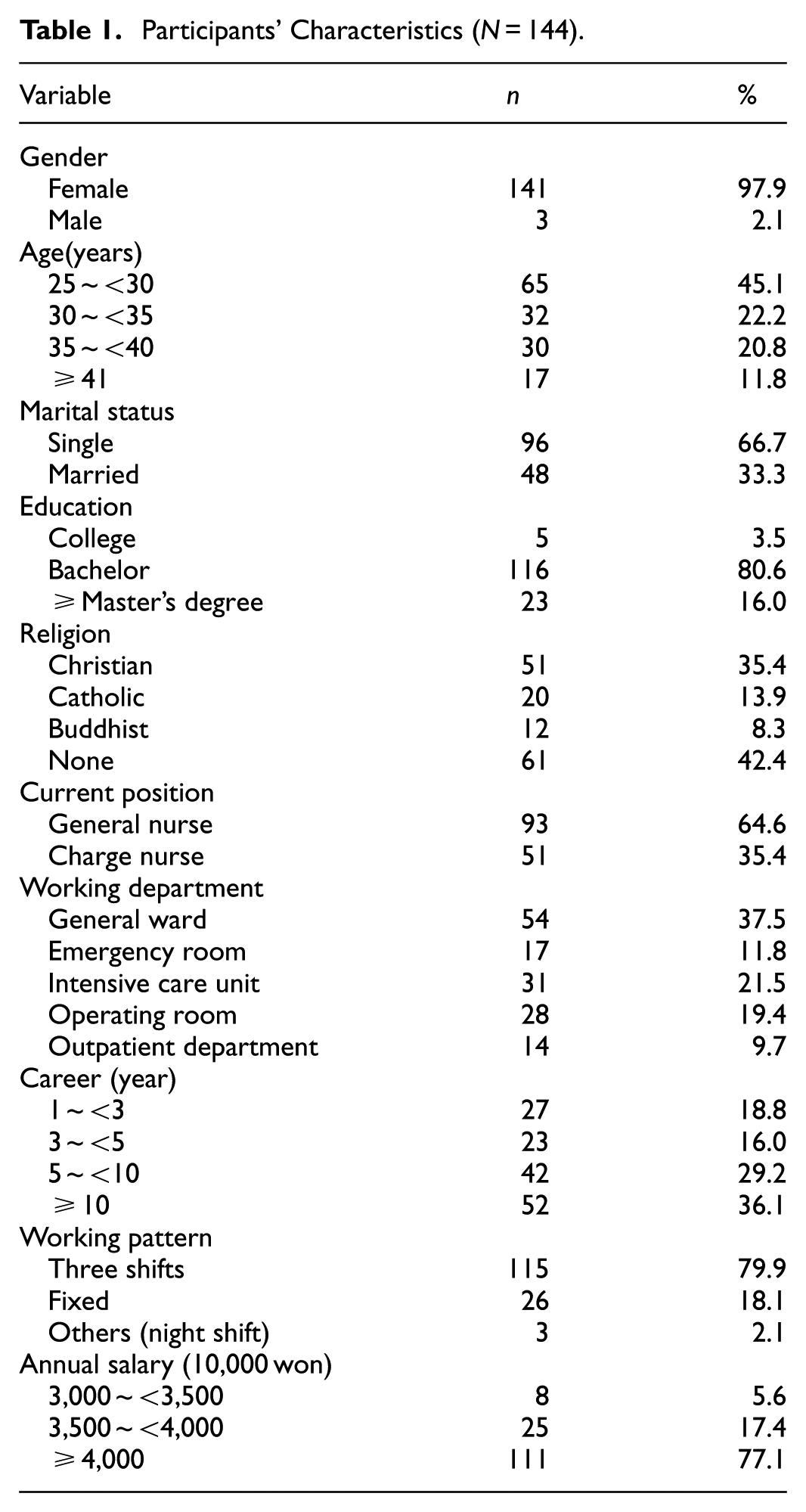
The socio-demographic characteristics of participants are summarized in Table 1. There were 141 (97.9%) females in the study, and 65 (45.1%) were between the ages of 25 and 30. 96 (66.7%) were unmarried, and 48 (33.3%) were married. Out of all participants, 116 (80.6%) had a bachelor’s degree, followed by 23 (16.0%) with a master’s degree or higher. Regarding religion, 61 (42.4%) had no religion or others, and 51 (35.4%) were Christian. A total of 93 (64.6%) were general nurses, which accounted for the largest distribution. Regarding working departments, 54 (37.5%) were in the general ward, followed by intensive care units, operating rooms, and emergency departments. Hospital nurses with over 10 years of experience accounted for 52 participants (36.1%). Regarding working shifts, 115 (79.9%) worked three shifts, and 26 (18.1%) worked during regular hours (9 a.m.–5 p.m.). The annual salary was more than forty million won, with 111 (77.1%) individuals, which accounted for the highest number (Table 1).
Participants’ Characteristics (N = 144).
Differences in Resilience, Emotional Exhaustion, Communication Competency, and Organizational Commitment according to Socio-Demographic Characteristics
There was a statistically significant difference in the resilience of the participants according to age (F = 3.32, p = .022), marital status (t = −2.21, p = .029), education level (F = 5.65, p = .004), and working department (F = 2.65, p = .036). Emotional exhaustion in the participants was statistically significantly different by gender (t = −2.39, p = .018), age (F = 5.62, p = .001), marital status (t = 3.15, p = .002), education level (F = 3.92, p = .022), position (t = 2.86, p = .005), working department (F = 4.16, p = .003), and clinical experience (F = 3.62, p = .015). There were no other significant relationships between socio-demographical variables and measures of communication competency. Organizational commitment of the participants was significantly different by age (F = 13.11, p < .001), marital status (t = −3.16, p = .002), education level (F = 11.81, p < .001), religion (F = 10.27, p < .001), position (t = −4.78, p < .001), working department (F = 5.62, p < .001), clinical experience (F = 10.58, p < .001), and annual salary (F = 3.21, p = .043) (Table 2).
Resilience, Emotional Exhaustion, Communication Competency, and Organizational Commitment According to Participants’ Characteristics (N = 144).

Note. SD = standard deviation; a, b, c, d = Scheffé test.
Mean Scores and Correlational Matrix of the Variables
The resilience was on average 2.36 (SD: 0.52), emotional exhaustion was on average 4.40 (SD: 1.04), communication competency was on average 3.54 (SD: 0.37), and organizational commitment was on average 4.22 (SD: 0.64) (Table 3). Correlations among resilience, emotional exhaustion, communication competency, and organizational commitment are shown in Table 4. Organizational commitment of the participants correlated positively with resilience (r = .436, p < .001) and communication competency (r = .364, p < .001). In addition, a positive correlation was found between resilience and communication competency (r = .507, p < .001). Emotional exhaustion was negatively correlated with organizational commitment (r = −532, p < .001), resilience (r = −511, p < .001), and communication competency (r = −402, p < .001).
Mean Scores of Resilience, Emotional Exhaustion, Communication Competency, and Organizational Commitment.

Note. SD = standard deviation; Min = minimum; Max = maximum.
Correlational Matrix of the Variables (N = 144).

p < .001.
Effects on Organizational Commitment
To identify factors affecting the organizational commitment of hospital nurses, we conducted a hierarchical multiple regression analysis of the Enter method using dummy variables. The Tolerance of 0.1 and the Variance Inflation Factor (VIF) were tested for multiple regression analysis to check multicollinearity between independent variables. The VIF did not exceed 10 for all variables, indicating no problem with multicollinearity between the variables. The Durbin-Watson statistics were 1.871, near the value of 2; thus, there was no autocorrelation between the independent variables, indicating that the error terms were independent. Therefore, the requirements for multiple regression analysis were satisfied.
As a result of hierarchical multiple regression analysis, categorical variables were converted into dummy variables. Model 1, which included socio-demographic characteristics as independent variables, showed that religion (Christian, t = 4.313, p < .001), work department (operating room, t = 2.587, p = .011), age (40 years and older, t = 2.381, p = .019; 35 to 40 years, t = 2.159, p = .033), clinical experience (over 1 year but less than 3 years, t = 2.380, p = .019), and educational level (master’s degree or higher, t = 2.306, p = .023) had statistically significant effects on organizational commitment. Specifically, nurses who were Christian (β = .322), worked in the operating room (β = .279), were aged 40 years or older (β = .249) or 35 to 40 years (β = .248), had clinical experience of over 1 year but less than 3 years (β = .249), and had attained a master’s degree or higher (β = .189) demonstrated higher organizational commitment. The explanatory power of Model 1 was 38.5% (F = 5.702, p < .001).
In Model 2, which controlled for socio-demographic characteristics and included resilience, emotional exhaustion, and communication competency, religion (Christian, t = 4.049, p < .001), emotional exhaustion (t = −3.221, p = .002), work department (operating room, t = 2.009, p = .047), and age (40 years or older, t = 2.003, p = .047) remained significant predictors. Higher organizational commitment was observed in nurses who were Christian (β = .277), worked in the operating room (β = .198), or were aged 40 years or older (β = .191). However, higher emotional exhaustion was associated with lower organizational commitment (β = −.249). The explanatory power of Model 2 increased to 49.8% (F = 7.451, p < .001) (Table 5).
Hierarchical Multiple Regression Analysis for Variables Predicting Organizational Commitment (N = 144).

Note. Reference group: Age = 30~<35; Marital status = single; Education = bachelor; Religion = none; Current position = general nurse; Department = out-patient department; Career = 5 ~ <10; Annual salary = 3,000 ~ <3,500.
Discussion
Organizational commitment is the organizational characteristic that positively views a high level of patient safety and the nursing organizational environment through providing quality services (J. Park & Park, 2022). Improving the organizational commitment of hospital nurses positively enhances job satisfaction, reduces turnover intention, and promotes efficient nursing services that ensure patient safety (Wang et al., 2023). In this study, hospital nurses’ resilience, emotional exhaustion, and communication competency are factors associated with organizational commitment. The study findings indicated that the level of resilience in hospital nurses was moderate, which was less than the resilience observed in a study of nurses in cancer wards using the same scale (Ko et al., 2018), but higher than the resilience found in emergency nurses (J. E. Park & Song, 2023). This difference may be due to various causes from hospital settings and working departments, and it is necessary to investigate these in the future with a larger participant pool, across multi-regions and various working departments. Moreover, in this study, the difference in resilience according to the socio-characteristics of the participants was significantly different depending on age, marital status, education, and working department. This was partially consistent with a study by Sihvola et al. (2022) that revealed that nurses’ age and position positively affected resilience. Since resilience is influenced by individual, family, and environmental factors and has an essential impact on overcoming difficulties in performing tasks and establishing identity (Ko et al., 2018; Y. Tang et al., 2022), in-depth research on the influencing factors related to the resilience of nurses is necessary. Additionally, as resilience can be acquired through training and education (Dordunoo et al., 2021; Guo et al., 2018), based on the attributes of resilience, it is necessary to develop and apply a continuous and systematic interventional program, such as mindfulness-based resilience training, peer-support initiatives, and leadership-driven coaching programs (Chesak et al., 2021; Mealer et al., 2014), to improve resilience among hospital nurses.
In this study, emotional exhaustion in hospital nurses was a mid-level score based on the standardized scale used. This was higher than the results of previous studies on general hospital nurses (Choi & Cho, 2022), but similar to the findings for clinical nurses as reported by Hetzel-Riggin et al. (2019). In addition, emotional exhaustion was significantly different based on gender, age, marital status, education level, position, working department, and clinical experience. This was partially consistent with a study on nurses’ burnout in a university hospital (Dordunoo et al., 2021) which reported significant differences in marital status, motivation to choose a nursing job, salary, and job satisfaction. In the future, it is necessary to conduct repeated studies considering the different regions and sizes of hospitals. However, several previous studies (Kelly et al., 2021; H. J. Lee & Jung, 2018; Wang et al., 2023) reported high emotional exhaustion, or burnout in hospital nurses, it was probably due to the increased job stress and burden of nursing work from the practical field with many emergencies directly related to human life. Therefore, emotional exhaustion can be alleviated through the active organizational support of hospitals and the provision of various continuing education programs that reduce job stress and burden in the workplace (Abdulmohdi, 2024).
The communication competency of hospital nurses was moderate; it was higher than that reported in the study by H. J. Kim and Cho (2022) on nurses in general hospitals with more than 300 beds. In clinical practices, nurses perceive their communication competencies through continuous communication with patients, caregivers, physicians, and collaborators (Arabiat et al., 2018; J. Kang et al., 2021) and become competent in communications through hospital organizational experience and problem-solving processes (Hong & Han, 2021). Nurses’ communication competency affects nurses’ job stress, burnout, and quality nursing services (N. R. Kim et al., 2022). Practical communication competency is essential to increase the nurses’ organizational commitment, strengthen organizational cohesion, and improve motivation, morale, and cooperation, while reducing emotional labor and job stress (Zhai et al., 2023). It is necessary to make an effort to alleviate emotional labor and job stress, and communication competency plays a buffering role in these relationships (H. J. Kim & Cho, 2022). Therefore, it is expected that inter-departmental work exchanges and employee training programs implemented in a tertiary hospital of this study would contribute to improving the communication competency of hospital nurses.
This study found that hospital nurses’ organizational commitment was moderate, which aligns with a study of emergency nurses (Li et al., 2020). However, it was lower than the study on the organizational commitment of first-line nurse managers (Akgerman & Sönmez, 2020). These phenomena seem to be due to the high organizational commitment of nursing managers, who, unlike general nurses, are dedicated to the nursing organization and have relatively high direct participation in decision-making and work responsibility. High organizational commitment reduces turnover intention and burnout, and it has a positive effect on nursing outcomes (Stewart et al., 2020) as well as self-efficacy, resilience, and job satisfaction (J. Kang et al, 2021; Li et al., 2020; Meng et al., 2019). This study found positive correlations among resilience, communication competency, and organizational commitments, while emotional exhaustion was negatively correlated with these variables. Although the studies that included our main variables were limited, the findings of this study were partially consistent with previous studies (Gavya & Subashini, 2024; Han, 2022; Moon & Lee, 2021; Ryu & Kim, 2016; Stewart et al., 2020). It seems that enhancing organizational commitment may improve both resilience and communication competency and decrease emotional exhaustion. Therefore, policies to enhance organizational commitment are necessary to improve resilience and communication competency and decrease the emotional exhaustion of hospital nurses. The findings identified that emotional exhaustion, religious affiliation, working department, and age were associated with the organizational commitment of hospital nurses. In particular, the results indicate emotional exhaustion and the working department, which are interventional factors for organizational commitment in nursing management and have significant implications. This finding was consistent with previous studies reporting that emotional exhaustion had the most significant impact on nurses’ turnover intention and was the main factor that hindered organizational commitment (Duru & Hammoud, 2022; Stewart et al., 2020). Nurses’ burnout reduces quality care delivery, patient safety management, patient satisfaction, and organizational commitment and outcomes (Hsiao et al., 2022; Jun et al., 2021). Moreover, the achievement-oriented and result-oriented nature of nursing practice is one of the causes of increased emotional exhaustion among hospital nurses. As such, reducing emotional exhaustion strengthens hospital nurses’ organizational commitment (Wang et al., 2023), in turn, practical strategies to alleviate emotional exhaustion among hospital nurses are essential for spreading a positive nursing organizational culture and providing quality care. The practice of meditation, participation in mindfulness programs, and implementation of stress management techniques have been known to have a beneficial impact on decreasing emotional exhaustion and enhancing organizational commitment in hospital nurses (Chmielewski et al., 2021). Ultimately, active and systematic interventions for establishing a suitable compensation system (e.g., recognition, remuneration, working environments, career development, etc.) by hospital and nursing administrators can significantly alleviate emotional exhaustion and improve the organizational commitment of hospital nurses. This suggests that when nursing administrators deal with emotional exhaustion, turnover intention, and burnout, integrating organizational commitment into these relationships may promote the development of strategies for nurse retention.
Strengths and Limitations
The strengths of this study are: First, resilience, emotional exhaustion, and communication competency were simultaneously considered predictors of the organizational commitment of hospital nurses. Furthermore, among these variables, emotional exhaustion as an interventional variable, was the most potent influencing factor on organizational commitment. Therefore, the practical strategy to effectively improve the hospital nurses’ organizational commitment must first alleviate emotional exhaustion. Second, this study suggested practice-based evidence that can explain organizational commitment related to human resource management in clinical practices. There are some limitations to this study. First, this study was conducted using a convenient sampling method to collect data, and the study’s setting was confined to a particular geographic location in Asia; thus, the generalizability of this finding to hospital nurses in other regions or countries cannot be assured. Second, because of the nature of the cross-sectional design used in this study, we cannot establish causal relationships among the four variables. In addition, this study did not reveal whether each variable directly affects nurses’ organizational commitment or whether one of them acts as a mediator involving the remaining variables. Future studies using longitudinal designs are strongly recommended. Despite these limitations, this study provides some valuable insights into the perspectives of the organizational commitment among hospital nurses in a Korean socio-cultural context.
Implications for Clinical Practice and Research
This study contributes to the existing literature on resilience, emotional exhaustion, communication competency, and organizational commitment in Korean hospital nurses working in a tertiary hospital. Moreover, it provides practice-based evidence for healthcare organizations to formulate strategies to enhance organizational commitment. This study implies that practical strategic approaches to improving the hospital nurses’ organizational commitment by hospitals and nursing administrators can increase resilience, communication competency, and job satisfaction and reduce turnover intentions by conducting them with a focus on emotional exhaustion. Additionally, this study informs healthcare organizations in other countries regarding the organizational commitment traits of Korean hospital nurses.
Conclusion
In the current study, exploring the organizational commitment of hospital nurses and related variables within the socio-cultural context of Korea, we suggested the interventional influencing factors on the hospital nurses’ organizational commitment to nursing personnel management. The findings highlighted that the promotion of organizational commitment of hospital nurses should include tailored interventional strategies that consider emotional exhaustion and the working department’s characteristics. Therefore, to increase the organizational commitment of hospital nurses, hospital and nursing managers, and healthcare policymakers should consider the factors identified in this study—specifically emotional exhaustion, and the working department’s characteristics—when developing organizational strategies. Furthermore, the study’s contribution to existing knowledge and its potential impact on hospital nursing practices warrants further exploration, as these findings could have far-reaching implications for nursing practices and education.
Future Research
Based on this study, we suggest further research to improve the organizational commitment of hospital nurses. First, expanding the study’s participants pool by gender, region, and size of hospitals and conducting repeated studies is necessary to identify the relationship among hospital nurses’ resilience, emotional exhaustion, communication competency, and organizational commitment. Second, it suggests developing a tailored continuing education program that considers emotional exhaustion and working department characteristics in nursing personnel management and verifying its effectiveness. Third, since 49.8% of hospital nurses’ organizational commitment was explained in this study, it suggests considering additional variables to enhance the explanatory power of the regression analysis model in subsequent studies.
Footnotes
Acknowledgements
The authors thank the hospital nurses who participated in this study for their time and patience. The authors sincerely thank Young R. Kim-Shim, Ph.D., (Adjunct Professor, Department of Psychology, Emory University) for her critical feedback and editorial support on this manuscript.

Ethical Considerations
This study was conducted in accordance with the ethical standards outlined in the APA Ethical Principles of Psychologists and Code of Conduct (Section 8.05) and adhered to the guidelines provided by SAGE Open for studies involving human participants. All procedures complied with the 1964 Helsinki Declaration and its later amendments. This study received ethical approval from the Institutional Review Board of Konkuk University in South Korea (Approval No. 7001355-201712-HR-223).
Consent to Participate
All participants provided written informed consent prior to participation, and their anonymity and confidentiality were strictly maintained throughout the study. Participants were informed of the study’s objectives, and their right to refuse participation or withdraw at any stage without any disadvantages was guaranteed. Additionally, all collected data were de-identified before analysis to ensure participant privacy.
Author Contributions
All authors contributed to the study’s conception and design. Material preparation, data acquisition, and analysis were performed by E.J.Y and H.Y.K. The first draft of the manuscript was written by H.Y.K., and H. J. K., and all authors commented on the manuscript’s writing, review, and editing. All authors have read and approved the manuscript.
Funding
The authors received no financial support for the research, authorship, and/or publication of this article.
Declaration of Conflicting Interests
The authors declared no potential conflicts of interest with respect to the research, authorship, and/or publication of this article.
Data Availability Statement
The data presented in this study are available on request to the first and corresponding author. The data is not publicly available due to ethical issues.