




Abstract
Effectively implementing leadership is critical for organizational success. In consideration of this issue, this study investigated effective leadership in US- and Germany-based multinational companies (MNCs) operating in South Korea. Drawing on transformational leadership (TL) theory and leadership contingency theory, the study clarified the contextual dependency of TL effectiveness. A survey was administered to 258 employees of the target MNCs, during which the participants were asked to rate their supervisors’ transformational leadership behaviors. The responses were empirically analyzed on the basis of the research framework. The findings showed that a leader’s group-focused TL behaviors indirectly influenced organizational commitment and that this relationship was mediated by psychological empowerment in the US-based MNCs. Conversely, a leader’s individual-focused TL behaviors demonstrated a pronounced effect on organizational commitment and that this association was also mediated by psychological empowerment in the Germany-based MNCs. The leadership behaviors that effectively empowered employees and increased their organizational commitment differed depending on the cultures prevalent in the organizations’ countries of origin. Adopting the two-dimensional model of TL, this study confirmed the contextual dependency of TL behaviors and suggested the need to incorporate an organization’s cultural context into predictions regarding the effects of certain leadership behaviors.
Keywords
Introduction
The emergence of transformational leadership (TL) due to its theoretical and practical usability in management has rendered this leadership style a popular subject of study. TL research have revealed its effectiveness on managing employees because it enhances the positive organizational outcomes expected from employees, such as organizational commitment and identification, job satisfaction, and citizenship behaviors (Avolio et al., 2004; Choi et al., 2016; Gillet & Vandenberghe, 2014; Mansoor & Ali, 2020; Saira et al., 2020). TL has also been examined from the perspective of human resource (HR) and leadership development and was found that this leadership style can be fostered through structured training and developmental leadership programs, thereby contributing to the effective functioning of organizations (Jacobsen et al., 2021).
However, despite the apparent effectiveness of TL in advancing organizational outcomes, its universal applicability remains a matter of dispute (Andersen, 2015; Dust et al., 2014; Eberly et al., 2017; Kim & Shin, 2019; Mesu et al., 2015). As explained by Eberly et al. (2017), the effectiveness of TL is situational, with this style being more effective in increasing employees’ job embeddedness and subsequently reducing turnover intention in the high extreme contexts. Similarly, Dust et al. (2014) reported that the effects of TL on employee outcomes are facilitated or attenuated by an organization’s structural context; that is, an organic structure enhances TL effects, whereas a mechanic structure constrains them. Finally, in raising a question about the claimed universal effectiveness of TL, Andersen (2015) argued for its plausible contextual dependency. These studies support leadership contingency theory, which posits the influence of context on the receptiveness to and effectiveness of leadership (House & Javidan 2004; Littrell & Valentin, 2005) and suggests a necessity of considering context and its influence on TL effectiveness.
Nothing this, this the current research focused on the plausible association between context and leadership effects. More specifically, it illuminated the role of an organization’s cultural context in the effects and processes of TL in subsidiaries of foreign multinational companies (MNCs). The organizational contexts of foreign MNCs operating in domestic locations differ because they are influenced by their cultures of origin (Webster & White, 2010), and such differences, in turn, affect the implementation of leadership and its effectiveness (Dust et al., 2014; Eberly et al., 2017). Notwithstanding the potential difference in TL effectiveness in foreign MNCs, leadership in these entities has rarely been investigated. To address this gap, the present work explored differences in cultural contexts between US- and Germany-based MNCs operating in South Korea and investigated their relationships with TL. These countries were chosen for two primary reasons. First, both the United States and Germany have had representatively long and closely cooperative economic relationships with South Korea, thus substantially contributing to its economic progress and advancement (Chang, 2011). Many US- and Germany-based MNCs operate in the country, accounting for 19.2% of 8,695 foreign subsidiaries in Korea as of 2020 (TASIS, 2022). Second, although they have commonalities in terms of their economic relationships with South Korea as Western-based MNCs, they differ considerably in terms of prevailing national cultures, which are rooted in their specific contextual, historical, and cultural heritages (Chang, 2011; Ferner, 1997; Kuchinke, 1999). This pronounced cultural difference provides an appropriate context for comparing variances in expected leadership effectiveness that are attributable to country of origin and organizational culture of subsidiaries in a local context.
To determine the expected differences in TL effectiveness in the subsidiaries of interest, this study examined leadership behaviors using a dimensional approach (Kim & Shin, 2019; Mesu et al., 2015; Minai et al., 2020). The rule of thumb in TL research is to adopt a unidimensional and collective approach by integrating all the individual leadership behaviors (Bass & Avolio, 1997), but this collective approach disregards the conceptual differences among the subconcepts that comprise TL, thus depriving researchers of the chance to gain deeper knowledge about the roles and contributions of individual concepts. Researchers have raised concerns over the unidimensional approach to TL study, calling for increased attention to the multidimensional nature of this leadership style (Kim & Shin, 2019; Mesu et al., 2015; Minai et al., 2020; Van Knippenberg & Sitkin, 2013). They further argued that the dimensions composing TL are conceptually distinctive and therefore induce different psychological processes, which results in the differences in organizational outcomes (Kunze et al., 2016; Mesu et al., 2015; Wu et al., 2010). In line with these contentions, the current work study takes the dimensional approach and separated TL into two distinctive dimensions: group- and individual-focused leadership. It also looked into the psychological process by which TL influences organizational commitment. Compared with other leadership styles, TL has been regarded as distinctively effective in fostering the intrinsic motivation of employees owing to its facilitation of empowerment and changes in employees’ work attitudes (Conger, 1999; Conger & Kanungo, 1988). In particular, employee empowerment is important in achieving certain tasks and goals. Correspondingly, this research delved into the mediating role of psychological empowerment in the association between TL behaviors (group- and individual-focused leadership) and organizational commitment in the target MNCs.
Theory and Hypotheses
Group- and Individual-Focused TL Behaviors
As a distinctive form of leadership, TL has received considerable attention in leadership and management studies (Bass & Avolio, 1995, 1997; Choi et al., 2016; Gillet & Vandenberghe, 2014; Kim & Shin, 2017; Mansoor & Ali, 2020). As manifested in the term “transformational,” TL’s importance lies in its relationship with and contribution to changes in the psychological statuses of employees with respect to their work and improvements to their intrinsic work motivation (Bass & Avolio, 1997). TL is developed and formulated by integrating four behavioral dimensions of idealized influence, inspirational motivation, intellectual stimulation, and individualized consideration (Bass & Avolio, 1995). Even though these dimensions uniformly comprise TL and such approach was adopted in TL research, it should be noted that each dimension has distinctive conceptual meaning and individually depicts the distinctive behaviors of a transformational leader. This multi-dimensional nature of TL, as suggested by Yukl (2010), should be considered because the individual character of each concept may lead to different processes and outcomes in organizations. This view questions the generally accepted unidimensional approach in TL studies and further suggests the need to adopt a taxonomical approach when examining TL effectiveness.
Certain researchers have supported a taxonomical and dimensional approach to exploring TL and suggested that this leadership style has a two-dimensional structure (Kark & Shamir, 2002; Mesu et al., 2015; Wu et al., 2010). Building on social identity theory and self-concept theory, Kark and Shamir (2002) found that TL dimensions engender a dual identification process, that is, the collective self and the relational self, which contributes to individuals’ formulation of different identities. Wu et al. (2010) investigated the dimensions of TL and discovered that the two subdimensions of idealized influence and inspirational motivation differ from the other two subdimensions of intellectual stimulation and individualized consideration in terms of targets of influence. Mesu et al. (2015) took an explorative approach and uncovered that TL is composed of two dimensions: visionary leadership, which encompasses leadership behaviors related to idealized influence, and development stimulation, which covers leadership behaviors associated with intellectual stimulation and individualized consideration.
This line of research validates the two-dimensional model of TL: one incorporating idealized influence and inspirational motivation and the other incorporating intellectual stimulation and individualized consideration. The former dimensional pair is related to group-focused TL behaviors that contribute to shaping group identity as a whole by driving the sharing of an organization’s vision and goals. The latter dimensional pair is related to caring for and maintaining individual identity through concern for individual needs and abilities (Kark & Shamir, 2002; Wu et al., 2010). Specifically, group-focused TL leadership articulates an organization’s vision, expresses optimism and confidence about the future of the organization, includes demonstrations of self-sacrifice by placing a group’s vision and goals over individual interests, and illustrates a leader’s capacity to be a role model for subordinates and an agent of the organization. Group-focused TL leadership inspires employees and encourages them to identify with an organization and strengthen their membership in it (Kark et al., 2003). This social identification process facilitates this dimension’s augmentation of intrinsic work motivation in employees. Individual-focused TL leadership (e.g., that demonstrated by the roles of coaches and mentors) is characterized by concern for each employee, with leaders dedicating their time and effort to comprehending their differing needs, capabilities, and skills, as well as providing useful and specific advice to help each employee enhance their capabilities or growth. Such leadership satisfies employees’ individual needs and makes them feel supported and personally bonded to an organization, which in turn, increases their work motivation (Kark & Shamir, 2002). This study adhered to this distinction and dichotomized TL as group- and individual-focused leadership.
The Mediating Effect of Psychological Empowerment
Psychological empowerment refers to a cognitively elevated feeling of intrinsic motivation toward work in its meaning, competence, self-determination, and impact (Spreitzer, 1995). As empowered employees are committed to their work responsibilities and perform well, they contribute to increased meaningful organizational outcomes, organizational creativity, and sustainable organizational success (Carless, 2004; Ergeneli et al., 2007; Joo & Shim, 2010; Liden et al., 2000). Employee empowerment is initiated by TL (Conger, 1999; Conger & Kanungo, 1988; Thomas & Velthouse, 1990). Specifically, TL behaviors, such as articulating and sharing a company’s vision, being optimistic about the company’s future, challenging employees intellectually, and demonstrating personalized care and concern for them, change employees’ perceptions about their work (Bass, 1999; Yukl & Van Fleet, 1992). Influenced by leaders, employees find their work significant and experience autonomy, control, and confidence, which increase their morale and motivation (Menon, 2001). This elevated empowerment leads employees to be passionate, responsible, and committed to their work (Liden et al., 2000). Consequently, psychological empowerment is connected to positive employee attitudes and organizational outcomes, such as organizational commitment, citizenship behavior, and job satisfaction (Gillet & Vandenberghe, 2014; Joo & Jo, 2017; Seibert et al., 2011).
Research has shown that psychological empowerment mediates the effects of TL on organizational commitment (Avolio et al., 2004; Kim & Shin, 2019). Organizational commitment is defined as affective and emotional attachment to an organization (Mowday et al., 1979). Such emotional affectivity is characterized by active involvement in an organization and a strong desire to maintain organizational membership (Mowday et al., 1979; Porter et al., 1976). Committed employees thus willingly invest a significant amount of time in their work and are less likely to leave their organizations (Mowday et al., 1979). Given that committed employees perform better because they exert more effort in accomplishing their jobs (Dessler, 1999; Riketta, 2002, 2008), obtaining and maintaining highly dedicated personnel are considered important for sustaining a company’s competitive advantage. On this basis, we predicted that the mediating role of psychological empowerment would also be observed in the US- and Germany-based companies operating in Korea. However, in consideration of the dimensionality of TL and the leadership contingency view, the study also incorporated these organizations’ cultural contexts into the analyses to determine their moderating effect on the mediation of TL dimensions.
The Role of an Organization’s Cultural Context in TL Effectiveness
The organizational cultures of foreign MNCs operating in a host country are generally determined by the national cultures of their countries of origin (Webster & White, 2010). These enterprises typically mirror the structural norms and managerial practices of their headquarters and transplant them into local settings (Grothaus, 2015; Taylor et al., 1996). The country-of-origin effect on MNC behavior is particularly common among advanced Western MNCs, such as those from the US, UK, and Germany, particularly when they expand their businesses to emerging and Asian nations (Ferner, 1997; Stehle & Erwee, 2007). Western MNCs adopt a convergence and standardized strategy in implementing management practices in a local context; they assign home country nationals to managerial positions in their subsidiaries to enforce control and ownership over these divisions (Hetrick, 2002). This convergence approach is a strategic decision of MNCs to maintain consistency in corporate culture and identity, thus enhancing management efficiency (Ferner, 1997; Taylor et al., 1996). It engenders similarities in organizational culture between foreign subsidiaries and headquarters in their home countries. Therefore, the organizational cultures of MNCs from two nations, such as those that we investigated, can differ because they reflect the respective cultural features of their countries of origin.
Different organizational cultures influence the emergence and effectiveness of leadership styles. Leadership contingency theory postulates that endorsed and effective leadership styles differ according to context (Houghton & Yoho, 2005; House & Javidan 2004; Jogulu, 2010; Littrell & Valentin, 2005). It argues that leadership effects are situational; that is, certain leadership behaviors correspondent with an organizational context are embraced by and have positive effects on employees. For instance, the organizational culture of US companies is characterized to a remarkable degree by a performance and competition orientation rooted in individualistic, short-term, and masculine cultural values (Ferner, 1997; Kuchinke, 1999). In such a culture, a leader’s role as an organization’s agent is important, thus prompting a show of confidence in the organization’s future. This agentic behavior of the leader influences employees to shape their organizational identity and strengthen the identification of employees with the organization. US companies also often value charismatic leadership behaviors, such as idealized influence and inspirational motivation (Kuchinke, 1999). Adding to these insights, Ardichvili and Kuchinke (2002) found a cultural dependence of leadership styles and showed that the leadership behaviors of idealized influence and inspirational motivation are frequently exercised by US managers. Studies have likewise suggested that group-focused TL behaviors are congruent with the culture of US companies and would be more effective as a means of managing employees. Specifically, congruent leadership behaviors facilitate empowerment by enhancing the process of identification with an organization (Kark et al., 2003). Through identification, employees feel enabled and thus develop organizational commitment. Accordingly, we assumed that group-focused TL behaviors effectively increase feelings of empowerment and thereby foster organizational commitment in US-based companies:
H1. Group-focused TL behaviors effectively exert a positive influence on organizational commitment via psychological empowerment in US-based companies operating in Korea.
Meanwhile, German companies pursue horizontal integration within groups and encourage the active and equal participation of employees in decision making (Grothaus, 2015; Hollingsworth, 2000). These corporations focus on specialization in work and cultivate an organizational learning culture that nurtures individual capability and specialization through personal education and training (Ferner, 1997; Stehle & Erwee, 2007). This culture defines the leadership role as that of a coach or mentor on the basis of exchange and personal relationships between leader and employee; the latter easily accepts such a leadership style (Littrell & Valentin, 2005). German companies are also often more relatively relational and human-oriented than other Western enterprises (Ferner, 1997; Hofstede, 1980). Given historical and cultural factors, they rarely advocate or exhibit charismatic leadership behaviors (Ardichvili & Kuchinke, 2002; Kuchinke, 1999). These features suggest that individual-focused TL behaviors coincide with the values of German companies and that personalized care and a focus on relationships are strongly endorsed by employees in such companies. Consistent with these possibilities, the leadership behaviors advance the efforts of employees to internalize organizational values by stimulating identification with leaders, thereby enhancing organizational learning and feelings of empowerment. The upshot of all these is heightened organizational commitment. Accordingly, we speculated that individual-focused TL behaviors effectively facilitate empowerment in Germany-based companies, ultimately contributing to the enhancement of organizational commitment in these enterprises (Figure 1):
H2. Individual-focused TL behaviors effectively exert a positive influence on organizational commitment via psychological empowerment in Germany-based companies operating in Korea.
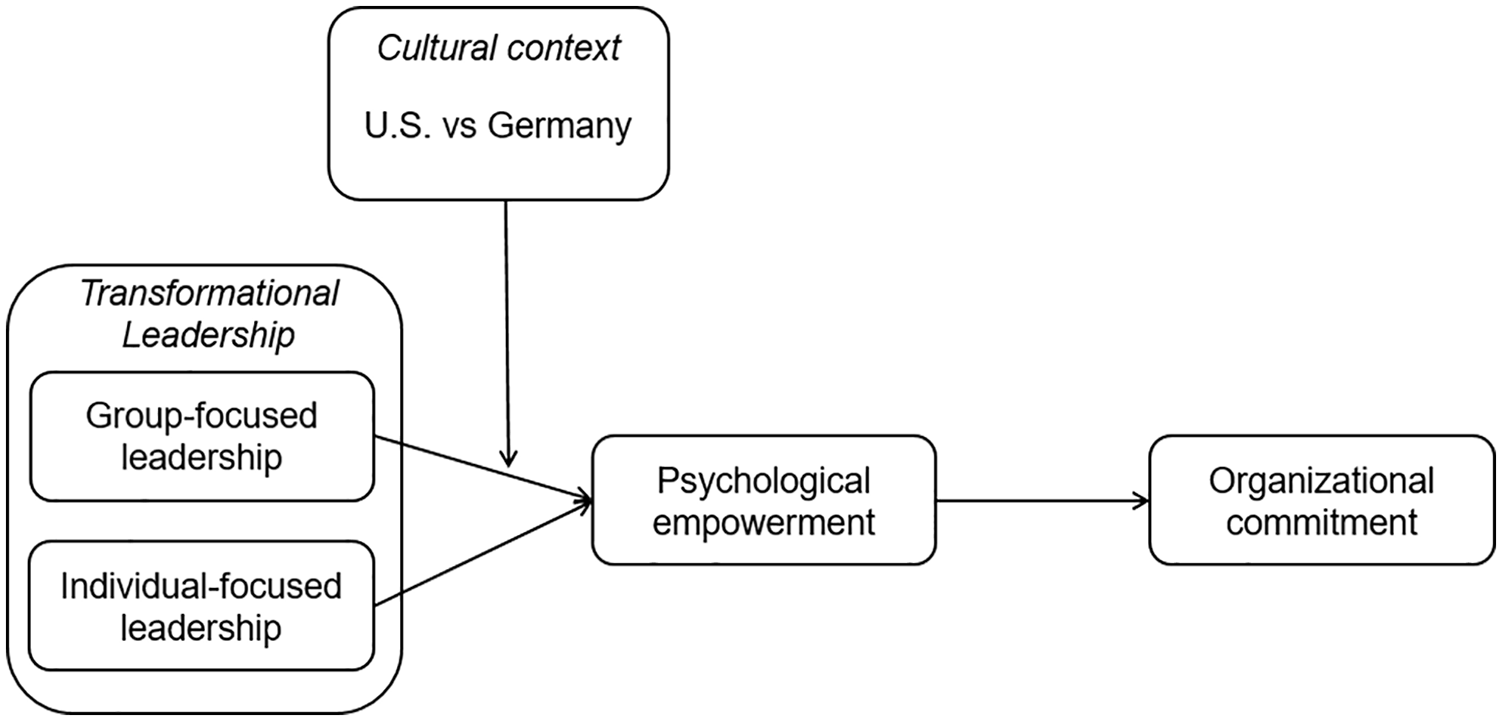
The hypothesized research model.
Methods
Data Collection
A survey was administered to employees working at US and German companies in Korea. MBA students working for these companies provided assistance by acting as liaisons between the authors and the employees. Because hierarchy in an organization possibly influences people’s attitudes, we enlisted only MBA students in mid-level or higher positions in the target companies. They were provided with 20 copies of the questionnaire and detailed instructions on data collection, and then they randomly distributed the questionnaires in their departments to ensure anonymity. The survey participants were instructed to evaluate the leadership behaviors of their direct supervisors, as well as those assessing their psychological empowerment and organizational commitment. The study targeted Korean employees working for foreign MNCs, so the initially developed English survey was backtranslated into Korean (Brislin, 1970). To ensure semantic parity between the English and Korean versions, the Korean survey was reviewed by professional researchers and PhD management students. It was also pre-tested by a number of Korean employees to confirm meanings. With their feedback as basis, some words were corrected to improve consistency in meaning. The survey was distributed to 20 companies (13 US MNCs and 7 German MNCs), among which 15 were large corporations (i.e., employing more than 300 people) and 17 operated in non-manufacturing industries. Of the 400 surveys distributed, 265 were returned, resulting in a 66.2% response rate. Some of the questionnaires had missing information and/or contained suspicious responses (e.g., the same answers listed for 10 or more consecutive items) and were therefore omitted from the analyses. This left us with a final sample of 129 completed surveys each from the US and German companies.
Table 1 lists the demographic characteristics of the survey participants. In both companies, the majority of the respondents were 30 years old or older (US 91.47% and Germany 89.92%, respectively). Most of them were highly educated, with the greater proportion having graduated from 4-year courses at university (US 82.17% and Germany 77.53%, respectively). Their positions varied from entry-level posts to top-tier management, but the distribution according to positions in the two companies was similar. The average tenure in the German companies (10.9 years) was slightly longer than that in their US counterparts (9.3 years). Similarly, the average work experience with their leaders was slightly longer among employees in the German companies (7.5 years) than among those in the US companies (5.6 years).
Demographic Characteristics of the Samples.

Note. Unit of tenure = month.
Measures
Group- and individual-focused TL
We used items from the Multifactor Leadership Questionnaire (MLQ-5X: Bass & Avolio, 1995) to measure group- and individual-focused TL. Because the behavioral aspects of leadership and their effects were the main focus of the study, we omitted four idealized influence items related to attribution (Kark et al., 2003), leaving us with 16 items. The respondents answered questions about their direct supervisors using a 5-point Likert scale ranging from 1 (not at all) to 5 (very frequently, if not always). Consistent with prior research (Kim & Shin, 2019; Kunze et al., 2016; Wu et al., 2010), the group-focused TL measure (8 items; US α = .90 and Germany α = .93) was constructed featuring idealized influence and inspirational motivation, whereas the individual-focused leadership measure (eight items; US α = .92 and Germany α = .93) was formulated featuring intellectual stimulation and individualized consideration. Sample items on group- and individual-focused TL, respectively, are as follows:
“My direct supervisor goes beyond self-interest for the good of the group.”
“My direct supervisor suggests new ways of looking at how to complete assignments.”
Organizational commitment (OC)
Organizational commitment was measured as affective commitment, as adapted from Allen and Meyer (1990; 8 items; US α = .84 and Germany α = .80). We chose affective commitment because its conceptual importance has been well documented in management studies (Joo & Shim, 2010), and its psychological properties have been shown to be adequate in explaining employee behaviors in South Korea (Lee et al., 2001). A 5-point Likert scale ranging from 1 (strongly disagree) to 5 (strongly agree) was used. A sample item measuring affective commitment is “I would be very happy to spend the rest of my career with this organization.”
Psychological empowerment (PE)
The items developed by Spreitzer (1995) were used to measure psychological empowerment. Ratings were assigned using a 5-point Likert scale ranging from 1 (strongly disagree) to 5 (strongly agree). Consistent with the measurement scheme used in prior studies (Avolio et al., 2004; Chen et al., 2007), the items were averaged to form a measure of psychological empowerment (12 items; US α = .90 and Germany α = .85). Sample items include the following:
“The work I do is meaningful to me.”
“I am self-assured about my capabilities to perform my work activities.”
Control variables
On the grounds of research that treated individual demographic factors as potential predictors of organizational commitment (Riordan et al., 2003), we included some individual variables (i.e., the respondents’ ages, genders, education, and job titles) and ruled out their explanations for variations in organizational commitment. Age was scaled from 1 to 7, with each value having a 5-year gap: younger than 25 years old (1) to 50 years old or older (7). Gender was dummy-coded (1 for male and 0 for female). Education and position were scaled from 1 to 5, in which a high value indicates high educational attainment and position. Organizational tenure (total duration of employment by now) and leader tenure (total duration at which respondents have worked with their direct supervisors) were measured in months, and the logarithmic form was used in the analyses.
Results
Descriptive Analyses
Table 2 presents the descriptive statistics and correlations of the study variables. The mean values of group-focused TL, individual-focused TL, and psychological empowerment were slightly higher among employees of the US-headquartered companies than among those of the Germany-based corporation. The correlational analysis of each US and German company showed that the independent variables (group- and individual-focused TL), the dependent variable (organizational commitment), and the mediating variable (psychological empowerment) were significantly correlated. Specifically, group-focused TL was correlated more strongly with organizational commitment in the US companies (r = .45, p < .01) than in their German counterparts (r = .33, p < .01). A similar result was obtained for individual-focused TL and organizational commitment (US companies, r = .44, p < .01; German companies, r = .33, p < .01), suggesting the possible greater importance of such leadership in the US enterprises. The significance of these group differences was investigated using the Fisher-Z method, which involves the transformation of normalizing Pearson correlations (Meng et al., 1992). The analysis indicated that the differences between the groups were not significant (group-focused TL: Z = 1.17; individual-focused TL: Z = 1.01), demonstrating that group- and individual-focused TL was significant in both companies.
Descriptive Statistics and Correlations Among Variables.
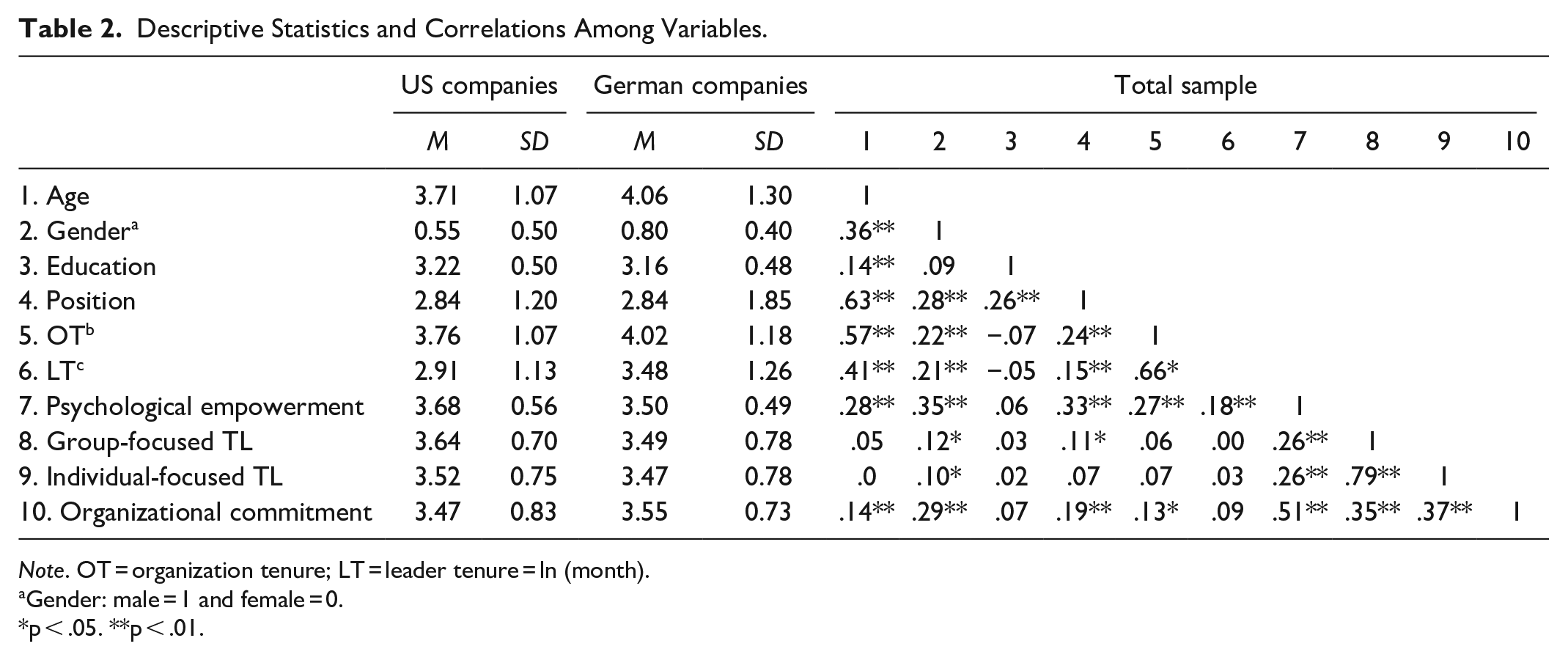
Note. OT = organization tenure; LT = leader tenure = ln (month).
Gender: male = 1 and female = 0.
p < .05. **p < .01.
Hypothesis Testing
We first examined the validity of the factorial structure in both samples. Because the framed research model included four latent variables—group- and individual-focused TL, psychological empowerment, and organizational commitment—we tested the model fit by conducting confirmatory factor analysis (CFA). Given the suggested cutoff values of the fit index (Hu & Bentler, 1999), the CFA results confirmed that the four-factor structure of our measurement model fit the data from both the US (χ2 = 462.26, df = 232, p < .01; comparative fit index [CFI] = 0.90; root mean squared error of approximation [RMSEA] = 0.08; Tucker–Lewis index [TLI] = 0.88) and German (χ2 = 429.64, df = 234, p < .01; CFI = 0.91; RMSEA = 0.08; TLI = 0.89) companies. Although we attempted to reduce the potential for common method bias by taking special care in designing and collecting the survey, the intrinsic weakness of single-source data prompted the performance of Harman’s one-factor analysis (Podsakoff et al., 2003). The results showed poor fit: χ2 = 1,200.36, df = 256, p < .01, CFI = 0.54, RMSEA = 0.17, and TLI = 0.51 in the US companies and χ2 = 1,065.58, df = 253, p < 0.01, CFI = 0.61, RMSEA = 0.16, and TLI = 0.58 in the German companies. These results confirmed the low possibility of common method bias.
We also performed hierarchical multiple regression to investigate increasing patterns and effect sizes owing to the addition of variables in order (Leech et al., 2008). Table 3 shows the results. Models 1 to 4 detail the results on data from the US companies, and Models 5 to 8 represent those from the German companies. Following previous research that found a significant influence of individuals’ demographic variables on psychological empowerment (Zhou et al., 2012), we included demographic factors only in Models 1 and 5. The results showed obvious differences between the companies. The effects of demographic variables on psychological empowerment were more pronounced in the US-based companies, explaining 24% of the total variance in psychological empowerment. Specifically, gender (β = .25, p < .05), position (β = .26, p < .01), and age (β = −.17, p < .05) were significantly related to psychological empowerment. In contrast, the effects of demographic factors explained only 12% of the total variance in psychological empowerment. Only gender showed a significant effect on psychological empowerment (β = .26, p < .05), implying that male employees felt more empowered than did their female counterparts.
Regression Results for Each Sample: The Effects of Group-Focused and Individual-Focusd TL.

Note. OT = organization tenure; LT = leader tenure = ln (month); PE = psychological empowerment; OC = organizational commitment.
Gender: male = 1 and female = 0.
p < .05. **p < .01.
In Models 2 and 6, the mediator (psychological empowerment) was regressed on the independent variables, and different results were derived for each sample. Whereas only group-focused TL was significantly related to psychological empowerment in the US sample (β = .19, p < .05, ∆R2 = 7%), only individual-focused TL had a significant effect on the mediator in the German companies, explaining an additional 19% of the total variance in psychological empowerment (β = .32, p < .01). On the grounds of these findings, in Models 3 and 7, the dependent variable (organizational commitment) was regressed on the independent variables. Model 3 showed that both group- and individual-focused TL was significantly related to organizational commitment in the US companies (β = .27, p < .05 and β = .27, p < .01, respectively). Contrastingly, Model 7 showed that only individual-focused TL was significantly associated with organizational commitment in the German sample (β = .24, p < .05); the effect of group-focused TL was non-significant (β = .07, n.s.).
To test the mediating role of psychological empowerment, it was incorporated into Models 4 and 8. Its addition to Model 4 explained the additional 15% of the variance in organizational commitment in the US companies. Under this addition, the effect of group-focused TL on organizational commitment remained non-significant (β = .16, n.s.), but that of individual-focused TL was still significant in the US sample (β = .26, p < .01). These findings imply that the relationship between group-focused TL and organizational commitment was mediated by psychological empowerment in the aforementioned companies. Adding psychological empowerment to Model 8 caused the effect of individual-focused TL on organizational commitment to become non-significant in the Germany-based companies (β = .09, n.s.), suggesting that psychological empowerment mediated the relationship between individual-focused TL and organizational commitment in these enterprises.
To confirm the significance of the mediation effects, bootstrapping analysis was conducted (Preacher & Hayes, 2004). As shown in Table 4, the mediation link of psychological empowerment to group-focused TL was significant in the US companies (β = .15, p < .01; bootstrap normal-based 95% confidence interval (CI) [0.05, 0.25]) but not in the German companies (β = .03, n.s.; bootstrap normal-based 95% CI [−0.06, 0.12]). By contrast, the mediation effect of psychological empowerment on individual-focused TL was significant in the German corporations (β = .12, p < .05; bootstrap normal-based 95% CI [0.02, 0.22]) but non-existent in their US equivalents (β = .02, n.s.; bootstrap normal-based 95% CI [−0.08, 0.13]). These mediation results translate to support for Hypotheses 1 and 2, which posit differences in effective TL leadership behaviors between the investigated MNCs. As presumed, group-focused TL effectively increased the organizational commitment of employees in the US companies by fostering psychological empowerment. Contrary to this, individual-focused TL effectively contributed to psychological empowerment in the German enterprises and subsequently improved organizational commitment.
The Mediation Test of Psychological Empowerment: Bootstrapping Result.

Note. PE = psychological empowerment; OC = organizational commitment.
Discussion
This study investigated effective leadership in two culturally different organizational contexts, namely, US- and Germany-based MNCs operating in Korea, and found a clear difference in consideration of the dimensionality of TL. The research uncovered that group-focused TL effectively empowered employees and subsequently enhanced their commitment to the US-based MNCs, but this effectiveness was achieved in the German counterparts through individual-focused TL. This intriguing finding supports the contextual dependency of leadership effectiveness. The results have significant theoretical and practical implications, discussed as follows:
First, with regard to the dimensional nature of TL, the study discovered that effective leadership differed between the organizations. The unidimensional approach is universally accepted and perceived as an effective method for conducting TL studies (Bass, 1999; Bass & Avolio, 1997). Its drawback is that it disregards the dynamic and significant effects that TL’s multi-dimensionality may engender (Kim & Shin, 2019; Mendez & Howell, 2015; Mesu et al., 2015; Minai et al., 2020). Applying the two-dimensional model of TL, this research found that each dimension operated differently between the organizations, which were typified by distinct cultural characteristics. Because of the conceptual difference between group-and individual-focused TL, they are differently perceived by employees; accordingly, their congruence with an organization’s cultural context determines their effectiveness on outcome variables. As argued by Yukl (2010), more attention should be paid to TL dimensions and their potentially varying effects. This may be particularly valuable when research is conducted in a context culturally divergent from the US because the TL concept may be new and not advocated in such settings (Ardichvili & Kuchinke, 2002; Kuchinke, 1999; Mesu et al., 2015). By clarifying the differing effects of TL dimensions and their mediating mechanisms in various organizations, the study supports the multi-dimensionality approach of TL study and contributes to the advancement of TL studies.
Second, the study demonstrated the significant influence of an organization’s cultural context on leadership effectiveness, finding that a charismatic leadership style that centers on a group’s overall vision effectively increased work motivation in the US-based MNCs and that such an increase was facilitated by close and relationship-based leadership in the Germany-based MNCs. These results lend support to previous studies wherein culture was found to influence the emergence and development of leadership styles and their effectiveness (Ardichvili & Kuchinke, 2002; Kuchinke, 1999). They also confirmed the assumption that the organizational culture in an MNC’s home country is reflected in the organizational culture of its subsidiaries and determines leadership effectiveness in a local context. Specifically, the leadership behaviors congruent with the organizational cultures of MNCs in their nations of origin effectively empower local employees, subsequently increasing their affective commitment to these organizations. The findings not only support leadership contingency theory but also extend it through the explanation of the variances in TL effectiveness between the explored different organizations operating within one country. In effect, the study highlights the need for an organization’s cultural context to be incorporated into analyses to elucidate the extent of acceptance of a certain leadership style and its expected outcomes on employees’ work attitude and behaviors (House & Javidan, 2004; Yiing & Ahmadm, 2009).
Third, the findings on the mediating effect of psychological empowerment on the relationship between leadership and organizational commitment should be noted. They indicated that group- and individual-focused TL contributed to the enhancement of employees’ psychological capital. In turn, this contribution effectively heightened emotional attachment to their organizations. This result is particularly important given the specific features of the Korean context. Despite rapid economic development and the influence of globalization, Confucian values continue to dominate in the country (Gelfand et al., 2004). Therefore, the organizational environment in Korea is structured hierarchically, where employees are isolated from decision making and thus feel powerless. The finding that leaders’ behaviors could elevate employees’ feelings of empowerment in completing their tasks suggests the important role of TL in facilitating a positive psychological mechanism among employees. The results also corroborate studies that elucidated the mediation of psychological empowerment between TL and organizational outcomes (Avolio et al., 2004; Choi et al., 2016; Dust et al., 2014; Kim & Shin, 2019; Mansoor & Ali, 2020).
The study also presents practical implications, particularly for foreign MNCs operating in Korea. The finding that leadership effectiveness was context dependent gave rise to a practical idea for framing leadership and HR development programs within companies. The results highlight the necessity of adopting group- and individual-focused TL in managing Korean employees. Such leadership can effectively develop their intrinsic task motivation, which increases their organizational commitment. This can be a useful and informative guideline for foreign MNCs in terms of framing HR management practices given that these companies generally have limited knowledge of the local populace (Taylor et al., 2008). On the basis of the results, companies can devise leadership training programs that strengthen leaders’ characteristics as transformational and thereby fit in with their organizational cultures. The programs might include the improvement of communication skills and the capabilities with which leaders can effectively convey an organization’s vision and plans to employees. Cultivating coaching and mentoring skills might also be helpful in this regard (Brown & May, 2012; Parry & Sinha, 2005). Such HR practices in leadership development are expected to help shape supportive organizational environments, where employees feel empowered and, thus, more affectively committed to their organizations.
An interesting and informative result is the different effects of leadership behaviors depending on country of origin considering that foreign MNCs operating in local contexts hire employees from the same local labor pool. This suggests the importance and effects of organizational socialization programs in employees’ espousal of organizational cultural aspects, which can be advanced by developing their understanding of organizational goals, values, history, and individuals in foreign MNCs (Klein & Weaver, 2000). Such a socialization process also enhances the comprehension of organizational strategic directions and the satisfactory acceptance and absorption of organizational practices. The findings also provided an idea to other foreign and local companies in Korea. The study found that group-focused TL behaviors worked effectively in the US-based companies, where the organizational context is masculine and performance-oriented. Companies with organizational cultures similar to those of US enterprises can apply a similar leadership style to their organizations by fostering charismatic and group-oriented TL behaviors. In contrast, leadership development programs designed to advance relationship- and individual-focused TL behaviors will be advantageous in organizations where horizontal relationships and individual coaching and care are valued, that is, institutions whose organizational cultures are similar to those of Germany-based companies. Thus, the findings provide useful advice to foreign MNCs in Korea when it comes to devising effective leadership skill development and training programs that encompass all organizational facets, from recruitment to leadership training.
Limitations and Suggestions for Future Research
Despite the contributions of our study to existing research, there are some limitations to be addressed. First, the study assumed that the corporate cultures of foreign companies operating in Korea are the same as those reflected in their headquarters. This assumption makes sense given that MNCs from advanced economies, such as the US and Germany, often adopt an integrated convergence strategy for effectively managing overseas subsidiaries (Grothaus, 2015; Taylor et al., 1996, 2008). Building on this, we expected the US and German companies to mirror and represent the cultures of their headquarters. However, this may not validate our argument fully given the possibility of variances in companies’ globalization strategies. Therefore, future research should provide evidence of this assumption by measuring the local HR management strategies implemented by these organizations and the cultures that they exhibit directly through interviews with personnel or through the collection of internal company data.
Second, this study didn’t consider other organizational and individual factors that may influence TL effectiveness. For instance, organizational structural conditions, climate, and the relationship between leaders and employees affect such effectiveness. Even if the study controlled for some potential effects of individual demographic factors, there are other possible determinants, including organizational structure, size, and industry (Dust et al., 2014; Mesu et al., 2015). This deficiency may raise doubts about the generalizability of the findings. Thus, future research should devise and implement a research model that covers potential individual and organizational factors. Controlling the impact of such determinants would validate the generalizability of our results.
Related to the second limitation, the study tested the model at the individual level, yet leadership effects are not confined to individual-level outcomes; rather, they broadly extend to team-, group-, and organization-level outcomes (Kozlowski & Klein, 2000). Group- and individual-focused TL may be closely related to outcome variables related to a given level (Chun et al., 2016). Therefore, a multi-level design that encompasses potential multi-level outcomes would substantiate the dynamic effects of TL dimensions and their probable differing effects on varying levels of outcome variables.
Finally, this study used measures that were developed originally in the West and then adapted them to the Korean context (Brislin, 1970). Although this method is commonly applied in cross-cultural studies and we took great care in developing the survey, we could not guarantee that the translated Korean version was linguistically and semantically equivalent to the English version. Reviews on the part of professional bilinguists and validation tests will help establish linguistic and semantic equivalence (Cavusgil & Das, 1997).
Footnotes
Declaration of Conflicting Interests
The author(s) declared no potential conflicts of interest with respect to the research, authorship, and/or publication of this article.
Funding
The author(s) received no financial support for the research, authorship, and/or publication of this article.
