




Abstract
The 2022 Beijing Winter Olympic Games has made more people focus on skiing. How to promote the development of ski tourism is the focus of this study. This study explores the relationship between skiers’ motivation and tourism intention. Based on social learning theory, the moderating effect of attractive influencers on satisfaction and travel intentions was explored. The results show that perceived ski motivation and affective engagement positively impact perceived value. The perceived value affects tourism intention through satisfaction, and perceived value directly impacts satisfaction and tourism intention. The willingness of skiers to travel will change with the attraction of ski influencers. Furthermore, the study results provide recommendations for enhancing ski destinations and offer suggestions for improving marketing strategies.
Keywords
Introduction
Ski tourism has become an emerging form of tourism (Perrin-Malterre & Chanteloup, 2018). With the successful bid to host the Beijing Winter Olympics, China has emerged as a rapidly expanding ski market on a global scale. From 2015 to 2019, the number of skiers increased by 13.15 million (Peng et al., 2022). The wonderful moments of skiers (Aileen Gu and Yiming Su) attracted more young people to the sport. According to the General Administration of Sports of China (2022) report, the number of people participating in ice and snow sports reached 346 million nationwide, with a resident participation rate of 24.56%. Ski tourism has gained popularity, and participation in outdoor recreation has increased during the epidemic (Wu et al., 2022). The Olympic spirit leads people to aspire to an active and healthy lifestyle. Ski tourism as a form of outdoor travel, relaxation brings mental health and exercise brings physical health. To improve the physical fitness of the entire population, the government has started to encourage people to take part in skiing. With the impact of the Winter Olympics, people may change their minds and perhaps become more attracted to skiing as an outdoor activity by the skiing influencers. The mixed findings regarding the relationship between motivation and behavioral intentions were partly due to insufficient consideration of moderating variables. As a result of the success of the Winter Olympics, individuals are beginning to pay more attention to sports celebrities when making sporting decisions (DIGITALING, 2022). With the prevalence of social media today, the appeal of influencers is essential. A review of the literature reveals that few scholars have examined the moderating effect of influencer attraction, particularly in outdoor sports. Successful tourism strategy and planning is key to implementing sustainable tourism after events such as the Olympics (Peng et al., 2022). The success of the Winter Olympics has allowed us to learn more about skiing, but more importantly, how do we need to develop the sporting legacy that will remain after the Games? The question of how to run these ski areas and how to attract more skiers to ski tourism is one that we want to look into at the moment. A thorough examination of skiing research pertaining to the Winter Olympics reveals that the majority of studies on ski travel have been undertaken within a Western context. However, there seems to be a dearth of substantial research focusing on skiing in emerging markets.
This study examines the relationship between variables from the perspective of Winter Olympics host sites. This study has special theoretical significance, with Attractive influencer as a moderating variable, introducing media theory into the tourism industry and expanding its application. In the context of the Winter Olympics, research on the behavioral intentions and participation motivations of skiers has enriched the literature in the field of skiing. In addition, our study complements the antecedent variables of tourism intention by exploring perceived value. It also provides marketing suggestions for ski resorts left after the Olympic Games.
Literature Review
Impact of the Olympic Games on Tourism
The Olympic Games are the most prestigious sporting event globalizing been held for over 100 years and having a significant impact on the host city (Chalkley & Essex, 1999). This approach offers host cities the possibility of “fast-track” urban regeneration, stimulating economic growth, improving transport and cultural facilities, and increasing global visibility and prestige. The hosting of the Winter Olympics has led to the development of tourism in the host cities. The 2014 Olympic Games successfully interpreted the Olympic City Tour and transformed a nationally renowned seaside resort into a world-class tourist destination (Alekseyeva, 2014). Olympic tourism is defined as “tourism behavior inspired or generated by Olympic-related activitie (Weed, 2007). Gaudette et al. (2017) studied the impact of the Games on cities and tourism. Tourism impact refers to the effects of the Games on the flow of visitors to the host city, the development of visitor equipment and infrastructure, and the image and international reputation. Thus, the development of the Olympic Games can attract income from tourism (Y. H. H. Kim & Barber, 2023; Preuss, 2004).
Ski Tourism
Skiing is one of the many competitions at the Winter Olympics. Skiing is not only a competition but also a form of exercise for young people to keep fit (D. Zhang, 2002). In fact, since the 1980s, we have observed a “shift from sport to leisure” (Augustin, 2011; Davras, 2021). Skiing is a good example. Skiing is also regarded as one of the ways for people to experience the natural environment (Niel & Sirost, 2008).
In previous studies, the Olympic Games in skiing have often been studied by scholars in terms of skiing competition (Lyons et al., 2012), sports medical (Praz et al., 2019; Zimmermann et al., 2022); winter Olympic heritage sites (Chappelet, 2003), and ski resort environments (Hudson, 1996). However, the impact of the Winter Olympics on ski tourism has rarely been studied by academics. Most studies on Olympic skiing have been conducted in Western countries. Nevertheless, the development trend of skiing tourism in China has its own characteristics. Under the influence of the Winter Olympics, the spending power of tourists and their travel experiences are also changing (Huang, 2017). The applicability of the findings based on international ski tourism motives to the Chinese ski market is open to further discussion.
The Effect of Perceived Ski Motivation and Emotional Involvement on Perceived Value
Travel motivation is guided by three classic travel motivation theories: hierarchy of needs theory, push-pull theory of motivation, and search and escape theory (Suhartanto et al., 2020). Travel motivation theory attempts to answer the question of why tourists travel and the underlying thought processes (Heitmann, 2011). According to Meng et al. (2008), tourism motivation is reflected in the combination of tourists’ needs and desires, which can form tourists’ interest in the destination, which is the tendency to go to the destination. Tourists’ motivations reflect their inherent dynamic needs, which are called drivers. In order to eliminate routine and combine with external forces, pull factors will affect tourists’ search escape factors to enjoy attractive pleasure in tourist destinations (Han & Hyun, 2018). Therefore, travel motivation may also influence participation, perceptions, and satisfaction (Fodness, 1994). Cronin et al. (2000) found that values directly or indirectly affect behavioral intentions through satisfaction. Prebensen et al. (2013) believe that motivation and participation are related to tourists’ perceived value, and the impact of motivation and participation on perceived value has been verified in different environments, especially in the field of tourism. This study proposes the following hypotheses: H1. Ski tourism motivation has a positive impact on tourists’ perceived value.
In specific contexts such as tourism, there is still no unified concept of participation. Most scholars’ research is about customer or tourist participation (Harrigan et al., 2018; Hollebeek et al., 2019). This perspective recognizes that the importance of engagement is based on cognition and affect (Hollebeek et al., 2014; Taheri et al., 2014). Emotional engagement can be positive or negative and can spill over from one brand element to another (Klapp et al., 2017). Therefore, if customers have a negative impact on a tourist attraction, their participation in the attraction will also be affected by them. Despite the increasing awareness of positive/negative emotions, most existing research focuses on positive emotions (Rather et al., 2022). The strength of the relationship between perceived value and satisfaction is affected by the level of involvement. In other words, as participation increases, the perception of value also increases. This study proposes the following hypotheses: H2. Emotional engagement has a positive impact on visitors’ value perceptions.
The Impact of Perceived Value on Satisfaction and Travel Intention
Perceived value is one of the most commonly used theories by marketing scholars and has received widespread attention in the tourism and hospitality industries (Sanchez et al., 2006). Perceived value is different from customer satisfaction. The former provides value to customers, while the latter is about meeting customer needs. According to Chen and Chen (2010), tourist satisfaction is a mixture of tourists’ expectations during the trip and their experiences afterwards, which can be achieved if their pre-travel expectations are met through the travel experience. In our study, tourism satisfaction is defined as tourists’ enjoyment after visiting a ski resort. One of the most important variables affecting visitor satisfaction is perceived value (Isa et al., 2018). Satisfaction is the most common topic in tourism research because it plays an important role in the survival and future of any tourism product or service (Gursoy & Gavcar, 2003; Gursoy & Swanger, 2007). Visitors’ perceived value directly affects their satisfaction, which in turn directly affects their desire to return. Despite studying in hotel and tourism environment, perceived value is a common variable, and most scholars believe that it is an important determinant of customer satisfaction (Ahrholdt et al., 2017; Alexandris et al., 2006). McDougall and Levesque (2000) found that influencing factors of customer satisfaction and future behavioral intentions include perceived value. Many studies in the tourism industry support the idea that perceived value has a significant impact on satisfaction and expected future behavior. This study proposes the following hypotheses: H3: Skiers’ perceived value has a positive impact on satisfaction. H4: Skiers’ perceived value has a positive impact on travel intention. H5: Skier satisfaction has a positive impact on travel intention
The Moderating Role of Attractive Influencers
Social learning theory (Bandura, 1978) suggests that Observational learning and reinforcement learning are two different structures that make up the social learning process and are defined as user behavior. Observational learning is the process of learning that occurs through observing the behavior of others (Lowry et al., 2016) and is an embodiment of social learning. When followers observe the behavior of others, a process of “exposure, imitation’ and eventual transformation into one’s behavior in the social environment” may occur and be made available to the other observer (Lowry et al., 2016). Thus, the behavior of others can be learned through imitation in an environment that does not deliberately process observational information and may be heavily influenced by the opinions and advice of experienced social referents. Observational learning frames individual behavior as a process of imitating role models from socially essential references such as friends, family, colleagues, and celebrities (Rumjaun & Narod, 2020). As social media use increases, so does the influence of social media influencers on customers’ behavior decisions, as customers see influencers as ideal role models that they try to emulate. They desire to emulate where their favorite influencers have been (Dinh & Lee, 2021). To imitate a behavior, our attention must be captured first. We observe many behaviors every day, many of which are not worthy of attention. Thus, attention is critical to whether a behavior influences others to imitate it (McLeod, 2011). The attractiveness of a spokesperson, or also known as an attractive influencer (AlFarraj et al., 2021). Attractive influencer, as it is viewed in this research, refers to the physical attractiveness of the skiing influencer. Silvera and Austad (2004) identified attractiveness as an important influencing factor of consumer attitude. Previous researchers have observed differences in the results of experts with attractive spokespeople across age groups in different geographic locations and even different product categories. Hung (2020) argued that influencers can highly engage fans because of their have the physical attractiveness. Hence, they are more engaged with the attraction, that is, skiing. Hence, they are more engaged with the attraction, that is, skiing. Ski influencers are thought to have greater influence in the skiing field than other influencers and are persuaded by the attraction of the influencers after multiple encounters in virtual reality, resulting in deep feelings and relationships (Yuan et al., 2022). From an influencer’s perspective, consumers tend to emulate their favorite celebrities and enjoy engaging with them (General Administration of Sports of China, 2022). Similarly, people imitate the behavior of celebrities. When an influencer thinks that a ski location or skiing is interesting, followers will also think that the place is interesting and may become more interested or more satisfied with the place. In addition, the attractiveness of an influencer is one of the important factors that influence people to increase their intention to travel (T. Zhang & Huang, 2022). Therefore, we can infer that influencer attractiveness has an important role. When the attractiveness of a ski influencer is strong, the satisfaction and willingness to travel of fans will also increase. The present study proposes the following hypotheses:
H6: Attractive ski influencers have a positive moderating role on satisfaction and travel intention.
Research Method
Research Context
We use a quantitative approach to focus on travelers who enjoy skiing. The success of the 2022 Beijing Winter Olympic Games has officially brought skiing to the limelight. More so, it has led to a new form of tourism in China. This study explores the relationship between ski tourism and tourists’ travel intention in terms of perceived ski motivation, affective engagement, perceived value, satisfaction, tourism intention Winter Olympic Games, and attractive influencers as shown in Figure 1.
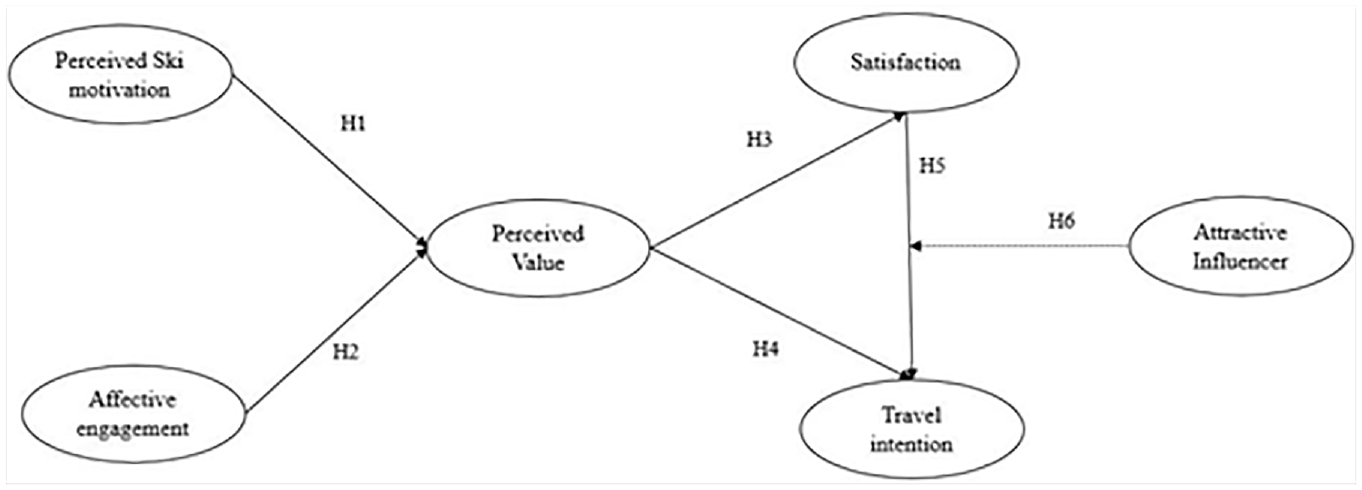
Proposed research model.
Questionnaire Development and Measurements
We devised a survey questionnaire to acquire quantitative data. The initial segment comprised screening inquiries to discern eligible participants for the investigation. The latter portion encompassed 36 questions, featuring responses on a 7-point Likert-type scale. Finally, background information investigation. Previous studies have substantiated the reliability and validity of scales employed in this investigation.
Since the questionnaires were collected in China, they were reviewed and revised by two proficient English researchers and five avid skiing enthusiasts to ensure the appropriateness of expression and wording for Chinese respondents. In order to mitigate the potential for common method variance, as suggested by Chang et al. (2020), three interference items were included in between the questions on the four constructs. A pilot test was conducted in March 2022 with 100 participants. Items with a coefficient below .7 were eliminated, resulting in a final questionnaire consisting of 36 items. The results indicated that the scale exhibited good reliability and validity.
Sampling
Given that skiing has certain restrictions on weather and geographical location. Ski tourism needs to be carried out in a cold natural environment, so this study chooses ski resorts or large ski resorts around Beijing as the study setting. Because there is no way to master the overall data of skiers in this study, collected the participants’ responses using convenience sampling. From March 5 to 25, we distributed and collected questionnaires Face-to-face surveys hold in the core ski of Beijing (e.g., at the Beijing Nanshan Ski Resort, National Alpine Ski Centre, and Beijing Xue du Ski Resort.) questionnaires, by professional interviewers to acquire data from a representative demographic profile.
Data Collection
Using Hair et al. (2011) criterion, we determined that a sample size of 400 would be appropriate for our survey, taking into account the 36 total number of items. From the initial 400 questionnaires received, 36 were found to be invalid. As a result, we obtained 364 valid responses, yielding an effectiveness rate of 91%.
Data Analysis
The data was analyzed employing partial least squares structural equation modeling (PLS-SEM). Confirmatory composite analysis using the composite-based method was conducted to validate the measurement models (Smart-PLS, 2022). CR and ρAs were utilized to measure internal reliability, while convergent and discriminant validities were employed to evaluate construct validity (Hair et al., 2020). SEM was employed to test specific hypotheses.
Results
Respondent Demographics
This article presents the demographic statistics within the final sample, as shown in Table 1. In the sample, the proportion of males and females was 43.1% and 56.9%, respectively. The primary age group of skiers concentrated between 18 and 30 years old, and the majority of skiers had a skiing experience ranging from 6 months to 1 year.
Respondent Profiles (n = 364).

Measurement Model
The measurement model’s is divided into three steps: (1) internal consistency, (2) convergent validity, and (3) discriminant validity (Hair et al., 2011). We examined the common method variance by utilizing Harman’s single-factor score to detect any potential biases arising from the measurement method (Podsakoff et al., 2012). The single factor was 36.98% of the total variance (Podsakoff et al., 2012).
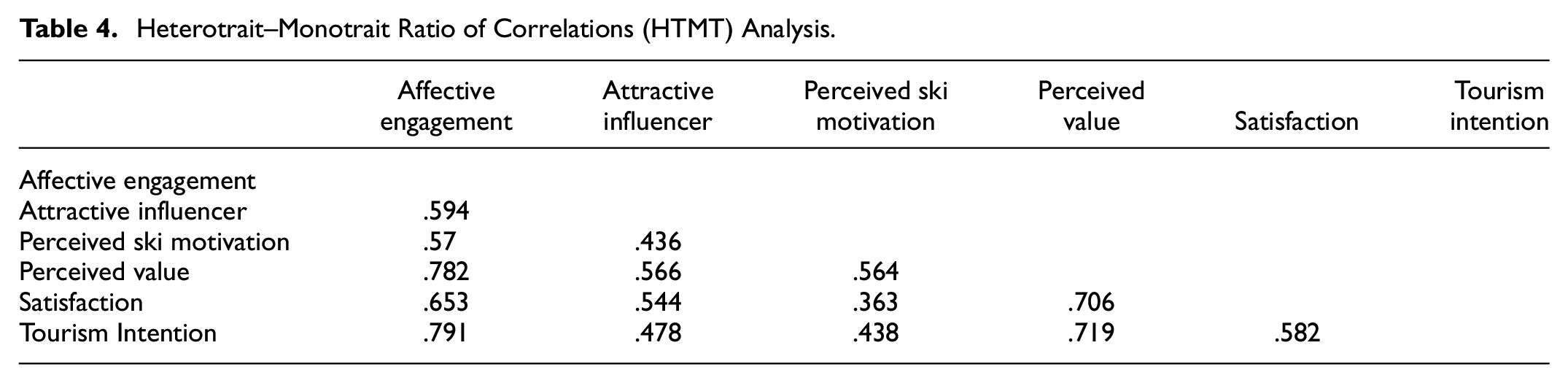
As shown in Table 2, the ρAs values in this study ranged from .719 to .934, while the CR values ranged from .784 to .941, as indicated in Table 3, meeting the established (Cronbach, 1951) standards. The factor loadings for this research project ranged from .701 to .888 (Chin, 1998). To assess its convergent validity, we employed the AVE, which yielded values ranging from .5 to .789 (Chin & Newsted, 1999; Fornell & Larcker, 1981). These results affirm the model’s strong reliability and convergent validity. Tables 4 and 5 illustrate the assessment of discriminant validity. Following the criteria set by Fornell and Larcker (1981) and Henseler et al. (2015), it is observed that the square root of the AVE exceeds the construct correlations. HTMT ratio remains below .85. These findings affirm the model’s strong discriminant validity.
Results of Confirmatory Factor Analysis.

Latent Variable Correlation Coefficients.

Refers to the square roots of AVE of the corresponding latent variable.
Heterotrait–Monotrait Ratio of Correlations (HTMT) Analysis.
Path Coefficients in the Structural Model.

Structural Model
The results of our study indicated that the VIFs ranged from 1.000 to 2.878. Bootstrapping resampling was done with 5,000 iterations to test the significance among constructs. According to the recommendations of Hair et al. (2021), in two-tailed tests, a t-value of 1.96 is used as the significance level, with a threshold of .05. f2 effect size and analysis on estimated path coefficients between constructs in this model. The f2 effect size quantifies the true impact of the predicted variable and denotes acceptability when the indicator surpasses .02 (Hair et al., 2021). According to the results, the f2 effect size of affective engagement and perceived value are both .486. The f2 effect size of perceived value to satisfaction and tourism intention are .606 and .231, respectively. The f2 effect size of satisfaction to tourism intention is .031. The f2 effect size of Perceived ski motivation to perceived value is .63. The above results are all higher than .02, indicating that the f2 effect size of each predictive variable was acceptable to the corresponding endogenous variable. As shown in Table 6 and Figure 3, the Perceived Ski Motivation (β = .206, p = .000) and Affective Engagement (β = .577, p = .000) indicate positive effects on Perceived Value. Furthermore, Perceived Value (β = .475, p = .000) and Satisfaction (β = .172, p = .008) demonstrate positive impacts on Tourism Intention. Lastly, Perceived Value positively influences Satisfaction (β = .614, p = .000).
Specific Moderating Effects in the Structural Model.


Final structural model with standardized path coefficients.
Table 7 and Figure 2 contemporary the outcomes regarding the moderating impact of appealing influencers. Within Figure 2, it is observed that attractive influencers exert a positive regulatory influence on the association between satisfaction and tourism intention (β = .128, p = .005). This finding suggests that as the attractiveness of an influencer increases, so does the satisfaction level of skiers, along with their inclination to visit the ski destination.
Specific Indirect Effects in the Structural Model.

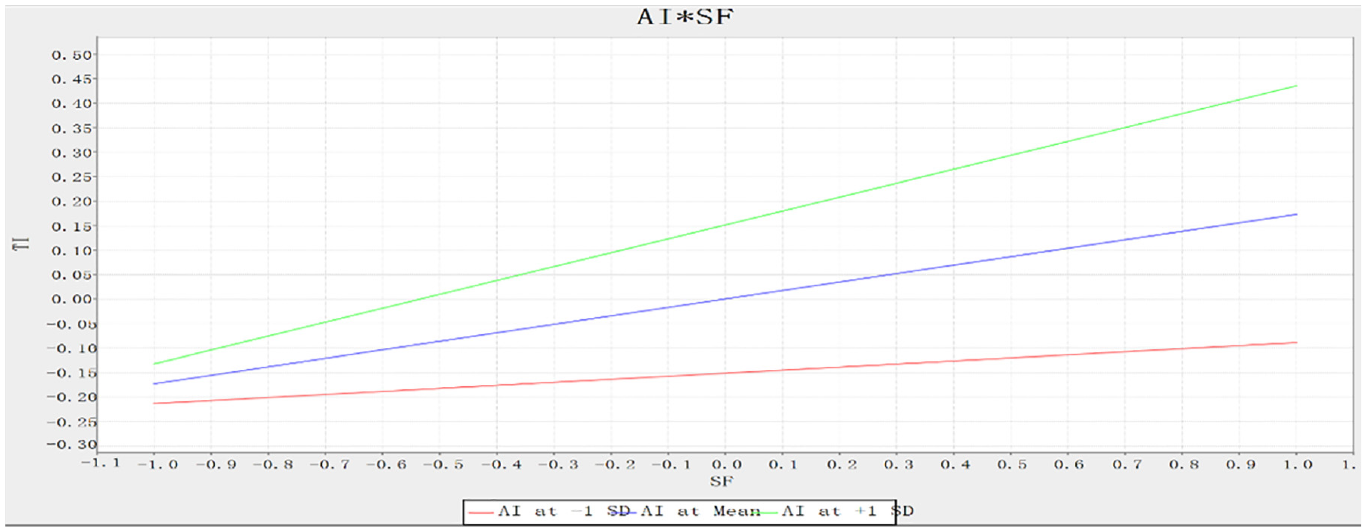
Moderating effect of attractive influencer to satisfaction and tourism intention.
The findings (see Table 7) indicate that satisfaction mediates the relationship between perceived value and tourism intention (β = .106, p = .012). Additionally, perceived value mediates the relationships between Perceived Ski Motivation and satisfaction (β = .172, p = .000), affective engagement and satisfaction (β = .354, p = .000), as well as Perceived Ski Motivation and tourism intention (β = .098, p = .000). These results support H1, H3, H4, H5, and H6 (see Figure 2).
R2 is employed to assess the predictive accuracy of the model. In our model, all R2 values fall within the range of .377 and .499, demonstrating a certain degree of prediction accuracy (Henseler et al., 2009). Furthermore, the structural model in the study exhibits substantial predictive capability, evident by all Q2 evaluation results exceeding zero (Chin, 1998; Henseler et al., 2009).
Discussion
This study investigated the relationship between Perceived ski motivation, affective engagement, perceived value, satisfaction, and tourism intention. The results indicate a strong fit between the proposed model and the data. This study successfully validated the direct and indirect effects among the variables, unveiling their intricate interconnections.
Perceived Ski Motivation and Emotional Involvement on Perceived Value
The structural model showed that Perceived ski motivation and affective engagement positively correlative with perceived value (H1, H2). The results of this study reveal a positive correlation between tourist motivation and perceived value, which aligns with previous findings (Lo & Lee, 2011). Ski motivation can have an impact on skiers’ perceived value, and that strong motivation to travel leads to a better perceived experience. The same relationship was observed in terms of affective engagement; perceived value increased when affective engagement was higher. Our findings are consistent with those of Hyun et al. (2011), who concluded that emotions have a positive effect on perceived value. The observed relationships have been well explained in the tourism literature. Travel motivation and affective engagement have been shown to influence perceived value (Y. H. Kim et al., 2013; Prebensen et al., 2013). Research in marketing has documented the relationship between the impact of engagement and perceived value (Marbach et al., 2016).In addition, we show that Perceived ski motivation and affective engagement have a beneficial impact on perceived value.
Perceived Value, Satisfaction, and Tourism Intention
This study found that perceived value positively correlated satisfaction (H3), a result that is consistent with previous research by Chen and Chen (2010). Moreover, perceived value positively correlated tourism intention (H4). In most of the current studies, perceived value affects tourism intention through satisfaction (Bayih & Singh, 2020; Lee et al., 2019). By contrast, this study directly examined the direct correlated of perceived value on tourism intentions. In addition, our study showed that satisfaction positively correlated tourism intention (H5). This finding is consistent with many scholars’ studies (Damanik & Yusuf, 2022; Pai et al., 2020), most of which support the finding that satisfaction has a positively correlated on tourists’ behavioral intentions. Therefore, in ski tourism, tourists’ positively correlated satisfaction, and their perceptions also have a direct positively correlated on tourism intention. When tourist satisfaction is high, their intention to travel will also be enhanced.
Moderating Role of Attractive Influencers
Furthermore, in this study, attractive influencers play a positive moderating role between the effects of satisfaction on tourism intention (H6). The results show that when ski influencers are attractive, satisfaction and tourism intention are also strong. The results of this study provide evidence that attractive ski influencers (visibility, professionalism, skill) are more noticed by skiers in a social media environment. The powerful attraction will make skiers follow or even imitate their behavior. Thus, the more attractive a ski influencer is, the more skiers will trust their message and may follow the ski destination they are in for the experience and may consider the ski destination where the ski influencer is located to be professional, thus increasing satisfaction and tourism intention. In summary, this study shows that attractive ski influencers contribute to satisfaction and tourism intention to travel to ski destinations.
Conclusions
Theoretical Implications
The current study provides a notable contribution to the snow and ice tourism literature. Firstly, this study was the combine social learning theory with push and pull theory and search-and-escape theory to improve the relationship between satisfaction and travel intention by using at-tractive influencers as moderating variables. The findings show that attractive influencers have a positive moderating effect between satisfaction and intention to travel. When influencers are attractive, skiers’ satisfaction and intention to travel also increase.
Second, although the academic community has been interested in ice and snow tourism recently, most studies explore this phenomenon from the perspectives of snow field environmental monitoring, sports rehabilitation and sports. This study, by contrast, examines the relationship between Perceived ski motivation and tourism intention after the Winter Olympics from the perspective of tourists. Enriched literature on the Winter Olympics and skiing tourism.
Third, our research is also one of the early studies that applied the theory of Affective engagement to in terms of skiing. Previous learning has shown that tourism motivation has a positive influence on perceived value. However, in the field of tourism, most studies have not discussed the impact mechanism of affective engagement on perceived value. In this study, the impact of affective engagement on perceived value is Running Title highlighted. Our results show that skiers with higher affective engagement have stronger perceived value.
Finally, our study complements the antecedent variables of tourism intention by exploring perceived value. Previous research results have shown that satisfaction typically moderates the relationship between perceived value and tourism intention. By contrast, in this study, this study examines the direct influence relationship between the two. The results show that perceived value has a positive correlated on tourism intention. This work is also one of the early-stage studies to attempt a direct influence relationship between perceived value and tourism intention.
Practical Implications
Our research results provides some targeted suggestions aimed at the sustainable change of ski areas and ski resorts in China after the Winter Olympics. These marketing tactics can achieve the effect of having a good experience of perceived value.
Secondly, our findings suggest that satisfaction enhances tourists’ intention to travel. When a tourist’s overall satisfaction with a local area is high, their tourism intention becomes strong (Bayih & Singh, 2020). Therefore, we can increase the number of visits by skiing tourists based on research findings. For example, we can improve people’s overall satisfaction and increase visitors’ tourism intention by enhancing the safety of ski facilities, the environment of ski resorts, and the supporting facilities (accommodation, food, and beverage).
Finally, our findings suggest that attractive influencers have a positive moderating effect between satisfaction and tourism intention. As a result, ski destinations can engage the services of such influencers to appeal to their target market. Influential skiers (Gu Ailing and Su Yiming) improve the attractiveness of tourist destinations. Social accounts can also promote their attractive locations and services, drawing attention to the ski destination. The above suggestions could help diversify ice tourism throughout the pandemic’s economic fluctuations. These efforts can lead to the common development of restaurants, hotels, and surrounding tourism facilities, thus promoting the popularity of ice and snow tourism and driving the better growth and Conducive to the physical and mental health of tourists.
Limitations and Future Research
This study has some limitations. Firstly, skiers in different regions may have biases in their cognition of ski tourism. Our sample site is Beijing, and there is no regional classification of the sample population, which makes the sample relatively homogeneous. Therefore, future studies should be analyzed with a sample of skiers from different geographical areas. Hence, future studies should target a sample of skiers from different geographic regions. Secondly, scope has certain limitations in this investigate. It did not include a comparison between domestic ski tourism and international ski tourism. In future studies, comparative differences can be included for more detailed discussion. Finally, the boundary conditions of the boundary relationship between satisfaction and travel intention should be explored, and perhaps other variables may be applicable to moderate this process. Adding age, gender, and income as moderating variables may also lead to interesting findings in future studies.
Footnotes
Acknowledgements
I want to thank my instructor Ziye Shang for guiding the direction of my thesis. I would like to gratefully acknowledge the support of the Editorial Technical Team for setting these guidelines.
Declaration of Conflicting Interests
The author(s) declared no potential conflicts of interest with respect to the research, authorship, and/or publication of this article.
Funding
The author(s) received no financial support for the research, authorship, and/or publication of this article.
Ethical Approval
This paper uses an informed consent, anonymous, confidential questionnaire when collecting data. At the same time, the items involve little private information.

Data Availability Statement
Data sharing not applicable to this article as no datasets were generated or analyzed during the current study.