



Abstract
Characterized with in-depth interactions and self-reflections, slow tourism has been gaining growing popularity in recent years thanks to the importance attached to quality of life and self-actualization of tourists in the post modern era, which has all been necessitated by the challenges wrought by the Covid-19 pandemic. In response to the current research lacuna of competitiveness analyses of specialized small-scale destinations, this study comprehensively proposes and empirically evaluates the competitiveness of slow tourism destinations as indicated by the values perceived by the slow tourists, and explores the mechanism of competitiveness of slow tourism destinations with investigation of the interrelationships between competitiveness and tourist attitude, consumption emotion and behavioral intentions through Structural Equation Modeling (SEM). The Gaochun District, which was the first accredited Cittàslow in China, was selected as the research site. Findings yielded four major competitiveness dimensions of community ambiance and service, tourist, and comprehensive management, cultural resources and values and natural resources and protection, and confirmed that perceived values are positively related to attitude, consumption emotion, and behavioral intentions. In addition to offering a valid scale measuring the competitiveness of slow tourism destinations, this study suggests the integration of cultural components in better planning and management of slow tourism destinations.
Keywords
Introduction
Slow tourism activities, featured with moderate pace of travel, imbuing of appreciation of natural beauty and cultural landscape and emphasis on enjoyment of sustainable real life experiences while traveling, have become more and more favored since their initiations in Italy in the 1980s (Fullagar et al., 2012). As a unique and significant niche market segment of slow tourism enthusiasts has steadily taken shape, facilitated by the speeding up of working life cycles and the piling up pressures, slow tourism destinations have been actively conceptualized and formulated by destination managers and marketers, with efforts of standardization and certification of so called Cittàslow, or slow cities, which amounted to over 250 members in 30+ countries around the world by 2019 (Meng & Choi, 2016; Shang et al., 2020). Lumsdon and McGrath (2011) recognized the vast development potential for destinations featured with slow tourism gravitated toward by the paradigm shift of the post modern society toward a zeitgeist of laid back vacationing and leisure embedded in slow life and culture. Therefore, it is paramount that tenable measurement of the core attractiveness of slow tourism destinations be constructed and refined to better cater to the emerging and lucrative slow tourism market.
By far, factors constituting the competitiveness of slow tourism destinations are still underexamined, notwithstanding the significance of competitiveness to both the economic sustainability and socio-cultural acceptability of the destination (Cibinskiene & Snieskiene, 2015; Wong, 2019). Particularly, due to the peculiarities of the consumption and behavioral patterns of slow tourists, existing scales of destination competitiveness may not be readily applicable in the context of slow tourism destinations (Meng & Choi, 2016). This study mainly aims to address the current research paucity by comprehensively investigating and evaluating the dimensionality and critical factors of the competitiveness of a slow tourism destination in China from the perspective of tourist perceptions, a research angle that has received growing attention in studies on destination competitiveness in recent years (Ye et al., 2020). On top of that, by focusing on the research context of slow cities, this study concurs with current research trend of examination of competitiveness issues at small scale or specialized destinations such as those featured with island, ski, and sports (Yang, 2020; Zheng, 2020). The research objectives of this study are two-fold. Firstly, this study explores the dimensionality of the competitiveness of slow destinations as represented in the visitor perspective of perceived values, with the case of Gaochun district in Jiangsu Province in East China, which was the first accredited Cittàslow of the country. In particular, this study intends to investigate how the perceived cultural values, deemed as an essential factor of the attractiveness of destinations in general (Yang, 2020), can be conceptualized and measured in the context of slow tourism destinations. Secondly, the mechanism of the competitiveness of slow destinations is evaluated with Structural Equation Modeling (SEM) of its relationships with other significant visitor-based variables of attitude, consumption emotion and behavioral intentions, from which theoretical insights and practical implications are derived.
Literature
Destination Competitiveness
Natalia et al. (2019) defined destination competitiveness as the capacity of the destination to meet the needs of tourists on facilities, services and experiences, and realize higher economic objectives at the same time. In this regard, destination competitiveness is conceptualized in congruence with classical elaborations on competitiveness of enterprises and industries as articulated by Porter (1990), with emphases on comparative advantages in natural and human resources, demand, sophistication of industrialization and supply chain, industrial structure, favorable policy supporting environment and opportunities. Beh & Bruyere (2007) stressed tourist preference and financial performance as the key indicators of destination competitiveness. In recent years, the welfare and life qualities of local residents of the destination together with appropriate utilization of local natural resources have also been incorporated as key indicators of destination competitiveness, thanks to the ethos of sustainable and balanced tourism growth and community-based development (Lee & King, 2010; Tang, 2019). Poon (1993) posited that higher competitiveness would be enjoyed by destinations which could respond to outside changes and challenges with continuous innovation and flexibility, which is echoed by Wong (2019)
Since its early proposition, destination competitiveness has been modeled by various studies under a wide range of local contexts. Major aspects of destination competitiveness that have been theoretically postulated and empirically examined cover destination products (Porter, 1990; Yi, 2007), local supporting factors (Dwyer & Kim, 2003), destination management levels (Ritchie & Crouch, 2003; Yi, 2007), destination environment and market demand (Wei, 2020), etc. For instance, Dwyer and Kim (2003) identified the key factors of destination competitiveness of natural resources, supporting resources, creative resources, environmental conditions, destination management, and market demand. Zhou and Bao (2005) canonically divided destination competitiveness into two levels of overriding and comparative factors, with the former referring to macro features of destination image, geographic location and public policies, and the latter concerning local facilities and services at business level. Cibinskiene and Snieskiene (2015) applied a qualitative approach and further highlighted supportive hardware and software at the destination as contributing to its competitiveness, such as destination status, monetary policies, education system and general leisure facilities. Local ecological environment is included in the competitiveness scale formulated by Cao et al. (2018) utilizing spatial distribution analyses. At the same time, the geographic scale of the destination has been considered in relevant research, extending from city to regional levels, based upon which comparative rankings and analyses were calculated in a comprehensive manner (Tang, 2019; Wong, 2019).
Trending of Slow Tourism
Slow tourism has been a trending phenomenon of travel pattern since late 20th century, duly responding to the exponential growth and accompanying problems of mass tourism. Derived from slow movement, slow tourism is defined as tour activities that are slow paced with the aim of experiencing and enjoying the visited locale to the fullest extent, as well as in-depth interactions with local residents (Pawlusiński & Kubal, 2018; Walker & Lee, 2019). Slow tourism is also commissioned to reduce carbon emission and protect the environment through less air travel. The world association of Cittàslow, or slow city, established in 1999, listed the key dimensions of slow tourism of time, slow pace, less pollution, emotion, authenticity, and sustainable development. del Bosque & Martín (2008) highlighted the enjoyment of mobility and escapism as the underlining ethos of slow tourism, from which people could be free of the pressure of time and work. In-depth experiences of the visited place and awareness of environment have been posited to be indispensable from slow tourism by Lumsdon and McGrath (2011). Park & Yoon (2009) further featured slow tourism with less places traveled to and longer stay at the visited place.
Meanwhile, several studies have summarized the ideals of slow tourism into such catch phrases like 3S(slow, simple, small), 3L(long, low, lohas), 3N (natural, native, new), 3R (ready, random, reflect), 3C (culture, communication, change), and 5M (Mood, Melody, Memory, Mainland, and Motion) etc. (Pu, 2017). Such identified aspects characterizing slow tourism reflect its physical as well as psychological implications for the slow tourists. Deng (2020) recognized the seven features of slow tourism as a nice mood of the tourist, avoiding traffic jams, emphasis on the trip, slow-paced visit, cultural changes, seeking surprises as well as remuneration of the hosts. Such culture-laden values to be sought from slow tourism are also echoed by Han & Liu (2019), who further highlighted slow pace in other tourist activities such as dining, sleep, shopping, learning, exchanges, and meditation. Yang and Wang (2018) further stressed self-actualizations of the tourists facilitated by slow stay and cultural interactions as the ideal outcomes of slow tourism, thereby leveraging the psychological and spiritual benefits of slow tourism.
Perceived Value
A classic concept in modern marketing and customer studies, perceived value is semantically defined by Deng (2020) as the subjective overall feelings of the customer in response to the stimulation of external consumption environment, and is formed in the consumption process characterized with active hedonic motivations. Zou (2017) posited perceived value as the outcome of the cost-benefit analysis conducted by the customer between perceived quality or performance and perceived cost as indicated by price. Perceived value encompasses tangible and intangible values, as well as singular and comprehensive values, depending on the features and complexities of the product or service concerned. The subjectivity underlining perceived value means that it usually shifts with changes in the psychological status and consumption experiences of the customer as well as the evolution of different consumption stages (Han & Liu, 2019).
Featured with the utilitarian assessments of what is paid for and what is obtained, perceived value is closely and positively related to other concepts such as perceived quality, perceived benefit and perceived sacrifice, all of which indicate the mental reflections and interpretations of the customer on the product or service (Nicholas et al., 2009). Perceived value has long been established as a key determinant of competitive edge of businesses in catering to the needs and expectations of customers (Lu et al., 2017). In particular, businesses need to actively engage in the activation, direction and transformation of perceived value that are amicable to their corporate objectives. In the context of destinations, the experiential and perceived values yielded by the tourists have been deemed to be the essential construct affecting the development of destinations, distinguishing them from competitors, and consolidating their competitiveness in view of the fierce market competition (Li et al., 2020). Mustafa et al. (2020) identified the creation and delivery of perceived values of tourists as a fundamental mission in the strategic development of destinations.
Tourist Consumption Emotion
Consumption emotion in a rational sense refers to the observed feeling or mood derived from completing or not completing a certain objective (Park & Lee, 2017). Depending upon the direction of such feelings, consumption emotion can be further classified into positive and negative categories (Sun et al., 2020). Pu (2017) recognized the unique function of consumption emotions in helping the individual mentally prepared for personal predictions for future uncertainties in behavior. The emotional states of tourists must be taken into account in explaining their behavioral intentions and actual behaviors (Lu et al., 2017). The consumption emotions of tourists can dynamically self-adjust and shift in response to the circumstances encountered in their travel experiences as manifested in the successful or unsuccessful completion of certain behaviors, which would in turn influence their travel behaviors (Gao, 2016). According to Parker et al. (1995), anticipated consumption emotions can significantly influence the decision making process. In tourism context, consumption emotions of tourists in both direct and indirect ways were found to join their perceptions in predicting their behavioral intentions (Han & Yoon, 2015; Liu, 2019; Richards et al., 2021).
Tourist Attitude and Behavioral Intentions
Tourist attitude is defined as the evaluative feelings, concerns, beliefs, stances and value systems held by the tourist on the travel experience (Jaafar et al., 2015). It can be regarded as a consequential outcome of travel perception, with the two constructs organically associated with the demonstrated positivity or negativity of the tourist in terms of benefit seeking and loss evading (Baker E W et al., 2007). Tourist attitude is also the antecedent that can directly predict and determine the behavioral intentions as well as actual behavior of the individual concerning traveling, to such an extent that with its intensity in belief and inclination, attitude can be viewed as proxy for likely behavior (Yang & Wang, 2018). The hierarchical relationships among these psychological attributes, as well as the fulcrum function performed by attitude, can be accounted for by the theory of planned behavior (TPB) (Ajzen, 1991). In TPB, together with normative beliefs and perceived behavioral control that represent the external social and cultural contexts, attitude links the behavioral beliefs, which relate to the opinions and evaluations of the target behavior, and behavioral intentions that can be derived. Thus, tourist attitude assumes its significance by serving as the crucial bridge spanning what the tourist thinks about travel and what he or she will do with travel.
Conceptual Framework, Hypotheses
This study, in view of current research gap in comprehensive investigations of slow tourism destination competitiveness, primarily explores the significant factors contributing to the competitiveness of a typical slow tourism destination with its incorporation of established variables in tourist consumer behavior literature. The competitiveness of the slow destinations is represented by this study as the values perceived by the slow tourists, because as direct judgments of the travel experiences of the tourists, perceived values have been solidly established in literature as tenable indices of the competitive edge of the destination (Ramkissoon & Uysal, 2011). On top of that, perceived values of tourists have received high priority in the planning, marketing, and management of destinations (Li et al., 2020).
Meanwhile, guided by articulations on TPB, this study examines the mechanism of its competitiveness in influencing other crucial variables germane to the psychological peculiarities and behaviors of slow tourists. The tourist angle of investigation adopted by this study, in particular, can duly complement existing studies on competitiveness focusing upon the destination perspective and analyses of secondary data, like AHP and DEA (Lee & King, 2010).
Specifically, based upon in-depth literature review of relevant constructs and their previous applications in the contexts of destination competitiveness research, this study intends to evaluate the interrelationships among perceived values, consumption emotion, attitude, and behavioral intentions of the slow tourists, with the proposition of the following six hypotheses, as described in Figure 1:
H1. The perceived values of slow tourists influence their attitudes to the slow destination.
H2. The perceived values of slow tourists influence their behavioral intentions on the slow destination.
H3.The perceived values of slow tourists influence their consumption emotions on the slow destination.
H4. The attitude of slow tourists influence their behavioral intentions on the slow destination.
H5. The consumption emotions of slow tourists influence their attitudes to the slow destination.
H6. The consumption emotions of slow tourists influence their behavioral intentions on the slow destination.

Conceptual framework and hypotheses.
Methodology
The research site of Gaochun, the first accredited Cittàslow in China
This study designated Gaochun District of Jiangsu Province along the Yangtze River Delta in East China about 300 km to the west of Shanghai as its research site. Gaochun, with a population of 450,000 and area of 790 km2 on plains, hills, and lakes, is renown for well-preserved ecological environment, rich agricultural and fishing resources and charming local folklore. Accredited in 2010, Gaochun was the first of the 13 Cittàslows in China as of 2020 and currently hosts the China Chapter of The International Association of Cittàslow. The accredited Chinese slow destinations have been distributed across China, such as the south Guangdong Province, northwest Shaanxi Province and northeast Jilin Province. They have eyed upon the slow membership as the opportunity to redeem and reinforce local cultural and social traditions that are consistent with slow destinations, as well as promote eco- and pro-poor tourism development.
By far, Gaochun has been successfully branded as a slow destination with wide acknowledgment in China, and development of slow tourism is essential to local economic and social development, with tourist visitation reaching 11.72 million in 2019, and tourism receipts, at 14 billion RMB (1 RMB = 0.15 USD), accounting for over 30% of the local annual GDP. Hence, Gaochun is deemed as an appropriate research site to investigate the research issues of this study with research results that can be extrapolated to other slow destinations in China and abroad.
Scale Formulation and Data Collection
Measurements of the constructs of this study were derived and formulated by taking into account both literature and peculiarities of the research site. Specifically, the original scale comprised of 33 items of perceived values of slow tourists (Baker & Crompton, 2000; Han et al., 2019; Jurowski & Gursoy, 2004; Ko & Stewart, 2002; Ramkissoon & Uysal, 2011; Ramseook-Munhurrun et al., 2015; Shi et al., 2008; Wang A Wu & Wang, 2018; Xie, Liu et al., 2019), 6 items of attitude (Ajzen, 1991; Jaafar et al., 2015), 5 items of slow tourist consumption emotions (Lee et al., 2012; Perugini & Bagozzi, 2001), and 5 items of slow tourist behavioral intentions (Perugini & Bagozzi, 2001) respectively. All measurement items in this study were evaluated with a 5-point Likert scale (1 = strongly disagree to 5 = strongly agree). Meanwhile, the demographic features of the respondents were also collected.
Data collection was conducted through a two-phase process, with a pilot study conducted in November 2020 through 50 surveys to adjust the wordings of the questionnaires so that the meanings could be more accurately and effectively communicated to the slow tourists. In the second stage, 300 copies of revised survey were distributed in December 2020 to the slow tourists visiting major spots of Gaozhun such as attractions, hotels, visitor center, and rural dining places and accommodations. In light of the restriction of access due to pandemic precautions, an additional online distribution of 105 copies of survey was also implemented. Out of the 405 distributed, 384 were successfully returned, of which 9 were deemed as invalid due to missing answers, thereby yielding 375 effective copies. The interviewers would offer help and explanations when respondents raised questions about filling the survey. The surveys were in Chinese and later translated into English for analytical purposes. Chi-Square examinations were conducted to evaluate the differences between answers of online and offline surveys. With p > .05, the contents of online and offline surveys were deemed as coherent for further evaluations. The analytical software of AMOS 23.0 and SPSS 27.0 were applied in data analysis.
Results
Demographic Features of Respondents
As is indicated in Table 1, among the 375 slow tourists surveyed, women accounted for the majority of 57.3%. The age group of 28 to 35 took up the largest portion of 57.1%, followed by 36 to 45 (22.7%), 46 to 60 (14.1%), under 18 (4.8%), and over 60 (1.3%), demonstrating the considerable attractiveness of slow destinations to the millenium generation. Respondents with an undergraduate degree made up the majority of 44.3%, with those with a diploma and high school certificate ranking second and third at 19.7% and 16.8%, respectively. Distribution of monthly income among the respondents was quite even, with less than 2000 RMB at 15.6%, 2,001 to 3,000 at 28.2%, 3,001 to 5,000 at 29.4%, 5,001–10,000 at 22.9%. The same trend was recorded in the category of occupation, in which students and white collar workers combined occupied over 50% (27.5% and 26.4% each).
Demographic Features of Survey Respondents.
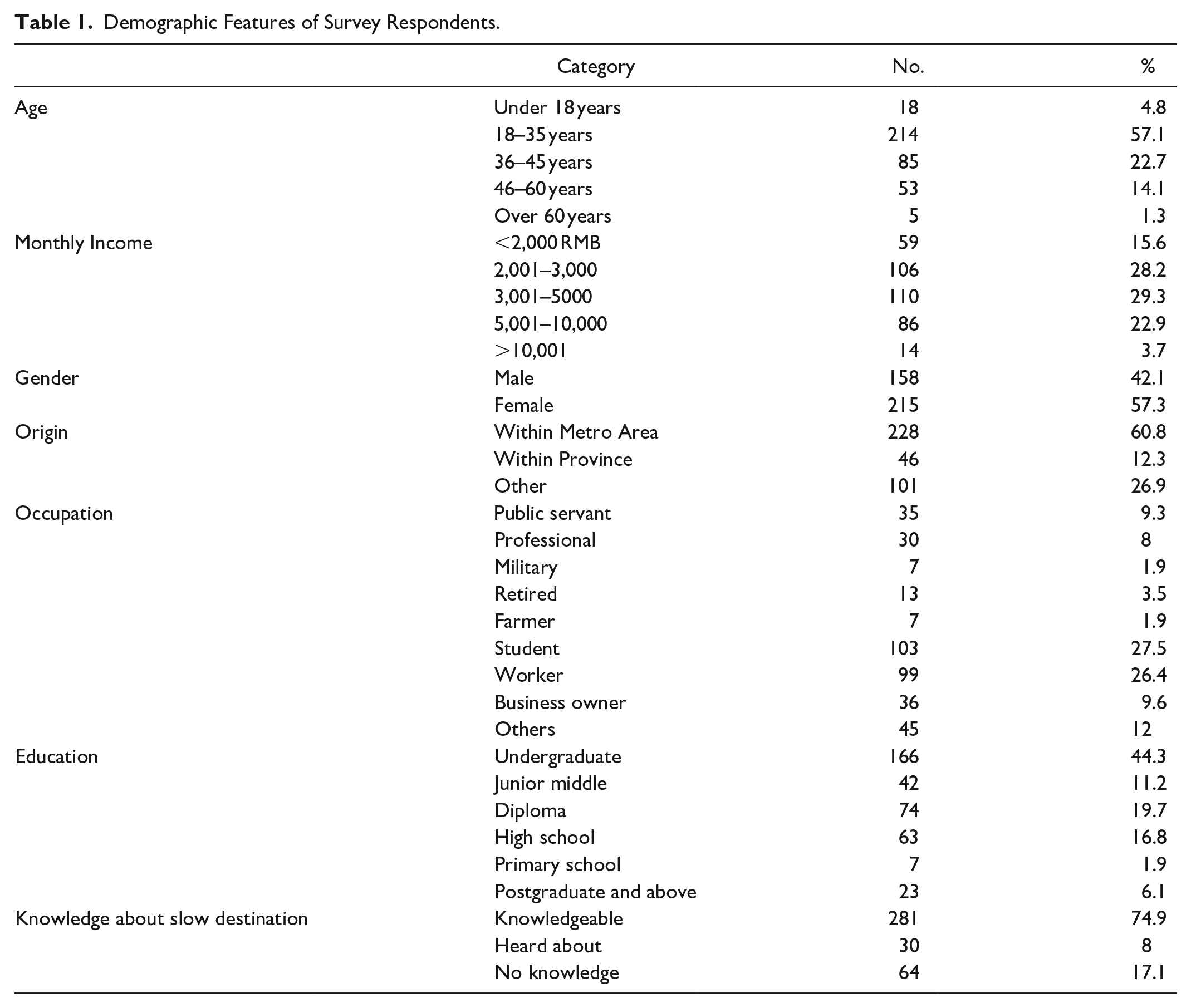
Turning to the travel-related features of the slow tourists, 73.1% of them were from markets within 2-hour high-speed train travel of Gaochun, demonstrating the unique charm of slow destination attracting market segments that would have been culturally homogeneous with the destination. It should be cautioned here that due to pandemic restrictions, cross-province travel was not endorsed by the authorities during data collection, possibly contributing to the comparatively smaller portions of slow tourists from other provinces. Meanwhile, outstanding brand recognition of slow destination was confirmed by the fact that the nearly three quarters of the slow tourists reported knowing about the slow destination before visiting.
Measurement Model-Exploratory Factor Analysis (CFA)
Firstly, internal reliability and validity of the proposed scale of measurements were examined. Results, as summarized in Table 2, revealed that the value of Cronbach’s α of the scale reached .986, with those of perceived values, tourist attitude, tourist consumption emotion, and tourist behavioral intentions at 0.980, 0.940, 0.937, 0.941, respectively, all reporting satisfactory levels of reliability. Meanwhile, KMO testing yielded results of 0.972 for perceived values, 0.904 for tourist attitude, 0.885 for tourist consumption emotion and 0.890 tourist behavioral intentions, all of which exceeded the satisfactory benchmark of 0.8, and found to be significant at level of p < .000 by Bartlett Test of Sphericity. Hence, validity of the dimensionality of the examined constructs could be confirmed. In addition, no significant difference was found among the two cohorts of on-site and online interviewees in all of the indices.
Results of Exploratory Factor Analysis.

To further explore the structure of competitiveness of slow destinations as represented by perceived values of the slow tourists, exploratory factor analysis was conducted, with the application of Principal Components Analysis and Varimax with Kaiser Normalization. Following Han & Ming (2019), standardized factor loadings with a value of less than 0.5 were deemed insignificant and prone to cross-loading. Hence, 1 item was discarded. Out of the 32 items, four factors could be extracted, each with eigenvalues greater than 1. The four viable factors constituted 75.2% of the total explained variance, manifesting a satisfactory level of scale validity. In accordance with the contents and features of the factors, Factor 1, consisting of 12 items, was named community ambiance and service; Factor 2, with 10 items related to supportive facilities and practices for the tourist at the destination, was named tourist and comprehensive management; Factors 3 and 4, each composed of 5 items, were titled cultural resources and values and natural resources and protection respectively. The four derived factors are deemed by this study to tenably account for the dimensionality of the competitiveness of the slow destination.
Structure Equation Model
The maximum likelihood method was employed to measure the six hypotheses of the model, with the performances of four modifications in accordance with the MI coefficient to reduce the Chi-Squre levels and enhance significant levels. The structure equation model was obtained at x2/df = 2.392, RMSEA = .041, GFI = .886, AGFI = .895, NFI = .901, CFI = .925, IFI = .926, PCFI = .845, PGFI = .688, PNFI = .802. Therefore, a sound goodness-of-fit was established according with relevant criteria (Lu et al., 2017). The path coefficients yielded also supported all of the six hypotheses, as delineated in Table 3. Specifically, excerpt for H4 which reported no significant positive relationships between the attitude and behavioral intentions of the slow tourists (0.115, p = .191), all of the other proposed relationships had been confirmed as positive and significant.
Structure Parameter Estimates.

Note. *for p < .05. **for p < .01.***for p < .001.
Figure 2 exhibits the examined interrelationships in the final model. It can be learned that the perceived values of the slow tourists on the slow destination can effectively influenced their attitude, consumption emotions and behavioral intentions. In other worlds, the competitiveness of the slow destination is closely associated with and tenably reflected by the significant psychological constructs of the tourists as investigated by this study. In particular, the strongest path of relationship is observed between perceived values and consumption emotions of the slow tourists (0.787), followed by that between their consumption emotions and behavioral intentions (0.647). Meanwhile, the direct path between perceived values and behavioral intentions, at 0.382, is less than those between perceived values and consumption emotions (0.787), as well as between consumption emotions and intentions (0.434), thereby consolidating the enhanced functions of consumption emotions in strengthening the relationships between perceived value and behavioral intentions of the slow tourists.

The final model.
Furthermore, to explore the the corresponding effects of the four dimensions of competitiveness of the slow destination on the behavioral intentions of the slow tourists, multiple regression analyses were employed, modeling the weighting of each observed construct as the percentage of its loading of that of the factor (Li et al., 2020). It can be concluded from Table 4 that with β coefficient at 0.337, 0.219, and 0.316, respectively, Factors 1, 2, and 3 all significantly accounted for the variance in behavioral intentions of the slow tourists, thus establishing acceptable degrees of their predictability for the behavioral intentions of the slow tourists. However, a negative relationship was observed between Factor 4 of natural resources and protection and behavioral intentions (β = .042, p = .457). This may be accounted for by the overwhelming role of Factor 3 emphasizing the cultural components of values perceived by the slow tourists, as compared with their perception of nature-related values of Factor 4. Or, perception of nature-related values may have aroused the awareness and concern of the slow tourists about the natural impact of their tourist activities at the slow destination, leading to the inhibition of their behavioral intentions.
Results of Multiple Regression Analyses.

Note. *for p < .05. **for p < .01. *** for p < .001.
Conclusion
This study makes its primary research contribution by being one of the first academic efforts to comprehensively propose and empirically evaluate the competitiveness of slow tourism destinations, a trending tourism phenomenon attracting various market segments especially the millennials. The four major competitiveness dimensions of community ambiance and service, tourist and comprehensive management, cultural resources and values and natural resources and protection, which are derived from the values perceived by the slow tourists, constitute the competitiveness of the researched slow destination of Gaochun, China, which can readily be extrapolated to other slow destinations in the country and abroad, in particular the other seven accredited slow destinations in east China in light of their cultural similarities to the research site. Meanwhile, this study elaborates the mechanism of the competitiveness of slow tourism destination with the examinations and confirmation of its positive interrelationships with significant tourist-related constructs of attitude, consumption emotion and behavioral intentions. Therefore, the results of this study can serve as a valuable reference for future investigations on competitiveness issues of slow tourism destinations in various locales and at different scales.
As can be learned from the four major dimensions of the confirmed plethora of items contributing to the competitiveness of the slow destination as perceived by the slow tourists, there are not only factors which are related to competitiveness of destinations in general such as accommodation, dining, and transportation etc. (Crouch & Ritchie, 1999; Ye et al., 2020; Yi, 2007), but also constructs more germane to the specific features of slow tourism and accounting for the competitiveness of the destination more significantly. For instance, strong path coefficients have been found in constructs revealing the slow culture in the aspects of local facilities and services, as well as community ambiance. This means that appropriate embodying and presentation of slow culture is essential to building up the competitiveness of slow tourism destinations, particularly in areas of shared slow cultural values and awareness among local residents that can lead to cohesive community cultivation of slow culture that can be actively perceived and acknowledged by the slow tourists (Shang et al., 2020). Meanwhile, the identification of the dimension of tourist and comprehensive management by this study has corroborated the remarkable achievements in establishing standardized and streamlined branding and SOP systems and management protocols and culture at slow tourism destinations (Meng & Choi, 2016).
The salience of culture in the competitiveness of slow tourism destination as found out by this study is further fully reflected in the dimension of cultural resources and values, with strong path coefficients reported in aspects of folklore, art and craft as well as health and body-building. In this sense, slow tourism destination can be regarded as one of the avant gardes riding the trend of growing emphasis on cultural dimensions and embedding cultural values into the visiting experiences of tourists in leveraging destination competitiveness (Fullagar et al., 2012; Matos (2004)). What is worth noting here is that this dimension is also where the peculiarities of the researched site are factored in, thereby corresponding to the craving for authentic cultural values by slow tourists as argued by Ramkissoon and Uysal (2011). Actually, the significance of the cultural dimension and relevant factors may have preoccupied the perceptions of the slow tourists and overwhelmed the influences of the dimension of natural resources and protection on the behavioral intentions of the slow tourists, as revealed by the research results of this study.
As for the mechanism of the competitiveness of slow tourism destination, the outstanding functions found out by this study of the consumption emotion of slow tourists in enhancing the interrelationships between their perceived values and behavioral intentions mean that delicate and rich psychological of the slow tourists have been activated in their experiences of the slow destination, which would affect the consequences that actualize the competitiveness of the slow destination. Such subjective feelings and moods of the slow tourists, that said, can be effectively aroused, intervened, modified, and integrated in a favorable manner for appreciation of the competitiveness of the slow destination facilitated by active efforts on the side of the destination (Shang et al., 2020).
Correspondingly, slow tourism destination planners and managers as well as operators of tourism businesses in slow destinations can heed the results of this study and formulated and initiate activities and measures that further attenuate the cultural specialties of slow tourism destinations, and communicative effectively with potential market segments. For example, various themed events and festivals that help demonstrate and leverage the cultural connotations of slow destinations can be conceptualized and planned in addition to routine tour products and activities at the destination, so as to provide opportunities for more in-depth cultural immersion of the slow tourists into their visiting experiences. In the meantime, given the strong effects of consumption emotion on moderating the relationships between tourist perception and behavioral intentions, effective measures should be introduced to better appeal to the consumption emotional states of the slow tourists during their visits to such an extent that the consumption emotional dynamics of the tourists can be manipulated favorably for the their perception of slow destination competitiveness and their relevant future actions.
Future research can build upon the findings of this study to broaden theoretical understanding of issues related to competitiveness of slow tourism destinations, from which practical implications can be derived. In the first place, the scale of competitiveness theoretically proposed and empirically tested by this study can be applied in other slow tourism destinations both in China and abroad, taking into account of more culture-relevant constructs. Therefore, the current scale can be refined to better account for the competitiveness of slow destinations. In addition, other significant constructs can be integrated into the current research model to more accurately reflect and explain the mechanism of slow tourism destination competitiveness. In particular, inclusion of negative consumption emotions would help articulate the functions of tourist consumption emotions in a more comprehensive manner. Last but not least, future studies can refine the sampling by this study as limited by pandemic influences, and distinguish different subgroups of slow tourists and evaluate their perceptions of slow tourism destinations accordingly, thereby enriching theoretical knowledge of competitiveness of slow destinations from the tourist perspective.
Footnotes
Declaration of Conflicting Interests
The author(s) declared no potential conflicts of interest with respect to the research, authorship, and/or publication of this article.
Funding
The author(s) disclosed receipt of the following financial support for the research, authorship, and/or publication of this article: This article is funded by National Science Foundation of China (41701158).
