




Abstract
While awareness among managers regarding the benefits of digital transformation in supply chain management has grown, many Chinese SMEs have not fully embraced this shift due to ineffective ICT investments, a lack of effective government support, and the presence of related cognitive challenges. Leveraging a sample of 302 SMEs in China, the study employs SEM techniques to validate the direct effect of ICTs on the digital integration capability, and the relationship between the digital integration capability and firm financial performance. Furthermore, the LMS technique is applied to investigate the moderating role of government support and cognitive constraints within these relationships. Result shows that: (1) ICTs positively affect firm’s supply chain digital integration capability; (2) firm’s supply chain digital integration capability positively affects firm financial performance; (3) perceived government support exhibits an antagonistic effect, hindering the promotion of supply chain digital integration capabilities through ICT infrastructures; (4) Certain cognitive constraints related to digital transformation act as negative moderators within the digital transformation process. Through the exploration of two previously overlooked factors, namely perceived government support and cognitive constraints related to digital transformation, our research contributes to a deepened understanding of dynamic capability theory, social cognitive theory, and organizational inertia theory. Our findings suggest that government policymakers must reassess the effectiveness and objectives of policies in the digital transformation journey. Furthermore, firms are urged to acknowledge and address the potential adverse effects of cognitive constraints within their organizations and among their supply chain partners. Emphasizing the importance of digital integration capability is also crucial.
Plain Language Summary
In this research, we investigated the digital transformation challenges faced by SMEs in China, with a focus on 302 manufacturing SMEs in the Pearl River Delta and Yangtze River Economic Belt. The study aimed to examine the necessity for SMEs to extend their focus beyond mere investment in ICTs toward enhancing digital integration capabilities to achieve improved financial performance. Additionally, it explored how SMEs’ perceptions of government support and cognitive constraints influence the relationship between ICTs and digital integration capability, as well as the impact of cognitive constraints on the link between digital integration capability and firm financial performance. The findings were clear: ICT infrastructures significantly enhance the digital integration capability of supply chains, leading to improved financial performance in SMEs. However, this process is complicated by SMEs’ perceptions of government support, which can inadvertently impede the development of digital integration capabilities. The study also highlights the existence of cognitive constraints hindering digital transformation. These insights are crucial for business managers, suggesting a shift in focus from solely investing in ICT to fostering digital integration capabilities within their supply chains and recognizing the impact of cognitive constraints on digital transformation efforts. For government policymakers, the findings underscore the need to reassess the efficacy and goals of support policies in the digital transformation journey of SMEs.
Keywords
Introduction
Digital transformation has driven managers to recognize the vast potential of digitalization, informatization, and intellectualization in supply chain management (Nasiri et al., 2020). Leading firms have proactively embraced the comprehensive digital transformation wave, yielding remarkable results. For example, research conducted by CCIDGROUP (2020) showed that Haier implemented digital supply chain integration to reengineer business processes, resulting in a significant 33% reduction in firm inventory, a 10% decrease in manufacturing costs, a 6% reduction in management expenses, and an impressive 35% increase in on-time delivery rates.
Despite the promising prospects of digital transformation, it remains a fact that a significant portion of Chinese entrepreneurs has yet to embark on this transformative journey. The 2021 China Enterprise Digital Transformation Index Research Report by Accenture attributes this reluctance to the high costs, lengthy implementation cycles, complexity, and inherent uncertainty associated with digital transformation initiatives. The significant costs associated with adopting new information technology and updating outdated equipment have posed substantial challenges for many firms. The issue of “malfunction” attributed to the perceived high costs of this transformation has gained increasing prominence, both the industry and businesses are calling for external support. As an important economic intervention tool to solve the problems of market failure, government policy, assuming the role of the “visible hand,” has embarked on a significant role in propelling the digital transformation of micro-level entities. Diverse measures, including government policy tools (e.g., subsidies, tax incentives, and loans), as well as the establishment of “benchmarking firms” and “lighthouse firms,” have been implemented across various regions (Rupeika-Apoga et al., 2022; S. Wang et al., 2023).
Nevertheless, a persistent challenge continues to exist in the implementation of policies. Our investigation and research within the Guangdong manufacturing industry have revealed that, while “large firms” in the sector actively or passively benefit from significant policy resources due to the “heightened attention,” SMEs face formidable obstacles (A representative survey of 425 Latvian SMEs by Rupeika-Apoga et al. (2022 shared the same view). SMEs, serving as pivotal stakeholders in the market and indispensable contributors to the ongoing digital wave, have remained relatively underexamined in terms of their assessment of government policy effectiveness. This dearth of attention is notably reflected in two primary facets: (1) Previous research on government support policies for digital transformation has predominantly focused on listed firms and utilized micro-level firm data (Y. Xu et al., 2023; Yu et al., 2023), this approach falls short as it neglects the contributions and needs of SMEs; (2) Prior research concerning the digital transformation of SMEs has refrained from quantifying the impact of government policies, primarily due to the limited implementation of these policies. Given this predicament, this study introduces a novel variable, perceived government support, to assess government assistance for digital transformation from SMEs’ perspectives. In light of this predicament, our study introduces a novel variable, “perceived government support,” with the aim of evaluating government assistance for digital transformation from the perspectives of SMEs. This approach aligns with the research conducted by Eagle et al. (2019), which underscores the distinction between perceived government support and received government support. This distinction is in accordance with the current application status of government policies in both benchmark enterprises and SMEs undergoing digital transformation. Consequently, the first research question centers on whether SMEs’ perception of government policy support (termed as “perceived government support”) influences their digital transformation process and the underlying mechanisms at play.
Within the realm of available research in the field of digital transformation, a dominant theme revolves around “endogenous development,” centering on internal positive factors that influence investments in ICTs and digital transformation. Consequently, research in this domain has delved into subjects such as organizational learning, technological innovation and investment, management and institutional coordination, as well as the managerial capabilities of firms (e.g., Dörner & Rundel, 2021; Feliciano-Cestero et al., 2023; Fu et al., 2023). In recent years, certain scholars (e.g., S. Wang et al., 2023; L. Zhang et al., 2021) have endeavored to explore external factors such as government support and supply chain finance. Most of these explorations have centered on describing the incentivizing role played by these key elements. However, our survey of manufacturing enterprises in the Yangtze River Delta has unveiled surprising insights. It has come to our attention that certain critical internal and external antagonistic factors have become focal points of concern for enterprises. Remarkably, these elements have remained underexplored within the existing literature. To provide specificity, our field research has shed light on concerns that encompass senior leaders’ hesitations within firms, middle managers’ anxieties stemming from the imposition of rigid and procedural management practices associated with the adoption of ICT tools, frontline employees’ apprehensions about potential job displacement resulting from the introduction of modern information technology, and external partners’ reservations concerning data privacy breaches. Additionally, there is reluctance to engage in the digital integration of the supply chain. These issues present formidable barriers to successful digital transformation and warrant meticulous consideration in the pursuit of fostering digital transformation capabilities. Consequently, this study endeavors to bridge this existing gap by examining the cognitive constraints exhibited by both internal and external stakeholders during the digital transformation process. A secondary question that emerges from this research pertains to the mechanisms through which these cognitive constraints impact digital transformation.
This study adheres to the principle of “derived from practical experience and applicable in real-world settings” to scrutinize the interconnections between firms and their supply chains within the context of ICTs, supply chain digital integration capability, perceived government support, cognitive constraints on digital transformation, and financial performance. The primary aim is to offer a fresh perspective on the efficacy of digital transformation and its ramifications for firms. Leveraging a sample of 302 SMEs, the study employs statistical analysis techniques such as structural equation modeling (SEM) and the latent moderated structural equation method (LMS) to validate and draw conclusions. This paper contributes to the existing literature in the following three respects. Firstly, it enhances our comprehension of dynamic capability theory by effectively addressing the question of how the integration of a firm’s internal and external ICT infrastructures can foster ICT-based capabilities, ultimately leading to improved firm financial performance. Secondly, this study introduces the variable of perceived government support into the field of IS research. This represents a valuable addition to previous studies, which predominantly relied on government policies measured through data from publicly listed firms. In this investigation, perceived government support serves as a pivotal representative variable for gaging government policy directives, especially for SMEs that have not received tangible government support. It reflects the subjective perceptions of SMEs, offering insights into their interpretation of the level of government policy support within their respective industry sectors. Lastly, this study introduces the variable of cognitive constraints related to digital transformation, thereby expanding the applicability of social cognitive theory and organizational inertia theory within the realm of supply chain management.
Theoretical Backgroud and Hypotheses
ICT Infrastructures and Supply Chain Digital Integration Capability
The fundamental question in strategic management is how firms can achieve and sustain competitive advantages. In today’s hyper-competitive environment, dynamic adaptability is essential for strategy formulation. However, strategic adjustments may exhibit rigidity due to factors such as sunk costs, substitution effects, and path dependence, which can impede dynamic strategic adaptability. In response to this challenge, Teece et al. (1997) proposed the dynamic capability theory, which emphasizes the importance of integrating and utilizing internal and external resources to influence strategy implementation and achieve sustainable competitive advantages. The theory highlights that resource ownership alone is necessary but insufficient for competitive advantages, and firms must develop more unique and dynamic capabilities through resource integration. As a result, the theory offers insights into how firms can leverage their resources to build a competitive edge in today’s rapidly changing business landscape (Teece, 2007).
Against the backdrop of rapid development of information technology, investment in ICTs has become a routine affair for most firms. Generally, ICTs have been conceptualized as infrastructures, such as Gibbs and Tanner (1997) who defined ICTs simply as “the fusion of information and communication technologies,” and Terry Anthony Byrd (2000) who noted that “ICTs are a shared set of technological resources that includes the hardware, software, communication technologies, data, and core applications that form the technological foundation of an organization.” Clearly, these ICT infrastructures are typical resources that firms can control, representing their modern information and communication technology and supporting service facilities. Although it is generally recognized in academia that the application of ICTs is meaningful for firms, as it can improve efficiency and ultimately create competitive advantages for them (Jatmiko et al., 2021), in reality, creating sustainable competitive advantages through ICTs is not simply a matter of investment and use.
Fawcett et al. (2011) underscored the notion that while ICT resources can be readily imitated and acquired, their strategic application in transforming or optimizing internal and external processes—including production, transactions, inter-organizational collaboration, order management, cash flow, and planning systems—facilitates the formation of a firm’s digital integration capability in the supply chain. As delineated by Haddud et al. (2017) and S. Kaplan and Sawhney (2000,pp 97-100), it is this unique digital integration capability that provides firms with a distinct competitive advantage.
That is, firms must go beyond investing in ICTs and focus on the digital integration capability that enable the use of information technology to coordinate internal functions and collaborate with customers, suppliers, and business partners. This leads to the hypothesis that:
Supply Chain Digital Integration Capability and Firm Financial Performance
Given the rapid advancements in information technology, digital transformation has become an indispensable facet for businesses, fostering internal and external integration. This shift transcends one-dimensional growth patterns, reshaping their value propositions and business logic to unlock enhanced opportunities for value creation and acquisition (Foss & Saebi, 2018). By harnessing integration capabilities grounded in ICTs, firms can achieve extensive and precise data collection, enabling the prompt identification and continuous tracking of diverse needs. This, in turn, fosters innovation in their external interaction methods, communication modes, and link channels (Khin & Ho, 2019; Nasiri et al., 2020). Such practices facilitate collaborative evolution with both supplier and customer entities, facilitating the streamlined optimization of inefficient links within their original organizational structures, culminating in an upgraded and more efficient structural model. Consequently, digital integration introduces novel concepts and methodologies for firms to construct heterogeneous resources and resource protection mechanisms.
Internally, digital integration promotes seamless internal communication, with digital technology facilitating closer connections among internal resources. This synergy empowers firms to establish a distinctive resource network through internal collaboration. Externally, empowered by digital capabilities, firms can forge a diverse complementary resource pool by linking with other members in their firm network. By constructing novel cross-border resource networks, businesses can create additional avenues for resources to realize economic value (Teng et al., 2022). Ultimately, the enhancement of dynamic capabilities driven by digital infrastructure enables firms to coordinate production and business activities more efficiently, reducing associated costs in management and governance processes. This improvement is reflected in enhanced firm financial performance. Based on these premises, the following hypothesis is proposed:
Perceived Government Support (PGS) in the Wave of Digital Transformation
According to the “White Paper on the Development of China’s Digital Economy (2020)” (CAICT, 2021), the majority of domestic firms are currently situated in either the observation or exploration phases of digital transformation. This phenomenon is primarily ascribed to the limited self-generating capacity of these firms and the constraints imposed by external mechanisms for support and adaptation (Tang & Zhu, 2020). Furthermore, the protracted and perilous nature of digital technology transformation, combined with the substantial expenses associated with iterative updates to technology applications and equipment, present formidable challenges that firms struggle to surmount (An & Liu, 2022).
Government policies are increasingly oriented toward promoting digitalization and addressing digital challenges. They employ a mix of traditional policy instruments, including tariffs, investment and tax incentives, innovation-focused procurement, and intellectual property policies, alongside new regulatory approaches (World Trade Report, 2020, p. 23). These policies are designed to target firm weaknesses and generate a signaling effect to stimulate and incentivize digital transformation, ultimately leading to enhanced productivity and economic performance (Chen et al., 2023; Wu et al., 2021)
Previous research on government support policies for digital transformation has predominantly focused on publicly traded firms and utilized micro-level firm data, as exemplified by Yu et al. (2023) and Y. Xu et al. (2023). However, this approach falls short as it neglects the contributions and needs of SMEs. In the current landscape of digital transformation in China, a central concern revolves around the digitalization efforts of SMEs. The prevailing reality highlights that digital transformation support policies in numerous regions suffer from excessive restrictions and bias. These policies are significantly influenced by the “siphon effect” exerted by large (or listed) firms. Consequently, despite the industry’s perception of substantial government support, many SMEs encounter formidable obstacles when attempting to access tangible governmental assistance. Even though firms are cognizant of the government’s support policies, more than 60% of the surveyed SMEs have never received actual government supports. Additionally, most SMEs fall short of meeting the eligibility criteria for government support initiatives. As a result, previous research has predominantly evaluated the effectiveness of government support policies in digital transformation from the vantage point of publicly traded firms, a perspective misaligned with the original intentions of these policies.
This study is grounded in practical experience and aims to introduce a novel variable—Perceived Government Support (PGS), designed to gage how SMEs perceive government support in the context of digital transformation. This encompasses various dimensions, including the perceived rationality, fairness, and accessibility of government policies. It is noteworthy that the concepts of perceived support and received support are not entirely novel, as evidenced in studies by Wethington and Kessler (1986), as well as Eagle et al. (2019) in their investigations into received and perceived social support. Similarly, Perceived Government Support (PGS) is not a new concept within China, as referenced in the research conducted by Ma and An (2016), where PGS is portrayed as a moderating variable influencing inter-firm cooperation motivation and cooperative behavior. It is essential to distinguish between perceived government support and received government support as elucidated in the research by Eagle et al. (2019). Perceived government support pertains to the perceived availability and sufficiency of government support networks, whereas received government support assesses the specific supportive behaviors provided to recipients by their support networks. In the context of SMEs that have not received subsidies, perceived government support emerges as a pivotal representative variable for gaging the effectiveness of government subsidy policies. It reflects a subjective assessment of the availability and adequacy of government policy support in the industry. Government policy support is characterized by precision and is delivered through mechanisms such as financial and tax subsidies and reductions in tax rates. This infusion of funds mitigates financing constraints during the digital transformation process, enhances firms’ willingness to invest in ICT, and even directly or indirectly reduces the cost of ICT investments. As a result, it provides vital support for nurturing integration capabilities, as well as transformation and innovation activities within firms (Shahadat et al., 2023; X. Wang & Jia, 2017). Consequently, the following hypotheses are proposed:
Social Cognitive Theory, Organizational Inertia Theory and Cognitive Constraints on Digital Transformation
The Social Cognitive Theory is a well-established framework commonly employed in psychology and education to analyze individual motivation and behavior within various environmental contexts. However, within the domain of strategic business management and supply chain research, its application remains notably scarce, particularly in the context of digital transformation. In line with Social Cognitive Theory, both individuals and organizations interpret their environment differently, leading to distinct responses and behaviors. This perspective finds resonance in the contemporary dilemma faced by businesses grappling with digital transformation (Schallmo & Williams, 2018). For example, H. Wang et al. (2020) provided evidence by investigating the impact of manager’s cognitive conflict on the relationship between a business’s digital transformation strategies and its financial performance.
Digital transformation represents a recognized and profound organizational paradigm shift that germinates internally within firms and subsequently permeates the external supply chain. The successful realization of these organizational changes hinges upon a nuanced understanding of the mechanisms that facilitate or hinder change within the organization’s “change” and “status quo” elements. To speed up “change,” it is imperative to recognize the feasibility and motivations behind organizational shifts, with a particular focus on positive drivers that can accelerate digital transformation. Conversely, for elements inclined toward “maintaining the status quo,” a thoughtful examination of impediments to change, such as the presence of organizational inertia, is essential.
Organizational inertia encapsulates an entrenched, self-reinforcing tendency of organizational characteristics, encompassing aspects like products, production methods, resource, conventions, and more, which resist modification due to the enduring influence of well-established, ingrained developmental patterns (Atuahene-Gima, 2005). For example, Gupta (2018) has identified several key elements characteristic of digital transformation. These encompass not only the firm’s vision but also the formidable inertia barriers posed by senior managers (their inconstancy belief in the vision and goal of transformation), middle managers (lacking expertise of management and digital capabilities, governance oversight and communication skills), and frontline employees (Who may lack awareness). Despite the growing prominence of digital transformation as a major trend, research conducted by Van der Bel (2019) reveals that many firms still grapple with the skills and mindset necessary for such a transformation. This, in conjunction with resistance to change and ineffective leadership, contributes to the sluggish pace of progress in digital transformation. Moreover, research by Kane et al. (2015) emphasizes that organizations with lower digital maturity often concentrate solely on individual technologies. Complementing this perspective, Van der Bel (2019) highlights that digital transformation transcends mere technological adoption, encompassing challenges related to cultivating an appropriate digital culture, characterized by empowered employees, as well as necessitating adept leadership at the management level. In their latest research, Yao et al. (2022) put forth the following perspective: “Digital transformation represents a profound organizational shift for firms, one that necessitates the active engagement of all employees. However, when employees perceive that digital transformation may jeopardize their job security, they may consciously or unconsciously resist this change. Managers equipped with digital leadership capabilities are better poised to embrace the changes and disruptions within the digital landscape, comprehending the value that digital technology brings to firms. Hence, the wholehearted support and promotion by managers are pivotal in ensuring that the digital transformation strategy is effectively implemented, from top-level design to the execution of business-related actions.”
This study introduces the concept of cognitive constraints on digital transformation within organizations and their supply chains. Firstly, organizational change is a multifaceted process influenced by both structural elements and human actors. Various social structures give rise to conflicts of interest between individuals advocating for and implementing change and those opposing and protesting it. The attitudes of senior managers, middle managers, and frontline employees toward digital transformation are shaped by their perceptions of the external environment. These negative attitudes significantly impact their actions and may impede the adoption of ICT infrastructures and digital integration processes. Secondly, achieving successful digital transformation also hinges on mutual support between the firm and its supply chain partners. The firm’s capacity to derive competitive advantages and enhance performance through increased ICT utilization and digital integration is contingent on how supply chain members perceive the environment. To ensure the effectiveness of digital transformation, it is imperative to address the obstacles to change and cultivate a supportive environment for all stakeholders involved in the process. Therefore, we assume that:
Guided by the foundational works of Haddud et al. (2017), X. Wang and Jia (2017), S. Kaplan and Sawhney (2000), this study meticulously examines the impact of ICT infrastructures on supply chain digital integration capability, considering perceived government support (PGS) and cognitive constraints as moderating variables. Subsequently, this research extends its investigation to the influence of supply chain digital integration capability on firm financial performance, with cognitive constraints serving as a moderating variable, drawing upon the insights of Teng et al. (2022), Van der Bel (2019) and Yao et al. (2022). The research conceptual framework is presented in Figure 1.
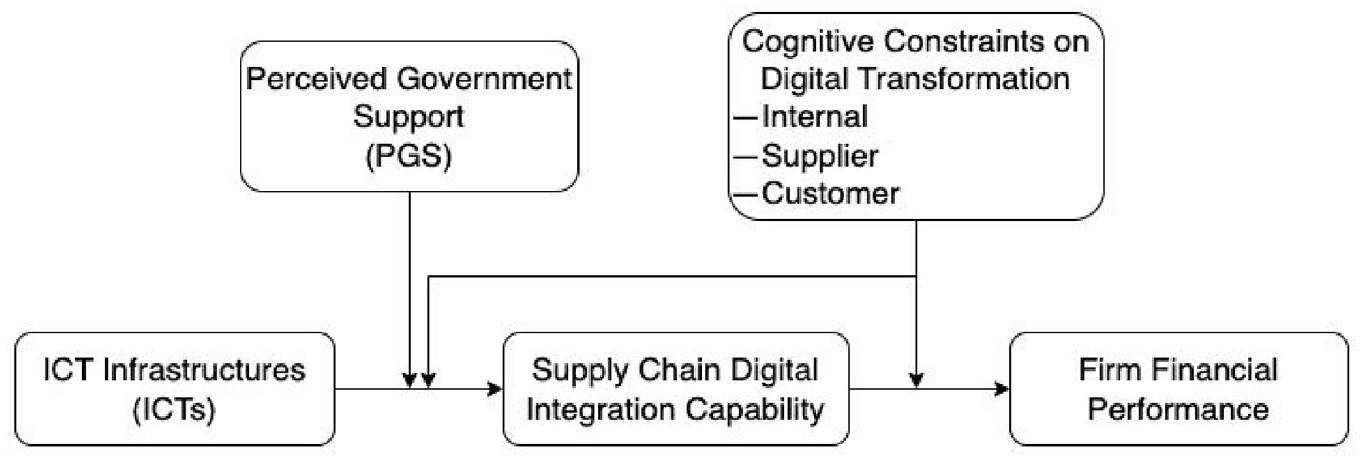
The conceptual model.
Research Methodology
Sample Description and Data Collection
China’s manufacturing industry predominantly thrives in its coastal economic belts, notably the Pearl River Delta and Yangtze River Delta. Collectively, these regions contribute over 50% of the nation’s manufacturing output (Iresearch, 2022), highlighting their central role in China’s industrial framework. Consequently, these economic belts were strategically chosen as the primary sampling areas for our survey.
Due to the unavailability of a comprehensive public listing of manufacturing companies, particularly Small and Medium-sized Enterprises (SMEs), a random selection of respondents was not feasible for our survey. Consequently, alternative methods were employed to gather the necessary data. In the Yangtze River Delta, the primary strategy involved leveraging the membership roster of the Yangtze River Delta Federation of Industrial Economics, which boasts over 8,000 SME members. After excluding entities with unclear contact information, a sample pool consisting of more than 6,600 SMEs was established. From this pool, stratified sampling was used to select 350 samples based on the industrial distribution pattern of the region. Additionally, to enhance our data collection, we actively participated in the 2022 Yangtze River Delta Digital Transformation Conference. This event provided an opportunity to collect questionnaires via on-site face-to-face interactions. In total, 164 valid questionnaires were obtained through these two distinct methods of data collection. In the Pearl River Delta, the absence of significant industry associations necessitated the use of alternative data collection methods, particularly conferences and forums organized by corporations. Over 200 questionnaires were distributed at events hosted by entities such as Guangdong Gaozhi Research Institute, Wuhan Fanuc Robot Co., Ltd., and Chengdu R** Technology Co., Ltd. The combined approach of direct interactions and email (and Telphone) follow-ups post-event resulted by our research team in 110 valid questionnaires, thus providing a substantial data set for analysis.
To mitigate bias inherent in quantitative questionnaire studies, our approach aligned with Tehseen et al. (2017, pp. 150–151), “The researcher should strive to get the measures of independent and dependent variables from different sources…. multiple sources of responses control the common method bias in the study.” This approach might include, for instance, varying response formats, utilizing diverse media, and drawing from different locations. The second phase of data collection in September 2022 aimed to diversify data formats, enhancing the validity of the dependent variable. Following the “Statistical Classification of Large, Medium, Small, and Micro Enterprises (2017)” by the National Bureau of Statistics, an additional 50 industrial SMEs (mainly from the Science and Technology Innovation Board and the Growth Enterprise Market) were selected for analysis. The categorization criterion for target Firms’ financial performance, as derived from “www.eastmoney.com,” exhibits a high degree of alignment with the quintile segmentation inherent to the 5-level Likert scale. Their annual reports (2019 and 2020) were transformed into survey responses, yielding 28 valid data points.
Ultimately, a total of 302 valid responses were amassed from both stages. Specifically, informant profiles are as follows: 144 middle managers (47.7%), 158 senior manaegers (52.3%). In terms of their business areas, there were 13 production managers (4.3%), 50 sales managers (16.6%), 56 marketing and public relations managers (18.5%), 40 supply chain managers (13.2%), 111 administrative managers (senior and top-level managers) (36.8%), 14 human resources managers (4.6%), and 18 research and development technicians (6%). In terms of gender, there were 228 males (75.5%). The surveyed firms’ industrial profile revealed a concentration in sectors like auto-parts, LED / Semiconductor, and machinery / equipment / heavy industries. This concentration aligns with the unique industrial clustering and geographic distribution in the Pearl River Delta and Yangtze River Delta regions. Research conducted by iResearch in 2021 substantiates this observation, indicating that in these regions, industries such as communication electronics, mechanical equipment, and automotive and spare parts manufacturing constitute a substantially higher proportion of the industrial landscape compared to other sectors. Additional details regarding the profiles of the firms under study are comprehensively presented in Table 1.
Firm Profiles.
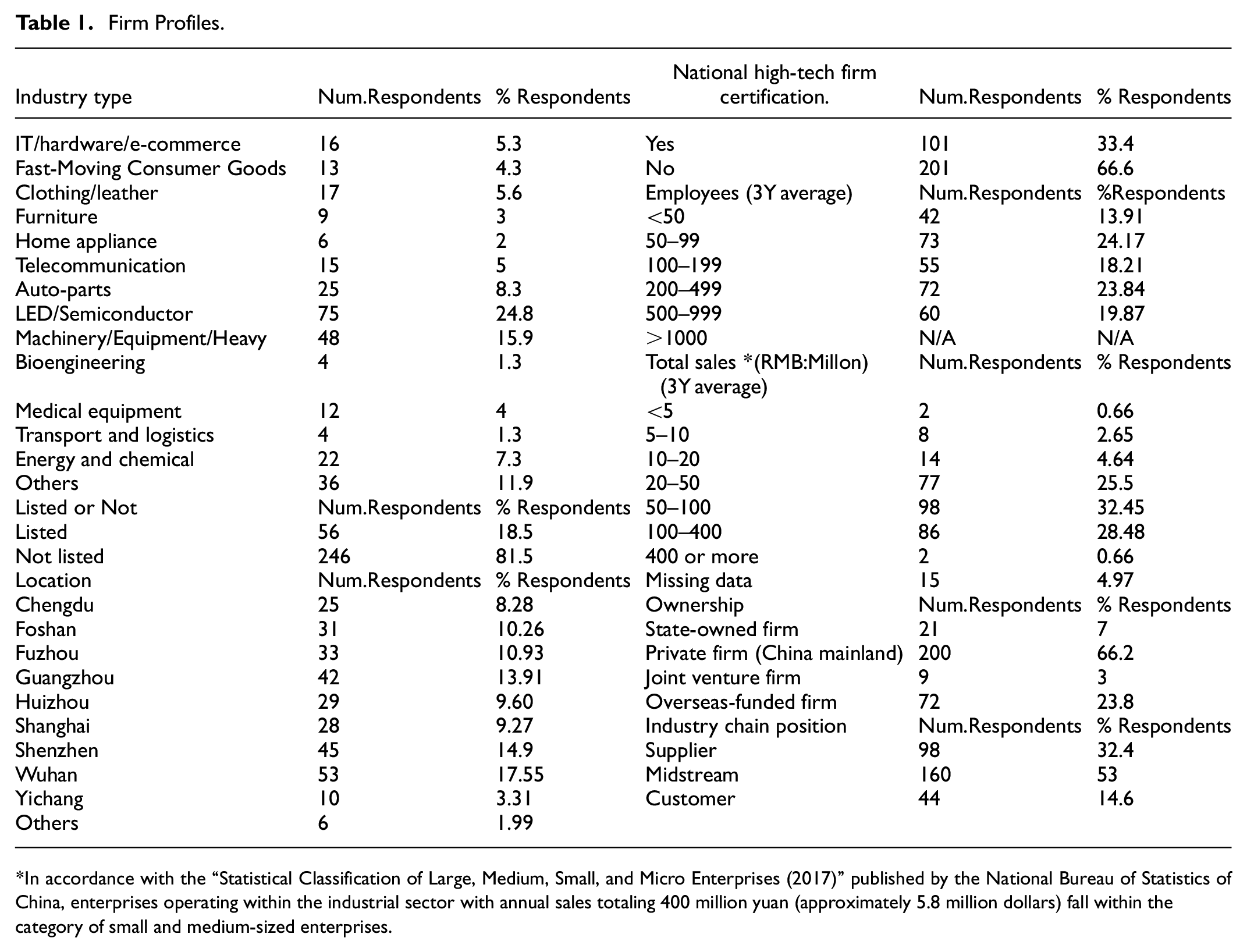
In accordance with the “Statistical Classification of Large, Medium, Small, and Micro Enterprises (2017)” published by the National Bureau of Statistics of China, enterprises operating within the industrial sector with annual sales totaling 400 million yuan (approximately 5.8 million dollars) fall within the category of small and medium-sized enterprises.
Questionnaire Design and Exploratory Factor Analysis (EFA) Test
In this study, the variables fall into two distinct categories: established scales derived from previous research and scales purposefully crafted for this investigation, requiring the development of standard scales.
Terry Anthony Byrd (2000) comprehensively defined Information and Communication Technologies (ICTs) as an integrated array of technological resources that include hardware, software, communication technologies, data, and key applications, forming the technological foundation of an organization. Expanding on this, X. Zhang et al. (2016) classified ICTs into two primary categories: Inter-organizational ICT, which encompasses technology-based infrastructure for transactions, information sharing, coordination, and governance between firms (e.g., Supply Chain Relationship Management, SCRM), and Intra-organizational ICT, which includes technologies and practices for internal information sharing, often involving systems that integrate financial, accounting, and logistics operations (e.g., Enterprise Resource Planning, ERP systems). Furthermore, Mendoza-Fong et al. (2018) and Thöni and Tjoa (2017) identified that in supply chain management, ICTs entail tools for e-procurement, e-commerce, data exchange systems, execution and monitoring systems (e.g., manufacturing execution system, Internet of things), along with real-time data exchange (e.g., electronic data interchange, EDI), ERP, MRP, CRM, among others. To assess ICT infrastructures, this study has developed 10 statements encompassing the following elements: (1) Internal ICT resources, including warehouse management system, manufacturing execution system, financial management software, material requirements planning system, enterprise resource planning software, data exchange system (e.g., EDI software), Internet of things (IoT) devices. (2) External ICT resources, comprising supplier relationship management, sales/customer relationship management, supply chain integration management software, online e-commerce.
Supply chain digital integration capability primarily characterize the utilization of information technology in the management and monitoring of order processing, packaging, distribution, transportation, and storage functions. This enhancement serves to strengthen an organization’s internal and external connections and collaborative capabilities. The variable that measures area (1) include both: (a) intenal digital/IT systems invested by focus firms; (b) extranet digital/IT systems invested by manufacturers; and (c) extranet digital/ITsystems invested by suppliers. Basing on So and Sun (2011) and Swafford et al. (2008), the measures of area (2) were operationalized in six management areas: (a) design and development; (b) procurement;(c) manufacturing;(d) logistics and warehouse;(e) purchasing and sales order; (f) supply and distribution management. Likewise, all variables of the two constructs were measured by a 5-point Likert scale.
Concerning firm financial performance, prior studies have primarily adopted two approaches: employing questionnaires to gage firm perceptions or utilizing publicly available data from listed firms as a measurement basis. Given our primary focus on SMEs, which often lack direct access to public financial data, and recognizing that relying solely on perception-based measurements can introduce significant errors. Tehseen et al. (2017, pp. 150–151) explicitly articulated, in reference to the perspectives posited by Podsakoff et al. (2003), “The researcher should strive to get the measures of independent and dependent variables from different sources…. multiple sources of responses control the common method bias in the study.” This approach might include, for instance, varying response formats, utilizing diverse media, and drawing from different locations. Our study attempts to amalgamate these diverse data formats to augment the robustness of the dependent variable. As outlined by M. Kaplan et al. (2014) and Li et al. (2017), financial performance is an assessment of an organization’s fundamental economic objectives, with key financial indicators encompassing profit (profit growth rate), sales trends (sales growth rate), and return on assets (return on investment). Based on this established academic perspective, these indicators have been selected as the pivotal metrics for our analysis. Specifically, we collected profit and sales revenue data for 2019 and 2020 from firms and applied the eastmoney (www.eastmoney.com)’s classification criteria for firm financial performance, which included categories like “great improvement,”“significant improvement,”“no change,”“significant decline,” and “great decline.” Profit and sales growth rates exceeding 50% were categorized as “great improvement,” while those ranging from 10% to 50% were labeled as “significant improvement,” and so on. Subsequently, we converted the data for these two quantitative measurement indicators into Likert scale data. Lastly, given the challenges in clearly defining return on assets within the survey, we continued to employ the perception measurement approach, using the Likert scale for its assessment.
To develop a new scale for measuring the cognitive constraints on digital transformation (including internal cognitive constraints, supplier cognitive constraints, and customer cognitive constraints) as well as perceived government support (PGS), we employed the scale development process outlined by Reise et al. (2000).
As there were no existing measurement scales in the literature for cognitive constraints on digital transformation, we developed measurement items informed by relevant studies. For internal cognitive constraints, we primarily referenced research by Gupta (2018), “Organizational Barriers to Digital Transformation” which discusses organizational obstacles, including senior managers lacking goals and vision, middle managers lacking change expertise, and frontline employees lacking motivation and participation. Vogelsang et al. (2019) also contributed valuable basic items by identifying hindering factors in their research. Moreover, as firms pursue digital transformation, they actively construct a solution-centered supply chain system and implement new governance mechanisms to regulate cooperation and value creation between firms Cennamo et al. (2020). The collaboration between supply chain partners is a crucial factor for firms to consider during digital transformation. We believed that the cognitive constraints of supply chain partners could negatively impact digital transformation efforts, making it necessary to measure them for a comprehensive understanding of the digital transformation process. In the absence of a mature scale for measuring these cognitive constraints, we selected measurement items related to information sharing barriers in the supply chain from previous literature, mainly drawing from the items proposed by Kembro and Näslund (2014), Pujara and Kant (2015), Zibak and Simpson (2019). Simultaneously, we employed Reise et al. (2000) scale development process for the latent variable of perceived government support, referring to the related research by scholars such as Wan et al. (2014), L. Xu et al. (2017), and Yee-Loong Chong et al. (2010)
After developing the basic scale, we conducted interview surveys with senior managers, middle managers, and frontline employees to evaluate and offer modification suggestions for these constructs based on their practical experience and insights. Then, we performed the EFA using principal component analysis in SPSS software to analyze the collected data. After checking the Kaiser-Meyer-Olkin (KMO)’s coefficient to evaluate the correlation between items in the scale and conducting a maximum variance rotation of the scale’s internal structure, we removed items with factor loadings below .5. The final adjusted measurement items included: 10 items for ICT infrastructures, six items for supply chain digital integration capability, nine items for perceived government support, 10 items for internal cognitive constraints, four items for supplier cognitive constraints, three items for customer cognitive constraints and three items for firm financial performance. These items served as the measurement instruments for the formal questionnaire analysis. The last EFA result has the KMO of 0.907 and sig of 0.000 (Table 2).
EFA Test.

Note. Extraction method: PCA; Rotation method: Varimax with Kaiser normalization. Removed items: ICT11: Online e-commerce trading platform; CUSADV4: Customers are concerned about information security; GSUB10: Firms can rapidly ascertain governmental feedback pertaining to the adjudication of their digital subsidy requisitions.
Rotation converged in seven iteration.
Data Analysis and Results
Reliability and Validity
Cronbach’s coefficient alpha is used primarily as a means of describing the reliability of multiitem scales. The “Cronbach’s alpha” results are presented in Table 3, It is generally believed that the value of Cronbach’s α coefficients should be at least greater than 0.6 (Miller, 2010). Since most items in our model are adapted from previous studies, content validity is ensured. The factor loadings, CR, and AVE of all constructs were employed to assess convergent validity. All the items loaded on their respective construct from a lower bound of 0.592 to an upper bound of 0.948 in Table 3 stated that the factor loading is above the 0.6 threshold showing sufficient convergent validity. There was a significant loading at the 0.001 level on all items, indicating that their indicators reflected the constructs appropriately (Bagozzi & Yi, 1988).
CFA Results for Measurements Scales and Associated Indicators.

The Discriminant Validity and Correlations (AVE-SV).
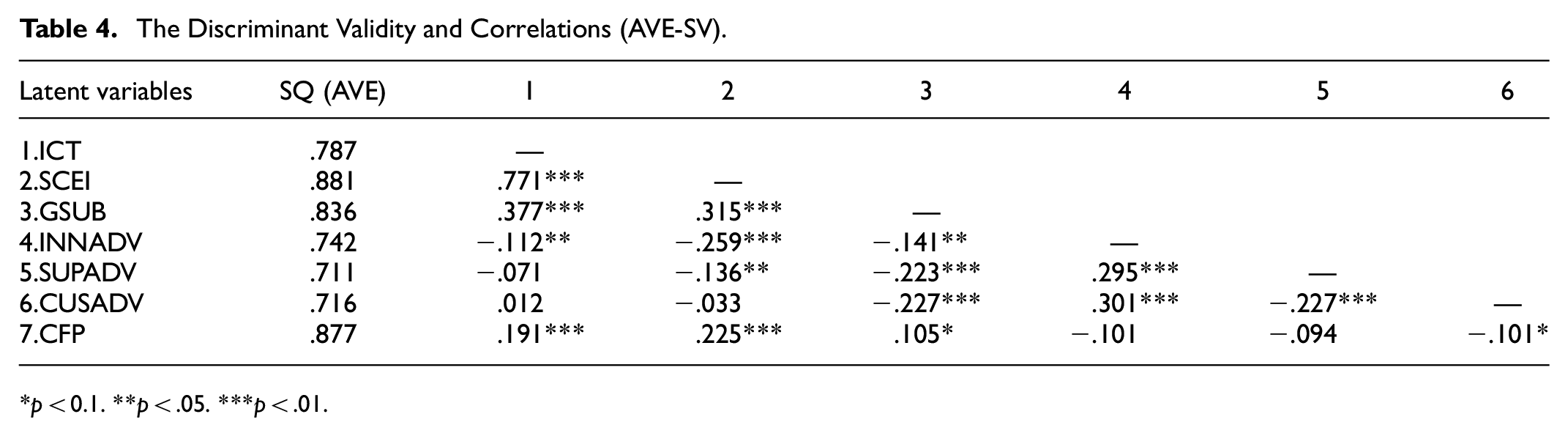
p < 0.1. **p < .05. ***p < .01.
Further, we assessed the discriminant validity by comparing the square root of each construct’s AVE with its coefficients of correlation with other constructs. If the square root of a construct’s AVE is the largest when compared with its correlation coefficients with other constructs in this model, the construct has sufficient discriminant validity (Fornell & Larcker, 1981). Tables 3 and 4 shows that all constructs in our model satisfy this requirement, indicating adequate discriminant validity.
Common Method Variance Testing
Many researchers (Podsakoff et al., 2003, 2012; Williams et al., 2010) have mentioned two main approaches that can be used to control the common method biases. The first method to minimize the influence of method biases is by the careful designing procedure of the study (the procedural remedies) and the second approach is to use statistical remedies in order to control the impact of common method bias after data collection. Chang et al. (2010)have strongly recommended using multiple remedies in order to assuage various concerns regarding CMV.
The procedural remedies to control the common method biases are followed Tehseen et al. (2017), in reference to the perspectives posited by Podsakoff et al. (2003): (1) Utilizing predictor (independent) and criterion (dependent) variables predominantly sourced from established research practices; (2) Acknowledging the challenges in acquiring data from multiple respondents for independent and dependent variables, our study attempts to amalgamate the diverse data formats (questionare and annual reports) to augment the robustness of the dependent variable; (3) The questionnaire underwent fine-tuning to enhance its relevance and structural interpretability, aligning it with the unique characteristics of China’s industrial landscape; (4) The questionnaire’s content underwent meticulous scrutiny and refinement by four practical and three theoretical experts to ensure clarity and eliminate any potential ambiguities. Theoretical experts primarily originate from universities and research institutes, including my doctoral supervisor and postdoctoral co-supervisor, specializing in the fields of enterprise operations and supply chain management. Practical insights are derived from professionals affiliated with various companies and associations, such as the Guangdong Gaozhi Industry Institute, Guanghua Electronic Technology Co., Ltd., Wuhan-Funac Co., Ltd., and Fuerda Intelligent Technology Co., Ltd. Additionally, English items were subject to a double-blind translation process to guarantee consistency in how respondents understood the questions; (5) We are ensuring respondent anonymity and minimizing evaluation apprehension to safeguard the integrity and validity of responses.
Many statistical remedies are applicable to structural equation modeling (SEM). It is the most common test that is carried out by the researchers to examine the CMV in their studies. A Harman one-factor analysis is a post hoc procedure that is conducted after data collection to check whether a single factor is accountable for variance in the data, if no single factor emerges and accounts for majority of the covariance, this means that CMV is not a pervasive issue in the study (Chang et al., 2010). We entered all items of seven latent constructs into SPSS file,loaded all items into factor analysis, clicked Rotation (none) then continued and ok. The generated PCA output revealed seven distinct factors accounting 70.25% of the total variance. The first unrotated factor captured only 28.022% of the variance in data. Thus, the two underlying assumptions did not meet, that is, no single factor emerged and the first factor did not capture most of the variance. Therefore, these results suggested that CMV is not an issue in this study. Although this test is easy to conduct but it has some drawbacks as well. For instance, Podsakoff et al. (2003) explained that Harman’s test is insensitive; therefore, the claim regarding CMV through this test is incomplete. Therefore, we continued to employ the “Partialling Out of General Factor” technique to tests whether common method bias is present or absent. The R2 value of the endogenous construct before and after adding the general factor was observed. The R2 value of firm financial performance was .051 before adding the general factor. After adding the general factor, the R2 value was slightly increased to .056. Thus, adding to this factor does not lead any significant change in R2 value of the endogenous construct, this suggests no substantial common method bias in this study. Further, there are several “Marker Variable” technique to assess and remove the common method biases (Chin et al., 2013), however, multiple unrelated measures are required to be collected at the same time of data collection for primary research model. The employed two statistical remedies provide substantial evidence regarding the absence or presence of Common Method Variance (CMV).
SEM Anylysis
The study employed Mplus 8.3 software to validate the structural model using the maximum likelihood estimation method (ML). Mplus stands as a robust statistical package renowned for its proficiency in analyzing latent variables, such as Structural Equation Models (SEMs) (Sardeshmukh & Vandenberg, 2017). The results, along with the fit indices concerning the structural model illustrating the relationship between ICT infrastructures, supply chain digital integration capability, and firm financial performance, are presented in Table 5. It is noteworthy that all fit indices align with the recommendations of Hu and Bentler (1999).
The Results of Regression Analyses (SEM).

Note. Model fit information: χ2/df = 2.68; TLI = 0.954; CFI = 0.947; RMSEA = 0.075; SRMR = 0.034.
p < .1. **p < .05. ***p < .01. nap > .1.
More specifically, ICT infrastructures positively influence the development of supply chain digital integration capability (β = .771***), and supply chain digital integration capability has a positive impact on firm financial performance (.226***). A firm’s supply chain digital integration capability represents its ability to integrate both internally and externally with its supply chain partners, signifying a new mode of cooperation and the extensive application of ICT infrastructures, which forms the basis for firm digital transformation. By utilizing ICT infrastructures to optimize internal operational activities, reconstruct processes, enhance information sharing, and facilitate value co-creation among firms, these efforts ultimately lead to cost reduction, inventory reduction, improved asset utilization, and enhanced sales performance. This aligns with the latest research conducted by Zhang (2022) in China.
Moderating Effects Test Results
Currently, research in the methodology field on moderation analysis mainly focuses on latent variable moderation analysis, and there are two main methods: the product indicator approach and the distribution analysis method (Kelava et al., 2011). The paired product indicator strategy makes the analysis of latent variable moderation effects simple, yet it grapples with two significant challenges—the creation of product indicators and the non-normal distribution of product terms, both of which continually face scrutiny. Therefore, more and more scholars have attempted the latent moderated structural equation method (LMS) in the distribution analysis approach (such as Klein & Moosbrugger, 2000). As noted by Sardeshmukh and Vandenberg (2017), it is worth highlighting that Mplus software distinguishes itself as the important software currently equipped to implement the Latent Moderated Structural Equation Modeling (LMS) strategy for the analysis of latent variable moderating effects. This study used the LMS method and Mplus8.3 software to conduct a moderation analysis of latent variables. This choice of software underscores our commitment to employing a rigorous and cutting-edge analytical approach in our research methodology.
Moderating Effect Analysis of Perceived Government Support (PGS)
Table 6 presents the results of the moderating effects of perceived government support (PGS) on the relationship between ICT infrastructures and supply chain digital integration capability. Specifically, perceived government support plays a negative moderating role in the process of promoting firm supply chain digital integration capabilities through ICT infrastructures (β = −.093**). This finding contradicts the hypothesis that a higher level of perceived government support would enhance the extensive adoption of ICT infrastructures firms, consequently strengthening the link from investment to IT-based capability. Evidently, this outcome deviates from the original intentions of the government’s digital transformation policy.
The Moderating Effects of Perceived Government Support (LMS ANALYSIS).

Note. Model fit information: Akaike(AIC)22104.532; Bayesian(BIC)22434.760.
p < .1. **p < .05. ***p < 0.01. nap > .1.
Moderating Effect Analysis of Cognitive Constraints on Digital Transformation
The results of the analysis concerning the moderating effects of internal cognitive constraints, supplier cognitive constraints, and customer cognitive constraints on the relationship between ICT infrastructures and supply chain digital integration capability, as well as the link between supply chain digital integration capability and firm financial performance, are presented in Table 7. The analysis revealed that when internal cognitive constraints on digital transformation was employed as a moderating variable, they counteracted the relationship between the firm’s ICT infrastructures and its supply chain digital integration capability (−0.078**), H4a was supported. This suggests that stronger internal cognitive constraints within the firm result in greater restrictions on the firm’s ability to transform into supply chain digital integration capability through its ICT infrastructures. However, the internal cognitive constraints of the firm did not significantly impact the relationship between the firm’s IT-based capability and its financial performance, H5a was rejected. This implies that once a firm has established its digital integration capability, internal cognition no longer hampers the role of these capabilities in cost reduction, efficiency enhancement, and performance improvement.
The Moderating Effects of Cognitive Constraints on Digital Transformation (LMS ANALYSIS).

Note. The conclusion supports H4a and H5b, rejects the other hypotheses. ICT means ICT infrastructures; INNADV means internal cognitive constraints on digital transformation; SUPADV means supplier cognitive constraints on digital transformation; CUSADV means customer cognitive constraints on digital transformation; SCEI means supply chain digital integration capability; CFP means firm financial performance.
Furthermore, supplier cognitive constraints on digital transformation has a negative effect on a firm’s ability to engage in digital transformation and hinder the development of digital integration capability throughout the entire supply chain (−0.081**). This negative impact underscores the pressure imposed by suppliers during digital transformation, particularly when integrating internal and external ICT infrastructures into a firm’s production and operational processes. More notably, supplier cognitive constraints also play a counteractive role in the relationship between their recognition of digital integration capability and the firm’s financial performance (−0.162***), H5b was supported. However, the study did not support H4b, the supplier cognitive constraints of the firm did not significantly impact the relationship between the firm’s IT-based capability and digital integration capability.
Lastly, the study did not identify the mechanism through which customer cognitive constraints on digital transformation impact the firm’s ability to develop digital integration capability and achieve superior financial performance within existing integration capability, H4c and H5c were rejected. This indirectly suggests that a firm’s digital transformation is primarily constrained by internal and supplier cognition, with customer cognition being a less significant factor for firms to consider.
Discussion
ICT Infrastructures, Supply Chain Digital Integration Capability and Firm Financial Performance
Historically, empirical evidence substantiating the role and advantages of information technology within the supply chain domain has been somewhat limited. A prevalent overemphasis and dependence on information technology infrastructure have often obscured enterprises’ understanding of the actual mechanisms through which information technology orchestrates, supports, and enhances the intricacies of complex supply chain operations. This obscurity frequently culminates in a disparity between the anticipated and realized benefits of such investments (Barratt, 2004). Dynamic capability theory (DCT) can be deemed the critical perspective for investigating the relationships among ICT infrastructures, digital integration capability, and supply chain performance. According to the dynamic capability approach, resource possession is indispensable, but not sufficient, for competitive advantage. The sufficient condition is communicated by the word how is the firm organized to employ its own resources to develop unique capabilities and value (Teece, 2007). Viewed from DCT, IT can be defined as a resource, which refers to a firm’s use of various infrastructures and IT support services. Nevertheless, mere IT implementation does not help a firm in achieving the competitive advantage. Fawcett et al. (2011) highlighted that ITs give competitive contribution only when they enable a dynamic integration capability.
Our research provides empirical insights into the nexus among ICT infrastructures, supply chain digital integration capability and firm financial performance, Echoing the perspectives of Haddud et al. (2017) and S. Kaplan and Sawhney (2000), our findings elucidate that when firms leverage ICTs to evolve or refine internal and external processes, thereby fostering a robust digital integration capability within the supply chain, they invariably cultivate a distinct competitive advantage and achieve enhanced performance. This research underscores the strategic importance of digital integration as a critical driver of firm success in the contemporary business landscape.
The Antagonistic Role of Perceived Government Support in Enhancing Firms’ Supply Chain Digital Integration Capabilities Through ICT Infrastructures
Government policies are increasingly oriented toward promoting digitalization and addressing digital challenges. Previous research on government support policies for digital transformation has predominantly focused on publicly traded firms and utilized micro-level firm data. However, this approach falls short as it neglects the contributions and needs of SMEs. Within the context of the current digital transformation landscape in China, Small and Medium-sized Enterprises (SMEs) are acknowledged as predominant participators to digital transformation. Even though firms are cognizant of the government’s support policies, more than 60% of the surveyed SMEs have never received actual government supports. As a result, previous research has predominantly evaluated the effectiveness of government support policies in digital transformation from the vantage point of publicly traded firms, a perspective misaligned with the original intentions of these policies. In contrast, our study contributes novel empirical evidence, indicating that perceived government support paradoxically assumes an antagonistic role in enhancing firms’ supply chain digital integration capabilities through ICT infrastructures.
To shed light on this unexpected result, the study engaged in in-depth discussions with firms, yielding the following explanation: first, theoretically, there are crowding-out effects and threshold effects in the effect of government support policies. If firms receive some government support policies such as subsidies, it will directly crowd out their own ICT investment, making them hesitant and greedy in building their own digital integration capability and accelerating their digital transformation level. That is, the synergy between these support policies and internal investment may hinder the improvement of firm digital level; second, as previously mentioned, government policies have significant siphoning effects and a distinct “favoritism toward large firms.” The perceived level of government support felt by SMEs is generally supportive of the industry, however, it rarely translates into actual benefits for themselves. This perceptual gap, diverging from actual gains, may yield detrimental consequences, potentially impeding firms’ motivation for digital transformation. SMEs also confront the ramifications of the digital wave. However, their limited investment in ICT infrastructures and the inadequacy of government support do not directly facilitate the digital transformation of these firms. Third, a notable aspect worth considering is the evident reluctance of numerous SMEs to divulge their financial statements, primarily stemming from concerns related to potential tax implications and financial audits. However, it is imperative to acknowledge that government subsidies often necessitate reference to tax data or the disbursement of subsidies contingent upon the prevailing tax circumstances. This principle also extends to government incentives aimed at promoting digital transformation, wherein tax compliance assumes a significant role. The reluctance of many SMEs to disclose their financial statements poses a natural impediment to this process. Furthermore, such active resistance may inadvertently fuel skepticism among these SMEs regarding the efficacy of the policy in question.
The Antagonistic Effects of Cognitive Constraints in Digital Transformation Process
Undoubtedly, existing research has begun to focus on the support and assistance of internal managers and employees, as well as supply chain partners, for the digital transformation of firms. However, there is a notable dearth of research concerning the strategies to advance firm digital transformation when such support and assistance are absent at the cognitive level. The constraints and antagonistic effects caused by the insufficient understanding of digital transformation by managers, employees and other stakeholders have been seriously ignored. For example, the firm’s senior managers may erroneously believe that the current business volume and operational domains do not warrant transformation. Managers may also refuse to introduce more transparent digital tools because these tools may make management more procedural and cause them to lose soft control. Employees may become unemployed because the firm adopts too much ICT technology. Suppliers and customers may not cooperate at all because they believe that the privacy of supply and demand data is very important. These problems and phenomena are common in practice, but rarely discussed in theory (such as Gupta, 2018; Yao et al., 2022).
This study focuses on the cognitive constraints of internal and external entities on digital transformation, and in-depth analysis can explain the antagonistic effects of cognitive biases in digital transformation. Although the internal and external cognitive constraints of firms are new variables established based on social cognitive theory and organizational inertia theory, the measurement of cognitive constraints can be completely transformed into cognitive support. For example, internal cognitive constraints of firms can be adjusted through firm management strategies to become internal cognitive support. According to the research conclusions, the internal cognitive constraints of the firm and the supplier’s cognitive constraints have an antagonistic effect. Consequently, it is discernible that internal members of the firm and external partners possess disparate perceptions of the external environment. These differing viewpoints translate into distinct attitudes and strategies for navigating the environment, ultimately leading to divergent actions. This phenomenon represents an inevitable topic of investigation and underscores the fundamental significance of this study.
Contributions
This study has the following theoretical contributions:
Firstly, this research contributes to a deeper understanding of dynamic capability theory. Historically, evidence illustrating the role and benefits of information technology in the realm of supply chain management has been lacking. A pervasive emphasis on and reliance upon information technology infrastructures have left numerous firms equipped with advanced information technologies and systems, yet they have failed to grasp the fundamental mechanisms of how information technology effectively organizes, supports, and propels highly intricate supply chain operations. Consequently, an investment-performance lag persists as these firms grapple with delineating the boundaries between internal and external organization, deciphering how to engage with the external environment, and mastering the art of integration (Lerner et al., 2000). The primary objective of dynamic capability theory is to elucidate “how and why firms establish competitive advantages in rapidly changing environments.” This research effectively addresses this question by promoting the integration of a firm’s internal and external ICT infrastructures to cultivate ICT-based capabilities, ultimately facilitating improved firm financial performance.
Secondly, this study introduces the variable of perceived government support into the field of IS research. Although perceived government support is not a novel variable, prior research has predominantly focused on cross-organizational collaboration. However, this study incorporates perceived government support as a variable for gaging government policy tools, adopting the perspective of SMEs within the research framework. This represents a valuable addition to previous studies, which predominantly relied on government policies measured through data from publicly listed firms. In this investigation, perceived government support serves as a pivotal representative variable for gaging government policy directives, especially for SMEs that have not received tangible government support. It reflects the subjective perceptions of SMEs, offering insights into their interpretation of the level of government policy support within their respective industry sectors.
Lastly, this study introduces the variable of cognitive constraints on digital transformation. This extension enhances the application of social cognitive theory and organizational inertia theory within the domain of supply chain management. Social cognitive theory underscores the variability in the perceptions of individuals and organizations toward their environment, influencing distinct attitudes and strategies in response to their surroundings. This paradigm aligns well with the current scenario of firms navigating the digital transformation landscape. Organizational inertia theory underscores the choices organizations face between “change” and “status quo” during digital transformation, which can be influenced by inherent developmental inertia within organizations. If firms and their partners lack the requisite skills and mindset for such transformation, they may resist digital transformation efforts. While resource-based theory, dynamic capability theory, and resource orchestration theory remain dominant theoretical foundations in the realm of digital transformation, they sometimes fall short in explaining the phenomenon where many firms currently exhibit hesitance, incapacity, ignorance, or reluctance to digital transformation. This article posits that social cognitive theory and organizational inertia theory can play a pivotal role in guiding the digital transformation journey of firms and their supply chains, offering a more multifaceted perspective for both the industry and academia to deepen their comprehension of the obstacles associated with digital transformation.
This study has the following practical contributions: (1) It proffers strategic insights for managers and owners of SMEs on the criticality of effectively managing digital integration capabilities to bolster business performance. This is paramount in circumventing “technological traps” and investment missteps, ensuring that well-devised strategies culminate in beneficial rather than counterproductive outcomes; (2) It offers a comprehensive analysis of the inhibitive influence of cognitive biases on digital transformation, advocating for the cultivation of a conducive organizational culture and the reshaping of supplier cognition, thereby aiding firms in their digital transformation endeavors; (3) It provides novel perspectives for governmental bodies employing policy instruments, urging a consideration of the distinct needs, interests, and the potential “crowding-out effect” peculiar to SMEs. These insights collectively aim to guide both corporate and policy strategies in the context of digital business ecosystems.
Conclusions, Practical Implications and Limitations
Conclusions
Facilitating the scientific and efficient digital transformation of SMEs assumes paramount importance as it stands as a critical determinant of China’s pursuit of high-quality economic development. Drawing upon an extensive analysis encompassing 302 SMEs, this study endeavors to elucidate these often-neglected barriers. The resulting findings from this inquiry are poised to offer invaluable insights:
(1) The findings derived from the SEM analysis reveal a direct and affirmative correlation between ICTs and a firm’s supply chain digital integration capability. Moreover, this digital integration capability is also observed to exert a positive influence on the financial performance of the firm.
(2) The results of LMS tests have unveiled noteworthy findings regarding the antagonistic effects of perceived government support and certain cognitive constraints associated with digital transformation. Firstly, it has been established that perceived government support and internal cognitive constraints exhibit antagonistic effects in the process of promoting a firm’s supply chain digital integration capabilities through ICT infrastructures, which contradicts the initially posited hypothesis. Secondly, supplier cognitive constraints are observed to exert antagonistic effects on the nexus between digital integration capability and the firm’s financial performance.
This research offers compelling evidence that underscores the presence of perceived government support and cognitive constraints pertinent to digital transformation. These factors emerge as critical barriers within the firm’s digital transformation process.
Practical Implications
Firstly, strengthening the Hierarchical Understanding of ICT Investment and Application. Considering China’s “14th Five-Year Plan” and the “Made in China 2025” strategy, the Chinese government is actively promoting the adoption of cutting-edge information technology to drive digital transformation across various industries. It is imperative to acknowledge that information technology transcends mere technologies or systems, instead, it should be recognized as an evolutionary process and a comprehensive system or framework for technological change. Unfortunately, numerous industries and firms grapple with comprehending and implementing these foundational concepts, let alone embarking on such profound transformations with unwavering commitment. Consequently, it becomes crucial for stakeholders at all levels, spanning governmental regulatory bodies, industry associations, and individual firms, to prioritize the promotion of digital integration concepts. This necessitates a shift in focus from mere “resources” to “capabilities” and a transition from a deep interpretation of policies to the practical application championed by firms themselves. These measures are indispensable in steering clear of potential “technological traps” and investment pitfalls.
Secondly, rethinking the effectiveness and applicability of government support policies in the process of digital transformation. Our research findings align closely with practical experiences, revealing that government macro-policy formulation typically commences at the industry level, with a focus on nurturing “benchmark firms,” thereby leading to policy limitations. We propose that when the government employs policy tools, it must consider the specific needs, interests, and the potential “crowding-out effect” on SMEs. Therefore, in the pursuit of promoting digital transformation across industries, it is essential to acknowledge that the digital transformation experiences of large firms cannot be seamlessly adapted to the myriad challenges faced by SMEs, given the differences in size, management systems, financial resources, and other pertinent aspects.
Thirdly, ennhancing the digital transformation awareness of firms both internally and externally during the transformation process. According to the research conclusions, the internal cognitive constraints of the firm and the supplier’s cognitive constraints have an antagonistic effect. Consequently, it is discernible that internal members of the firm and external partners possess disparate perceptions of the external environment. These differing viewpoints translate into distinct attitudes and strategies for navigating the environment, ultimately leading to divergent actions. For firms aspiring to partake in the realm of digital transformation, fostering internal cognition can be realized through the cultivation of organizational culture, whereas shaping supplier cognition can be achieved through the adoption of a multi-supplier strategy aimed at mitigating supplier influence.
Limitations and Future Research
While making significant theoretical and practical contributions to the supply chain management literature, the findings of this paper still have some limitations that need to be taken into consideration in future studies. First, this study has a limited sample pool (302 respondents), and data are collected from several typical geographic coverage, so the results cannot be generalized to other regions with different characteristics. Future researchers are encouraged to expand the sample size to cover other regions to obtain better generalizations. Second, this research is designed as quantitative research. As a result, in-depth interviews were not conducted, which may result in in-depth assessments and analyses being inadequately presented. Future research can use a qualitative approach to gain deeper insight into the novel variables, perceived government support and cognitive constraints. Third, this study endeavors to amalgamate questionnaire data with annual report data to enhance the robustness of the dependent variable, namely, firm financial performance. While the robustness of this methodology has yet to be thoroughly validated due to the absence of precedential scholarly references, it represents a pioneering exploratory effort.
Future research is imperative to systematically investigate the following: The advent of the COVID-19 pandemic and subsequent global supply chain disturbances have catalyzed governmental initiatives to enhance digital transformation as a strategic response to mitigate disruption risks. This situation has concurrently led to a heightened recognition among enterprises of the critical role played by organizational digitalization. During this period, it is likely that the perception of digital transformation within enterprises has undergone significant shifts. A thorough exploration of these aspects is deemed essential for a comprehensive understanding of the evolving digital landscape in the business context.
Footnotes
Acknowledgements
Authors would like to thank Hubei Provincial Department of Education and Hubei University of Technology for funding this research.
Author’s Note
Research interests: Supply chain management
Research interests: industry economy and supply chain management
Declaration of Conflicting Interests
The author(s) declared no potential conflicts of interest with respect to the research, authorship, and/or publication of this article.
Funding
The author(s) disclosed receipt of the following financial support for the research, authorship, and/or publication of this article: This study was funded by the Philosophy and Social Science Research Project (21Q085) of the Hubei Provincial Department of Education and the Doctoral Starting up Foundation of Hubei University of Technology.

Data Availability Statement
The datasets generated during and/or analyzed during the current study are available from the corresponding author on reasonable request.