




Abstract
Corporate social responsibility and its relationship with firm performance have been the focus of studies concerning the area of social responsibility of companies over the last four decades. The area has undergone significant progressions and shifts over time. There is a tremendous interest among the researchers in analyzing the relationship between corporate social responsibility and firm performance, as evident by the increasing surge in the research publications in this domain, especially since 2010. This study intends to highlight the knowledge expansion and research dispersion in the broad area concerning corporate social responsibility and its effect on firm performance. For this purpose, the research articles published in the Scopus database from 1987 to 2021, covering 34 years, have been taken to perform a bibliometric analysis. The study explains the descriptive trend of research publications focusing on performance indicators and uses a thematic evolution tool to highlight the major themes. The results of the bibliometric studies reveal that the focus of research encompasses the dimensions of sustainability, strategic management, institutional pressures, disclosure, and corporate social responsibility reporting. Based on these dimensions, the paper presents insights into the existing studies and offers the scope for future research.
Keywords
Introduction
The mission to establish the impact of Corporate Social Responsibility (CSR) on a firm’s performance in the literature has been the focus of many past research studies (Orlitzky et al., 2003; Waddock & Graves, 1997). Exploring and analyzing the effect of corporations being socially responsible on their performance have been explained using various theoretical and conceptual underpinnings. The discussions on the relationship between CSR and firm performance started in the 1980s and 1990s when scholars were still interested in defining what constitutes CSR and who the company should be responsible for. These discussions continued in the 21st century and are relevant to the interest of researchers in this area. The query “does it pays to do well” led the studies to inquire about the relationship between CSR and firm performance. The research studies on the theme’ business case of CSR’ focus on what bottom-line tangible benefits companies get from being responsible. Responsive to the different stakeholders’ expectations leads to positive reciprocities (Jones, 1995). Theories such as stakeholder theory, resource-based view, and legitimacy theories have tried to explain the different reasons or mechanisms through which social responsibility leads to improved performance of firms. Some studies explore the said relationship in different contexts and use other proxies of social responsibility and firm performance (Bodhanwala & Bodhanwala, 2018; Maqbool & Zameer, 2018; Mishra & Suar, 2010; Orlitzky et al., 2003; Pradhan, 2016). There have been attempts to measure the direction of this relationship (Maqbool & Zameer, 2018; Waddock & Graves, 1997) and to solve various methodological issues and conceptual operationalization of the different constructs measuring corporate social responsibility and firm performance (McWilliams & Siegel, 2000). The recent studies relating to CSR and Financial performance have given a negative (Jyoti & Khanna, 2021; Sekhon & Kathuria, 2019), positive (Bag & Omrane, 2022; Cordeiro et al., 2021), and mixed (Jaisinghani & Sekhon, 2022; Oware & Mallikarjunappa, 2022) relationship. Researchers have attributed these inconsistencies to the incongruity of stakeholders, lapses in theoretical foundations, conceptual factors of CSR, methodological differences, and functional deviations in the measurement aspect of CSR and financial performance (Lu et al., 2014; H. Wang et al., 2016; Q. Wang et al., 2016).
Even after decades of research in the business case of CSR, incongruence exists in the conclusions about the effect of CSR on firm performance. This study appoints a bibliometric analysis to look back and analyze past and present positions and highlight future studies in the business case of CSR. This study aims to provide a comprehensive review of the studies on the effect of corporate social responsibility on a firm’s performance to evaluate the present position and developing trend in the publication from 1987 to 2021 through a bibliometric analysis. The data has been retrieved from Scopus and Biblioshiny software of R, and VOS viewer is used for the bibliometric analysis. The focus of the study is to (i) conduct a descriptive analysis of research trends and publication output, (ii) evaluate the most cited documents and authors, (iii) construct a country collaboration network, (iv) explore and analyze the keywords through keyword co-occurrence network, and thematic evolution, and (v) create and analyze a co-citation network of references. This paper is organized as follows: the second section presents a literature review that discusses the critical studies that have led to the development of the field. The third section explains the data and methodology, followed by the results of the bibliometric analysis. The fifth section provides concluding remarks and discusses the significant findings, succeeded by future research directions.
Theoretical Background
CSR and Its Impact on Firm’s Performance
The discussions about corporate social responsibility as the subject of strategic planning and the foundation of business ethics came around with the book by Bowen (2013) initially printed in 1953. Since then, shifts have come in the general direction of studies focusing on CSR. The business case of CSR relates to deliberations on the motives, pressures, drivers, and short-term and long-term benefits of socially responsible behavior of business organizations (Aggarwal & Jha, 2019; Vishwanathan et al., 2020). The research studies relating to Business’ responsibility toward society have been necessitated as a response to Friedman (2017), who stated that the business’s sole objective is to increase profits in a New York Times article published in 1970. This was further challenged by Freeman (1994), who was the proponent of stakeholder theory which states that businesses need to focus on satisfying stakeholders for their long-term survival and growth. Carroll (1991) defined corporate social responsibility in the form of a pyramid that captures four duties a business has toward its society: economic, philanthropic, legal, and ethical, confirming that companies have some responsibility toward society as substantiated in her further research works (Carroll & Shabana, 2010).
Over time, different theories have been developed which congruously explain the concept of the business case of CSR and the context within which fulfilling societal responsibilities affect a business organization. The stakeholder theory elucidates the responsibility of businesses toward multiple stakeholders (Freeman, 1994), and institutional theory discusses the different pressure organizations face, which motivates their sustainable behavior (DiMaggio & Powell, 1983; Scott et al., 2004). Barney’s (1991) resource-based view posits that being responsible provides a unique advantage for firms which gives a distinct competitive advantage to companies. The instrumental stakeholder theory has been developed by combining stakeholder, economic, and theories from ethics and behavioral science (Jones, 1995). The basic tenet of this theory is that the firms operate through their managers who contract with various stakeholders based on mutual trust and cooperation. The business case of CSR has also been popularized by the works of Porter (1991) and Porter and Kramer (2002), where the shared vision concept of strategic CSR has been explained. With the development of these theories and studies that have been empirically tested (McWilliams & Siegel, 2000; Mishra & Suar, 2010; Orlitzky et al., 2003; Waddock & Graves, 1997), the effect of CSR on firm performance has given new avenues of research in the field.
Bibliometric Analysis in CSR Research
The bibliometric research studies in corporate social responsibility have gained momentum in recent years. This section describes such studies in CSR research that have been done using bibliometric analysis. A bibliometric analysis enlightens researchers with a broad view of the documents published in any domain, including their trend and general direction of research studies. The earliest known bibliometric study on corporate social responsibility research was conducted by (De Bakker et al., 2005), who analyzed 30 years of CSR-corporate social responsibility theory and research. Since then, there has been a steady rise in bibliometric studies encapsulating various sub-fields of CSR research, with the highest number of articles published in 2020 and 2021. The bibliometric studies have focused on “CSR and sustainability” (Du et al., 2021; Meseguer-Sánchez et al., 2021; Nunhes et al., 2020; Secinaro et al., 2021), “CSR and communication research” (Ji et al., 2020; Verk et al., 2021), “trend of specific journal publication in CSR” (Kumar et al., 2020; Wu et al., 2021), “employee centered CSR” (Santana et al., 2020), and “gender/board diversity and CSR” (Amorelli & García-Sánchez, 2021; Sánchez-Teba et al., 2021). The bibliometric studies have also focused on “CSR trends and research in Small and Medium Enterprises” (Guillén et al., 2022; Maldonado-Erazo et al., 2020), “supply chain management and CSR” (Modak et al., 2020), “CSR and share price” (Raza et al., 2021), “evolution of CSR” (Ferramosca & Verona, 2020), and “CSR in marketing and consumer behavior” (Nova-Reyes et al., 2020).
The previously published literature has exemplified the review studies and seminal research papers on the meaning and definitions (Carroll, 1979, 1991, 2016; Dahlsrud, 2008) and theories of CSR (Barney, 1991; Freeman, 1994; Friedman, 2017; Jones, 1995; Scott et al., 2004). There are review studies that have analyzed the business case of CSR by explaining the underlying mechanisms and studying the effect of a company’s social responsibility on a firm’s performance (Aguinis & Glavas, 2012; McWilliams & Siegel, 2000; Orlitzky et al., 2003; Vishwanathan et al., 2020). The surge of these bibliometric studies in recent times, especially in business research, can be attributed to their ability to handle significant volumes of data and deliver research effects (Donthu et al., 2021). A preliminary review of the above-mentioned bibliometric studies reveals a need for this paper to perform a comprehensive bibliometric review on the effect of CSR on the performance of firms.
Data and Methodology
Source of Data and Search Terms
For the study, data and information is extracted from the Scopus database and analyzed using Biblioshiny and VOS viewer. In this study, documents extracted from Scopus database have been used, one of the world’s most extensive abstract and citation databases in terms of coverage and journal range (Falagas et al., 2008). Four keywords are used to extract relevant information on the broad area of corporate social responsibility: CSR OR Corporate Social Responsibility AND Firm performance OR financial performance. The database in Scopus is dynamic and gets updated at frequent intervals. Because of this, information was exported on 27th October 2021.
For the analysis, the data period selected is from 1987 to 2021, comprising 34 years, which aligns with the inception of the empirical work using the relevant keywords. A preliminary search using the key search terms yielded 2072 articles. The selected articles were limited to subject area as Business management and accounting. Articles, edited book chapters, conference proceedings, and reviews were selected, and source type was restricted to Journal, conference proceeding, and book. The language was English, and only published articles were taken for the study, which ultimately yielded 1244 articles.
Tools for Analysis
The data has been analyzed in the present study using VOS Viewer and Biblioshiny software. The Biblioshiny is a shiny app that gives a web interface for Bibliometrix, an open-source R package that provides an elaborate bibliometric analysis (Aria & Cuccurullo, 2017). The VOS Viewer is an app that presents a graphical representation of network maps and can display extensive bibliometric data in maps in a very user-friendly and easy-to-analyze manner (Van Eck & Waltman, 2011).
All analyses have been done using Biblioshiny except the country collaboration network and keyword co-occurrence network, which have been drawn using VOS viewer.
Results
Basic Information About the Data Analyzed
The period of the study is 34 years, from 1987 to 2021. Within this period, 1,244 documents were found, including 1,086 articles, 52 book chapters, 54 conference papers, and 52 review papers. The search yielded 2,498 authors’ keywords, and the total number of authors was 2,713.
Annual Scientific Production and Research Trend
The analysis of the trend of the annual scientific production of 1,244 documents used in the study shows that the number of articles before 2004 is relatively low, averaging only three per year. Significant growth in published papers occurred in 2009 and 2015, when the publications averaged 55 and 115, respectively, with the highest in 2020, equalling 171. The growth in Figure 1 shows an increasing interest in authors in this field, especially in recent years.
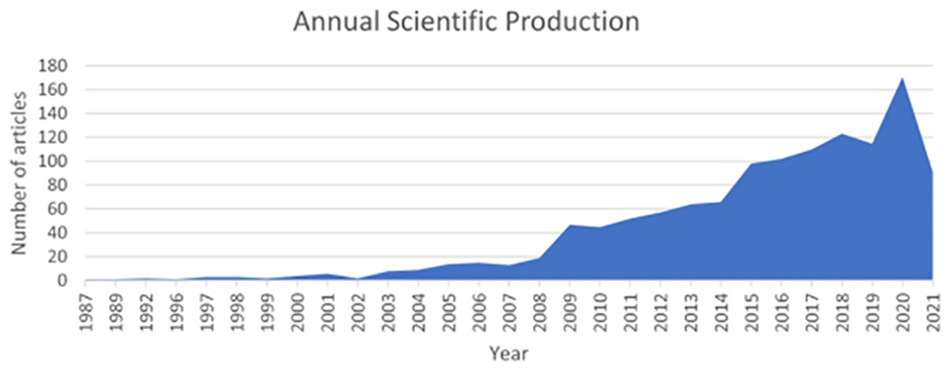
Annual scientific production.
Documents With the Most Citations and Impact Factor
This section discusses the most relevant or productive sources of articles. Out of the 1244 documents published in 438 journals, the top 10 most productive sources are shown in Table 1. The top journals per publication are the Journal of business ethics (22.4%), followed by Corporate social responsibility and environmental management (13.8). The impact of journals is in terms of the H index, which measures the Journal’s number of articles (h) that have received at least h citations. So, the most impactful journals in terms of H index are “The Journal of Business Ethics” as shown in Table 2.
Most Relevant Sources as per the Number of Articles.

Source. Biblioshiny using Scopus database.
Most Impactful Sources as per H Index.

Source. Biblioshiny using Scopus database.
The most cited article, the one with the highest local as well as global citation, is by (Orlitzky et al., 2003) titled “Corporate Social and Financial Performance: A Meta-Analysis” from “Organization Studies,” where the authors provided a rigorous review based on 52 studies of the effect of social performance on financial performance. By evaluating the themes of the top 10 most cited documents as given in Table 3, the articles mainly focused on the nature of CSR on CFP, review studies on the relationship, and theories explaining the said relationship.
Documents Having Maximum Citations-Biblioshiny Using Scopus Database.

Source. Biblioshiny using Scopus database.
Authors and Affiliations
This section describes the details of the authors and their impact. Out of the 2,713 authors that have authored 1,244 documents, 203 are single-authored documents, with authors per document averaging 2.31. The most productive authors are Seoki Lee with 12 and Garca-Snchez IM with 10 papers. The top 10 most productive authors, their local citations, and their impact by H index is shown in Table 4. Seoki Lee had the highest H index of 11.
Top 20 Author Production, Author Impact by H Index, and the Number of Citations.

Source. Biblioshiny using Scopus database.
Most Relevant Affiliations and Active Countries
This section focuses on the most relevant affiliations for the documents selected for the study. Out of 1483 institutions that have published data on CSR and its effect on firm performance, the top 10 most affiliated institutions have been studied. The University of Zaragoza has produced the most articles (16), followed by The Hong Kong Polytechnic University (15), as shown in Table 5. The most productive country, as given in Table 6, is the USA, with 468 documents, followed by China (237). The USA excels in the total production of articles, and there is a considerable difference of almost 50 % between the articles produced in the USA and China.
Top 10 Most Relevant Affiliations and Their Country.

Source. Biblioshiny using Scopus database.
Most Productive Countries.

Source. Biblioshiny using Scopus database.
Country Collaboration Network
A country collaboration network gives a perspective on whether research in a given area is clustered or is representative of the different countries in the world (Donthu et al., 2021). The country collaboration network is shown in Figure 2. The network shows that the highest link strength is of the United States, with more than 4 lakh links. The network is divided into five clusters where cluster 1 shows the link between the world’s developed countries, with US having the highest link strength. Cluster 2 shows the link between the developing countries of the world with the highest link of India, and cluster 3 includes the links between the East Asian countries, with China having the highest link strength.

Country collaboration network.
Keyword Analysis and Thematic Evolution
The keywords have been analyzed in this section by studying the most frequently appearing keywords and keyword co-occurrence network. The thematic evolution has been shown by using thematic maps. The keywords co-occurrence network is drawn using VOS Viewer, and Biblioshiny has been used for showing thematic evolution. The keywords discovered in the literature survey are used to draw a vocabulary picture of a particular field of study (Feng et al., 2017). A total of 2498 keywords were discovered in this study as authors’ keywords from 1244 articles, out of which 995 were categorized as Keyword Plus (ID), which is generated from the title of references that an author has cited and is considered more descriptive than author keywords (Zhang et al., 2016). Apart from corporate social responsibility and firm or financial performance, the most occurring keywords are finance, sustainable development, economic and social effects, social aspects, stakeholder, environmental management, industry, and corporate strategy showing the focus of studies in these areas in Table 7.
Frequently Occurring Keywords.

Source. Biblioshiny using Scopus database.
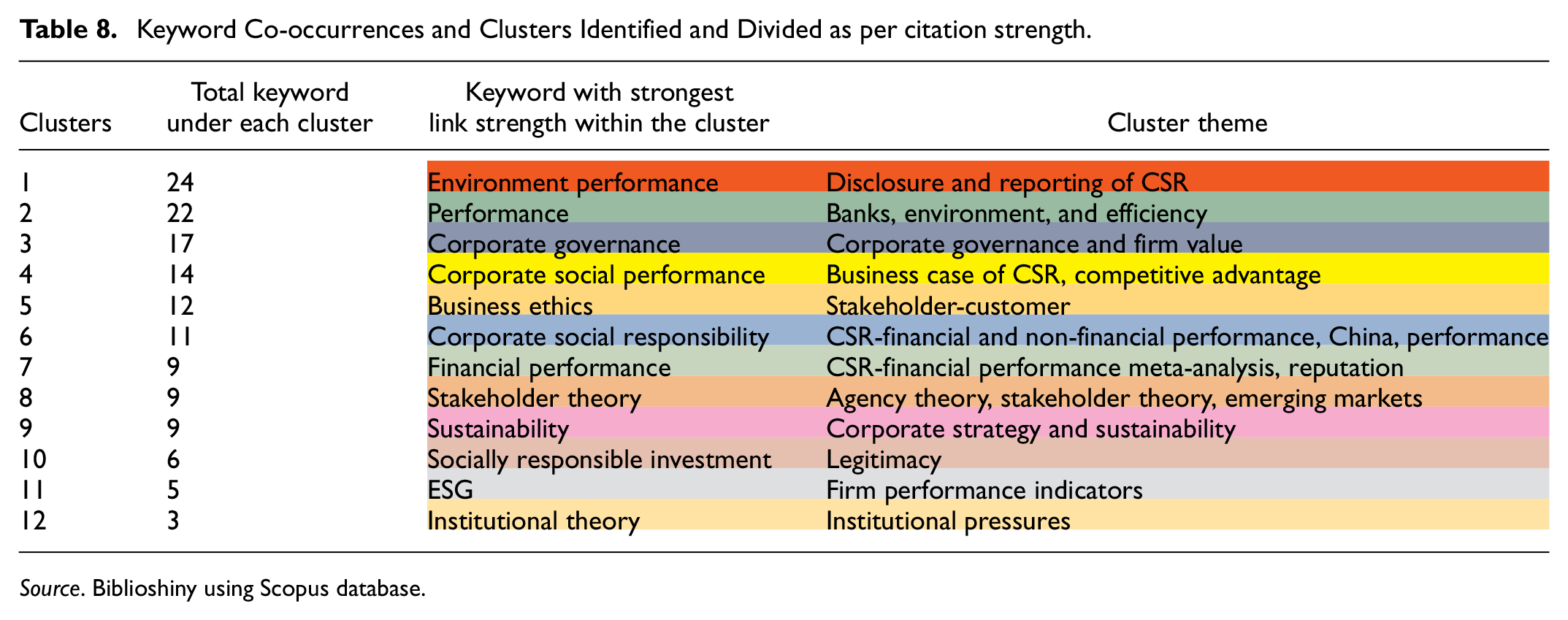
Keyword co-occurrence analysis aims to probe into the co-occurring nature of keywords in the given publications (Aria & Cuccurullo, 2017). The nodes in the network represent keywords, the node’s size indicates the occurrence of the keyword, and the line showing the link between the nodes shows the co-occurrence between the keywords. The width of the line indicates the number of times the keywords co-occur together. The color denotes a thematic cluster where the nodes and links are used to describe the cluster’s description of themes and the relationships between them. As shown in Figure 3, a keyword co-occurrence network reveals that 12 clusters have been formed. The keywords with the highest link strength, clusters, and cluster themes, along with the cluster color, are shown in Table 8. The most prominent cluster with more than 10 keywords and their links have been identified as Cluster 1 with environmental performance as the most prominent theme, cluster 2 with “performance,” cluster 3 with “corporate governance,” cluster 4 labeled with “corporate social performance,” cluster 5 with “business ethics,” and cluster 6 with “corporate social responsibility.” The top five keywords with the highest co-occurrence strength are “corporate social responsibility,” “financial performance,” “corporate governance,” and “CSR and sustainability.”

Keyword co-occurrence network of author’s keywords.
Keyword Co-occurrences and Clusters Identified and Divided as per citation strength.
Source. Biblioshiny using Scopus database.
Thematic Evolution
A thematic evolution analysis is performed using Biblioshiny to identify how different themes in the literature have evolved over time by dividing the time period from 1987 to 2021 into two time slices. The period selected was 1987 to 2014, 2015 to 20, and 2021. A total of 310 keywords were studied with a minimum cluster size of 5.
A thematic map has four quadrants based on the impact and centrality of themes. The motors themes (upper right) are well developed and are the most critical themes in the analyzed studies, the niche themes(upper left) include isolated and peripheral themes. The basic or transversal themes are essential but not well developed in the literature, and emerging or declining themes in the lower left quadrant are poorly advanced (Cobo et al., 2011). The quadrants for each period are shown in Figure 4a to c. As per their importance in highlighting the essential and emerging themes, motor and transversal themes have been highlighted below.

(a) Major themes from 1987 to 2014, (b) major themes from 2015 to 2020, and (c) major themes for the year 2021.
Motor themes: the analysis of motor themes from 1987 to 2014 shows that the central focus of studies is related to stakeholders concerning intangible resources of the firm like reputation, image, and the resource-based theory, which explains that CSR is an intangible resource of the firm which affects its value. Other themes were related to customers like customer loyalty, perceived value, etc. The studies have been focused on the banking sector, and India and Brazil have emerged as significant themes Figure 4a. The period from 2015 to 2020 included CSR and financial performance clusters focusing on supply chain management. Disclosure is one significant thematic cluster concentrating on financial and non-financial reporting, global reporting initiatives, etc. The studies have increasingly focused on developing and emerging markets, mainly China, India, and developed countries like Spain and have analyzed different institutional pressures for corporates to engage in CSR as institutional theory is one of the essential themes Figure 4b. The latest studies (2021) have focused on themes such as environment and theory of human self-motivation such as self-determination theory and disclosure of CSR by corporates. This line of studies indicates the present situation related to Covid 19 pandemic Figure 4c.
Transversal themes: this reflects the important themes but is not well developed in the literature. Figure 4a identifies such themes concerning studies from 1987 to 2014 and thematic clusters such as CSR-financial performance, content analysis (reporting of CSR), ethical investment, corporate strategy (mainly focused on the developed countries like the USA and European countries) and governance (board of directors, ownership), environmental performance and strategic management. The 2015 to 2020 period showed the most critical thematic clusters such as corporate governance, including gender diversity, agency theory, board independence, and women directors. CSR and firm performance with reputation, innovation, small and medium enterprises, and competitive advantage is another cluster in Figure 4b.
The recent transversal themes based on studies published in 2021 gave four thematic clusters. Financial performance is one of the clusters, with agency theory and stakeholder theory as major sub-themes. Audit fees emerged as a separate cluster, and corporate social performance was another cluster, including studies on Environmental, Social Governance, and COVID-19 as sub-themes within the cluster. The themes have been highlighted in Figure 4c.
Reference Co-Citation
Reference co-citation is a method of science mapping that postulates that the articles cited together most are linked with each other thematically, exposing the intellectual form of a field of study (Hjørland, 2013). This method can help find clusters based on a theme from the citations and can be helpful for studies to identify influential publications and foundational themes (Donthu et al., 2021). Figure 5 shows the co-citation network of the articles divided into four clusters separated by different colors. The higher co-citation two articles receive greater will be their co-citation strength. Table 9 shows the top 60 most co-cited references. The betweenness and closeness centrality was calculated using the Biblioshiny app, which measures a node (reference) to pass on information between the nodes or groups and to carry information effectively by being nearer to other nodes (references) in the network, respectively. The betweenness and closeness centrality measure of Orlitzky et al. (2003) is the highest revealing the importance of this reference in the network, followed by Freeman (1994), Waddock and Graves (1997), Margolis and Walsh (2003), and McWilliams and Siegel (2001). The co-citation network in Figure 5 categorizes the references into four thematic clusters marked by red, blue, green, and purple. By closely observing each of these clusters, four themes can be identified for studies related to “review and conceptualization of CSR,” “seminal studies on CSR and firm performance, different CSR perspectives and theoretical underpinnings,” “definition and concept of CSR,” and “CSR theory and strategic implications.” Cluster 1, denoted by red color, consists of articles that broadly focus on the review paper (Orlitzky et al., 2003) and the definition and conceptualization of CSR as a construct (Carroll, 1979). This cluster includes articles on the various theoretical foundation which has started the debate and discussion on the business case of CSR (Friedman, 2017). Cluster 2 (blue) includes seminal articles on the relationship between CSR and firm performance (McWilliams & Siegel, 2000) that established the direction of the relationship between CSR and firm performance (Aupperle et al., 1985; Waddock & Graves, 1997). Cluster 3 (green) broadly focuses on what constitutes CSR (Barnett, 2007) and the different theoretical underpinnings of the CSR construct (McWilliams & Siegel, 2001; Russo & Fouts, 1997). It also has articles that focus on different CSR perspectives from the point of view of stakeholders (Servaes & Tamayo, 2013) and related to CSR and risk management perspectives (Godfrey et al., 2009). Cluster 4 (purple) includes studies on the strategic importance of social responsibility of companies focusing on the stakeholders (Hillman & Keim, 2001)and the concept of social responsibility mainly from the perspectives of stakeholders, especially at the micro level of CSR (Turban & Greening, 1997). These foundational themes have led to many research studies in the related areas.

Co-citation network of references.
Top Co-Cited References Separated by Cluster Color and Centrality.

Source. Biblioshiny using Scopus database.
Cluster colour: Cluster 1- Red, Cluster-2-Blue, cluster 3- Green, Cluster 4- Purple
Discussion and Conclusion
The study of the relation between CSR and firm performance is attracting more focus from scholars, given the surge of publications in the area in recent years. The bibliometric data for 1244 articles which studied the relationship were collected and analyzed with an elaborate bibliometric analysis using Biblioshiny and VOS viewer. Performance analysis was followed by science mapping using network maps for keyword co-occurrence analysis, thematic evolution, and reference co-citation.
After decades of research in corporate social responsibility and firm performance, researchers still have an interest in exploring this relationship, as evident by the increasing trend of publications in recent times. As per the categorization done by Scopus, most articles in the area of CSR have been in journals categorized under business, management, and accounting. “Journal of Business Ethics” is the most impactful Journal in the area as per the H index and the total number of publications. Most review papers and seminal research papers on the relation between CSR and firm performance have received maximum citations.
The USA is the most active country in terms of publications, which exceeds by almost double the second most active country, China. The University of Zaragoza in Spain has the greatest number of affiliations. The collaboration network of nations has also been analyzed. The USA has the highest link with other countries in terms of collaboration. Regional collaborations between studies are the most prominent, with the highest link strength of China among the East Asian countries, and India has the most links with other developing countries of the world.
Apart from the key search terms of the study, sustainability has been a critical research area within the studies focused on CSR and firm performance, as evidenced by keyword co-occurrence analysis. The other essential themes highlighted are “corporate strategy,” “business ethics,” “corporate governance,” and “environmental performance.” A thematic evolution was done to show the development of the most relevant themes over time by dividing the period into two time slices. The emerging themes were related to studies focusing on “corporate governance,” “intangible resources,” “competitive advantage,” and “ESG.” An intellectual form of the field was revealed by reference co-citation analysis. The essential citations disclose three broad clusters in the study relating to the “review studies on CSR-CFP relation,” “CSR theory,” “conceptual development of CSR,” and “corporate social performance.”
Future Research Directions
Thematic evolution maps as shown in the analysis has divided the keywords into four clusters out of which the basic or motor themes and transversal themes reflect the most important which gives directions for future studies.The authors have made some observations relating to the most important themes, which will have a presence in future research articles related to the business case of CSR, highlighted below.
Institutional theory has emerged as a motor or basic theme according to the thematic evolution analysis relating to the studies from 2015 to 2020, mainly within the context of studies in developing countries like China, India, and Spain. The focus is on analyzing the institutional pressures faced by corporate and how these pressures shape their level of performance. This indicates the shift of studies from Business-centric to society-centric (Wickert, 2021) aspect of CSR, where the government has an important role.
Analysis of CSR disclosure and reporting has also emerged as a central research theme in CSR studies in recent times, as reflected by the keywords such as Global Reporting Initiatives(GRI) and disclosure as the motor themes identified in the thematic evolution maps between 2015 and 2020. Financial and non-financial reporting, especially in adopting the international reporting guidelines such as the ones given in the GRI framework, aids in disseminating information to stakeholders about the social performance of firms. There is also an increasing interest in CSR and communication scholars to study the frames within which the CSR communication research has been developed and analyzed and within those frames reporting, and the relationship between CSR and firm performance have been identified as the two most prominent themes (Ledwani et al., 2022; Verk et al., 2021)
CSR and business strategy have received scholars’ attention (McWilliams et al., 2006; Porter & Kramer, 2002). These studies have focused on the implications of intertwining the CSR strategy of a company with corporate strategy. In this regard, scholars have concentrated on the effect of the strategic considerations toward framing CSR policy on a firm’s performance (Yu & Liang, 2020). In the same context, CSR scholars have borrowed theories such as the absorptive capacity perspective from strategic management literature (Tang et al., 2012) to study how “how” engaging in CSR leads to improved firm performance rather than focusing on “why.” The strategy being a vital motor and transversal theme identified between 2015 to 2021 reveals that there is still scope for exploring how strategic considerations can play an essential role in exploring the business case of CSR in future research studies.
Most studies have focused on analyzing the direct impact of CSR on the financial performance of firms as disclosed by the most co-cited articles identified in different clusters in the reference co-citation network, although it has been studied that the effect is perhaps an indirect one (Vishwanathan et al., 2020). In the articles examined in this review, “moderator” and “mediator” were added as additional search terms, yielding 42 articles indicating that in the business case of CSR, there is more scope for analyzing mediators and moderators influencing the relationship between CSR and firm performance. Aguinis and Glavas (2012) and Grewatsch and Kleindienst (2017) revealed various underlying mechanisms in the form of mediators and moderators that will impact the said relationship. They also mainly revealed that studies have focused on the organizational and institutional level of mediators and moderators, leaving scope for individual analysis. The most researched mediator variables explain only 20% of mediation effects leaving an area for further investigation as found in a meta-analytical study (Vishwanathan et al., 2020). The analysis of CSR and its impact on firm performance can be fully explored when these mechanisms which explain the said relationship are explicitly studied.
The studies on CSR and the business case of CSR have evolved to focus on the various themes as disclosed in the present study. One such transition is seen in some recent studies that have used themes such as self-determination theory (Nazir et al., 2021), COVID 19 (Qiu et al., 2021), and human self-motivation theory (Li et al., 2021) also identified as transversal themes in thematic evolution map of 2021. This indicates that future CSR research will focus on analyzing the impact of responsible practices on primary stakeholders such as employees.
The present study has revealed some exciting findings but is not free from shortcomings. The data and findings relate to the data collected from Scopus only. Even though it is the world’s largest citation database, taking other databases like Web of Science and Google Scholar can give a broader picture. The bibliometric analysis mainly uses quantitative data to describe and interpret the data, further qualitative analysis using content analysis or other tools may present an objective view. In addition to the data in bibliometric analysis, which uses abstract, title, and keywords to perform the analysis, taking full papers to narrow down specific trends may be further valuable.
With the pandemic bringing a threat to many businesses’ survival, the CSR initiatives certainly will be refocused as well. The need to recreate shared values for business and society will be essential. Companies must be proactive in CSR engagement rather than reactive to CSR pressures. The business’s response to CSR cannot simply comply with a regulation or law but be more strategic in their approach to create a favorable impact for society and business. In this context, the “business case of CSR” will continue to be an important research area in the future. In this regard, this study would be an illuminating pathway for academicians and researchers to explore the area further to nurture a theoretical, empirical, and conceptual relationship between CSR and firm performance.
Footnotes
Acknowledgements
The authors are thankful to Manipal Academy of Higher Education for providing access to relevant databases.
Declaration of Conflicting Interests
The author(s) declared no potential conflicts of interest with respect to the research, authorship, and/or publication of this article.
Funding
The author(s) received no financial support for the research, authorship, and/or publication of this article.
Ethical Approval
No experiment or testing done on human or animals.
