




Abstract
Metaphor comprehension is an important component in the process of constructing metaphorical thinking. Therefore, the topic of “metaphor comprehension” should be a crucial part of metaphor studies. This study uses Bibliometrix to conduct a bibliometric study of research on metaphor comprehension from 2013 to 2023, focusing on the knowledge structure, the hot spots, and the research fronts. The co-citation analysis shows that the Contemporary Theory of Metaphor (CTM) in Cognitive Linguistics has provided the dominant knowledge foundation for the research of metaphor comprehension. A large number of hypotheses from CTM not only provide theoretical guidance for the current understanding of metaphor but also provide a reference for experimental paradigms. The coupling analysis shows that most of the influential studies in the time span have conducted empirical studies, demonstrating the explanatory power of empirical results and the interdisciplinary trend of metaphor in psychology and neuroscience. In the past decade, theoretical approaches to metaphor comprehension have been divided into linguistic and interdisciplinary categories, in which different experimental paradigms and conditions were used to reveal the comprehension mechanism. However, while providing insights for metaphor comprehension study through the existing research results, the bibliometric analysis reflects that researchers should fully consider the gap between metaphor in use and metaphor in experiments. This may be mediated through the progress of metaphor comprehension models in different contexts. This study suggests that future research on metaphor comprehension should enrich their theoretical models, properly use or combine research methods and designs, and look into different types of research objects.
Plain language summary
The purpose of this paper is to explore the knowledge structure and research fronts of metaphor comprehension studies published from 2013 to 2023 and provide suggestions for future research. The bibliometric study found that in the past decade, the Contemporary Theory of Metaphor has provided the main knowledge base to metaphorical comprehension studies. In the past decade, the studies of metaphor comprehension present interdisciplinary characteristics and diversified experimental conditions. This study, based on the critical review, provided suggestions on theoretical model, research method, experimental design and research object in order to provide reference for the following research on metaphor comprehension.
Introduction
In Cognitive Linguistics, the “Contemporary Theory of Metaphor (CTM)” (Lakoff, 1993, p. 203) holds that the use of metaphor is not only poetic but also pervades daily language use. The essence of metaphor is not mere language expression, but that we use one domain of thought to understand another. CTM believes that humans can perceive the world through metaphorical thinking—an important cognitive tool underlying metaphors in language. Metaphorical thinking enables the speaker to produce a metaphorical expression, which is transmitted to the receiver through the form of sound or text, and the receiver needs to understand the metaphorical expression to obtain the metaphorical thinking that the speaker wants to convey. Whether in the field of cognitive linguistics or in the wide range of linguistic research, the study of metaphor has become a hot topic. Then, how do receivers understand metaphorical expressions to obtain information at the thinking level? According to the statistics displayed by Han et al. (2022, p. 7), metaphor comprehension has gained increasing attention from researchers.
Therefore, it is necessary to review the numerous research achievements on metaphor comprehension so as to find the research fronts and hot spots for reference in the future. However, it is a pity that although the number of studies on metaphor comprehension continues to grow (according to the publication counting in Figure 1), the perspectives continue to be enriched, and the methods continue to improve, there is seldom a systematic bibliometric study on “metaphor comprehension.” Consequently, the current situation of metaphor comprehension and processing research has not been properly reviewed. Holyoak and Stamenković (2018) reviewed psychological research based on the main theories of metaphor understanding. Although their review involves analogies, categorizations, or conceptual mapping processes in metaphor comprehension, it is largely based on psychological research without fully revealing the knowledge structure behind these studies. Also, cognitive linguists, the scholars closest to CTM, should take note not only of psychological research or other interdisciplinary research confirming the mechanisms of metaphor understanding, but also of the relationship between CTM and psychological research. To achieve this goal, it is imperative to clarify the importance of CTM in metaphor understanding and the cutting-edge features of current research results. Traditional literature review relies on scholars’ experience and subjective judgment. On the contrary, a bibliometric study can generate statistics of publications and citations over time using appropriate algorithms, reflecting the knowledge organization of related fields and offering a more objective and trustworthy analysis than traditional literature reviews (Aria & Cuccurullo, 2017, p. 959). Therefore, a bibliometric study on metaphor comprehension has become an urgent and beneficial task for cognitive linguists who focus on the research of CTM.

Publications and citations of metaphor comprehension research.
Bibliometrix (http://www.bibliometrix.org) is an effective analytic tool for bibliometric study. Based on the built-in algorithm, it can realize the science mapping analysis. Bibliometrix operates in the R language environment, so it is flexible and easy to update and integrate with other R packages when necessary. Therefore, the present study uses Bibliometrix as the analysis instrument of metaphorical comprehension research published on Web of Science (WOS) Core Collection from January 2013 to December 2022 (the time span will also be referred to as “the past decade”). At the same time, this paper also uses the critical synthesis to sort out the typical and high-impact publications, so as to realize the combination of bibliometric study and critical literature review. In terms of bibliometric analyses, this study focuses on the bibliographic clustering, keywords co-occurrence, and co-citation in metaphor comprehension research to provide answers to the following research questions:
What is the significance of CTM in metaphor comprehension in the past decade?
What are the hot topics and research fronts in metaphor comprehension research?
What are the possible directions for the future development of metaphor comprehension research?
Research Methods
Data Establishment
The data source in this study is the WOS Core Collection. The search term is “metaphor comprehension” and the search scope is “All Fields,” which includes title, topic, abstract, keywords, and other available scopes that may contain the search term, and can achieve a relatively complete search. In order to obtain a general view, the preliminary search of this paper does not constrain the date range. Therefore, the citation report function of WOS can be used to observe the publication and citation of the long-term research on metaphor comprehension, which will help to demonstrate the importance of the time span chosen for this study. The last search date was in March 2023. Through the preliminary search, the publications and citations of metaphorical comprehension studies from 1975 to 2023 were obtained, as shown in Figure 1. The broken line chart shows the change in citations over the years, and the bar chart shows the change in publications.
It can be seen that, in the general upward trend from 1975 to 2023, both publication and citation of literature on “metaphor comprehension” in the time span of 2013 to 2023 showed a rapid increase and reached a peak around 2020. The reason for the drop in 2023 is that the search only contains the data for January. Therefore, the published documents from 2013 to 2023 accurately represent the topic of metaphor comprehension. Since an important research question in this paper is to observe the role of CTM in the study of comprehensive metaphor comprehension, this study exported the records of documents published since 1980, the time when the Conceptual Metaphor Theory was proposed (Lakoff & Johnson, 1980), for future reference. All publications were exported in plain text format with the “Full records and cited references” choice. A total of 1,316 pieces of literature were exported, and the literature types were “Articles,”“Proceeding articles,”“Review articles,”“Online publication,”“Book chapters” and “Book reviews,” and the language was “English.” The discipline of the documents is not defined a priori in order to better reflect the interdisciplinary specificity of the study of metaphor comprehension. Since the bibliometrix does not have a dedicated data cleaning function, we performed a duplicate removal process for the initial exported data with CiteSpace. The documents were then further compacted into one file and imported into Bibliometrix for subsequent analysis. For the analysis, the timespan was set to 2013 to 2022 using the “Filter” function in Bibliometrix, and 721 articles were left, comprising 586 articles, 2 book chapters, 105 proceeding articles, 2 book reviews, and 26 review articles. The document collection in the 10-year time span involved more than 1700 authors and 376 source journals and books. In addition, the bibliographic collection includes 24,189 references that are cited in the included documents. Therefore, documents and their references are considered collectively in this study.
Instrument
Bibliometrix is the R-based bibliometric program for scientific literature analysis developed by Aria and Cuccurullo (2017) of Federick II University of Naples. The developers also present the tool as a web interface (running in the R language [bibliometrix: : biblioshiny ()] code) for the convenience of analysis. Bibliometrix combines data collection and processing, data analysis, and data visualization capabilities together. It can make statistical analysis of relevant scientific literature index, construct data matrix, conduct research and visualization processing in co-citation, coupling, cooperative analysis and co-word analysis, and conduct a complete set of literature information analysis and visualized display. It can deal with a large number of bibliometric analyses. As it analyzes, Bibliometrix automatically loads the normalization algorithm on values, resulting in greater comparability between data. Meanwhile, the operating environment of the R language also provides the advantage of zero cost. In order to answer the research questions raised above, this study focuses mainly on two specific bibliometric functions: co-citation analysis which can provide the answer to research question two, and bibliographic coupling and co-word analysis which can provide the answer to research question one. As for the third question, the authors integrated the information acquired and conducted an in-depth analysis to provide appropriate suggestions.
Results and Discussion
Co-Citation Analysis
Citation analysis is very important in bibliometrics because citation analysis can provide key information related to knowledge structure. Citation analysis, as a common analysis method in bibliometrics, measures the similarity among documents, authors, and journals by mining citation information in databases (Aria & Cuccurullo, 2017). Generally speaking, a document collection (or database) contains two kinds of citation information: the different publications co-cited by at least one document in the collection, and the different documents in the collection citing at least one of the same publications. These two types of reference information can be categorized into co-citation and bibliographic coupling, respectively. The former refers to the co-citation relationship between two publications when they are cited by the same literature in the document collection (Aria & Cuccurullo, 2017). The latter refers to the coupling relationship between two documents in the collection when they both cite at least one of the same references (Kessler, 1963). Therefore, document coupling is static reference information, and co-citation has dynamic characteristics.
The co-citation network displays the literature co-cited by the database, and the co-citation intensity is determined according to the frequency of different earlier references being cited. Three clusters were synthesized in the co-citation analysis (see Table 1), and the betweenness (keeping only two decimal places) in each cluster represents the intensity of the literature being cited. The literature with high betweenness in each cluster can reflect the knowledge base of metaphor comprehension research in the past decade, and to a certain extent, can infer what inspiration these studies have provided. According to the result of the co-citation analysis, the extent to which the role of CTM under Cognitive Linguistics plays in metaphor comprehension research can be revealed. Four pieces of literature with the strongest betweenness in each cluster were selected and put in Table 1 for further review.
Crucial Publications of the Clusters in Co-citation Analysis.

Cluster 1
Metaphors We Live By (Lakoff & Johnson, 1980), whose betweenness ranks second in the cluster, as the founding work of Conceptual Metaphor Theory (CMT), is an important publication that cannot be ignored by any contemporary metaphor research. Based on embodied philosophy, CMT proposes in the field of cognitive linguistics that metaphor is not only a decoration of language, but also an important cognitive tool for understanding the world and constructing concepts, and that our world is metaphorical in nature. Lakoff (1993) later made some supplements and developed his metaphor theory into CTM. Lakoff & Johnson (1980) believe that metaphor comprehension is accomplished through cross-domain mapping. That is to say, we can map the familiar or concrete concept of the source domain onto the unfamiliar or abstract concept of the target domain to complete the understanding of the target domain. Since then, many different models of metaphor comprehension have emerged in linguistics. Blasko and Connine (1993, p. 295) tested metaphorical comprehension mechanisms with different levels of familiarity and appropriateness through cross-model paradigm empirical experiments. They began by invoking two models, the first of which is the Direct Access Model (DAM). In the DAM, the literal meaning is used to derive metaphorical meaning, but it is not necessarily to be acquired before metaphorical meaning. The second is the Indirect Access Model (IAM), which can be called “the standard pragmatic model” (Searle, 1979). When metaphor is in the process of understanding, a receiver first generates literal meaning, tests literal meaning in context, and further seeks appropriate non-literal meaning when semantic tension of literal meaning appears. This three-stage model was influential at the time. Through experiments, Blasko and Connine (1993) found that metaphors with high familiarity were easier and faster to understand. In the case of low familiarity, both familiarity and appropriateness affect metaphor comprehension time. This study tested two theoretical models of metaphor comprehension in two different conditions, not only broadening the research horizon of the factors influencing metaphor comprehension but indicating that metaphor comprehension hypotheses are actually conditional and require confirmation. In addition, Glucksberg (2003) provided insights into the Categorical View (CV) of metaphor comprehension, illustrating that the name of the prototype of a category can be used to understand the name of the whole category, and if the target domain shares similar attributes with the prototype it will be understood under the category by imposing the attribute of the category on the target domain. Therefore, he proposed that the understanding of metaphor is characterized by categorization, rather than just the comparison between two conceptual domains. In CV, the novel usage of metaphor will gradually become conventionalized and stored in the mental lexicon and be regarded as a member. However, Glucksberg believes that further research is needed to determine whether the understanding of novel and conventional metaphors are the same. To provide an answer to this problem, Bowdle and Gentner (2005) proposed “Metaphor Career Theory (MCT),” which enjoys the highest betweenness in the cluster in Table 1. They explain the change of the metaphor comprehension process from novel to conventional metaphor, that is, the process changes from comparison to categorization. The Comparison Model (CM) holds that there are similar potentials between the source and target domains, which are activated by the property matching process (Ortony, 1979). The MCT integrated the two models and further proposed that the conventionality and language form of metaphor directly determine the processing of metaphor.
Studies in Cluster 1 mainly provide two knowledge bases for metaphor comprehension research: models that explain the processing difference between literal and non-literal meanings, and models that explain the difference between metaphors with different novelty. The DAM and IAM made assumptions on the processing sequence of literal and non-literal meanings, while the MCT, through combing the CV and CM, proposed a solution for the processing mechanism of novel metaphors and conventional ones. Therefore, after the conceptual metaphor theory was put forward in Cognitive Linguistics, the comparative study of literal meaning and metaphorical meaning comprehension has become an influential direction. However, comprehension models in CTM continue to develop, because only the literal/non-literal and novel/conventional levels cannot completely provide the knowledge structure for metaphorical understanding.
Cluster 2
Giora (1997) proposed the Graded Salience Hypothesis (GSH) to consider more complex situations, and the betweenness (95.63) indicates that the GSH has a very important status in the knowledge base, which may be caused by its integrating ability of different comprehension models. Giora does not stick to the relationship between metaphorical and literal understanding, but focuses on the significance of meaning itself. The accessing of non-literal or literal meaning is restricted by the salience of the meaning. That is to say, when the meaning salience of an expression is unbalanced, the more salient meaning is understood before the less salient one. When multiple meanings are salient, parallel processing occurs, which means the salient meanings will be acquired in the same time course. Therefore, according to GSH, different degrees of meaning salience will result in different comprehension processes, such as direct, indirect, or parallel. Bambini et al. (2011) studied the neural functional structure of metaphor comprehension through functional Magnetic Resonance Imaging (fMRI). They aimed to focus not only on the contribution of the right hemisphere to metaphor comprehension, but also on the role of different functional components of the brain. fMRI can detect hemoglobin in the arteries of brain tissue. When functional activity occurs in the brain tissue, the corresponding hemoglobin content in the artery changes, affecting the signal of the functional area and thus being captured and imaged by the instrument. Bambini et al. (2011) extended the focus of metaphor comprehension studies on the right hemisphere to the bilateral functional components of the brain. Rapp et al. (2012) conducted a meta-analysis of 38 fMRI studies of non-literal language. They found that the 38 studies reflected a somewhat consistent pattern of non-literal language processing in the right hemisphere, but the activation factors in the right hemisphere were unclear. Although many studies have provided some support for the GSH, in addition to salience, factors such as familiarity (Desai et al., 2011) and individual differences (Rapp et al., 2010) may also play an influential role in the process of brain region activation. Bohrn et al. (2012) also used the meta-analysis method to conduct an integrated analysis of 23 fMRI studies on metaphor processing. They also found that the right hemisphere of the brain was involved when interpreting novel metaphors, which is consistent with the GSH, which suggests that the right hemisphere of the brain contributes to the understanding of novel metaphors, while the left hemisphere is the first to respond to the literal meaning of novel metaphors. However, the conventional and salient metaphorical meaning is preferentially interpreted by the left brain (Giora, 1997).
The influential knowledge base in Cluster 2 is the mechanism of brain region activity during metaphor comprehension. The GSH, except for the assumptions on processing course, also hypothesized the role of the left/right hemisphere in understanding novel/conventional metaphors, and this hypothesis has become a focus of research in cognitive neuroscience. The study on the activation of brain regions in the process of metaphor comprehension can explain the neural basis of metaphor. fMRI is characterized by high spatial resolution and is a mainstream measurement device in this cluster. It can be seen that although the experimental method of neuroscience plays an important role in exploring the understating mechanism, the theoretical hypotheses still originated from CTM.
Cluster 3
Coulson and Van Petten (2002) found that compared with literal meaning comprehension, it is still unclear whether metaphorical comprehension requires extra cognitive efforts. They believe that the same time course of literal and non-literal language processing does not mean the same processing difficulty of both, so they added “literal mapping” as the intermediate term between metaphor and literal language to determine the cognitive effort in metaphor comprehension. Their research uses the “Conceptual Blending Theory (CBT)” proposed by Fauconnier and Turner (1998) as the theoretical basis. CBT explains the selectivity of attribute mapping in conceptual metaphor through the integration of attributes in different mental spaces. According to the CBT, the understanding of all languages involves attribute mapping between cognitive domains, which gives theoretical support to the concept of literal mapping. Coulson and Van Petten (2002) found through ERP study that the demand for conceptual integration has an impact on both literal and metaphorical meaning understanding, and the difficulty of metaphorical meaning understanding is greater than that of literal meaning understanding. Arzouan et al. (2007) used Event-Related Potentials (ERP) experiments to study novel metaphor processing. The materials used include literal language, conventional metaphor, novel metaphor and irrelevant statements. It is found that the N400 component of ERP of these four statements shows an increasing trend. The form of N400 is a negative wave, N being negativity, 400 being component appearance about 400 milliseconds after the stimulation. The amplitude of N400 will change under the influence of semantic information processing, which can reflect the difficulty of acquiring conceptual knowledge related to language expression (Kutas & Federmeier, 2000). Therefore, Arzouan et al. (2007) found that the initial understanding process of novel metaphor and conventional metaphor are similar, but the difficulties are different. Coulson and Van Petten (2007) realized the stimulation of different hemispheres through the presentation of a single visual field, and EEG data was still measured by the ERP experiment. The results showed that the hemifield presentation paradigm can induce significant changes in ERP components in both left and right hemispheres, but the hemispherical presentation does not significantly affect the N400 amplitude, indicating that both hemispheres are sensitive to the comprehension difficulty of metaphorical expression. Lai et al. (2009) also used ERP to study the understanding process of formal metaphor and novel metaphor. At the beginning of understanding, their results were consistent with those of Arzouan et al. (2007). However, in the late stage of understanding, the N400 amplitude of the conventional metaphor is similar to that of literal language, while the N400 amplitude of the novel metaphor is still distinctive. This shows that in the initial stage, metaphor comprehension involves cross-domain mapping, and cross-domain mapping causes cognitive burden.
In Cluster 3, the dominant research instrument is ERP, in which the main ERP components are N400 and some late waves. ERP differs from fMRI in that it is more time-sensitive and can show the degree of electrical activity in the brain in milliseconds. ERP collects EEG signals by touching electrodes on the scalp, so the amplitudes of components can reflect the difficulty of metaphor comprehension, and the scalp distribution of electrodes can also provide a reference for cortical involvement, but even though its spatial localization is not as accurate as that of fMRI. Many studies on metaphor comprehension judge the difficulty of comprehension by observing the components of ERP, which makes up for the problem of inferring the cognitive load required for metaphor comprehension only by time progression.
Through the analysis of co-citation, it can be found that most of the academic achievements with the strongest centrality in the three clusters are based on CTM in Cognitive Linguistics, and the theoretical hypotheses are extracted from different metaphor comprehension models for verification. This shows that, over the past decade, the CTM has played a fundamental role in the knowledge structure of metaphor comprehension research. It can be concluded that previous achievements of CTM mainly provide two types of knowledge bases: metaphor comprehension models or hypotheses such as the Direct/Indirect Access Model, Comparison Model, Categorical View, Metaphor Career Theory, Graded Salience Hypotheses, and Conceptual Blending Theory; and experimental methods with different devices such as behavior experiment, fMRI, and ERP. In addition to the constantly proposed or improved metaphor comprehension models, fMRI and ERP are often used to explore the brain regions and cognitive load of metaphor comprehension. This reflects two other phenomena: First, empirical research on metaphor comprehension has had great importance attached to it in the current research, and these research results have formed an important basis for the research of metaphor comprehension in the past decade. Second, interdisciplinary studies such as the experimental paradigm of psychology and experimental methods of neuroscience can help to verify the truth conditions of theoretical models. These interdisciplinary potentials should not be ignored. Thus, this paper can answer the first research question: CTM in Cognitive Linguistics has provided the dominant knowledge foundation for metaphor comprehension research in the past decade. A large number of hypotheses in CTM, combined with empirical research, provide theoretical guidance for the current understanding of metaphor and a reference for experimental paradigms.
Bibliographic Coupling Analysis
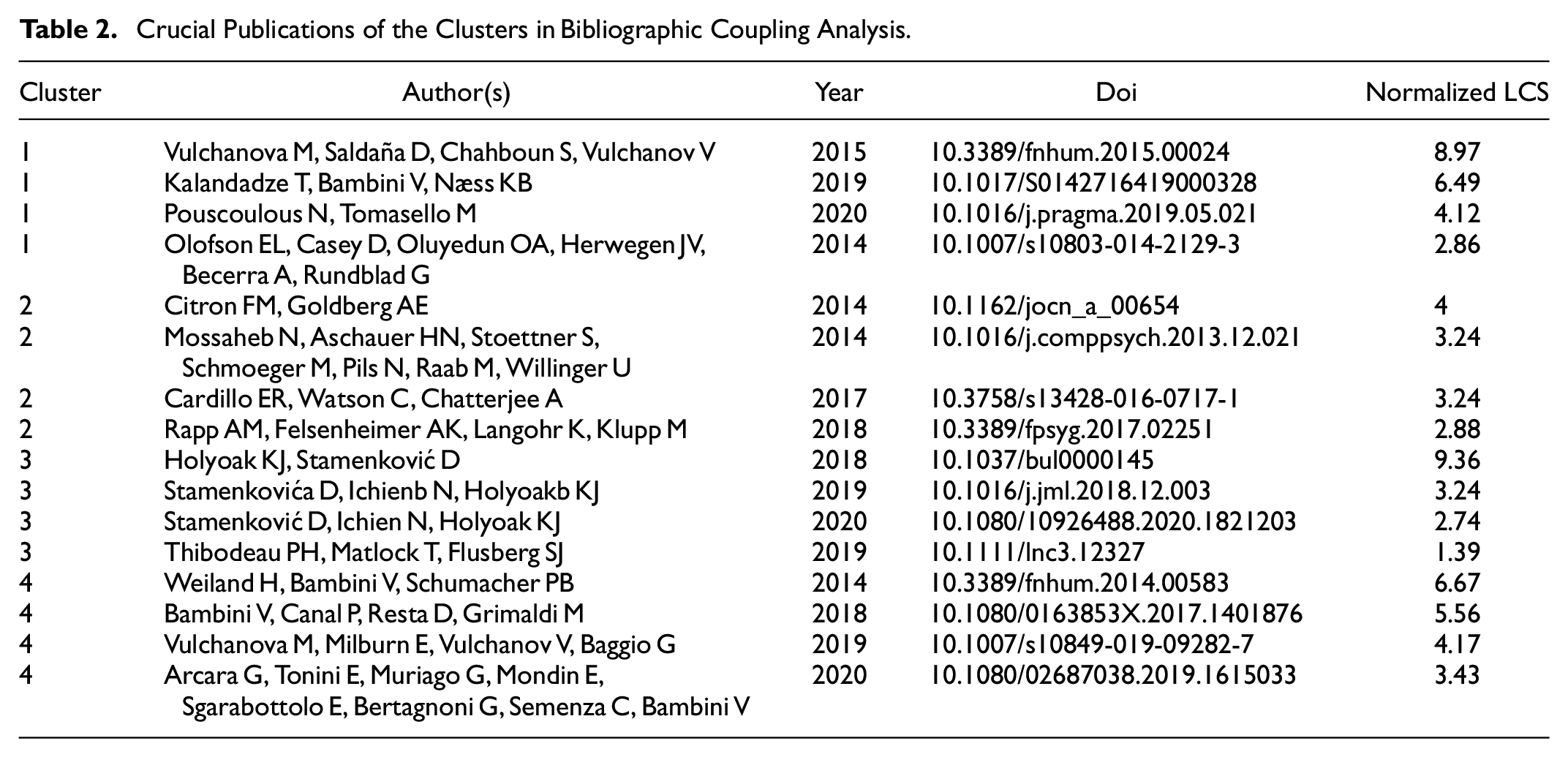
In order to determine the research fronts in metaphor comprehension over the past 10 years, this study used bibliographic coupling analysis. As can be seen in Table 2, four main clusters were formed using the bibliographic coupling function of Bibliometrix by the shared references of documents in the database. The ranking in the table was conducted according to the normalized local citation score (LCS), which is the score of a document that has been cited in the database. The LCS is a useful index for identifying the frontiers of metaphor comprehension research because it shows how influential a field is. The larger the LCS, the greater the influence. Therefore, this paper reviews the first four articles with the highest normalized LCS in each cluster.
Crucial Publications of the Clusters in Bibliographic Coupling Analysis.
Cluster 1
Vulchanova et al. (2015) reviewed the research on figurative language processing based on autism spectrum disorder (ASD) patients. They found that the common difficulty the patients have in understanding figurative language cannot be explained by assuming that the use of figurative language depends on more specific core concepts and phenomena. They suggest that evidence for a separation between structural and figurative language abilities should be looked for in the more general cognitive mechanisms of autism phenotypes. This disjunctive view contradicts the simple continuum of language understanding, or in other words IAM. From the perspective of CTM, metaphor is universal in language and thinking, so the existence of this continuum should be reliable. But in fact, many studies on atypical development subjects have shown that they have a good comprehension of structural language but difficulty in understanding figurative language, suggesting that the human brain may not be able to access figurative meaning after rejecting the literal meaning. Therefore, there may exist a potential mechanism for the separation of figurative language and structural language. Through the review, Vulchanova et al. (2015) further put forward some important variables for future research, including the subject group, the metaphor conventionality, word frequency and collocation frequency, the embodied cognitive model in sensori motor disorder, and the specific test of information integration ability. Kalandadze et al. (2019) conducted a review and meta-analysis of metaphorical task attributes, intergroup differences among subjects, and the relationships among task attributes in 14 relevant studies. They found that the task attributes were not properly considered and controlled, and the attribute variables of the metaphorical materials used in the experiment were not shown and described in detail. They suggest that the attributes of metaphorical tasks should be reported in future studies to provide a basis for the evaluation of experimental paradigms. Using a behavioral choice task, Pouscoulous and Tomasello (2020) conducted an experimental study of novel metaphor comprehension in 3-year-olds. The results suggest that 3-year-olds do have the ability to understand novel metaphors appropriate to their age group. Children are able to understand novel metaphors based on age-appropriate vocabulary and knowledge, but this process is not based on meta-linguistic reflection. Olofson et al. (2014) investigated the basic conceptual metaphor comprehension ability of typical developmental individuals and individuals with ASD. They use conventional metaphors and novel metaphors as stimuli. It was found that although individuals with ASD performed less efficiently in understanding conventional and novel metaphors than those with typical development, they can still understand these metaphors. This indicates that individuals with ASD perform better than chance in metaphor comprehension and have certain metaphorical abilities. Therefore, they suggest further exploring the question of delayed development of metaphorical ability in ASD individuals during their growth, which is of great educational significance. They also suggest that future research should expand the types of metaphors that people with ASD can understand.
It can be seen from the above four articles that cluster 1 focuses on the influence of individual development and growth on metaphor comprehension ability, so the participants of the experiment come from different age groups or have different health states. The ASD individuals are also the focus of this cluster. The combination of linguistic research and clinicopathology can not only explore the language mechanism involved in metaphor comprehension, but also provide a reference for the research of ASD. In this cluster, the comparison between different variables is evaluated by the time course and difficulty of understanding to reveal the comprehension difference in different conditions.
Cluster 2
Citron and Goldberg (2014) experimentally compared the meaning of metaphors whose source domains are taste-related expressions to their literal meanings. MRIs data showed that common taste metaphors were based on sensorimotor representations, because the understanding of such metaphors activated primary and secondary taste areas. At the same time, the activation of brain regions suggests that metaphorical expressions are implicitly more emotionally appealing than literal ones. Nevertheless, the reason for the increase in emotional activation is still unknown. They suggested that in future studies, metaphor stimuli could be placed in a complete narrative structure to improve the ecological validity of tasks. Mossaheb et al. (2014) used a series of metaphorical tasks to identify familiar metaphors, interpret the meanings of familiar metaphors and generate novel metaphors in order to explore the possible quantitative differences in image processing between patients with Schizophrenia Spectrum Disorder (SSD) and the healthy individual group. Their findings suggest that patients’ metaphor identification, interpreting, and novel metaphor generation ability are impaired, which may be related to impaired cognitive function or severity of symptoms. Cardillo et al. (2017) generated a large number of metaphorical and literal sentence pairs in the study to increase the number and types of metaphorical stimuli, making considerable contributions to the verification of metaphorical understanding hypotheses and the improvement of sample size. The three dimensions they used to differentiate the generated metaphors were grammatical classes of fundamental words, sensorimotor characteristics, and syntactic structures. They normalized the generated metaphorical and literal sentence pairs, which could be controlled on 14 parameters. The parameters at the syntactic level include length, frequency, concreteness, familiarity, naturalness, imageability, figurativeness, interpretability, ease of interpretation, valence, and valence judgment reaction time. The parameters at the basic lexical level include visual, motion, and auditory imagery. Metaphorical sentences generated in this study can be manipulated experimentally in the aforementioned 14 parameters according to different purposes of different researchers, such as adding context, questions, priming, etc. It provides reliable and valuable experimental material for the research of metaphor comprehension by experimental methods in psychology and neuroscience. Rapp et al. (2017) conducted a study on the understanding of German metaphors in patients with SSD. The stimulus included novel metaphor, conventional metaphor, and meaningless expression. The experiment used a semantic matching task in which subjects made choices based on their familiarity with the stimulus. The results showed that the healthy control group performed better than the SSD group in understanding conventional and novel metaphors. For familiar metaphors, there was no difference between the patient group and the healthy group, while the former group was significantly lower than the control group only in the understanding of novel metaphors. The patients did not differ from the control group in their performance of nonsensical utterances, meaning that the non-metaphorical stimulus was not misinterpreted as metaphorical.
An obvious feature of the research in this cluster is that researchers control the parameters of the stimulus used in the experiment (such as the type, language, familiarity and conventionality of metaphor, etc.). Researchers pay more attention to the understanding of metaphorical expressions after different dimensions of metaphorical expressions have been controlled. There are studies focusing on schizophrenia, combined with the characteristics of Cluster 1, which also indicates that the study of individual differences has gained attention in recent research on metaphor comprehension. The researchers in this cluster also put forward the corresponding research shortcomings and future implications.
Cluster 3
Holyoak and Stamenković (2018) reviewed the theory and evidence of metaphor comprehension and summarized the psychological research on the main theory of metaphor comprehension. They found that behavioral and neuroscience experiments are roughly based on three theoretical perspectives: the comparison model, the categorical view, and the conceptual mapping of metaphor comprehension. Among them, comparison and categorization are related to specific information processing, and concept mapping is related to embodied cognition. They provided a review of the supporting and refuting evidence based on each perspective, and called for the addition of contextual factors in future studies to examine the pragmatic function, emotional impact, and literary interpretation of metaphor. Thibodeau et al. (2019) also reviewed the research on metaphor comprehension. They found that many research results support the idea that people automatically activate the concept of source domain in the process of conventional metaphor comprehension, but this evidence is not enough to prove that people use metaphorical thinking in this process. Therefore, to examine the conceptual mapping mechanism in the mind, one needs to be very careful when using only linguistic metaphors as research objects. They also provided a review of how metaphors shape thinking through cognitive, emotional, and social-pragmatic factors. However, they found that not all studies agree that concrete experience plays a key role in metaphor use and understanding, and put forward some suggestions accordingly. Stamenković et al. (2019) measured the influence of individual differences on metaphor comprehension. They focused on participants’ fluid and crystallized intelligence. Crystallized intelligence is solidified long-term intelligence, and fluid intelligence is dynamic intelligence. They found that crystallized intelligence affected different types of metaphor comprehension, while fluid intelligence mainly affected more complex metaphor comprehension. To measure crystallized intelligence related to metaphor comprehension, they developed the semantic similarity test (SST). The combined influence of fluid and crystallized intelligence on the understanding of metaphors, especially those that require cognition, suggests that people may integrate multiple reasoning processes when understanding metaphors. They pointed out that future studies should pay more attention to the understanding of literary metaphor, broaden the syntactic forms of metaphor expression, and explore the influence of pragmatic or linguistic context on metaphor comprehension. The following year Stamenković et al. (2020) again studied the individual differences in metaphor comprehension, but this study added a contextual factor compared to the 2019 study, following their previous suggestion for future research. In the 2020 study, they introduced context-free, metaphorical and literal contexts. It is found that the metaphorical congruent context promotes the understanding of metaphorical meaning, while the literal congruent context harms the understanding of metaphorical meaning. The influence of individual differences on metaphor comprehension is moderated by transcendental context. Overall, the understanding of literary metaphor was positively correlated with measures of fluid and crystallized intelligence, confirming and extending previous findings.
To sum up, Cluster 3 involves more theoretical models in studies, such as existing different comprehension models and other cognitive abilities like intelligence, which may be a crucial trend for explaining the difference reflected in experiments and constructing comprehensive comprehension models. In addition, scholars are paying more attention to the pragmatic aspect of metaphor understanding by considering different kinds of context factors.
Cluster 4
Weiland et al. (2014) combined the cross-modal priming paradigm and ERP in order to compare and verify the DAM and IAM in metaphor comprehension. The data showed that the literal meaning is accessed during the processing of metaphor and metonymy, which supports the indirect access model. At the same time, the study also found that the cognitive cost of metaphor and metonymy is not necessarily the same. Therefore, they suggest expanding the study of rhetorical types, such as proverbs, ironies, and idioms, in future studies. This study shows that despite being two traditional models, DAM and IAM are still relevant enough to be used in non-literal language studies. Bambini et al. (2019) used ERP to study metaphor comprehension in Italian poetry and novels. Compared with literal expressions, metaphorical expressions induce N400 components with larger amplitudes, which are continuously reflected in the frontal lobe, indicating that metaphorical meaning acquisition requires extra effort. At the same time, the familiarity of metaphor will affect the generation of late negative waves. Although this study adopts the classical paradigm, it is forward-looking in exploring metaphor in literature and poetics. Vulchanova et al. (2019) discussed the role of compositional meaning in the processing and acquisition of figurative language. They found that compositional meaning promotes or hinders the construction of figurative meaning due to various factors. Arcara et al. (2020) studied metaphor comprehension of individuals with traumatic brain injury (TBI) based on Relevance Theory. They first used the Assessment of Pragmatic Abilities and Cognitive Substrates (APACS) test to conduct a detailed analysis of the pragmatic characteristics of TBI patients and assess their language output and comprehension. Then, different types of rhetorical language comprehension were used to investigate the relevant comprehension ability of the participants. The results showed that TBI patients had difficulties expressing and understanding figurative language. Meanwhile, TBI patients showed greater difficulty in giving verbal explanations than in making choices. Although there is no significant difference between different types of rhetorical language comprehension, the oral interpretation of proverbs reflects certain difficulties. This can be explained by Relevance Theory. Participants interpret the meaning of proverbs by both accessing the ideas that belong to the community and organizing and interpreting this knowledge in conversation, based on the echoic features of proverbs assumed by relevance theory. Notably, the authors suggested that the selection task may promote comprehension by providing context-relevant vocabulary.
The studies in Cluster 4 also mainly utilize ERP technology to reveal the difficulties of metaphor comprehension. This cluster shows that metaphor comprehension research can be conducted with more pragmatic features, such as using Relevance Theory to explain the understanding mechanism and applying different genres such as poetry and novel as research objects. This cluster is further enhanced by the addition of a metaphorical understanding of brain injury subjects, which adds to the body of knowledge regarding the process of atypical people’s ability to comprehend rhetorical language. At the same time, it can also be seen from different clusters that there has been a trend in recent years to investigate non-English languages.
Co-word Analysis
Co-word analysis (Callon et al., 1983) refers to the use of keywords published in a document collection to analyze the conceptual structure in a specific research field. The purpose of the co-word analysis is to map and cluster terms extracted from keywords, titles, or abstracts in bibliographic collections using word co-occurrence networks to map the conceptual structure of the framework (Aria & Cuccurullo, 2017, p. 969). By finding the shared keywords in different literatures, the analyst can predict to what extent the documents have similar concerns. In Bibliometrx, analysts can perform a factorial analysis of keywords in the literature and synthesize the topic dendrogram. In this study, “keywords plus,” which is generated from the content of the documents, is selected as the field in the setting for forming a dendrogram. Keywords plus can effectively reflect the knowledge structure in a certain scientific field (Zhang et al., 2016), and can grasp the content of the publications in more depth and variety (Garfield & Sher, 1993). This study obtains the clustering and distribution information of keywords in the collected metaphor comprehension study by factorial analysis, as shown in Figure 2:
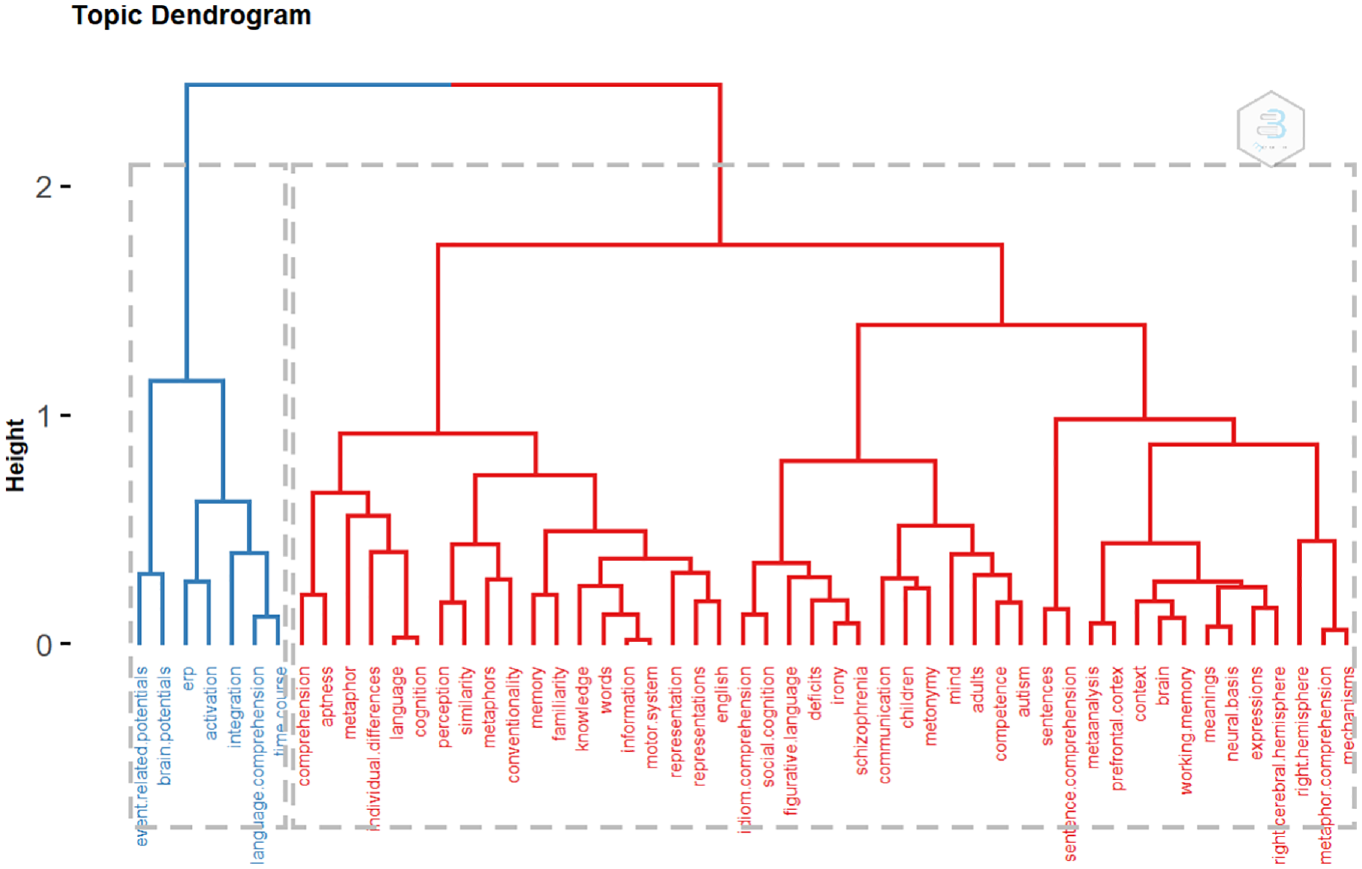
Topic dendrogram of metaphor comprehension research.
Topic Dendrogram classifies keywords into two clusters and identifies them in different colors. The graphs in the blue cluster are mainly divided into two branches, the first includes ERPs and brain potential keywords, and the second involves activation, integration, time, etc. An obvious feature of blue clustering is the use of psychological and neural experiments to explore the mechanism of metaphor comprehension, including the commonly seen ERP technology and response time in psychological experiments. This cluster is dominated by empirical research. The red cluster size is larger by comparison. First, it is divided into two branches. The one on the left contains many concepts related to metaphor in the field of linguistics, such as the aptness of metaphor usage and metaphor familiarity, the representation of metaphor in language and cognition, and the lexical representation and conventionality of metaphor. The theoretical characteristic of this branch is obvious. The branch on the right clearly reflects the interdisciplinary characteristic of metaphor comprehension study, including the comparative study of metaphor and other figurative expressions (such as metonymy and irony), social factors (adult or child), pathological factors (e.g., schizophrenia or autism) in metaphor comprehension, and metaphor comprehension in relation to brain regions (e.g., left and right hemispheres and other brain regions). This branch indicates that in the past decade, metaphor comprehension studies concern literary, pragmatic, clinical, and neural disciplines.
The blue cluster examines the detailed process or difficulty of metaphor comprehension, and attempts to prove or disprove the previously proposed metaphor comprehension models. The red cluster shows another direction of metaphor comprehension research, which can be concluded as the evolution of theoretical perspectives and interdisciplinary research. This indicates that the research on metaphor comprehension and processing has realized the interdisciplinary trend in the past 10 years. With the help of the empirical research paradigm of psycholinguistics and experimental equipment of neurolinguistics, electrophysiological investigations into metaphor comprehension have been carried out. At this point, we can provide an answer to research question 2. Firstly, in the past decade, the research on metaphor comprehension has fully adopted the theoretical perspective of CTM. Some pragmatic perspectives, such as relevance theory and GSH, also provide options for the interpretation of understanding mechanisms. One of the leading trends that can be observed is the more comprehensive and detailed testing of theoretical hypotheses of CTM. At the same time, there is a tendency to broaden the assumption of understanding mechanisms to other kinds of rhetoric. Secondly, the research on metaphor comprehension in the past decade has fully reflected the characteristics of interdisciplinary research. The majority of standard literature uses quantitative techniques to support the process of metaphor comprehension. This process has realized the interdisciplinarity of the CTM, psychological experiments, cognitive neural experiments, and clinical pathology research. Finally, in terms of experimental paradigm, recent studies have expanded the control of many experimental variables and parameters on the basis of inheriting the classic psychological experimental paradigm, which makes the research results more reliable and makes the comparison between different research results easier.
Future Suggestions
Despite the great achievements of metaphorical comprehension research in the past decade, metaphor comprehension research can still be improved. For example, from the analysis results of this study, it can be seen that previous studies were mainly based on the understanding model of CTM, and to some extent ignored the description of the understanding mechanism of metaphor in traditional rhetoric. Although there have been research results on the understanding of metaphor in poetry and novel (Bambini et al., 2019), the proportion is very small. At the same time, the ubiquitous metaphorical thinking advocated by CTM was mainly based on linguistic metaphor in the research, which failed to fully reflect the understanding role of metaphorical thinking in other communication modes. Finally, in the past decade, traditional theoretical models have been mainly used in metaphor understanding research, in which the models deserve to progress to achieve research objectives under detailed conditions. In terms of research methods, this study found that quantitative metaphor understanding studies in the past decade have had higher prominence, while there are few critical metaphor understanding studies mainly based on qualitative research, which may be because metaphor understanding mechanisms need to be supported by experiments. However, the combination of research methods is more likely to advance metaphorical understanding models and provide data support. Metaphorical understanding in different discourse types may provide more detailed guidance for the selection and control of experimental variables. Therefore, based on these problems to be improved, this study puts forward more specific suggestions for the development of theoretical models, the selection of research methods, and research objects.
Theoretical Model
Focus on the Innovation of Theoretical Models of Metaphor Comprehension According to Metaphors in Different Text Types and Modes
With the deepening of the research on metaphor comprehension, the explanatory power of many theoretical hypotheses in different situations has been supported or refuted to varying degrees. At this time, it is essential to continuously explore the mechanism of metaphor comprehension. In future research, scholars can pay attention to the integration and innovation of different theoretical models of metaphor comprehension. At the same time, based on the characteristics of metaphorical thinking in language and multimodal representation, more general understanding models can be put forward, which provide new hypotheses and new supports for the existence of metaphorical thinking. Developments have also been made in the research of metaphors in recent years, such as mixed metaphor (Gibbs, 2016), Extended Conceptual Metaphor Theory (Kövecses, 2020), etc., whose applicability studies should be further enriched and strengthened.
Research Method
Pay More Attention to the Combination of Quantitive and Qualitative Methods
In the quantitive research method, corpus linguistics may provide more evidence on metaphor comprehension in natural language use. It should be noted that no matter how important the research using cognitive neural experimental equipment is, it cannot provide conceptual content (Lakoff, 2008). Therefore, the explanatory power of critical analysis of metaphor should not be ignored. Since metaphors in natural languages are represented in complex forms and contexts, critical analysis can provide necessary supplements for experimental results, and vice versa.
Pay More Attention to the Application of the Method of Corpus Linguistics
It is regrettable that there is no obvious use of corpus methods in the literature highlighted in recent years. Most of the stimuli used in the experiments are ideal structured sentences manipulated or fabricated by designers, which may not reflect the whole picture of metaphor comprehension. Therefore, using the corpus method to study metaphors in natural language can provide more explanations for the understanding mechanism or metaphorical thinking.
Experimental Design
Variable Control of Experimental Design Should be More Targeted
First, the empirical research design can be further optimized and refined. Experimental design can reflect metaphorical understanding thinking, such as pragmatics, context, emotion, and other factors. Secondly, the potential effects of validity and confounding variables can be fully considered in the setting of experimental tasks. For example, different context information may interfere with the discussion making in the task. More refined control should be applied to the parameters of the experimental stimulus, including topic familiarity, collocation familiarity, appropriate collocation lines, convention, combination frequency, word frequency, context and other linguistic parameters.
Focus More on the Individual Differences of the Participants
In addition to different social factors such as occupation, gender and age, subjects with different cognitive abilities can also be considered. The metaphorical understanding of subjects with normal development and brain injury has been studied for a long time and has an important guiding role for the research on the laterality of metaphorical understanding and processing. In this study, it is suggested that brain injury subjects can be further refined to distinguish recent injury from congenital injury or early injury. This should facilitate the further exploration of whether early brain injury patients have developed a compensatory function to help them understand metaphorical expression.
Research Object
Consider Metaphor Comprehension in Non-English Languages
This will help to reveal the similarities and differences in metaphor comprehension based on different cultural and social backgrounds and different linguistic structures and also to compare the mechanism of metaphor comprehension across languages. Further, cross-language comparative studies can explain the foundation of metaphor in human thinking and the differences and similarities among cultures.
Broaden the Scope of Research Objects and Match the Interdisciplinary Characteristics
In addition to considering the stimulation of different modes or sensory channels in the experimental method, the research of multimodal metaphor comprehension can be strengthened to provide evidence for the hypotheses related to metaphorical thinking. Metaphorical thinking cannot be fully supported by evidence from linguistic metaphors. On the contrary, metaphors represented by different modes can reflect the processing mechanism of metaphor comprehension.
Conclusion
A bibliometric study of the past decade of research on metaphor comprehension has been conducted, and the knowledge structure and the research fronts have been properly excavated. The study found that the CTM has played a fundamental role in providing theoretical bases for metaphor comprehension studies in the past decade. Different models generated by cognitive linguists and pragmatic scholars have mainly provided hypotheses on the sequence of metaphor comprehension and brain region of metaphor comprehension, and have been tested under different conditions. They have provided insights for the studies in the past decade. As for the research fronts, there is a trend for researchers to combine the CTM with psychological or neural experiments. This may provide detailed confirmation of certain comprehension models of metaphors. Therefore, based on the results of the knowledge structure, the robust research fronts of metaphor comprehension are testing the validity of comprehension hypotheses with devices of high spatial or temporal resolution, investigating comprehension features of atypical developed individuals, adding more detailed conditions and variables, while continuously promoting the theoretic progress. However, the topics in research fronts have not been totally excavated. Therefore, based on the content of the review, possible suggestions for metaphor comprehension research are provided for future research. Limitations also exist in the present study. Only WOS Core Collection was used for the database, so it would be of great comprehensiveness if more data sources can be included. This study uses “metaphor comprehension” as the topic instead of “metaphor processing” because the latter may involve more complex contents that may require more careful categorization of the bibliometric results. Due to limited energy, this study only tackles the knowledge structure and fronts of metaphor comprehension. In the future, related bibliometric studies can also consider information about journals, cooperations among scholars, institutions, and so on to provide more detailed science mapping of metaphor comprehension research.
Footnotes
Declaration of Conflicting Interests
The author(s) declared no potential conflicts of interest with respect to the research, authorship, and/or publication of this article.
Funding
The author(s) disclosed receipt of the following financial support for the research, authorship, and/or publication of this article: This paper is supported by the Graduate Research Innovation Project of Guangdong University of Foreign Studies (22GWCXXM-069) and the Key project of the Institute of Hermeneutics of Guangdong University of Foreign Studies (CSY-2021-ZD-02)

Data Availability Statement
The datasets generated and analyzed during the current study are available from the corresponding author on reasonable request.