




Abstract
The study of bilingualism and multilingualism has gained increasing prominence in the context of globalization. As a result, research on code switching has garnered growing attention, leading to a substantial number of published papers in recent decades. To gain insights into the current status and potential trends of psycholinguistic research on code switching, this study conducted a bibliometric analysis of 1,293 articles focusing on code switching from 1968 to 2022. The analysis was performed using bibliometrix, a bibliometric software package in R. The results of the analysis indicated that code switching between English and other languages, the role of inhibition ability, and the processing mechanisms of highly proficient bilinguals were prominent hot topics in the field of code-switching research. Additionally, the processing of grammatical gender, bilingual language production, and plurilingualism were identified as potential emerging research trends. By presenting a macroscopic landscape of research on code switching, this study aims to provide readers with a comprehensive overview and serve as a beneficial reference for researchers in this field.
In the context of increasing globalization, the number of bilingual and multilingual individuals has been on the rise (Marian & Shook, 2012; Zhong & Fan, 2023). The study of bilingualism and multilingualism is gaining importance as proficiency in multiple languages is essential for facilitating effective communication between countries (Sokolovska, 2023; Tang & Calafato, 2022a). Researchers from diverse fields have delved into the phenomenon of bilingualism and multilingualism, each offering unique perspectives. One significant aspect that demands further investigation in the realm of bilingualism and multilingualism is code switching or language switching, which has garnered considerable attention in recent decades (e.g., Chen et al., 2023; Choi et al., 2022; Takeuchi, 2023; Tang & Calafato, 2022b; Tomić & Kaan, 2022).
Code switching refers to the linguistic phenomenon wherein bilinguals or multilinguals switch between two or more languages within the same discourse or conversation (Grosjean, 1982). While discussing code switching, it is crucial to address the related concept of translanguaging, which also plays a significant role in bilingual communication. Translanguaging is a broader sociolinguistic concept that goes beyond mere language switching. It involves the integrated use of multiple languages by bilingual individuals to create meaning and convey their thoughts effectively (García, 2011). Unlike traditional views that treat languages as separate systems, translanguaging deems that bilingual speakers fluidly draw from their linguistic repertoire, blurring the boundaries between languages to better express themselves. In the context of code switching, both intra-sentential and inter-sentential switching can be seen as instances of translanguaging. Intra-sentential code switching occurs when different languages are mixed within a single sentence (Poplack, 2013), while inter-sentential code switching involves alternating between languages across different sentences (Auer, 2013). These forms of code switching can be seen as manifestations of translanguaging practices, exemplifying how bilingual individuals seamlessly blend linguistic elements to convey nuanced meanings and navigate their communicative contexts. Scholars have classified code switching based on different criteria, such as language comprehension and production or the linguistic units involved, like word, sentence, and text processing. Translanguaging, as a related concept, provides insights into the holistic nature of bilingual language use, illuminating how code switching is just one aspect of a larger phenomenon that encompasses a deeper understanding of bilingual communication.
Clear definitions of multilingualism and language are crucial for effectively analyzing code-switching, as understanding varies across different perspectives. Multilingualism can be broadly defined as the ability of individuals to communicate proficiently in multiple languages. However, from a sociolinguistic perspective, multilingualism extends beyond mere language proficiency to encompass the cultural and social dimensions associated with language use (Wei, 2018). In this sense, multilingualism is not just the possession of multiple language competencies but also the engagement in diverse linguistic practices that reflect the individual’s cultural identity and social affiliations. Language, too, can be understood in different ways. From a cognitive perspective, language is seen as a system of rules and structures that enable communication and thought (Chomsky, 1957). However, from a sociolinguistic viewpoint, language is not only a formal linguistic system but also a social construct shaped by cultural norms, dialects, and variations (Labov, 1972). The concept of language encompasses not only standard varieties but also regional dialects, sociolects, and registers, each with its unique linguistic features and communicative functions. These varied interpretations of multilingualism and language can significantly influence the analysis of code-switching. When considering factors such as registers, dialects, and standard varieties, code-switching may occur differently in various linguistic contexts. For instance, code-switching in a formal setting may involve a switch to the standard variety of a language, while in an informal or colloquial context, the use of dialects or regional variations may be more common.
Moreover, the psychological underpinnings of code-switching need to be explored from multiple angles. Code-switching is not solely a cognitive phenomenon but also has a psychological basis. It can be influenced by social factors, affective elements, and the speakers’ emotional states. Code-switching can be a means of expressing identity, cultural affiliation, and a sense of belonging to a particular social group (Auer, 2005; Heller, 1988; Tang & Calafato, 2022c). For bilingual individuals, code-switching may serve as a way to negotiate their complex linguistic and cultural identities (W. Li, 2020). Therefore, a comprehensive analysis of code-switching should consider both its cognitive and affective dimensions. Beyond cognition, code-switching can be associated with affective elements, such as emotions, attitudes, and interpersonal relationships. In certain situations, code-switching may be used strategically to establish solidarity with a particular group or to convey emotions more effectively (Gumperz, 1982; Pavlenko, 2006). It can also be employed as a tool for humor, irony, or sarcasm, thus carrying affective connotations beyond the mere transmission of information. Therefore, an in-depth exploration of code-switching should take into account the affective motivations behind language choice and switching.
Theoretical models and hypotheses have been developed to explain the phenomenon of code switching during bilingual and multilingual language processing. These include the inhibitory control model (ICM), interactive alignment model (IAM), language-specific selection hypothesis, and language-specific selection threshold hypothesis. The ICM, proposed by Green (1998), emphasizes the role of inhibitory processing in bilingual language production. It suggests that lexical extraction in bilingual language production occurs at the lexical level and is closely related to the adoption of a language tag. The IAM, proposed by Pickering and Garrod (2004), posits that conversation serves not only to encode information but also to facilitate mutual understanding through idea exchange. The language-specific selection hypothesis challenges the inhibitory mechanism and proposes that lexical selection focuses on the linguistic units of lexical representation. Additionally, non-task languages do not compete for the selection of target words, as they are not involved in accessing target words (Costa et al., 1999). Building on this research, Costa and Santesteban (2004) proposed the language-specific selection threshold hypothesis, suggesting that bilinguals with low proficiency achieve target language extraction through a non-language specific extraction mechanism, while bilinguals with high proficiency achieve it via a language-specific extraction mechanism.
Despite the extensive exploration and development of code switching, there is a lack of bibliometric visual analysis in the disciplines of linguistics, psychology, and neuroscience. In light of this research gap, the present study employed bibliometrix, a bibliometric software package in R, to visually analyze 1,293 articles on code switching from 1968 to 2022. The aim is to provide a macroscopic overview and reveal the hotspots and trends in relevant studies. This analysis addresses two primary research questions: (1) What is the current state of research in the field of code switching? and (2) What are the prevailing research trends of code switching? The significance of this study lies in its contribution to the existing literature on code switching. By performing a comprehensive literature review and utilizing bibliometric analysis, we can identify research gaps and uncover emerging trends in the study of code switching. Additionally, this research offers valuable insights into the cognitive mechanisms underlying bilingual and multilingual language processing and sheds light on the practical implications of code switching in linguistic, psychological, and neuroscientific contexts. Through this study, we hope to advance the understanding of code-switching processing and its role in bilingual and multilingual communication, thereby contributing to the broader field of language processing research.
Method
Data Collection
A bibliometric analysis is a computational methodology used to identify significant research and authorship contributions and their interrelationships within a specific field or topic (De Bellis, 2009; Qian & Zhong, 2023). The two most commonly used bibliographic databases for bibliometric analysis are Web of Science (WOS) and Scopus (Singh et al., 2021). Compared to Scopus, WOS has a higher level of stringency and indexes approximately 99.11% of the journals that are also indexed in Scopus (Singh et al., 2021). Therefore, a collection of published papers on code switching from 1968 to 2022 (the first paper was published in 1968) was collected from the WoS Core Collection, which includes Science Citation Index Expanded (SCI-EXPANDED), Social Sciences Citation Index (SSCI), Arts and Humanities Citation Index (A and HCI), Conference Proceedings Citation Index-Science (CPCI-S), Conference Proceedings Citation Index Social Science and Humanities (CPCI-SSH) as well as Emerging Sources Citation Index (ESCI). The collected bibliographic records were all written in English. The search strategy and inclusion criteria are outlined in Figure 1. The data were collected on November 30, 2022, resulting in a total of 1,817 records from 200 journals distributed across 122 WoS categories. The study focused on the literature of code switching in the disciplines of linguistics, psychology, and neuroscience, leading to the extraction of 1,293 articles for further analysis. These articles were distributed among 16 categories (Figure 2), with Linguistics, Language Linguistics, and Psychology Experimental comprising the majority, with over 300 papers each.

The flowchart of the search strategy and selection process involved in this study.

The categories involved in this study.
The categorization process involved organizing the retrieved articles into relevant disciplines based on their subject matter. As a result, articles were categorized into relevant WoS categories that best represented these disciplines. The rationale behind this categorization was to gain insights into the diverse aspects of code-switching research and its interplay with various disciplines. Linguistics, as a core category, encompasses the foundational linguistic aspects of code switching, such as language structure, syntax, and phonetics. Psychology, another major category, signifies research on code switching from a psychological perspective, delving into the cognitive processes, language comprehension, and cognitive control during language switching. Neuroscience, the third relevant category, encompasses studies that delve into the neural mechanisms underlying code-switching. By categorizing the articles into these relevant disciplines, the present study aimed to provide a comprehensive understanding of code-switching research from multiple angles, highlighting the diverse dimensions in which the mechanisms of code switching have been explored.
Instrument
The present study employed bibliometrix R-tool, which serves as a unique open-source tool for carrying out comprehensive science mapping analysis, to visually analyze 1,293 articles regarding code switching from 1968 to 2022. A recommended workflow is provided by Bibliometrix for performing bibliometric analysis. R programing makes the tool flexible, easy to upgrade, and available to be integrated with other statistical packages in R (Aria & Cuccurullo, 2017).
To identify extant status, reveal critical references, and predict emerging trends in the field, the current research explored the knowledge domain of code switching in the disciplines of linguistics, psychology, and neuroscience.
Results and Discussion
Analysis of Annual Publications and Citations
Annual publications and citations can provide valuable insights into the changing trends in the field of code switching over time. As depicted in Figure 3, the annual publications on code switching showed a fluctuating pattern over the years 1968 to 2022. Notably, the period from 2011 to 2020 witnessed a remarkable surge in research activity, with the number of papers published per year consistently exceeding 40, peaking at 133 articles in 2020. This upswing in research output may be attributed to several factors, including the increasing recognition of code switching as a crucial area of study in linguistics and the growing interest in bilingualism and multilingualism research. Similarly, the annual citations of code-switching research exhibited a steady rise, reaching its highest point of 3,870 citations in 2020. This indicates that the findings and insights from studies on code switching have been attracting significant attention among scholars and researchers. The increasing citations may be attributed to the expanding body of literature on code switching, emphasizing its importance and relevance in various linguistic and sociolinguistic contexts.

Annual publications and citations of research on code switching.
Analysis of Authors, Affiliations, and Countries
The top 10 authors and cited authors in code-switching research are shown in Table 1. Notably, Gollan from the University of California San Diego emerges as the most productive author with an impressive record of 26 publications, closely followed by Declerck from Radboud University Nijmegen with 21 publications. Other highly prolific authors include Philipp (19 papers), Costa (18 papers), Liu (18 papers), and Koch (16 papers). In terms of citations, Costa stands out as the most influential author with 570 citations, followed closely by Gollan and Philipp with 545 and 424 citations, respectively. It is intriguing to observe overlaps between the lists of most productive authors and most cited authors. For instance, Gollan not only leads in productivity but also ranks as the second most cited author. Similarly, authors such as Declerck, Philipp, and Costa appear in both lists, underscoring their essential impact on code-switching research. Additionally, we find a noteworthy connection between the productivity of authors and their affiliations. Gollan and Declerck are affiliated with the University of California San Diego and Radboud University Nijmegen, respectively, both of which are among the top four most productive institutions in code-switching research. This highlights the pivotal role that key researchers play in driving scientific advancements within their affiliations.
The Top 10 Productive Authors and Most Cited Authors in the Field of Code Switching.

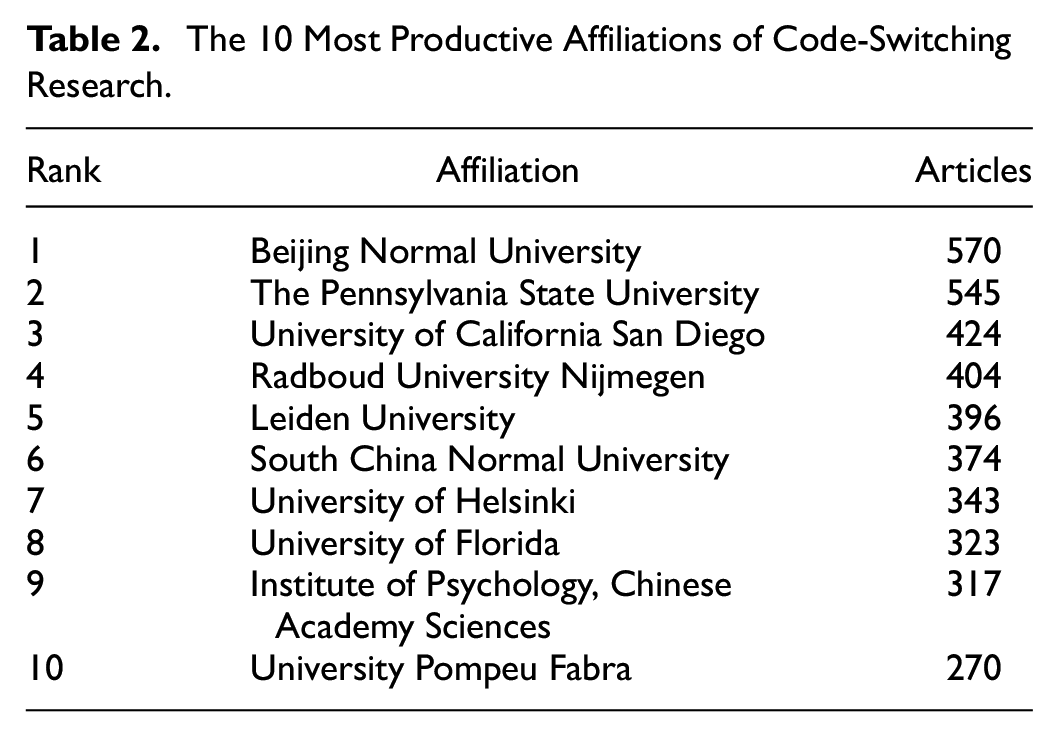
The 10 most productive affiliations of research on code switching (Table 2) revealed that Beijing Normal University (China) takes the lead with 53 published articles, with other prominent institutions such as the Pennsylvania State University (USA), University of California San Diego (USA), and Radboud University Nijmegen (Netherlands) also making significant contributions with 50, 48, and 32 papers, respectively. Interestingly, these institutions are situated in the top three most frequently collaborative countries, as demonstrated in Figure 4. This underscores the indispensability of international cooperation in fostering scientific research within the field of code-switching.
The 10 Most Productive Affiliations of Code-Switching Research.

Country collaboration worldmap of code-switching research.
The 10 most productive countries of research in code switching are listed in Table 3. The USA emerges as the leading country with a remarkable publication count of 660 articles, accounting for approximately 51% of the total retrieved literature. China and the UK follow with 273 and 193 publications, respectively. Figure 4 provides a country collaboration world map, illustrating the frequency of cooperation between different countries. The USA stands out with the most connections, signifying its influential role in international cooperation and extensive academic exchanges in the domain of code-switching research. Moreover, the analysis of cooperative frequency reveals that the most frequent collaborations occur between the USA and China (28 times), followed by the USA and Canada (23 times), and the USA and Netherlands (20 times), among others. However, it is evident that there is a lack of international cooperation between countries other than European countries and the USA. Hence, to address the vital issues in this research domain comprehensively, fostering international collaboration and inclusivity among researchers from diverse regions is crucial.
The 10 Most Productive Countries of Code-Switching Research.

In conclusion, our in-depth analysis of top authors, affiliations, and countries involved in code-switching research provides valuable insights into the dynamic trends shaping the field. The findings shed light on the significance of key researchers in driving scientific advancements within their affiliations and emphasized the importance of international collaboration in promoting research progress. The implications of our findings extend the overall significance of code-switching studies, and we hope this analysis can contribute to further advancements in this exciting area of research.
Analysis of Top Journals and Most Cited Journals
The top 10 journals and the most cited journals in code switching are demonstrated in Table 4. Notably, Bilingualism - Language and Cognition emerges as the most fruitful journal, publishing an impressive 85 papers on code switching. It is closely followed by the International Journal of Bilingualism, Frontiers in Psychology, and International Journal of Bilingual Education and Bilingualism, with 78, 46, and 45 papers, respectively. These journals are prominent platforms that have been instrumental in disseminating studies related to code switching. Furthermore, when assessing the frequency of citations, Bilingualism - Language and Cognition stands out as the most influential journal, with an astounding 2,666 citations. Journal of Memory and Language follows closely with 1,799 citations, and Journal of Experimental Psychology - Learning Memory and Cognition also exhibits considerable impact with 1,170 citations. These journals have served as key reference points in the field, suggesting their pivotal roles in shaping code-switching research.
The Top 10 Journals and Most Cited Journals for Code-Switching Research.

The high publication rates and citation frequencies of these top journals can be attributed to several factors. Firstly, these journals have consistently maintained high standards of academic rigor and peer review, attracting top-quality research on code switching. Secondly, they likely encompass a diverse range of topics and methodologies within code-switching research, appealing to a broad audience of researchers and scholars. Moreover, these journals might have facilitated the dissemination of groundbreaking studies, further increasing their visibility and impact within the field.
The implications of our findings are twofold. Firstly, they provide valuable guidance to researchers seeking to publish their work on code switching, highlighting the most fruitful and influential journals in the field. Authors can strategically target these journals to enhance the visibility and impact of their research. Secondly, the prominence of certain journals also underscores the need for continuous scholarly dialog and collaboration within the code-switching community. Encouraging researchers to publish in these well-regarded journals can foster knowledge exchange and catalyze further advancements in the field.
Overall, this analysis sheds light on the key players within the realm of code-switching research—the prominent journals that have played an instrumental role in shaping and disseminating knowledge. Our in-depth examination of publication rates and citation frequencies contributes to a better understanding of the dynamics at play in the field, while also providing valuable insights for researchers and practitioners. By recognizing the significance of these journals, our study reinforces the importance of scholarly dissemination and collaboration, ultimately bolstering the overall significance of code-switching research.
Analysis of Top Cited Articles
The top five most cited articles in code switching are listed in Table 5. These seminal papers have had a profound influence on research in this domain. The most cited paper, authored by Poplack (2013), aimed to investigate code switching in non-fluent bilinguals and whether they violated the equivalence constraint or avoided switching within sentences altogether. To address this, Poplack examined the speech of 20 Puerto Ricans residing in a stable bilingual community, each with varying degrees of bilingual proficiency. The study found that both fluent and non-fluent bilinguals engaged in frequent code switching while maintaining grammaticality in both their first language (L1) and second language (L2). The results suggested that code switching was a sensitive indicator of bilingual ability rather than a reflection of degrading linguistic skills. The second most cited paper, authored by Meuter and Allport (1999), focused on investigating bilinguals’ response times when switching between their languages. Participants were required to name digits in either their L1 or L2 unpredictably. The findings revealed that participants exhibited longer response times during switch trials compared to non-switch trials. Additionally, the code-switching cost increased consistently when switching from their weaker L2 to their dominant L1. Meuter and Allport proposed that this asymmetry in switching cost could be attributed to the relative proficiency of the bilinguals’ two languages and the unconscious persistence of the previous language set during code switching. Green and Abutalebi (2013), the third most cited article, delved into the nature and dynamics of bilingual speakers’ speech production processing. They identified eight control processes involved in code switching, encompassing goal maintenance, conflict monitoring, interference suppression, salient cue detection, selective response inhibition, task disengagement, task engagement, and opportunistic planning. The study also considered different interactional contexts, such as single language use, dual language use, and dense code-switching. Green and Abutalebi proposed that language control processes adapt themselves to the social interaction demands placed upon bilingual speakers. The fourth most cited article, Costa and Santesteban (2004), conducted five experiments to explore bilingual speakers’ performance in picture naming tasks during code switching. Experiment 1 examined code switching in Spanish-speaking Catalan learners and Korean-speaking Spanish learners between their L1 and L2. The results indicated larger switching costs when switching from L2 to L1 compared to switching from L1 to L2. However, subsequent experiments with highly proficient Spanish-Catalan bilinguals performing tasks in their L1 and L2 or in their L1 and L3 (English) revealed no asymmetrical switching costs. Based on these findings, Costa and Santesteban concluded that the code-switching mechanism for highly proficient bilinguals differed from that of L2 learners. The fifth most cited article, Otheguy et al. (2015), provided a comprehensive definition of the term “translanguaging” in both educational settings and language use. Translanguaging was clarified as the act of using one’s own idiolect regardless of language boundaries set by society and politics.
The Top Five Most Cited Articles in Code Switching.

The main tasks employed in the above-mentioned studies are digital naming task (Meuter & Allport, 1999) and picture naming task (Costa & Santesteban, 2004; Xu, 2021). These two tasks are frequently adopted in the studies examining code-switching processing during language production. Besides, word naming task (Jost et al., 2020; Macizo et al., 2012) is also a frequently used task involved in the research of code switching during language production. With regard to research investigating code-switching processing during language comprehension, semantic categorization task (C. Li & Gollan, 2022; von Studnitz & Green, 2002) and semantic judgment task (Giancaspro, 2015; Koronkiewicz, 2022) are frequently employed in the experimental design.
The analysis and interpretation of these top five most cited articles contribute significantly to the understanding of code switching in bilingual contexts. These studies collectively shed light on various aspects of code switching, including its relationship to bilingual proficiency, cognitive processing, language control mechanisms, and the performance of highly proficient bilinguals compared to L2 learners. Understanding the underlying similarities and differences among these articles allows us to identify key gaps in the current knowledge and pave the way for future investigations in the field of code switching, leading to a more comprehensive and nuanced contribution to the existing literature.
Analysis of Hot Topics
Keywords are the condensation of the core ideas and main contents of academic papers, and the analysis of keywords can help to reveal the hot topics of studies on code switching. In this study, we conducted an analysis of 50 keywords related to code switching sourced from the WoS database, and the word cloud representing their frequency distribution is presented in Figure 5. Notably, “language” emerged as the most frequent keyword, followed by “English” (e.g., Liu & Chaouch-Orozco, 2023; Wang, 2022), “inhibition” (e.g., Fernandez et al., 2023; Zang et al., 2022), and “highly proficient bilinguals” (e.g., Gullifer et al., 2013; Phillips & Pylkkänen, 2021).

Word cloud based on the main keywords related to code switching.
Code switching between English and other languages has been a focal point in numerous studies. One such investigation by Jiang et al. (2023) employed a self-paced reading task to explore how intra-sentential code switching affects Chinese-English bilinguals’ cognitive control during language comprehension. Their findings revealed a larger asymmetry in switch costs in alternation contexts compared to dense code-switching contexts. This suggests that cognitive control during language comprehension is differentially triggered by various types of intra-sentential code-switching contexts. Mosca et al. (2022) delved into the cognitive aspects of code switching and whether cognitive preparation could mitigate switching costs. Their study involved Dutch-English bilinguals performing a picture-naming task with varying preparation times. The results demonstrated that code switching incurred costs when speakers had no preparation time, but these switching costs were eliminated when sufficient preparation time was provided. These findings indicate that cognitive preparation plays a crucial role in code switching and could potentially eliminate the associated costs.
Inhibition ability has been identified as a significant factor in the code switching process. Liu et al. (2018) investigated bilingual pairs’ picture-naming task, where they were required to perform language production and comprehension tasks cooperatively based on language cues. They found that switching from L1 to L2 elicited an increased late positive component (LPC) compared to switching from L2 to L1 during stimulus production, indicating that inhibition’s primary function was to suppress non-target lemma formation. Additionally, Liu et al. (2020) explored the role of inhibitory control in voluntary code switching through transcranial direct current stimulation (tDCS). The results showed that bilinguals executed repeat trials more rapidly than switch trials, suggesting a cost associated with code switching. Inhibition-related brain regions were found to interfere with voluntary code switching.
The mechanism of code switching in highly proficient bilinguals has gained increasing attention from researchers. Tsui et al. (2019) investigated bilingual Cantonese-English adults with varying language proficiency levels to examine code switching during language production. The results indicated that unbalanced bilinguals switched from the dominant to the non-dominant language without a reverse effect during language production. In contrast, balanced bilinguals showed no switching cost during language production, suggesting differences in language production mechanisms between these two groups. Kang et al. (2018) conducted code switching training with a group of unbalanced Chinese-English bilinguals to explore the plasticity of their lexical selection mechanisms. The experimental group, which received language switching training, displayed an early N2-latency effect in cue-locked event-related potential (ERP). This finding suggests that code switching experience may modulate unbalanced bilinguals’ language control mechanism.
In addition to the above, several other highly frequent keywords, such as lexical access (Boos et al., 2022), costs (Heredia & Altarriba, 2001), cognitive control (Rodriguez-Fornells et al., 2012), and selection (Olson, 2013), also play significant roles in code-switching research and deserve further investigation. These keywords demonstrate the multidimensional nature of code switching, incorporating various cognitive and linguistic processes that interplay during language switching. The analysis of hot topics in the field of code-switching research provides valuable insights into the prevalent themes and recent trends within the field, contributing significantly to our understanding of code-switching processes and its underlying mechanisms. The analysis and interpretation of studies related to these topics offer valuable insights into the cognitive control processes involved in code switching during language comprehension and production. For instance, the role of inhibition during code switching process and its neural underpinnings have been elucidated, as well as the influence of language proficiency on code-switching processing. By incorporating these findings, the significance of the study is strengthened; it enriches the existing literature on code switching in bilingual language processing.
The thematic map of keywords of research on code switching (see Figure 6) revealed that language, particularly English, and speech are among the fundamental themes in code-switching research. However, it is noteworthy that several other themes have emerged as focal points for researchers, including studies on inhibition mechanisms, bilinguals, and lexical access. Conversely, topics related to education, identity, and discourse are relatively peripheral in the current research landscape.

Thematic map of keywords of research on code switching.
One of the prominent themes that have garnered considerable attention is the investigation of inhibition mechanisms during code switching (Fernandez et al., 2023; Zang et al., 2022). These studies shed light on how bilingual speakers inhibit competing languages when engaging in code switching. The observed findings might indicate that researchers are keen on understanding the cognitive processes that underlie the selection and inhibition of languages during language switching. Further analysis and interpretation of these findings could explore the neural mechanisms involved in inhibition, providing valuable insights into the cognitive control required for effective code switching. The theme of bilinguals, particularly highly proficient bilinguals, has emerged as a significant area of interest (Kang et al., 2018; Phillips & Pylkkänen, 2021). This research likely reflects the growing recognition of the unique linguistic abilities and challenges faced by bilingual individuals. Investigating code switching in highly proficient bilinguals allows researchers to delve into the specific cognitive and linguistic factors that influence their language control mechanisms. These findings could contribute to a deeper understanding of how language proficiency and language experience shape code-switching behavior. Another noteworthy theme is lexical access (Boos et al., 2022; Gullifer et al., 2013), which explores how bilingual speakers retrieve and access words when switching between languages. Understanding the underlying factors that influence lexical access during code switching is crucial for comprehending the intricate processes of language switching and bilingual language processing. Detailed analysis and interpretation of these findings might reveal how lexical access is affected by factors such as language proficiency, language dominance, and the frequency of language use.
The emergence of themes such as talk, repair, and construction as significant topics in code-switching research indicates a growing interest in the conversational aspects of language switching. These themes likely reflect researchers’ exploration of how code switching functions as a communicative tool in social interactions and how speakers manage linguistic repairs and the construction of meaning during language switching. An in-depth analysis of these findings could provide valuable insights into the pragmatic functions and sociolinguistic implications of code switching in various communicative contexts. On the other hand, it is intriguing to note that themes related to education, identity, and discourse are relatively peripheral in the current research landscape. This observation may imply that there is an opportunity for researchers to explore these areas further and investigate how code switching intersects with educational practices, language identity construction, and discourse patterns. Understanding the implications of code switching in these contexts could have significant implications for language education, identity formation, and social interaction.
The thematic evolution of keywords of studies on code switching is presented in Figure 7. It revealed a notable trend in the development of research topics from 2016 onward. Themes related to constraints and English have evolved toward switching costs and English, indicating a shift in focus toward understanding the cognitive and linguistic factors that influence code switching. Additionally, themes of selection and lexical access have evolved toward inhibition and costs, suggesting an increasing interest in exploring the inhibitory control processes and the associated costs in code switching. However, it is important to note that topics related to education and language have not experienced significant breakthroughs in recent years, indicating potential areas for further exploration and research.

Thematic evolution of keywords of research on code switching.
The observed thematic evolution may be driven by several underlying factors. Researchers might have recognized the significance of investigating the cognitive mechanisms involved in code switching, leading to the transition from studying constraints to focusing on switching costs and English. This shift may reflect a growing awareness of the cognitive resources required during language switching, prompting researchers to delve deeper into understanding the cognitive control processes involved in code switching. Likewise, the transformation of themes related to selection and lexical access toward inhibition and costs suggests an inclination toward exploring how inhibition plays a crucial role in code switching. As researchers gain insights into the mechanisms that inhibit competing languages during language switching, they are likely to explore the associated cognitive costs incurred during this process. Understanding these underlying inhibitory processes can provide valuable insights into the complexities of code switching and how bilingual speakers manage language competition in real-time communication.
The absence of significant breakthroughs in topics related to education and language might be due to various reasons. It is possible that researchers are yet to fully explore the potential implications of code switching in educational settings. Investigating how code switching affects language learning and instruction can contribute to enhancing language education practices and understanding the role of code switching in language classrooms. Similarly, the lack of substantial developments in topics related to language might indicate that researchers have not extensively explored the role of language-specific factors in code switching. Language-specific features, such as typological differences and language dominance, can influence code-switching patterns and language selection strategies. Further exploration of these factors could provide valuable insights into the intricacies of code switching across different languages and language communities.
The trend topics by author keywords of research on code switching have been revealed (Figure 8). The analysis reveals interesting patterns in the trajectory of code-switching research over time. One notable finding is the continuous attention toward code switching in aphasia (Jomaa et al., 2022; Lee & Faroqi-Shah, 2021). This persistent interest suggests that researchers recognize the significance of understanding code switching in individuals with language disorders, and it highlights the relevance of code-switching studies in clinical and neuropsychological contexts. From a broader perspective of research trends, certain topics have been increasingly attracting attention from researchers exploring code switching in recent decades. Among these topics, grammatical gender (Balam et al., 2023; Pierantozzi & Cocchi, 2022), bilingual language production (Chen et al., 2023; Zang et al., 2022), and plurilingualism (Marshall, 2022; Nguyen et al., 2022) have emerged as focal points. These trends indicate a growing interest in exploring the intricacies of code switching in relation to linguistic features, bilingual language processing, and the use of multiple languages in diverse sociolinguistic settings. For instance, Balam et al. (2023) investigated passive bilingual compound verbs (BCVs) that switch between Spanish and English. The results revealed that stative and eventive passive BCVs were compatible with the light verb “hacer,” and the acceptability of code-switched BCVs varied between different bilingual contexts. This study highlights the importance of examining specific linguistic phenomena, such as compound verbs, to gain insights into the code-switching patterns in different bilingual populations. Chen et al. (2023) explored the non-task language effect on trilinguals switching between their two languages. The findings suggested that the interference caused by the non-task language could be overcome with a proactive language control mechanism. This research contributes to our understanding of language control processes in multilingual individuals and how they manage code switching between multiple languages. Marshall (2022) investigated the self-interpretation of religious orations by plurilingual preachers in Indonesia. This study identified self-interpreting as a highly creative and semi-conscious practice involving code-switching between national and local languages. The research sheds light on how plurilingual speakers navigate language choices to convey meaning effectively in religious contexts. Another noteworthy observation is the increasing use of the ERP technique in code-switching research (e.g., Blackburn & Wicha, 2022; Fernandez et al., 2023). The employment of ERP, a neurophysiological method, allows researchers to study the real-time cognitive processes involved in code switching. This trend signifies a growing interest in uncovering the neural mechanisms underlying code switching and furthering our understanding of the cognitive aspects of language switching.

Trend topics by author keywords of research on code switching.
The implications of these findings are significant for the field of code-switching research. The continuous attention to code switching in aphasia underscores the relevance of studying language switching in clinical populations, which can inform language rehabilitation and therapy practices for individuals with language disorders. Moreover, the increasing interest in grammatical gender, bilingual language production, and plurilingualism highlights the need for comprehensive investigations into specific linguistic features, bilingual language control, and the complex dynamics of multilingualism. Understanding how grammatical gender influences code-switching patterns, exploring the cognitive mechanisms behind bilingual language production, and examining code switching in plurilingual contexts can contribute to a more nuanced understanding of language switching phenomena. Additionally, the growing use of ERP techniques in code-switching research presents exciting opportunities to delve into the neural underpinnings of code switching. This integration of neurophysiological approaches with behavioral studies can provide a more holistic picture of the cognitive processes involved in language switching.
Conclusion and Future Work
The current study examines 1,293 articles regarding code switching from 1968 to 2022 using bibliometrix, a bibliometric software package in R, to identify current status, and detect potential trend of research on code switching in the disciplines of linguistics, psychology, and neuroscience. The results reveal that: (1) an increasing number of researchers dedicate to studying code switching, as demonstrated by the growing number of publications and citations. (2) Gollan T. H. is the most productive author, and Beijing Normal University is the most fruitful affiliation in the field of code-switching research. The USA is the most productive and influential country with the most extensive academic collaboration in the field of code-switching research. (3) Bilingualism - Language and Cognition is the most fruitful and influential journal with the most publications and citations of papers concerning code switching studies. (4) Digital naming task and picture naming task are frequently employed in the code-switching studies. (5) Code switching between English and other languages, the effects of Inhibition ability, as well as the processing mechanism of highly proficient bilinguals are hot topics of research on code switching. Furthermore, the processing of grammatical gender, bilingual language production, and plurilingualism are potential research trends in the field of code switching.
Future studies on code switching may be extended in the following four aspects. First, the scope of the research on code switching can be broadened from two perspectives. For one thing, the extant code-switching research has mainly focused on the code switching at the lexical level. In the future, the cognitive mechanism of code switching at different levels, such as sentence level and discourse level, is waiting to be explored. For another, the majority of previous studies examined the processing of code switching between L1 and L2. The third language or even more language may be involved in the relevant research in the future. Second, the comparative studies of code switching between different types of languages are waiting to be carried out. Most of the present studies involve the switching between English and other languages. English belongs to the type of fusional language. Future research may attach importance to investigating the processing mechanism of code switching among different types of languages, including isolating language such as Chinese, and agglutinative language such as Japanese. Third, much attention has been paid to reader-based factors, such as language proficiency, and inhibitory control ability. Future studies may attempt to explore the impact of varieties of factors on the processing of code switching. Particularly, the interaction between reader-based factors and text-based factors on processing of code switching deserves further research. Fourth, cross-validation of code-switching research by the adoption of various techniques deserves to be conducted in the future. Inevitably, different research techniques have their limitations. For example, the ERP technique provides a high temporal resolution, whereas fMRI provides a high spatial resolution. In addition, previous studies rarely employed eye-tracking technique to explore the cognitive processing of code switching. In the future work, studies with more elaborated techniques would be conducive and beneficial for researchers to gain a more multidimensional understanding of the cognitive mechanism of code-switching process.
Footnotes
Declaration of Conflicting Interests
The author(s) declared no potential conflicts of interest with respect to the research, authorship, and/or publication of this article.
Funding
The author(s) disclosed receipt of the following financial support for the research, authorship, and/or publication of this article: This research was supported by Double First-Class Disciplines Project of Beijing Foreign Studies University (2022SYLZD008).
