




Abstract
Brand Authenticity plays a crucial role in marketing activities. Over the past two decades, considerable progress has been made in the academic research on Brand Authenticity. However, a more comprehensive investigation on this subject still needs to be done. This paper aims to conduct a literature review using a bibliometric approach to summarize articles published between 2003 and 2023. The aim is to identify the publication trends, key authors, pivotal literature, significant journals, research clusters, intellectual base, and topic trends. We intend to establish a foundation for future agendas by consolidating existing achievements and identifying gaps. We employed two analysis tools, VOSviewer and Bibliometrix, to analyze and visualize 880 selected articles. The result indicates an overall increasing trend in publications; several authoritative scholars have emerged, and international collaborations are extensive. Several knowledge groups have also been formed, focusing on tourism, food and retail, and marketing/management. There need to be more significant breakthroughs, prompting the exploration of new topics to expand the scope of brand authenticity research. Some potential areas of investigation include exploring more antecedents and consequences variables, cross-cultural marketing, specific product authenticity, and the impact of corporate social responsibility on perceived authenticity. By addressing these directions, we can advance the understanding of brand authenticity and enrich the existing knowledge on this topic, thereby contributing to its future development.
Plain language summary
The concept of brand authenticity holds significant importance within the realm of marketing endeavors. Considerable advancements have been achieved in the scholarly investigation of Brand Authenticity during the preceding two decades. Nevertheless, further research is required to do a more thorough analysis on this topic. This study aims to perform a bibliometric analysis to synthesize the scholarly publications published from 2003 to 2023. This study aims to analyze the publication patterns, prominent authors, influential literature, notable journals, research clusters, intellectual foundations, and topic trends. Our objective is to lay the groundwork for future initiatives by integrating current accomplishments and identifying areas that require attention. Two analysis tools, namely VOSviewer and Bibliometrix, were utilized to conduct an analysis and visualization of a total of 880 selected articles. The findings demonstrate a general upward trajectory in the number of publications, accompanied by the emergence of numerous esteemed researchers and the prevalence of extensive international cooperation. Additionally, many knowledge clusters have been established, explicitly emphasizing tourism, food and retail, marketing and management. There is a requirement for a more significant number of substantial advancements, which would stimulate the investigation of novel subjects to broaden the research domain on brand authenticity. Several possible topics of inquiry can be identified, such as the examination of additional antecedent and consequence variables, the exploration of cross-cultural marketing dynamics, the investigation of specific product authenticity, and the analysis of the influence of corporate social responsibility on the perception of authenticity. Through the examination and implementation of these instructions, it is possible to enhance comprehension of the concept of brand authenticity and augment the current body of knowledge.
Introduction
Authenticity is a fundamental human desire, particularly in a complex and ever-changing world. Climate change, ecological crises, and geopolitical instability have heightened uncertainty (Bruhn et al., 2012). The proliferation of information on the internet, excessive commercialization, and deceptive advertising have contributed to a sense of meaninglessness (Morhart et al., 2015). Consequently, individuals seek authenticity to alleviate uncertainty and overcome this sense of meaninglessness. When it entered the marketing realm, scholars gradually focused on “Brand Authenticity,” considering it one of the cornerstones of contemporary marketing (Brown et al., 2003). This is because brands play a vital role in consumers’ pursuit of authenticity. Over the past 20 years, the study of brand authenticity has dramatically enriched the marketing field, and today, no one can deny its significance. Considerable advancements have been achieved in the scholarly investigation of Brand Authenticity during the preceding two decades. Previous research has explored various aspects of brand authenticity, including its concept (Moulard et al., 2021), typologies (Newman & Smith, 2016), measurement (Morhart et al., 2015), antecedents and consequences (Loureiro, 2019; Xu et al., 2021), building a substantial knowledge foundation. Scholars contend that “Brand Authenticity” has supplanted “quality” as the primary criterion for consumers to evaluate products (Gilmore & Pine, 2007), becoming a crucial source in shaping the brand image (Ballantyne et al., 2006).
On one hand, broader reviews tend to focus only on subtopics of brand authenticity or are implemented as subsections within empirical paradigm studies. For example, Akbar and Wymer (2017) evaluated 40 dimensions of authenticity derived from 30 articles in their paper “Refining the conceptualization of brand authenticity,” aiming to reassess the concept of brand authenticity (similarly referenced by Campagna et al., 2023). Additionally, Newman and Smith (2016) encompassed the literature related to authenticity across four levels: Kinds of Authenticities, Convergence Across Typologies, Two Dimensions of Authenticity Judgments, and Psychological Process, with the goal of precisely examining the meaning of “authenticity.” Fritz et al. (2017) traced the origins of the definition of brand authenticity in his research, asserting that the definition is influenced by philosophy, psychology, sociology, anthropology, and more. This school of research shares a common goal: to critically review the dimensions of authenticity, thereby providing a basis for clarifying definitions and optimizing measurement tools, offering scholars alternative ways to measure authenticity.
On the other hand, reviews on brand authenticity often focus on specific consumer or production contexts. For instance, Rickly (2022) systematically reviewed 458 samples to clarify the dynamics of authenticity in tourism academia, while Le et al. (2019) organized the literature on the authenticity of the “dining experience.” Other contexts covered in this review category include honey production (Bogdanov et al., 2002), teaching (Kreber et al., 2007), and language learning (Gilmore & Pine, 2007; MacDonald et al., 2006), among others. Overall, this research stream aims to explore the specificity of authenticity in different contexts and expand on new insights into authenticity based on these findings.
Compared to above studies, Södergren (2021) conducted more comprehensive systematic review using the ADO framework proposed by Paul and Benito (2018), reviewing 73 publications to reveal the significance of brand authenticity from various perspectives. Unfortunately, this method still faces inherent limitations: (1) It is more suited to limited, niche research areas (Donthu, Kumar, Mukherjee, et al., 2021), such as the authenticity of micro-films, and given the vast scope of “brand authenticity,” the qualitative systematic literature review method is inadequate; and (2) This method is prone to subjective biases from scholars across different fields (MacCoun, 1998; Tranfield et al., 2003). To date, there is still a lack of a completely objective, quantitative, and interdisciplinary comprehensive review of brand authenticity that reflects on the historical development of the topic, evaluates its current status, and forecasts future trends.
Hence, identifying the current state of research and future directions remains essential. Therefore, taking stock of existing accomplishments to assess their impact, identify knowledge gaps, and discover academic trends and insights is crucial. To address the existing gaps, bibliometric analysis has been identified as the most suitable method for the following reasons: (1) It is a scientific approach to studying science (Boyack et al., 2005), allowing for a quantitative examination (Mayr & Scharnhorst, 2015) of literature, thereby providing objective criteria for our research. (2) It effectively reveals authorship, articles, journals, and countries’ performance and predicts research trends, offering clear insights into the knowledge structure of the research topic and identifying gaps in existing studies, which can lead to novel perspectives (Donthu, Kumar, & Pandey, 2021; Lada et al., 2023; Nicole et al., 2022). (3) Considering the richness of research output on brand authenticity, the volume of relevant literature is substantial, making traditional review methods cumbersome (Ramos-Rodríguez & Ruíz-Navarro, 2004). (4) The maturity of bibliometric techniques, along with the availability of software such as VOSviewer, Bibliometrix, and Citespace, offers efficient analysis tools and vivid visualizations for this research (Ansar et al., 2023; Bouteraa et al., 2023; Moral-Muñoz et al., 2020).
Research Question
This research aims to identify the knowledge foundation and future trends related to brand authenticity between 2003 and 2023 by evaluating prolific authors, journals, countries, co-citation networks, keywords, and thematic trends. To achieve our objectives, we have formulated the following research questions and developed corresponding analysis procedures (see Table 1).
Research Questions (RQ).

Methodology
Bibliometric
Donthu, Kumar, Mukherjee, et al. (2021) suggest three main approaches for reviewing past studies: systematic literature review, meta-analysis, and bibliometric analysis. For this research, the bibliometric approach was chosen as the primary method due to the following reasons: (1) It is a scientific approach to studying science (Boyack et al., 2005), allowing for a quantitative examination (Mayr & Scharnhorst, 2015) of literature, thereby providing objective criteria for our research. (2) It effectively reveals authorship, articles, journals, and countries’ performance and predicts research trends, offering clear insights into the knowledge structure of the research topic and identifying gaps in existing studies, which can lead to novel perspectives (Donthu, Kumar, & Pandey, 2021; Donthu, Kumar, Pandey, & Gupta, 2021; Verma & Gustafsson, 2020). (3) Considering the richness of research output on brand authenticity, the volume of relevant literature is substantial, making traditional review methods cumbersome (Ramos-Rodríguez & Ruíz-Navarro, 2004). (4) The maturity of bibliometric techniques, along with the availability of software such as VOSviewer, Bibliometrix, and Citespace, offers efficient analysis tools and vivid visualizations for this research (Aria & Cuccurullo, 2017; Moral-Muñoz et al., 2020).
To broaden the research scope, we extended our literature collection beyond “Brand Authenticity” to include the keyword “Product Authenticity.” We selected the Web of Science (WOS) database to ensure data quality. Subsequently, we utilized two renowned bibliometric tools, VOSviewer and Bibliometrix, to extract data on the number of publications and citations, analyze trends in annual paper production, authors, journals, countries, keywords, and generate a knowledge map to facilitate readers’ access to and extraction of information.
Based on this, the following analysis methods were adopted under the framework of bibliometric analysis.
Performance Analysis
As a descriptive statistic, performance analysis is a hallmark of bibliometric analysis (Donthu, Kumar, Mukherjee, et al., 2021). Given our research questions, it is essential to present a detailed overview of existing research components through performance analysis to identify relevant contributions and evaluate their impact. To achieve this, we selected the following indicators when examining contributions of authors, journals, countries, and articles: overall publication trends, overall citation trends, total number of publications, total citations, average citations per paper, global citations, local citations, local to global citation ratio, and standardized citation indicators.
Co-citation Analysis
Co-citation analysis was employed to cluster research components to identify the knowledge base in this field and delineate research clusters (McCain, 1990) was employed to cluster research components. Assuming two units, the more frequently they are co-cited, the stronger the correlation between them (Zupic & Čater, 2015). As a result, they are grouped into different clusters, wherein units within the same cluster demonstrate significant similarity, while those in different clusters exhibit considerable dissimilarity. Therefore, this method allowed for the creating of separate groups for journals, articles, and authors based on similarities and differences. Co-citation analysis also facilitates understanding the evolution of research paradigms and schools (Pasadeos et al., 1998). This research mainly used co-citation analysis of journals and articles to address the research questions.
Keyword Analysis
Following Donthu, Kumar, Mukherjee, et al.’s (2021) recommendation, keyword analysis was used as a complementary approach to co-citation analysis to enhance the understanding of the topic clusters obtained from co-citation analysis. Keyword analysis focuses on the actual content of the literature by extracting keywords to establish the conceptual space and thematic relationships of brand authenticity (Börner et al., 2003). We employed topic trend analysis based on keyword extraction and utilized two indicators—topic density and centrality—to further identify research hotspots and gaps.
Data Source
To ensure the reliability of this study, Web of Science was selected as the data source. Ding and Yang (2022) assert that WOS is the most suitable database for bibliometric analysis and has gained trust among scholars under the guidance of Dr. Eugene Garfield, the inventor of the world’s first citation index. Moreover, WOS covers a wide range of publications across multiple disciplines, providing a multidimensional perspective and broader insights for our research.
Retrieval Design
Based on the previous literature review, we recognized that brand authenticity and product authenticity are not mutually exclusive. Managers can create brand authenticity by improving production technology and infusing passion into product manufacturing (Beverland, 2005) or conveying brand authenticity to products (Moulard et al., 2014), thereby establishing product authenticity. Thus, this study encompassed two key terms: “Brand authenticity” and “Product authenticity.” Following Chen’s (2017) recommended search strategy, the terms “brand authentic*” and “product authentic*” were combined with “OR” to retrieve the data. Additional criteria were applied, including a date range from July 5, 2003, to July 5, 2023, language restriction to English, and selection of “articles” and “reviews” due to their publication in journals, representing “certified knowledge” (Callon et al., 1993; Ramos-Rodríguez & Ruíz-Navarro, 2004), having undergone the evaluation process.
Inclusion/Exclusion Criteria
The search was conducted at the library of Universiti Malaysia Sabah on July 3, 2023, employing the PRISMA method as recommended by Selçuk (2019) to enhance accuracy (see Figure 1). The initial search yielded 1,184 publications, then narrowed to 1,064 publications by excluding disciplines unrelated to the research topic, such as medicine. Subsequently, data was exported and subjected to the double-extraction method; two marketing PhD scholars (professor rank) independently examined the extracted data, including titles, keywords, and abstracts, using the screening criteria of accepting words similar and relevant to authenticities, such as integrity, legitimacy, stability, transparency, provenance, morality, tradition, heritage, sincerity, accuracy, completeness, and good faith.
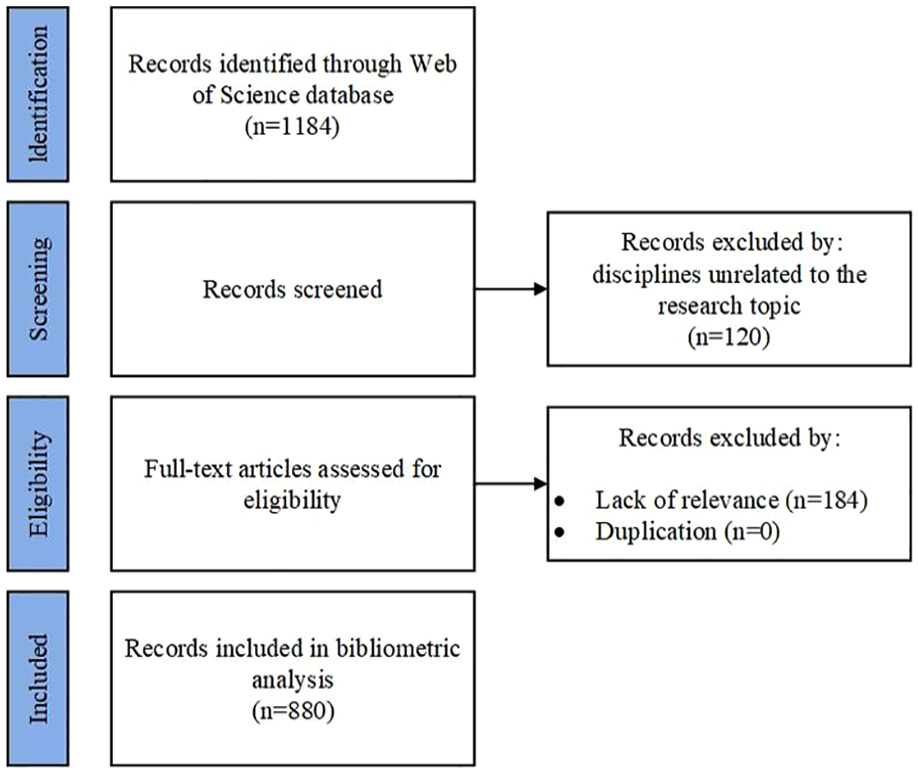
PRISMA flow diagram.
We opted to involve two marketing professors to leverage their expert knowledge and ensure the relevance and accuracy of the articles included in our analysis. Their expertise in the field was crucial in accurately assessing the pertinence of the content to our research questions. The decision to involve specifically two researchers was made to facilitate a comprehensive and unbiased review process, allowing for a consensus approach which strengthens the validity of the article selection phase. The criteria for their invitation were based primarily on their academic credentials and their specific expertise in the pertinent areas of marketing that our study focuses on. This was crucial for ensuring a high standard of review and relevance to our topic. This process resulted in 880 publications. Finally, the 880 publications underwent further qualification assessment, and since they were all found to be relevant, duplicate documents were checked for, and none were found. Therefore, the final number of publications was confirmed to be 880.
Analysis Tools
Bibliometrix was chosen as the primary analysis tool for this study, as it offers various effective statistical algorithms, high-quality numerical computation programs, and visualization capabilities, which are essential qualities for scientific computation (Aria & Cuccurullo, 2017). Additionally, VOSviewer was used as a supplementary tool due to its user-friendly mapping and aesthetically pleasing graphics, facilitating a more precise presentation of the research findings on this topic (Van Eck & Waltman, 2010).
Results
Performance Analysis
Overall Trend
This study selected 880 articles from 69 countries, 1,008 organizations, and 1,959 authors, published in 265 journals, citing 43,054 references from 16,152 journals. Figure 2 illustrates the temporal distribution of brand authenticity-related papers and their total citations. The figure depicts a continuous increase in scholarly attention towards brand authenticity over the 21 years from 2003 to 2023, with a notable surge in interest observed from 2017 onwards. Moreover, the publication count remained steady between 120 and 140 papers during the 3 years from 2020 to 2022. As of the statistical cut-off date, July 5, 2023, 61 articles have already been published 2023, indicating a growing scholarly interest in the concept of “authenticity” in the marketing field, making it a new focal point for researchers. Regarding the total citation counts per year, there was an overall upward trend from 2003 to 2019, followed by a decline from 2019 to 2023, which might suggest a reduced focus on breakthrough research in brand authenticity. However, it is essential to note that a precise assessment of the field’s status can only partially rely on the decline in citations.
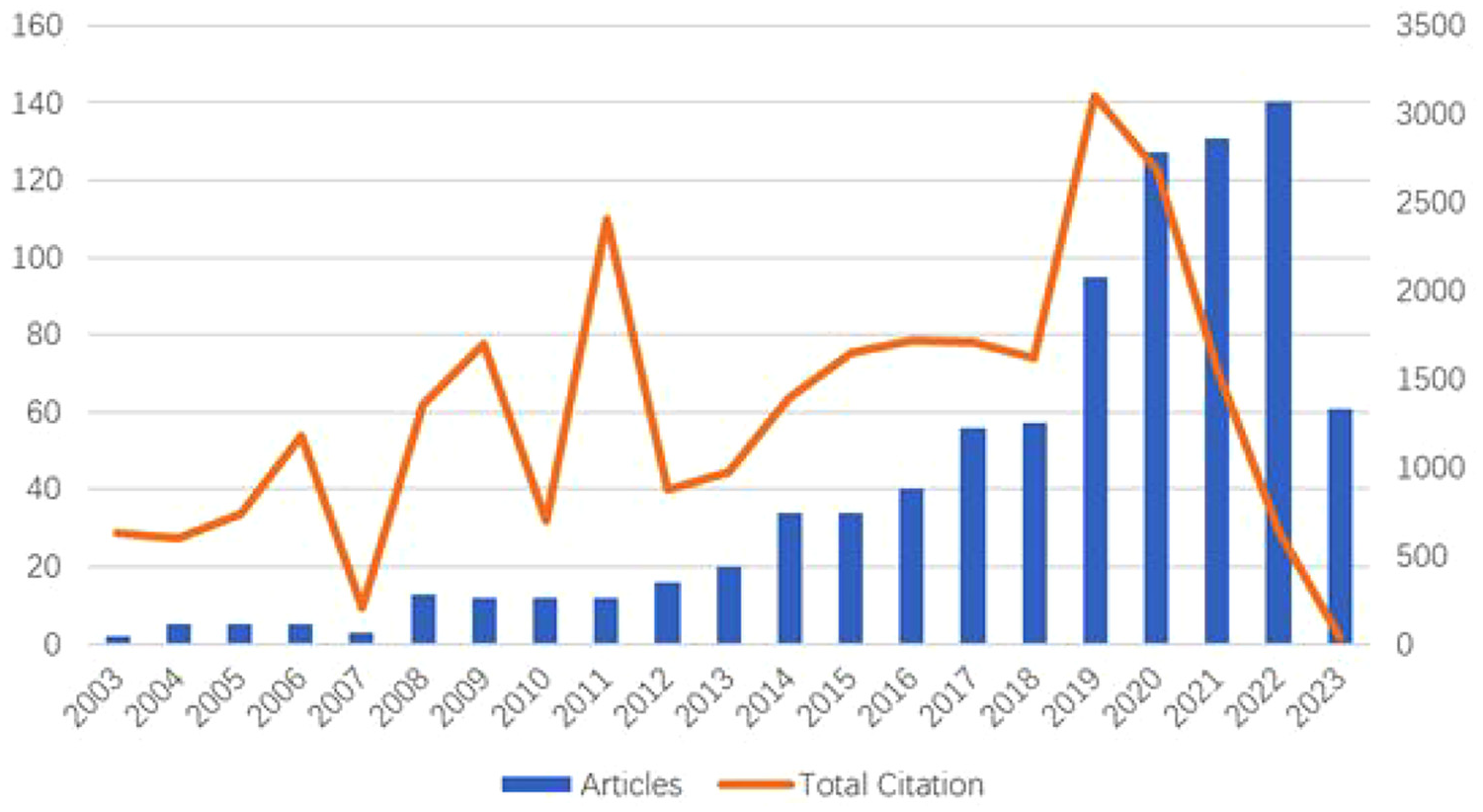
Publication and citations trend on brand authenticity.
Author Analysis
In order to understand authors’ contributions and academic influence to promote scholarly exchange and collaboration, this study conducted an author analysis and identified a core author group to focus on the current research status. According to Price (1963), for a specific research question, approximately half of the papers are authored by a core group, with the number of authors in this group being approximately equal to the square root of the total number of authors (N) involved, as shown in the formula below:

Where n(x) represents the number of authors who have published x papers, I = nmax denotes the number of publications by the most prolific author (in this study, I equals seven articles), and m represents the minimum number of publications required for a core author. Following Price’s law, the minimum number of publications for core authors is calculated as m = 0.749 × √(nmax) ≈ 1.98. Hence, authors who have published two or more articles are designated as core authors. After statistical analysis, a total of 200 authors, who collectively contributed 501 papers, were identified as the core author group, accounting for 56% of the total publications. This finding suggests that a stable research community has been established in the field of brand authenticity.
Table 2 displays the top productive authors, considering a threshold of five papers, and presents the top 15 authors based on their publication count, citation count, and average citations per paper. Among these three indicators, Beverland ranks the highest. He has a strong foundation in the field of marketing, with his main publication years falling between 2005 and 2010. His research focuses on brand innovation and positioning (Beverland, Farrelly, & Quester, 2010), brand authenticity in advertising communication (Beverland et al., 2008), and consumers’ authentic cultural identity (Beverland, Napoli, & Farrelly, 2010). Specific products of interest include strategies for brand authenticity in luxury wine (Beverland, 2005, 2006; Beverland & Luxton, 2005). Another noteworthy author is Moulard, with five publications, a total citation count of 543, and an average citation count of 108.60. Moulard has been active mainly between 2014 and 2021 and has introduced innovative perspectives by challenging the customer-centric approach, suggesting that brand authenticity is the extent to which brand managers are passionate and dedicated to the products they offer (Moulard et al., 2016). In this context, he explores the antecedents and consequences of brand authenticity. He conducts pioneering research on personal brand authenticity, including how celebrities (Moulard et al., 2015) and artists (Moulard et al., 2014) shape authenticity. Guevremont is another highly productive and highly cited author whose leading publications were between 2016 and 2021. His research exhibits significant relevance and reference value, investigating the relationship between brand authenticity and brand scandals (Guèvremont & Grohmann, 2018), as well as the authenticity of young brands (Guèvremont, 2018). Combining the authors with the highest local citations, as provided in Figure 3, Beverland, Moulard, and Guevremont are considered authoritative experts in this field, ranking among the top three. Additionally, two authors, Septianto and Song, have high publication counts of seven articles each, but their total citation count and average citation count are relatively low, indicating that while they are prolific, they receive less attention. It should be noted that this table ranking only reflects authors’ research output levels, and the relevance of specific literature will be analyzed in the following sections.
Most Prolific Authors.


Most local cited authors.
Journal Analysis
A statistical analysis was conducted on the journals to which the literature belonged, revealing that most were marketing-related journals, encompassing general business or marketing journals and more specific categories. These categories included food, tourism, hospitality, and personal branding, while marketing functions covered areas such as advertising, branding, consumer psychology, retail, market intelligence, and planning. The top 15 journals in the core area based on Bradford’s Law (Bradford, 1934) were observed (see Table 3). It found that the top three journals with the highest number of publications were Sustainability, Journal of Business Research, and Journal of Product and Brand Management.
Most Prolific Sources.

We evaluated the quality of these publications, and total citations were examined, with the top three journals in terms of total citations being Journal of Business Research, Tourism Management, and Journal of Sustainable Tourism. Furthermore, the average citations per paper were analyzed, with the top three journals in this category being Journal of Sustainable Tourism, Tourism Management, and Journal of Business Research.
The frequent inclusion of tourism marketing journals on the list indicates the positive role that destination authenticity plays in tourism marketing. The journal Journal of Sustainable Tourism achieved the highest average total citation count, demonstrating its superior article quality and primary focus on the relationship between tourism and sustainable development. The journal with the highest total citations was the prominent comprehensive business journal Journal of Business Research, which covers various topics such as consumer behavior, interactive marketing, and corporate social responsibility. Additionally, the open-access journal Sustainability had the highest number of publications, highlighting the significant contribution of open-access approaches to advancing research in this field.
Country Analysis
Countries that produce more publications may exhibit more significant interest in the research field. Table 4 presents the ranking of countries based on their research output, the countries with the highest total citations, and their respective average citations per paper. The data indicates that the United States is the most attentive country to brand authenticity, publishing 459 articles over 20 years and receiving 9,383 citations. The Netherlands has the highest average citations per paper, with 52.9 citations. A cooperative map and frequency were observed to further understand the collaborative relationships among countries. The data reveals that China and the United Kingdom have the most collaborations, with 22 co-publications. This is followed by collaborations between the United States and China (20 publications) and the United States and South Korea (14 publications). Furthermore, using VOSviewer, a co-authorship map of countries was generated with a threshold of 5, where dots represent the number of publications, colors represent clusters, and line thickness indicates the strength of collaborative ties (see Figure 4). The figure indicates relatively close international cooperation and multiple strong collaborative relationships regarding brand authenticity, signifying the global academic community’s collective interest in this research topic.
Most Prolific Countries.


Co-occurrence relationships among countries.
Highly Cited Literature Analysis
Table 5 presents the top 10 most globally cited papers provided by Bibliometrix. Unlike the previous sections on author and country analysis, to ensure a fair and accurate comparison and to effectively identify significant research achievements in brand authenticity, we also introduced the Global Normalized Total Citation (Normalized TC) indicator for comprehensive evaluation. The specific approach is to divide the total citations of a paper by the average total citations of all documents within the corresponding field or time range to eliminate differences in citation counts across different fields, disciplines, or time ranges.
Most Global Cited Documents.

The data indicates that the top-ranked paper is “I Tweet honestly, I Tweet passionately: Twitter users, context collapse, and the imagined audience,” published by Marwick and Boyd (2011) in “New media & society.” The paper has received a total of 1,946 citations, and its Normalized TC is also high (9.73). This suggests that this article has a higher citation frequency and broader global impact than other papers. The research employed an anonymous survey to explore the conflicts and balances between information privacy and image authenticity for individual brands or “micro-celebrities” when interacting with an “imagined audience” on Twitter. The paper provides a detailed interpretation of social media communication. It offers insightful deconstruction and elaboration on the theme of “authenticity,” positing that authenticity depends on the context of dialogue and the construction of the audience. The paper’s content is comprehensive, and the research design is methodologically sound, contributing to the understanding of how to build authenticity for personal brands and “micro-celebrities.”
Ranked second is the paper “Food, place, and authenticity: Local food and the sustainable tourism experience” by Sims (2009), published in the Journal of Sustainable Tourism. The paper, which used qualitative interviews, indicates that considering food as a symbol of a tourist destination can achieve authentic experiences for visitors, and iconic food can successfully shape the destination’s image. The research opens up new directions in tourism studies.
Similarly, the paper by Chhabra et al. (2003) investigates the impact of activities showcasing ethnic or cultural traditions on shaping the authenticity of tourist destinations. The study found that tourists can still experience high authenticity even when these activities are held far from their cultural origins. The research provides new insights into heritage tourism. The high citation counts of these two papers and their inclusion in Table 2’s two tourism-related journals indicate that authenticity has received widespread attention and in-depth research in tourism marketing. The other seven papers can be broadly categorized into two groups: authenticity of specific products and authenticity from the consumer perspective.
To assess the influence and significance of literature in this specific area of authenticity, we also compiled a list of the top 10 locally cited papers (see Table 6) and provided the local-to-global citation ratio to enable readers to evaluate the impact of literature in this field more accurately. In contrast to Table 4, the top two ranked papers are related to “Measuring Authenticity,” indicating that the investigation and measurement of authenticity dimensions are a focus of attention in this field. Morhart et al.’s (2015) study is highly significant in this area, as it develops a four-dimensional scale of brand authenticity: credibility, integrity, symbolic meaning, and continuity. It confirms the influence of perceived authenticity on indexical, existential, and iconic clues, providing a reliable measurement tool for subsequent research related to authenticity. Similarly, the paper by Napoli et al. (2014) titled “Measuring consumer-based brand authenticity” develops a three-dimensional scale of brand authenticity: quality commitment, sincerity, and heritage, and has also been well-received by scholars, with a local-to-global citation ratio as high as 50.83%. This number marks it as an essential research achievement in brand authenticity. Beverland (2005), as an authoritative expert and prolific author in this field, has three papers listed. “Crafting brand authenticity: The case of luxury wines” has 530 local citations. The research reveals that the authenticity of wines depends on factors such as artisanal techniques, uniqueness, connections to specific regions, and passion for wine production. At the same time, authenticity is unrelated to commercial motives, reasonable production methods, and modern marketing techniques. The paper serves as a model for case studies and interviews. Additionally, it is worth noting that studies on the antecedents and consequences of brand authenticity, similar to scale development, have also gained favor in this field, represented by the 7th-ranked study by Fritz et al. (2017) and the 9th-ranked study by Moulard et al. (2016).
Most Local Cited Documents.

Co-citation Analysis
Journal Co-citation Analysis
Bibliometrix was used to perform co-citation clustering analysis for journals, employing the walktrap algorithm to generate 50 primary nodes and three clusters. Figure 5 visually represents the three clusters, each color representing a distinct group. Based on the journal names, it can be preliminarily inferred that brand authenticity research falls into three journals: tourism and hotel management, business and marketing management, and retail and food. This initial analysis indicates that studies on the “specific authenticity” of certain products and services have emerged, but the focus still predominantly lies in research on “general authenticity.”

Co-citation sources network.
The first group (in red) comprises the “Tourism and hospitality management” group comprising 10 journals. The top-tier Journal Annals of Tourism Research is the largest node, with a high betweenness centrality of 93.58, ranking second among the 50 nodes. Moreover, it has the highest closeness centrality of 0.017 within this group, indicating its significant mediating influence and impact on brand authenticity research. It demonstrates a strong capacity for knowledge dissemination and information exchange, effectively promoting the advancement of knowledge in this field. The second and third-ranked journals in this group are Tourism Management (betweenness centrality = 66.22) and International Journal of Hospitality Management (betweenness centrality = 58.97), respectively.
The second group (in blue) is the comprehensive group of “Business and Marketing,” also the largest group, comprising 34 journals. Notably, the top-ranked Journal of Business Research exhibits the highest cumulative degree of co-citations among the 50 nodes in Bibliometrix. Other highly co-cited journals include Journal of Consumer Research, Journal of Marketing, etc., indicating that the study of authenticity has extended to various aspects of marketing, including advertising, branding, consumer behavior, and business ethics.
The third group (in green) is the “Retail and Food” group, consisting of six journals. The largest node in this group is the Journal of Retailing and Consumer Services, with the highest betweenness centrality (95.90) and closeness centrality (0.018) among the 50 nodes. Furthermore, two “food journals,”British Food Journal and Food Quality and Preference, belong to economics and food science but have relatively low cocitation strength. This suggests that the exploration of authenticity has shown interdisciplinary tendencies but has yet to be prominent.
Co-citation Analysis of Literature
Conducting co-citation analysis on classic cited literature helps to explore the knowledge foundation in the field (Chen, 2006). We employed VOSviewer to visualize the co-citation network of literature with a threshold of 30 co-citations, identifying 67 co-cited articles for cluster analysis. Figure 6 displays the results, presenting four distinct clusters.
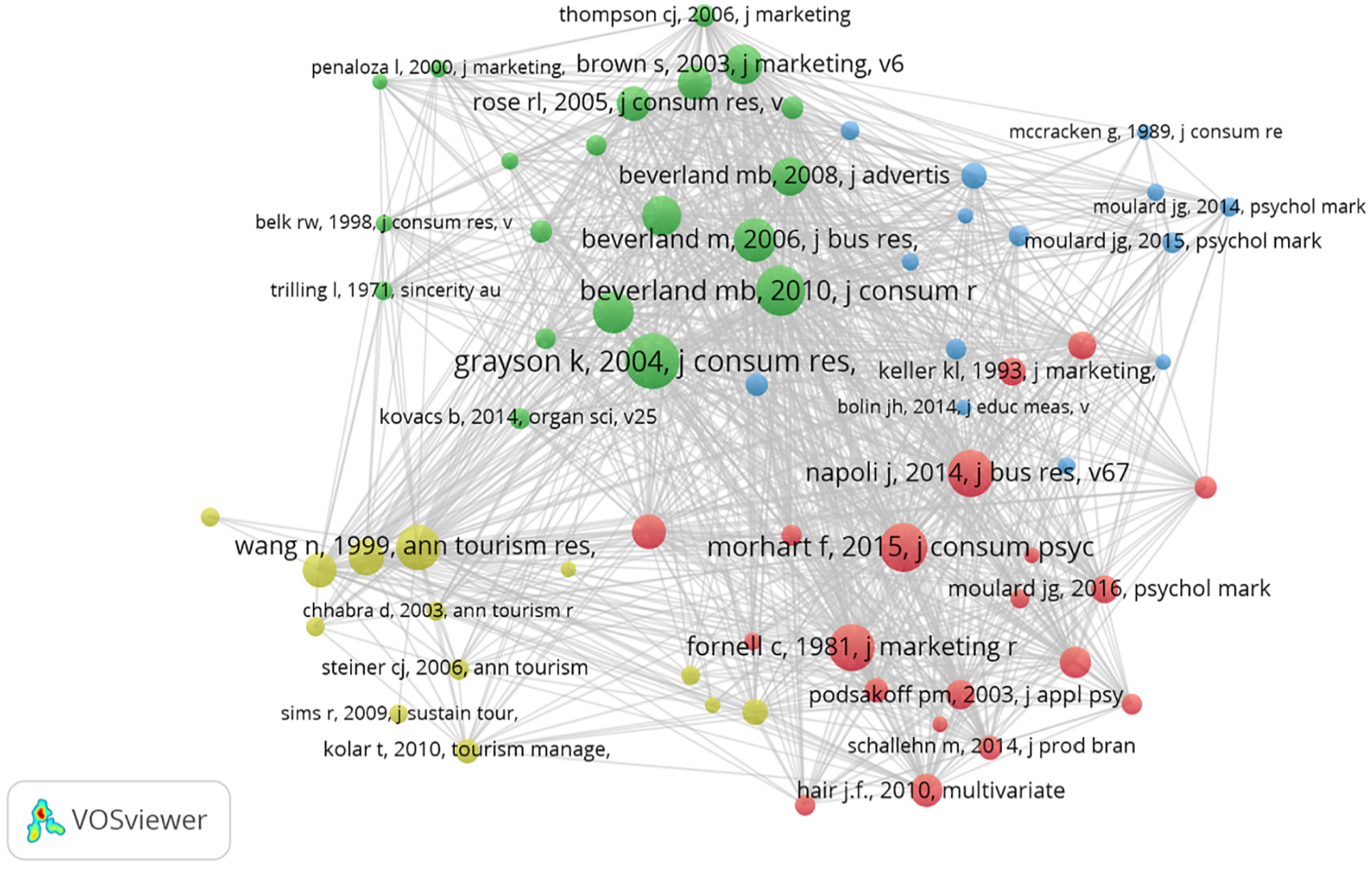
Co-citation references network.
The first cluster (in blue) comprises 14 articles that aim to explore the conveyance of authenticity in personal branding and how authenticity attributed to celebrities originates from cultural meaning (McCracken, 1989). Consequently, endorsing brand authenticity through celebrity attachment can enhance audience satisfaction and loyalty. Companies should strive to maintain the authenticity of endorsers (F. Z. Chekima & Chekima, 2019; Febrilia et al., 2024; Thomson, 2006) or create personalized brand personalities (Fournier & Eckhardt, 2019). Within this framework, the effective transmission of personal brand meaning to products is crucial. For instance, the authenticity of artists can influence consumers’ evaluation of artworks (Moulard et al., 2014). This cluster also includes review articles on authenticity typology and prospects (Newman & Smith, 2016).
The second cluster (in red) comprises 20 articles primarily focused on authenticity measurement, including scale development and examining antecedents and consequences. Gilmore and Pine’s (2007) work “Authenticity: What consumers really want” is a foundational theory. Morhart et al. (2015), Napoli et al. (2014), and Bruhn et al. (2012) developed authenticity scales, while Fritz et al. (2017) and Moulard et al. (2016) examined antecedents and consequences.
The third cluster (in green) comprises 20 articles, where the works of the authoritative author Beverland are predominantly found. Utilizing the binary approach of indexed authenticity and iconic authenticity proposed by Grayson and Martinec (2004), this group focuses on exploring the construction of consumer-perceived authenticity for different products from the brand management perspective. Examples include red wine (Beverland, 2005, 2006), automobiles (Leigh et al., 2006), and reality television shows (Rose & Wood, 2005), among others.
The fourth cluster (in yellow) consists of 13 articles and is primarily dedicated to investigating the construction of authenticity in tourist destinations; as mentioned earlier, no further elaboration is necessary.
Keyword Analysis
Co-word Analysis
To enhance the interpretation of co-citation analysis and further predict the future trajectory of the topic, we conducted keyword analysis. Figure 7 presents the top 40 most frequent keywords. Apart from “Authenticity,” the other widespread keywords include “perception” (143 occurrences), “impact” (129 occurrences), “antecedents” (117 occurrences), “consumption” (105 occurrences), “tourism” (75 occurrences), and “culture” (52 occurrences). The prominence of these keywords indicates that brand authenticity research primarily focuses on tourism and social media domains. Additionally, “loyalty,”“quality,”“word of mouth,” and “satisfaction” reveal investigations into brand authenticity outcomes. Figure 6 also highlights potential combinations of keywords and displays them in Figure 8 according to certain magnitudes.

Most frequent words’ tree map.

Words cloud.
Theme Trend Analysis
This study presents the thematic trend graph from 2013 to 2023, as shown in Figure 9. From 2013 to 2019, research was dispersed across various domains, exploring “authenticity construction” in fields such as tourism, culture, and art. Additionally, there were studies focused on the meaning of authenticity. During this phase, research outcomes gradually propagated and converged, leading to the keyword “authenticity” emergence in 2020. This phenomenon indicates that the academic community developed a more unified theory of authenticity.

Trend topic
In the years after 2019, keywords such as “antecedents,”“impact,” and “perception” started to surge, signifying the broad academic attention towards the antecedents and consequences of consumer perception of authenticity. Furthermore, in 2022, new themes surfaced, including “Corporate social responsibility,”“helpfulness,” and “socioemotional,” which indicates the expanding focus of the academic community on authenticity from a societal and macroscopic perspective. This trend suggests that future research might explore corporate social responsibility certification and management, focusing on social-emotional wealth orientation and authenticity building.
Furthermore, we generated the Brand Authenticity-related research theme map, as shown in Figure 10, representing different research themes using the authors’ keywords and their connections. The nodes in the graph have two attributes: centrality and density. Centrality indicates the relevance between different themes, while density represents the cohesion between nodes. In the graph, the themes related to brand authenticity are divided into four quadrants:
Quadrant 1: Motor Theme, primarily comprising “Corporate social responsibility” and “politics.” These themes have significantly progressed in the last 2 years and are crucial for brand authenticity.
Quadrant 2: Niche Themes, which have developed well but are currently less relevant in the field, including “anthropology,”“cities geographies,” and “sociology.”
Quadrant 3: Emerging or declining themes, representing marginal themes that may have recently emerged, such as “city conservation,”“gender,”“beauty,” and “race.”
Quadrant 4: Basic Themes, encompassing vital themes that significantly contribute to brand authenticity and require further development. Notably, “food” is a major topic in the product aspect, and academia still needs to explore issues related to consumer perception and recognition of authenticity as well as its impacts and antecedents.

Theme trend.
Implications
On a theoretical level, this study rigorously adheres to the data filtering and analysis processes of bibliometric approach, revealing the developmental trends and evolutionary paths of brand authenticity research. This not only provides a valuable historical perspective and knowledge framework for further development of the topic but also organizes authoritative opinions and academic contributions, enhancing our understanding of the academic influence within this field. As a typical bibliometric study, the primary contribution of this research meets the expectations of authoritative scholars (Donthu, Kumar, Mukherjee, et al., 2021), namely: advancing the field of authenticity research in a novel and meaningful way. Through this work, future scholars can more efficiently identify knowledge gaps and easily position their anticipated contributions to the field.
Previous reviews on brand authenticity have focused on clarifying and simplifying its meaning. However, it must be acknowledged that authenticity is not a singular, linear attribute but a dynamic and complex system influenced by multiple factors (Akbar & Wymer, 2017; Napoli et al., 2014). Thus, understanding authenticity should not only focus on minute details but also embrace a broader perspective. Until now, there has been a lack of a comprehensive global review; this study timely addresses this gap by covering more literature, authors, citations, journals, and industries than previous reviews. Therefore, the second marginal contribution of this research is its first-time comprehensive analysis, which complements and corroborates the work of past scholars (Akbar & Wymer, 2017; Campagna et al., 2023; Södergren, 2021, etc.), enabling the marketing community to more fully appreciate the rich connotations of brand authenticity and its application in various business contexts.
On a practical level, this study can serve as a forward-looking strategic guide for brand managers. By following the information presented in this research, companies can further clarify the direction of brand development, especially in building and maintaining brand authenticity. Authenticity is an ancient topic, but seeking truth and being pragmatic are human instincts. In an era of worsening ecological environments, geopolitical changes, and increasing brand homogenization, authenticity continues to be seen as a core asset in mainstream marketing (Södergren, 2021), thus underscoring that emphasizing authenticity is never outdated. Specifically, this research reviews works in areas such as micro-celebrity marketing, food, travel, corporate social responsibility marketing, sustainable brand building, production processes, consumer psychology surveys, and cross-cultural marketing. It proposes an understanding and expectations of authenticity in different contexts, facilitating companies to align theoretical knowledge with specific business practices according to market characteristics, thereby enhancing brand appeal.
Conclusion and Future Research Recommendations
The main objective of this study is to empirically record publication trends, influential authors, journals, and publications related to brand authenticity using bibliometric methods. Additionally, key terms were used to identify research achievements, knowledge foundations, and research gaps in the field of brand authenticity. To achieve this goal, we conducted the performance analysis and knowledge map visualization of 880 publications retrieved from the WoS database.
Research on brand authenticity shows an overall upward trend, indicating an increasing interest in authenticity. From the author analysis and highly cited literature analysis, it is evident that a core group of authors has emerged, generating a series of seminal research outcomes. However, there has been a lack of milestone progress in recent years, as evidenced by the decline in total citations from 2019 to 2023 and the thematic quadrant analysis. The knowledge map highlights the ongoing need for sustained and comprehensive exploration of specific critical issues, including antecedents and consequences, consumer perceptions, and model constructions. Scholars are encouraged to broaden their investigations by incorporating additional antecedents and outcome variables tailored to diverse research contexts. This approach will contribute to a deeper understanding of the subject matter and facilitate the development of more robust models.
International collaboration in brand authenticity research has been extensive and effective. However, there needs to be more research on authenticity in different cultural contexts. Culture has been shown to be a persuasive factor influencing individual behavior (B. Chekima & Chekima, 2019; B. Chekima et al., 2023; Yaveroglu & Donthu, 2002), and values are crucial principles guiding attitudes and actions (Rokeach, 1973). Therefore, investigating the perception of authenticity characteristics and cross-cultural authenticity in marketing in diverse cultural backgrounds would be valuable. Future research should pay attention to how cultural factors modulate perceived authenticity.
The co-citation clustering analysis indicates that brand authenticity research has established a rich knowledge base, mainly focused on consumer products. However, specific product authenticity research is relatively scarce. Given the significant differences in brand authenticity connotations across product categories, using a “general authenticity” scale may not yield optimal results for measuring “specific product authenticity.” Hence, it becomes crucial to discern the authenticity across various product categories. Additionally, our database reveals an expanding exploration of “authenticity” within the domains of food science and economics. This observation underscores the importance of incorporating research agendas focused on topics like “production processes and industrial product authenticity” and “the influence of policies on social authenticity.” Such inclusion would significantly enrich the breadth of authenticity research.
In the thematic trend analysis, particular attention should be paid to the emergence of “Corporate social responsibility” in 2022. A closer examination of related literature reveals its association with cause-related marketing (Ilicic et al., 2019), brand ethics (de Kerviler et al., 2021), and other elements. This indicates that the academic community recognizes the significance of corporate social responsibility, public welfare initiatives, and sustainable development in shaping authenticity. Companies with a sense of social responsibility can gain trust from employees, customers, and citizens (Gaio & Gonçalves, 2022), which aligns with the impact of brand authenticity (e.g., a genuine person gains the trust of friends). In light of the dynamic market landscape, integrating corporate social responsibility into marketing strategies is imperative. Doing so proactively contributes to establishing brand authenticity, particularly in the context of “green brands” or those promoting environmental friendliness, which warrants dedicated focus and attention.
Footnotes
Declaration of Conflicting Interests
The author(s) declared no potential conflicts of interest with respect to the research, authorship, and/or publication of this article.
Funding
The author(s) received no financial support for the research, authorship, and/or publication of this article.

Data Availability Statement
Data sharing not applicable to this article as no datasets were generated or analyzed during the current study.