




Abstract
While there are many useful studies on Indonesian native phonology and loanword phonology, none has yet explored Minangkabau loanword phonology in depth. Therefore, based on a list of 52 well-established native Indonesian loanwords elicited from 10 adult native speakers of Minangkabau and verified by native speakers and transcribed in IPA, and within the ambit of Optimality Theory, this paper aims to investigate the following research questions: What are the phonotactic repair strategies employed in Minangkabau to adapt these words? Why are they triggered? Are they phonologically or phonetically driven? And why? The study finds that the two observed repairs are consonantal debuccalization and consonantal deletion, which are both employed in order to fulfill the phonotactic conditions of Minangkabau. In Minangkabau, obstruent and liquid consonants are disallowed word-finally; as a result, word-final voiceless stops /p, t, k/ in native Indonesian words are debuccalized into the glottal stop /ʔ/, and the voiceless fricative /s/ into the glottal fricative /h/. However, unlike word-final obstruents, the word-final liquid consonants /r, l/ in native Indonesian words are adapted through deletion when entering Minangkabau. The results, moreover, show that that the above repair strategies are guided by phonology rather than phonetics; that is to say, among others, they are guided by coda restrictions in Minangkabau phonotactics in terms of word-final obstruent and liquid consonants. Finally, by presenting evidence from Minangkabau in favor of the phonological stance, it is believed that the paper contributes to the significant debate as to whether loanword adaptation is phonological or phonetic.
Introduction
Adaptation is the process whereby a lexical item from the source language undergoes segmental, suprasegmental, and phonotactic repairs in the recipient language. These repairs are triggered in order to integrate the ill-formed structure of the source word into the recipient language’s linguistic system.
Although there are descriptive studies that have shed some light on Indonesian loanwords in Minangkabau, there is a lack, if not absence, of existing in-depth research on Minangkabau phonology and Minangkabau loanword phonology, especially where it pertains to the literature on the role of phonology versus phonetics in Minangkabau loanword adaptation. Therefore, the aim of this paper is three-fold. Firstly, drawing upon a list of well-established native Indonesian loanwords, it seeks to add to the theoretical understanding of Minangkabau linguistics in general and Minangkabau loanword phonology in particular. Secondly, couched in Optimality Theory (OT), it investigates the phonotactic adaptation of Indonesian words when incorporated into the standard Minangkabau spoken in Padang city, West Sumatra. Thirdly, the study intends to contribute to the ongoing debate whether loanword adaptation is governed by phonology or phonetics. The list of words used in the study consists of 52 frequently used words. These words are purely native Indonesian loanwords. They were elicited from (five male/five female) adult native speakers of standard Minangkabau residing in Padang, West Sumatra.
Standard Indonesian and standard Minangkabau are classified as Malayo-Polynesian Austronesian languages, and they are related to each other in terms of structure and vocabulary. Lexically speaking, a large collection of native Indonesian words has been adopted into the Minangkabau lexicon. However, the phonotactic structure of many of these borrowed words is different in Minangkabau than in Indonesian. To avoid illicit codas, Minangkabau employs two adaptation processes in order to fit the Indonesian words into its phonotactic system: consonantal debuccalization and consonantal deletion. As a subtype of lenition, consonantal debuccalization is defined by O’Brien (2012) as a weakening process, whereby “various consonants with oral constrictions” (p. 9) are reduced to laryngeal consonants. In other words, as a result of debuccalization, oral consonants no longer have air obstructions in the oral tract, yielding either /ʔ/ or /h/. In Minangkabau, obstruents are not allowed in word-final coda positions. Therefore, to meet this coda condition, Minangkabau debuccalizes the word-final voiceless stops /p, t, k/ and the voiceless fricative /s/ in native Indonesian words to the glottals /ʔ/ and /h/, respectively. In OT terms, the process of debuccalization is captured by ranking the conditions of Align-Left (Align-L; NonGlottalObstruents, σ), Max-IO (C), Dep-IO (V), Ident (Manner), and Align-Right (Align-R) higher than Ident (Place). In addition to obstruent consonants, Minangkabau prohibits word-final liquid consonants. As a result, to fulfill this coda constraint, word-final coda liquids are simply deleted. This consonant deletion is accounted for by the higher-ranking of Align-L (Liquids, σ), Dep-IO (V), Ident (Manner), and Ident (Place) over Align-R and Max-IO (C).
In the literature on loanword phonology, two major theoretical approaches to loanword adaptation are usually discussed. The first is the phonological stance, which holds that adaptation is fully phonological and that phonetics (or perception) plays little, or no, role in loanword adaptation (Paradis & LaCharité, 1997, 2002, 2005; Paradis & Tremblay, 2009). At the extreme opposite end of the discussion is the view that adaptation always takes place in perception and is susceptible to the phonetic details of the source input. In this view, loanword adaptation is not defined by phonology (Peperkamp, 2005; Peperkamp et al., 2008; Peperkamp & Dupoux, 2003). This paper describes and discusses the two phonotactic repair strategies (i.e., consonantal debuccalization and deletion) using OT and makes the argument that the repairs triggered in Minangkabau to integrate native Indonesian loanwords are phonologically guided. Based on the analyzed data, this study presents evidence that the repairs are triggered to obey Minangkabau’s phonotactic conditions and meet the syllable count of the Indonesian loanwords in Minangkabau. Furthermore, this study strongly supports Lombardi’s (1999, 2001) place neutralization whereby word-final voiceless bilabial, alveolar, and velar obstruent consonants are lenited into glottal consonants /ʔ/ and /h/ (a glottal place) and that the place distinction among these obstruent consonants is lost (i.e., neutralized) when they enter Minangkabau. Finally, this study discusses evidence drawn from the data that would not be otherwise explained by the phonetic approach.
In sum, the study intends to answer the following four research questions:
What are the phonotactic repair strategies that are triggered in Minangkabau to integrate native Indonesian loanwords?
Why are these strategies triggered?
Are these adaptation strategies phonologically or phonetically guided, and why?
Literature Review
Indonesian and Minangkabau: Speakers and Location
Indonesian (locally known as Bahasa Indonesia) and Minangkabau (locally known as Baso Minangkabau) belong to the Malayo-Polynesian branch of the Austronesian language family. Although linguistically related to each other to a great extent in terms of phonemic inventory, morphology, syntax, and vocabulary, the two languages are not completely mutually intelligible (Crouch, 2009). Indonesian is the national and official language of the Republic of Indonesia. It is spoken predominantly across Indonesia by approximately 200 million speakers; it is a first language (L1) for 43 million speakers and a second language for 157 million speakers (Indonesia’s Census Bureau, 2010). Compared to Indonesian, Minangkabau has a smaller population of 6.5 million speakers (Antoni et al., 2019; Halimiyah et al., 2014; Wiratsih et al., 2014). It is the principal standard regional language in West Sumatra where it is spoken as L1, and is regarded as a symbol of nationality and culture, and is used as a tool for intergroup communication (Amri et al., 2013; Ayub, 1993; Erwandi, 2018; Medan et al., 1986; Mulyadi, 2017; Rahmadani et al., 2013; Restifiza & Rosa, 2012; Sumidita et al., 2013; Wulandari & Nugraheni, 2019; Zurmita et al., 2013). Both Indonesian and Minangkabau have different dialects in different provinces.
Consonantal Inventories
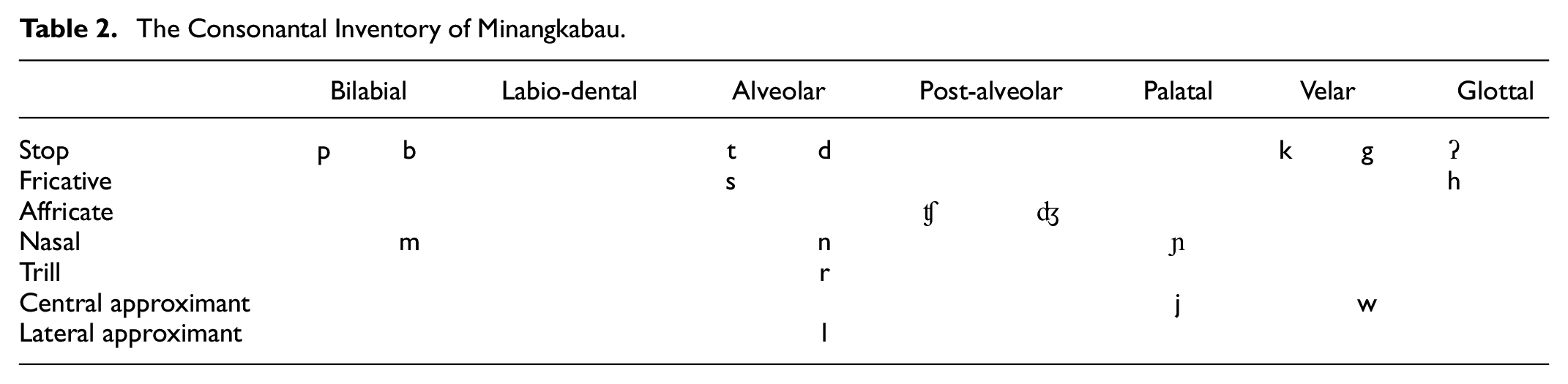
As shown in Tables 1 and 2, Indonesian (Adelaar, 1992; Adisasmito-Smith, 2004; Batais, 2013; Lapoliwa, 1981; Soderberg & Olson, 2008) and Minangkabau (Adelaar, 1992; Almos, 2012; Erwandi, 2018; Medan et al., 1986; Zurmita et al., 2013) share 19 consonants: three bilabials /p, b, m/, six alveolars /t, d, s, n, r, l/, two post-alveolars /ʧ, ʤ/, two palatals /ɲ, j/, four velars /k, g, ŋ, w/, and two glottals /ʔ, h/. However, compared to Minangkabau, Indonesian has four additional consonants, namely /f, z, ʃ, x/, which are limited to foreign loanwords (as a result, they are placed in parentheses in Table 1).
The Consonantal Inventory of Indonesian.

The Consonantal Inventory of Minangkabau.
Phonotactics
The basic syllable structure in both Indonesian and Minangkabau is CVC (Batais, 2013; Wiratsih et al., 2014; Zaharani, 2005; Zurmita et al., 2013). In both languages, only singleton onsets and codas are allowed, and onsets and codas are not mandatory. With respect to phonotactic constraints, according to Macdonald (1976), Lapoliwa (1981), and Batais (2013), in Indonesian words, all consonants except the glottal /ʔ/ can occupy the syllable onset position, but only /p, t, k, ʔ, s, h, r, l, y, m, n, ŋ/ are permitted in coda positions. On the other hand, in Minangkabau, only /m, n, ŋ/ are allowed to occupy coda positions, while /ʔ, h/ can only appear in word-final coda positions (Medan et al., 1986; Wiratsih et al., 2014). In addition, /ʔ, h/ cannot occupy onset positions.
Language Contact
Indonesian has been in close contact with many major regional languages in Indonesia, including Minangkabau. This language contact is inevitable, as Indonesian is Indonesia’s official and national language, the medium of instruction, and the language that is increasingly used for inter-group communication across the archipelago (Nababan, 1985). In addition, for many speakers of regional languages, the use of Indonesian by Indonesians generally denotes social prestige and modernity, and broadens their access to the job market in metropolitan Jakarta as well as in regional cities. As a result, superstrate Indonesian has linguistically impacted substrate regional languages (Sneddon, 2003), affecting phonological, morphological, syntactic, and lexical changes. For example, on the lexical level in Minangkabau, Indonesian has contributed a large number of vocabulary items to domains such as religion (e.g., agamo“religion,”puaso“fasting,” and sarugo“heaven”), medicine (e.g., ilimu“science,”kulik“skin,” and panyakik“disease”), geography (e.g., gampo“earthquake,”lauik“sea,” and gunuang“mountain”), body parts (e.g., kaki“feet,”mato“eye,” and rambuik“hair”), education (e.g., guru“teacher,”belajar“study,” and kuliah“lecture”), and technology (e.g., komputer“computer,”masin“machine,” and ubuangan“connection”). This is not an exhaustive list and demonstrates the contributory impact of Indonesian on Minangkabau.
Theoretical Approaches to Loanword Adaptation
Two major opposing approaches have emerged to address the question of whether phonology or phonetics is involved in loanword adaptation. The purely phonetic approach claims that all loanword adaptation processes always take place in phonetics/perception. This claim is motivated independently by psycholinguistic evidence that non-native phonological structures, such as segments, suprasegments, and syllables, are distorted (i.e., misperceived) by L1 listeners during perception. Along the lines of this phonetic claim, Peperkamp and Dupoux (2003), Peperkamp (2005), and Peperkamp et al. (2008), make arguments which will now be highlighted. First, they argue that the borrowing speakers cannot access the phonological system of the lending language. Second, the incoming input is not purely segmental; instead, it is the acoustic (or surface phonetic) representation (with syllable-sized chunks) of the source language. Third, during speech perception, the phonetic input form as a whole, rather than individual segments, is mapped onto the closest available well-formed native counterpart, as determined by phonetic distance between the source and target categories, with as minimal phonetic adjustments as possible. Therefore, in the view of these authors, loanword adaptation processes are on-line “minimal transformations” (Peperkamp, 2005) of a phonetic nature.
Fourth, in addition to being driven by minimal phonetic distance, the loanword adaptation processes are sensitive to the fine phonetic details of foreign speech, but not to its phonological properties. To illustrate this, Peperkamp (2005) and Peperkamp et al. (2008) examine the asymmetry in the online Japanese adaptations of French and English loanwords ending in [n]. They show that word-final [n] in English loanwords is directly mapped on a final moraic nasal (e.g., Japanese [peN] for English “pen”), whereas, in adapting the French loanwords, word-final [n] is realized with a following epenthetic vowel (e.g., French [dwan] → Japanese [duan:ɯ]). As noted by the authors, the vowel epenthesis in the French loanwords is not phonotactically necessary since words ending in a moraic nasal consonant are permitted in native Japanese phonology (e.g., [teN] “point”). To solve this puzzle, Peperkamp (2005) and Peperkamp et al. (2008) explain that, based on experimental evidence, the above asymmetry is due to the phonetic differences of word-final [n] in English and French which, as a result, have largely influenced the way they are perceived by native speakers of Japanese. This is particularly notable, because in French, unlike English, word-final [n] has a strong vocalic release; therefore, Japanese listeners perceive a vowel after [n]. Subsequently, the “perceived” vowel is mapped onto the phonetically closest native vowel [ɯ].
By contrast, the purely phonological model proposes that the loanword adaptation is done by bilingual speakers (i.e., main adapters) and occurs within the realm of production (i.e., phonology). This means that the speakers can access the phonological structure of the source language; consequently, the source phonological representation, not the phonetic output, with its L2 distinctive feature combinations is mapped directly onto a native representation (L1 input). This runs counter to the purely phonetic position which argues that the loanword adaptation takes place in phonetics/perception, that borrowing speakers have no knowledge of the borrowing language, and that the input to perception is merely a superficial acoustic signal. Among the prominent works couched in the purely phonological framework are Paradis and LaCharité (1997, 2002, 2005) and Paradis and Tremblay (2009).
Paradis and LaCharité (1997) propose the Theory of Constraints and Repair Strategies (TCRS) to account for the adaptations of segmental and syllabic malformations in a corpus of 545 French loanwords in Fula. In line with TCRS, Paradis and LaCharité stress that loanword adaptation is constraint-based and is triggered when an illicit source form violates the L1 constraints. Next, universal repair strategies, which either insert or delete content or structure, are initiated in a predictable fashion so that the malformed form meets the violated constraint. Paradis and LaCharité (2005), along the same lines as Paradis and LaCharité (1997), moreover, maintain that loanword adaptation is largely a phonological process, not a case of misperception of the L2 phonetic sound by monolingual speakers. They further advance the notion of phonemic approximation and test its predictions, as well as the predictions by the phonetic approximation approach, against the 12 corpora of English and French loanwords. For example, Paradis and LaCharité (2005) show that /b/ in English words borrowed in French is preserved as [b] despite the fact that English /b/ is phonetically (acoustically) closer to French /p/. The same feature combination of voiced stop /b/ exists in both English and French; accordingly, English /b/ is phonologically identified with French /b/. On the other hand, if this combination does not exist in L1, Paradis and LaCharité (2005) suggest, the foreign sound is usually adapted (provided that it is not imported) by the deletion of problematic features.
Another piece of evidence against the phonetic approximation comes from Paradis and LaCharité (2002). They consider three cases that include the adaptation of English voiced stops in Spanish, adaptation of English rhotic in Japanese, and a case of phonetic metathesis. For example, with respect to the Spanish adaptation of the voiced stops in English loanwords, it is predicted, from the view of phonetic approximation, that monolingual Spanish speakers will map the English voiced stops, namely /b, d, g/, on their Spanish voiceless counterparts, based on the fact that the VOT (Voice Onset Time) values of the English voiced onset stops and Spanish voiceless stops are more or less similar. This prediction does not appear to be true. Paradis and LaCharité test this prediction against their corpus data of 1,514 English loanwords (containing 563 voiced onset stops) in Mexican Spanish and observe that the English voiced stops /b, d, g/ are integrated as /b, d, g/ (and then realized as [b, d, g]) in Mexican Spanish, based on their phonemic status in the phonology of the borrowing language, not their phonetic properties, as advocated by the purely phonetic approach. Therefore, employing the phonetic closeness would give the wrong adaptation.
Paradis and Tremblay (2009) also strongly favor the phonological stance in their attempt to explore the adaptation of voiced and voiceless stops of English loanwords in Mandarin Chinese. The phonetic view predicts that the borrowing speakers of Mandarin Chinese will pay close attention to the tiny phonetic details of English stop aspiration and consequently equate the English aspirated stops and unaspirated stops with Chinese aspirated voiceless stops and unaspirated voiceless stops respectively. Contrary to the phonetic prediction, the study results show that English aspirated and unaspirated voiceless stops are both invariably treated as aspirated stops (despite the fact that Mandarin Chinese enables its speakers to differentiate between aspirated and unaspirated stops), whereas English voiced stops are systematically adapted as voiceless unaspirated stops in Mandarin Chinese.
This study tests the predictions made by both approaches against the analyzed data. It provides evidence from Minangkabau loanword adaptation in support of the phonological approach and strongly argues for the irrelevance of the phonetic approach.
Methodology
Participants
Ten adult native speakers of Minangkabau participated in the study. They were five male and five female speakers. Their ages ranged from 25 to 41 years. They speak Minangkabau as a first language. In addition, all 10 participants were born and raised, and presently reside, in the city of Padang, West Sumatra. Padang was selected in order to rule out any dialectal differences among the participants (thus ensuring they all speak standard Minangkabau).
Data
The total number of source words used in this study is 52. They were drawn from Rusmali et al.’s (1985) Minangkabau-Indonesian Dictionary and Burhanuddin and Zabadi’s (2013) Indonesian-Minangkabau Dictionary. The selected source words must meet the following criteria: They must be native Indonesian lexical items; consequently, foreign loanwords (including Arabic, English, Portuguese, and Dutch words) were excluded. They must vary in their syntactic categories (e.g., verbs, nouns, adjectives, etc.) and syllable lengths (monosyllabic, bisyllabic, etc.). Most importantly, they must be well-established lexical items. To verify this, before the start of the study, the list of selected words was presented in writing to three adult native speakers of Minangkabau living in Padang. They confirmed that all 52 words were quite familiar to them (see Appendix 1 for the list of words).
Data Collection and Transcription
The data in this study was collected through word elicitation. Each word of the 52 Indonesian loanwords was elicited only once from each participant. After completing the questionnaire (see Appendix 2), the 10 participants were individually face-to-face interviewed and recorded by a native speaker of Minangkabau. The portable digital recorder used for this purpose was a Marantz PMD660 model with an internal stereo microphone. All of the recordings occurred over a period of 10 days.
Each interview started by the participant stating his or her name. Next, the interviewer elicited from each participant the list of 52 words through one of the following tasks: fill-in-the- blanks, short definitions matching the meaning of the target loanword, and object-naming. Only the pronunciation of each target loanword was digitally recorded. If, after many attempts, the participant failed to guess and hence pronounce the word, the interviewer would pronounce it and ask the participant whether he or she was familiar with the word. If it was known to the participant, he or she was next asked to pronounce it. Loanwords thus pronounced were recorded and designated as (*** Yes) so to differentiate them from the words which were spontaneously pronounced (designated as Yes). However, if the word was not familiar to the participant, the participant was not further asked to pronounce it. In this case, the word was labeled as (No). None of the elicited words were unfamiliar to all participants.
Next after recording, both types of familiar elicited loanwords were transcribed in International Phonetic Alphabet (IPA) symbols. It is worth noting that only on a few occasions did I resort to two native speakers of Minangkabau to help me discern a handful of indistinct sounds in the elicited data (owing to some recording complications).
Per each speaker, the final draft of the transcription sheet of the elicited list of loanwords, after being transcribed, has seven columns. A sample transcription sheet is provided in Appendix 3. The first leftmost is No. column which gives a number to each elicited word. The second and third columns, from the left, list the standard Minangkabau spellings of each elicited loanword according to the two used dictionaries: Rusmali et al. (1985) and Burhanuddin and Zabadi (2013) respectively. The fourth column indicates the participants’ familiarity with each elicited word. The fifth column displays the phonetic transcription of the participant’s pronunciation of each elicited loanword. The sixth column displays the phonemic representations of the elicited words in the source language (i.e., Indonesian). The source phonemic representations of the Indonesian words were taken from Kamus Besar Bahasa (Pusat Bahasa, Departemen Pendidikan Nasional, 2008) and were later reviewed by a native speaker of Indonesian. Finally, the seventh column contains the English gloss of each elicited loanword in Minangkabau.
Model
The model used in the study to examine and account for the phonological processes of consonantal debuccalization and deletion employed in Minangkabau is Optimality theory (OT) (McCarthy & Prince, 1993; Prince & Smolensky, 1993). Being a constraint-based framework, the basic premise of OT is that any language consists of a set of hierarchically violable constraints. These constraints are universal, but their ranking differs from one language to another (i.e., language-specific).
In OT, there are two types of constraints: markedness and faithfulness. The markedness constraints ensure structural well-formedness of the output forms, penalizing structures that are hard to produce. For example, Coda requires that syllables end with a coda, while NoOnset militates against any syllables starting with an onset. Faithfulness constraints, on the other hand, guarantees identity between the input and output forms; therefore, all linguistic features in the input must be preserved in the output. For example, Max prohibits any deletion of segments, while Dep prevents any insertion of segments. Both markedness and faithfulness constraints can conflict with each other to determine the best candidate known as the optimal output.
The optimal (winning) output is selected out of an infinite set of candidates which are generated by the function Gen (Generator). Next, based on the language-specific constraint ranking, the function Eval (Evaluation) evaluates the candidates generated by Gen and selects the candidate that minimally violates the constraint ranking. In Table 3, there are three candidates generated from the input by Gen. These candidates are evaluated by Eval against three constraints ranked as follows: Constraint 1 is ranked higher than Constraint 2 which dominates Constraint 3 (C1>> C2>> C3). Each of the three candidates incur one violation. However, Candidate A and Candidate B are excluded because they violate higher constraints (i.e., Constraint 1 and Constraint 2, respectively), hence marked with an asterisk and an exclamation mark (*!). Candidate C, on the other hand, is selected as the optimal output because it violates the lower-ranked constraint (Constraint 3) with the minimal punishment (thus, marked with an asterisk *). In sum, lower ranked constraints can be minimally violated in order to satisfy higher ranked constraints whose violations are most serious and fatal.
Explanation of OT: Candidates and Constraints.

Data Analysis and Discussion
This section first analyzes the debuccalization of the word-final voiceless obstruents /p, t, k/ and /s/ into the voiceless glottals /ʔ/ and /h/, respectively, followed by the deletion of the word-final liquids /r, l/.
Debuccalization of the Word-Final Obstruents /p, t, k, s/
When occurring word-finally, the obstruent consonants /p, t, k, s/ in Indonesian words that are incorporated into Minangkabau are replaced with /ʔ/ and /h/ respectively, as detailed in Table 4
Examples of Minangkabau Debuccalization of the Word-Final Obstruents /p, t, k, s/.

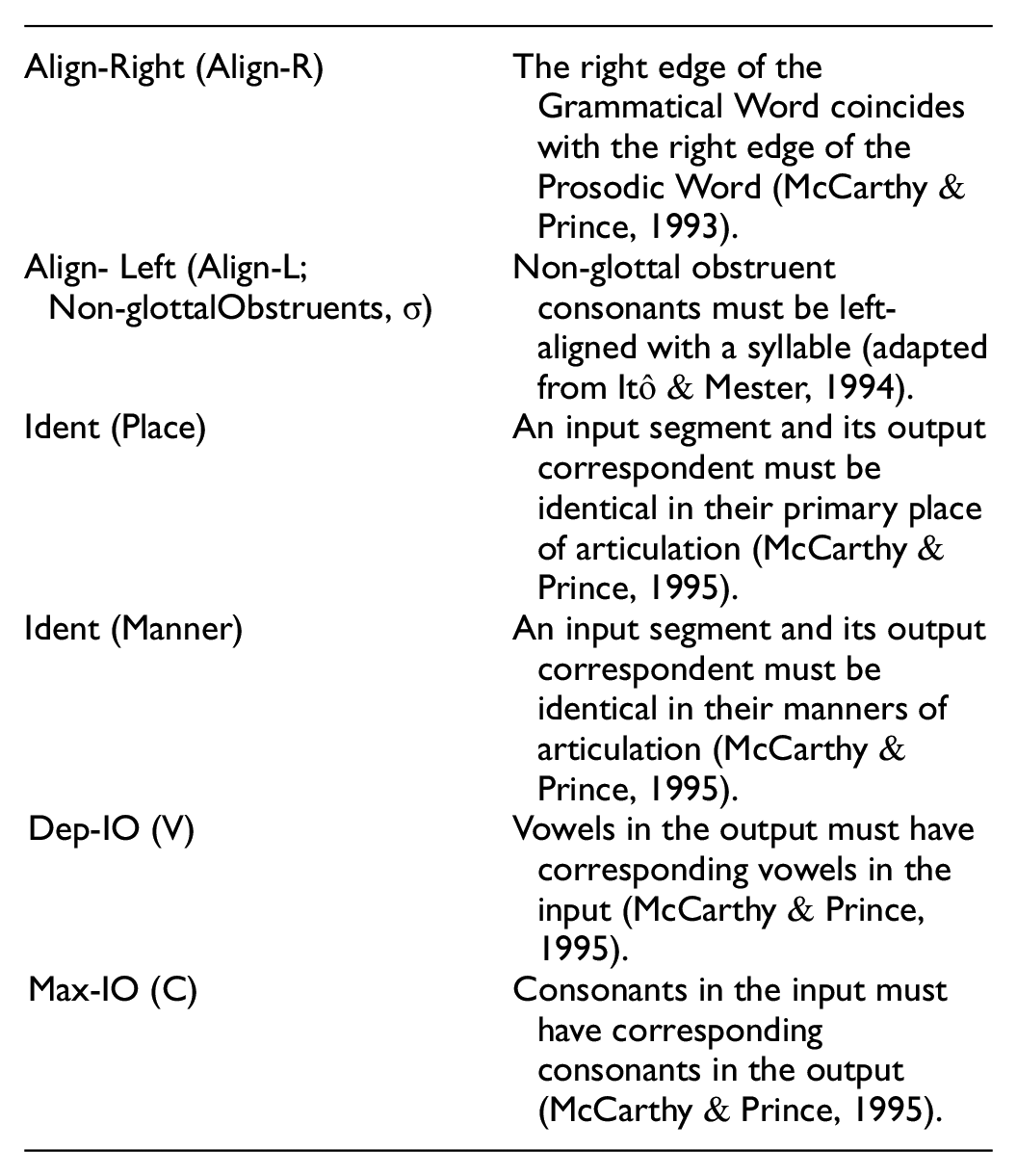
To account for the debuccalization of the above word-final obstruents in Minangkabau, this study proposes the following OT constraints:
See the Minangkabau adaptation of Indonesian /asa
For the word-final voiceless stops /p, t, k/ to be mapped onto the voiceless glottal stop [ʔ], the Align-L (Non-glottalObstruents, σ), Dep-IO (V), Max-IO (C), Ident (Manner), and Align-R constraints must be undominated. Any violation of these five constraints is fatal to the candidates. As shown in Table 5, the winning outputs are the candidates in Row (a). By replacing the three word-final obstruents with the voiceless glottal [ʔ], the candidates in Row (a) satisfy the five highest ranked constraints at the expense of violating the lowest ranked Ident (Place) since the only mismatch between /p, t, k/ and /ʔ/ is the place of articulation. Because it is violable in actual outputs in Minangkabau, this mismatch is considered a small violation.
OT Analysis of Debuccalization of Indonesian Word-Final Voiceless Stops in Minangkabau.

On the other hand, the candidates in Row (b) are excluded because they violate the Align-L (Non-glottalObstruents, σ) constraint, which requires that the word-final non-glottal obstruents occupy the left edge (i.e., onset) of the word’s final syllable. The obstruents in the candidates in Row (b) are in the coda position. Furthermore, the candidates in Row (c) lose, owing to their disagreement with Max-IO (C). The candidates in Row (d) are also ruled out due to their violation of Dep-IO (V). Preserving word-final obstruent consonants via vowel epenthesis and subsequent re-syllabification as onsets yields incorrect outputs, namely the candidates in Row (d). Note that, as a result of violating either Max-IO (C) or Dep-IO (V), the right alignment of the candidates in Rows (c) and (d) is affected (hence the violation of the Align-R condition). Finally, the candidates in Rows (e) and (f) are eliminated on the basis that they do not satisfy the highest ranking condition of Ident (Manner). In these sets of candidates, the three word-final input stop consonants are realized as output consonants (i.e., fricative [h] and nasal [m, n, ŋ]) with different manners of articulation.
Now, consider the Minangkabau adaptation of the Indonesian word-final voiceless fricative /s/. As illustrated in Table 4, it is adapted into the phonotactically permissible word-final [h]. For this repair to occur, the constraints Align-L (Non-glottalObstruents, σ), Dep-IO (V), Max-IO (C), Ident (Manner), and Align-R must be equally non-violable and dominate Ident (Place), as shown in Table 6.
OT Analysis of Debuccalization of the Indonesian Word-Final Voiceless Fricative /s/ in Minangkabau.

As a consequence of their violation of Dep-IO (V) and Max-IO (C), the candidates (a) and (b), respectively, are excluded. Furthermore, owing to vowel epenthesis and consonant deletion to repair the word-final /s/, the right edges of candidates (a) and (b) are not well-aligned with the right edges of the inputs, thereby incurring a serious violation of the undominated Align-R condition. Candidate (c)ends with the voiceless fricative /s/; therefore, it is eliminated for disobeying the highly ranked Align-L (Non-glottalObstruents, σ) condition. Moreover, in candidates (d) and (e), the manners of articulation for the word-final consonants [ʔ] and [n], respectively, are different from that of the word-final /s/ in the input. This repair strategy is prohibited in Minangkabau; therefore, candidates (d) and (e) lose for violating the undominated Ident (Manner) constraint. In addition to Ident (Manner), candidate (d) disagrees with the lowest ranked constraint of Ident (Place). Finally, candidate (f) wins because, unlike the other candidates, it satisfies the five high ranking constraints due to sacrificing the lowest ranked Ident (Place) condition.
Deletion of the Word-Final Liquids /r, l/
As seen in Table 7, the word-final liquid consonants /r, l/, unlike word-final obstruent consonants, are adapted to Minangkabau phonotactics through consonant deletion.
Examples of the Deletion of the Word-Final Liquids /r, l/ in Minangkabau.

In addition to Dep-IO (V), Ident (Manner), Ident (Place), Align-R, and Max-IO (C), this paper proposes the following constraint to explain the word-final deletion of Indonesian liquids in Minangkabau:

The preference for the deletion of word-final liquid consonants in Minangkabau is illustrated in Table 8. This deletion occurs by demoting Align-R and Max-IO (C) while keeping non-violable Align-L (Liquids, σ), Dep-IO (V), Ident (Manner), and Ident (Place) at the top of the constraint hierarchy. In light of this constraint ranking, the candidates in Row (a) are the winning outputs because they incur non-fatal violations of the lower ranked Align-R and Max-IO (C) conditions in that the word-final liquids are deleted and thereby cause harm to the right alignment of the word; however, they satisfy the higher ranked Align-L (Liquids), Dep-IO (V), Ident (Manner), and Ident (Place) conditions. The remaining candidates in Rows (b) through (e), by contrast, are eliminated based on their violation of the fatal high ranking four constraints. For example, the candidates in Row (b) lose because they do not comply with Align-L (Liquids, σ) condition as they end with word-final liquids. In addition, the candidates in Row (c) are excluded as a consequence of fatally violating the Dep-IO (V) condition. Finally, the candidates in Rows (d) and (e) are incorrect outputs because they disagree with Ident (Manner) and Ident (Place). That is to say, substituting an output consonant (with or without the same place or manner of articulation) for word-final input liquid consonants is a fatal violation in Minangkabau.
OT Analysis of the Deletion of Indonesian Word-Final Liquid Consonants in Minangkabau.
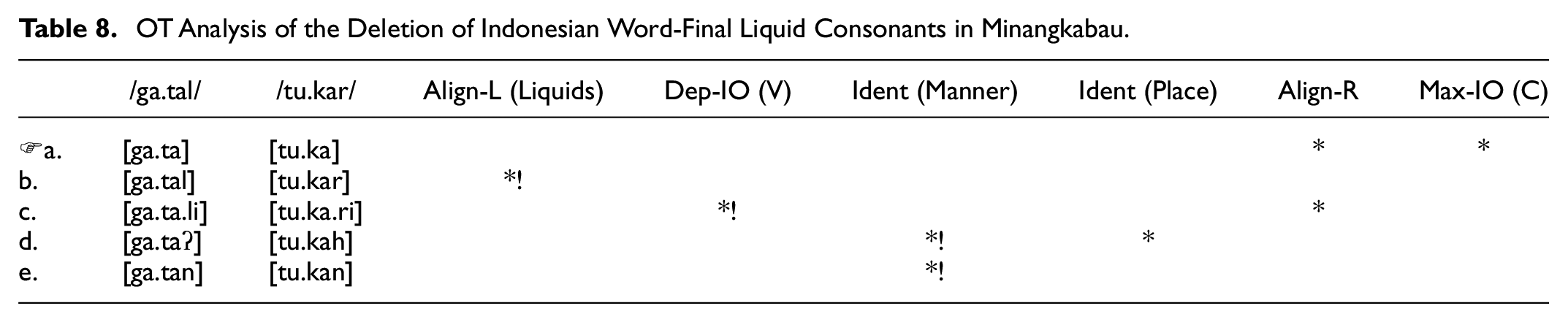
The OT analyses in this section confirm the major role of phonology in loanword adaptation (Paradis & LaCharité, 1997, 2002, 2005; Paradis & Tremblay, 2009), as explained here. First, the observed Minangkabau repairs of word-final Indonesian obstruents and liquid consonants are governed by Minangkabau phonotactics. Therefore, the OT constraints of Align-L (Non-glottalObstruents, σ) and Align-L (liquids, σ), which ensure that the obstruents /p, t, k, s/ and the liquids /r, l/ do not appear in the word-final coda position, are always undominated. To fulfill the restriction against word-final obstruent consonants in Minangkabau, the repair via consonantal debuccalization is triggered, resulting in the inputs /p, t, k/ and /s/ weakening and becoming the glottals /ʔ/ and /h/, respectively. Moreover, in line with the Minangkabau phonotactic constraint, the Indonesian word-final liquid consonants /r, l/ are repaired via consonant deletion in Minangkabau. As a result, such consonant deletion, unlike debuccalization, has an effect on the right alignment of the output (hence, the demotion of the Align-R and Max-IO (C) conditions).
Second, the analyses confirm that the word-final voiceless obstruents are debuccalized into glottal consonants in Minangkabau corroborates Lombardi’s (1999, 2001) phonological position that, in many languages, some Place and Laryngeal features are restricted in the coda position (i.e., Coda Condition). As a result, to meet this phonotactic condition, a process known as neutralization is automatically triggered. For example, in German, syllables cannot end in voiced consonants; therefore, laryngeal neutralization via devoicing takes places, yielding devoiced consonants. Likewise, subject to the same coda condition, syllable-final obstruents with different Place features in languages such as Slave, Burmese, and Kelantan Malay are disallowed; hence, they are neutralized to consonants with an unmarked Place. The latter case of Place neutralization is evidenced in the data analyzed in this paper in which Minangkabau prohibits any Place distinction among the obstruents /p, t, k, s/ word-finally. As a consequence, the bilabial, alveolar, and velar Place distinctions among these coda obstruents are lost in Minangkabau. In other words, these obstruents are automatically neutralized and, thus, appear as the glottals /ʔ/ and /h/ with an unmarked Place (therefore, the Ident (Place) condition is always demoted).
The third piece of evidence drawn out is that adaptation through debuccalization exhibits the preference of Minangkabau phonology to maintain the same syllable count of the input word, preserve input-output manner identity, and keep the right alignment of the output word intact. As a result, neither vowel epenthesis nor consonant deletion is employed to adapt the Indonesian obstruents to Minangkabau constraints (hence, the OT constraints Dep-IO (V), Max-IO (C), Ident (Manner), and Align-R are the highest ranked conditions). In a similar way to the obstruent consonants, the liquid consonants /r, l/ cannot be adapted through vowel epenthesis, or be mapped onto consonants with the same or different place or manner of articulation. Therefore, in this case, Align-L (Liquids, σ), Dep-IO (V), Ident (Manner), and Ident (Place) are always non-violable.
Finally, the purely phonetic approach (Peperkamp, 2005; Peperkamp et al., 2008; Peperkamp & Dupoux, 2003) cannot account for the deletion of post-vocalic liquids /r, l/. Per this approach, these two liquids have strong perceptual/acoustic cues in post-vocalic coda contexts (Silverman, 1992; Yip, 1993, 2006); accordingly, they should be perceived and realized in the adapted output. Contrary to the phonetic prediction, the two liquids in the current study are deleted, by virtue of the restriction against liquids in coda positions and the preference for bisyllabic minimality in Minangkabau phonology. Moreover, while the purely phonetic approach predicts the retention of voiceless obstruents /p, t, k, s/ on the basis of their high acoustic audibility and perceptual detectability in post-vocalic positions (Shinohara, 2006), it does not explain why /p, t, k/ are matched with [ʔ] and /s/ with [h]. In order for the phonetic-only approach to account for the observed adaptations, the process of phonetic adaptation must be driven by phonological constraints. In other words, the phonetic assimilation must interact with other aspects of the native language phonology; in this case, it will be called phonology-based phonetic assimilation. The purely phonetic approach cannot be solely responsible for loanword adaptation based on phonetic details only.
In sum, the findings drawn from this study are important for the following reasons. Firstly, they contribute to the literature on loanword phonology by reaffirming the findings of previous phonology-only research that loanword adaptation is a phonological process, and disprove the claim that it is a phonetically/perceptually motivated operation. Secondly, the findings can add to the Austronesian linguists’, as well as laypeople’s, theoretical understanding of the differences in terms of sounds and syllable structures between Standard Minangkabau and Standard Indonesian. Thirdly and finally, it was hoped that the study findings would fill some research gaps in the under-researched areas of Minangkabau phonology and Minangkabau loanword phonology by investigating (using the OT model) the phonological processes of consonantal debuccalization and deletion that are both triggered to assimilate Indonesian loanwords into native Minangkabau phonology, and this has been achieved.
Conclusion
The paper discussed the phonotactic adaptation of Indonesian loanwords in Minangkabau. The findings indicated that the Minangkabau loanword adaptation is phonologically guided. Minangkabau exhibited a strong tendency to lenite word final obstruents and word-final liquids through debuccalization and deletion, respectively. While consonantal debuccalization and deletion are allowed phonotactic repair strategies in Minangkabau to avoid word-final coda obstruents and liquids, vowel epenthesis is never permissible. This revealed the importance of preserving the same number of syllables in both the input and the output.
Recommendations for Future Research
The following research remains to be conducted in order to confirm and cement the findings of this study. Firstly, while the current study recruited adult participants, it would be important to recruit young participants (between 12 and 17) to determine if these young speakers would employ the same repair strategies used by their adult counterparts. Secondly, it would be interesting to conduct a comparative study to investigate whether or not other Austronesian languages (e.g., Javanese and Acehnese) in the Indonesian archipelago would trigger the same phonotactic repair strategies evident in Minangkabau to adapt native Indonesian loanwords. Thirdly and finally, it is highly recommended that more research is conducted to examine whether the adaptations of word-final obstruents and liquids in foreign words (e.g., Arabic, Dutch, and English) borrowed from Indonesian into Minangkabau would exhibit the same patterns observed in the adaptation of the native Indonesian words.
Footnotes
Appendix 1 List of Elicited Words.

| No | Minangkabau word | English gloss |
|---|---|---|
| 1. | maha | “expensive” |
| 2. | dakek | “near” |
| 3. | luruih | “straight” |
| 4. | tuka | “exchange” |
| 5. | kumpua | “get together” |
| 6. | tipih | “thin” |
| 7. | ampek | “four” |
| 8. | gapuak | “fat” |
| 9. | leba | “width” |
| 10. | barek | “heavy” |
| 11. | tumpua | “blunt” |
| 12. | busuak | “rotten” |
| 13. | lapih | “layer” |
| 14. | iduik | “life” |
| 15. | danga | “listen” |
| 16. | panggia | “call” |
| 17. | tutuik | “close” |
| 18. | banyak | “much/many” |
| 19. | lauik | “sea” |
| 20. | cukuik | “enough” |
| 21. | gata | “itchy” |
| 22. | bareh | “rice” |
| 23. | pendek | “short” |
| 24. | bana | “correct” |
| 25. | sakik | “sick” |
| 26. | aruih | “must” |
| 27. | langkok | “complete” |
| 28. | gadih | “girl” |
| 29. | taba | “thick” |
| 30. | angkek | “to lift” |
| 31. | padeh | “spicy” |
| 32. | gigik | “to bite” |
| 33. | lemba | “sheet” |
| 34. | kulit | “skin” |
| 35. | bata | “cancel” |
| 36. | baliak | “return” |
| 37. | takuik | “fear” |
| 38. | bibia | “lip” |
| 39. | baleh | “to reply” |
| 40. | banjia | “flood” |
| 41. | duduak | “to sit” |
| 42. | tungkek | “a stick” |
| 43. | kasa | “rude” |
| 44. | asok | “smoke” |
| 45. | sampik | “narrow” |
| 46. | boco | “leak” |
| 47. | dompek | “wallet” |
| 48. | pasa | “market” |
| 49. | utak | “brain” |
| 50. | ikua | “tail” |
| 51. | paneh | “hot” |
| 52. | baka | “grilled” |
Appendix 2
Appendix 3 A Sample Transcription Sheet.Participant# 4,female,31 years old.

| No | Rusmali et al. (1985) | Burhanuddin and Zabadi (2013) | Familiar with the word? | Actual Phonetic transcription of the said word | Phonemic representation of the source word | English gloss |
|---|---|---|---|---|---|---|
| 1. | maha | maha | Yes | [maha] | /mahal/ | “expensive” |
| 2. | dakek | dakek | Yes | [dakeʔ] | /dekat/ | “near” |
| 3. | luruih | luruih | Yes | [luruәh] | /lurus/ | “straight” |
| 4. | tuka | tuka | ***Yes | [tuka] | /tukar/ | “exchange” |
| 5. | kumpua | kumpua | Yes | [kumpuәʔ] | /kumpul/ | “get together” |
| 6. | tipih | tipih | Yes | [tipih] | /tipis/ | “thin” |
| 7. | ampek | ampek | Yes | [ampeʔ] | /empat/ | “four” |
| 8. | gapuak | gapuak | Yes | [gapuәʔ] | /gemuk/ | “fat” |
| 9. | leba | leba | Yes | [leba] | /lebar/ | “width” |
| 10. | barek | barek | Yes | [bareʔ] | /berat/ | “heavy” |
| 11. | tumpua | tumpua | ***Yes | [tumpua] | /tumpul/ | “blunt” |
| 12. | busuak | busuak | Yes | [busuәʔ] | /busuk/ | “rotten” |
| 13. | lapih | lapih | Yes | [lapih] | /lapis/ | “layer” |
| 14. | iduik | iduik | Yes | [iduәʔ] | /hidup/ | “life” |
| 15. | danga | danga | Yes | [danga] | /dengar/ | “listen” |
| 16. | panggia | panggia | Yes | [paŋgiә ] | /paŋgil/ | “call” |
| 17. | tutuik | tutuik | Yes | [tutuәʔ] | /tutup/ | “close” |
| 18. | banyak | banyak | Yes | [banjaʔ] | /banjak/ | “much/many” |
| 19. | lauik | lauik | Yes | [lauәʔ] | /laut/ | “sea” |
| 20. | cukuik | cukuik | Yes | [ʧuku әʔ] | /ʧukup/ | “enough” |
| 21. | gata | gata | Yes | [gata] | /gatal/ | “itchy” |
| 22. | bareh | bareh | Yes | [bareh] | /beras/ | “rice” |
| 23. | pendek | pendek | Yes | [pendeʔ] | /pendek/ | “short” |
| 24. | bana | bana | Yes | [bana] | /benar/ | “correct” |
| 25. | sakik | sakik | Yes | [sakiʔ] | /sakit/ | “sick” |
| 26. | aruih | aruih | ***Yes | [aruәh] | /harus/ | “must” |
| 27. | langkok | langkok | Yes | [laŋkoʔ] | /lenŋkap/ | “complete” |
| 28. | gadih | gadih | Yes | [gadih] | /gadis/ | “girl” |
| 29. | taba | taba | Yes | [taba] | /tebal/ | “thick” |
| 30. | angkek | angkek | Yes | [aŋkeʔ] | /anʔkat/ | “to lift” |
| 31. | padeh | padeh | Yes | [padeh] | /pedas/ | “spicy” |
| 32. | gigik | gigik | Yes | [gigiʔ] | /gigit/ | “to bite” |
| 33. | lemba | lemba | ***Yes | [lemba] | /lembar/ | “sheet” |
| 34. | kulit | kulit | Yes | [kuliʔ] | /kulit/ | “skin” |
| 35. | bata | bata | Yes | [bata] | /batal/ | “cancel” |
| 36. | baliak | baliak | Yes | [baliәʔ] | /balik/ | “return” |
| 37. | takuik | takuik | Yes | [takuәʔ] | /takut/ | “fear” |
| 38. | bibia | bibia | Yes | [bibiә] | /bibir/ | “lip” |
| 39. | baleh | baleh | Yes | [baleh] | /balas/ | “to reply” |
| 40. | banjia | banjia | Yes | [banʤiә] | /banʤir/ | “flood” |
| 41. | duduak | duduak | Yes | [duduәʔ] | /duduk/ | “to sit” |
| 42. | tingga | tingga | Yes | [tiŋga] | /tiŋgal/ | “to live” |
| 43. | kasa | kasa | Yes | [kasa] | /kasar/ | “rude” |
| 44. | asok | asok | Yes | [asoʔ] | /asap/ | “smoke” |
| 45. | sampik | sampik | Yes | [sampiʔ] | /sempit/ | “narrow” |
| 46. | boco | boco | ***Yes | [boʧo] | /boʧor/ | “leak” |
| 47. | dompek | dompek | Yes | [dompeʔ] | /dompet/ | “wallet” |
| 48. | pasa | pasa | Yes | [pasa] | /pasar/ | “market” |
| 49. | utak | utak | Yes | [utaʔ] | /otak/ | “brain” |
| 50. | ikua | ikua | Yes | [ikuә] | /ekor/ | “tail” |
| 51. | paneh | paneh | Yes | [paneh] | /panas/ | “hot” |
| 52. | baka | baka | Yes | [baka] | /bakar/ | “grilled” |
Acknowledgements
The author would like to thank both the Deanship of Scientific Research at King Saud University and the Research Center in the College of Language Sciences at King Saud University for funding this research project.
Declaration of Conflicting Interests
The author declared no potential conflicts of interest with respect to the research, authorship, and/or publication of this article.
Funding
The author disclosed receipt of the following financial support for the research, authorship, and/or publication of this article: This article was funded by both the Deanship of Scientific Research at King Saud University and the Research Center in the College of Language Sciences at King Saud University.

Data Availability Statement
Data sharing not applicable to this article as no datasets were generated or analyzed during the current study.