




Abstract
Regional indigenous heritage languages (RIHLs) are in decline in Indonesia, and this problem needs attention from language policy and planning. This study explores a subset of the Indonesian language policy, namely, its acquisition planning. Content analysis and doctrinal method were employed. The sample included national legislations and some regional legislations. The results are as follows. As subjects taught in schools, Indonesian is “compulsory” at all levels; RIHLs are “optional” at primary and secondary levels and “absent” at the tertiary level; English is “compulsory” at the secondary level and “optional” at the tertiary level. As the media of instruction, Indonesian is “compulsory” at all levels; RIHLs are “optional” in very limited cases; English is “optional” at the tertiary level. As languages for mass media, Indonesian is “compulsory”; English is “optional” for specific aims or audience; RIHLs are “optional” for local communities. There are possible “incoherences” among various legislations, that is, the Constitution, some national laws and regulations, and some regional bylaws. To implement constitutional mandate, the acquisition planning may need revision. In the revision, RIHLs may need to be included as mandatory subjects, while some RIHLs may need to be used as the media of instruction and in mass media. Further studies for the revision are recommended.
Keywords
Introduction
Indonesia is a country with a great diversity of 719 languages (Ethnologue, 2019). Consequently, in the efforts to unify diverse ethnic groups and facilitate development, the country’s leaders have pursued various policies, including a language policy for establishing a lingua franca. The policy started even before independence. In 1928, young leaders and representatives in the country declared a pledge, that is, Sumpah Pemuda (Youth Pledge), whose third stanza stated, “We the sons and daughters of Indonesia uphold the language of unity, the Indonesian language” (Sneddon, 2003, p. 102). This declaration, which elevated the Indonesian language as the national and official language, was then endorsed in the 1945 Constitution.
After independence, determined and continual planning has been carried out to develop standard Indonesian language to serve as the national and official language (Alisjahbana, 1976; Moeliono, 1986; Sneddon, 2003). As a result, the language’s position has been well established (Montolalu & Suryadinata, 2007), and it has been used for government administration, business, media, and the medium of instruction (Kohler, 2019). It is understood or spoken by most Indonesian people, although their mastery may vary (Maryanto, 2009; Zentz, 2016). In this regard, while countries like India and the Philippines may still have to persuade some groups within their populations to accept a national official language, Indonesia has achieved a great success (Kaplan and Baldauf (2003).
However, the success comes at a price because a decline has been observed among Indonesian regional indigenous heritage languages (RIHLs). The decline generally occurs through their shift to the Indonesian language, henceforth referred to as Indonesian. The shift has been observed in majority as well as minority languages, such as Sundanese (Sobarna, 2007), Sasak (Wilian, 2010), Javanese (Ravindranath & Cohn, 2014; Setiawan, 2013), and in RIHLs in general (Sugiharto, 2014; Zein, 2020). Complicating the problem is the growing presence of English, in which RIHLs have been pressured by Indonesian, which, in turn, has been pressured by English (Coleman, 2016). Subtractive multilingualism, a situation where the acquisition of a language replaces or marginalizes other languages (Lambert, in Herdina & Jessner, 2002), has taken place, in which the RIHLs have lost to Indonesian and English (Zein, 2019).
The Indonesian language policy has thus produced two diverging outcomes. This situation constitutes a significant language problem, whose solution may require language planning (Haugen, 1972), which, in the present context, may constitute a reconsideration for the language policy. This article aims to offer some contribution in this direction, through developing an argument for the revision of existing language policy, particularly of acquisition planning, for the Indonesian RIHLs. The development is carried out through analyzing and interpreting specific passages from relevant legal documents from language as well as educational specific legislations. The latter refer to the country’s legislations, that is, national acts and their derivatives and regional bylaws, which pertain to educational matters. Then, if incoherences are found among these legislations, an argument could be built for their revision.
To start the discussion, some definition is required for the Indonesian RIHLs. Heritage languages refer to nonsocietal and nonmajor languages that are spoken by linguistic minorities, which could be indigenous or migratory (Fishman, 2001; Valdes, 2005).
1
Various terms exist for these languages, like vernaculars (Nababan, 1991), regional languages (Moeliono, 1986), regional and local languages (Maryanto, 2009), mother tongues and indigenous languages (Sugiharto, 2014), and indigenous languages (Zein, 2020). There is also a formal definition in Act 24/2009, Article 1: 6. Regional languages are the languages that are used from generations to generations by Indonesian citizens in the regions within the area of the Unitary State of Republic of Indonesia.
2
Here, “regional” refers to Indonesian areas while “from generations to generations” points out the heritage nature of these languages. To relate to these different usages, a broad term is used, that is, “Regional Indigenous Heritage Language(s)”.
It has been mentioned that Indonesian RIHLs are in decline. The decline should raise serious concerns for several reasons. First, most RIHLs are relatively endemic or having no speaker bases outside Indonesia. For example, according to Gutman and Avanzati (2013), Javanese was spoken by 95 million people in Indonesia; however, it was spoken in only few other countries, like Malaysia, Suriname, and New Caledonia, with less than 1 million speakers in total. As the number of the RIHLs is large (i.e., 719, per Ethnologue, 2019), their decline or extinction would mean a great loss for world heritage. Second, global awareness has been rising, and calls have been made for their protection and cultivation (UNESCO, 2002), to which Indonesian leadership and community need to respond. Finally, Indonesian language policy and planning (LPP) needs to be grounded in the country’s history and politics. Historically, the Youth Pledge elevated Indonesian as the national language but arguably still carried the spirit of multilingualism. Politically, the same spirit may be maintained in the Constitution, which, being the supreme law, must be adhered to by lower legislations.
Therefore, RIHL decline may raise a question on how the Indonesian LPP addresses the problem. While there have been numerous descriptive studies on RIHLs, few have covered the LPP question. For example, Alisjahbana (1976), Moeliono (1986), and Sneddon (2003) were about Indonesian (language) development. Various studies, for example, Sobarna (2007), Wilian (2010), and Ravindranath and Cohn (2014), devoted their attention to language shift, not to LPP. Others, like Nurhayati et al. (2013) and Zulaeha (2017), explored ways for RIHL maintenance but did not discuss LPP. Rosmaladewi and Abduh (2017) analyzed some government documents for language policy content but did not discuss RIHLs. Still other studies gave some attention to LPP but their focus was on linguistic situation. Setiawan (2013) urged the government to take legal actions to revitalize and maintain RIHLs while Coleman (2016) commented that the overall legal standing of local languages was “precarious” (p. 60).
Among the few studies that have examined the LPP, Kohler (2019) reviewed the Indonesian language education policy through a general analysis of various regulations but did not focus on specific legal passages. She found that local language was marginal while Indonesian was dominant, as the medium of instruction and a subject. Zein (2020) performed a comprehensive review of Indonesian LPP; in this review, he encompassed various planning types and used analysis on language-specific regulations. He found that indigenous languages needed revitalisation and recommended measures for “revitalisation planning” (Chapter 5).
These studies suggest that the present planning is inadequate and that revision may be necessary. However, what still needs exploration is the development of an effective argument to show that the legal standing of RIHLs was “precarious” (Coleman, 2016, p. 60) and to support the required legal actions, as urged by Setiawan (2013). Consequently, there is a need to build an argument with a legal perspective, through analyzing and interpreting relevant legislations. The laws, as reflected in the legislations, are hierarchical and normative. Thus, if incoherence occurs, that is, if a lower tier regulation diverges from an upper tier regulation, then revision is essential, even mandatory.
The significance of legal approach is shown by the following case.
Case: Dissolution of “SBI”
Until 2013, Indonesian regional governments introduced “SBI (Sekolah Bertaraf Internasional)” [International Standard School] program, which was developed on a legal basis provided by Act 20/2003, Article 50, verse 3, which stated, “The Government . . . administer(s) at least one education unit at all levels of education to be developed into an international standard education unit.” The program was implemented through the development of special classes that used English as the language of instruction, for some subjects, at junior and senior secondary schools. However, activists sought to terminate the program by developing an argument that the verse was “incoherent” with the Constitution. Through their lawyers, they challenged it in the Constitutional Court.
The Constitutional Court considered that the program limited equal opportunity for all school children. (The inequality may occur because an English instruction class requires students to acquire fair English mastery; however, Indonesians generally have low English mastery, as reflected by the country’s English mastery rank, which belongs to the “low” category (Education First, 2019)). As such, the program was deemed to be “incoherent” with the spirit of the fourth paragraph in the Constitution, which states, “. . . the Indonesian state government . . . develops the nation’s intellectual life . . .” (The Indonesian Constitution). Thus, through Decision no. 5/PUU/2012 Year 2013, the Court declared that the said verse in U20/2003 was against the Constitution and thus annulled. Since then, the SBI program was abolished. 3
This case revealed that allocation, or negation, of a public domain for a language requires legal basis. Here, allocation for English as the language of instruction in the SBI program could not be sustained because the legal basis for the program was removed. Similarly, allocation of public domains for RIHLs requires legal foundation, if the allocation is to be developed or sustained.
Allocation of public domains for RIHLs is essential for their conservation. In this respect, Barrena et al. (2006), in a study involving 525 languages across the world, revealed that most languages that declined did not have any official recognition. Meanwhile, among languages that increased their speakers, 59% were official and 40% were (co-)official, in which they were given allocations in public domains. These allocations require language policies.
To provide a theoretical foundation, a short review is made for the concept of “language policy” and “language planning,” which are used interchangeably. Cooper (1989) refers to language planning as “deliberate efforts to influence the behaviour of others with respect to the acquisition, structure or functional allocation of their language codes” (p. 45). Judd (1992) defines language policy as the set of statements, objectives, and/or commands that concern languages and are decreed by some institution (usually governmental) over its area of jurisdiction. Kaplan (2013) refers to (a) language planning as an activity, mostly by government, to promote linguistic change in some speaker community and (b) language policy as a set of ideas, laws, regulations, and practices to effect language change in the society, group, or system. Spolsky (2004) refers to the language policy of a community as the set of its language practices, its language beliefs, and its language management, that is, the plan, usually written, to modify or influence the practices. Johnson (2013) defines language policy as a policy mechanism that affects language structure, function, use, and acquisition. The policy includes official regulations, unofficial mechanism, process by agents, and discourse in various contexts.
From the definitions, an umbrella term, that is, “language policy and planning”, is used. This article adopts LPP as defined by Cooper (1989), Judd (1992), and Kaplan (2013), or the management part of Spolsky’s (2004) and the official part of Johnson’s (2013) definitions. Thus, LPP refers to an attempt to affect linguistic change in various aspects, such as language use, acquisition, and structure. This action is usually performed by the government, through various legislations.
LPP comprises three branches (Cooper, 1989; Kloss, 1969; Lo Bianco, 2010; Wright, 2016):
(a). Status planning, which refers to the attempt to set the positions of languages relative to one another, in particular the promotion of what language varieties would become official.
(b). Acquisition planning, which refers to the effort to enlarge the number of users of languages, particularly those designated as official.
(c). Corpus planning, which refers to the attempt to modify or develop language body, such as grammar, vocabulary, and spelling.
Status planning and acquisition planning involve the promotion of language varieties in various domains, especially public domains. Domains, in turn, refer to areas of language use or spheres of (language) activity (Schmidt-Rohr, in Fishman, 1972). Stewart (1968) and Cooper (1989) identify 12 domains of language functions or language uses in society, that is, national official language, regional official language, language in the workplace, language for wider communication, international language, language for literary and scholarly works, group and community language, capital language, religion language, language as subject, language as the medium of instruction and language for mass media. The last three are associated with acquisition planning (Cooper, 1989; Hogan-Brun et al., 2013; Hornberger, 2006).
By itself, legal foundation for language planning does not guarantee implementation or success (Spolsky, 2004). However, in Indonesia, as shown in the case of “SBI” dissolution, policy measures may be difficult to execute or sustain if they have no legal foundation. Discretionary measures by lower authorities, as implied in Spolsky (2004) and Johnson (2013), may also be difficult to initiate or sustain, if they lack legal bases. Thus, while explicit planning may not serve as a sufficient condition, it nevertheless provides a necessary condition for RIHL conservation.
Consequently, it is essential to explore Indonesian legal sources, to find out their allocations of public domains for RIHLs, their coherence and their adequacy. From these, revision(s) could be recommended if necessary. Due to the need to limit the scope, the exploration is limited to acquisition planning, which includes allocations of two domains in education and one in mass media. Language educational policy is significant in language planning (Spolsky, 2017), as language instruction in schools constitutes a significant means, sometimes even the sole means, for language cultivation and protection, in numerous countries (Judd, 1992). Meanwhile, mass media may provide opportunity to learn language(s) (Cooper, 1989). Furthermore, allocations of domains for RIHLs in this planning area, though possibly small, may serve as a seed for further allocations, if revision is necessary.
Objective
This article aims to find out the acquisition planning, or the allocations of public domains in the acquisition areas for languages, particularly RIHLs, as expressed in various legislations, and the planning coherence and adequacy.
Spolsky (2017) maintains that overall language policy could be found in a constitutional clause or in a law dealing with language. Therefore, the first goal is to find out acquisition planning in the Indonesian constitutional stipulations on language. As the Constitution may only provide a general guideline, the second goal is to find out the acquisition planning at the national level, through stipulations on allocations of domains in national legislations. The third goal is to find out the acquisition planning at the provincial level, through stipulations on authority delegation, and examples of stipulations on allocations of domains in several provincial legislations.
The study is limited to the management aspect of the policy, that is, the stipulations (written statements) in various legislations, on language domains. The focus is on national planning and thus there is no exhaustive treatment of regional legislations, which need a separate study. For educational legislations, the focus is limited to those for general schools, as they constitute mainstream education. 4
Method
Hult and Johnson (2015) declare that language policy study incorporates theories and methods from various disciplines, such as law, linguistics, political science, social psychology, and sociology of language, to investigate problems on various policy aspects. Both scholars point out the significance of political theory and law, whether an investigator selects political or legal orientation or employ other methods. Therefore, legal method, while less employed as other methods, may offer its own contribution.
Design
The study analyses the allocation of domains in acquisition planning on RIHLs, through stipulations (written statements) on RIHLs in the country’s legal documents. To analyze and interpret the stipulations, descriptive content analysis was employed (Fraenkel & Wallen, 2009). However, due to the normative and hierarchical nature of laws, as represented in the legal documents, and the need to build an argument for possible revision, doctrinal method was incorporated.
The doctrinal method comprises two parts, namely, (a) locating the legal sources and (b) analyzing and interpreting the relevant texts, to find out the nature and parameters of the law (Hutchinson & Duncan, 2012). The method is similar to the historical textual method (Johnson, 2018), in that it analyses policy documents. It is also similar to the critical approach (Johnson, 2018), in that it could be used to address inequality. However, it introduces a significant element, in utilizing the normative and hierarchical nature of laws, as regarding argument for revision. If incoherence occurs, then (a) due to hierarchy, a lower regulation needs revision, to follow an upper regulation and (b) due to normativity, the revision is essential, even mandatory.
As exposed in “Introduction,” activists tried to terminate the “SBI (International Standard School)” program, with an argument that a verse in Act 20/2003, the legal basis for the program, was against the Constitution. The Constitutional Court approved their case and thus annulled the said verse. Similarly, an argument could be developed in the case of RHILs, if revision of planning is wished, and for this the doctrinal method is required.
Sample
The documents for the study were selected through purposive-criterion sampling (Fraenkel & Wallen, 2009), with language-regulation component as criterion. The relevant legal sources comprise the most recent sources. Older sources, if found to have been replaced by the newer sources, were excluded. As language issues involve language and education, legal sources from both areas were analyzed.
Procedure and Analysis
The study consisted mainly of content analysis of law in language-related legal documentation. Hutchinson (2010) asserts that “The law can be broadly categorized as primary data” (p. 37) and thus analysis of the texts in language-related laws can also be referred to as data analysis. Interpretation and analysis were performed with logical reasoning, which comprises deduction, induction, and analogy (Chynoweth, 2008). The procedure was as follows:
Locating relevant legislations.
Finding stipulations, or written statements, in the articles and/or verses in the legislations that regulated languages, with special attention to RIHLs.
Using content analysis and logical reasoning to isolate key themes and interpret stipulations that were related to language matters.
With respect to the allocations of domains for RIHLs in the stipulations, several categories were established, in which an allocation for a language in a specific legislation may be (a) compulsory or mandatory, (b) optional, either in general or in specific case(s), (c) prohibited, (d) not explicit, (e) nonexistent or absent, and (f) not clear. With respect to relationship among legal sources, the categories include coherent, or connected, and incoherent, or disconnected.
As an example, Act 24/2009, in Article 29, verse 2, stipulates, “The use of the Indonesian language is obligatory as the medium of instruction in national education.” The term “obligatory” indicates that the use of Indonesian in the domain of language of instruction is “compulsory.” Thus, an RIHL could not be used as the language of instruction. Hence, the allocation for RIHL in the domain of medium of instruction is “prohibited.”
With respect to regional language planning authority, some informal interviews were held, with the head and other personnel of Yogyakarta regional language agency. Yogyakarta is selected as it is one of two centers of Javanese language, the largest RIHL in Indonesia. Notes were taken during the interviews, with the focus on possible discretion by the regional government on language matters.
Result
Before analyzing regulations, legislation types and their hierarchy need to be reviewed, as stipulated in Act number 12, Year 2011, as follows:
Article 7
Types and hierarchy of legislations consist of: (a). The 1945 Constitution of the Republic of Indonesia; (b). Decree of People Consultative Assembly; (c). Act/Government Regulation in Lieu of Act; (d). Government Regulation; (e). Presidential Regulation; (f). Provincial Regulation; (g). Regency/Municipality Regulation.
The legal power of the legislations follows the hierarchy as referred to in verse 1.
Article 8
The legislation types other than referred to in Article 7 verse (1) include the regulations that are issued by . . . Constitutional Court . . . Minister . . . Governor . . .
The legislations as referred to in verse 1 . . . have binding legal power as long as they are commanded by higher legislations or established on authority.
Currently, there is no regulation on RIHLs from tiers b and e. Meanwhile, as this article focuses more on national policy, tier g (last) is not discussed. From the remainder (tiers a, c, d, and f), the following legal sources (listed in “References on legal sources”) were found to have language-related passages, particularly to RIHLs. Due to space limitation, only the translations of the passages are included. Moreover, while full quotations are ideal, partial quotations are used, while the passages’ essences are maintained.
The list of regulations on language matters for analysis comprises:
The (1945) Constitution;
National regulations, which consist of the following: (a). Act Number 20 Year 2003, on national education, abbreviated to Act 20/2003; (b). Act Number 24 Year 2009, on language and national flag, symbol and anthem, abbreviated to Act 24/2009; (c). Act Number 12 Year 2012, on higher education, abbreviated to Act 12/2012; (d). Government Regulation Number 57 Year 2014 on languages, abbreviated to GR 57/2014; (e). Various Ministerial Regulations, that is, Ministerial Regulations no. 57/2014 (Number 57 Year 2014) on elementary curriculum, no. 35/2018 on junior secondary curriculum, no. 36/2018 on senior secondary curriculum, no. 60/2014 on vocational curriculum, and no. 232/U/2000 on higher education curriculum; these are abbreviated to MR 57/2014, MR 35/2018, MR 36/2018, MR 60/2014, and MR 232/U/2000, respectively;
Selected provincial bylaws, which comprise: (a). Yogyakarta Province Governor Decree Number 64 Year 2013, abbreviated to B 64/2013; (b). Northern Sumatra Regional Bylaw Number 8 Year 2017, abbreviated to B 8/2017.
To find coherence, analysis is performed on various legislative tiers, that is, the Constitution, national acts and regulations, and some regional bylaws. In quoting legal passages, “Article” is fully written while verse is represented by number in bracket. Thus (3) indicates verse 3.
Acquisition Planning in the Constitution
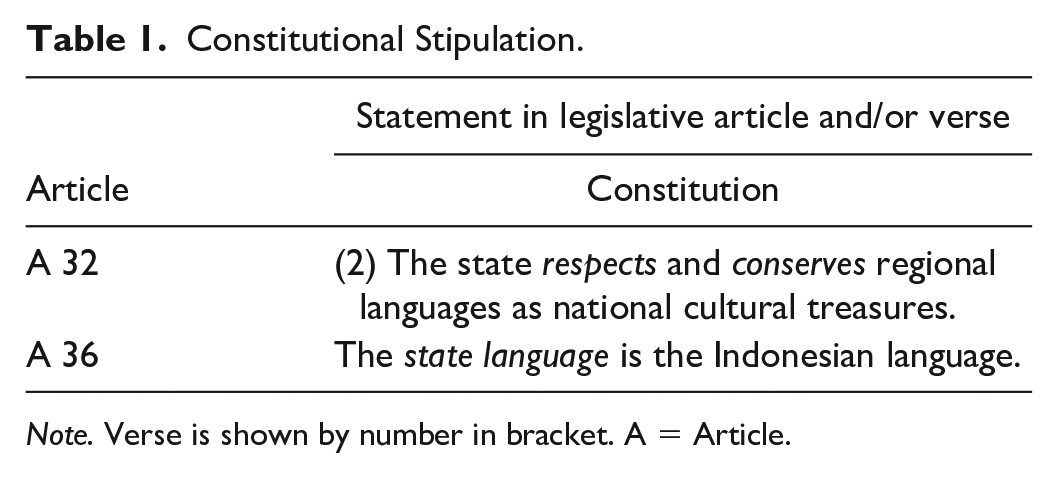
The Constitution offers only a very general guideline on language matters on RIHLs in Article 32, which does not contain any explicit stipulation on allocation of domains (see Table 1). Thus, the allocation of domain for RIHL is “not explicit.” Meanwhile, Article 36 reveals the formalization of the Youth Pledge (third stanza) and elevates the status of Indonesian as the state language.
Constitutional Stipulation.
Note. Verse is shown by number in bracket. A = Article.
Article 32, verse (2) arguably maintains the multilingual spirit of the original Youth Pledge. For the verse, Asshiddiqie (2008) offered his interpretation, which merits serious attention, considering his background as a former Constitutional Court chair. 5 He interpreted that the constitutional verse contains two significant meanings, namely, (a) a reaffirmation that RIHLs constitute national cultural heritages and (b) an obligation for the state and all national components to undertake measures to respect and conserve RIHLs. These, he maintained, could be attained through policies that do not marginalize RIHLs. As marginalization occurs when a language lost its public domains (Crystal, 2000), a conclusion could be drawn that, to prevent the marginalization of RHILs, policies need to endow public domains for them. It remains to be seen whether lower legislations carry out such policies.
Acquisition Planning at the National Level
As the constitution only provides a general guideline, the allocations of domains needs to be explored in national legislations.
Allocation for RIHL in the domain of language as subject
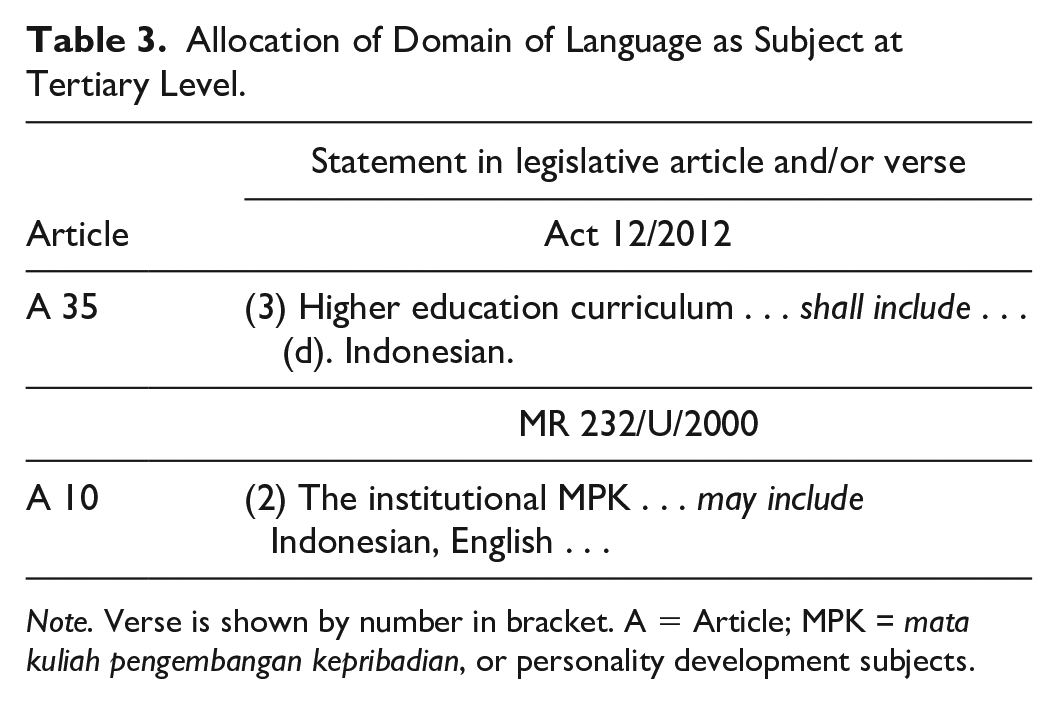
Act 20/2003 obligates the instructions of Indonesian, foreign languages (particularly English), and RIHLs, while GR 57/2014 declares a means for conserving RIHLs, through their instruction at the elementary and secondary levels (see Table 2). Meanwhile, for the tertiary level, Act 12/2012 obligates only Indonesian; however, MR 232/U/2000 declares that courses may include English, while RHIL instruction is “absent” (see Table 3).
Allocation of Domain of Language as Subject for Elementary and Secondary Levels.

Note. Verse is shown by number in bracket. A = Article.
Allocation of Domain of Language as Subject at Tertiary Level.
Note. Verse is shown by number in bracket. A = Article; MPK = mata kuliah pengembangan kepribadian, or personality development subjects.
Previously (see Table 2), Act 20/2003 and GR 57/2014 mandate RIHL instruction at elementary and secondary levels. However, Table 4 reveals that various ministerial regulations on curricula, that is, MR 57/2014 for elementary school, MR 35/2018 for junior secondary school, MR 36/2018 for senior secondary school, and MR 60/2014 for vocational school, only include “mandatory” instruction for Indonesian, English, and “Arts and Culture” and/or “Handicraft,” which supposedly include RIHL(s). In these regulations, time for RHIL instruction (generally up to 2 hours/week) is inadequate (Kaplan & Baldauf, 1997) and is far smaller than those for Indonesian and English.
Weekly Contact Hours for Language Subjects.

Combined with handicraft.
Table 5 indicates that MR 35/2018 contains an important note, which is also found in attachments to MR 57/2014 for elementary school, MR 36/2018 for senior secondary school, and MR 60/2014 for vocational school, respectively. The note conveys significant information, that is, that Indonesian and English are “developed by the central government,” that arts & culture and handicraft are “developed by the central government and may be supplemented with local content” and that “local content may include regional languages.” The information indicates that RIHL instruction is “optional.” As such, these ministerial regulations are “incoherent” with Act 20/2003 and GR 57/2014, which mandate RIHL instruction at elementary and secondary schools.
Attachment to MR 35/2018.

Including Indonesian and English. bIncluding arts and/or handicraft, which belong to local content.
In conclusion, in the domain of languages as subjects, allocations are as follows:
(a). Indonesian is “compulsory” at all educational levels.
(b). English is “mandatory” at secondary levels and “optional” at the tertiary level.
(c). RIHLs are “optional” at elementary and secondary levels but “absent” at the tertiary level.
Allocation for RIHL in the domain of language as the medium of instruction
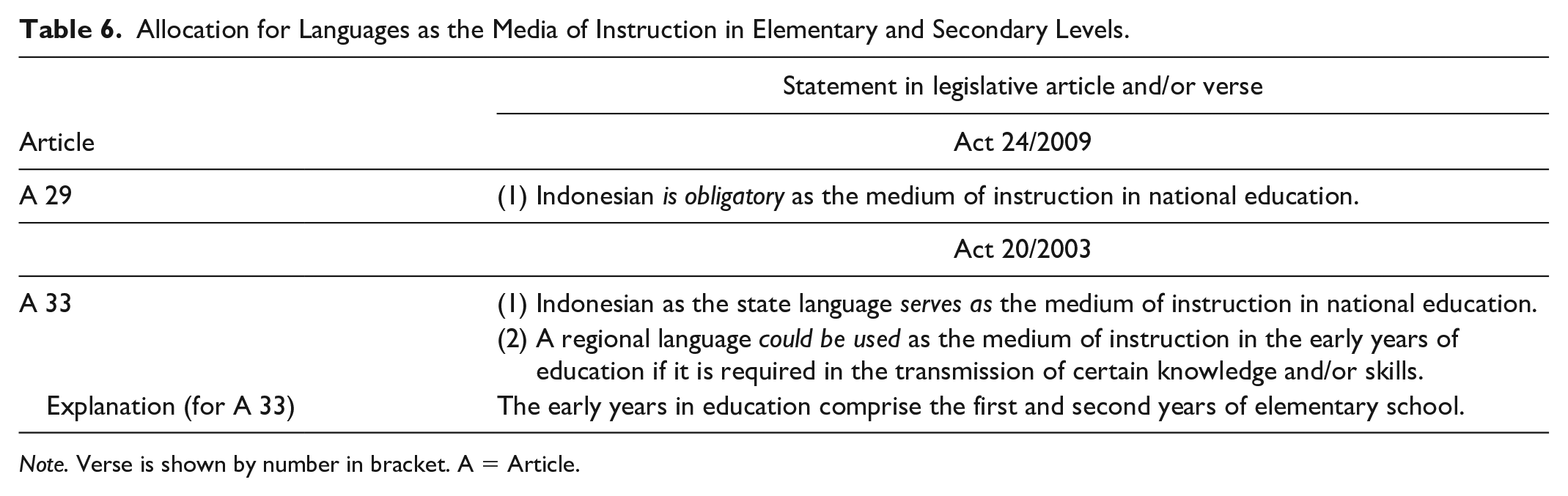
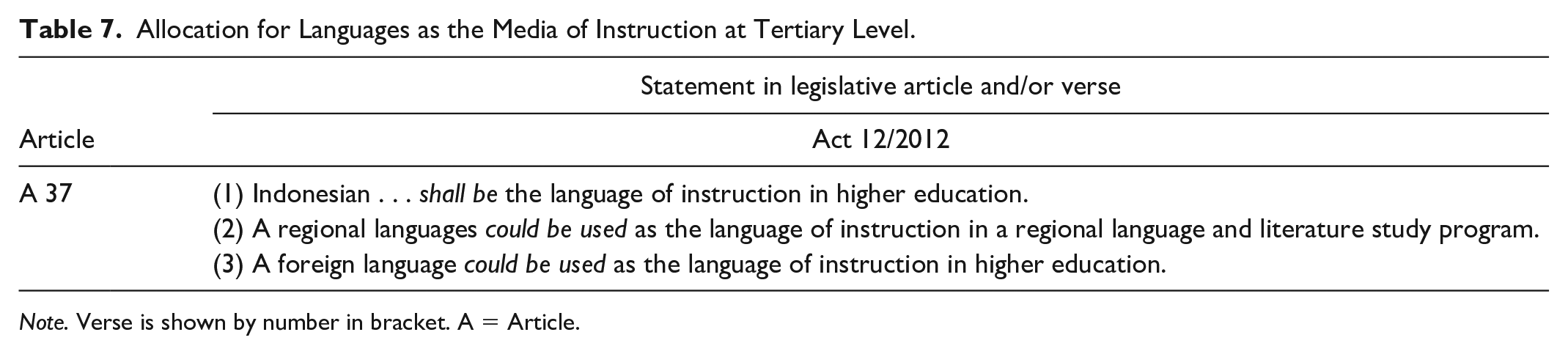
Tables 6 and 7 reveal that Act 24/2009, Act 20/2003, and Act 12/2012, through phrases of “is obligatory,” “serves as,” and “shall be,” declare the obligation of using Indonesian as the medium of instruction at all levels (elementary, junior secondary, senior secondary, and tertiary levels). Act 20/2003 also states that an RIHL “could be used” as the medium of instruction at the first and second grades at elementary level.
Allocation for Languages as the Media of Instruction in Elementary and Secondary Levels.
Note. Verse is shown by number in bracket. A = Article.
Allocation for Languages as the Media of Instruction at Tertiary Level.
Note. Verse is shown by number in bracket. A = Article.
Meanwhile, for the tertiary level, Act 12/2012 states that an RIHL “could be used” for the language of instruction only at the regional language and literature study program, while English “could be used” as the medium of instruction (see Table 7).
Therefore, in the domain of media of instruction, allocations are as follows:
(a). Indonesian is “compulsory” for all educational levels.
(b). RIHLs are “optional” for only very specific cases (Years 1 and 2 at the elementary level and the regional language and literature study program at the tertiary level).
(c). English is “optional” at the tertiary level.
Allocation for RIHL in the domain of language in mass media
In Table 8, Act 24/2009 states that the use of Indonesian “is obligatory” in mass media and that the mass media “could use RIHLs or foreign languages for special objectives or audience.” Meanwhile, GR 47/2014 asserts that regional languages could be used in local mass media.
Allocation for Languages in Mass Media.

Note. Verse is shown by number in bracket. A = Article.
Thus, in mass media, allocations are as follows:
(a). Indonesian is “compulsory.”
(b). English and RIHLs are “optional” for very specific cases.
Summary for allocation of domains
The previous analyses reveal that allocations of domains for RIHLs in national legislations are very limited. Allocation for the domain of language as subject is “optional” and embedded in another subject. There are “optional” allocations in the domains of languages as the medium of instruction and language in mass media; however, these apply only for very specific cases. This situation confirms the “precarious” position of RIHLs (Coleman, 2016, p. 60).
Acquisition Planning at the Provincial Level
To find acquisition planning at the provincial level, first it is necessary to look at delegation of authority to regional governments; then, examples are shown on how some provincial governments exercise the delegation through the allocation of domains in bylaws.
Distribution of authority on language issue
There are two sources; namely, Act 24/2009 and GR 57/2014 (see Table 9).
Distribution of Authority on Language Matters.

Note. Verse is shown by number in bracket. A = Article.
Central government
In these legal sources, RIHL conservation is the responsibility of regional governments. Nevertheless, they need to comply with national laws and work “under the coordination of language agency”; here, the agency refers to Badan Pengembangan dan Pembinaan Bahasa [The Agency for Language Development and Cultivation] of the Ministry of Education and Culture. This could be interpreted that the agency, which consists of a national agency and various regional branches, supervises regional language planning. As the agency and its branches work within the Ministry, they might find it difficult to support certain measures, if these measures go beyond the national parameters. Two cases may provide a clue.
Case: “SBI” dissolution
As mentioned in “Introduction,” up to 2013, various regions established the “SBI” (International standard school) program, with English as the medium of instruction for certain subjects, at secondary schools. However, the Constitutional Court annulled the legal basis for the program and it was terminated.
Case: Decree to use Javanese RIHL in public in Yogyakarta
The Yogyakarta Governor issued Instruction No. 1/Instr/2009, which recommended the use of Javanese (language) at workplaces on a certain day. This instruction comprises a discretionary measure by a regional government in a status planning domain. However, this domain is not allocated to RIHLs, as Act 24/2009 obligates the use of Indonesian in public domains in various articles/verses, for example in Article 33, verse 1 (see Table 10).
The obligation to use Indonesian in formal communication in the workplace.

Note. Verse is shown by number in bracket. A = Article.
To inquire about this discrepancy, some informal interviews were held with the head and personnel of Yogyakarta regional language agency, which, per Act 24/2009, supervises the regional government’s language planning. The interviews were focused on possible discretion by the Yogyakarta regional governor, in particular with respect to the aforementioned decree. The head appreciated the spirit of the decree, as an initiative for the Javanese language conservation. However, he perceived that the decree might not be in line with Act 24/2009. The head wondered in what manner his agency might support the implementation of the decree and that he preferred to wait for further development. Further discussion on this aspect belongs to status planning areas, which is beyond the scope of this article.
These interviews underlined the limited authority of a regional government in status planning and acquisition planning areas, as accorded by national legislations. An example of the limited authority is the power to obligate Javanese instruction in elementary and secondary schools in Yogyakarta province. However, the Yogyakarta provincial government and language agency have wider authority in Javanese corpus planning areas (i.e., the development of Javanese orthography, structure and vocabulary in various levels). In these areas, the provincial government provides support while the language agency publishes its own works and supervises or monitors works that are produced by other publishers. The agency also collects works on Javanese literature and studies on Javanese language and culture. Further discussion on corpus planning is beyond the scope of this article.
It is to be noted that the views of the head and personnel of Yogyakarta regional language agency might not represent the views of the heads and personnel of other regional language agencies. However, Yogyakarta (besides Surakarta) is one of the two main centers of Javanese language and culture, while the Javanese language is the largest RIHL in Indonesia. Thus, the views of these officials might carry some weight. Furthermore, various regional agencies work under the supervision of the national agency, and thus they might share similar opinions.
The incidents of policy discrepancy point out the difficulty of regional language administrators, who have to conserve RIHL but may not have sufficient leeway to do so. To find out how regional governments exercise their authority within the limited corridor, two examples are supplied below.
Allocation in some regional bylaws
Two regional bylaws are explored, that is, B 64/2013, for Yogyakarta province (see Table 11), and B 8/2017, for Northern Sumatra province (see Table 12). In both bylaws, allocation for RIHLs is only available in the domain of subject, with small hours of instruction.
Allocation for Javanese RIHL as Subject in Yogyakarta.

Note. Verse is shown by number in bracket. A = Article.
Allocation for RIHLs as Subjects in Northern Sumatra.
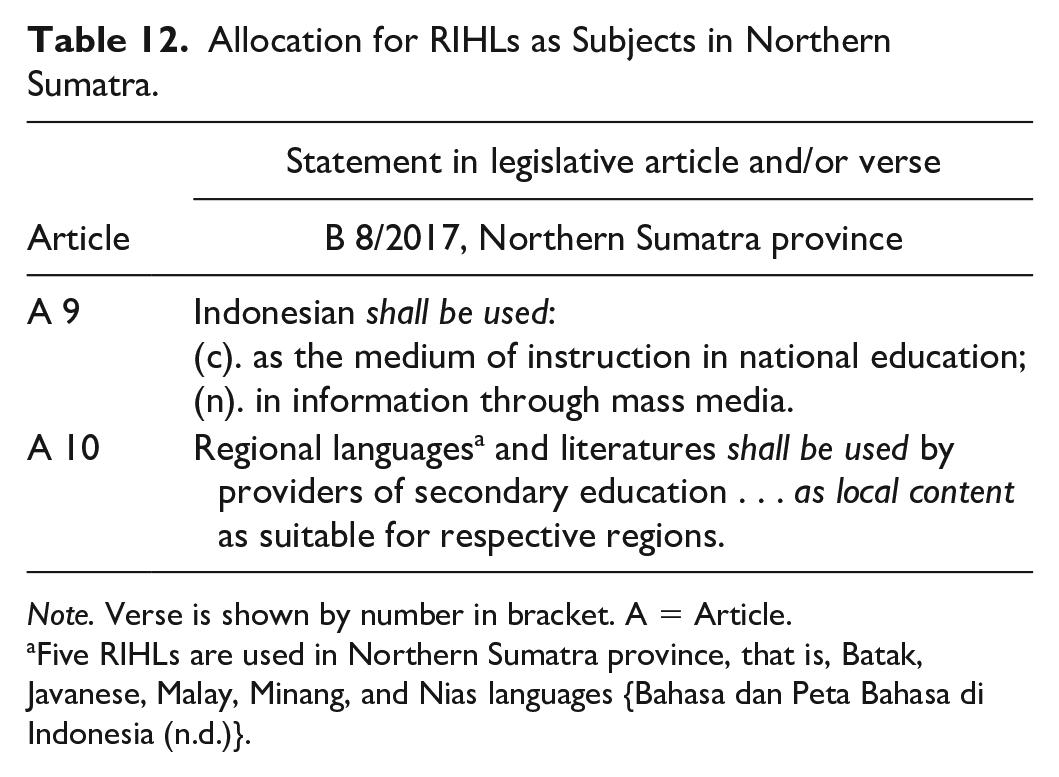
Note. Verse is shown by number in bracket. A = Article.
Five RIHLs are used in Northern Sumatra province, that is, Batak, Javanese, Malay, Minang, and Nias languages {Bahasa dan Peta Bahasa di Indonesia (n.d.)}.
Here, there are “disconnects” among Act 20/2003 and GR 57/2014, which mandates RIHL instruction, various MRs (ministerial regulations), which provide for their “optional” instruction, and these bylaws, which obligate their “compulsory” instruction. As the total number of contact hours is set by the Ministry (of Education and Culture), the “disconnects” may create difficulty for RIHL instruction in the regions. Consequently, other regions may opt for different regulations or even dispense with RHIL instruction. Meanwhile, the second bylaw also confirms the primacy of Indonesian as “mandatory” for the language of instruction and language in mass media.
Discussion
Present Situation
Possible “incoherence” is revealed between the ideal of RIHL acquisition planning as shown in the Constitution, which requires adequate measures for RIHL conservation, and its implementation in lower legislations, which only allocates the domain of language as subject (course) to RIHLs, with little time (generally 2 hours/week). In the use of RIHLs as the subjects of instruction, there are possible “incoherences” among various national and regional legislations, and this may make it difficult for regional administrations to provide for their instruction in schools. The uses of RIHLs as the media of instruction and in mass media are also limited. Such treatment is in contrast with that for Indonesian, which is “mandatory” as a subject (with ample hours), as the medium of instruction, and as the language of mass media. Allocation for RIHL instruction is generally also smaller than that for English.
This situation happens despite the fact that RIHL decline requires serious actions and that calls have been made for willingness to revitalize and conserve RIHLs with comprehensive national policy (e.g., Zein, 2020). Furthermore, while overall legal standing of the RIHLs was still “precarious” (Coleman, 2016, p. 60), the government’s attitude to address the situation was perceived as inadequate (Sugiharto, 2014).
It is important to note from history that Indonesian has successfully developed, from a small minority language to the national official language, through determined planning and continuous effort to spread the language (Moeliono, 1986; Sneddon, 2003). By analogy, if the same measures could be applied to RIHLs, then they could be in a better position. Yet, little evidence shows that the same courtesy is applied to RIHLs.
To understand how the diverging situations could happen, another look at the Indonesian history may provide a clue. As mentioned in “Introduction,” to unify regions and facilitate development, Indonesian leaders establish policies, including a national official language policy. Here, Foulcher (2000) described how the first two presidents established the language policy. To unify the country, especially against separatism, Ir. Sukarno (ruling from 1945 until 1966) instilled strong nationalism; then, General Suharto (ruling until 1998) consolidated the unification and introduced national development. Both supported strong promotion of Indonesian as the national and official languages. During their administrations, Youth Pledge revision was promoted, in which the original stanza (We . . . uphold the language of unity, the Indonesian language), was revised to “. . . we have one language, the Indonesian language” (Foulcher, 2000). It is true that the revision affected only few words; however, the implication was profound, as the multilingual spirit of the original pledge was arguably replaced by the monolingual spirit of the revised pledge. The latter may have led to a language ideology, that is, the set of consensus or agreement that justifies linguistic choice for language users (Spolsky, 2004), that favors monolingualism.
The language ideology may underlie the determined endeavor to develop Indonesian as the language of unity and modernization (Alisjahbana, 1976), through comprehensive and detailed LPP (which encompass status, acquisition, and corpus planning, Moeliono, 1986), and has led to a great success for Indonesian. However, the success comes with a price in the decline of RIHLs (e.g., in Ravindranath & Cohn, 2014).
Complicating the problem is the influence of English, a global language, whose mastery offers prestige and possible benefits in various areas, like higher education, internet utilization, employment in foreign companies, and involvement in tourist industry. Its presence grows in various domains in status and acquistion planning, like language in the workplace, language of instruction, and language in mass media. In community language, people often mix English words to Indonesian (Dharmaputra, 2019), while in corpus planning, English words have been borrowed (Sneddon, 2003).
The English influence in various public domains actually affects Indonesian more, as these public domains are allocated to Indonesian. Nevertheless, the English presence adds additional pressure to RIHLs. For example, young people may prefer to cultivate them than RIHLs. Furthermore, people may choose English over RIHLs for local content or for additional home language, besides Indonesian, rather than RIHLs (Coleman, 2016; Dharmaputra, 2019; Sugiharto, 2014).
It is evident that the present planning is untenable, in view of the fact that the decline of RIHLs requires serious actions, due to their endemic state and that awareness has arisen for their conservation (UNESCO, 2002). Consequently, calls for improvement have been made. For example, Coleman (2016) declared that the country “still lacks a comprehensive language policy” (p. 61), while Zein (2020) called for the promotion of indigenous languages. Furthermore, Setiawan (2013) called for real actions for RIHL conservation through legal means, through reconsideration of legislations, which have served in nation building through monolingualism but may have caused multiple language loss (Kochenov & de Varennes, 2015).
More significantly, the Constitution declares, in Article 32, “(2) The state respects and conserves RIHLs as national cultural treasures.” The Constitution is the supreme law, to which lower legislations need to adhere to (Act 12/2011). Hence, Asshiddiqie (2008) believed that the Constitution obligates the state and all national components to undertake measures to respect and conserve RIHLs, through policies that do not marginalize RIHLs. As revealed in legislation analysis, the very limited allocation for RIHLs in laws and regulations arguably might not represent such policies. Furthermore, the limitation might not keep the spirit of the original Youth Pledge, the historical milestone in Indonesian LPP. As such, policy reconsideration may be in order.
In sum, there is a significant language problem, the solution of which may require language planning (Haugen, 1972), which, in this context, may constitute a reconsideration of the existing language policy. Language policy may create inequality; however, it could also be utilized to redress the inequality, through creating more equal playing fields for RIHLs, by giving more access to RIHLs to public domains (Paulston, 1994; Tollefson, 1991).
Future Direction
Public domains are significant for RIHLs, as heritage languages decline if they lack allocation in public domains and thus losing prestige and utility (Crystal, 2000). This loss might discourage people from cultivating RIHLs and they might choose to raise their children in the language that was more widely used (e.g., Sugiharto, 2014). Furthermore, Barrena et al. (2006) revealed that 99% of the languages that stayed, or thrived, had official or co-official status, as the status endows them with allocation in various public domains. Thus, to stem their decline, RIHLs need more allocations in public domains and these allocations require a legal foundation.
To establish the legal foundation, some legislations, such as Act 20/2003 and Act 24/2009 may need some revisions. Alternatively, additional authority could be granted to regional governments. For example, Bali (also Yogyakarta) might need special status on language and culture (Suwarno, 2017). It is to be noted that in a language policy, whether national or regional, there is a wide range for the allocations of RIHL domains, to reverse language shift. The range extends from Stage 8, which includes the developments of language corpus and speaker groups for a moribund language, to Stage 1, in which RIHLs are fully (co-)official (Fishman, 2006) and thus acquire most or all of the 12 domains (Cooper, 1989; Stewart, 1968). Modest changes, particularly in acquisition planning, may be feasible below Stage 1, through stages that allocate RIHLs with the domains of languages as subject, as the media of instruction and in mass media.
For example, in RIHLs as subjects, various ministerial regulations may need review, as they are “incoherent” with Act 20/2003 and GR 57/2014. Instructional hours might need extension, to provide more opportunity to use the target language (Kaplan & Baldauf, 1997).
Even with such extension language experience is still limited and thus other domains need consideration. Here, inspiration may be drawn from India, which provides wider uses of indigenous languages in public spheres (Indian Constitution). Quoting from Annamalai and Khubchandani, Groff (2007) asserted that, within India’s 114 languages, 47 languages were used as the media of instruction and some minority languages were used as partial media, and that other states produced bilingual programs and textbooks in heritage languages. Furthermore, 87 languages were used for press and 71 for radio.
Concerning Indonesian mass media, support may be needed for printed media in RIHL, as their readership may be small due to their local scope. Furthermore, regulations may be necessary to commit regional radio and TV stations to allocate RIHL programs, whose extent depends on the numbers of RIHL speakers. RIHL use in internet has big potential as internet could reach million users.
Meanwhile, the use of RIHLs as the media of instruction in the country is recommended, at least at the primary level, as such practice may improve students’ language skills, academic performance, and self-confidence (UNESCO, 2016). Hopefully, their prestige and utility may thus increase and community members could be persuaded to cultivate RIHLs at home. In this manner, the RIHLs might be strengthened against pressures from Indonesian and English (e.g., Coleman, 2016). As each Indonesian region may have several RIHLs, regional governments need empowerment for deciding on the languages for the media of instruction, with consideration for expense (Grin, 2003). Such use may be feasible if the speakers are large (above 1 million) but might not be feasible if the speakers are less than 100,000. Suwarno (2014) suggested that (a) majority and minority RIHLs were included as subjects, while (b) majority RIHLs were also used as the languages of instruction, up to a certain level.
Spolsky (2004) points out that an explicit policy or plan does not guarantee implementation or success. However, without the explicit plan, scope for discretion to RIHLs is limited. Consequently, while the explicit plan may not constitute a sufficient condition for RIHL conservation, it nevertheless provides a necessary condition for further conservation measures. Hence, further discussions, studies, and actions need to be generated, in the government and among scholars and the community, to find means for more domain allocations for RIHLs. The LPP success in developing Indonesian as support for unification and development is acknowledged. However, as these original aims have been reached (Zein, 2020), it may be high time to turn attention to RIHLs.
It may be fitting to close the discussion by reiterating the consequence of the lack of RIHL language policy and the urgency for such a policy, as declared by Sugiharto (2013), Yet, it is more plausible to argue that the threat of local language extinction is due to the sheer absence of minority language policy. With the absence of this policy, the protection of minority languages amid competition from other languages could not be assured. (para. 4). Thus, the creation of an indigenous language policy is vital not only for the maintenance or preservation of language diversity and the protection of the rights of those speaking minority languages, but most importantly for national cultural strategies. (para. 12).
As a final note, measures for RIHL conservation need multidiscipline approaches from political, legal, and linguistics aspects. For example, sociolinguistics and psycholinguistics have been developed through the incorporations of principles from sociology and psychology. To deal with language issues in legal areas, principles from legal study needs to be incorporated, perhaps in a new branch, lego-linguistics.
Limitation and Suggestion
The writer is aware that this article is limited to the LPP management aspect, that is, the regulations, in acquisition planning. For a comprehensive perspective on Indonesian LPP, further exploration is needed on status planning. Furthermore, language policy includes practice, ideology, and management (Spolsky, 2004); it also includes laws, unofficial mechanism, and discourse at various levels (Johnson, 2013). For policy revision, further studies are required to explore views among other stakeholders, especially those who could influence the policy, and to find ways for persuading change and effecting revision.
Conclusion
Studies show that RIHLs are in decline, that their legal standing is weak, and that national legal action is necessary. From analysis, the following conclusions could be drawn.
Historically, the Youth Pledge carried a multilingual spirit. Politically, the Constitution reveals a spirit of multilingualism in its acquisition planning, through its stipulations. It could be argued that these stipulation call for adequate measures for conservation of RIHLs, including more allocations of domains for them.
However, the national acquisition planning, as shown in stipulations for domains at national legislations, shows very limited allocations for RIHLs in various domains. In the domain of language as subject, there are wide gaps in allocations among languages. Indonesian is “compulsory” at all levels, with time allocation far greater than that for RIHLs. English is “mandatory” at secondary levels and “optional” at the tertiary level; its time allocation is smaller than that for Indonesian but still generally larger than that for RIHLs. RIHLs are “optional” at primary and secondary levels and “absent” at the tertiary level. Concerning RIHL, “disconnect” exists between certain acts and government regulations and various ministerial regulations. Meanwhile, in the domain of language of instruction, Indonesian is “compulsory” as the sole language of instruction at all levels. English is “optional” at the tertiary level. RIHLs are “optional” for very limited cases (i.e., for Grades 1 and 2 and the regional language and literature study program). Finally, in the domain of language in mass media, Indonesian is “compulsory” as the sole language in general. English is “optional” for specific aims or audience. RIHLs are “optional” for local communities.
As for acquisition planning at the provincial level, the regional governments are obligated to conserve RIHLs; however, they need to work “under the coordination of the language agency.” Their authority is limited as national laws allocate very few domains for RIHLs. Some regional governments provide “compulsory” RIHL instruction; however, local schools may find it difficult to carry out the provision, as the curricula are mostly centralized. Limited interviews with the head and personnel of Yogyakarta regional language agency confirmed that the regional government and language agency have limited authority on status and acquisition planning. However, they have wider authority on corpus planning.
In sum, Indonesian acquisition planning on RIHLs reveals some “incoherence” between the Constitution and national legislations. As the Constitution is the supreme law, its mandate needs to be followed. There are also possible “incoherences” among various national legislations and regional legislations.
In view of the “incoherences,” some legislations may need revision. In the revision, RIHLs need allocations in more public domains; various legislations need to be amended in order that RIHL could (a) get longer hours for instruction, (b) be used use as the language of instruction, and (c) be used in mass media. Further studies and actions are recommended on exploring the views of those who could influence the policy and on finding ways to persuade for change and effecting revision.
Footnotes
Declaration of Conflicting Interests
The author(s) declared no potential conflicts of interest with respect to the research, authorship, and/or publication of this article.
Funding
The author(s) disclosed receipt of the following financial support for the research, authorship, and/or publication of this article: The author is grateful for the financial support from the University of Bengkulu for the publication of this article.
