




Abstract
This article tackles a phenomenon in Urban Jordanian Arabic (UJA) where young individuals (mainly females) in Amman, the capital of Jordan, add the Arabic suffix -ɪk, which is glossed as second female singular or as a possessive pronoun, to English loanwords to sound more “modern,” for example, “I love you” becomes [lʌvvɪk]. Through examining the data, two initial hypotheses were formalized, namely, when the Arabic suffix -ɪk is added to English monosyllabic words which have a short vowel in the nucleus (e.g., love), the coda is geminated. However, if the word is disyllabic (e.g., mobile) or monosyllabic, but has a long vowel (e.g., juice) or a diphthong (e.g., face) in the nucleus, no gemination occurs. This article analyzes this phenomenon based on hierarchical syllable structure, metrical phonology, and optimality theory.
Introduction
The high status of English in Jordan has been attested for decades (Hamdan & Abu Hatab, 2009). It has been observed that the degree of one’s knowledge of English in Jordan, in general, and Amman, the capital, in particular, is viewed as prestigious (Hamdan & Abu Hatab, 2009). As a result, many English loanwords have been integrated into Urban Jordanian Arabic (henceforth UJA), a dialect spoken in Amman. This article takes a closer look at one phenomenon, which is particularly pervasive among young girls (15-23 years) in Amman. These girls add the Arabic suffix -ɪk, glossed as second female singular and used as an object pronoun as in [lʌvvɪk] “I love you” or as a possessive pronoun as in [feɪsɪk] “your face,” to English loanwords to sound more “modern” and “cool.” 1 Through observing the data, I formalized two initial hypotheses: (a) When the Arabic suffix -ɪk is added to English monosyllabic words that have a short vowel in the nucleus (e.g., love), the coda is geminated. (b) In contrast, if the word is disyllabic (e.g., mobile) or monosyllabic, but has a long vowel (e.g., juice) or a diphthong (e.g., face) in the nucleus, no gemination occurs. This article examines and analyzes the data to test whether these hypotheses are borne out throughout the data. The theoretical framework of this article is based on the hierarchical syllable structure as outlined by Kiparsky (1981) and Selkirk (1982), metrical phonology as discussed by Hayes (1995) and Watson (2002), and finally Optimality Theory (henceforth OT) as discussed in the work of Prince and Smolensky (2008).
Background
UJA
Arabic is a Semitic language spoken in North Africa, most of the Arabian Peninsula, and other parts of the Middle East. Modern Standard Arabic (henceforth MSA) is currently the only official form of Arabic and has no speech community. Spoken Arabic includes several dialects, such as Jordanian Arabic (henceforth JA), which is spoken in Jordan by more than 9 million people. Three dialects of JA are spoken: the Northern dialect, the Bedouin dialect, and UJA (see Rakhieh, 2009; Zibin, 2016a, 2016b, 2018; Zuraiq & Zhang, 2006). These dialects are classified as VC dialects by Kiparsky (2002). This type of dialect resolves a CC consonant cluster (geminate) by inserting a vowel preceded by a glottal stop in onset clusters (Kiparsky, 2002). This article focuses mainly on UJA, which is spoken mostly in Amman by approximately 2.2 million people. The next section provides an overview of loanwords and their adaptation into the target language.
Loanwords
Borrowing takes place when a particular language incorporates vocabulary from another language in its vocabulary system. These words are referred to as borrowed or loanwords. As a result of foreign language instruction and contact with other languages through media (i.e., television, Internet, and social media), certain words from a source language start to find their way into a target language (Winford, 2002). Different analyses of the adaptation of loanwords into the target language have been proposed in the past two decades. For instance, after examining L2 large corpora of English and French loanwords in different languages, LaCharité and Paradis (2005) argue that the adaptation of loanwords into the target language is driven by phonology rather than phonetic approximation. The latter can be defined as attributing loanwords adaptation to the L1-referenced perception of the phonetic form of a foreign word. Scholars who adopt the phonetic approximation view (e.g., Silverman, 1992) argue that the acoustic signal of the borrowed foreign sound is often interpreted through a perceptual system. This system is mainly attuned to the phonetic rules of the source language L1, and that is why the foreign sound is often incorrectly interpreted from the perspective of the target language L2 (LaCharité & Paradis, 2005). However, this phonetic view is rejected by LaCharité and Paradis (2005), who propose that loanwords adaptation is based on L2-referenced perception of L2 phonemes and is not simply a case of misinterpretation of the surface form of the foreign word. The analysis of the adaptation of foreign words into L2, thus, can provide insights into phonological theory, in particular, the syllable structure and the constraints of the borrowing language (LaCharité & Paradis, 2005). The two researchers do not conclude that phonetics is irrelevant; on the contrary, they argue that as borrowed words adaptation is phonological, it will conform to phonetic principles. The two views will be referred to in the discussion (see section “Data Analysis”).
Several studies have investigated the integration of English words into different varieties or dialects of Arabic (e.g., Al-Btoush, 2014; Alsadeqi, 2010; Hafez, 1996). In Amman, several words from English and other languages have been integrated into UJA. Based on my observation as a female UJA speaker, female university students may use English loanwords more than their male counterparts. This is because using English is viewed as prestigious by females. For example, in a study conducted by Al-Btoush (2014), the female respondents indicated that they use English words such as Internet, IPhone, missed call while speaking in Arabic (i.e., code-mixing) because they want to sound more “modern” and, in some cases, because these words have no equivalent in Arabic. However, in this study, the loanwords used by young individuals (mostly females) do have an equivalent in Arabic. For instance, the Arabic equivalent of [missak] “I miss you (masculine)” is [ʔəʃtɑʔtəllak] “I miss you (masculine).” 2 I would argue that these girls use the English word with an Arabic suffix rather than the Arabic word itself as an identity marker as a form of slang, aiming to show that they are so acquainted with the English language to the extent that they can manipulate English words. However, this issue will not be discussed here any further as it is beyond the scope of this article. A sociolinguistic investigation of this phenomenon can provide insight into the Jordanian community and the linguistic characteristics pertinent to it. The next section provides a background on the syllable structure.
The Structure of the Syllable
The term “syllable” does not even appear in the index of the book that established the field of phonology, The Sound Pattern of English (henceforth SPE) by Chomsky and Halle (1968). However, in later years, the importance of the syllable has been recognized in phonological organization of language (Selkirk, 1982). It has been observed, for instance, that children seem to be aware of the syllable (e.g., in the babbling stage) from a very early age (Pullen & Justice, 2003; Spencer, 1996). The fact that the syllable can be represented in a hierarchical structure or tree diagram cannot be found in SPE in which the representation of the phonological information related to a word consists of a single line of structure (Katamba, 1989; Spencer, 1996). However, the hierarchical syllable theory cannot accommodate the linear approach due to the importance of the hierarchical structure in phonology. This structure is important for two reasons; first, a great number of phonotactic constraints apply to the syllable, that is, /kn/ is not a possible way to begin an English syllable. Second, the syllable plays an important role in the organization of phonological rules, such that epenthesis is found in languages where the morphology combines morphemes that result in impermissible consonant clusters in the onset or coda (Selkirk, 1982; Spencer, 1996). In sum, understanding the syllable structure is crucial for understanding the phonological organization of language (Itô, 2018). Following Kiparsky (1981), the syllable is viewed as made up of small units that are arranged hierarchically. The following figure shows the syllable structure of the word mats:

The word mats comprises one syllable. It can be observed that the syllable branches into two nodes, Onset (O) and Rhyme (R). The latter, in turn, branches into two other nodes, the Nucleus (N) and the Coda (C) (Selkirk, 1982). All syllables must have a sound that functions as a nucleus, which is usually a vowel (Itô, 2018). The other two constituents, the onset and coda, are optional. Hence, the nucleus is the only obligatory part of the rhyme; in other words, it is the head of the syllable (Selkirk, 1982). This is because words that do not contain a coda (cow [kaʊ]), an onset (ant [ænt]), or both (eye [aɪ]) can be found in many languages (Selkirk, 1982). This hierarchical structure is adopted in the current article to analyze the data. The next section sheds light on syllable structure in Arabic, in general, and in JA, in particular.
Syllable Structure in UJA
The structure of the syllable in Arabic has been discussed extensively in the relevant literature (see Abu-Salim, 1982; Al-Ani, 1970; Btoosh, 2006; McCarthy, 1979a, 1979b, 1980). The following syllable types in Arabic are the possible ones. Examples are provided from UJA: 1) CV 2) CVV 3) CVC ra. 4) CVVC ba.raa. 5) CVCC 6) CVVCC
Examples (1) to (6) show that all syllable types identified in the literature exist in UJA. While CV is a light syllable, CVC and CVV are heavy ones and CVCC, CVVC, and CVVCC are superheavy syllables (see Watson, 2002). McCarthy (1979a, 1979b) explains that the syllables in Examples (1) to (3) can be described as unmarked based on their distribution. This is ascribed to the fact that these three types are used more than the other three types, that is, CVVC, CVCC, and CVVCC. Similar to other Arabic dialects, UJA requires that there should be at least one consonant in the prevocalic position (see Btoosh, 2006). But, it is not possible to have a branching onset in UJA. Thus, UJA allows simple onsets only. Another observation relates to the number of consonants permitted in UJA codas. It can be seen that the syllable coda may consist of one consonant, for example, CVC and CVVC. On the contrary, it may not contain any consonants, for example, CV and CVV. However, no more than two consonants are allowed in the coda, for example, CVCC (McCarthy, 1979a, 1979b). Finally, with regard to syllable weight, UJA syllables are maximally bimoraic suggesting that they contain two moras (a unit that measures syllable weight) only (cf. Watson, 2002). The next section discusses metrical phonology theory which is adopted in the analysis of data in this article.
Metrical Phonology
Metrical phonology was originally proposed by Liberman (1975) and further developed and expanded by Liberman and Prince (1977), Selkirk (1980), and Hayes (1981, 1995). This theory is the branch of linguistic theory which deals with stress in natural language. It is distinct from other phonological theories in that it proposes a hierarchal structure similar to those structures employed in discussions of poetic meter which explains the name “metrical theory.” Metrical phonology proposes a set of constituents which can be built over a string of syllables. This set of constituents as well as the algorithms which are available to assign these constituents to strings constitute the essence of this theory (Hammond, 1995). The most important notion stipulated by this theory is the metrical foot. This notion can be defined as the rhythmic structure of a word. Feet are the units which allow phonologists to describe stress patterns. In every foot, there is one syllable characterized by being more prominent or stronger than the other syllables. This syllable is referred to as the strong syllable, whereas the other ones which are less prominent are referred to as weak syllables (Nübling & Szczepaniak, 2008; Watson, 2002). The majority of versions of metrical theory discuss two types of feet, namely, iambs and trochees. In iambic feet, “elements contrast in duration naturally from groupings with final prominence” (Hayes, 1995, p. 80). Put differently, an iambic foot dominates two syllables and assigns stress to the second one. Hayes (1995) defines trochaic feet as “elements contrasting in intensity from groupings with initial prominence” (p. 80). Hence, a trochaic foot is left-dominated. That is, a trochaic foot dominates two syllables and assigns stress to the first one. According to Watson (2002, p. 84), under metrical phonology theory, a metrical structure which is defined as “a hierarchy of rhythmic beats grouped into a hierarchy of constituents” can be provided. This hierarchy of layers includes the word, foot, syllables, and moras. Such a structure gives a clear picture of phonological units of the data the researcher is interested in (see Figure 12 in section “Data Analysis”). Assigning feet either to words or phrases outlines a phonological system that makes a distinction between stressed and unstressed syllables (Hammond, 1995). Metrical stress can be presented using a metrical grid, in which the most prominent unit would be dominated by the most number of *’s (Hayes, 1995), as in the following metrical grid of the word metri’cality: Line 2 * Line 1 * * Line 0 * * mə trɪ
Note that the metrical structure is non-exhaustive (it does not need to exhaust all the syllables in a word). In other words, some syllables may not count in the metrical structure (Hayes, 1995). 3 Under peripherality condition, a constituent may be extrametrical only if it is on the (left or right) edge of its domain (Hayes, 1995). The analysis in section “Data Analysis” adopts this theory to account for stress in English loanwords in UJA. The next section discusses OT.
OT
During the 1990s, OT became one of the most prominent theories in the theoretical linguistics scene. It was introduced by Prince and Smolensky in 1991 and later developed by many researchers (e.g., Bermúdez-Otero, 2006; Kiparsky, 2015; McCarthy, 2002). Prince and Smolensky developed ideas which were present in linguistics, but they provided them with new characteristics, changing our understanding of grammar. OT established a dichotomy between the operational component of the grammar, on one hand, and the constraint component, on the other (McCarthy, 2007). The former component, referred to as GEN, generates a number of candidate output forms which deviate from the input in different ways. The latter component, referred to as EVAL, selects a number of these inputs generated by GEN to be the actual input of the grammar. Under OT, it is hypothesized that constraint ranking is the only way in which grammars differ. Thus, the essence of any OT analysis consists of a collection of constraint rakings followed by a logical justification for these rankings (McCarthy, 2007). Generally, a ranking can be justified by comparing two output candidates derived from the same input. One of these candidates, referred to as the winner, is the observed output for that input in the language under examination. In contrast, the other candidate is regarded as the loser. Even though it is derived by GEN and taken from the same input, it is not the most harmonic candidate based on EVAL (McCarthy, 2007). In order for EVAL to choose the most harmonic candidate as the winner, some constraints which favor the winner over the loser should dominate every constraint which favors the loser over the winner (McCarthy, 2007). Arguments pertaining to constraint ranking rely on this logic. There are two types of constraints under OT, namely, markedness and faithfulness constraints. In the former type, the constraints are concerned with the well-formedness of the output, for example, complex consonant clusters are not good, whereas the latter require that the output of the grammar resembles its input (Prince & Smolensky, 2008). Due to the fact that markedness constraints exhibit preference of some linguistic structures over others, they often compete with faithfulness constraints whose job is to resist modifications to input structures. This competition is referred to as constraint conflict. Such conflict is resolved in OT through ranking. The selection of the optimal candidate or the winner relies on satisfying the top-ranked constraints as the violation of such constraints results in ruling out other candidates (McCarthy, 2007). This analysis is adopted in this article to analyze English loanwords in UJA. The following section presents the data analysis.
Data Analysis
Syllable Structure and Metrical Phonology Analysis
As mentioned before, this article focuses on one phenomenon, whereby an Arabic suffix –ɪk, glossed as second female singular or as a possessive pronoun, is attached to an English word (usually either a noun or a verb). For instance, “I miss you” becomes [mɪssɪk], “your lip (masculine)” [lɪbbak], 4 “your ring” [rɪŋggɪk], 5 “your juice” becomes [dʒuːsɪk], “your mobile” becomes [mo:baɪlɪk]. The data in this article were collected via face-to-face interviews with 12 Jordanian females (speakers of UJA) who study at the University of Jordan, Amman (see Zibin & Altakhaineh, 2018). The mean age of the participants was 20. I selected the sample randomly by walking through campus and interviewing females who live in Amman (approximately for 10-15 min), asking them how they would say the target expressions and whether they use the English loanword inflected with Arabic morpheme. The interviews were recorded and transcribed for data analysis purposes. Initially, 25 words were collected but only some examples are analyzed in this article due to word limitation. By exploring the data, the following hypotheses were formalized:
The analysis of the data aims at testing the above-mentioned hypotheses. First, the syllable structure of some monosyllabic words that have a short vowel in the nucleus is analyzed, showing the underlying and the surface representation of each word. Second, monosyllabic words with a long vowel or a diphthong in the nucleus are analyzed, and finally, disyllabic words. The underlying representation of [lʌvvɪk] “I love you” is /lʌvɪk/; this is shown in Figure 1.

Underlying representation /lʌvɪɪk/
When actually pronounced, /lʌvɪk/ “I love you” surfaces as [lʌvvɪk]. Love is a monosyllabic word that has a short vowel /ʌ/ in the nucleus. Thus, when the Arabic suffix -ɪk is added to it, the /v/ is geminated yielding [lʌvvɪk].
The controversy on how to represent geminates cross-linguistically revolves around making a distinction between the geminate and its singleton counterpart (Davis, 2011). The fact that Chomsky and Halle (1968) envisage a geminate as a single consonant, which has the feature [+long], has been deemed insufficient by other linguists (Davis, 2011). This is because long consonants can behave like a sequence of two consonants for certain phenomena (Davis, 2011). In linear phonology, geminates are viewed either as a long consonant or a sequence of two identical consonants. However, this is considered a dilemma as no clear-cut boundary has been drawn to distinguish between the two (Davis, 2011). This problem has been treated in nonlinear phonology or autosegmental phonology. This has been achieved by proposing another representation of geminates, in which a single consonant is linked to two slots on the skeletal tier (Spencer, 1996). This is due to the Obligatory Contour Principle (henceforth OCP), which prohibits the juxtaposition of two identical sounds (Goldsmith, 1979). This can be seen as follows:
1.  (geminate)
On the contrary, autosegmental phonology treats single consonants as follows:
2.  (single consonant)
With regard to moriac representation, geminates have been viewed as being underlyingly heavy or moraic, whereas single consonants are underlyingly nonmoraic (Hayes, 1989). This analysis can be seen as follows:
3. Underlying moraic representation of geminates and single consonants

In terms of the syllable structure, two analyses have been proposed for geminates. In the first approach, geminates have been viewed as a case of consonant rearticulation by Delattre (1971). In this scenario, the first consonant of the geminate occupies the coda, whereas the second occupies the onset of the following syllable (Delattre, 1971). In this view, geminates are different from their singleton counterparts in that geminates have two stages of articulation (Delattre, 1971). This analysis can be seen in Figure 2.

Surface representation [lʌvvɪk].
In another approach and in a manner similar to that of the autosegmental approach (e.g., McCarthy, 1979) in which geminates are seen as a single consonant that is attached to two C-slots on the skeletal tier (see Example 1), geminates have been viewed as a single consonant which occupies the coda of the first syllable and the onset of the second syllable simultaneously (Hayes, 1989,). This analysis can be seen in Figure 3 where /v/ is attached to the coda of the first syllable and to the onset of the second syllable at the same time.
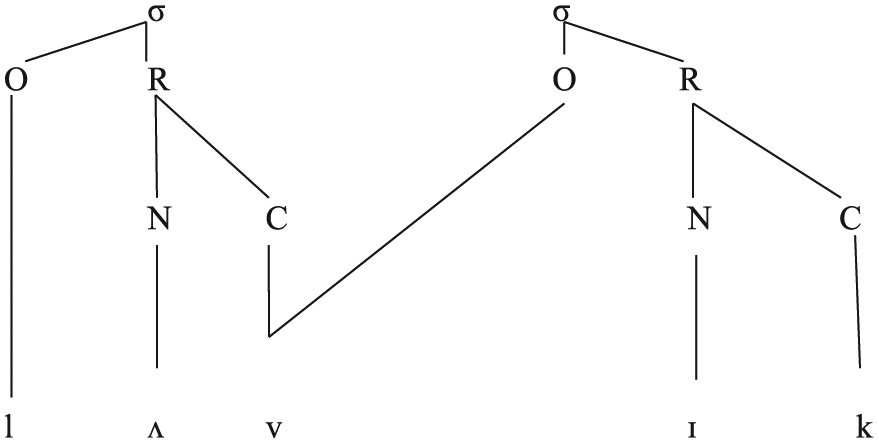
Surface representation [lʌvvɪk].
This phenomenon in which a consonant belongs to the preceding and following syllable at the same time (when one segment is dominated simultaneously by two nodes) is called ambisyllabicity (Selkirk, 1982). As mentioned before, the linear approach has some problems, especially in distinguishing between geminates and their singleton counterparts. Therefore, the above analysis (Figure 3) is the one adopted in this article as it is compatible with autosegmental phonology approach where two adjacent identical segments are not allowed under OCP.
In addition to English verbs, the Arabic suffix -ɪk can also be attached to nouns, for example, ring. Figure 4 shows the underlying representation /rɪŋgɪk/ “your ring.”

Underlying representation /rɪŋgɪk/
However, in actual speech, /rɪŋgɪk/ surfaces as [rɪŋggɪk]. Figure 5 shows the surface representation.

Surface representation [rɪŋggɪk].
The reason for the gemination is explained in the remainder of this section. Moving to monosyllabic words that have a long vowel in the nucleus, when the suffix -ɪk is added to such words, for example, juice, /s/ is not geminated. For instance, in [dʒuːsɪk] “your juice” no gemination occurs. Figure 6 demonstrates the underlying representation /dʒuːsɪk/.

Underlying representation /dʒuːsɪk/
When actually pronounced, /dʒuːsɪk/ “your juice” surfaces as [dʒuːsɪk] without any changes. This can be seen in Figure 7.

Surface representation [dʒuːsɪk].
Similarly, when the suffix -ɪk is attached to monosyllabic words that have a diphthong in the nucleus, for example, mouth, no gemination occurs as shown in Figure 8.
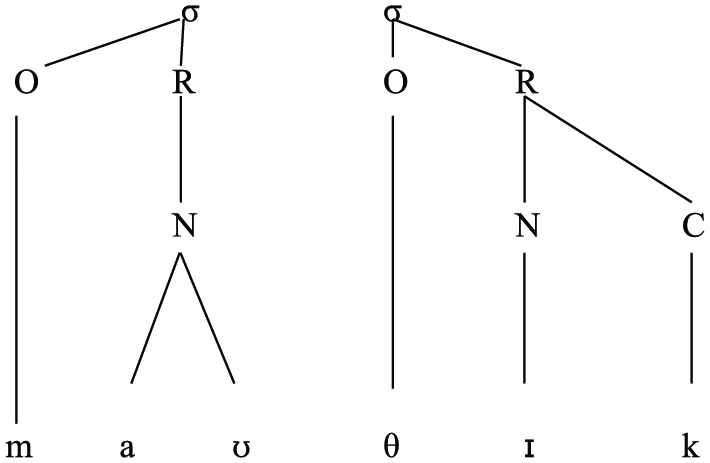
Underlying representation /maʊθɪk/
When pronounced in actual speech, /maʊθɪk/ “your mouth” surfaces as [maʊsɪk] as shown in Figure 9. 6

Surface representation [maʊsɪk].
Figure 9 shows that /θ/ which surfaces as [s] is not geminated. 7 The same can be observed with disyllabic words such as mobile. The surface [mo:baɪlik] representation is identical to the underlying one where the /l/ is not geminated. Figure 10 shows the surface representation [mo:baɪlɪk].

Surface representation [mo:baɪlɪk].
Interestingly, this phenomenon is not exclusive to English loanwords integrated into UJA. For example, the suffix -ɪk is attached to the French word pantalon “trousers” yielding [bantˤəloːnɪk] “your trousers.” Pantalon is trisyllabic, yet when the suffix is attached to it, the /n/ is not geminated as shown in Figure 11.

Surface representation [bantˤəloːnik].
One may notice that /p/ is realized as /b/ in [bantˤəloːnik] as /p/ does not exist in the phonemic inventory of UJA. Therefore, when a loanword which contains /p/ is integrated into UJA, /p/ is realized as /b/. The analysis of the data shows that the two hypotheses are confirmed.
Beginning with monosyllabic words that have a short vowel in the nucleus, as mentioned previously, when the Arabic suffix -ɪk is attached to the English verb “love,” the /v/ is geminated. Acoustic evidence shows that there is a relationship between geminates and the preceding vowels. In particular, geminates usually occur intervocalically or after a short stressed vowel (Davis, 2011). Examination of the words in which gemination occurs, that is, [lʌvvɪk] “I love you,” [mɪssɪk] “I miss you,” [lɪbbɪk] “your lip,” [rɪŋggɪk] “your ring,” shows that indeed geminates occur after short stressed vowels and between two vowels (except [r’ɪŋggɪk] “your ring”). Hayes (1989) argues that stress falls on syllables that have a long vowel CVV or those that have a geminate as a coda CVG. Under this claim, these syllables are considered heavy or bimoraic. On the contrary, syllables such as CV or CVC (if on the right edge) are light or monomoraic (Hayes, 1989; Watson, 2002). It is important to note that the majority of Arabic dialects are maximally bimoraic and left-dominated; thus, they usually have trochaic feet (Watson, 2002) (see section “Metrical Phonology”).
The words in which gemination occurs have the following syllable structures where the stress falls on the penultimate heavy syllable, while the final syllable is unstressed (see Altakhaineh, 2016, 2017). According to Watson (2002), if there is no final superheavy syllable (i.e., CVCC or CVVC) or a CVV syllable in Arabic, stress falls on the penultimate heavy (CVC or CVV) syllable: [lʌvvɪk] ‘CVC1.C2VC [mɪssɪk] ‘CVC1.C2VC [lɪbbɪk] ‘CVC1.C2VC [rɪŋggɪk] ‘CVCC1.C2VC
A metrical structure of [lʌvvik] is presented in Figure 12, where the stressed element of the foot is marked with (x), whereas the unstressed element is marked with (•) (Watson, 2002).

Metrical structure of [lʌvvɪk].
As can be seen in Figure 12, the stress falls on the stressed (heavy syllable) of the left bimoraic foot (trochaic). This results in a short stressed vowel in the penultimate syllable, which is the ideal environment for gemination. This can be represented in a phonological rule as follows: C G / ‘V ______
Stress assignment is clearer when a metrical grid is provided: Line 2 Line 1 * Line 0 * * l ʌ v . v ɪ k
Secondary stress is not perceived in UJA; thus, Line 2 is not assigned any asterisks. In fact, Watson (2002) suggests that in words that contain more than two syllables, optionally where the leftmost syllable is heavy and rightmost one is superheavy, one or more of the remaining syllables receive secondary stress. However, as stated above, in many Arabic dialects, secondary stress is not perceived and UJA is one of them (Watson, 2002).
Based on the metrical grid of [lʌvvɪk], it can be seen that stress is assigned to the leftmost syllable that has the greatest number of asterisks. With regard to the ultimate syllable, it is monomoraic; hence, it is not a foot altogether. According to Hayes (1995), the weightless consonant on the (right) edge of the syllable does not count in stress assignment; thus, it is extrametrical (CV<C>). One may also notice that the first consonant of the geminate which is in the coda of the first syllable is heavy, whereas the other consonant in the onset of the second syllable is light, as the latter does not bear any moras.
Examining monosyllabic words that have a long vowel or diphthong in the nucleus as well as disyllabic words, it can be noticed that gemination does not occur in these words because the syllable to which the suffix –ɪk is added does not contain a short stressed vowel. The data analysis shows that the syllable structure of these words is as follows: [dʒuːsɪk] ‘CVV.CVC [maʊsɪk] ‘CVV.CVC [feɪsɪk] ‘CVV.CVC [fiŋɡərɪk] ‘CVC.CV.CVC
In Arabic, the stress falls on the bimoraic left foot as shown in the following metrical grid of [fiŋɡərɪk]: Line 2 Line 1 * Line 0 * * * f ɪ ŋ . g ə . r ɪ k
The metrical grid shows that the trigger for gemination is not there to begin with; as the syllable preceding the suffix –ɪk does not contain a short stressed vowel, the stress falls on the antepenultimate syllable. For a clearer picture, the metrical structure of [fiŋɡərɪk] is provided in Figure 13.
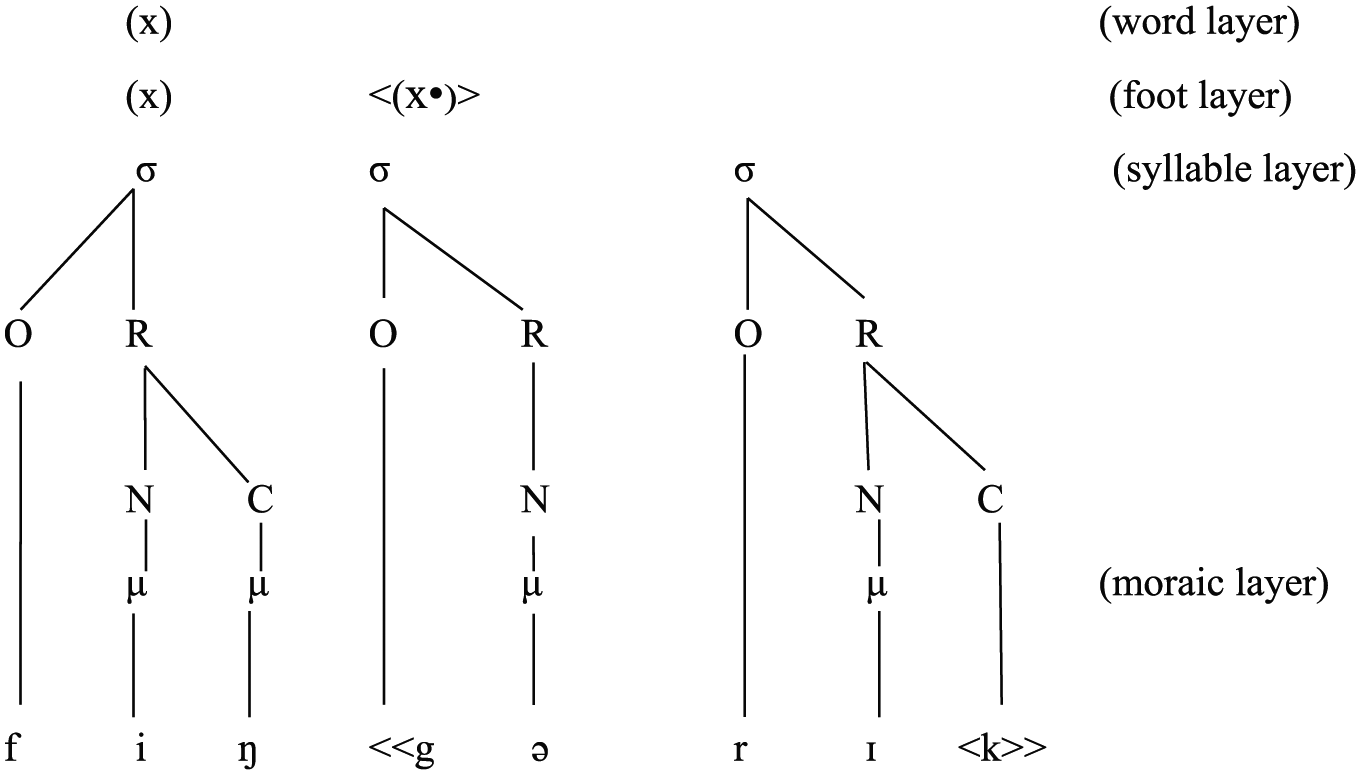
Metrical structure of [fiŋɡərɪk].
Figure 13 shows that the right foot <(CV.CV<C>)> is invisible to the metrical structure, as both syllables are monomoraic (weak); hence, the right foot is not assigned stress (Hayes, 1995). As discussed in section “Metrical Phonology,” some syllables may not count in the metrical structure due to the fact that the metrical structure is non-exhaustive, that is, it does not need to exhaust all the syllables in a word (Hayes, 1995). Thus, under peripherality condition, a constituent may be extrametrical only if it is on the (left or right) edge of its domain (Hayes, 1995). Because many dialects of Arabic (UJA included) have trochaic feet, the weightless foot at the right edge is extrametrical.
One may then wonder whether the adaptation of these loanwords into UJA follows phonological or phonetic patterns. According to LaCharité and Paradis (2005), loanwords adaptation is based on L2-referenced perception of L2 phonemes, suggesting that it is phonological. However, phonetics is not discounted in this schema. In other words, even though loanwords adaptation is phonological, it has to conform to phonetics. Therefore, LaCharité and Paradis’s (2005) view may be plausible, as the adaptation of English loanwords in UJA is a combination of both phonology and phonetics. This can be attributed to two factors. First, the rule that triggers the gemination is a phonological one: C→G / ‘V______
This rule predicts a geminate after short stressed vowels. Interestingly, this rule is demonstrated by UJA; in [bəħɪbbɪk] “I love you,” the stress falls on the penultimate syllable, thus creating the environment for gemination: Line 2 Line 1 * Line 0 * * * b ə . ħ ɪ b . b ɪ k
In addition, as mentioned before, the phoneme /p/ does not exist in the inventory of UJA; hence, the adaptation of loanwords that contain /p/ is based on L2 phonemes. That is, UJA speakers search for the closest L2 phoneme to /p/, which means that their perception is based on L2 phoneme inventory (cf. LaCharité & Paradis, 2005).
Second, this phonological adaptation has to conform to L1 phonetic rules as well, because the stress patterns of the loanwords discussed above follow those of L1 (UJA). An example is [bantˤəloːnɪk] “your trousers,” which is borrowed from French where the stress falls on the penultimate syllable of the trochaic foot as follows: Line 2 Line 1 * Line 0 * * * * b a n . tˤ ə . l o: . n ɪ k (C V C . C V) (C V: .C V C)
In French, however, the feet are usually iambic, that is, right-dominant (Andreassen & Eychenne, 2013). This can be seen in the following metrical structure of the French word [pɑ̃ta’lɔ̃].
Based on Figure 14, it is evident that the foot is iambic, as it is right-dominated, whereas the antepenultimate syllable (on the left edge) is extrametrical. However, as can be seen in the metrical grid of [bantˤəloːnɪk], the feet in UJA are clearly trochaic (left-dominant). This means that the stress pattern of the French loanword conformed to those of UJA not French. Hence, it can be argued that loanword adaptation is a phonological one, which has to be compatible with the phonetics of L1 (cf. LaCharité & Paradis, 2005). The next section proposes an OT analysis.
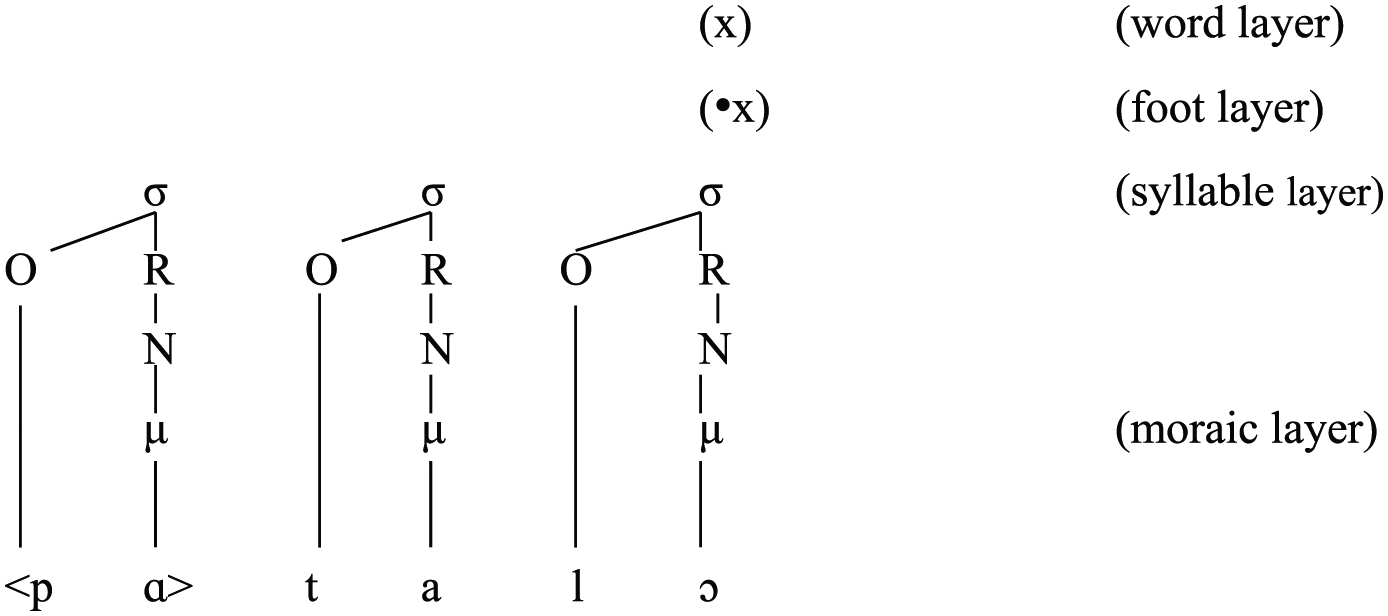
Metrical structure of [pɑ̃ta’lɔ̃].
An OT Analysis of English Loanwords in UJA
Conducting an OT analysis to account for the adaptation of English loanwords in UJA requires identifying the constraints that should be taken into account and how they are ranked in UJA to yield the optimal output (see section “OT”). Based on data analysis, I suggest the following constraints:
IDENT-MOR: The bimoraic structure of UJA should be preserved—This constraint is needed to preserve the bimoraic structure of UJA, which excludes all candidates that have monomoraic or trimoraic structures (see Watson, 2002). The data analysis shows that this constraint is ranked high in UJA.
*GEM: Geminates are prohibited (Boudlal, 2001)—It has been argued that geminates are marked cross-linguistically, as they violate SON (in a syllable sonority increases towards the peak and decreases towards the margins (Morelli, 2003)), *COMPLEX (syllables should have at most one consonant at edge (Archangeli & Terence Langendoen, 1997)), and OCP; thus, they are prohibited (Crowhurs, 2001). Nonetheless, in Arabic, the frequent occurrence of geminates word-medially and word-finally generally makes *GEM tolerated in UJA. This means that *GEM is less high than IDENT-MOR.
MAX-IO: Every segment in the input must have a corresponding segment in the output—so deletion is prohibited (McCarthy & Prince, 1995).
*CODA: A syllable must not have a coda (Prince & Smolensky, 2008).
ONSET: Every syllable must have an onset (Prince & Smolensky, 2008). 8
DEP-IO: Every output segment must have a corresponding segment in the input, that is, insertion is prohibited (McCarthy & Prince, 1995).
With regard to the first hypothesis, in which I argue that the final sound in the English word is geminated when the Arabic suffix -ɪk is added to monosyllabic words that have a short vowel in the nucleus (i.e., love), Table 1 demonstrates that the interaction between the two markedness constraints, DENT-MOR and GEM*, results in favoring the candidate which preserves the bimoraic structure of UJA. With the exception of the optimal candidate [‘lʌv.vɪk] which is bimoraic, the rest of the candidates are not. This means that they should be all excluded (see section “Metrical Phonology”). Even though the optimal candidate violates a high-ranking constraint that prohibits geminates, it does not violate the highest-ranked constraint IDENT-MOR reserving the well-formedness of the output. 9
The Addition of -ɪk to Monosyllabic Words Which Have a Short Stressed Vowel in the Nucleus.

Concerning the second hypothesis, that is, if the word is monosyllabic with a long vowel (i.e., juice) or a diphthong (i.e., face) in the nucleus, or disyllabic (i.e., mobile), no gemination occurs, Table 2 shows that the non-geminated output is selected as the optimal candidate, namely, [‘dʒuː.sɪk]. The geminated output [‘dʒuːs.sɪk] violates the highest ranking constraint, IDENT-MOR, as it is not bimoraic. It also violates the second high-ranking constraint *GEM; hence, it is excluded. The two outputs [‘dʒuː.sk] and [‘dʒuː.si] are not chosen as the optimal candidates because they violate the formedness constraint MAX-IO. Finally, the output [‘dʒuːs.ɪk] is not chosen as the optimal output because it has two violations of *CODA and one violation of ONSET. This makes [‘dʒuː.sɪk] the optimal candidate as it only violates *CODA. A similar analysis is provided in Table 3, which demonstrates the analysis of an English monosyllabic loanword in UJA (e.g., face), and Table 4, which shows the analysis of an English disyllabic loanword (mobile).
The Addition of –ɪk to Monosyllabic Words With a Long Vowel.

The Addition of –ɪk to Monosyllabic Words With a Diphthong.

The Addition of –ɪk to Disyllabic Words.

Conclusion and Recommendations
This article has analyzed loanwords in UJA to which an Arabic suffix -ɪk is added, for example, [lʌvvɪk] “I love you” and [feɪsɪk] “your face.” The analysis is based on syllable structure, metrical phonology and OT. The data analysis reveals that monosyllabic words that have a short stressed vowel in the nucleus trigger a gemination in the coda of the first syllable. On the contrary, no such gemination occurs in monosyllabic words that have a long vowel or a diphthong in the nucleus, or in disyllabic or trisyllabic words. This is because in the latter four cases, the environment in which geminates are usually found is not there. In other words, the two hypotheses are confirmed. It has also been argued that the adaptation of English or French loanwords into UJA is a phonological one that conforms to the phonetics of L1. UJA has several English loanwords and loanwords from other languages (e.g., Turkish) that exhibit certain behaviors. Thus, it is recommended that studies which examine these words using the theoretical framework adopted in this study can contribute to our understanding of the mechanisms by which loanwords are adapted in different languages. It is also recommended that a sociolinguistic analysis of this phenomenon is needed to shed light on the linguistic and communicative behavior of young individuals in Amman.
Footnotes
Declaration of Conflicting Interests
The author(s) declared no potential conflicts of interest with respect to the research, authorship, and/or publication of this article.
Funding
The author(s) received no financial support for the research, authorship, and/or publication of this article.
