




Abstract
This study argues that the degree of linguistic abstraction in negative reviews can lead to varying levels of persuasiveness and that tailoring response strategies and voice according to the situation mitigates the impact of negative reviews. This study examines the impact of language abstraction in negative online reviews on potential customers’ attitudes and purchase intention, as well as the moderating effects of managerial responses, response strategies, and response voices on the persuasiveness of negative reviews. The data were collected through three studies that focused on reviews and managerial responses across both the service and functional product categories. The mediation analysis showed that, compared to abstract negative reviews, concrete negative reviews could significantly enhance potential customers’ attribution of responsibility toward service or product providers and their perception of stability and controllability of negative events, leading to a more negative perception of the company, but not lower purchase intention. Additionally, the moderation analysis showed that corporate responses could significantly reduce potential customers’ attribution of responsibility to the disputing company and improve their evaluation. Accommodative responses to concrete negative reviews and defensive responses to abstract negative reviews induced potential customers to make favorable judgments about the firm.
Plain Language Summary
This study argues that the degree of linguistic abstraction in negative reviews can lead to varying levels of persuasiveness and that tailoring response strategies and voice according to the situation mitigates the impact of negative reviews. We intend to achieve the following objectives through three experiments. First, this study aims to confirm that observers of negative reviews will enhance their judgment of corporate responsibility for negative events and lower their evaluation of the company as linguistic specificity and clarity of negative reviews increase, providing a basis for businesses to effectively manage negative electronic reviews. Second, this study explores the interactive effects of response strategies, response tone, and linguistic style employed in response to negative reviews.
Keywords
Introduction
The number of online shoppers in China has reportedly reached 710 million as of March 2020, and in 2019, 10.63 trillion CNY worth of transactions—16.5% more than the previous year—were reported. The increasing popularity of online shopping has resulted in a massive volume of online consumer reviews (hereafter “online reviews”), that is, “a consumer’s opinion and/or experience of a product, service, or business. Reviews can be found on specialist websites and on the websites of several retailers, retail platforms, booking agents, and trusted trader schemes (schemes helping consumers to select a trader)” (ICPEN, 2016). People frequently refer to online reviews to understand the features and benefits of goods and services before making purchases.
Online reviews are often divided into positive and negative reviews based on valence. Despite the significance of positive online reviews, negative ones are more influential (Chevalier & Mayzlin, 2006). Although a few studies have indicated the benefits of negative online reviews—for example, they may increase the popularity of unknown products (Berger et al., 2010)—there is sufficient evidence in the literature to prove that negative reviews are more harmful than they are beneficial to enterprises and brands. Negative online reviews affect consumer attitudes (Lee et al., 2008), including toward the product (Shihab & Putri, 2019), brand (Purnawirawan et al., 2015), seller (Le & Ha, 2021), purchase intention (Le & Ha, 2021), sales of products (Cui et al., 2012), and company performance (Basuroy et al., 2003). Thus, given the significant influence of negative online reviews, it is crucial to delve into the topic.
As not all negative comments equally impact consumers’ behavior (Lis & Fischer, 2020), recent research tends to focus on different types of negative reviews, comparing their impacts on consumer perceptions and behavior, and exploring the optimal response strategies (Lis & Fischer, 2020; Sridhar & Srinivasan, 2012; Zhao et al., 2020). Moreover, given that the degree of language abstraction impacts discourse authenticity (Hansen & Wänke, 2010) and the attitude of product reviewers perceived by observers (Schellekens et al., 2010), this study examines the effects of negative online reviews on the attitude and consumption behavior of potential customers by categorizing negative reviews according to linguistic style.
Additionally, researchers have accorded greater attention to managerial responses to negative online reviews as their prominent role gradually unfolds. Whether on consumer-generated or brand-generated platforms, managerial intervention in response to negative electronic word-of-mouth can result in a more positive evaluation of the target brand (van Noort & Willemsen, 2012). However, disagreement exists regarding what constitutes an effective response. One controversial issue is the choice of response strategy—whether business owners or sellers should apologize and take corrective action—as the response itself may be a double-edged sword (Lee & Song, 2010). Relevant empirical studies have also presented different results. For example, Lee and Song (2010), Chang et al. (2015), Weitzl and Hutzinger (2017) suggested that assuming responsibility for negative events can lead to a more positive evaluation of businesses or products. However, Li et al. (2018), Zhao et al. (2020), Surachartkumtonkun et al. (2021) showed that it is better to choose between assuming responsibility and rejecting it depending on the type of negative review and the severity of negative events.
The language style employed to respond to negative reviews is also crucial because it can significantly impact the mindset of the target audience and is a powerful tool to bond with them (Lee & Theokary, 2021). The application of an appropriate language style by sellers when responding to negative online comments to influence potential consumers to have a positive evaluation of their businesses or products has attracted immense academic attention. The “Conversational Human Voice” (CHV) perspective presented by Kelleher (2009) is significant for exploring the appropriate language style for a response. However, according to Liebrecht et al. (2021), who reviewed 38 articles related to the CHV, its positive effects are yet to be confirmed. This is mainly because of the inconsistent interpretation and operationalization of thin the existing literature. Furthermore, when customers are concerned about appropriate resolutions to their problems, the use of an informal language style by firms to address their concerns may be considered insincere, even contemptuous (Fuoli et al., 2021).
This study argues that the degree of linguistic abstraction in negative reviews can lead to varying levels of persuasiveness and that tailoring response strategies and voice according to the situation mitigates the impact of negative reviews. We intend to achieve the following objectives through three experiments. First, this study aims to confirm that observers of negative reviews will enhance their judgment of corporate responsibility for negative events and lower their evaluation of the company as linguistic specificity and clarity of negative reviews increase, providing a basis for businesses to effectively manage negative electronic reviews. Second, this study explores the interactive effects of response strategies, response tone, and linguistic style employed in response to negative reviews. With these objectives in mind, the present study proposes a conceptual framework as shown in Figure 1.

Conceptual framework.
Findings demonstrate that concrete negative reviews, as opposed to abstract ones, can significantly raise potential customers’ attribution of blame toward service or product providers as well as their perception of the stability and controllability of negative events, which results in a more negative perception of the company, though not lower purchase intention. Additionally, corporate reply may considerably lower the extent of blame prospective consumers attribute to the disputed firm and improve their opinion about it. Notably, accommodative responses to concrete negative reviews and defensive responses to abstract ones are effective in persuading potential clients to form favorable opinions about the business. The results provide significant managerial implications for businesses that engage in negative word-of-mouth intervention.
Literature Review and Hypothesis Development
Negative Reviews
Two theories account for the fact that negative reviews are generally more influential than positive ones (Liebrecht et al., 2019). One is the theory of “negativity bias” in psychology (Jing-Schmidt, 2007), which states that because negative information is usually associated with danger and risk, people instinctively pay greater attention to it. The other is the “Pollyanna Principle” (Jing-Schmidt, 2007). People are deeply influenced by social traditions based on politeness and face-saving and generally use and anticipate positive evaluation language. Therefore, when someone sends out negative messages that go against people’s expectations, the message’s prominence rises. Consumers will not hesitate to vent their negative emotions online if the products or services are of poor quality or fail to meet their psychological expectations. This is especially true in the information era, when online anonymity reduces the worries of senders of negative information who violate social norms. Furthermore, the Internet’s speed and reach amplify the impact of negative reviews. Consequently, it is critical to research and investigates the characteristics and influences of negative online reviews.
Over the last 20 years, most studies on negative online reviews have approached the issue from the perspective of review valence (Zheng, 2021), primarily comparing the effects of positive and negative reviews, whereas very few studies have focused exclusively on the effects of negative online reviews. However, a few exceptions exist: Lee et al. (2008), Weisstein et al. (2017), Shihab and Putri (2019), Le and Ha (2021). Nevertheless, these studies on negative reviews focus on quantitative characteristics such as proportion and rating, whereas the qualitative parts of reviews remain under-investigated. It is noteworthy that recently scholars have begun to explore the influence of qualitative aspects other than digital ratings, such as the text features of online reviews (Huang & Liang, 2021), including the language style of reviews.
Language Abstraction in Online Reviews
Language is an essential component of text features, and academic interest in the influence of language features on the effectiveness of reviews has been increasing (Huang et al., 2023; Packard & Berger, 2017; Wu et al., 2017). Regarding language and cognition, a fundamental distinction exists between concrete and abstract words. Concrete words are related to tangible items, which are labels of objects and behaviors that we perceive directly in the environment, enabling us to convey what we observe to others. In contrast, abstract words represent a series of complex and less tangible concepts, including mental processes, values, social structures, and relationships (Hoffman, 2016). Moreover, abstract language is generally more difficult to process and understand in many scenarios than concrete language (Hoffman, 2016). Therefore, abstract and concrete languages may have different effects in the context of online reviews.
Current research results are controversial, with most claiming that concrete reviews are more persuasive (Aerts et al., 2017; Lee & Song, 2010; Li et al., 2013). However, Schellekens et al. (2010) arrived at a different conclusion. They covered multiple product categories and investigated the influence of product review language on the sender and receiver of reviews by creating real product experiences. The results showed that when abstract language is used in positive reviews, review readers are more inclined to infer that the sender holds a positive attitude toward the product. However, when abstract language is used to describe unpleasant product experiences, review readers tend to think the sender of reviews hold a more negative attitude. The study also revealed the effect of language abstractness on consumer behavior. The use of abstract language in positive reviews leads to higher purchase intention, whereas abstract language in negative reviews leads to lower purchase intention.
An in-depth literature analysis has revealed a dearth of studies on negative online consumer reviews from a language abstraction perspective. Moreover, the few studies that have investigated this perspective have produced contradictory results, primarily because of different definitions of abstract and concrete reviews as well as research designs based on conflicting theories in earlier studies. For example, Lee and Song (2010) defined concreteness as “interesting and close,” which far exceeds language aspects and refers more to the psychological aspects. Schellekens et al.’s (2010) research is anchored in the theory of the Linguistic Category Model (Semin & Fiedler, 1988), which is better suited to analyzing people’s words used to describe social events than for discussing product experiences (Aerts et al., 2017), and concrete language used in online reviews is not confined to a few types of action verbs. Nevertheless, it contains richer information involving product features and other details. Therefore, it is necessary to further investigate the impact of language abstraction in online reviews by clarifying the core concepts and introducing more persuasive theoretical perspectives.
Aerts et al. (2017) state that concrete reviews “can attract the senses, can be observed and measured, and offer more product details,” whereas abstract reviews “refer to ideas or concepts and contain fewer product details.” Based on these definitions, this study applies Paivio’s (1991) dual coding theory to examine the effects of the degree of abstraction of negative reviews on prospective consumers’ attitudes and purchase intentions.
According to this theory, verbal and imagery information exist in different semantic systems, namely the verbal and non-verbal systems. The latter maintains representations of sensory experiences linked to specific concepts through visual and other sensory pathways, whereas the former stores information about the grammatical and syntactic relationships between words; for example, an object’s appearance, sounds, and movement. Whereas abstract words exist only in the verbal system, concrete words benefit from dual coding and are present in both systems. For example, if the language of a negative review is concrete, information is encoded by both the verbal and non-verbal systems. This conveys a richer meaning and enhances the content’s persuasiveness. However, if the language is abstract, then information is encoded only by the verbal system. Consequently, the meaning conveyed is not sufficiently rich, and the persuasiveness of the content is relatively weak. Therefore, the following hypothesis is proposed.
Attribution of Responsibility
Irrespective of outcome, human beings have never stopped analyzing and searching for causality to understand better and manage themselves or their environment (Weiner, 1985). “Attribution” refers to the understanding and inference of the causes of things, and the “attribution theory” is the study of people’s perceived causality (Kelley & Michela, 1980). Unfortunately, people are more willing to seek causal explanations for negative results than positive ones (Borden & Zhang, 2019).
According to Chang et al. (2015), Weiner’s (1985) three-dimensional theory, which focuses on “locus,”“stability,” and “controllability,” is the most typical classification and interpretation of “attribution” in the context of product or service failure. The term “locus” refers to the distinction between internal and external causes, essentially equal to environmental and human variables (Kelley & Michela, 1980). The second dimension, “stability,” is relevant to internal and external causes and refers to whether the reason is dynamic or constant. Finally, the third dimension, “controllability,” refers to whether the causes of the results can be “independently controlled.”
The effect of online consumer reviews on causal attribution for products or services has been documented in the literature. For example, Browning et al. (2013) identified that comments about core services were more likely to generate positive service quality perceptions, recent comments affected consumers’ causal attribution regarding the controllability of service delivery, and negative comments adversely affected consumers’ perception. Additionally, Surachartkumtonkun et al. (2021) ascertained that reasonable review content could induce the third-party’s attribution of responsibility to service providers.
This study uses the three dimensions of “attribution of responsibility” as the mediator variables to examine the impact of linguistic abstraction of negative reviews on potential consumers’ attitudes and purchase intentions and the relationship between corporate replies and unfavorable reviews.
When faced with concrete negative reviews, readers or potential customers are more likely to blame the company in question for negative events. This is because concrete negative remarks provide more information about the goods or services associated with unpleasant experiences, which is strong evidence that the company may be at fault. Meanwhile, because concrete language can be recognized faster (Bleasdale, 1987) and is more visualized than abstract language (Semin & Fiedler, 1988), potential customers may be more deeply impressed by negative events described in concrete language, their memory of the negativity of the event may be more lasting, and their perception of the stability of negative events may be stronger. Concrete language is embedded in specific circumstances, whereas abstract language is divorced from, and transcends, specific circumstances (Semin & Fiedler, 1988). Therefore, compared to general negative feelings divorced from specific situations, a particular failure experience embedded in a specific consumption situation can be more controllable or likely to be avoided. Based on the above analysis, this study presents the following hypothesis.
According to the attribution theory (Weiner, 1985), if a failure is attributed more to internal than external causes, it might have been prevented, and there is a high likelihood that it will recur, and people will have a less favorable assessment of the disputing party. Therefore, this study proposes the following hypothesis in the context of negative reviews.
Responding to Negative Reviews
In the age of electronic information, negative ratings are permanently archived on review websites or e-commerce platforms, endangering the reputation of companies and their goods. Therefore, corporations must endeavor to efficiently manage unfavorable online reviews as inaction might have disastrous strategic consequences. In fact, current research suggests that managers’ responses to negative reviews can produce positive business results. Particularly when service failures are due to controllable factors, managerial responses can significantly alleviate the effects of negative reviews (Rose & Blodgett, 2016).
The signaling theory suggests that the market price of goods or services is influenced by the signal sent by the seller (Marcus & Goodman, 1991). Potential customers typically attribute the failure of the product or service to the company that provides them when exposed to negative evaluations of the product because observers have the natural tendency to do so (Gilbert & Malone, 1995). However, providing additional information through an appropriate reply can remind customers of other possible explanations, prompting them to adjust their default attribution mechanism (Li et al., 2018). Therefore, the following hypothesis is proposed.
When faced with negative online reviews, firms’ response strategies can be accommodative, defensive, or non-responsive. Lee and Song (2010) believe that accommodative strategies include any form of apology, compensation, and/or corrective measures, whereas defensive strategies mainly constitute denial of responsibility, attacking the accuser, shirking responsibility, etc. “No response” includes no comment and no public action.
Inclusive evidence exists regarding what kind of response can produce the best result. Most studies indicate the advantages of accommodative responses (Chang et al., 2015; Lee & Song, 2010; Weitzl & Hutzinger, 2017). However, others show that sometimes a defensive reply is a better option (Fuoli et al., 2017). Recently, an increasing number of studies have proved that tailoring response strategies to different types of negative reviews produces more positive results (Li et al., 2018; Allard et al., 2020; Surachartkumtonkun et al., 2021; Zhao et al., 2020).
This study argues that business response strategies should be based on a realistic examination and classification of negative reviews. To achieve the best outcomes, businesses should adopt a response strategy depending on the degree of specificity or abstraction of the negative reviews. As Aerts et al. (2017) argue, reading reviews written in concrete terms requires little cognitive processing, which puts readers psychologically close to reviewers. In contrast, reviews written in abstract terms require more cognitive processing and puts readers psychologically farther away from reviewers. Then, when consumers feel “close” to concrete negative reviews, businesses should respond to negative comments with accommodative responses by acknowledging problems and proposing solutions to soften accusations against them and mitigate negative attitudes toward their products. However, because consumers maintain a greater psychological distance from abstract negative comments, businesses can employ defensive strategies to protect the goodwill of their brands and persuade prospective customers to place the blame for failures on reviewers or other factors rather than on the companies themselves, which will lead to a more positive attitude toward their goods or services. Based on the above analysis, this study proposes the following hypothesis.
Voice of Response
When responding to negative online reviews, companies engage in online communication, which is different from face-to-face communication. Face-to-face interaction involves the maximum number of cues, including the context, non-verbal signals, and synchronicity, so that information interpretation requires less cognitive effort. However, these cues decay as the type of media used in communication varies (Lewandowski et al., 2011). Conversation based on Web pages and online platforms is unnatural, which negatively impacts information interpretation, including higher cognitive effort, more ambiguity, and less physiological arousal (Kock, 2004). Therefore, when responding to customers’ electronic comments, especially negative reviews, businesses should be aware of the cognitive burden of “lack of non-verbal signals” for the information receivers and endeavor (e.g., by strengthening the verbal signals) to compensate for this deficiency to enhance the effectiveness of the response.
The CHV proposed by Kelleher (2009) is an extremely influential concept, defined as “an engaging and natural style of organizational communication as perceived by an organization’s public based on interactions between individuals in the organization and individuals in public.” This concept includes two attributes. One is to reflect the voice attributes of a person (in contrast to a company’s voice), such as the use of humor and treating others as humans. The other is dialog attributes, such as providing timely feedback and being willing to communicate (Kelleher, 2009).
However, Liebrecht et al. (2021) suggested that researchers hold different views regarding CHV’s ability to produce positive effects, mainly because of the diversified interpretations and operationalizations of the CHV in previous studies, as reflected in the different types and quantities of language elements used to establish the CHV perception in online brand communication. Moreover, although researchers have indicated in their study limitations that the adoption of various degrees of the CHV correlates to various levels of the CHV perception, it is necessary to confirm the effects of the CHV on consumer attitudes and brand-related outcomes (Liebrecht et al., 2021).
Based on the main arguments related to the CHV in the extant literature, this study classifies the voice of managerial responses to negative reviews into “personal voice” and “corporate voice.” As defined by Barcelos et al. (2018), the “personal voice” is a “more natural, intimate and human” online communication mode, whereas the “corporate voice” is a “more distant and formal” manner of communication used by companies. This study argues that a personalized response voice is more efficient than a corporate one in lowering potential customers’ disapproval of the business. When companies respond to negative reviews, because a “personal voice” conveys a stronger sense of reality, intimacy, and concern than a “corporate voice,” it should be more acceptable and recognized by potential customers. This may be true, irrespective of the negative remarks being abstract or concrete. The following hypothesis is thus proposed.
Study 1
Study 1 verifies whether language concreteness versus abstractness of negative reviews exerts different degrees of impact on the attitude and purchase intention of potential customers; whether the impact is mediated by the three dimensions of “attribution of responsibility”; and whether managerial responses moderate the impact of negative reviews.
Methods
Experimental Design and Procedure
A 2 (negative review type: abstract reviews vs. concrete reviews) ×2 (managerial responses: no vs. yes) between-subjects experimental design was adopted. For scenario development, 10 pieces of negative reviews about hotel services were randomly selected from Ctrip.com—a leading, influential hotel booking service platform in China, which boasts of a network of more than 600,000 hotels at home and abroad. We chose negative reviews regarding “service” because “service” is an essential part and a core feature of the hotel business (Han et al., 2011), and “service” is also a major criterion consumers consider when choosing hotels. We moderately used the selected reviews to ensure that the length of all comments was controlled between 30 and 40 Chinese characters to eliminate the confounding effect of review length. Subsequently, we invited a few participants with substantial online shopping experience to evaluate the abstractness and concreteness of the 10 comments. These participants had no advance information about the main purpose of this experiment. Finally, the two most representative comments were chosen, for which we edited a piece of managerial response by referring to responses by hotel managers on the Ctrip platform. The managerial response includes problem confirmation, apology, and problem resolution assurance. The specific content of the reviews and responses are presented in Table 1.
Negative Reviews and Managerial Response for Study 1.
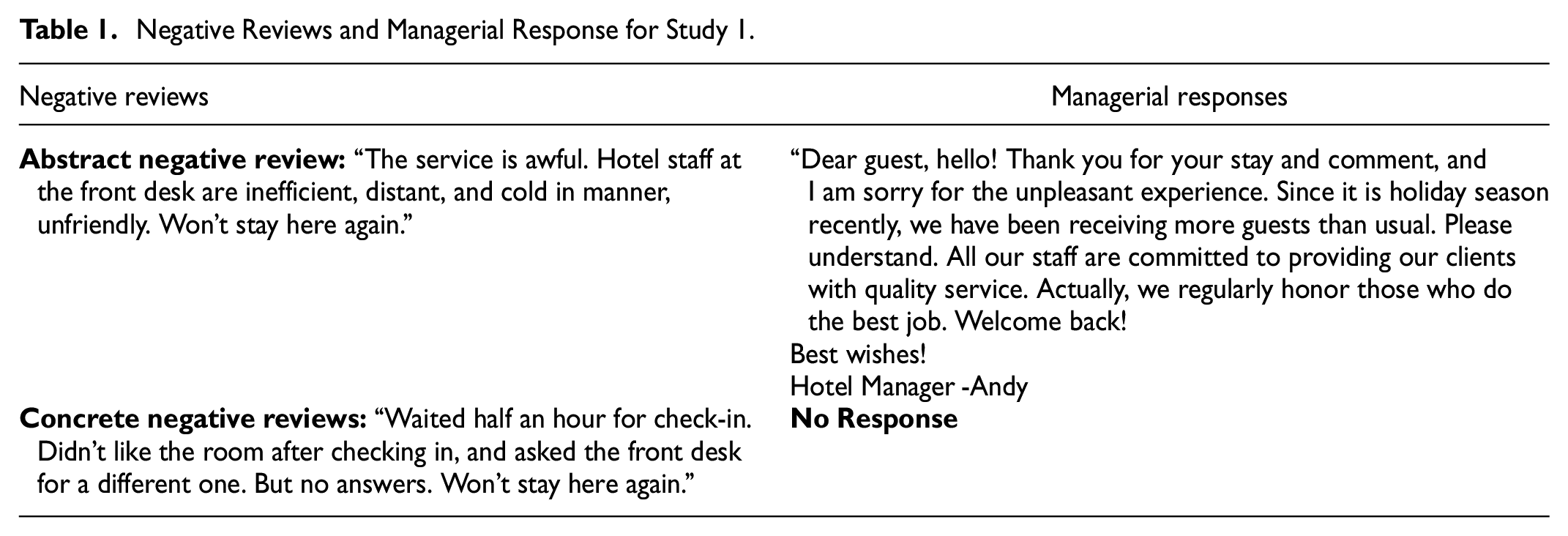
With the above comments and replies determined, four experimental conditions were developed. Participants were randomly assigned to one of the four experimental conditions. In the Direction section, this study provides the following documents. “Suppose you are going on a vacation. Before booking a hotel online, you see a comment about the hotel as follows. Please read the comment and response, and then answer the questions below honestly and independently.” After the instruction, all participants were asked to complete the study’s task.
Participants and Measurement
Overall, 134 samples were collected via the Sojump survey online platform in China. Prior to the experiment, all participants received a monetary compensation. Participant anonymity and data confidentiality were guaranteed. Participants were exposed to a negative abstract review about hotel service with the response from the hotel (N = 35) versus without (N = 32), as well as a concrete one with hotel response (N = 33) versus without (N = 34). Most participants were female (79.1%); over 90% shopped online and read online reviews.
Study 1 questionnaire includes the following constructs: “locus,”“stability,”“controllability,”“attitude toward the firm,” and “purchase intention.” All construct scales have been borrowed from previous studies with slight adaptations. Among them, the “locus” scale is adapted from the study by Poon et al. (2004), which contains three items: “The hotel caused the reviewer’s unpleasant experience,”“The hotel should be blamed for any undesirable outcomes,” and “The hotel is responsible for the reviewer’s unpleasant experience.” (Cronbach’s α = 0.932). The “stability” scale is adapted from the study by Zhao et al. (2020), which contains such items as “This problem is very likely to be permanent,”“This problem is very likely to be temporarily solvable” (reversed), “This problem is very likely to occur frequently,” and “The violation is very likely to recur.” (Cronbach’s α = 0.925). The “controllability” scale, adapted from the study by Chang et al. (2015), includes: “The hotel’s service failure reflected by this comment can be controlled,”“The hotel’s service failure reflected by this comment can be prevented,” and “The hotel’s service failure reflected by this comment can be avoided.” (Cronbach’s α = 0.928). The “attitude toward the firm” scale is adapted from Le and Ha (2021) and includes: “I have a bad impression of the hotel after reading the review,”“I don’t think I like the hotel after reading the review,” and “I don’t think this hotel is satisfactory after reading this review” (Cronbach’s α = 0.917). The “purchase intention” adapted from the studies by Surachartkumtonkun et al. (2021) and Borden and Zhang (2019), includes three items: “I would like to stay at the hotel if it meets my selection criteria (e.g., location and price),”“I may book the hotel,” and “I would like to recommend the hotel to my friends” (Cronbach’s α = 0.880). Additionally, the scale for the manipulation test of the independent variable is adapted from the study by Zhang et al. (2021), which contains three items, namely, “Is the review concrete or abstract,”“Is the review specific or general,” and “Is the review detailed or rough.” The content realism check scale, adapted from Liu and Ji (2019), contains three items: “The phenomenon reflected by this review sounds realistic,”“The phenomenon reflected by this review could happen in real life,” and “The review reflects problems with services offered by the hotel” (Cronbach’s α = 0.937).
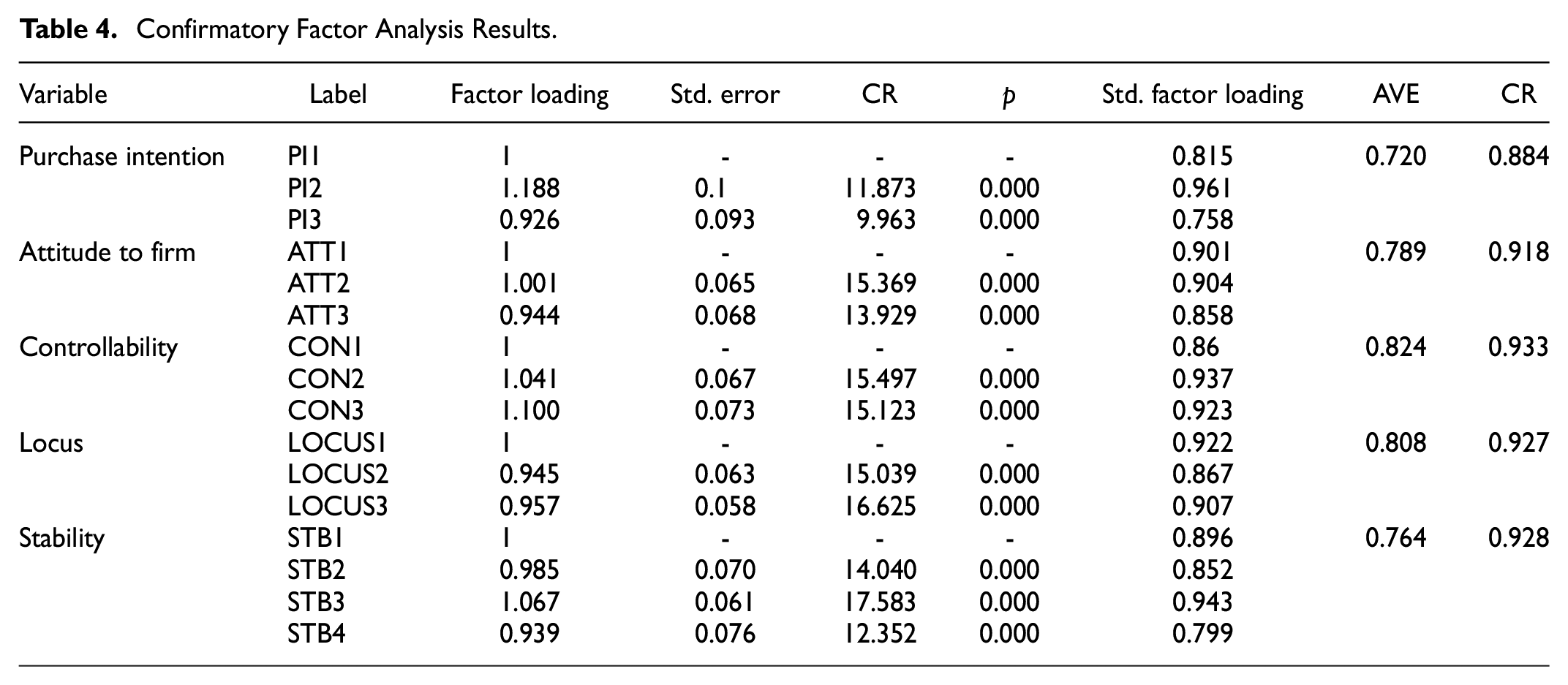
Table 2 provides the descriptive statistics, reliably, correlation, and AVE. As presented in Table 3, the measurement model exhibited a good fit (χ2/Df = 2.002, GFI = 0.853, RMSEA = 0.088, CFI = 0.951, NFI = 0.908, TLI = 0.900, SRMR = 0.047). Confirmatory Factor Analysis results confirmed that standard factor loading values are greater than 0.600 and AVE values are lager than 0.500 (Table 4).
Descriptive Statistics, Reliably, Correlation, and AVE.
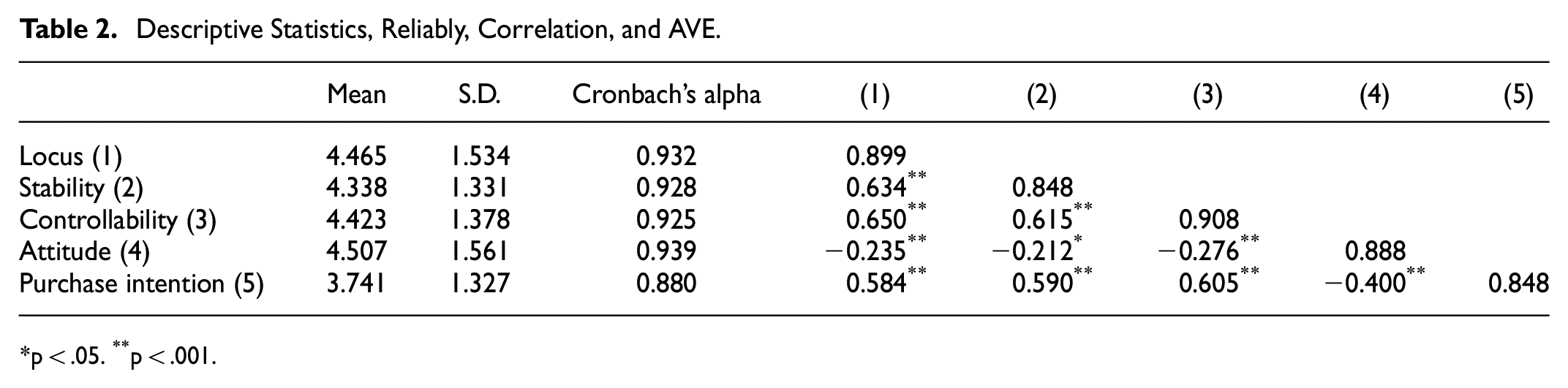
p < .05. **p < .001.
Model Fits.

Note. Df = degree of freedom; GFI = goodness-of-fit index; NFI = normalized fit index; CFI = comparative fit index; RMSEA = root mean square error of approximation; SRMR = standardized root mean square residual.
Confirmatory Factor Analysis Results.
Data Analysis and Results
The manipulation of review type and review realism was tested. First, regarding review type, the average score of the abstract review group (M = 4.61) was higher than that of the concrete review group (M = 4.01), and the difference was significant (t = 2.625, p = 0.016). Second, regarding review realism, the abstract review group (M = 4.73) was not significantly different from the concrete review group (M = 5.22, t = –1.926, p = 0.057), which implies that the problems reflected by the two comments are of the same kind in reality. Additionally, there was no significant difference between the abstract review group (M = 3.56) and the concrete review group (M = 3.72) in the degree of perceived negativity (t = –0.457, p = 0.648). In other words, the results of the manipulation test showed that the differences between the two types of reviews perceived by participants were solely reflected in the language style of reviews rather than other aspects, indicating that the manipulation of the independent variable in this study was successful.
Mediation Analysis
To testify the first four hypotheses, this study performed a mediation analysis using Model 4 from PROCESS (bootstrap samples: 5,000) (Hayes, 2017). Participants’ gender, monthly income, online shopping times, and review habits were treated as control variables, and the negative review types as independent variables (the abstract review was coded as “1” and concrete review “2”). Participants’ perceptions of controllability, locus, and stability were treated as mediators, and their attitude toward the hotel and purchase intention as dependent variables.
First, a significant main effect of negative review type on participants’ attitude toward the hotel was observed (b = 0.622, SE = 0.200, t = 3.112, p = 0.002), indicating that a concrete language style does exert a greater impact on potential customers’ attitude than an abstract one. However, the effect of negative comments on participants’ purchase intention was not statistically significant (b = –0.091, SE = 0.238, t = –0.382, p = 0.703). Therefore, Hypothesis 1 was partially supported.
Second, we identified that negative comments could significantly enhance participants’ perception of controllability (b = 0.638, SE = 0.236, t = 2.709, p = 0.008), locus (b = 0.763, SE = 0.255, t = 2.994, p = 0.003), and stability (b = 0.568, SE = 0.219, t = 2.590, p = 0.011) of the negative event. In other words, negative reviews in a concrete language style are more likely to prompt potential customers to attribute the cause of the problem to the hotel and increase their perception of the controllability and stability of the incident than those in an abstract style. Thus, Hypothesis 2 was supported.
Third, participants’ attitude toward the hotel was significantly affected by their perception of controllability (b = 0.260, SE = 0.096, t = 2.695, p = 0.008), locus (b = 0.230, SE = 0.093, t = 2.469, p = 0.015), and stability (b = 0.366, SE = 0.104, t = 3.514, p = 0.001) of the incident. In other words, the stronger the potential customers’ perception that the hotel is to blame for the incident and that the cause of the incident is controllable and stable, the more negative their attitude will be toward the hotel. However, when potential customers’ purchase intention was made the dependent variable, the effects of “controllability,”“locus,” and “stability” was not statistically significant. Therefore, Hypothesis 3 was partially supported.
This study also identified that negative review type could significantly affect potential customers’ evaluation of the hotel by increasing their perception of controllability (b = 0.166, SE = 0.101, 95% CI [0.006, 0.388]), locus (b = 0.175, SE = 0.105, 95% CI [0.007, 0.411]), and stability (b = 0.208, SE = 0.114, 95% CI [0.031, 0.462]). However, no such significant indirect effect on the purchase intention was verified.
Thereafter, a two-way ANOVA test of the effect of hotel responses and negative reviews on participants’ attribution of responsibility was conducted, with controllability (p = 0.138), locus (p = 0.340), and stability (p = 0.319) not violating the assumption of the homogeneity of variance. When there was a hotel response, potential customers’ perception of controllability (F = 30.788, p < 0.001), locus (F = 31.491, p < 0.001), and stability (F = 27.015, p < 0.001) were all lower than when there was none. This indicates that managerial responses to negative reviews can significantly reduce the likelihood that potential customers attribute the incident to the firm involved, and that they view the cause of the incident as highly controllable and stable, thus producing favorable business outcomes. Thus, Hypothesis 4 was supported.
Furthermore, to confirm the moderating role of managerial responses, a further moderation analysis using Model 1 from PROCESS was performed (Hayes, 2017). The moderation test results showed that the managerial response moderated the effect of the review abstract on locus controllability (interaction term = −1.088, p = 0.016), controllability (interaction term = −1.518, p = 0.002) and stability (interaction term = −0.877, p = 0.026). It revealed that the effect of negative reviews on potential customers’ perception of controllability (non-response: b = 1.425, 95% CI [0.853, 1.997]; response: b = −0.254, 95% CI [−0.817, 0.309]), locus (non-response: b = 1.338, 95% CI [0.702, 1.974]; response: b = 0.062, 95% CI [−0.563, 0.688]), and stability (non-response: b = 1.070, 95% CI [0.516, 1.625]; response: b = −0.036, 95% CI [−0.582, 0.509]) all declined with the presence of hotel responses. This further confirms the effectiveness and necessity of managerial responses to negative reviews.
Discussion
The results of Study 1 showed that a concrete language style of negative reviews is more likely than an abstract one to induce potential customers to attribute service failure to the hotel that offers it and to consider the causes more controllable and stable, eventually leading to a more negative attitude toward the hotel. However, no significant changes in the purchase intention are found. Furthermore, Study 1 confirmed the effectiveness of corporate responses in containing or mitigating the adverse effects of negative reviews. Potential consumers are less inclined to blame the hotel for service problems, more willing to dismiss the controllability and stability of the issue, and more prepared to forgive the disagreeing party as a result of the hotel’s reaction. Can firms, therefore, use differential response strategies to optimize the impact of reply, given the disparities in the linguistic abstractness of negative comments? This issue will be explored in Study 2.
Study 2
Study 2 verifies whether accommodative managerial responses to concrete negative reviews and defensive managerial responses to abstract negative reviews make it less likely for potential customers to blame service providers for negative events, thereby significantly improving their opinion of the disputing company.
Method
Experimental Design and Procedure
A 2 (negative review: abstract review vs. concrete review) × 2 (hotel response: defensive response vs. accommodative response) between-subjects experimental design was adopted. The same negative reviews were used as in Study 1, but the hotel’s responses were changed. Ten hotel responses were selected at random from the Ctrip platform, and a few participants with substantial online shopping experience were asked to assess the level of responsibility service providers should bear for the incidence of service failure suggested by each response. Finally, we chose the two most representative responses and fine-tuned their content to limit each response to 100 to 110 Chinese characters; this was performed to avoid the confounding effect of message length. The content of managerial responses is presented in Table 5.
Managerial Responses for Study 2.

Participants
We collected data from 127 panels on the Sojump online survey platform and randomly assigned one of four conditions: a negative abstract review matched with an accommodative response (N = 30) versus a defensive one (N = 32), as well as a negative concrete review with an accommodative response (N = 35) versus a defensive one (N = 30). As in Study 1, all participants received a monetary compensation prior to the experiment. Participant anonymity and data confidentiality were guaranteed. A total of 81.1% of the participants were female; they frequently shopped online (95.3% more than twice a month) and read online reviews (98.5%).
Measures
The same scales as in Study 1 were used to measure locus, stability, controllability, attitude toward the hotel, purchase intention, review abstraction manipulation, and realism check. The scale for measuring two types of hotel responses was adapted from Lee and Cranage (2014), which included four items, namely, “The hotel apologized for the problem,”“The hotel admitted responsibility for the problem,”“The restaurant shifted the blame to others” (reversed), and “The hotel disagreed and argued with the complaining customer” (reversed) (Cronbach’s α = 0.867). All measurement scale adopted seven-point system raging 1 = “strongly disagree” to 7 = “strong agree”.
Table 6 presented descriptive statistics, reliably, correlation and AVE, Table 7 presented model fit, and Table 8 presented confirmatory factor analysis results indicating the measurements meet reliability and validity minimum requirement.
Descriptive Statistics, Reliably, Correlation, and AVE.

Note. The value in ( ) is the square root of AVE.
Model Fits.

Note. Df = degree of freedom; GFI = goodness-of-fit index; NFI = normalized fit index; CFI = comparative fit index; RMSEA = root mean square error of approximation; SRMR = standardized root mean square residual.
Confirmatory Factor Analysis Results.

Data Analysis and Results
The manipulation of reviews and hotel responses was tested. The abstract review group scored higher in language abstraction degree than the concrete review group (t = 4.222, p < 0.010), and participants’ perceptions of the hotel’s level of responsibility were considerably greater in the accommodating response than in the defensive response (t = 4.136, p < 0.01). This indicates that the manipulation was successful.
The difference in mean causal attribution scores between accommodative and defensive responses was compared using an independent samples t-test. When the language style of the negative review was concrete, an accommodative hotel response, as opposed to a defensive one, significantly lowered potential customers’ perceptions of controllability (t = 3.842, p < 0.010) and stability (t = 6.260, p < 0.010) of the incident, as well as their likelihood of attributing service failure to the hotel (t = 2.832, p = 0.006). Therefore, Hypothesis 5 was supported. However, when the language style of the negative review was abstract, a defensive hotel response was significantly more effective in reducing potential customers’ perceptions of controllability (t = −2.215, p = 0.031), locus (t = −3.969, p < 0.010), and stability (t = −3.834, p < 0.01) than an accommodative one. Therefore, Hypothesis 6 was supported.
Additionally, the moderation analysis results indicated (Hayes, 2017; Model 1) that the iteration term of review types and response types was significant (bLocus = −2.1578, p < 0.001; bControllability = −1.880, p < 0.001; bstability = −2.501, p < 0.001) (See Figure 2).

Moderation results: (a) moderation results (locus), (b) moderation results (controllability), and (c) moderation results (stability).
Discussion
The results of Study 2 showed that when dealing with negative online reviews, companies can achieve better results by tailoring their response strategies to the degree of language abstraction of negative comments. If customers use more concrete language to describe their poor service experience when complaining online, accommodative response strategies such as accepting the problem and assuming responsibility benefit the company as potential customers’ evaluation of the firm tends to improve. However, if customers use more abstract language to complain, defensive managerial response strategies, such as offering reasonable excuses and clarifying problems, have a better chance of producing favorable results for the company. Thereafter, in addition to the choice of response strategy, will the choice of response tone, such as a personal voice versus a corporate voice, make a difference? Study 3 answers this question.
Study 3
Study 3 verifies whether managerial responses in more natural, personalized, and informal language, as opposed to more official and formal language, have different effects on potential customers’ attitudes. Additionally, it verifies whether the results of Studies 1 and 2 are still valid beyond the service industry, such as, in the field of functional products (using “laptop” as an example).
Method
Experimental Design and Procedure
A 2 (negative reviews: abstract vs. concrete reviews) × 2 (managerial response: corporate voice vs. personal voice) between-subjects experimental design was adopted, with the mediator and dependent variables consistent with those of Studies 1 and 2. We decided on “laptop computer” as the target product for Study 3 as it is generally considered a high-involvement one. Ten negative reviews of a brand were randomly selected from JD.COM, with the names of the platform and brand concealed. JD.COM, which is among the largest and most popular online shopping platforms in China, is equipped with a powerful online evaluation system.
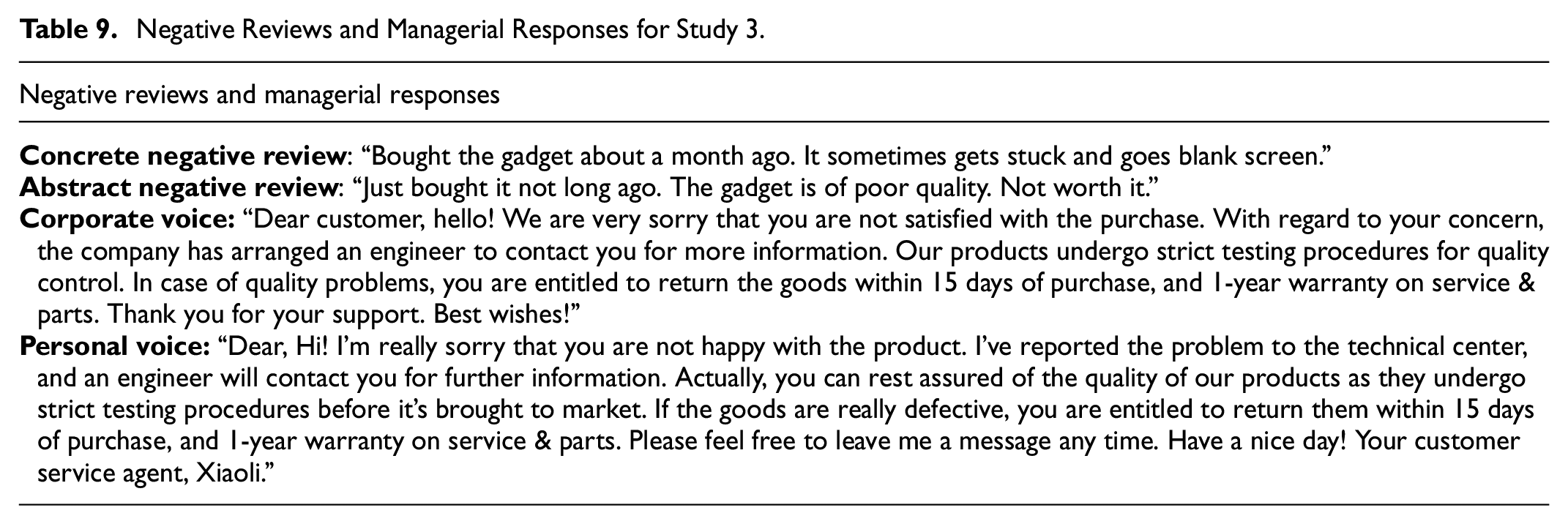
The length of all comments was 10 to 20 Chinese characters. A few participants with substantial online shopping experience were asked to evaluate the abstractness and concreteness of the 10 comments before the two most representative ones were selected. As for the managerial response, the researcher selected and edited two different versions of the reply: one in corporate voice, and another in personal voice, based on relevant definitions in the theoretical section of this study. However, the content of the versions was identical, and the length was 120 to 130 Chinese characters. The content of the reviews and reply is presented in Table 9. Only the content of reviews and corporate responses was adjusted in Study 3, and other experimental procedures were consistent with those of Studies 1 and 2.
Negative Reviews and Managerial Responses for Study 3.
Participants
We collected 153 valid samples on the Sojump online survey platform in China, which were randomly assigned one of four conditions: negative abstract review answered in a personal (N = 50) versus a corporate voice (N = 31), as well as a concrete one answered in a personal (N = 31) versus a corporate voice (N = 41). As in the first two studies, all participants received a monetary compensation prior to the experiment. Participant anonymity and data confidentiality were guaranteed. Participants were mostly female (81.7%); they frequently shopped online (95.4% more than twice a month) and read online reviews (99.3%).
Measures
The same scales as in Studies 1 and 2 were used to measure dependent, mediator, and other variables with slight adaptations. The scale developed by Kelleher and Miller (2006) was adapted to measure managerial responses to negative reviews. It contains five items: “The firm is open to dialog,”“The firm uses conversation-style communication,”“The firm tries to communicate in a human voice,”“The firm attempts to make communication enjoyable,” and “The firm treats customers as human” (Cronbach’s α = 0.956).
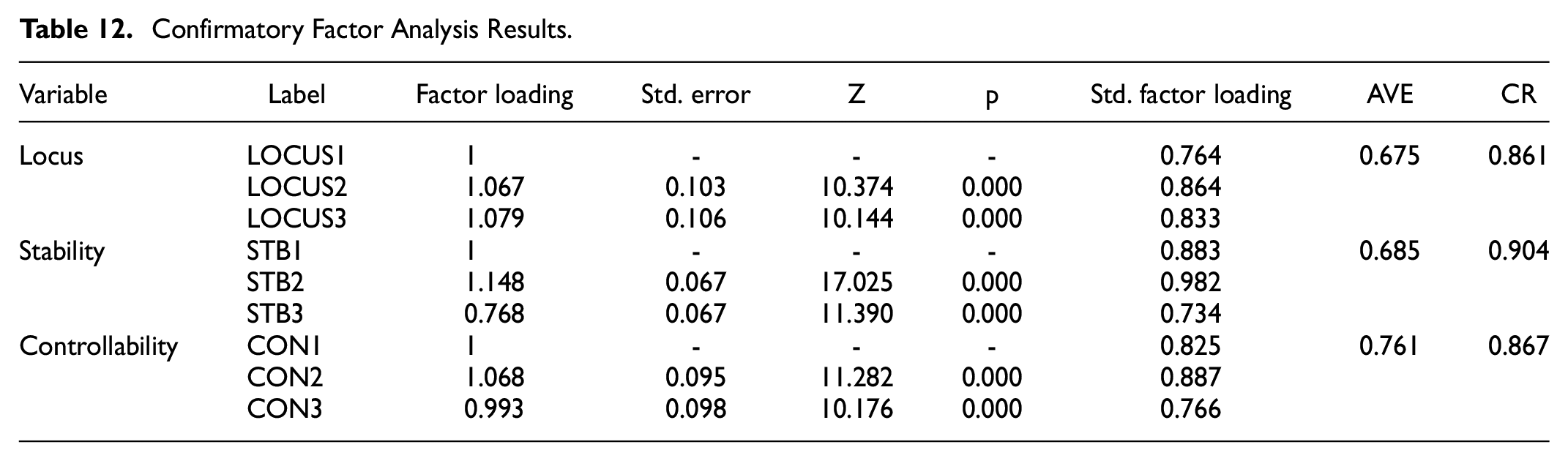
Table 10 presented descriptive statistics, reliably, correlation and AVE, Table 11 presented model fit and Table 12 presented confirmatory factor analysis results indicating the measurements meet reliability and validity minimum requirements.
Descriptive Statistics, Reliably, Correlation, and AVE.

The value in ( ) is the square root of AVE.
Model Fits.

Note: Df: degree of freedom; GFI: goodness-of-fit index; NFI: normalized fit index; CFI: comparative fit index; RMSEA: root mean square error of approximation; SRMR: Standardized root mean square residual.
Confirmatory Factor Analysis Results.
Data Analysis and Results
To verify whether the classification of the two contrasting comments and responses was successful, the mean scores of the abstract review and concrete review groups were compared via an independent samples T-test. The results showed that, in terms of language abstraction degree, the mean score of the abstract review group (M = 4.45) was higher than that of the concrete review group (M = 3.93, t = 2.394, p = 0.018). Meanwhile, the two comments are equally realistic (abstract comment group M = 4.60, concrete comment group M = 4.78, t = −0.759, p = 0.450) and negative (abstract comment group M = 3.70, concrete comment group M = 3.96, t = −0.806, p = 0.422). This indicates that the two negative comments—as respondents saw them—differed significantly only in language abstraction but not in content realism and degree of negativity. Additionally, there were significant differences in respondents’ evaluation of business reply tone (corporate voice group M = 4.28, personal voice group M = 4.90, t = −2.602, p = 0.010), which implies that respondents perceived two different styles of response. Thus, the manipulation of the treatment variables for Study 3 was successful, and hypotheses testing could be performed.
First, a mediation analysis using Model 4 from PROCESS (bootstrap samples: 5,000) was performed (Hayes, 2017). As in the first two studies, participants’ gender, monthly income, and other aspects were treated as control variables; negative review types as independent variables (the abstract review was coded as “1” and concrete review as “2”); the three dimensions of “attribution of responsibility” as mediator variables; and “the attitude toward the firm” and “purchase intention” as dependent variables. The results revealed a main effect of negative comments on potential customers’ attitudes toward the firm (b = 0.449, SE = 0.218, t = 2.057, p = 0.042), but not on “purchase intention” (b = −0.487, SE = 0.275, t = −1.769, p = 0.079). Apparently, when negative reviews address “functional products” instead of “services,” concrete negative reviews still appear more persuasive than abstract ones to potential customers, which is consistent with the results of Studies 1 and 2.
The direct effects of negative comments on potential customers’ causal attribution process were reconfirmed. Negative review types significantly affected people’s perceptions of controllability (b = 0.800, SE = 0.206, t = 3.883, p = 0.006), locus (b = 0.782, SE = 0.222, t = 3.513, p = 0.001), and stability (b = 0.654, SE = 0.237, t = 2.758, p = 0.007) of the incident. In other words, concrete negative reviews seem more compelling than abstract ones when observers, consciously or subconsciously, search for causes of negative events described in negative reviews, lending further support to Hypothesis 2. Similarly, potential customers’ evaluation of the disputed firm was directly affected by their judgment of controllability (b = 0.347, SE = 0.086, t = 4.027, p < 0.01), locus (b = 0.233, SE = 0.087, t = 2.689, p = 0.008), and stability (b = 0.179, SE = 0.078, t = 2.287, p = 0.024). The stronger these three dimensions, the more negative is the attitude of observers toward the disputing firm. However, these direct effects were not noticeable in the context of purchase intention, which is consistent with Studies 1 and 2.
The mediating effects of “responsibility attribution” between negative comments and observers’ attitude toward the firm as well as their purchase intention were also examined in Study 3. The results were consistent with those of Study 1.
Most importantly, the ANOVA test results revealed that a corporate response tone moderated the effect of negative reviews on observers’ judgment of the disputing firm’s responsibility for the negative event. Specifically, when potential customers were exposed to a managerial response in a personal voice rather than a corporate voice, their perceptions of controllability (F = 35.450, p < 0.001), locus (F = 16.873, p < 0.001), and stability (F = 15.676, p < 0.001) significantly decreased, irrespective of the negative review being concrete or abstract.
Furthermore, we performed a moderation analysis using Model 1 from PROCESS (bootstrap samples: 5,000) (Hayes, 2017). All other control, independent, and dependent variables remained the same as in Study 1. The moderating variable here is the response voice of the firm. In terms of controllability (corporate voice: b = 1.230, 95% CI [0.715, 1.744]; personal voice: b = 0.014, 95% CI [−0.485, 0.514]), locus (corporate voice: b = 1.469, 95% CI [0.892, 2.045]; personal voice: b = −0.155, 95% CI [−0.716, 0.405]), and stability (corporate voice: b = 1.101, 95% CI [0.467, 1.734]; personal voice: b = −0.076, 95% CI [−0.692, 0.539]), the downsides of negative reviews declined when they were addressed in a personal voice as opposed to a corporate voice. Therefore, Hypothesis 6 was supported.
Discussion
The results of Study 3 revealed that regardless of the language abstraction degree of negative reviews, it is better for firms to respond with a personal voice, that is, using more natural and friendly language than official and formal language, to address customer concerns. This can significantly alleviate the responsibility judgment of the matter made by potential customers, thus improving their attitude toward the firm. Additionally, Study 3 proved that the persuasive power of language concreteness of negative reviews and the utility of cooperate response strategy is applicable to categories other than the service industry, such as functional products.
Discussion, Implications, Limitations, and Further Research
General Discussion
To explore the influence of language abstraction in negative online consumer reviews and corporate response, this study tested a series of hypotheses via three experiments. The following main conclusions can be drawn. First, this study provides strong evidence that language abstraction degree can significantly affect the persuasiveness of negative reviews. Compared to abstract negative comments, concrete ones can induce potential customers to attribute negative events more to the service or product provider, and develop a stronger sense of the stability and controllability of negative events. This can contribute to a more negative attitude toward the firm. This conclusion confirms the findings by Aerts et al. (2017) and Lee and Song (2010), but contradicts those by Schellekens et al. (2010). Possible explanations include the fact that concrete reviews provide more detailed, vivid, and rich information about a service or product failure, which is easily processed, understood, and memorized by potential customers because of the dual coding of verbal and non-verbal systems, and thus, significantly impacts potential customers’ attribution of blame and evaluation of the organization. In contrast, abstract negative reviews mostly convey general feelings about a service or product failure, which are encoded only by the verbal system, making them more difficult to interpret and notice for observers, thereby reducing their influence on the attribution of blame and lowering the threat to organizational reputation.
Second, this study presents sufficient evidence that responses to negative reviews from service or product providers can make a significant impact. As Esmark Jones et al. (2018) found, managerial responses to negative comments invariably result in more positive changes in consumers’ attitudes compared to no response. Corporate interventions, in particular, boost potential consumers’ evaluation of the organization by reducing perceptions of the incident’s controllability, locus, and stability. One possible reason is that excuses, apologies, or justifications by service or product providers (Conlon & Murray, 1996) give potential customers a better perspective of the negative event, which may help persuade them to attribute service or product failures more to external factors (say, customers’ unique preferences, accidental mistakes, or other uncontrollable factors). However, the non-responsive attitude of the firm, when faced with online complaints, may be misinterpreted as indifference or acquiescence, which will undoubtedly increase the possibility of customers blaming it all on the firm.
Third, the results show that the choice of business response strategy should be dependent on the degree of language abstraction in negative reviews. Accommodative responses to concrete reviews and defensive responses to abstract reviews can cause observers’ attribution of responsibility to the benefit of the firm, and more positive attitude changes. One of the main reasons may be that, with the presence of richer and more detailed evidence presented in concrete comments, only sincere apologies and assuming responsibility can preserve the firm’s image. However, when there is lack of evidence in gratuitous or ambiguous abstract comments, clarification of problems and elimination of misunderstandings are better for the firm’s reputation. This conclusion proves that in the field of word-of-mouth management, customers may not always be correct. Instead of always catering to customers, word-of-mouth managers should offer more comprehensive and reasonable explanations, providing people more opportunities to analyze and judge for themselves. This study investigated the role of response (vs. none response), defensive (vs. Accommodative), and cooperate voice (vs. personal voice) as firm’s strategy. Apology may be one of potential firms’ strategies (Gao & Yan, 2022), which provides further work opportunities to extend current research and enrich the literature on a firm’s strategy in the context of negative online consumer reviews.
Thirdly, the results reveal that “how to say it” is no less significant than “what to say” when firms respond to negative online reviews. Compared to a corporate voice, personalizing the response can significantly alleviate attribution of responsibility and hostile attitude toward the firm on the part of potential customers. One possible explanation is that a “more natural, intimate, and human” style of communication adopted by the service or product provider implies its concern for customers and sympathy with victims, which strengthens the firm’s connection with potential customers. This is consistent with the finding that expressing timely sympathy to victims in the case of negative events or crises can improve the reputation of organizations (Coombs, 1999).
Finally, in terms of measurement of mediation, effect of negative review type on participants’ attitude toward the hotel was observed, however the effect of negative comments on participants’ purchase intention was not statistically significant. Moreover, the regression analysis identified that negative comments could significantly enhance participants’ perception of controllability locus, controllability, and stability of the negative event in order of effect size. And consumers’ attitude toward the hotel was significantly affected by their perception of stability, controllability, locus, and of the incident. The moderation analysis identified that negative review type could significantly affect potential customers’ evaluation of the hotel by increasing their perception of controllability (b = 0.166, SE = 0.101, 95% CI [0.006, 0.388]), locus (b = 0.175, SE = 0.105, 95% CI [0.007, 0.411]), and stability (b = 0.208, SE = 0.114, 95% CI [0.031, 0.462]). However, no such significant indirect effect on the purchase intention was verified.
Implications
First, this study indicates the effect of language abstraction on the persuasiveness of negative reviews and fills the research gap through a new classification of negative reviews. To date, most studies have focused on quantitative aspects, such as the proportion and rating of reviews. However, this study investigates the text features of reviews, which is significant for relevant future research. For example, it is worth exploring whether the degree of abstractness of consumer reviews will affect their perceived usefulness and credibility. Furthermore, this study contributes a novel research perspective for complaint handling or crisis communication literature. In-depth investigation of negative word-of-mouth intervention strategies and communication methods should be based on a better understanding and knowledge of negative reviews. This article re-examines the defensive and accommodating corporate responses in light of the language features of unfavorable reviews, and comes to the conclusion that the utility of response tactics is directly linked to linguistic abstraction of reviews. Therefore, this research idea might pave the way for new research avenues in linked domains.
The conclusions of this study have significant practical implications for brand owners, sellers, marketing or customer service managers, and buyers. First, as responding to negative reviews is better than no response, brand owners and sellers should establish a dynamic and regular online review monitoring system to collect customer feedback, understand their requirements, and respond in a timely manner. This is vital to maintaining the reputation of a brand or company. Second, marketing or customer service managers should respond to online customer complaints in a flexible manner. How customers express their dissatisfaction should be considered. If customers use concrete language in their comments, full of product or service failure details, this study recommends apologizing, assuming responsibility, and offering compensation, if necessary, as these strategies can improve potential customers’ opinion of the brand or firm. If customers use more abstract language, that is, more expressions of subjective feelings about the product or service experience, or evasive, ambiguous language, it is necessary that additional details be provided to clarify issues or help paint a more comprehensive picture so that people can understand and forgive. Third, brand owners, sellers, or customer service managers should learn to use the appropriate language style or voice in response to legitimate online complaints, accusations, or criticisms. Evidence drawn in this article indicates the advantage of a “personal voice,” suggesting that businesses should actively invite customers for a conversation about the incident or issues being raised in an open-minded, informal, and personalized manner so that people can perceive signals of empathy, tolerance, and accountability from the organization and evaluate more objectively. They should use less of “corporate voice” as it may imply indifference or perfunctory courtesy, which is often not conducive to attaining understanding from potential customers. By adopting response (vs. none-response), defensive (vs. Accommodative), and cooperate voice (vs. personal voice) as firm’s strategy, firm could recover the trust from the negative influence of user-generated contents and stability keep their sales. Finally, from the buyers’ perspective, when they encounter an unpleasant product or service experience and want to remind or help other customers via online comments, they should use concrete language to provide a truthful and objective explanation of the situation. The use of abstract language will increase the difficulty of achieving understanding and sympathetic responses from observers and may even be misunderstood as being unreasonable or harsh.
Limitations and Future Research
This study has several limitations, and the gap can be filled by future research. The first is the limitation of the research context. In this study, the language style of negative comments, response strategies, and voice were examined in the context of a single comment and reply. In fact, the ratio of negative word-of-mouth to positive one, or the consensus degree of online comments, as a significant factor influencing the persuasiveness of reviews and managerial responses, is not considered by the present study. The main reason why consensus counts is that potential customers may not process all available reviews prior to making a purchase decision. Instead, they use customer consensus information as a shortcut for evaluating products or services, and tend to form a negative perception when the majority of reviews are negative (Lee & Cranage, 2014). Moreover, the degree of opinion consensus also affects attribution of responsibility. In the condition of high opinion consensus, people are more inclined to attribute the negative result to the negative event itself, whereas in the condition of low opinion consensus, people are likely to attribute negative outcomes more to factors other than negative events (Conway et al., 1990). Additionally, the consensus level of negative online reviews affects the effectiveness of corporate responses (Lee & Cranage, 2014). Therefore, follow-up research can further explore the interaction between the consensus degree of negative online comments and language style, as well as the influence of the consensus degree on the choice of response strategies and tone.
The second limitation lies in the operationalization of a key research construct. Although this study demonstrates that the CHV can improve the effectiveness of the corporate response, its operationalization rests on the verbal level, which could have included other meaningful elements of communication style, such as the musicality of spoken language, graphic features (say, emoticons), and the speaker’s avatar. (Barcelos et al., 2018). Therefore, follow-up research should include more CHV elements to examine the effect.
Another limitation is that the direct and indirect effect of language style of negative reviews are investigated from the perspective of consumer attitude and purchase intention, when in fact the sales are the major concern of brand owners, sellers and marketing managers. Therefore, future research should try to explore how negative reviews and response strategies affect the sales.
Finally, there is the limitation of samples and social social desirability. Participants of this study are several groups of consumer panels. Although they are in the lead when it comes to online shopping and checking online reviews, whether the conclusions of this study are applicable to other groups (such as workplace personnel) still needs to be further verified. Social desirability is one of the potential instruments that weaken our proposed hypotheses and model. Therefore, further study should investigate social desirability’s effect on consumer attitude and choice.
Footnotes
Appendix

| Variables | Items or Description | Sources |
|---|---|---|
| Abstract negative review | “Just bought it not long ago. The gadget is of poor quality. Not worth it.” | Stimuli (Our Own) |
| Concrete negative reviews | “Bought the gadget about a month ago. It sometimes gets stuck and goes blank screen.” | |
| Managerial responses | ||
| Corporate voice | The firm is open to dialogue. | Kelleher and Miller (2006) |
| The firm uses conversation-style communication. | ||
| The firm tries to communicate in a human voice. | ||
| The firm attempts to make communication enjoyable. | ||
| The firm treats customers as human. | ||
| Locus | The hotel caused the reviewer’s unpleasant experience. | Poon et al. (2004) |
| The hotel should be blamed for any undesirable outcomes. | ||
| The hotel is responsible for the reviewer’s unpleasant experience | ||
| Score System: ranging from 1 = “strongly disagree” to 7 = “strongly agree.” | ||
| Stability | This problem is very likely to be temporarily solvable” (reversed). | Zhao et al. (2020) |
| This problem is very likely to occur frequently | ||
| The violation is very likely to recur. | ||
| Score System: ranging from 1 = “strongly disagree” to 7 = “strongly agree.” | ||
| Controllability | The hotel’s service failure reflected by this comment can be controlled. | Chang et al. (2015) |
| The hotel’s service failure reflected by this comment can be prevented. The hotel’s service failure reflected by this comment can be avoided. | ||
| Score System: ranging from 1 = “strongly disagree” to 7 = “strongly agree.” | ||
| Manipulation check | Is the review concrete or abstract | Zhang et al. (2021) |
| Is the review specific or general | ||
| Is the review detailed or rough | ||
| Score System: ranging from 1 = “strongly disagree” to 7 = “strongly agree.” | ||
| Content realism check | The phenomenon reflected in this review sounds realistic. | Liu and Ji (2019) |
| The phenomenon reflected by this review could happen in real life. | ||
| The review reflects problems with services offered by the hotel. | ||
| Score System: ranging from 1 = “strongly disagree” to 5 = “strongly agree.” |
Author Contributions
All authors listed have made substantial, direct, and intellectual contributions to the research. Additionally, all authors have read and agreed to the published version before approving it for publication.
Declaration of Conflicting Interests
The author(s) declared no potential conflicts of interest with respect to the research, authorship, and/or publication of this article.
Funding
The author(s) received no financial support for the research, authorship, and/or publication of this article.
Institutional Review Board Statement/Informed Consent
This study guaranteed the anonymity of the participants by ensuring that their responses were voluntary. The results of the study were also thoroughly analyzed. No additional ethical approval was necessary as per national legal requirements, as this study did not involve the collection of personal identification information or private data. It adheres to the guidelines set forth in the Helsinki Declaration.

Data Availability Statement
The data that support the findings of this study are available from the corresponding author upon reasonable request.