




Abstract
The purpose of the current research is to investigate the primary teachers’ epistemological and pedagogical beliefs related to how to improve students’ L1 (mother tongue) writing skills. Furthermore, the participating teachers’ attributions regarding their students writing achievement levels were examined. A basic qualitative research design was preferred in the current study. The study was conducted with six primary school teachers. The participants were categorized as teachers who adapted the process-based writing or product-based writing. According to the current study results, it is clearly stated that teachers’ beliefs related to the writing instruction were differentiated according to the preferred writing instruction philosophy, and their attributions regarding their students’ writing success were different in the context of Attribution Theory [AT]. This current study’s findings reveal important and timely information on how to teach writing to primary graders that extends beyond the U.S. or European context.
Introduction
One of the most important requirements for high-quality L1 (mother tongue) writing instruction is teachers’ beliefs about how-to-teach writing (De Smedt et al., 2019; Hsiang et al., 2020; Tavsanli, Bilgin, et al., 2021). Because teachers apply many different teaching procedures while teaching writing in line with their beliefs about writing instruction. Thus, it can be said that teachers’ beliefs about writing instruction are effective on students’ writing success. Also, the teachers’ beliefs related to writing instruction are described by the instructional procedure (how often they conduct and how conduct) conducted by the teachers (Hsiang et al., 2020). To explain, teachers’ pedagogic actions for teaching how to write creatively, perspectives on writing pedagogy, and in-class activities dedicated to improving students’ writing are determined by their deep-rooted beliefs about how to teach writing.
The other component required to teach writing effectively is teachers’ epistemological beliefs that describe how one becomes a good writer and knows about writing. Explaining teachers’ epistemological beliefs related to writing is vital because these beliefs shape teachers’ pedagogical actions used while teaching writing and as a filter for interpreting information about one's competence in writing instruction (Tavsanli et al., 2023).
Attribution Theory and Writing Instruction
According to the AT, many researchers stated that individuals not only monitor the events around them but also, consciously, or unconsciously, rationalize the underlying reasons for the incidents (Schunk et al., 2012). According to Weiner (1985), individual-led attributions can be internally oriented or externally oriented. The internally oriented attributions are private justification that are reflected to the own related to the why some events occur or not (Weiner, 2010). For instance, if a teacher thinks that their students’ low achievement in writing is associated with the instructional approach for writing that the teacher conducts, this is identified as a version of internally oriented attribution. Based on the example mentioned above, if the teacher states that their students’ inadequacy in writing is due to the families’ apathy, this attribution would be an external one.
Another aspect of the AT is controllability. For example, if a teacher believes that students’ falling behind the expectations in writing is due to their families’ socioeconomic level, this attribution is an example of the uncontrollable one. A teacher is not an authority or does not hold responsibility for changing the mentioned low socioeconomic status, so they would not act to deal with this external case. Otherwise, if a teacher considers that student writing capability progresses more slowly than expected due to unvarying in-class writing activities, this case would be a good example of a controllable attribution. The third layer of the AT is stability. Teachers’ attributions related to their students’ academic writing capacities would include stable or unstable justifications. To exemplify, a family’s education level is generally not anticipated to completely change over the course of time, and this case would be an example of a stable attribution pertaining to the relation between student attainment in writing and the family’s educational expertise. On the other hand, if a teacher attributes a student’s failure to an unstable situation (e.g., having sufficient pen and notebook), this may be resolved immediately, in turn, the case is conditional.
Justification for the Present Study and Research Questions
The present study is justified by three primary considerations. Firstly, it aims to determine whether teachers’ beliefs regarding the instruction of writing and students' development in writing skills are internally or externally oriented. Understanding this distinction is critical, as teachers who attribute students' success or improvement in writing to external factors may not actively engage in efforts to foster and enhance their students' writing capabilities (Graham & Harris, 2020; Weiner, 2019). Specifically, Weiner (2019) emphasized that teachers’ attributional beliefs directly influence their motivational strategies and instructional practices, potentially affecting students’ academic performance.
Secondly, this study investigates whether teachers' beliefs vary according to the core writing approaches they internalize—namely, process-based or product-based approaches. Research underscores that teachers' beliefs significantly impact students’ writing competencies (Gaitas & Alves Martins, 2015; Tavsanli et al., 2018). For instance, Graham et al. (2013) found that process-based writing instruction positively influences students’ cognitive and motivational development, while Hyland (2016) reported distinct pedagogical outcomes depending on whether a teacher favors a process-oriented or product-oriented approach. Additionally, Sun and Feng (2009) highlighted that teachers' instructional beliefs and preferred pedagogical methods are interrelated, affecting their instructional effectiveness in teaching writing.
Finally, although numerous studies have explored various aspects of writing instruction, including motivation and beliefs about writing (Graham et al., 2022; Hsiang et al., 2020; Rietdijk et al., 2018; Seban, 2008), none have specifically utilized Attribution Theory (AT) to enhance understanding in this domain. Previous research, such as that by Graham et al. (2015), emphasized the pivotal role of teacher beliefs but did not explore attributional dimensions explicitly. Incorporating AT into research on teachers’ beliefs about writing instruction thus represents a novel contribution to the field, addressing a significant gap identified in both national and international literature. By systematically examining these attributional beliefs and through methodological iterations by scholars across diverse contexts, this research can contribute to meaningful insights and enable insightful cross-cultural comparisons, while acknowledging that broad generalizations are limited due to the qualitative nature and sample size of the study.
Considering the significance of Weiner’s Attribution Theory within the context of this research, it is crucial to highlight the impact of teachers' causal attributions for students' writing successes and failures. Teachers’ attributions can significantly vary depending on students’ achievement levels, influencing how they perceive the effectiveness of process-based and product-based writing instruction approaches. For instance, teachers might attribute the writing success of high-achieving students to internal factors, such as teachers’ writing method or efforts, while attributing the limited success of lower-achieving students to external factors like home environment or insufficient parental support. By explicitly examining these attributional differences among teachers based on varying student achievement levels, this study seeks to deepen the understanding of how these perceptions potentially affect instructional practices and, consequently, students’ writing development.
The selection of Weiner’s Attribution Theory as the core conceptual framework for this study is grounded in its robust explanatory power in educational contexts, particularly in understanding motivation and responsibility attribution in academic performance. Among various attribution models, Weiner’s theory uniquely distinguishes between internal and external attributions and links them directly to emotional and behavioral consequences, which is highly relevant for examining teachers’ perceptions of student writing success. Thus, the theory provides a comprehensive and well-supported lens for analysing how writing instruction is conceptualized through teachers' attributional beliefs.
We addressed three research questions:
How are teachers’ epistemological beliefs related to their views on what constitutes good writing and how students become good writers?
How are teachers’ pedagogical beliefs related to how to teach writing?
What are teachers’ attributional reasonings regarding the factors they associate with their students’ writing success, and how do they perceive the role of student failure in this context?
Method
Research Design
A basic qualitative research design was preferred in the current study to determine the teachers’ epistemological and pedagogical belief related to the writing instruction and attributional reasoning regarding which factors would influence the students’ writing success. There is an effort to explore and delve into a phenomenon or a process in depth within basic qualitative research (Merriam, 1998). In this point of view, the background indicators of the phenomenon are tried to be made sense from the individuals’ experiences. Qualitative research aims not to present generalized statements that are mostly seen in the quantitative tenet; however, it aims to yield theories of a social phenomenon or focus on a cultural entity (Merriam, 1998).
Therefore, the above-stated interpretivist approach was preferred to investigate the teachers’ epistemological-pedagogical beliefs and attributional tendencies regarding the affecting factors of students’ writing achievement levels. The teachers’ attributional orientations about the factors affecting the students’ writing improvements originated from their individualized experiences that occur as a meaning-making process in comprehending one’s writing capacity. More importantly, the current study investigated whether the teachers’ preferences of writing instruction approaches regulate their attributional reasonings.
Participant
The current study was carried out with six primary school teachers (female = 4, male = 2). Although the participant teachers are currently teaching third-grade students, all of them have previously taught at different grade levels from first to fourth grade in earlier years. In the Turkish education system, a primary school teacher typically teaches the same group of students from first through fourth grade. This means that all participating teachers have teaching experience across all four primary grade levels.
The participating teachers’ professional experience ranges from 7 to 22 years. Rather than focusing on a specific subgroup, this diversity was intentionally sought to ensure a richer and more nuanced understanding of the phenomenon under investigation. In line with the principles of qualitative research, the aim was not to generalize findings but to explore a variety of perspectives shaped by different levels of teaching experience.
In qualitative research, the primary goal is not to generalize findings to a larger population, but to explore participants’ experiences and perspectives in depth (Creswell, 1998). The number of participants in this study—six primary school teachers—was deemed sufficient based on the principle of data saturation. During data collection and analysis, recurring themes and patterns began to emerge after the initial interviews, and no new significant information was identified in the final stages. This indicates that saturation had been achieved (Creswell, 1998). Furthermore, the participants were purposefully selected to ensure diversity in terms of years of teaching experience and the grade levels they had previously taught, contributing to the richness and depth of the data. Therefore, the sample size was considered appropriate for the scope and aims of this qualitative inquiry.
The participants were coded with anonymous names for confidentiality. To select the participant teachers, we identified five criteria for clarifying whether the teachers implement internalized process or product-based approach to teach writing. These criteria are (1) composing time per paper, (2) the focus point in writing instruction, (3) the meaning of writing studies, (4) the expectations from students while implementing writing studies, and (5) the expectations from teachers while implementing writing studies. A one-to-one interview and observations by the author of this article and his colleague were initially conducted with the participants to identify their pedagogical belief systems related to teaching writing, and we clarified the teachers as product or process-based oriented. For the first criterion, to explain, if a teacher allows three or more lesson hours to complete a writing paper, we identified s(he) as process-based. However, if a teacher stated that s(he) completed a writing study in less than three lecture hours, we coded them as product based. For the second criterion, if a teacher gives more attention to context than the technical and grammatical issue we determine them as process-based, and the versus situation we determine the teachers as product-based. The third criterion is more related to the meaning of the writing study and how teachers percept writing instruction. If a teacher sees writing studies as a ready tree to foster, we identified these teachers as process-based. However, if a teacher percept the writing studies only like a product or output, we clarified these teachers as product-based. For the fourth criterion, we observed the expectations from students while implementing writing exercises. This criterion was coded by observation notes, and if a teacher’s expectations from students are more about improving the paper in terms of context, we determined these teachers as process-based. Otherwise, if a teacher expects students to create the paper faultlessly, we identified them as product-based. The last criterion includes the expectations from the teacher while conducting writing work. For example, if a teacher acts as a guide and advocates to improve students writing skills, we clarified these teachers as process-based. However, if a teacher only focuses on technical details, we determined these teachers as a product-one.
The coded process to clarify the participant teachers was carried out by two researchers, and the consistency between the two researchers’ codes is 100 %. To explain differently, two different researchers coded all participants consistently.
After classifying the teachers based on these criteria, follow-up interviews were conducted with each participant to discuss their classifications and the responses they had provided. During these interviews, their pedagogical approaches to writing instruction were explicitly shared with them, enabling participants to reflect on and verify the accuracy of the classifications. While the primary intention of the current study did not explicitly focus on changes in teachers’ orientations during the research process, future research could beneficially explore how teachers’ pedagogical orientations might evolve through such reflective interactions.
Data Collection Tools
Two semi-structured interviews and a recommendation letter as a written reflection tool conducted with the participatory teachers were the data of the current research. Two data collection tools were developed by the researcher, and within three times, the data collection process was completed. In order to uncover the participant teachers’ pedagogical beliefs related to the writing instruction, and epistemological beliefs about writing an initial interview was conducted. In this sense, through the main and probing questions embedded in the initial interview protocol, two fundamental points were tried to be grasped (Nespor, 1987). First, it was tried to be concretized the perceptions of the participant teachers regarding how an ideal writing instruction should be implemented. The second point that was focused on during the initial interview was to identify how the participant teachers acted in the frame of their indicated pedagogic perceptions of teaching writing and how one becomes a good writer and knows about writing. The interview protocol consisted of 16 questions and additional prompts to deepen upon the participant statements that were conducted prior to the pilot study. The initial interview protocol was delivered to the examination of the external audits and based on their revision suggestions; three questions were removed from the protocol. The pilot study was carried out with two primary school teachers; then, it was observed that two questions were conceived as completely the same; therefore, these were merged due to their thematic and semantic similarity. As a whole, the final form of the interview protocol, consisting of 12 questions, was used in the main interview processes (see Supplemental Appendix 1).
The second interview protocol was developed to elucidate the participant teachers’ attributional reasonings for their students’ writing success levels. Prior to developing the interview protocol, related research’s outcomes regarding the factors that are thought to be influencing students’ writing success were taken into account. The major purpose of this secondary interview was to materialize the participant teachers’ reasonings about students’ writing success through the AT. The first version of the secondary interview protocol incorporated 12 questions and additional probing. Then, the secondary interview protocol was submitted to two external audits, and according to their comments, two questions were removed from the protocol due to their inappropriateness as they were overly prompting. Afterwards, a 10-question final version of the protocol was used in the current study’s interviewing processes (see Supplemental Appendix 2).
The last data collection tool was the recommendation letters gathered from participant teachers. The recommendation letter required the participatory teachers to externalize their pedagogical beliefs regarding writing instruction and attributional reasoning tendencies on their students’ writing achievement. In the frame of the recommendation letter, the participatory teachers were demanded to write down their educational suggestions about the writing instruction to the fresh teachers.
Data Analysis
We used a reliability-oriented thematic analysis of coding (Braun & Clarke, 2021) to analyze the data. This analysis aims to determine the participant teachers’ epistemological-pedagogical beliefs related to the writing instruction and their attributional reasonings regarding their students’ writing success. Thematic analysis is a flexible method that allows for identifying, analyzing, and interpreting patterns of meaning (themes) within qualitative data. In this study, themes were generated through a recursive process of familiarization with the data, initial coding, theme development, and refinement. This approach enabled us to capture both explicit statements and underlying meanings in participants’ responses, ensuring a comprehensive and trustworthy interpretation of their beliefs and justifications (Clarke & Braun, 2017).
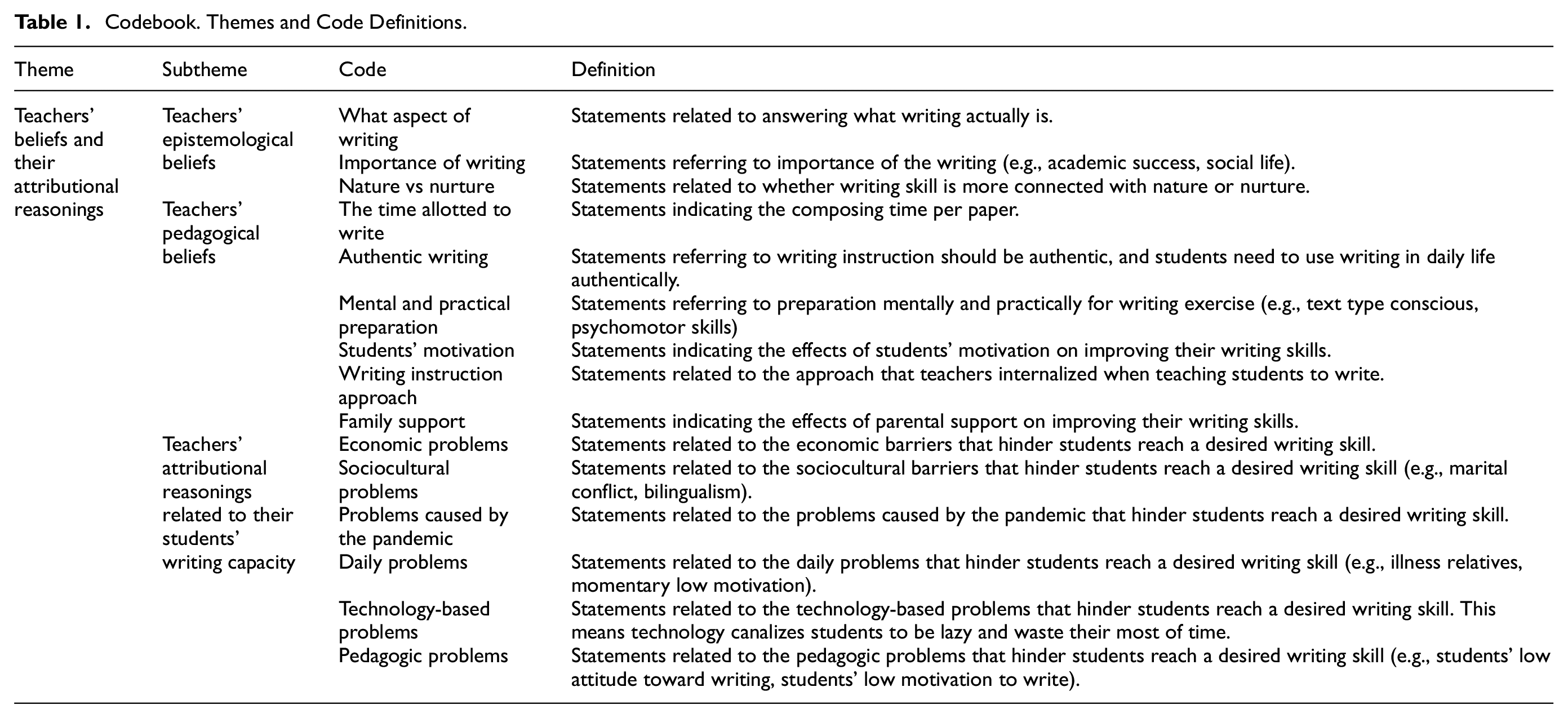
The data were analyzed through three primary coding cycles utilizing deduction techniques to identify how teachers’ epistemological beliefs, pedagogical beliefs, and attributional reasonings related to their students’ writing success, especially why these students do not access the desired level of writing. During the first cycle, the researchers read the entire dataset to familiarize themselves with teachers’ responses and develop analytic memos for a posterior coding process. Analyses began with an open coding cycle using structural and descriptive to create an initial list of codes repeated across interviews and could be assigned to different interview segments and recommendation letter segments. To this end, an author and an independent researcher independently read 12 interviews and 6 recommendation letters, underlining key ideas and coding each interview and recommendation letter segment with only one code related within a theme labeled teachers discourses. Once these initial codes were identified, the researchers of this article began creating a codebook with rules, definitions and good examples of illustrative comments for each code (Lincoln & Guba, 1985). During the second coding cycle, the first author and independent researcher met five times through comparing codes and comments for each of the six interviews and two recommendation letters, discuss the list of codes, and identify three preliminary subthemes and 20 codes. From these meetings, the codebook containing each code was updated. The code was briefly defined and illustrated with an example quote illustrating the measured construct. This codebook was shared with the external auditor to discuss and modify as needed. Through this iterative process, codes were reorganized and reduced through collapsing or elimination, and finally, fifteen codes were identified. These 15 codes were grouped into three main subthemes (teachers’ epistemological beliefs, pedagogical beliefs, and attributional reasonings). These fifteen codes were used to establish a codebook to be applied by the authors of this article (see Table 1 for the Codebook. Themes and Code Definitions).
Codebook. Themes and Code Definitions.
In the last stage of the data analysis, an integrative analysis and interpretation were carried out, including the findings from all three data sets, to reinterpret the pedagogical-epistemological beliefs regarding writing instruction and these beliefs how will be affect the barrier-attribution relationship.
Trustworthiness of the Study
In the present study, some standards of validity and reliability of a qualitative research were considered. First, intercoder reliability coefficients were found at an acceptable level defined as Cohen’s kappa (first: 0.82; second: 0.89; third: 0.87). To estimate intercoder agreement, we selected six interviews (four for revealing the participating teachers’ epistemological and pedagogical beliefs and two for teachers’ attributional reasonings) and two recommendation letters, representing approximately 44% of the total data. Miles and Huberman (1994) stated the vitality of evaluating and reviewing a codebook. To test if the codes could be implemented consistently, the author and independent researcher initially coded eight data sets (mentioned above, six interviews and two recommendation letters) to compare and correct possible problems in the codebook. The researcher then met to compare the coding and identify possible problems associated with the codebook, resolving issues by further examining teacher comments that generated disagreement. Then the remaining interviews and recommendation letters were coded by the article's author.
Secondly, a triangulation method was used in terms of the data source (Patton, 1980). To explain, the current study’s data was gathered from different persons (six participatory teachers) and diversifying sources (two interviewing protocols, a recommendation letter as a written reflection tool). In the present study, two external audits kept the researcher honest by playing the devil’s advocate role. Especially, the external audits demanded the researcher to check whether he supported his findings, interpretations and conclusions by the data (Lincoln & Guba, 1985). In addition, a member checking was carried out by inviting the participants to judge the accuracy and plausibility of the interpretations of the researcher. For the member checking procedure, not the raw data but the analysed and interpreted data were presented to the participants’ re-evaluations.
Findings
The Participating Teachers’ Epistemological Beliefs
We considered the participating teachers’ epistemological beliefs in two sections. Preliminary, we presented the stated mutual beliefs of the teachers. Afterwards, the participants’ differentiated beliefs were investigated related to adopting the product based or process-based writing approach (Figure 1).

The participating teachers’ epistemological beliefs.
The Teachers’ Common Beliefs
The teachers who internalize a product and process-based approach stated some beliefs related to “what aspect of the writing.” First and foremost, they described writing as a communication tool that has a vital effect on individuals’ lives. In their views, writing as a social phenomenon cannot be separated from communication processes. The roots of all mentioned above activities depend on communication due to interacting with two or more people. “Conveying my feelings and thoughts apart from oral communication. Writing is a communication way.” (Emma, Product-based).
The other aspect of writing is embodying the intangible thoughts in the mind. To put it differently, individuals make visible their opinion, demand, complaint, or academic success by using writing. “Briefly, I can call writing the process of transferring ideas and thoughts to paper with the help of psychomotor skills by structuring something in the students’ minds. Thus, we see and make sense of what is in students’ minds.” (Sophie, Process-based).
The last aspect of writing stated by participant teachers who internalize the core writing approaches as process-based and product-based is retention. This aspect of writing (retention) is connected with embodying intangible thoughts by writing. To sustain writing to be permanent, it must first be visible. The teachers stated retention mostly in the context of knowledge. “We use the writing in courses for providing some information related to the course topic to be permanent.” (Emma, Product-based).
We determined another belief theme, “the beliefs related to the importance of writing”. Teachers explained and elaborated on why writing is so vital for individuals. First and foremost, all teachers claim that writing is an essential tool for academic success. They mentioned that the students might learn, discuss, do homework etc., by writing. “Both reading and writing effect all courses’ success. We use writing with reading for better understanding and academic achievement.” (Jack, Process-based).
One of the beliefs obtained by the teachers’ discourses is social life. Teachers handled the importance of writing as a social and communicational process. To explain, their discourses related to the importance of writing connected with social life activities or the individuals’ sociality. “They (students) will not be able to express themself in sufficient detail. Straight, short, no aesthetics because they’re test boys. This is an obstacle to being more social.” (Isabella, Product-based).
The Teachers’ Differentiating Beliefs
The differentiating beliefs regarding “what aspect of the writing?” were revealed between the teachers who adopted the process or the product-based approaches. Firstly, the teachers adopted the process-based approach identified the writing as cognitive and psychomotor actions. They think that writing is born in individuals’ minds and occurs using psychomotor activities. “Writing is created in individuals’ minds. To write effectively, there should be something in our heads. Then the fingers operate, and the writing has occurred.” (Sophie, Process-based).
Second, the participating teachers who internalized process-based writing mentioned a concept that is “imagination” while explaining and elaborating the writing. They believe that imagination is vital for writing. From this point of view, these teachers perceive and comprehend the writing as “fiction text.”“Writing is a process that needs using imagination. For instance, while I write about something firstly, I imagine the things related to my writing topic. When we do this, we can say proudly: That is writing.” (Chris, Process-based).
Another belief related to what aspect of the writing stated by the process writing approach user teachers is meaningful whole. For instance, they claim that the parts of the written texts should be connected in a meaningful way. The teachers highlighted coherence and cohesion in this example. “The writing text should include paragraphs that have connections between them. In addition, the sentences that occur in paragraphs should be related as well.” (Jack, Process-based).
The last differentiating belief related to “what aspect of writing” is an act of art. This belief was reflected by the teachers who adopted a product-based approach. These teachers believe that while an individual writes something about, in addition, s/he acts an art activity. “We wrote composition when I was a little girl. It had an event, characters, conclusion, and most importantly, a message. I realized that I make art with the power of the pen while I write it.” (Emma, Product-based).
The differentiating beliefs apart from “what aspect of the writing?” were determined between the teachers who adopted the process or the product-based approaches. These beliefs were more related to the importance of writing. The teachers who internalized process-based writing stated that they attach importance to writing due to daily life activities, psychological well-being, and having/sharing the information between people. “For example, we sometimes need to write petitions or bucket or shopping lists. How can we write if we do not know writing?” (Sophie, Process-based-daily life activities).
The teachers who adopted the product-based approach elaborated on some different beliefs regarding the importance of writing. Product-based writing supporter teachers uttered that writing is an important skill all people should gain due to profession life, being sophisticated, and aesthetic pleasure. “We use writing for our profession like many people who have another profession.” (Emma, Product-based- profession life).
Nevertheless, a teacher who adopted a product-based approach stated very distinctive and extraordinary beliefs, unlike all other teachers. This teacher believes writing is only important if a student’s writing success level is subcritical. If students are above the subcritical level, it doesn’t matter how much their writing skill has improved. “There is a certain critical level, and writing is important for students below this critical level because it can affect their lives or academic success, but it is enough for others to go above the critical level.” (Chris, Product-based).
The teachers’ other differentiating belief is nature or nurture regarding the epistemological belief of writing. The participating teachers’ beliefs related to why some students have better writing quality than others differentiated according to the adopted process-based writing or product-based writing. The teachers who internalized the product-based approach claimed that some students have better writing quality due to their nature. According to these teachers working with the students has a very limited effect on improving their writing capability. “I think that writing is a skill that is not improved by working. For instance, I am a teacher, and I have 25 students in a class. Some of these students have high-quality writing skills, and some of them not. However, their teachers are the same.” (Isabella, Product-based). Although the beliefs of teachers who support product-oriented writing are as above, the process-based supporter teachers’ beliefs are at opposite poles from product-based supporter teachers. The teachers who adopted the process-based oriented writing stated that the students writing skills may improve with the work. According to their beliefs, writing is not a skill that comes from nature; rather, writing is a skill that is acquired and improved with systematic programs and work. “I think eighty or ninety per cent of the writing is effort. If the correct writing process is known, a person can write a quality text if s/he has received training.” (Lily, Process-based).
The Participating Teachers’ Pedagogical Beliefs
We considered the participating teachers’ pedagogical beliefs into two sections. First, we determined the general beliefs of the teachers. Then, the participants’ common and differentiated beliefs were examined to internalize the product based or process-based writing approach (Figure 2).

The Participating Teachers’ Pedagogical Beliefs.
The Time Allotted to Write
We determined that the participating teachers allotted time to write is differentiated according to the adopted process or product-based writing. To exemplify, the teachers who have a process-based pedagogic oriented claim that the time allotted to write a text should last at least four lesson hours. However, the product-oriented teachers stated that one lesson hour should be enough to complete a text writing. “I think finishing a paper continues maximal one forty minutes (one lesson hour).” (Chris, Product-based). “At least four or five lesson hours (the time allotted to write). There are so many activities to complete a writing workshop.” (Isabella, Process-based).
Authentic Writing
The participating teachers, regardless of which type of writing instruction was adopted, stated that the writing instruction should be authentic. They confirm that using writing for daily life activities is very essential to combine it with an individual’s life. “Students should write to prepare a shopping list. The child needs to be aware of using writing. They should integrate writing into their life.” (Emma, Product-based).
Mental and Practical Preparation
Some similar and different discourses were determined in the teachers’ statements regarding mental and practical preparation. The participants explained that some skills should be gained before the teaching exercise to increase writing quality. These skills confirmed by both process-based and product-based support teachers are reading, the text type conscious, and psychomotor skills. “Students’ fingers must have reached sufficient maturity.” (Chris, Product-based). “Students need to read many books to be ready for writing. As you know, to write upper-intermediate level, they also need to extent their imagination by reading a substantial book.” (Isabella, Process-based).
The teachers also stated some differentiating beliefs according to internalize the process or product approach. The product-based implemented teachers justified that researching is a skill that all students need while writing. Furthermore, similar teachers claimed that conceptional knowledge is also essential to writing. “We say -write!- easily to children, but how can s/he write? They should have the information first” (Emma, Product-based). Some opinions stated by the teachers who adopted process writing are different from mentioned above statements. These teachers clarified the importance of observing to sustain high-quality writing papers. “At this point of view, I attribute the importance to observing. Upwards from the borning, everyone observes nature, other people, and maybe own.” (Lily, Process-based).
Students’ Motivation
The importance of students’ motivation to boost the students’ writing skills was stated by all participating teachers. In this sense, there is no differentiating belief regarding the effectiveness of students’ motivation on students writing capacities development. “It is an action that the child should really want and do with love.” (Emma, Product-based).
Writing Instruction Approach
There are strictly root differentiating beliefs of the participant teachers related to how to improve the students’ writing capability considering the teaching writing approaches. To put it differently, the teachers who adopted product-based writing belief that writing instruction is more related to spelling rules, punctuation, and the page layout. On the contrary, the other teachers that they internalize the process-based approach, focusing on context rather than technical rules of writing. “While writing, did the student make a line break between paragraphs, did they start with a capital letter after a period, did they make a typo, is the writing legible?” (Isabella, Product-based). “I believe the contextuality in teaching writing. The other factors such as punctuation and writing rules may be fixed in future.” (Sophie, Process-based).
The product-based supporter teachers conceptualize the writing as a small moment activity. However, participants saw teaching writing as a consecutive and skill-oriented act on the other side. “Writing is an act that starts and finishes for a small moment for the child.” (Chris, Product-based). “Teachers generally want their students to write quickly. However, the allotted time to write should not be short. The teachers should handle it (writing exercise) as a consecutive process.” (Jack, Process-based).
The other diversity of the current teachers’ beliefs is whether the writing instruction should be student-centered or teacher-centered. According to the discourse, we understood that the participating teachers who adopted the product-based approach justified the teacher-centered instruction in teaching writing context. However, the other teachers who internalize the process-based approach asserted that writing instruction should be student centered. “The writing process must be my-controlled. The students need to follow my instruction” (Isabella, Product-based). “We should flex the writing process for all students. Teachers should do the guidance to command the students’ self-writing process.” (Lily, Process-based).
On the other hand, the teachers who rely on product-based writing stated some opinions regarding the importance of homework and punishment/reward. These teachers claimed that homework is one of the most important parameters to foster students writing capacity. Furthermore, they supported using punishment and reward to motivate students to write. “Sometimes I punish students due to their illegible writing. Sometimes, I also reward them if they did not make any mistakes in their writing according to the writing rules.” (Chris, Product-based).
Other focusing points among teachers who advocate process-based writing are using different techniques while teaching the writing process, effective feedback, and peer support. These teachers believe that the students writing skills might be boosted only by using various writing techniques. Furthermore, these teachers stated that giving effective feedback to students writing during the pre-writing, writing process, and after writing is essential for improving students’ writing capability. Also, they advocated the importance of the peer-support while writing. According to them, the students understand their friends better than adults, and their support might be more inspiring to motivate them to write. “It is used many techniques while writing. In addition, students should aid each other.” (Lily, Process-based). “I believe that the power of revising and editing effect in writing instruction. They (students) must improve and edit their papers according to the feedback.” (Jack, Process-based).
Parental Support
The last theme stated by participating teachers regarding pedagogical belief is parental support. Teachers who adopted product-based writing and process-based writing justified the effect of parental support on improving student writing capacity. “Children can write without family support. However, with family support, the writing process will be easier, and the child will reach their potential more quickly.” (Emma, Product-based).
Barriers and Attributions Relationship
The participating teachers’ barrier’s regarding their students’ writing achievement and their attributional reasonings to elaborate on these barriers were presented in six categories (Figure 3).

Barriers and Attributions Relationship.
The first attribution of teachers related to the factors that effect their students’ writing capability is economic problems. Economic problems as a barrier to writing achievement stated by the teachers who internalized both product and process-based writing approaches. However, this problematic is seen as an externally oriented attribution. In addition, the teachers are not part of the solutions to achieve this barrier. Therefore, the economic problems are shown as uncontrollable attributions. Moreover, poverty is a phenomenon that has existed for a long time. Thus, this case would be an example of a stable attribution due to probably, poverty will exist in the future. “If the economic conditions were better, we could easily put in front of the materials that would arouse much more interest in children.” (Emma, Product-based).
According to the participant teachers’ views, the next barrier to the students’ writing achievement is socio-cultural problems. In this category, the marital conflict was stated by the participants who internalized the product and process-based writing. The participant teachers exemplify that their students are under pressure most of the time from their parents due to the desire for success in writing. “Students go home after school, and there is the eighties generation at home, for example, my students’ parents, seventies, eighties, roughly. Well, naturally, for example, when the student cannot write or write wrong, parents do not have the same patience as we do.” (Sophie, Process-based). Some of the statements, bilingualism, and uneducated social environment, in socio-cultural problems were claimed by only teachers who believed in the product-based writing approach. These teachers explained that implementing writing studies is difficult with bilingual students. They stated that in Türkiye, especially in some regions, Turkish is an acquired language that negatively effects students’ writing capacity. “Some of the students’ mother tongue is not Turkish. They learned the Turkish language after they started pre-primary or primary schools. These students know fewer words, are not familiar with sentence structures, and have prejudices about writing in Turkish.” (Chris, Product-based). The socio-cultural problems are an illustration of an externally oriented, stable, and uncontrollable attribution. Thus, the teachers may not change these situations.
The other attribution related to the students’ obstacles in writing are problems caused by the Covid-19 pandemic. This barrier was stated by the participating teachers who internalized the product-based writing. This attribution is externally oriented, uncontrollable, and not stable. The pandemic problems are not stable, which means that these problems will not occur in the future due to the temporary nature of the pandemic process. The difficulties of conducting online courses and following writing implementations in distance education were the main barriers during the pandemic. “The covid pandemic effected my writing exercises. In this process, my writing tasks were decreased.” (Chris, Product-based).
Daily problems as an obstacle to success in writing were stated by the teachers who carry out the product-based writing in-class writing instruction. These daily problems were an example of unstable attributions. To exemplify, a participating teacher elaborated that a student in her classroom has ill relatives around them, which causes them not to focus on the instructional process. This barrier is also identified as external oriented and uncontrollable. “A student said that there is a sick person in the family and his mother must take care of her all the time. He explained that he couldn’t focus on his writing assignments either.” (Emma, Product-based).
The other barrier to success in writing is technology-based problems. This barrier was stated by the participants who internalized the product-based approach. Teachers claimed that the students do not need to write classically with increasing technology use. They also elaborated that the students want to do their homework through the internet and technological sources, and also, the students do not want to do homework by classical methods. This attribution was determined as uncontrollable and external oriented such as mentioned above attributions. “If technology were less in our lives, maybe the kids would write a letter.” (Isabella, Product-based).
The last and most extended barriers related to the students’ success in writing were determined as pedagogical problems. The pedagogic issues consisted of student-caused, teacher-caused, classroom management caused, curriculum caused, and educational system caused. First and foremost, all teachers stated that the students’ attitude toward writing, motivation to write, and capability regarding writing are effective on students writing success. Therefore, they mean that if the student has a low-quality writing skill, s/he probably has a negative attitude toward writing, low motivation, or low capability in writing. This attribution is externally oriented, unstable, and uncontrollable. Teachers think that the problem to improve students writing is not related to their writing instruction or competency; it is related to the student caused factors. “They (students) do not like writing. They do not like homework needed writing. So, their failure in writing is more related to their capacity, motivation, and desire.” (Isabella, Product-based).
The other pedagogical problem was caused by the teachers-based issues. First, all teachers who internalized product or process-based writing believe that teacher competency is effective in students’ writing development. Moreover, the teachers who used process-based writing stated that the teachers are the most essential factor to be more successful or fail in students’ writing. For the first time, the participating teachers’ attributions regarding their students’ writing failure are internally oriented, controllable, and unstable. This means that the teachers may challenge these barriers. The attribution that means students’ writing failure caused by the teacher was stated mostly by the teachers who internalize the process-based approach. “Prior to everything we may talk about, we should handle the competency of the teachers. Do they know new approaches in writing instruction? Do they use some writing strategy to improve students writing skills?” (Lily, Process-based).
Classroom management is the next pedagogical attribution related to the participant teachers’ students’ writing success. Especially the class size that teachers were employed was caused this barrier. This mentioned above attribution was displayed by all teachers, and they determined externally oriented, uncontrollable and stable. To explain, the teachers could not do anything to challenge this problem due to class sizes are not under the teachers’ authority. “Think about it. You have fifty students in a class. How you can manage this class. It was very hard to implement high-quality writing exercises.” (Chris, Product-based).
Curriculum and educational system caused obstacles to students’ writing success were also stated by all participants. The teachers claimed that the Turkish education system does not attach importance to boost students writing capability. According to their views, the curriculum is insufficient to develop students writing capacity. “The writing curricula are insufficient to develop students’ writing skills. The most important thing in our education system is to choose true options in central exams.” (Emma, Product-based). The above barriers are an example of externally oriented, uncontrollable, and stable attribution.
Discussion
Since beliefs serve as a guide for action and a filter for thinking about how teaching writing should continue, it is widely assumed that teaching writing is shaped by the beliefs of those who teach it (Graham & Harris, 2018). Previous studies have examined various teacher beliefs about writing, including beliefs about readiness to teach writing (e.g., Gilbert & Graham, 2010), efficacy to teach writing (e.g., Rietdijk et al., 2018), attitudes towards writing and writing (e.g., Hsiang & Graham, 2016) and epistemological beliefs about the role of open learning and the natural learning process in teaching writing (e.g., Brindle et al., 2016; Graham et al., 2002). An important contribution of this study is handling teachers’ beliefs related to writing and writing instruction with attributions regarding the barriers in writing instruction. Therefore, the current research was differentiated and extended the previously mentioned research results.
One of the most interesting results of this study is revealing the differences between participating teachers’ who internalized process or product-based writing beliefs related to whether writing is nature or nurture. The teachers who adopted product-based writing claimed that improving students’ writing skills are more related to their nature. Thus, they stated that their effort to boost their students’ writing capability is not enough to improve it. Seban (2008) stated that there is a wide range of views among teachers about how to teach writing, and there were significant differences in the writing practices of teachers. The current research supported Seban’s (2008) study. In addition, Hsiang et al. (2020) explained that the teachers also slightly agreed that effort and process are important ingredients to becoming a good writer. The teachers who internalized the process-based approach uttered similar opinions in this study. Thus, this result slightly supports some of the Hsiang et al. (2020) results.
One of the other results of the current research is the differences in the teachers’ allotted time to write. According to the results, there was a serious difference related to the allotted time to write between the teachers. The teachers who internalized the process-based approach allotted approximately four-lesson hours to complete a writing exercise; however, the teachers who adopted the product-based allotted only an hour. A second common theme of writing instruction worldwide that was replicated in the current study is that there is considerable variability in how writing is taught within a country, and some teachers devote more time and energy to writing instruction than others (e.g., Cutler & Graham, 2008; Wilcox et al., 2016). A sizable minority of teachers (37%) in Hsiang et al. investigation reported they taught writing every day (Hsiang et al., 2020). In this study, the teachers who implemented process-based writing in their classes allotted an hour per weekday to teach writing to their students. Nevertheless, the teachers who used product-based writing allotted only an hour per week. Thus, this research supported other researches such as Cutler and Graham (2008), Hsiang et al. (2020), Seban (2008), and Wilcox et al. (2016) relatively.
Another result of the present study is that the teachers’ focus point while teaching writing. The teachers who internalized the process writing indicated consecutively, skill-oriented, and contextual writing instruction. On the contrary, the teachers who implemented product-based writing emphasized spelling rules, punctuation, and page layout. Many research’s reported that the technical aspects of writing such as spelling rules, punctuation, page layout mentioned above more emphasized by Turkish teachers (Tavsanli, Kaldirim, & Gedikli, 2021). This may be caused that the students attach importance to the technical aspect of writing rather than the contextual point. Thus, both national research papers and reports stated that the Turkish students do not have the desired writing level (OECD, 2016).
This research also supports the results of the studies (Hsiang et al., 2020; Hung & Van, 2018; Kaldirim & Tavsanli, 2018) that confirm the effectiveness of mental and practical preparations, authentic writing, student motivation, different teaching techniques, effective feedback, peer support, and family support on students writing capability. The teachers both who internalized process or product-based approaches stated that they make preparations before the lessons, and they see their own as enough regarding writing instruction. Hsiang et al. (2020), Graham et al. (2022) and Graves (1983) confirmed that pre-writing exercises are essential to contextualize the writing process. Contrary to the current study’s findings related to the teachers’ efficacy in teaching writing, Hsiang et al. (2020) reported that the Taiwanese Teachers indicated they were not adequately prepared to teach writing, but they were slightly positive about their own writing, teaching students to write, their efficacy as writing teachers and students’ progress as writers. Some research conducted in different countries also reported similar findings (De Smedt et al., 2016; Veiga Simão et al., 2016).
Another interesting result of this research is the participating teachers’ external-oriented attributions. In general, teachers to explain their students’ failure in writing indicated the external causes-they do not see responsible own. In AT, if the attributions were continuously identified as an externally- oriented, they are called a fundamental attribution error (Weiner 1972). Teachers would not desire and effort to improve their students’ writing skills if they do not see their own as one of the responsible factors. If the problem emerges based on the family, socioeconomic factors, students, or daily life problems, how teachers could motivate themself to boost their students’ writing? This finding also supports the teachers’ uncontrollable and stable attributions. As we predicted before, teachers’ most of the attributions are uncontrollable and stable. This means that teachers’ reasonings related to their students writing success level, especially their failure in writing more related to uncontrollable factors such as poverty, bilingualism, and low socioeconomic level. Furthermore, these attributions analysed from the teachers’ interviews show that the factors causing their students’ failure in writing are stable. The attributions such as poverty, socioeconomic level, and technology-based problems will probably sustain in future. Only problems caused by the pandemic were identified as unstable attribution regarding their student’s failure in writing according to teachers’ reasonings. Therefore, we clearly say that the teachers’ attributions related to their students’ failure in writing were determined as a fundamental attribution error. In these conditions, the teachers would not be expected to endeavour to improve their students’ writing capability.
Internal-oriented, controllable and unstable attributions related to the students’ inadequacy in writing were stated by only participating teachers who internalize the process-based writing. In general, the teachers who apply the process-based writing stated more equal attributions related to the internally or externally oriented attributions. These teachers explained that they are responsible for their students’ failure in writing as far as the other factors stated by the teachers who internalized the product-based approach. The teachers who adopted process-based writing in their in-class activities highlighted the teacher caused factors: teacher adequacy, motivation, interest, etc. These internally oriented attributions are needed to increase teachers’ teaching desire, develop teachers’ career development, and follow the new tendency in teaching and learning (Williams & Beam, 2019). Thus, these teachers believe that if they improve their pedagogical background, their students will be able to write more adequately. It means that boosting students writing capability is under the control of the teachers.
Our study’s findings are in line with those of Kansızoğlu (2023), who explored the challenges faced in writing instruction within Turkish secondary schools. While Kansızoğlu highlighted issues such as inadequate teacher preparation and limited pedagogical competence, our study adds to this understanding by providing insights from primary school teachers and focusing specifically on their attributional reasoning and pedagogical beliefs. Together, both studies emphasize the pressing need for continuous professional development to support teachers in adopting effective and reflective writing instruction practices across all levels of education.
Internationally, a study conducted in New Zealand by Walls and Johnston (2023) examined the effects of teachers’ beliefs and practices on students’ writing progress. The research highlighted that explicit teaching practices positively correlated with student progress, while socio-cultural and process-oriented approaches showed less impact. This contrasts with our findings, where process-based approaches were perceived as more effective by Turkish teachers.
These differences may be attributed to cultural factors influencing educational practices. In collectivist cultures like Türkiye, there is a greater emphasis on contextual and relational aspects of learning, which aligns with process-oriented approaches. Conversely, individualistic cultures may favor explicit instruction and measurable outcomes. Understanding these cultural nuances is crucial for developing effective writing instruction strategies that are culturally responsive and contextually appropriate.
To sum up, in general, the teachers who internalized the process-based writing believe that the writing instruction should be consecutive, contextual, and skill-oriented. However, the teachers who implement a product-based approach indicated the more technical factors such as writing rules, punctuations, and layout. The teachers who used the process approach allotted a subsequent more time to teach writing rather than the teachers who believed in product-based writing. Moreover, the attributions of teachers who internalized process-based writing are more balanced. The internally oriented, controllable and unstable attributions may be seen as a pathway to improve students writing skills. Nevertheless, the externally oriented, uncontrollable, and stable attributions, especially if they are constant, could be an obstacle to reaching the desired writing level.
Conclusion
According to this current research, the participating teachers stated that writing is a communication tool that embodies intangible thoughts and guarantees retention. The teachers who internalized the process-based writing highlighted the cognitive and psychomotor actions, imagination, and meaningful whole aspects of the writing process. The participating teachers claimed that improving students’ writing ability is needed to sustain academic success and social life. The participating teachers’ opinions on whether writing is a nature or nurture were differentiated according to the internalized process or product-based approach. The teachers who used the process approach to implement writing instruction in their class explained that improving the students’ writing capability is more related to nurture; on the contrary, the participants who believe in the product-based writing approach claimed that nature.
When we focus on the participating teachers’ pedagogical beliefs, there were more intense differences between the teachers who adopted the process or product-based approaches to teach writing in their class. To exemplify, the teachers who internalized the process writing stated that they complete a whole writing exercise in four lesson hours, contrary to the teachers who use the product based finished in an hour. The teachers also focused on mental and practical preparations, authentic writing, student motivation, and family support. Regarding the writing instruction approach, the teachers who internalized the product-based writing emphasized spelling rules, punctuation, page layout, teacher-centered, homework, and punishment. The participants’ who believe in product-based writing to boost their students’ writing capacity claimed that writing instruction should be implemented consecutively, skill-oriented and contextual. They stated that focusing on different techniques to teach writing, effective feedback, and peer support is essential to improve students writing capability.
Finally, the teachers’ attributions related to the barriers to students writing skills were considered, economic, socio-cultural problems caused by the pandemic, daily problems, technology-based problems, and pedagogic problems were determined as participating teachers’ attributions related to the obstacles to improve students’ writing skills. Generally, the attributions related to the barriers to enhance students’ writing capabilities were identified as externally oriented. The teachers who internalized the process-based writing approach stated more internal-oriented attributions than teachers who believed in a product-based approach. Most of the attributions related to obstacles in students’ writing skills were stable and uncontrollable. To put it differently, especially the teachers’ attributions who adopted a product-based approach show that the rationales’ regarding the students’ obstacles in writing are external, stable, and uncontrollable.
Educational Implications
The findings of this study yield several meaningful implications for educational practice, particularly in the context of writing instruction in primary education.
First, the study highlights the importance of understanding teachers’ attributional beliefs and how these beliefs influence instructional practices. Teachers who attribute students’ writing performance primarily to internal factors, such as student effort or innate ability, may approach instruction differently than those who attribute outcomes to external factors like home environment or systemic limitations. Thus, professional development programs should include reflective training sessions that encourage teachers to critically examine their own causal attributions and how these beliefs shape their pedagogical decisions.
Second, the findings indicate that teachers' preference for process-based or product-based approaches to writing is deeply connected with their perceptions of students’ capabilities. This suggests a need for training programs that expose teachers to both approaches and encourage blended, flexible instructional strategies tailored to diverse classroom needs. Equipping teachers with evidence-based knowledge on both models can empower them to make pedagogical choices that best support student growth.
Third, the study underscores the role of cultural and contextual factors in shaping teacher beliefs. In contexts like Türkiye, where educational practices are influenced by both collectivist values and exam-oriented systems, teachers may need additional support in implementing student-centered, process-focused writing pedagogies. Educational policymakers and curriculum developers should consider these cultural dynamics when designing writing curricula and assessment tools.
Lastly, the study’s emphasis on attribution theory as a lens for understanding teaching behavior offers a theoretical foundation that can inform teacher education and research. By fostering awareness of how attributional reasoning affects classroom interactions and expectations, teacher training institutions can promote more equitable, motivational, and student-centered writing environments.
Limitations
One limitation of this study is that it did not systematically examine the potential influence of variables such as teachers’ age, gender, years of professional experience, or their professional roles (e.g., head teacher, classroom teacher, novice vs. experienced teacher). These factors may shape teachers’ beliefs and attributional reasoning in meaningful ways. Future research could benefit from exploring how such demographic and professional characteristics influence teachers’ perspectives on writing instruction, particularly in relation to their decision-making processes and educational responsibilities.
Another limitation of this study lies in its exclusive reliance on self-reported data through interviews. While in-depth interviews provide rich qualitative insights into teachers’ beliefs and attributional reasoning, they may also be subject to social desirability bias or memory-based distortions. Teachers might have presented their instructional practices or beliefs in a more favorable light, especially when discussing sensitive topics such as student success and failure. Incorporating observational data or triangulating with student feedback in future research would enhance the validity and reliability of findings.
The current study was conducted with a relatively small and context-specific sample—six primary school teachers from a single national setting (Türkiye). While the study offers in-depth understanding within this cultural and educational context, the limited sample size and lack of regional or institutional variation restrict the generalizability of the findings. Future studies could extend this inquiry by involving a larger and more diverse group of participants across different regions or educational systems, enabling cross-cultural comparisons and broader interpretations of attributional beliefs and pedagogical orientations.
Supplemental Material
sj-docx-1-sgo-10.1177_21582440251360060 – Supplemental material for Investigating Turkish Primary School Teachers’ Beliefs About L1 Writing Instruction Through Attribution Theory: Process-Oriented versus Product-Oriented Perspectives
Supplemental material, sj-docx-1-sgo-10.1177_21582440251360060 for Investigating Turkish Primary School Teachers’ Beliefs About L1 Writing Instruction Through Attribution Theory: Process-Oriented versus Product-Oriented Perspectives by Omer Faruk Tavsanli in SAGE Open
Supplemental Material
sj-docx-2-sgo-10.1177_21582440251360060 – Supplemental material for Investigating Turkish Primary School Teachers’ Beliefs About L1 Writing Instruction Through Attribution Theory: Process-Oriented versus Product-Oriented Perspectives
Supplemental material, sj-docx-2-sgo-10.1177_21582440251360060 for Investigating Turkish Primary School Teachers’ Beliefs About L1 Writing Instruction Through Attribution Theory: Process-Oriented versus Product-Oriented Perspectives by Omer Faruk Tavsanli in SAGE Open
Footnotes

Funding
The author received no financial support for the research, authorship, and/or publication of this article.
Declaration of Conflicting Interests
The author declared no potential conflicts of interest with respect to the research, authorship, and/or publication of this article.
Data Availability Statement
The data that support the findings of this study are available from the corresponding author, upon reasonable request.
Supplemental Material
Supplemental material for this article is available online.
References
Supplementary Material
Please find the following supplemental material available below.
For Open Access articles published under a Creative Commons License, all supplemental material carries the same license as the article it is associated with.
For non-Open Access articles published, all supplemental material carries a non-exclusive license, and permission requests for re-use of supplemental material or any part of supplemental material shall be sent directly to the copyright owner as specified in the copyright notice associated with the article.
