




Abstract
Based on grounded theory, this paper discusses the classification of observer attribution of supervisor knowledge hiding and constructs a theoretical model of observer attribution of supervisor knowledge hiding. This study lasted for 3 months, during which 57 knowledge workers from various positions in industries such as technology, culture, and finance in the Yangtze River Delta region of China were interviewed through theoretical sampling. The interview data were analyzed using the three-level coding process of procedural grounded theory. It is found that, from the perspective of observer, supervisor knowledge hiding is the interaction result of four factors: supervisor kind guidance, supervisor selfishness, supervisor moral disengagement, and supervisor situational response. Among them, positive attribution of supervisor kind guidance and negative attribution of supervisor selfishness, supervisor moral disengagement constitute the internal environment of the supervisor. Supervisor situational response is the external environment of the organization. They form the logic of positive attribution: internal and external environments, and the logic of negative attribution: internal and external environments, revealing the mechanism of observer attribution of supervisor knowledge hiding. The research findings expand the study of the formation mechanism of supervisor knowledge hiding and provide important guidance for knowledge management practice.
Introduction
There is a Chinese saying that goes “Teach disciples, starve master.” It reflects the common psychology of supervisors hiding knowledge from subordinates in workplace since ancient times. In fact, specific knowledge, experience and skills stored in the minds of managers are important sources of the manager’s control and management status due to their exclusivity, scarcity and difficulty imitation. Therefore, in order to maintain the knowledge advantage in the organization and prevent being replaced by subordinates, managers are likely to deliberately hide some important knowledge from subordinates (Zhu & Wei, 2023). According to this phenomenon, the academic community put forward the concept of supervisor knowledge hiding, and defines it as the behavior of supervisors intentionally hiding or covering up the knowledge needed by subordinates (Butt & Ahmad, 2019). Due to the trickle-down effect, this top-down knowledge hiding is more destructive than the knowledge hiding among employees, and will cause varying degrees of harm to individual performance, team communication and organizational innovation (Akhtar et al., 2021). At present, under the guidance of China’s innovation-driven and high-quality development of digital intelligence, supervisor knowledge hiding has become a key problem hindering enterprise knowledge innovation, transformation, and improvement(Akhtar et al., 2021; Arain et al., 2020; Liu et al., 2020), and has also become the focus of current knowledge management practice.
Until now, academic research on supervisor knowledge hiding is still in its infancy. Although Cheng et al. (2008) discovered knowledge hiding at different levels and highlighted the gap in this research field, previous research on knowledge hiding mostly focuses on horizontal coworker knowledge hiding. There is a lack of specific study on the new phenomenon of supervisor knowledge hiding at the vertical level in complex situations (Zhao & Jiang, 2021). Existing studies on supervisor knowledge hiding have mostly concentrated on the cultural context of the Middle East (Butt & Ahmad, 2019), yet human behavior patterns vary across cultures. Therefore, further research is needed across various cultural contexts, including China, to ensure the validity of the findings (Akhtar et al., 2021; Arain et al., 2020) and explore the complexity of supervisor knowledge hiding phenomena.
Compared to other negative leadership behaviors in the workplace, such as abusive management and workplace bullying (H. Chen et al., 2022), current research on knowledge hiding still focuses on the perspectives of knowledge hiders and seekers, with limited attention given to the vast group of observers. Observers are other subordinates within the same leadership team, excluding the direct participants in the knowledge hiding incident. Social cognitive theory posits that observers tend to imitate the behavior of those around them through observation, learning, and mimicry (Yaffe & Kark, 2011). Supervisors, as key organizational factors influencing observers’ decision-making, have been shown to have harmful effects on the organization, leading employees to engage in knowledge hiding behavior (Offergelt & Venz, 2022). Therefore, observers are likely to accept and subconsciously adopt this behavior, thereby amplifying the harmful effects of supervisor knowledge hiding (Ahmad et al., 2019; Bormann & Diebig, 2021). Existing research has largely overlooked the important perspective of observer attribution (Song & Wang, 2023). Despite the fact that observers play a key role in analyzing supervisor knowledge hiding behavior, little is known about the factors influencing observer attribution. Since the number of observers far exceeds that of the direct participants, and according to attribution theory, observers and direct participants attribute the same behavior differently (H. Chen et al., 2022), the attribution of observers often has a more profound and harmful impact on the organization (H. Chen et al., 2024). To bridge these gaps in the literature, this study uses an attribution framework to examine how observers attribute supervisor knowledge hiding.
Therefore, this study focuses on an ignored group (i.e., observers) in the literature of supervisor knowledge hiding, and constructs a conceptual model of how the observer perceives and attributes supervisor knowledge hiding through an exploratory study based on grounded theory. This paper not only enriches the academic discussion on supervisor knowledge hiding, but also provides practical insights to help enterprises optimize knowledge management and enhance organizational innovation by stimulating active intervention of observers.
Specifically, this paper first reviews the current research progress and clarifies the research questions. It then proceeds to design the study based on the methodology of proceduralized grounded theory, collecting data through theoretical sampling, and employing a three-level coding process to analyze the data. Finally, it summarizes the various categories and conceptual models derived from the analysis, providing a detailed explanation. The study concludes by discussing the implications of the findings and proposing directions for future research on supervisor knowledge hiding.
Literature Review
Observer Attribution Theory
According to Bandura (1973), most complex behaviors displayed by individuals are learned either deliberately or unconsciously through the influence of role models. As supervisors within a team, their actions significantly influence the behavior of all members, subtly shaping subordinate conduct (Lily et al., 2024). The Chinese proverb “Kill the chicken to warn the monkey” aptly illustrates the profound impact of leadership behavior on observers. Attribution theory suggests that individuals craft their own interpretations of why others behave in certain ways. These interpretations, in turn, influence their cognitive and behavioral outcomes (Arain et al., 2020), highlighting the significance of individual attribution. However, existing research on leadership attribution has predominantly focused on the involved parties, with scant attention given to observers. These observers, who are team members not directly engaged in incidents such as knowledge hiding, outnumber both knowledge hiders and seekers. Their interpretations of leadership actions significantly affect the interactions between these groups (Zhao et al., 2023). Moreover, the attributions made by observers about the same leadership behaviors may differ from those made by directly involved parties, thereby influencing varied behavioral decisions (Song & Wang, 2023). Studies have demonstrated that negative leadership behaviors tend to have a more enduring and deeper impact on observers than on directly affected employees (H. Chen et al., 2022, 2024), posing greater risks to organizational health (Butt & Ahmad, 2019; Zhao et al., 2023). Although existing studies often focus on the direct effects between perpetrators and victims, considering the substantial number of observers and their potential influence underscores the need for a broader analysis of organizational dynamics. Consequently, this study will employ observer attribution theory to further investigate the mechanisms underlying supervisor knowledge hiding.
Supervisor Knowledge Hiding
Supervisor knowledge hiding refers to a phenomenon where superior managers intentionally conceal knowledge from their subordinates, a practice prevalent in management (Butt & Ahmad, 2019). This behavior represents a burgeoning area of research within the field of knowledge hiding, challenging traditional confines and broadening the scope from a horizontal to a vertical examination (Cheng et al., 2008; Connelly et al., 2012). This expansion has catalyzed cross-level investigations into knowledge hiding. Butt and Ahmad (2019) have categorized the antecedents of supervisor knowledge hiding into personal, interpersonal, and organizational levels, as elaborated in Table 1. Their findings reveal that the precursors to this behavior are varied and multi-tiered, encompassing factors like personal indispensability, career prospects, interpersonal relationships, and organizational culture (Butt & Ahmad, 2019; Butt, 2019). This segmentation offers critical insights into the motivations behind supervisor knowledge hiding.
Research on the Antecedents of Supervisor Knowledge Hiding.

Recent studies on the consequences of supervisor knowledge hiding indicate that this behavior adversely affects individuals by diminishing work performance and innovation (Abdelmotaleb et al., 2022; Arain et al., 2020) and impacts organizational identification and citizenship behaviors (Butt & Ahmad, 2019; Offergelt et al., 2019). Notably, Zhao and Jiang (2021) have introduced the concept of the double-edged sword effect of supervisor knowledge hiding, suggesting that under varying stress responses, it can have both positive and negative outcomes on subordinate knowledge hiding. This notion introduces novel perspectives to the discourse on the ramifications of supervisor knowledge hiding and contributes a localized theoretical framework.
Research Review
Although current research provides valuable insights into supervisor knowledge hiding, it also exhibits several shortcomings. Firstly, existing studies have overlooked the critical role of observer attribution in analyzing supervisor knowledge hiding behavior, a gap noted by scholars (Arain et al., 2020; Zhao & Ma, 2025). Despite the significance of observers, little is known about the factors influencing their attributions. Secondly, much of the research has been focused on the Middle East, with scant studies conducted in other cultural contexts such as China (Akhtar et al., 2021; C. Chen, 2020). Given that behavioral patterns vary across cultures, it is challenging to ascertain the applicability of existing findings to Chinese enterprises (Butt & Ahmad, 2019; Xie et al., 2024). Finally, the scope of existing research is somewhat limited and does not fully capture the complexity of the supervisor knowledge hiding phenomenon. Consequently, this study employs grounded theory to undertake exploratory research on supervisor knowledge hiding from the perspective of observer attribution, aiming to bridge the identified research gaps and provide new theoretical and practical insights for the local Chinese context.
Methodology
Research Methods
Supervisor knowledge hiding represents a burgeoning area within the broader field of knowledge hiding. Given the complexity of the antecedent factors, existing theories are inadequate to fully address this topic. Consequently, this article adopts grounded theory as the methodological approach for several compelling reasons. Grounded theory is a well-established qualitative research method that is both scientifically rigorous and explanatorily robust, recognized by the academic community. It provides a comprehensive framework for data analysis, particularly suited to exploring new or poorly understood phenomena that existing theories fail to explain adequately (Fan et al., 2017). Additionally, grounded theory is apt for localized studies, which helps to address the research gap in understanding supervisor knowledge hiding within the Chinese cultural context (Jia & Tan, 2010).
The analytical focus of grounded theory is on coding, involving the detailed abstraction and conceptualization of data line-by-line. This process culminates in the identification of key concepts and categories, ultimately facilitating the construction of a theoretical framework with significant explanatory power and practical relevance.
Theoretical Sampling
Definition of Core Concepts
Building on previous literature, this paper defines the core concept of supervisor knowledge hiding as a phenomenon where superior managers intentionally conceal knowledge from their subordinates within an enterprise (Butt, 2019).
Research Object Selection Criteria
Guided by the question-oriented requirements and data-driven principles of grounded theory, the selection criteria for research objects in this study are as follows: (a) Typicality: All selected subjects have observed supervisor knowledge hiding behavior in the workplace; (b) Standardization: Each subject provides an interview that yields valid and comprehensive evidence; (c) Diversity: Subjects are drawn from a range of positions, industries, and regions, thereby ensuring a richness of data sources. This diversity aligns with the grounded theory’s emphasis on information richness over sample size (Glaser & Strauss, 1967).
Data Collection
The data for this study were primarily gathered through unstructured interview questionnaires targeting employees who observed supervisor knowledge hiding behaviors during their employment. The core questions posed were: (a) Have you, as an observer, witnessed or heard of similar behaviors at work? (b) What do you believe are the principal reasons behind supervisors hiding knowledge from subordinates? (c) Why are these reasons deemed critical in influencing supervisor knowledge hiding behavior?
The data collection for this study began in June 2023 and concluded in September 2023, lasting 3 months. The interviews were conducted either at the participants’ company or in meeting rooms at Shanghai University. Each interview lasted approximately 1 hr on average. Prior to the interviews, we provided the participants with a detailed explanation of the research objectives and interview content. They were then asked to sign an “Informed Consent Form,” and the interviews proceeded only after obtaining their consent.
Initially, the study collected and preliminarily analyzed ten interviews. Subsequent to this, theoretical sampling was utilized, guided by the research framework and the need for conceptual development articulated in this paper, resulting in an additional 47 interviews being collected for comprehensive analysis. Ultimately, a total of 57 participants were involved, comprising 10 from the initial sample and 47 from the theoretical sampling phase. All participants had observed supervisor knowledge hiding in their workplaces. We selected employees from various industries, including technology and science, culture, and finance, in the Yangtze River Delta region of China. These companies have cooperative relationships with our research team, and with the help of their HR departments, they facilitated the acquisition of relatively rich and authentic research data. This aligns with the principle in grounded theory, which emphasizes the richness of information from the target subjects rather than the size of the sample (Öberseder et al., 2011). Furthermore, these companies include various types of knowledge teams, such as research teams, marketing planning teams, and consulting project teams, which helped us gather accurate first-hand data about knowledge workers. Specifically, the demographic breakdown of the interviewees is as follows: 31 male (54%) and 26 female (46%). They had varying levels of work experience, representing different hierarchical levels within the organization. The breakdown of their job titles is as follows: 18 department heads (32%), 14 managers/assistant managers (25%), 11 professionals (19%), 5 general staff/assistants (9%), 5 directors (9%), 3 assistants/assistants (5%), and 1 CEO/partner (1%). For detailed information, please see Table 2.
Sample group: Demographic information.

Coding Process and Model Construction
This study follows the data analysis process based on the proceduralized grounded theory represented by Strauss and Corbin (1990). Its coding process is unique and representative, consisting of three stages: Open coding-axial coding-selective coding. Additionally, the paradigm model is used to establish connections between various categories, which is one of the most important distinctions between the proceduralized version and the classic version (Kendall, 1999).
During analysis, NVIVO 20 software is utilized to encode the original data, leading to the identification of basic categories through conceptualization and categorization. This process subsequently results in the derivation of main and sub-categories, culminating in the core category of this research. A theoretical model is then constructed. Prior to formal coding, the data are pre-filtered to exclude responses irrelevant to the research topic, such as evaluations or descriptions of supervisor knowledge hiding behavior and deviations like knowledge hiding among colleagues.
To reduce the impact of personal subjectivity during the coding process, each coding stage was discussed by an expert group to ensure the reliability and validity of the theoretical construction. The group consisted of at least two independent coders (Feng, 2014; Stevens et al., 2014). In this case, the expert group was composed of one professor, one doctoral student, and one master’s student. The professor primarily guided the two master’s students in business management to conduct the coding. Since the study involved two independent coders and the data were nominal without missing codes, Cohen’s Kappa was used to measure inter-coder reliability (ICR), which is the most commonly used method in qualitative research (Nili et al., 2017). After establishing clear coding rules and procedures, the coding process began. After the preliminary screening, the valid responses were coded simultaneously by the two master’s students. Once the coding was complete, the results were compared, and any discrepancies were marked. Final decisions were made after in-depth discussion by the review group. The Cohen’s Kappa value for this study was 0.83 (>0.80), indicating good reliability between the coders (Landis & Koch, 1977).
Open Coding
Open coding involves the conceptualization and categorization of collected original data. In this study, the basic categories are derived through a systematic abstraction process. In this study, we promptly record insights in memos during the interviews, and further refine our understanding through subsequent discussions and relevant literature review, thereby developing the basic categories of this paper (Margolis & Molinsky, 2008). To minimize the subjective influence of researchers, this paper primarily utilizes original statements from the data to define phenomena. Table 3 illustrates the data analysis process of open coding. Given the constraints of article length, only a portion of the coding process is presented. In total, this study identified 433 summarized phenomena, denoted as “a+ serial number.” These were then abstracted to form 59 concepts, labeled as “aa+ serial number.” Further comparative abstraction allowed the author to refine these 59 concepts, removing those that were contradictory or mentioned fewer than three times, and ultimately categorizing them into 11 basic categories. These categories, marked as “A+serial number,” are listed in Table 4: benefit calculation, developing subordinates, moral justification, adapting to organizational norms, self-interest orientation, shifting responsibility, negative reciprocity, response to high-level demands, promoting the team, self-image whitewash, and advantage maintenance.
A Portion of Open Coding Process.

Basic Category.

Axial Coding
Axial coding is an abstraction process that builds on basic categories to derive main categories and subcategories based on the paradigm model. The paradigm model represents a logical sequence: antecedent condition → theoretical phenomenon → context background → mediating condition → action/interaction strategy → outcome. This paper’s analysis of 59 concepts and 11 basic categories has led to the identification of four main categories: supervisor selfishness, supervisor moral disengagement, supervisor situational response, and supervisor kind guidance, as detailed in Table 5. Additionally, each main category is supported by a corresponding evidence chain within the paradigm model. For instance, the evidence chain for supervisor selfishness is as follows: the antecedent condition involves benefit calculation and self-interest orientation; the theoretical phenomenon is the self-serving attribution for supervisor knowledge hiding behavior; the context background includes adapting to organizational norms and response to high-level demands; the mediating condition focuses on cost and return; the action/interaction strategy involves self-image whitewash and advantage maintenance; and the outcome is characterized as supervisor selfishness.
Main Category and Category Connotation.

Selective Coding
Selective coding, the final step in the data analysis process of proceduralized grounded theory, is primarily aimed at abstracting the core categories from the basic and main categories through further analysis. It employs the “story line” approach to organize and integrate various concepts and categories from the research into a comprehensive and systematic theoretical framework. Through analysis of the original data and categories, the core category identified is “observer attribution of supervisor knowledge hiding.” This category effectively encapsulates most of the main and basic categories identified during axial and open coding. The study’s narrative is centered around this core category, summarized as follows: under the pressure of organizational norms and high-level demands, supervisors engage in knowledge hiding behaviors that are self-serving yet deemed morally acceptable, aiming to preserve their interests, image, and competitive advantage, while also developing capable subordinates and promoting the ideal team, using strategies like shifting responsibility and moral justification.
This study draws on the multidimensional attribution framework for subordinates’ perceptions of leadership behavior proposed by Song and Wang (2023). This framework categorizes each main category by attribution toward the supervisor or situation and by positive or negative connotations, constructing corresponding theoretical models. The specific relational structure model for each category is depicted in Figure 1.

The classification structure model of observer attribution factors for supervisor knowledge hiding.
Theoretical Saturation Test
The theoretical saturation test involves the re-analysis of newly acquired original material to determine if further categories or theories can be developed. If no new categories or theories emerge, and the concepts and categories derived from coding align with the findings of this study, the theory is considered saturated, validating the study’s results. For this test, the author randomly selected 10 interview questionnaires and performed three-level coding. The analysis revealed no new categories or concepts within the main categories, confirming consistency with the initial research findings. Consequently, all categories and models developed in this study successfully meet the criteria of the theoretical saturation test. A theoretical model of observer attribution of supervisor knowledge hiding has thus been established, as depicted in Figure 2, which finalizes the research outcomes of this study.
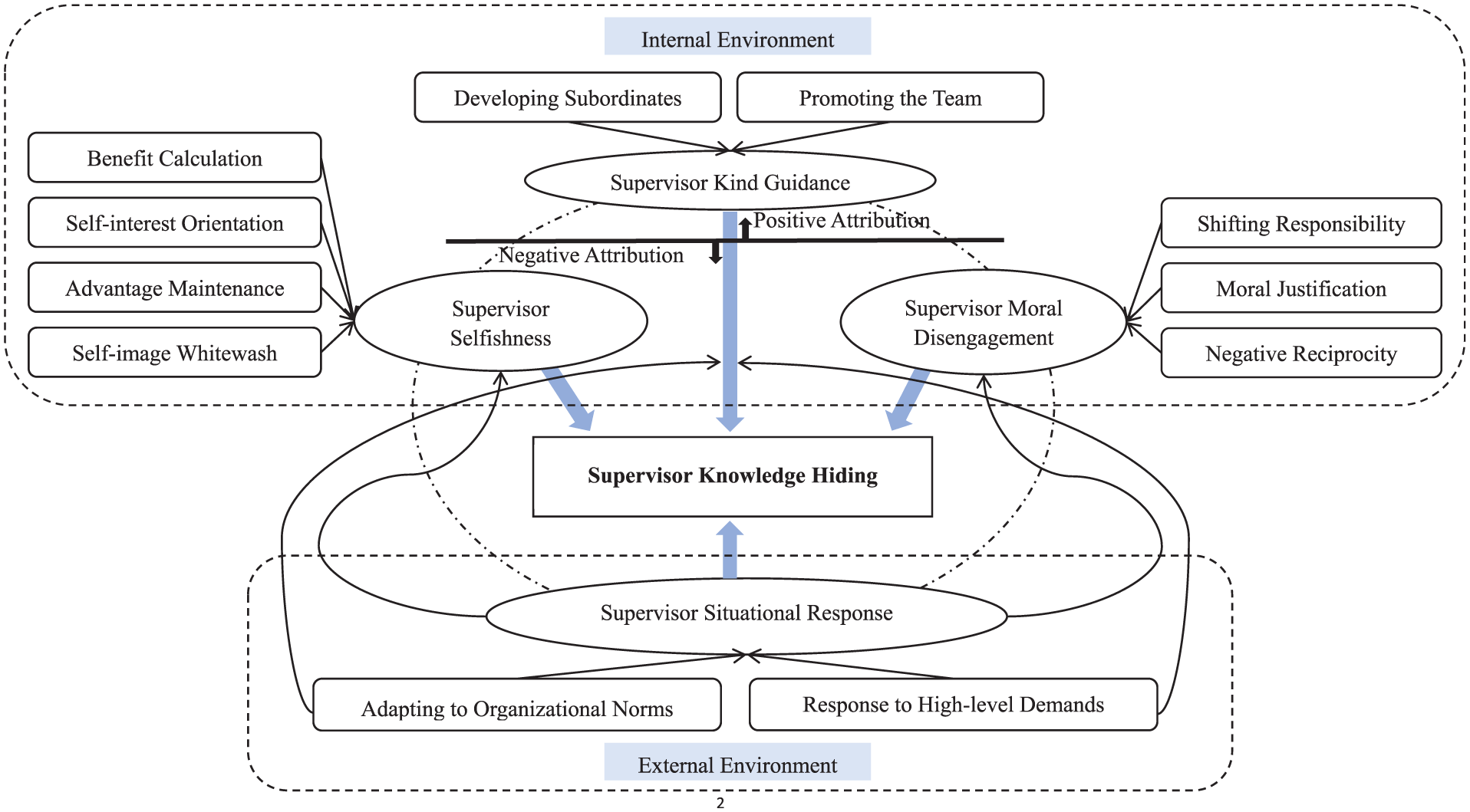
The theoretical model of observer attribution of supervisor knowledge hiding.
In Figure 2, the dashed circles connect the four main categories of this study. The colored arrows indicate the subordination relationships between the main categories and the core category, while the solid arrows represent the subordination relationships between the main categories and the basic categories. Referring to the classification structure model of observer attribution factors for supervisor knowledge hiding in Figure 1, the dashed rectangles divide the main categories according to whether they are attributed to the supervisor or the situation, and the bold arrows divide the main categories according to whether they are attributed positively or negatively.
Conceptual Model Interpretation
Supervisor Kind Guidance→Supervisor Knowledge Hiding
Supervisor kind guidance primarily involves using knowledge hiding as a strategy to foster team growth, encompassing the basic categories of developing subordinates and promoting the team. Some representative viewpoints from the respondents are as follows: “The supervisor wants to push subordinates to think for themselves and understand the knowledge on their own, rather than simply providing the answers”; “Sometimes, being a lazy supervisor helps the team grow faster,” and so on. Research indicates that supervisors enhance subordinates’ growth and innovation by encouraging them to identify work challenges and address them proactively, thereby improving team capabilities and creating a virtuous cycle of “setting challenges → stimulating solutions → promoting growth” (Bakker et al. 2023).
Developing subordinates reflects the supervisor’s attention to individual team members. To cultivate competent subordinates, supervisors may employ knowledge hiding to encourage independent learning, discussion, and growth, unlocking potential and discouraging the development of counterproductive work habits that yield effortless gains, thereby enhancing work enthusiasm. Promoting the team, on the other hand, demonstrates a focus on the team as a whole. Supervisors use knowledge hiding to stimulate communication among subordinates, enhance knowledge flow within the team, implement effective knowledge management, boost team cohesion, and augment the team’s overall capabilities. Thus, from the perspective of observers, developing subordinates and promoting the team are considered positive attributions of supervisor knowledge hiding.
Supervisor Selfishness→Supervisor Knowledge Hiding
According to the conservation of resources theory, the potential or actual loss of resources represents a threat to supervisors under pressure (Cheng et al., 2008). Consequently, when knowledge-seeking inquiries target a supervisor’s specific expertise, experience, and skills, the supervisor may feel threatened and engage in knowledge hiding behaviors. This reaction forms a logical sequence: “perceiving threat → taking action → maintaining status.”
Benefit calculation and self-interest orientation are inherently linked to personal interests. As one respondent stated, “Doing this doesn’t benefit the supervisor at all; on the contrary, it actually takes up more of their personal time.” Therefore, supervisors are likely to engage in knowledge hiding when they perceive that the personal benefits derived from disclosing information are outweighed by the costs (e.g., time, energy). Such calculations prompt them to conceal knowledge to secure and sustain personal benefits. If supervisors are predominantly self-interested, they may act individualistically, prioritize personal gains over organizational or others’ interests, enhance their own image through others’ ignorance, and seize resources regardless of subordinates’ needs.
Advantage maintenance involves supervisors hiding knowledge to limit others’ access to information, thereby maintaining their competitive edge and enhancing their bargaining power within the organization. Conversely, self-image whitewash involves supervisors hiding knowledge to preserve an image of flawless leadership and impeccable reputation, thereby concealing their deficiencies and preventing reputational damage. This can be seen from some representative viewpoints of the respondents, such as “protecting one’s own rights and position, and preventing subordinates from competing for one’s role,” and “some supervisors may not be very professional in certain areas but are unwilling to admit their lack of expertise, fearing that the information they provide could lead to wrong decisions and damage their reputation,” and so on.
From the observer’s perspective, a supervisor’s benefit calculation, self-interest orientation, advantage maintenance, and self-image whitewash are considered core factors influencing their behavior.
Supervisor Moral Disengagement→Supervisor Knowledge Hiding
Supervisor moral disengagement reflects changes in leadership cognition, encompassing three categories: shifting responsibility, moral justification, and negative reciprocity. Supervisors use moral disengagement to rationalize the motives behind their knowledge hiding behaviors, thereby alleviating psychological pressure and evading responsibility. This process forms a relational sequence of “moral disengagement → peace of mind → detachment” (Cai & Gao, 2019). In our in-depth interviews, many respondents repeatedly emphasized this point, such as “My supervisor was once subjected to knowledge hiding by their own superior, and now they are doing the same to their subordinates,” and “They are worried that once subordinates obtain important information, they might sell it to competitors,” and so on.
Shifting responsibility involves supervisors attributing their refusal to share knowledge to external factors, thus circumventing blame. Moral justification occurs when supervisors reinterpret their knowledge hiding behaviors, using excuses such as excessive workload or the perceived untrustworthiness of subordinates to rationalize their actions and lessen their moral burden. Negative reciprocity describes supervisors engaging in tit-for-tat behaviors in interactions with subordinates, disregarding ethical standards and potential consequences. Consequently, the behaviors associated with shifting responsibility, moral justification, and negative reciprocity capture the attention of observers and are identified as negative moral attribution factors.
Supervisor Situational Response→Supervisor Knowledge Hiding
Supervisor situational response plays a significant role in shaping knowledge hiding behavior, serving as an external motivator for supervisors to engage in such practices. As repeatedly mentioned by the respondents, such as: “If the internal incentive mechanism of the company or organization leans toward individual competition, it will encourage supervisors to engage in knowledge hiding behavior toward subordinates”; “Some content involves company secrets, and there are explicit regulations prohibiting supervisors from disclosing them,” etc. Prior research indicates that situational factors critically influence knowledge transfer, establishing a cyclical relationship characterized by “organizational acquiescence → catering to practice → strengthening atmosphere” (Dong & Zhang, 2024).
Adapting to organizational norms underscores the impact of organizational culture on behavior. When a culture promotes individual competition, supervisors may default to knowledge hiding to boost competitiveness. Additionally, if an organization devalues internal communication and collaboration, favoring independent work instead, supervisors are more inclined to engage in knowledge hiding, thereby fostering a competitive atmosphere. Conversely, if the culture encourages knowledge sharing, supervisors are more likely to actively guide their subordinates in knowledge practices.
Responding to high-level demands highlights the influence of senior management. Corporate executives consider factors such as information security and industry competition to maintain a company’s competitive edge. Consequently, they may mandate or expect supervisors to conceal knowledge. Under such directives, supervisors might feel compelled to adopt knowledge hiding behaviors due to pressure from senior management.
Therefore, the adaptation to organizational norms and the response to high-level demands are recognized as critical situational factors influencing observer attribution.
Explanation of Logical Relations
The theoretical model of observer attribution of supervisor knowledge hiding incorporates four key factors: supervisor kind guidance, supervisor selfishness, supervisor moral disengagement, and supervisor situational response. This model abstracts the categories and relationships derived from the study. Among these, supervisor kind guidance, supervisor selfishness, and supervisor moral disengagement are attributed to the supervisor’s internal environment. In contrast, supervisor situational response, which pertains to situational factors, is attributed to the organization’s external environment. The logical relationships between these factors are structured as follows:
Logic of Positive Attribution: Internal and External Environments
As an external environmental factor, supervisor situational response not only directly impacts supervisor knowledge hiding but also synergizes with supervisor kind guidance. This relationship is depicted in Figure 3. A supervisor’s adapting to organizational norms and response to high-level demands, when aligned with a commitment to team progress and subordinate development, can lead to the use of knowledge hiding as a motivational strategy. Conversely, concerns about industry competition at higher levels might prompt supervisors to employ knowledge hiding to assess subordinates’ loyalty and competence.

Logic of positive attribution: internal and external environments.
Logic of Negative Attribution: Internal and External Environments
Supervisor selfishness and supervisor moral disengagement can influence knowledge hiding behavior both independently and interactively, producing a compounded effect. Furthermore, these can operate in conjunction with supervisor situational response. This logical relationship is illustrated in Figure 4. Supervisor selfishness finds legitimate and excusable justifications through moral disengagement (Cai & Gao, 2019), which bolsters the rationale for knowledge hiding behavior. Supervisor situational response serves as a basis for moral disengagement by providing excuses rooted in organizational factors. Concurrently, when the organizational culture promotes personal competition, this aligns the personal and organizational goals, enhancing the propensity for knowledge hiding among self-serving supervisors.

Logic of negative attribution: internal and external environments.
The Mechanism of Observer Attribution of Supervisor Knowledge Hiding
In the dynamic between superiors and subordinates, the unique access of supervisors to team resources and information prompts observers to naturally explore the underlying motives of leader behaviors and develop personalized interpretations. These interpretations critically shape the observer’s cognition and subsequent behavioral responses (Arain et al., 2020; Lu et al., 2023). The process of observer attribution can be succinctly summarized by the sequence: “supervisor behavior → observer interpretation → observer behavior”. Building on this framework and existing related research, this study delineates the mechanism of observer attribution of supervisor knowledge hiding, as depicted in Figure 5.
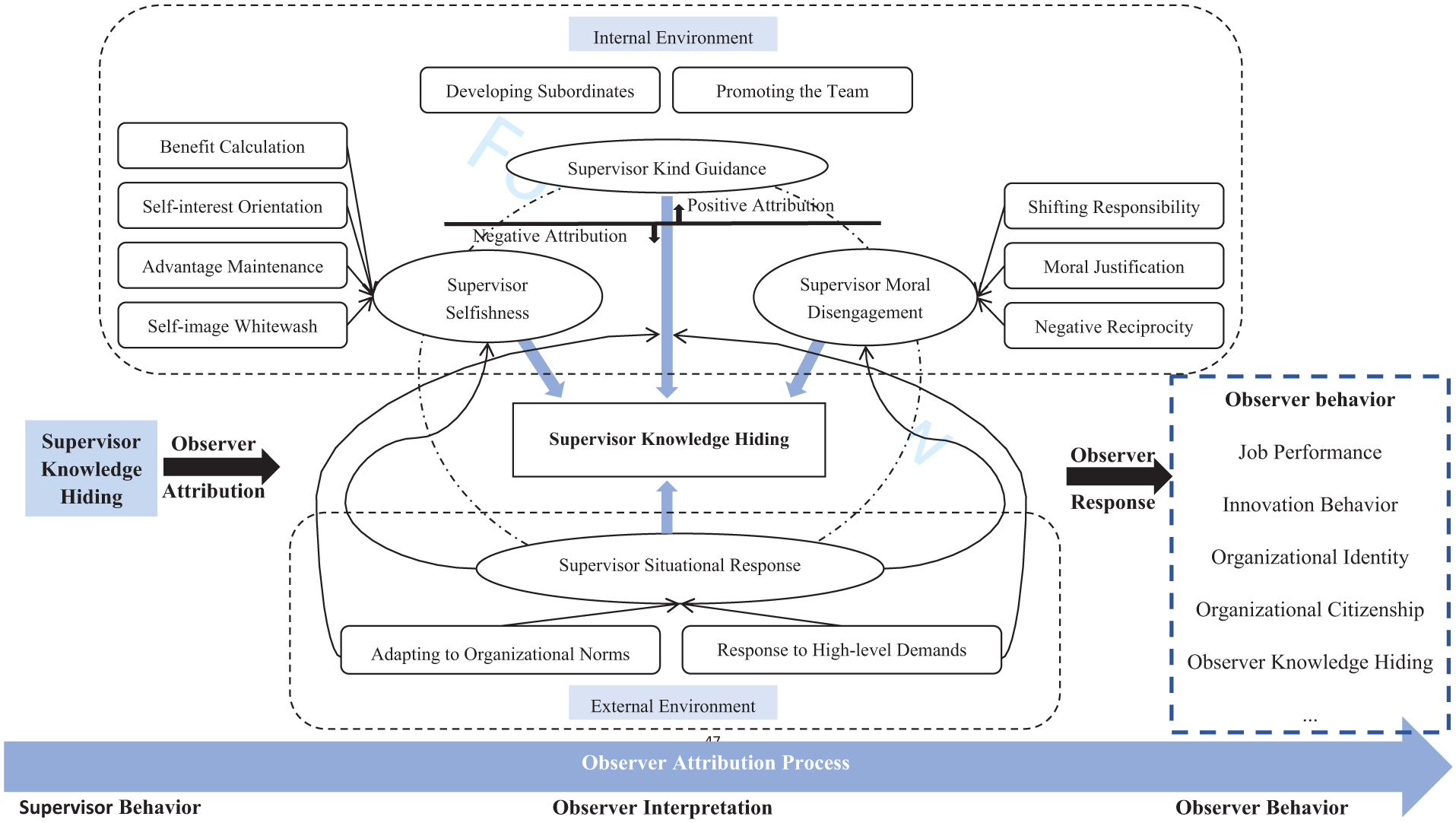
The mechanism of observer attribution of supervisor knowledge hiding.
Discussion
Theoretical Implications
This study applies grounded theory to analyze the observer attribution factors for supervisor knowledge hiding, constructing conceptual models that enriches research on the antecedents of supervisor knowledge hiding:
First, this study responds to Cheng et al. (2008) call for in-depth research on supervisor knowledge hiding hiding, expanding research on knowledge hiding in vertical contexts. Previous studies have extensively explored employee knowledge hiding but largely overlooked knowledge hiding at vertical levels, particularly supervisor knowledge hiding hiding. Only recently have studies begun to recognize the significance and importance of supervisor knowledge hiding from the perspective of employees and its antecedents (Arain et al., 2020). Focusing on supervisor knowledge hiding, this study reveals both positive and negative attributions by employees, uncovering the complex attribution mechanisms underlying supervisor knowledge hiding.
Second, this study responds to the call for cultural diversity by Butt and Ahmad (2019) conducts research within the Chinese cultural context. Unlike Western or Middle Eastern cultures, in Chinese organizations characterized by high-context cultural features, supervisors are not merely role models for observational learning by employees. Observers’ divergent attributions toward supervisor knowledge hiding behaviors also influence their behavioral outcomes. This study further responds to the call of Xue et al. (2024), adopting the qualitative research method of grounded theory to explore the factors influencing supervisor knowledge hiding in the context of Chinese culture through interviews.
Third, previous research has primarily focused on negative attributions of supervisor knowledge hiding, but this study is the first to identify positive attributions related to supervisor kind guidance and proposes a dual attribution logic—both positive and negative—toward supervisor knowledge hiding. On one hand, the family-like culture in China positions the supervisor as a paternalistic figure within the organization (Tsang, 2011), which creates a “tough love” dynamic, motivating supervisors to hide knowledge with the goal of improving team and subordinate development. On the other hand, due to the high collectivism, high traditionalism, and large power distance characteristics of Chinese culture, supervisors are more likely to adopt a “my way or the highway” attitude when managing subordinates, focusing on personal success, which leads them to engage in knowledge hiding. This study uncovers the logical relationships among various attribution factors, enriching the theoretical research and making it more systematic and universal.
Last, previous research has mainly studied supervisor knowledge hiding from the perspectives of the involved parties, overlooking the perspective of observers. Given the large number of observers and the interwoven nature of their attributions with those of the primary actors, observers influence the behavior of both the knowledge hiders and seekers. Moreover, in the Chinese cultural context, where traditional Confucian, Taoist, and Buddhist values such as “harmony first” and “silence is golden” prevail, observers of supervisor knowledge hiding tend to be more passive. However, this does not mean they are unresponsive; instead, it can lead them to engage in covert disruptive behaviors. Therefore, this paper develops the observer perspective within the field of supervisor knowledge hiding based on attribution theory, broadening the research scope of this domain.
Practical Implications
First, it is crucial to prioritize the observer group within the organization. This study reveals that different observer attributions toward supervisor knowledge hiding significantly influence their subsequent behaviors. Supervisors should therefore avoid engaging in publicly controversial leadership behaviors. At the same time, organizations must establish observer feedback mechanisms—such as suggestion boxes, regular surveys, and interactive dialogues—to promptly capture observers’ genuine psychological dynamics and monitor informal communication channels like workplace gossip. For employees who attribute supervisor knowledge hiding to positive factors, organizations should provide foundational support such as work-related materials, training courses, and material resources to facilitate their tasks. Additionally, managers should be educated to care about employee growth and actively promote communication between supervisors and subordinates, thereby building harmonious superior-subordinate relationships. For employees who attribute it to negative factors, organizations should proactively mediate conflicts between supervisors and subordinates, encourage both formal and informal communication within the team, provide targeted psychological counseling for these employees, and offer additional management training for the supervisors to minimize negative impacts.
Second, within the leadership’s internal environment, organizations need to identify and address both positive and negative influence factors. Regarding negative influences, in response to the self-serving behavior labeled “supervisor selfishness,” it is advisable for managers to consider values and moral standards during supervisor selection and to promote cautiously. Strategies might include collecting real-time feedback from subordinates, incorporating value-based questions and specific test items in the selection process, and focusing on peer and subordinate evaluations during promotion assessments. Concerning “supervisor moral disengagement,” managers should check for behaviors such as shifting responsibility, moral justification, and negative reciprocity. Possible interventions include organizing one-to-one informal communications for moral enhancement, opening subordinate feedback channels, providing collective ethical training, and regularly holding recognition ceremonies to reinforce positive behaviors. Regarding positive influences, in the case of “supervisor kind guidance,” managers should allow supervisors the autonomy to develop their subordinates and promote the team, while still monitoring team dynamics and offering guidance.
Finally, concerning the organization’s external environment, for the situational attribution factor “supervisor situational response,” managers should assess the overall cultural atmosphere and promote an open and inclusive environment that supports knowledge sharing. This involves clarifying high-level leadership’s knowledge management expectations to ensure transparency and understanding across the organization. Practical steps may include establishing clear organizational policies on confidentiality, creating a knowledge-sharing platform, organizing experience-sharing sessions with exemplary employees, and promoting role models among peers.
Furthermore, for observers, the findings of this study provide valuable reference and guidance on how to rationally respond to supervisor knowledge hiding in the workplace. Observers should recognize that their attribution judgments about supervisor knowledge hiding behaviors are inherently subjective. Therefore, they must objectively acknowledge the existence of such phenomena in the workplace, proactively adjust their mindset, and consciously guide themselves toward adopting more constructive behavioral responses.
Limitations and Future Avenues
This study has identified several areas for improvement that could enhance the depth of future research. The primary limitations and prospects for future work are outlined in four key aspects:
First, as an exploratory study, this research primarily relies on grounded theory, with a limited overall dataset and a lack of support from large-scale empirical testing. Future studies could benefit from integrating quantitative and qualitative methods to more thoroughly explore the mechanisms of supervisor knowledge hiding.
Second, this study did not examine the impact of observers’ differentiated characteristics—such as organizational background, personal traits, and supervisor leadership styles—on the results. Observers were directly defined as subordinates within the same leadership team who were not directly involved in knowledge hiding, but no distinction was made between observers with and without management experience. Observers with management experience may better understand supervisors’ decision-making logic, potentially reducing negative attributions. Therefore, future research could incorporate more individualized observer factors to explore whether different types of observers generate distinct attribution patterns toward supervisor knowledge hiding.
Third, all data in this study were derived from employee self-reports, inevitably subject to common method bias. Future research should collect multi-source data to strengthen the model’s explanatory power and enhance the generalizability and reliability of the findings.
Last, covariance theory suggests that the consistency, coherence, and distinctiveness of leadership behaviors influence observer attribution. These factors were not specifically addressed in this study. Future research could apply covariance theory to distinguish and analyze supervisor knowledge hiding behaviors based on these characteristics, potentially leading to more precise attributions.
Conclusions
This study, based on the methodology of grounded theory, responds to calls from scholars and focuses on the Chinese cultural context (Butt & Ahmad, 2019; Xue et al., 2024). It explores the attribution factors of supervisor knowledge hiding from the perspective of observers, with a particular focus on two research questions: What are the antecedents of supervisor knowledge hiding from the perspective of observers? What is the underlying formation mechanism of these attributions? The main findings are as follows: After proceduralized coding, it was found that supervisor knowledge hiding behavior results from the interaction of four factors: supervisor kind guidance, supervisor selfishness, supervisor moral disengagement, and supervisor situational response. Building on this, the study identified both positive and negative dual attributions of supervisor knowledge hiding from the perspective of observers, and constructed the classification structure model of observer attribution factors for supervisor knowledge hiding, as well as the theoretical model of observer attribution of supervisor knowledge hiding. The study analyzes how each factor influences supervisor knowledge hiding, and ultimately reveals the mechanism of observer attribution of supervisor knowledge hiding. This paper extends the academic discussion on supervisor knowledge hiding and provides valuable insights for guiding knowledge management practices.
Footnotes

Ethical Considerations
This study employed an interview survey methodology to collect data. All participants voluntarily engaged in the survey, and there is no risk of individual participants being identified or experiencing potential harm from the dissemination of study results. Therefore, this research does not involve traditional ethical issues.
Funding
The authors disclosed receipt of the following financial support for the research, authorship, and/or publication of this article: This work was supported by China’s National Natural Science Foundation (72172086 and 72472093) and “Shuguang Program” supported by Shanghai Education Development Foundation and Shanghai Municipal Education Commission (21SG41).
Declaration of Conflicting Interests
The authors declared no potential conflicts of interest with respect to the research, authorship, and/or publication of this article.
Data Availability Statement
Data sharing not applicable to this article as no datasets were generated or analyzed during the current study.