




Abstract
This study examines whether technology-based performance tasks can mediate communicating in English and enhance language learner engagement. This study investigated how low-proficiency Japanese English-language learners could change their attitude toward communicating in their target language by completing a performance task that involved making and presenting a digital portfolio, requiring linguistic and contextual self-mediation. The study adopted a questionnaire with two types of questions: one type was scored on a three-point Likert scale and the other included open-ended questions about the performance task; the questionnaire was completed by 33 and 28 students in the first and second semesters, respectively. Data from the open-ended questions were analyzed qualitatively from a phenomenological perspective. Students’ comments showed that they positively engaged in the performance task throughout the two semesters by reflecting on themselves as English learners, with some difficulty mediating in their first and second languages.
Plain Language Summary
This study aimed to examine whether technology-based tasks could help Japanese English-language learners with low proficiency in English improve their communication skills and increase their engagement in language learning. The researcher focused on a specific performance task involving the creation and presentation of a digital portfolio, which required the learners to independently navigate and understand language and context. Data was collected through a questionnaire, which included three-point Likert questions and open-ended questions about the performance task. A total of 33 students completed the questionnaire in the first semester, and 28 students completed it in the second semester. The researchers analyzed the qualitative data from the open-ended questions using a phenomenological perspective to gain insights into the students’ engagement with the performance task over two semesters. The findings indicated that the students actively participated in the task and exhibited a positive attitude toward it. They also reflected on their experiences as English learners. However, they encountered challenges when mediating between their first language (Japanese) and their second language (English). In conclusion, the study revealed that technology-based performance tasks can facilitate English communication and enhance learner engagement. The participants’ positive engagement suggested that the task had a beneficial impact on their attitudes toward communicating in English. Nonetheless, the study had limitations, such as a relatively small sample size and a focus on low-proficiency Japanese English-language learners. Therefore, caution should be exercised when generalizing the results to other populations or proficiency levels.
Keywords
The present study investigated whether Japanese university students with low English language proficiency could enhance their language learner engagement by mediating themselves linguistically in Japanese and English as well as contextually in a certain learning environment through a performance task. Many Japanese universities must admit students with low English proficiency, such as those at the A1 level of the Common European Framework of Reference (CEFR), because of their admission requirements. Several practices for such low English proficiency students in Japanese universities appear to be aimed at imparting linguistic knowledge first, rather than improving communicative abilities (Nakamura, 2005). However, given the present situation in Japanese education, it seems that many Japanese learners lack any experience of communicative practices in English classes or of using English outside the classroom (Toyoshima, 2016), particularly with regard to expressing themselves in English at the CEFR A1 level. Many people at this level are assumed to have difficulties engaging in communicative tasks in English because of their lack of experience coupled with anxiety about their proficiency. Thus, this study introduced a performance task, namely creating and presenting a digital portfolio involving various topics related to textbook material, for students to mediate themselves to communicate in English and enhance their engagement in the task. The task was conducted in a university English class for first-year students using a computer-assisted language learning (CALL) system. This study adopted a phenomenological research perspective and administered an open-ended questionnaire to investigate how students’ language learner engagement was enhanced in completing the task. Finally, the pedagogical and research implications are discussed.
Literature Review
Mediation to Communicate and Engage in Language Learning
Most second/foreign language (SL/FL) learners who have begun learning in formal educational settings live in their first language (L1) world while acquiring their L1 and establishing their L1 selves. This implies that such learners are already able to engage in self-mediation by activating their L1 when interacting with their peers or by themselves (Antón & Dicamilla, 1999; DiCamilla & Anton, 1997). Sociocultural theory, which has been applied in SL/FL pedagogies (Lantolf, 2000), claims that language (i.e., interaction) is significantly connected to thought (i.e., cognition). In other words, language is the principal semiotic tool for mediating our thoughts on both the social and individual planes. Hence, depriving second language (L2) learners of L1 entails depriving them of two efficient tools for learning: “the L1 and effective collaboration” (Antón & Dicamilla, 1999, p. 245). This suggestion follows Vygotsky’s (1986, p. 161) concept of learning a foreign language: “In learning a new language, one does not return to the immediate world of objects and does not repeat past linguistic developments but uses instead the native language as a mediator between the world of objects and the new language.”Grenfell and Harris (1999) claim that such a learning experience is “problematic” and that developing a linguistic competence is “much about mediating or control with respect to the world (the language to express and direct it), others (the language to understand and develop relationships), and self (to express what one needs to say about oneself and how to act)” (p. 43, emphasis added by the present author). In adult L2 learners with low proficiency, the process of “the whole [array of] learning experiences” might be more “problematic” than that of other levels of learners, as they might have low willingness to communicate in their L2 (Liu & Jackson, 2008; Tan & Phairot, 2018; Yasuda & Nabei, 2018). Thus, they need to “mediate” or “control” themselves linguistically and contextually between the L1 and L2 worlds by activating both languages to learn and communicate in L2.
Theoretical Features of Language Learner Engagement
“Engagement” can be defined in simple terms as follows: Learners’“actions” are driven by something or someone (Mercer, 2019). Mercer and Dörnyei (2020) explain this action as “active participation and involvement in certain behaviors,” including external (observable) and internal (cognitive and emotional) engagement (p. 2, emphasis in the original). This engagement is distinguished from language learner motivation; that is, “Motivation is about intent, whereas engagement is about action” (Mercer, 2019, p. 645). In addition, Oga-Baldwin (2019) claims that engagement should differ from motivation or “intended effort” (p. 3). Engagement refers to learners’ exact actions, which emerge from their emotions or thoughts, even if the intended effort does not always lead to the intended goal. This distinction has been expressed as: “Motivation is will and intention, [and] wanting and wishing, [while] engagement is the moment when word turns to deed” (Oga-Baldwin, 2019, p.3).
However, without intent, there is no action; engagement and motivation are interrelated or include common factors (Mercer, 2019; Oga-Baldwin, 2019). Thus, the antecedent to engagement must be the same as that for motivation, a construct of the learner’s self, when applying Ryan and Deci’s (2000) self-determination theory (SDT; Mercer, 2019; Noels et al., 2019). Mercer and Dörnyei (2020) elaborated on this discussion for practitioners, encouraging them to consider the following four aspects to construct and facilitate language learner engagement: (1) the learner’s mindset as the learner’s internal (intrapersonal) facet, including their sense of self or competence; (2) the rapport between teacher and learner, which enhances learner autonomy; (3) consciously elevating classroom dynamism and culture for learners to establish good relationships (interpersonal facet); and (4) the development of pedagogical tasks for learners’ sustainable engagement. Furthermore, Noels et al. (2019) claim that language learner engagement involves interacting with the learner’s self, which includes competence, autonomy, and relatedness as psychological needs or satisfaction, as well as intrinsic, extrinsic (integrated, identified, introjected, and external), and amotivation as orientations, to use SDT terminology (p. 100).
Task Design Conducive to Language Learner Engagement
Tasks for learning a target language include authentic or nearly real-world aspects encountered by learners, even in pedagogical situations, allowing them to engage in tasks in captivating and positive ways (Ellis, 2017; Norris et al., 1998; Nunan, 1989; Richards & Rodgers, 2014; Svalberg, 2018). For learners, the task’s learning content and language materials from the teacher are also authentic because the learning itself aligns with what is “real” for them (Met, 1998). However, similar task engagement must exist both inside and outside the classroom (Ellis, 2017; Nunan, 1989; Svalberg, 2018). Practitioners face the challenge of ensuring both authenticity (practice for real-world survival) and pedagogy for language acquisition (psycholinguistic aspects in second language acquisition theory) in tasks (Nunan, 1989).
Previous studies have suggested that aspects of task design other than the authenticity of topics and content affect L2 learners’ engagement. For example, a study of Thai university students’ willingness to present in English showed that presentation topic familiarity and preparation time reflected students’ willingness to present (Sridhanyarat et al., 2022). Some studies have also reported that the cognitive load of a task correlates with the degree of task completion because of growing anxiety (Chen & Chang, 2009; Donate, 2018).
Regarding language engagement during task performance, it is important to discuss who designed the task (Lambert, 2017). Comparing six empirical studies published in Volumes 2 and 6 of Language Teaching Research, Lambert (2017) wrote in an editorial that the proportion of a learner’s involvement in task design, topic, content, details, and language affects learner engagement in L2 use (Aubrey, 2017; Butler, 2017; Kormos & Préfontaine, 2017; Lambert, Philp, & Nakamura, 2017; Phung, 2017; Qiu & Lo, 2017). These include student-determined tasks, topics, content, and materials (Lambert, 2017). This argument concludes that if teachers trust students’ task design, they should supervise their students to establish learners’ L2 selves as antecedents of language learner engagement and determine how they self-mediate linguistically and contextually.
Previous Studies of Performance Tasks in Language Learning Classrooms
A performance task is defined as a complex task that requires the synthesis and use of knowledge and skills in a realistic context including a simulation context (Tanaka et al., 2011). Previous studies have investigated the effects of performance tasks, especially digital or e-portfolios, on learning outcomes and assessments. Huang et al. (2011) investigated the effect of e-portfolio satisfaction on students’ learning motivation and Internet self-efficacy on the use of e-portfolios. The findings revealed positive correlations between learning motivation, Internet self-efficacy, and e-portfolio satisfaction. With regard to language skills tasks, previous studies have found that digital portfolios are effective tools for improving speaking and writing skills (Al-Hawamleh et al., 2022; Cabrera-Solano, 2020; Meletiadou, 2021). Al-Hawamleh et al. (2022) showed how self-regulated learning contributes to stimulating students’ speaking skills. As actions, skills, and strategies feature learner planning in class, digital portfolios have a substantial impact on language learning. This study examined the impact of speaking tasks in English as foreign language (EFL) classes on Kuwaiti female students’ self-regulation. In Cabrera-Solano’s (2020) study, students used their smartphones to create digital portfolios on a free storage service (Google Drive), which included videos and audio clips about certain topics considered in the course syllabus, finding that the implementation of digital portfolios through free storage services could increase students’ motivation to practice oral skills in the target language. Meletiadou (2021) introduced creating digital portfolios with Padlet, sharing e-portfolios via their Virtual Learning Platform (VLE), and asking for peer and lecturer feedback every time they completed a written task. The students reported that they enjoyed this interactive experience, which was both engaging and rewarding, whereas the students expressed their wish for more support when using IT tools and e-portfolios and asked to be guided to develop their writing and reflective skills and engage even more with their e-portfolios.
When performance tasks are introduced, the assessment of tasks, that is, performance assessment, should be considered. Shavelson et al. (2019) argued that introducing performance assessments that use the elements of “criteria” drawn from real-world situations in which students are taught within and outside academic or professional contexts would lead to critical thinking as a part of 21st century skills. Sulistyo et al. (2020) examined whether the implementation of portfolio assessment affected students’ writing ability and determined students’ attitudes toward portfolios. The results showed that the implementation of portfolio assessment increased positive attitudes toward the performance task, as well as students’ writing ability. However, previous studies have rarely investigated whether the introduction of performance tasks, including teachers or self-assessment in language learning, could enhance the willingness to communicate in a target language and establish their L2 self, which would lead to language learner engagement (see the previous sections). Therefore, such practices will be required to conduct research suggesting the effectiveness of performance tasks including the assessments as mediators to communicating in a target language and enhancing language learner engagement.
Method
The Pedagogical Hypothesis and Research Question
The previous studies discussed in the last section led to the hypothesis that pedagogical tasks for English learning may influence learners’ mediation to communicate in English and enhance their engagement in learning it. In particular, Japanese adult learners with low English language proficiency might have negative impressions of the English language, negative L2 selves, low self-efficacy, and high anxiety, which in turn could lead to a low willingness to communicate (Liu & Jackson, 2008; Tan & Phairot, 2018; Yasuda & Nabei, 2018). Thus, this pedagogical study poses the following two research questions:
Is it possible for a performance task to be a mediator for linguistic and contextual communication for low-proficiency English learners?
Would a performance task be effective in enhancing low-proficiency English learners’ engagement in learning English positively and enjoyably?
In this study, conducted as action research, the performance task included both “performance” (in the narrow sense) and “product” (work; Tanaka et al., 2011).
Students
The participants were first-year students at a Japanese public university located approximately 100 km from central Tokyo. They belonged to the Sociology Department, where approximately 150 students were registered in English courses, including general English and an English course using the CALL system. The students were divided into five classes based on their English proficiency: CEFR A1 to B1. A total of 26 first-year students whose English level was CEFR A1 were included in this study. They belonged to the department’s lowest English proficiency group. The class in this study consisted of 26 first-year students and repeaters who had failed the class in previous academic years.
Teaching and Research Procedure
The class was conducted in a classroom using the CALL system. The textbook, Keynote American English Level 1 (Bohike, 2017), was adopted and four units were planned for completion in one semester. The students made digital presentation slides to introduce themselves on the topics determined by the teacher (the present author), all of which were related to the unit’s themes (see Appendix 1) and were aimed at developing linguistic knowledge and allowing the students to practice the four skills through each unit’s materials. The teacher offered example slides for reference. The presentation slides were called a “digital portfolio” because they represented each student’s learning outcome, in that the series of slides introduced each student’s personality and preferences to express themselves by using language materials introduced in each unit of the textbook. Students gave a presentation based on the portfolio, called a portfolio session, twice per semester. Portfolio sessions were similar to a poster presentation at a conference; that is, half of the students stayed in their seats with a computer and presented their portfolios, and the other half moved around to listen to, ask questions, and comment on other students’ portfolios. They took turns so that both halves of the class could present their portfolios. The entire session was recorded using an integrated circuit recorder for the assessment (one recorder was offered to each student pair). After the session, they assessed each portfolio they listened to as an audience member using a rubric based on three aspects: content (alignment with the topic and how interesting the idea was), visuals (design and appeal), and English (appropriateness), considering the two aspects of performance and product of the performance task. Participants were self-assessed using the same rubric. The teacher assessed both aspects of the performance tasks for each student’s portfolio and recorded the content. The task was semi-teacher-generated, as the teacher let students decide the content of the portfolio (Lambert, 2017).
Three international exchange program students, two from Denmark and one from England, participated in the first session of the second semester to facilitate more authentic communication with non-Japanese English speakers, which was necessary for generating pedagogical tasks. The international students attended the students’ presentations and provided comments, similar to their Japanese peers. The inclusion of international students in such activities had been implemented in previous academic years. These previous practices demonstrated that their participation enhanced the students’ experiences of authentic English communication and increased their engagement in the task. However, it should be noted that the international students’ study period at the university was limited to 3 months during the second semester. Therefore, I had planned for their involvement from the beginning of the academic year and requested the participation of exchange students from that specific academic year in the second semester.
The present study adapted a Japanese-language questionnaire with three-point Likert scale questions scored “Yes,”“Partially Yes,” and “No” to let the participants decide the stance to each question about the performance task, as well as open-ended questions to clarify the reason for the answer to each Likert-type question and investigate the students’ psychological state while participating in the task (see Appendix 2). The reason of the two types of questions was that considering the students’ low English proficiency, which may also be related to their language competence in their first language (L1), The researcher as their teacher anticipated that it might be challenging for them to provide subjective comments directly, even in Japanese. Students were asked to complete the questionnaires on the university’s portal website once at the end of the first semester and once at the end of the second semester. The questions in the questionnaire implicitly encouraged participants to reflect on their performance during the task at the end of the semester, whereas the performance task included self-assessment, as shown above. A total of 33 students agreed to answer the questionnaire in the first semester and 28 in the second semester. They provided consent after being informed that they would not be treated disadvantageously in class and that the research data would be preserved ethically.
Students were asked to answer the questions anonymously to ensure that their responses would be frank and honest. However, the number of comments differed for each question, because the students decided which questions to answer. Their responses emerged from their own experiences of classroom phenomena in what is called “intentional meanings that presented themselves (manifested, appeared) in human consciousness through lived experiences,” namely learning English in a particular context (Vagle, 2018, p. 31). Thus, the study applied phenomenological research perspectives, which posit that the researcher, namely, the teacher, should have a “longstanding awareness about the importance of the research questions,” recognize “the need for empathetic understanding and trust-building” with students, and engage in “imaginative and on-going reflection” or “see[ing] the world with [students’] eyes” (Butler-Kisber, 2018, p. 63). The students’ responses revealed the representativeness and authenticity of learners who showed “intentional meanings” through their “lived experiences” of engaging in a particular task for English learning (Butler-Kisber, 2018; Hitchcock & Hughes, 1995; Lincoln & Guba, 1985; Mishler, 1990; Toyoshima, 2007, 2018, 2020, 2022; Vagle, 2018). The anonymity and the clear explanation of the research established trustworthiness and encouraged “trust building” between the students and the teacher/researcher so that the students’ comments would be authentic and representative of the real situation. Thus, such narrative data that emerged phenomenologically should be discussed in terms of authenticity and representativeness rather than in terms of validity and reliability (Hitchcock & Hughes, 1995; Lincoln & Guba, 1985; Mishler, 1990; Toyoshima, 2007, 2018, 2020, 2022).
Analysis
The results of the three-point Likert scale questions are presented as frequency tables to show the proportion of each answer. The study also adopted content analysis based on sociology studies to evaluate the narrative data collected from the open-ended questions to investigate the participants’ psychological states while conducting the task. The narrative data were entered into an Excel sheet depending on each question, and students’ feelings about the task were analyzed by comparing the changes between the first and second sets of responses (Toyoshima, 2007, 2018, 2020, 2022).
Results
Result 1: Digital Portfolio as a Mediator for Communication
Through open-ended questions, students revealed positive attitudes toward communicating in English through performance tasks. To the first question (Q1), “Do you think that you could express yourself in English by making a digital portfolio?” (Appendix 2), asked in the first semester, all students answered “Yes” or “Partially Yes” (Table 1).
Answer to Q1 (First Semester; N = 33).

As listed below, some of the comments on the reasons for answering the aforementioned question, which was written in Japanese and translated by the author into English (Question 2), showed that compiling and presenting portfolios caused them to reflect on themselves and understand each other more easily:
C1: I could talk with my classmates using slides (digital portfolios) and speaking English. Also, I could make a unique portfolio by myself. (Yes)
C2: Making my portfolio was difficult for me because I had to find photos or illustrations to accompany the stories, and it was challenging to look up unknown words or structures in dictionaries to write explanations in English; however, I enjoyed the sessions because I could express myself. (Partially Yes)
C1, from a student who answered “Yes,” and C2, from a student who answered “Partially Yes,” suggest that most students found the performance task meaningful as a mediator for communication under this context in terms of understanding each other through the self-expression facilitated by the portfolios, although compiling the portfolios and presenting them in English constituted the most they could do in the two semesters.
In the second semester, responses to the first question were slightly different (Table 2).
Answer to Q1 (Second Semester; N = 28).

The reasons for the answers were as follows:
C3: The topics were familiar to me, and it was easy to express myself. Everyone listened to me encouragingly. (Yes)
C4: I didn’t have enough English ability to express myself, but I will study English harder. (Partially Yes)
C5: I found myself lacking in English proficiency. (No)
The students experienced authentic communication with the international students during the semester. The results show that the proportion of students who answered “Yes” increased, indicating that they had become more confident in expressing themselves in English, as C3 showed. Subsequently, those who answered “Partially Yes” and “No” might have become aware of the limits to their English ability through authentic communication, as revealed in C4 and C5. Nevertheless, the student who provided C4 had an intention to continue studying more, whereas the student providing C5 revealed dissatisfaction with themselves by answering “No.” This result implies that the experience of authentic communication with international students would enhance confidence in communicating in English for most students through their digital portfolios, whereas the experience might lead to increased awareness of limited English ability, even though they attempted to mediate themselves in the context of the performance task.
However, their responses to whether the students could make themselves understood in English through the presentation of their portfolios were different. Regarding Question 3, “Do you think that you could make yourself understood by the audience when you present your portfolio?” (Appendix 2), asked in the first semester, most students thought that they could make themselves understood in English fully or partially (Table 3).
Answer to Q3 (First Semester; N = 33).
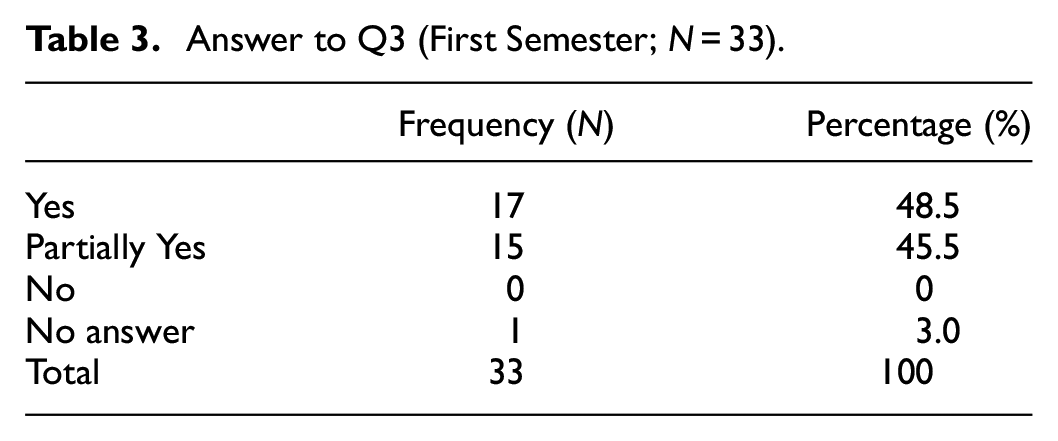
Overall, students’ comments on the task were positive. In response to the aforementioned question at the end of the first semester, students revealed the following thoughts about the task:
C6: I wrote clear and understandable English expressions and added many photos to my portfolio to make myself understood by my classmates. (Yes)
C7: The sessions were good opportunities for me to improve my English skills. I especially feel that I have improved my speaking ability. (Partially Yes)
C6 expressed students’ satisfaction with their portfolios and indicated that their portfolios helped them be understood by their classmates. C7 also indicated that students might have developed a more positive attitude toward speaking in English than before, even though they felt that they had made themselves understood only partially.
In the second semester, more students answered, “Partially Yes” than “Yes,” and no student answered “No” (Table 4).
Answer to Q3 (Second Semester; N = 28).

The reason for the answer “Partially Yes” was mostly the lack of adequate English-speaking skills, according to the comments on the communicative task, perhaps because the students struggled to respond to questions asked by the international students in the third session, or by expressing more than what they were capable of in the second semester. However, some of them attempted to make themselves understood in English through their portfolios and limited English abilities:
C8: I enjoyed creating my portfolio and listening to my classmates’ presentations. I enjoyed learning English very much. (Yes)
C9: I don’t think my portfolios were good but I’m sure now that I could make myself understood by the audience. (Partially Yes)
C10: I couldn’t say what I wanted to express in the sessions because I was anxious about my limited English vocabulary and grammatical knowledge, but I could create my portfolio using words and expressions that I already knew. (Partially Yes)
C11: I felt that it was difficult to express myself because I couldn’t match my English level with that of my native language. Also, I was sometimes confused by unfamiliar words when I spoke, even if I had prepared the sentences in my portfolio. (Partially Yes)
C8 expressed the student’s satisfaction with their portfolio, similar to C6, and implied that the student would have been able to mediate themselves linguistically and contextually between the L1 and L2 worlds after undergoing the performance task (Svalberg, 2018). In contrast, C9, C10, and C11 suggest that the students had been struggling with the gap between their L1 (Japanese) and L2 (English) worlds; that is, they attempted to apply their L1 experiences to their L2 (Grenfell & Harris, 1999), which might have made them aware of themselves more objectively than in the first semester. C9 and C10 showed one student’s experience with personal achievement in the process of mediation while making and presenting their portfolios, although C9 depicted the student’s dissatisfaction with their performance in the session, and C10 revealed one student’s anxiety about their English knowledge. In contrast, C11 strongly revealed the student’s struggle with the gap between L1 and L2 and how they might get lost between them. Such struggles during mediation should be the acquisition gateway; that is, a “sprout” of becoming an L2 user with multicompetence in L1, interlanguage, and L2 (Cook, 2008). They must undergo the process of acquiring English for the first time if they do not have experience with second-level education.
The answers to Question 4, “Do you think that you could understand your classmates through their portfolio and presentation?” (Appendix 2) showed that approximately half of the students thought they could fully understand their classmates through the task in both semesters (Tables 5 and 6).
Answer to Q4 (First Semester; N = 33).

Answer to Q4 (Second Semester; N = 28).

This result also showed that the other half felt that some parts of their classmates’ presentations were unclear, even with their digital portfolios, as some of them might have struggled in both semesters, as discussed above. However, the students’ comments on the performance task below suggest that their understanding of their classmates and international students, even partially, might have given them a good experience because English was used as a common language in the class:
C12: The session with the international students was a valuable experience. They gave me good advice about my presentation, so I want to use English more confidently from now on. (Yes)
C13: The students’ ideas and comments were interesting, and I found them different from each other. I think I learned a lot about them. (Yes)
C12 suggests that the student had a feeling of anxiety toward and incompetence in English, which might make them avoid communicating in English (Liu & Jackson, 2008; Tan & Phairot, 2018; Yasuda & Nabei, 2018). Once they feel confident about communicating in English because of positive experiences in which they have made themselves understood in real-life situations, they are likely to be willing to communicate in English, even with low proficiency in the language. This indicates that such positive experiences would lead to linguistic mediation between L1 and L2, even though they experienced difficulty. Subsequently, C13 suggested that students noticed the differences among students, including international students, by expressing themselves via digital portfolios in the second semester. This indicates that the performance task functioned as a mediator for communication in English sufficiently to understand the difference between his/her classmates and international students in the task.
Result 2: A Performance Task to Enhance Language Learner Engagement Establishing L2 Learner Self
Self-reflection and interaction with other students through the task may have encouraged them to recognize themselves as English learners. Comments about the task (Question 5, Appendix 2) showed slight changes in students’ self-awareness as English learners.
C14: Making the portfolio was an opportunity for me to reflect on myself. Listening to others’ portfolio presentations was an opportunity for me to learn about them. It was fun.
C15: I think I can express myself well by reflecting on and learning about myself through this activity. In addition, it was a good experience writing on several topics.
C14 and C15, in the first semester, indicated that the performance task made the students self-reflect and was a good way to encourage them to make friends with each other, as they saw each other only once a week. In other words, students may begin engaging in learning English through social interactions in the task, establishing themselves as L2 learners; these interactions become inter-subjective activities with others (Toyoshima, 2007). This “interpersonal facet” between the student’s self and others would be a significant factor in enhancing language learner engagement (Mercer & Dörnyei, 2020).
In addition, C16 could be interpreted as expressing the students’ sense of fulfillment or accomplishment with regard to engagement in the task after finishing the two sessions in the first semester.
C16: I consider the experiences of the two sessions to be good fortune. The activity attracted me very much in terms of the fact that many Japanese people would be poor at expressing themselves.
The student might be one of the “many Japanese people” who have metacognitive awareness of themselves and realize that the task would enable them to overcome their problem objectively. This suggests that students would establish a learner’s mindset as the learner’s internal (intrapersonal) facet, including a sense of self or competence, via an interactive task as their interpersonal facet (Mercer & Dörnyei, 2020).
Comment C13, given in the second semester, as introduced in the previous section, shows that the experience of engaging in the performance task might influence their attitude toward intercultural friendship; in other words, they might realize that the reason for learning English is to facilitate communication with others, including non-Japanese speakers, to get to know each other well. This indicates that the task of using digital portfolios could contribute to the conscious raising of classroom dynamism and culture for learners to establish good relationships (interpersonal facet) as a key factor in enhancing language learner engagement (Mercer & Dörnyei, 2020).
Some students found their fluency in communication and their engagement in the classroom improving as a result of their experiences in the four sessions at the end of the second semester:
C17: It was sometimes hard but overall fun to make the portfolio. Besides, I felt myself being able to use English expressions faster than before.
C18: I could check my English expressions objectively by writing on portfolio slides, and I think that I learned English more by taking part in the task than by just listening to the teacher’s lectures.
C19: This class introduced “active learning” and helped me learn a lot because I could express myself clearly and learn about my classmates in English.
C20: I could learn English enjoyably because it was very interesting to make and present my portfolio and listen to the others present theirs.
C17 implies that the task might make students notice their own improvements in L2 proficiency, which would be a key factor in establishing a sense of self and integrating the meaningfulness of learning English into the learners’ selves (Ryan & Deci, 2000; Toyoshima, 2016). This would in turn be conducive to language learner engagement and intrinsic motivation (Mercer, 2019; Mercer & Dörnyei, 2020). C18, C19, and C20 suggest that the students realized what they should aim for as English learners; that is, they should learn English by taking on the role of agent and legitimate participant rather than merely being recipients of knowledge during class or being members of a passive or “empty” audience, even with low proficiency (Dewaele & MacIntyre, 2016; Firth & Wagner, 1997; 1998; Sfard, 1998). C18 and C19 also indicate that this performance task, as seen in Dewey’s (1938) concept of “learning by doing,” which forms part of task-based language teaching principles (Ellis et al., 2020), would be preferred and suitable for learning engagement in the classroom and might yield an effective learning outcome. C20, which was similar to C6 and C8 discussed in the previous section, showed that students could enjoy learning English by engaging in a task, which might energize the students to engage in learning English (Dörnyei & Muir, 2019; Ibrahim, 2016; Mercer, 2019).
Result 3: Issues of Task Generation and Instruction
The task was semi-teacher-generated, and the students were not allowed to select the task or topic. This issue was not posed as a research question, but the following comment revealed dissatisfaction with the topics offered by the teacher (see Appendix 1):
C21: I could not relate personally to the topic “Someone with a great talent,” and I could not find an appropriate subject for the topic. I prefer topics of my own choosing, like “How about this dream job?”
C21 expressed a student’s desire to be an agentic learner and their hope for an opportunity to select a topic.
Moreover, the following comments criticized the teacher’s instructions and development of the task.
C22: I didn’t have enough time to make my portfolio. The teacher should have introduced each topic earlier.
C23: I think the teacher should have explained the production of the portfolio in greater detail.
C22 and C23 reveal students’ dissatisfaction with the teacher’s instruction, even though the teacher presented the topics in the course syllabus in advance and explained each topic in detail using examples. The comments shown in this section suggest that the issues of task generation and task instruction might also influence the students’ engagement.
Discussion
This study investigated the relationship between language learning, task engagement, and communication in English. The results suggest that positive feelings of achievement or enjoyment in using English could be considered a distinct dimension from learning English in an anxious state, as discussed by Dewaele and MacIntyre (2016). To achieve this, we employed a performance task for the entire academic year, including social interactions using digital portfolios, to promote linguistic and contextual mediation. This study suggests that this approach would encourage students to self-reflect, enhance their metacognitive awareness of themselves in both their first language, Japanese (L1), and English (L2), and lead to meaningful student engagement in the task. The results showed that it was difficult for many students to mediate between the two languages in the first semester, and some of them continued to feel this until the course ended.
However, more students expressed that they gradually gained confidence in English communication through the use of digital portfolios. This suggests that they were able to mediate themselves linguistically and contextually while creating and presenting their portfolios throughout the course. One possible reason for this could be that the teacher did not primarily focus on assessing their linguistic accuracy, nor did the students excessively focus on their own linguistic knowledge. Additionally, engaging in authentic communication with international students, as previously observed in the author’s practice, could enhance their confidence in English communication, even if the opportunity was limited due to the international students’ duration of stay in Japan. Such target language interactions provide learners with valuable opportunities to practice language skills, build language knowledge, and develop communicative competence (e.g., Holec, 1981), although the experience may also reveal their limitations and increase awareness of their language abilities. Nevertheless, it is possible that the development of more authentic tasks contributed to a change in students’ attitudes toward English communication and their overall engagement in the task. Therefore, the present study asserts that the introduction of performance tasks, along with their formative development, can enhance language learning engagement by promoting self-reflection and self-efficacy (Al-Hawamleh et al., 2022; Huang et al., 2011).
The findings also suggest that engaging in a performance task can positively affect the students’ self-reflection and self-awareness, as English learners have intrapersonal facets (Mercer & Dörnyei, 2020). These results are consistent with previous research on task-based language teaching, which suggests that tasks involving meaningful interaction and a focus on communication can lead to increased the students’ engagement (Ellis et al., 2020). The study also highlights the importance of metacognitive awareness and self-reflection in language learning as performance assessment. Students who reflected on their own learning and saw improvements in their language proficiency were more likely to feel a sense of accomplishment and engagement in the task. This finding is consistent with those of research on self-determination theory, which suggests that learners who feel a sense of competence and autonomy in their learning are more likely to be intrinsically motivated and engaged (Ryan & Deci, 2000).
Furthermore, this study highlights the importance of interpersonal facets of language learner engagement, which involve social interactions and relationships with others. Mercer and Dörnyei (2020) argued that this facet is crucial for language learning engagement as it allows learners to feel connected to others and see the relevance of their learning to their social and personal goals. Comments from the students in the study suggest that the performance task provided opportunities for interpersonal interaction and connection, which might have contributed to their engagement in the classroom.
In terms of task design, Lambert (2017) highlights the importance of creating pedagogical tasks that promote learners’ sustainable engagement by incorporating elements such as task variety, clear instructions, and opportunities for interaction and feedback. A balance between teacher-generated and learner-generated task designs is also necessary to cater to learners’ diverse needs and interests. Furthermore, the students’ comments regarding the teacher’s instruction and task development highlight the importance of establishing rapport and effective communication between teachers and learners. Mercer and Dörnyei (2020) emphasized the role of teacher-learner relationships in fostering learner engagement, as learners’ perceptions of their teachers’ approachability, responsiveness, and understanding can influence their engagement in the classroom. The present study claims that the issues of task generation and task instruction should be considered as a factor to enhance or reduce language learner engagement.
Conclusion: Implications for Practice and Research
This study yielded several findings regarding the author as the students’ English teacher. First, creating and presenting a digital portfolio may enhance language learner engagement in communicating in English (Svalberg, 2018), although mediation between L1 and L2 might still be problematic and challenging for some students (Grenfell & Harris, 1999). In the English class, most students behaved as agents and legitimate participants by mediating themselves in the learning context, the performance task, and the learning materials, despite their low English-language proficiency; however, some revealed difficulty in mediating themselves in Japanese and English. In particular, the experience of more authentic communication in English with international students in the second semester made the students aware of their English proficiency more clearly, because the students would reflect on themselves more deeply and enhance their metacognitive awareness enough to recognize their English proficiency level (Berk & Winsler, 1995; Ellis, 2017; Norris et al., 1998; Nunan, 1989; Richards & Rodgers, 2014; Svalberg, 2018). Such authentic communication could be effective for students who feel self-efficacy in communication-enhanced language learner engagement in the future; subsequently, it would lead others to engage less in learning and using English if they believe the communications to have failed, which would deprive them of self-efficacy and, in turn, self-esteem (Jabbarifar, 2011; Mills, 2014). This suggests that teachers should consider such aspects of the performance task and support the latter type of student as much as possible, such as by giving meaning-focused feedback for communication rather than form-focused feedback for accuracy in regular lessons, encouraging students with low self-efficacy to make use of digital technology to compensate for their lack of English knowledge and skills (Butler, 2021), or preparing and practicing the tasks well before performing them, which is necessary for CEFR A1 level learners (Council of Europe, 2001, 2020). Furthermore, the teacher should demonstrate flexibility by letting students create task content or topics to encourage them to enhance their language learner engagement both inside and outside the classroom, with support provided throughout the process in terms of linguistic aspects and task compression. Thus, practitioners should create a balance between learner- and teacher-generated content in task design regardless of the educational situation or restrictions (Lambert, 2017).
Regarding the implications for further research on language learner engagement, practitioners should study the classroom in an ecological learning context and more deeply investigate participants in the situated learning place (Mercer, 2019). It is possible that different cases would yield different results and findings, even if the same tasks were adopted. The present study was ecologically situated in an English classroom using a CALL system that was introduced for Japanese English-language learners with low proficiency at a local university in Japan, which would turn out to be a case of the “ecologies of engagement” that emerged from and went back to the antecedents of learner engagement (Mercer, 2019, p. 657). The more ecological and situated the research context for observing language learner engagement is, the more individual and subjective the outcome under a particular research condition will be (Svalberg, 2018). The present study investigated students’ responses to open-ended questions to reveal the variety in attitudes toward the performance task among students and to show different reactions to it. This study indicates that the phenomenological research method is suitable for investigating sensitive emotions in L2 language learners (Ibrahim, 2016; Piniel & Albert, 2019; Vagle, 2018), and should therefore be suitable for investigating L2 learners’ psychological states while learning a target language.
Footnotes
Appendices
Note
This research was conducted while Saeko Toyoshima was at Tsuru University in Yamanashi Prefecture, Japan. She is now at Tsuda University and may be contacted at stoyo@tsuda.ac.jp.
Declaration of Conflicting Interests
The author declared no potential conflicts of interest with respect to the research, authorship, and/or publication of this article.
Funding
The author disclosed receipt of the following financial support for the research, authorship, and/or publication of this article: The author received a financial support from Tsuru University for the research.

Data Availability Statement
Data sharing not applicable to this article as no datasets were generated or analyzed during the current study.