




Abstract
This study aimed to explore the influence of online learning environments on learners’ empowerment, learning behavioral engagement and learning motivation and examine the mediating role of learning motivation. A total of 398 (132 male and 266 female) students from a comprehensive university in China participated in questionnaire survey and reported on their perceived online learning environments, learners’ empowerment, learning behavioral engagement, and learning motivation. Results showed that online learning environments significantly and positively influenced learners’ empowerment, learning behavioral engagement, and learning motivation; learners’ empowerment is positively associated with learning behavioral engagement. Furthermore, learning motivation mediated the relation between online learning environments and learning behavioral engagement. These findings unraveled the associations of both the external factors (e.g., online learning environments) and the internal factors (e.g., learning motivation; learners’ empowerment) of affecting students’ online learning behavioral engagement, thereby contributing to our further understanding and exploration of the imperatives of the joint inherent and extrinsic driving mechanisms. This study highlighted the importance of constructing appropriate online learning environments in accelerating students’ learning behavioral engagement, and would suggest focusing on teachers’ conscientious behaviors of enhancing the awareness of online learning community and stimulating students’ learning motivation.
Keywords
Introduction
Online learning, characterized as convenient access to expanded resources, venues and learning spaces, has become an alternative for students to conduct personalized learning (Teo et al., 2010). The utilization of online platform indeed promoted a more convenient and secure way for students to learn relevant courses, but it also triggered a lot of arguments and concerns for the problems that appeared in students’ online learning process due to the immaturity and inadequacy of the burgeoning substance. Specifically, in spite of students’ freshness and readiness for online learning, it is a big challenge for both students and teachers, as teachers generally lack online teaching experience and students are still not equipped with sufficient awareness and skills of self-regulated online learning (Pedrotti & Nistor, 2019). What’s more, the distinctive features of online education such as the unitary teaching mode and insufficient pedagogical interaction may cause students’ isolation, maladjustment, low motivation to learn, and the decrements in academic performance (Inoue, 2007; Molnar et al., 2019). Thus, focusing on learners’ perspectives of initiating technology-based learning, scholars are arguing for the need to promote students’ learning behavioral engagement under the online learning environment (Chien & Hwang, 2022; Hod & Katz, 2020). Student’s learning behavioral engagement essentially encapsulates the conception of the involvement in academic and extracurricular activities and is considered as a key condition supporting academic achievement and mitigating dropping out (Gregory et al., 2014).
Substantial research suggested that students’ behavioral engagement was influenced by the overall environments constructed by the school, the supports offered by teacher, and individuals’ intrinsic factors (Kelly & Turner, 2009; Tuan et al., 2005). Some research focused on the school characteristics related to students’ learning behavioral engagement and identified that particular school size and rigid rules had a strong association with students’ learning behavioral engagement (Shernoff, 2013). Kelly and Turner (2009) affirmatively clarified that classroom instructional factors and students’ behavioral engagement were closely tied up. Students’ interactions with teachers and peers were also regarded as a critical factor to increase students’ learning behavioral engagement (Cooper, 2014; Davis & McPartland, 2012). For instance, Skinner and Belmont (1993) examined the association between teacher behavior and students’ learning behavioral engagement, confirming that students who present higher levels of learning behavioral engagement perceived more teacher supports.
Apart from these external factors, some previous studies have affirmed that students with higher intrinsic motivation intrinsically devoted more efforts and persistence as they participated in learning activities (Suárez et al., 2019; Wigfield et al., 2006). Among the widely used, varieties factors were considered as the dominant determinant of students’ learning behavioral engagement. However, in spite of some previous research being conducted by considering either external or internal dimensions, the exploration of the influencing factors on students’ learning behavioral engagement from both the joint external and internal perspectives is still scant. Thus, this study attempted to investigate how the external variables (e.g., online learning environments) influenced students’ learning behavioral engagement, examine whether students’ learning motivation would mediate the relationship between online learning environments and learning behavioral engagement, and discuss whether there exists the correlation between online learning environments and learners’ empowerment. The present study contributed to highlighting the vital role of online learning environments in influencing students’ learning behaviors and the inherent mechanism of learning motivation. Thus, this study helps educators understand the tremendous significance of maximizing the potential of technology-based learning environments, and also informs of capitalizing on available technological routes to empower students’ learning engagement and stimulate online learning motivation.
Literature Review
Online Learning Environments
Decades of research literature on technology-based language learning has attested to the various facets of the powerful impact of online learning environments on learners’ learning behaviors and achievements (Fraser, 2001; Velayutham & Aldridge, 2013). Despite the complexity of defining the concept of learning environment, much progress has been made in the conception, assessment and examination of its determinants and effects, which provided the following online learning environment with abundant explanations. Lewin (1936) recognized that environment and interaction was powerful determinant of individuals’ behavior. Similarly, Moos (1974) delineated three dimensions characterizing any human environment: personal relationships involving strengths of relationships, personal growth building on the availability of opportunities, and system management. Consistent with these arguments, and with a particular focus on self-directed learning, Handelzalts et al. (2007) developed an instrument that could be used to assess active, self-directed and technology-enhanced collaborative learning environments for students to engage in.
With the burgeoning of computer technology, significant researches on the online learning environment have been conducted. However, the emphasis of the factors in online learning environment was still associated with students’ cooperation and interaction. Bećirović et al. (2022) held that students’ cooperation played an important role in the current EFL learning environment, for it was highly beneficial to learners’ positive attitude and learning achievements. Students’ interaction with peers and the teacher by using technology tools in the online learning environment was considered as an efficient route to solve the learning problems. What’s more, resource acquisition was discussed in the online learning environment as it was very common to find and use online resources with the help of computer-assisted technology to deal with learning challenges (Heo et al., 2021). Therefore, in the current study, online learning environments mainly referred to classroom cooperation, classroom interaction and resource acquisition. Cooperative learning was defined as “organized group learning activity between learners in groups to solve the learning problems cooperatively in the online learning environment” (Olsen & Kagan, 1992, p. 8). Interaction learning aimed to allow learners to communicate with their peers or the teacher for discussing learning topics, thus enabling learners to finish tasks, establish a better relationship and promote the willingness to interact with each other more (Oxford, 1997). Resource acquisition pointed to the ability that students “incorporate learning resources/activities recommended and shared by teachers into their learning ecology” (Lai, 2015, p. 76).
Learners’ Empowerment
The concept of “empowerment” was originally closely associated with “Power,” pointing to “resistance to oppression and the pursuit of justice” (Zimmerman, 2000). With the development of society, especially the advancement of educational technology, empowerment has now been applied to the field of education with a richer meaning, typically involving the enhancement of participation, the empowerment of autonomy and the self-directed decision-making (Hur, 2006). The convergence of technology and media enables smart classrooms to focus on individual student’s situational engagement and the interactions between student groups (G. Lu et al., 2022). On this basis, the smart classroom can respond to students’ learning needs and provide adaptive learning support and personalized assistance (Li et al., 2015). Therefore, theoretically, learners in technology-based classrooms have an appropriate personalized learning experience. Many scholars have given diverse definitions of empowerment. For instance, Page and Czuba (1995) defined “empowerment” as a social process that helps individuals take control of their own lives, coinciding with UNESCO’s Education 2030 Framework for Action published in 2016 which states that technology is raising questions about what it means to learners and that in the future educational landscapes, it is critical that learners need to become engaged and responsible. Similarly, Luechauer and Shulman (1996) broadly defined learners’ empowerment as “the humanistic process of adopting the values and practicing the behaviors of enlightened self-interest so that personal and organizational goals may be aligned in a way that promotes growth, learning, and fulfillment” (p. 831). Following on from this, Zimmerman (2000) highlighted that the potential for empowerment lay in individuals’ possessing the opportunity to take initiative, make choices, participate in decision-making and connect to their communities. Grounded on Frymier et al. (1996)’s study, Pan (2022b) put forth that “in the field of education, learners’ empowerment refers to the process by which learners accomplish tasks, improve self-efficacy and develop multiple capabilities in specific learning situations and activities, which concentrates on the transformation of learners’ thinking, the process of identifying with task values, and the reinforcement of self-meaningful behaviors, thus making individual and collective goals consistent so as to ultimately promote the realization of collective goal” (p. 3). Indeed, learners need to be empowered to develop themselves as responsible individuals in the process of self-fulfillment. Specifically, in terms of subjectivity, learners’ empowerment is reflected in the individual’s independent planning and autonomous choice of developmental direction. As for instructional pedagogy, it highlights the concept of student-centered orientation and bring into play learners’ subjectivity and autonomy. When connected to initiative, learners’ empowerment places a strong emphasis on stimulating learners’ potential. To sum up, learners’ empowerment lies in the emphasis on individuals’ internal motivation, responsibility and creativity, with the aim of promoting learning and allowing learners to take the initiative to explore the acquisition of knowledge (Frymier et al., 1996). One of the important principles is to give full play to students’ initiative, encourage students to participate in learning independently, and motivate students to conduct self-directed learning. Therefore, the motivation and the sense of empowerment formed by learner’s internal driving mechanism will be the most powerful force for their growth (Yang et al., 2020).
From the literature, learners’ empowerment “was described in terms of two key dimensions: (1) value identification, which focuses on learners’ identity to the meaning and value of learning in relation to one’s own beliefs, ideals, and standards; and (2) self-reinforcement, which refers to learners’ engaging in self-fulfilling behaviors in relation to the individual’s perception of their own learning capability” (Pan, 2022b, p. 3). Taking into account the evidence that, in the online learning environment, the multi-faceted and multi-sensory feelings of the individual learners in technology-based learning constitute the unique emotional experience and form learners’ understanding of the “empowerment” of technological applications, this study extended the conception of learners’ empowerment by adding a new dimension of affective state which describes a cognitive belief state of personal involvement. Thereby, in this study, learners’ empowerment was highlighted as being composed of three dimensions: affective state, value identification and self-reinforcement.
Existing studies of technology-enhanced learning have reported on a close relation between learning environment and learners’ empowerment. Learning environment is considered as the antecedent of constructing a “wider ecology of learning” (Sefton-Green, 2006, p. 4). On the one hand, technology is utilized to construct a good learning environment, which endows learners with more potential of learning engagement. On the other hand, learning environment interacts with the student-oriented educational system. As Pan (2022b) elaborated, “considering that pedagogical guidance exerts a profound impact on students, it is necessary to enable students to have a sense of empowerment which embodies the internalization of positive attitudes that ultimately results in a heightened sense of personal effectiveness” (p. 3). Thus, building an effective online learning environment and providing effective learning support to promote efficient online learning for learners and enable online learning to truly empower learners has become an important issue worth exploring.
Learning Behavioral Engagement
Learning behavioral engagement is regarded as a multi-dimensional concept, sticking out the result of interaction between learners and learning environment. Learning behavioral engagement mainly focuses on learners’ behaviors and performances involving learners’ affection, efforts, concentration, and time spent on learning, etc., which can be observed and explicitly express the emotional and cognitive engagement (Patrick et al., 1993). Numerous researchers expanded and supplemented the concept of learning behavioral engagement by putting forward categories and measuring indexes about it. Thus, based on these findings, learning behavioral engagement was concluded into six categories, namely, participation, interaction, persistence, concentration, academic challenge, and self-directed learning. Participation, as the fundamental factor in learners’ learning behavioral engagement, mainly refers to the efforts and time learners devoted to, reflecting whether learners agreed with the school rules and teachers’ requirements (Fredricks et al., 2004; Nguyen et al., 2018; Skinner & Belmont, 1993). For instance, Finn (1989) conceptualized learning behavioral engagement as learners’ performance on participating academic activities and other extracurricular activities and put forward a “participation-identification” model including a sequential process: participation, school success, identification, nonparticipation, poor school performance and emotional withdrawal. Interaction reflected mutual actions and influence between learners and teachers as well as learners and their peers, which not only involved learners’ attempt to communication, cooperation and discussion with teachers and other peers aiming at solving the problems but also the input of establishing good relationship with individuals in the learning ecology (Hamane, 2014; Lai et al., 2015). Persistence demonstrated learners’ management of efforts and emotions to achieve their goals especially when they suffered difficulties while concentration manifested learners’ efforts of keeping attention like listening to the lectures attentively, both of which related with the metacognitive strategies (Miller et al., 1996). Academic challenge was defined as the behavioral engagement where learners participated and made efforts in more tougher tasks which would develop learners thinking quality (Coates, 2006). Self-directed learning mainly refers to learners’ regulation on their learning process such as setting learning goals, making learning plans and managing learning time which reflected learners’ awareness of self-responsibility and management (Johnson et al., 2014). This research selected three aspects of learning behavioral engagement as research objects, that is, participation, interaction and self-directed learning and combined the former two factors as a category named students cooperative learning. In addition to the definition and categories of learning behavioral engagement, there are plenty research exploring the relationship of learning behavioral engagement and other influential factors such as social supports and learners’ individual factors. To be specific, the degree of learners’ behavioral engagement was deeply influenced by external factors especially online learning environments which would apparently promote learners learning behaviors (Murray, 2009). Besides, behavioral engagement was also highly associated with learners’ internal components such as interest, self-efficacy and learning motivation. For instance, learning behavioral engagement was a prerequisite for emotional engagement such as inner interest in certain subject (Rose-Krasnor, 2009). However, although some studies explored learning behavioral engagement and connected it with educational issues, the current literature can be further enriched and expanded by exploring how external supports (e.g., online learning environments) influence students’ learning behavioral engagement, and examining whether learning motivation can mediate these relations.
The Mediating Role of Learning Motivation
Learning motivation is a kind of motive tendency to guide and maintain students’ learning behavior, and to direct it to certain academic goals (Jarvis, 2005; Taylor et al., 2014). It is characterized as an internal motive to promote students’ learning, and is regarded one of the psychological conditions that directly affect students’ learning outcomes (Kim & Kim, 2018; White et al., 2015). Typically, the research on learning motivation has been carried out around the orthodox teaching environment. However, with the ongoing development of information technology and the popularity of online learning, the significance of motivation in technology-supported learning is beginning to emerge. The empirical study found that motivation level was an important predictor for the polarization phenomenon in flipped classroom teaching (Zheng et al., 2020). The existing literature also confirmed that on one hand, online teaching supports, the overall learning atmosphere and the sense of community had a direct impact on learners’ online learning motivation, and on the other hand, online learning motivation directly influenced online learning behaviors (Gasevic et al., 2014). The stimuli and maintenance of online learning motivation entails the support services such as emotional motivation, learning strategies and online feedback, etc., which is consistent with the core element of the online learning motivation model proposed by Bonk and Khoo (2014), that is, the reinforcement of learning motivation to improve learning experience and learning satisfaction in online learning.
Moreover, the existing researches on online learning have begun to pay attention to the online learning motivation of college students and the mechanism of the interaction between online learning motivation and learning effect, such as, the association between online learning motivation, attribution, self-efficacy and learning effects (S. Hu & Kuh, 2003). Most of these studies adopted online learning engagement as a surrogate variable for learning outcomes, arguing that the first condition for achieving good learning outcomes is effective participation and high engagement by learners. Such studies showed that external educational environment and individual psychological characteristics are the predictors of learning engagement (Hashim et al., 2015), with learning motivation being considered as the basic form of the psychological characteristics of individual learners.
In addition, extant research showed that learning motivation both directly affected the online learning effect and indirectly affected academic achievement by influencing learning engagement (Froiland & Worrell, 2016; Fırat et al., 2018). In online learning environment, online interaction is one of the main characteristics of teaching. Previous studies have shown that interactivity is an important index to evaluate the quality of online course teaching (Imlawi et al., 2015; J. Lu & Churchill, 2014). Different from the traditional teacher-led classroom, the teacher-student interaction in online learning is more student-centered, encourages students to participate and cooperate in learning, and thus contains more interactive content related to emotion and motivation (Domagk et al., 2010). The psycho-social interaction can alleviate the loneliness of learners in the process of online learning, increase positive emotional experience, and maintain the motivation of learners to continue learning (J. Lu & Churchill, 2014). Online interaction may not only directly affect learning engagement, but also indirectly affect learning engagement through autonomous motivation as an intermediary variable in the interaction between teachers and students (Legault, 2017).
Previous studies have further found that a high level of teacher-student interaction in online learning environment can help constitute the satisfaction of their basic psychological needs, and build up the self-confidence of learners, thus promoting the generation of autonomous motivation (Ifinedo, 2017). Moreover, autonomous motivation can promote students to adopt appropriate learning strategies to cope with learning tasks, thus positively predicting online learning engagement (Martin & Bolliger, 2018). In a multimedia learning environment, teacher-student interaction leads to more positive emotions (Domagk et al., 2010) and meanwhile a high level of positive emotions predicts the use of in-depth learning strategies, thus increasing learners’ learning engagement (Hamane, 2014). In summary, online teacher-student interaction may affect students’ learning engagement through the mediation of autonomous motivation, as the theory of self-determination stated that the stronger autonomous motivation a person possesses, the more likely he is to experience spontaneous interest and feel pleasure and satisfaction (Legault, 2017; Ryan & Deci, 2000).
Despite great amount of evidence regarding the importance of learning motivation toward technology-based learning, the related mechanisms through which online learning environments and teacher supports affect the students’ learning behavioral engagement through the mediating role of learning motivation have yet been less explored. Thus, this study aimed to extend the current literature by examining the mediating role of learning motivation on the links of students’ perceived online learning environments and teacher supports with their learning behavioral engagement.
Theoretical Framework
Sawver (2014) decomposed the theoretical basis of learning science into five parts: constructivism, cognitive science, educational technology, sociocultural studies, and disciplinary knowledge management, and learning is therefore characterized by ecology, contextualization, and increasingly cultural orientation. The study of systematic learning theory originated from psychology, surrounding the study of learning theory on behavior and cognition as the dominant sphere, in which cognitivist learning theory was adopted to examine sophisticated learning behaviors (Aparicio & Rodríguez Moneo, 2005). Boosted by the development of network technology and the increasing popularity of online learning behaviors, the theoretical research on technology-initiated online learning and its interdisciplinary applications has become a hot spot. The situational characteristics which gradually emerge in the theoretical explorations of online learning accelerates a pivotal focus on the construction of interactive learning environments, the effective adoption of information technology and the support of online platforms (Lai et al., 2016). Currently, the theoretical research of online learning is transformed into learner-centered paradigm, as Blaschke (2021) advocated the dynamic mix of self-determined learning and technology by highlighting the significance of increasing learners’ engagement and motivation, the introspection capability of tacit knowledge, as well as higher levels of learner self-efficacy, and giving full play to learners’ empowerment.
Furthermore, network technology constructs a learning situation for learners which differs from the traditional classroom, therefore, the theory of situational cognition also lays a theoretical foundation for this research. The situational viewpoint considers practical behaviors as being interconnected with learning and cognitive construction tremendously being related to practical behaviors and situational contexts in which meaning is negotiated (Zheng et al., 2020). Knowledge acquisition is a dynamic interaction state which is constructed in the interactive relationships between individuals and the environment, and meanwhile individuals’ competence to coordinate a series of behaviors assists adapting to the dynamically changing and developing environments (Lin et al., 2019). In fact, situational learning is not simply a proposal to contextualize or be contextually relevant to teaching, but a theoretical rational about the nature of human knowledge, which focuses on how human knowledge develops by being associated with learning behaviors. Characterized as integrating knowledge acquisition with learners’ development and identity construction, situational cognitive theory emphasizes learner-centered learning, highlighting that the arrangement of content and activities should be linked with the specific practice of human society, and that it is best to organize teaching in real situations in a way similar to human real practice. Scrutinizing cognitive regulations in online learning engagement from the situational cognitive theory perspective can help us understand how the components of instructional design and learning environments facilitate students’ cognitive gains, and provides a theoretical basis for new fields of educational technology, such as information technology and curriculum integration, computer-supported collaborative learning and virtual learning community construction.
Research Questions and Hypotheses
Informed by the above visions concerning the study of students’ learning behavioral engagement, three research questions are specified below.
What are the contributions of online learning environments to learners’ empowerment, learning behavioral engagement and learning motivation?
Will learning motivation mediate these relationships?
What is the role of learners’ empowerment among these relationships?
Grounded on these three research questions, the following multidimensional relations are constructed (Figure 1), and thereby research hypotheses were generated.

The hypothesized research model.
For technology-based learning, on the one hand, technology empowers the environment, promoting the upgrading and development of the learning environment in the direction of digitalization and intelligence. The construction of learning environments requires the support of technology, which empowers learning environments to support learning, accelerates the direct involvement of students, and increases learning behavioral engagement (Lin et al., 2019). On the other hand, the environment empowers education. The learning environment interacts with education modalities, and the online learning environment which provides individualized learning opportunities exercises learners’ self-determination capability and arouses learning motivation (Liu et al., 2011). In align with the current literature, this study proposed the following hypotheses (H1–H3).
H1: Online learning environments significantly and positively influence learners’ empowerment.
H2: Online learning environments significantly and positively influence learning motivation.
H3: Online learning environments significantly and positively influence learning behavioral engagement.
Mercer (2011) argued that self-directed language learning behavior is contingent on “a learner’s sense of agency involving their belief systems, and the control parameters of motivation, affect, metacognitive/ self-regulatory skills, as well as actual abilities and the affordances, actual and perceived in specific settings” (p. 9). Students with higher level of learning motivation were found to be more likely to actively engage in learning using deep strategies (Sun et al., 2018), generate energized emotional states (Xie et al., 2019), and display positive behavioral intentions in academic activities (Sökmen, 2021). Thus, this study hypothesized that:
H4: Learning motivation significantly and positively influence learning behavioral engagement and mediates the relationship between online learning environments and learning behavioral engagement.
In the network technology environment, learners’ empowerment is a deepening embodiment of “technology for learning,” aiming to enhance learners’“voice” (Hod & Katz, 2020), and ensures that learning is a student-driven process, so that students become empowered to actively use technology to promote learning engagement. Therefore, this study came up with the hypothesis that:
H5: Learners’ empowerment significantly and positively influences learning behavioral engagement and mediates the relationship between online learning environments and learning behavioral engagement.
The three dimensions of learners’ empowerment (affective state, value identification, and self-reinforcement) reflect that students become empowered learners and are able to actively and proactively use technology to promote learning and thus enhance learning motivation. Thereby, this study advanced the hypothesis that:
H6: Learners’ empowerment significantly and positively influences learning motivation.
Methodology
Participants and Procedure
The participants are sophomore students from a university in eastern China who were taking college English courses. In Chinese universities, college English course typically lasts for 2 years, and the reason for the option of sophomore students as research participants is that they have experienced technology-based college English learning. As pointed out, in China, “currently, the advanced network technology has been applied in college English teaching and learning in accordance with the innovation of college English course” (Pan & Chen, 2021, p. 5). Thus, in college English course, online platform constitutes an important avenue for students’ technology-based language learning.
Totally 410 questionnaires were distributed in the classroom and collected on the spot after completion. Participants obtained informed consents and anonymously completed the face-to-face questionnaire survey in about 10 min and were informed of the voluntary principle of participating in this study and their rights to withdraw at any time during or after the completion of the questionnaire. After discarding incompleted and invalid 12 questionnaires, a total of 398 participants (132 male, accounting for 33.17%) reported on their perceived online learning environments, learners’ empowerment, learning behavioral engagement and learning motivation.
Instruments
The research instruments involved four questionnaire scales measuring different variables, that is, online learning environments, learners’ empowerment, learning behavioral engagement and learning motivation. This study adopted a 6-point Likert Scale, which ranges from 1 (strongly disagree) to 6 (strongly agree), with higher points indicative of students’ higher perceptions of the corresponding items.
Online Learning Environments Scale
Drawing on some research suggestions (Kramarski & Gutman, 2006; Liaw & Huang, 2013) that students’ online learning environments provide students with interaction, communication and a wide range of information and resources, online learning environments scale was developed into three subscales with a total of 12 items: classroom interaction (four items), classroom cooperation (five items), and resources acquisition (three items). A sample item is “I have an easy access to online learning resources.” CFA was conducted to test the reliability and validity of this questionnaire. The test results indicated an acceptable model fit with X2/df = 2.858, CFI = 0.968, TLI = 0.953, RMSEA = 0.079, SRMR = 0.042. The Cronbach alpha and Kaiser-Meyer-Olkin (KMO) value for validity are .946 and .932, respectively, indicating a good reliability and acceptable validity.
Learners’ Empowerment Scale
Learners’ empowerment has been connected with the fundamental emphasis by Frymier et al. (1996) and Kearney (1994) on “an increasing internalization of positive attitudes toward the content or subject matter, and a cognitive belief state of personal involvement that ultimately results in a heightened sense of personal effectiveness” (Pan, 2022b, p.7). Combined with existing literature and the research practice, this scale consists of affective state (four items), value identification (five items) and self-reinforcement (five items). A sample item is “I think I can conduct online collaborative learning with peers.” The CFA test showed the satisfactory model fit results: X2/df = 2.928, CFI = 0.978, TLI = 0.963, RMSEA = 0.077, SRMR = 0.053. The total Cronbach alpha and Kaiser-Meyer-Olkin (KMO) value is 0.955 and .930, which indicated that the scale had good reliability.
Learning Behavioral Engagement Scale
Based on a comprehensive review of the literature (Fredricks et al., 2004; Hamane, 2014), the learning behavioral engagement scale was developed for this study, involving two dimensions: students’ self-directed language learning (five items); students’ cooperative language learning (five items), such as “I discuss problems about online learning with my classmates.” By CFA test, acceptable model fits were found with X2/df = 2.951, CFI = 0.982, TLI = 0.973, RMSEA = 0.079, SRMR = 0.025. The Cronbach alpha and the Kaiser-Meyer-Olkin (KMO) values for validity are .953 and .947, respectively, which suggested that the scale had reliability.
Learning Motivation Scale
Totally 12 motivation items, adapted from the studies of Guilloteaux and Dörnyei’s (2008) and Kormos and Csizér’s (2014), were used to measure students’ learning motivation. The initial CFA of the learning motivation scale revealed that factor loadings of three items (“I was ready to learn at English through online platform”; “I prefer to learn English online”; and “I really enjoyed learning English online”) were lower than 0.70. After deleting these three items, CFA showed a satisfactory fit to the data concerning the remaining nine items in the measurement model: X2/df = 2.811, CFI = 0.948, TLI = 0.957, RMSEA = 0.065, SRMR = 0.052. The items consisted of two dimensions: confidence and effort (four items), interest in online language learning (five items). The assessment of Cronbach alpha and Kaiser-Meyer-Olkin (KMO) showed the respective value of .916 and .884, indicating good reliability.
Data Analysis
First of all, this study used Excel 2010 for data entry and management, and adopted SPSS 21.0 to perform descriptive statistics and correlation analysis. Secondly, this study employed Amos 21. 0 to establish the measurement model and examine the validity and reliability of the scales. Finally, based on the guideline of several goodness-of-it indexes from L. Hu and Bentler (1999), the structural equation model was established to examine the effects of online learning environments on learners’ empowerment, learning behavioral engagement and learning motivation, and to assess the moderating effects of learning motivation on the relationship between online learning environments and learning behavior engagement.
Results
Descriptive Statistics
Table 1 presented the descriptive statistics of the study constructs. The mean values of four variables ranged from 4.402 to 4.488, demonstrating participants’ positive response to the investigated variables. An acceptable spread of participants’ responses was found from the standard deviations ranging from 0.836 to 0.917. Besides, Cronbach alpha ranged from .916 to .955, the KMO values exceeded the threshold value of .50, and the Barlett’s Test of Sphericity revealed statistically significant values (p < .001), which indicated that all the measures had acceptable reliabilities.
Descriptive Statistics of the Study Constructs (N = 398).

Note. OLE = online learning environments; LEm= learners’ empowerment; LBE = learning behavioral engagement; LM = learning motivation.
p < .001.
Table 2 indicated significant Pearson correlation matrices amongst the study variables. “But none of the correlation coefficients exceeded .80, excluding the issue of multicollinearity” (Tabachnick & Fidell, 2007, p. 21). As expected, OLE was positively associated with LEm, LBE, and LM. In addition, LE was positively related to LBE and LM. Besides, LBE was positively correlated with LM. These results were preliminary evidence to supporting the research hypotheses of this study. In this study, the research structural model was established and analyzed to further examine the research hypotheses.
Discriminant Validity for the Measurement Model.
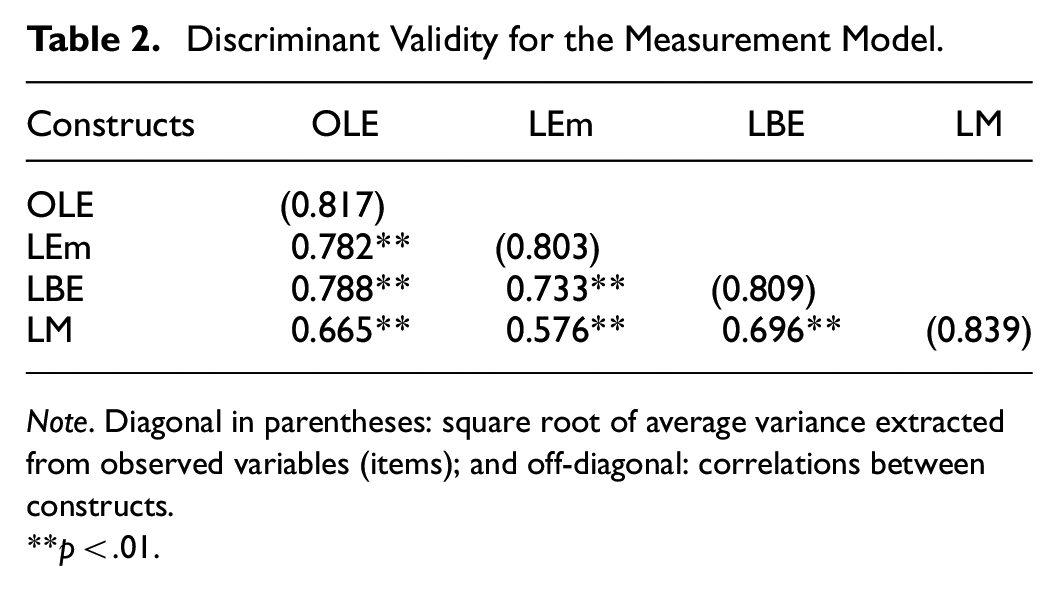
Note. Diagonal in parentheses: square root of average variance extracted from observed variables (items); and off-diagonal: correlations between constructs.
p < .01.
Convergent and Discriminant Validity of the Measurement Model
Confirmatory factor analysis (CFA) was adopted to assess the overall model fitness of the measurement model and found acceptable test results with X2/df = 3.742, CFI = 0.958, TLI = 0.945, RMSEA = 0.077, SRMR = 0.061. The convergent validity was established by testing standardized factor loading of each item, average variance extracted (AVE), t-value (>2), CR and S. E. value (>0) of parameter estimation while the discriminant validity was assessed by examining the square root of AVE for each construct. According to Teo and van Schaik (2012), “convergent validity, which examines whether individual indicators are indeed measuring the constructs they are purported to measure, was assessed using standardized indicator factor loadings, and they should be significant and exceed 0.7, and average variance extracted (AVE) by each construct should exceed the variance due to measurement error for that construct (i.e., AVE should exceed 0.50)” (p. 182). Besides, according to Teo (2011), the presence of discriminant validity was suggested when a construct was more strongly associated with its indicators than with the other constructs on the condition that the square root of the average variance extracted (AVE) was greater than the off-diagonal elements in the corresponding rows and columns. Table 3 met the recommended guidelines, indicating good convergent validity, as the standardized factor loading of all items exceeded 0.7 and the average variance extracted (AVE) ranged from 0.645 to 0.704, exceeding the minimum value of 0.5. Furthermore, Table 2 indicated that the square root of AVE of each construct varied from 0.803 to 0.839 which was higher than corresponding correlation matrix (ranging from .576 to .788) for that variable in all cases, suggesting good discriminant validity.
Results of the Measurement Model Testing.

Note. SFLs = standardized factor loadings; S.E.= standardized estimates; CR = composite reliability; AVE = average variance extracted.
Test of the Structural Model
Based on the literature (e.g., Hair et al., 2010; L. Hu & Bentler, 1999), in evaluating the structural equation modeling (SEM), several goodness-of-fit indexes, that is, “the comparative fit index (CFI), the Tucker-Lewis index (TLI), the root mean square error of approximation (RMSEA), and the standardized root mean square residual (SRMR) were used” (Syväoja et al., 2014, p. 3). The goodness-of-fit of model is reflected with values of 0.90 or more for the CFI and TLI, and values of 0.08 or less for RMSEA and SRMR (Hair et al., 2010).
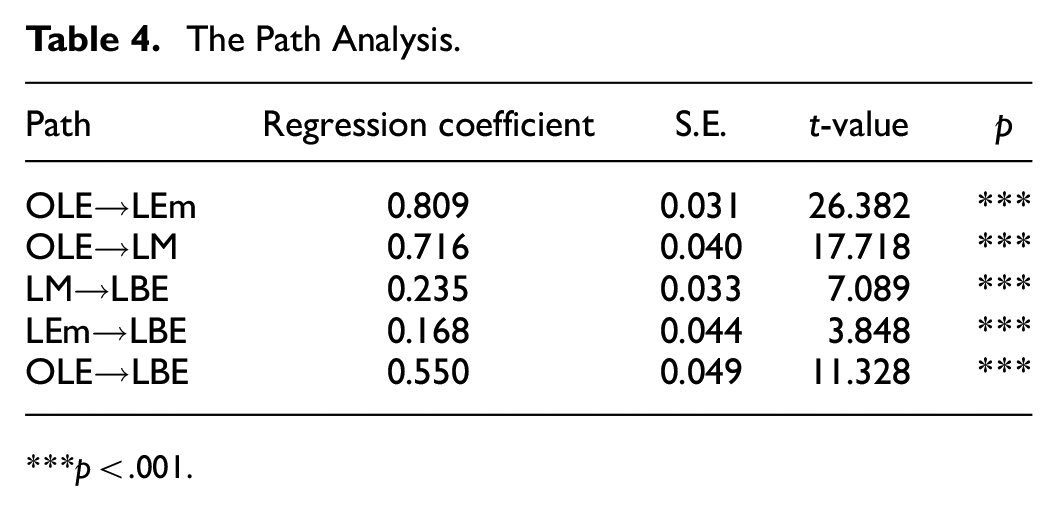
The test results of the hypothesized research model (Figure 1) found that the saturated model was not fitted to the data of at least one group. “For this reason, only the ‘function of log likelihood’, AIC and BCC are reported. The likelihood ratio chi square statistic and other fit measures are not reported” (Pan, 2022a, p. 9). After deleting the path (LEm→LM with a path coefficient of 0.133, S.E.=0.066, C.R.= 2.018, p = .044, thereby supporting Hypothesis 6.), the final structural model (Figure 2) was tested again and was found to have satisfactory model ft indices: X2/df = 2.951, CFI = 0.997, TLI = 0.984, RMSEA = 0.078, SRMR = 0.018.

The final structural model.
Path Analysis
Path analysis was employed to explore the contribution of online learning environments to learners’ empowerment, learning behavioral engagement and learning motivation. Research results (Table 4) found a vitally significant association between OLE and LEm (β = .809, p < .001, 95% CI [0.738, 0.872]), and OLE and LM (β = .716, p < .001, 95% CI [0.623, 0.804]), supporting Hypotheses 1 and 2. Similarly, LM was positively predictive of LBE (β = .235, p < .001, 95% CI [0.156, 0.313]). Also, LEm was significantly correlated with LBE (β = .168, p < .001, 95% CI [0.042, 0.298]). Besides, the association of OLE with LBE was vitally significant (β = .550, p < .001, 95% CI [0.423, 0.685]), supporting Hypothesis 3, and meanwhile was mediated by LM. Taken together, the results manifested LM plays a significant role when it comes to the impact of OLE on LBE, which corroborated the previous researches on the significance and effect of psychological needs (Fırat et al., 2018).
The Path Analysis.
p < .001.
The Assessment of Mediating Paths
The mediating effects of learning motivation and learners’ empowerment were tested using bootstrapping approach with structural equation model (Cheung & Lau, 2008). The results (Table 5) found that learning motivation significantly and positively influenced learning behavioral engagement and mediated the relationship between online learning environments and learning behavioral engagement with the indirect effect of 0.305, 95% CI [0.195, 0.411], which indicated statistical significance and met the recommended guidelines by Cohen (1988) of the values ranging from 0.1 to 0.5 reflecting a medium indirect effect, supporting Hypothesis 4. In addition, learners’ empowerment significantly and positively influenced learning behavioral engagement but did not significantly act as mediator variable in explaining the relationship between online learning environments and learning behavioral engagement with the indirect effect of 0.026, therefore partly supporting Hypothesis 5.
Results of the Mediational Analysis (H5-H6).

p < .001.
Discussion
This study established a structural model to examine the influence of online learning environments on learners’ empowerment, learning behavioral engagement and learning motivation, and examined the mediating role of learning motivation.
Correlational analyses corroborated the links between online learning environments, learner’s empowerment, learning behavioral engagement and learning motivation, which is in alignment with previous studies (Lai, 2013; Teo, 2011). From the path analysis results, firstly, online learning environments exerted direct influence on learning behavioral engagement. In this study, online learning environments mainly refer to classroom cooperative interaction and resource acquisition. Therefore, this result verified the promoting effect of students’ perceived educational situation on their sense of learning engagement and satisfaction (So & Brush, 2008; Zhao et al., 2014), and corroborated the idea that students were more willing to make an attempt to learn language if they were provided with interactional opportunities (Kumaravadivelu, 1990). Thereby, in online learning environments, students’ cooperative learning was related to positive interdependence, the formation of cooperative groups and the development of communicative skills, while classroom interaction referred to “interaction-producing tasks, willingness to interact, learning styles, group dynamics, stages of group life, physical environments” (Oxford, 1997, p. 444). The findings also confirmed that educational context not only contains the physical scene that supports the occurrence of learning behavior but also the constructed social environment, and the cognitive situation with the intervention of thinking consciousness, the purpose of which is to accurately depict the elements of learners, teachers, instructional contexts, and learning activities in real educational scenes, to explore the potential characteristics of related factors and the complex interaction between these elements (Murphy, 2004). As such, the perception of educational situation helps enhance students’ online learning experience and boost group members’ collaborative learning (Gerdes, 2010). Thus, this study identified the influence of online learning environments that related directly to learning behavioral engagement, and meanwhile examined the mediational effect of learning motivation that may accelerate students’ technology-based language learning (Reinders, 2010). The findings of this study extended previous studies on educational situation perception model (Cukurova et al., 2019; Gu et al., 2019) and further corroborated that “collaborative learning is a reacculturative process that helps students become members of the knowledge communities whose common property is different from the common property of knowledge communities they already belong to” (Bruffee, 1993, p. 3). Considering that the construction of collaborative learning community in the online learning environment is inseparable from the guidance and support of teachers, further exploration in the future studies can be placed on how a diversified array of cognitive and metacognitive assistance that teachers offer could influence students’ perception of online learning environments.
Secondly, online learning environments significantly influenced learning motivation. This finding was in line with the former research which indicated that students under the cooperative learning environments were more learning goal oriented, and expressed greater favorable attitudes to learn English (Nichols & Miller, 1994), thus verifying the positive effects of online learning environments on students’ learning motivation. The possible reason may be that, with positive online environments which promote positive emotions, students’ intrinsic motivation would stimulate their intentional behavior of interacting with the teacher and peers to meet their language learning desire. Meanwhile, this research finding also confirmed that collaborative online learning environments including peers’ and teacher’s interactive assistance vigorously affected students’ learning motivation, which was in consistent with the previous research that the peers’ and teacher’s behavior supports such as participating in the learning tasks would foster students’ learning motivation (Haakma et al., 2017). Therefore, it is vital to create a harmonious and mutually helpful environment to strengthen students’ learning motivation, thereby promoting students’ learning behavioral engagement.
Thirdly, online learning environments were significantly and positively associated with learners’ empowerment. This finding provided further empirical evidence for online learning supporting learners’ empowerment, and is also in line with existing findings on empowering learners through online-learning, artificial intelligence techniques, etc. (Wang et al., 2021; Yang et al., 2020). Meanwhile, this finding concurs with the research of Yang et al. (2020) which found that the learning environment (e.g., students perceived pedagogical presence) is an important predictor of learners’ empowerment during online learning. Based on this, this study confirmed and suggested the significance of “empowering learners to design and deploy fused, formal and information educational spaces” (Hall, 2009, p. 21). For students, the certain challenges that students confront when conducting online learning which differs from traditional classroom learning matrix may lead to maladjustment (Mamun et al., 2020). More importantly, this category of maladjustment can directly feed back to the hard nut of the devising rationality of online learning environments. Therefore, the realization of an organic fusion of online learning environments and instructional devising to improve students’ adaptability to technology-based language learning is worth taking into account. For example, it is important to develop school-based learning resources and broaden the sharing of high-quality resources so as to provide an available resource path for students’ online learning. This study thus highlighted that teachers and educational institutions should change the traditional education model to adapt to the new innovation of technology-based online learning environments and fully comprehend the unique characteristics of individual students.
Fourthly, the study found that learning motivation significantly mediated the relationship of online learning motivation and students’ learning behavioral engagement. Concretely, students who perceived greater support of online learning environments reported higher learning motivation, and in turn, students with higher learning motivation also reported more engagement with learning behaviors. This finding supported the contention that motivation is one “of the most important factors affecting the speed, intensity, direction, and persistence of human behavior” (Fırat et al., 2018, p. 63). Overall, these findings confirmed the positive influence of the supportive online learning environments on learning motivation, which in turn significantly accelerated learning behavioral engagement by providing students with adaptive learning support (Walker et al., 2011), as students’ perceived online learning environments assist constituting “a sense of ‘realness’, a quality of not being fake or contrived” (Rambe & Mkono, 2019, p. 704). More importantly, this study provided the explanatory mechanism of the mediational role of learning motivation on the association between students’ simultaneous perceptions of online learning environments and their learning behavioral engagement in technology-based online learning.
Implications and Limitations
Grounded on the research findings, the implications can be depicted as follows. (1) This study suggested optimizing the online learning environments to echo students’ cooperative, collaborative and self-directed learning so as to accelerate students’ learning behavioral engagement. (2) This study gave prominence to the significance of strengthening online teacher feedback and improving peer interactions through online platform, as enlightened by the research finding of the positive effect of online learning environments on learners’ empowerment. For instance, teachers should not only undertake the responsibility of offering affective and emotional supports such as sharing students with optimistic attitude toward online language learning, but also build an online learning community to improve students’ affective state, value identification and self-reinforcement. In the course of online learning, the enhancement of students’ sense of empowerment needs to devise harmonious teacher-student interaction activities, construct the good mechanisms of collaborative environment, and enhance the awareness and sense of online learning community, which brings great enlightenment to the design of online learning environment and the practice of online education. (3) This study informed the necessity of making more effective use of technology to stimulate students’ learning motivation, as Rotgans and Schmidt (2012) perceived learning motivation as an indispensable component that directly affects learners’ cognitive constructs which are, in turn, assumed to be associated with learning behavior.
In spite of rigorous testing procedure adopted, this study still has a few limitations. Firstly, “data from this study were collected via the use of self-report scales and this gave rise to the possibility of a common method bias for some of the results” (Teo & Noyes, 2014, p. 63). Future researchers may combine qualitative research design to further verify the results. Secondly, in this study, the simplex cross-sectional design may affect the accuracy of the results. Hence, it is suggested that, in the future studies, multidimensional methods should be utilized to attain more inclusive results. Thirdly, this study surveyed the students enrolled in college English course. The key factors that affect online learning environments, learners’ empowerment, learning behavioral engagement and learning motivation may vary across different student groups and other subject matters. Thus, it should be cautious when applying the research results to subjects other than English language learning.
Conclusion
The present research set out to explore the association of online learning environments, learners’ empowerment, learning behavioral engagement and learning motivation, and examined the mediating role of learning motivation. The research findings revealed that online learning environments significantly and positively influenced learners’ empowerment, learning behavioral engagement and learning motivation. Besides, learning motivation was found to be a significant mediating variable for the relation between online learning environments and learning behavioral engagement. Given these findings, this study expanded on how technology empowers education, which helps teachers systematically and intuitively examine the mechanism of students’ learning behavioral engagement in the curriculum, understand learners’ empowerment and motivation, and comprehend the relationship between learners’ environmental perception and learning engagement. This study indicated the significance of online learning environments and learners’ empowerment in accelerating learning behavioral engagement and highlighted the function of learning motivation mediating these relationships. The conclusions suggest actively optimizing a supportive institutional environment, providing sufficient resources for learners, guiding them to consciously and continuously engage in online language learning, and meanwhile stimulating learners’ motivation.
Footnotes
Data Availability Statement
The raw data supporting the conclusions of this article are available on request to the corresponding author.
Declaration of Conflicting Interests
The author(s) declared no potential conflicts of interest with respect to the research, authorship, and/or publication of this article.
Funding
The author(s) disclosed receipt of the following financial support for the research, authorship, and/or publication of this article: This work was supported by the Research Project of the 2021 Teaching Reform of Xingzhi College, Zhejiang Normal University (Grant No. ZC303921073).
Ethics Approval
Ethical review and approval was not required for the study on human participants in accordance with the local legislation and institutional requirements. Informed consent was obtained from all individual participants included in the study.
