




Abstract
This study addresses the question of whether the use of problematic strategies is a threat to the effectiveness of a specific form of extensive reading. Extensive reading has been considered an effective way to receive comprehensible input in second language learning, and its benefits on the development of second language reading skills have been well documented. Meanwhile, it is also common that extensive reading is implemented as a part of existing language courses. In such courses, learners’ performance on comprehension tasks could affect their course grades. A potential concern here is that problematic strategies, including cheating, are employed to increase task performance. Interview and questionnaire surveys were conducted in the English department of a Japanese university, where active efforts are made to realize principle-based extensive reading, and extensive reading performance (i.e., the amount of reading) affects students’ course grades. While there were large individual and group differences in the students’ behavior, the results provide evidence that the use of problematic strategies is a real threat to the effectiveness of extensive reading. Based on our observations, we also propose some possible ways of promoting positive engagement with extensive reading.
Introduction
The development of reading skills in a second language requires continuous exposure to comprehensible input (Grabe & Stoller, 2019), and extensive reading is perceived as an effective way to receive such input. In extensive reading programs, language learners read a great deal primarily for pleasure and information (Day & Bamford, 2002), which can also lead to linguistic development. The available empirical evidence supports the effectiveness of extensive reading in facilitating second language reading skills (Hamada, 2020; Jeon & Day, 2016; Nakanishi, 2015); meanwhile, little systematic attention has been paid to potential threats to the effectiveness of extensive reading. Jeon and Day’s (2016) meta-analysis indicated that extensive reading could be less beneficial when implemented as a part of existing language courses than when it takes the form of voluntary or extracurricular activities. In this paper, we argue that such differences in treatment effects may be related to students’ rule-breaking behaviors. In language courses, learners’ text comprehension is often assessed for formative and diagnostic purposes, and performance on comprehension tasks could also affect school grades (Carney, 2016; Milliner & Cote, 2015; O’Neill, 2012; Yamashita, 2013). A potential concern with extensive reading activities related to school grades (i.e., credit-based extensive reading) is that problematic strategies, including cheating, are used to meet course requirements. On the one hand, it seems that rule-breaking in extensive reading courses is not a major problem, as (a) strenuous efforts are being made to prevent cheating (Carney, 2016; O’Neill, 2012; Sun, 2003), and (b) previous research has shown that extensive reading experience promotes positive attitudes toward reading (Ro, 2013, 2016; Yamashita, 2013). On the other hand, a recent qualitative study reported that cheating in extensive reading may be more prevalent than many suppose (Tagane et al., 2018). Because there is no clear evidence regarding the type and degree of rule-breaking in extensive reading, this study seeks to answer the question of whether the use of problematic strategies in credit-based extensive reading should be a serious concern of language researchers and teachers.
Some may wonder if a niche topic of this nature would be of benefit to the field at large. We argue that rule-breaking behaviors are by no means a minor problem. In some countries, English language is a compulsory subject at all levels of schooling, and the motivation of learners taking mandatory classes may not be as high as teachers and researchers expect. Every effort of teachers to maximize the learning experiences of their students can fail and leave them wondering what went wrong, as their students seemed to have completed all assigned work. In these situations, it could be the case that the students did the work simply for the sake of completing the assignment and did not learn much. Most studies in professional journals report on the “good results” of students’ work, but this study sheds light on the “dark side of the moon,” where the metaphorical moon is language learning and teaching.
In this study, we briefly review the known benefits of extensive reading in language learning, before presenting the reasons why it is crucial to further our knowledge of rule-breaking in extensive reading activities. We then report on a study exploring the use (or lack thereof) of problematic strategies in a real-life setting.
Background
The aim of this study is to shed light on the nature of rule-breaking in extensive reading. To understand the need for such a project, it is important to know (a) the principles and mechanisms of successful extensive reading, (b) variations in the implementation of principle-based extensive reading, and (c) learners’ possible reactions to a specific extensive reading form.
Extensive Reading and Second Language Reading Skills
Day and Bamford (2002) outline five core principles that underpin successful extensive reading practice. These principles are (1) the reading material is easy, (2) learners choose what they want to read, (3) learners read as much as possible, (4) reading is individual and silent, and (5) teachers orient and guide their students (Day & Bamford, 2002, pp. 137–140). The principles reflect the claim that we learn to read by reading (Day et al., 2015). Learners in extensive reading programs receive comprehensible input by reading graded materials, and personalize their learning by choosing texts interesting to them. Beginner readers may need more help from teachers in developing reading habits; however, as readers individualize their learning experience, reading can be more enjoyable and autonomous. Continuous exposure to comprehensible input in extensive reading is expected to lead to linguistic development through incidental acquisition of new words and grammar rules.
Indeed, the benefits of extensive reading on the development of second language reading skills have been well documented. For instance, using a quasi-experimental design, Suk (2017) confirmed that groups engaging in extensive reading consistently showed greater gains in reading rate, reading comprehension, and vocabulary acquisition compared to those not practicing extensive reading (regarding reading rate, see also McLean & Rouault, 2017). Also, Aka (2019) demonstrated that a group that underwent a 1-year extensive reading program outperformed their grammar instruction counterpart in the grammar and vocabulary sections of a post-test. Similar findings were demonstrated in meta-analyses (Jeon & Day, 2016; Nakanishi, 2015), and Jeon and Day’s (2015) meta-analysis concluded that the implementation of principle-based extensive reading programs resulted in greater language gains compared to intensive and more traditional approaches. More recently, Hamada (2020) re-estimated the treatment effect of one-semester of extensive reading on reading comprehension using a moderator analysis (d = 0.37–0.55), and then demonstrated that a similar magnitude of effects can be achieved through an in-class extensive reading program. All in all, the available empirical evidence consistently supports the benefits of extensive reading on the development of second language reading skills.
Program Structure and Treatment Outcomes
Another interesting finding of Jeon and Day’s (2016) meta-analysis was that there are marked variations in the implementation of principle-based extensive reading, including in terms of treatment lengths, library sizes, and the form of extensive reading. Regarding the latter, it became clear that extensive reading has been implemented far more frequently as a part of existing credit-based courses than as a voluntary or extracurricular activity. Although Jeon and Day regarded the dominant use of one extensive reading form in their dataset as a drawback, their results showed that voluntary and extracurricular extensive reading had more beneficial effects (d = 0.91 and 0.67, respectively) than extensive reading implemented as a part of existing courses (d = 0.47). These findings raise the question of what makes credit-based extensive reading less beneficial compared to voluntary and extracurricular designs. In this article, we propose the possibility that such differences stem from the unique use of reading records in credit-based language courses.
All extensive reading activities, regardless of the form, share the common goal of gaining pleasure and information from reading. One way to achieve this goal is to make use of formative reading records. These reading records contain multiple types of information on students’ reading activity, including the number of words/books read, the difficulty level of the books chosen, the reasons for selecting each book, and how enjoyable the books were (see, e.g., Takase, 2007). These data help teachers assist students in choosing appropriate books for their proficiency levels and interests, so that reading becomes both easy and enjoyable.
It is also common that the reading records entail reading comprehension data. Book summaries/reports (Takase, 2007; Yamashita, 2013) and quizzes on texts (Ramonda & Sevigny, 2019; Sun, 2003) are often used to measure reading comprehension. Performance in such tasks has evaluative meaning in that it helps determine whether students have properly understood what they claim to have read. On one hand, comprehension assessment is key to diagnosing problems in learners’ engagement with extensive reading, such as reading books beyond their current proficiency levels and reading too fast. Meanwhile, post-reading tasks could also be perceived by learners as an extrinsic reason for reading (Stoeckel et al., 2012). This may be particularly so in credit-based courses, as students’ engagement with extensive reading can either positively or negatively affect their course grades (e.g., task performance falling below certain standards not being counted as an achievement, or extra points being given to high-volume readers). Under such conditions, there may be incentives for students to make their reading records look better than they actually are. This view may explain why credit-based extensive reading appeared to be less beneficial than voluntary and extracurricular forms in Jeon and Day’s analysis (2016). That is, the effect of credit-based extensive reading may have been moderated by rule-breaking for the sake of higher course grades, whereas there is no practical reason to engage in such a behavior in voluntary or extracurricular extensive reading. The next section will expand upon this argument by discussing the possibility of rule-breaking in extensive reading programs.
Learners’ Reactions to Reading Comprehension Tasks
There are some reasons to assume that rule-breaking in credit-based extensive reading programs is not a serious threat. The first is that various approaches are presently being employed to prevent cheating in comprehension tasks, such as conducting on-site tests for all participants simultaneously (Sun, 2003), or using a series of different tasks throughout a program (e.g., plot analysis, character study, and opinion reporting) (O’Neill, 2012). Also, nowadays web-based reading systems allow teachers to spot suspicious behaviors in students’ reading records (e.g., multiple students have read the same books or students have high scores in post-reading tests even though they have read online-books unreasonably fast) (Carney, 2016; Tagane et al., 2018).
Second, there is the possibility that careful implementation of extensive reading leads to positive engagement with reading, even when reading comprehension is measured by tests. Stoeckel et al. (2012) found no clear indication that the use of comprehension quizzes in extensive reading negatively affects students’ reading attitudes. Stoeckel et al. then further argued that reading behaviors initiated by extrinsic incentives (i.e., for test-taking) may even become intellectually rewarding as learners continue extensive reading. On this point, Yamashita (2013) used book reports as her extensive reading assignment, and still observed increases in the intellectual value in reading and comfort with reading during a 15-week program. These attitudinal changes seem to be fully achievable with teachers’ active involvement, as Ro (2016) reported that engagement with extensive reading is greatly facilitated by teacher factors, including how teachers use reading tasks and guide students, as well as by the fundamental characteristics of extensive reading (see also Ro, 2013).
The findings of Tagane et al. (2018), however, told a different story. Their study reported that five types of problematic strategies were employed by students in an extensive reading program, where both post-reading quizzes and book reports were used to assess reading comprehension. This result deserves our close attention because the use of all of these observed strategies was explicitly prohibited in the program, and thus the students’ behaviors were concluded to be intentional cheating. Being a small sample interview investigation (N = 10), the generalizability of Tagane et al.’s (2018) findings remains unclear; however, their data do support the possibility that the use of problematic strategies undermines the effectiveness of extensive reading.
In summary, although the findings described above provide some suggestive hints, the question remains whether the use of problematic strategies is a threat to the effectiveness of credit-based extensive reading.
Problematic Strategies in Extensive Reading: A Real Threat?
On one hand, reading attitudes and behavior are reported to be improvable with the proper implementation of extensive reading (Ro, 2016) and as reading experience accumulates (Stoeckel et al., 2012; Yamashita, 2013). Meanwhile, there is evidence that problematic strategies have actually been used to falsify reading record data (Tagane et al., 2018).
The aim of this study is to advance our understanding of this topic. Specifically, our research questions were:
What types of problematic strategies are used in a credit-based extensive reading program which conforms to the five core principles of extensive reading?
How many strategies are used per student in the principle-based extensive reading program?
How frequently are these strategies used in the principle-based extensive reading program?
What is the relationship between the length of extensive reading experience, and the number and frequency of strategy use in the principle-based extensive reading program?
The first three questions focus on the types and use of problematic strategies in a well-designed extensive reading program in terms of the principles underlying it (Jeon & Day, 2015). The last question explores whether the length of extensive reading experience affects the students’ strategy use behaviors (Stoeckel et al., 2012; Yamashita, 2013).
Methodology
Participants
Data collection took place at the English department of a Japanese university, where the first and second authors were teaching. It was felt that the present sample provided a useful indication of strategy use, because adult/university learners and Japanese students were two of the most widely investigated samples in the extensive reading literature (Jeon & Day, 2016; Nakanishi, 2015). Two hundred forty-one active students were invited to participate in this study, and 220 (91%) agreed to take part. Of these students, 95% (=208) spoke Japanese as their first language. To improve sample homogeneity, we retained the data of native Japanese speakers for data analysis (N = 208). As with many other English learners in Japan, the 208 students had experienced approximately between 730 and 900 hr of classroom English instruction during their 6-year middle and high school period. 1 Extensive reading was one way in which students were exposed to extended forms of English in the target English department (see the next section for details). The 208 students’ reading scores on a standardized English test (i.e., TOEIC®) indicate that their reading proficiency in English was generally at the Elementary level (i.e., A2) on the Common European Framework (M = 174.03 out of possible 495, SD = 65.66, Skew = 0.52). 2 This test score is fairy similar to the average for Japanese university students (N = 416,191, M = 199). 3 In terms of reading proficiency, therefore, the 208 participants were typical of many such students who have been studying English in a Japanese context.
All 208 students had experienced extensive reading as a part of required English courses. At the time of the data collection, the 208 students had received the extensive reading treatment for either 14 weeks (n = 60: 43 males and 17 females), 42 weeks (n = 52: 34 males and 18 females), or 56 weeks (n = 96: 53 males and 43 females).
Extensive Reading
Extensive reading in the target English department was designed to satisfy all five core principles (Jeon & Day, 2015). Namely, the students were instructed to (a) read individually and silently, (b) choose easy books for them, referring to the graded reader levels, (c) self-select books from over 2,200 copies covering a wide range of genres, and (d) read as much as they could. In addition, the teachers supported the students to discover books suitable to their interests and levels, with reference to their reading records. Reading activities, including test-taking, were done outside the classroom.
As a part of credit-based courses, extensive reading was worth 35% of semester grades. This reward was earned when a student read more than the minimum requirement, which was 75,000 words in the 14-week group and 100,000 words in the remaining groups. It is fair to say that the above requirements were easy to satisfy, as Al-Homoud and Schmitt (2009) reported that high performers in their novice reader sample had read approximately 162,000 words in a 10-week program (20–25 min of extensive reading, each week in their case).
The students’ reading volume (i.e., the number of words read) was recorded via an online platform called M-reader. 4 As a student finished reading a book, he/she logged in to the system and completed a quiz on the book. In most cases, 10 questions were randomly selected from a larger item pool and used in the quiz. The number of words used in the book were counted as an achievement when a student obtained a total score above the predetermined pass/fail cutoff. No feedback on the quiz was given upon failure, and each student had three chances to reach the threshold score per book.
The program teachers explicitly prohibited all actions that defeated the purpose of extensive reading, which included, for instance, reading books together with classmates and receiving help in the quiz. The protocol was that teachers confirm whether students broke the rule of the program when questionable behaviors were seen in the M-reader’s built-in cheating detection system, or when teachers observed suspicious behaviors in the study room where most students engaged with extensive reading (i.e., a space where they could read books and take the quizzes).
Procedure
All 208 students agreed to participate in this research project under the condition of anonymity. The students were also informed that their responses would not affect their school records. Note that the procedure undertaken for this research project met the ethical requirements of the institution involved.
The method selected for this study was to first conduct individual interviews with selected students to identify the cheating strategies most commonly used, and then use these findings to develop a questionnaire survey so as to measure how widespread these strategies were among the learner group.
Interviews
One of the major challenges of this research project was to identify what types of problematic strategies were being used (research question 1), because cheating is normally done as discreetly as possible. To deal with this issue, convenience sampling and individual semi-structured interviews were used. As noted earlier, the first and second authors had been teaching in the target department, and for this reason they could determine which students would disclose inside information when interviewed privately.
We conducted semi-structured interviews with five students (two males and three females). Of the five students, two were recruited because they were known for their rule-violating behaviors. The remaining three participated as they had observed their classmates employing prohibited or questionable techniques. All interviews were conducted by the first author and in Japanese. The interviewer first let the students elaborate the techniques that they or their classmates had used (question 1: “tell me how you/your friends have cheated in the reading of M-reader books.”). The purpose of this question was to identify new techniques previously not reported. Second, depending on the students’ response, the interviewer also confirmed if the students themselves or their classmates had used the cheating tricks reported in previous studies (Carney, 2016; Sun, 2003; Tagane et al., 2018) and those introduced in the M-reader website (question 2: “let me ask you about some techniques you or your friends may have used.”). For instance, Tagane et al. (2018) reported that their participants tried to find the quiz answers on the Internet. Accordingly, if an interviewee did not mention this technique in his/her first response, the interviewer asked him/her “Have you ever searched for the quiz answers on the Internet before? How about your friends?”
At the second interview, the students were asked if they or their classmates had used the techniques discovered through the first interview (question 3: “let me confirm if you or your friends have used the following techniques. Have you ever…”). The interviewer also asked the students if there was any technique that they had forgotten to mention (i.e., question 4). No new technique was reported after two to three rounds of interviews. At this point the authors judged that data saturation was achieved (Faulkner & Trotter, 2017), meaning that enough pieces of information were obtained to examine the frequency of strategy use in the target department.
Survey
A department-wide survey was conducted to clarify the quantitative aspect (i.e., the number and frequency) of strategy use (research questions 2, 3, and 4). The survey questionnaire consisted of two parts. The first part asked the students to report their name, gender, age, and year in school.
As will be shown in the results section, nine strategies were identified by analyzing the interview data. The nine items were thus used in the second part of the questionnaire. This part asked the students, including the ones who participated in the interviews, to indicate how often they had used problematic strategies in the last extensive reading program that they participated in. A sample question is “I read the M-reader books after translating them into Japanese using translation websites, smartphone apps, and the like” (see Appendix A for the full list of items). Ratings are done on a seven-point scale, ranging from 0 (have never done) to 6 (have done every time). The challenge was to obtain honest answers from the students. To deal with this issue, as noted earlier, we explicitly informed all students that their responses would not affect their school records.
Data Analysis
Interview Data
To understand what types of problematic strategies are being used (research question 1), we conducted a thematic analysis (Braun & Clarke, 2006). An inductive approach was used to identify patterns in the transcribed data at a semantic or explicit level. Prominent and recurring patterns were detected in the data that allowed us to create a coding scheme. Codes were organized into sub-themes and principal themes. The analysis was done by the first author using the software NVivo 12. The second author cross-checked the analysis for consistency. Member checking was employed to assess the credibility of our results (Creswell & Guetterman, 2019). Two students who had participated in the interviews were invited to review the results in relation to the types and descriptions of problematic strategies. Both students validated the accuracy of our findings.
Survey Data
We first examined the number of strategies that each student had used in the last extensive reading practice (research question 2). In the survey, the students evaluated how often they had used the nine strategies on the seven-point scale (from 0 to 6). The scores of all question items were dichotomized into 0 (originally 0/have never done) and 1 (originally from 1 to 6). In this calculation, the total score of the nine items was the number of strategies that a student had used in their last extensive reading practice (hereafter the Number index). For instance, a score of zero in Number means that one did not use any strategy, while all strategies were used when the score reached nine. The third research question, the usage frequency of each target strategy, was examined using the original range of 0 (have never done) to 6 (have done every time) (hereafter the Frequency indexes). Lastly, we performed Tobit regressions to assess the relationship between the length of extensive reading experience (hereafter Length), and Number and Frequency (research question 4). The Tobit model was applied because all strategy data were left-censored. Such distribution forms were not surprising as the use of all nine strategies were prohibited in the target program. Length, the predictor variable, took the range of 1 to 3 (1 = 14 weeks, 2 = 42 weeks, 3 = 56 weeks). Number and the nine Frequency indexes were set as the dependent variables. All variables were standardized before analyses. Alpha was set at .05 using the false discovery rate control procedure (Benjamini & Hochberg, 2000). R version 3.6.1 (R Core Team, 2019) and the package censReg (Henningsen, 2020) were employed for statistical computations.
Results
Research Question 1: The Types of Problematic Strategies
We identified that nine problematic strategies were used in the target department (see Strategy in Figure 1). As shown in Figure 1, there were four themes illustrating the characteristics of the strategies: Execution, Reading, Substitute, and Circumstance. We will explain each of these themes with reference to Table 1. First, Execution describes who, or how many persons, are involved in a specific behavior. For instance, we can see that the rule-breaking behaviors in Table 1 are undertaken either by a student him/herself (code 1), by a group of students (code 6), or by somebody else (code 8). The second theme, Reading, concerns whether students read English texts during a rule-breaking process (see code 3 and 5 in Table 1). When rule-breaking was done by the student him/herself, then they needed to engage with language activities other than extensive reading (i.e., Substitute in Figure 1). Substitutes include, for instance, (a) searching for quiz answers on the Internet and (b) the reading of Japanese-translated texts (code 2 and 4 in Table 1). When rule-breaking was done by a group or somebody else, then there were unique conditions surrounding it (i.e., Circumstance in Figure 1). Circumstance encapsulates (a) reducing workload by splitting assignments with friends and (b) receiving someone’s assistance for free (code 7 and 9 in Table 1).

Flow diagram showing the determinants of problematic strategies and categories.
Sample Transcription and Coding Process.

The nine problematic strategies were grouped into four strategy categories: Shortcut, Bypass, Codependence, and Outsourcing (see Category in Figure 1). In what follows, we will explain the characteristics of each category and the strategies belonging to them (for a detailed description of the strategies, see Table 2). The first category is Shortcut, the purpose of which is to reduce the time and effort involved in reading. Shortcut consisted solely of Summary Reading. That is, students read book summaries so that they could grasp the gist of texts.
Observed Problematic Strategies in the Target Program.
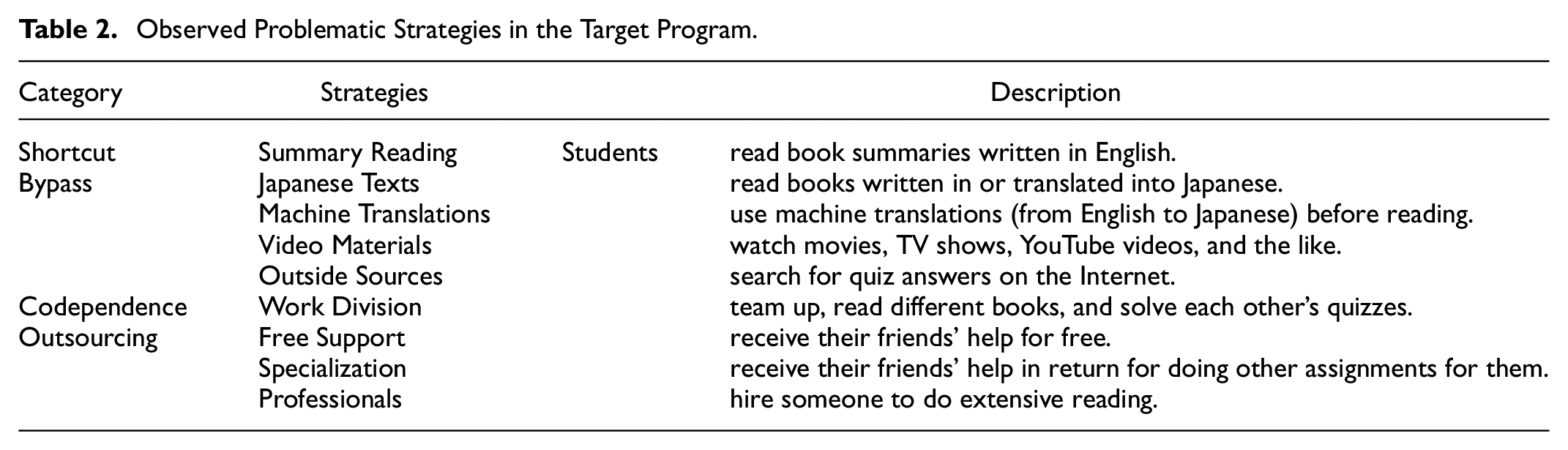
The second category, Bypass, is a set of self-help strategies by which students avoided second language reading. Bypass includes the use of (a) books written in or translated into Japanese (Japanese Texts), (b) machine translation software (Machine Translation), (c) audiovisual materials (e.g., movies and YouTube videos) (Video Materials), and (d) the Internet in search of quiz answers (Outside Sources).
The third category is Codependence. Here, students team up in order to reduce reading efforts. Codependence also consisted solely of one strategy. That is, Work Division. When Work Division is used, multiple students first read different books and then help each other in answering quiz questions.
The last category, Outsourcing, means that one has others do extensive reading for them. A student receives someone’s assistance either for free (Free Support), with monetary payment (Professionals), or in return for doing somebody’s school assignments other than extensive reading (Specialization).
Research Question 2: The Number of Strategies Used per Student
We found that the 208 students used an average of 2.37 strategies in the last extensive reading practice. At the same time, however, there were large individual differences in the Number index (SD = 2.85, Mdn = 1.00, Skew = 1.24).
Research Question 3: The Frequency of Strategy Use
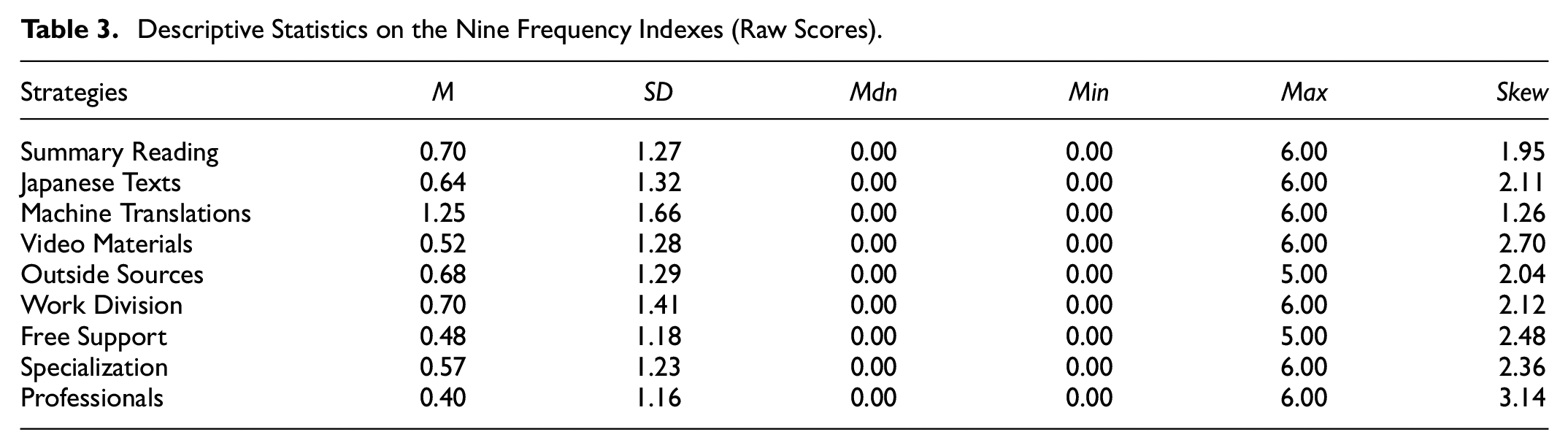
Table 3 shows the descriptive statistics for the nine Frequency indexes (N = 208) (see Appendix B for the complete data set). On average, the usage frequency of all target strategies was quite low (i.e., M > 1.00 out of possible 6.00 for all indexes except for Machine Translations, and Mdn = 0.00 for all indexes). However, as indicated by large standard deviations compared with their own average, individual differences were also apparent in all nine indexes.
Descriptive Statistics on the Nine Frequency Indexes (Raw Scores).
Research Question 4: The Relationship Between Reading Experience, the Number and Frequency of Strategy Use
There were three main trends in the number of strategy use (see Figure 2). First, one-third of the 208 students reported that they never used any strategy (i.e., the leftmost bar in Figure 2: n = 69). Second, the use of one or two strategies accounted for 37% of the total observation (n = 77). Third, 26% (n = 55) of the students relied on four or more strategies. In Figure 2, it is also clear that most students in the 14-week group (represented by the dark bars in Figure 2) either did not use any strategy or employed a single strategy. Meanwhile, the use of one to two strategies became common in the 42- and 56-week groups (represented by the gray and white bars). In addition, it was mostly the members of the 42- and 56-week groups who relied on four or more strategies.
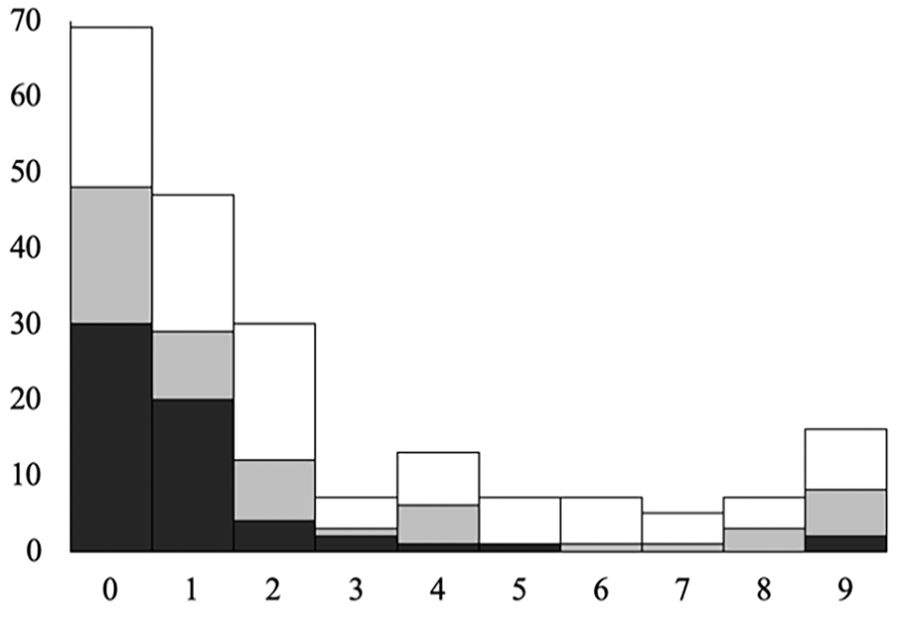
The number of strategies used by the 208 students by group.
Figures 3 to 5 show how frequently the nine strategies were used in each of the three groups. When we compare these figures, two things become clear. The first is a trend toward greater strategy use in the groups with more reading experience. The nine strategies were generally used with less frequency in the 14-week group (see Figure 3) than in the 42-week group (see Figure 4), and the same applies to the differences between the 42- and 56-week groups (see Figure 5). Another notable point is the popularity of Machine Translation. This strategy was most frequently and popularly used in all three groups, even though the ratio of frequent strategy users remained higher in the groups with more reading experience.
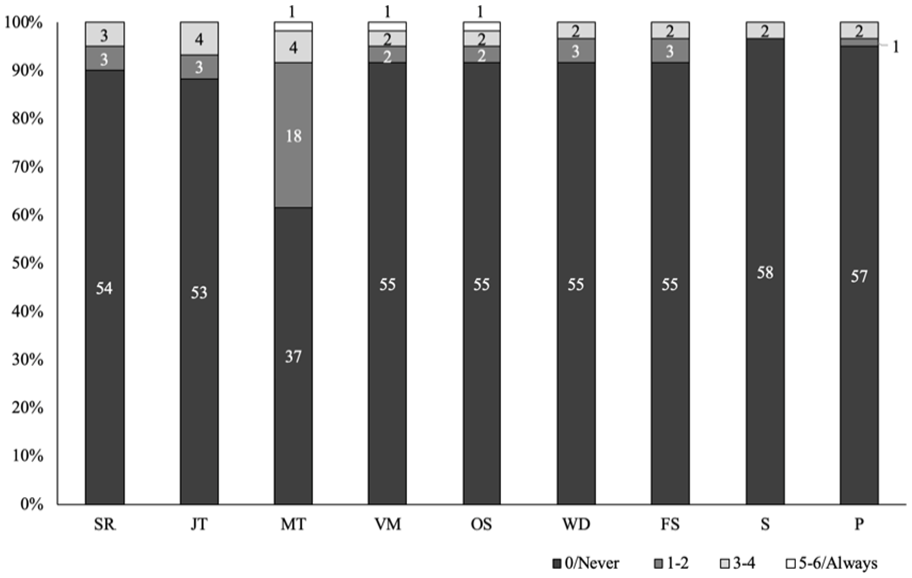
Summary of the 14-week group’s frequency data.

Summary of the 42-week group’s frequency data.

Summary of the 56-week group’s frequency data.
Lastly, the results of Tobit regression demonstrate that Length is a significant predictor of Number, and of seven out of the nine Frequency indexes (i.e., Outside Sources, Work Division, Summary Reading, Specialization, Japanese Texts, Free Support, and Machine Translations) (see Table 4).
Summary of the Effect of Length on the Strategy Use.

Note. N = 208, df = 1, robust standard errors were used for the calculation.
Discussion
The first research question explored the types of problematic strategies used in the principle-based extensive reading program. Analysis of the interview data revealed that the nine types of problematic strategies were being used in the target program. The survey results further indicated that a nontrivial number of students, especially those with prolonged reading experience, had employed these problematic strategies in their latest extensive reading practice. We will discuss these results and their implications in what follows.
Strategy Use in Credit-Based Extensive Reading
The second and third research questions addressed the number and frequency of strategy use. On these points, our study showed that the rule-breaking discussed in previous studies (Carney, 2016; O’Neill, 2012; Sun, 2003; Tagane et al., 2018) is not just a teachers’ concern, but a real threat to the validity of reading records. In particular, two-thirds of the target students (N = 208) used one or more strategies (M = 2.37), and the high standard deviations and left-skewed distributions observed in the frequency indexes indicate that there were heavy strategy users (M = 0.40–1.25, SD = 1.16–1.66, Skew = 1.26–3.14). These results confirmed that the students’ strategy use does introduce a bias to the measurement of reading engagement (i.e., the reading amount in our case). Such a bias is, to begin with, a major obstacle for teachers in assessing learners’ needs and achievements in their programs. Also, from a research perspective, the upward bias in reading records distorts the estimates of the relationship between reading engagement and educational outcomes (Nakanishi, 2015). Moreover, the present results support the idea that the effectiveness of credit-based extensive reading could be limited by rule-breaking behaviors.
The fourth research question examined the relationship between the length of extensive reading experience, and the number and frequency of strategy use. The results of Tobit regression demonstrated that reading experience is associated with an increase in the number of strategy use (β = .30, p < .001) and the usage frequency of the seven out of nine strategies (β = .21–.38, p < .001–.016). The present findings are incompatible with the observations that (a) post-reading tasks do not negatively affect reading attitudes (Stoeckel et al., 2012), and (b) reading experience has a positive effect on reading attitudes (Al-Homoud & Schmitt, 2009; Ro, 2013, 2016; Stoeckel et al., 2012; Yamashita, 2013). One reasonable way to explain the former discrepancy is to think of the learners’ perceptions of test stakes in each research setting. In Stoeckel et al. (2012), task results were not consequential to course grades, even though test-taking itself could have acted as an extrinsic motivation to read. Meanwhile, task performance in our target setting was worth 35% of the semester grade. Such conditional differences raise the possibility that, even though intellectual challenges (i.e., comprehension tasks) per se may not negatively affect reading attitudes, task consequences (i.e., receiving lower or higher grades due to task performance) may strengthen the perceived value of task performance, and, in turn, facilitate rule-breaking behaviors.
The possibility of task consequences being an incentive for rule-violation also helps explain the relationship between how long the students had experienced extensive reading and their strategy use. First, Yamashita (2013) confirmed that the positive effect of extensive reading on reading attitudes applied to the participants of a credit-based program. The point here is that Yamashita’s (2013) participants experienced extensive reading for a similar period to our 14-week group. This similarity suggests that the low strategy use of our 14-week group is a function of enhanced reading attitudes. The next point to be considered is the fact that the 42- and 56-week groups had finished two to three extensive reading courses before the target semester. Repeated participation in the credit-based program provides students with a clearer understanding of the relationship between task performance and final course grades. It is not surprising, therefore, that some students, especially low achievers in previous courses, start to pay more attention to task performance and gradually rely more on problematic strategies.
The results of this study raise two more interesting possibilities regarding the development of strategy use. The first is that the popularity of a strategy is partly determined by how discreetly and efficiently it can be implemented. Support for this possibility is our observation that Machine Translation was the most frequently used strategy in all three target groups. It appears that such popularity is partly attributable to the discreetness of this self-help strategy. This aspect is of great importance for learners, as they know that the use of such a strategy cannot be detected by teachers. On this point, the five self-help strategies in the Shortcut and Bypass categories could be done without being noticed even by classmates. In that sense, they are more discreet than the remaining four strategies that require the cooperation of others. In addition, Machine Translation is the most time-efficient strategy among the self-help types. All learners need for Machine Translation nowadays is a smartphone, which most university students possess, and the translation output is derived immediately after taking a photo of a book page. Meanwhile, learners must find optimal materials or websites before they are able to employ Summary Reading, Japanese Texts, Video Materials, or Outside Sources. Given these characteristics, it is reasonable to assume that Machine Translation was most frequently used in all three groups because the target students were aware of its relative benefits compared to other strategies.
The second possibility is that the adoption of Codependence and Outsourcing strategies (i.e., Work Division, Specialization, and Free Support) is accelerated with increased familiarity with classmates. Learners in a long-term extensive reading program, like the ones in our study, become more knowledgeable about which individuals in their social networks received what grades in previous courses. Such knowledge helps learners find partners to conduct Work Division and to do extensive reading on their behalf (i.e., Specialization and Free Support). Also, learners may feel more comfortable asking for classmates’ help with cheating as they build rapport with them. These factors provide plausible explanations for why three out of four less discreet strategies were also used more in the groups with longer reading experience.
To sum up, our results indicate that task consequences rather than the task itself are the main cause of the students’ rule-breaking in credit-based extensive reading. In addition, it is a realistic view that the use of problematic strategies in credit-based extensive reading becomes more severe with the accumulation of knowledge about learners’ own and their classmates’ performance in previous courses.
Educational Implications
Fundamentally speaking, the use of all problematic strategies should be discontinued at once. A simple countermeasure would be to eliminate the incentive for rule-violation. There will be little reason for learners to rely on problematic strategies when extensive reading is implemented as a voluntary or extracurricular activity. However, as setting up extensive reading programs requires at least a certain amount of financial and human resources (Davis, 1995), it may be beyond the power of individual teachers to prepare a principle-based program just for self- and out-of-class learning. For this reason, we recommend two more realistic approaches in what follows.
First, even though language learning is not the main goal of extensive reading (Al-Homoud & Schmitt, 2009; Day & Bamford, 2002), it seems reasonable to let learners know the known benefits of extensive reading on linguistic development (Hamada, 2020; Jeon & Day, 2016; Nakanishi, 2015). We recommend this because such information provides learners with an obvious reason not to prioritize short-term rewards (i.e., better task performance) over the evidence-based benefits.
The integration of extensive reading with task-based learning seems to be another viable option to promote intrinsic motivation for reading and prevent the use of problematic strategies. Green (2005) argued that some learners experience difficulties in having a clear purpose for reading in the conventional extensive reading design (i.e., free individual reading). Green thus proposed to use extensive reading to gain necessary information for the completion of interactive tasks. In this way, according to Green, learners would view reading as a critical element for interaction and negotiation, and have a personal reason to engage with extensive reading. The effectiveness of this approach was supported by a later study. Chen (2018) reported that information-sharing and learner–learner interactions after reading (e.g., reasoning-gap and decision-making tasks) first gave his participants a sense of achievement. Such perceived achievement successively promoted motivation to read, then helped develop reading habits, and eventually led to linguistic development. Given these findings, the use of interactive tasks in credit-based extensive reading would be beneficial for the potential rule-breakers to have communicative goals for their reading. Another merit is that this integrated approach makes rule-breaking behaviors more manageable. First, the Shortcut, Bypass, and Outsourcing strategies are easily detectable (and thus lose their meaning) when individual and salient reading takes place in a classroom before task engagement. While the decrease in the total reading amount is a potential downside of this implementation method, this issue can be handled by using classroom reading only for assessment-relevant on-site tasks, and letting learners enjoy voluntary individual reading outside the classroom. Next, the use of Work Division would also be difficult as teachers either split students into random pairs and groups, or carefully observe who works with whom in each class.
Limitations
Several limitations must be noted. First, this research project was conducted in the university where the first and second authors were teaching. This helped to collect inside information from students; meanwhile, it is optimistic to think that research conducted in one university can reveal every cheating trick used in extensive reading programs. For instance, because our reading system M-reader takes the form of print reading, cheating techniques that may be useful in screen reading were not addressed in this study (Tagane et al., 2018). Also, our research setting is somewhat unique in that all participants study English as their major. This means that the 208 participants had more opportunities to increase their familiarity with their classmates compared to non-English majors who participate in extensive reading programs with unfamiliar individuals (e.g., students of different majors). Such a contextual difference could particularly affect how often the Codependence and Outsourcing strategies are used. For these reasons, future studies would benefit from testing the transferability and generalizability of our results using a conceptual replication (i.e., using different methods and samples).
Next, our analyses were based on cross-sectional data, meaning that the development of strategy use proposed in this study must be backed up by longitudinal data. Lastly, even though we employed all possible strategies to ensure students’ responses were honest, some students may still have underestimated or underreported their strategy use in the survey due to their own sense of shame or out of fear of being perceived as a cheater. The adoption of a double-blind approach in future studies could be a solution for this potential problem.
Conclusion
The conclusion drawn from this study is that rule-breaking behaviors can be a real threat to the effectiveness of credit-based extensive reading, even when active efforts are made to ensure principle-based extensive reading. It would be helpful for teachers to know that (a) the use of problematic strategies is likely to be facilitated by the consequences attached to tasks rather than test taking, and that (b) extensive reading experience could have an adverse relationship with strategy use, as learners understand more about the impact of task performance on their final course grades. These issues, however, can be mitigated or even eliminated as teachers implement appropriate countermeasures. These include, for instance, the provision of explicit explanation of the evidence underlying the benefits of extensive reading, and the integration of extensive reading with task-based learning. Also, one option, where possible, would be to use voluntarily and extracurricular forms of extensive reading instead of a credit-based design.
Footnotes
Appendix A
Question Items (Original Items are in Japanese)
Acknowledgements
We are grateful to four anonymous reviewers for their insightful comments on this manuscript. We would also like to thank Natalie-Anne Hall for English language editing.
Correction (May 2023):
The text has been corrected on p7 in Para 2 from “The second category..” onwards.
Declaration of Conflicting Interests
The author(s) declared no potential conflicts of interest with respect to the research, authorship, and/or publication of this article.
Funding
The author(s) disclosed receipt of the following financial support for the research, authorship, and/or publication of this article: This work was supported by the Japan Society for the Promotion of Science (No. 20K13147 and 18K00801).
Ethics Approval
At the time of data collection, ethical review and approval were not required for the non-invasive study involving human participants, such as interviews and questionnaire surveys. This was in compliance with the local legislation and institutional requirements.
Consent to Participate
All participants provided their written informed consent to participate in this study.
Consent for Publication
Written informed consent was obtained from all participants for publication of this study.
Availability of Data and Material
The datasets generated for this study will be made available by the first author upon reasonable request.
