




Abstract
This study examined the potential trade-off in performance between maximum physical capabilities in the handball jump throw, a fundamental skill comprised of two mechanically independent tasks. Elite handball players performed jump throw actions from a force plate for each of three instructions: jump at maximum capability, throw at maximum capability, and jump and throw at maximum capability simultaneously. Jump height and throwing velocity were derived from motion capture data. When jumping and throwing at maximum capability simultaneously, no trade-off between jump height and throwing velocity was present, but rather a concurrent decline from their respective maximums. This decline could be explained by mechanical factors related to movement execution; magnitudes of directional impulses favored vertical movement for jumping and horizontal movement for throwing. However, no explanation for differences in total magnitude of impulse between instructions was evident. Due to the expertise of the participants, information processing should not be a limiting factor, leaving movement strategy as the most likely explanation for the present findings.
Introduction
The jump throw is one of the most fundamental skills in handball, representing >70% of all throws in game situations in professional competition (Wagner, Kainrath, & Müller, 2008). At its core, the jump throw requires the initiation of two coordinative sequences, namely jumping and throwing. Both of these can be considered performance factors; jumping as it relates to player positioning and throwing as it relates to ball velocity and ball placement. Naturally, due to the multitude of game situations a given player faces, not all jump throws demand maximum physical effort of both jumping (i.e., displacement) and throwing (i.e., velocity), but one or the other might be necessary.
In expert players, the jump throw is ostensibly performed as a singular task (see, e.g., Wagner, Buchecker, von Duvillard, & Müller, 2010; Wagner, Pfusterschmied, von Duvillard, & Müller, 2011). However, from a purely mechanical point of view, jumping and throwing can be considered independent tasks. By law, jump height is determined at take-off by the vertical momentum of the player (and ball). In contrast, throwing velocity is not determined by the horizontal momentum at take-off, although it does contribute, but rather by the momentum imparted on the ball by the player when throwing. As soon as the player leaves the ground, the only external force acting on the player and ball that is of consequence for momentum is gravity (air resistance is negligible); hence, they function as a closed system with respect to horizontal movement. Thus, any change in momentum of the ball is, by law of conservation, dependent on an opposing change in momentum of the player. Because the difference in mass between the player and the ball is large, the change in player velocity as a result of throwing the ball should be small (disregarding their initial velocities, a 70-kg player throwing the 350-g ball with a velocity of 20 m∙s−1 would experience a –0.1 m∙s−1 change in velocity). Vertically, the same principle applies for the player and ball, but the total momentum is continually affected by gravity. Because this momentum is inevitably zero at the apex of the jump (where velocity is necessarily zero), jump height should remain unaffected by throwing the ball.
Although theoretically possible, delaying the entire execution of the throwing motion until after take-off, with jump height determined, would be an impractical strategy due to the demands it would place on creating ball velocity in the limited time available (e.g., Karcher & Buchheit, 2017; van den Tillaar, Zondag, & Cabri, 2013). Likely because of this, the throwing motion begins prior to the jump (Pori & Sibila, 2003; Sibila, Pori, & Bon, 2003) and the two tasks are executed concurrently. However, it is unknown whether or not they interfere with each other in some form and hence whether or not players are able to jump and throw at maximum capability simultaneously.
Information concerning a potential trade-off between maximum physical capabilities in discrete, gross movements is scarce. Among theoretical frameworks for explaining declining performance in dual-task situations, resource theory appears to hold transferable value (see, e.g., Temprado, Zanone, Monno, & Laurent, 2001). It proposes that there is a limited amount of processing resources, which must be allocated between tasks if their collective demands exceed the total amount available; applying this concept to physical resources, a player presumably has, for example, a defined capacity for producing force, limiting the attainable magnitudes of the vertical and horizontal components. The result is either a decline in performance in both tasks (i.e., reduced jump height and throwing velocity) or a trade-off in performance where one task is given priority (i.e., a strategy is chosen which favors either jump height or throwing velocity). However, before this merits further discussion, the presence or absence of a performance trade-off must be established.
The purpose of this study was to investigate whether or not expert handball players are able to both jump and throw at maximum capability simultaneously. Based on their mechanical independence, it was hypothesized that no trade-off between jump height and throwing velocity or concurrent decline would be present.
Method
Participants
Thirteen women handball players from a top division club in Norway voluntarily participated in the study (age = 20.8 ± 2.7 years, height = 174.2 ± 6.9 cm, body mass = 73.1 ± 10.7 kg, organized playing experience = 12.5 ± 3.3 years, top-level playing experience 2.8 ± 2.8 years). The following inclusion criteria were used: outfield player (no goalkeepers) competing at the elite level, cleared for full training and match participation by the club. All participants provided written, informed consent (parental consent was obtained for participants <18 years) and were made aware they could withdraw from the study at any point without providing an explanation. The study was approved by the Norwegian Social Science Data Services (Project number 43906) and conducted in accordance with the Declaration of Helsinki.
Experimental Setup
Custom wooden flooring (3 × 2 m) was constructed around a 0.6 × 0.4 m Kistler force plate (Kistler 9286BA, Kistler Instrumente AG, Winterthur, Switzerland) on an inside court. A 1 × 1 m target area, marked with tape, was located 8 m from the force plate, with its center at a height of 1.1 m (equivalent to the center of a regulation handball goal). Seven motion capture cameras (Oqus 400, Qualisys AB, Gothenburg, Sweden) were placed in a circle around the throwing area. See Figure 1 for an illustration of the experimental setup. The force plate was internally calibrated and the camera system was calibrated according to the manufacturer’s specifications. Force and kinematic signals were recorded synchronously at 1000 Hz and 250 Hz, respectively, using Qualisys Track Manager 2.10 (Qualisys). Force signals were acquired via a Kistler data acquisition system (64ch DAQ system Type 5695A, Kistler Instrumente AG).

Schematic diagram of the experimental setup.
On each participant, passive spherical reflective markers (ø 19 mm) were placed bilaterally on the trochanter major and on the middle phalanx III on the hand of the throwing arm. In addition, two markers (ø 16 mm) were placed on opposite sides of the ball to detect its center, eliminating the contribution of spin to velocity.
Test Protocol
Following a 15-min warm-up of running, dynamic stretching, and throwing activities (including familiarization with the test setup), the participants completed an 8-s standing measurement on the force plate to determine body weight and a 5-s measurement with the ball to determine the grip distance (mean distance between the middle phalanx III and the center of the ball during standard ball grip). The participants then performed five jump throw actions with a three-step run-up for each of three instructions: jump at maximum capability without releasing the ball (jump instruction); throw at maximum capability without regard for maximizing jump height (throw instruction); and jump and throw at maximum capability simultaneously (combined instruction). The first two instructions were given in a counterbalanced order among participants to account for potential systematic order effects, whereas the combined instruction was always given last to avoid any potential influence on the isolated instructions. An attempt was regarded as successful when the participant jumped from the force plate with the leg contralateral to her throwing arm and hit the target area with the ball (if applicable). The use of resin was permitted. The participants were given ~1 min rest between attempts and ~2 min between instructions to avoid any effects of fatigue on either jumping or throwing capability.
Data Analysis
All data were processed in Matlab R2015a (version 8.5.0.197613, Mathworks, Natick, MA, USA). Force signals were low-pass filtered at 200 Hz with an eighth-order Butterworth filter. Body weight (BW) was obtained from the standing measurement as the mean vertical force. Ground contact time was determined as the period when vertical force was ≥2 SDs above mean baseline force (unloaded force plate). The relative total impulse was calculated as the vector sum of mean vertical and horizontal (in goal direction, unless stated otherwise) force during ground contact multiplied by contact time, normalized by the impulse created by BW alone. Changes in vertical and horizontal velocity during ground contact were calculated using the impulse-momentum theorem. Positive values indicate acceleration in the respective goal directions.
Kinematic signals were spline interpolated where missing data gaps were ≤5 samples and low-pass filtered at 20 Hz with a fourth-order Butterworth filter. Velocities were calculated using a 5-point differentiating filter on the time signals of marker positions. Because position could not be obtained through the integration of force due to a lack of knowledge about initial conditions (i.e., integration constants) at the onset of force measurement, jump height was calculated from the average of the two hip markers, determined as the difference between the maximum height achieved after take-off and standing height. The center of the ball was calculated as the average of the two opposing markers on the ball. Where applicable, ball release was determined as the point at which the distance between the middle phalanx III and the center of the ball became and stayed ≥1.3 times the grip distance. This threshold was determined through visual inspection of the data. Throwing velocity was determined from the vector sum of vertical and horizontal ball velocity as the mean during 12 ms (3 samples) around release. The timing of ball release was expressed relative to the occurrence of maximum average hip marker height (approximate midpoint of aerial time) as the percentage of time from take-off to this point (i.e., ball release exactly at maximum height was 100%) rather than in absolute terms to account for varying aerial times.
For each variable, results were averaged across all repetitions with sufficient data (≥3 repetitions). For throwing velocity and timing of ball release, the mean ± SD number of repetitions with sufficient data was 4.2 ± 0.8 for the throw instruction and 4.3 ± 0.8 for the combined instruction. For the remaining variables, all five repetitions had sufficient data. Average values were used because any given repetition in an isolated instruction is no closer linked to the same order repetition than to any other repetition in the combined instruction. There was no distinct effect of order on any of the variables. Effects of practice and fatigue during the experiment were deemed negligible, and were likely nonexistent due to the experience of the participants. The within-participant coefficient of variation ranged from 2.2% to 6.6% across instructions in all variables except horizontal velocity change during ground contact, for which it ranged from 9.2% to 14.9%.
Statistical Analysis
To determine the within-participant effect of instruction (from isolated to combined), linear mixed models with random intercept terms were fitted separately for the dependent variables (jump height, throwing velocity) using maximum likelihood estimation. Both reduced models (only instruction, without covariates—equivalent to a paired samples t tests) and full models (instruction and covariates) were fitted to investigate the effect of explanatory variables. This statistical approach was necessary to account for nonconstant, continuous covariates, something the repeated measures analysis of variance is unable to incorporate (West, 2009).
Instruction and covariates were entered as fixed factors. Covariates included in the full models for jump height and throwing velocity were vertical velocity change during ground contact and horizontal velocity change during ground contact, respectively. These were chosen for being mechanical variables theoretically linked to the dependent variables, and were added through forward selection (once any potential effect of instruction present in the reduced model was explained, no further covariates were added). To disaggregate between-participant effects and within-participant effects (Bell & Jones, 2015; Blackwell, de Leon, & Miller, 2006; Curran & Bauer, 2011), covariates were both grand mean centered and person-mean centered.
Random slopes were not specified. With only a single observation for every instruction level of every participant after data reduction, random slope variance would be completely confounded with trial-level error and hence, random slope models would be unidentifiable (Barr, Levy, Scheepers, & Tily, 2013). Because only a random intercept was estimated, the covariance structure in all models was, by default, scaled identity (assumes constant variance and no correlation). The need for random intercepts to account for heterogeneity among participants was tested with a Wald test (see, e.g., Tang, Slud, & Pfeiffer, 2014); as indicated by the significant outcomes (Table 1), the inclusion of a random intercept term was supported in all four models.
Estimates of Intercept Variance for Reduced and Full Models for Both Jump Height and Throwing Velocity.

Note. Reduced model = no covariates included; full model = covariates included. CI = confidence interval.
Normality of residuals (see, e.g., Cheng, Edwards, Maldonado-Molina, Komro, & Muller, 2010) was checked with the Shapiro–Wilk test as well as visually (histograms, Q-Q plots), whereas linearity was assessed with residual plots (fitted values against residuals). All four models satisfied the assumptions of normality and linearity. For each model, within-participant effect size (Cohen’s d) was calculated as the difference in estimated marginal means between instructions divided by the SD derived from the standard error.
Although model comparison with the intent of finding the best model was not of interest, as a formality, the fit of reduced models compared with full models was assessed with chi-square tests using Schwarz’s Bayesian information criterion (BIC). There was an improvement in model fit from the reduced to the full model for jump height, χ2(2) = 13.208, p = .001, but no difference between models for throwing velocity, χ2(2) = 2.781, p = .249.
For descriptive purposes, differences in relative impulse and timing of ball release between the combined instruction and the respective isolated instructions were checked with paired t tests, also reporting Cohen’s d. Normality of the differences between instructions was checked with the Shapiro–Wilk test as well as visually (histograms, Q-Q plots). All statistical analyses were performed in SPSS version 24 (IBM Corporation, Armonk, NY, USA). The level of statistical significance was set at α = .05.
Results
Mean values of all descriptive variables across instructions are shown in Table 2. There was an effect of instruction on both jump height and throwing velocity (Table 3, reduced models). From the isolated instructions to the combined instruction (adding the second task), jump height decreased by 0.02 m (p = .034, d = 0.47) and throwing velocity decreased by 0.42 m∙s−1 (p = .038, d = 0.34). Effectively, when performed simultaneously, both jump height and throwing velocity decreased relative to their respective isolated instructions (Figure 2, triangle markers).
Mean (SD) Values of Descriptive Variables From 13 Elite Women Handball Players Performing Jump Throw Actions Across Three Instructions.

Note. jump = maximize jump height; combined = maximize jump height and throwing velocity; throw = maximize throwing velocity; ∆vvert = change in vertical velocity during ground contact; ∆vhor = change in horizontal velocity during ground contact; release timing = timing of ball release relative to maximum position.
Estimates of Fixed Effects for Reduced and Full Models for Jump Height (From Instruction jump to combined) and Throwing Velocity (From Instruction throw to combined) From 13 Elite Women Handball Players Performing Jump Throw Actions.

Note. Reduced model = no covariates included; full model = covariates included. jump = maximize jump height; combined = maximize jump height and throwing velocity; throw = maximize throwing velocity; CI = confidence interval; ∆vvert = change in vertical velocity during ground contact; ∆vhor = change in horizontal velocity during ground contact; -B = between-participant effect (grand mean centered); -W = within-participant effect (person-mean centered).
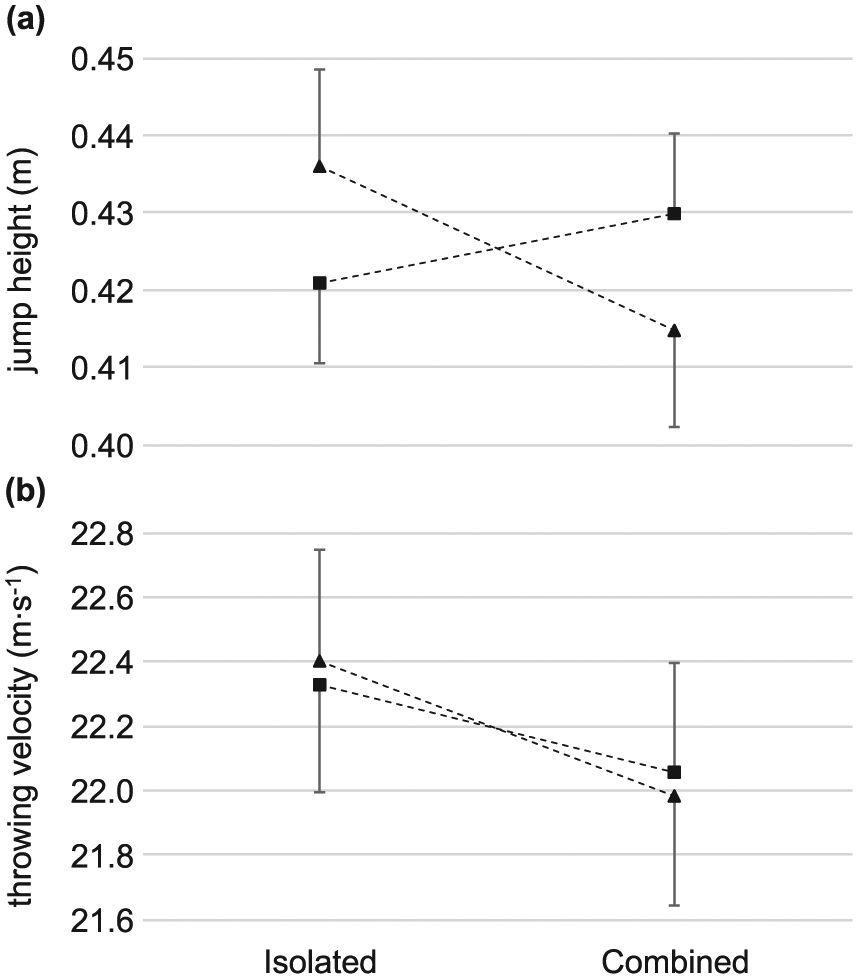
Changes in jump height (a) and throwing velocity (b) from their respective isolated instructions to the combined instruction, with and without covariates taken into account (estimated marginal means with standard error, n = 13).
However, these relationships were no longer present when covariates were accounted for (Table 3, full models). For jump height, including vertical velocity change as a covariate removed the effect of instruction (p = .266, d = 0.24). Similarly, for throwing velocity, including horizontal velocity change as a covariate removed the effect of instruction (p = .445, d = 0.22). Effectively, taking mechanical explanatory variables into account for jump height and throwing velocity eliminated the significant differences between the respective isolated instructions and the combined instruction (Figure 2, square markers). More specifically, when the decrease in vertical velocity change from the jump instruction to the combined instruction was accounted for, there was practically no difference in jump height (0.009 m) between the instructions. Similarly, when the decrease in horizontal velocity change (i.e., increase in horizontal breaking) from the throw instruction to the combined instruction was accounted for, the difference in throwing velocity between the instructions decreased from −0.42 m∙s−1 to −0.27 m∙s−1.
The paired t tests showed that, compared with the combined instruction, relative impulse was higher in the jump instruction (t12 = 3.051, p = .010, d = −0.53) and lower in the throw instruction (t12 = −2.935, p = .012, d = 0.69), whereas timing of ball release did not differ between the combined instruction and the throw instruction (t12 = −1.143, p = .275, d = 0.21).
Discussion
The purpose of this study was to investigate whether or not maximum jumping and throwing capability in the handball jump throw would be retained when attempting to maximize both. Contrary to what was hypothesized, the participants were unable to retain maximum performance in both tasks. The simultaneous execution of these tasks revealed a concurrent decline from their respective maximums during isolated execution rather than the prioritization of one over the other. However, this was explained by mechanical factors; the inclusion of change in vertical and horizontal velocity during ground contact as covariates for jump height and throwing velocity, respectively, removed the effect of the added task.
From a biomechanical point of view, the effect of vertical velocity change on jump height was as expected, due to their inevitable relationship, with the result determined by take-off. For throwing velocity, contrastingly, the degree of braking is only the beginning of the throwing process, making the relationship with horizontal velocity change more indirect in nature. In line with this, the effect of horizontal velocity change on throwing velocity was not as strong as that of vertical velocity change on jump height (Table 3). Nevertheless, it was sufficient to account for the decline in throwing velocity.
While the observed declines in jumping and throwing performance could be explained by mechanical factors, the participants were ultimately not able to perform both tasks at maximum capability simultaneously. Rather than trade the performance of one task for the other, the two tasks appeared to receive relatively equal priority in the combined instruction, as indicated by their similar performance decrements. It is possible that these decrements in physical performance were affected by movement strategy. When maximizing only jump height, the participants were aware that it was not necessary to produce any ball velocity prior to take-off, which opens the door to a strategy in which a minimum of physical resources is allocated to the throwing motion until the result of jumping is determined (i.e., at take-off). Such a strategy would probably not be feasible when also attempting to maximize throwing velocity, due to the limited time of the aerial phase. In fact, timing of ball release did not differ significantly between the combined instruction and the throw instruction, suggesting that the participants maintained a similar temporal strategy for throwing regardless of the demand for jump performance.
In line with the notion of physical resource allocation, perhaps the most direct explanation of the concurrent decline found in the combined instruction would be that the distribution of total impulse, and thus momentum, in the respective isolated instructions favored either vertical (jump instruction) or horizontal (throw instruction) movement. From the changes in vertical and horizontal velocity during ground contact (Table 2), it can be inferred that this was indeed the case, because those values are derived from (and are directly proportional to) the vertical and horizontal impulses, respectively. The more exclusively an instruction required maximum jump performance, the greater the vertical impulse and the more negative the horizontal impulse (i.e., increased horizontal braking). Correspondingly, the more exclusively an instruction required maximum throwing performance, the lesser the vertical impulse and the less negative the horizontal impulse (i.e., decreased horizontal braking). Interestingly, the directional distribution was not the only difference between instructions. The total magnitude varied as well, favoring jump performance; compared with the combined instruction, relative impulse was significantly greater when attempting to maximize only jumping and significantly lesser when attempting to maximize only throwing. This might simply reflect that jump height necessarily has a greater dependency on the impulse than throwing velocity. However, it does not explain why the participants did not produce a total impulse of equal magnitude when throwing. Although the results suggest that most of the throwing velocity is produced after take-off, any increase in horizontal momentum could still contribute by way of a greater initial ball velocity. In theory, the participants could have taken advantage of this particularly in the throw instruction, where jump height was not a performance outcome and hence vertical momentum was not a priority. In practice, however, they did not. One possible explanation is that the participants did not produce a greater horizontal (and thus total) impulse when throwing to avoid jumping too far horizontally, perhaps to maintain invariant throwing technique. Another is that movement technique affects the utilization of the presumed defined amount of physical resources available for allocation. For example, vertical and horizontal jumping have been shown to be only moderately correlated in women (Meylan et al., 2009), indicating that jumping is not a general capability where it is merely a matter of prioritization with regard to the direction in which force is applied.
Because a mechanical explanation for the differences in physical execution between instructions is not evident, the alternative must be considered. Evidence exists pointing to the concurrent performance of tasks declining when they must share information processing resources compared with when they do not utilize common resources (Wickens, 2002). However, a strategy to avoid this problem would be to unify the two tasks into a whole to eliminate the dilemma of sharing: Dual-task interference decreases when spatial patterns (i.e., movements) can be conceptualized as components of a single-task (Franz, Zelasnik, Swinnen, & Walter, 2001). The more commonly investigated trade-off between velocity and accuracy serves as an interesting parallel. Although this trade-off is seemingly present in general overhand throwing (Indermill & Husak, 1984), accuracy does not appear to be affected by velocity in expert handball throwing (Garcia, Sabido, Barbado, & Moreno, 2013; van den Tillaar & Ettema, 2003a, 2003b, 2006). The explanation cited is the highly specialized nature of elite players. This notion has support in the literature, albeit based on movements of a much smaller magnitude; dual-task interference tends to decrease with practice (Eversheim & Bock, 2001; Temprado, Monno, Zanone, & Kelso, 2002) and is low when approaching automaticity (Wu, Kansaku, & Hallett, 2004), presumably due to reduced resource demands. The same reasoning can be applied to the jump throw in experts. At some point in learning, the two tasks—jumping and throwing—have ostensibly become one task—the jump throw. If that is indeed the case, the concurrent decline found presently should primarily be the result of conflicts related to the execution of the movement rather than information processing. Furthermore, in the current experiment the participants still performed the throwing motion—albeit minus ball release—when attempting to maximize only jump height and still jumped when attempting to maximize only throwing velocity; hence, the observed performance decrements in the combined instruction should in any case not be the result of a greater demand on information processing (i.e., “added coordination”). Interestingly, when accuracy is the main focus, throwing velocity has been found to decrease, but accuracy does not improve (van den Tillaar & Ettema, 2006). However, because the throwing tasks in the current experiment required only gross accuracy (1 × 1 m target), there is no reason to believe aiming interfered with performance, considering the level of the participants.
The addition of a separate mental task, on the contrary, can conceivably affect performance. Throwing velocity in handball has been found to decrease gradually with added opposition (Rivilla-Garcia, Grande, Sampedro, & van den Tillaar, 2011), from no opposition to the presence of not only a goalkeeper but also a defender. This was speculated to be a result of the players no longer being able to focus only on throwing velocity. In the current experiment, the participants were relieved of all mental tasks such as tactical choices and decision-making to isolate the potential effects of the two physical tasks on each other. Overall, there is no compelling argument to be made that the observed performance decrements should be attributed to information processing.
In conclusion, elite women handball players were not able to both jump and throw at maximum capability simultaneously in the handball jump throw. No trade-off was present, but rather a concurrent decline in performance. Theoretically, the two tasks should be mechanically independent, while conflicts related to information processing should not be a limiting factor due to the expertise of the participants. The declines in jump height and throwing velocity from their respective isolated performances could be explained by mechanical factors related to the execution of the movement, favoring vertical movement for jumping and horizontal movement for throwing. However, no explanation for the differences in execution between instructions, by means of total physical resources used, was evident. Thus, movement strategy is left as the most likely explanation for those differences and hence the concurrent decline in jumping and throwing performance. It should be noted that these results are based on a limited sample size (an unfortunate side effect of doing research on elite athletes), making their generalizability uncertain. Further research should strive to include larger sample populations of sufficient skill level and examine whether players are able to maintain invariant movement technique between isolated and combined instructions, both with and without the presence of an opponent, as well as whether similar results occur in equivalent tasks in other ball sports.
Footnotes
Acknowledgements
The laboratory facilities were provided by NeXt Move, Norwegian University of Science and Technology (NTNU). The authors thank the club and the participating players for their cooperation during the experiment, as well as Xiangchun Tan (Department of Neuromedicine and Movement Science, NTNU) for valuable assistance in the laboratory.
Declaration of Conflicting Interests
The author(s) declared no potential conflicts of interest with respect to the research, authorship, and/or publication of this article.
Funding
The author(s) received no financial support for the research, authorship, and/or publication of this article.
