




Abstract
This article seeks to explore the effectiveness of a comprehensive performance management system in terms of employee performance. Besides, the mediating effect of work engagement was also examined. The performance management system effectiveness (PMSE) was determined by the extent of its accuracy and fairness, as recommended by previous researchers. A sample of 285 employees was selected from various branches of private banks located across Pakistan. A structured questionnaire was used, which was validated through confirmatory factor analysis (CFA) in the Pakistani context. The results indicated a significant impact of PMSE and work engagement on task and contextual performance of employees. Also, complementary mediation of employee work engagement in the relationship between PMSE and employee performance (in terms of task and contextual performances) was also supported. The findings of the research are helpful for the development of HR and PMSE strategy in the private banks of Pakistan. The study also suggests that a comprehensive PMSE model including the perception of fairness as a mandatory part, may be introduced for employees’ enhanced work engagement and task/contextual performance. The mediating relationship of work engagement has established the process of PMSE for the task and contextual performances of employees, which is a valuable contribution of the study.
Keywords
Introduction
Background
Performance management system effectiveness (PMSE) is the measure of alignment between employee and organizational objectives (Armstrong, 2015). Researchers (e.g., Kennerley & Neely, 2003; Kolich, 2009; Tan & Smyrnios, 2006) have substantiated that a careful implementation of an effective PMS ensures this consistency. An effective PMS implementation process necessitates that employees eagerly accept and effectively participate in the goal-setting process. A detailed examination of previous literature show that majority have focused on PMSE in the context of organizational performance only (Busco et al., 2008; de Wall & Coevert, 2007; Elliot, 2016; Garengo et al., 2005; Ohemeng, 2009; Payambarpour & Hooi, 2016; Thursfield & Grayley, 2016), while ignored the employees’ perception completely. Some recent literature has attempted to address this aspect and recommended exploring PMSE from employees’ perspectives. More specifically, studies recommended the exploration of PMSE in terms of its impact on employees’ motivation, work engagement, performance, and retention (Audenaert et al., 2019; Mishra, 2014; Sharma et al., 2016). The current study examines the missing link between PMSE and employees’ work engagement and performance.
Research Gap
The literature has conceptualized PMSE in many ways. Lawler (2003) found certain design factors responsible for PMSE, for example, ongoing feedback, use of behavior-based measures, preset goals, trained raters, and equitable rewards. However, his study considered and used items pertaining to performance appraisal effectiveness (PAE) in terms of its relationship with different rewards practices, although he used the terms PMS and PMSE quite frequently. Moreover, his study was more of an exploratory nature, where he collected information from HR managers of only 55 Fortune 500 companies and analyzed data using simple mean scores. Hence, the findings of his study lack generalizability for other companies, which are not using similar performance appraisal practices.
Dewettinck and van Dijk (2013) have studied PMSE for its clarity of goals and expectations and the extent to which these were linked with their individual objectives of performance, development, and career enhancement. Their study also indicated strong linkages between PMSE and goal setting, control, and expectancy theories. They added the items of “employees’ work engagement” to determine PMSE including employees’ self-esteem, comfort, and most importantly employees’ realization of the fact that their performance adds value and contributes positively to the overall organizational performance. They included perception of fairness as a mediator in the study but did not consider it as a part of an effective PMS.
However, Sharma et al. (2016) adopted a slightly different approach to use these factors to ascertain PMSE. They defined PMSE as a combined effect of performance management system accuracy (PMSA) and performance management system perceived fairness (PMSF). They conceptualized PMSA as a set of effective goal setting, feedback and control, measurement and review, and reward system. PMSF was the extent to which all these practices were perceived just and equitable by the employees (Becker & Gerhart, 1996; Marr et al., 2004; Stokes, 2000). They also established the link between PMSE and theories of goal setting and equity. The current study uses the same premise by taking PMSA and PMSF as important dimensions of PMSE.
Although contemporary research and practice have started taking Performance Appraisal as a part of the overall PMS (Armstrong & Baron, 2004), there is a scarcity of literature on substantiating the factors leading to PMSE (Biron et al., 2011). Some researchers have analyzed the determinants of PMSE (Biron et al., 2011; Schleicher et al., 2019), while others have studied its effectiveness in highly developed and advanced countries, which leaves a space for extension in other developing economies. Some researchers (Becker & Gerhart, 1996; Marr et al., 2004; Stokes, 2000) have specifically indicated that different firms adopt different PM strategies on the basis of several internal and external factors. Broadbent and Laughlin (2009) add that the concept of PMSE is also dependent on the context that varies on the basis of history, purpose, technology, people, and environment of the organization. It is, thus, equally important to understand that the organizational structures, culture, and performance of organizations in developing countries are different from the developed world, and therefore, may have varied effects on PMSE (Audenaert et al., 2019; Brinkerhoff & Brinkerhoff, 2015). This article, therefore, is an attempt to fill this gap.
Teeroovengadum et al. (2019) investigate PMSE from three types of organizational purposes—strategic, development, and administrative. Similarly, in another study, Lappalainen et al. (2019) indicate that PMSE serves two main functions—judgmental and developmental. The first one is evaluative and helps make administrative decisions about employees, whereas the developmental part is related to its potential for high performance (McAfee & Champagne, 1993) leading to higher organizational outcomes (Kagaari et al., 2010). Research suggests that employee performance can be managed by effectively controlling its determinants and therefore should be explored from this perspective (Almatrooshi et al., 2016; Kang & Choi, 2019).
Zhong et al. (2016) have also found that individual-level performance is beneficial for organizational performance. The interplay between individual and organizational control has recently shifted from technical to social mechanisms, where technicality of control and command is concerned with a structural and bureaucratic trend to cultural, and behavioral aspects leading to organizational outcomes (Smith & Bititci, 2017). The literature shows that past research has adopted a limited approach toward understanding PMSE, and mostly validated its quantifiable outcomes. Therefore, the link between individual-level employee emotions, attitudes, behaviors, and PMSE remains unexplored (Korff et al., 2017). Work engagement as one of the behavioral aspects is a possible consequence of PMSE (Alarcon & Edwards, 2011; Bakker et al., 2012; Gruman & Saks, 2011). The reliance of contemporary organizations on PMS for improving the organizational results (Buchner, 2007) can only be achieved if they focus more on proximal outcomes like employee performance through work engagement. Mone and London (2010) also suggest that an effective PMS can help in the creation and sustenance of a high level of employee work engagement (EE) leading to better performance.
Work engagement (WE) is an effective antecedent of employee performance (Abraham, 2012; Macey & Schneider, 2008a). de Vries et al. (2016) define work engagement as “active investment of energy in domains of interest.” Smith and Bititci (2017) conduct an exploratory action research involving pilot and control groups from two departments of a U.K. bank to find out the interaction between performance management, work engagement, and performance. They find that effective performance management enhances employees work engagement in those who find themselves comfortable at work and more inclined toward better performance. They also include engagement as a mediator between PMSE and performance; however, they do not adopt the empirical methodology, which they have proposed for future research. Although their study is more relevant to the current research, still they left gaps in finding the empirical relationship. They also suggested replicating their research framework in the developing economies by adopting more robust research methods like survey techniques to enhance the generalizability.
Some researchers have also indicated a gap in the previous literature on employee-related outcomes of PMSE like work engagement, employee performance, and so on (Biron et al., 2011; Cawley et al., 1998; Sharma et al., 2016). A study conducted by Cheese and Cantrell (2005) conclude that organizations having a higher level of engagement among employees who develop a better culture of motivation, commitment, and work (Harter et al., 2002). Similarly, Saratun (2016) establishes a relationship between PMS and work engagement leading to corporate sustainability, but do not consider the intervening role of work engagement leading to employee performance as an intermediary outcome of the relationship. It is important because enhanced employee performance is the proven ingredient of organizational outcomes (Cravens & Oliver, 2006). Effective goal setting, control and feedback, measurement, alignment with objectives, performance-based rewards, and positive perception of fairness have been declared as the important elements of PMSE (Sharma et al., 2016). All these elements individually and collectively have the potential to enhance employees’ engagement and involvement at work (Medlin & Green, 2009; Mone et al., 2011; Saks, 2006; Schaufeli & Salanova, 2007; Scott & McMullen, 2010). Consequently, employees put more effort toward the achievement of their individual and collective organizational goals. Hence, their performance enhances both the qualitative (contextual performance [CP]) and quantitative (task performance [TP]; Anitha, 2014).
Research Objective and Significance
This article presents a PMSE model, which may foster work engagement and produce higher levels of employees’ TP and CP in the private sector banks of Pakistan. The banking structure of Pakistan is a two-tier system, which includes State Bank of Pakistan, commercial banks, specialized banks, development finance institutions (DFIs), microfinance banks, and Islamic banks. Currently, 33 commercial banks are operating in Pakistan including Twenty-nine domestic (nine public sector and 20 private) and four foreign banks (Akhtar et al., 2018; www.sbp.org.pk). The private banking sector of Pakistan has adopted multiple HR policies and is well ahead of the public sector banks in both implementations of these policies and financial outcomes. These policies are centrally formed and controlled by the head offices and implemented uniformly across the country. However, still, research and development is a missing link that if bridged may enable organizations to make better-informed decisions especially from an HR perspective (Informal interviews with managers; Ahmad & Allen, 2015). Moreover, as indicated in the earlier discussion, there exists a need for an empirical study in the developing economies as it can be very useful for both researchers and practitioners within this context. Therefore, the banking sector of Pakistan was chosen for the current study.
Literature Review
An effective PMS is considered as a useful tool to achieve organizational effectiveness in the modern management literature and practice (Aguinis & Pierce, 2008; den Hartog et al., 2004; Lawler & McDermott, 2003). We conceptualize PMSE as a combined effect of PMSA and PMSF. PMSA has been defined by Sharma et al. (2016) as employee perception of the correctness of PMS through the alignment of the employees’ and organization’s goals; clarity about goals, performance standards and skills/behaviors required at different levels; clear linkage of goals with business needs (e.g., the market potential for sales); performance evaluation against planned standards; proper evaluation of employee strengths; regular feedback about performance; facilitation of employee development; and clear linkage between performance and performance management system outcomes (rewards and recognition, p. 231).
In other words, PMSA provides a combined theoretical reflection of goal-setting theory (GST; Locke et al., 1981), control theory (Klein, 1989), and expectancy theory (Vroom, 1964) as a system (Buchner, 2007; DeNisi & Pritchard, 2006; Dewettinck & van Dijk, 2013). PMSF is the extent to which employees perceive their organizational PMS as fair and equitable in terms of its procedures, interactions, and distributions (Sharma et al., 2016), where equity theory (Adams, 1963) becomes important.
GST explains the criteria for effective goal setting that leads to better employee performance. According to this theory, the extent of difficulty and specificity of a goal lay the foundation of the effectiveness of the goal-setting process (Donovan, 2001; Locke et al., 1981). Goal specificity enables people to prioritize and focus on expected performance outcomes (Buchner, 2007). We use the scale of Sharma et al. (2016) to measure PMSA that includes items about clarity and accuracy of goal setting, as recommended by GST. PMSE also cannot be achieved without participative and specific goal setting and, therefore, is embedded in GST to explain its usefulness. The same stance was adopted by Sharma et al. (2016) and Dewettinck et al. (2013) to explain PMSE in terms of GST. Similarly, control theory (Klein, 1989) explains the process of continuous and ongoing feedback that reduces the difference between the result standards and observed consequences of actual performance (Buchner, 2007).
Donovan (2001) further explains the process as to how PMS can be linked with control theory. He indicates that regular and ongoing feedback, which is an important facet of PMSA in this article, plays a critical role in enhancing EE, which also facilitates our study to conceptualize work engagement as a mediating mechanism and performance. He further describes that when employees realize inconsistency between actual performance and desired standards, they tend to take corrective measures and try to adjust their performance accordingly. Therefore, if employees are provided with more frequent feedback, it helps them make frequent comparisons between results and standards and timely corrections to yield positive evaluations. This practice of continuous feedback has been found more effective than annual performance reviews.
Expectancy theory (Vroom, 1964) postulates that people are motivated to the extent of their comprehension and expectations (expectancy) that their effort (instrumentality) shall produce desired results and will be positively rewarded (valence) accordingly. The same premise is used by an effective PMS that starts with the participative planning process. Employees are encouraged to set their goals and expectations and are provided with requisite resources and guidance to accomplish these. It lays the foundation for their expectations to achieve better results for better rewards. Hence, the theory explains the effectiveness of PMS in terms of participative goal setting, implementation effort, and rewarding strategy.
Equity theory (Adams, 1963) explains that the employees want to have an equitable work environment where their work should be acknowledged with similar outcomes as they perceive for others in the organization. Park et al. (2016) find that employees’ perceptions of fairness and trust build a positive sense of self-worth and self-identity that works as a strong motivator for their engagement at work. Employees are well aware that their efforts shall produce the desired outcomes and rewards accordingly; therefore, they strive to achieve the targets (Armstrong, 2015), and this willingness to strive is the key to their work engagement encouraging them to perform better at the workplace. Therefore, we view PMSE as a composite construct, providing a merger of the four different but interlinked theories.
The present study takes work engagement as a mediating variable. Meyer and Gagne (2008) define work engagement from the perspective of self-determination theory (SDT) proposed by Deci and Ryan (1985). The SDT provides the best merger of intrinsic and extrinsic motivation where the first one indicates a desire to attain rewards or avoid punishment, whereas intrinsic motivation is more about satisfying or enhancing one’s ego or avoiding feelings of guilt (introjections), achieving a valued personnel goal (identification), or expressing one’s sense of self (integration). From this point of view, EE is a resultant factor of intrinsic and extrinsic motivation, leading to performance-related outcomes for employees and organization. Although SDT is mainly linked with motivation, as indicated by some researchers (Macey & Schneider, 2008b; Meyer and Gagne, 2008), it has the potential to amicably explain work engagement, as well as the psychological state and behavioral reactions that can result in absence of engagement. They further point out that “engagement” is a multidimensional concept with a vast spread of theoretical and empirically demonstrated nomological networks. Here, SDT along with the related theories can provide “engagement” a useful framework combining these theories effectively for a better explanation of the underlying mechanism.
Research in the field of PMSE and work engagement provides a positive link between the two constructs (Gruman & Saks, 2011; Mone et al., 2011; Mone & London, 2010; Saratun, 2016). Mone et al. (2011) report several PMS activities, which are related to enhancing engagement. They indicate that jointly set performance and development goals help employees to understand how their work supports the overall company strategy and direction. Similarly, a satisfactory amount of recognition and productive feedback help employees improve their performance. Employee development practices like coaching, career planning, and development discussions also have a positive impact on employee behavior, even when taken on an individual basis. As PMSA is a combined set of all these activities, it can be proposed as an effective tool to foster the engagement and performance of employees at work.
It is not very easy to accurately define, measure, capture, and predict performance at work. Researchers have separated the overall performance of employees into in-role (task) and extra-role (contextual) performance for ease of comprehension and measurement (Motowidlo et al., 1997). TP is defined as officially desired outcomes and behaviors that directly fulfill the organizational goals and objectives (Behrman & Perreault, 1982; Motowidlo & Van Scotter, 1994) and effective sales presentations among other activities (Behrman & Perreault, 1982). As the employees perform several other activities, and TP does not amicably describe the whole range of human performance at work, extra-role behaviors of employees are also considered as an important determinant of performance (Morrison, 1994). It is also known as CP or citizenship behavior of employees, which is a buzzword in contemporary business research. CP is defined as actions that go beyond formally stated job descriptions. These are the discretionary behaviors on the part of an employee and are believed to directly promote the effective functioning of an organization (MacKenzie et al., 1991).
Saratun (2016) recommends that the future research and practice should start considering the objective of an effective PM process by including engagement, which has not received its due attention in the past. He further indicates that a specific concept of “self” constructed PM and psychological capital proves interesting and provides useful opportunities for both. He further contends that previous research has not studied this relationship, especially with PMSE but in most cases, PMS along with organizational justice were taken as parts of other managerial processes. These two variables (PMSA and PMSF) combine to make a composite variable of PMSE in our study. Although several researchers (Idris et al., 2015; Marelli, 2011; Saks & Gruman, 2011) have indicated a positive impact of EE on their respective job performance, none of them has studied mediating role of work engagement between PMSE and employee performance as is done in our study. On the basis of literature review and recommendations by researchers (Dewettinck & van Dijk, 2013; Saratun, 2016; Sharma et al., 2016; Smith & Bititci, 2017), the research framework and hypotheses for the current study are discussed below.
Research Framework and Hypotheses
This study was conducted to evaluate the effectiveness of PMS from employees’ perspective for which a positive relationship between PMSE comprising PMSA and PMSF, work engagement, and employees’ TP as well as CP was selected on the basis of literature review. Therefore, six hypotheses were developed and tested empirically for proposed relationships (Figure 1).

Proposed framework for study.
The main objective of this study was to investigate the relationship between PMSE and employee performance in the private sector banks of Pakistan. For this, literature has identified two major types of employee performances, namely, TP and CP. Therefore, in the present study model, these two different facets of performance are included. Singh (2012) indicates that an effectively designed and implemented PMS can potentially enhance employee performance. This is achieved through better clarity of role and performance alignment at the individual, team, and organizational levels. Other researchers have also found a positive relationship between the PMS team and individual performance (Armstrong & Baron, 2004; McAfee & Champagne, 1993). Ozcellk and Uyargll (2019) explored the effectiveness of PMS toward the TP and CP of employees. On the basis of qualitative analysis of the conceptual framework and data, they not only concluded a positive relationship among the variables but also recommended further and deeper examination in various contexts.
Taylor and Pierce (1999) also indicate that an effective PMS, with a specific focus on goal setting and measurement criteria, has a significant impact on employee performance. Other facets of PMS contributing to enhanced performance include standardization of performance objectives, increased feedback on performance, development of more accurate/relevant performance measures (Harper & Tricia, 2005), opportunities for remedial skills development, and career development programs for individuals (Nankervis & Compton, 2006). All the above-mentioned facets were included in the study instrument while collecting data for PMSE. Thus, the same premise was used for the first two hypotheses (H1 and H1a) of the present study.
Researchers have identified several important activities of PMS as effective antecedents of work engagement among employees. Mone et al. (2011) indicate that the specific and effective goal setting plays a critical role in creating engagement among the employees (Medlin & Green, 2009). Similarly, literature supports that feedback is an effective stimulator of engagement. Price et al. (2011) examine the relationship between feedback and engagement using analytical model and find a positive relationship between the two constructs. At the same time, they suggest that a more holistic and socially embedded conceptualization is required (Bakker, 2011; Bakker & Demerouti, 2008). Rewards are another important factor that leads to enhancement of engagement (Jacob et al., 2014; Mone & London, 2010). Work engagement has been proved as a useful concept for guiding in the day-to-day management of employees’ performance, while also fostering high levels of EE (Mone et al., 2011). Considerations of how to promote work engagement as an effective and desirable outcome of PMS thus represent a significant, but untested, development in the performance management literature (Sparrow, 2008). Linley et al. (2009) suggest a primary focus on work engagement in the performance management process, which ultimately results in higher employee performance. On the basis of these studies, the current study hypothesizes that
Various studies on consequences of work engagement has shown its relationship with positive outcomes such as job satisfaction, low absenteeism, low turnover, and high organizational commitment and performance (Salanova et al., 2003; Schaufeli & Bakker, 2004). Schneider and Bowen (1993) argue that when employees feel vigorous, involved, and happy in the workplace, they may experience positive perceptions about their work characteristics and service climate. Psychosocial research in organizations has shown that when people are working together, they may share beliefs and affective experiences and, thus, show similar motivational and behavioral patterns, which ultimately lead to enhanced individual as well as team performance in organizations (Bakker et al., 2005; Bandura, 2001; Barsade, 2002; Bartel & Saavedra, 2000; Bedarkar & Pandita, 2014; Gonzalez-Roma et al., 2000; Peiro, 2001). Keeping in view the suggestions made in previous literature, following two hypotheses were developed:
Although no specific study is available that suggests the mediating role of work engagement in relationship between PMSE and employee performance, several researchers (Anitha, 2014; Bakker, 2011; Bakker & Demerouti, 2008; Koyuncu et al., 2006; Lee et al., 2012; Saks, 2006; Simpson, 2009) have studied the antecedents and consequences of work engagement. Their findings indicate that various activities of performance management can potentially enhance the work engagement and consequently employee performance. For instance, collaborative goal setting is associated with work engagement as it stimulates energy, focus, and intensity (Gruman & Saks, 2011; Macey et al., 2009; Mone & London, 2010; Xanthopoulou et al., 2008).
Similarly, providing feedback (Atwater et al., 2007; Gruman & Saks, 2011; Mone & London, 2010), recognition and reward (Brun & Dugas, 2008), employee development activities (Schaufeli & Salanova, 2007), coaching (Gruman & Saks, 2011), and performance appraisal (Mone & London, 2010) were also found having a positive impact on employee involvement at the workplace. On the contrary, ample justification is available for a positive link between EE and employee performance (Harter et al., 2002), at the individual (Christian et al., 2011; Rich et al., 2010), intra-individual (Bakker & Matthijs, 2010), and even at organizational levels (Avey et al., 2008; Xanthopoulou et al., 2009). Mone and London (2010) suggest that designing an effective PMS to foster EE will lead to higher levels of performance. Along these lines, they argue that the effectiveness of PMS will enhance by focusing on EE as a proximal outcome and fundamental determinant of job performance. In other words, they have recommended a research model where engagement may act as an intervening variable in the relationship between PMSE and employee performance. Therefore, drawing an inference from all of the above studies, the following hypotheses are proposed (H4 and H4a):
Method
Participants and Procedures
The research data were collected from the managers of eight private banks located across Pakistan (Islamabad: 41, Rawalpindi: 39, Lahore: 40, Faisalabad: 20, Jhelum: 25, Multan: 17, Quetta: 19, Peshawar: 29, Karachi: 28, and Hyderabad: 14). A mixed data collection strategy was adopted. A list of all private banks was obtained from the official website of State Bank of Pakistan (www.sbp.org.pk). Only those banks were selected that showed willingness to share information regarding their performance management, which makes 40% (eight out of 20) representation of the private banking sector of Pakistan. While selecting the cities, it was ensured that the four provinces of Pakistan have the required representation to enhance the generalizability of the results across the country and to mitigate the cultural differences especially in the context of the current study. Similarly, all the branches of eight banks located in selected cities were approached for data collection and participation in the study. However, in some cases, the response was not very encouraging, especially through online data collection techniques.
A total of 350 paper-based structured questionnaires were personally floated by the researchers, out of which 272 replies were received back with a response rate of 78%. Approximately 32 online questionnaires were sent to 20 distant branches located in Karachi, Hyderabad, and Quetta, out of which 15 (47%) replies were received. On the whole, 287 questionnaires were received out of which two were incomplete and 285 responses were used for the first- and second-order confirmatory factor analysis (CFA) and structural equation modeling (SEM) analyses in SPSS (v-19) and AMOS (v-21). There were 62 (22.8%) female and 210 (77.2%) male members to represent their respective genders where 53% of respondents were in the age group between 21 and 30, 37% in 31 and 40, and 10% in 41 and 50 years. The majority of the respondents (74%) possessed master’s degree mainly in business, whereas 12% represented higher education in terms of MPhil or MS. The remaining 14% were bachelors in business administration.
Scales and Measures
PMSE was measured through PMSA and PMSF as suggested by Sharma et al. (2016). The 12 items scale developed and used by them for PMSA (Sharma et al., 2016) and 20 items scale for PMSF (Colquitt, 2001) was used for data collection. The dependent variables TP and CP were measured by two separate scales for each. The CP was measured by 16 items scale of Borman and Motowidlo (1993), and TP was measured by 17 items scale developed by Van Dyne and Lepine (1998). EE was used as a mediating variable in the current study and it was measured through a 17 items scale developed by Schaufeli and Bakker (2003). Data were collected against a 5-point Likert-type scale ranging from strong disagreement (1) to strong agreement (5) and a neutral point (3) for the ease of indecisive responses.
The survey questionnaire was distributed with separate cover letters, where one part contained the items of PMSE (PMSA and PMSF) and the second part included items relating to the mediator (EE) and outcome variables. The respondents were asked to give their opinion as to what extent certain practices were being carried out in their organizations. The scales were checked for their internal consistency through Cronbach’s alpha (Table 2) and were found within the desired satisfactory limits (.7–.99; George & Mallery, 2003). The data also confirmed the absence of multicollinearity (Graham, 2003). The correlation matrix (Table 2) indicated values below .9 and above .3 as required for normal data with no multicollinearity (Fields, 2013). As suggested by Podsakoff et al. (2003), the respondents were assured of confidentiality of the data and were informed that the research was purely academic in nature. They were given options to include their identity and contact information to share the results if required. Moreover, the questionnaire was distributed at a different point in time (at lunch and at office closing time) to respondents and was divided into two parts (IV and MV + DV) with separate cover letters, and was floated personally by the researchers. This was done to seek the respondents’ attention and ensure that they consider them separately. These techniques helped to reduce common method bias (CMB) which was measured using latent common factor method in AMOS (Podsakoff et al., 2003; Yik et al., 1999).
The results indicated good fit to the data (chi-square [CMIN] = 2,724.056, df = 2004, p = .00, CMIN/df = 1.359, comparative fit index [CFI] = 0.954, Tucker–Lewis index [TLI] = 0.952, root mean square error of approximation [RMSEA] = 0.036, root mean square residual [RMR] = 0.021). Moreover, the differences between substantive latent variable correlations for both models (with and without common factor) varied negligibly (mean difference .01). These results demonstrated that the respondents were able to understand and differentiate between substantive variables and they provided correct data based on actual practices being carried out in their respective organizations. To ensure generalizability of the results across private banks of Pakistan, one-way ANOVA was used to check if there were significant differences in terms of PMSA and PMSF (combined as PMSE) practices across the organizations, which was found insignificant (F = 0.517, p = .22).
Data Analysis
Measurement Model
The measures used in this study were adapted and had gone through validity and reliability processes by previous researchers. However, these were being used in different contexts and combinations, therefore, CFA was conducted for revalidation of items. Table 1 contains the results of two CFA (first and second order) models. First-order CFA was conducted; however, several items with very low factor loadings contributed to poor model fitness and had to be removed (Byrne, 2005; Fields, 2013; Wismeijer, 2012). The new model comprised 65 items, indicated better fit indices and factor loadings, and the same was used for further analyses. The significant correlation (.52) and covariance (.32) between PMSA and PMSF recommended a second-order CFA model which indicated similar satisfactory but slightly better fitness of the model and was used for further analyses. As shown in Table 1, the fit indices (CMIN = 2,731.083; p = .00, CMIN/df = 1.360, TLI = 0.954 > 0.90; CFI = 0.952 > 0.90; incremental fit index [IFI] = 0.954 > 0.90; RMSEA = 0.036 < 0.05) fulfill the desired criteria for fitness of model (Awang, 2012; Baumgartner & Homburg, 1996; Hair et al., 2010).
Fit Indices.

Note. CFA first order (before) are the values for complete model before removing low factor items and CFA first order (after) stands for the values after removing 17 low factor items. Second-order CFA was conducted where PMSA and PMSF were set as determinants of PMSE. CMIN = chi-square; RMR = root mean square residual; GFI = goodness of fit; TLI = Tucker–Lewis index; CFI = comparative fit index; IFI = incremental fit index; RMSEA = root mean square error of approximation; CFA = confirmatory factor analysis; PMSA = performance management system accuracy; PMSF = performance management system fairness; PMSE = performance management system effectiveness.
p < .001.
The data were further tested for convergent and discriminant validity measured through composite reliability (CR), average variance extracted (AVE), maximum shared squared variance (MSV), and average shared squared variance (ASV), calculated through AMOS 21 and statistical tools package in MS Excel 2007 (Table 2). The values of CR (Min = 0.871, Max = 0.972) were found greater than the threshold value of .70, hence, the data qualified the conditions for reliability. Similarly, the value of AVE for each variable was found as more than the required value of .5. Moreover, the value of CR was greater than AVE (Min = .620, Max = .774) as required for the convergent validity of the data. The values of MSV (Min = .183, Max = .408) were also smaller than AVE and conform to the conditions for discriminant validity for the data.
Reliability and Validity Analyses.
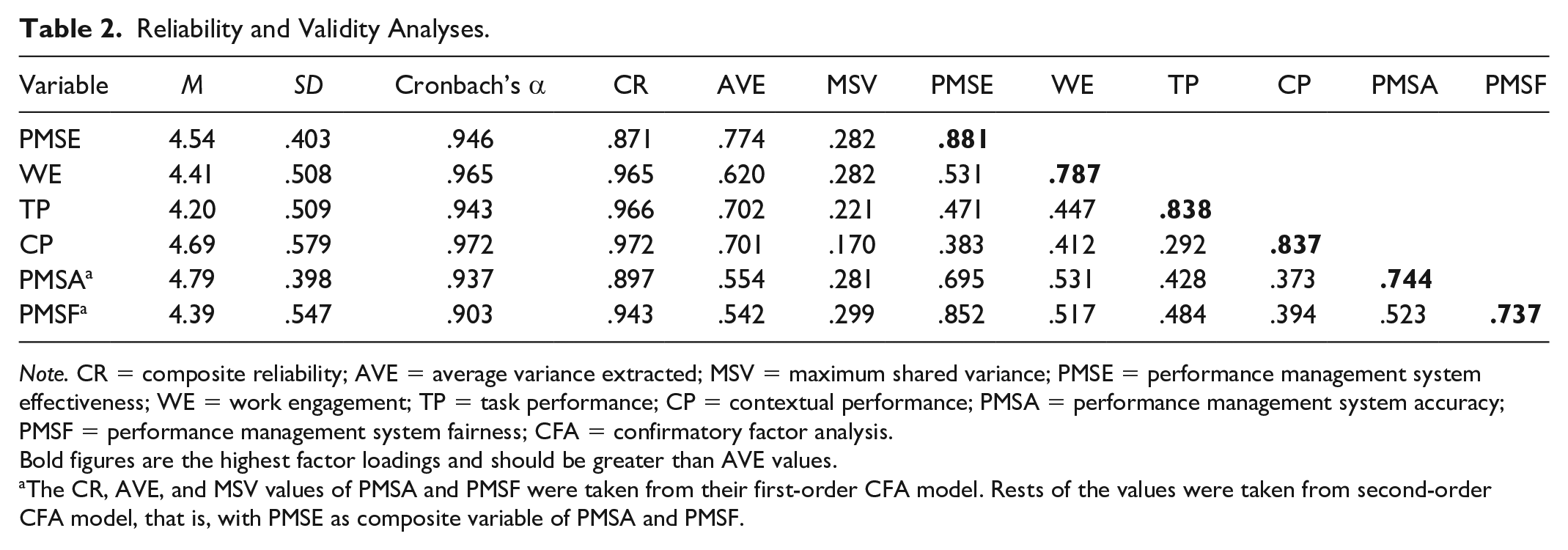
Note. CR = composite reliability; AVE = average variance extracted; MSV = maximum shared variance; PMSE = performance management system effectiveness; WE = work engagement; TP = task performance; CP = contextual performance; PMSA = performance management system accuracy; PMSF = performance management system fairness; CFA = confirmatory factor analysis.
Bold figures are the highest factor loadings and should be greater than AVE values.
The CR, AVE, and MSV values of PMSA and PMSF were taken from their first-order CFA model. Rests of the values were taken from second-order CFA model, that is, with PMSE as composite variable of PMSA and PMSF.
Structural Models
Structural models in Table 1 also indicate the values of fit indices for SEM Model 1 and Model 2 as satisfactory (Awang, 2012; Hair et al., 2010). Table 3 indicates the results of the direct and indirect impact of PMSE on EE and TP/CP for which second-order SEM analyses were conducted. The direct relationships of PMSE with TP (β = .374, p < .01) and CP (β = .464, p < .01) were found significant to support H1 and H1a, respectively. Moreover, PMSE was also found to have a significantly positive impact on EE (β = .527, p < .01) and validates the path “a” for further mediation analyses as well as proves H2. Similarly, the two relationships EE-TP (β = .271, p < .01) and EE-CP (β = .295, p < .01) were also noteworthy, suggesting a positive and significant impact of EE on their TP and CP. These relationships validate the path “b” for mediation analyses and provide grounds for accepting H3 and H3a. Likewise, the indirect impact of PMSE on TP (β = .343, p < .01) and CP (β = .225, p < .01) was also significant (Figure 2); however, the values were smaller in the second case. The results suggest complementary mediation (Imran et al., 2018; Zhao et al., 2010) of EE in both PMSE-TP and PMSE-CP relationships. This was further verified through the values of bootstrapping standard error, which was found significant in both cases (p = .049 < .05 and .043 < .05). Based on these results and bootstrapping values, H4 and H4a are also accepted. All the four hypotheses, developed for the study were accepted.
Direct and Indirect Estimates.

Note. CR = composite reliability; WE = work engagement; PMSE = performance management system effectiveness; CP = contextual performance; TP = task performance.
p < .001.

Indirect model.
Discussion
The results of this study provide evidence that PMSE has a positive and significant contribution toward enhancing TP and CP of employees in the Pakistani private banking sector and prove the first two hypotheses, H1 and H1a, as correct. Employees view PMS as having a positive role in their professional growth. The study also endorses that PMS is positively related to work engagement. This relationship is important as performance management is considered as an effective tool to motivate employees through participative planning, decision making, and reward system. Here, the second hypothesis (H2) of the study is supported by the results. It aims at enhancing employee and organizational performance. The study included PMSF as an additional variable to enhance the effectiveness of the overall system. The employees of private banks of Pakistan have not only approved it as a useful and mandatory part of PMS but also supported its positive linkages with work engagement and performance. In other words, the absence of fairness perception in PMS has emerged as a major limitation of the contemporary PMS models. The main contribution of the present study was the focus on work engagement as a mediator. The results indicate that EE has a positive impact on TP and CP of employees and endorse the hypotheses H3 and H3a. These findings are in line with the studies conducted by Christian et al. (2011) and Karatepe and Olugbade (2016).
The TP of employees is related to their immediate tasks that they perform at the workplace. Work engagement helps in enhancing the efforts put toward accomplishing the tasks by employees. Similarly, CP relates to intrinsic motivation and engagement of employees in tasks other than officially assigned duties. This study provides evidence that the private banking sector employees view PMSE as helping them in achieving internal satisfaction and provides space to them in enhancing the quality and quantity of their work simultaneously. These results endorse the hypotheses (H4 and H4a), of this study. Overall, the current study has proved all the hypotheses as true and extended the legitimacy of previous research in this field. However, the combined model of PMSE leading to WE and TP as well as CP in the Pakistani banking sector was a noteworthy contribution of the present research.
As indicated by Schleicher et al. (2019), previous literature has not sufficiently conceptualized the factors leading to the effectiveness of PMS, the current study was an attempt to fill this gap. Although Sharma et al. (2016) presented this model previously, there was a need to revalidate the same in different contexts and with different variables (Brinkerhoff & Brinkerhoff, 2015; Broadbent & Laughlin, 2009). Therefore, the current study used empirical data to revalidate the PMSE model and used second-order SEM to justify that PMSA and PMSF are its significant dimensions. Especially, the employee perspective of the performance management system has not been sufficiently researched so far (Audenaert et al., 2019). The current study investigated PMSE in the context of its employees’ related outcomes like work engagement, TP, and CP. Although a few researchers (Audenaert et al., 2019; Noronha et al., 2018) attempted to establish such relations, they have not studied a comprehensive PMSE model including fairness as a dimension, as done in the current study. Therefore, this research is unique and contributes significantly to PMSE literature.
Implications and Future Research
Theoretical Implications
This study has extended and revalidated PMSE and work engagement theories in the Pakistani context. The GST (Locke, 1968) had postulated that ambitious and specific goals lead to employee motivation which ultimately enhances employee performance. The current study extended its validity and further specified that goal setting along with other elements of PMSE contributes positively toward EE and performance. The results also authenticate SDT (Deci & Ryan, 1985) in the Pakistani context, which indicates that intrinsic and extrinsic motives enhance employee intrinsic motivation toward better performance. In the present study, the elements of PMSE act as extrinsic and intrinsic motives, which lead to enhanced intrinsic motivation, work engagement, and TP as well as CP. The study also extended the legitimacy of work engagement theory (Kahn, 1990) and its related job satisfaction (Smith et al., 1969) and organizational commitment (Meyer & Allen, 1991) concepts. The work engagement theory had proposed that employees with a higher level of work engagement outperform others at work. The study also found similar results that higher level of work engagement enhances employees’ TP and CP. These results provide solid grounds for extension of these theories and testing in different contexts with different determinants, correlates, and consequences. The study of PMSE from employees’ perspective is our important contribution as employees are particularly responsible for the implementation of an effective PMS in an organization.
Practical Implications
This study may enable organizations to adopt a participative approach toward designing an effective PMS and enhancing the likelihood of its acceptance by the employees to obtain desired results. Moreover, the study also provides an opportunity for the management to identify issues and limitations of PMSE and make informed decisions to overcome these accordingly. The results are particularly important for the banking sector. The study would be helpful for these organizations to design a comprehensive and more effective PMS to ensure employee-related outcomes (engagement, performance, retention) acceptable for both employees and the management at the same time. The HRM policies of the study organizations were centrally controlled and the differences among these were insignificant. Therefore, the results are generalizable for the private banking sector across Pakistan, which is a unique strength of the study with specific reference to the Pakistani context.
Research Implications
The current study has provided an empirical investigation of the PMSE, work engagement, and performance model. Moreover, as suggested by Sharma et al. (2016), the study used a combined construct of PMSA and PMSF for PMSE and provided empirical justification for the second-order model. The same combined construct can be used for future research with other variables like job design, organizational resources, management policy, work–life balance, employees, and career development activities and cultural issues, and so on, that contribute to improving work engagement and performance. Moreover, the model can also be tested with individual elements of PMSE in different contexts to compare as to which of the elements contributes more toward achieving the employees’ related outcomes. The study has also found that PMSE has a greater impact on TP in comparison with the CP, which indicates the instrumental nature of PMSE. Similar results have been observed in case of “work engagement–task performance” (WE-TP) and “work engagement–contextual performance” (WE-CP) relationships, and future research can be extended on this premise. The significant mediating effect of EE explains the process as to how an effective PMS helps enhance employee performance. The empirical investigation of this model is a significant contribution to the PMSE literature, especially the mediation of “work engagement.”
Limitations of the Research
There are several limitations of the study. For example, PMSE as a comprehensive model is not implemented in the private banking sector of Pakistan that constrains the study. Organizations in Pakistan view PMS as something sacred for which information is reluctantly shared with the researchers. Causal and experimental research designs are considered the best to study the effectiveness of any intervention like PMSE within the organization, which require a lot of physical and financial resources, and also are subject to administrative and legal authorizations. These requirements were beyond the immediate control of researchers.
Conclusion
The research conducted in eight private sector banks of Pakistan provided evidence of linkages between PMSE, EE, and performance, which are employee-related outcomes of PMSE. PMSE was found to have a positive and significant impact on EE and their TP as well as CP. Moreover, EE is found to have a positive and significant impact on employee performance. The most important finding of the research is the test of the mediating relationship of work engagement between PMSE and TP/CP. This relationship also depicts a complementary mediation in both cases.
Footnotes
Declaration of Conflicting Interests
The author(s) declared no potential conflicts of interest with respect to the research, authorship, and/or publication of this article.
Funding
The author(s) received no financial support for the research, authorship, and/or publication of this article.
