




Abstract
Analyzing the impact of economic openness and institutional environment on technological innovation is of great significance for China to build a new system of open economy. This study investigates the short- and long-run effects of economic openness and institutional environment on innovation by applying a dynamic panel regression model and two-step system generalized method of moments (GMM) method to dynamic panel data of China’s 30 provinces, autonomous regions and municipalities directly under the Central Government (referred to as provinces hereafter) from 2008 to 2017. Results indicate that trade openness impedes innovation, whereas foreign direct investment (FDI) significantly promotes China’s innovation particularly in the long-run. The continuous improvement of institutional environment promotes domestic innovation particularly in the long run. The integration of economic openness and institutional environment magnifies the effects of trade openness and FDI on innovation. The effects of economic openness and institutional environment on innovation differ by region with a descending pattern from China’s Eastern to the Central and Western regions.
Keywords
Introduction
China’s economic growth has been healthy and continuous since the Reform and Opening-up policy, resulting in sensational achievements and miracles. A report from the 19th National Congress of the Communist Party of China indicates that innovation is the primary driving force of development and the strategic support for a modern economic system. Technological progress is the premise for sustainable economic growth, and China’s domestic innovation plays an essential role in propelling technological advancement.
It remains disputed in the academia whether economic openness promotes the innovation of domestic corporations. Supporters believe economic openness encourages domestic technological innovation through FDI’s effects of competition, personnel training and flow, role model and imitation, forward and backward linkages (Girma et al., 2008; Smarzynska Javorcik, 2004). Opponents of economic openness argue that FDI inflow intimidates the innovation of domestic corporations (Feng et al., 2019). China’s improvements in innovation are closely related to the reform and opening-up policy, although domestic politics and institutional environment of the economy may also have played a role.
These disputes call for further elaboration. This research intends to investigate the changes in China’s innovation capacity when economic openness and institutional environment construction play and will continue to play a key role. Based on provincial panel data, this paper examines the impact of economic openness and institutional environment on innovation, as well as the long-term effects of both on innovation. This is the focus of this article, and it is also one of the important propositions for China to achieve high-quality development under the new opening pattern. In the background of economic openness, have the effects of import-export trade and FDI on innovation changed? How has China’s institutions influenced its domestic innovation? What may be the long-term joint effects of economic openness and institutional environment on innovation? The answers may render significant implications for a fine integration of complete economic openness and improved institutional environment as well as for further promoting China’s domestic innovation.
The possible marginal contributions of this paper are: First, from the perspective of research, existing literatures only focus on the impact of a single economic opening or a single institutional environment on innovation. Compared with existing researches, the marginal contribution of this paper is to combine the two perspectives that are usually independently studied in literatures and bring economic opening and institutional environment into a unified analytical framework. At the same time, the influence of the combination of economic opening and institutional environment on innovation is considered. Second, at the level of research content, this paper discusses for the first time the long-term effect of trade openness and institutional environment on technological innovation, and uses the long-term effect calculation formula to clarify the importance of the interaction between the two on technological innovation.
Literature Review
Integrating into globalization and advocating an open economy, China achieved leapfrog development by learning and adopting foreign advanced technologies through FDI utilization and import-export trade. A plethora of studies show that international economic cooperation promotes technological spillover, thus improve the innovation level of a country (Coe & Helpman, 1995; Eaton & Kortum, 1996; X. Liu & Zou, 2008).
The latest studies tend to investigate the effect of economic openness on innovation from the perspective of trade openness and FDI. Another key factor of innovation, trade openness introduces advanced products and equipment from developed countries with import and export. Domestic corporations can learn and adopt these technologies, and are prompted to increase their research and development efforts, so as to take in the spill-over cash, technology and experiences from abroad. Consequently, their competitiveness is enhanced (Comin & Gertler, 2006; Holmes & Schmitz, 2001; Lee, 2011; Navas, 2015). Nevertheless, other scholars believe trade openness negatively influences innovation. Autor et al. (2020) found that the increase of import from China intensified market competition, thus negatively impacted the R&D expenditure and patent application by US corporations. Q. Liu and Qiu (2016) believed that the import of intermediate products will significantly reduce the cost of using foreign advanced technologies, therefore undermining corporate innovation. Pan et al. (2019) believed that technological innovation is affected by both financial development and trade opening.
The effect of FDI on a country’s innovation remains disputed. Supporters believe FDI corporations’ localized innovations significantly promotes the innovation of domestic corporations through spill-over channels including reverse engineering, technical labor flow, demonstration effect and supplier-client relationships, thus benefiting the innovation activities of the host country (Cheung & Lin, 2004; Wang & Wu, 2016). Opponents believe the technological knowledge brought forth by FDI has not been effectively adopted, therefore unable to promote domestic innovation (Connolly, 2003; Fan & Hu, 2007; Schneider, 2005). X. Liu and Zou (2008) believe that multinational corporations’ R&D in the overseas greenfield projects of the host countries significantly promotes the innovation performance of domestic corporations, and the intra- and inter-industry spill-over effects from overseas greenfield R&D exist. Based on this, the first research hypothesis of this paper is proposed:
Hypothesis 1: Economic openness may have a positive promoting effect or a negative impact on the level of domestic innovation.
Many factors are involved in the effect of economic openness on innovation, and the most important factor is China’s fundamental institutional environment including society, politics and the economy. When entering a domestic market, FDI corporations face many uncertainties. The quality of the institutions is the primary determinant whether FDI corporations can effectively keep these uncertainties under control. The academia conducted a multitude of studies on the relationship between institutional environment and a country’s innovation capacity with a consensus that countries with high-quality institutions tend to have better innovation capacity as well. High-quality institutions, property right protection, financial marketization and government-market relationship positively influenced manufacturing technological innovation (Chu et al., 2018; Tebaldi & Elmslie, 2013 found that institutional factors including corruption control, laws and regulations, effective supervision and expropriation risks significantly influenced the number of patents. Similarly, Maskus and Penubarti (1995) and Gould and Gruben (1996)emphasized the effect of institutions for intellectual property rights protection on the number of patents and economic growth in different countries. Bekhet and Latif (2018) believed that the interaction between technological innovation and the quality of governance system has a significant positive impact on the long-term development of Malaysia’s economy. Donbesuur et al. (2020) believed that technological innovation and organizational innovation have a synergistic effect on international performance, and this effect depends on the unique domestic institutional factors. High-level organizational innovation and technological innovation jointly improve the international performance of small and medium-sized enterprises. The particularity of institutional environment and the enforceability of institutional environment enhance the complementary effect of organizational innovation and technological innovation on small and medium-sized enterprises’ international performance. Arshed et al. (2022) pointed out that better institutions benefit many aspects of the economy. Based on this, the second research hypothesis of this paper is proposed:
Hypothesis 2: Continuous optimization of the institutional environment has a positive effect on innovation, and this positive effect is more significant in the long run.
Research Design
Model Parameters
As the sample is dynamic panel data, patent applications that lagged for one period were included in the regression model as an independent variable to control for its influence on the dependent variable. For dynamic panel data, estimated parameters are biased and inconsistent with normal panel regression, whereas two-step system generalized method of moments (GMM) can solve the endogeneity of dynamic panel data and ensure the effectiveness and consistency of estimated parameters (Blundell & Bond, 1998). In addition, human capital, R&D intensity and other control variables may interact with dependent variable. Because the sample is N>T, it is necessary to test the issues related to cross-sectional data. The Pesaran’s CD test (Pesaran, 2021) indicated that concomitant probability was less than .000, thus the null hypothesis was rejected. Cross-sectional data were strongly correlated. Testing endogeneity with methods of ordinary least squares (OLS), fixed effects (FE), random effects (RE), and feasible generalized least squares (FGLS), large differences existed for regression coefficients, and the proportion of individual error rate was high. Individual effect was correlated with other independent variables. Furthermore, after simultaneously regressing the dependent variable on the lagged items of all the independent variables, the results were consistent with those of the aforementioned methods, indicating strong endogeneity. Based on these findings, this research adopted two-step system GMM to estimate the endogeneity of dynamic unbalanced panel data.
Based on data availability, this study focused on the annual data of China’s 30 provinces from 2008 to 2017, and established the baseline model:

In this model,
To investigate the effects of economic openness and institutional environment on innovation, this research first established the following model by taking trade openness (trade) and FDI flow (FDI) as measurement indicators of economic openness. See Equation 2:

Next, the potential influence of institutional environment on innovation is analyzed in Equation 3:

In the above equation,
Innovation Measurement Indicator
Similar to Naceur et al. (2017), this research aims to confirm the potential driving factors of innovation as well as the effects of economic openness and institutional environment on innovation. Therefore, innovation is the dependent variable of this study. Extant literature uses R&D expenditure as the measurement indicator of technological innovation, and patent is a key dimension to measure technological innovation capacity (Schmoch, 1997). A lapse exists between application and grant of a patent. For instance, it usually takes about 2 years to grant an invention patent. Therefore, patent data include numbers of applications and grants. This research uses the number of patent application acceptance to stand for China’s innovation capacity for direct and deep analyses.
Economic Openness Measurement Indicator
There are many forms of economic openness, of which the most straightforward measurements are trade openness and FDI. This research uses the ratio of total volume of imports and exports to GDP to measure trade openness, and the ratio of net capital inflow to GDP to measure FDI flows. Net capital inflow means the difference between inward FDI and non-financial outward FDI of the provinces.
Institutional Environment Measurement Indicator
According to the new institution economists, institutions are a collection of formal and informal regulations. Because the connotation of institution is very complex, it remains difficult to measure institutions accurately. In extant literature, institution is often represented by a series of economic and political variables, which are then compiled into an index to evaluate the corresponding institutional environment and its evolution. A widely accepted index in academia is “marketization index” (Ang et al., 2014; Du et al., 2008). This index faithfully shows the relationship between the government and corporations and government efficiency. This research investigates the effects of economic openness and institutional environment on patents, taking into consideration property rights as well as economic and legal institutions. Property rights are divided into government intervention and corruption level. Government intervention is represented by the government-market relationship in marketization index. Corruption level is represented by ratio of number of duty crime cases to per 10,000 civil servants. Economic institution is represented by factor market development in marketization index. Measuring the marketization of capital allocation in the financial industry and credit funds, the level of FDI attraction, etc., this indicator accurately reflects the quality of market environment. Legal institution is represented by the development of market intermediary organizations and legal institution environment, which include law enforcement efficiency, intellectual property right protection, etc. This indicator better reflects the establishment of legal institutions.
Institutional Environment Substitute Indicator: the ratio of GDP to forfeiture income is used to measure property rights protection environment. In regions where property rights protection is weak, the government is more likely to obtain income from forfeiture. Thus, a higher ratio indicates that property rights in the region are better protected. The substitute indicator for corruption level is represented by the ratio of the sum of expenditure of public security organs and public security expenses to GDP. The data of public security organ expenditure are not calculated after 2006, therefore excluded from this research. Public security expenses include all the spending by the government to process administrative issues including prosecution, court, judicial, and prison. Higher public security expenses indicate the greater capital investment by the government in judicial issues. The efficiency of judicial system may improve accordingly, resulting in better corruption control. Therefore, this research adopts the ratio of public security expenses to GDP as the substitute indicator of corruption level. A higher value of the indicator shows higher efficiency in corruption control.
Other Control Variables
There are many measurements of human capital, namely, worker remuneration, education expenditure, student enrollment, average years of education, etc. Barro and Lee (1993) used the number of student enrollment of per 10,000 persons to measure human capital, whereas Frankel and Romer (1999) used the average years of education to measure human capital. This research adopted average years of education for human capital, calculated capital stock with the perpetual inventory method, used the logarithm of actual GDP per capita for regional income level, and adopted the ratio of R&D expenditure to GDP as R&D intensity.
Introduction to Data and Descriptive Statistics
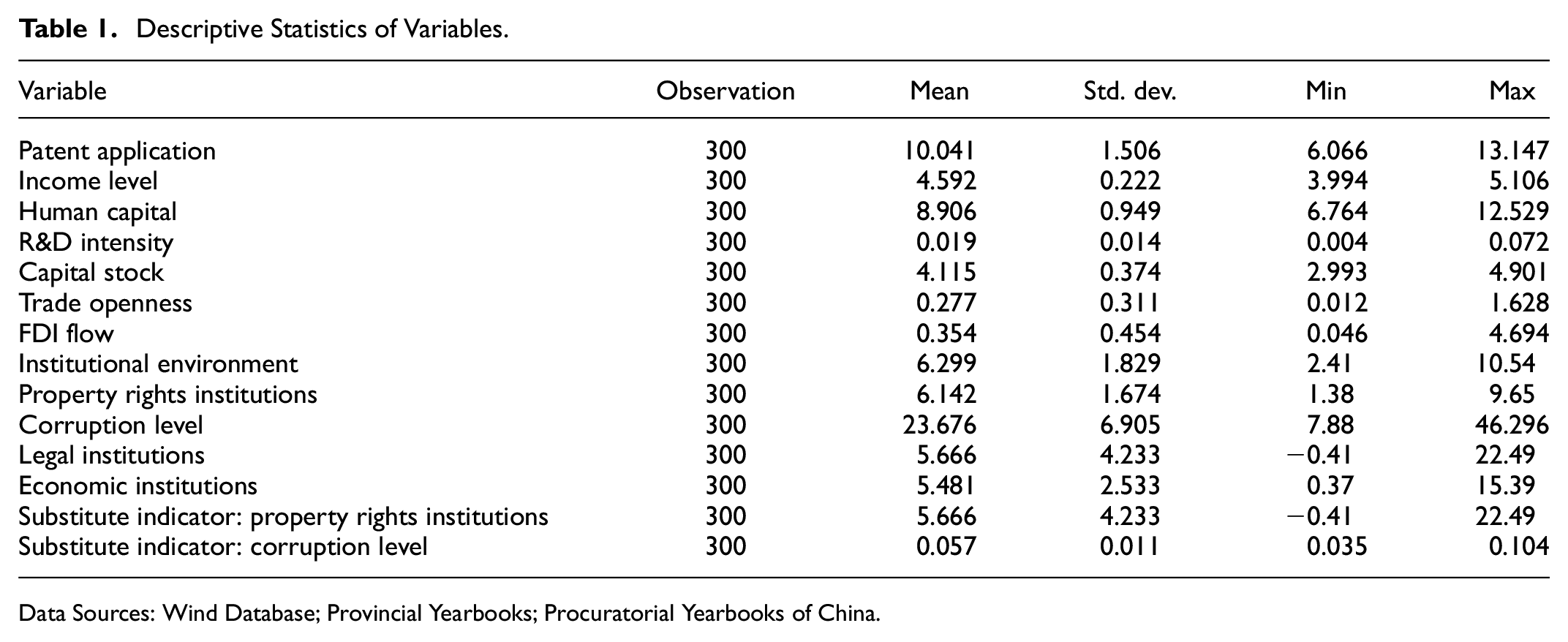
Considering the availability and continuity of data about institutional environment and other control variables, the sample of this study covers data of China’s 30 provinces from 2008 to 2017. Specifically, economic openness data come from Wind Database and provincial statistical yearbooks. Data to calculate capital stock and the related control variables are from Wind Database. Corruption data come from Procuratorial Yearbooks of China and work reports of provincial procuratorates. Following the practices in extant literature, this research completes the marketization index with the average growth rate per annum. Descriptive statistics of major variables can be found in Table 1. The average value of trade openness is 0.277, which verifies that there are differences in the degree of trade openness among regions in China, with the maximum value reaching 1.628 and the minimum 0.012. The mean value of FDI flows is 0.354, the maximum value is 4.694, and the minimum value is 0.046, indicating that there are also significant differences in FDI flows in China. The mean value of institutional environment is 6.299, indicating that the institutional environment in various regions of China is relatively good, the maximum value is 10.54, the minimum value is 2.41. The average value of patent applications is 10.041, and there are differences between different regions in China, with the maximum value being 13.147 and the minimum value being 6.066.
Descriptive Statistics of Variables.
Data Sources: Wind Database; Provincial Yearbooks; Procuratorial Yearbooks of China.
Empirical Results and Analyses
As the sample is dynamic panel data, patent applications that lagged for one period were included in the regression model as an independent variable to control for its influence on the dependent variable. For dynamic panel data, estimated parameters are biased and inconsistent with normal panel regression, whereas two-step system generalized method of moments (GMM) can solve the endogeneity of dynamic panel data and ensure the effectiveness and consistency of estimated parameters (Blundell & Bond, 1998). In addition, human capital, R&D intensity and other control variables may interact with dependent variable. Because the sample is N>T, it is necessary to test the issues related to cross-sectional data. The Pesaran’s CD test (Pesaran, 2021) indicated that concomitant probability was less than .000, thus the null hypothesis was rejected. Cross-sectional data were strongly correlated. Testing endogeneity with methods of ordinary least squares (OLS), fixed effects (FE), random effects (RE), and feasible generalized least squares (FGLS), large differences existed for regression coefficients, and the proportion of individual error rate was high. Individual effect was correlated with other independent variables. Furthermore, after simultaneously regressing the dependent variable on the lagged items of all the independent variables, the results were consistent with those of the aforementioned methods, indicating strong endogeneity. Based on these findings, this research adopted two-step system GMM to estimate the endogeneity of dynamic unbalanced panel data.
Because lagged dependent variable exists in dynamic models, all the estimated coefficients represent the short-term effects of the independent variables. Conceptually, however, innovation is a long-term process, thus calls for the measurement of the long-run effects of economic openness and institutional environment. This study used the equation by Papke and Wooldridge (2005) to calculate long-term effects:
Economic Openness and Innovation
Different tendencies were demonstrated by the influence of economic openness indicators on innovation, as shown in Table 2. One of the indicators, the negative effect of trade openness (Trade) on innovation is −1.0295, and the long-run effect is −1.448, suggesting that trade openness is detrimental to domestic innovation in the long run. A possible explanation is that, on one hand, the advanced know-how and technology from imports and exports create a highly competitive market environment, preventing the domestic corporations from conducting innovation effectively. On the other hand, in long-run development, more-frequent trade activities can only impede domestic innovation if the level of economic development was unable to digest the latent benefits of trade. Similarly, more trade activities only negatively influence innovation if the domestic economic cannot provide an appropriate institutional environment. This finding is inconsistent with Coe and Helpman (1995), which suggested that import trade positively influenced domestic innovation.
Regression Results Based on Two-Step System GMM: Economic Openness and Innovation.

Note.*, **, and *** mean statistically significant at 10%, 5% and 1% levels; System GMM adopted a two-step method; values in parentheses are robust standard errors. IVs stand for the number of instrumental variables. Values in AR(1), AR(2) and Hansen test are p-values.
The other indicator of economic openness, FDI flow (FDI) had a positive effect on innovation with a coefficient of 0.4362, and the long-run effect was 0.3103, statistically significant at .01 and .05 levels, respectively. This means that in the long run, FDI flows facilitate patent application and domestic innovation. This finding reiterates the key role that FDI capital flows in domestic economic growth through the positive spill-over effect for patents.
As for the relationship between other control variables and patent application, it can be found that GDP per capita (GDPPC) was positively correlated with patent application, a finding that is consistently with extant research conclusions (Naceur et al., 2017; Tebaldi & Elmslie, 2013). Human capital and capital stock positively influenced patent application. These observations show that the higher the average years of education, the greater the innovation capacity is, and the more patent applications can be completed (Démurger, 2001). R&D intensity was strongly positively correlated with patent application, showing that increased R&D efforts promoted innovation (Griliches, 1979). Capital stock represents capital acquisition in a certain sense. The improvements in financial industry and the easing of capital acquisition could promote innovation (Zhang et al., 2022).
Institutional Environment and Innovation
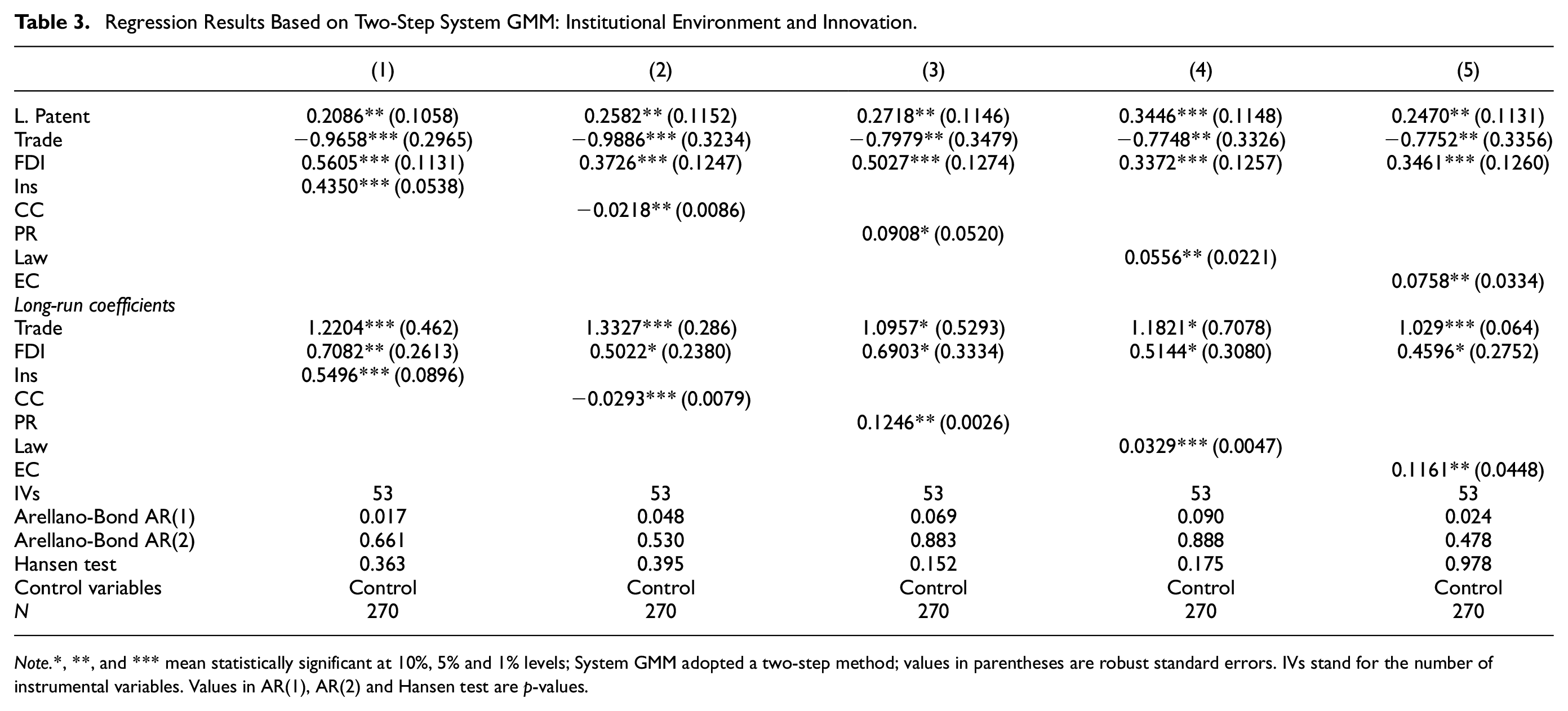
Table 3 explains the relationship between institutional environment and innovation. The coefficients of short-and long-run effects of trade openness and FDI flows are the same as above. For institutional environment, the coefficient of overall effect on innovation is 0.4350, suggesting that the improvements in institutional environment facilitates patent application and promotes the level of domestic innovation. With the exception of corruption level, of property rights, legal institutions and economic institutions, the estimated coefficients and statistical features of significance all demonstrated the positive effects of institutional environment. Specifically, corruption level was negatively correlated with patent application. The increase in the number of corruption cases in a country impedes domestic patent applications, thus inhibit the output of innovation. The coefficient of short- and long-run effect is −0.0218 and −0.0293 respectively. The contagion of corruption impedes patent applications in the long-run. Property rights promote patent application by 0.0908%. A sound property rights institution lowers information asymmetry, lowers transaction costs, and provides a more flexible market for patent application. The coefficient of long-run effect is 0.0293, and the short-term effect was magnified. The short- and long-run coefficient of the effect of legal institution on patent application is 0.0556 and 0.0329 respectively. The long-run effect is also positive, suggesting that intellectual property rights protection and more-effective judicial environment somewhat relieve the negative impact of corruption and promote domestic innovation. The short- and long-run coefficient of the effect of economic institution is 0.0758 and 0.1161 respectively. The improvements and the proportion of foreign capital of the financial market promote patent application in the long-run, which is consistent with the effect of FDI flows. The significant effect of institutional environment on the number of patents highlights the key role institutional environment plays in promoting research activities and national innovation, which is paramount for long-term economic growth. This result renders important empirical evidence for governments to stimulate patent number, improve domestic institutional environment, and make policies for long-term economic growth. The estimated coefficients of other control variables were slightly varied, but the directions of influence as well as significance levels did not change qualitatively, thus were omitted.
Regression Results Based on Two-Step System GMM: Institutional Environment and Innovation.
Note.*, **, and *** mean statistically significant at 10%, 5% and 1% levels; System GMM adopted a two-step method; values in parentheses are robust standard errors. IVs stand for the number of instrumental variables. Values in AR(1), AR(2) and Hansen test are p-values.
The Effect of Combination of Economic Openness and Institutional Environment on Innovation
The regression results in Table 4 show that trade openness singularly impedes patent application. After combining corruption level and trade openness, the short- and long-run coefficients were 0.0765 and 0.1659 respectively, suggesting that the harms of corruption are particularly in the long-run. After combining corruption and FDI flows, the coefficient of the interaction term was −0.0802, suggesting that although FDI promotes patent application, corruption still can prevent local corporations and market from digesting FDI technologies, thus impede innovation improvement. The short- and long-run coefficients of interaction terms between property right institution, legal institution, economic institution and trade openness are all positive, suggesting that if a country has sound property right, legal and economic institutions in the short- and long-run, the effect of trade openness on innovation can be reversely moderated, thus relieving the impact of trade openness on innovation. This shows the importance of domestic institutional environment. The short- and long-run coefficients of interaction terms between property right institution, legal institution, economic institution and FDI are all positive, suggesting that property right institution, legal institution and economic institution magnify the short-run effect of FDI, and improvements in institutional environment strengthen the economic effects of FDI flows. The combination of economic institution and economic openness strengthens the positive impact of FDI flows. In summary, given better institutional environment and more opportunities for global manufacturers to satisfy domestic consumer needs, both trade openness and FDI flows promotes China’s domestic innovation. This finding reminds policy makers to simultaneously consider these factors when designing short- and long-run policies.
Regression Results Based on Two-Step System GMM: Combination of Economic Openness and Institutional Environment.

Note.*, **, and *** mean statistically significant at 10%, 5% and 1% levels; System GMM adopted a two-step method; values in parentheses are robust standard errors. IVs stand for the number of instrumental variables. Values in AR(1), AR(2) and Hansen test are p-values.
Robustness Test and Extension Analysis
Robustness Test
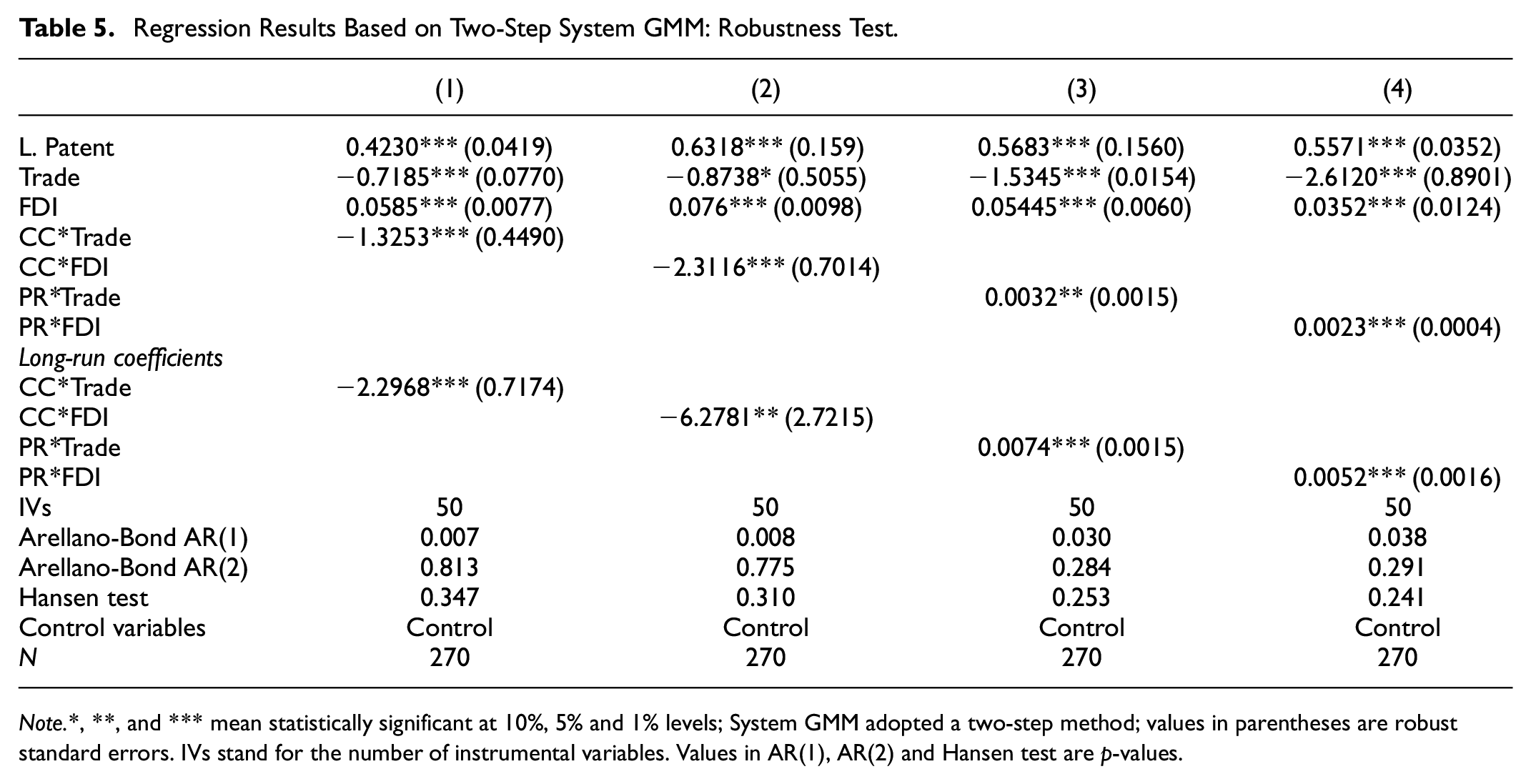
To further test the stability and reliability of the aforementioned regression estimates, this research remeasured the core variable of institutional environment for robustness test. Based on this this research re-estimated the dynamic panel data Equation 3, and the results were reported in Table 5. Comparing Table 5’s regression results with those in the previous tables, no qualitative changes can be found in the value, direction and significance of coefficients of both the core independent variables and other control variables. Therefore, the conclusion of this research is essentially robust.
Regression Results Based on Two-Step System GMM: Robustness Test.
Note.*, **, and *** mean statistically significant at 10%, 5% and 1% levels; System GMM adopted a two-step method; values in parentheses are robust standard errors. IVs stand for the number of instrumental variables. Values in AR(1), AR(2) and Hansen test are p-values.
Extension Analysis
To test whether the effects of economic openness and institutional environment on patent application have regional differences, this research divided the 30 sample units into 3 subsamples: East, Central and West. Eastern region includes Beijing, Tianjin, Hebei, Liaoning, Shanghai, Jiangsu, Zhejiang, Fujian, Shandong, Guangdong and Hainan. Central region includes Shanxi, Jilin, Heilongjiang, Anhui, Jiangxi, Henan, Hubei and Hunan. Western region includes Inner Mongolia, Guangxi, Chongqing, Sichuan, Guizhou, Yunnan, Shannxi, Gansu, Qinghai, Ningxia and Xinjiang. Two-step system GMM was applied to the three subsamples respectively, and the results are in Table 6. The effect coefficients of trade openness and FDI in East and Central areas remain similar to coefficients of the national sample. The effect of FDI is the strongest in East, followed by Central, then West. The coefficient of institutional environment was positive, and the effect of overall institutional environment on innovation was stronger in East than in Central and West. Corruption level unanimously impeded patent application in East, Central and West. Economic institution perfectly illustrates the importance of the development of local financial market. Regression coefficients show that the highly marketized financial business in Eastern region provides a sound financial environment to promote domestic innovation. In contrast, financial market in Western region is underdeveloped, and the technological infrastructure is also backward, resulting in lower patent application number than Eastern and Central regions. Property right and legal institutions promote patent application across national, Eastern, Central and Western regions with similar coefficients. The effect of property right institution in Central region is relatively weaker. The coefficient of the interaction between trade openness and institutional environment is positive, a finding that is consistent with the aforementioned conclusions. The effect is most significant in Western region. The coefficient of the interaction between FDI flows and institutional environment is positive, and the effect is strongest in Eastern region. The foreign capital flows in Eastern costal region are greater than in Western region. In addition, the institutional environment in Eastern region is better than in Western region, therefore the coefficient of the Eastern region is larger than that of the Western region.
Effects of Economic Openness and Institutional Environment on Innovation: Samples of East, Central and West of China.

Note.*, **, and *** mean statistically significant at 10%, 5% and 1% levels; System GMM adopted a two-step method; values in parentheses are robust standard errors. IVs stand for the number of instrumental variables. Values in AR(1), AR(2) and Hansen test are p-values.
General Conclusions and Policy Implications
Applying two-step system GMM to China’s provincial dynamic panel data from 2008 to 2017, this research investigated the short- and long-run effects of economic openness and institutional environment on innovation. It was found that trade openness negatively influenced domestic innovation, whereas FDI promoted domestic innovation in both short- and long-run. Institutional environment was a key driving force for innovation, and generally institutional environment promoted innovation, particularly in the long-run. Property right system, legal system and economic system all had positive effects. The exception was the degree of corruption, which was negatively correlated with patent applications. The effect of economic openness on innovation was intensified when institutional environment was improved. The interaction term of institutional environment and economic openness showed that following the improvements in institutional environment, the effects of FDI flows and trade openness were magnified. In addition, regional differences existed in the effects of economic openness and institutional environment on patent application across Eastern, Central and Western regions, showing a decreasing trend from Eastern to Central and then to Western region. The conclusion of this paper is different from the previous studies that only unilaterally emphasized the impact of economic openness or institutional environment on innovation. It is found that the dual impact of economic openness and institutional environment has a long-term positive effect on innovation.
These research conclusions suggest that trade openness alone cannot sufficiently improve domestic innovation of China. The institutional environment must be improved, including a sound property right institution, a stringent legal institution and a complete financial market environment. High-quality institutional environment is the cornerstone for corporate innovation. China should steadily promote trade liberalization, and create a desirable business environment for FDI. Domestic reform and opening-up to the world should be complementary, so as to improve China’s institutional environment and promote domestic innovation. Differentiated innovation strategies should be practiced in East, Central and West China, and inter-regional technological cooperation should be reinforced, so the technological innovation in Central and West China can catch up with East China. China should establish efficient mechanisms to digest technology and re-innovate. By learning from the advanced technologies from abroad, China can achieve independent innovation with better digestive capacity, and further improve its innovation abilities.
This paper studies the effects of trade openness and institutional environment on innovation, but there are still some limitations. First, in view of the availability of data, the study period of this paper is still in 2017, and it will be updated with the update of institutional environmental data in the future to analyze the long-term effects of the two on innovation in a longer period of time. Second, this paper is based on macro data, the next step will be based on enterprise patent data. Third, in the era of digital economy, digital trade is reshaping the world economic pattern, and it is necessary to focus on the long-term and dynamic observation of the impact of digital trade on China’s technological innovation and its mechanism. How to further study the impact of digital trade on innovation, as well as the long-term effects of digital trade and institutional environment on innovation, are worthy of further study in the future.
Footnotes
Correction (May 20X4):
This article has been updated with the Henan province for Huixin Lu affiliation.
Declaration of Conflicting Interests
The author(s) declared no potential conflicts of interest with respect to the research, authorship, and/or publication of this article.
Funding
The author(s) disclosed receipt of the following financial support for the research, authorship, and/or publication of this article: This work was funded by Key Project of National Social Science Foundation of China (19AJY001), Humanities and Social Science Fund of Ministry of Education of China (20XJC790007), Soft Science Research Program Funded by Shaanxi Provincial Science and Technology Department (2020KRM051), Social Science Fund Project of Shaanxi Province (2021D065), Scientific Research Program Funded by Shaanxi Provincial Education Department (19JK0701), Research Fund of Xi’an International Studies University (19XWD14), and Key Research Base Project of Humanities and Social Science in Shanxi Province (20190113).
Ethical Approval
Not applicable.

Data Availability Statement
Data sharing not applicable to this article as no datasets were generated or analyzed during the current study.