




Abstract
Second language (L2) enjoyment has gained recent interest, but little research has attended to the sources of L2 vocabulary learning enjoyment. Drawing on the regulatory focus theory and the assumption that advancing toward a goal can contribute greatly to learning enjoyment, this study examined the extent L2 vocabulary selves and capacity for self-regulatory vocabulary learning are related to vocabulary learning enjoyment. A questionnaire was administered to two cohorts of 897 low-intermediate university students at two different times: one in the middle of a summer semester and the other in the following semester. The ages of the students were in the 17 to 24 range (M = 18.84, SD = 0.79). Hierarchical regression, dominance, relative weight, and Boruta random forest analyses revealed that capacity for self-regulatory vocabulary learning was the most important predictor of L2 vocabulary enjoyment, followed by ideal L2 vocabulary self/own. Mediation analyses showed that capacity for self-regulatory vocabulary learning had a direct effect on L2 vocabulary learning enjoyment, and ideal L2 vocabulary self had a stronger mediating effect than ought L2 vocabulary self. The findings and implications were discussed.
Plain Language Summary
Second language (L2) learning enjoyment has been the focus of recent research, but scant research has investigated its sources. The purpose of this study was: a) to examine the extent to which L2 vocabulary selves (i.e., L2 vocabulary future self-concepts with the L2 vocabulary competences that L2 learners desire to acquire to meet their own expectations) and capacity for self-regulatory vocabulary learning (i.e., the perceived ability to regulate commitment, metacognition, satiation, emotion and environment in vocabulary learning) can predict L2 vocabulary learning enjoyment; and b) to investigate whether L2 vocabulary selves can mediate the relationship between capacity for self-regulatory vocabulary learning and L2 vocabulary learning enjoyment. A questionnaire was administered to 897 students at a Vietnam university. The findings indicated that capacity for self-regulatory vocabulary learning was three times as important as ideal L2 vocabulary self and almost seven times more important than ought L2 vocabulary self in terms of predicting L2 vocabulary learning enjoyment. Capacity for self-regulatory vocabulary learning had a direct effect on L2 vocabulary learning enjoyment, explaining 53% of L2 vocabulary learning enjoyment. Ideal L2 vocabulary self and ought L2 vocabulary self had indirect effects on L2 vocabulary learning, significantly mediating the relationship between capacity for self-regulatory vocabulary learning and L2 vocabulary learning enjoyment. Given the current influx of digital stimuli, with clear and specific L2 future self-guides and good practices of self-regulated learning strategies, learners can enjoy and engage in the challenging process of learning L2 vocabulary, achieving the desired L2 vocabulary learning outcomes.
Keywords
Introduction
Research has documented the pivotal role of the mastery of the size and depth of L2 vocabulary (Schmitt, 2014), both in terms of single words and mutipleword items (Pellicer-Sánchez, 2019), in L2 learning and achievement (Stæhr, 2009). However, many L2 learners still have limited knowledge of general vocabulary (Le-Thi et al., 2017; Read & Dang, 2022) in part due to the difficulty in vocabulary acquisition, as noted by Gu (2020) that “vocabulary learning is a daunting task” (p. 271). Applied linguists have identified a range of L2 vocabulary learning attributes, such as (a) the cumulative characteristic of L2 vocabulary acquisition (Schmitt, 2008), (b) the possibility of decay in L2 vocabulary knowledge (Barclay & Pellicer-Sánchez, 2021), (c) the requirement of multiple encounters for L2 vocabulary to be incidentally acquired (Webb, 2014), or (d) the operationalization of working memory in the explicit vocabulary learning process (Li, 2022). Furthermore, individual differences factors can be involved in the process of vocabulary learning (Kim & Webb, 2022). For example, anxiety tends to negatively affect vocabulary acquisition (MacIntyre & Gardner, 1994). In practice, the link between anxiety and enjoyment in L2 learning has only gained recent attention; Botes et al.’s (2022) meta-analysis indicates a negative association between L2 learning anxiety and enjoyment, while learning enjoyment impacts L2 achievement positively. Given the challenges in L2 vocabulary learning, the negative impact of anxiety on L2 vocabulary acquisition, and hence the difficulty in achieving a high level of L2 vocabulary, more research focus should be directed toward examining factors contributing to enjoyment in L2 vocabulary learning.
Future L2 selves involve ideal L2 self and ought-to L2 self, the two factors of the tripartite construct of L2 motivational self system (L2MSS) developed by Dörnyei (2005, 2009). Ideal L2 self is the aspired identity with desirable L2 competencies the learner hopes to cultivate at a future time point, while ought-to L2 self is related to the L2 qualities they think they ought to obtain to satisfy the expectations of other people or to avoid problems ( Dörnyei, 2009). The only way to acquire these L2 competences is to motivationally, emotionally, behaviorally, and cognitively self-regulate, engage, and persist in the learning process until the goal is attained (Mercer & Dörnyei, 2020). However, there are not always joys in the way of achieving the goal. Major setbacks and adverse forces can erode motivation (Albalawi & Al-Hoorie, 2021). In essence, demotivation in L2 learning is not uncommon (Sakai & Kikuchi, 2009), and the absence of interest is unlikely to lead to motivated learning behaviors (Gardner, 2007). Furthermore, evidence has suggested that negative emotions are generally negatively linked to achievement (Dewaele & MacIntyre, 2014). Thus, the quest for the sources of L2 learning enjoyment, specifically L2 vocabulary learning enjoyment, merits research attention.
Drawing on regulatory focus theory (Higgins, 1997) and the assumption that one key source of enjoyment is “making progress toward a goal” (Dewaele & MacIntyre, 2014, p. 242), this paper attempted to examine the extent that L2 vocabulary selves mediated the effect that capacity for self-regulatory vocabulary learning have on L2 vocabulary learning enjoyment.
Theoretical Background
Regulatory Focus Theory
Regulatory focus theory is a motivational and behavioral construct in social psychology proposed by Higgins (1997, 2012). Grounded in self-discrepancy theory (Higgins, 1987), the theory accounts for individuals’ behaviors in relation to their goals. An invididual’s engagement in a particular pattern of behaviors is related to their promotion focus (i.e., pursuing progress, obtaining ambitions, or fulfilling aspirations) or prevention focus (i.e., having security, completing obligations, or avoiding problems). While the system focusing on pursuing growth and development is motivated by ideal self-guides (i.e., self-concepts individuals hope and aspire), the system focusing on obligations and security is motivated by ought self-guides (i.e., self-concepts individuals believe they are obliged to live up to). While the promotion focus system is directed to the final states of ideals and accomplishments, the prevention focus system is directed to the final states of obligations and safety. In addition, individuals can self-regulate from their own independent standpoint (i.e., their own goals and standards), or from the standpoint of other people who are important to them. Regulatory focus theory has significance for strategic goal pursuits and emotional experiences; with the promotion focus, individuals would prefer self-regulated strategies of approaching self-states (i.e., the states that identify with their self-concepts) that align with the final state they desire. In contrast, with the prevention focus, individuals would prefer self-regulated strategies of avoiding the undesired self-states that conflict with their desired end-state. Similarly, the former is sensitive to positive outcomes, while the latter is sensitive to negative outcomes (Higgins & Nakkawita, 2021). Notably, the distinction between the two regulatory systems does not automatically equate with two different categories of individuals. Either of the systems does not necessarily refer to a different type of personalities or persons, but “Anyone at a particular moment can be pursuing a goal with a promotion focus or a prevention focus” (Higgins, 2012, p. 490). As such, the theory can be relevant to understanding psychological factors that can impact self-regulated behaviors in educational contexts. In L2 research, regulatory focus theory by Higgins (1997) is in part operationalized in the construct of L2MSS proposed by Dörnyei (2005, 2009), a popular theoretical framework for considerable empirical work in L2 motivation (Boo et al., 2015).
Future Self-Guides
L2 future self-guides, also termed as L2 selves, refer to the L2 self-concepts/images that the L2 learners construct for their future selves from their desires to acquire specific L2 competences they currently do not have. L2 future self-guides comprise ideal L2 self and ought-to L2 self in the L2MSS (Dörnyei, 2009), which has the motivational dimension of L2 learning experience in addition to ideal L2 self and ought-to L2 self. According to Dörnyei (2009), ideal L2 self involves the future self-concept/image with the L2 competences that the L2 learner hopes and aspires to have; ought-to L2 self “concerns [the L2] attributes that one believes one ought to possess to meet expectations and to avoid possible negative outcomes” (p. 29); L2 learning experience involves contextual factors arising from the reality of L2 learning (Dörnyei, 2009). L2MSS has been examined in different L2-learning contexts (e.g., Arslan & Çiftçi, 2021; Hiver, 2013; Ryan, 2009; Shafiee Rad & Alipour, 2023; Wong, 2020), and the findings suggested that ideal L2 self is a consistently strong predictor of intended efforts (Kormos & Csizér, 2014; Teimouri, 2017). However, as noted by Al-Hoorie (2018), the relationship between ideal L2 self and L2 achievement is not strong, which could be ascribed to the fact that without the six conditions outlined in the initial conceptualization of L2MSS being satisfied, ideal L2 self does not exert its full motivating power; another reason can be the ambiguity of the items measuring ideal L2 self. As opposed to ideal L2 self, the link between ought-to L2 self and intended effort is either weak (Papi & Teimouri, 2014) or non-existing (Csizér & Kormos, 2009); ought-to L2 self is not related to L2 achievement (Al-Hoorie, 2018).
Considering future self-guides in L2 learning from the perspective of regulatory focus theory, Lanvers (2016), Papi et al. (2019), and Teimouri (2017) put that one possible reason accounting for the lack of predictivity of ought-to L2 self in L2 learning is that the measurement of L2 self-guides in L2MSS cannot do justice to the different own versus other perspectives across various contexts. Lanvers (2016) found that there existed different dimensions of self-guides, including the own, clashed with each other, and argued for a need to foster the own aspect of self-guides among young learners. To address this, Teimouri (2017) revised the L2MSS. The findings indicated that only ideal L2 self and ought-to L2 self/own were predictors of the positive emotion of joy, with the former having more predicting power. Papi et al. (2019) proposed a revised model, which have four components: ideal L2 self/own (i.e., the L2 future self-concepts/images with the L2 competences that L2 learners aspire to acquire to meet their own expectations), ideal L2 self/other (i.e., the L2 future self-concepts/images with the L2 competences that L2 learners want to obtain to satisfy other people) ought L2 self/own (i.e., the L2 future self-concepts/images with the L2 competences that L2 learners believe they are obliged to achieve to satisfy their own wants), and ought L2 self/other (i.e., the L2 future self-concepts/images with the L2 competences that L2 learners believe they are obliged to achieve to meet the expectations of other people). Their findings indicated that all the self-guides predicted motivated behavior, with ought L2 self/own being the best predictor. The model was validated by Papi and Khajavy (2021), showing that only ideal L2 self/own was the predictor of enjoyment. Feng and Papi (2020) suggested that while the L2 selves in the other viewpoint did not predict motivated behavior, in the own perspective, ideal L2 self predicted motivated behavior better than ought L2 self. Regarding how L2 selves is linked to achievement, ideal L2 writing self/own was a predictor of L2 writing achievement (X. Zhu et al., 2022). However, the use of standardized beta coefficients in the interpretation of the importance of predictors variables to criterion variables can be erroneous (Mizumoto, 2023) in previous studies concerning L2 selves; L2 research has yet to address this possible issue for better understanding the predicting power of L2 future self-guides.
Self-Regulation
The concept of self-regulation is rooted in behavioral psychology (Bandura, 1986) and is defined as a process or an ability that involves an individual’s controlling and managing their cognitions, emotions, motivations, and behaviors (Schunk & Greene, 2018). The concept was developed in education by educational psychologists, in which the terms self-regulation, self-regulatory learning, and self-regulated learning are interchangeably used (Zimmerman et al., 1996). In the field of education, self-regulation is defined as a process whereby learners direct, control, and manage their cognitions, emotions, motivations, behaviors, and social and environmental factors to stay focused and engaged and achieve their learning goals (Schunk & Greene, 2018). Self-regulation was adopted in L2 research in the late 1990s by Dörnyei and Ottó (1998) and Oxford (1999); it was noted in Dörnyei and Ottó (1998) that “the knowledge of and skills in using self-regulatory strategies” (p. 59) is key to bolstering, sustaining, and increasing motivation. Following Kuhl (1987), Dörnyei (2000) and Dörnyei and Ottó (1998) used the term “action control” in the three-phase process model of L2 motivation to refer to self-regulation. As Dörnyei (2000) noted: Action control processes involve self-regulatory mechanisms that are called into force in order to enhance, scaffold, or protect learning-specific action; active use of such mechanisms may “save” the action when ongoing monitoring reveals that progress is slowing, halting, or backsliding (p. 527).
The model, comprising three phases of pre-action, action and post-action, all of which are influenced by motivational forces, was the ground for Dörnyei’s (2001) taxonomy of motivational strategies, which was also referred to as self-regulatory strategies (Tseng et al., 2006, p. 85). In a book chapter, Dörnyei (2005) critically argued for “the shift of attention from learning strategies to self-regulation” (p. 192) because the latter: (a) can cover a broader range of processes, mechanisms, and factors involving L2 acquisition, (b) denotes the process rather than the product of action, (c) aligns with the developments of educational psychological theories, and (d) allows for the possibilities of psychometric testing and analyses. To better explain vocabulary learning, Tseng et al. (2006) developed a unidimensional construct (i.e., the construct that measures a single attribute or factor) of capacity for self-regulatory vocabulary learning (p. 98), which was drawn on the taxonomy of motivational strategies (Dörnyei, 2001), and the taxonomies of strategies for action control by Corno and Kanfer (1993) and (Kuhl, 1987). The scale measures “five facets…[of capacity for self-regulation]: commitment control, satiation control, emotion control, and environmental control” (Tseng et al., 2006, p. 95).
Notably, there are conceptual differences between the unidimensional construct of capacity for self-regulatory vocabulary learning by Tseng et al. (2006) and multidimensional constructs of self-regulated/self-regulatory learning strategies (e.g., Teng & Zhang, 2016). For example, the former refers to the learner having a general ability to regulate themselves toward the learning goals while the latter involves the use of a particular self-regulatory method. In their systematic review of learning strategies for L2 learners and self-regulation, Rose et al. (2018) put that although Teng and Zhang’s (2016) the questionnaire for self-regulated learning strategies in L2 writing is robust in terms of instrument development, being “the best example of an integrated model,” it “still embodies a strategy-based conceptualization, in that their study examined strategic action as products rather than the underlying force that is self-regulation” (p. 158). Dörnyei and Ryan (2015) noted that “the SRCvoc [self-regulatory capacity in vocabulary learning] does not measure strategy use but rather the learner’s underlying self-regulatory capacity that will result in strategy use” (p. 159). Although unidimensionality was assumed in the development of the original construct, which “taps into one single underlying trait” (Tseng et al., 2006, p. 94), several studies found more than two factors in the construct. Mizumoto and Takeuchi (2012) found up to three factors, and S. Zhu and Wang (2022) found two, indicating multidimensionality. The confusion can be because Cronbach’s alpha was tested across the five facets in the original model development. Another reason could be that when looking into the underlying factors or components, a combination of factor retention criteria (Plonsky & Gonulal, 2015) was not used in these studies. Despite the conceptual significance (Rose et al., 2018), few studies drew on the scale of capacity for self-regulatory vocabulary learning to examine the direct link between the capacity for self-regulatory learning and L2 future self-guides. Iwaniec (2014) found that ideal L2 self strongly predicted capacity for self-regulated learning (β = .61). Csizér and Tankó (2015) indicated that students having more developed ideal L2 self had the higher ability of satiation control. Han and Hiver (2018) found that students with a higher ability to commit to their writing goals and learning processes had higher scores for ideal L2 writing self.
Enjoyment
Enjoyment refers to one type of positive emotional experiences, which is “one of the most relevant and frequently experienced discrete emotions for both teachers and students in classroom contexts” (Frenzel et al., 2018, p. 628). The concept of enjoyment was attended to in behavioral psychology during 1970s and 1980s when Csikszentmihalyi (1975) underscored the role of positive psychology in intrinsically motivated behaviors. He stated that most of the then academic and professional practices were organized on the assumption that serious work was dull and uninteresting, making everyday life activities less meaningingful, and by “studying enjoyment, we might learn how to redress this harmful situation” (p. 1). Drawing in part on this idea, Ryan et al. (1990) developed the scale of interest-enjoyment to measure the levels of positive emotions related to the text that the participants experienced in the learning context devoid of specific external instruction to learn; the factor of interest-enjoyment was regarded as “the central affective accomplishment of intrinsically motivated behaviors and is maximized under conditions of optimal challenge and absence of extrinsic pressures toward a specific goal” (p. 3). The subsequent development in research concerning positive psychology involves Pekrun’s (2006) the control value-theory of achievement motivations. According to Pekrun et al. (2023), the latter involves the achievement emotions can be categorized into three dimensions: valence (positive/pleasant vs. negative/unpleasant), arousal (activating/high arousal vs. deactivating/low arousal), and object focus (object type: activities vs. outcomes, and object-person relation at the time the emotion occurs).
In L2 research, the concept of enjoyment has received increasing attention since Dewaele and MacIntyre (2014) refined Ryan et al.’s (1990) enjoyment-interest scale to measure enjoyment in foreign language learning. Two main scales have thus far been used to measure L2 enjoyment: one involving the enjoyment of the activity of learning or using an L2 (Teimouri, 2017), and the other concerning both enjoyment of the activity of L2 learning or using and the factors situated in the L2 learning context (C. Li & Wei, 2023). Taken together, L2 enjoyment can be referred to as: (a) a positive/pleasant and activating/high arousal emotion involving the activity of learning or using an L2, and (b) the factors situated in the process of learning the L2. In Li et al.’s (2022) individual differences taxonomy, L2 enjoyment is categorized as an affective individual differences factor, which has been found to be negatively associated with the affective factor of anxiety (Dewaele & MacIntyre, 2016), and positively associated with conative differences such as willingness to communicate (Khajavy et al., 2018), motivation (Tahmouresi & Papi, 2021), or grit (Wei et al., 2019). L2 enjoyment can predict self-perceived proficiency (Zhang et al., 2020) and achievement (C. Li & Wei, 2023). However, despite the positive association between L2 enjoyment and individual differences factors and learning outcomes, a handful of L2 studies have addressed this concern.
Teimouri (2017) indicated that both ideal L2 self and ought-to L2 self/own predicted enjoyment; beta coefficients were 0.56 and 0.12, respectively. Papi and Khajavy (2021) found that only ideal L2 self/own was the predictor of enjoyment. Tahmouresi and Papi (2021) indicated that ideal L2 writing self/own was positively correlated with L2 writing enjoyment, but there was no correlation between ought L2 writing self/own and L2 writing enjoyment. One interesting common aspect of these studies is that they only measured enjoyment of the activity of learning or using an L2 instead of both the activity and the factors situated in the learning process, as noted in (Teimouri, 2017), the enjoyment scale they used is to “measure learners’ positive feelings of joy during language learning and use” (p. 694). However, while ideal L2 self/own is found to predict enjoyment, the results were mixed regarding ought L2 self/own. In addition, the findings concern L2 achievement and L2 writing skills, and it is unknown whether they can still be consistent for enjoyment in learning other L2-specific skills.
In brief, capacity for self-regulated learning in L2 plays a crucial role in furthering our understanding of L2 achievement and factors related to L2 achievement. However, although attention has been placed on the relationship between self-regulation and enjoyment in educational research (You & Kang, 2014), no study has examined how capacity for self-regulated L2 learning can be associated with L2 enjoyment. Furthermore, the regulatory focus theory postulates that self-regulation can be related to both promotion focus and prevention focus, and Dewaele and MacIntyre (2014) puts that one critical source of enjoyment is advancing toward a goal; L2 selves and capacity for self-regulated learning as sources of L2 enjoyment merits scholarly attention. Considering the above and regarding L2 enjoyment as a single-factor construct concerning enjoying the activity of learning or using the L2, this paper aims to answer the following two questions:
How do L2 vocabulary selves and capacity for self-regulatory vocabulary learning predict L2 vocabulary learning enjoyment, and which predictors are the most important?
How do L2 vocabulary selves mediate capacity for self-regulatory learning in predicting L2 vocabulary learning enjoyment?
Methods
Participants and Procedure
This study used non-probability convenience sampling because the participants were geographically proximal, accessible, available, and willing to volunteer to participate in the study (Wilson & Dewaele, 2010). The questionnaire was translated and piloted with 25 students with similar characteristics to those it was administered to in the main study. Some students reported that several items in the scale measuring capacity for self-regulatory vocabulary learning appeared to be repeated because of the recurrences of such phrase as “when learning vocabulary” at the beginning of each scale item; the rewording of these items was then done. The data collection procedure was then carried out as follows: First, the research purpose and the procedure got approved by the department head. Second, an email was sent to the class teachers to seek volunteers in support of questionnaire administration. Third, the questionnaire was emailed to two independent student cohorts of students at two different times of an academic year. The students gave consent through an electronic consent form and got informed that their participation was voluntary. Next, the teachers were instructed on the questionnaire administration procedure, and the students completed the questionnaire over regular class hours, after the class activities. To avoid missing data, all the survey items were required to be answered before proceeding to the next item. The students were told that if they did not want to answer any of the survey items, they could stop answering the survey at any time.
Finally, a total of 897 students (608 male, 273 female, and 16 unknown) responded to the questionnaire, of which 28.3% were from the second student cohort. However, the representativeness of the participant numbers was not established because data about the university students studying in similar contexts across Vietnam was not accessible. The participants were from a range of disciplines, including computer science and information technology (48.1%), finance and business (29%), language studies (9.7%), and marketing and multimedia (13.2%). The ages of the participants ranged from 17 to 24 (M = 18.84, SD = 0.79). They were in their first and second years, with the first being at levels 4 and 5 of a five-level compulsory English preparatory program and the second studying their majors. They self-reported their L2 proficiency, ranging from level 1 (beginner) to 5 (upper-intermediate and above). Overall, the students were at a low intermediate level (M = 3.32, SD = 1.01).
Instruments
The six-point Likert-scale questionnaire (see Supplemental File for the English version) was translated into Vietnamese by two professional translators and consisted of three sections. The process of translation-back translation was carried out by two independent translators. The back-translated versions and the original English version were then compared; the differences were resolved, and the wording was finalized for the final translated version.
Capacity for Self-Regulatory Vocabulary Learning
The measure of capacity for self-regulatory vocabulary learning by Tseng et al.’s (2006) was slightly adapted to evaluate the ability to regulate oneself in vocabulary learning. The measure comprises 20 items, gauging five aspects of self-regulation: commitment control (e.g., “I persist until I reach the goals that I make for myself when learning vocabulary,” metacognitive control (e.g., “When learning vocabulary, my methods of controlling my concentration are effective.”), satiation control (e.g., “During the process of learning vocabulary, I know how to overcome any sense of boedom,” emotion control (e.g., “When feeling stressed about vocabulary learning, I know how to reduce this stress,” and environment control (e.g., “When I am studying vocabulary and the learning environment becomes unsuitable, I try to sort out the problem”). Two areas of adaptation were done: change in the order and the phrasing of several signpost expressions, such as “when it comes to” and removal of hedging phrases, such as “I believe.” The item contents were kept almost unchanged.
L2 Vocabulary Selves
L2 vocabulary selves include two subscales, ideal L2 vocabulary self/own and ought L2 vocabulary self/own (interchangeably used with ideal L2 vocabulary self and ought L2 vocabulary self for short). The subscales were adapted from Teimouri’s (2017) ideal L2 self and ought-to L2 self/own, Papi et al.’s (2019) 2 × 2 L2 self-guides, Tahmoureri and Tahmouresi and Papi’s (2021) L2 writing selves, and Taguchi et al.’s (2009) ideal L2 self and ought-to L2 self. In this way, the scale’s concepts were based on the ideal self-concepts, the ought self-concepts, the own standpoint of the regulatory focus theory, and ideal L2 self and ought-to L2 self from L2MSS. Specifically, the conceptual underpinnings of the self-concepts for vocabulary competences in the scales of L2 vocabulary selves were largely based on the ideal and ought self-concepts for language learning in the scales of L2 selves by Papi et al. (2019) and writing competences in the scales of L2 writing selves (Tahmouresi & Papi, 2021). While L2 selves refer to L2 future self-concepts/images with the L2 competences L2 learners desire to acquire to meet their own expectations, L2 vocabulary selves refer to the L2 vocabulary future self-concepts/images with the L2 vocabulary competences L2 learners desire to acquire to meet their own expectations. For example, one item measuring ideal L2 self in Taguchi et al. (2009)“I can imagine myself speaking English with international friends or colleagues.” was adapted into “I can imagine a day when I have enough vocabulary to use English effectively when communicating with people from all around the world” Another example is the item measuring ought L2 writing self/own in Tahmouresi and Papi’s (2021) “I must learn how to write in English; otherwise, I will fail my English course” was adapted into “I will have problems in my other English skills, such as writing, if I don’t work on my English vocabulary”.
L2 Vocabulary Learning Enjoyment
The four-item scale (Table 1) was adapted from Papi and Khajavy (2021), which measures the enjoyment of learning an L2.
The Scale of L2 Learning Enjoyment and the Adapted.

Data Analysis
The procedure for data analysis included two major steps of preliminary analyses and main analyses. The purpose of the first step was to warrant the validity and reliability of the instruments measuring the variables, which comprised the processes of data screening for outliers and normality and factor analysis. Following that, hierarchical regression, dominance and Boruta random forest, and mediation analyses were carried out to answer the two research questions. The results of the preliminary analyses and main analyses were presented in the result section.
First, the data was examined to identify and remove univariate and multivariate outliers because these values are abnormal compared to the rest in the data set, and thus can render conclusions inaccurate (Brown, 2015). Following the suggestion by Jeon (2015), the removal of univariate outliers were based on the criteria of removing the data values having z-scores beyond the range of −3.29 to 3.29. Multivariate outliers were examined using the Mahalanobis Distance test, in which the values of chi-square (χ2) at the probability level (p < .001) were removed (Jeon, 2015). Second, factor analysis was carried out to identify underlying patterns in the data set by “deriving a more parsimonious number of related variables, referred to as factors or components” (Loewen & Gonulal, 2015, p. 183). Factor analysis involves two types. The first is exploratory factor analysis (EFA), which is used when researchers do not have clear assumptions about the number of factors existing in the data sets, hence suitable for the purpose of identifying new structures in the data (Thompson, 2004). Two subtypes of EFA are principal component analysis (PCA) and EFA. Although many times, the results generated by EFA are very similar to those by PCA, they differ in that EFA differentiates between unique and common variance (Loewen & Gonulal, 2015), with its primary purpose being to explore the underlying constructs, estimating factors in the data set, while PCA is relevant to the purpose of reducing the variables to only principal components because it considers all types of variance.
The second is confirmatory factor analysis (CFA), which is preferred when researchers have specific assumptions about the number of factors or components; it is used to test whether a model fits the data well by evaluating a number of fit indices (Loewen & Gonulal, 2015). The index of chi-square test (χ2) and normed chi-square (χ2/df), which involve measuring the discrepancy between the observed data and the expected data, can be used to assess the overall fit of the construct, with the significant chi-square value indicating a poor fit. However, since the chi-square test is vulnerable to sample size (Hu & Bentler, 1999), the assessment of a single factor scale can rely on comparative fit index (CFI) and root mean square error of approximation (RMSEA). While the former compares the fit of the specified simple model to a baseline model, the latter serves the function similar to the chi-square test, but is less sensitive to sample size (Sun, 2005). It is recommended that a CFI value of above 0.9 and a RMSEA value of 0.07 or below indicate a good fit (Hair et al., 2010).
On the above account, factor analysis was performed following the procedure suggested by Loewen and Gonulal (2015). First, item recoding and item analyses were performed to remove items that were potentially problematic (i.e., corrected item-total correlation of equal or below 0.3) to the internal consistency of the scales (Field, 2018). Second, PCA was used for the measures of capacity for self-regulatory vocabulary and L2 vocabulary selves. The reason this method was used for the former was that it was not clear how many components could exist in its original conceptualization. It is thus justifiable to use PCA to reduce the variables to retain the main component(s) measuring this construct. PCA was aslo used to examine the structures of the scale measuring L2 vocabulary selves other than CFA, because this instrument was adapted from a number of relevant scales. Third, parallel analyses, a “robust method for determining the number of factors to retain” (Loewen & Gonulal, 2015, p. 196), were carried out using the psych package in R, version 4.1.2 (Revelle, 2022). In the parallel analysis, the actual eigenvalues (i.e., the variance amount accounted for by a component) of the data are compared with the eigenvalues randomly generated by computer program. CFA, which was performed with JASP software, version 0.17.2 (JASP Team, 2023), was used to assess the scale of L2 vocabulary learning enjoyment because it was a single factor scale, adatped from an L2 learning enjoyment scale. Fourth, the oblique rotation method of direct oblimin (i.e., rotating the initial solution to make the component structures more interpretable) was used because the underlying components in the scale can be related to each other (Field, 2018). The retention criterion is eigenvalue greater than 1, which is also the default value commonly used for the component retention in L2 research (Loewen & Gonulal, 2015). Subsequently, factor loadings and scores were considered before further analyses. Skewness values were between −1.03 and 0.02, and kurtosis values were between – 0.42 and 1.00 (Table 3), being within the acceptable range for large sample sizes (n > 500), indicating that, generally, the variables were normally distributed.
Finally, in the main analyses, to examine the predictive power of independent variables L2 vocabulary selves, capacity for self-regulatory vocabulary learning and self-perceived proficiency on the criterion measure L2 vocabulary learning enjoyment, hierarchical regression analyses were carried out in SPSS 26. Dominance, relative weight, and Boruta random forest analyses were conducted in the “langtest” web application, version 1.0, by Mizumoto (2015), which assessed the relative importance of the independent variables in explaining the criterion measure. The dominance analysis and relative weight analysis respectively generate domination weight values and relative weights, which are used as alternatives to standardized beta coefficients for explaining the prediction effect of independent variables, since standardized beta coefficients can be the accurate metrics of evaluation only if predictors are not correlated, which is not the case for data in the real world (Mizumoto, 2023). Boruta random forest analysis, an approach used to cross-validate the accuracy of hierarchical regression, dominance and relative weight analyses (Mizumoto, 2023), was subsequently conducted. SPSS process macro (Hayes, 2013) was used to examine how L2 vocabulary selves mediated the relationship between capacity for self-regulatory vocabulary learning and L2 vocabulary learning enjoyment.
Results
Preliminary Analyses
The analysis for univariate outliers resulted in the removal of three cases for ideal L2 vocabulary self, three for ought L2 vocabulary self, and one case for L2 vocabulary enjoyment (z-scores were all under −3.29). Three additional cases of multivariate outliers were removed (p < .001), leaving 887 participants for further analyses.
As regards the instrument measuring capacity for self-regulatory vocabulary learning, item analyses indicated that these two revered items were removed because they had corrected item-total correlations of less than 0.30 (Field, 2018). The PCA analysis suggested two factors, which explained about 58.8% of the variance, but the scree plot (i.e., the plot presenting the eigenvalues of factors) with parallel analysis (Figure 1a) indicated only one factor with eigenvalue above 1 in the context being examined. Kaiser-Meyer-Olkin value was 0.96, and the Bartlett’s test was significant (χ2 = 9834.2, p < .001), indicating the excellent sample size and the suitability of the PCA (Loewen & Gonulal, 2015). As shown in Table 2, the items with very strong component loadings of above 0.70 (Furr, 2018), communalities above 0.5, and without cross-loadings (i.e., the item significantly loading on more than one factor) were retained (Field, 2018), thus leaving 10 items.

Scree plot with parallel analyses suggesting one component of capacity for self-regulatory vocabulary learning (a), two components of L2 vocabulary selves (b).
Factor Loadings and Communalities of 10 Items Measuring Capacity for Self-regulatory Vocabulary Learning

Following that, a PCA was carried out with nine items measuring L2 vocabulary learning selves. The initial analysis suggested two factors with eigenvalues above 1, explaining about 57.7% of the variance, and the parallel analysis confirmed the existence of two factors (Figure 1b). Kaiser-Meyer-Olkin value was 0.88, and the Bartlett’s test was significant (χ2 = 2775.1, p < .001). One ideal L2 vocabulary self/own item with a loading of below 0.5 was removed (Costello & Osborne, 2005). Factor loadings of the eight items were above 0.6 (highlighted in bold in Table 3). They were loaded on to two components with all items having communalities above 0.5 (Table 3). The CFA for the instrument measuring L2 vocabulary learning enjoyment suggested that although chi-square test provided a significant value [χ2 (2, N = 887) = 11.15, p < 001], other criteria showed that the scale fit the data well (CFI = 0.992; RMSEA = 0.072), indicating its measurement validity.
Factor Loadings and Communalities of Nine Items Measuring L2 Vocabulary Learning Selves

As shown in Table 4, the values of skewness and kurtosis were within the range of -1 to 1, indicating the normal distribution of the data (Hair et al., 2017). Four variables had acceptable reliability, with Cronbach’s alpha ranging from .72 to .93, suggesting good internal consistencies of the measures.
Intercorrelations and Descriptive Statistics

Note. IVS = ideal L2 vocabulary self/own; OVS = ought L2 vocabulary self/own; CSRV = capacity for self-regulatory vocabulary learning; VLE = L2 vocabulary learning enjoyment. CI = confidence interval; LL = lower limit; UL = upper limit.
p < .01.
Predictors of L2 Vocabulary Learning Enjoyment
Research Question 1
How Do L2 Vocabulary Selves and Capacity for Self-Regulatory Vocabulary Learning Predict L2 Vocabulary Learning Enjoyment, and Which Predictors Are the Most Important?
Results from hierarchical regressions (Table 5) suggested that L2 vocabulary selves explained around 28% of the variance in vocabulary learning enjoyment in the first model, with both predicting the criterion measure. When capacity for self-regulatory vocabulary learning was added in model 2, it predicted the variance in L2 vocabulary learning enjoyment above and beyond that by ideal L2 vocabulary self/own and ought L2 vocabulary self/own, altogether explaining up to 57%. Figure 2 illustrates the results of dominance analysis. Capacity for self-regulatory vocabulary learning was the most important predictor of vocabulary learning enjoyment, with a dominance weight of 0.39, making up almost 68% of the predictors. The second most important predictor was ideal L2 vocabulary self/own (22%), while the dominance weight of ought L2 vocabulary self/own was at only around 10%. The differences in dominance weights between pairs of independent variables were significant. The results from the random forest analysis (Figure 3) supported those of dominance and relative weight analyses, suggesting capacity for self-regulatory vocabulary learning being the far largest contributor, approaching 90 in magnitude, followed by ideal L2 vocabulary self/own, while ought L2 vocabulary self/own was the least important of the significant contributors in predicting the criterion measure.
Hierarchical Regressions with L2 Vocabulary Learning Enjoyment as a Criterion Measure

Note. IVS = ideal L2 vocabulary self/own; OVS = ought L2 vocabulary self/own; CSRV = capacity for self-regulatory vocabulary learning; DW = dominance weight; 95% CI = 95% confidence intervals around the raw weights.
p < .01. ***p < .001.
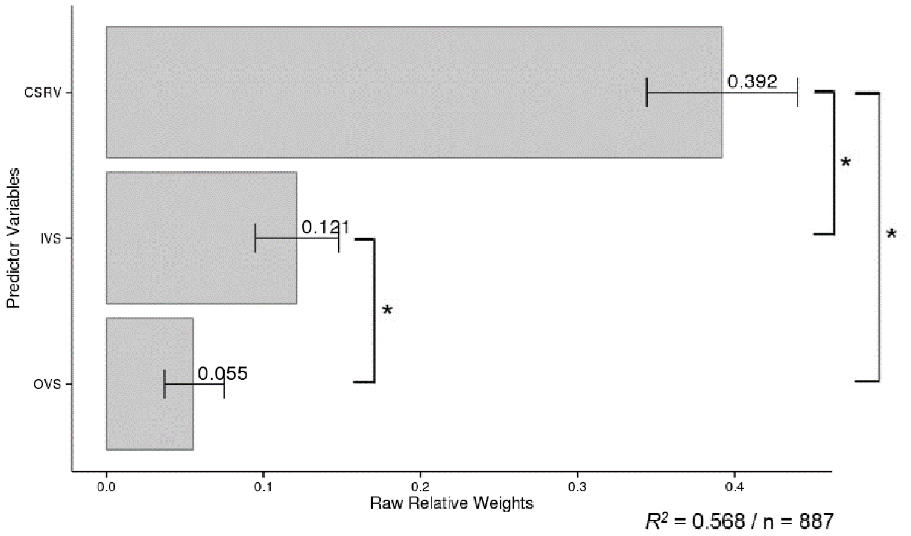
Relative weights generated from a relative weight analysis and corresponding 95% confidence intervals, which is a range of values estimated for the relative weights to fall if resampled. The horizontal bars indicate 95% CI generated from 5,000 bootstrapped replications (i.e., computerized random selection of a sample for 5,000 times). CSRV = capacity for self-regulatory vocabulary learning, IVS = ideal L2 vocabulary self/own, OVS = ought L2 vocabulary self/own. Asterisks mean that the CIs did not include 0 (p < .05).
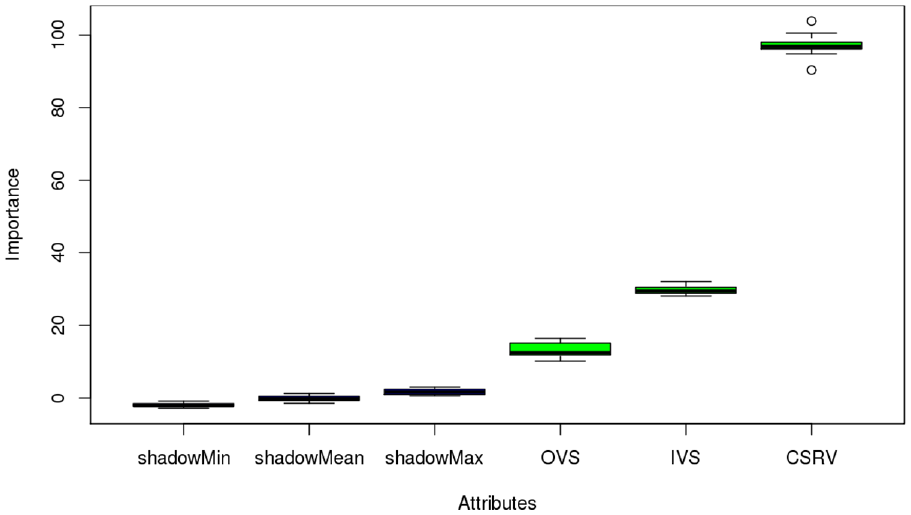
Variable importance plot which is generated from a Boruta random forest analysis. CSRV = capacity for self-regulatory vocabulary learning, IVS = ideal L2 vocabulary self/own, OVS = ought L2 vocabulary self/own. ShadowMin, shadowMean, and shadowMax are nonsense variables, generated by randomly shuffling the original values of the predictors. The predictors above the shadow variables, marked by green boxplots, are important.
Mediating Effects of L2 Vocabulary Selves
Research Question 2
How Do L2 Vocabulary Selves Mediate Capacity for Self-Regulatory Learning in Predicting L2 Vocabulary Learning Enjoyment?
As is shown in Figure 4, capacity for self-regulatory vocabulary learning had significant effects on both ideal L2 vocabulary self/own (path a1, 95% CI [0.417, 0.525)] and ought L2 vocabulary self/own (path a2, 95% CI [0.266, 0.395]). The two mediators had significant effects on the outcome variable (path b1, 95% CI [0.132, 0.276]; path b2, 95% CI [0.035, 0.156]). The direct effect of capacity for self-regulatory learning on enjoyment in L2 vocabulary learning was significant (path c’, 95% CI [0.662, 0.778]. Mediation analyses indicated that both ideal L2 vocabulary self/own and ought L2 vocabulary self/own significantly mediated the effects of capacity for self-regulatory vocabulary learning on L2 vocabulary learning enjoyment (path a1b1, boot 95% CI: [0.060, 0.131]); path a2b2 boot 95% CI [0.011, 0.052]), with the former had a stronger mediation effect than the latter.

Unstandardized coefficients for the relationship between capacity for self-regulatory vocabulary learning and L2 vocabulary learning enjoyment as mediated by L2 vocabulary selves, with standard error estimates in parentheses.
Discussion
Drawing on the regulatory focus theory (Higgins, 1997) and the assumption that advancing toward a goal can contribute greatly to learning enjoyment (Dewaele & MacIntyre, 2014), this study investigated the extent L2 vocabulary selves and capacity for self-regulatory vocabulary learning are related to vocabulary learning enjoyment. To this end, the study sought to answer two research questions:
Research Question 1 concerns the extent to which L2 vocabulary selves and capacity for self-regulatory vocabulary learning predicted L2 vocabulary learning enjoyment and the importance of the predictors in explaining the criterion measure. The results suggested that all the independent variables predicted vocabulary learning enjoyment. The sizes of unstandardized coefficients were 0.10, 0.20, and 0.72 for ought L2 vocabulary self/own, ideal L2 vocabulary self/own, and capacity for self-regulatory vocabulary learning, respectively. Dominance, relative weight, and Boruta random forest analyses confirmed the most important role of capacity for self-regulatory vocabulary learning in predicting L2 vocabulary learning enjoyment. Its dominance weight (68.3%) accounted for over three times as much as ideal L2 vocabulary self (22%) and nearly seven times as much as ought L2 vocabulary self (9.8%). The reason can be that when capable of managing the internal and external stimuli to engage in the learning action that takes them toward the self-concept related goals, the learners enjoy the action. The results aligned with those by Papi and Khajavy (2021), Tahmouresi and Papi (2021), and Teimouri (2017) in terms of the role of ideal L2 self/own in L2 learning enjoyment. Having the future self-images of becoming successful L2 vocabulary learners to meet their own needs for advancement may allow learners to have elated feelings and enjoy the learning process, possibly resulting in more motivated learning behaviors, engagement, and learning outcomes (Le-Thi et al., 2022; Safdari, 2021).
Regarding ought L2 self/own, the findings were different from Khajavy (2021) and Tahmouresi and Papi (2021), who found that ought L2 self/own did not predict learning enjoyment, but in alignment with Teimouri’s (2017). One explanation is while focusing on avoiding problems pertaining to the obligations imposed by others can be associated with the absence of enjoyment, the opposite can be true for focusing on eschewing problems that can hinder personal growth. The problems considered in ought L2 vocabulary self/own involve the latter, explaining the learning enjoyment. Another reason can be that the participants learn in a context socially and culturally different from those in Khajavy (2021) and Tahmouresi and Papi (2021); managing to navigate these issues to stay secured can be a meaningful goal, partly explaining their learning enjoyment. This is justifiable given that cultural differences play a role in L2 learning and teaching (Scovel, 1994). Recent findings by Ady et al. (2023) also suggests that the beliefs of the newcomers to Canada concerning the value of employment in the fulfilment of their personal responsibilites and obligations enhanced their motivation and willingness to engage with language learning more than the L2 students residing in Canada.
Research Question 2 concerns the mediating roles of L2 vocabulary selves in the relationship between capacity for self-regulatory vocabulary learning and L2 vocabulary learning enjoyment. The findings show that capacity for self-regulatory vocabulary learning had a direct effect on L2 vocabulary learning enjoyment (β = .72); 53% of L2 vocabulary learning enjoyment can be explained by capacity for self-regulatory vocabulary learning. Ideal L2 vocabulary self and ought L2 vocabulary self/own had indirect effects on the criterion measure, significantly mediating the direct effects in the relationship between capacity for self-regulatory vocabulary learning and L2 vocabulary learning enjoyment, with the former having a stronger mediating effect. This suggests that focusing on avoiding problems can compliment the focus on growth-oriented goals in support of the perceived abilities in managing internal and external distractions in learning, significantly affecting learning enjoyment. The findings corroborate regulatory focus theory by Higgins (1997). When learners focus on achieving advancement or growth (promotion focus), the potential positive outcomes related to their self-concepts/images can act as a impetus for self-regulation. When learners focus on fulfiling obligations or staying secured, the negative outcomes concerning the failure of realizing the responsibilities or having insecurities (prevention focus) can trigger self-regulation.
The direct effect of capacity for self-regulatory vocabulary learning on L2 vocabulary learning enjoyment can be because the study was carried out in the context of low-intermediate students learning L2 vocabulary in a computer-assisted learning environment. They learned vocabulary both explicitly through online game-based activities organized by classroom teachers and incidentally through content-based interactive lessons and ebooks in and outside classroom. This is a regular classroom practice at the students’ university, where learning and teaching are supported by technologies. The teaching activities are organized in the way that can enhance their abilities to control their concentration, procrastination, commitment to a goal, boredom, stress, or environmental conditions. Specifically, vocabulary instruction is practiced throughout English (L2) preparation courses in which six major self-regulated teaching and learning strategies, techniques, and approaches are used, including multiple encounters through exclicit integrated with incidental learning (Le-Thi et al., 2017), motivational teaching (Lamb, 2017; Le-Thi et al., 2022), digital game-based learning (Chen et al., 2018), collaborative learning (Rabie-Ahmed & Mohamed, 2022), blended learning (Tosun, 2015) and formative assessment (Colby-Kelly & Turner, 2007). This may involve the students’ better perception of the self-regulated capacity in vocabulary learning, allowing them to move one step closer to their future selves, significantly impacting their learning enjoyment.
Limitations and Future Directions
There are several limitations concerning this study. First, the data were collected from only one university; further studies should consider multiple-site data collection to increase generalizability. Second, as the participants learned in an environment where their self-regulated capacity was well supported by computer mediated learning, future research can consider other learning contexts. Also, the study looked at a small number of variables as part of the sources of L2 vocabulary learning enjoyment. Future research can examine an integrated model with a wider range of variables to shed more light on L2 learning enjoyment. Future research could also examine the effects of L2 enjoyment on other individual different factors and L2 development, with attention being paid on the effects of both L2 learning enjoyment and general L2 classroom enjoyment. Various data types, collection methods, measurements, and analyses could be utilized to further the understanding of the interactions and influences. Real-time self-regulation with eye-tracking or fMRI methods and longitudinal examinations (Teng & Zhang, 2022) could be employed to provide more fine-grained results so that L2 research and practice can be better informed.
Conclusion
This study’s findings indicated that the capacity for self-regulatory vocabulary learning was unidimensional, and the two components of ideal L2 vocabulary self/own and ought L2 vocabulary self/own were valid instruments to measure future self-guides in vocabulary learning. The ability of self-regulation in vocabulary learning had strong predictive power and a direct effect on L2 vocabulary learning enjoyment. L2 vocabulary selves moderately predicted vocabulary learning enjoyment and mediated the effect of capacity for self-regulated learning on learning enjoyment. Given the current influx of digital stimuli and distractions, with the mediation of L2 future self-guides and good practices of self-regulated learning strategies and techniques, learners can enjoy and engage in the challenging process of learning L2 vocabulary, achieving the desired L2 learning outcomes.
The implication for L2 teachers is that to make vocabulary learning an enjoying experience for their students, firstly, they can help students develop meaningful goals pertinent to their self-concepts and self-images involving effectively using L2 vocabulary for future personal and professional communication purposes. In addition, a sense of responsibility for the potential problems concerning the failure to fulfill the goals does no harm but good to students in terms of mediating their capacity for self-regulated learning and hence learning enjoyment. Once the students have the L2 vocabulary selves as learning goals, teachers and schools can support them in developing the ability of self-regulated vocabulary learning by systematically incorporating teaching approaches, strategies, and techniques that make students concentrate, commit to the goal, and avoid procrastination, boredom, stress, or unfavorable environmental conditions in order for them to advance toward their goals. In this way, the students can enjoy learning the L2 vocabulary, thereby engaging in the learning process and developing their L2 skills (Le-Thi et al., 2022). One implication for L2 teacher-researchers and researchers is that they can explore and examine factors predicting and affecting L2 vocabulary selves and self-regulated vocabulary learning strategies. The sources of learning enjoyment can also be examined in other L2-specific skills.
Supplemental Material
sj-docx-1-sgo-10.1177_21582440241239894 – Supplemental material for Capacity for Self-Regulatory Vocabulary Learning and Learning Enjoyment: The Mediating Role of L2 Vocabulary Selves
Supplemental material, sj-docx-1-sgo-10.1177_21582440241239894 for Capacity for Self-Regulatory Vocabulary Learning and Learning Enjoyment: The Mediating Role of L2 Vocabulary Selves by Duyen Thi Le in SAGE Open
Footnotes
Acknowledgements
I am grateful to the anonymous reviewers for their helpful comments. I also thank my colleagues at English Department, FPT University, Hanoi campus, for their support in this research.
Declaration of Conflicting Interests
The author declared no potential conflicts of interest with respect to the research, authorship, and/or publication of this article.
Funding
The author received no financial support for the research, authorship, and/or publication of this article.
Ethics Statement
No human subjects approval is required for this study.

Supplemental Material
Supplemental material for this article is available online.
References
Supplementary Material
Please find the following supplemental material available below.
For Open Access articles published under a Creative Commons License, all supplemental material carries the same license as the article it is associated with.
For non-Open Access articles published, all supplemental material carries a non-exclusive license, and permission requests for re-use of supplemental material or any part of supplemental material shall be sent directly to the copyright owner as specified in the copyright notice associated with the article.
