



Abstract
The study aimed to verify the prediction of general work performance by a perception of a leader as a security provider (LSP) in tram drivers. Contextual performance (job dedication) was a mediator in the predictive model. The research sample consisted of 196 tram drivers, 62.22% of the organization’s tram drivers. All participants shared the same leader, the head of the tram operation. They completed quantitative cross-sectional self-administered surveys. Results showed that job dedication (contextual performance) predicted the general performance. Job dedication as a partial mediator enhanced the percentage of the general performance’s explained score from 15.3% to 26.3%—predicted by perceiving the leader as a safe figure. Discussion suggested further analyzing the functions of a leader as an attachment figure in work settings and their connections to the other organizational behavioral variables. Functions of emotionality and separation distress did not relate to the work performance of tram drivers. Secure-based leadership and focus on job dedication fostered the tram drivers’ general work performance.
Keywords
Introduction
Achieving success, meeting goals, or annual milestones is the engine of every company. Organizations try to identify which factors impact employee performance and implement individual procedures for their potential development (Walthall & Dent, 2016). One such factor is the relationship quality between the leader and the follower. Research emphasizes the quality of dyadic relationships, which is closely related to the individual performance of employees (Bauer et al., 2006). As Gillath et al. (2017) concluded, relational variables such as adult attachment play a significant role in driving performance and outcomes. Except for the individual adult attachment orientations, leaders can serve as an attachment/safe figure for their followers (Keller, 2003).
The relationship between adult attachment at work and job performance is well described (Davidovitz et al., 2007; Khorakian & Sharifirad, 2019). In simulated traffic situations, Gillath et al. (2017) examined the relationship between attachment style and driving performance. He recommended the inclusion of the attachment in the study of drivers’ performance or interventions for its improvement. However, few empirical studies examine the perception of a leader as a safe figure (Molero et al., 2019). None link the perception of a leader as a safe figure with the performance of his followers in transportation. The current study aims to examine how perceiving leader as a secuity provides can relate to professional tram drivers’ work performance.
Attachment
Initially, the attachment was studied in the context of the mother-child relationship (Bowlby, 1969), where the mother played an attachment figure’s role. The tendency to maintain a bond with the attachment figure works by activating the binding behavioral systems, a consequence of innate needs. In adulthood, the various significant people take over the role of the attachment figure. They are usually adult partners (Hazan & Shaver, 1994). However, other people can also hold this function, for example, therapists, lecturers, leaders, and even various objects, animals, or places (Crawford et al., 2006; Fournier, 1998; Lacœuilhe, 2000; Pralong, 2004; Rioux, 2016). Mayseless (2010) emphasizes leaders as primary attachment figures because they are a consistent security source for their followers in stress and challenging situations. The bond between the leader and the follower is similar to those between mother and child. Both mother and leader play the role of a stronger, more capable, and caring individual, who protects the weaker ones, in this case, subordinates (Popper & Mayseless, 2007).
Molero et al. (2019) described the role of a leader as an attachment figure, the security provider (LSP). LSP provides five essential functions of attachment figure to their followers. They are a secure base (perceiving leaders as supporting and encouraging the efforts), a safe haven (source of support and protection in pressure situations), warm response to the search for closeness (the ability to respond subtly and promptly to the follower in times of need), emotional ties (feeling positive emotions toward leader), and the distress of separation (feeling the stress of separation from relationships). The more intense employees perceive a leader as a safe figure, the more satisfied they are with their leader. The better they perceive his efficacy, the more engaged, job-satisfied, and less burnt out (Molero et al., 2019) they are. LSP is a friendly and supportive supervisor whose way of communicating with employees is visible in overcoming stressful situations during the work process (Hudson, 2013).
Performance
General performance is the expected value for an organization consisting of individual management episodes performed over time. It is evaluated by superior or fluctuation, salary, or productivity (Motowidlo & Kell, 2013). Contextual performance contributes to the organization’s psychosocial well-being, which may not be recorded as part of a formal job or paid (Borman & Motowidlo, 1997; Motowidlo & Van Scotter, 1994). Employee behavior exceeds standard work requirements (Arnold et al., 2010). An employee with contextual performance indirectly contributes to the organization’s performance and contributes directly to social, organizational, and psychological support. Contextual performance optimizes communication within an organization (Borman & Motowidlo, 1997). It includes job dedication and interpersonal facilitation (Paschal et al., 2009).
The usual predictors of job performance are general mental abilities and personality traits (Furnham, 2005; Salgado, 2016). Cognitive abilities predict general performance, while personality traits predict the contextual component of general performance (Borman & Motowidlo, 1997), especially the altruistic dimension (Mallick et al., 2014). Contextual performance is considered a predictor of general performance (Basu et al., 2017). We assume that contextual performance will predict general performance based on this evidence.
The Role of Leader as Security Provider in Predicting Performance
We assume that perceiving the LSP will predict the general job performance and that contextual performance will mediate this relationship. Adult attachment styles are well-known predictors of contextual (Little et al., 2011; Richards & Schat, 2011) and general performance (Davidovitz et al., 2007; Neustadt et al., 2011). Adult attachment styles are likely to form implicit leadership styles (Davidovitz et al., 2007; Keller, 2003; Mayseless, 2010). Quality relationships between leaders and their followers are associated with the better contextual performance of both parties regardless of which one rates it (Brouer et al., 2013; Loi et al., 2011). Evidence suggests that LSP predicts work engagement and work satisfaction mediated by authentic leadership (Molero et al., 2019), which predicts contextual performance (Christian et al., 2011). In conclusion, there is evidence that attachment styles play a role in predicting performance and forming leadership styles associated with different quality relationships. The quality of a working relationship is related to contextual performance. LSP is an integrating concept describing positive relationships followers may have with their leaders based on the attributes of secure attachment. It should have a similar connection with contextual and general performance as variables it encompasses. Contextual performance predicts general performance, and some of the variability of general performance predicted by LSP will likely be mediated by contextual performance. The current research study will help understand how perceiving the leader as an attachment figure can support job performance. Mediation analysis could clear the path from attachment figures to general job performance through contextual performance. Hypotheses will confirm that attachment contributes to the general performance through the relational characteristics of the contextual performance in tram drivers.
Hypotheses 1: The contextual performance will predict general work performance.
Hypotheses 2: The contextual performance will mediate the prediction of general work performance by the perception leader as a security provider.
Methods
Participants and Procedure
The research sample of participants consisted of tram drivers from one Slovak company. Out of 315, 196 drivers participated in the research, with a 62.22% response rate. About 71% of the samples were men. The research sample was 41 years (SD = 12) on average, ranging from 20 to 65 years. Drivers worked with the current leader from 0 to 40 years, with an average length of 6.9 years (SD = 6.9).
The tram drivers, who took part in the research, work in single or two-shift operations. Their working hours are irregular. They do not share a workspace with their leaders, and their mutual contact is minimal. The head of the tram operation comes into direct contact with the vast majority of drivers five to six times a year. Most often, during regular training, which is mandatory for tram drivers every 6 months. He then meets drivers when dealing with serious breaches of work discipline, vehicle accidents, and conflict. The head of the tram operation is the same superior to all drivers. This leader has been with the company for more than 40 years and is well known for his nature and approach to employees.
We chose a group of professional drivers for the research because of the absence of research in the field of attachment to the leader related to work performance in the professional drivers. Understanding the role of the LSP in general and contextual performance could help prevent employee turnover, workplace stagnation, and conflicts in interpersonal relationships.
After taking permission from the management of the organizations in writing, all tram drivers were approached as research participants. The company’s management agreed to research reciprocally for presenting the study results. Participants attended the research voluntarily and anonymously and signed the written informed consent. The researcher explained the study’s objectives and the method of filling up the questionnaire to the tram drivers. He answered the questions about how to fulfill the questionnaires. He assured the employees about the confidentiality of data and the academic purpose of their use. Data were collected from December 2020 to February 2021 in paper form. Drivers handed over the completed questionnaires in an envelope directly to the researchers or sent them by mail. Data gathering followed the ethical guidelines of Internal Institutional Regulation 5/2014. The company’s management allowed data collection and research analysis under number 11398/2021.
Measures
Two independent translators translated the questionnaires into Slovak (Greškovičová, 2020). In discrepancies, the researchers agreed upon the final form to capture the meaning optimally.
The Leader as security provider scale (LSPS) measures the leader’s perception as an attachment figure Molero et al. (2019). It consists of 15 items on a 5-point Likert scale ranging from 0—strongly disagree to 4—strongly agree. The scale was translated into Slovak, and its psychometric properties were tested. The original one-dimensional model did not show a good fit with data (X2 = 267.619, df = 90, p < .001; TLI = 0.882, CFI = 0.899, RMSEA = 0.104, and SRMR = 0.051). EFA (rotation Promax) indicated a 2-factor model that explained 60.6% of the variance. Six items were loaded on the first factor, LSPS1 (e.g., If my leader left, I would miss them a lot), with explained 33.3% of the total variance and Cronbach α = .911. LSPS1 describes employees who build emotional ties with their leaders and feel distressed when separated from them. Factor 2, LSPS2, comprised five items (e.g., I can count my leader will support my efforts on the job), with explained 27.4% of the total variance and Cronbach α = .857. LSPS2 describes an attachment figure that provides a secure base and a safe haven (safe figure). Employees tend to perceive their attachment figure/leader as supportive and encouraging in their pursuits of non-attachment-related goals in a safe environment (Molero et al., 2019). Two-factor model fit the data better than one-factor model did (X2 = 114.696, df = 43, p < .001; TLI = 0.928, CFI = 0.944, RMSEA = 0.095, and SRMR = 0.045).
The contextual performance questionnaire (Stone-Romero et al., 2009) measures two contextual performance dimensions (CP). (1) Interpersonal facilitation of six items (e.g., praise coworkers when they are successful; Cronbach α = .920). It means helping others and cooperating with coworkers. (2) Job dedication of eight items (e.g., put in extra hours to get work done on time; Cronbach α = .896). It means exercising discipline and self-control and complying with instructions even when supervisors are not present. This two-factor model fit the data well (X2 = 163.332, df = 76, p < .001; TLI = 0.940, CFI = 0.950, RMSEA = 0.077, and SRMR = 0.058).
The General Work Performance Questionnaire (Motowidlo & Van Scotter, 1994) measures general perceived work performance (GP) with three 7-point Likert items. Here 7 is for high and 1 for low performance, for example, “exceeds standards for job performance—does not meet standards for job performance.” Cronbach alpha for the overall mean score after adaptation is α = .924.
Data Analysis
We processed the data with JASP 0.15.0.0. The model fit indices for CFI are the Comparative Fit Index (CFI), Tucker-Lewis Index (TLI), Standardized Root Mean of Residuals (SRMR), and Root Mean Squared Error of Approximation (RMSEA). CFI and TLI value greater than 0.90 and RMSEA and SRMR values less than 0.08 are acceptable. CFI and TLI values greater than 0.95 and RMSEA and SRMR values lower than 0.05 are considered excellent (Byrne, 2009; Kline, 2005).
We verified the distinctiveness of the variables by CFA. The results (Table 1) indicated that the proposed five-factor model fits the data best, and the questionnaires measure distinct constructs.
Confirmatory Factor Analyses.

Note. LSPS1 = emotionality and separation distress factor from the LSP scale; LSPS2 = safe figure factor from the LSP scale; GP = general work performance; IF = interpersonal facilitation dimension of CP; JD = job dedication dimension of CP.
Results
None of the variables correlates at a medium or large level with age and years spent with a leader (Table 2). On the contrary, the observed variables are interrelated. The LSPS (0.762) and CP (0.649) dimensions strongly inter-correlate. The perception of a leader as a safe figure correlates moderately significantly with GP and CP.
Correlations, Means, Standard Deviations.

Note. Age = average age in years; TWL = average time spent with leader in years; GP = general work performance; LSPS1 = emotionality and separation distress factor from the LSP scale; LSPS2 = safe figure factor from the LSP scale; IF = interpersonal facilitation; JD = job dedication; AM = mean; SD = Standard deviation.
Time with leader correlated statistically significantly with age (0.529). All significant correlation were at the level p < 0.01, marked with two asterisks (**)
Hypotheses 1: The contextual performance will predict general work performance.
Linear regression analysis (stepwise method) showed that IF does not significantly predict GP, and JD predicts GP. The regression model explained 27.5% of GP score variability (R = .524; R2 = .275; F (1 195) = 73.551; p < .001). Verification of hypothesis 1 showed that only the JD should be allowed for the further mediation analysis of hypothesis 2. The results supported hypothesis 1 for the job dedication. Job dedication predicts the general performance of tram drivers significantly.
Hypotheses 2: The contextual performance will mediate the prediction of general work performance by the perception leader as a security provider.
Before we ran the mediation analysis to verify hypothesis 2, we conducted regression analyses (enter method with LSPS1 and LSPS2 as predictors) to check the mediation model appropriateness (Table 3). LSPS1 did not predict GP significantly. LSPS2 predicted GP, and the regression model explained 15.3% of GP score variability (R = .391; R2 = .153; F (1 195) = 35.071; p < .001). LSPS1 did not predict JD significantly. LSPS2 predicted JD significantly, and the regression model explained 25.9% of JD score variability (R = .509; R2 = .259; F (1 195) = 67.918; p < .001).
Regression Models Output with Coefficients for LSPS1 and LSPS2 as Independent Variables.

Note. GP = general work performance; LSPS1 = emotionality and separation distress factor from the LSP scale; LSPS2 = safe figure factor from the LSP scale; JD = job dedication.
Although both LSPS1 and LSPS2 correlated with GP and JD, only LSPS2 predicted them significantly. According to Baron and Kenny (1986), the independent variable must significantly affect the dependent variable and mediator as the required conditions for testing the mediation analysis. Because of that, we only included LSPS2 (safe figure) as a predictor in mediation analysis. Table 4 and Figure 1 show the results of the mediation analysis. LSPS2, mediated by JD, explained 26.3% of GP variance (Total Standardized Estimate = 0.513; SE = 0.086; z = 5.952; p < .001; 95% Confidence Interval = [0.366, 0.699]). Hypothesis 2 was confirmed for the safe figure (factor of LSP scale) as a predictor of general performance, mediated through the job dedication dimension of contextual performance. Job dedication serves as a mediator in predicting the general work performance of tram drivers by perceiving a leader as a safe figure.
Analysis of the Path From LSP (Safe Figure) to General Work Performance Mediated Through Contextual Performance (Job Dedication).

Note. Delta method standard errors, bias-corrected percentile bootstrap confidence intervals, ML estimator.
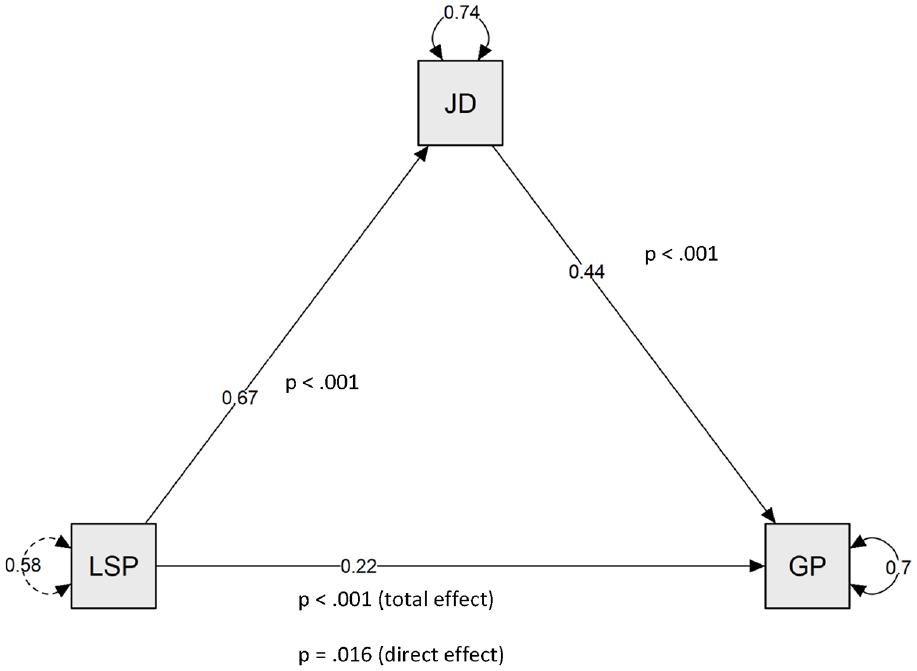
Path plot with standardized parameter estimates.
Discussion
Perceiving a leader as a safe attachment figure predicts general performance. Job dedication enhances the predicted general performance score percentage from 15.3% to 26.3%. That means that perceiving the leader as a safe figure relates to job dedication. Neustadt et al. (2011) found that conscientiousness is a supportive factor in attachment and its relationship to work performance. Job dedication can be considered a behavioral characteristic of personality, “which includes self-disciplined, motivated acts such as working hard, taking the initiative, and following rules to support organizational objectives” (Van Scotter & Motowidlo, 1996, p. 525) and which is predicted by conscientiousness (Borman & Motowidlo, 1997). Ronen and Zuroff (2017) also reported that secure attachment predicts job performance while the relationship is mediated by collaborative and prosocial behaviors (coalition–building). It is questionable whether coalition-building would be a significant mediator even in a low interaction job setting, such as in the current study.
Adults who respond to stressful situations seek an attachment figure to restore well-being (Bowlby, 1969). Their leader can represent such a figure. Furthermore, the work activity itself shares similarities with the act of exploration. Tendencies to move away from attachment figures to explore and understand the environment may result in productivity at work (Hazan & Shaver, 1990; Molero et al., 2019). In contrast, an anxious, insecure attachment style characterized by “worries about separation and rejection” (Mikulincer & Shaver, 2007, p. 36) appears to be negatively correlated to job performance (Neustadt et al., 2011), with burnout acting as a mediator between the two variables (Vîrgă et al., 2019). Emotionality and separation distress in tram drivers did not significantly predict general or contextual performance. The perception of security in the figure of a leader seems to be more critical for the performance of tram drivers than their emotionality and separation distress related to the leader. Interpersonal facilitation was not a significant predictor of general performance. The nature of the work could cause this because tram drivers work alone and do not have many opportunities to socialize with colleagues at work.
Findings align with the results of studies linking secure attachment to better general work performance (Neustadt et al., 2011). Unlike Little et al. (2011), we could not find a relationship between an interpersonal component of contextual performance and secure attachment. Our results also support a positive relationship between the leader-follower relationship and contextual performance (Brouer et al., 2013; Loi et al., 2011). Contextual performance predicts general performance, as Basu et al. (2017) reported.
Limitations of the Study
No study research is free of limits, and the current study is no exception to the rule. This research is cross-sectional by design and is limited by the time frame in which it was conducted. Therefore, the discussed dynamics and causalities are based on theoretical hypotheses only. The current research focused on a single leader. Consequently, it isn’t possible to generalize findings to a broader population of leaders and followers. The performance measures used in this research were not objective. Self-evaluation of performance has its limits, such as socially desirable responses. The convergent validity threshold for the correlation between objective and subjective performance measures has not been reached (Bommer et al., 1995), meaning that they are two different albeit correlated constructs. The data collection process combined questionnaire distribution and collection via postal services, followed by data collection in person. The participants perceived the process as complicated, and some expressed negative attitudes. Participants asked the researcher for help with fulfilling the study often. They needed to discuss the meaning of questions with the researcher.
Contributions of the Study
The study’s contributions include the research sample of tram drivers generalizable for the company, with the same leader (the head of the tram operation). The manager has been with the company for more than 40 years. Although he is not often in contact with drivers, results show that he serves as a source of safety perception. This sample did not confirm that the fear of separation from the leader affected the perception of work performance (contrary to Neustadt et al., 2011; Vîrgă et al., 2019), whether general or contextual. Employees rarely meet with the manager, mostly when resolving conflict situations. It seems that separation from him would not disrupt their typical day. However, it is positive that understanding him as a safe figure is related to employees’ perception of work performance. The perception of a leader as a safe figure in conflict situations supports interpersonal trust at work, autonomous and situationally appropriate behavior (Simmons et al., 2009).
Another benefit of the study is that the research sample of tram drivers comes from one company. All participants have the same leader. When fulfilling the LSP scale (Molero et al., 2019), tram drivers were instructed to focus on a specific leader—the person at the head of the tram operation position. The research of attachment at work is usually realized on convenience samples completed in multiple companies, with numerous leaders, from various labor sectors (Molero et al., 2019; Scrima, 2020; Vîrgă et al., 2019), students (Ronen & Zuroff, 2017; Vîrgă et al., 2019) or people with higher education, working mentally (Neustadt et al., 2011).
The main contribution of this study is the finding of a relationship between perceiving a LSP with contextual and general performance in a specific setting. The results of this study were shared with the company’s management. Therefore, they can be applied to its practices to benefit the company and its employees.
Implications for Further Research
Perceiving the LSP means a positive aspect of the work for employees (Molero et al., 2019). The current study also showed that contextual performance, particularly job dedication, can strengthen this relationship. Further research can focus on more mediators/moderators between perceiving the leader as a safe figure and work performance. This relationship can be mediated and interfered with by, for example, leadership and leader-follower exchange (Hudson, 2013), burnout (Molero et al., 2019; Vîrgă et al., 2019), coalition-building behaviors (Ronen & Zuroff, 2017), vigor at work (Little et al., 2011) or a societal crisis undermining general security (Hinojosa et al., 2020).
A global attachment style might be a critical interfering variable since it strongly determines attachment between leader and follower (Keller, 2003). It has been suggested that extreme forms of insecure attachment style might completely prevent secure attachment between leaders and followers from forming (Hinojosa et al., 2014). Other dependent variables could be included in future research, such as fluctuation, absenteeism, motivation, and work engagement in settings similar to the current study. How perceiving an LSP affects a resistance to change might be especially interesting and beneficial for improving the flexibility and adaptation of employees during organizational change (Grady et al., 2019). Future research on attachment in work settings could focus on designing case studies for specific organizations where teams and working groups have the same leader.
The current study’s results suggest that for the employees’ focus on the work performance, not all of the attachment figure’s functions in a leader are critical. Future research could differentiate the functions of the leader as an attachment figure/security provider and their relations to the organizational behavior variables (e.g., compliance, counterproductive work behavior). The five functions of an attachment/security provider figure are secure base, safe haven, proximity seeking, emotional ties, and separation distress (Molero et al., 2019). According to our results, we can assume that the emotionality and separation distress functions are less significant for the work performance than the secure base and safe haven (Lisá et al., 2021).
Practical Implications
Public drivers nowadays deserve more attention. As first-line workers and essential employees in pandemic times, they are subject to more workload and stress (M. Bauer et al., 2021; Katrakazas et al., 2021; Magnusson et al., 2021) and thus require more attention from their leaders in the sense of secure based leadership (Coombe, 2010).
The research results are in line with strategies proposed by Osborne and Hammoud (2017), who suggested that companies should focus on improving a system of rewarding employees, supporting employees’ positions, and creating a secure attachment between managers and employees. A sense of security is a significant predictor of work engagement (Altinay et al., 2019; Hilton & Sherman, 2015; Park & Ono, 2017). An LSP perception similarly predicts engagement (Molero et al., 2019). Work engagement predicts beneficial job outcomes while mediating a relationship for various other predictors (Bakker & Bal, 2010; Kim et al., 2013). Fostering secure relationships between leaders and employees might be instrumental for fluctuation and preventing absenteeism (Feeney et al., 2020). Leaders acting as security providers might be especially beneficial for overly anxious employees in attachment and who need the most support (Wu & Parker, 2017). Therefore, a leader’s perception as a security provider is an essential addition to models serving as a foundation for developing strategies for the optimal functioning of organizations.
Conclusion
Perceiving a leader as a security provider predicts general work performance in tram drivers. Contextual performance (job dedication) predicts the general work performance, partially mediating the predictive relationship between perceiving a leader as a safe figure and general work performance. When perceiving the leader as an attachment figure, emotionality and separation distress do not relate to general nor contextual performance. Perceiving the joint leader as a safe figure and experiencing job dedication in tram drivers of one organization foster their focus on performance. The emotional relationship to the leader and separation distress do not relate to tram drivers’ performance—contextual or general.
Footnotes
Authors’ Contributions
Conception and design of the work: EL; the acquisition, analysis: LD, EL, interpretation of data: EL, MV; have drafted the work or substantively revised it: EL, KM, MV.
Declaration of Conflicting Interests
The author(s) declared no potential conflicts of interest with respect to the research, authorship, and/or publication of this article.
Funding
The author(s) received no financial support for the research, authorship, and/or publication of this article.
Submission declaration and verification
The work described has not been published previously. It is not under consideration for publication elsewhere, its publication is approved by all authors and tacitly or explicitly by the responsible authorities where the work was carried out. If accepted, it will not be published elsewhere in the same form, in English or in any other language, including electronically without the written consent of the copyright-holder.

Data Availability Statement
Data sharing not applicable to this article as no datasets were generated or analyzed during the current study.