



Abstract
Drawing from social identity theory and social cognitive theory, this study investigates the mediating role of organizational identification in the relationship between perceived overqualification and proactive customer service performance, as well as the moderating role of leader integrity via leader mindful attention. Results from a two-wave, two-source field survey of 204 employees and 90 leaders indicate that organizational identification mediates the relationship between perceived overqualification and proactive customer service performance. This indirect relationship is strengthened when leaders exhibit higher levels of integrity. Moreover, the moderating effect of leader integrity is accounted for by leader mindful attention. These findings deepen our understanding of how employees’ perceptions of overqualification shape customer-related outcomes and offer practical implications for how organizations may foster proactive customer service performance among employees.
Plain Language Summary
Drawing from social identity theory and social cognitive theory, this study investigates the impact of perceived overqualification on proactive customer service performance with organizational identification as a mediator between perceived overqualification and proactive customer service performance. At the same time, leader integrity and mindful attention are incorporated as two moderators between perceived overqualification and organizational identification. Based on collected data from 204 employees and 90 leaders, the results indicate that perceived overqualification is negatively associated with organizational identification, and this relationship is stronger when leaders exhibit high integrity and mindful attention. Besides, leader integrity is positively related to mindful attention, and its moderating effect is mediated by leader mindful attention. Moreover, organizational identification positively influences proactive customer service performance, and its mediating effect is reinforced when leader integrity and mindful attention are high.
Keywords
Introduction
As downward pressure on the economy increases, organizations face fewer opportunities to recruit new employees (B. Ma & Zhang, 2022; Pan & Hou, 2024). To stand out in an increasingly competitive labor market, many candidates continuously enhance their knowledge, skills and abilities, sometimes to a degree that exceeds the requirements of the jobs they obtain. In practice, employees may develop a sense of overqualification when they realize that their competencies surpass what is needed to perform their assigned tasks (Z. Q. Liu et al., 2024; Maynard et al., 2006). Prior research has shown that perceived overqualification can have detrimental effects on employees’ work attitudes and behaviors (Erdogan, Karaeminogullari, et al., 2020; Fan et al., 2023). However, it remains unclear whether these negative effects extend to employees’ interactions with customers (Jang et al., 2020). Among customer-related outcomes, proactive customer service performance is particularly significant, as it reflects employees’ initiative in addressing customer needs and contributes to organizational competitive advantage in highly dynamic and competitive service markets (Rank et al., 2007; Zhao et al., 2023). Therefore, this study investigates the impact of perceived overqualification on proactive customer service performance.
Moreover, prior research suggests that identification from some sources are important mechanisms linking perceived overqualification to work behaviors. For example, C. Ma et al. (2020) demonstrated that career identification mediates the relationship between perceived overqualification and career planning, drawing on role identity theory. Similarly, Wu et al. (2023) drew from social comparison theory and found that relational identification mediates the effect of perceived overqualification on knowledge hiding. However, it remains unclear whether employees’ identification with their organization can help explain how perceived overqualification shapes their proactive customer service performance. This question is particularly relevant given the central role of identification with the employing organization in guiding employees’ attitudes and behaviors in service contexts. Proactive customer service performance refers to voluntary, sustained and forward-looking service behaviors that extend beyond basic organizational requirements (Rank et al., 2007), and such extra-role behaviors are often driven by employees’ strong identification with their organization (Gong & Kanwal, 2025). According to social identity theory (Ashforth & Mael, 1989; Piening et al., 2020; Sharma et al., 2023), employees differ in the degree to which they identify with their employing organization, and these differences influence the extent to which they internalize organizational goals and enact behaviors aligned with them. Accordingly, employees who feel a stronger sense of organizational belonging are more likely to invest additional effort in serving customers proactively. Thus, based on social identity theory, we propose that organizational identification works as a mediator in the relationship between perceived overqualification and proactive customer service performance.
In addition, existing studies have revealed that the consequences of perceived overqualification can be contingent on both individual factors (e.g., employee ambition; Schreurs et al., 2021) and team-level factors (e.g., qualification differences; Wu et al., 2023). However, relatively few studies have examined the role of leader-related factors, such as a leader’s integrity. According to social identity theory, the development of employees’ organizational identification is influenced by the social environment in which they are embedded (Ashforth & Mael, 1989). Leaders with high integrity help establish a fair and trustworthy work climate in which employees believe they are respected and treated appropriately (Duan et al., 2020; Erdogan, Karakitapoglu-Aygün, et al., 2020). For employees who perceive themselves as overqualified, this is particularly important, as they often feel that their abilities are undervalued by the organization. The alignment between fair treatment conveyed by the leader and employees’ self-perceived value facilitates the formation of organizational identification. Conversely, when such alignment is lacking, organizational identification is less likely to develop, leading to weakened proactive customer service behaviors. Therefore, we propose that leader integrity moderates the mediating effect of organizational identification on the relationship between perceived overqualification and proactive customer service performance.
Furthermore, while previous studies have demonstrated that leader integrity can exert direct moderating effects (e.g., Chen et al., 2024), a few scholars argue that this influence may operate indirectly through leaders’ own work states (Nawaz et al., 2023). Examining how leader integrity shapes leaders themselves offers a clearer understanding of its moderating mechanism. Indeed, social cognitive theory posits that individuals’ internal standards influence how they direct their attention and regulate their actions (Bandura, 1986; Bussey & Bandura, 1999; Farasat & Azam, 2022). Thus, leaders with high integrity are more likely to exhibit mindful attention, enabling them to remain present, attentive, and responsive to employees’ needs (Zhou et al., 2023). This attentive leadership style helps create a work environment in which employees’ concerns are recognized and addressed. However, employees who perceive themselves as overqualified are more likely to believe that the organization has not adequately acknowledged their capabilities or assigned them roles that match their potential. According to social identity theory, such perceived misalignment weakens employees’ sense of organizational belonging and identification, which consequently diminishes their willingness to engage in proactive customer service behaviors. Hence, we propose that leader mindful attention mediates the moderating effect of leader integrity on the relationship between perceived overqualification and proactive customer service performance.
In summary, combining social identity theory and social cognitive theory, we propose a mediated moderation model as shown in Figure 1. Specifically, we examine organizational identification as the mediating mechanism through which perceived overqualification influences proactive customer service performance, and we investigate how leader integrity moderates this indirect relationship through leader mindful attention. By doing so, this study strives to provide critical implications into how organizations can alleviate the negative effects of perceived overqualification and foster proactive customer service performance, thereby enhancing organizational competitiveness in highly challenging market environments.
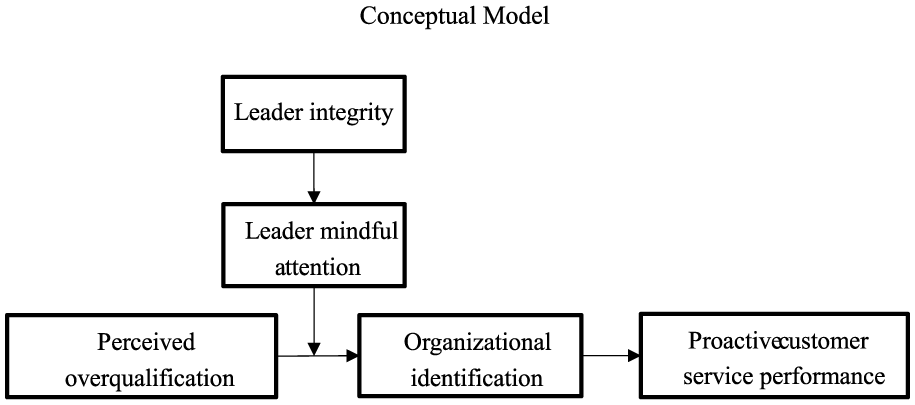
Conceptual model.
The subsequent sections are organized as follows: Theoretical Foundations and Hypotheses reviews the relevant literature and theoretical framework. Method outlines the research method. Results presents the empirical results. Discussion discusses the findings and their implications. Finally, we conclude this study with limitations and future directions.
Theoretical Foundations and Hypotheses
Perceived Overqualification and Organizational Identification
Perceived overqualification refers to the extent to which individuals believe that their skills, qualifications, and knowledge exceed the requirements of their job (Z. Q. Liu et al., 2024; Maynard et al., 2006). Previous studies have highlighted that when employees perceive themselves as overqualified, they often feel that their abilities are underutilized and insufficiently recognized, which can negatively affect their work attitudes. For example, overqualified employees may find it difficult to relate to their coworkers (Wu et al., 2023) and tend to report lower job satisfaction (Pan & Hou, 2024). Following this logic, we argue that perceived overqualification may also reduce organizational identification, defined as the degree to which individuals perceive themselves as part of an organization and experience a sense of belonging and attachment to it (Ashforth & Mael, 1989; Costa et al., 2022).
According to social identity theory, employees derive their self-concept and belonging in part from their membership in their organizations (Ashforth & Mael, 1989; Piening et al., 2020). When employees perceive themselves as overqualified for their roles, this misalignment between their capabilities and job demand may lead them to feel undervalued and disconnected from the organizational context (Ye et al., 2021). Overqualified employees often believe that the value they are capable of contributing far exceeds what the organization currently recognizes or requires. As a result, they are less inclined to link their self-concepts with organizational values and less likely to internalize those values. Consequently, their organizational identification is weakened. Correspondingly, we propose the following hypothesis.
The Moderating Role of Leader Integrity
It has been found that the negative effects of perceived overqualification are not uniform but can be shaped by contextual factors. For instance, these effects tend to intensify when employees have high ambition (Schreurs et al., 2021) or when there are substantial qualification disparities among team members (Wu et al., 2023), suggesting that misalignment between employees’ self-perceived capabilities and their work environment can exacerbate negative outcomes. Extending this logic, we argue that leader integrity serves as a moderator in the relationship between perceived overqualification and organizational identification.
Integrity is defined as the quality of being honest and adhering to strong moral principles (Moorman et al., 2013; Nawaz et al., 2023). Leaders with high integrity exemplify a steadfast commitment to ethical behavior, consistently aligning their words with actions (Duan et al., 2020). Social identity theory suggests that organizational environments that align with employees’ expectations and values are more likely to foster organizational identification (Ashforth & Mael, 1989). Under high-integrity leadership, employees generally anticipate fair treatment and tend to align their behaviors with organizational norms (Nawaz et al., 2023). However, overqualified employees are more likely to experience a perceived mismatch between their abilities and job assignments, leading them to feel that the organization does not fully recognize or utilize their potential. This misalignment makes it difficult for them to internalize organizational values and see themselves as integral members of the organization, ultimately reducing their organizational identification.
When leaders have low integrity, they may prioritize personal gains over ethical principles and fail to meet their promises (Cha et al., 2020). Because leaders are viewed as representatives of the organization (Marstand et al., 2021), their actions shape employees’ perceptions of organizational values and fairness. Under low-integrity leadership, employees generally hold diminished expectations for fair treatment and consistent recognition. In this context, overqualified employees are less likely to interpret the mismatch between their abilities and job assignments as a personal devaluation; rather, they may perceive it as a natural consequence of a broader dysfunctional environment. Consequently, they may be more inclined to accept the situation and less likely to feel excluded from the organization. Taken together, the following hypothesis is proposed.
The Role of Leader Mindful Attention
Extant research indicates that a leader’s integrity can influence his or her own attitudinal and cognitive processes. For example, leaders with high integrity tend to exhibit greater courage and demonstrate higher levels of work engagement (Nawaz et al., 2023; Palanski et al., 2015). In a similar vein, we propose that leader integrity may enhance their mindful attention, defined as the psychological capacity to maintain conscious awareness of experiences in the present moment (Brown & Ryan, 2003; Harvey & Kudesia, 2023).
Social cognitive theory states that, individuals’ moral standards enable them to consciously motivate and regulate their actions (Bandura, 1986; Farasat & Azam, 2022). Leaders who exemplify integrity consistently align their behavior with ethical principles, allowing them to focus more fully on their responsibilities without the distraction of conflicting values or unethical behaviors. Furthermore, high-integrity leaders encourage open and genuine communication (Erkutlu & Chafra, 2020), creating an environment in which they can receive accurate feedback and engage in reflective practices. As a result, they are better equipped to make informed decisions, recognize potential biases, and adapt to new information, thereby enhancing their overall mindfulness toward both internal states and external contexts. Correspondingly, we formulate the following hypothesis.
Further, we argue that leader mindful attention plays a moderating role in the relationship between perceived overqualification and organizational identification. Specifically, leaders with high mindful attention are deeply present and aware in the moment, enabling them to engage fully with both employees and their tasks (Zhou et al., 2023). Such leaders are more likely to notice and respond to employees’ concerns in a timely and considerate manner. In turn, employees working under mindful leaders are more likely to adopt similar mindful tendencies, becoming more aware of the needs and goals of the organization (Zoghbi-Manrique-de-Lara et al., 2020). However, overqualified employees are also more aware of the mismatch between their abilities and their assigned roles. According to social identity theory, when employees’ expectations regarding the meaningful use of their capabilities conflict with organizational realities, this inconsistency weakens their sense of belonging. As a result, overqualified employees are less likely to identify with the organization, even in a mindful and supportive work environment.
When leaders exhibit low mindful attention, they tend to become distracted, less attuned to organizational goals, and insufficiently responsive to employees’ concerns (Liang et al., 2016; Qian et al., 2020). As leaders represent the organization in employees’ daily interactions, such inattentive behaviors may signal that the organization is indifferent to whether employees’ job assignments appropriately match their abilities (Pan & Hou, 2024). In this context, employees are less encouraged to internalize organizational values and gradually develop lower expectations regarding recognition and support. For overqualified employees, they are more likely to accept their unsatisfactory circumstances, as the lack of attention aligns with their already diminished expectations. As a result, they are less likely to experience strong feelings of exclusion from the organization and tend to maintain relatively higher levels of organizational identification compared to those working under highly mindful leaders. Thus, we propose the following hypothesis.
Combining Hypotheses 2 to 4, leaders with strong integrity consistently align their actions with their promises, which enables them to focus their attention on their responsibilities and possess high levels of mindful awareness. However, for overqualified employees, the supportive and attentive work environment created by highly mindful leaders contrasts sharply with their perception that their abilities are undervalued, thereby further inhibiting the development of their organizational identification.
When leaders exhibit low integrity, the inconsistency between their words and actions makes it difficult for them to remain focused and engaged, resulting in lower mindful attention. As leaders are key representatives of the organization, their inattentiveness may signal to employees that the organization is indifferent to whether job assignments appropriately match employees’ abilities. In such circumstances, employees generally maintain lower expectations for recognition and support. Consequently, overqualified employees are more likely to accept the mismatch between their capabilities and job roles as part of the organizational reality, and therefore are less likely to experience heightened feelings of exclusion or markedly reduced organizational identification. In sum, we develop the following hypothesis.
Organizational Identification and Proactive Customer Service Performance
Employees’ organizational identification has been shown to be closely linked to their work behaviors. Employees who strongly identify with their organizations are more likely to engage in voice behaviors ( H. K. Wang & Yen, 2023) and exhibit organizational citizenship behaviors directed toward the organizations (Marstand et al., 2021). Likewise, we propose that organizational identification may promote proactive customer service performance—voluntary, sustained, and forward-looking service behaviors in which employees actively initiate actions to meet customer needs (Rank et al., 2007; Zhao et al., 2023).
In line with social identity theory, employees’ work behaviors are influenced by the extent to which they identify with the organization (Ashforth & Mael, 1989; Sharma et al., 2023). When employees closely identify with their organization, they internalize its values, goals and norms, and view its successes as their own (C. Liu et al., 2021). This psychological integration motivates them to act in ways that positively represent and promote the organization. As primary agents in customer interactions (Jang et al., 2020), such employees are more likely to spontaneously and consistently deliver high-quality, long-term oriented service to project a positive organizational image, thereby demonstrating higher levels of proactive customer service performance. Consequently, the following hypothesis is developed.
The Moderated Mediation
Integrating H2 and H6, high-integrity leaders adhere to ethical principles and act in alignment with their stated intentions, thereby fostering a reliable and consistent work environment. However, this does not align with the perception of overqualified employees. According to social identity theory, this will further inhibit the formation of their identifications with the organization, thereby reducing their frequencies of proactive customer service performance.
When leaders display low integrity and fail to act in accordance with their words, overqualified employees are likely to form diminished expectations regarding fair and consistent recognition. In such environments, the inconsistency between their abilities and job roles becomes less surprising and more acceptable. Consequently, overqualified employees may be less inclined to possess low organizational identification, and finally their proactive customer service performance will be less likely to be reduced. Accordingly, we propose:
Synthesizing H4 and H6, leaders who demonstrate a high level of mindful attention are capable of fostering a considerate and attentive work environment. Nevertheless, overqualified employees are also more aware of their mismatch situation and are less likely to develop organizational identification, resulting in lower proactive customer service performance.
On the contrary, when leaders exhibit low mindful attention, they may appear inattentive and distracted in their professional behavior. Overqualified employees generally develop lower expectations for recognition and support, making them less likely to experience significant reductions in organizational identification. Consequently, their proactive customer service performance is less likely to be substantially affected. To conclude, we propose:
Method
Sample and Procedure
In this study, employees and their immediate leaders from a Chinese trade company were invited to conduct a questionnaire survey. The data collection was divided into two periods, with an interval of 3 months. Participants’ questionnaires were numbered to ensure the match between employees and leaders. In the first session, employees rated perceived overqualification, leader integrity and mindful attention as well as filled in their demographic information. After eliminating invalid questionnaires with incomplete responses, 237 employee data were reserved. Three months later, employees reported organizational identification and leaders evaluated employee proactive customer service performance. After sorting, we obtained valid data from 204 employees and 90 leaders. Details about the demographic information of employees were presented in Table 1. Besides, they had worked for 4.17 years on average.
Demographic Information of Employees.

To assess potential common method bias, we employed Harman’s single-factor analysis. The results indicated that the single factor explained less than 50% of the variance (25.49%), suggesting that the common method bias issue was not significant.
Measures
All scales used in the present study were originally developed in English, and the standard “translation-back translation” procedure was carried out when translating the items into Chinese version. The 7-point Likert scale was adopted for all variables (1=“strongly disagree”;7= “strongly agree”). Details about the measurement were presented in Table 2.
Measurement.

Note. R = Reverse-coded.
Control variables: Employees’ demographic variables (i.e., age, gender, education, and job tenure) have been found to influence the relationship between perceived overqualification and proactive behavior (C. Ma et al., 2023). Therefore, we controlled for employees’ age (1 = “21–25”; 2 = “26–30”; 3 = “31–35”; 4 = “36–40”; 5 = “41–45”; 6 = “46–50”; 7 = “51–55”; 8 = “56–60”), gender (1 = “male”; 2 = “female”), education (1 = “high school or below”; 2 = “junior college”; 3 = “undergraduate”; 4 = “graduate”) and job tenure (in years).
Analytic Approach
SPSS 30.0 was used to conduct common method bias, correlation and reliability tests. MPLUS software was used to perform Confirmatory Factor Analyses. HLM software (H1–H4, H6), R software (H5), and PROCESS macro (H7a–H7b) were adopted to conduct hypotheses testing.
Results
Confirmatory Factor Analyses
The hypothetical five-factor model was tested, and its main indexes were χ2 = 438.82, df = 242, RMSEA = 0.06, CFI = 0.91, TLI = 0.90, showing a good fit to the data. According to the features of the variables, we set up four competition models, namely the four-factor model (organizational identification and proactive customer service performance combined), three-factor model (organizational identification and proactive customer service performance combined; leader integrity and leader mindful attention combined), two-factor model (variables except perceived overqualification combined) and one-factor model (all variables combined), as shown in Table 3. Comparative analyses found that the original model fitted better, indicating that the five variables in this study had good discriminant validity.
Confirmatory Factor Analyses.

Note. N = 204. PO = perceived overqualification; OI = organizational identification; PCSP = proactive customer service performance; LI = leader integrity; LMA = leader mindful attention.
p < .001.
Descriptive Statistical Analyses
Table 4 exhibited the means, standard deviations, and correlations of the variables. It showed that perceived overqualification was significantly negatively correlated with organizational identification (r = −.20, p < .01). Leader integrity was significantly positively related to leader mindful attention (r = .69, p < .01). Organizational identification was significantly positively associated with proactive customer service performance (r = .16, p < .05). The above results preliminarily supported H1, H3 and H6.
Descriptive Statistics and Correlations.

Note. N = 204.
p < .05. **p < .01.
Hypotheses Testing
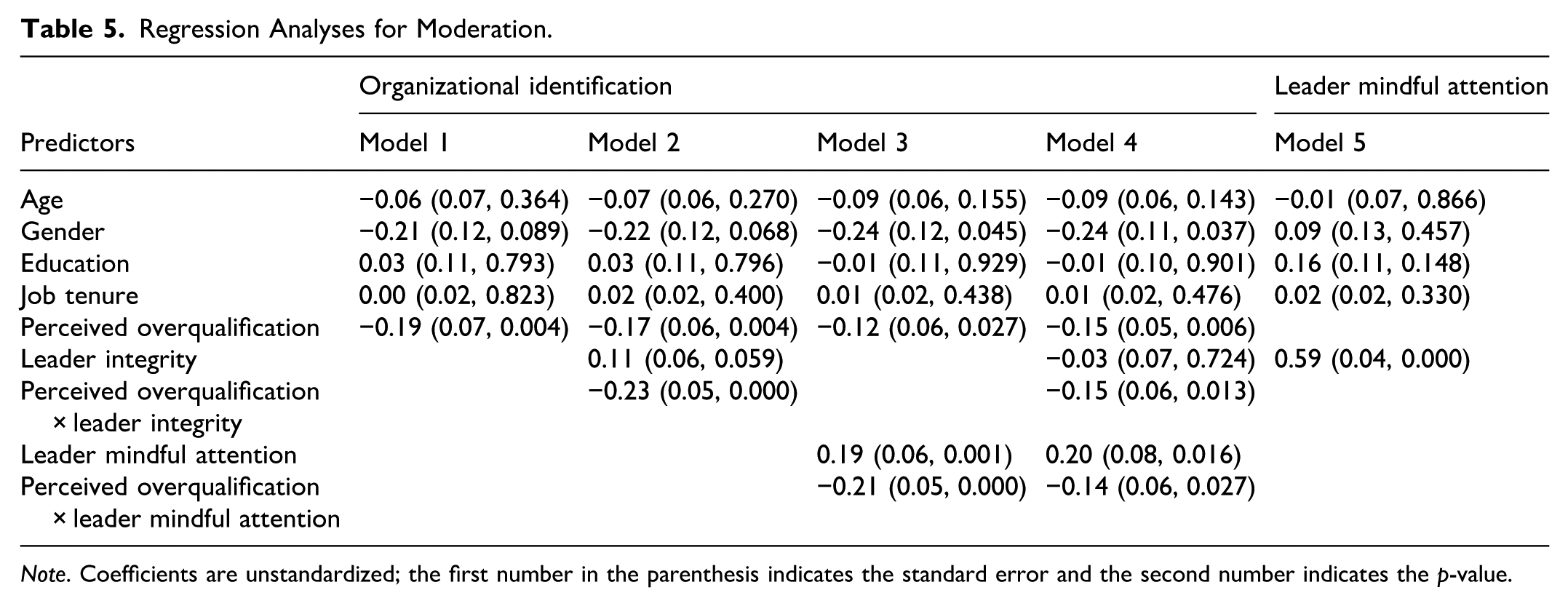
Although all the variables in this study were at the employee level, due to the nested relationship between employees and leaders, in order to make the results more rigorous, we used hierarchical linear modeling (HLM) for the regression analysis of moderation, and the results were presented in Table 5. Consistent with H1, Model 1 indicated that perceived overqualification was negatively related to organizational identification (γ = −.19, p < .01). As shown in Model 2, the interaction term of perceived overqualification and leader integrity was negatively related to organizational identification (γ = −.23, p < .001), which supported H2. To demonstrate the moderating effects of leader integrity, we drew the corresponding simple slope plot (see Figure 2). When leader integrity was high, perceived overqualification had a stronger negative effect on organizational identification (γ = −.40, p < .001). In the case of low leader integrity, the relationship between perceived overqualification and organizational identification was not significant (γ = .06, p = .401). Therefore, H2 was further supported.
Regression Analyses for Moderation.
Note. Coefficients are unstandardized; the first number in the parenthesis indicates the standard error and the second number indicates the p-value.

Moderating effects of leader integrity.
Supporting H3, leader integrity was found to be positively correlated with leader mindful attention (γ = .59, p < .001, Model 5). On the basis of Model 3, perceived overqualification and leader mindful attention jointly influenced organizational identification (γ = −.21, p < .001), providing support for H4. The corresponding simple slope plot was depicted in Figure 3. In the case of high leader mindful attention, the effect of perceived overqualification on organizational identification became stronger (γ = −.33, p < .001). On the contrary, perceived overqualification had a non-significant positive influence on organizational identification when leader mindful attention was low (γ = .08, p = .296). These results also supported H4. According to Model 4, after considering the moderating roles of leader integrity and mindful attention together, the former exhibited a decrease in significance (γ = −.15, p < .05) while the latter was still significant (γ = −.14, p < .05). Thus, H5 was supported. To further verify the mediated moderation effect, we performed a Monte Carlo-based simulation with 10,000 repetitions to estimate confidence intervals and obtained supporting results (indirect effect = −0.09, 95% CI = [−0.165, −0.010]).

Moderating effects of leader mindful attention.
In line with H6, organizational identification was positively related to proactive customer service performance (γ = .20, p < .01). To test the moderated indirect effect of leader integrity and mindful attention, the bootstrap method with 5,000 repeated samplings and 95% confidence interval was used for analysis. The results in Table 6 revealed that the indirect influence of perceived overqualification on proactive customer service performance through organizational identification was negative at a high level of leader integrity (indirect effect = −0.09, 95% CI = [−0.176, −0.015]) but became non-significant when leader integrity was low (indirect effect = 0.02, 95% CI = [−0.024, 0.063]). Besides, the difference between the two situations was significant (indirect effect = −0.11, 95% CI = [−0.210, −0.017]). Similarly, when leader mindful attention was high, the indirect effect of perceived overqualification on proactive customer service performance through organizational identification was negative (indirect effect = −0.06, 95% CI = [−0.131, −0.009]) but became not significant in the case of low leader mindful attention (indirect effect = 0.02, 95% CI = [−0.018, 0.074]). Moreover, the difference between the two conditions was significant (indirect effect = −0.08, 95% CI = [−0.179, −0.010]). Thus, H7a–b received support.
Moderated Mediation Results.

Discussion
Based on social identity theory and social cognitive theory, this study explored the mediating role of organizational identification in the relationship between perceived overqualification and proactive customer service performance, as well as the moderating role of leader integrity via leader mindful attention in the above relationship. Empirical analyses of two-wave, two-source data from 204 employees and 90 leaders indicated that perceived overqualification negatively affected organizational identification, and leader integrity reinforced this relationship through leader mindful attention. In addition, organizational identification was positively related to proactive customer service performance, and the mediating effect of organizational identification was stronger when leader integrity and mindful attention were high.
Although the moderating effects of leader integrity and mindful attention are supported, their counterintuitive nature requires further clarification. First, the benefits of integrity and mindful attention in leadership are undeniable (Crucke et al., 2022; Harvey & Kudesia, 2023). High integrity in leadership helps foster a consistent climate, while high mindfulness in leadership creates a considerate and attentive work environment. In such environments, employees should not only be treated fairly but also have their concerns properly addressed. However, overqualified employees are not assigned to suitable positions, and are more likely to notice the discrepancy and mismatches between themselves and their environment. According to social identity theory (Ashforth & Mael, 1989), this discrepancy makes overqualified employees less likely to identify as members of the organization, thereby further diminishing their organizational identification and inhibiting their proactive customer service performance.
Theoretical Contributions
First, we enrich the behavioral outcomes of perceived overqualification. Previous research has uncovered that employee perceived overqualification can affect their work behaviors. For example, employees who feel overqualified are less likely to exhibit innovation behavior (Fan et al., 2023) and organizational citizenship behaviors targeting others (Erdogan, Karaeminogullari, et al., 2020). However, these studies have focused primarily on the behaviors of such employees within the organization, but have neglected their behaviors outside the organization (e.g., toward customers). Indeed, as a group that directly serve customers, employees’ perceived overqualification significantly influences how they treat customers (Jang et al., 2020). Our findings indicate that perceived overqualification negatively impacts proactive customer service performance, thereby extending the literature on the behavioral outcomes of overqualification to external stakeholders.
Besides, we extend research on the mediating mechanisms between perceived overqualification and work behavior from a social identity perspective. While prior research has established career and relational identification as key mediators (C. Ma et al., 2020; Wu et al., 2023), social identity theory posits that individuals derive identity from multiple sources, including their organization (Ashforth & Mael, 1989). Organizational identification significantly influences how employees perceive their duties and subsequently act (Piening et al., 2020; Sharma et al., 2023). Our findings confirm that organizational identification mediates the relationship between perceived overqualification and proactive customer service performance. This offers a new perspective on how overqualification influences employees’ identifications and, ultimately, their work behaviors.
In addition, we broaden the boundary conditions that influence the effect of perceived overqualification. Research suggests that the negative effects of perceived overqualification can be moderated by individual-level (Schreurs et al., 2021) and team-level (Wu et al., 2023) factors. Yet, the role of leaders remains under-explored. Given that the environment shapes organizational identification (Ashforth & Mael, 1989), scholars emphasize examining how leaders, as key representatives, influence the linkage between perceived overqualification and work attitudes (Erdogan, Karakitapoglu-Aygün, et al., 2020). Our study addresses this gap by demonstrating that leader integrity and mindful attention moderate the effect of perceived overqualification on organizational identification. This enhances our understanding of the contingent impact of leader-level factors on employees’ perceived overqualification.
Finally, we reveal the moderating role of leader integrity in the effect of perceived overqualification. Although previous studies have demonstrated that leaders’ integrity can exert a direct moderating effect (e.g., Chen et al., 2024), a few scholars suggest that examining the impact of leader integrity on themselves may help elucidate its moderating mechanism (Nawaz et al., 2023). Indeed, according to social cognitive theory, individuals’ internal standards significantly influence how they allocate their attention and manage their actions (Bandura, 1986; Farasat & Azam, 2022). Our findings indicate that leader mindful attention mediates the moderating effect of leader integrity, which contributes to the leader integrity literature and enlarges its nomological network.
Practical Implications
From a practical perspective, the findings of this study provide critical insights into how organizations can motivate proactive customer service performance. First, organizations could conduct regular, future-focused career conversations to understand employees’ aspirations and examine if their capabilities exceed their current scope (Duan et al., 2022). Second, if a significant gap exists between their competencies and the role requirements, managers can take corrective actions by delegating developmental assignments, offering mentorship opportunities, or enabling cross-functional project involvement to fully utilize their expertise. Finally, organizations could properly adopt the reward mechanisms; this includes adjusting salary bands for mastering complex skills and granting discretionary bonuses for exceptional contributions (Dar et al., 2022).
Moreover, given the positive impact of organizational identification on proactive customer service performance, enhancing employees’ organizational identification will also be helpful. For instance, organizations can host quarterly, goal-driven team-building exercises that align individual contributions with the organization’s mission (C. J. Wang, 2024). Concurrently, managers can establish a structured feedback system through a digital suggestion platform and ensure that employee insights are integrated into operational decisions, fostering a tangible sense of ownership in the organization’s direction and growth (Lo Presti et al., 2024).
Additionally, while leader integrity and mindful attention may reinforce the negative impact of perceived overqualification on proactive customer service performance through organizational identification, we do not recommend mitigating such effect by decreasing leader integrity and mindful attention that are generally acknowledged to be beneficial to the organization (e.g., Crucke et al., 2022; Harvey & Kudesia, 2023). Instead, organizations need to first assess the level of perceived overqualification. When perceived overqualification is high, organizations could implement targeted development programs (e.g., personalized coaching modules, leader-member exchange workshops, and empathy-building seminars) that explicitly train their leaders in inspiring employee growth and providing individualized support (Z. Q. Liu et al., 2024).
When perceived overqualification is low, high leader integrity and mindful attention will be useful. Organizations can foster leader integrity by embedding ethical testing within the selection process to assess consistency between expressed values and actual conduct (Erkutlu & Chafra, 2020). To enhance leaders’ mindful attention, organizations should implement regular mindfulness training programs that incorporate meditation techniques tailored to leadership contexts, complemented by post-session reflective journaling (Zhou et al., 2023).
Limitations and Future Prospects
It should be noted that this study has some limitations. For example, although we adopted a multi-wave and multi-source research design, it was still not a good way to infer the causal relationship between variables, which can be verified by future research through longitudinal studies or experimental methods. Moreover, our research was conducted only in China, yet whether our findings can be generalized to other countries for the globally prevalent phenomenon of perceived overqualification (Erdogan, Karakitapoglu-Aygün, et al., 2020) needs to be further examined (Hussain et al., 2023). In addition, we did not explore the boundary conditions between organizational identification and proactive customer service performance, but customer factors such as customer compliments (Lv et al., 2024) may enhance this relationship, which need to be tested in future studies.
Fourth, given that our sample came from a single company and we had no access to data on the frequency of employee-customer interactions, we were unable to control for the potential influence of industry type (Hussain et al., 2020; Hussain, Wang, et al., 2022) and customer interaction frequency. Future research could collect data across multiple industries (Hussain, Maqbool, et al., 2022) and measure customer interaction frequency to better understand the above relationship.
Finally, although our analysis indicated that common method bias was not a serious issue, we acknowledge the potential for social desirability bias. This is particularly relevant given the cultural and organizational context of the surveyed Chinese trade company, where employees evaluated all variables except proactive customer service performance. Future research can control for social desirability to eliminate its potential influence on the results.
Footnotes

Ethical Considerations
All procedures performed in studies involving human participants were in accordance with the ethical standards of the institutional and/or national research committee and with the 1964 Helsinki declaration and its later amendments or comparable ethical standards.
Consent to Participate
Informed consent was obtained from all individual participants included in the study.
Author Contributions
Q.X.: Conceptualization, Data curation, Funding acquisition, Investigation, Methodology, Resources, Writing—review & editing. H.H.: Conceptualization, Data curation, Formal analysis, Investigation, Methodology, Software, Visualization, Writing—original draft, Writing—review & editing. S.Z.: Funding acquisition, Project administration, Supervision, Writing—review & editing. H.L.: Funding acquisition, Supervision, Writing—review & editing.
Funding
The authors disclosed receipt of the following financial support for the research, authorship, and/or publication of this article: This research received grants from the National Natural Science Foundation of China (No. 72342027, 72272032), the Humanities and Social Science Fund of Ministry of Education (No. 23YJA630110), and the Social Science Foundation of Jiangsu Province (No. 24GLB009).
Declaration of Conflicting Interests
The authors declared no potential conflicts of interest with respect to the research, authorship, and/or publication of this article.
Data Availability Statement
The data that support the findings of this study are available on request from the corresponding author*.