



Abstract
The study aimed to investigate the main effect of leader humility on job crafting and the potential three-way interaction effect between leader humility, trust in leaders, and gender on job crafting. Data were collected from 158 employees in two organizations in South Korea. In order to analyze the proposed hypotheses, we used hierarchical regression analysis and PROCESS macro (Model 3) in SPSS with 5,000 bootstrap samples. The results revealed that leader humility influences job crafting, and the impact of leader humility on task crafting depends on the level of trust. In particular, higher trust between a leader and employee indicates a more positive relationship between leader humility and the employee’s task crafting behaviors. Furthermore, a moderated moderation effect was discovered of gender on the two-way interaction effect. The results of this study highlight that leader humility plays an important role for employees’ job crafting behavior particularly when they have highly trusting relationships with their leaders. In addition, this study provides a comprehensive understanding of leader humility’s effect on job crafting by investigating the role of gender.
As business environments have become increasingly unpredictable and the nature of work boundless and complex, employees are asked to be proactive and self-directed agents who can redefine and create their jobs rather than be passive recipients of their work (Wrzesniewski & Dutton, 2001). In this regard, the research on job crafting, which represents employees’ proactive behaviors in actively transforming the boundaries of the task and relationship, has received significant attention from scholars over the past decade. Previous studies have shown that job crafting behaviors are positively associated with organizational and individual outcomes, such as work engagement (Frederick & VanderWeele, 2020; Tims et al., 2015b), innovative work behaviors (Khan, Mubarik, and Islam, 2021), performance (Lee & Lee, 2018; Maden-Eyiusta & Alten, 2021; Weseler & Niessen, 2016), and colleagues’ well-being (Tims et al., 2015a).
Due to the importance of job crafting, many scholars have scrutinized the factors that stimulate employees’ job crafting behavior in the workplace (Rudolph et al., 2017). In particular, several scholar have insisted that leaders’ behaviors and attitudes are one of the important factors affecting employees’ job crafting behavior (Bizzi, 2017; Kim & Beehr, 2020; Oprea et al., 2020; Zhang & Parker, 2019). Notwithstanding that job crafting is self-initiated and features bottom-up change, leaders also play an important role in employee job crafting behaviors because leaders empower and inspire employees to craft jobs and are responsible for allocating and controlling resources in the workplace. Prior studies have indicated a positive relationship between transformational leadership (Hetland et al., 2018), empowering leadership (Kim & Beehr, 2018), and servant leadership (Bavik et al., 2017; Khan, Mubarik, Islam, et al., 2021) and job crafting.
However, little attention has been paid to the role of leader humility in employees’ job crafting. Unlike dominant leadership styles, leader humility is defined as bottom-up leadership that places much more emphasis on subordinates’ growth and development. According to Owens et al. (2013), leader humility is defined as an interpersonal characteristic manifested by (a) the willingness to perceive oneself accurately, (b) an appreciation of the strengths and contributions of others, and (c) openness to learning new ideas and feedback from others. Thus, humble leaders view themselves more objectively, appreciate others’ contributions, and are open to new information or ideas (Owens & Hekman, 2012). This study proposes that leader humility influences employees’ job crafting, drawing on attachment theory (Bouwlby, 1982). Attachment theory explains how employees’ perception of leader support influences employees’ exploration behaviors. Humble leaders tend to appreciate employees’ work contributions and are open to considering their opinions and advice, thereby encouraging and supporting them to take proactive action at work (Owens et al., 2013). Thus, employees with humble leaders may easily craft their jobs.
Furthermore, this study explores the boundary effect of trust and gender in the relationship between leader humility and job crafting in responding to Tims et al.’s (2021) call for research. Previous studies show that the impact of leader humility on employees’ behavior could differ depending on employees’ perception of their leaders’ behavior. As Owens and Hekman (2012) noted, a leader’s humility can be interpreted as a sign of weakness since humble behaviors, such as accepting their shortcomings and mistakes and taking advice from subordinates, are seen as ineffective behavior. However, when employees have a high level of trust in leaders’ competence and ability, the effect of leaders’ humble behavior could be stronger. In other words, trust enables employees to experience psychological safety, autonomy, and power to perform their work (Li & Tan, 2013; Seppälä et al., 2011). Therefore, trust in leaders can be a crucial boundary influencing employee job crafting behaviors.
Moreover, based on the potential interaction between trust and gender (Van Den Akker et al., 2020), this study investigates whether the interactive effect of leader humility and trust on job crafting changes depend on gender. It considers gender as a second moderator because men are more trusting of leaders than women. We suggest that women are less trusting in their leaders than men. As such, women employees are more hesitant to engage in job crafting when they have lower level of trust in leaders.
This study contributes to organizational research in several ways. First, by investigating the main effect of leader humility on three dimensions of job crafting, we respond to the call for more empirical research examining the role of leadership as an antecedent for employees’ job crafting (Lichtenthaler & Fischbach, 2018). From this study’s findings, we can better understand leader characteristics that influence employees’ job crafting behavior in an organization. Second, we examine a boundary condition of trust in leaders in the leader humility-job crafting relationship. Past studies suggest that the effect of humble leadership on employees’ behavior could be different depending on situational cues (Jeung & Yoon, 2016). Even though trust in leaders was considered as a significant factor for enhancing the effectiveness of leader humility on employees’ behavior, trust in leaders has not been explored as a boundary condition in existing empirical studies. Thus, we can deepen the understanding of the leader humility’s effect on employees’ proactive behavior such as job crafting by investigating the moderating role of trust in leaders in the relationship between leader humility and job crafting. Third, this study adopts another significant angle—gender—to analyze the relationship. Even though previous studies have shown that gender plays an important role in trusting behavior, relatively little attention was paid to gender’s role in employees’ job crafting. By exploring the role of gender, this study can provide a comprehensive understanding of leader humility’s effect on job crafting. The proposed model is presented in Figure 1.

Proposed conceptual model.
Theoretical Background and Hypotheses
Relationship Between Leader Humility and Job Crafting
Although there are various operationalizations of job crafting, there are the two most common approaches: the role-based approach (Wrzesniewski & Dutton, 2001) and the resources-based approach (Tims et al., 2012). According to the role-based approach, job crafting refers to physical and cognitive changes individuals effect on the task or relationships of their work. The resources-based approach operationalizes job crafting as changes in the level of job demands and resources (Tims et al., 2012). It incorporates four job crafting dimensions that increase structural job resources, social job resources, and challenging job demands while decreasing hindering job demands. Since the resources-based approach is limited to task and relational crafting, and does not include cognitive crafting, this study follows the role-based approach.
The role-based approach is the original conceptualization of job crafting. In their seminal study, Wrzesniewski and Dutton (2001) argued that work could be subjectively constructed based on the social construction theory and employees can craft their jobs in three different ways. First task crafting means that employees change their task boundaries by doing more or less of their work than the tasks listed in their job descriptions. For example, employees can volunteer to participate in a new project or spend less time and focus less attention on an uninteresting job. Second, relational crafting refers to changing the quantity or quality of social interactions in the workplace. Employees can decide with whom to interact and alter the interaction quality. Third, cognitive crafting is fundamentally reframing one’s work by adding personal meaning to work. For instance, a nurse can redefine her work to become a patient advocate instead of providing high-quality technical care (Wrzesniewski & Dutton, 2001).
Drawing from the attachment theory (Bouwlby, 1982), we proposed that leader humility is another bottom-up leadership style associated with job crafting. According to the attachment theory, primary caregivers early in life facilitate infants to form an attachment style which, in turn influences the development of secure relationships in their lives (Bowlby, 1982). In particular, the theory asserts that caregivers’ sensitive and responsive support foster individuals’ active exploration of new environments because it is a secure base from which they become competent in environmental interactions. While the attachment theory was originally developed to explain the relationships of infants with caregivers, the theory has been applied to understanding supervisor–subordinate relationships (Bharanitharan et al., 2019; Simmons et al., 2009) because leader–follower relationships are similar to parent–child dynamics with respect to instruction, guidance, and care (Popper & Mayseless, 2003; Wu & Parker, 2017).
Based on this theoretical framwork, we expect that humble leaders may play the role of good parents to their employees by being a supportive and reliable role model which, in turn, helps them become more proactive. More specifically, humble leaders focuse on followers’ growth and development, thereby facilitating their role expansions and modeling self-transcendence (Chen et al., 2021; Owens & Hekman, 2012). In addition, humble leaders encourage employees to proactively participate in developing new knowledge, skills, and expertise, and because they are typically open to new ideas and receptive, they help employees feel capable of challenging the status quo (Owen et al., 2013). Moreover, such leaders value difference and recognize employees’ abilities, potential, and strengths (Oc et al., 2020). Therefore, employees with humble leaders can easily extend job boundaries and cause workplace changes with proactive behaviors (i.e., task crafting).
In addition, humble leaders are good mentors and coaches for subordinates (Oc et al., 2020) because they are interested in employees’ development and indicate openness toward learning (Owen & Hekman, 2012). These attributes of humble leaders can influence the cognitive crafting of employees because leader feedback can alter their job perspectives and help them find or transform the meaning of their work (i.e., cognitive crafting). Leaders’ interpretations of work and input can shape work identity and evoke additional meaning in employees’ work. Thus, employees with humble leaders will more easily reframe their work by seeking advice and accepting others’ perspectives because humble leaders facilitate and encourage employee openness to advice and critical feedback.
Furthermore, employees of humble leaders are more likely to interact with other members of different work-related groups to gain additional resources and opportunities for collaboration (i.e., relational crafting). Humble leaders activate employees’ resource-seeking behavior by recognizing their strengths and limitations regarding knowledge, skills, and opportunities (Owens & Hekman, 2012). Therefore, this study proposed the following hypothesis:
H1: Leader humility is positively related to task crafting (H1a), cognition crafting (H1b), and relational crafting (H1c) among employees.
Moderating Role of Leader Trust
Trust in a leader is defined as “the willingness of a party to be vulnerable to the actions of another party based on the expectation that the other will perform a particular action important to the trustor, irrespective of the ability to monitor or control that other party” (Mayer et al., 1995, 712). Employees who trust their leaders assume that the leaders’ behaviors and decisions are driven by positive intentions, thus these employees are more willing to be vulnerable to the leader’s actions. Therefore, when employees trust their leader, they are more likely to feel safe, comfortable, and inclined to interpret their leaders’ behavior positively. Studies have indicated that trust in leaders plays a key role in an individual’s motivations and reactions in leader–member relationships and employee attitudes and behaviors (Dirks & Ferrin, 2002; Tan & Tan, 2000).
Drawing from the attachment theory, we expected that trust in supervisors would moderate the association between leader humility and employee job crafting. We argue that employees’ perceptions of leaders’ humble behavior are more likely to increase job crafting when they perceive leaders as trustworthy. When employees have a high level of trust in leaders, the intentions behind their supervisors’ humble behavior may be perceived positively, thereby increasing their proactive behavior, such as job crafting. Employees who trust their leader have positive expectations, perceptions, and beliefs about the leaders’ intentions and willingness to take risks, and they depend on their leaders (Legood et al., 2020). Therefore, humble leaders help employees feel safe and further extend and alter their task boundaries. Furthermore, because trusting relationships are based on emotional bonds between the trustor and trustee (McAllister, 1995), they may provide positive emotional experiences for employees. Employees who have humble leaders and trust them can easily build relationships with people within organizations. In addition, when employees are strongly connected with leaders and have faith in their positive intentions, they are more inclined to seek feedback and advice from their leaders. Therefore, employees guided by such leaders may have increased chances to reframe their work and include additional meaning in their work through feedback and advice from leaders when they have high trust in leaders.
Studies have shown that the effectiveness of leader humility depends on how employees perceive their leaders’ behaviors (Ma et al., 2019; Yuan et al., 2018). For example, Yuan et al. (2018) have shown that the relationship between leader humility and perceived organizational support was moderated by leader competence. In addition, Ma et al. (2019) indicated that leader humility enhances employees’ proactive behavior, such as using a constructive voice when employees perceive the sincerity of the leader’s humility. Therefore, the study hypothesizes that the relationship between leader humility and job crafting will be influential as employee trust in the supervisor increases.
H2: Trust in leaders will moderate the relationship between leader humility and job crafting, such that the relationship between leader humility and task crafting (H2a), cognitive crafting (H2b), and relational crafting (H2c) is stronger for individuals with a high level of trust in leaders, compared with those who have a low level of trust.
The Moderating Role of Gender
Numerous past studies have noted that trusting behavior differs among men and women (Buchan et al., 2008; Zeffane & Melhem, 2017). Although the results are mixed, many experimental studies have found that men are more trusting than women (Buchan et al., 2008; Riedl et al., 2010; Zeffane & Melhem, 2017; Van Den Akker et al., 2020). For example, Buchan et al. (2008) showed that men trust more than women, whereas women were more trustworthy toward partners in terms of investment.
According to evolutionary psychology (Trivers, 1972) and sociocultural theories (Eagly & Wood, 2016), women are more cautious and less trusting than men because they are more communal and less likely to want to destroy trusting relationships. On the other hand, men are more trusting than women because they are more actively involved and confident about gaining resources in an economic exchange. Consequently, studies have noted that men are more likely to take risks than women (Croson & Gneezy, 2009; Fischer & Hills, 2012). Croson & Gneezy (2009) found that women are more likely to be risk-averse when faced with a risky choice because they experience emotions, such as fear and nervousness, stronger than men. In addition, men are more overconfident in uncertain situations and tend to see a risky situation as a challenge, whereas women are more likely to see risky situations as threats that encourage avoidance.
Job crafting requires employees to be actively engaged in redesigning more resourceful and challenging jobs (Tims et al., 2012; Wrzesniewski & Dutton, 2001). Therefore, we believe that the influence of leader humility and trust in leaders on job crafting would be stronger for men than women. In addition, men have more trust in leaders than women, allowing them to evaluate the leader’s humble behavior positively. Therefore, when male employees have high trust in leaders, the effect of leader humility on job crafting will increase. However, women are more cautious and less trusting than men, so the effect of the leaders’ humble behavior on their behavior would be weaker, regardless of the level of trust. Therefore, this study suggests that gender moderates the two-way interaction effect of leader humility and trust in leaders on job crafting.
H3: Gender moderates the two-way interaction effect of leader humility and trust in leaders on task crafting (H3a), cognitive crafting (H3b), and relational crafting (H3c), such that the moderating effect of trust is stronger among female employees compared with male employees.
Method
Research Setting and Participants
We conducted a survey study to test our hypotheses. Participants were recruited from two large public organizations in South Korea. One organization is in the energy sector and the other is in the HR training service sector. We used a convenient sampling technique for this study. The first author contacted HR managers of each organization and the managers distributed paper-based questionnaire to office workers. Participants were informed that their participation was voluntary and their answers would remain anonymous. A total of 165 participants from two companies filled out the questionnaire and send it to HR managers in each company. The researcher went to each organization to collect the completed questionnaires a week after they were distributed.
Out of 165 completed questionnaires (130 from one and 35 from the other), 158 responses (125 from one company and 33 from the other) were acceptable for further analysis. Respondents consisted of 105 male (66.9%) and 52 female employees (33.1%) (one employee did not respond to the gender question). The majority of respondents possessed a bachelor’s degree (n = 116, 73.4%), followed by high school (n = 30, 19.0%), community college (n = 6, 3.8%), and master’s degrees (n = 5, 3.2%). The average age of respondents was 32.1 years (SD = 5.70). The average tenure in the current organization was 4.8 years (SD = 4.11).
Measures
The items were measured using a 5-point Likert scale, ranging from 1 (strongly disagree) to 5 (strongly agree). A forward–backward translation procedure was employed because the original questionnaires were developed in English (Behling & Law, 2000).
Leader Humility
Nine items developed by Owens et al. (2013) were used to measure employee perceptions regarding the humility of their immediate supervisors. Leader humility comprises three subdimensions: willingness to perceive oneself accurately, appreciating others’ strengths, and teachability. These subdivisions contain three items. Sample items included “This person actively seeks feedback, even if it is critical,”“My direct supervisor takes notice of others’ strengths,” and “My direct supervisor is willing to learn from others.” The Cronbach’s alpha for this scale was .95.
Trust
Eleven items developed and validated by McAllister (1995) were used to measure trust in supervisors. The measure consists of two subdimensions: affect-based trust (five items) and cognition-based trust (six items). A sample item for affect-based trust was, “We have a sharing relationship. We can both freely share our ideas, feelings, and hopes.” A sample item for cognition-based trust was “My supervisor approaches their job with professionalism and dedication.” The Cronbach’s alpha for this scale was .97.
Job Crafting
The Korean version of the job crafting questionnaire (JCQ-K) (Lim et al., 2014) was used for assessing job crafting. The original version of the JCQ, which contained 15 items, was developed and validated by Slemp and Vella-Brodrick (2013). A sample item of task crafting was “I introduce new approaches to improve my work.” A sample item for cognitive crafting was “I think about how my job gives my life purpose.” Moreover, a sample item for relational crafting was “I make friends with people at work who have similar skills or interests.” The Cronbach’s alpha values for task, relational, and cognitive crafting were .80, .85, and .83, respectively.
Gender
Gender was measured as a binary variable (0 = female, 1 = male).
Control Variables
The study controlled for age (in years) and tenure with the organizations (in months) because previous studies have shown that these variables were associated with job crafting (Akkermans & Tims, 2017; Tims et al., 2013).
Results
Descriptive Statistics and Correlations
Table 1 shows the means, standard deviations, and correlations of the study variables. As can be seen in Table 1, leader humility was significantly and positively associated with all types of job crafting (r = .24−.48). Trust in a leader was also significantly and positively related to the three types of job crafting (r = .28−.44). Gender was only positively related to relational crafting (r = .24).
Means, Standard Deviations and Correlations for All Variables (N = 109).
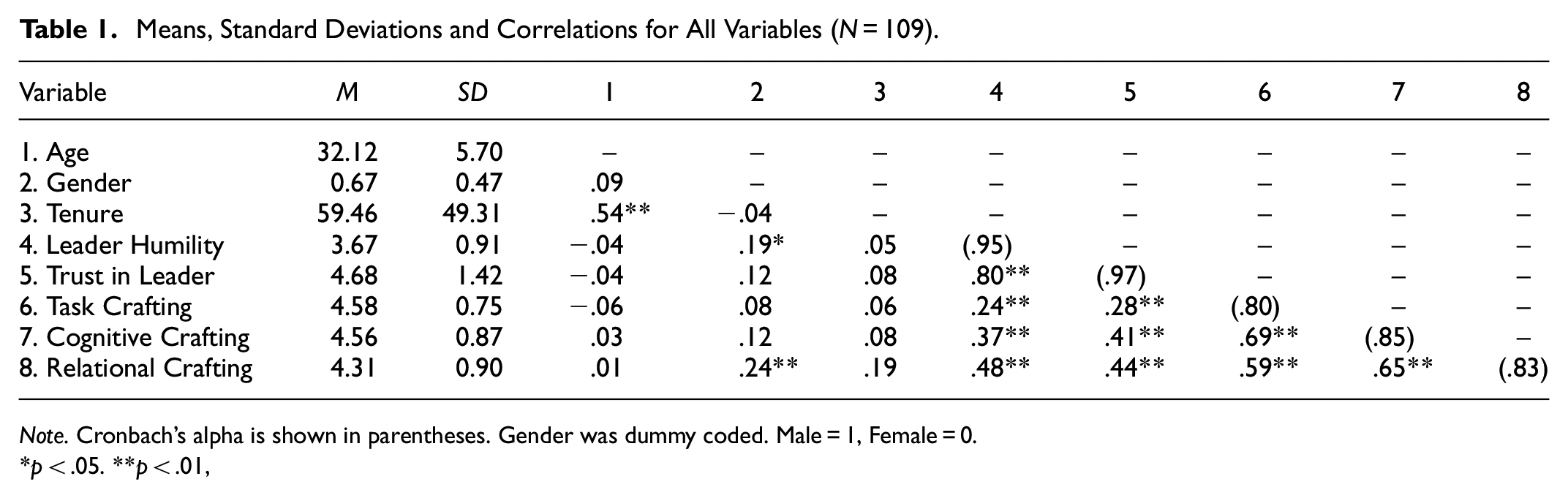
Note. Cronbach’s alpha is shown in parentheses. Gender was dummy coded. Male = 1, Female = 0.
p < .05. **p < .01,
Test of Measurement Model
Preiliminary analysis using SPSS 22.0 was conducted. We handled the outliers and missing data (<.1%) with the mean imputation. To determine the presence of common method bias, Harman’s single-factor analysis was conducted (Podsakoff et al., 2003). The results showed that 43.91% variance of the total variance was explained by a single factor, which was less than the cut-off value of 50%. Thus, common method bias was not a serious issue here. We also performed a full collinearity test to examine whether predictor variables along with a criterion variable are mutually collinear (Kock, 2015). The results showed that variance inflation factor (VIF) values range between 2.09 and 2.95, which are below the threshold 3.3 (Kock, 2015) and we confirmed that CMV is not a significant issue.
A series of confirmatory factor analyses were conducted by structural equation modeling, using AMOS 21, to test the discriminant validity of variables (leader humility, trust in leader, and three dimensions of job crafting). Leader humility (represented by three componenets including the willingness to see oneself accurately, appreciation of employees’ strengths and contributions, and teachability) and trust in the leader (represented by two components such as affect-based trust and cognition-based trust) are conceptualized as a second-order construct. The chi-square test (χ2), the comparative fit index (CFI), the Tucker-Lewis Index (TLI), and the root mean square error of approximation (RMSEA) were used to evaluate the model fit.
The five-factor model showed reasonable fit to the data, χ2 (160) = 407.83, CFI = .88, TLI = .86, RMSEA = .10. Although the standardized factor loadings of each item ranged between .54 and .99 (p < .001), one item from task crafting (item 5 = 0.47) was less than .5. Therefore, this item was deleted and excluded from the analysis (Hair et al., 2010), and the measurement model was reiterated. As presented in Table 2, the hypothesized five-factor model fits the data well, χ2 (144) = 313.15, CFI = .91, TLI = .90, RMSEA = .09. Compared to other alternative models, the hypothesis model fits the data better than the four-, three-, two-, and one-factor models. Thus, all the study variables were distinct.
Results of the Confirmatory Factor Analysis.

Note. CFI = Comparative Fit Index; TLI = Tucker Lewis Index; RMSEA = root-mean-square residual.
Hypothesized model: five factor model (leader humility, trust in leader, task crafting, cognitive crafting, and relational crafting).
Model 1: Four factor model combining leader humility and trust in leader as a single factor.
Model 2: Three factor model combining task crafting, cognitive crafting, and relational crafting as a single factor.
Model 3: Two factor model combining leader humility and trust in leader as a single factor; combining task crafting, cognitive crafting, and relational crafting as a single factor.
Model 4: One factor model combining all variables.
p < .01
Hypothesis Testing
This study used separate hierarchical regression analyses to test the main effects of leader humility (H1a, H1b, and H1c), the moderating role of trust (H2a, H2b, and H2c), and gender (H3a, H3b, and H3c) on the relationships among leader humility and the three dimensions of job crafting. Prior to analysis, independent variables and moderators were centered on reducing the multicollinearity among variables (Aiken & West, 1991). Table 3 presented the regression results. Two control variables (age and tenure) were included in all analyses, and none were significant.
Results of Hierarchical Regression.

Note. All regression coefficients are unstandardized; numbers in parentheses are standard errors; LH = Leader humility; T = trust in leader, G = gender; Gender is dummy-coded as male = 0, female = 1; tenure is month.
p < .001. **p < .01. *p < .05. †p < .1.
H1 posited that leader humility was positively related to the three dimensions of job crafting. As shown in Table 3 (step 1), leader humility was positively associated to task crafting (b = 0.21, p < .01), cognitive crafting (b = 0.35, p < .01.), and relational crafting (b = 0.47, p < .01). Thus, H1a, H1b, and H1c were supported.
H2 posited that trust in a leader moderates the relationship between leader humility and the three dimensions of job crafting, such that the relationship is stronger when trust in a leader is high. As presented in Table 3 (step 3), the interaction effects of trust in leaders and leader humility on task crafting was significant (b = 0.14, p < .01), thereby supporting H2a. However, the interaction effects of trust in the leader and leader humility on cognitive crafting (b = 0.05, n.s.) and relational crafting (b = 0.04, n.s.) were not significant. Thus, H2b and H2c were not supported. Simple slope tests were conducted, and the interaction effect was plotted (Figure 2) to explore the nature of the interaction effect of trust in leaders and leader humility on task crafting. It was observed that the relationship between leader humility and task crafting was stronger for employees with high levels of trust in leaders (slope = 0.32, t = 2.34, p < .05). However, for employees with low levels of trust in leaders, the relationship between leader humility and task crafting was not significant (slope = −0.04, t = −0.41, p = .69). Thus, H2a was supported.

Two-way interaction between leader humility and trust in leaders on task crafting.
H3 predicted that a three-way interactive relationship, such that leader humility, trust in leaders, and gender will jointly relate with job crafting, whereby the relationship between leader humility and job crafting is stronger for male employees with high levels of trust in leaders than female employees. As presented in Table 3 (step 4), the three-way interaction effect of leader humility, trust in leader, and gender on task crafting (H3a) was significant in the expected direction (b = −0.23, p < .05). However, the three-way interaction effect of leader humility, trust in leader, and gender on cognitive crafting (b = 0.09, p > .05) and relational crafting was nonsignificant (b = −0.16, p > .05). Therefore, H3b and H3c were not supported.
The PROCESS macro was also used to further identify the three-way interaction, thereby evaluating whether the interaction between leader humility and trust in leaders on job crafting differed depending on the gender of employees. According to the analyses, the conditional interaction between leader humility and trust in leaders was significant for male employees (b = 0.09, p < .05) and female employees (b = 0.31, p < .01). More specifically, we examined the conditional effects of leader humility on job crafting when trust in leaders was one standard deviation below the mean (low), at the mean (average), and one standard deviation above the mean (high). As presented in Table 4, under conditions of high trust in leaders, leader humility was positively associated with task crafting for male, b = 0.35, SE = 0.15, 95% CI [0.05, 0.65]. However, leader humility was not associated with task crafting for males under average conditions, b = 0.22, SE = 0.12, 95% CI [−0.02, 0.46], and low trust in leaders, b = 0.09, SE = 0.11, 95% CI [−0.13, 0.32]. For female employees, leader humility was negatively associated with task crafting under conditions of low trust in leaders, b = −0.79, SE = 0.25, 95% CI [−1.29, −0.29]). However, leader humility was not associated with task crafting for females under conditions of average, b = −0.35, SE = 0.24, 95% CI [−0.83, 0.13], and high trust in leaders, b = 0.08, SE = 0.29, 95% CI [−0.50, 0.66]. The three-way interaction in Figure 3 was also plotted.
Conditional Effects of Leader Humility on Task Crafting at Vales of the Moderators.

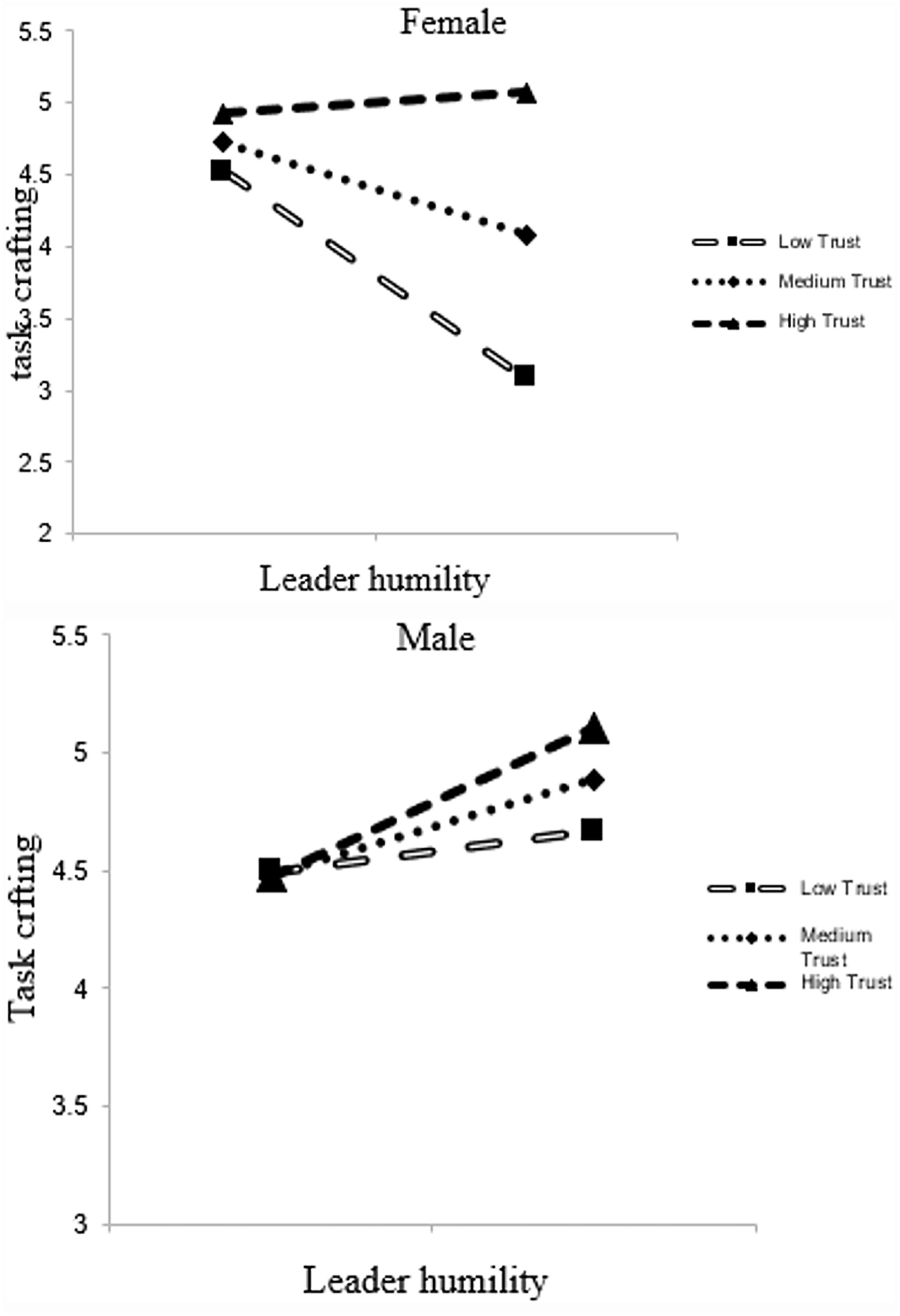
Three-way interaction among leader humility, trust in leaders, and gender on task crafting.
Discussion
This study found that employees’ perception of their leaders’ humility influences their job crafting behavior, particularly when they perceive their leaders as trustworthy. Higher trust between a leader and employee indicates a more positive relationship between leader humility and the employee’s task crafting behaviors. In particular, this study revealed that the two-way interaction of leader humility and trust in leaders on task crafting was moderated by employees’ gender. In other words, male employees significantly enhance job crafting behaviors when they have high-trusting relationships with humble leaders. However, female employees reduce their task crafting behaviors when they have low-trusting relationships with their leaders, even though the leaders demonstrate leader humility.
Theoretical Implications
Theoretically, this study contributes to existing knowledge of job crafting research and leader humility in several ways. First, drawing on the attachment theory, this study contributes to job crafting literature as it empirically demonstrates the relationship between leader humility and three dimensions of job crafting: task, cognitive, and relational crafting. This finding is consistent with previous studies that found leader humility influences employees’ proactive behaviors (Ding et al., 2020; Luu, 2020, 2021). Leaders with humility are usually open to new ideas and have receptive minds (Owens et al., 2013; Tangney, 2000). Furthermore, humble leaders value difference and recognize employees’ ability, potential, and strength (Oc et al., 2020); they tend to encourage employees to try new things, think differently and extend workplace relationships. Under this kind of leadership, employees can easily extend job boundaries and social relationships and enact change.
Second, this study suggested trust as a moderator in the relationship between leader humility and task crafting. Previous studies suggest that the effect of humble leadership on employees’ behavior may differ depending on situational cues (Jeung & Yoon, 2016). Although studies in humility have emphasized the key role of trust (Owens & Hekman, 2012), only a few studies have examined trust in leaders as a moderator in humility research. This study revealed that the relationship between leader humility and task crafting was stronger when employees have high-trusting relationships with their leaders. Thus, it was confirmed that trust plays a key role as a moderator in the relationship between leader humility and task crafting. However, similar results were not noted in two other dimensions of job crafting (i.e., relational and cognitive crafting). The perception of leaders and employees’ relationships with them may strongly impact task crafting instead of relational or cognitive crafting, particularly when they have a high level of trust. This situation may arise when employees perceive task crafting as relatively high risk-taking behaviors than cognitive and relational crafting. Therefore, trust in leaders plays a crucial role in fostering task crafting. This results are consistent with the results of Berg et al. (2008), which also argued that trust in leaders enables employees to feel comfortable to take risks and provides opportunities to craft their task-related aspect of the job.
Thrid, this paper contributes to the relevant literature by providing new knowledge regarding the role of gender-related differences in job crafting. Studies have shown contradictory results regarding gender differences in job crafting. Some show that gender is not significantly related to job crafting (Bacaksiz et al., 2017; Nagy et al., 2019), while others have noted a significant relationship between the two (Akkermans & Tims, 2017). Further, a meta-analysis (Rudolph et al., 2017) found small significant gender differences in job crafting. The study results have indicated that the interaction effect of leader humility and trust on task job crafting was moderated by gender. Male employees significantly enhance job crafting behaviors when they have high-trusting relationships with humble leaders. However, female employees reduce their task crafting behaviors when they have low-trusting relationships with their leaders, although the leaders demonstrate leader humility. Studies have revealed that women are less trusting (Buchan et al., 2008; Irwin et al., 2015) and more risk-averse (Croson & Gneezy, 2009) than men. Task crafting can be a risky decision for employees because employees should put their personal (e.g., physical, psychological, or social) resources to extend their work boundaries or make changes within their jobs. Moreover, leaders and colleagues may not welcome job crafting behavior because the proactive behaviors may generate unexpected changes in the work process. Therefore, it would be more difficult for female employees with humble leaders when they experience low trust in their leaders. However, male employees with humble leaders will increase task crafting when they have higher trust in their leaders.
Practical Implications
This study also offers practical implications for leaders, HR managers and policy makers. First, the findings of this study demonstrated that employees’ perception of leader humility promotes proactive behavior such as job crafting. Therefore, organizations should let leaders know the importance of humble behavior and encourage them to facilitate employees to more actively engage in crafting their jobs. Even though humility is a personal trait, organizations can help leaders enhance humble behaviors by offering diverse leadership training and development programs that nurture leaders’ humble attributes, such as self-awareness, appreciation of others’ strengths and contributions, and openness to new ideas and feedback. Providing opportunities for self-reflection can also help leaders perceive themselves accurately and be aware of their weaknesses and strengths (Matsuo, 2021).
Moreover, the results indicated that employees are more likely to extend their work boundaries and attempt new ideas when a high-trusting relationship has been established with managers. Accordingly, it is important for leaders to build trusting relationships with their employees and show their vulnerability with their followers. As Soderberg and Romney (2021) suggested, enhanced communication skills such as providing feedback, asking and encouraging questions, active listening, and demonstrating kindness and politeness to others may help leaders to build trusting relationships with employees. Therefore, HR managers should help leaders to enhance their communication skills to strengthen subordinate trust.
In particular, this study’s findings revealed that building trusting relationships is particularly important for female employees, as they reacting more sensitively to leaders’ behaviors when they experience low trust. Therefore, leaders need to pay more attention to how they can develop mutual trust with female employees and and also how to not betray trust. Giving more chances for female employees to be actively involved in decision-making processes may help to build trusting relationships. This can be especially important to organizations and departments with a large number of female followers. Accordingly, HR managers and HR policy makers in organizations with a large number of female employees should consider promoting practices encouraging female employees build trustful relationships with their leaders.
Limitations and Future Research
Like other studies, this study has limitations. First, it used cross-sectional data. Although the conceptual model was carefully developed based on theories and previous research, causal inference cannot be produced. Second, self-reported data from employees was used, which may cause a common method variance. Therefore, future studies may consider using multiple-source data and apply longitudinal design to avoid the previously mentioned limitations. Third, because data were collected from South Korea, which is characterized by a high power distance, caution should be exercised in generalizing the findings. It is recommended that future researchers should test this model in other Asian and Western countries to increase the generalizability of these findings. Furthremore, studies have indicated that leader humility is more acceptable and effective in low-power distance cultures (Peterson & Seligman, 2004); therefore, comparative studies between low- and high-power distance cultures may provide interesting insights into the cultural effect on the perception of leader humility and proactive behavior by employees. Finally, this study used convenient sampling. Although this sampling method has been widely used in various academic fields, the participants recruited for our study may not be representative of the general population of South Korean employees. Hence, a more sophisticated sampling technique should be considered for any future study. Furthremore, due to the small sample size from two public organizations, readers should be careful when they generalize the findings of this study to other contexts. Therefore, future researchers should consider using a larger sample from various types of organizations and industries.
Footnotes
Declaration of Conflicting Interests
The author(s) declared no potential conflicts of interest with respect to the research, authorship, and/or publication of this article.
Funding
The author(s) received no financial support for the research, authorship, and/or publication of this article.
