




Abstract
This study analyzes the relationship between employee’s perceptions of exploitative leadership and their vertical knowledge withholding and the mediating roles of employee’s perception of job insecurity, organizational injustice, and hostile attribution bias. A time lag study was conducted to test hypotheses by data collection in three phases from the 402 employees working in three service sectors (i.e., banking, telecommunication, and higher education) of Pakistan. Results of statistical analysis showed that (i) employees who experience high levels of exploitation from leaders are more likely to withhold knowledge; (ii) exploitative leadership has a significant influence on hostile attribution bias, perceived job insecurity, organizational injustice; (iii) perceived job insecurity and perceived organization injustice function as strong mediators between the relationship of exploitative leadership and vertical knowledge withholding; and, (iv) hostile attribution bias acts as a strong mediator between exploitative leadership and perceived job insecurity. This study explains the connection between employees’ perceptions of exploitative leadership and resultant knowledge withholding tendency, with specific consideration of individual and organizational factors to explain this process. The organizations should develop a culture within the organization that discourages knowledge withholding practices and motivates positive leader-employee relationships.
Keywords
Introduction
Ever since organizations are becoming knowledgeable, leadership has been considered a pivotal factor in organizational success and change (Hussain et al., 2018). The dark side of leadership has been the focus of attention for many decades (Guo et al., 2020). The diverse range of negative leadership behaviors studied, includes petty tyranny (Ashforth, 1994), abusive leadership (Valle et al., 2019), despotic leadership (De Hoogh & Den Hartog, 2008), and a relatively new concept of hubristic leadership (Sadler-Smith et al., 2019). However, the role of exploitative leadership, focusing on the toxicity attached to self-interest and resultant destructive ability, is still understudied (Schmid et al., 2019). An exploitative leader focuses on self-interest by manipulating and exploitation of the interests of others around (Schmid et al., 2019). The obvious outcomes of exploitative leadership like an imbalance in social exchange perceptions (Pircher Verdorfer et al., 2019), increased turnover intentions, burnout, and workplace deviance (Schmid et al., 2018, 2019) have already been studied. However, little did we know how and why exploitative leadership behaviors may lead to vertical knowledge withholding (VKW). A recent study conducted by Guo et al. (2020) focused on the role of psychological distress in predicting vertical knowledge withholding behaviors, concluding that the indirect impact of exploitative leadership (EL) and knowledge withholding through psychological distress is stronger when there are high levels of hostile attribution bias. When leaders refrain from sharing some useful information with their followers or vice versa, they are involved in vertical knowledge withholding (Connelly et al., 2012). The importance of knowledge sharing and leadership roles calls for comprehensive research. Hence, this study focuses on how exploitative leadership predicts vertical knowledge withholding with a mediating role of perceived job insecurity (PJI), perceived organizational injustice (POI), and hostile attribution bias (HAB).
Based on the concept presented by displaced aggression theory, it is assumed that whenever a threat is felt in the form of manipulation and exploitation, the targets try to behave aggressively and vent it out toward others around. They sometimes try to withhold information that may be critical for goal achievement (Srivastava et al., 2006). Social exchange theory also explains that cost and benefit analysis occur when two parties involved have something of value to each other. When individuals face exploitative leadership behaviors at work, they tend to behave defensively and analyze what can be done to protect themselves from exploitation, insecurity, and prevailing injustice. As a result, employees start retaining and withholding information of value from their leaders. They reciprocate what they receive in perceived manipulation (Cook et al., 2013). They attribute hostility, insecurity, and injustice to exploitative experiences and behave accordingly by withholding knowledge (Liu et al., 2024). Correspondingly, the conservation of resource theory (COR) also advocates for the fact that environmental triggers of stress in the workplace induce certain behaviors among employees where they try to conserve their resources, keeping in view their loss as compared to what they have invested in the form of human capital possessions (Hobfoll, 1989). They engage in functional or dysfunctional coping mechanisms, indulging in gain or loss spirals. They affirm the acquisition and conservation of valuable resources like the information in this case (Hobfoll, 2011). So, to preserve individual values, they may engage in knowledge withholding behaviors that may have adverse consequences for organizations.
The current study proposes that exploitative leadership behaviors instigate perceptions of hostility toward leaders. Resultantly, individuals may feel job insecurity and develop a sense of organizational injustice, due to which they may employ knowledge withholding behaviors. Therefore, it is vital to investigate the complex nomological interplay of exploitative leadership behaviors leading to vertical knowledge withholding behaviors among employees through multiple mediating effects of perceived job insecurity, perceived organizational injustice, and hostile attribution bias.
In order to develop a theoretical link between the variables, the current study explores further pertinent literature and theories. The approaches used and the outcomes of the analysis of quantitative data are covered in the following sections, along with explanations. The last portion of the paper concludes the study and provides pertinent conclusions and suggestions for further research after matching the findings with the research questions in the discussion section.
Exploitative Leadership and Vertical Knowledge Withholding
Leaders’ behavior has a strong influence on how their followers behave in terms of sharing or withholding knowledge within organizations. Knowledge is a critical strategic asset for the organization (Hamilton & Philbin, 2020; Kumar Jha & Varkkey, 2018). Knowledge sharing is directly related to empowering leadership behaviors (Tepper, 2000) and long-term competitive advantage for organizations (Rahmi et al., 2017). Destructive leadership behaviors, on the other hand, prevent followers from sharing knowledge (Hamilton & Philbin, 2020; Kumar Jha & Varkkey, 2018), harming the social exchange narrative, inhibit creativity and innovative work processes (Riaz et al., 2019). According to Schmid et al. (2019), exploitative leadership has five dimensions (i.e., egoism, taking credit, exerting pressure, undermining development, and manipulating).
Vertical knowledge withholding has recently gained prominence in the OB literature (Connelly et al., 2012). Exploitation is a significant source of job stress (Schmid et al., 2019) and a strong predictor of knowledge withholding behaviors in employees (Khalid et al., 2018). Syed et al. (2019) investigated the role of knowledge withholding behaviors and explained its role in mediating the relationship between exploitative leadership and employee-level outcomes such as turnover intentions, performance, and creativity. When employees face exploitation, work overload, and barriers to development, they begin to lose vigor and interest in their jobs and withhold creative contribution (Lin et al., 2016). Employees who are unable to control their environmental situations engage in knowledge withholding behaviors in the hope of feeling secure (Burmeister et al., 2019).
Employees, according to social exchange theory, engage in a give-and-take relationship with others, exchanging resources such as knowledge in exchange for rewards or benefits (Adongo et al., 2019). When leaders are perceived to be exploitative, subordinates may believe they are not being compensated fairly for their knowledge and expertise. As a result, they may withhold their knowledge and refuse to contribute to the objectives of the organization. This can lead to a breakdown in the social exchange relationship because subordinates no longer feel adequately rewarded for their contributions. We hypothesize the following based on the preceding arguments:
H1: Exploitative leadership has a direct positive relationship with vertical knowledge withholding.
Exploitative Leadership, Perceived Job Insecurity, and Vertical Knowledge Withholding
According to research, leadership behaviors do not always translate into follower behavioral outcomes. Certain outcomes require the use of mediational mechanisms (Aftab & Waheed, 2021; Eissa & Lester, 2017). Syed et al. (2019) found that exploitative leadership behaviors among individuals result in knowledge withholding behaviors, affecting individual and organizational performance. Similarly, Kumar Jha and Varkkey (2018) found that a lack of recognition, trust, reciprocation, a competitive workplace, a sense of job stability, and faith in one’s expertise can lead to knowledge withholding behaviors. Exploitation increases the likelihood of job tension and psychological strain among employees, which increases the likelihood of knowledge withholding. Employee loyalty suffers as a result of this psychological strain, and job insecurity rises (Riaz et al., 2019).
Many workers in Pakistan are concerned about the relationship between exploitative leadership and job insecurity. Exploitative leadership can contribute to job insecurity by creating a fearful and uncertain work environment, which can have a negative impact on employees’ mental health and work behaviors (Akhtar et al., 2022).
According to COR theory, employees have limited resources (such as time, energy, and money), and they try to conserve these resources to avoid losses. When employees perceive their leaders to be exploitative, they may fear losing their job or other resources and may be more likely to withhold their knowledge to protect themselves. Similarly, when employees believe their job security is low, they may believe their resources are in jeopardy and are more likely to withhold information (Zhao et al., 2019; Zhou et al., 2020). As a result, we hypothesize:
H2: Exploitative leadership has a direct positive relationship with perceived job insecurity.
H3: Perceived job insecurity has a direct positive influence on vertical knowledge withholding.
H4: Perceived job insecurity mediates the direct relationship between exploitative leadership and vertical knowledge withholding.
Exploitative Leadership, Perceived Organizational Injustice, and Vertical Knowledge Withholding
The knowledge request implies that the person carrying the information has a social and moral obligation to contribute to knowledge sharing. An orientation to violate this commitment by concealing knowledge suggests a complex and deep underlying psychological drive (Rezwan & Takahashi, 2021). Employees may believe they are being treated unfairly if they believe their leaders do not treat them with decency and respect (Lavelle et al., 2018). Employees withholding information pose a significant threat to individual and organizational performance in competitive environments (D. Wang et al., 2019).
Perceived organizational injustice is common and relevant in a variety of cultural contexts as a negative job experience (Khattak et al., 2019). Previous research indicates a link between employees’ perceptions of organizational injustice and knowledge withholding (Connelly et al., 2012; Jahanzeb et al., 2020). Because this study focuses on Pakistan, the society has a high level of uncertainty avoidance. Individuals prefer order, consistency, structure, orchestrated procedures, and regulations to precarious positions (Peretz & Fried, 2012). Employees in cultures where there is a strong fear of uncertainty may be more negatively impacted by unfair treatment, which is an inconsistency (Jahanzeb et al., 2020; Naseer et al., 2020).
Employees use the equity theory to judge whether the ratio of their input (such as effort and knowledge) to their output (such as rewards and recognition) is fair or unfair (Zhu et al., 2021). When employees perceive their leaders to be exploitative and their organization to be unjust, they may feel that their input is not adequately rewarded and may withhold their knowledge to restore balance. As a result, we propose that:
H5: Perceived organizational injustice has a direct positive relationship with vertical knowledge withholding
H6: Exploitative leadership has a direct positive relationship with perceived organizational injustice.
H7: Perceived organizational injustice mediates the direct relationship between exploitative leadership and vertical knowledge withholding.
Role of Hostile Attribution Bias in Vertical Knowledge Withholding
Exploitative leadership can contribute to the development of hostile attribution bias, which is the tendency to interpret others’ behavior as hostile or aggressive on purpose, even when there is no evidence to support this interpretation (Emmerling et al., 2023). According to Guo et al. (2020), higher levels of exploitative leadership result in increased levels of psychological distress and resource depletion, which is followed by increased levels of hostile attribution bias, in which employees look forward to conserving resources they have, so employees begin withholding knowledge.
Hostile attribution bias has recently emerged as an important factor in determining how employees react to resource loss as a result of stressful events (Zhu et al., 2021). Individuals with a hostile attribution bias are more likely to withhold information or expertise in the workplace (Lyu et al., 2016). Employees may perceive others as potential threats; they may withhold information to protect themselves. Additionally, employees with a hostile attribution bias may perceive requests for information or expertise as potentially threatening. As a result, they may interpret requests as manipulative or as attempts to gain power over them. So, in order to avoid feeling vulnerable or exploited, they may withhold information or expertise (Guo et al., 2020). Khalid et al. (2020) discovered that hostile attribution bias strengthens the relationship between psychological entitlement and exploitative leadership.
According to the cognitive dissonance theory, people experience psychological discomfort when they hold beliefs or behaviors that contradict each other. Individuals with a hostile attribution bias may withhold information or expertise in order to avoid the psychological discomfort that comes with sharing knowledge with people they perceive as threatening or manipulative (Porten-Cheé et al., 2020).
Research has shown that individuals who are subjected to exploitative leadership are more likely to perceive organizational injustice, as they may experience mistreatment, discrimination, or other unfair treatment from their leaders (Almeida et al., 2022). This, in turn, can lead to a hostile attribution bias, as individuals may become more sensitive to any negative actions or comments and may interpret them as intentional or malicious (Zhao et al., 2020 ). As a result, we hypothesize:
H8: Exploitative leadership has a direct positive relationship with hostile attribution bias.
H9: Hostile attribution bias mediates the relationship between exploitative leadership and perceived job insecurity.
H10: Perceived organizational injustice mediates the relationship between exploitative leadership and hostile attribution bias.
Research Methodology
Sample and Procedure
This study employed a quantitative technique and collected primary data for analysis. This study’s population consists of employees in Pakistan’s banking, telecommunication, and higher education sectors, from the first-line to top levels of management. These sectors were selected because of their knowledge intensity. Due to the apparent consistency and relative randomness during data collection, along with the large sample size, convenience sampling was selected.
For questionnaire distribution and collection, trained research associates were tasked.
Participants were informed that their participation was voluntary, the surveys were for research reasons, and their information would be kept confidential before each survey. Participants were issued codes to match responses over time, and no personally identifiable information was required. The first survey measured demographics and exploitative leadership, while the second measured mediators such as perceived organizational injustice, hostile attribution bias, and job insecurity. The third survey examined vertical knowledge withholding. Data collection took 6 months (10th July 2021 to 10th January 2022).
Two Urdu language lecturers and two English professors helped translate scale items from English to Urdu and versa. The surveys were pretested. Five employees from each industry evaluated the surveys for clarity. Each industry received 250 survey forms throughout three data collection phases. We received 428 complete responses, but only 402 were viable (Banking = 89, Telecommunications = 160, Higher education = 153). The survey had a 53.6% response rate. Several responders left their organizations or became uncommitted within six months, resulting in this low response rate. Most participants were between 31 and 40 years old (M = 35.89, SD = 6.25). Males comprised 62.9% of the participants. Around 29.5% of respondents had a Bachelor’s degree, 42.9% a Master’s, and 27.6% a Doctorate. 36.5% of respondents were single, 59.1% were married, and 4.5% were divorced. Private sector participants comprise 75.2% of the total.
Measures
This is a quantitative study and questionnaires comprised of reflective constructs adopted from the extant literature. To measure exploitative leadership (Phase 1), a 15-item scale by Schmid et al. (2019) was used. Regarding exploitative leadership behavior, respondents were asked to rate their immediate supervisor on a 5-point Likert scale ranging from 1 (never) to 5 (always). The items in the scale covered exerting pressure, egoism, taking credit, manipulating, and undermining development dimensions of exploitative leadership. Sample items include “My boss puts me under pressure to reach his or her goals, my boss manipulates others to reach his or her goals, my boss uses my work to get himself or herself noticed.” The Cronbach’s value for this scale was 0.886.
To measure hostile attribution bias (Phase 2), 12 items from the Minnesota multiphasic personality inventory developed by Barefoot et al. (1989) were used. Sample items include “I feel that I have often been punished without cause, I am sure I am being talked about, I have often found people jealous of my good ideas, just because they had not thought of them first.” Respondents were asked to rate their perceptions on a 5-point Likert scale ranging from 1 (strongly disagree) to 5 (strongly agree). The Cronbach’s α value for this scale was 0.942.
For measuring employees’ perceived job insecurity (Phase 2), a 4-item scale of Dengler and Gundert (2021) was used. The items of this scale covered three dimensions of perceived job insecurity (i.e., affective, cognitive, and labor market job insecurity). The items on the scale range from 1 (strongly disagree) to 5 (strongly agree). Sample items include “I am worried that I would lose my job; I feel insecure about the future of my job; currently, it is difficult to find a job that is at least as good as the one I have now.” The Cronbach’s α value was 0.874.
Perceived organizational injustice (POI) (Phase 2) was measured using the scale developed by Hodson et al. (1994). This three-item scale covers three dimensions of perceived organizational injustice (i.e., special treatment, unfair credit, and malingering). Respondents rate their perceptions of organizational injustice on a 5-point Likert scale ranging from 1 (strongly disagree) to 5 (strongly agree). Sample items include: “Some people at my workplace receive special treatment because they are friendly with the supervisor, and people at my workplace sometimes get credit more than they do.” The Cronbach’s α value for the perceived organizational injustice scale was 0.759.
Vertical knowledge withholding (VKW) (Phase 3) was measured by a 12-item scale developed by Connelly et al. (2012). The scale measures respondents’ perception regarding their supervisor’s hiding knowledge or information from them based on three dimensions of vertical knowledge withholding (i.e., evasive hiding, playing dumb, and rationalized hiding). Each dimension has four items. A sample item for evasive hiding is: “My supervisor agrees to me but instead gives me information different from what I want.” A sample item for playing dumb is: “My supervisor pretends that he/she does not have the updated information.” A sample item for rationalized hiding is: “My supervisor explains that the information is confidential.” Respondents rate their perceptions of vertical knowledge withholding on a 5-point Likert scale ranging from 1 (never) to 5 (always). The Cronbach’s α value for the vertical knowledge withholding scale was 0.953.
Common Method Variance (CMV)
To reduce social desirability bias, respondents were informed about the confidentiality of data and were assured that their identities would remain unidentifiable. Additionally, in the questionnaire design phase, dependent and independent variables were placed in separate sections and were distributed in different phases. To investigate CMV, the items of all variables were entered in a principal component analysis (PCA) to conduct Harman’s single-factor test (Gannon et al., 2021). The eigenvalue of unrotated PCA identified five factors for the data collected. The highest portion of variance explained by a single factor was 31.482%, while the main factors of the study explained 84.873% of the cumulative variance, lower than the 40% threshold. The study also utilized the unmeasured method factor approach, where a common method factor was used in the structural model (Liang & Chia, 2014). This showed that the average variance was 69%, and the average method-based variance was 1.5%, displaying a ratio of 46:1. Hence, according to Hair et al. (2017) and Podsakoff et al. (2012), CMV is not a concern for this research.
SmartPLS version 3.2.8 and SPSS version 24 were used to analyze the relationships described in the literature review and Figure 1. The partial least squares structural equation modeling (PLS-SEM) method was employed because it is highly recommended when the research focuses on exploring and predicting exogenous variables. The study constructs were also reflective (Hair et al., 2017).
Findings
Measurement Model Assessment
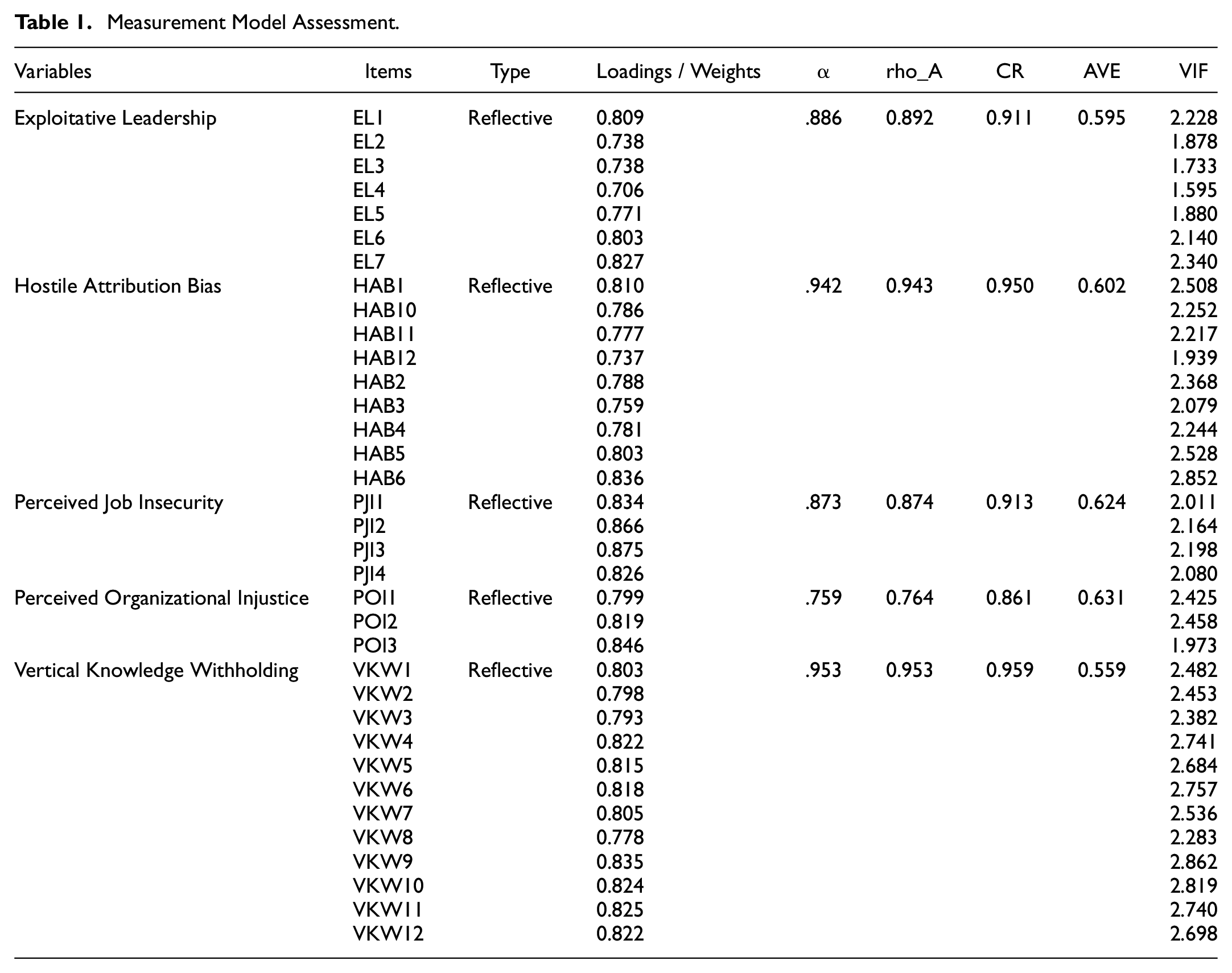
For the measurement and structural model assessment, this study followed the guidelines given by Hair et al. (2017). All items of the latent constructs load significantly. For exploitative leadership items, factor loading range from 0.706 to 0.827; for hostile attribution bias items, factor loading range from 0.737 to 0.810, from 0.826 to 0.875; for perceived job insecurity items, from 0.799 to 0.846 for perceived organizational injustice items, and from 0.778 to 0.835 for vertical knowledge withholding items.
The measurement model’s reliability, convergent validity, multicollinearity, and discriminant validity were assessed. First composite reliability (CR) and average variance extracted (AVE) were examined. According to the studies conducted by Hair et al. (2017) and Gannon et al. (2021), the values of reliability (Cronbach alpha, Rho-A, and composite reliability) should surpass 0.7, and values of AVE should be greater than 0.5 (as shown in Table 1). The values highlighted in Table 1 show high relationships in the items and established reliability and convergent validity of the respondents. Collinearity diagnostics were also performed, and all variance inflation factor (VIF) values were well below 3, so multicollinearity is not an issue in this study (Table 1).
Measurement Model Assessment.
Further discriminant validity was also examined using the Fornell-Larcker criterion, and heterotrait-monotrait (HTMT) approaches (Gannon et al., 2021). The values in Table 2 for the Fornell-Larcker criterion and heterotrait-monotrait (HTMT) show that the discriminant validity of the data is acceptable. According to the study conducted by Henseler et al. (2015), acceptable HTMT values should be lower than 0.85. Table 2 also indicates the acceptable results of the Fornell-Larcker criterion as the square root of the construct’s AVE is greater than the correlation values of all the constructs (Fornell & Larcker, 1981).
Discriminant Validity: Hetro-Trait Mono-Trait (HTMT) and Fornell-Larcker Criterion.
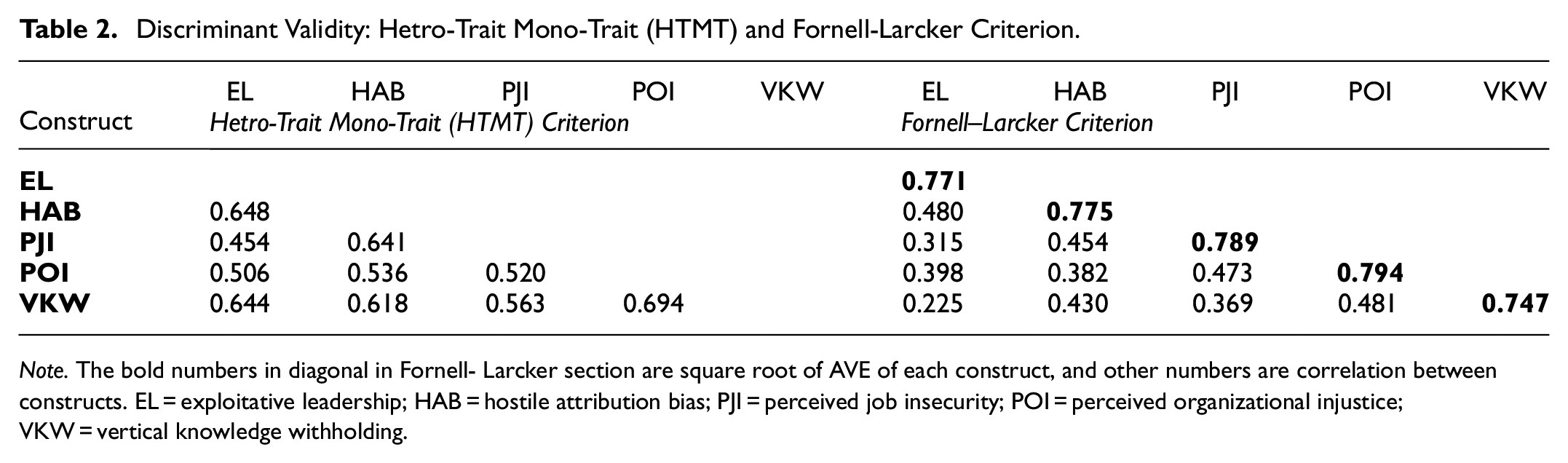
Note. The bold numbers in diagonal in Fornell- Larcker section are square root of AVE of each construct, and other numbers are correlation between constructs. EL = exploitative leadership; HAB = hostile attribution bias; PJI = perceived job insecurity; POI = perceived organizational injustice; VKW = vertical knowledge withholding.
Descriptive and Correlation Statistics
Descriptive statistics (i.e., mean and standard deviation) and correlation coefficients among the demographics (i.e., age, gender, marital status, and education), exploitative leadership, hostile attribution bias, perceived job insecurity, perceived organizational injustice, and vertical knowledge withholding is provided in Table 3. Correlation analyses were conducted using the average values of the scale items for each construct. According to the values mentioned in Table 3, vertical knowledge withholding is significantly and positively related to exploitative leadership (r = .577, p < .01), hostile attribution bias (r = .426, p < .01), perceived job insecurity (r = .571, p < .01), and perceived organizational injustice (r = .481, p < .01). Values of correlation analyses show moderate to high-level correlation among variables (Cohen, 1988).
Descriptive and Correlation Statistics.
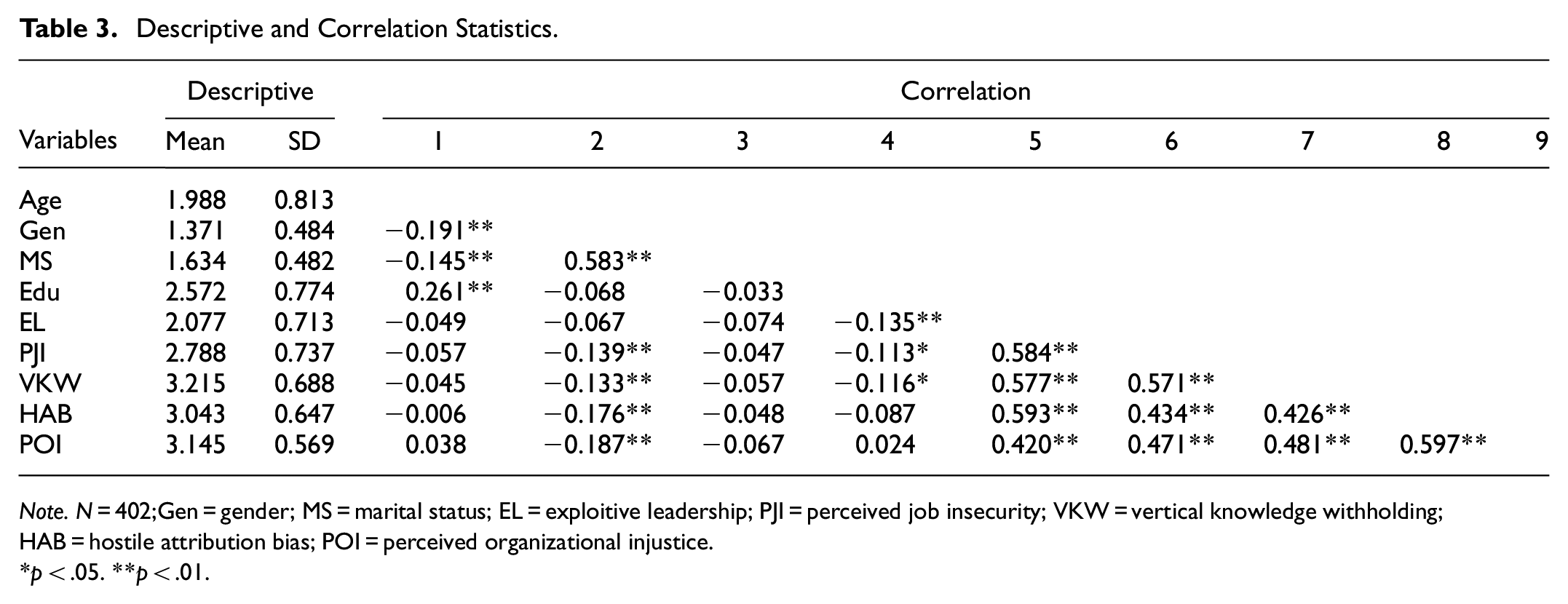
Note. N = 402;Gen = gender; MS = marital status; EL = exploitive leadership; PJI = perceived job insecurity; VKW = vertical knowledge withholding; HAB = hostile attribution bias; POI = perceived organizational injustice.
*p < .05. **p < .01.
Structural Model Assessment
Table 4 and Figure 2 demonstrate the results of hypotheses testing. The results highlight the significance of exploitative leadership on vertical knowledge withholding by portraying the moderately positive significant influence (β = .060, p < .001). Thus, H1 was supported. Moreover, the results also support the effect of exploitative leadership on perceived job insecurity (β = .433, p < .001), perceived organizational injustice (β = .425, p < .001), and hostile attribution bias (β = .315, p < .001). Thus, supporting H2, H6, and H8. The results of Table 4 also emphasize the direct influence of perceived job insecurity (β = .879, p < .001) and perceived organizational injustice (β = .425, p < .001) on vertical knowledge withholding (Supporting H3 and H5).
Structural Model Results.

Note. EL = exploitative leadership; PJI = perceived job insecurity; POI = perceived organizational injustice; HAB = hostile attribution bias; and VKW = vertical knowledge withholding.

Theoretical model.

Measurement model.
To access the potential mediation effects of perceived job insecurity, hostile attribution bias, and perceived organizational injustice, the product coefficient approach (indirect effect) was applied. The significance of the indirect effects was assessed using bias-corrected bootstrap confidence intervals (CI) (Gannon et al., 2021; Hayes & Scharkow, 2013). Results of Table 4 show a moderately significant influence of exploitative leadership on vertical knowledge withholding (H1). However, the indirect influence of exploitative leadership on vertical knowledge withholding through perceived job insecurity (H4) and perceived organizational injustice (H7) was highly significant. Hence, the mediating roles of perceived job insecurity [β = .380, p < .001, CI = (0.342, 0.414)] and perceived organizational injustice [β = .127, p < .001, CI = (0.115, 0.141)] between exploitative leadership and vertical knowledge withholding were confirmed.
The results also confirm the significant indirect effect of exploitative leadership on perceived job insecurity through hostile attribution bias (H9) and the mediating role of hostile attribution bias [β = .188, p < .001, CI = (0.163, 0.214)]. Nonetheless, the direct effect was far stronger than the indirect effect. Finally, the results demonstrate the indirect effect of exploitative leadership on hostile attribution bias through mediating the role of perceived organizational injustice (H10). However, the direct influence of exploitative leadership on hostile attribution bias is moderately stronger as compared to the indirect influence through perceived organizational injustice [β = .282, p < .001, CI = (0.231, 0.320)].
Assessment of a model’s predictive capability should focus primarily on one key target construct (EL). Following the suggestions of Hair et al. (2020), numerous criteria were utilized to explain and predict the variation in endogenous variables produced by exogenous variables. It includes Q2predict (more than 0.00), normed fit index (greater than 0.90), and square root mean residual score (less than 0.08). The endogenous variables in Table 5 have good Q2predict values for hostile attribution bias (Q2predict = 0.354, Q2 effect = Large), perceived job insecurity (Q2predict = 0.586, Q2 effect = Large), perceived organizational injustice (Q2predict = 0.265, Q2 effect = Moderate), and vertical knowledge withholding (Q2predict = 0.559, Q2 effect = Large), indicating that the study model captures the empirical data accurately and has a strong predictive ability (Sorlin, 2017). The SRMR value (0.073) and NFI value (0.906) provide additional evidence that the model fit is satisfactory.
Model Evaluation.

Note. SRMR = standardized root mean square residual; NFI = normed fit index; Q2 = predict for predictive relevance; MAE = mean absolute error; RMSE = root mean square error.
Discussion, Implications, and Future Directions
Discussion
Vertical knowledge withholding and exploitative leadership have appeared as growing concerns from both employees and organizations (Schmid et al., 2019; Syed et al., 2019). Although researchers are exploring vertical knowledge withholding and exploitative leadership as two separate variables, and have given very little consideration regarding a possible direct or indirect association between them. The current study has highlighted the positive influence of exploitative leadership, directly and indirectly, on vertical knowledge withholding through perceived job insecurity, perceived organizational injustice, and hostile attribution bias.
In the workplace, organizations and leaders are crucial for the employees. Exploitative leaders may create a culture of fear and mistrust in the workplace, where employees feel that they must protect themselves by withholding information or knowledge from their bosses. This can occur for a variety of reasons, such as a fear of retribution or punishment, a lack of trust in the leader, or a desire to protect oneself from being taken advantage of. This can have negative effects on organizational effectiveness and culture, and may ultimately lead to decreased productivity and turnover.
Exploitative leadership and vertical knowledge withholding are significantly mediated by job insecurity and organizational injustice. Our research differs from earlier studies on exploitative leadership’s vicious outcomes (J. Feng & Wang, 2019; Khalid et al., 2018). Our findings show that exploitative leadership’s effect on vertical knowledge withholding depends on certain conditions (i.e., job insecurity, perceived organizational injustice and hostile attribution bias). Exploitative leadership makes employees feel mistreated, undervalued, and unappreciated. In such a culture, employees may fear retribution from leaders and be less reluctant to share their expertise. Knowledge withholding can further weaken confidence between employees and leaders, leading to more job insecurity and information withholding. Employees may suppress knowledge or skills if they feel job insecurity. They may see their knowledge or experience as a source of power or job stability, they may worry that sharing it may leave them more vulnerable to exploitation or mistreatment. Exploitative leaders may also foster a culture of fear, competitiveness, and underappreciation that encourages knowledge withholding. Exploitative leaders can discourage knowledge sharing and collaboration by putting employees against each other and encouraging secrecy.
The study also identifies the strong positive impact of exploitative leadership on hostile attribution bias. When employees perceive their leaders as exploitative or abusive, they may be more likely to interpret their behavior as intentionally hostile or aggressive, even when there is no evidence to support this interpretation. This can contribute to a cycle of hostility and mistrust in the workplace, as employees respond with their own hostile or aggressive behavior, which in turn reinforces the leader’s exploitative behavior.
The results of the study show a strong and positive association among exploitative leadership, perceived organizational injustice, and vertical knowledge withholding. Exploitative leaders abuse their positions of power, treat their employees unfairly, and disregard their well-being. Employees may feel deceived and resentful. Employees’ feelings can intensify if they believe their problems are not being acknowledged or addressed by leaders or the organization. Employees may believe that sharing their knowledge or experience will benefit their leaders or the organization, but this is not the case. As a result, they may withhold information in order to protest or defend themselves.
Theoretical Implications
Our study has twofold theoretical contributions. First, the study has contributed to the limited literature available on exploitative leadership by identifying new employee outcomes and liking them with vertical knowledge withholding and other employee’s behavioral outcomes (Guo et al., 2020; Jahanzeb et al., 2020; Schmid et al., 2019).
Second, this study enhances our understanding of the underlining procedure between exploitative leadership and vertical knowledge withholding by demonstrating the mediating roles of perceived job insecurity, perceived organizational injustice, and hostile attribution bias. The processes of exploitative leadership, vertical knowledge withholding, perceived organizational injustice, and perceived job insecurity is also based on social exchange theory (SET) (Blau, 1964; Zhao et al., 2016). Organizational injustice and job insecurity impact the social exchange patterns by enhancing destructive exchange relationships among leaders and employees, thus enhancing negative actions from resulting in negative consequences (i.e., vertical knowledge withholding) (Nguyen et al., 2022). The results indicate that perceived job insecurity and perceived organizational injustice mediate the relationship between exploitative leadership and vertical knowledge withholding. To clarify these relationships, we try to analyze the underlining psychological processes with the support of both leader-member exchange and social cognition theories. According to LMX theory, there are two forms of leader-member relationships (i.e., insiders and outsiders) (Dulebohn et al., 2012). Employees who face verbal and non-verbal exploitation from their leaders will feel that they are outsiders, resulting in a decrease in leaders’ and employees’ social and informational exchanges. These alienated relationships would lead to higher distrust and betrayal from both leaders and organizations, resulting in job insecurity and organizational injustice (Jahanzeb et al., 2020; Y. Wang et al., 2019).
Practical Implications
Exploitative leadership behavior is a negative leader’s behavior, which is shaped when the leaders ignore employees’ feelings and emotions with their verbal and non-verbal exploitative behavior (Zappalà et al., 2021). It creates stressful situations for employees and forces them to regulate their behaviors and cognitions in social and informational exchanges (Y. Wang et al., 2019). Due to the economic crisis and limited availability of organizational positions, employees do not resist the negative leader’s behavior and unfair organizational procedures, increasing their psychological pressure and concerns about their job insecurity (D. Wang et al., 2019).
Pakistani employees worry about exploitative leadership and job insecurity. Exploitative leadership stimulates a fearful and uncertain work environment, which can have a negative impact on employees’ mental health and job performance (Akhtar et al., 2022). Knowledge withholding can also create mistrust and anxiety in the workplace, lowering productivity and turnover. Hence, Pakistani leaders must foster trust, openness, and open communication to prevent information withholding and foster a good organizational culture. Labor laws should be strengthened and workers’ rights should be protected to avoid exploitative leadership in the first place. This requires not only the economic exchanges (i.e., rewards and promotions) but also require more consideration of social exchanges (i.e., behavior and attitudes) (Syed et al., 2019).
Organizations in Pakistan must promote fairness and openness to address exploitative leadership, perceived organizational injustice, and vertical knowledge withholding. Employees and leaders can be taught about ethical leadership and encouraged to collaborate and communicate. Fair career advancement opportunities can increase employee engagement and reduce feelings of injustice. Leaders must be trustworthy and polite in order for employees to understand organizational policies. Organizations require procedural, distributive, and transparent justice practices, because these strategies would promote employee perceptions of organizational equity and justice, while also strengthening leader-employee relationships and reducing job insecurity and organizational injustice (Kmieciak, 2023).
Individuals with enhanced hostile attribution bias tend to blame others’ actions as hostile even when they are not. Thus, when employees experience exploitative behavior from the leader, hostile attribution bias will increase, resulting in high job insecurity (Lyu et al., 2016). It is believed that employees with negative reciprocity beliefs strongly impact unfavorable organizational and individual circumstances (i.e., job insecurity and organizational injustice). Moreover, the study’s findings indicate that exploitative leadership greatly enhances individuals’ hostile attribution bias, which enhances their job insecurity. Organizations can manage employees with hostile attribution bias by using personality evaluation tests at the time of staffing to hire an employee with low hostile attribution bias. Supervisors of employees with high hostile attribution bias should provide these employees with special coaching and mentoring to develop empathy, emotional stability, and intelligence.
The service sector has experienced rapid growth in its national and international markets. They are facing fierce competition resulting in enhancing the stress levels of their employees. Organizations need to make their environment more productive by carefully selecting and training their supervisors. They need to develop a mechanism that should provide a gateway for their employees to cope with behaviors like exploitative leadership and deal with perceptions like job insecurity, organizational injustice, and hostile attribution bias. If employees experience a leader’s exploitative behavior, their psychological health is affected in this situation. Also, employees with high hostile attribution bias are more affected by exploitative leadership behaviors, so organizations need to take care of them by providing them psychological counseling and comfort.
Future Directions and Limitations
This study has some limitations, which suggests further research opportunities. The first limitation is regarding the generalizability of the results to other contexts. The cultural setting of the organization sets the tone for the entire employer-employee relationship. Cultures can be classified as horizontal-individualist or vertical-collectivist (Hofstede, 1980). Our findings represent organizations in Pakistan’s vertical-collectivist culture. As a result, additional cross-cultural studies may aid in determining the significance of exploitative leadership in generating knowledge withholding. These variations may shed light on how cultural differences affect the relative significance of the study variables.
The second limitation is regarding the tested construct of vertical knowledge withholding. The study did not separate the three sub-dimensions of knowledge withholding (i.e., evasive hiding, playing dumb, and rationalized hiding). Future researchers could explore the unique antecedents of vertical and horizontal knowledge withholding (i.e., between coworkers) and identify methods, to effectively reduce their negative consequences.
The third limitation of the study is regarding the research design. Although to create causality of the study variables and reduce common method bias, the data were collected in three phases; due to the correlational nature of the data, the study cannot ensure proposed causal relationships. Thus, we encourage future researchers to use experimental and longitudinal research designs to retest our results. In addition to improving research design and reducing common method bias, future studies can utilize supervisor-subordinate dyads for data collection.
The fourth limitation is regarding the process of how exploitative leadership indirectly affects vertical knowledge withholding. This study only utilizes mediating paths (i.e., perceived organizational injustice, perceived job insecurity, and hostile attribution bias). However, other possible mediating paths may exist (e.g., supervisor and coworker ostracism). To understand the complete picture of exploitative leadership and vertical knowledge withholding, different individual (e.g., occupational self-efficacy and political skills) and organizational (e.g., internal employability) constructs may consider as the alternate boundary condition.
Conclusion
In conclusion, our research provides novel insights into the relationship between exploitative leadership and knowledge withholding. Our findings provide strong support for the negative impacts of exploitative leadership in Pakistan’s high-power collectivist culture and developing country context. High-power collectivist culture avoids disturbance in response to stressful conditions (exploitative leadership) and promotes sustaining harmonious relationship (e.g., study’s moderate EL and VKW relation). Moreover, employees view exploitative leadership as a threat to their resources, thus they avoid confrontation with such leaders. This enables them to preserve their personal resources by withholding knowledge. Yet, the employee’s psychological characteristics (i.e., hostile attribution bias, perceived job insecurity, and felt organizational unfairness) can exacerbate the situation and significantly influence the relationship between exploitative leadership and vertical knowledge withholding. In addition, the study also provides leaders, managers, and researchers with multiple guidelines to deal with employees’ attitudes and behaviors related to vertical knowledge withholding.
Survey Questionnaire
Honorable Respondents,
I am pleased to present you with my best regards and appreciation, and I hope that you would kindly take a part of your time to fill out a questionnaire entitled:
It is assured that all the participant’s information would be kept confidential and the data would be used to serve the research purpose only.
Thank you for your response and I am highly grateful for your support.
Please answer the following questions by indicating the extent to which you agree or disagree with how the statement describe the person you identify as your leader. (Strongly Disagree = 1, Disagree = 2, Neutral = 3, Agree = 4, Strongly Agree = 5)
Demographics.


Footnotes
Declaration of Conflicting Interests
The author(s) declared no potential conflicts of interest with respect to the research, authorship, and/or publication of this article.
Funding
The author(s) received no financial support for the research, authorship, and/or publication of this article.
Ethics Statement
Participants were provided written assurance of their anonymity. They were also provided with the research purpose and how the data will be used. All participants gave their verbal consent for inclusion before participating in the study.

Data Availability Statement
Data sharing not applicable to this article as no datasets were generated or analyzed during the current study.