




Abstract
Although previous research has examined the influence of job insecurity on perceptions, attitudes, and behaviors of employees, the literature has paid insufficient attention to the impact of job insecurity on organizational performance and the underlying mechanisms of this association. Organizational performance is one of the most critical outcomes in an organization, and studies are needed to examine the influence of job insecurity on organizational performance together with its intermediating processes. Accordingly, this study investigates the intermediating mechanisms between job insecurity and perceived organizational performance with a sequential mediation model. Specifically, this article hypothesizes that levels of employees’ psychological safety and organizational commitment sequentially mediate the job insecurity–perceived organizational performance link. Using three-wave time-lagged data from 321 employees in South Korea, this study found that psychological safety and organizational commitment were sequential mediators in the link. This finding suggests that levels of psychological safety and organizational commitment in employees function as underlying processes in explaining the job insecurity–perceived organizational performance link.
Keywords
Introduction
Due to severe competition and complexity, many firms have reduced job stability for employees by downsizing, outsourcing labor, and implementing temporary or short-term employment contracts to maximize operational efficiency (Lam et al., 2015; Sverke et al., 2002; Wang et al., 2015). For employees who are main actors in the operation of their firms, job retention is an essential goal. Thus, the issue of job insecurity is fundamental for employees. Indeed, scholars and practitioners have paid much attention to job insecurity because the issue substantially influences the working lives of employees, as well as organizational outcomes.
Job insecurity is defined as a “worker’s perception or concern about potential involuntary job loss” (De Cuyper et al., 2012, p. 770). Many scholars have reported that job insecurity is one of the most detrimental job stressors. For example, although previous research shows mixed results, job insecurity is closely associated with poor mental/physical well-being and poor work attitudes/behavior in employees (e.g., job satisfaction, well-being, organizational commitment, job involvement, trust in organizations, creativity, and organizational citizenship behavior) as well as poor performance outcomes on the part of employees and organizations (Cheng & Chan, 2008; De Witte et al., 2016; Ferrie et al., 2001; Gilboa et al., 2008; Kim, 2019; Lam et al., 2015; Niessen & Jimmieson, 2016; Probst et al., 2007; Richter & Näswall, 2019; Shin et al., 2019; Shoss, 2017; Sverke et al., 2002; Wang et al., 2015).
Even though existing studies have examined the impact of job insecurity on a variety of organizational outcomes as described above, our study suggests that gaps remain in the research (Shoss, 2017). First, studies on the relationship between job insecurity and organizational outcomes do not fully investigate the influence of job insecurity on organizational performance. Instead of examining the influence of job insecurity on organizational performance, existing research has mainly focused on employee attitudes/behaviors (e.g., job satisfaction, organizational commitment, organizational citizenship behavior) or physical/mental health in employees (Kim, 2019; Richter & Näswall, 2019; Shin et al., 2019; Shoss, 2017). Considering that organizational performance is one of the most important objectives/goals for an organization in terms of being a fundamental factor for survival, further research into the relationship between job insecurity and organizational performance is required.
Second, extant works on the job insecurity–performance link tend to show mixed results (Shoss, 2017; Wang et al., 2015). Two meta-analyses report that job insecurity is significantly and negatively associated with individual-level performance (Cheng & Chan, 2008; Gilboa et al., 2008). These studies suggest that job insecurity plays a harmful role in organizations by increasing employees’ stress levels and negative perceptions of social exchanges with their organizations (De Cuyper & De Witte, 2006; De Witte et al., 2016; Kim, 2019; Piccoli & De Witte, 2015; Richter & Näswall, 2019; Shin et al., 2019). In contrast, other research has demonstrated that job insecurity is not related to performance (Loi et al., 2011; Staufenbiel & König, 2010; Sverke et al., 2002). Interestingly, some studies have reported that, as a job-preservation motivation mechanism, job insecurity functions to motivate additional efforts by employees (Staufenbiel & König, 2010; Stynen et al., 2015). These inconclusive results may originate in the lack of research on the intermediating processes in the job insecurity–performance link (Shoss, 2017). This current research aims to elaborate upon the mechanisms of this link.
Third, previous studies on the link between job insecurity and performance tend to focus on individual-level performances of employees. For example, Staufenbiel and König (2010) have shown the impact of job insecurity on both self- and supervisor-rated performances of employees, for example, “I/this member adequately complete(s) assigned duties” and “I/this member make(s) innovative suggestions to improve quality in the department.” The work of Wang et al. (2015) reports the relationship between job insecurity and employees’ overall job performance as evaluated by their supervisors (e.g., “This member is producing a high market share for your company in your territory”). Although this existing research acknowledges that employees’ individual performances are fundamental components of building company performance, we assert the need for research to more specifically examine the influence of job insecurity on organization-level performance (Kim, 2019; Richter & Näswall, 2019; Shin et al., 2019; Shoss, 2017).
To resolve the gaps in the research, this article examines the underlying processes between job insecurity and organizational performance. Specifically, this study proposes that feelings of psychological safety and organizational commitment by employees would sequentially mediate the relationship between job insecurity and organizational performance. For employees, psychological safety can be defined as feeling “able to show and employ one’s self without fear of negative consequences to self-image, status, or career” (Kahn, 1990, p. 708). Although previous works have not examined the influence of job insecurity on psychological safety (Frazier et al., 2017; Shoss, 2017), based on pertinent findings in the existing literature (Edmondson, 1999; Kahn, 1990), this article expects that job insecurity in employees decreases their levels of psychological safety.
What is more, extant studies have shown that psychological safety in employees enhances their levels of organizational commitment (Frazier et al., 2017; Singh & Winkel, 2012). Organizational commitment indicates the psychological attachment, and willingness of individual members, to make efforts for their organization (Mathieu & Zajac, 1990). This concept is regarded as a central construct in an organization where an employee who is attached to his or her organization tends to have high levels of job satisfaction, organizational commitment, and in-role/extra-role performance, as well as low turnover (Cohen, 1993; Cooper-Hakim & Viswesvaran, 2005; Meyer & Allen, 1997). When employees feel psychological safety in an organization, they may perceive that they are cared for and respected by the organization (Detert & Burris, 2007; O’Neill & Arendt, 2008). These positive perceptions lead employees to attach themselves to organizations by enhancing their social identity (Cohen, 1993; Mathieu & Zajac, 1990; Pratt, 1998). Accordingly, this article expects that higher levels of organizational commitment in employees contribute positively to increasing organizational performance (Cooper-Hakim & Viswesvaran, 2005; Meyer & Allen, 1997; Riketta, 2002).
To empirically test the ideas above, this study conducts a sequential mediation model analysis with a structural equation modeling (SEM) technique, collecting three-wave time-lagged data from employees in South Korean firms. Specifically, to measure organizational performance, this research utilizes the concept of “perceived organizational performance” for the following reason. According to literature in areas of organizational behavior, employees’ subjective evaluations of certain phenomena (e.g., perceived organizational performance or perceived corporate social responsibility) can reflect the phenomena itself (e.g., the level of organizational performance or the level of corporate social responsibility practices) more accurately than objective measures (e.g., sales, operating profit, net profit, and investment in corporate social responsibility). This is because employee perceptions are likely to critically build the realities from which employees draw their judgments (Hansen et al., 2011). While this study acknowledges that utilizing objective measures on organizational performance has valid strong points for testing hypotheses, utilizing a subjective measure is likely to be worthwhile and meaningful.
Taken together, the aim of this research is to resolve the mixed findings of previous research in the job insecurity–organizational outcomes link by investigating intermediating mechanisms in the relationship between job insecurity and perceived organizational performance. Our efforts stand to provide meaningful contributions to job insecurity literature from theoretical and practical perspectives.
Theories and Hypotheses
Job Insecurity and Psychological Safety
Limited research has been dedicated to investigating the influence of job insecurity on psychological safety in employees (Frazier et al., 2017; Shoss, 2017). However, it is self-explanatory that job insecurity in employees decreases their levels of psychological safety (Edmondson, 1999; Kahn, 1990). Psychological safety means an employee’s perception that he or she “feels able to show and employ one’s self without fear of negative consequences to self-image, status, or career” (Kahn, 1990, p. 708). When an employee in an organization perceives that he or she is psychologically safe, the employee is more likely to not only take risks but also raise tough or important issues without the psychological burden of fearing that he or she will be rejected (Edmondson, 1999). In turn, the employee more easily asks other employees for help because he or she likely believes that other employees will not treat him or her in harmful ways.
When an employee feels that his or her job is not secure in an organization, they feel pressure to be perfect to retain the job, and in this situation, it is difficult for the employee to express his or her own true self without fear (Edmondson, 1999; Kahn, 1990). This research argues that as a natural consequence, to feel safe in an organization, an employee with job insecurity is not likely to bring up critical (but potentially uncomfortable) issues. Rather than raising an issue or creating a problem, an employee may compromise himself/herself for questionable norms or rules in the organization in order not to risk rejection. Also, an employee with job insecurity is not likely to seek the help of other members due to fear of being evaluated as an incompetent employee. An insecure employee is likely to perceive that other members aim to cause damage to them because all employees are seen as potential rivals in the competition of job retention in the organization.
Accordingly, this article expects that job insecurity negatively affects psychological safety in employees. Thus, this study proposes the following hypothesis.
Psychological Safety and Organizational Commitment
Existing works have reported that feelings of psychological safety in employees increase their levels of organizational commitment (Frazier et al., 2017; Singh & Winkel, 2012). In feeling psychological safety in an organization, an employee is likely to perceive that he or she is cared for and valued by the organization, thereby experiencing positive outcomes such as job satisfaction (Detert & Burris, 2007; O’Neill & Arendt, 2008). In turn, positive perceptions and outcomes increase an employee’s positive attitude toward the organization, including fostering a high level of organizational commitment due to the employee’s enhanced social identity (Cohen, 1993; Mathieu & Zajac, 1990; Pratt, 1998).
The relationship between psychological safety and organizational commitment can be explained by social identity theory (Cohen, 1993; Mathieu & Zajac, 1990; Pratt, 1998). According to the theory, a person’s concept of his or her self (i.e., self-concept) tends to be influenced by any group to which the person belongs. The “self” being created by the impact of a social context is called the “social self.” Because a group such as a firm, wherein a person is employed, is crucial to the life of employees, the firm is located at the center of an employee’s social self. In turn, for employees, this connection to work deeply influences the employee’s self-concept (Cohen, 1993; Mathieu & Zajac, 1990; Pratt, 1998). When an employee feels psychological safety, they may perceive that they are cared for and respected by their firm. Due to feelings of psychological safety, the employee is likely to have a high level of job satisfaction (Detert & Burris, 2007; O’Neill & Arendt, 2008) together with a low level of anxiety (Frazier et al., 2017). In turn, positive experiences derived from positive features of a firm (i.e., stability for employees) may enhance an employee’s self-concept as well as his or her social self. A positive sense of self in employees may cause employees to have positive attitudes toward their firms in the form of stronger organizational commitment (Aryee et al., 2002; Dukerich et al., 2002; Dutton et al., 1994; Smidts et al., 2001; Van Knippenberg et al., 2007). In other words, an employee with a positive sense of self is likely to display a strong commitment to the organization. Thus, this article suggests the following hypothesis.
Organizational Commitment and Perceived Organizational Performance
This study suggests that organizational commitment in employees increases perceived organizational performance. Organizational commitment is a central concept in organizational research because the variable is a fundamental antecedent of various important attitudes or behaviors in employees (Cohen, 1993; Cooper-Hakim & Viswesvaran, 2005; Mathieu & Zajac, 1990; Meyer & Allen, 1997). For example, previous works on organizational commitment have shown that this concept is positively and significantly related to job satisfaction, organizational citizenship behavior, in-role/extra-role performance, and organizational performance (Meyer & Allen, 1997; Meyer et al., 2002; Riketta, 2002; Wright & Kehoe, 2009).
Specifically, when an employee feels strongly attached to his or her organization, the employee makes robust efforts to achieve the goals of the organization by utilizing all his or her cognitive, emotional, and behavioral resources (Cooper-Hakim & Viswesvaran, 2005; Mathieu & Zajac, 1990). These efforts on the part of an employee may be transformed into positive attitudes and behaviors, such as organizational commitment, organizational citizenship behavior, and in-role/extra-role performance, all of which are considered critical organizational outcomes (Meyer & Allen, 1997; Meyer et al., 2002; Wright & Kehoe, 2009). Through a social contagion mechanism (Ostroff, 1992), the employee’s cognitive, emotional, and behavioral interactions with colleagues in the organization facilitate the prevalence of positive attitudes and behaviors among all employees. In turn, these improved attitudes and behaviors shared among employees are transformed into collective-level efforts toward positive outcomes. Eventually, as previous studies have suggested (Meyer & Allen, 1997; Riketta, 2002), shared positive attitudes of collective organizational commitment significantly increase levels of organizational performance. Therefore, this article proposes the following hypothesis.
Sequential Mediating Role of Psychological Safety and Organizational Commitment between Job Insecurity and Perceived Organizational Performance
Based on the above arguments about the relationships among the research variables (i.e., job insecurity, psychological safety, organizational commitment, and perceived organizational performance), this study expects that psychological safety and organizational commitment sequentially mediate the association between job insecurity and perceived performance. Specifically, job insecurity may negatively affect perceived organizational performance by decreasing the level of an employee’s psychological safety and organizational commitment. Thus, this research proposes the following hypothesis (please also see Figure 1).

Framework of the research model.
Method
Data Collection
Using an online survey method, data for this study were collected from currently working South Korean employees at three different time points. One of the largest online research companies in South Korea (i.e., comprising approximately 1,300,000 panelists) implemented processes to conduct the survey. The target firm randomly selected participants to reduce the possibility of sampling bias. By virtue of effective operating systems, the firm was able to keep track of who responded to the survey, ensuring that respondents from Time Point 1 to Time Point 3 are the same.
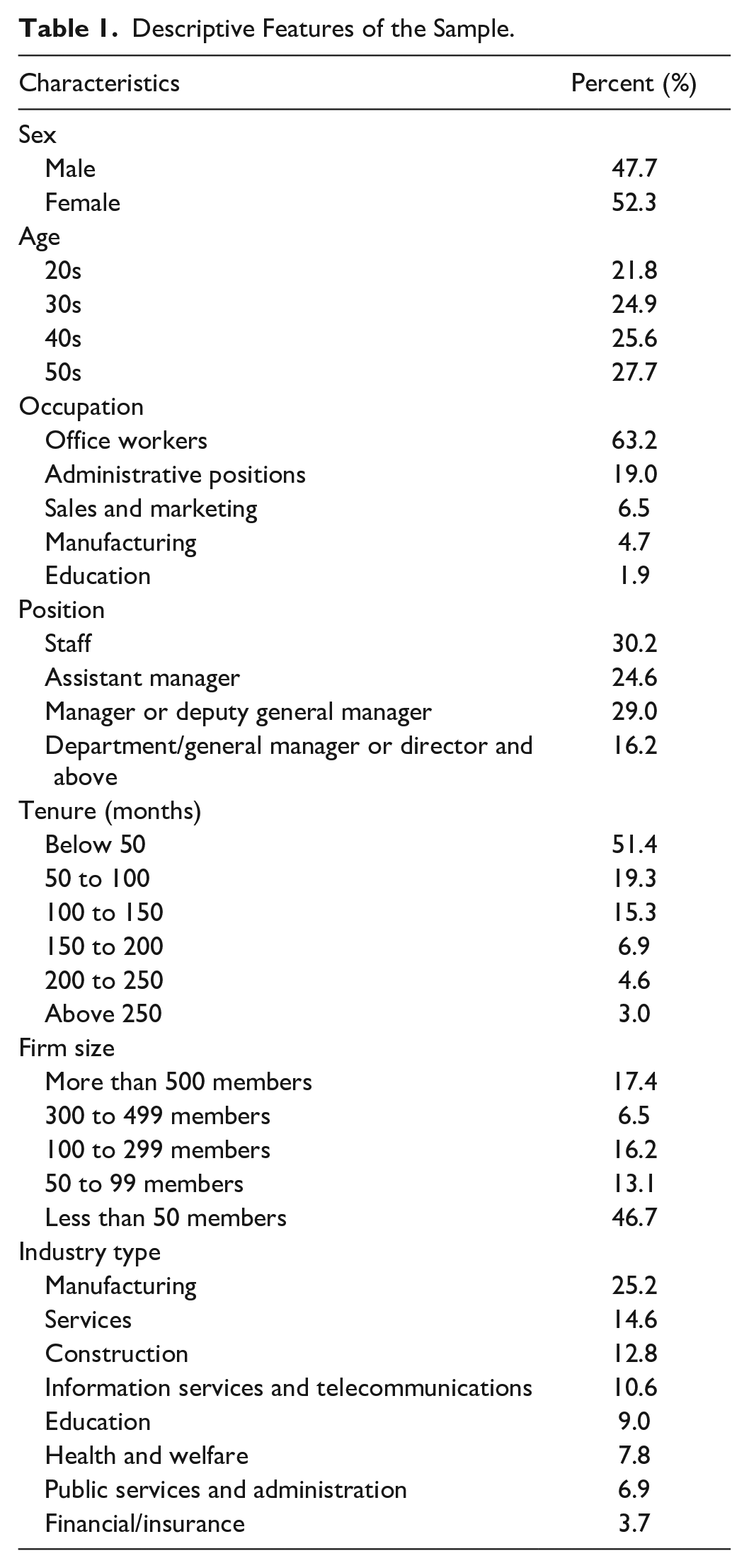
At Time Point 1, a total of 512 employees participated in the survey. At Time Point 2, 378 employees responded to the second survey. At Time Point 3, 335 employees responded to the third and final survey. The time span between each time point was 4 weeks. After gathering the data, any missing data were deleted. Final data comprised responses from 321 participants. To determine the sample size, we utilized suggestions from previous research. For example, Barclay et al. (1995) suggested that one observable variable needs at least 10 cases (i.e., the rule of 10) in SEM. And Chin and Newsted (1999) suggested that at least 150 cases are required to adequately conduct SEM. Because the research model of this study has 17 observable variables, our final 321 cases comprise an adequate sample. The characteristics of the sample are described in Table 1.
Descriptive Features of the Sample.
Measures
This article measures study variables with a 5-point Likert-type scale (with scores ranging from 1 = strongly disagree to 5 = strongly agree) and computes internal consistency of the variables by utilizing Cronbach’s alpha values.
Job insecurity (Time Point 1, gathered from employees)
To measure the degree of job insecurity among employees, this article utilized four items from the job security scale of Kraimer et al. (2005). Sample items included “If my current organization were facing economic problems, my job would be the first to go,” “I will not be able to keep my present job as long as I wish,” “My job is not a secure one,” and “My job will not be there although I want it.” The value of Cronbach’s alpha in this research was = .89.
Psychological safety (Time Point 2, gathered from employees)
Four items were used to measure employees’ psychological safety based on previous research (Edmondson, 1999). From a scale measuring followers’ perceptions of psychological safety, sample items were “It is safe to take a risk in this organization” and “I am able to bring up problems and tough issues in this organization.” The Cronbach’s alpha value was = .79.
Organizational commitment (Time Point 3, gathered from employees)
This research utilized five items from a measure of organizational commitment in a previous study (Meyer & Allen, 1997). Sample items were “I really feel as if my organization’s problems are my own,” “I feel a strong sense of belonging to my organization,” and “I feel emotionally attached to my organization.” The Cronbach’s alpha value was = .91.
Perceived organizational performance (Time Point 3, gathered from the directors of human resource departments in each company)
To measure the level of perceived organizational performance of each firm, directors of human resource departments in each firm evaluated four items. Sample items were from previous research (Kim et al., 2018), including “Our company is more efficient and productive than our competitors,” “Our management performance is superior to our competitors,” and “Our financial performance is excellent in comparison to our competitors.” By gathering data from multiple sources, this article aims to diminish the potential issue of common method bias. The Cronbach’s alpha value herein was = .93.
Control variables
Because previous research demonstrates that the size and industrial traits of companies substantially influence organizational performance (Greer & Ireland, 1992; Zhang & Li, 2009), this article includes variables to control for perceived organizational performance. Moreover, employees’ tenure (in months), position, and education levels are utilized to control for organizational commitment (Jackson et al., 2003; Smith et al., 1994). Variables were gathered at Time Point 2.
Statistical Analysis
To get basic insights from the data, a correlation analysis was implemented. Because the research model includes various variables, we subsequently conducted SEM to analyze the sequential mediation model and obtain fit indices (Cheung & Lau, 2008). Following the work of Anderson and Gerbing (1988), this article took a two-step approach, including the measurement model and the structural model. To evaluate the adequacy of the model fit, this study considered several goodness-of-fit indices including the comparative fit index (CFI), the Tucker–Lewis index (TLI), and the root mean square error of approximation (RMSEA). According to these indices, adequate fit is indicated by CFI and TLI values greater than .90 and an RMSEA less than or equal to .06 (Browne & Cudeck, 1993).
Results
Descriptive Statistics
The results of descriptive analysis are shown in Table 2. The main variables including the independent variable, mediators, and dependent variables were shown to be highly correlated.
Means, Standard Deviation, and Correlation Between Variables.
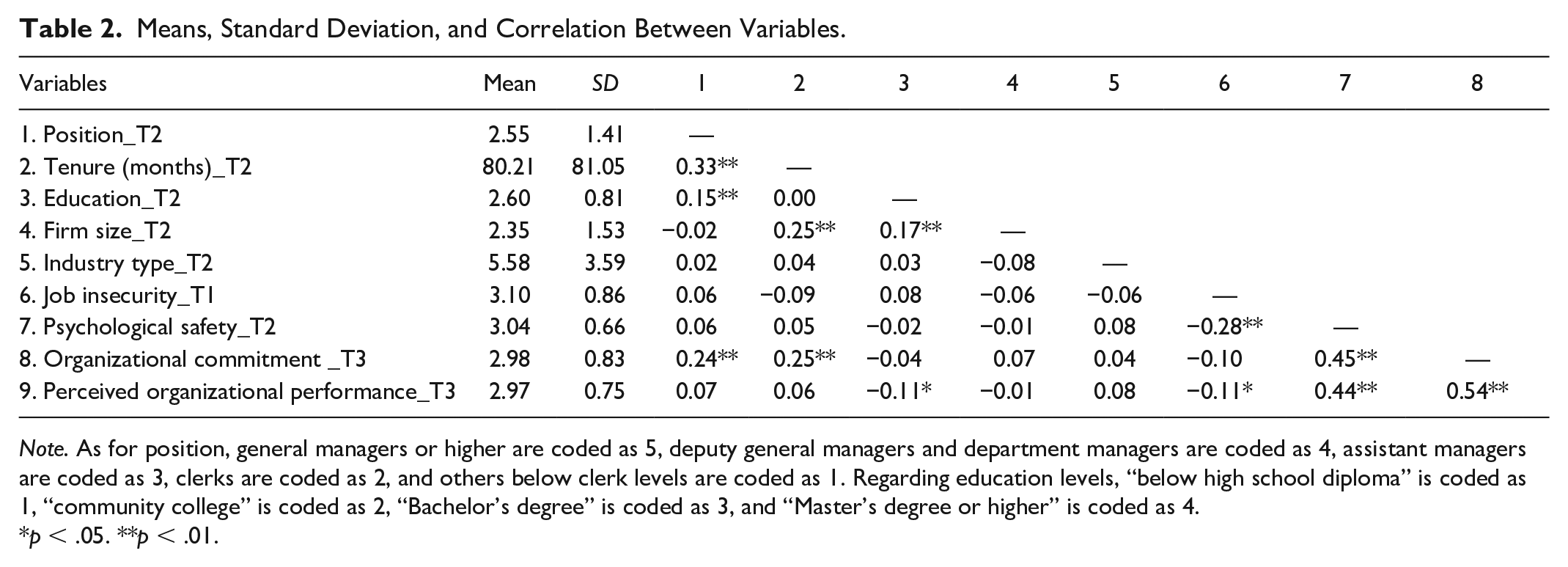
Note. As for position, general managers or higher are coded as 5, deputy general managers and department managers are coded as 4, assistant managers are coded as 3, clerks are coded as 2, and others below clerk levels are coded as 1. Regarding education levels, “below high school diploma” is coded as 1, “community college” is coded as 2, “Bachelor’s degree” is coded as 3, and “Master’s degree or higher” is coded as 4.
p < .05. **p < .01.
Measurement Model
To determine whether there was an adequate level of discriminant validity, a confirmatory factor analysis (CFA) was conducted for research variables from the same employee (i.e., job insecurity, psychological safety, organizational commitment). In this CFA, perceived organizational performance was not included because that variable was gathered from directors of human resource departments in each firm rather than from employees themselves. The three-factor model was shown to have a good fit with the observations, χ2 (df = 56) = 119.32; CFI = .975; TLI = .965; RMSEA= .059. Subsequently, sequential chi-square difference tests were conducted to compare the three-factor model with two-factor and single-factor models, respectively. The results of the tests show that the three-factor model has the best fit among each alternative model (please see Table 3). Therefore, this research confirms that the research variables are distinctive.
Chi-square Difference Tests Among Alternative Measurement Models.

CFI = comparative fit index; TLI = Tucker–Lewis index; RMSEA = root mean square error of approximation.
Structural Model
This study establishes a sequential mediation model using an SEM technique. In the structural model, the association between job insecurity and perceived organizational performance is sequentially mediated by psychological safety and organizational commitment.
To determine whether job insecurity directly or indirectly influences perceived organizational performance, this study compared a hypothetical model (i.e., full mediation model) with an alternative nested model (i.e., partial mediation model) by conducting chi-square difference tests. The fit indices of the full mediation model (Model 1) were adequate with values of χ2 = 352.02 (df = 187), CFI = .957, TLI = .946, and RMSEA = .053. The alternative nested model (Model 2) included a direct path from job insecurity to organizational performance. Although the fit indices of Model 2 were also shown to be adequate, χ2 = 349.96 (df = 186); CFI = .957; TLI = .946; RMSEA = .052, the results of chi-square difference tests between Model 1 and Model 2 show that Model 1 is better than Model 2 for our purposes (Δχ2 [1] = 2.06, nonsignificant). In the final model, most of the control variables (i.e., education level, firm size, and industry type) were not statistically significant, with the exception of employee position and tenure. The model demonstrated that job insecurity is significantly and negatively associated with psychological safety (β = −.31, p < .001) and that psychological safety is positively related to organizational commitment (β = .55, p < .001). Finally, organizational commitment was shown to be positively associated with perceived organizational performance (β = .60, p < .001). The results support Hypotheses 1, 2, and 3 (please see Figure 2).

Standardized estimate values of the final model.
Bootstrapping
Bootstrapping analysis with a sample of 5,000 was conducted to evaluate Hypothesis 4, which predicts a sequential indirect effect between job insecurity and perceived organizational performance. Indirect mediation effects are significant at the 5% level when the 95% bias-corrected confidence interval (CI) for the mean indirect mediation effect does not include zero (Shrout & Bolger, 2002). In the analysis herein, the bias-corrected CI for the effect on the pathway from job insecurity to perceived organizational performance via psychological safety and organizational commitment excluded zero (95% CI = [−.14, −.05]). This result indicates that the sequential indirect mediation effect of psychological safety and perceived organizational commitment on the pathway is significant at a level of 5%, thereby supporting Hypothesis 4.
Discussion
The following section describes the theoretical and practical implications of this research, as well as its limitations.
Theoretical Implications
This research stands to contribute to the growing body of job insecurity literature by suggesting the following theoretical implications. First, by examining the relationship between job insecurity and organizational performance, this article positively contributes to job insecurity literature (Shoss, 2017). Previous studies on job insecurity have practically ignored the influence of job insecurity on organizational performance, mainly focusing on attitudes/behaviors or physical/mental health in employees (Shoss, 2017). Considering that organizational performance is a fundamental component and one of the most critical goals of organizations, studies on the relationship between job insecurity in employees and organizational performance are vital.
Second, by examining intermediating processes in the job insecurity–performance link, this study stands to contribute to reconciling mixed results on the link in previous research (Shoss, 2017; Wang et al., 2015). Several works show that job insecurity is significantly and negatively associated with performance (Cheng & Chan, 2008; Gilboa et al., 2008). However, other studies report that job insecurity is not related to performance (Loi et al., 2011; Staufenbiel & König, 2010; Sverke et al., 2002). In contrast, some studies show that job insecurity, in fact, increases performance (Staufenbiel & König, 2010; Stynen et al., 2015). By empirically testing and showing that job insecurity negatively influences employees’ levels of perceived organizational performance by decreasing their levels of psychological safety and organizational commitment, this article supports existing research proposing the harmful effects of job insecurity on performance.
Third, this article examines the influence of job insecurity on perceived organizational performance, rather than on individual-level performances of employees. Considering the importance of organizational performance for firms, even though employees’ individual performances (e.g., in-role and extra-role performances) are critical, previous studies have not fully articulated the impact of job insecurity on organization-level performance (Shoss, 2017). This attempt to delve into the association between the variables is meaningful.
Practical Implications
The results of this research may provide some practical implications for top management teams or leaders in an organization. First, the findings suggest that the issue of job insecurity in employees has important performance implications. By conducting SEM analysis, this article shows that job insecurity decreases organizational performance. In other words, job insecurity in employees is critical to explain one of the most valuable goals in an organization—namely, organizational performance. Based on the results, this study suggests that top management teams or leaders in an organization should acknowledge that the issue of job insecurity has substantial power to negatively influence the survival and sustainability of their firm. Accordingly, they should endeavor to adequately deal with the issue by attempting to reduce levels of job insecurity in employees. For example, a firm can implement various human resource management practices, such as a stable/long-term contracts, fair evaluation systems, and clear rewards/promotion systems.
Second, the results provide effective indicators for top management teams or leaders attempting to implement the above-mentioned practices to reduce levels of job insecurity in employees. When top management teams and leaders establish various systems or practices to manage employees’ levels of job insecurity, they may need to know what factors are influenced by which practices. By demonstrating that job insecurity negatively influences organizational performance by undermining levels of psychological safety and organizational commitment in employees, this research suggests that top management teams or leaders should first identify employee levels of psychological safety and organizational commitment. From there, management will be able to discern the impact of various practices in an organization. In other words, indicators exist to measure the effectiveness of organizational practices. This may be helpful in dealing with the issue of job insecurity in employees.
Limitations and Suggestions for Future Research
Despite this article having several theoretical and practical implications, there are some limitations as well. First, this research does not deal with various external and systemic factors that affect the independent variable of job insecurity. Herein, we consider job insecurity in employees as a perception of employees according to subjective measures. Although, from a conceptual viewpoint, job insecurity is a perception, there are many objective factors that substantially contribute to employee perceptions in an organization. Such factors include downsizing rates, overall characteristics of human resources management systems, and levels of social insecurity systems. Thus, we suggest that future studies more fully consider the impact of objective factors on job insecurity.
Second, to measure levels of organizational performance, this article utilizes subjective measures from directors of human resource departments in participating firms. The subjective measures have their own strong points—not only have previous studies validated the subjective measures (Chin & Newsted, 1999), but also the measures have powerful explanatory power by adequately reflecting real-world circumstances pertinent to the organizational performances of each firm (Hansen et al., 2011). Nevertheless, this study strongly suggests that future studies should utilize objective measures such as sales, operating profits, and net profits to assess organizational performance.
Third, even though this article used three-wave time-lagged data to decrease bias due to its cross-sectional research design, the approach is insufficient to test the sequential mediation structure herein because there are many possible directions of causality. In addition, this article could not fully include all the variables that influence the dependent variable of perceived organizational performance. In other words, some variables that substantially affect findings may have been omitted from this study. Findings from this article should be interpreted with caution. Future studies are required to account for the limitations of this article.
Conclusion
The aim of this article was to reconcile mixed results from previous research in the job insecurity–organizational outcomes link by delving into intermediating processes of the association. To empirically test the hypotheses, this article utilizes three-wave time-lagged data from employees in organizations in South Korea. By conducting a sequential mediation model analysis with an SEM technique, this study shows that levels of psychological safety and organizational commitment in employees function as sequential mediators in the association between job insecurity and perceived organizational performance.
Although this article has some limitations, this study stands to positively contribute to existing literature in job insecurity by demonstrating elaborate intermediating processes between job insecurity and perceived organizational performance. The findings suggest that employee levels of psychological safety and organizational commitment function as sequential mediators in the job insecurity–organizational outcomes link. The results indicate that job insecurity lowers levels of organizational outcomes by negatively affecting employee perceptions (i.e., psychological safety) and attitudes (i.e., organizational commitment). In other words, this article in fact resolves the mixed findings of previous research in the job insecurity–organizational outcomes link and positively contributes to existing research in job insecurity.
Footnotes
Declaration of Conflicting Interests
The author(s) declared no potential conflicts of interest with respect to the research, authorship, and/or publication of this article.
Funding
The author(s) disclosed receipt of the following financial support for the research, authorship, and/or publication of this article: This work was supported by the Research Fund of University of Ulsan.
