




Abstract
Counterproductive work behavior significantly increase a firm’s operating costs and resource wastage, thus seriously impairing organizational performance. Therefore, it is crucial to identify the reasons why employees engage in counterproductive work behavior. This study uses Affective Event Theory (AET) as a theoretical framework to reveal how exploitative leadership further influences employees’ behavioral choices by affecting their emotions. Specifically, exploitative leadership influences employees’ behavioral decisions by triggering their anger; employee anger plays a key mediating role between exploitative leadership and counterproductive work behavior, a finding that provides deeper theoretical support for the central role of emotions in organizational behavior. In addition, this study examines the moderating role of power distance. While traditional studies have focused on the direct effects of leadership behavior on employee outcomes, this study further reveals how power distance affects employees’ emotional intensity and behavioral response patterns, thereby providing a more comprehensive understanding of employees’ emotional and behavioral performance in the face of exploitative leadership. Data analysis of 294 Chinese SME employees revealed that exploitative leadership has a significant positive effect on employee anger and counterproductive work behavior; employee anger mediates the relationship between exploitative leadership and counterproductive work behavior, while power distance has a significant negative moderating effect in this relationship. Based on these findings, this study not only expands the scope of exploitative leadership research, but also provides new perspectives and ideas for understanding the role of power distance in leadership research. In addition, this study provides targeted practical recommendations for optimizing leadership styles, enhancing employee mental health support, and reducing counterproductive work behavior.
Plain Language Summary
Using affective event theory (AET) as a theoretical framework, this study articulated the process by which exploitative leadership influences counterproductive work behavior. Specifically, the mediating role of employee anger is verified in the process of exploitative leadership, which induces counterproductive work behavior. Additionally, the moderating role of power distance and its moderating mediating role are also verified.
Keywords
Introduction
Because Chinese small and medium-sized enterprises (SMEs) are more resource-poor than large firms and face more intense turbulence in the external business environment (B. S. Ye et al., 2023), leaders of SMEs tend to have higher demands and expectations of their employees’ ability to do their jobs, which exacerbates employee stress (Y. Wang et al., 2020). Exploitative leadership is often characterized by selfishness, taking advantage of others, and lack of concern for employee development, which may be more common in stressful organizational environments (Mackey et al., 2021). Although, with the rapid changes in the market environment, employees’ work pressure is increasing, which increases counterproductive work behavior (Q. Chen et al., 2022). Counterproductive work behavior (CWB) can lead to employee negativity and a waste of organizational resources, which can be harmful to the organization’s management (R. Y. Wang et al., 2022).
CWB pertains to intentional actions undertaken by employees that result in detriment to the organization or its stakeholders (Fox et al., 2001). Therefore, the reasons for employees’ CWB must be identified to reduce the negative effects thereof. In particular, the greatest source of stress for employees in the Chinese cultural context is direct leadership (Y. G. Zhang et al., 2023). This study argues that employee behavior is largely influenced by leadership. Exploitative leaders will put their own needs above those of others and usurp employee outcomes (Schmid et al., 2019). This predisposes an unequal relationship between exploitative leadership and employees, which stimulates negative emotions and can trigger negative behaviors from employees. Therefore, this study emphasizes the role of exploitative leadership, which can influence counterproductive work behavior. Exploitative leadership refers to leaders who achieve their personal selfish goals by squeezing employees and violating their entitlements (Schmid et al., 2019). When employees feel exploited, they feel disrespected, and to compensate for this imbalance, they may resist or retaliate against the leader (G. Qin & Zhang, 2022). Therefore, exploitative leadership can be very harmful to employees and lead them to engage in CWB.
The objective of this research is to investigate the extent to which exploitative leadership fosters counterproductive work behavior, as well as to delineate the mediating variables that may influence this relationship. Employee anger refers to an emotional reaction exhibited by employees when they perceive unfair treatment within the organization (G. Qin & Zhang, 2022). Bullying and unfair behavior toward employees from exploitative leadership can easily lead to negative emotions (Y. G. Zhang et al., 2022). Anger causes employees to feel bitter, which leads to an urge for revenge or a tendency to leave the organization (C. J. Yang & Chen, 2022). Therefore, employees feel angry when facing their leaders’ exploitative behavior. To show their dissatisfaction and vent their anger, they develop counterproductive work behavior. Thus, we suggest that employee anger serves as a mediating variable in the relationship between exploitative leadership and counterproductive work behavior.
Additionally, this study argues that the degree of power distance influences employees’ perceptions of exploitative leadership, resulting in differential attitudes and behaviors. Employees characterized by high power distance are more likely to adhere to organizational directives, whereas Reduced power distance individuals value power equality and resist unfair hierarchies (H. M. Zhang et al., 2019). This highlights the need to assess power distance serves as a moderating variable in the relationship between exploitative leadership and the expressions of anger, as well as counterproductive behaviors, while comparing its impact across high and low orientations.
Therefore, this study’s purpose is as follows:
Existing literature is relatively extensive regarding the influence of leadership on counterproductive work behavior (Hu et al., 2023; M. B. Kayani & Alasan, 2021; Kessler et al., 2013). However, limited research has examined how exploitative leadership impacts employees’ engagement in counterproductive work behavior, meaning that additional efforts are required in the study of employee counterproductive work behavior. Therefore, this study focuses on exploitative leadership, a relatively rare leadership style, to further understand how poor leadership conduct affects employees psychological and behavioral responses. This not only provides new perspectives for the study of the connection between types of leadership and employee conduct, but also enriches the theoretical framework of organizational behavior regarding counterproductive work behavior.
Based on these statements, the research questions are as follows:
Second, existing research has primarily focused on identifying factors that lead to counterproductive work behavior or those that influence its intensity (Penney & Spector, 2002, 2005). This study integrates employee anger as a mediating variable, utilizing affective events theory as a foundational framework. Affective event theory states that an employee’s work experience in an organization affects his or her emotions, which subsequently influences their behavior (Weiss & Cropanzano, 1996; Zhu et al., 2024)). This provides a new perspective on employees’ counterproductive work behavior. Herein, facing leaders’ exploitative behavior triggers strong anger among employees, who engage in counterproductive work behavior to vent their anger. By validating this mediating process, this study can provide more details for understanding how employees respond to unfair leadership behaviors. It helps organizations to improve their management practices and mitigate the adverse effects of exploitative leadership on employees’ emotional and productivity.
Third, power distance—closely linked to leadership—significantly influences employee behavior (Kirkman et al., 2009; H. Wang & Guan, 2018), particularly in high power distance cultures like China (Farh et al., 2007). Understanding power distance helps explain employees’ emotional and behavioral responses to leadership style and organizational practices. This study explores its moderating role by analyzing how it interacts with exploitative leadership to impact employee anger and counterproductive work behavior, offering practical insights into leadership and emotion management.
Overall, this study aims to clarify mechanisms leading to address counterproductive work behavior, an analysis will be conducted that explores both mediating and moderated mediating effects. It expands existing research and provides theoretical grounding for further studies. Practically, it alerts managers—especially in resource-constrained SMEs—to the risks of exploitative leadership. The findings support leadership training, emotional support programs, and feedback mechanisms that can reduce negative behaviors and foster healthier workplaces.
Theoretical Background and Hypotheses
Exploitative Leadership
Leaders engaging in exploitative leadership are self-centered and use their subordinates as tools for their own profit (M. Kayani et al., 2021). They increase subordinates’ stress at work and the consumption of psychological resources, thereby increasing subordinates’ emotional exhaustion (Z. N. Wang et al., 2023). As exploitative leadership makes employees feel that there is no hope for them to continue working in the organization, it decreases their sense of identification with organization (Y. D. Sun & Zhang, 2022).
Moreover, exploitative leaders tend to stimulate employees to develop negative emotions, which leads them to vent their dissatisfaction with the leader by complaining (Y. D. Sun & Zhang, 2022). Exploitative leaders take advantage of employees for personal gain, thereby decreasing their job satisfaction while exacerbating their stress levels and frustration (M. Kayani et al., 2021). Facing exploitative leadership, subordinates develop negative emotions such as anger, which leads to complaining behavior or willingness to leave (Y. D. Sun & Zhang, 2022).
Employee Anger
Employee anger is a negative emotion evoked by an individual for self-protective purposes when treated with hostility (C. J. Yang & Chen, 2022). Furthermore, employee anger, as a highly stimulating negative emotion, tends to negatively affect employees’ perceptions and cause them to act more aggressively (Pivetti et al., 2016). Stress also increases when employees experience anger, which leads to the manifestation of counterproductive behavior (M. Kayani et al., 2021). Additionally, anger reduces employees’ altruistic motivation and positive behavior (Z. H. Wang, 2018), and makes it difficult for them to think rationally and behave positively (H. M. Zhang et al., 2019).
Moreover, employee anger is an unpleasant and uncomfortable emotion that can have harmful consequences for individuals and organizations (Domagalski & Steelman, 2005). Employee anger can lead to resentment and cynicism (Geddes et al., 2020). Angry employees are more likely to be hostile toward others, which may increase interpersonal conflict in the organization (Pivetti et al., 2016). Ultimately, employees’ desire to vent when angry can stimulate them to act out of line (G. Qin & Zhang, 2022).
Power Distance
Power distance captures how willing employees are to accept and adhere to power imbalances in organizational hierarchies (Clugston et al., 2000). Employees with high power distance believe that leaders have greater control over work decisions and information sharing (Cui et al., 2022). Therefore, the organizational behavior of employees with high power distance is less influenced by abusive leadership (L. L. Wang et al., 2023). Furthermore, they also tend to preserve hierarchical boundaries and demonstrate courtesy and obedience to authority figures (Farh et al., 2007). In contrast, low power distance situations are associated with a higher sense of involvement and decision making, which facilitates the psychological motivation of positive behavior (Cui et al., 2022). Moreover, employees with different levels of power distance differ in their emotional responses to leadership exploitation. Typically, those with a lower power distance tend to be more emotionally depressed (Y. G. Zhang et al., 2022).
Counterproductive Work Behavior
When employees are treated unfairly by and are dissatisfied with the organization, their intentional behavior to harm the legitimate rights and interests of the organization and its stakeholders is called CWB (Y. W. Li et al., 2021). When employees sense a threat to their organizational status, their sense of belonging diminishes, increasing the likelihood of CWB (R. Y. Wang et al., 2022). This type of behavior can reduce productivity, break organizational rules, and violate employees’ interest (Peng, 2012). Moreover, abusive management by leaders can negatively affect employees and lead to counterproductive work behavior (Lu et al., 2020), which can damage the organization and others and disrupt the organizational climate (Wei et al., 2019). Employees’ long-term, negative work experiences can lead to negative work attitudes that induce counterproductive work behavior (Y. W. Li et al., 2021), which may increase organizations’ production and operational costs and destabilize it (L. Lin et al., 2010).
Exploitative Leadership and Employee Anger
Exploitative leaders are self-serving and oppressive, causing employees to experience extreme work stress and organizational injustice. This unpleasant work experience stimulates employees’ anger (Y. D. Sun & Zhang, 2022). Moreover, exploitative leadership can limit employees’ personal development (Z. N. Wang et al., 2023). When encountering exploitative leaders, employees endure various selfish and oppressive behaviors, and these negative work experiences can lead to anger (Y. D. Sun & Zhang, 2022). Additionally, employees become angry when exploitative leaders try to manipulate them by exerting pressure on them (Schmid et al., 2019). Thus, these types of leaders put psychological pressure on employees and increase their negative perceptions, which stimulates anger. Overall, exploitative leadership make employees feel their interests are being violated and the resulting stress can lead to helplessness, despair, and anger (Y. Ye et al., 2022). Further, exploitative leadership’s self-serving behavior undermines the fair exchange relationship between superiors and subordinates, which also stimulates employees’ anger (Y. G. Zhang et al., 2023). Therefore, this study suggests that exploitative leaders take advantage of employees’ interests and increase their negative work experiences, reducing their trust in their leaders and stimulating their anger. Based on this, the following hypothesis is suggested:
Employee Anger and Counterproductive Work Behavior
Employees in a state of anger are unable to achieve effective emotional control to solve problems and will express their dissatisfaction and complaints about the organization with negative behaviors (X. C. Wang et al., 2020). When employees feel angry, they hold negative opinions about the organization and actively display strong confrontational and aggressive behaviors (Chow et al., 2008). Additionally, individuals may project their frustrations related to work-related issues onto others as a means of managing their own emotional states (Z. Wang et al., 2024). Therefore, employees will proactively engage in counterproductive work behavior to change the status quo and release negative emotions (Hsiung & Tsai, 2017). Simply put, employee anger is a destructive negative emotion for both, the organization and its members, and psychologically motivates employees to engage in negative behaviors. Generally, when employees feel angry, they are motivated to retaliate and engage in counterproductive work behavior to gain psychological balance (H. M. Zhang et al., 2019). Therefore, this study concludes that employee anger reduces employees’ rationality and control. Employees will engage in counterproductive work behavior to express their dissatisfaction and vent their anger. Based on the above, the hypothesis is proposed as follows:
Exploitative Leadership and Counterproductive Work Behavior
When exploited via exploitative leadership, subordinates develop a sense of unfairness, which triggers a desire for revenge (Y. Ye et al., 2022). Moreover, if the leader makes employees feel hurt and belittled, they will be hostile to the leader (Y. Chen & Du, 2020). Therefore, a leader’s negative behavior will make employees feel their interests are violated, and they will lose trust in the leader and even become hostile toward them. Moreover, employees feel uncomfortable at work because of the leader’s negative behavior and negative organizational climate. They will be strongly concerned that their own interests are threatened, and to protect their interests and resources, will demonstrate counterproductive work behavior (Park et al., 2022). However, if leaders do not care about the developmental needs of their subordinates, employees lose confidence in the organization and become disillusioned regarding the prevailing organizational atmosphere, which also fuels counterproductive work behavior (Y. W. Li et al., 2021). Moreover, the psychological gap between employees’ perceptions, that they have not been given their desired job rights and status, can lead to negative perceptions that prevent them from psychologically identifying with their jobs and predispose them to counterproductive work behavior (R. Y. Wang et al., 2022). In situations where supervisors are perceived as just and considerate, they consider them as just and fair and will consciously follow the organization’s rules and standards and uphold its interests (G. Qin & Zhang, 2022). Accordingly, this study proposes that exploitative leadership provokes hostile responses from employees toward their supervisors. In response, employees may deliberately engage in counterproductive work behavior as a means of safeguarding their own rights and interests. Based on this rationale, the following hypothesis is put forward:
The Mediating Effect of Employee Anger
Individuals base their judgments on their emotional reactions to targets when choosing behaviors and making decisions (Xia & Wang, 2022). When employees become angry, their self-control is reduced and they exhibit a greater propensity to participate in counterproductive behaviors and negative emotional venting (Wei et al., 2019). Moreover, based on dissatisfaction with deteriorating interpersonal relationships and an unfair internal environment, employees develop anger that hinders normal communication and stimulates hostility toward supervisors (R. Y. Wang et al., 2022). Therefore, employees’ emotions drive their behaviors. Leaders’ exploitative behaviors will demoralize employees and create great psychological pressure, making them feel oppressed, cheated, and unfairly treated, this results in feelings of anger and counterproductive behavior. Generally, exploitative leadership creates a stressful environment where employees are treated unfairly, leading to their anger and counterproductive work behavior (M. Kayani et al., 2021). Moreover, employees’ perceptions of organizational unfairness induce anger, which in turn decreases pro-organizational motivation and increases counterproductive work behavior (X. N. Qin et al., 2022). Therefore, exploitative leadership increases employees’ negative experiences, triggers anger, and leads to counterproductive work behavior. Additionally, based on the affective event theory, facing a leader’s exploitative behavior will trigger employees’ anger. To vent this anger, employees will engage in counterproductive work behavior in retaliation. Based on this rationale, the following hypothesis is put forward:
The Moderated Mediation Effects of Power Distance
This study highlights the moderating effect of power distance, which reflects employees’ tolerance for hierarchical inequality. In China’s high power distance context, leadership privileges are often normalized, making power distance a key factor shaping employee behavior (P. P. Li et al., 2012). Prior studies have also shown that when employees experience unfair treatment, the level of power distance significantly affects employee mood, employee silence, employee innovation, and counterproductive behavior (Khalid et al., 2024; Lee & Yeh, 2024; J. Li et al., 2024; Yue et al., 2024). The following analysis further elaborates on the moderating role of power distance.
Employees with high power distance tend to remain passive and refrain from reacting to negative leadership, exhibiting minimal emotional fluctuation or resistance (Samnani, 2013). Conversely, those with low power distance are more sensitive to resource loss caused by leadership behavior, leading to higher psychological strain and greater susceptibility to anger (M. Yan et al., 2020). This indicates that high power distance employees are more accepting of authority—even if exploitative—whereas low power distance employees view leader–subordinate relations as equal and are more likely to resist perceived oppression, resulting in emotional dysregulation (Y. G. Zhang et al., 2022). High power distance employees may not perceive such behavior as threatening to their psychological needs and are more resilient to perceived abuse (Z. Sun et al., 2023). Overall, lower power distance is associated with stronger anger in response to exploitative leadership.
Employees with high power distance are more inclined to comply with leadership authority and accept their subordinate role within hierarchical structures (J. T. Zhou & Liao, 2018). They tend to respect and follow their leaders without challenge (He & Zhang, 2017), demonstrating greater tolerance for inequality and unfair treatment, which reduces their likelihood of engaging in counterproductive work behavior (Xu & Li, 2017). Prior studies further confirm that even when feeling mistreated, high power distance employees are less likely to retaliate through counterproductive behavior (Chao et al., 2011). In contrast, low power distance employees challenge hierarchical differences, are less tolerant of perceived injustice, and are more prone to retaliatory counterproductive behavior when facing exploitative leadership. Therefore, high power distance dampens the impact of exploitative leadership on counterproductive work behavior.
Exploitative leadership often leads to perceptions of unfair treatment, intensifying employees’ negative emotions and prompting counterproductive work behavior as a coping mechanism (Schmid et al., 2019). Compared to high power distance employees, those with low power distance are less accepting of status hierarchies, less tolerant of injustice, and more prone to anger (Liu et al., 2019). They also struggle more with stress and resource loss caused by exploitative leadership, which increases emotional distress and the likelihood of counterproductive behavior (M. Yan et al., 2020). As a result, the indirect effect through employee anger is influenced by the level of power distance. This study examines power distance as a moderating variable influencing both employee anger and counterproductive work behavior. Furthermore, it explores how power distance moderates the mediating role of employee anger in the relationship between exploitative leadership and counterproductive behavior. Accordingly, the following hypothesis is proposed:
Methods
Data Collection Process
In this study, data were collected in a 4-day online survey in May 2023, and the sampling process was carefully designed to ensure that the data were representative and reliable. The target group of the survey was employees of Chinese SMEs across a wide range of industries, including manufacturing, services, and information technology. In order to increase the diversity of the sample, no strict restriction was placed on the geographical distribution of the firms in this study.
The sample selection criteria were employees aged 18 above who were currently employed by SMEs. To increase the participation rate, participants were recruited through social media platforms (e.g., WeChat). SME managers were first contacted and invited to share the survey link with eligible employees. The survey invitation clearly outlined the study’s purpose, assured participants of anonymity, emphasized the voluntary nature of participation, and confirmed that neither individuals nor their affiliated organizations would face any negative consequences.
The questionnaire consisted of five sections focusing on exploitative leadership, employee anger, power distance, counterproductive work behavior and demographic information. The data collection process consisted of three steps: first, the survey invitation was distributed; second, participants completed the questionnaire via an online platform. Third, the responses were subsequently imported into the data analysis software.
Analysis Methodology
Data were analyzed using SPSS 26.0, beginning with assessments of reliability and correlation, followed by multiple regression and PROCESS Macro (Models 4 and 8) to examine the effects among exploitative leadership, employee anger, power distance, and counterproductive work behavior. Confirmatory factor analysis (CFA) was also executed via AMOS.
Sample Characteristics
The study targeted employees from Chinese SMEs, with confidentiality assured. A total of 294 valid responses were collected across various industries. Among the participants, 51.7% were male (n = 152) and 48.3% female (n = 142).
Regarding age, 1.4% were under 20, 41.2% aged 20–30, 20.4% aged 31–40, 24.5% aged 41–50, 10.2% aged 51–60, and 2.3% over 60. In terms of education, 42.5% held junior college degrees or below, 43.2% held bachelor’s degrees, 11.6% master’s, and 2.7% doctoral degrees.
As for tenure, 13.6% had less than one year of experience, 13.3% had 1–3 years, 15.0% had 3–5 years, 7.5% had 5–7 years, and 50.6% had over seven years of work experience.
Regarding their work duration with their current, immediate supervisor, 66 participants (22.4%) have worked for less than one year, 46 (15.6%) are between one and two years, 43 (14.6%) are between two and three years, 33 (11.2%) are between three and four years, 13 (4.5%) are between 4 and 5 years, and 93 (31.7%) have worked for more than 5 years.
Among the respondents, 74.8% (n = 220) were formal employees, while 25.2% (n = 74) held non-formal positions.
Regarding industry type, 16% (n = 47) worked in construction, 19.7% (n = 58) in services, 3.7% (n = 11) in sales, 12.6% (n = 37) in education, 4.8% (n = 14) in healthcare, 3.4% (n = 10) in IT, and 39.8% (n = 117) in other sectors.
Measurement
Internal consistency was evaluated using Cronbach’s alpha. A coefficient above 0.70 generally indicates acceptable reliability (P. P. Li et al., 2021). Item-total correlations were also assessed to ensure measurement quality (see Table 1 for details).
The result of item-total correlation values.
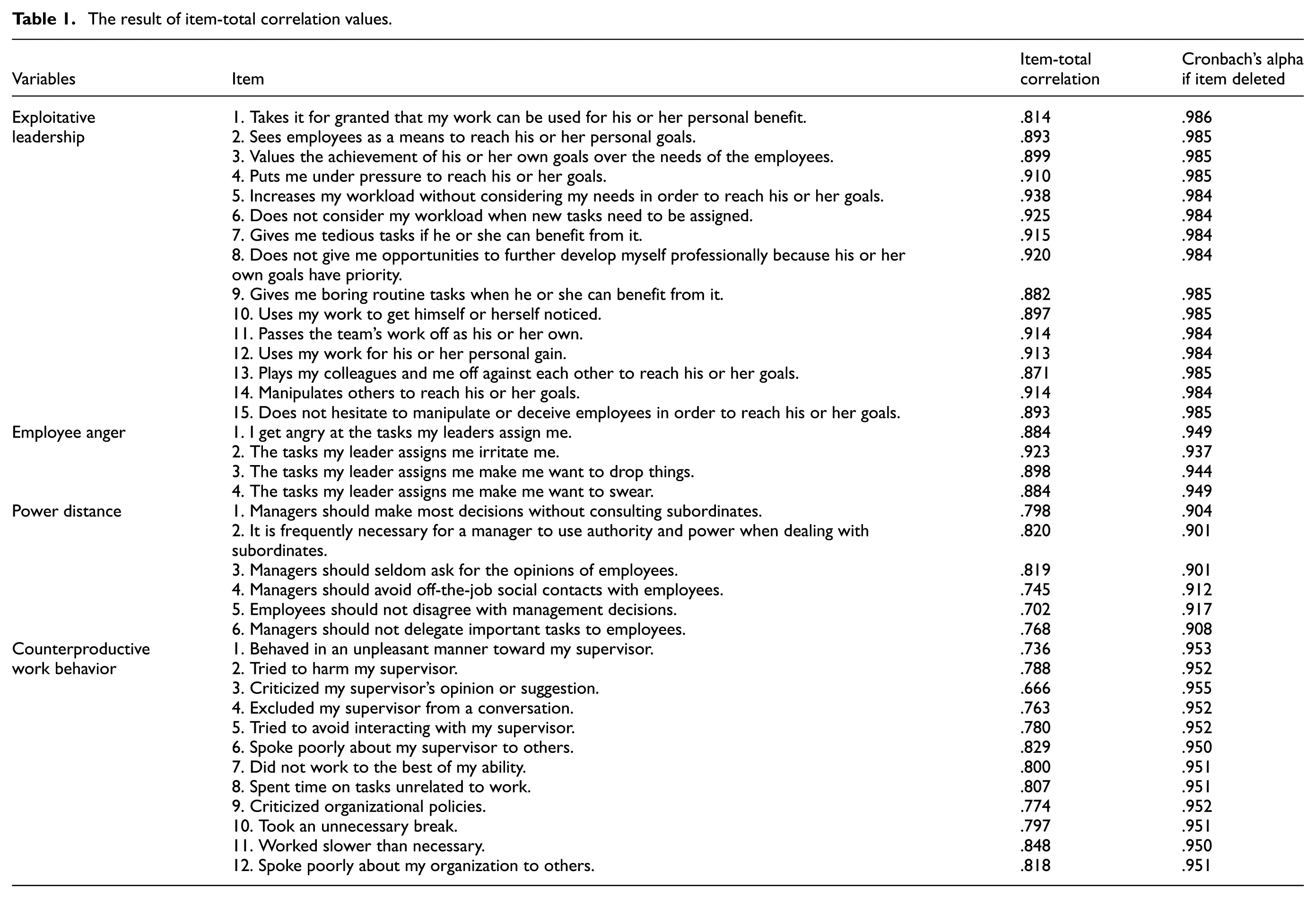
Exploitative leaders are fundamentally selfish and consider employees as mere instruments to achieve their own objectives (Schmid et al., 2019). This construct was measured using a 15-item scale from Schmid et al. (2019). A sample item is: “My leader presumes, as a matter of course, that my work should serve their personal interests.” The reliability was excellent (α = 0.986).
Employee anger refers to a strong emotional response triggered by dissatisfaction or hostility (Y. Chen et al., 2017). Anger was assessed using a 4-item scale adapted from Y. Chen et al. (2017), based on Spielberger’s (1995) State-Trait Personality Inventory. A sample item is: “I feel angry about the tasks assigned to me by my leader.” The reliability was excellent (α = 0.958).
Power distance refers to the degree to which individuals accept unequal distribution of power within an organization (Dorfman & Howell, 1988). This variable was measured using a 6-item scale developed by Dorfman and Howell (1988). A sample item is: “Leaders often need to utilize authority and power when dealing with employees.” Internal consistency was strong (α = .921).
Counterproductive work behavior refers to any deliberate actions taken by employees that harm the legitimate interests of the organization (Gruys & Sackett, 2003). CWB was measured using a 12-item scale from Dalal et al. (2009). A sample item is: “I will display a displeased attitude toward my leader.” Reliability was high (α = .956).
All variables were rated on a 7-point Likert scale (1 = strongly disagree, 7 = strongly agree), with higher scores indicating stronger agreement. Figure 1 presents the research model.
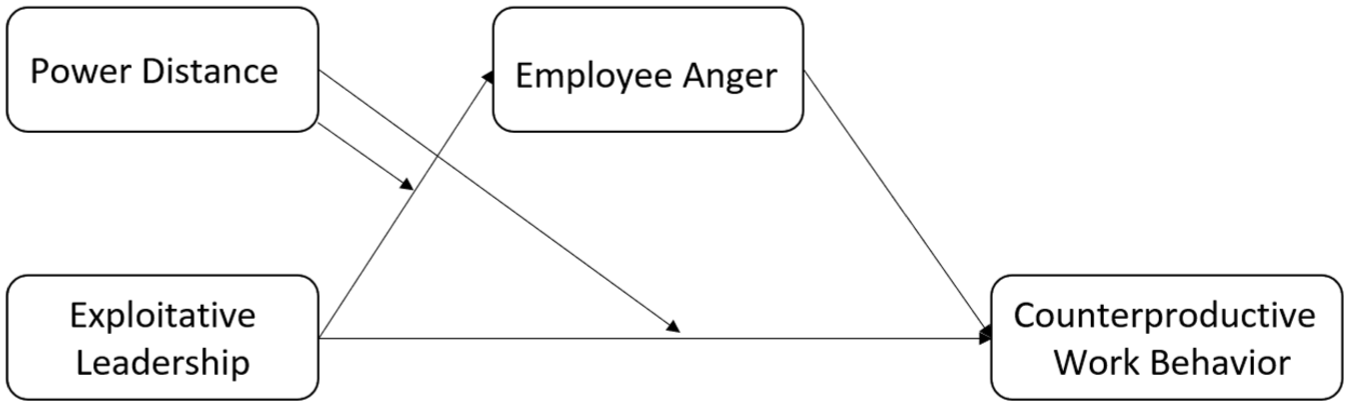
Research model.
Results
Confirmatory Factor Analysis
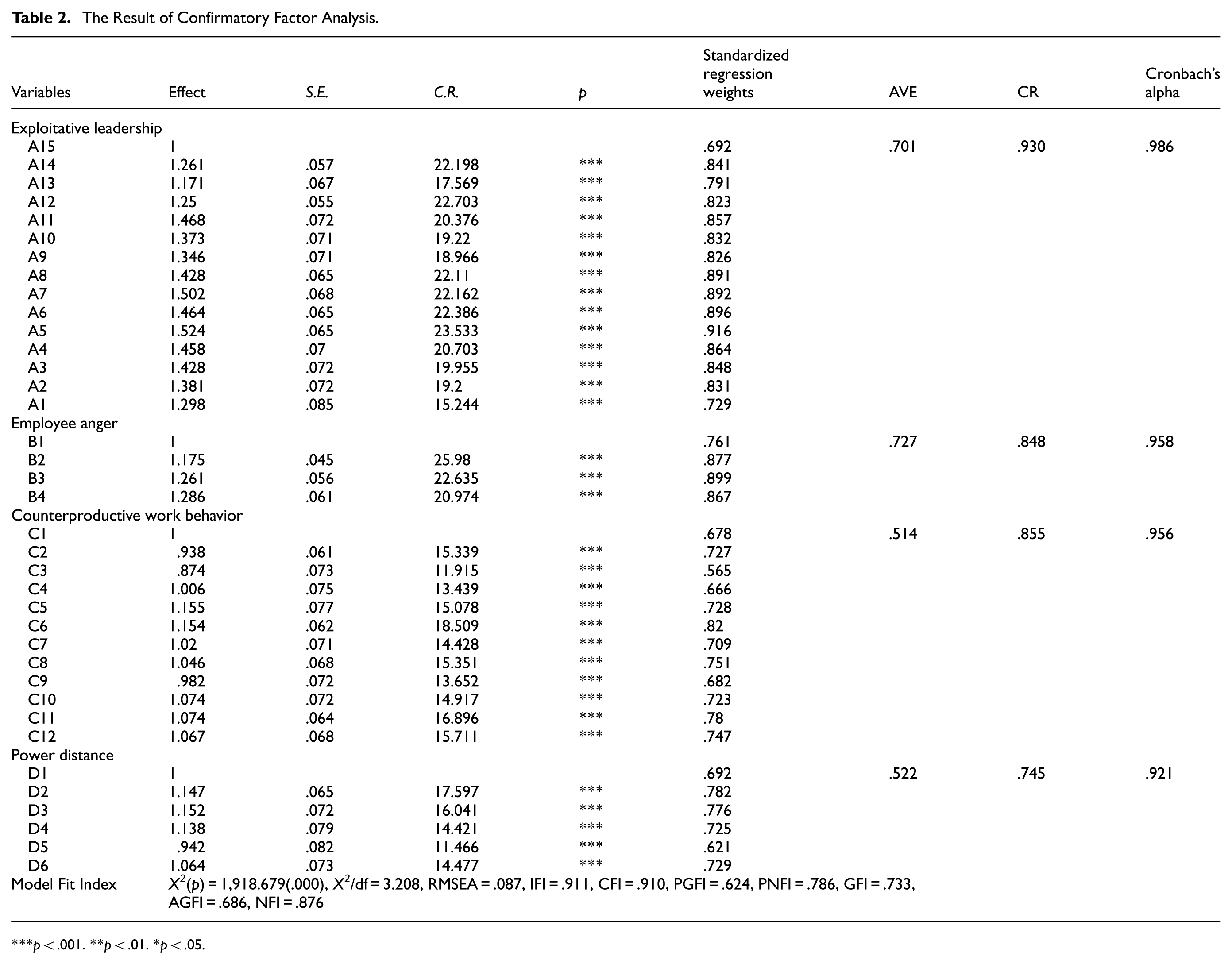
Confirmatory factor analysis (CFA) results for the four-factor model (Model 1) indicated good model fit and acceptable construct validity. Convergent validity was assessed through standardized factor loadings, AVE, and CR values. Standardized loadings ranged from 0.692 to 0.916 for exploitative leadership, 0.761 to 0.899 for employee anger, 0.565 to 0.820 for counterproductive work behavior, and 0.621 to 0.782 for power distance—all exceeding the recommended threshold of 0.5. The average variance extracted (AVE) reflects how much variance in the observed indicators is accounted for by the underlying latent construct (Dos Santos & Cirillo, 2023). The average variance extracted (AVE) values were 0.701 (exploitative leadership), 0.727 (employee anger), 0.514 (CWB), and 0.522 (power distance), indicating satisfactory convergent validity. Composite reliability (CR) scores were 0.930, 0.848, 0.855, and 0.745 for the respective constructs, all above the 0.7 cutoff, demonstrating good internal consistency (Ngo & Nguyen, 2016). According to Jin and Hahm (2021), these AVE and CR values confirm adequate measurement validity.
Additionally, model fit was assessed using three categories of indices: absolute fit, incremental fit, and parsimonious fit indices. The absolute fit index X2/df < 3 indicates a good fit, while < 5 indicates a moderate fit (Hong, 2000). The incremental fit index (IFI) and comparative fit index (CFI) are indicators used to assess the goodness of fit in structural equation modeling (SEM), Generally, a value > 0.90 indicates a good model fit (Bollen, 1989; Loehlin, 2004). The parsimonious adjusted index (PAI) is a metric that adjusts for model complexity, used to balance model fit and parsimony (Osman et al., 2017). Examples include PGFI and PNFI. Generally, PGFI and PNFI values greater than 0.50 indicate a good model fit. The evaluation of absolute model fit began with X2(p) = 1918.679(0.000), X2/df = 3.208, and RMSEA = 0.087. The RMSEA, a “badness-of-fit” index, showed a strong fit with values near zero indicating minimal approximation error. According to Browne and Cudeck (1992), RMSEA values below .05 suggest close fit, 0.05–0.08 indicate reasonable fit, and values above 0.10 imply poor fit. In this study, incremental fit indices were acceptable (IFI = 0.911; CFI = 0.91), and parsimonious indices also met recommended thresholds (PNFI = 0.786; PGFI = 0.624), suggesting an overall acceptable model fit (Jin & Hahm, 2021). Thus, the structural model demonstrated adequate fit.
For reliability, all constructs exceeded the 0.70 benchmark for Cronbach’s alpha, indicating strong internal consistency: exploitative leadership (α = .986), employee anger (.958), counterproductive work behavior (.956), and power distance (.921). These results are summarized in Table 2.
The Result of Confirmatory Factor Analysis.
p < .001. **p < .01. *p < .05.
Descriptive Statistics and Correlation Analysis
Descriptive statistics were calculated, including the means and standard deviations. The average score for exploitative leadership, employee anger, counterproductive work behavior, and power distance were 3.325, 3.180, 2.838, and 3.048, respectively. The standard deviations of exploitative leadership, employee anger, counterproductive work behavior, and power distance were 1.879, 1.665, 1.377, 1.482, respectively. The correlation analysis revealed a positive relationship between exploitative leadership and employee anger (r = .705, p < .001), and counterproductive work behavior (r = .695, p < .001) and power distance (r = .648, p < .001) are positively related. Employee anger also showed a positive relationship with counterproductive work behavior (r = .810, p < .001) and power distance (r = .686, p < .001). Power distance likewise showed a positive link to counterproductive work behavior (r = .748, p < .001). The results of the descriptive statistics and correlation analyses are presented in Table 3.
The Result of Descriptive Statistics and Correlation Analysis.

p < .001. **p < .01. *p < .05.
To assess multicollinearity, linear regression was conducted in SPSS. The VIF values for exploitative leadership (2.214), anger (2.426), and power distance (2.104), as well as for anger as a mediator (1.989), were within acceptable limits (under 5), showing that multicollinearity was not an issue.
Hypothesis Test
Using SPSS PROCESS Model 4, the mediating role of employee anger was tested. Results indicated that exploitative leadership significantly predicted employee anger (Estimate = .625, p < .001) and counterproductive work behavior (Estimate = .180, p < .001). Employee anger also had a significant positive effect on counterproductive work behavior (Estimate = .526, p < .001), supporting Hypotheses 1–3.
For Hypothesis 4, the indirect effect of exploitative leadership on counterproductive work behavior via employee anger was 0.329, with a 95% bootstrap CI of [0.258, 0.405], excluding zero. This confirms a significant mediation effect. Details are provided in Table 4.
The Results of Process Model 4.

Descriptive Moderating role of Power Distance
To examine the moderating role of power distance, SPSS 23.0 was used to perform multiple regression analysis. As shown in Tables 5 and 6, power distance significantly moderated the relationship between exploitative leadership and employee anger (β = –.076, p < .05), as well as between exploitative leadership and counterproductive work behavior (β = –.093, p < .01). These findings support Hypotheses 5 and 6, indicating that higher power distance weakens the positive effects of exploitative leadership on both employee anger and counterproductive behavior.
The Result of Moderation.

p < .001. **p < .01. *p < .05.
The result of Moderation.

p < .001. **p < .01. *p < .05.
The Durbin-Watson statistic (DW) was employed to test whether the residuals of the regression model satisfy the independence assumption. The Durbin-Watson statistic is primarily used to detect autocorrelation in the residuals of a regression model, particularly first-order autocorrelation (Munfaati et al., 2023). Typically, a Durbin-Watson (DW) value between 1.5 and 2.5 is considered indicative of no severe autocorrelation issues (Field, 2024). In this study, the Durbin-Watson statistics were 2.007 and 2.082, both close to 2, indicating no significant first-order autocorrelation in the residuals. This satisfies the fundamental assumption of regression analysis and demonstrates that the model results are highly reliable (Figures 2 and 3).
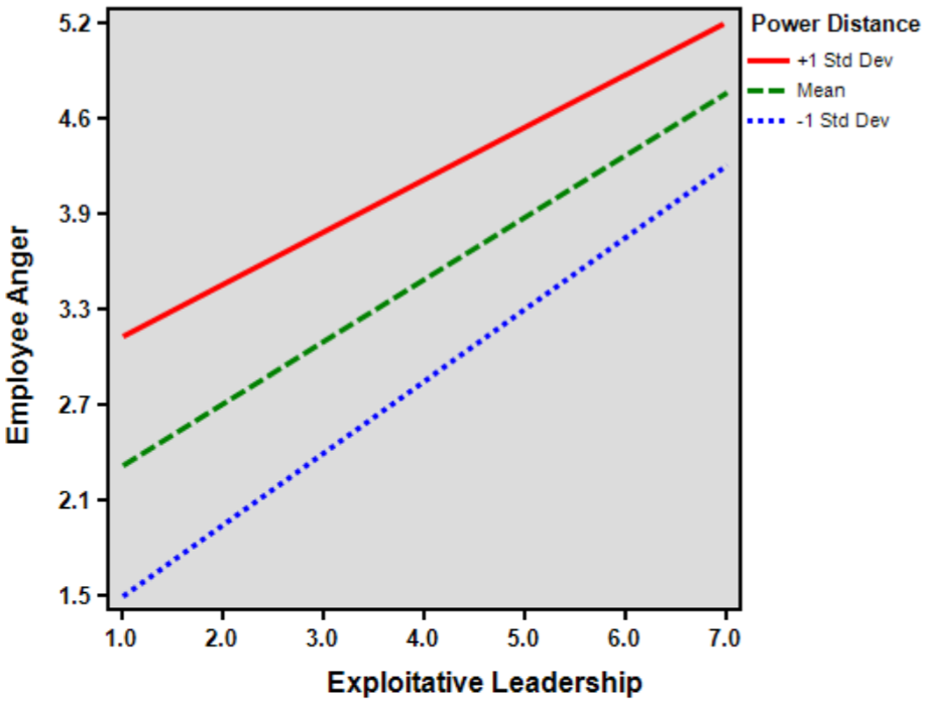
The moderating effect of power distance.
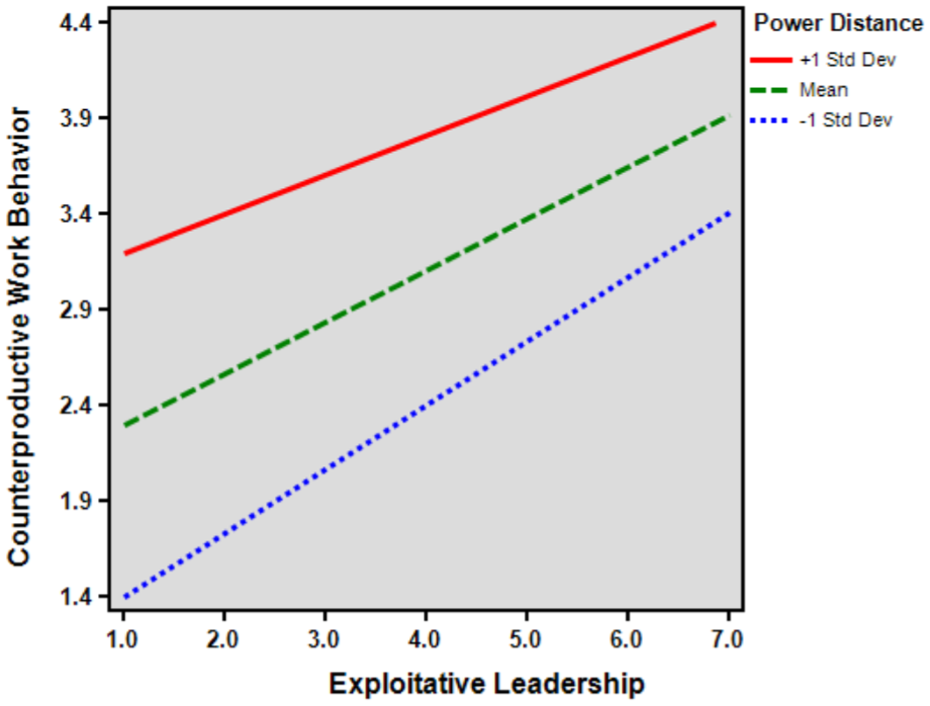
The moderating effect of power distance.
Moderated Mediation Effect of Power Distance
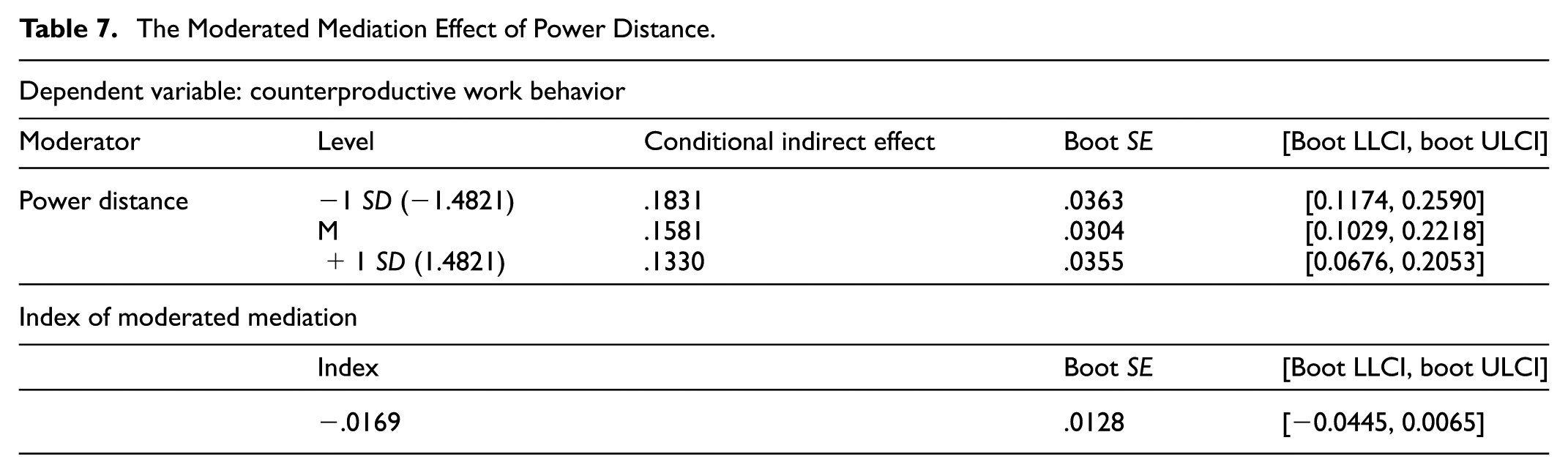
Finally, to test whether power distance moderates the mediating effect of employee anger between exploitative leadership and counterproductive work behavior, SPSS PROCESS Macro 3.4 (Model 8) was applied with 5,000 bootstrap samples and 95% confidence intervals.
Conditional indirect effects were examined at three levels of power distance (−1 SD, M, +1 SD). At −1 SD, the indirect effect was .1831 (Boot SE = .0363, CI [0.1174, 0.2590]); at the mean level, it was .1581 (Boot SE = .0304, CI [0.1029, 0.2218]); and at +1 SD, 0.1330 (Boot SE = .0355, CI [0.0676, 0.2053]). As zero was not within any confidence interval, the conditional indirect effects were statistically significant across all levels.
However, the index of moderated mediation was −.0169 (Boot SE = .0128, CI [−.0445, .0065]), which includes zero—indicating the moderated mediation effect was not significant. Thus, Hypothesis 7 is not supported. Details are presented in Table 7.
The Moderated Mediation Effect of Power Distance.
AMOS was used to further verify the mediating role of employee anger. The indirect effect of exploitative leadership on counterproductive work behavior via employee anger was significant (Estimate = 0.484, Boot CI = [0.386, 0.608]), as the confidence interval excluded zero. Model fit indices indicated acceptable fit: χ2(p < .001) = 1335.17, χ2/df = 3.305, RMSEA = .089, IFI = .929, CFI = .929, PGFI = .624, and PNFI = .783. These results confirm the significance of the mediation effect. Table 8 provides the complete findings (Table 9).
The Mediating Effect of Employee Anger.

p < .001.
The Results of Hypotheses Test.

Discussion
This study grounded in Affective Events Theory (AET), the study demonstrates the process by which exploitative leadership triggers employee anger, which then leads to CWB. This “event-emotion-behavior” chain explains how negative leadership stimulates emotional responses such as anger. If unmanaged, this anger can evolve into retaliatory or confrontational behaviors. This insight contributes to the emotional mechanism literature and offers guidance for practice—highlighting the need for managers to monitor emotional reactions and foster healthy, supportive environments to reduce workplace deviance. By incorporating power distance into the model, the study extends existing research on exploitative leadership. While prior studies often emphasize direct effects, this research uncovers how power distance shapes emotional intensity and behavioral responses.
Theoretical Implications
The study examined the impact of exploitative leadership on employee anger and counterproductive work behavior. Findings indicated that exploitative leadership significantly increases both employees’ anger and their engagement in counterproductive behavior. Exploitation can be characterized as the experience of being subjected to unjust treatment (Schmid et al., 2019). The psychological stress of employees is higher when faced with leadership injustice (W. Lin et al., 2013). Moreover, employees’ negative perceptions can lead to dissatisfaction and anger toward their surroundings (R. Y. Wang et al., 2022). Therefore, exploitative leaders tend to be selfish and self-interested, which can exert great psychological pressure on employees and increase their negative perceptions and anger. Additionally, when employees feel exploited by their leaders, their internal stress increases, and to restore the balance, they may engage in counterproductive work behavior like resistance and retaliation (G. S. Yang et al., 2018). This indicates that exploitative leadership fosters counterproductive work behavior.
Second, we determined the relationship between and examined the effect of employee anger and counterproductive work behavior. It was verified that employee anger has a significant positive effect on counterproductive work behavior. Employees respond to and express their perceptions of events through emotions (G. Qin & Zhang, 2022). They engage in counterproductive work behavior to express their dissatisfaction and vent their anger (W. Yang & Li, 2021). This suggests that high levels of employee anger are associated with high levels of counterproductive work behavior.
Third, the study confirmed that employee anger mediates the relationship between exploitative leadership and counterproductive work behavior. Adverse organizational experiences are likely to evoke negative emotional responses from employees (F. F. Zhou et al., 2021). When employees are angry, they are more prone to impulsive actions and reduced rational judgment (G. Qin & Zhang, 2022). Therefore, when employees are angry, they may lose their reason and believe their supervisors are violating their rights, and, thus, engage in counterproductive work behavior.
Fourth, this study confirmed that power distance significantly and negatively moderates the effects of exploitative leadership on both employee anger and counterproductive work behavior. Power distance reflects individuals’ expectations about subordinate–superior relationships (Cui et al., 2022). Employees with low power distance value fairness and autonomy, making them less tolerant of supervisory exploitation, which increases emotional distress and anger (Y. G. Zhang et al., 2022). In contrast, employees with high power distance are more accepting of inequality and display greater tolerance for unfair treatment, making them less reactive emotionally and behaviorally (Xu & Li, 2017). Continuous exposure to exploitative leadership leads these employees to experience stronger anger and a higher likelihood of engaging in counterproductive behaviors.
Finally, to test whether power distance moderates the mediating role of employee anger, this study examined a moderated mediation model. The results indicated that the moderated mediation effect was not significant. One explanation is that employees with high power distance generally accept hierarchical structures and view their leaders as legitimately holding greater authority (Zheng et al., 2023). As a result, they are more tolerant of exploitative behaviors and tend to resolve issues through compliant or indirect means rather than through counterproductive work behavior, even when angered. Although negative emotions can lead to CWB (Song et al., 2024), high power distance employees often show greater respect for authority (Kirkman et al., 2009) and perceive exploitative leadership as normal or justified (Zhang et al., 2006), reducing their tendency to retaliate. Second, due to increasing job insecurity in China’s SME sector, employees may fear punishment or job loss if they engage in CWB (Su et al., 2022). This fear leads high power distance employees to suppress emotional reactions, despite feeling exploited. Third, in Chinese organizational culture, employees with high power distance often view fulfilling their roles as a duty and prioritize group interests over personal grievances (Farh et al., 2007). Their loyalty and professional ethics further discourage counterproductive behavior.
Practical Implication
First, exploitative leadership remains prevalent in Chinese organizations (Y. D. Sun & Zhang, 2022) and is linked to employee distress and negative emotions (Majeed & Fatima, 2020). Therefore, during leadership selection, organizations should avoid self-serving candidates and prioritize individuals who demonstrate empathy, dedication, and a collectivist mindset. Second, to foster a climate of open communication, organizations should implement effective feedback systems. Anonymous channels can encourage employees to voice concerns about leadership behavior, while regular team discussions on challenges and achievements can strengthen leader–employee understanding and interaction.
Second, leadership behavior can intensify employee anger, which depletes emotional resources and lowers motivation (R. Y. Wang et al., 2022). Rather than reacting defensively, supervisors should view anger as a meaningful signal requiring attention and empathy (Geddes et al., 2020). A positive organizational climate enhances employee satisfaction (Jin et al., 2022). Therefore, leaders should foster a supportive environment, regulate their own conduct, monitor employee emotions, implement care programs, and address anger constructively to prevent further counterproductive behaviors.
Third, counterproductive work behavior leads to low productivity, affects the daily operation and development of the organization, and harms the organization’s interests (L. Lin et al., 2010). Leaders need to increase communication with employees, understand their routine experiences and reduce superfluous job stress (Jin & Hahm, 2021). Paying attention to employees’ emotions and reducing fueling their anger is the most important. Furthermore, leaders should improve the management system, clarify work goals, and give employees a reasonable career plan to improve their motivation and enhance their recognition of their work. Additionally, leaders should establish an emotional care and catharsis system in the organization to ensure employees’ psychological health and create a caring climate.
Fourth, power distance plays a key role in shaping employee attitudes and behaviors. It reflects employees’ perceived autonomy at work (Cui et al., 2022), with higher autonomy linked to greater motivation and satisfaction (Jin et al., 2023). Employees with low power distance feel more involved in decision-making and are more affected emotionally and behaviorally by exploitative leadership (Z. Sun et al., 2023). To ensure alignment between leadership style and employee expectations, organizations can assess power distance levels during recruitment and assign roles accordingly.
Limitations and Future Research
Despite validating the relationship between exploitative leadership and CWB, this study has some limitations, which are outlined below with proposed future research directions.
First, this study solely examined employee anger as a mediator between exploitative leadership and counterproductive work behavior. However, it is likely that other variables also play a mediating role in this relationship. Specifically, psychological detachment and job burnout may serve as alternative mediators linking exploitative leadership to counterproductive behavior. Therefore, future research is encouraged to explore these additional mediating mechanisms.
Second, this study focused solely on power distance as a moderator between exploitative leadership, employee anger, and counterproductive work behavior. However, other potential moderators at the individual and organizational levels—such as employee personality traits, leadership support, and organizational climate—warrant further investigation. Future research is encouraged to explore and validate the moderating effects of these variables.
Third, the survey population in this study was only employees working in Chinese SMEs. Considering China’s high power distance cultural context, future studies should empirically examine SME employees in other countries to identify potential cross-national differences and assess how the findings may vary across contexts. It is also necessary to conduct empirical research targeting members engaged in various industries. Companies exist in various forms. In particular, it would be valuable to examine what differences there are through comparative research targeting small and medium-sized enterprises and large corporations.
Fourth, this study was cross-sectional. To draw more accurate conclusions, a longitudinal study with multiple measurements over a certain time interval is needed. This will allow us to obtain more accurate findings.
Finally, as the majority of respondents were employees and as the data were obtained through self-reported measures, the possibility of common method bias cannot be ruled out. Future studies should consider separating data sources to mitigate this issue. employees should capture the leader’s characteristics or leadership skills, and the leaders should report on employees’ actions or attitudes, for example.
Footnotes
Acknowledgements
We are grateful to the organizational members from Chinese SMEs who participated in the survey for this research.

Ethical Considerations
This research did not require ethics approval. The main reasons are as follows.
1. All participants were over the age of 18, and there were absolutely no minors included.
2. Our research is not involving animals. Therefore, there is absolutely no content about animal abuse or animal testing.
3. It absolutely did not include human biological experiments or general experiments.
4. Although the survey was conducted, it was not conducted compulsorily or coercively.
Before conducting the survey, participants were allowed to participate voluntarily without being forced.
In addition, personal information processing was secured. Therefore, we promise that there are no ethical problems.
Funding
The authors received no financial support for the research, authorship, and/or publication of this article.
Declaration of Conflicting Interests
The authors declared no potential conflicts of interest with respect to the research, authorship, and/or publication of this article.
Data Availability Statement
The datasets generated and/or analyzed during the current study are available from the corresponding author upon reasonable request.