




Abstract
The present article investigates the influence of compensation plans – financial as well as nonfinancial and performance feedback – with respect to the retention of the employee considering the retail sector in India from viewpoint of employees. A structured questionnaire was employed to gather information from the Hyderabad city and Greater Hyderabad Municipal Corporation (GHMC) consisting of 571 retail outlet employees as sample respondents. The collected data was analyzed using structural equation modeling (SEM) to assess the hypothecated relationship among financial that is, extrinsic rewards (FR), non-financial that is, intrinsic reward (NFR), performance feedback (PF), and employee retention (ER). The findings reveal that intrinsic and extrinsic benefits portray an important role in performance feedback (PF) which in turn helps the organization to retain their employees for years to come. The study offers academia and practitioner a thoughtful and insightful understanding of some of the important aspects of keeping skillful and talented performers and ultimately increasing productivity and providing a competitive advantage to the organization.
Keywords
Introduction
In the present hyperactive era of business management, specifically traditional human resource management approaches and practices in policy formulation and implementation are experiencing uphill challenges to keep talented and skillful personnel. The task is even becoming difficult due to the presence of Zoomers (also known as “Generation Y i.e., Gen Y”) and millennials (also known as “Generation X i.e., Gen X”) in the current workforce, utilization of conventional strategies to retain employees is nowadays found to be ineffective to fulfill the requirements of the present generations (Kashyap & Rangnekar, 2014). The dynamic nature of globally changing market condition is compelling organizations to find alternative means to adapt, accommodate, and cooperate as the pressure and challenges of competition is highly intensive as well as nerve-breaking (Park et al., 2010). Keeping this view, the combination of employee compensation (e.g., monetary and non-monetary) and performance feedback (PF) can be an innovative and unique idea that could be helpful to achieve the organizational objectives and could also outperform their rivals (Yukl, 2010).
The term employee retention (ER) is regarded as the lifeblood for a firm to be successful in the business. The term employee retention can be defined as “a process in which the employees are encouraged to remain with the organization for the maximum period or until the completion of the objectives (Singh & Dixit, 2011).” The primary objective of employee retention tactics and policies is of dual aspects concerning the organization. The first one is to diminish the turnover of employees and the second is to significantly minimize the related overhead costs incurred in acquiring, giving training, and providing induction to the fresh personnel (Iqbal & Hashmi, 2015).
In management literature, the topic of performance feedback is gaining popularity due to its importance as it is a mechanism by which managers should know how to provide feedback for organizational effectiveness (Chappelow & McCauley, 2019). It helps an organization in adapting behavior to attain performance goals not only to individual extent but also to the extent of organization (Greve & Gaba, 2017).
The performance feedback research has a vast literature on the organization (Alvero et al., 2001; Ben-Oz & Greve, 2015; DeNisi & Murphy, 2017; Greve & Gaba, 2017; Kotiloglu et al., 2021; Tagliabue et al., 2020) and individual/group level (Brown et al., 2016; Christ et al., 2016; Greve & Gaba, 2017; Hannan et al., 2008). Concerning organization, empirical research focused primarily on the adaptive implication of financial performance objectives for example return on assets (Shinkle, 2012) while some of the recent research has explored the non-financial performance objectives for example social goals by (Stevens et al., 2015), innovation by (Gaba & Bhattacharya, 2012), growth by (Greve, 2008), safety by (Baum & Dahlin, 2007), status by (Baum et al., 2005). With respect to groups/individuals, most of the empirical research has principally focused on adapting performance improvement tactics. Apart from that some of the studies also focused on other areas such as personal growth (Holt et al., 2012), continuous learning and feedback, recognition (Gilbert, 2011; Weyland, 2011), flexibility (Lowe et al., 2008), work environment (Amabile et al., 2004).
The study on how compensation (i.e., extrinsic or financial and intrinsic or non-financial) plans, individually or in a group may affect performance feedback is vital since human resource executives play a decisive role in designing compensation bucket as well as providing valuable input to the decision and policymakers. To devise effective compensation plans, it is essential to recognize which reward schemes are competent enough concerning performance feedback and their role to improve employee retention in an organization. This knowledge can facilitate designing compensation plans and information systems which suit employees’ interests with that of the organization.
The present study is carried out keeping in view the individual perspective by analyzing the influence of compensation practices (i.e., monetary and non-monetary) with respect to performance feedback on employee retention (ER) with respect to Indian retail sector. To pursue the research, primary (i.e., first-hand) data were gathered from retail outlets of Hyderabad and Greater Hyderabad Municipal Corporation (GHMC) area. Primary data from a 571 sample size were considered for analysis, wherein employees of 8 top retail outlets from Hyderabad city and GHMC were considered for the study. The research findings show that the employees of retail outlets in Hyderabad are facing several problems specifically their average salary is insufficient to manage their daily needs and similarly the work culture and timing impact their performance and productivity which ultimately influence the retention of experienced employees in the organization. They always look for a better opportunity to secure their career in such a way that they can live their life better and seek further development for career growth.
Retail Sector Scenario in India
India is one of the fast-developing nations in the world. In the development of India, the retail industry has a fair contribution by providing opportunities to the medium educated individuals like Secondary School (10th class) Certificates, Higher Secondary (12th class) Certificates and simple graduate passed people. The retail industry appears to be fastest growing sector in India because it has a fascinating market for retail business which is why several big players are trying to enter the Indian retail market. According to IBEF Report (2021) report, the contribution of the retail industry to India’s Gross Domestic Product (GDP) is over 10 percent, and 8 percent in employment. As per the IBEF report, India is the fifth-largest global and preferred destination for doing business and it will become the third-largest consumer economy by 2025. IBEF has reported that Indian retail market is flourishing with growth rate ranging from 9% to 11%. Further they have projected that the retail sector would touch 1.75 trillion US dollars by the year 2026.
For present study, assuming that there is a lack of consensus regarding the common variable which can be attributed to employee retention (ER), because of the reason of contextual uniqueness of a specific industry and country. Therefore, this research intends to bridge the gap by contributing to which factors impact performance feedback (PF) with respect to employee retention (ER) in the context of Indian retail industry. As per the extant literature and knowledge, there is scarce research available to measure the influence exclusively concerning monetary that is, extrinsic and non-monetary that is, intrinsic rewards through performance feedback on employee retention (ER) in the dynamic retail outlets of India, although very few research are available in the western context.
Review of Literature and Hypotheses Development
According to Fox (2014), performance feedback is considered a placard in the retention strategy between employees and the management of an organization. A recent survey conducted by LinkedIn called “The Exit Survey” shows that 7,530 members changed their jobs. These members were asked what would convince them to change jobs, however, the actual reason they changed jobs was different (Grunewald, 2014). In an organization, it is important to keep a feedback system effectively in place, and time is allocated, to periodically reflect on, re-assess, and make necessary adjustments to the feedback mechanism (Bonino et al., 2014). The use of a feedback mechanism has the potential to keep the organization in a winning position between employees and employers (Busser, 2012). In the long run, performance review mechanism acts as incubator for both employee and employer. It helps the employer to provide constructive feedback about the employees which ensures that the business is operating in the best manner.
The performance feedback process is considered as an ongoing process between employees and managers (Griffeth et al., 2000). It considers involvement of both performances expected and performance exhibited while exchanging information in an organization (DeNisi & Murphy, 2017). It is also important for an organization to provide constructive feedback which helps to praise good performance or take corrective measures for poor performance (Posen et al., 2018). An organization needs to set a performance standard as well for effectively reaching the goals of the organization. It is also found that having a conversation face-to-face with employees leads to resolving performance obstacles. The performance feedback of an employee can be either positive or negative (Bakker et al., 2007; Schaufeli & Bakker, 2004) and an adjustment may need to be made based on the feedback which will be helpful in employee engagement effectively (Gruman & Saks, 2011).
Retention of employees can be practiced by using different factors which can change the mindset of workforces to work with organization for longer time includes reward, recognition, and respect which can increase the productivity of employees (Nazia & Begum, 2013). Financial rewards, work environment, and employee benefits can be used to hold the personnel in the company (Ghosh et al., 2013). Compensation is one of the major factors which can be considered a critical issue that affects attrition rate within company (Carraher et al., 2006; Griffeth et al., 2000; Moncarz et al., 2009; Willis, 2000). Retention of good employees in the organization is key to success (Gulzar et al., 2017). Job satisfaction is an important factor that can be used in retaining employees because satisfied personnel become loyal and used to staying for a longer period with the company (Beecham et al., 2008; Ghiselli et al., 2001; Lee, 2000). In some organizations, the turnover cost is high; the reason includes employing temporary workers, background checks, training, and employee orientation expenses (Abdullah Al Mamun & Nazmul Hasan, 2017).
Culture and Reward System
The reward system is most of the time formulated considering organizational viewpoint where the financial necessities of the company take superiority when compared to the financial needs of personnel (Conlon & Parks, 1990; Kerr & Slocum, 1987). Since the organization’s requirements take precedence over individual employee’s necessities, the lucrative calculated incentives offered to them used to lose their existence as it is not valued by personnel (Robbins, 1988). It is also evident that “what is important is not whether a program looks good on paper or is considered ‘state-of-the-art’, but only employees want the reward and are willing to work toward desired results to receive it (Wilson, 1997, p. 63).”
Lawler (2000) suggested that a people-oriented system of rewards must be understood by exploring individual expectations, values, and needs. These expectations and needs vary based on the individual characteristics (Andrews & Henry, 1972; Ingram & Bellenger, 1983; Mamman et al., 1996). The psychological traits and needs and how they leverage to impact the efficiency of reward system may be explained by motivational theories (Adams, 1963; Deci, 1975; Maslow, 1954; Porter & Lawler, 1968). The motivational theories such as content and process theories, argue that effectiveness of reward depends on the fact that if reward is valuable and significant to the employees. The literature also provides evidence that employees perceived need and their preference signifies the key motivational factor of incentive (Maslow, 1954; Porter & Lawler, 1968).
As per Hofstede (2001), changes in employee’s preferences and perceptions are ascribed to value motif immanent in sociocultural category. It is evident from the cross-cultural studies (Gomez-Mejia & Welbourne, 1991; Hodgetts & Luthans, 1993; Hofstede, 1980) that understanding of diversed culture improves the propensity of an organization in adoption and implementation of managerial practices in the best possible manner to and from contrasting nationwide environment.
The widely used cultural dimensions are explained by Hofstede which includes “individualism-collectivism, uncertainty avoidance, power distance and masculinity-femininity.” Studies such as Chiang and Birtch (2007, 2005) provide evidence that various cultural factors scientifically associated with differentiation in perception and preferences for different types of rewards, criteria and systems. For example, in terms of individualism culture, Japanese favored job involvement as core basis for compensation whereas South Korean and Hong Kong preferred to maintaining a relationship. Japanese consider themselves as more independent than other two Asian nations (Fischer & Smith, 2003; Kim & Leung, 2007). Papalexandris and Panayotopoulou (2004) found that power distance was negatively correlated within 19 European nations when determining individual pay. The countries that try to avoid uncertainty highly favored pay based on the seniority of the employees and less favored pay based on performance of the individual employees (Schuler & Rogovsky, 1998). Masculinity culture favors financial rewards more valuable whereas social rewards appear to be highly valued in feminine culture.
Countries like Germany (Segalla et al., 2006) and Finland (Chiang & Birtch, 2007) used to follow the practices of equality but in case of Asian and Anglo-Saxon nations, used to favor individual competitive systems. Joshi and Martocchio (2008) show influence of national cultural values specially individualism-collectivism and masculinity-femininity and reward systems on turnover intention to move out of the organization in the context of United States workforce.
The literature explicates that compensation that is, reward system may indeed perceive diverse meaning in culturally different nations. Moreover, there are abundance of studies available comparing the Western-Eastern countries. However, handful of differentiations were also observed within Asian countries.
Culture and Performance Feedback
Culture acts as an important facet in the performance feedback mechanism which differs from one nation to another nation (Audia & Tams, 2017; MacDonald et al., 2013; Morrison et al., 2004). As per Peterson and Behfar (2003), performance feedback works excellent in collectivism culture where in it works well in individualistic culture (Stone-romero & Stone, 2002). A meta-analysis done by Oyserman et al. (2002) investigating measures of self-report (such as assessing employee’s values and attitudes etc.) asserting to distinctly evaluate collectivism as well as individualism. The outcomes of their study explicated that China, Hong Kong and Taiwan displaying the highest variance in terms of individualism approach as opposed to Canadians and Americans counterparts, but these Asian nations appeared to be less significant in terms of individualism approach. In contrast, Americans seems to be less significant in terms of collectivism approach in comparison to afore-mentioned Asian nations.
Performance feedback is considered valuable if it enhances the self-determination of an individual. It implies that, for example, performance feedback (PF) can attract attention of the individual performer to non-monetary (i.e., intrinsic) aspirations such as autonomy, competency, or association in contrasts to merely hunting financial rewards (i.e., extrinsic). The quest for intrinsic individual aspirations is found to be optimistically associated with wellbeing and adjustment (Kasser & Ryan, 1996). It is evident from the literature that theory of self-determination advocates how human being utilize feedback has significant consequences.
Employee Turnover (ET) and Performance Feedback (PF)
Employee turnover is one of the critical issues for any organization. According to (Abbasi & Hollman, 2000), it is categorized into two kinds that is, voluntary, and involuntary. Whenever an employer discharges any employee, it is known as involuntary turnover whereas when an employee chooses to resign from employment then it is known as voluntary turnover. These kinds of turnover can be due to functional reasons (i.e., removing under-performers) or dysfunctional reasons (i.e., being unable to keep good employees) for the firm. There are several studies conducted by various scholars focusing on factors affecting turnover in an organizational setting which may be categorized into organization related, linked to work environment, associated to job, and related to personal circumstances. The other factors which are explored include financial and nonfinancial rewards, imparting training and development to employees, job stress, work-life balance, organizational culture, and job dissatisfaction (Anderson et al., 2002; Firth et al., 2004; Horwitz et al., 2003; Pfeffer, 1998).
Performance feedback (PF) is a process of transmitting evaluative information about an action or a process of performing a task or a function of employees. Performance feedback is a formal system established and used to allow managers to provide information about action then such information is used for different purposes, in expectation of a lots of benefits that includes taking corrective measures to improve some element of employee response. The importance of performance feedback can be understood by directly analyzing the impact on performance of employees in an organization which contributes to accomplishing the goal of the business. Performance feedback plays crucial function, especially in retail sector, in molding employees’ attitude to increase their potential and loyalty to work.
The performance feedback literature is exhaustive, in the present study economic and psychological aspect of performance feedback is considered. The performance of an individual gets affected due to various compensation (either intrinsic or extrinsic benefits) proffered to personnel (Brown et al., 2016; Christ et al., 2016; Harackiewicz, 1979). The economic aspect is related to the extrinsic rewards or benefits which motivate an employee to perform the assigned task efficiently. A better extrinsic or financial benefit inspires an employee’s decision to accept the employment offer and reflects their intent to continue or quit (Chinyio et al., 2018; DeNisi & Murphy, 2017; Randy et al., 2002). Apart from extrinsic benefits, employees also seek an intrinsic or non-financial benefit that attracts and motivates them to stay for a longer period with an organization (Alhmoud & Rjoub, 2019; Chinyio et al., 2018; Nnabuife et al., 2017). Which reward has stronger effect either financial or non-financial on the performance that leads to employee satisfaction and compel them to stay back with the organization is having little consensus (Morgan et al., 2013). On the basis of extant available literature concerning performance feedback (PF) and employee turnover (ET), posit below hypotheses.
Hypothesis 1(H1): “Financial reward has a positive influence on the performance feedback of the employees.”
Hypothesis 2(H2): “Non-financial reward has a positive influence on the performance feedback of the employees.”
Performance Feedback (PF) and Employee Retention (ER)
Employee retention in today’s dynamic business scenario is posing the utmost challenges faced by managers and organizations (Pregnolato et al., 2017) that causes losing more skillful, talented, and competent workforce incurring hefty expenditures on the shoulder of employer with regards to technical know-how and also investment needed in recruiting and training the new employees. In the present scenario of intensified rivalry for keeping skillful employees by business houses globally, increasing turnover rate of employees is becoming a bigger threat. The organizations must have to look after their retention strategies, as rival organizations are offering lucrative rewards systems which attract and enhance employees’ career development (Alhmoud & Rjoub, 2019). For the firm to be abreast with their rivals, sustainable growth and development of their business, retention strategies need to be very effective in ensuring the satisfaction level of employees, improving employee productivity, and eventually protecting against high turnover (Nwokocha & Iheriohanma, 2012).
The extant literature shows that various studies examined to recognize the factors influencing employee retention. However, the impact of performance feedback from the viewpoint of personnel on employee retention especially by considering compensation exclusively financial (i.e., monetary, or extrinsic) and non-financial (i.e., non-monetary or intrinsic) rewards as antecedents is scarce. Based on the related review of literature, posit below hypothesis.
Hypothesis 3(H3): “Performance feedback has a positive influence on employee retention.”
Based on the review of literature, the hypotheses have been developed and the model for the present study is shown in the Figure 1.
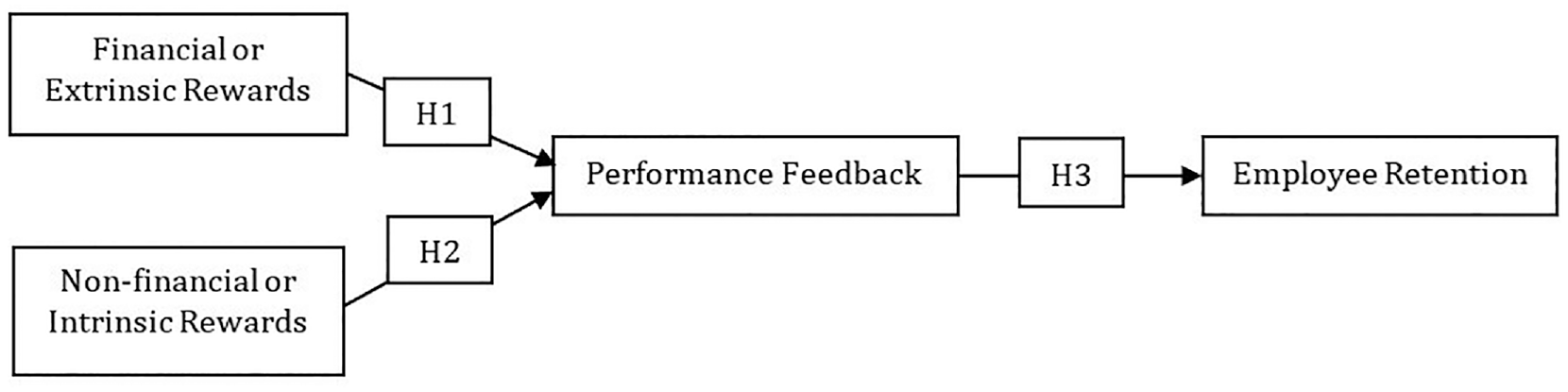
Research model for the study.
Materials and Methods
Study Sample
The present research is descriptive in nature as it attempts to understand the employee’s perception regarding the variables under study. The study was conducted in Hyderabad, which tops the chart as the best city to live and work in India (Industries and Commerce Department, Government of Telangana, Report, 2020–2021).
The study was based on a quantitative approach. The sampling method used for the study was purposive. The responses were collected from employees of 8 major hypermarkets and supermarket retail outlets situated at Hyderabad and Greater Hyderabad Municipal Corporation (GHMC) (Talkcharge, 2022). Furthermore, previous literature (Imna & Hassan, 2015; Kaur, 2013; Moon & Bates, 1993; Mukerjee et al., 2019; Newsome et al., 2013; Zedeck & Cascio, 1982) shows that various hypermarkets and supermarkets were considered for the similar kind of study in retail sector.
Data Collection Instrument and Procedure
The data were collected with the help of structured questionnaire with 5-point Likert scale (“1-being strongly disagree and 5 being strongly agree”) from the various retail outlets in Hyderabad.
The questionnaires (i.e., 2,855) were disseminated physically to the personnel of selected retail outlets. Out of total distributed questionnaire (i.e., 2,855), 613 responses were received. After discarding missing and partially filled responses, 571 were considered as sample size (refer Appendix 1).
Prior to collecting the data through the questionnaire, the employees were asked beforehand to ensure they have completed at least 1 year in their current organization. The performance appraisal and feedback normally conducted annually by organizations were well documented in literature (Bayo-Moriones et al., 2019; Brumback & Vincent, 1970; Cascio, 1998; Cederblom, 1982; Du Plessis & Van Niekerk, 2017; Obisi, 2011). Therefore, employees who have completed minimum 1 year in their current organization were considered as sample respondents for the present study.
Study Instrument and Analysis Method
In the present study, researchers used previously developed scale. The items of employee retention (ER) were adopted from Govaerts et al. (2011), compensation that is, financial rewards (FR) and non-financial rewards (NFR) were borrowed from (Chiu et al., 2002; Morgan et al., 2013; WI-bite et al., 1998), performance feedback (PF) were derived from (Bryant & Allen, 2013; Chong & Leung, 2018; Christ et al., 2016).
The methods to analyze the quantitative data were first exploratory to find out the various items related to specific factors, then confirmatory to verify factor alignment and finally structural equation modeling (SEM) to analyze connection between measured and latent variables. The size of sample required (in the present study were 571) for analysis ranged from 200 to 600 as recommended for performing afore-mentioned analysis (Hair et al., 2010; Hinkin, 1995).
Results and Findings
Characteristics of Sample
The description of the sample in terms of demographics is provided in Table 1. It shows that majority of respondents were young (94.05%) aged between 18 and 35 years. The gender divide stands as male (65.5%) and female (34.5%). Out of the total respondents, 83.89 percent have working experience between 1 and 3 years. Almost 50 percent of the respondents earn a monthly salary between Rs 10,000-15,000 per month.
Description of Demographic Characteristics of Sample Respondents.
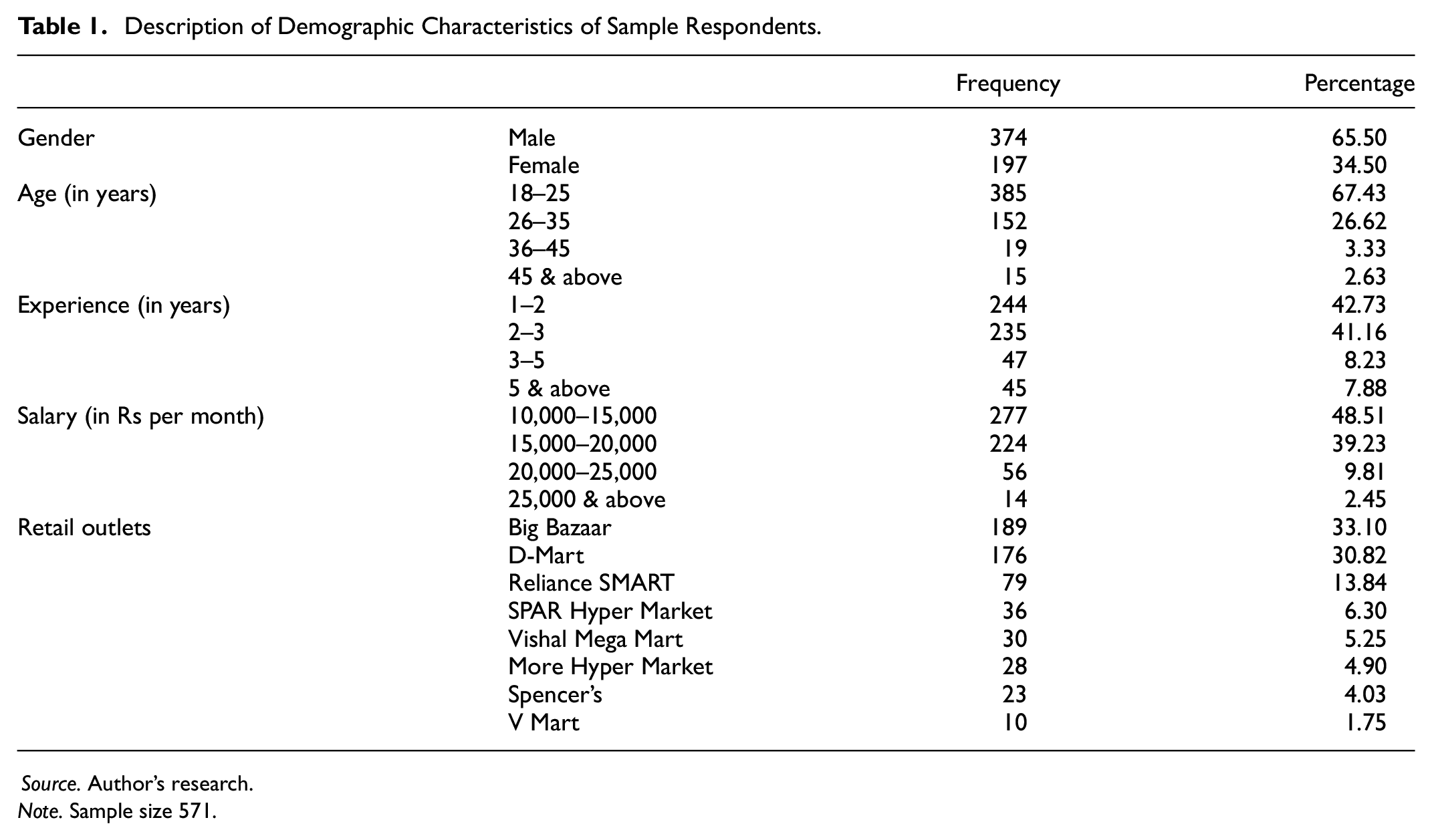
Source. Author’s research.
Note. Sample size 571.
Reliability and Validity
Below Table 2, which shows reliability and Table 3, which shows convergent and discriminant validity of the construct under study are met. Since criteria for reliability, convergent and discriminant validity are satisfied, it advocates that instrument employed in present study found to be appropriate. The present research’s Cronbach Alpha (CA) measures for factors that is, Financial Rewards (FR), Non-financial, Rewards (NFR), Performance Feedback (PF), and Employee Retention (ER) fall in the range between .80 and .890. The overall Cronbach Alpha value for the four factors of the instrument is found to be .832, which is considered as recommended value for scale robustness (Bentler & Chou, 1987; Nunnally, 1967). Therefore, it demonstrates an acceptable level of reliability.
Construct Reliability and Validity.
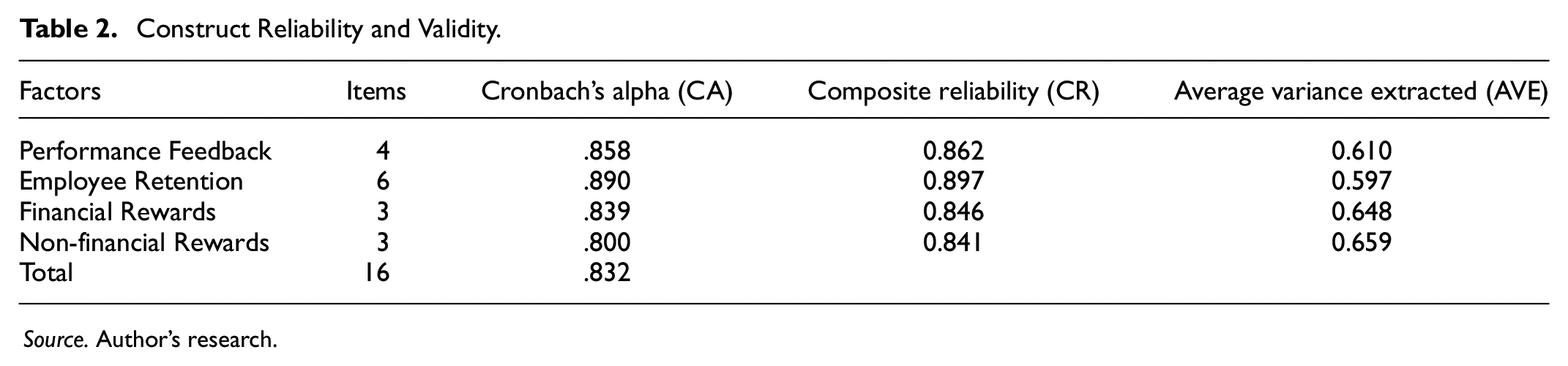
Source. Author’s research.
Construct Convergent and Discriminant Validity.

Source. Author’s research.
Note. CR = Composite Reliability; AVE = Average Variance Extracted; MSV = Maximum Shared Variance.
The CR of the factors are more than 0.7 and AVE are more than 0.5 which fulfills criterion for convergent validity. The MSV along with the square root of the AVE are greater than the correlations among factors demonstrating discriminant validity.
Confirmatory Factor Analysis (CFA)
CFA was executed by the researcher on the four factors namely financial rewards (FR), non-financial rewards (NFR), performance feedback (PF), and employee retention (ER) to test the measurement model. The precise summary of key fit indicators is portrayed in Table 4.
Measurement Model.

Source. Author’s research.
The recommended measures for CMIN/df differ throughout investigators ranging from <2 (Ullman, 2001) to <5 (Schumacker & Lomax, 2004). The other fit indices such as RMSEAi.e.,., Root Mean Squared Error of Approximation) preferred by Byrne (1998) found to be between 0.05 and 0.08 considered as fair fit. The various key model appropriate indicators such as “Comparative Fit Index (CFI), Goodness of Fit Index (GIF), Adjusted Goodness of Fit Index (AGFI), and Tucker-Lewis Index (TLI)” accompanying ideal levels which were recommended (Byrne, 1998; Hair et al., 2010; Hu & Bentler, 1999; Mulaik et al., 1989; Schumacker & Lomax, 2004; Ullman, 2001) shown in Table 4.
Structural Equation Modeling
SEM is useful in evaluating the various fit indices. All fit indices viz. “Cmin/df = 3.432, GFI = 0.936, AGFI = 0.909, CFI = 0.951, TL = 0.939, and RMSEA = 0.065,” fulfill recommended threshold as prescribed by scholars (Byrne, 1998; Hair et al., 2010; Hu & Bentler, 1999; Mulaik et al., 1989; Schumacker & Lomax, 2004; Ullman, 2001) shown in Table 5.
Structural Model Fit Statistics.

Source. Author’s research.
The SEM helps to assess the proposed model (refer to Figure 2) and illustrates a significant association between the construct under study. The relationship between financial rewards (FR) and performance feedback (PR), non-financial rewards (NFR) and performance feedback (PF); performance feedback (PR) and employee retention (ER) were found to be significant at 0.05 level of confidence depicted in Table 6.
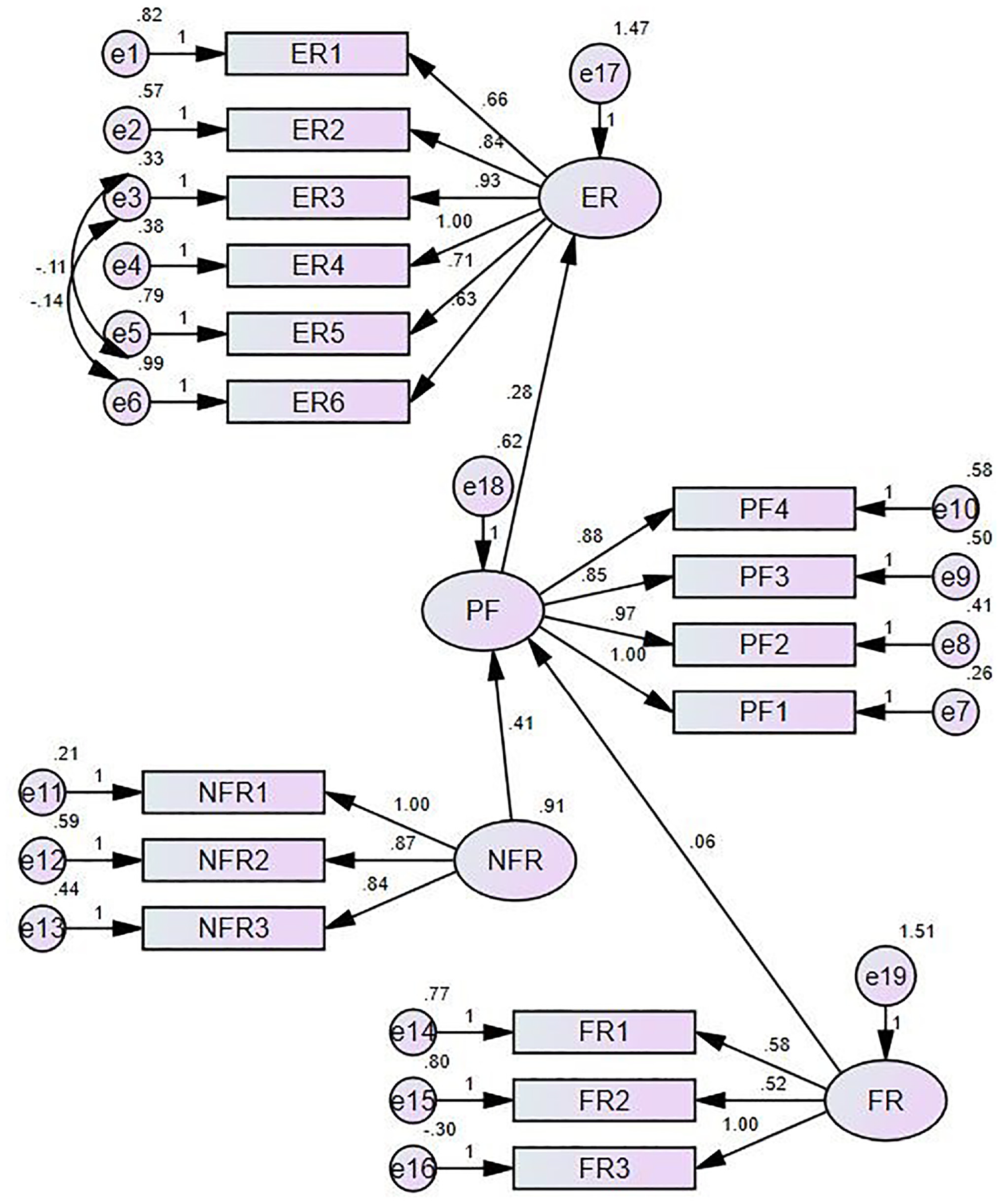
Structural model.
Regression Weights and Significant Relationship between Factors.

Source. Author’s research.
The hypothesized relationship between financial rewards (FR) and performance feedback (PF) that is, H1 statistically significant showing a regression value 0.057, non-financial rewards (NFR) and performance feedback (PF) that is, H2 statistically significant showing a regression value 0.413, performance feedback (PR) and employee retention (ER) that is, H3 statistically significant showing a regression value 0.284 at confidence level of five percent. Thus, all hypotheses H1 (Financial Rewards → Performance Feedback), H2 (Non-financial Rewards → Performance Feedback), and H3 (Performance Feedback → Employee Retention) were supported.
Discussion
The motive of present research was double-folded. The first purpose dealt with examining the compensational aspects that includes financial (i.e., extrinsic) benefits as well as non-financial (i.e., intrinsic) benefits impacting performance feedback, and the second one dealt with analyzing the impact of performance feedback with respect to employee retention considering the Indian retail industry.
To achieve the first objective of compensational factor with respect to financial and non-financial reward, hypothetical assumption (H1) established positive relationship with .025 (p-value) and .057 (β), indicating that financial reward (FR) positively effects on employee performance feedback (PF). Important factors such as wages or salary or material incentives that is, extrinsic rewards consist of overall package of tangible gains was also explored way back by Thorndike (1911) which motivates employee to work in organization. Even though recent research focuses mainly on the significance of other kinds of compensation (Bryant & Allen, 2013).
It is apparent from literature as well as present study that financial (i.e., extrinsic) gains continue to be prominent in terms of employment and management of personnel (Twenge et al., 2010). It is also evident that various financial aids provided to the personnel found to be sufficient in fulfilling their materialistic requirements due to which they want to stick with present company (Chinyio et al., 2018). Most noteworthy, wages considered to be indispensable benefits (McGovern et al., 2004), however, extant literature spills that personnel intend to be with their existing firm if they find career advancement prospects along with the high wages (Chinyio et al., 2018; Stearns & D’Arcy, 2008).
It is therefore inferred that financial rewards profoundly influence the performance feedback of the employees. This finding of the study is commensurate with the earlier study of (Alhmoud & Rjoub, 2019; Brown et al., 2016; Christ et al., 2016) where outcomes obtained induce that performance feedback posits an important facet in the minds of the employees through a competitive salary, provident fund, hike in salary, incentive pay, etc.
The hypothetical assumption (H2) established positive relationship with .00 (p-value) and .413 (β). Therefore, non-financial rewards positively influence the performance feedback of employees. The importance of intrinsic reward also advocates retention of employees (Saeed et al., 2013). The performance of the employee does not only rely on the financial aspect offered by the organization as it is evident that extrinsic reward considered as unreliable and tends to fulfill only the materialistic things while intrinsic reward helps to satisfy primarily psychological needs of the employees (Stone et al., 2010). As per Pregnolato et al. (2017), non-financial benefits such as recognition which considered as one of the important psychological needs, helps an employee to boost their self-esteem resulting in better performance and ultimately, they stick to the organization for a longer period.
The basic principle for total reward system emphasizes that appropriate combination with proper implementation of compensational bucket will help a firm in exercising the motivational and retaintional practices (Bryant & Allen, 2013). It is found that inclusion of exclusive combinations of intrinsic rewards such as learning, and career development do not impact on attracting the employees (Schlechter et al., 2015). In contrast, extant literature revealed that a substantial impact evolves from appropriately as well as explicitly planned total rewards management (Rumpel & Medcof, 2006)
It is also found that training and development provided to the employees positively impacts their performance and helps organization in retaining personnel (Anis et al., 2011). Contrary, Gharib et al. (2017) assert that despite imparting training as well as skill development to the employees if proper compensational policy not implemented then it fails to retain the employees. The present probe is in accordance with the previous study (Alhmoud & Rjoub, 2019; Brown et al., 2016; Harackiewicz, 1979) where the results obtained suggest that performance feedback also influenced by intrinsic or non-financial rewards such as promotion, health insurance, child education, etc.
Intrinsic rewards were viable sources of motivation for employees (Saeed et al., 2013). However, previous research advocated that extrinsic rewards are greatly and positively influence when compared to intrinsic rewards (Edirisooriyaa, 2014). Past studies largely focused on the extrinsic reward neglecting the intrinsic reward (Ali et al., 2016). Although monetary rewards accepted as usual incentive (Gardner et al., 2004) but fails to sustain employee motivation in a longer run because employees preferred non-monetary reward such as praise and recognition over money (Jiang et al., 2009). However, the present study is in consent with Agarwal and Munish (2015) as they viewed that both financial and non-financial rewards possessed noteworthy effect on performance feedback and retention of personnel.
The hypothetical assumption (H3) established positive relationship with .00 (p-value) and .284 (β). Performance feedback is profoundly used by the organization to improve the productivity of the employees. The present study fulfills the gap identified by DeNisi and Murphy (2017) on performance appraisal mechanism as well as performance management system, where they suggest that there is scarcity of empirical research to provide evidence that performance feedback is an essential aspect which helps an organization in retaining the employees. Performance feedback considered as important component that leads to retention of employees (Pregnolato et al., 2017). It acts as a motivational factor for employees in achieving set objectives put forth by the firm. Prior studies show that if performance feedback laden with favoritism, then employee feels unfairness and it leads them to quit the organization (Jason et al., 2016). The outcome of present work indicates profound evidence wherin performance feedback plays a vital role in employee retention. This result is in accordance with the foregoing investigation (Alhmoud & Rjoub, 2019; DeNisi & Murphy, 2017; Randy et al., 2002).
Conclusion
The purpose of the present research was to establish whether the compensational package (i.e., both financial or extrinsic and non-financial or intrinsic) had an influence on performance feedback and performance feedback had an effect on employee retention. The assessed employees were working professionals from various retail outlets. The present study expanded on earlier research carried out by various scholars from the lens of compensation and performance feedback on employee retention.
In any organization, retaining the existing personnel is considered to be uphill task and retention of personnel helps in reducing attrition rate that play a major role in gaging its well-being. When employees quit a company, abundance of knowledge as well as investment made on them use to carry away along with those personnel. Smart business owners under no circumstances subvert the worth of keeping the outwit and top performer. The approaches of organization in conventional, and human resource practices and policies in specific, should be carved out in such manner that they make sure that prime and skillful personnel should be with the employer.
The result of present study revealed that the strategies for retaining personnel by company need to be focused on overall compensational package as well as the performance feedback mechanism. In other words, employees, for example seeking self-esteem would prefer intrinsic benefits over extrinsic as it is materialistic and at the same time their voice should be acknowledged if they have any grievances.
Another interesting result is that millennials tend to incline toward non-financial rewards, advocating that modern age group emphasized on intrinsic (non-materialistic) benefits over extrinsic (materialistic) benefits (Thompson & Gregory, 2012). In present study, majority of participants approximately 90 percent falls in the age group of 18–35 years, which might be the cause that age has a momentous impact on personnel retention, since they predominantly belong to modern age group also known as millennials.
The compensation package and feedback mechanism must be in accordance with keeping in mind the prospects of personnel which must be linked with their performance. A reasonably rational and handsome salary must be on par with the industry standard is a critical issue to be taken care of by the organization. An incompatible compensation bucket may restrict a firm from surviving in the current dynamic business. It is a common human resource practice in any organization to hire less skilled and talented workers to piggy bank on costs such as wages, salaries etc. and hiring highly skilled and talented workers at a higher compensational package. Contrary, compatible compensation bucket may not only appeal skillful and capable individuals to work with firm but may also warrant that chief and top performers remain with firm.
Globally, the success of a firm is determined and dependent on the well-being of its personnel. Retaining human resources, particularly skillful and talented performers, would be significantly dependent on the effectiveness of the compensation system and policies put in force within the firm. Even maintaining a higher employee retention rate would considerably minimize the overall expenses in acquiring (i.e., recruitment, selection, and training) the desired human resources within a firm. Modern firms and managers become conscious about compensational strategies and policies are extremely vital to keep talented employees. The function of human resource management has become more important part of any organization to handle new challenges in the organization in today’s world and it is also important for sustainable development and competitive advantages (Patgar & Kumar, 2015). Therefore, the company should make their compensation system and policies in the light of employee requirements so that employees can fulfill their needs and ultimately it helps in achieving the organizational goal. The organization must make performance feedback effective so that it will help to motivate employees for better performance by which employees can feel a sense of belongingness which will help them remain for a long time in the company.
Constraints and Direction for Future Research
Every research has few constraints, this study also has few limitations. The sample was obtained through the purposive sampling method. The present study considered only retail sector employees and confined only to selected cities or geographical regions as sample respondents, which may not be generalized to the entire retail sector globally. The compensational scheme and policies differ based on geographical regions so their impact can be investigated by keeping in view the respective region’s rules and regulations. Apart from compensational rewards like financial and nonfinancial, other factors such as social rewards could also be explored and investigated for implementing effective strategies and policies which will help the organization to achieve its objectives. The present study considered only indirect effects of extrinsic (i.e., financial) as well as intrinsic (i.e., non-financial) well-being in retaining the personnel. A further commendation for upcoming research prospective to examine the mediating effect of performance feedback between compensational package and employee retention which would provide a better insight to the organization in formulating their strategies.
Footnotes
Appendix
Retail Outlet Questionnaire Distribution and Responses

| Retail outlets | Distributed Questionnaire | Received responses | Valid responses | Percentage |
|---|---|---|---|---|
| Big Bazaar | 1,000 | 197 | 189 | 33.10 |
| D-Mart | 800 | 183 | 176 | 30.82 |
| Reliance SMART | 350 | 86 | 79 | 13.84 |
| SPAR Hyper Market | 250 | 40 | 36 | 6.30 |
| Vishal Mega Mart | 200 | 36 | 30 | 5.25 |
| More Hyper Mart | 150 | 32 | 28 | 4.90 |
| Spencer’s | 80 | 27 | 23 | 4.03 |
| V Mart | 25 | 12 | 10 | 1.75 |
|
|
2,855 | 613 | 571 | 100 |
Declaration of Conflicting Interests
The author(s) declared no potential conflicts of interest with respect to the research, authorship, and/or publication of this article.
Funding
The author(s) received no financial support for the research, authorship, and/or publication of this article.

Data Availability Statement
The data used in this study are available from the corresponding author upon reasonable request.