




Abstract
The purpose of this study is to investigate the effects of capacity building and managers’ support on employee performance in the textile industry. Moreover, this article also investigates the moderating effect exerted by employee retention on the effects of capacity building and managers’ support on employee performance. Data were collected through a convenience sampling technique. A self-administered questionnaire survey was conducted for data collection. Two hundred copies of questionnaires were distributed, and data were collected from the lower to middle-level employees who are working in the textile sector of Pakistan. SPSS 23 and SmartPLS-3 software were used for analysis. The results indicate that capacity building has a positive and significant impact on employee performance. In contrast, managerial support has an insignificant impact on employees’ performance. However, the impact of capacity building and managerial support on employee performance is positive and significantly moderated by employee retention. The results of this study will motivate owners/policymakers to invest in capacity building to enhance their organizational performance/productivity.
Introduction
Capacity building is referred as the development of knowledge, attitude, and skills of the workforce for enhancing the abilities to achieve the short-term and long-term goals on organizational as well as personal levels (Groot & van der Molen, 2000; Millar & Doherty, 2016). According to this, capacity building broadly covers the inabilities of all employees and develops the desirable skills and attitude, which enable them to accomplish suitable tasks efficiently (Yamoah & Maiyo, 2013). Capacity building has a positive impact on the employees’ performance along with external factors significantly examined (Ahmad, Farrukh, & Nazir, 2015). In general, capacity building improves effectiveness at the organizational level.
Elnaga and Imran (2013) argue that managers play an integral role to build up employees’ capacities and create an efficient work environment. The managers are involved in designing the different training programs for enhancing employees’ learning, aptitudes, and capacities for the accomplishment of organizational goals. These efforts not only enhance the employees’ performance but also develops a better organizational image (Fang et al., 2010). The manager support involves the provision of favorable and reasonable conditions of employment, while capacity building deals with providing sustainable opportunities to employees, keeping in view their natural talents. So, the capacity building can enhance the socioeconomic benefits for the employees as well as for the local industry (Hu, Rao, & Sun, 2006).
Importance of Capacity Building and Managerial Support in Textile Sector
Textile industry plays a vital role in the economic growth of World. Textile sector of Pakistan has 9.5% contribution to GDP. And more than 25 million population of the World are employees of the textile sector. The textile industry has provided employment to approximately 15 million people in Pakistan (Safeer et al., 2018). According to the Pakistan economic survey 2016 to 2017, the textile sector of Pakistan contributes 62% of the total export. Studies and surveys support that its involvement in total exports is almost 60% and it involves almost 38% of manufacturing labor force to get more than 46% share in a whole of manufacturing products/units (Safeer et al., 2018). In this study, we conduct an analysis of the textile industry of Pakistan as a representative of manufacturing industries of developing countries. Therefore, the hierarchical performance can be increased by adjusting the performance management methods with training and development (Den Hartog, Boselie, & Paauwe, 2004). Superior employees’ performance stimulates the effectiveness and efficiency of the general procedure of an organization. Several factors influence the performance of employees, such as managerial support, training programs, employee retention, monetary and nonmonetary benefits, and training and support programs of an organization for career development that ultimately lead to firm profitability through higher employees’ performance (Gul, Akbar, & Jan, 2012).
Research Gap
Capacity building is a core component to enhance the employees’ performance. However, no systematic study was conducted in the manufacturing sector of developing countries for determining the effect of capacity building and managers’ support on employee performance and productivity. This study helps to bridge this gap, focusing on investigating the effect of capacity building, managers’ support, and employee retention on employees’ performance in the manufacturing sector of developing countries. Employee satisfaction lies parallel to the customer satisfaction, that is, international customer demands that production process must fully satisfy the employees. International customers around the world equally weigh the values of the product and employees related to the production of the product. So, the employees in organizations should be skilled, trained, and satisfied with their work, so that they can enhance their productivity to meet organizational goals.
Research Problem
Employee performance is the central issue of this study. There is a need for human resource (HR) practices, regarding skills, training, and development of employees. Capacity building is a systematic process to improve employees’ knowledge, skills, understanding, values, attitude, motivation, and capability necessary to perform well at work. Usually, the positive impact of the capacity building affects organizational revenue, competitiveness, and performance.
However, Ali and Zafar Iqbal discussed the governance challenges in the manufacturing industries of developing countries, where the employers have the perception that there is no contribution of capacity building and managerial support on the firm and employee performance (Ali & Jadoon, 2012). A few of the organizations’ executives in developing countries assume that improvement of the skills and knowledge of employees through capacity building helps in improving employee performance. However, majority of executives think that there is no role capacity building plays in employee performance (Adegoke, Mani, Abubakar, and Van Den Broek, 2013), and they believe that the new employees would learn from the supervisors, while other employees would learn by performing their duties, and this approach prohibits them from investing more on the formal capacity building of their employees (Mndeme, 2011). Nelissen, Forrier, and Verbruggen (2017) discussed that there is a perception of how HR activities increase the risk of employee turnover. Local management has serious concerns about HR development, and they think that if they develop their employees, they may leave their organization after getting training. The reason behind this myth is that the employees perceive more job opportunities in the labor market due to their newly acquired skills. This leads to high labor turnover along with an increase in the cost of hiring new employees. We conduct this research to respond to the myth of developing countries’ industrialist regarding the effects of capacity building on employees.
Research Objectives
This study focuses on examining the relationship between variables in the context of employees’ performance in the textile industry. The precise aims of the study are to
investigate the effect of capacity building on the employees’ performance,
explore the effect of managers’ support on the employees’ performance,
examine the moderating effect of employee retention between capacity building and employee performance, and
examine the moderating effect of employee retention between managers’ support and employees’ performance.
Literature Review
Employee Performance
Employee performance can be defined as “the record of outcomes, produced by specifying job activities or functions during a given period” (Bernardin, 2002). The performance of an employee is drived from considered as possible job-related employee work practices are implemented. Employee performance is evaluated by a manager every year on a quarterly basis or monthly basis that provides insight for the betterment of employees (Saleem & Amin, 2013). As defined by Tzafrir (2005), capacity building is a critical component in developing effective human capital. Financing in capacity building and training programs can make employees feel grateful to a firm.
Employee performance (dependent variable) is a primary interest of this research. The main goal is to understand and describe the importance of employee performance in the textile sector, which is a labor-intensive industry. According to Delaney and Huselid (1996), clarifications, performance, and results depend upon the way the managers are used to deal with their employees. So, manager support and capacity building can directly affect employee performance and business outcome. Employee performance can be developed by accepting special measures that include job-related skills, knowledge, social capital, organizational capital, leading role, employee job development, authorization, redesign of work, training and development programs based on skills, evaluation, and reward system (Pfeffer & Jeffrey, 1998).
Manager Support
Manager support involves the process of influencing employees to work for the achievement of organizational goals (Lussier, 2011). A manager’s leadership can have direct impact on the satisfaction of employees through personal contact and indirect impact through shaping supporting policies (Yukl & Becker, 2006). Manager support is described as the degree to which the leaders appreciate the contributions of its employees and care about their welfare. Employees are probably going to remain in those associations where they trust that their capacities, commitments, and positive attitudes are valued (Terera & Ngirande, 2014). A leader with excellent support is what makes employees feel heard, appreciated, and favored. With support, people can face adversity and overawed challenges and more willing to sustain a positive image of capable learning and development and demonstrate its success. A manager performs many functions in an organization. A leader makes a clear vision of the organization, motivates employees, guides employees through the work process, and strengthens the moral (Turk, 2007). The most performance enhancement activities, managers can use, have a negligible impact on the performance of individual employees. The outcomes indicate that managers have an excellent opportunity to dramatically improve employees’ performance and focus their efforts on a much smaller list of benefits. The managers who set criteria of performance appraisal and provide fair and accurate informal feedback from the management on performance can significantly increase the individual performance (Trinka, 2005). Efficient fluency of work means managers engage in work with their employees and support them in all the problems they have encountered during the work.
Many managers recognize themselves at human skill level (Scase & Goffee, 1990), and in many organizations, training for nontechnical skills is very low. Many managers are distressed when they are restrained and restricted by top management, and they are not allowed to give innovative ideas for overcoming the current problematic situation. Those who have reached their position from a technical background fear uselessness of their old skills and are nervous about their ability to acquire new skills. In this situation, senior management should support newly promoted employees of the organization. Employees have a stronger commitment to their organizations when they perceive that their supervisors are committed to their wellbeing (Kwenin, Muathe, & Nzulwa, 2013).
“Energy is an essential idea in material science, and comparatively, the power is one of the central ideas in social science” (Yilmaz & Ergun, 2008). Power is the most critical resource; managers use to ensure that they achieve organizational goals by inspiring, motivating, and supporting their employees. According to the organization support theory, the perceived organization support would result in perceived manager support, and it would create a sense of responsibility and commitment in employees toward the organization to achieve the goals which would help to decrease employee turnover (Eisenberger, Stinglhamber, Vandenberghe, Sucharski, & Rhoades, 2002).
Capacity Building
The term capacity building has been used in varying contexts, expressing different meanings and explanations. It was considered that the term correlates closely with HR development, that is, enhancing employees’ knowledge and training. The field was quite narrow, which concentrates on the development of staff by formal education and trained workers to fill the gap of the qualified personnel in the industrial operations (Rajabifard & Williamson, 2004). However, the past few years have transformed this old concept into a broader and global perspective. It focuses on employee development, covering institutional as well as specific initiatives of the country (Williamson, Rajabifard, & Enemark, 2003).
Each has distinct abilities and needs. On the same day of recruitment, employee training should be started. According to the nature of the job, employers try to bring knowledge, experiences, and skills in their employees. However, some employees rely on the knowledge and training provided by the organization in their orientation session to perform their jobs. All organizations must include on-the-job training and off-the-job training in their standard operating procedures (SOPs) and manuals. Managers invest in the HR and capacity building of their employees to change and adapt the knowledge, behavior, and skills related to their job. As a result, the trained employee becomes the ambassador of the brand and uses their updated knowledge and skills to do their job better, which results in the positive outcomes and employee retention (Benson, 2006; Gull & Azam, 2012).
Capacity building is the practice of developing and establishing skills, nature, ability, procedures, and resources that are required for the organizations and societies to adapt and increase employee performance in a fast-changing world continuously. Capacity building, in general, is regarded as the tactical steps accepted to enhance employee proficiency, showing significant enhancements in performances, development of assets, and extra encouragement among working persons (Fullan, 2001). Capacity building of employees in a great judgment, can be regarded as upgrading the employees capacity to perform the right task inside more extended arrangement of execution guidelines of the Association (Yamoah & Maiyo, 2013).
Employees’ skills may be enhanced by adopting various human resource management (HRM) practices. The first and the most common are to involve either refining quality of individuals appointed or enhancing skills of current employees or both. It is usually achieved through extensive training regarding the job and other developmental activities after selection (Delaney & Huselid, 1996). Training is a continuous process, designed according to the individual requirements, and it is constantly renewed to meet needs and feedback after training. The training programs of the employees vary from industry to industry, so one cannot be certain that a specific training should be conducted by industry yearly, bi-annually, or quarterly. In contrast, capacity building is a continuous process, involving intellectual capital, social capital, and firms’ capital for the accumulation of value in gaining maximum results from the minimum output. Capacity building programs include multinational organization planning to improve their employees’ performance and firm performance.
Employee Retention
“It is the percentage of employees remaining in the organization” (Phillips & Connell, 2003). According to the study conducted by Fitz-Enz (1997), on average, a company loses almost one million dollars with every 10 executive employees who leave the organization. Usually, the total cost of employee turnover is equal to 2 years’ salary and benefit of the uncertain employee. Losing the most significant employees of an organization not only affects the economical growth but also the organizational growth. Knowledge is gained by the experience and formal education, and it is applied to meet the customer expectations. Knowledge management is a process of acquiring and sharing knowledge to improve a firm’s performance (Bassi, 1997).
Employee retention is considered as the heart of organizational success (Khalid & Nawab, 2018). Employee retention is a critical component of organizations, which is a common approach to talent management. The talent management is well defined as “the implementation of integrated strategies to increase workplace productivity by improved processes of attracting, developing, retaining, and using HRs with the required skills and aptitude to meet current and future business needs” (Lockwood, 2006).
Employee retention is the most critical aspect of management. Managers must have trust and faith on employees to build an atmosphere of coordination and peace, which are required for a job (Hartline & Bejou, 2012). Retaining top-level employees is the primary concern for numerous organizations these days. A critical examination of workforce movements found that there is a shortage of highly skilled workforce who possess required knowledge and capability to perform at top level, but a sense that organizations are neglecting top performers will eventually upset their capability to be competitive (Rappaport, Bancroft, & Okum, 2003). The past studies, related to employees’ satisfaction, recognized it as a factor that results in the high turnover of the employees (Steel, Griffeth, & Hom, 2002). Maertz and Campion (1998) concluded that relatively few studies discussed how to retain an employee within the organization. This study focused on employees’ performance, considering employee retention has a positive impact on employee performance. This study examines the moderating role of employee retention; by the above literature, the following hypothesis was developed.
Conceptual Framework
In the literature review, we have found that managers’ support and capacity building have a significant impact on employee performance. Organizational performance depends on both employees’ and managers’ performance. Capacity building and manager support and employee retention are antecedents to enhance employee performance in the industries. The following theoretical framework was designed to describe a relationship between managers’ support, capacity building, and employee performance in the presence of moderating variable such as employee retention. Managers’ support and capacity building have an impact on employee performance. Managers’ support and capacity building not only morally develop employees but also organize their abilities for enhancing the productivity of organizations (DeJoy & Wilson, 2003, Figure 1).
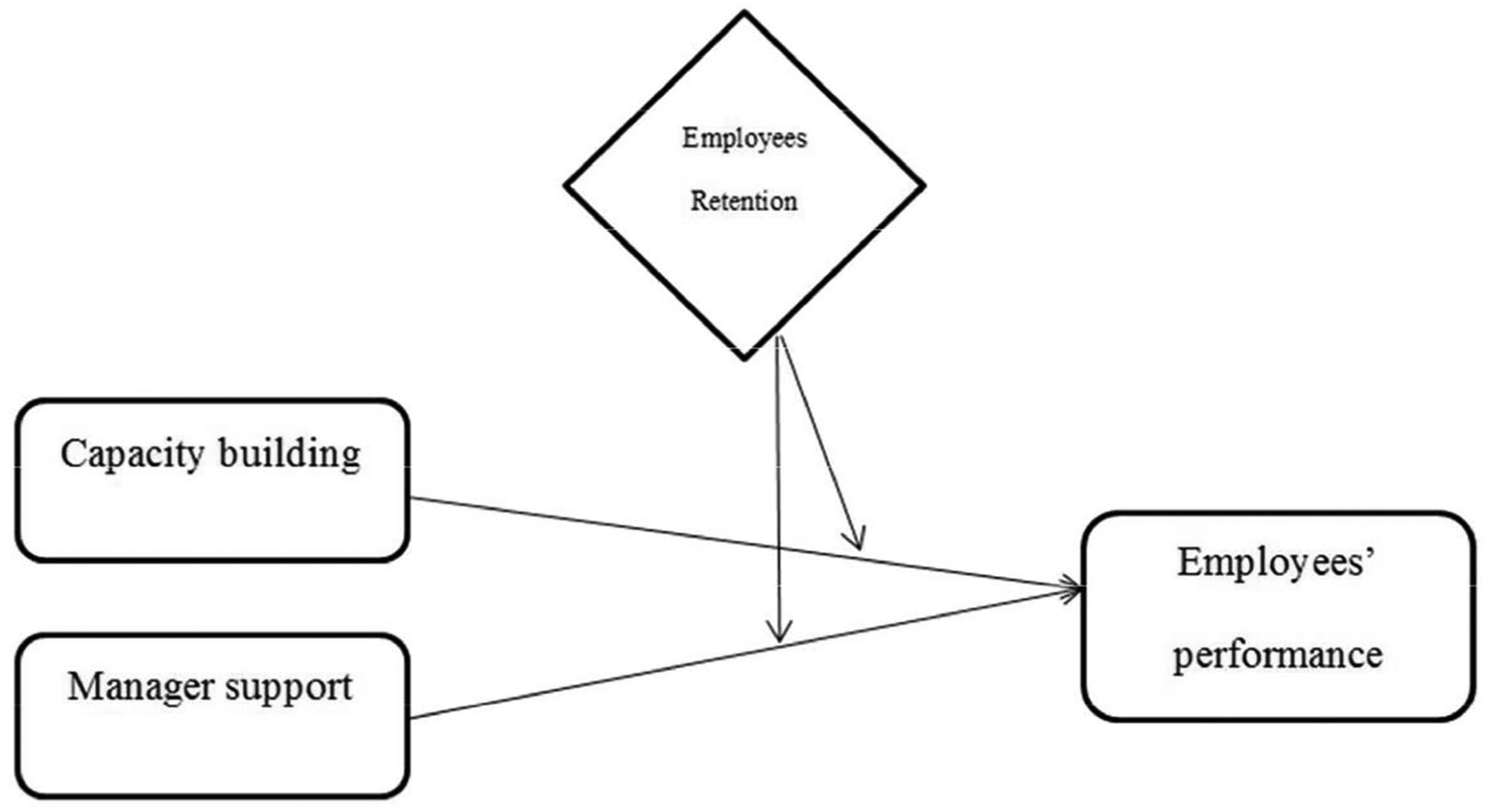
Conceptual framework.
Methodology
In this study, a quantitative approach was used, and primary data were collected for analysis purpose. The population in this investigation consists of lower to top-level management employees who are performing their duties in the textile sector of Pakistan. Convenience sampling techniques were used for data collection, which is called a nonprobability sampling technique. Two hundred questionnaires were distributed to employees. One hundred seventy-five questionnaires were collected back from the respondents. Out of 175, 50 questionnaires were incomplete and not used for data analysis. Remaining 125 questionnaires were used for analysis. The adapted items of the different variables were used in the questionnaire. The 5-point Likert-type scale was used for data collection, ranging from “5” for strong agreement with the “1” for strong disagreement with the statement. The questions were selected based on their previous good reliabilities in Pakistan and other countries. The study used already developed measures to collect data from respondents as shown in Table 1.
Measures Used From Previous Studies.

Statistical Package for the Social Sciences (SPSS) was used for descriptive analysis, and SmartPLS (partial least squares) was used for a casual modeling approach, that is, evaluation of the measurement of the inner model and the structural model which was developed by Ringle, Wende, and Will (2005).
Results
Descriptive Analysis
A total of 200 questionnaires were distributed to respondents and 175 questionnaires were collected back from the respondents, out of which 50 incomplete questionnaires were released. Therefore, 125 questionnaires were entered into the SPSS to perform the descriptive analysis. In the descriptive analysis, the demographic characteristics of respondents were discussed. Demographic characteristics included in this study were gender, age, education, designation, and experience that is shown in Table 2.
Descriptive Statistics.

Model Assessment
The main objective of this study is to predict the relationship between the dependent variable and independent variables, so partial least squares structural equation modeling (PLS-SEM) is used (Henseler, Ringle, & Sinkovics, 2009). Simultaneously, all hypotheses were tested by using SmartPLS-SEM. PLS-SEM is a causal modeling approach that evolves two phases, that is, evaluation of the measurement model (outer model) followed by the assessment of the structural model (inner model; Hair, Ringle, & Sarstedt, 2011). The outer model determined the relationship between valuable and related items, while the inner model defined the relationship between exogenous and endogenous constructs (Hair, Sarstedt, Hopkins, & Kuppelwieser, 2014).
Assessment of Measurement Model (Reliability and Validity Analysis)
Evaluation of the measurement model has been constructed for reliability and validity (Hair et al., 2014). The reliability of the proposed model has been decided on the basis of factor loading and composite reliability (CR; Chin, 2010). Table 3 and Figure 2 demonstrates that all factor loadings and CR exceeded the recommended value of .70 that confirms the model reliability items and construct levels (Henseler et al., 2009). The validity of the measurement model has been assessed based on the average variance extracted (AVE) and CR (Hair et al., 2014). In Table 3, evaluation of the measurement model shows that AVE and CR for all constructs exceed the minimum acceptable value of .5 and .7, respectively, and provide support to the convergent validity (Chin, 2010; Hair et al., 2014) as shown in Table 3. The reliability of an instrument is measured by using Cronbach’s alpha, which is based on internal consistency. Table 3 and Figure 2 show that all values of factor loading are higher than the threshold level. All the values of Cronbach’s alpha were also higher than.7, which are shown in Table 3.
Evaluation of the Measurement model.
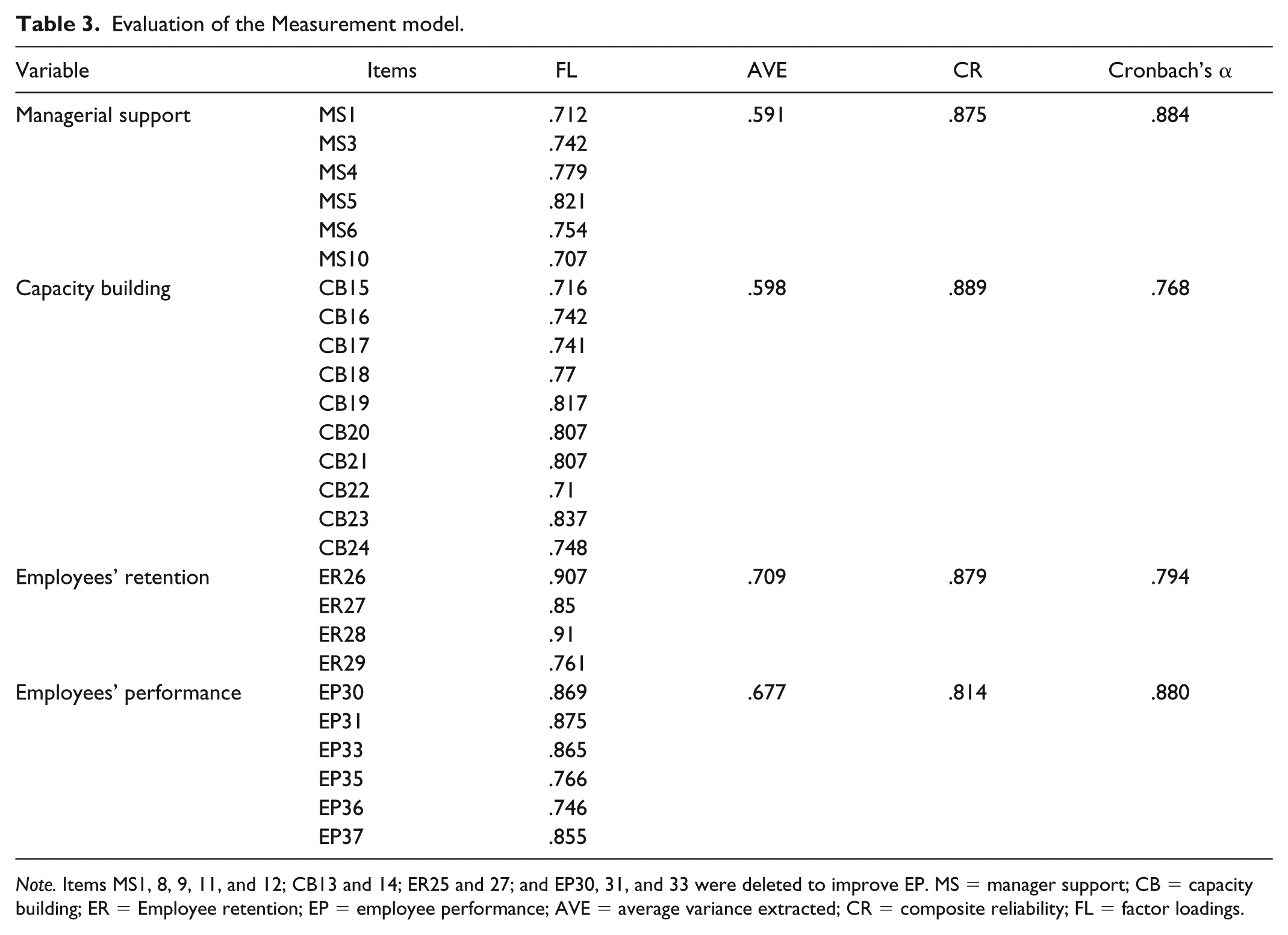
Note. Items MS1, 8, 9, 11, and 12; CB13 and 14; ER25 and 27; and EP30, 31, and 33 were deleted to improve EP. MS = manager support; CB = capacity building; ER = Employee retention; EP = employee performance; AVE = average variance extracted; CR = composite reliability; FL = factor loadings.

PLS algorithm.
Discriminant validity of the model is determined through Fornell and Larcker (1981) criterion, which is assessed on the basis that “square root of the AVE of a construct (diagonal values) must be greater than the correlations among other constructs (off-diagonals values) in row and columns.” Table 4 shows the results of discriminant validity.
Discriminant Validity at Construct Level.

Note. Correlation values of CB = capacity building; ER = employee retention; EP = employee performance; MS = manager support.
The R2 Value of Endogenous Structure.

Note. MS = manager support; CB = capacity building; ER = employee retention; EP = employee performance.
Evaluation of Structural Model
The findings are shown in Table 6, which represent beta values, t values, and significant values. Furthermore, the R2 index of the variables demonstrated an adequate level of predictability, which exceeded the suggested value (Falk & Miller, 1992; Hair et al., 2014).
Evaluation of Structural Model.
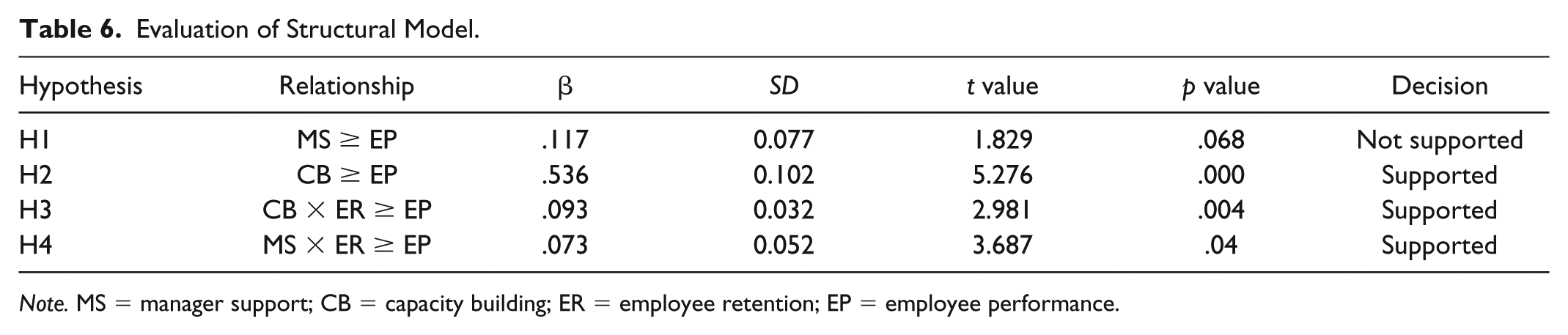
Note. MS = manager support; CB = capacity building; ER = employee retention; EP = employee performance.
Table 6 shows the results of the structural model from SmartPLS yield. Employees’ retention significantly moderates the relationship among capacity building, managers’ support, and employee performance.
Table 6 and Figure 3 display the results of the structural model through PLS output. As the H1 suggests, capacity building has a positive impact on the employee performance of the textile sector in Pakistan. Table 6 and Figure 2 show positive β value of .536, which means 53% influence of capacity building on employees’ performance. The t value and p value show a significant relationship between capacity building and employees’ performance (β = .536, p < .05, t < 5.276). So, H1 is accepted. H2 explains that managers’ support has a positive relationship with employee performance. The t = 1.829 and p value of .068 show the insignificant relationship between managerial support and employees’ performance. The results show that H2 is rejected as the values are (β = .117, p = .068 <.05, t = 1.829 < 1.960). This study hypothesized that employee retention has a moderating effect on the relationship between capacity building and employee performance. Table 6 and Figure 2 highlight the positive β value of .093. The t value and p value show the significant moderating role of employee retention between managers’ support and employee performance. The t value and p values show significant values that support the H3 (β = .093, p < .05, t < 2.981). Furthermore, employee retention also moderated the relationship between manager support and employee performance; the results show significant p value (β = .073, p < .05, t < 3.687). These results support the H4.

PLS bootstrapping.
Discussion
The findings of this survey indicate that capacity building has a substantial effect on employee performance. According to Asfaw, Argaw, and Bayissa (2015) and Guest (1997), training and capacity building programs are important for HR development. According to Fletcher, Alfes, and Robinson (2018), capacity building has a significant impact on employee performance and employee retention. The importance of capacity building for employees’ development has included different training programs for enhancing an employee’s knowledge and skills to perform a task efficiently and effectively. Some other studies also have similar findings such as Gul et al. (2012), which explore the impact of the capacity building on the employees’ performance in the banking sector of Pakistan. They found a significant impact of the capacity building on the employees’ performance. Another study, conducted by Wanyama and Mutsotso, on commercial banks of Kenya, found a positive and significant impact of the capacity building on employees’ productivity (Wanyama & Mutsotso, 2010). HR development plays an important role in improving the performance of all industrial sectors of the economy; however, the textile industry has to face the challenges due to lack of skilled human capital and managerial support (Carroll, 2011). The result shows that capacity building of employees impacts the individual employees’ performance, which is influenced by the psychological, sociological, educational, physical, economic, and chance factors, increasing the probability of career development of any individual over the lifespan (McDaniels & Gysbers, 1992; Otoo & Mishra, 2018), and capacity building is the formal program, designed by the organization for the employees’ performance in an organization (Noe, 1996; O’Dwyer & Ryan, 2002; Wentland, 2003). These findings provide support for H2. H1 purposes the effect of managers’ support on employees’ performance. The findings show that manager support has a positive, but an insignificant impact on the employees’ performance. So, H1 is rejected. A study conducted by Ahmad et al. (2015) found that supervisory support has an insignificant but a positive effect on employees’ performance in Pakistan. However, Saleem and Amin (2013) found a positive and significant impact on firm performance. Furthermore, Noe (1996) worked on position, and managers’ support had a significant effect on the development of an employee’s behavior
In H3, the study proposed that employees’ retention moderates the relationship between manager support and employees’ performance. The findings show the significant moderating effect of employees’ retention on the relationship between managers’ support and employees’ performance. So, H3 is accepted, and our findings show that employee retention is supportive in improving the impact of capacity building and managerial support on employee performance. It is also illustrated that employee retention is the source of enhancement of trust and commitment among the employees who tend to acquire skillful knowledge and create culture of performance. In the context of the absorptive capacity theory, the knowledge-based firms have been gaining immense popularity and valuable position due to the employee retention, which ultimately leads toward the knowledge acquisition and employee performance in the most helpful manner (Papa, Dezi, Gregori, Mueller, & Miglietta, 2018). Hence, the results of our research show that employee retention improves the effect of capacity building and manager support on employee performance. H3 and H4 are accepted. One potential reason for these phenomena is that retained employees show more commitment and trust toward the organization and also learn more knowledge related to their job for sponsoring the innovative culture that enhances the employees’ performance (Soto-Acosta, Popa, & Palacios-Marqués, 2017). Moreover, the absorptive capacity theory also supports our result, which is related to the moderating effect of employee retention (Cohen, 1983).
Conclusion
This study was conducted to explore the relationship among the capacity building, managers’ support, employee retention, and employees’ performance. The efficiency and effectiveness are related to the employees’ performance, leading toward the overall progress in the textile sector. This research highlighted previous contributions of scholars, which discussed the factors affecting employees performance. Particularly, this research focuses on employees’ capacity building, and skill development of employees enhance the performance and productivity. Furthermore, the study determines the role of managers’ support toward his or her team members, which is not assistive to enhance employee performance. The results of the research show that managers’ support does not significantly affect the performance of textile industry employees. The research findings suggest that employee retention has a significant impact on the relationship between manager support and employee performance in the textile sector of Pakistan. The retained employees are more experienced and capable of handling any situation in organizations, so their overall impact is positive on the employees’ performance, which provides opportunities for organizational growth. Employees’ capacity building improves the performance of employees is justified by this study. However, the managers’ support cannot significantly influence employee performance, but the moderating role of employees’ retention makes the relationship significant and has a significant role in employee development. Based on the results, the study recommended that employees’ capacity building is positively linked with the employees’ performance. Therefore, firms should arrange training for employees with the collaboration of the HR department.
The first recommendation, regarding the employees of the industries of developing countries, is that they should give the utmost preference to the capacity building. The capacity building of an employee through training programs should be introduced to increase the knowledge, skills, and abilities of the employees. Capacity building and managers’ support can help to create a sustainable competitive advantage over other key players. It should be a continuous process as it contributes to reducing the cost in the end. These things improve the efficacy power of employees, and they perform at their best of abilities. The retained and committed employees make a business successful, so they should be given full independence and authorization to make job decisions which produce better results.
Another significant social and manager implication of this study is that employers have to be compelled to establish the most suitable retention policies and strategies and also implement the proper bundle of internal customer retention practices for the growth and robust the relationship between capacity building and internal customer performance.
The importance of the development of intellectual capital is highly acknowledged to improve the employees’ performance. Currently, the industries of developing countries probably need to identify and utilize the human capital of employees. The program should provide clear findings that draw out the result of the engagement of the coaching. Recognition of individual weaknesses and strength and how they can be improved will ensure that the workers will perform better in future.
Limitations and Future Research
This study used cross-sectional data for the interpretation of the results in this study, but longitudinal data will give a clearer picture of the model. We used nonprobability sampling technique for data collection, but usually, the results of probability sampling will be more valid for generalizing results. Due to the shortage of time, the sample size of this study was small. However, data can be collected from the textile industries of Pakistan. Owing to the deficiency of collaboration between leading and nonleading organizations, training institutes, and universities, it was difficult to collect sufficient data from the respondents as they are hesitant and do not share their technical knowledge, research, and development with each other for the betterment of skills, capability, and development of employees, which is helpful for the achievement of organizations’ goals.
Footnotes
Declaration of Conflicting Interests
The author(s) declared no potential conflicts of interest with respect to the research, authorship, and/or publication of this article.
Funding
The author(s) received no financial support for the research, authorship, and/or publication of this article.
