




Abstract
The study of why a fundraising professional would choose to leave his or her employer is critical to the ongoing success of religiously based nonprofit organizations as they work to achieve their mission. Without continuity in the donor relationship, donors will likely leave the organization or become disenfranchised. This study focuses on development professionals at Seventh-Day Adventist institutions across North America. The results of this study are applicable to other religiously based nonprofit organizations. The present article reveals the reasons affecting employee retention and proposes approaches to mitigate the loss of valuable employees. Data were gathered using a structured online survey and analyzed for its descriptive outcomes.
Keywords
Introduction
Fundraising at nonprofit organizations in North America has become increasingly important during difficult economic times. Although nonprofits have had to scale back their services in some cases, it is critical that they strive to maintain their donor base and philanthropic income to continue the services that are most necessary to the constituents they serve.
The range of essential nonprofit contributions to our communities—from healing the sick to showcasing artistic expression—depends on the vitality of our nonprofit workforce. (Peters, Fernandopulle, Masaoka, Chan, & Wolfred, 2002, p. 22)
Maintaining healthy nonprofit organizations not only affects the workforce but also those who receive the valuable services from these nonprofit organizations:
The turnover of fundraisers is a topic that may seem irrelevant to the majority of the population, but it is an issue that impacts much of our society. As the nonprofit sector grows, it will continue to touch the lives of millions of people. Nonprofits need to pay close attention to the turnover of fundraisers in order to be financially stable. (Horstman, 2006, p. 124)
Development or fundraising professionals are key to maintaining relationships with donors and thus they are key to maintaining the inflow of donor dollars. Development professionals encompass support staff, annual fund directors, prospect researchers, special events staff, directors of development, alumni relations staff, and administrators. Donors interact with all of these individuals at some level. With a lack of employee retention, the relationship process becomes disrupted and donors may choose to invest their philanthropic dollars at other nonprofit organizations or delay their giving until the relationship process is restored or repaired.
Institutional advancement is all about relationships: with alumni, parents, volunteers, donors, other constituents, the media, faculty, and students. Without open, trusting relationships, institutional advancement initiatives will fail. (Salopek, 2008)
Donors can become confused or upset when their key fundraising contact at a nonprofit organization leaves. “But many charities aren’t doing as much as they should to ensure donors aren’t upset when they are passed from fund raiser to fund raiser—especially if a fund raiser has left unhappily” (Schwinn, 2002).
In addition, when advancement initiatives fail, the services the nonprofit organization provides can be disrupted or discontinued all together.
In challenging economic times, general operations at a nonprofit may be functioning with minimal financial margin. To continue operating or to consider expansion, philanthropy is key. Nonprofit organizations are relying more and more on fundraisers to maintain financial stability (Wagner, 2002).
A key to philanthropic success at a nonprofit organization is the donor pipeline. By building a series of relationships that will generate gifts over a period of time, consistent philanthropic income is possible and can be reliably included in the budgeting process. With disruptions in the donor relationship process, the pipeline will be jeopardized, and thus the mission of the nonprofit organization may falter or stagnate.
Seventh-Day Adventist (SDA) institutions in North America were chosen for this study. These institutions are similar to other private religiously based nonprofit organizations, and the results of this study may be considered for use by other organizations that feel they are substantially similar.
The literature reveals other studies that have measured turnover and reasons employees leave their nonprofit organizations. This study examines the topic at a more granular level by examining the reasons employees would consider leaving broken down by employee category.
In addition to describing the results of the study, recommendations are made from the literature for each employee category to help nonprofit organizations improve their retention rates.
Turnover and Retention at Nonprofit Organizations
Turnover is a measurement of how many employees out of the total will leave the organization during a given time period. This could be a voluntary or involuntary (i.e., termination) departure from the organization. The lower the turnover number, expressed as a percentage, the more stable an organization is considered to be.
In 2010, nonprofits reported a 16% turnover rate compared with a 21% turnover rate in 2009. Although this trend may appear to be positive, 37% of nonprofits said retention was a problem (Opportunity Knocks, 2010). This change in the turnover rate from 2009 to 2010 could be explained by continuing economic challenges. There are not as many open positions to be pursued as in the past, and employees may have chosen to stay with their current position until the economy improves.
Nonprofits also reported that of those employees who left, almost 20% were in their positions for less than 1 year (Opportunity Knocks, 2010). This can significantly diminish the ability of a nonprofit organization to move its agenda forward. The employees leave as soon as they become orientated to their new position and begin to acquaint themselves with the donors. The nonprofit organization is left to fill the vacant position, train the new employee, and try to explain to donors what has happened.
One way organizations measure their success is by reviewing their retention rates compared with a national retention rate. The latest data from Association of Fundraising Professionals (AFP) indicate that the average length of tenure for a fundraising professional in North America is 3.99 years. Furthermore, it indicates that men stay in their positions longer than women (4.43 vs. 3.85), and the larger the institution you are employed by, the longer your tenure will likely be (Compensation and Benefits Study, 2009).
The literature points to several reasons why a fundraiser might leave the organization. Duronio and Tempel’s 1997 study included two ideas: (a) employees’ desire to advance their own career financially over their loyalty to their employer and (b) their perception of poor support from the board of trustees (Duronio & Tempel, 1997). The Chronicle of Philanthropy (Schwinn & Sommerfield, 2002) outlined several reasons for a fundraiser’s departure such as stress from the pressures of the position, higher salary, more prestigious job title, and conflict with his or her supervisor. Both of these sources point to two fundamental reasons for leaving an employer: discontent with leadership and a desire to advance one’s career (higher salary or better job title).
SDA institutions in North America are included in the survey results of Opportunity Knocks (2010) and Compensation and Benefits Study (2009). As a matter of practicality, the focus of this study looks specifically at the factors that affect employees’ decision to leave their organizations. The data are broken down by category of employees. By addressing the reasons employees leave, an organization can implement strategies to improve retention.
Likelihood of Development Professionals Leaving From Survey Respondents
Do SDA institutions need to worry about turnover in their fundraising departments? Table 1 outlines the likelihood of each employment category to leave their institution of employment.
Likelihood of Respondents Leaving Their Current Position

The biggest area of concern is with Directors of Development/Major Gift Officers. More than half are either actively looking for another position or would consider leaving compared with those who are definitely not planning to leave. This is a volatile group that is in high demand within nonprofit organizations. They likely receive regular telephone calls from headhunters that offer lucrative compensation packages. This group also tends to be the bread and butter of fundraising programs. They bring in a wide range of gift sizes and manage the relationships of the highest number of donors and prospects.
The next most likely group to depart their organization are administrators/vice presidents. About one third indicated they would either actively look for another position or would consider leaving. This cohort is also in high demand, especially in the SDA system. Some SDA institutions pay market-rate salaries, whereas some pay denominational-rate salaries. This creates disparities and can tempt someone to leave.
The most stable group of respondents are in planned giving. Only 9% would consider leaving. None were seeking other employment. This makes sense in that planned giving tends to be a terminal position and also a well-compensated position for those not on the denominational-pay system. Employees in planned giving tend to be older and well established in their communities.
Research Method
Analysis of the factors that affect a professional’s decision to leave his or her organization required empirical research. A questionnaire was designed with input from other fundraising professionals and a statistician. The objective was to obtain enough data to represent the majority of individuals in different development fields and positions. In some cases, not enough responses were received for a given position. There were 32 questions asked, ranging from general demographic information to specific questions on what it would take for an individual to consider leaving the organization.
A link to the survey was emailed in October 2010 to 379 individuals across North America that worked for a SDA institution and were employed in a development role. These development roles included the following:
Administrator: vice president or executive director, depending on the type of organization
Director of development/major gifts officer
Planned giving officer
Support staff: administrative assistant, prospect researcher, gift processing
Special events staff
Grants officer
Donor relations
Annual giving
The response rate was 46.4% (N = 176). This response rate falls within the average to good range for online surveys and better than average for email surveys (Assess Teaching Response Rates, 2011).
The data were analyzed for descriptive properties. Recipients were asked to choose the top three reasons they might leave their current position. Analysis of the data focused on the top three reasons, unless more than three were represented somewhat equally. The options respondents could choose from for the reasons they might leave their employer are outlined below. Respondents could also write in a response.
Higher salary
Better benefits
Opportunities for professional development
Opportunities for promotion
Better geographic location
Desire to work in a high-performing environment
Feel burned out
I have done all I can do in my current role
I want to get out of fundraising
Desire to work for an organization that I have a commitment to
Desire to change the type of organization I work for (example: moving from education to health care)
My suggestions to improve fundraising are not taken seriously
It is difficult to work with coworkers on the fundraising projects
Familial reasons
Personal health
Demographic Information
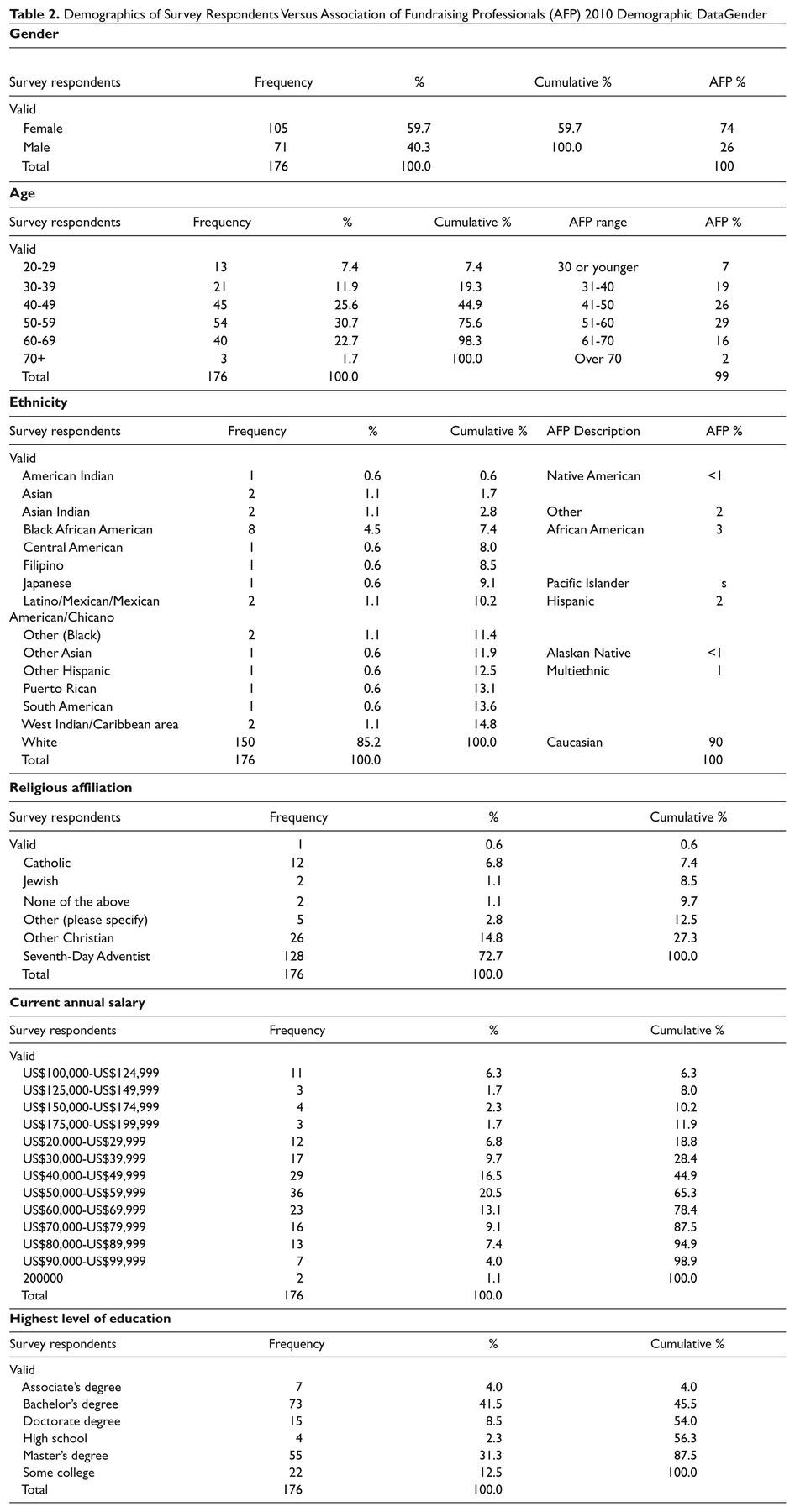
The majority of respondents were female, by a three to two margin.
The age breakdown favored the 50 to 59 range with 40 to 49 and 60 to 69 following closely.
The ethnicity of survey respondents was overwhelming Caucasian. African American ranked second, with a wide range of other ethnicities represented.
The most-represented religion among survey takers was SDA. This is not surprising considering only those working at SDA institutions were surveyed. “Other Christians” was the second most frequent response, and “Catholic” was the third most frequent.
The majority of those surveyed earn between US$50,000 to US$59,000. Just below this group are those who earn US$40,000 to US$49,000. More than 65% earned less than US$60,000, and 34.67% earned more than US$60,000.
Many fundraising positions at SDA institutions require at least a bachelor’s degree. Survey responses showed that 81.25% have at least this level of education, with a sizable number having a master’s degree.
In Table 2, data from the survey respondents are represented along with data from the AFP. The gender, age, and ethnicity information for AFP come from their data on general membership demographics. This comparison shows that the SDA organizations use more men than the AFP membership. The age ranges are quite similar. In addition, the SDA organizational fundraising workforce is slightly more ethnically diverse.
Demographics of Survey Respondents Versus Association of Fundraising Professionals (AFP) 2010 Demographic DataGender
The types of organizations respondents work for are featured in Table 3. The vast majority came from k-12 education, higher education, and health care.
Type of Organizations Respondents Work For

Results
Before presenting the data, it is important to discuss in general terms some misconceptions about employee retention, as this will set the stage for the analysis and recommendations provided for each employee position and accompanying data.
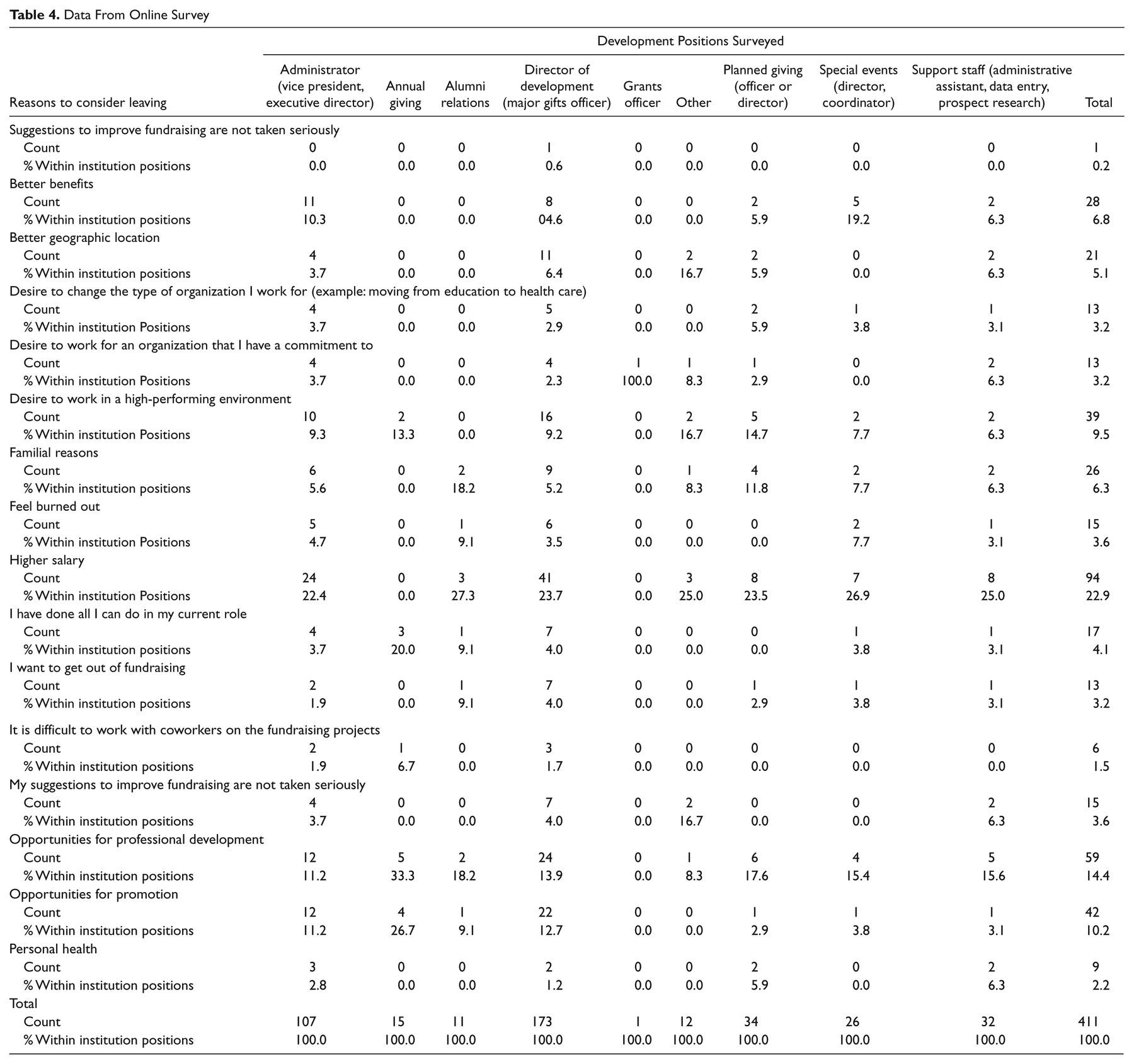
Salary and benefits are good options for attracting new employees, but not the most effective route when attempting to retain employees (Salopek, 2008). Table 4 represents the data showing the factors affecting retention, organized by employment position. Each employment position is described in terms of the top three factors affecting retention unless more than three factors were represented somewhat equally. In addition, for each employment position, a conclusion will be drawn about how an organization may influence the decision of the employee to stay with their current employer. The category of “grants officer” was not reported because of insufficient descriptive data to provide meaningful analysis. The category of “other” in the data was not reported because the specific position could not be determined from the surveys.
Data From Online Survey
Administrators
The top reasons an employee in this category would consider for leaving are higher salary (22.4%), opportunities for professional development (11.20%), high-performing environment (9.3%), and opportunities for promotion (11.2%). As discussed earlier, a higher salary or enhanced benefits are not the best retention tools. The employer could provide financial assistance for graduate study as a way to provide opportunities for professional development. Promoting a fundraising professional to the position of president/CEO might be a good option because this position requires substantial participation in fundraising activities.
Director of development
The top three reasons an employee in this category would consider for leaving are higher salary (23.70%), opportunities for professional development (13.90%), and opportunities for promotion (12.70%). Directors of development and major gift officers can be easily tempted with higher salaries at organizations nearby. To keep an employee engaged and productive, consider helping him or her obtain a professional certification (e.g., Certified Fund Raising Executive [CFRE]). This gives him or her something meaningful to work toward and may help the employee feel valued. An organization might also consider creating a tiered system or ladder that employees can climb, which includes financial incentives such as associate director of development, director of development, and senior director of development. By requiring specific knowledge, skills, and education for each position, the employer can incentivize employees to pursue professional development opportunities and obtain promotions.
Planned giving
The top three reasons an employee in this category would consider for leaving are higher salary (23.5%), opportunities for professional development (17.60%), and high-performing environment (14.70%). Planned giving is a field that requires significant education and continuing education to stay current with laws, regulations, and industry trends in planned giving. Retention may be improved by offering the planned giving employee avenues to stay current. A high-performing work environment demonstrates to the planned giving employee that leadership values progress and performance. Performance metrics that are mutually agreed on and consistently expected will help the planned giving employee feel he or she has something to strive for, and the mission of the nonprofit organization is likely to benefit with increased revenue. The nonprofit organization could create financial incentives for achieving specific goals, as long as the financial incentive is not a percentage of the dollars raised (Frequently Asked Questions, 2012).
Annual giving
The top four reasons an employee in this category would consider for leaving are opportunities for professional development (26.70%), opportunities for promotions (26.70%), and I have done all I can do in my current role (20.00%). Annual giving is an entry-level position at many nonprofit organizations, and the employees in this area may want to move up on the corporate ladder. The first two factors reflect this desire. Without an outlet for these employees, they will feel frustrated and undervalued. By offering them the tools they need to upgrade their skills and by providing them with opportunities to be promoted to higher positions, retention can be improved. An intermediate step before a promotion to a director of development position is to provide annual giving employees with a small portfolio of donors appropriate to their skill level that they can use to prove their ability at managing relationships and soliciting gifts.
Special events
The top three reasons an employee in this category would consider for leaving are higher salary (26.90%), better benefits (19.20%), and opportunities for professional development (15.40%). Special events positions are often occupied by individuals who do not necessarily want to become directors of development. They prefer to plan and execute special events such as galas rather than ask donors directly for gifts. It is not surprising then that special events staff may be tempted by a higher salary at a larger nonprofit organization. To feel valued, they could be offered additional training at a seminar so that they feel they are becoming more effective in event-related activities. If the nonprofit organization wishes to pay a higher salary to an employee in this category, they might consider merging special events with alumni affairs in an educational institution. These two positions are complimentary and would justify the additional compensation based on the workload and skills/knowledge required to perform effectively.
Alumni relations
The top three reasons an employee in this category would consider for leaving are higher salary (27.30%), opportunities for professional development (18.20%), and family reasons (18.20%). This category is also often an entry-level position where the employee would benefit from opportunities to attend conferences and to network with other alumni relations professionals. The final factor listed, family reasons, cannot be readily addressed by the employer. As with special events personnel, a higher salary could be justified if the responsibilities of the job were expanded.
Support staff
The reasons an employee in this category would consider for leaving are higher salary (25.00%), opportunities for professional development (15.60%), better benefits (6.30%), better geographic location (6.30%), high-performing environment (6.30%), work for an organization that I have a commitment to (6.30%), my suggestions are not taken seriously (6.30%), familial reasons (6.30%), and personal health (6.30%). Support staff may not feel included in the fundraising process at a nonprofit organization. By including them in the training that is provided and allowing them to attend conferences so they fully understand the processes involved in fundraising, the organization may alleviate many of their reasons for leaving. Given that many support staff positions are similar, it is tempting to consider a different position for higher compensation. By including the support staff as much as possible in the fundraising process, the organization can help them feel appreciated and a part of the process.
Across all development positions, everyone surveyed would like to be paid more money. This factor favors the employer that is attempting to attract new employees rather than those that are trying to retain their best employees. By leveraging the strategies listed above, a nonprofit employer will increase its odds of being successful. In addition, being more successful in retaining development employees increases the effectiveness of the nonprofit organization.
Employees may tell you why they want to leave (any number of reasons), but may be leaving for altogether different reasons. According to Kaye, in her book Love ’Em or Lose ’Em: Getting Good People to Stay, employees do not leave organizations, they leave bad managers. Other literature also points to this conclusion about why employees leave their place of employment.
Gurchiek states in her article “Bad Bosses, More Than Bad Salaries, Drive Workers Away” that “an abusive supervisor, rather than dissatisfaction with pay, was more likely to prompt employees to leave their job.” She cites several statistics from a 2004 study that included 700 workers.
31 percent, said their supervisor gave them the “silent treatment” in the past year . . . 24 percent said their supervisor invaded their privacy . . . 39 percent said their supervisor failed to keep his or her promises. (Gurchiek, 2007)
Gurchiek quotes Dilbert cartoonist Scott Adams who said of this research, “That’s a lot of different ways to say ‘My boss is an idiot’” (Gurchiek, 2007, p. 1).
Kaye, in her book Love ’Em or Lose ’Em: Getting Good People to Stay compiled a list of what workers want to stay satisfied and engaged. This want list includes “meaningful and challenging work, a chance to learn and grow, fair and competitive compensation, great coworkers, recognition, respect, and a good boss” (Kaye & Jordan-Evans, 2002, pp. 20-21).
Managers have the opportunity and responsibility to manage and improve the retention in their nonprofit organizations. When retention is an issue and senior management wants to know what is happening, it is easy to point a finger at every reason imaginable for their employees leaving without looking in the mirror.
When senior administration realizes that managers have the power to significantly affect the retention rate of their employees and make a difference not only in how happy their employees are, they must hold managers accountable for employee retention.
Intentionality is key for managers to improve retention. The simplest way to be intentional is for managers to speak to each of their employees about why they are valued and ask what can be done to keep them engaged. This should be done every 6 months. Take the employees’ suggestions seriously and watch for results.
Conclusion
The value of these data resides in that it affirms other studies that show employees at nonprofit organizations would like to be compensated at higher levels (Schwinn & Sommerfield, 2002). In addition, it goes beyond what has been done before by analyzing data from individual employee categories.
This article can help nonprofit organizations that struggle with employee retention so that they might improve their retention rates and thus improve the effectiveness of their organizations. By becoming intentional in their efforts to retain their best employees, a nonprofit organization can raise more funds for the causes to which they are committed.
Footnotes
Acknowledgements
The author wishes to thank Philanthropic Service for Institutions and Loma Linda University School of Pharmacy for their support of his continued research efforts.
Declaration of Conflicting Interests
The author(s) declared no potential conflicts of interest with respect to the research, authorship, and/or publication of this article.
Funding
The author(s) disclosed receipt of the following financial support for the research and/or authorship of this article: This work was supported by Philanthropic Services for Institutions.
Bio