




Abstract
Information sources affect people’s tourism, culture, and entertainment buying. It is therefore important to study the apportionment effects by information source type and comprehensively analyze how information sources positively or negatively impact the consumption of tourism, culture, and entertainment. This research analyzed the influence of four information sources on such buying based on data from the China Family Panel Studies (CFPS) from 2014 to 2018. Regression analysis was used to examine the relationships among variables. The findings were that: (1) information sources (Internet, broadcast, print, and word of mouth) had a significant positive impact on tourism, culture, and entertainment buying; (2) the effects of information were significantly different based on age, education level, and place of residence (urban vs. rural); and (3) information source digitalization increased the share of TCE consumption in overall household consumption through improving social interactions and convenience of transactions. The findings contribute to alleviating the information asymmetry in tourism consumption, helping tourism enterprises develop targeted marketing measures, and promoting the improvement of residents’ tourism consumption.
Plain Language Summary
Purpose: This research analyzed the influence of four information sources on such buying based on data from the China Family Panel Studies (CFPS) from 2014 to 2018. Methods: Regression analysis was used to examine the relationships among variables. Conclusions: 1) information sources (Internet, broadcast, print, and word of mouth) had a significant positive impact on tourism, culture, and entertainment buying; 2) the effects of information were significantly different based on age, education level, and place of residence (urban vs. rural); and 3) information source digitalization increased the share of TCE consumption in overall household consumption through improving social interactions and convenience of transactions. Implications: The findings contribute to alleviating the information asymmetry in tourism consumption, helping tourism enterprises develop targeted marketing measures, and promoting the improvement of residents’ tourism consumption. Limitations of your study: Other factors in this research influence tourism, culture, and entertainment consumption, including the country of residence. For example, the data analyzed in this research were from China and the results may not be generalizable to other countries. Future researchers are encouraged to conduct similar studies in other countries, regions, and cultural contexts.
Keywords
Introduction
Tourism, culture, and entertainment (TCE) participation is essential to many people’s lifestyles (Briguglio & Sultana, 2018; Clark & Achterberg, 2014). This form of consumption is not only affected by income, age, interests, and education levels (Kim et al., 2007) but is also influenced by the accessibility, timeliness, accuracy, and comprehensiveness of information sources on TCE options (Şchiopu et al., 2016). However, TCE information sources are varied in scope and potentially also in accuracy (e.g., fake news and reviews). There may also be a lag between when suppliers create information and when consumers access it, and information asymmetry between suppliers and buyers creates risk for the latter (Oukarfi et al., 2020). While the Internet and social media platforms have expanded the information available, they may have inadvertently made information searches more complex.
The information sources available to consumers include mass communication channels such as the Internet, television and radio, and newspapers and magazines (Globalwebindex.com, 2019), as well as through word-of-mouth in interactions with other people. The variety, availability, and quality of information sources determine consumer information-gathering capacities and play a crucial role in purchasing decision-making. The rapid development of information communication technologies (ICTs) has introduced significant changes in how people search for information and make purchases. E-marketing is now the primary communication channel for TCE suppliers, while online platforms are becoming consumers’ primary information source and booking venue (Chu et al., 2023).
Information sources impact the purchases of tourism and cultural products and services. However, the differences in effects among information sources, whether these effects vary by individuals, households, and regions, and how they influence buying are unclear. The primary purpose of this research was to examine the influence of information sources on TCE consumption using data from a household tracking survey in China. Apart from addressing the gaps in the literature, the study provides a reference for the government and companies to enhance TCE products and their communication.
Literature Review and Development of Hypotheses
Factors Influencing TCE Consumption
Tourism, culture, and entertainment (TCE) drive economic growth and development and previous scholars have comprehensively analyzed the factors affecting TCE buying, including the following.
External factors: These include macroeconomic factors (e.g., economic recessions) (Papatheodorou & Pappas, 2017), environmental pollution (Zhou et al., 2019), vulnerability (Kusune, 2020), and sensitivity of tourism (Falk, 2015) that affect TCE consumption as well as labor income risk (Pereira, 2019), health risks (Carneiro & Eusébio, 2019), and housing and commercial investment (Bohn, 2015). Some scholars emphasize that family age structure (Bernini & Cracolici, 2015), retirement (Deng et al., 2023), and economic uncertainty (Nguyen et al., 2022) have a significant effect on TCE consumption. Based on the absolute income and persistent income hypotheses (P. Zhang & Cao, 2022), others assert that increases in current and expected incomes, as well as expected and unexpected increases in asset prices (Lee & Kim, 2021), result in expanded household consumption of travel and culture. In contrast, based on the precautionary savings theory, other scholars have found that households increase precautionary savings to manage uncertainties such as health (Gao et al., 2021) and employment (Nilashi et al., 2019), resulting in a decline in TCE consumption.
Individual factors: The influences of age (Y. Liu et al., 2018), income (Alegre & Pou, 2004), gender (Lin et al., 2021), education level (Alegre et al., 2009), living standards (Bernini & Fang, 2021), and tourism literacy (Chang et al., 2019) on household and individual TCE consumption have been analyzed as well. Differences in personality, habits, marital status, presence of children, income from various sources, and consumption habits may also affect buying.
Asymmetric market information: Research on information acquisition and consumer behavior can be traced back to the asymmetric information theory proposed by Akerlof (1978), which holds that market failure results from contradictory or missing information and produces a market for “lemons” (inferior quality products). The research on asymmetric information has expanded to tourism. Access to information is a significant factor affecting consumption (Xiang et al., 2015). This access has changed significantly due to ICTs, which may be elevating the purchasing of tourism, culture, and entertainment. The ease of use and functionality of online platforms help to lower risk perceptions, reduce payment, time, and psychological costs, and increase the willingness and confidence of people to travel (Zelenka et al., 2021). However, certain scholars have reached the opposite conclusion (e.g., Tassiello & Tillotson, 2020). Internet information has inherent problems such as price dispersion, system loopholes, deception, and denial, which may aggravate uncertainty in consumption (Akhtar et al., 2019), and reduce trust between suppliers and consumers, resulting in decreases in willingness to travel.
Information sources: The existing studies mainly consider the factors influencing tourism consumption. Few studies apportion effects by information source type or comprehensively analyze how information sources positively or negatively impact tourism, culture, and entertainment consumption. This research adopted an information dissemination perspective in exploring if and how information sources generate changes in such consumption.
Action Mechanisms
Consumer information behavior theory points out that the information environment has a decisive impact on consumer behavior (S. X. Chen et al., 2021). The traditional consumption information processing model simply divides the consumer information decision into different stages, and in each stage, the information has a different influence on the consumer. Information is transmitted from the sender to the consumer through the media, which generally goes through the following processes: attention, interest, desire, memory, action, and repurchase. In the theory of information communication, Lasswell was the first scholar who studied the communication activities of human society by establishing a model (Peng, 2015). He proposed the classic “5W” model—who, who says what, in what channel, to whom, and with what effects. These five elements constitute the basic content of communication studies. “Who” is the disseminator, responsible for collecting, processing, and transmitting information in the dissemination process. “Says what” refers to the content of the message, which is a combination of meaningful symbols. “In what channel” refers to the intermediary or material carrier through which information is transmitted, such as by word-of-mouth, letter, telephone, newspaper, radio, television, or online. “To whom” refers to the receiver, audience, final object, and communication destination. “With what effects” refers to the reactions caused by the information within the audience at various levels of cognition, emotion, and behavior, which is an important measure to test the success of communication activities. Generally, information transmission through information channels is “unidirectional”; individuals search for information through information channels to obtain the information they need, thus affecting individual behavior (Tavitiyaman et al., 2021). When information channels transmit information, there are differences in the amount of information, speed, and communication efficiency. With the development of Internet technology, information transmission channels have gradually changed from traditional information channels to new information channels and presented new features, such as two-way interaction. Traditional broadcast and print media have become digitalized (Figure 1a), permitting access to them via smartphones, pads, laptops, and desktop computers. This has broadened the sources of TCE information for people and made access more convenient. The Internet can now access all three other information sources (print, broadcast, and word of mouth). Time and space barriers are removed between consumers, suppliers, and service providers through information communication technologies. Interactions have changed from discontinuous, one-way, and time-delayed to continuous, two-way, and real-time, facilitating greater TCE consumption.

(a) Traditional media and tourism, culture and entertainment consumption and (b) new media and tourism, culture and entertainment consumption.
As a new information channel, the Internet can effectively transmit consumers’ feelings, evaluations, experiences, and word-of-mouth to other consumers and businesses, and finally, realize a virtuous circle of information dissemination (Figure 1b). Traditional media are mainly in the form of text, images and video. New media not only have rich text, images and videos, but also offer interactivity, social contact, augmented/virtual reality and other features, and the communication content is also richer and more diversified. In Lasswell’s “5W” model, the connection through the Internet information channel greatly improves the depth and breadth of the communication effect, no matter who says it or to whom (Kunold & Onnasch, 2022). This new feature of Internet channels provides consumers with a convenient platform to obtain, screen, and feedback information, share experiences, and create tourism demand. It greatly reduces the information asymmetry in the tourism market, reduces the risk perception of cultural travel consumption, lowers the cost of payment, time, and psychological costs, and makes the consumption decision of tourism consumers more systematic and rational. However, other scholars have come to the opposite conclusion. Xu et al. (2021) believe that price dispersion, system loopholes, deception, price discrimination based on customer characteristics, and deniability in the Internet market aggravate consumption uncertainty and reduce the willingness to travel. C. M. Chen et al. (2019) regard Internet use as a type of leisure and find that there is a substitution relationship between Internet use and cultural travel consumption, that is, the increase in Internet use time also crowds out family cultural travel consumption.
Hypotheses Development
Information sources are the main channels for consumers to obtain tourism-related information (including the Internet, broadcast media, print media, and word of mouth). Many scholars point out that broadcast media, print media, and word of mouth are traditional information sources, while the Internet is a new information channel (Ni & Wang, 2021; Sun et al., 2020). Owing to the dissimilarities of different information sources, the costs of tourism information acquisition vary, affecting final travel choice decisions.
Internet: An estimated 63% of the world’s population used the Internet in 2021 (International Telecommunication Union [ITU], 2022). The Internet encourages people to take the initiative to obtain information that is more purposeful and targeted; moreover, they have a keen sense of information acquisition (H. Zhang, 2021). TCE consumers now enjoy more convenient transactions via cashless payment modes involving apps, QR codes, and fingerprint and facial recognition. Time savings can be reallocated to greater TCE participation. More discounts, coupons, and gift cards provided by TCE organizations stimulate higher consumption levels. The online sphere has eliminated historic information barriers to consumption. People spend 61% of their online media time, or around 6.75 hr daily (Globalwebindex.com, 2019). It is noteworthy that the residents of urban areas (75.6%) are making greater use of the Internet than those living in rural areas (38.8%) (ITU, 2022). Internet penetration varies by country; for example, in China, it stood at 73% of the total population in 2021 (China Internet Watch, 2022). Online, people find it more convenient to acquire products and services of interest and expand the range of products and services from which to choose. Owing to the scope and interactivity of the Internet, consumers have extensive access to copious quantities of information cost-free and can vicariously experience destinations. These online experiences and interactions encourage people to book travel. As part of Internet activity, social media platforms are pervasive worldwide. There were around 4.65 billion social media users worldwide in April 2022 (Kepios, 2022), equivalent to almost 59% of the total population. People spend 2.5 hr daily using social media (Globalwebindex.com, 2019). As with the Internet, social media use is much greater in cities than rural communities.
Print media: Print media, including newspapers and magazines, provide information about politics, economics, society, culture, fashion, and travel. People can view print content in its traditional “hard copy” format or view the content online. Reading online content is now greater than hard copy reading in all countries (Globalwebindex.com, 2019). Newspapers are inexpensive and deliver up-to-date news from around the world on various topics. Magazines are more expensive and colorful and often address special interests, including travel and culture. They also have specific reader demographic profiles, which enhances market targeting (Hilmi & Ngo, 2011). On a daily basis, people spend 6% of their total media time reading print media (Globalwebindex.com, 2019). Although not now used as much as the Internet, print media still significantly positively affect culture and tourism consumption.
Broadcast media: Broadcast media play a key role in many people’s lives. TV and radio watching and listening are often regarded as leisure activities. Around 25% of total media time (about 2.5 hr) is spent per day on broadcast TV and radio (Globalwebindex.com, 2019). There are now specialized channels and content on travel and various aspects of culture and history, which can stimulate travel and cultural participation. Also, popular TV series and dramas often stimulate tourism (Hua et al., 2021). Connected TV and video streaming are experiencing robust growth in use (Interactive Advertising Bureau, 2021).
Word of mouth (WOM): WOM is interpersonal communication among consumers that significantly affects purchasing decisions (Lai et al., 2018). WOM has long been considered one of the most potent factors in consumer purchasing. The influence of user-generated content (UGC) and electronic word-of-mouth (eWoM) on tourism decision-making is significant and is growing (Litvin et al., 2008, 2018; Pourfakhimi et al., 2020).
Based on these differences among the four information sources, the following hypotheses were proposed:
H1a: There are significant differences in the effects of information sources on tourism, culture, and entertainment consumption.
H1b: The Internet has the greatest effect on tourism, culture, and entertainment consumption.
Age: The effects of information sources may be connected to age, education level, and place of residence (urban vs. rural). In terms of age, tourism participation first increases and then decreases with an increase in age (H. Li et al., 2016). These researchers found domestic travel in China was lower for those under 25 and over 55. Generations Y and Z were brought up in the Internet and social media eras, so they are more likely to use online sources (Xiang et al., 2015).
Education: The digital and tourism literacy of individuals impact their capabilities to process what information sources offer, and they are connected with education levels (Caldevilla-Domínguez et al., 2021; Peco-Torres et al., 2021). Education and income have positively influenced travel frequency and distances (LaMondia et al., 2014). The development of the Internet has expanded the amount of information available; however, it is more difficult for consumers to screen information and make correct judgments. There is a “digital divide” with the Internet; those with more education have greater access and obtain more benefits from being online (Van Deursen & Helsper, 2015).
Place of residence: There are differences in access levels to information sources between urban and rural areas. As a result, there are stark dissimilarities in TCE consumption among those living in cities and people residing in predominantly agricultural areas. The network infrastructure in rural areas is often incomplete, and service is not as good as in urban areas, especially with broadband Internet (Benda et al., 2020). Also, rural residents have lesser access to print and Internet than people living in cities. Rural residents tend to have lower income and education levels and low digital literacy (Fong, 2009).
Based on these apparent differences, the following hypothesis was proposed:
H2: The effects of information sources are significantly different according to age, education level, and place of residence.
Research Design and Methodology
Data Source
The China Family Panel Studies (CFPS) is a nationwide, large-scale, multidisciplinary social tracking survey project. It conducts follow-up interviews every 2 years, reflecting the three levels of community, family, and individual, and provides high-quality microdata to study Chinese household financial problems. As of 2018, five surveys have been conducted. Because “culture and tourism consumption” was included in the questionnaire for the first time in 2014, this research was based on the data from 2014, 2016, and 2018. Data cleaning and matching and eliminating missing and abnormal data were done to obtain the data set for analysis. The research covered 18,169 households in 4,682 villages (communities) in 1,264 counties (county-level cities) in 32 provinces, including 172,278 individuals who met the research needs and 22,059 respondents with the same observation records. Additionally, regarding access to information, this study is based on the information and communication theory, which is divided into four media channels: the Internet, broadcast media, print media, and word of mouth (Table 1).
Descriptive Statistics.

Comparing 2014 and 2018, the importance of the Internet for obtaining information increased by 27.44%; broadcast media decreased by 2.82%; print media decreased by 6.95%; and word of mouth increased by 1.14%.
Variable Descriptions
Explained variable: Per capita, TCE consumption expenditure was determined by dividing the total amount of household TCE consumption by the household size. The total household consumption on TCE was based on the CFPS database. The sum of “How much did your family spend on travel in the past 12 months, including travel expenses such as transportation, accommodation, and tickets to scenic areas?” and “how much did your family spend on culture and entertainment in the past 12 months, including buying books, newspapers, and magazines, going to movies and theaters?”
Explanatory variable: People obtain information from four main sources: Internet, broadcast, print, and word of mouth. The Internet data were derived from answers on “the importance of the Internet for you to obtain information” in CFPS. Broadcast media statistics were derived from the survey question on “the importance of TV for you to obtain information,” print media data from “the importance of journals to access information,” and word of mouth from the “importance of what others tell you.”
Control variables: Personal characteristics in CFPS included age, gender, education level, health level, and employment status. Household data were household size, savings, and annual income. The place of residence variables was urban and rural classifications and county coding.
Model Construction
The CFPS database has several cases where household TCEs zero, although the TCE consumption cannot be negative. Therefore, ordinary OLS estimation cannot provide a constant estimation (Suess et al., 2018). However, if the individuals whose TCEs are 0 are deleted, a large amount of data and authenticity are lost, which may bias the estimation results. Therefore, the mixed panel

Where the explained variable
Results
Benchmark Regression Analysis
Table 2 shows the benchmark regression results of the influence of information sources on TCE consumption. Column (1) includes the Internet, broadcast media, print media, and word of mouth in the mixed panel
Baseline Regression Results.

Note.*** indicate significance at the 1% levels, respectively.
Regarding the other control variables, the regression coefficient of the square term of age was negative; in other words, age had an inverted U-shaped relationship with TCE expenditures, which passed the 1% significance test. TCE consumption expenditure first increased and then decreased with advancing age levels. The coefficient for gender was negative, indicating that women expanded TCE expenditures more readily than men. TCE spending was positively correlated with education levels. TCE expenditures of married people were 8.4% higher than unmarried. Employed respondents generated more demand for TCE consumption than the unemployed. Health status was positively correlated with TCE spending. Additionally, the number of household members significantly negatively affects TCE consumption decisions and scale.
Robustness Test
To ensure the core conclusions’ reliability and better ascertain the effect of information source dependence on TCE consumption, robustness tests were conducted on the benchmark regression results using winsorize, substitution variables, and selection of sub-samples. First, the winsorize method deleted outliers. The responses within a 5% range of TCE consumption were eliminated via the head-tail reduction method, and a panel mixed
Robustness Test.

Note.*** and **, are significant at 1%, 5%, levels, respectively. Results of other control variables are not listed due to space limitations.
Heterogeneity Tests
Next, differences in the impacts of information sources on TCE consumption were tested for age and education levels and urban and rural areas. The specific results were as follows.
Age: According to the age classification standards of the United Nations World Health Organization, residents were divided into younger, middle-aged, and elderly (younger: 18–40; middle-aged: 41–65; older: 66 years or older). Through grouping regression, it was found that the influence of information sources on TCE consumption varied significantly with age (Table 4). The influence of the Internet on the TCE consumption of middle-aged and younger people was greater than that of the elderly. In comparison, the influence of broadcast media on the TCE consumption of the elderly was greater than for print media and word of mouth. The main reasons could be as follows. Information technology is transforming society and changing people’s ideas and behaviors. Older adults may have a lower acceptance of modern technologies such as the Internet, and the willingness to change TCE participation may differ from younger and middle-aged people. Therefore, they may be less affected by the Internet. The capacity of older people to learn innovative technologies is also lower.
Regression Structure of Different Age Levels.

Note.*** and ** indicate significance at the 1%, 5% levels, respectively. The results for the other control variables are not listed owing to space limitations.
Education
Referring to the studies of Sun et al. (2020) and Zhao et al. (2022), respondents were divided into three education-level categories (illiterate/semiliterate, junior high school/senior high school/technical school/vocational high school, and college/undergraduate/master’s degrees). Table 5 clearly shows that the channel dependence on the Internet, broadcast, print, and word of mouth has significant heterogeneity in their effect on the cultural and tourism consumption of residents with different education levels. The cultural and tourism consumption of college, undergraduate, and master’s residents with a higher education degree is significantly influenced by network and print media. However, network and airwave media significantly affect the consumption of illiterate or semiliterate residents with low education levels. Additionally, print media had no considerable influence on illiterate or semi-illiterate residents.
Regression Structure of Different Educational Levels.

Note.*** and ** indicate significance at the 1%, 5% levels, respectively.
Place of Residence
Table 6 shows significant differences in the effect of information acquisition channels on the cultural and tourism consumption of urban and rural residents. The influence coefficients of network, broadcast, and word of mouth on urban residents were 1.353, 0.228, and 0.042 higher than those of rural residents. The influence coefficient of print media on rural residents’ cultural and tourism consumption was 0.046, which was higher than that of urban residents. The possible reasons are as follows. First, urban residents with an elevated level of education, stable vacation time, and a strong ability to accept information such as the Internet, periodicals, and newspapers, are more willing to contact new things. It is easier to turn tourism plans into tourism activities. Second, although the Internet penetration rate in rural areas has improved, many farmers already have smartphones and other network terminal devices. However, they still cannot use the functions of booking tickets, online shopping, or information search independently, making rural residents less dependent on online media information.
Regression Results of Urban and Rural Groups.

Note. *** and ** indicate significance at the 1%, 5% levels, respectively.
In conclusion, print media (newspapers, periodicals, magazines) are more traceable and accessible for rural residents to accept and trust. Therefore, print media have a greater impact on rural residents’ cultural and tourism consumption than urban residents. Therefore, the promotion effect of various information channels on urban residents’ cultural and tourism consumption is greater than that of rural residents. The above conclusions further verify hypothesis 2.
Digitalization of Information Sources and the Share of TCE Consumption in Overall Household Consumption
Following the rapid development of ICTs, information sources have significantly changed. People’s information sources gradually change from word of mouth, print, and broadcast media to the Internet and online. In other words, information sources are more digital. The proportion of TCE consumption in the share of overall household consumption was taken as an explanatory variable to evaluate movement in the share of household consumption, including consumption of services
Column (1) of Table 7 shows that the digitalization of information sources resulted in a higher proportion of TCE consumption in service consumption and increases in TCE consumption. Digitalizing information sources enlarged the share of TCE consumption in overall household consumption. Columns (2) and (4) indicate that the information source digitalization significantly increased the ratio of TCE consumption to the consumption expenditures on essential goods and the ratio of TCE consumption to total consumption. However, column (3) shows a significant negative effect on the proportional relationship between TCE consumption and other consumption. The positive effect of information source digitalization on TCE consumption was reflected in service consumption and the consumption of necessities while overshadowing other consumption, such as medical treatment.
Effect of Information Source Digitalization on Share of TCE Consumption.

Note. Cultural travel, education and training, health care, and beauty are regarded as service consumption, while durable goods, clothing, shoes and hats, and food are regarded as necessities consumption, and medical, beauty, health care, training are regarded as other consumption.
Note. ***, and ** indicate significance at the 1%, 5% levels, respectively.
First, information source digitalization increased the share of TCE consumption in overall household consumption through greater social interactions. The Internet improves the symmetry of market information and creates greater interaction and feedback between TCE organizations and consumers. Additionally, online social interactions increase information sharing, forming a peer group effect. Therefore, the frequency of engaging in Internet interactions with others was selected to evaluate social interaction
Mediating Effect Analysis.
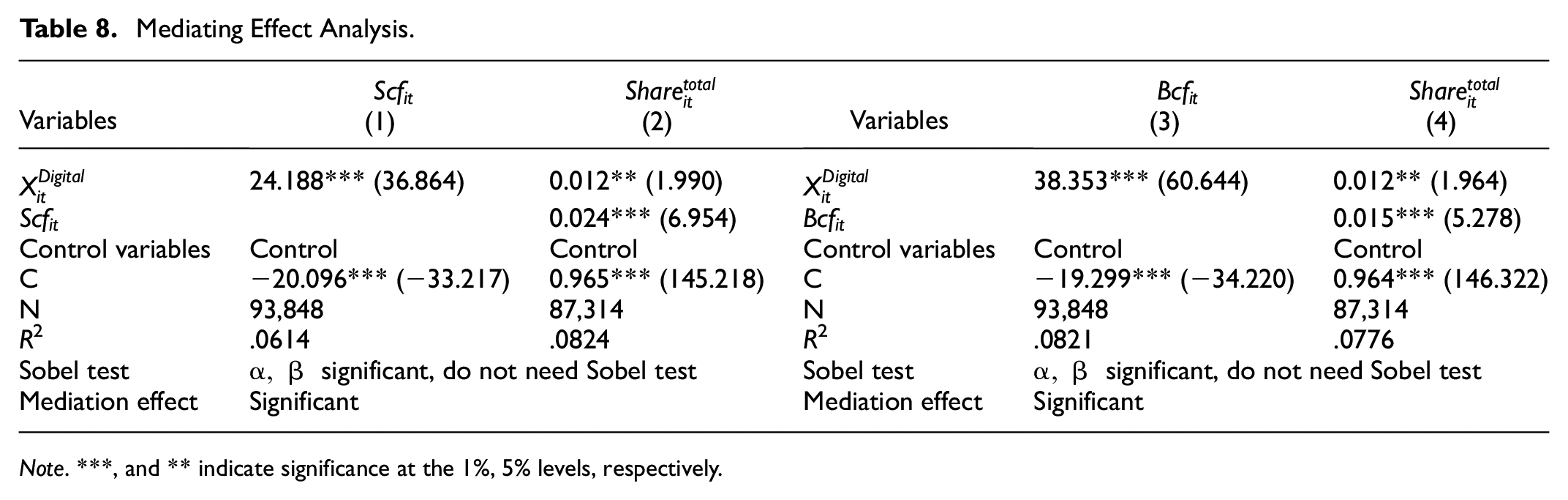
Note. ***, and ** indicate significance at the 1%, 5% levels, respectively.
Additionally, when
Second, information source digitalization increased the share of TCE consumption by offering more convenient transactions. Referring to Yi and Zhou (2018), the frequency of Internet business activities (1 means “never,” 2 “once a few months” and “once a month,” 3 “2-3 times a month” and “once or twice a week,” 4 “3-4 times a week” and “almost every day”) was selected as the proxy variable for the convenience of Internet transactions to explore the mediating effect of digitalization on promoting convenient transactions to promote share of TCE consumption. Column (3) of Table 6 shows that digitalization had a significant positive effect on the convenience of transactions, and the regression coefficient was 38.353 (significant at p = .01). According to column (4), the regression coefficients of information source digitalization
Conclusions
Based on the China Family Panel Studies (CFPS) data, this research examined the impact of information sources on tourism, culture, and entertainment (TCE) consumption using panel data and
First, the regression analysis results indicated that the Internet, broadcast, print, and word of mouth positively and significantly increase TCE consumption. The positive effects were greatest for the Internet, followed by print, broadcast, and word of mouth. R. Luo et al. (2022) also found that in urban and rural areas, for families who do not use the Internet, internet usage can indeed promote family tourism consumption, and the effect is significant and steady. The results remained robust after several tests, including tail reduction, substitution variables, and selective subsamples.
Second, the effect of information sources on TCE consumption was significantly affected by age, education level, and place of residence. The Internet’s influence on younger respondents’ TCE consumption was greater than that of older adults. In addition, some scholars have found that Internet usage has dissimilar effects on the tourism consumption of families with varying income levels. The greatest impact is on middle-income families (Z. Liu & Yang, 2022). Broadcast media influenced the consumption of older respondents. The elderly are relatively lonely, and radio can reduce the elderly’s sense of loneliness and isolation (R. Luo et al., 2022). Hence, the radio is an important way for the elderly to get information. The Internet and print media most impacted those with higher education degrees. Respondents with low education levels were more influenced by the Internet and broadcast media than by print because print media requires readers to have a greater vocabulary and strong logical thinking ability (Gössling, 2021). Internet, broadcast, and word-of-mouth information sources had a stronger upward effect on urban resident TCE consumption; print media had a greater influence on such consumption for rural residents.
Third, information source digitalization increased the share of TCE consumption in overall household consumption through improving social interactions and convenience of transactions. These changes significantly increased the ratio of TCE consumption to the consumption of services and essential goods and the ratio of TCE consumption to total consumption. The advent of new technologies has generated a series of mutations in the dynamics and structure of production and consumption at the global and tourism destination levels, changing the requirements of tourists (Şchiopu et al., 2016). However, it significantly negatively affected the proportion of TCE consumption to other consumption, such as medical treatment. Tourism may positively affect people’s health in the long run (Pessot et al., 2021) as it restrains other consumption expenditures. Additionally, these advances in information sources led to more TCE consumption by promoting greater social interaction and more convenient transactions.
Implications
Based on the results and conclusions, there were several implications. First, there is a need to improve information and communication infrastructure, especially in providing Internet service in rural areas. Local governments should expand and improve the construction of 5G networks and communication base stations, expand and upgrade the coverage of networks, give full play to the role of Internet information sources in narrowing the disparities in access to information, and promote a more equitable flow of information among different regions. The sources of information need to be enriched for all people. Particularly, governments should continue to expand rural informatization, give more emphasis to the critical role of the Internet and other new information channels (H. M. Li & Zhang, 2019), improve the weaker state of rural network infrastructure, and redress the situation of “information island” in rural areas (Wang et al., 2022). Also, local governments and tourism and culture agencies should reinforce contact with information management departments and standardize information transmission quality through different sources. While reducing the cost of information acquisition and screening, the authenticity and reliability of information should be ensured to reduce misleading and false information.
Second, greater awareness should be established of the availability and importance of information sources. People should be aware of the importance of information sources, and steps should be taken to increase digital and tourism literacy.
Third, TCE marketing activities should be conducted considering the differences in preferences and use according to demographic and place of residence characteristics. TCE organizations should utilize all sources to ensure a more consistent information supply. Additionally, government departments and TCE organizations should educate and coach people to better use information in TCE consumption.
Limitations and Future Research Needs
There are recognized limitations in conducting secondary data analysis, such as the China Family Panel Studies (CFPS) (Black, 2018; Goodwin, 2012). These include the potential of methodological and data collection problems (e.g., with validity), missing data, lack of generalizability, and the absence of variables that may be relevant to the research. There are future opportunities for scholars to conduct specific surveys using the variables examined in this research.
Other factors in this research influence tourism, culture, and entertainment consumption, including the country of residence. For example, the data analyzed in this research were from China and the results may not be generalizable to other countries. Future researchers are encouraged to conduct similar studies in other countries, regions, and cultural contexts.
Footnotes
Acknowledgements
We sincerely thank the editor and anonymous referees, whose remarks have been very constructive and inspiring in preparing the final version of the paper.
Authors’ Contributions
Q.C. wrote the whole paper and the formal analysis. Y.M. and A.M designed the research framework and revised the manuscript. Y.M. collected and jointly analyzed the data.
Declaration of Conflicting Interests
The author(s) declared no potential conflicts of interest with respect to the research, authorship, and/or publication of this article.
Funding
The author(s) disclosed receipt of the following financial support for the research, authorship, and/or publication of this article: This study was supported by the National Natural Science Foundation of China (grant nos. 42201236); the Scientific research Project of Hubei Education Department (grant no. B2021171, 21Q204); Scientific Research Cultivation Project 2020 of the Hubei University of Economics (PYYB202009); Humanities and Social Science Project of Guangxi Universities (2021QGRW059).
Ethics Statement
Not applicable.
Supplemental Material
First, open the CFPS website ( ), and then, click on the “Data”→“New users, both please register here”→“register,” and then fill in those information: “Work Email, Identifying Code, etc. Finally, click “submit.” Next, you will receive an email notifying you of the outcome of the project review. If approved, you can download and use the CFPS data.
Data Availability Statement
Data set and the estimation codes will be made available on request.