




Abstract
The Internet of Things (IoT) is increasingly becoming a key technology for service transformation, that is, the transition from pure product sales to so-called “bundles” of customer-focused combinations of products and services. These combinations are termed product-service systems. They aim to add value for the customer. However, the role of IoT in this context is not quite clear. In this contribution, therefore, we examine the role of IoT in the context of service transformation. Our structured analysis of transformation processes reveals IoT as essential enabler of digital service transformation. We explain IoT-relevance on a strategic and operational level of IoT-capable business models. IoT not only can supplement a portfolio of products on a strategic level, but also completely replace a product. At the operational level, capabilities such as remote monitoring or remote control play a crucial role. IoT also plays a crucial enabling role when the convergence between service transformation and Industry 4.0 is targeted. However, when realizing service transformation, the various IoT capabilities are mutually dependent. Hence, implementation follows in some way a waterfall-like process in which certain results are required to trigger the next development step. We describe these dependencies, and thus facilitate decision making when IoT is used for service transformation processes. Organizations can then take appropriate development actions.
Introduction
Industry has faced many challenges and change requirements in recent years, including the shift from traditional automation to the fourth industrial revolution (Industry 4.0). Thereby, machines and devices are networked into intelligent systems (Cyber-Physical Systems) through the support of the Internet of Things (IoT) (Wollschlaeger et al., 2017; Zheng et al., 2019)) to create added value for industrial activities (Sanders et al., 2016; Zheng et al., 2021)). Moreover, the trend of service transformation, which describes a transformation process from a product-oriented to a service-oriented business model, the result of which (Product Service System, PSS) generates added value for customers and stakeholders (Raddats et al., 2019; Xing & Ness, 2016).
The Internet of Things (IoT), introduced to describe the networking of physical objects by adding radio frequency identification and sensors for various purposes including identification, detection, communication and data collection (Ashton, 2009), is seen as the most important technology of Industry 4.0 and smart Product-Service Systems (PSS) (Zheng et al., 2020). Based on data collected through IoT technologies, companies can improve their products and business models and thus increase their competitiveness in the market (Rymaszewska et al., 2017).
The developments of IoT are not only limited in connection with Industry 4.0, but are also increasingly taking place in combination with the business model innovation service transformation, also known as servitization. Service transformation, as introduced by Vandermerwe and Rada (1988) describes the transition from pure product sales to so-called “bundling” of customer-focused combinations of products, services, support, and knowledge. The resulting PSS (Baines et al., 2007; Tukker, 2004) and are intended to create added value for the customer (Paschou et al., 2020).
IoT capabilities in that context have a strong focus on digitally enhanced product development in terms of simulation for smart manufacturing (Mourtzis, 2020), while recognizing methodological support requirements, in terms of for example, integrating business models with products and services in PSS (Xing & Ness, 2016), or PSS resource planning (Mourtzis et al., 2020). Methodological support helps realizing various benefits of servitization, as has been shown for Digital Twin models (cf. Minerva & Crespi, 2021; Zhang et al., 2019). They include:
customization of product functionalities
alignment of products to the lifestyle and needs of customers
introduction of additional new functions to products
prevention of malfunctions of products before they actually occur.
However, an increasing number of organizations consider service transformation key to financial, strategic and technical marketing opportunities, creating additional benefits to existing product offerings (Paschou et al., 2020). For successful service transformation, digital technologies play a crucial role (Rabetino et al., 2018). Digital technologies can strengthen or completely transform the capabilities of services and thus enable new service-oriented business models (Adrodegari & Saccani, 2017). Companies including Rolls-Royce, General Electric, and Kone revealed novel business models and smart services implemented through digital technologies. Rolls-Royce’s “Power-By-The-Hour” sales program (cf. Smith, 2013) is an example of a service-transformed business model. Thereby, airlines no longer buy the engines, but “pay-per-use” with Rolls-Royce monitoring the engine data in real time to ensure the best possible service.
The convergence between service transformation and digital technologies is termed digital service transformation (Bustinza et al., 2018). In this context, IoT is repeatedly mentioned as a core technology and enabler of service transformation, but without detailing its role and support functions. In this paper, we aim to find out how value is generated through IoT as core technology that is handled by stakeholders acting in various roles (cf. Aiello et al., 2021), and what opportunities IoT offers in relation to service-oriented business models. Our goal is not only to find out effects IoT can have, but also to frame IoT-driven service transformation processes conceptually. Such a perspective enables opening a space of design opportunities for organizations to proceed in their structural development albeit pursuing well-established industrial engineering practices. The results are intended to support organizational decision-makers when questioning which role the IoT plays in the context of service transformation. The developed conceptual framework is based on the detailed analysis of existing experiences and research.
The contribution is structured as follows: Section 2 reports on the methodology including the procedure of identifying and selecting relevant findings from literature. Section 3 explains the concept and terminology of service transformation, including product service systems (PSS) and their categorization, in order to provide a common understanding for framework development. Section 4 details the role of IoT in the context of service transformation from various perspectives and provides the proposed framework for service transformation derived from the analyzed findings. In Section 5, we conclude with reflecting on the results, and identify research areas for future work.
Methodology
In this section we detail the procedure we followed to identify and consolidate findings on the relations between IoT and service transformation processes, including structured literature search and the subsequent qualitative evaluation of selected studies.
Due to the focus on the enabling function of IoT on service transformation the search was based on two groups of keywords addressing service transformation and the Internet of Things (IoT). Combinations of these keywords formed the search strings—see Figure 1 left side for service transformation and right side for IoT—when accessing the following digital repositories: Scopus, Google Scholar, ScienceDirect, Springerlink, ACM (Association of Computing Machinery) digital library, IEEE (Institute of Electric and Electronic Engineers) digital library, and Emerald Insight.

Structuring the research following Mourtzis (2020).
We selected only journal articles with an impact factor ≥0.7 in the first run for the sake of reliable findings and ensuring a sufficient level of granularity of information for the analysis. We then included conference papers in the second run. Initially the analysis was limited to the title and abstract of papers, in order to obtain the most precise search results possible. The literature found was then pre-sorted by examining the abstracts. This presorting resulted in 12 journal articles and two conference papers. A more in-depth analysis of the content with respect to the enabling function of IoT on service transformation processes finally led to eight journal articles as primary sources for the analysis—see Figure 2.

Primary sources.
The selected results show at a first glance, on the one hand, that research into service transformation with regard to IoT is predominantly performed in marketing and production, and on the other hand, is still in its early stages, as revealed by the publication date of the primary sources . Even more interesting is the insight from studying the objectives of these sources that most of the studies focused on IoT as a result of service transformations, whereas only Naik et al. (2020) examined the role of IoT in a service transformation process, and thus, recognized IoT (developments) as a specific factor influencing service transformation processes. In the following we detail the findings according to conceptual and terminological understandings in Section 3, before analyzing the role of IoT in service transformation processes in Section 4.
Service Transformation
This section specifies the concept of service transformation, including its context of use. We define the term service transformation, and the characteristics of respective processes. The properties of services are described using different service types. Service transformation strategies are presented, and different categories of product service systems are discussed. Finally, the convergence of digital technologies with service transformation is detailed, framing the findings on the role of IoT in the context of service transformation as detailed in Section 4 subsequently.
Key Terms
Before going into more detail on service transformation, the terms product and service, which are closely related to service transformation, must be defined. In short, a product is understood to be a material artifact (e.g., car, machine). The term service is often used in different ways. In the production area, service is understood as an offer (e.g., maintenance, repair). In this work, the term service is defined as an economic activity that does not result in possession of a tangible asset (Pascual et al., 2019).
The term service transformation, called servitization, was introduced in 1988 by Vandermerwe and Rada, denoting the approach of companies to bundle services with products and to sell them (Vandermerwe & Rada, 1988). Adding services to products enables companies to get closer to customers and better meet their needs while still offering the same products. Service transformation is viewed as a strategy that uses a service-oriented approach to satisfy customer needs in order to gain competitive advantage and improve organizational performance (Paiola et al., 2021; Pascual et al., 2019; Zheng et al., 2021).
Service transformation is associated with activities that generate added value and unique competencies and skills, resulting in economic benefits (Baines et al., 2009). Companies that have successfully implemented service transformation create new, unprecedented opportunities for customers that result in a competitive advantage. The aim here is not “just” to sell products, but rather to create solutions for customers by creating a bundle by integrating services into products (Vandermerwe & Rada, 1988).
Service transformation processes can be supported by different key performance measurements, adapted or novel new operation models, and new network partnerships (Dimache & Roche, 2013). However, the shift to servitisation needs to be considered as a decision-making problem (cf. Dimache & Roche, 2013): “What is servitisation in the context of the business? How appropriate is the company’s offering for the move to a product-service system (PSS)? What are the changes necessary in the company to develop a new PSS model? Where is the business on the PSS continuum? What is the company’s end goal in the PSS continuum? What is the next step on the PSS continuum for the company?” (p. 1436).
Key Features
Although companies have long been providing services, they have been considered as a necessary evil in terms of marketing strategies for a long time. Most of the added value was related to physical products. Services were considered as add-on to products (Gebauer et al., 2005). This attitude has changed dramatically. Services are considered as a main factor in an integrated product and service offering (Baines et al., 2009). They are increasingly used as value proposition. Fundamental value creation activities have become part of holistic offerings (Gebauer et al., 2006). It enables companies to remain competitive (Zheng et al., 2021).
A key feature of service transformation is the focus on customer-specific needs. Customers are offered tailor-made solutions rather than products (Baines et al., 2009). According to (Oliva & Kallenberg, 2003) this customer orientation consists of two different elements. The first element describes the transition of the service offer from product-oriented services to user-process-oriented services, for example, from functioning of products to focusing on the efficiency and effectiveness of customer processes associated with the product. The second element describes a transition in customer interaction from transaction-based to relationship-based relations, for example, from product sales to customer knowledge management which is still considered a challenging task (cf. Zheng et al., 2019).
There are various forms of service transformation, along the so-called product-service continuum (Baines et al., 2009). This continuum ranges from traditional manufacturing companies, where services are sold as an add-on to the products, to pure service providers who see services as the main part of their value creation process. Such services have the capability to generate further key features for organizations in terms of resource optimization and operation innovations. Embedded sensing systems in Production-Service-Systems utilizing an ontology-based framework (cf. European ICP4Life project, Maleki et al., 2018) industrial machinery maintenance could be optimized. These developments show a strong relation to technical IoT components, bringing into play technology-oriented key features like crowd-sensing and self-adaptive components aside human-centric needs (cf. Zheng et al., 2019).
It is important for organizations to identify their own position in this continuum and to recognize the opportunities and challenges. This should take place as a dynamic process by finding your own position from time to time and taking a step forward toward service dominance (cf. Zheng et al., 2021). The integrated consideration of technology and user-generated data and features can lead to a data-driven circularity of IoT systems, including autonomous configuration with context-awareness as its manifestation, and user-oriented long-lasting evolving as its motivation, however its smartness depending on specific models and algorithms (cf. Li et al., 2020).
Service Types
So far, the term service has been used in general and is not differentiated based on its characteristics. There exist various service types, with a focus on progressive services that have a high level of service transformation maturity and require special skills for implementation. Baines and Lightfoot examined various service offerings from service-transformed companies and divided them into three different types (Baines & Lightfoot, 2013): (i) Basic services product delivery, (ii) Intermediate services (product repair, monitoring, and customer service), (iii) Advanced services (Pay-Per-Use, Fleet Management, Availability Contract, Integrated Solutions).
Basic services focus on product provision, such as product and spare parts deliveries. Intermediate services focus on maintenance, such as customer service, monitoring or repairs. An advanced service is an outcome that focuses on the provision of a capability through the performance of the product and is provided through product service systems. With advanced services, a company takes on more risk and responsibility. The company focuses on the result of the product’s performance and is also responsible for achieving the performance targets. A range of advanced services enables long-term contracts, closer customer relationships, new business opportunities and income streams, and greater customer benefits. Advanced services typically include risk & revenue sharing agreements, revenue through usage agreements, rental agreements or regular revenue payments (cf. Baines & Lightfoot, 2013).
Advanced services are provided by companies that have a good understanding of the customer’s core objectives and difficulties. According to Raddats et al. (2014), eight service transformation skills are required to develop advanced services. These are technical expertise, customer-focused methodologies, service culture, network relationships, service innovation, customer familiarity, service infrastructure, and tailored and consistent service offerings. From an internal perspective, a manufacturer needs technical expertise, a service culture and tailored and consistent service offerings. Together with the company’s internal interfaces between service and product engineers, this facilitates the provision of product-oriented services such as maintenance or repairs. However, in order to be able to offer advanced services, the transition to a service-oriented corporate culture is necessary. This culture means that services play the central role of the offer and are no longer seen as just an addition to a product. All stakeholders should internalize this.
For advanced services tailored service offerings are required. They allow the customer to select the most suitable offer and adapt it if necessary. For understanding customer challenges and finding effective solutions, familiarity with the customer needs to become part of service processes and methods. Technical expertise of products needs to be combined with knowledge of the customer’s behavior to improve and innovate customer processes. Relations to service providers can help in addition to an effective infrastructure for service developments satisfying customer needs (Raddats et al., 2014), however, in a human-centric way (cf. Zheng et al., 2019).
Drivers
Several factors guide companies in pursuing a service transformation strategy: finance, strategy and marketing (Baines et al., 2009; Gebauer et al., 2006; Oliva & Kallenberg, 2003). Thereby, higher profit margins and stable income are main financial drivers (Gebauer et al., 2006), for example, as shown for automotive manufacturers generating once or twice more revenue with services than with new sales. Product-service bundles are also less sensitive to price-based competition, as these bundles cannot be compared as easily as products (cf. Baines et al., 2009; Aiello et al., 2021).
Strategic drivers of service transformation generate competitive advantage. Generating competitive advantages through services is considered more sustainable, as these need to be identified by competitors before copying (Gebauer et al., 2006; Oliva & Kallenberg, 2003).
The use of services with the aim of increasing product sales by influencing the purchase decision is a driving force in marketing (Gebauer et al., 2006). Services can generate customer loyalty through novel/repeated sales and expanded communication. The latter results in insight into customer needs, and this improved offers (cf. Baines et al., 2009; Zheng et al., 2019).
Product Service System (PSS)
A product service system (PSS) is a special case of service transformation and describes the specific offer that results from a service transformation process. It is understood as an integrated combination of product and services, which are offered as a bundle and deliver a value in use (Baines et al., 2007; Tukker, 2004). Based on a service-oriented strategy it helps differentiating from competitors beyond fighting for market shares by reducing prices (Pascual et al., 2019), including mass customization (Maleki et al., 2018).
PSS are systems of products, services and networks of different actors who strive to be competitive by satisfying customer needs and at the same time to generate low ecological impact (Goedkoop et al., 1999). PSS can be viewed as offers from manufacturers who pursue a service transformation process—PSS are service-transformed offers. As such they have some special characteristics. They not only integrate services with products, but can also follow the concept of selling the use of the product and not the product itself (Baines et al., 2007): The customer only pays for the period of use of the product or for a result of the use of a product and does not transfer ownership (see also PSS types).
For instance, initially Rolls-Royce has sold turbines to airlines and the sales process ended with delivery. By developing through a service transformation process the product service system “Power-By-The-Hour” as a total care package including installation, maintenance, repairs and other services, Rolls-Royce remains the owner of the turbines and only provides the customer with the use of the turbine. It takes responsibility for effective use while collecting performance and usage data. In this case, the customer only pays for the effective use of the turbine (cf. Smith, 2013).
PSS Types
Various PSS types have been implemented, according to Tukker (2004), either being product-, benefit-, or result-oriented (see Figure 3). Their position in the service transformation continuum reveals PSS as special cases of service transformations (Baines et al., 2007).

PSS types based on (Tukker, 2004).
Digital Service Transformation
Looking at the relation between digital technologies and service transformation in general frames studying the role of IoT for service transformation in the next section.
Digital technologies and service transformation are tightly coupled. Digital technologies facilitate developing service transformations toward new and complex service offerings (cf. Paschou et al., 2020). Technologies such as IoT or Artificial Intelligence (AI) can strengthen or even completely change the capabilities of services (Rymaszewska et al., 2017) and thus enable new service-oriented business models. The development or improvement of services using digital technologies is referred to as digital service transformation (Paiola & Gebauer, 2020).
Digital technologies can generate knowledge from data and thereby improve the performance of the company, which in turn leads to higher competitiveness. Benefits of digital service transformation include (cf. Paiola et al., 2021; Paschou et al., 2020):
Benefits for customers: Digital technologies can save staff and costs on the customer side, increase flexibility and adaptability and save time. Customers are enabled to incorporate their needs into the product and to help shape it, however requiring some collaborative effort (cf. Kaar & Stary, 2019)
Benefits for providers: On the part of the service provider, the application of cloud computing is used as the core mechanism for value creation. This added value is achieved by improving the customer experience, increasing the customer’s perception of their own company and reducing procurement costs. Furthermore, digital technologies enable various new technology-supported business models. These business models generate benefits in which customers can be offered knowledge-based services over the entire product life cycle, which is ultimately reflected in a competitive advantage. Studies also show that digital technologies can increase the efficiency and effectiveness of maintenance. For example, through remote detection and diagnosis of problems, a reduction in unplanned maintenance can be achieved, which leads to a reduction in operating costs, delays and cancelations and increases productivity.
Benefits for the environment and society: Digital service transformation not only brings advantages for customers and providers, but also advantages for the environment, such as energy savings. Studies show that technologies increase resource efficiency and extend the product lifespan. In addition, digital technologies bring benefits to society. Examples of this are inexpensive and high-performance networked devices, such as smart wearable devices that record personalized data for fitness and well-being.
By far the most widespread digital technology related to digital service transformation is the Internet of Things (IoT). IoT can be seen as a prerequisite for smart services, as this technology allows the collection and transmission of data from products and systems (Ardolino et al., 2018) and thus enables remote monitoring and control of products and systems (Porter & Heppelmann, 2014). Big data technology, including data analysis, is also important for digital service transformation, as knowledge can be extracted in order to exploit the full potential of advanced services. In particular, services can be based on predictions, adaptive control and optimization of a product. Other technologies that are receiving attention in the literature are cloud computing, as well as horizontal and vertical integration and traditional ICTs such as ERP and CRM systems (cf. Paschou et al., 2020).
Aiello et al. (2021) in their recent guide could identify several challenges to utilize IoT along digital service transformation processes. One of the major challenges is the interpretation of provided data by IoT devices. Termed as no-semantic cases, it requires to interpret delivered data in way meaningful information can be distilled and further processed and finally, collaboratively shared. First results from using OWL-T as an ontology have been presented by the authors. It enables defining IoT components or systems and services, thus, preparing a common ground for servitization. In that context, stakeholder roles and relations have been addressed in an interaction model addressing the roles provider, facilitator, and customer.
Summing Up
Service transformation terms the transition from product-focused sales to so-called “bundles” of customer-focused combinations of products and services, which are referred to as product-service systems (Baines et al., 2007; Tukker, 2004) and should create added value for the customer (Paschou et al., 2020). Services can be basic targeting product delivery, intermediate focusing on maintaining the product condition, and advanced. The latter concentrate on the provision of a capability through the performance of the product, and are provided by product service systems (Baines & Lightfoot, 2013).
A product service system (PSS) is thus a special case of service transformation. It captures the specific offer that results from a service transformation process. PSS can be product-, benefit-, or result-oriented, with the latter focus on services, leading to more intense customer relations (Tukker, 2004).
Transformation processes are tightly coupled with digital technologies, leading to digital service transformation. Benefits for customers, providers, the environment and society can be achieved through core technology and enablers, in particular, IoT. In combination with other technologies such as big data innovative and complex service offerings can be developed (cf. Paschou et al., 2020).
The Internet of Things (IoT) for Digital Service Transformation
In this section, the role of IoT in the context of service transformation is examined in detail. After briefly reviewing its basic properties, business model development enabled by IoT is addressed on the strategic and operational level. Lines of convergence between Industry 4.0 and digital service transformation featured by IoT are detailed, before IoT in service transformation processes is discussed.
IoT as integrator of the physical world with the digital world and vice versa (Fleisch, 2010) impacts daily lives (Barnaghi et al., 2012) and organizations (M. Hung, 2017). IoT’s core concept is the seamless integration of virtual and physical objects in a network, leading to contextual interaction and cooperation to achieve common goals, enabled by its omnipresence in the real and digital world (Barnaghi et al., 2012; Fleisch, 2010). IoT development has been driven by improving supply chains, trade and inventory management through the application of Electronic Product Codes, see (Rothensee, 2008), for example, storing and exchanging information with other objects, laying ground for thinking in “things” (cf. Atzori et al., 2010). With the Internet technology as carrier IoT started propagating to almost all societal systems (cf. Madakam et al., 2015), and triggering transformation processes in PSS (cf. Xing & Ness, 2016).
IoT-Featured Transformations of Business Models
As the amount of connected things and corresponding semantic representations, for example, in OWL (Web Ontology Language), is still increasing, IoT-enabled service-transformed business models emerge. They can be categorized into four archetypes based on their main value creation offerings: add-on, sharing, usage-based and solution-oriented business models with a total of nine subcategories (Suppatvech et al., 2019). In the following, the business models are described using practical examples and the connection to the underlying product service systems (PSS).
In the innovative digital service business model, IoT is used to combine digital services with physical goods in order to create a single hybrid offer (Fleisch et al., 2014)—products are equipped with sensor-based digital services, which imply new value creation offers (Suppatvech et al., 2019). An example of this type of business model is the “FuelBand” bracelet from sports manufacturer Nike, enabling the monitoring of health data and fitness activities of a user. IoT devices transmit data wirelessly to a smartphone (Gerpott & May, 2016).
In the business model of supporting service provision, IoT is used to increase the efficiency of an offered service (Gerpott & May, 2016). For instance, the logistics company Geis Group operates IoT-based customer order processes through just-in-time information exchange (Leminen et al., 2012).
The business model with a focus on customer data usage uses the information from customers that is collected while using the product in order to be able to offer personalized services (Fleisch et al., 2014). For instance, the company Bundles applies this model. It offers a smart washing machine that uses integrated IoT technology to send customers monthly feedback on their interaction with the device (Dijkman et al., 2015).
In the on-demand delivery business model, the additional function only becomes available when requested by the customer (Suppatvech et al., 2019). For instance, Philips’ wireless lighting system “Hue” connects LED lightbulbs to the smartphone through IoT, thus enabling remote control of the lightbulbs (Gerpott & May, 2016).
In summary, add-on business models focus on additional offers of digital services for existing products, which are expanded by IoT in order to generate additional benefits. These additional digital services are also often offered for sale as a premium version of the product.
According to the pay-per-use business model, the customer is only charged for the actual use of the product or service. The provider utilizes IoT technology to monitor and measure the product while it is in use (Suppatvech et al., 2019). For instance, Brothers, a manufacturer of computer accessories, offers managed printing services that give customers the option of paying a fixed price per printed page regardless of the amount of ink used. The ink level is remotely monitored via IoT and new ink cartridges are automatically reordered if necessary. The service also includes the return and subsequent recycling of used ink cartridges (Fleisch et al., 2014).
In the subscription business model, the customer is granted unlimited access to the product or service, limited to the time of the subscription (Suppatvech et al., 2019). The customer has to pay a fee for the subscription itself. For instance, this business model was used by an information service provider of spare parts for industrial machines to check authenticity. After purchasing this service in the form of a monthly subscription, a customer has access to a database that enables the authenticity of a product to be verified using its serial number (Bucherer & Uckelmann, 2011). For instance, an IoT device like a temperature sensor system delivering data from a supply chain is subscribed for logistic goods that transported under certain temperature conditions.
The
In the availability business model, manufacturers offer customers guaranteed, continuous use and uninterrupted use of the products that demonstrate a certain benefit. The provider is responsible for the product and its maintenance, in order to ensure use without interruption during the contract period. With the help of IoT, providers can access real-time information about the product, facilitating maintenance and other supporting services—see Rolls-Royce’s“TotalCare” package.
In the optimization/consulting business model, providers use IoT to monitor the current use of the product and to subsequently analyze the behavior patterns used in order to be able to offer solutions or advice for the customer’s business operation. When implementing this model, providers not only ensure the availability of the product, but also support customer processes. For instance, a Finnish supplier of sheet metal processing machines, uses IoT to monitor the daily output of the connected machines at the customer site. It enables offering long-term contracts for remote support and optimization of the customer’s production plans. The provider is not only responsible for the installation and scheduled maintenance, but also can help customers to optimize their production, for example, reducing operation costs through increasing the plant utilization (Rymaszewska et al., 2017).
In Figure 4, the various IoT-featured, service-transformed business models are summarized and put into relation to the different PSS types.
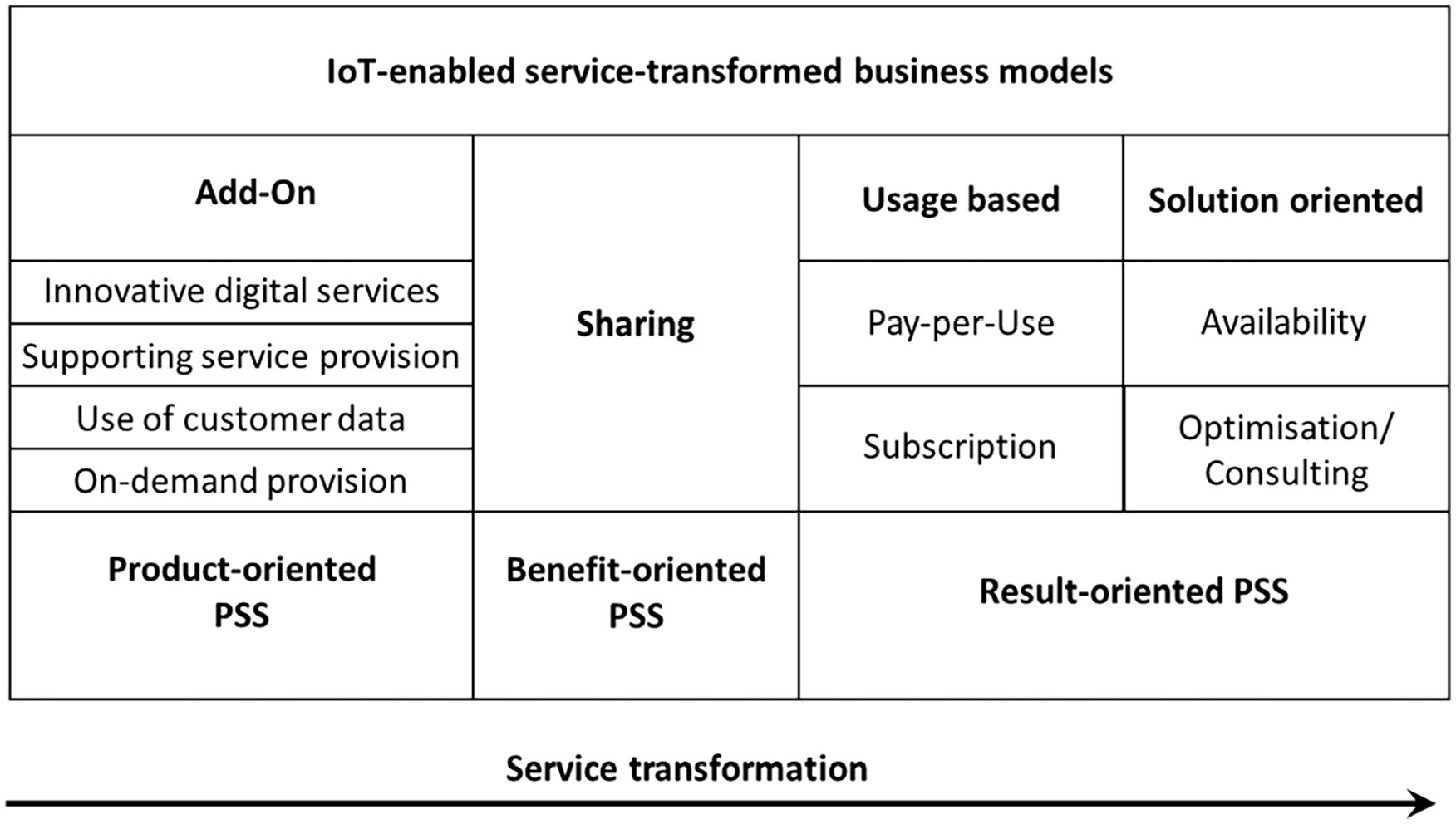
IoT-based service-transformed business models in the context of PSS types.
Experienced Benefits
IoT service-transformed business models have several benefits for providers and producers: Additional income can be generated through additional services created by IoT—long-term contracts replace traditional product sales (Kralewski, 2016). The use of IoT helps companies to reduce resources in the provision of services, for example, saving wage costs through remote diagnosis. It can lead to lower operating costs (Herterich et al., 2015). In addition, the introduction of IoT-enabled services can intensify customer relationships, as IoT enables the customer to individualize a service, which in turn allows the provider to offer customized solutions. Long-term solutions that create significant value for the customer and sustain provider-customer relationships (Hagberg et al., 2016). Finally, using IoT, companies can expand their product portfolio and subsequently expand their business (Ardolino et al., 2016; Rymaszewska et al., 2017; Saarikko et al., 2017).
Service offerings can be continuously improved (Suppatvech et al., 2019), for example, offering them in a customer-centered way. When giving providers insight into product usage behavior, resource consumption and management can be improved (Bressanelli et al., 2018). Such IoT-enabled service-transformed business models can lead to competitive advantages, as integrated product-services are highly context-sensitive and hard to copy (Kaňovská & Tomášková, 2018). Finally, with the help of IoT technologies, companies can evaluate the risk of the product and service offerings (Suppatvech et al., 2019)—service provision is continuously monitored and evaluated to identify possible risks, in particular with respective to sustainability (cf. Li et al., 2021).
Digital business-model innovation can impact sustainability, as shown in manufacturing servitization (cf. Paiola et al., 2021). Services become gradually use-oriented offerings as a result of digital product and service transformation. Advanced forms of market relations enable co-creations in collaborative network settings respecting customer processes in a result-oriented PSS. Transitions do not only require active participation of IoT providers, but rather informed decision making (cf. Dimache & Roche, 2013) featuring incremental and stakeholder-compatible transformation steps (cf. Xing & Ness, 2016). As their empirical findings show, each step needs to be identified upfront and negotiated, for both, the product-service provider, and customers, since “this change is from the traditional sell/buy model (high cost, low service, high carbon footprint) to the PSS model (low cost, high service, low carbon footprint)” (Xing & Ness, 2016, p. 528). In each incremental step expected and already achieved service benefits should be captured, in order to check whether “the total benefits of a combined PSS solution are greater once all the component areas are aligned into a single solution” (Xing & Ness, 2016)
In Figure 5, the benefits of the various IoT service-transformed business models are shown based on Suppatvech et al. (2019). The benefit of lower operating costs applies to all business models. The most potential benefits have been found for add-on and solution-oriented business models, since IoT is closely integrated.

Experienced benefits of IoT-enabled service-transformed business models.
Strategic and Operational Roles of IoT in Service-Transformed Business Models
In the previous section, the service-transformed business models enabled by IoT and their benefits have been explained. In this section the roles IoT can play in transforming business models are addressed on the strategic and operational level of an organization. Strategic roles are grouped according to the strategic use of IoT to enable services, whereas operational roles are grouped according to the functional use of IoT in the provision of services (cf. Suppatvech et al., 2019).
Strategic Roles
In order to understand the influence of IoT technologies on the service transformation of business models from a strategic point of view, Gerpott and May (2016) have defined three roles of IoT that can be assumed in a portfolio of services. In Figure 6, these IoT roles are shown and grouped into two categories, depending on the type of use in an offer. In the first category, IoT components only complement the product portfolio, that is, IoT is not considered the main driver of transformation. IoT can smooth (smoothing) or change (adaptation) the portfolio. Utilizing IoT technology, however, can lead to a complete replacement of existing products (innovation), namely by creating capabilities that do not yet exist (Gerpott & May, 2016).
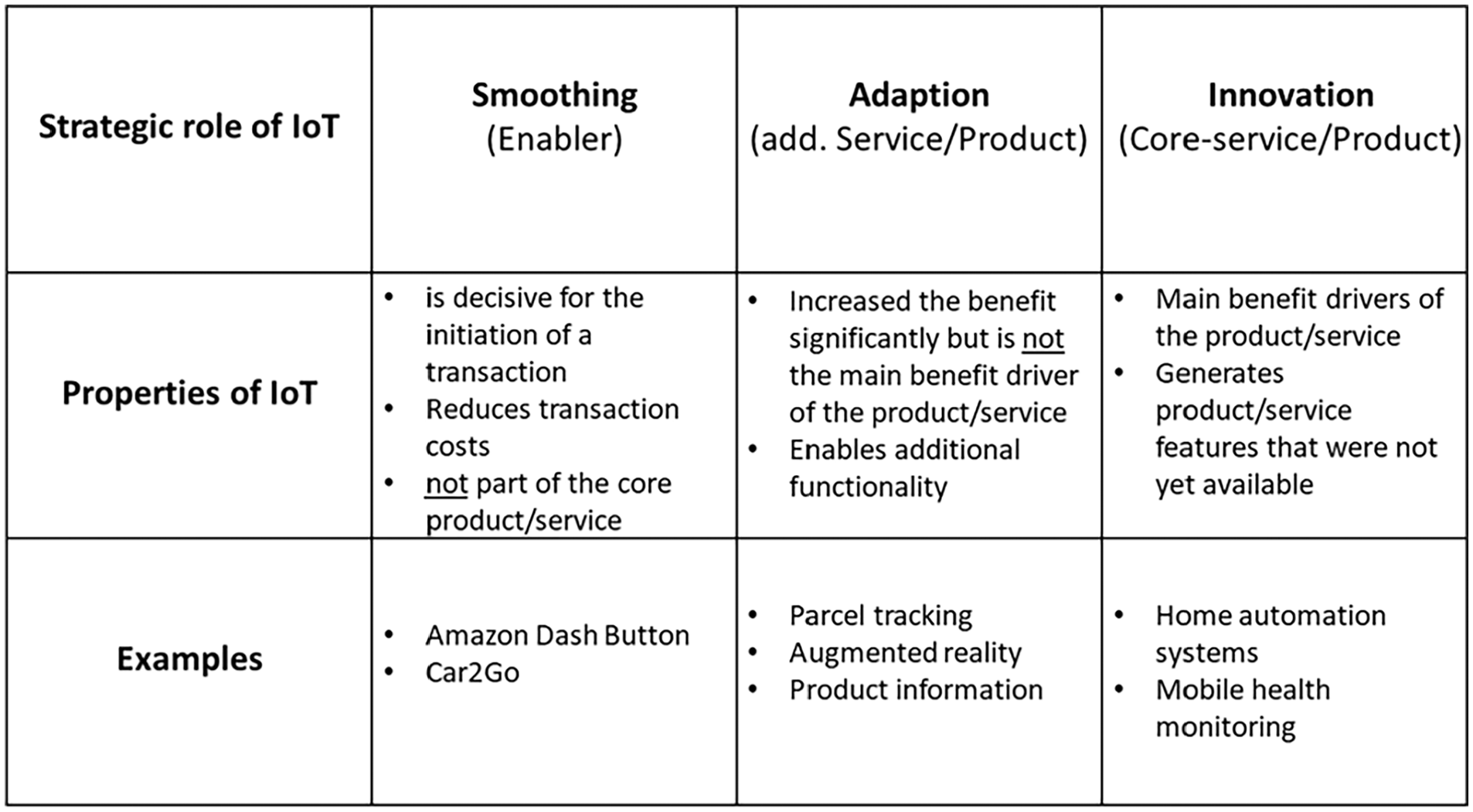
Strategic roles of IoT in service transformation, based on (Gerpott & May, 2016).
Smoothing and adaptation complement a portfolio, whereas innovation aims to completely replace a company’s current product (Gerpott & May, 2016):
The
The IoT role
The role of IoT as an
Figure 7 shows that all IoT-enabled service-transformed business models have the strategic role of adaptation (Suppatvech et al., 2019). This means that every business model basically uses IoT to add additional functions to a product or service. Furthermore, all business models, except the solution-oriented, use IoT in the smoothing role, which can be attributed to the reduction of transaction costs through easier communication between customer and provider (Suppatvech et al., 2019).

Strategic roles of IoT-enabled service-transformed business models.
Operational Roles
At the operational level, according to Suppatvech et al. (2019) seven roles representing functionalities of IoT in the provision of services can be identified:
Responsive maintenance refers to maintenance and repairs after a machine has already failed. The condition of the customer’s machine or product can be monitored by IoT technology in real time and an immediate response to a failure can be made in order to ensure that a return to a normal state can be achieved and the downtime is minimized (Suppatvech et al., 2019; Zancul et al., 2016).
Proactive maintenance involves using IoT to monitor and gain detailed product insights that help companies deal with product problems before they even occur (Suppatvech et al., 2019).
Operational optimization means that IoT-embedded products collect the operating data, algorithms and data analysis tools are used for product operation, capacity utilization, and performance are improved (Ardolino et al., 2016; Suppatvech et al., 2019).
Remote control means that the product equipped with IoT enables companies to monitor the product condition in order to diagnose errors and, if necessary, to correct them. In this case, not only the service provider is able to control the product remotely, but the customer also has the option to operate components of the product remotely, which is perceived as an additional service of the provider (Lee et al., 2015).
Autonomous management can be seen as a high capability of the IoT-embedded product. In this role, IoT is used to enable autonomous operation, automated decision-making, and self-diagnosis (Porter & Heppelmann, 2014). This means that IoT-embedded products have their own capabilities to decide whether certain functions, such as self-maintenance, should be performed or not (Ardolino et al., 2016).
In remote monitoring IoT is used to monitor aspects of the product, such as current location or usage data, and report relevant information to the customer (Ardolino et al., 2016).
Monitoring of customer usage behavior means that customer usage patterns are observed through IoT in order to develop personalized services (Ardolino et al., 2016).
Figure 8 shows that each business models uses IoT for remote monitoring of products and customer usage behavior. In addition, solution-oriented business models use the full spectrum of operational roles, as these provide for highly integrated offers and require a high level of sensor capability. (Suppatvech et al., 2019)

Operational roles of IoT-enabled service-transformed business models.
IoT Interfacing Service Transformation and Industry 4.0
IoT has not only be recognized as the most prominent technology related to digital service transformation, but also as the most important technology of Industry 4.0 (Rymaszewska et al., 2017). Service transformation and Industry 4.0 converges on the basis of IoT, as Industry 4.0 is focusing on intelligent cyber-physical systems to create added value for industrial activities (Frank et al., 2019). The Industry 4.0 trend is mainly based on a technology push (Lasi et al., 2014). This technology push implies a radical business model innovation by manufacturing companies, which requires a strong investment in new technologies (Müller et al., 2018). At the same time, companies have to respond to the trend toward service transformation. Industry 4.0 and service transformation come from different research areas and were therefore considered as separate topics for a long time. However, since both strategic orientations have profound effects on competition, relating the two topics has moved to the center of development (Weking et al., 2020).
In order to explain the connection between Industry 4.0 and service transformation, on the one hand, the intensity of the digital technologies embedded in a service offer, or in short, the digitization level (Frank et al., 2019) is of interest, and on the other hand, the strategic roles of IoT in a service-transformed business model needs to be clarified. These strategic roles of IoT have already been described above. There are the roles of smoothing, adaptation and innovation. Smoothing services use IoT to support the functionalities of a product or service, adapted services (adapting) to adapt the functionalities, and innovative services create a completely new offer (Gerpott & May, 2016).
Digitization Levels of Service Offerings
Digitization is defined as the transition process that companies are faced with when they start to introduce digital technologies, in order to implement a networked, intelligent company, as proposed in the concept of Industry 4.0. Frank et al. (2019) suggest three intensity levels of digitization, based on its purpose in service offers. The first stage is called manual services and refers to the low use of digital technologies in a service offering. At this stage, digital technologies are only seen as a supporting component, for example, for customers to manage relationships. IoT does not yet play a role at this stage. The second stage of the digitization of offers is that of digital services. Digital technologies are used with moderate intensity at this stage and enable companies to offer their customers services on the basis of digital technologies such as IoT or cloud computing. They provide the service itself, whereby the service brings added value for the customer. The two digitization stages presented so far, manual and digital services, focus only on added value for the customer from a business model perspective. The last stage of digitizing service offers, namely Industry 4.0-related services, relates to high-tech services that create added value not only for the customer but also for the internal processes of the provider. This is the (only) level of digitization of service offers that is in line with the concept of Industry 4.0. In this stage only services are developed, that return benefits and create new types of interactions between customers and the manufacturing processes of companies through IoT (Coreynen et al., 2017; Frank et al., 2019; Figure 9).
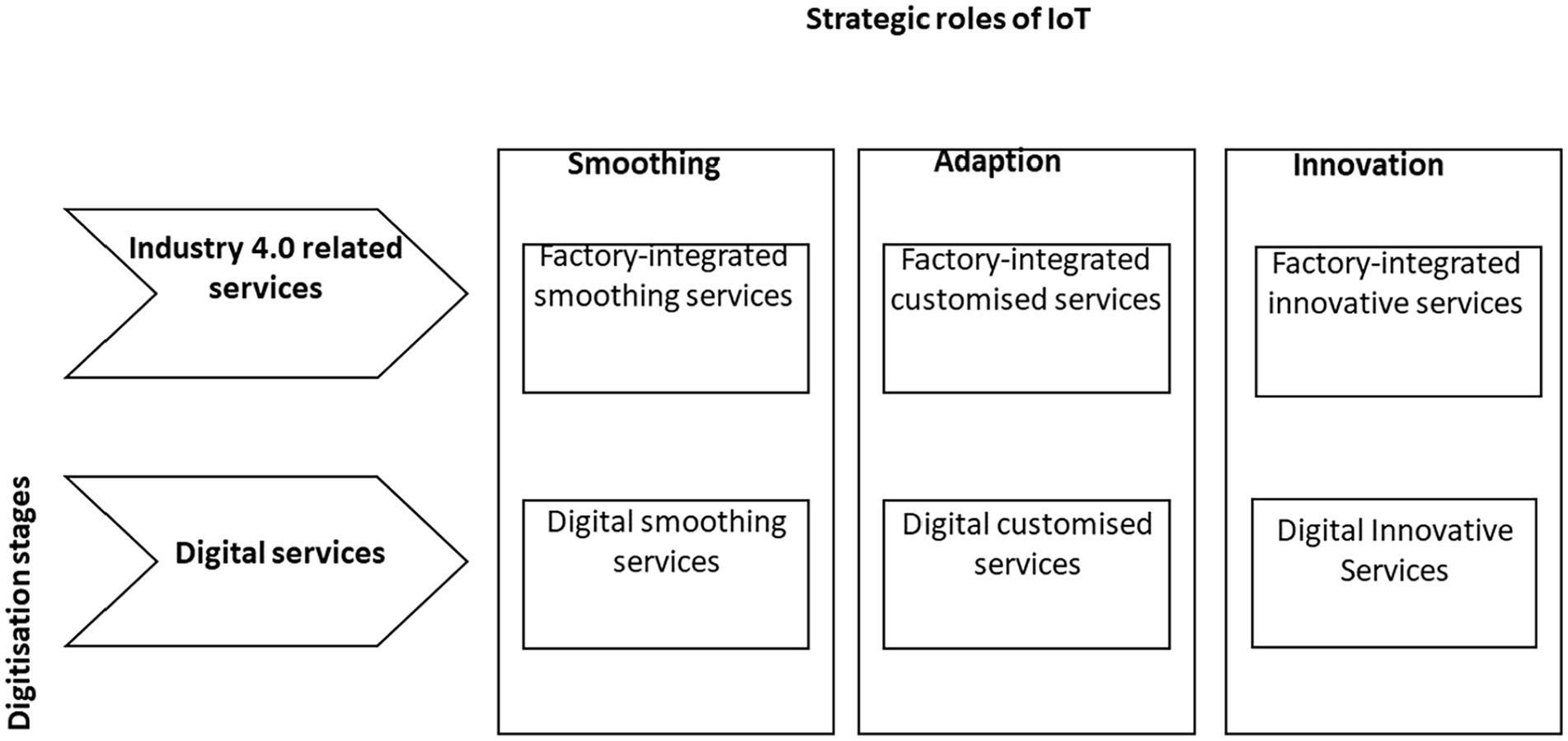
IoT-enabled service transformation for Industry 4.0 based on (Frank et al., 2019).
Framing the Interface Between Service Transformation and Industry 4.0
If the digitization levels of service offerings are compared with the strategic roles of IoT in a service-transformed offer portfolio, there are nine configurations according to Frank et al. (2019). However, since IoT does not play a role in manual services, six IoT-enabled configurations remain.
Three of these configurations focus on the internal production processes and at the same time on customer integration, and thus completely correspond to the concept of Industry 4.0:
The highest level of digitization in the smoothing services is the configuration of factory-integrated smoothing services. In this case, digital technologies such as IoT support the delivery of the service to the customer. However, with the help of IoT, among other things, additional data is collected to integrate the services with production in order to improve activities such as production planning and control, new product launches or warehouse management, corresponding to Industry 4.0 (Naik et al., 2020). For instance, the bearing manufacturer SKF has developed condition monitoring technology to support its concept for optimizing system efficiency (Grubic, 2014).
Factory-integrated customized services also correspond to the concept of Industry 4.0. Added value is created for the customer and the internal production processes at the same time. In this case, the company uses the data collected with the help of IoT not only to monitor and optimize customer processes, but also to adapt and improve its own product functionalities and production planning (Krueger et al., 2015). For instance, the company John Deere produces the same engine for different engine variants and only uses software to modify the engine’s performance for different customer segments. Furthermore, John Deere uses technologies such as IoT to give customers recommendations on how to use the tractors (Porter & Heppelmann, 2014).
The last type of Industry 4.0-related services are the factory-integrated innovative services. IoT is not only the driving force behind the service itself, it is also used to improve product planning and control. One example of this configuration is the tire manufacturer Michelin, which offers a pay-per-use solution. It includes IoT components installed in the vehicles for the transmission of information such as total kilometers, fuel consumption, temperature, and tire pressure. The data gives feedback to the company’s own processes and is also used to develop a large number of new solutions, such as outsourcing tire management or increasing fuel efficiency (Gebauer et al., 2017).
These three configurations, made possible by digital technologies and in particular IoT, offer added value for the customer as well as for the internal production processes based on the principle of Industry 4.0. They help strategic decision-makers to combine service offerings with digital technologies such as IoT, or to bring the service transformation strategy into line with the digitalization strategy in relation to Industry 4.0.
IoT in Service Transformation Processes—Opportunities and Dependencies
So far, various results or business models have been discussed that can result from a service transformation supported by IoT, without, however, addressing the processes that companies have to implement in order to achieve these results. This section therefore explains the implementation possibilities of IoT in a service transformation process.
Opportunities
The result of a service transformation process is not only dependent on the use of technologies such as IoT, but is viewed as the result of perceived opportunities from the relationship between technological features and business goals (Strong et al., 2014). That means, depending on the corporate goal, different possibilities are perceived that can be implemented through IoT (Figure 10). In their multiple case study, Naik et al. (2020) categorize the opportunities of IoT based on their contributions to a service offer in first-, second- and third-order opportunity and the results of the implementation into basic, internal and external results (Naik et al., 2020; Figure 11). The key features of IoT that emerged from this study are remote monitoring, data analysis and data exchange. Company goals can, for example, improve service efficiency, product performance, reactive service delivery, customer satisfaction, the product, the service portfolio or the product availability (Naik et al., 2020).
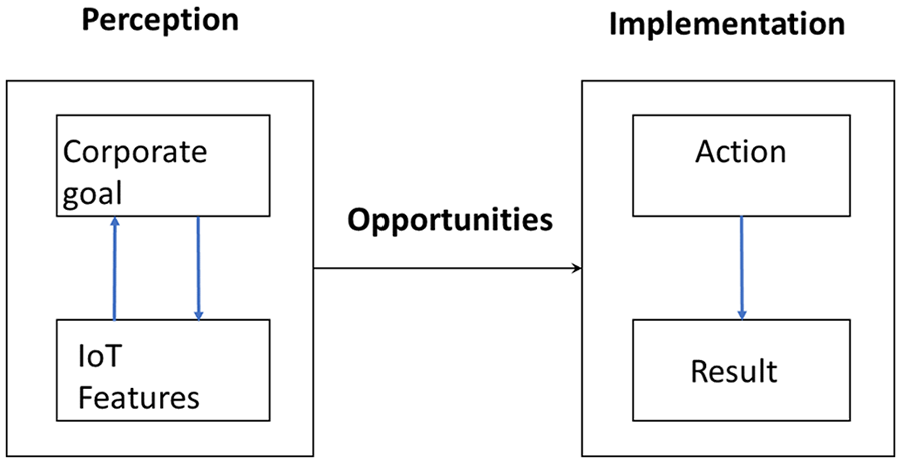
Implementation mechanism based on (Naik et al., 2020).
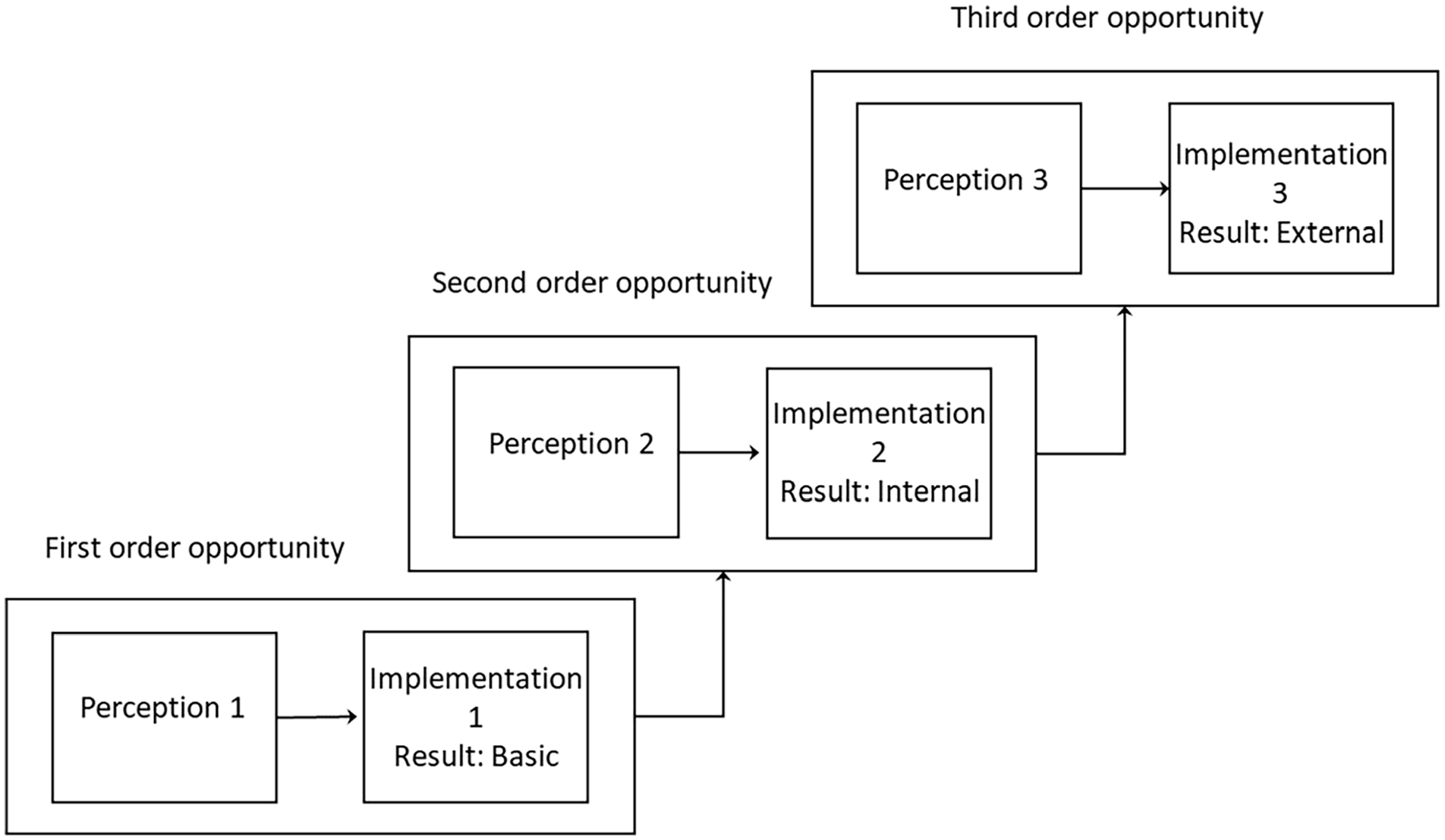
Service transformation process framework based on (Naik et al., 2020).
First-order opportunities use IoT features to establish basic remote connectivity and collect operational data. For instance, remote detection of problems is an opportunity, which results from the corporate goal of improving service efficiency and the IoT feature remote monitoring. To realize this opportunity, the action “Establishing a remote connection and collecting data” needs to be carried out, resulting in access to live data (as “basic result”) (Naik et al., 2020).
When companies can improve their internal business processes, resulting in higher quality results (as second-order opportunity according to Naik et al., 2020), they use first-order (basic) results, such as usage data, to perceive second-order opportunity, for example, “improving maintenance efficiency.” When realizing this opportunity, the result is “effective planning of maintenance visits and resource allocation” is generated. Since the results of the realization of these opportunities directly affect internal company processes, these are referred to as internal results (Naik et al., 2020).
Opportunities that allow companies to support their customers’ businesses are called third-order opportunities (Naik et al., 2020). For instance, the implementation of the option of “improving customer business processes,” leads to more intense use of the product in the entire customer portfolio, and can have an influence on the customer’s business processes. Therefore, these are referred to as external results (Naik et al., 2020).
Dependencies
First-, second-, and third-order options are linked in a sequential manner. More precisely, the result of the first-order opportunities (basic results) is linked to the perception of the second-order opportunities. The result of the second-order opportunities (internal results) is in turn linked to the perception of the third-order opportunities. The realization of the third-order opportunities is dependent on the realization of the second-order opportunities and this in turn depends on the realization of the first-order opportunities. Recognizing these dependencies is important in order to understand the contribution of IoT in a service transformation process, according to Naik et al.′s case study (Naik et al., 2020). A company has developed a new income channel based on performance consulting services as a high-quality service offering for its customers—implementing the third-order opportunity “Improvement of customer business processes.” Before this could be implemented, however, it had to be ensured that the customer business processes and products have been optimized. This was achieved through the internal results “Customer notification and maintenance planning” and “Improved product design and reduced errors” by implementing the second-order options “Reduction of shutdowns” and “Reduction of error repetitions.” In order to take advantage of these second-order opportunities, which allow the company to analyze data to improve product performance, remote connections and data collections have been implemented (as basic results). Corresponding requirements were met results through the implementation of the first-order options “Identification of common errors,” “Understanding product usage” and “Detecting problems from a distance.”
In figure 12, the opportunities of IoT identified by Naik et al. (2020) from six multinational companies in a service transformation process and their implementation results are summarized.

Occurrences of IoT in service transformation processes based on (Naik et al., 2020).
The roles of IoT in the business models can be strategic or operational. The strategic roles are smoothing, adaptation and innovation, with smoothing and adaptation complementing a portfolio and the innovation role completely replacing an existing product or service (Gerpott & May, 2016). An important finding from the operational roles of IoT is that each of the business models uses IoT for remote monitoring of the product or customer usage behavior. Remote monitoring can therefore be viewed as the basic role of IoT-enabled service-transformed business models.
Furthermore, the dimension of digitization in the context of Industry 4.0 was compared to the strategic roles of IoT, in order to describe the convergence between service transformation and Industry 4.0 utilizing IoT. This analysis resulted in three configurations that fully correspond to the concept of Industry 4.0. They offer added value for the customer as well as for internal production processes.
When looking at the service transformation process and realizing opportunities enabled by IoT technologies, service transformation options do not only arise from IoT features per se, but mainly from recognizing the relationship between IoT features and corporate goals (cf. Strong et al., 2014). However, the various opportunities to realize a service transformation process build upon each other. For instance, before a reduction in product defects can be achieved through IoT, a remote connection for data collection must be established. To illustrate these dependencies, opportunity management of IoT can be structured according to three stages in a waterfall-like process.
Conclusions
In the following we reflect on the achievements with respect to the role of IoT in service transformation and identify topics for further research.
The increasing penetration of the Internet of Things (IoT) in so-called service transformation processes creates new opportunities for companies. The aim of this study was to examine the role of IoT in the context of service transformation in more detail from published findings, in particular to describe roles IoT plays in the context of service transformation.
In order to find answers to this question, it first had to be investigated what is meant by the term service transformation. Service transformation describes the transition from pure product sales to so-called “bundles” of customer-focused combinations of products and services, which are referred to as product-service systems (Baines et al., 2007; Tukker, 2004) and add value for the customer should create (Paschou et al., 2020). A product service system (PSS) is a special case of service transformation and describes the specific offer that results from a service transformation process.
PSS (Product-Service-Systems) can be product-oriented, usage-oriented, or result-oriented, with the focus on services being largest in result-oriented PSS (Tukker, 2004). The latter feature generating complete solutions for customers, in contrast to product-oriented PSS, focusing on selling a product with additional services (Tukker, 2004).
Digital service transformation represents a special case of service transformation due to the use of digital technologies to create novel, complex service offerings (Paschou et al., 2020). In this context, IoT plays a central role and is recognized core enabler of digital service transformation. The digital service transformation is thus the starting point for analyzing the role of IoT in service transformation.
Looking at the digital service transformation from the business model perspective, four archetypes of IoT-enable service-transformed business models could be presented, in which IoT can take on different roles on a strategic and operational level. The strategic roles are smoothing, adaptation and innovation, with smoothing and adaptation complementing a portfolio and the innovation role completely replacing an existing product or service. Operational roles of IoT in IoT-enabled service-transformed business models are, for example, remote monitoring, remote control, proactive maintenance, or operational optimization.
When considering the concept of Industry 4.0 in the context of the strategic roles of IoT, there are three service configurations that fully correspond to the concept of Industry 4.0 and create added value for the customer as well as for the internal production processes. These configurations create the interface between service transformation and Industry 4.0.
From the perspective of realizing the opportunities of IoT in a service transformation process, it was shown that various possibilities of IoT are derived from a perception of the relationship between IoT features and company goals (cf. Strong et al., 2014). Furthermore, there is a certain dependency between the opportunities, that is, before certain possibilities can be realized, certain results of a realization of opportunities of a lower level must be implemented. This was illustrated in a three-step process.
An answer to the research question therefore depends on the perspective of service transformation. From a business model perspective, these are the strategic and operational roles of the IoT-enabled service-transformed business models. If we look at the implementation process itself, understanding the dependencies of the opportunities to implement IoT is essential for understanding the role of IoT in the context of service transformation. These findings allow decision-makers to recognize the connections between service transformation and IoT and to take appropriate actions for companies.
Like all research work, this study is limited to a certain extent. Literature search has revealed that IoT has been considered in the context of service transformation only recently. Accordingly, the search resulted in a limited number of studies.
Above all, concrete implementations according to the identified opportunities in service transformation processes requires more in-depth research. Specific use cases would have to be investigated and analyzed to gain deeper insight in both, handling of opportunities and IoT-driven transformation processes. For instance, organizational roles should be identified that trigger and facilitate these processes.
When looking forward to smart PSS the value co-creation perspective becomes prominent, since stakeholders increasingly engage in service transformation processes, leading to an environment open for new services and relationship. It can be supported by other digital capabilities, in particular related to Business Intelligence and Machine Learning, however, require a knowledge management initiative to ensure semantic and organizational interoperability (cf. Weichhart et al., 2018) of PSS.
Footnotes
Declaration of Conflicting Interests
The author(s) declared no potential conflicts of interest with respect to the research, authorship, and/or publication of this article.
Funding
The author(s) disclosed receipt of the following financial support for the research, authorship, and/or publication of this article: Published with the support of the Johannes Kepler University’s Publication Fund. Open Access Funding by the University of Linz.
