




Abstract
Personality traits, skills, competencies, and capabilities —also generally known as abilities—are terms widely used within the business domain in both the managerial and entrepreneurial contexts. Although the differences between entrepreneurial and managerial roles have been widely discussed among scholars, the literature still fails to identify the abilities that distinguish these roles. Moreover, new capabilities common to both fields have also recently emerged, related to both entrepreneurial and managerial roles, that are strictly connected to the rapid change and uncertain dynamics of the global economy. This research contributes to knowledge by disclosing this new group of capabilities, also known as dynamic capabilities. A bibliometric analysis has been conducted to examine the evolutionary intricacies of both entrepreneurial and managerial roles while shedding light on the specific skills creating these dynamic capabilities.
Plain Language Summary
In the business world, distinguishing abilities between entrepreneurs and managers has long been a topic of interest. Our study delves deep into this, highlighting the emergence of “dynamic capabilities,” a set of skills vital in today’s fast-paced global economy. Through a detailed analysis of literature, we trace the evolution of these roles and pinpoint the skills defining modern business leadership. Discover the traits that set today’s entrepreneurs and managers apart.
Keywords
Introduction
Over the last few decades, scholars have tried to identify the most relevant and distinctive characteristics to describe and classify managerial and entrepreneurial abilities, using terms such as skills, capabilities, and competencies. These investigations have ranged from questioning specific genetics or skills that characterize managers and entrepreneurs from birth as opposed to those acquired through direct experience or education. Entrepreneurial and managerial roles have been studied to investigate managers’ and entrepreneurs’ personality traits, mindsets and direct or indirect experiences at national and international levels, with the identification of specific skills grouped differently by scholars.
In the industry landscape, managers and entrepreneurs perform two different functions despite some duties and responsibilities seeming to be very similar and sometimes overlapping. In today’s global business economy, entrepreneurs and managers are forced to work in a highly digitalized, globalized, and multicultural environment (Deloitte, 2020a, 2020b; de Waal & de Boer, 2017; Mangla, 2021; McKinsey, 2021a, 2021b; Newman & Ford, 2021), most of the entrepreneurial abilities are also required for managerial positions (Rings & Rasinger, 2020). They have different duties and responsibilities as well as different levels of commitment in terms of resources and time, which is a distinctive variable (see Figure 1). Furthermore, entrepreneurial activities are usually longer in duration than a standard project lifecycle.

Conceptual map for entrepreneurial and managerial roles.
From an academic perspective, one denotes some level of ambiguity within research focused on analyzing managerial and entrepreneurial skills within the small and medium-sized enterprises (SME) literature. For SMEs, the nature of the owner–manager role demands a combination of those skills. In such a scenario, the terms “entrepreneur” and “manager” are used interchangeably with no clear evidence of the differences in specific abilities for each role. Some scholars, such as Petrikova and Sorokova (2016), have proposed a ranking of skills as determinants of business rather than focusing on making a distinction between managerial and entrepreneurial skills. The contribution of this study lies in its focus on identifying the ability groups specific to entrepreneurs and managers, as well as those common to both roles. This investigation is illustrated in Figure 1, which presents a conceptual map. The outcomes of this research will shed light on the essential skills and competencies required for success in these professions and thus provide valuable insights for educators, policymakers, and practitioners alike.
Historically, entrepreneurs have been seen as “capable managers” (Sexton & Bowman, 1985) with some extra characteristics or skills that allow them to function and operate at a higher level, where risk-taking and innovation are some of the most important abilities required. More recently, some of the so-called “entrepreneurial skills” or abilities have been required to secure managerial positions (Prüfer & Prüfer, 2020). This may be due to the changes in the workplace landscape which now requires resilient individuals who are able to handle uncertainty in a constantly changing world (Meahjohn & Persad, 2020). On the other hand, managers are often compared to entrepreneurs due to the similar nature of their roles when managing staff and multiple activities (Kerr et al., 2018; Petrikova & Sorokova, 2016). Zhao and Seibert (2006) performed a meta-analysis review on 23 studies from 1970 to 2002 and found that entrepreneurs are more open to experience, more conscientious, less agreeable, less neurotic, and have similar characteristics to extraverts. Conversely, other studies have demonstrated the opposite. For example, Envick and Langford (2000) assessed 218 entrepreneurs and managers within Canada and discovered that entrepreneurs are significantly less conscientious and extraverted than managers.
Over the last few decades, extensive literature has also focused on identifying personality traits (Ameer et al., 2022; Diller et al., 2020; Kerr et al., 2018; Mayanja et al., 2021) and mindset (Felício et al., 2012; Haynie et al., 2010; Naumann, 2017; Panina, 2021; Pidduck et al., 2023). This literature has clarified that managers and entrepreneurs are characterized by different personality traits, which generate a different mindset equipped with different skills mostly acquired by learning or experience. Such traits, combined with additional practice, promote the development of specific competencies necessary to perform specific duties effectively.
Research Aim
Within entrepreneurship and management domains, scholars use terms such as skills, abilities, capabilities, competences or competencies but there is no clear consensus within these research fields (Khalid & Bhatti, 2015; Rasmussen et al., 2011; RezaeiZadeh et al., 2017; Sánchez, 2011). According to the Oxford Dictionary, skill is the ability, coming from one’s knowledge, practice, aptitude and so forth, to do something well. Competence is the quality of being competent, and possessing the required skills, knowledge, qualification, or capacity, whereas capability is the quality of being capable of having the capacity and the ability to do something well. Those definitions suggest that there is an overall misperception of these terms due to a lack of comprehensive definitions, probably because of the incremental progress in the business domain (Kerr et al., 2018).
In this analysis, we seek to answer a fundamental question: What are the most commonly used terminologies to describe managerial and entrepreneurial abilities? We will explore how these terms, including skills, competencies, capabilities, abilities, and personal traits, are interconnected in both fields. With this research, we want to uncover any potential capabilities that are shared between managers and entrepreneurs and identify the unique roles and responsibilities distinct to each group.
What emerged from a preliminary analysis within the business and entrepreneurship domains, is that entrepreneurs need to possess managerial abilities to effectively conduct their entrepreneurial activities. On the other hand, entrepreneurial abilities include also a sets of competencies managers need to effectively operate in their daily activities. Considering the lack of agreement on the use of these terms across and within fields, we want to answer the following research questions:
RQ1: Which are the most used terms to describe and explain entrepreneurial and managerial abilities?
RQ2: How are these terms connected to the management and entrepreneurship domains?
RQ3: Is there a crossover between the two domains with regard to abilities?
Theoretical Background
The investigation of entrepreneurial and managerial abilities is a highly significant field of study, as emphasized by a growing body of research (Foreby et al., 2016; Mayanja et al., 2021; Prüfer & Prüfer, 2020; Yeganegi et al., 2019; Zahra et al., 2006). This is particularly important in today’s global economy, where SMEs from all sectors face unprecedented challenges to remain competitive in a volatile, uncertain, complex, and ambiguous (VUCA) environment (Rings & Rasinger, 2020). Recent literature has emphasized the importance of developing and exploring new entrepreneurial competencies, especially in response to the needs of the market (Mayanja et al., 2021), such as during the COVID-19 pandemic, where entrepreneurs have had to confront heightened uncertainty (Yustian, 2021).
In today’s dynamic and rapidly changing business environment, the traditional roles of managers and entrepreneurs have started to converge. Increasingly, both are being viewed as leaders who must possess a unique set of abilities to navigate through the complex challenges that arise when not just trying to survive in business but also pursuing innovation and growth. The concept of the “entrepreneurial manager” (Teece, 2016) has emerged as a response to this need for a hybrid leadership (Ambrosini & Altintas, 2019). This term refers to individuals who possess both managerial and entrepreneurial abilities that allow them to identify and pursue new opportunities while also managing resources, mitigating risks, and executing strategies effectively. Such leaders seem to be able to balance the demands of short-term performance with long-term vision and adaptability as the new global market requires. Moreover, the emergence of new technologies and digital platforms has further accelerated the need for entrepreneurial management capabilities due to the amount of time that organizations have to adapt (Teece, 2012). Dynamic managerial capabilities refer to a subset of dynamic capabilities that focus on the pivotal role of managers in revitalizing and transforming a company’s resource base to sustain and enhance its competitive edge and performance. This involves developing entrepreneurial abilities to identify opportunities and effectively leverage the firm’s resources. Therefore, managers must engage in entrepreneurial activities to foster innovation and maintain the firm’s competitive advantage in a dynamic business environment (Ambrosini & Altintas, 2019). Top managers play a crucial role in developing and utilizing dynamic capabilities, as highlighted by several theoretical studies (Ambrosini & Bowman, 2009; Kor & Mesko, 2013; Martin, 2011; Rosenbloom, 2000; Teece, 2016; Tripsas & Gavetti, 2000) . These managers may be referred to as top management, CEOs, senior managers, or general managers. Teece (2007) emphasizes the importance of top management leadership skills in sustaining dynamic capabilities since they are responsible for transforming the resource base.
In summary, the cross-over of abilities between managers and entrepreneurs is a critical development in today’s business landscape (Ambrosini & Altintas, 2019).
Globalization, technology, and the constant change in customer needs and preferences are just a few practical examples of the many other external factors that are disrupting traditional business models. At the same time, new opportunities and challenges are always emerging for organizations. Dynamic capabilities become in this context crucial abilities to enable organizations to adapt and innovate in response to the constant changes dictated by the business environment (Tabaklar et al., 2021). Both entrepreneurs and managers are responsible for developing these capabilities to create value both inside and outside of the company, enhancing value for customers and stakeholders. These dynamic capabilities have become, in recent years, an interesting area of research in the strategic management literature (Bendig et al., 2018; Haarhaus & Liening, 2020; Helfat & Peteraf, 2015). Following Teece et al. (1997) definition, dynamic capabilities can be defined as distinctive procedures and resources that highlight the uniqueness of a company’s established capabilities. Three principal dimensions were identified by Jantunen et al. (2012) and Wang and Ahmed (2007): (i) adaptative capacity—the ability to recognize and benefit from new emerging opportunities; (ii) absorptive capacity—the ability to identify and value information gained outside the company and used for business operations; and (iii) innovation capacity—the ability to use and combine employees’ knowledge to generate new knowledge. Those dimensions have been confirmed by further studies, such as Afzal et al. (2018), which have examined the influence of entrepreneurial capabilities on innovation performance and new venture performance since they promote organizational change, which fosters competitive advantage (supported by previous research by Burgelman and Grove (2007), Vu (2020), and Zahra and George (2002). Based on a recent literature review on dynamic capabilities (Vu, 2020), researchers concluded that those capabilities foster financial and strategic performance.
Methodology
The current investigation follows the suggested rules and template on how to write a paper within the entrepreneurship domain developed by Shepherd and Wiklund (2020). It is based on the rigorous bibliometric analysis first introduced by the French researcher Otlet (1934) and translated into English by Pritchard (1969).
This scientific method is especially beneficial for analyzing research conducted in the business field (Donthu, Kumar, Pandey, & Lim, 2021; Khan et al., 2021). Specifically, it is one of the primary review methods that enable the management of datasets that are too extensive to be manually reviewed, allowing for a comprehensive investigation aimed at identifying and quantifying emerging trends, such as, in our case, around the usage of terms in the managerial and entrepreneurial domains.
For this study, we follow the four-step analysis process suggested by Donthu, Kumar, Mukherjee, et al. (2021), reported in Figure 2. The first step in a bibliometric study is to clearly define the purpose and scope of the analysis. This involves identifying the research goals, the specific research questions to be answered, and the boundaries of the research. By establishing the scope of the analysis, scholars can determine what data needs to be collected and what techniques will be used to analyze the data. The second step requires the selection of the appropriate bibliometric analysis technique for the study. There are several techniques available, including citation analysis, co-citation analysis, and bibliographic coupling analysis. The choice of technique will depend on the research questions, the type of data available, and the goals of the study. The third step aims to collect the relevant data for the analysis. This step involves identifying the sources of data, such as scientific journals, conference proceedings, and patents, and extracting the necessary information. The data collection process should be systematic and comprehensive to ensure that all relevant data is included in the analysis. The fourth and final step requires conducting the bibliometric analysis using the selected technique and reporting the findings.

Bibliometric analysis steps adapted from Donthu, Kumar, Mukherjee, et al. (2021).
For this research work we also considered the bibliometric guidelines proposed by Rauch (2020) and the data analysis structure suggested by Lampe et al. (2020).
Step 1 provides a quantitative analysis of the use of those terms within the international business field, highlighting the emerging or uncovered trends in the literature and identifying relationships between terms referred to as managerial and entrepreneurial roles. By using bibliometric analysis, we rely on a quantitative technique that helps to mitigate author bias. The scope of the bibliometric analysis is justified by the broad range of the articles—3,423 publications—which is too large a dataset for a manual review (Ramos-Rodríguez & Ruíz-Navarro, 2004).
Step 2 aims at exploring the existing and future relationship between the international entrepreneurship and international business research domains (Baker et al., 2020, 2021; Donthu, Kumar, Mukherjee, et al., 2021) and thus we chose a science mapping technique that focuses on relationships between constituents (Donthu, Kumar, Pandey, & Lim, 2021). With the co-word analysis (Baker et al., 2020; Emich et al., 2020; Liu et al., 2019), the unit of analysis is “word” and data requirements are extrapolated by title and abstract only. The goal of this bibliometric analysis is to present the use of the listed keywords identifying the intellectual structure and emerging trends within the management and entrepreneurial fields (Donthu, Kumar, Mukherjee, et al., 2021, p. 289).
Step 3 consists of selecting the search terms (Table 1), database, techniques, and data segregation to eliminate duplicates. Among other existing databases, we considered Web of Science (WoS), as a multidisciplinary database that provides access to several citation databases, such as Social Sciences, Emerging Sources, and Conference Proceeding citation indexes (Alam et al., 2021). WoS is also recognized as the most up-to-date database, well-known for its accuracy and reliability when conducting bibliometric studies (Rialti et al., 2019; Wilden et al., 2019) and consistent with prior bibliometric studies in the field of social sciences (Alam et al., 2021; Marzi et al., 2020; Rialti et al., 2019; Wilden et al., 2019).
Step 4 consists of performing the bibliometric analysis and reporting outcomes, which are reported in the discussion and conclusion paragraphs.
Queries Developed for Managerial and Entrepreneurial Roles in WoS Database.

Discussion
In this section, we present and discuss the findings following steps reported in the model in Figure 2. Four subsections, one for each step, provide a more clear and comprehensive use of the bibliometric analysis performed.
Step 1—Aim and Scope
This study aims to shed light on the use of terms such as “skills,”“capabilities,” and “competences” as the most frequently used terms that fall under the umbrella of “abilities.” These terms are often used in conjunction with “personality traits” which are often used in the international business (IB) (Custódio et al., 2019; Helfat & Martin, 2015; Postuła & Majczyk, 2018; Rambe, 2018; Schlatter et al., 2015) and international entrepreneurship (IE) fields (Al Mamun et al., 2019; Boyles, 2012; Cortellazzo et al., 2020; Greblikaite et al., 2016; Pidduck et al., 2023; Prüfer & Prüfer, 2020; RezaeiZadeh et al., 2017; Ridho & Abdullah, 2020; W. L. Smith et al., 2007; C. G. Smith & Smith, 2021; Tittel & Terzidis, 2020; Volery et al., 2015) interchangeably, although some authors have tried to highlight a few differences (Kerr et al., 2018; Malach-Pines et al., 2002; Petrikova & Sorokova, 2016).
Step 2—Selection of Techniques
Using VoSViewer software v.1.6.7, we performed a co-word analysis since it allowed us to identify the most used trends in the terminology. The results are presented through a network visualization. The co-words analysis is based on title and abstract and full text, as required by the method technique (Emich et al., 2020).
Step 3—Data Collection
The queries developed and run in WoS are reported in Table 1, which also provides details about the filtering techniques and results per field of interest. We considered two all-inclusive queries with the same keywords (skill, capability, ability competence, and personality trait) for both domains. The timeframe ranges from 2005 to 2022, which covers globalization to the COVID-pandemic era. The large dataset, made up of 3,423 publications, justifies the use of bibliometric analysis. In addition, the scope is broad since it includes both the entrepreneurship and management domains (Donthu, Kumar, Mukherjee, et al., 2021).
Step 4—Bibliometric Analysis
Keywords frequency network visualization (Figure 3) shows the clusters for each field considered.

Keywords frequency network visualization of WoS dataset for managerial and entrepreneurial skills, capabilities, competencies, abilities and personality traits via co-word analysis and network visualization by VOSViever.
Each node represents an item (i.e., keyword) identified with a circle. The size of each node indicates the occurrence of each keyword, so the size of the node determined the weight of the item. The higher the weight, the larger the node. According to the VoSViewer manual, each link has a strength, represented by a positive numerical value. Higher values correspond with stronger links. The total link strength indicates the number of publications in which two keywords occur together.
The link between nodes represents the co-occurrence between two keywords. The thickness of the link signals the frequency of co-occurrences, with each color representing a thematic cluster where nodes and links explain the relationship between topics within the same cluster.
The keywords management, entrepreneurship and dynamic capabilities are the most influential. The area of dynamic capabilities emerged from this investigation as a critical field of study in recent years. The concepts of management and entrepreneurship are undoubtedly influential, but it is the notion of dynamic capabilities that has truly captured the attention of researchers and practitioners alike within the considered timeframe. The growing body of literature and the significant attention paid to this area is evidence of the vital role that dynamic capabilities play in shaping organizations’ ability to respond and adapt to changing circumstances. The keyword selection has been performed with a minimum occurrence threshold set to 10, which returned seven clusters with 70 items generated through the VoSViewer embedded clustering algorithm (Table 2). Each cluster shows evidence of a close relationship with terms of the same cluster.
Clusters Analysis Breakdown.

Table 2 provides a breakdown analysis per cluster and the cluster occurrence for each cluster. Moreover, with reference to Figure 3, cluster 1, red, identifies dynamic capabilities with 19 items. Cluster 2, green, identifies the management domain with 17 items, and cluster 3, blue, features 16 items within the entrepreneurship field. Cluster 4, yellow, is about self-efficacy and has 12 items; cluster 5, purple, identifies entrepreneurial education with 3 items. Cluster 6, teal, is about capabilities and considers 2 items, and lastly, cluster 7 considers just one item which is the dynamic managerial capabilities.
From the network visualization (Figure 3), entrepreneurship and management are strongly related, and this is evidenced by the short length of the link and the weight of these items. The link strength between the two items is 26 which means both management and entrepreneurship co-exist in 26 publications, which explains the overlapping of both fields when investigating entrepreneurial or managerial abilities.
Through the analysis of the co-occurrence network, we extrapolated the top 12 items (keywords) by occurrence as reported in Table 3
Top 12 Keywords Occurrence From WoS Dataset for Managerial and Entrepreneurial Skills, Capabilities, Competencies, Abilities and Personality Traits.

Management, entrepreneurship, dynamic capabilities, and capabilities are the most influential keywords, as is also shown in the keywords network visualization (Figure 3). Other relevant terms are competence, entrepreneurship education, skills, competences, and competencies. Conversely, capability, competency and ability are less used. Considering Table 3, binding managerial and entrepreneurial fields together, it is possible to denote that the concept of competence in all its declensions (competence, competences, competencies, competency) occurs 271 times and it is positioned immediately after management and entrepreneurship items, whereas the concept of capability/capabilities occurs 185 times.
Furthermore, we investigated the selected keywords or research labels that we used to generate queries in WoS. Table 4 summarizes the frequency of each keyword of interest to this study. To do that we performed a manual search in the VoSViewer cluster section with the research label as indicated in Table 4.
Research Labels Frequency.

From this investigation, we found that “Manag* capabilit*” has 136 occurrences and includes management capabilities (18), management capability (67), managerial capability (41) and managerial capabilities (10). “Manag* competenc*” is made up of five terms, including management competencies (11), managerial competence (17), managerial competences (18), managerial competencies (34), and management competence (11). The research label “Entrepreneur* competenc*” has 83 occurrences, divided into entrepreneurial competence (20), entrepreneurial competences (15), and entrepreneurial competencies (48). “Manag* Skill*” occurs 78 times and includes managerial skills (37) and management skills (41), whereas “Entrepreneur* Skill*” consists of entrepreneurial skills only, and occurs 62 times. “Entrepreneur* capabilit*” has 37 occurrences, constituting entrepreneurial capability (15), and entrepreneurial capabilities (22). Both the keyword research labels “Manag* abilit*” and “Entrepreneur* abilit*” record null occurrence while personality traits occurs 11 times and is connected to both the entrepreneurial and management domains.
In Figure 4, we present an overlay visualization based on publication year that depicts the trend for the specified search areas over time. The visualization reveals a notable surge in scholarly interest in the entrepreneurship field from 2014 to 2018, with a specific focus on entrepreneurial and managerial skills, competencies, personality traits, and dynamic capabilities. There are several possible reasons why there was a surge of scholarly interest in entrepreneurship during the specified period. One key factor could be the emerging economic conditions that encouraged more people to start their own businesses and in turn encouraged academic research related to entrepreneurship. Another possible factor could be the rapid rise of digital technologies and the internet, which has opened up new opportunities for entrepreneurs to innovate and disrupt traditional industries, leading to a greater academic interest in studying the factors that contribute to successful entrepreneurship in the digital age. Finally, the increasing popularity of entrepreneurship in popular culture and society could have also contributed to the rise in academic research in the field, as socio-cultural factors created a more favorable environment for entrepreneurial activity and research. More recent studies have concentrated on mediation and moderation effects, as well as entrepreneurial orientation, although their impact has been less significant. Dynamic capabilities are marked in green and yellow, showing how interest has emerged over the last few years in this new form of capability that relates to both fields. This concept has attracted more attention due to the new dynamic landscape which requires a different level of adaptation and flexibility to manage uncertain situations, such as those that have emerged due to the pandemic.
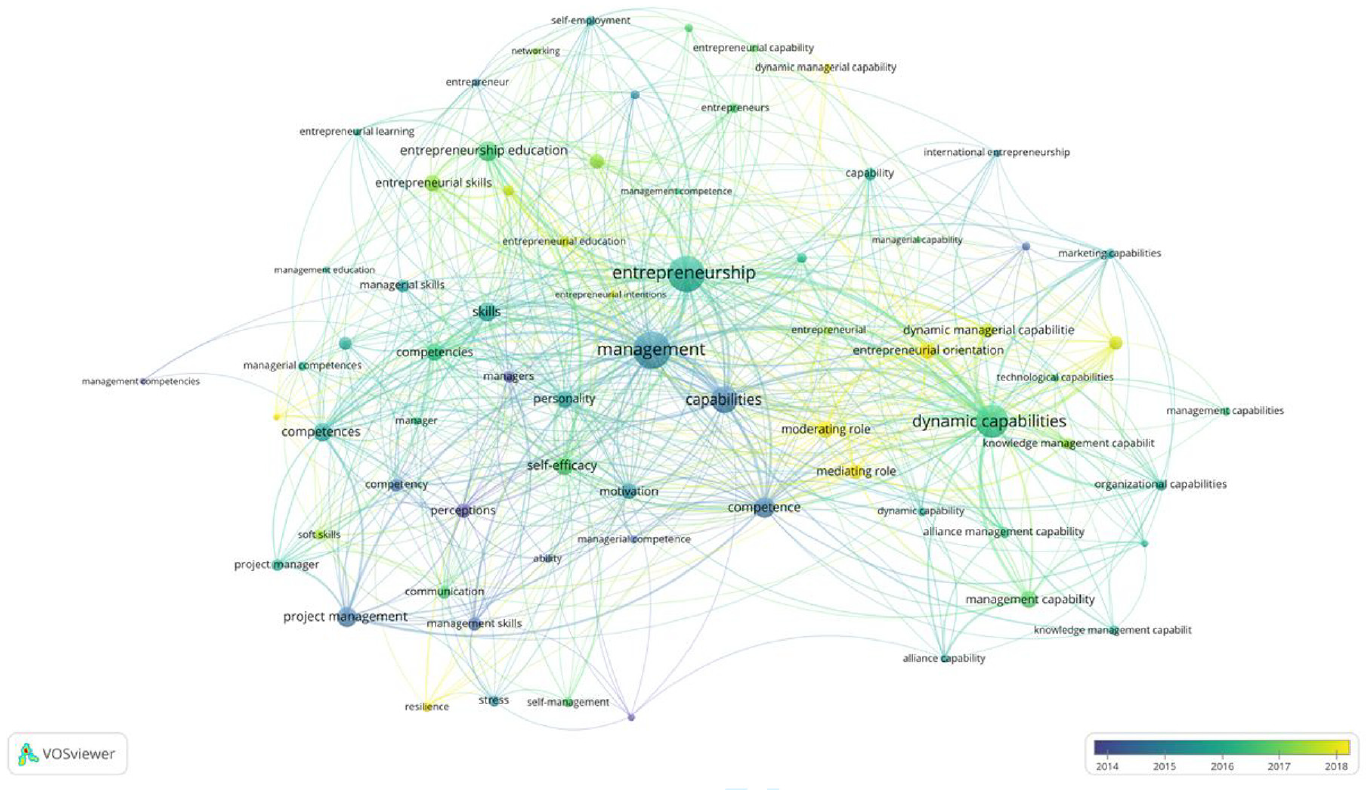
Overlay visualization by year of publication.
Analyzing the overlay map displaying the number of average publications per topic/keyword of interest (Figure 5), we argue that dynamic capabilities today represent one of the most influential topics of research for both the management and entrepreneurship domains since it can be also seen as a form of capability essential for leadership roles.

Overlay visualization per average publications.
The density map per occurrence (Figure 6) confirms the outcome mentioned above and visually represents the depth of research. The map highlights the focus areas within the domains of entrepreneurship, management, dynamic capabilities, and capabilities shift, with a noticeable yellow hue indicating scholars’ attention. Additionally, while dynamic capabilities are a distinct domain, they still maintain a connection to both fields.

Density visualization per occurrence.
By utilizing a density visualization per link (Figure 7), it becomes apparent that there is a notable co-occurrence between specific keywords. This co-occurrence is particularly evident between entrepreneurship, management, and capabilities, as it is for skills and competence, personality, self-efficacy, and motivation. Even in this visualization, dynamic capabilities represents a separate area.
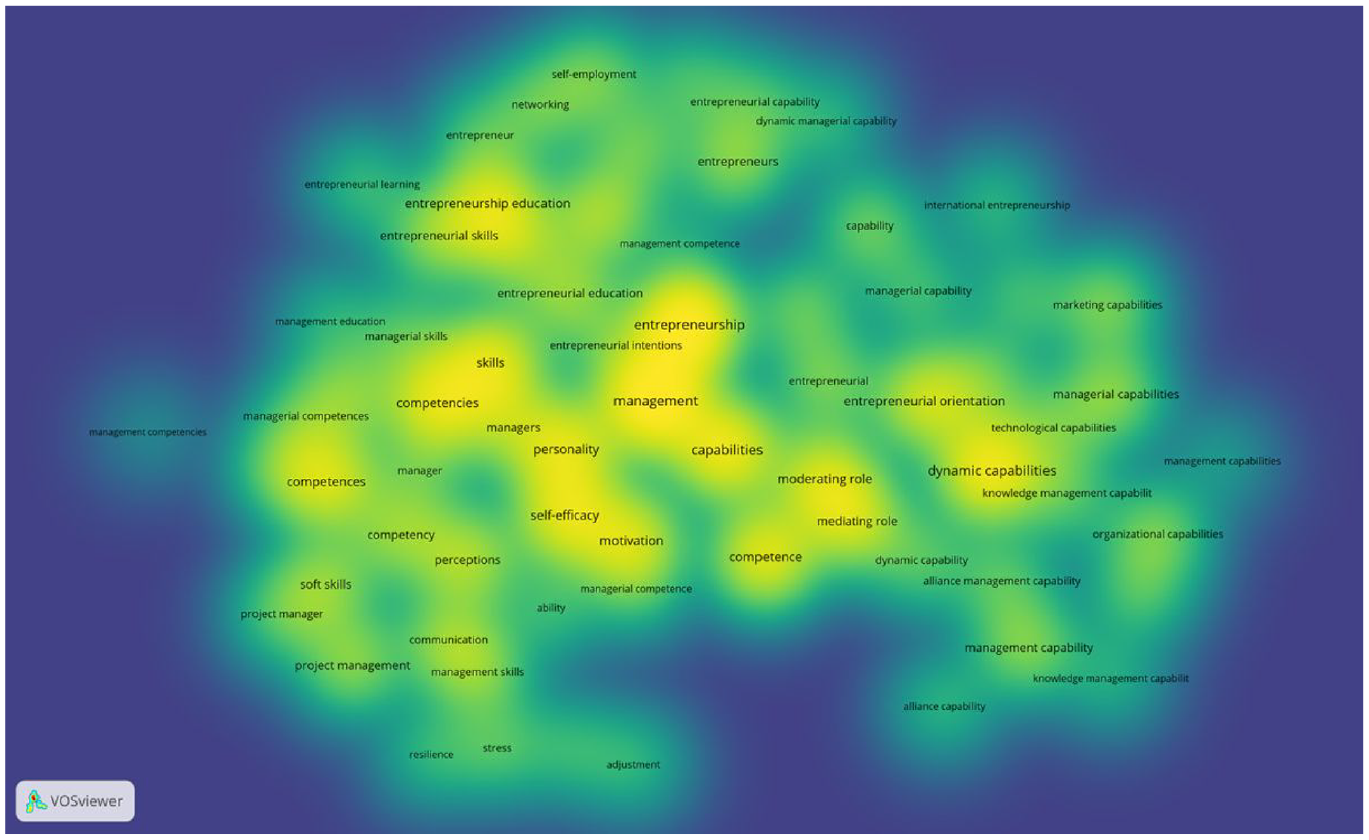
Density Visualization per link.
Conclusion
This paper provides a quantitative investigation into the terminology used in the entrepreneurship and management fields to describe entrepreneurial and managerial characteristics employed in the literature that sometimes generate confusion due to the similarity of terms such as skills, competencies, capabilities, abilities, and personality traits.
Through the bibliometric analysis performed in WoS and cluster analysis breakdown (Table 2), we were able to effectively confirm that skills, competencies, and personality traits have been used interchangeably in previous international business and entrepreneurship literature studies (Cubico et al., 2018; Etemad, 2017; Pennetta et al., 2023; Prüfer & Prüfer, 2020; Ridho & Abdullah, 2020; Shabbir et al., 2019). It was also identified that the terms capability and competency in all their forms (plural and different declensions) are mostly used in the management domain, whereas competency and skills are the most frequent terms used within the entrepreneurship field. Competency in all its declensions is also widely used in the management field, where frameworks to define different natures of competencies have been proposed (Antonacopoulou & FitzGerald, 1996; Haryono et al., 2021; Sáez-López et al., 2021; Tarigan et al., 2021).
The outcomes of our bibliometric study have allowed us to respond comprehensively to the three research questions we identified.
RQ1: Which Are the Most Used Terms to Describe and Explain Entrepreneurial and Managerial Abilities?
In response to our first research question, our analysis reveals that terms such as entrepreneurial and managerial abilities, skills, capabilities, and competencies are commonly employed in the literature. However, we observed a noteworthy trend in the emergence of a distinct set of abilities referred to as “dynamic capabilities.” These dynamic capabilities find application in both entrepreneurial and managerial contexts, likely due to the dynamic nature of contemporary business environments that demand continuous adaptability and flexibility from both entrepreneurial and managerial perspectives. This trend reflects a growing recognition of the importance of dynamic capabilities in the literature, suggesting a shift in emphasis toward agility and responsiveness in both entrepreneurial and managerial contexts. This shift underscores the evolving landscape of skills and abilities in the realms of entrepreneurship and management, possibly signaling an increasing convergence of the two disciplines. It highlights the necessity for individuals and organizations to cultivate dynamic capabilities to thrive in an ever-changing business environment.
This finding offers a significant theoretical contribution by underscoring the increasing importance of dynamic capabilities as a central concept in comprehending entrepreneurial and managerial abilities. This shift signifies a paradigmatic change in the way scholars perceive the skills and competencies needed in contemporary business contexts. It enriches the theoretical foundation by recognizing that dynamic capabilities, similar to the concept of “agility,” are vital for organizations to swiftly adapt to rapidly changing market conditions. This insight enhances academic discussions, providing a deeper understanding of the evolving landscape of skills in entrepreneurship and management. From a practical standpoint, our findings emphasize dynamic capabilities’ real-world relevance. Organizations can apply this knowledge to continuously innovate and adapt to evolving market dynamics. Our research thus offers practical guidance for businesses aiming to enhance their adaptability and responsiveness.
RQ2: How Are These Terms Connected to the Management and Entrepreneurship Domains?
For our second research question, we find that the term “competence” is more frequently associated with managerial abilities, while “capability” is predominantly used in the context of entrepreneurial abilities. Moreover, our analysis reveals that terms like “skills,” although still associated with managerial roles, are gradually giving way to the broader concepts of capabilities and competencies in both the entrepreneurship and management fields. This shift in terminology reflects evolving conceptualizations of skills and abilities within these domains, possibly reflecting a broader recognition of the multifaceted nature of entrepreneurial and managerial competencies. Furthermore, it suggests that the delineation between managerial and entrepreneurial abilities is becoming less rigid, as both fields draw from a common pool of capabilities and competencies, highlighting the interconnectedness of these disciplines in contemporary business practices.
Our study contributes to theory by shedding light on the evolving terminology within the domains of entrepreneurship and management. This evolution is akin to how the concept of “soft skills” has expanded to encompass broader competencies, challenging traditional categorizations. By blurring the boundaries between managerial and entrepreneurial abilities, our findings offer a fresh theoretical perspective. This perspective fosters a deeper understanding of the multifaceted nature of skills and competencies in the contemporary business landscape. On a practical level, our research has implications for talent management and recruitment practices. Organizations can leverage these insights to optimize their talent strategies and enhance their capacity to innovate and adapt.
RQ3: Is There a Crossover Between the Two Domains With Regard to Abilities?
Regarding our third research question, a pivotal discovery emerges in the concept of “dynamic capabilities.” This concept serves as a bridge between the entrepreneurship and management domains, facilitating the integration of both managerial and entrepreneurial capabilities. With a total of 226 occurrences and visualized as a distinct cluster connecting these domains in VoSViewer, we affirm the existence of a tangible crossover between the two domains concerning capabilities. The prevalence of dynamic capabilities as a cross-disciplinary concept underscores the necessity for scholars, educators, and practitioners in both entrepreneurship and management to recognize the mutual relevance and influence of these domains, fostering a holistic understanding of how capabilities drive success in modern business contexts.
Our research yields a substantial theoretical contribution by identifying dynamic capabilities as a bridging concept that transcends the traditional boundaries between entrepreneurship and management. This concept mirrors the interdisciplinary nature of fields like innovation management, where the integration of entrepreneurial and managerial principles is pivotal. Recognizing this synergy enriches academic discussions and frameworks, fostering a holistic understanding of how capabilities drive success in modern business contexts. It encourages scholars to explore the interconnectedness and interdependence of these domains. In practical terms, the concept of dynamic capabilities finds resonance in diverse industries. Organizations can apply this knowledge to navigate the complex dynamics of contemporary business environments by fostering a culture of dynamic capabilities. It provides practical guidance for organizations aiming to enhance their adaptability and innovation capabilities for sustained growth and competitiveness.
In conclusion, from dynamic capabilities clearly represent the new set of soft skills helpful to the organization to facilitate strategic changes and required by individuals to work in the current VUCA environment, which emerged during the pandemic (Rings & Rasinger, 2020). From an academic perspective, further research needs to be undertaken concerning the emergence of dynamic capabilities across both domains to understand whether they rank differently in importance in either field. The contribution of this research work in identifying the new trend of capabilities, “dynamic” in nature for both fields, is an essential starting point that enables firms to adapt and innovate in response to changes in the external environment. The need to investigate dynamic capabilities emerged also due to the Covid pandemic that generated changes in the global market with the rise of the VUCA environment (Rings & Rasinger, 2020; Schepers et al., 2021; Syriopoulos, 2020) where industries across the globe despite size and field needed to upskill and reskill the entire workforce (Portuguez Castro & Gómez Zermeño, 2021; Saputra et al., 2021).
Entrepreneurs’ dynamic capabilities can simply refer to their ability to explore new opportunities, but it can also incorporate innovation, risk-taking, and creativity. Those capabilities are essential for organizations because they allow them to face competition by constantly introducing new products and services or reshaping business models. From a managerial perspective, dynamic capabilities can refer to the ability to manage and renew resources over time and can include concepts such as strategic planning, resource allocation, or performance measurement. Those capabilities are also important for firms to optimize their existing resources and respond quickly to environmental changes. The importance of managerial and entrepreneurial dynamic capabilities can be seen through firm innovation because those capabilities allow firms to identify and exploit new opportunities. Dynamic capabilities benefit competitive advantage because they allow firms to quickly respond to changes and improve performance through creating value for customers and fostering organizational learning.
At the individual level, dynamic capabilities are essential for career development, personal growth, development of entrepreneurial dynamic capabilities, innovation, and resilience. Moreover, according to the Oxford Dictionary, skill, competence and capability are described as the “ability to do something well” (Oxford Dictionary, 2020). From the academic perspective, some research suggests that the term “capability” indicates the ability of individuals to use skills, while “competence” refers to the level of the capabilities used. Notwithstanding such definitions, we identified the unclear use of such terms across a broad range of literature and seek further clarity. In particular, from an academic perspective, a clear need has emerged to highlight the commonality of the use of terms across entrepreneurship and management. This should be considered when new training and courses are developed in higher education so that the abilities required are embedded in the overall content of the training or education curriculum.
The implications of this investigation in fact highlight the key role of academia in developing tailored micro-credentialing courses and degrees curricula that need to match the expectation of the upskilling and reskilling programs promoted by the government during COVID-19, for example. Universities need to contextualize specific skills in any industry sector to develop related capabilities through collaboration with industry partners. Mentoring programs delivered by industry professionals, for example, can become a significant component of the educational path promoted by universities that are also aligned with government initiatives concerning workforce ability enhancement or the acquisition of new abilities to respond to unpredicted job market changes. Therefore, it is extremely important that academia set a proper use of terminologies to provide more clarity amongst institutions with a clear path to upskill and or reskill the labor force.
Limitation
This study highlights the emergence of dynamic capabilities as a new form of capabilities that combines both entrepreneurial and managerial roles. The importance of dynamic capabilities in the field of business is undeniable, given the new characteristics that have emerged in the business landscape. However, the study has limitations in terms of its definition of dynamic capabilities, as it does not delve deeply into what these capabilities can represent for entrepreneurs and managers. Dynamic capabilities are a relatively recent concept that have gained significant attention in the field of business. They refer to the ability of organizations to adapt and respond to changes in the external environment. These capabilities involve a combination of resources, processes, and routines that enable firms to identify and seize new opportunities, while also managing and adapting to new challenges. While the study acknowledges the importance of dynamic capabilities, it falls short in terms of providing a comprehensive definition of what these capabilities entail. Specifically, the study does not delve deeply into how dynamic capabilities can be leveraged by entrepreneurs and managers to drive business success. A more in-depth exploration of dynamic capabilities could help shed light on the specific ways in which these capabilities can be developed and utilized in different contexts. For instance, future research could focus on the types of resources and processes that are needed to develop dynamic capabilities, or on the strategies that firms can use to leverage these capabilities in order to achieve sustained competitive advantage. Overall, while the study identifies dynamic capabilities as a critical area of focus for both entrepreneurs and managers, further research is needed to fully understand the nature and implications of these capabilities in the context of business success.
This study has been performed considering WoS only, as one of the most inclusive bibliometric databases. The other limitation resides in the embedded clustering algorithm of VoSViewer which cannot be customized.
Future Research Contributions
This quantitative research serves as an important starting point for further investigations into the differences between managerial and entrepreneurial abilities. The study sheds light on the overlapping capabilities and the distinctive abilities between the two roles, highlighting the need for a more nuanced understanding of these abilities.
To further investigate these differences, it would be possible to narrow the scope of the study by implementing a Critical Literature Review or Systematic Literature Review methodology. This would enable researchers to identify specific managerial, entrepreneurial, and common skills between the two roles, which could then be further analyzed and compared.
Another promising avenue for research is to contextualize these skills in the context of globalized, digitalized, and multicultural environments. With the rise of globalization and digitalization, businesses are increasingly operating in a highly diverse and interconnected environment. This presents both opportunities and challenges for entrepreneurs and managers alike, as they must navigate new cultural norms and technologies while also staying competitive in an ever-evolving market. To investigate the impact of these factors on entrepreneurial and managerial abilities, empirical investigations could be conducted. These could involve case studies of successful entrepreneurs and managers in globalized and digitalized contexts, as well as surveys or interviews with entrepreneurs and managers operating in multicultural environments.
Overall, this research lays the groundwork for further investigations into the nuances of entrepreneurial and managerial abilities. By narrowing the scope of the study and contextualizing these abilities in diverse environments, researchers can gain a more nuanced understanding of the skills and competencies needed to succeed in these roles.
Footnotes
Declaration of Conflicting Interests
The author(s) declared no potential conflicts of interest with respect to the research, authorship, and/or publication of this article.
Funding
The author(s) received no financial support for the research, authorship, and/or publication of this article.

Data Availability Statement
Data sharing not applicable to this article as no datasets were generated or analyzed during the current study.