




Abstract
Despite the changes in the tourism industry that are more oriented toward digital services, extant studies on entrepreneurship education tend to overlook the role of entrepreneurial and digital competencies in shaping the aspiration of university students in tourism and hotel management to become entrepreneurs in the era of the digital economy. Therefore, the purpose of this study is to investigate whether support from students’ closest environment, such as their parents and their education institutions through entrepreneurship education, can shape their entrepreneurial career aspirations. More specifically, this research examines whether parental attitudes toward entrepreneurship and entrepreneurship education contribute to the development of entrepreneurial and digital competencies, which in turn affect students’ entrepreneurial career aspirations. By using survey data on 442 university students majoring in tourism, retail, and hotel management in Indonesia, this study employs the Structural Equation Model (SEM) to test the direct and indirect effects of entrepreneurial and digital competencies on entrepreneurial career aspirations. Moreover, the study uses Necessary Condition Analysis (NCA) to reveal specific competencies that contribute to entrepreneurial career aspirations. Our findings indicate significant effects of entrepreneurial and digital competencies in mediating the relationship between parents’ positive attitude toward entrepreneurship and entrepreneurship education on entrepreneurial career aspirations. Entrepreneurial and digital competencies are found to be critical mediators, acting as necessary conditions for entrepreneurial career aspirations. Our findings thus highlight the important role of both entrepreneurial and digital competencies in shaping students’ entrepreneurial career aspirations and reveal the specific competencies required to shape their entrepreneurial career aspirations.
Plain Language Summary
What was the purpose of the research? The study aimed to understand how two key factors: entrepreneurship education and parental support, affect university students’ aspirations to become entrepreneurs, especially in the fields of tourism, retail, and hotel management. In today’s digital economy, both entrepreneurial and digital skills are crucial for success. The researchers explored whether parental attitudes toward entrepreneurship and the education students receive help shape these important skills and their future career goals. What actions did the researchers take? The researchers surveyed 442 university students in Indonesia studying tourism, retail, and hospitality management. They used advanced statistical methods, including Structural Equation Modelling (SEM) and Necessary Condition Analysis (NCA), to examine how parental support and entrepreneurship education influence the development of students’ entrepreneurial and digital skills, and how these skills affect their career aspirations. What discoveries did the researchers make? The study found that entrepreneurial and digital skills play a significant role in shaping students’ aspirations to become entrepreneurs. Parental support and entrepreneurship education contribute to the development of these skills, which act as key links between students’ career goals and their environment. What are the implications of the results? The findings highlight the importance of both family support and targeted education in developing the skills necessary for success in entrepreneurship. To pursue entrepreneurial careers, students need not only encouragement from their parents but also education that equips them with vital digital and entrepreneurial competencies, especially in industries like tourism, retail, and hospitality.
Keywords
Introduction
Entrepreneurial career aspirations is an important research topic to uncover the process that explains how young people choose and develop their careers. This topic has become more prominent as the data from the Global University Entrepreneurial Spirit Students’ Survey (Guess), which surveyed students in 57 countries, showed that about 30% of students consider pursuing an entrepreneurial career 5 years after their graduation (Sieger et al., 2023). The number is even higher in Indonesia, where 44.26% of university students in the survey said that they were interested in becoming founders of their own businesses right after graduation. The number rose to 62.22% when they were asked about what they wanted to be in 5 years after graduation (Suhartanto, 2023).
Prior studies on entrepreneurial career aspirations were mostly conducted on higher education students under the term entrepreneurial intention (Maheshwari et al., 2021), career path intention (Cieślik & van Stel, 2017), or career intention (Gorgievski et al., 2018; M. Liu et al., 2023). These studies look at students’ short and long-term intention to become entrepreneurs and both the personal and contextual factors that shape the intention. A large number of these studies reveal the role of entrepreneurship education (EE) in developing entrepreneurial knowledge and stimulating skills which later contribute to students’ entrepreneurial aspirations (Maheshwari et al., 2023). Nonetheless, the effects of EE were found to be varied among students and certain disciplines were less represented in the existing studies. For example, there was a significant difference between business students versus science and engineering students. Moreover, there was a lack of studies that were aimed at tourism and hotel management students (Horng et al., 2020Zhang & Chen, 2024).
A study on the relationship between EE and entrepreneurial career aspirations (ECA) among tourism and hotel management students thus becomes even more important, given that entrepreneurship-related subjects are increasingly being incorporated into the curriculum of higher education institutions. Historically, the curriculum was designed as a combination of vocational disciplines (e.g., hotel and restaurant operations, principles of tourism development) and business management modules; to prepare students to work in the hospitality industry (Arranz et al., 2017). However, with the nature of the tourism sector that is predominated by small and medium enterprises (SMEs), and with the changes in the tourism industry that are more oriented toward digital services (Pencarelli, 2020), little is known about the situational factors that may shape entrepreneurial career aspirations of tourism and hotel management students in the era of digital economy. More specifically, little is known whether support from students’ closest environment, such as their parents in terms of their attitudinal support and the university through entrepreneurship education, can equip them with the entrepreneurial and digital competencies that are needed to start their entrepreneurial career in the digital economy.
In addition to this first gap, prior studies that look at the effect of entrepreneurship education tend to neglect the effect of entrepreneurship education on individuals’ competencies to exploit digital technology (e.g., Ferreras-Garcia et al., 2021; González-López et al., 2021). These studies tend to emphasize the effect of entrepreneurship education on certain entrepreneurial competencies in starting a new venture, such as in decision-making, working with uncertainty, creativity, and preparing business plans, thus have overlooked at knowledge and skills needed to exploit digital technologies (Bachmann et al., 2024; Sitaridis & Kitsios, 2024. Digital competencies are a set of knowledge, skills, and attitudes, that enable individuals to effectively navigate, understand, and utilize digital technologies (Ferrari et al., 2013). A better understanding of the role of digital competencies thus becoming essential given that some recent studies have revealed the role of digital technology in enabling the processes and outcomes of entrepreneurship (Chalmers et al., 2021; von Briel et al., 2018), as well as in changing value creation and value capture within the industry (Lorenz et al., 2024). These studies provide insights for aspiring entrepreneurs that mastering digital technology has become necessary for venture creation and growth, which may contribute to future entrepreneurial careers (Bachmann et al., 2024).
To address this research gap, we therefore aim to reveal the situational factors that affect students’ entrepreneurial and digital competencies and how the two competencies may explain their entrepreneurial career aspirations. More specifically, our first aim is to reveal the effect of parents’ attitudes toward entrepreneurship and entrepreneurship education on hotel and tourism management students’ entrepreneurial career aspirations. Second, we aim to investigate whether parental attitudes toward entrepreneurship and entrepreneurship education contribute to developing entrepreneurial and digital competencies, affecting students’ entrepreneurial career aspirations. To achieve these objectives, we developed a model that explains entrepreneurial career aspirations due to students’ competencies in entrepreneurship and digital technology derived from EE and their parents’ positive attitudes toward entrepreneurship. We tested the model by using a sample of 442 students in tourism, retail, and hotel management in Indonesia. The results of our study signify the important role of entrepreneurial and digital competencies in bridging parental and education support in shaping entrepreneurial career aspirations for students in retail, tourism, and hotel management.
Literature Review and Hypothesis Development
Entrepreneurial Career Aspirations and Parents’ Attitude Toward Entrepreneurship
Parents’ positive attitudes toward entrepreneurship may impact their children’s entrepreneurial career aspirations through several mechanisms. First, the social cognitive theory (Bandura, 1986; Malhotra & Kiran, 2024) suggests that children learn behaviors, attitudes, and values by observing and imitating their parents. When parents display positive attitudes toward entrepreneurship, such as valuing innovation and risk-taking, these attitudes maybe internalized by their children which later shape their entrepreneurial aspirations. Moreover, when parents hold positive views on entrepreneurship and support entrepreneurial endeavors, they can increase their children’s interest and self-efficacy in pursuing entrepreneurial careers.
Second, the Theory of Planned Behavior (Ajzen, 1991) highlights the role of subjective norms or beliefs about whether important others, like parents, approve or disapprove of certain intentional behaviors. When parents show a positive attitude toward entrepreneurship, children may not only develop a favorable attitude toward entrepreneurial careers, but they also may feel that they have the support and approval which enhance their perceived behavioral control and confidence in their competence to succeed in entrepreneurial careers (Muigai et al., 2022). Prior research supports this view, demonstrating that parental background affects career decisions in entrepreneurship (Palmer et al., 2021). When parents hold favorable views toward entrepreneurship, they foster a sense of legitimacy and encouragement, increasing the likelihood that their children will aspire to entrepreneurial careers.
More specifically, on students whose parents are entrepreneurs, parents can serve as role models that inspire and motivate children to choose an entrepreneurial career. Several mechanisms explain the transmission of entrepreneurial careers within the family: (1) through genetic transmission from parents to children. (2) Through parental support, where parents use financial and non-financial resources to support their children (3) Through the process of socialization, where parents transmit values, knowledge, and skills (Laspita et al., 2012). Therefore, based on these theoretical insights, we hypothesize:
H1: Parents’ positive attitude toward entrepreneurship (PA) has a positive and significant effect toward Entrepreneurial Career Aspirations (ECA).
Entrepreneurial Career Aspirations and Entrepreneurship Education
Entrepreneurship education is the learning experience in formal schools, informal training and other types of experiences to learn entrepreneurial knowledge, attitudes, and skills (Bae et al., 2014). It is different from business education, as it is aimed at increasing awareness of entrepreneurship as a career path through the founding of a business organization, while business education is to prepare students to work in more established ventures (Bae et al., 2014; Hahn et al., 2020).
Entrepreneurship education in higher education has made significant contributions to students in creating entrepreneurial skills by providing a platform for students to learn to identify, understand, and act on new business opportunities (Hahn et al., 2020; Pham & Nugroho, 2022). Students who attend entrepreneurship courses will gain a more realistic perspective on what is required, increasing their confidence in entrepreneurial skills and supporting their ability to create and establish new businesses. Some empirical studies (Khalil et al., 2024; Nabi et al., 2018) have shown the role of EE in developing entrepreneurial knowledge and stimulating skills which later contribute to students’ aspirations in entrepreneurship (Maheshwari, 2021). Therefore, we propose the following hypothesis:
H2: Entrepreneurship Education (EE) positively and significantly affects Entrepreneurial Career Aspirations (ECA).
Parents’ Attitude Toward Entrepreneurship and Its Effects on Entrepreneurial and Digital Competencies
A family environment that values entrepreneurship may encourage children to adopt entrepreneurial mindsets and practice their entrepreneurial skills. Parents with a positive attitude toward entrepreneurship often foster an environment that nurtures entrepreneurial competencies in children, such as opportunity recognition, creativity, and resilience (Powell & Eddleston, 2013). Children may feel that their parents support them to initiate entrepreneurial activities, motivating them to develop entrepreneurial and digital skills needed to start a digital business through learning by doing. Parents’ positive attitude toward entrepreneurial career will also be more likely to help their children to cover financial requirements and support their learning and emotional journey of initiating entrepreneurial activities when they can exercise their knowledge and skills, such as in calculating risk, negotiation, leading a team, utilizing digital commerce technology, and social media for promotion (Maziriri et al., 2024; Saoula et al., 2023).
Parents with favorable views toward entrepreneurship are more likely to provide experiences and support that foster relevant competencies for their children (Maziriri et al., 2024). In addition, parents who promote digital engagement create environments that enhance children’s digital literacy (Ika Sari et al., 2024; Wang et al., 2024). Parents’ positive attitudes toward entrepreneurship may shape their children’s entrepreneurial and digital competencies by adopting mindset, support, and encouragement to learn the knowledge and skills needed to create and develop either conventional or digital businesses. Following Bachmann et al. (2024), we define digital competencies as knowledge, skills, abilities, and personal attributes that empower individuals to perform job-related tasks securely and responsibly using digital tools. These competencies encompass data and information management, digital communication and collaboration, and technology-enabled problem-solving. In summary, parents’ positive attitudes toward entrepreneurship may shape their children’s entrepreneurial and digital competencies through the adoption of mindset, support, and encouragement to learn the knowledge and skills needed to create and develop either conventional or digital businesses. Consequently, we hypothesize the following:
H3: Parents’ positive attitude toward entrepreneurship (PA) positively and significantly affects Entrepreneurial Competencies (EC).
H4: Parents’ positive attitude toward entrepreneurship (PA) positively and significantly affects Digital Competencies (DC).
Entrepreneurship Education and Its Effects on Entrepreneurial and Digital Competencies
Entrepreneurship education aims to prepare students for entrepreneurial practice and develop entrepreneurial competencies (Tittel & Terzidis, 2020). Through EE, students can gain entrepreneurial competencies that consist of (1) Knowledge in opportunities recognition, problem-solving, and risk management; (2) Skills, such as communication, interaction, and conflict resolution; (3) Attitudes, such as growth mindset and perseverance (Tittel & Terzidis, 2020).
In addition to entrepreneurial competencies, entrepreneurship education may equip students with digital competencies relevant to supporting entrepreneurial activities. In today’s digital economy, students who attend entrepreneurship courses will learn how to identify and exploit entrepreneurial opportunities both in the real and virtual worlds (Singh et al., 2024). Students will also learn how to utilize digital marketing, data analysis, and e-commerce strategies to promote and market products that they create (Secundo et al., 2020). Moreover, given the digitalization of entrepreneurship, EE programs often integrate technology-based tools and platforms, enhancing learners’ digital skills (Ghauri et al., 2022; Paul et al., 2023). These competencies are essential in navigating today’s tech-driven entrepreneurial landscape. Acquiring EE in higher education settings thus will equip tourism, retail and hotel management students with both entrepreneurial and digital competencies. We, therefore, hypothesize that:
H5: Entrepreneurship Education (EE) has a positive and significant effect on Entrepreneurial Competencies (EC).
H6: Entrepreneurship Education (EE) positively and significantly affects Digital Competencies (DC).
Entrepreneurial and Digital Competencies and Their Effects on Entrepreneurial Career Aspirations
Entrepreneurial competencies refer to the set of skills, behaviors, and attitudes that enable individuals to identify opportunities, innovate, and manage risks within a business context. These competencies include problem-solving, creativity, leadership, adaptability, and strategic thinking (Mitchelmore & Rowley, 2010). Their work provides conceptual and empirical insights, illustrating that equipping learners with a balanced set of competencies is essential for fostering entrepreneurial intentions and capabilities. Extant studies have shown that individuals with high levels of entrepreneurial competencies are more likely to view entrepreneurship as a viable career option, as these skills provide them with the confidence to navigate the complexities of starting and running a business (Bauman & Lucy, 2021; Mack et al., 2024; Somià et al., 2024). Entrepreneurial competencies empower individuals to overcome barriers to entrepreneurship, such as fear of failure or uncertainty about the business environment. For example, those who are strong in risk management and adaptability are better equipped to handle the uncertainties that come with starting a new venture.
In addition to the general entrepreneurial competencies, as the business world becomes increasingly digital, digital competencies are emerging as critical components of entrepreneurial success. Entrepreneurs need these skills to leverage the internet and digital platforms for innovation, customer outreach, and market expansion. Furthermore, digital competencies are essential for scalability and global reach. Entrepreneurs with digital marketing skills can reach wider audiences through online platforms, while data-driven decision-making allows for more efficient and effective business strategies. As a result, digital competencies are increasingly linked to entrepreneurial success and aspirations in the modern economy (Singh et al., 2024). Therefore, we propose the following hypothesis:
H7: Entrepreneurial Competencies (EC) will positively and significantly affect Entrepreneurial Career Aspirations.
H8: Digital Competencies (DC) will positively and significantly affect Entrepreneurial Career Aspirations (ECA).
The Mediating Role of Entrepreneurial and Digital Competencies on the Relationship Between Parents’ Positive Attitude Toward Entrepreneurship and Entrepreneurial Career Aspirations
Parents’ positive attitudes toward entrepreneurship may shape their children’s entrepreneurial career aspirations. Parents provide a motivating atmosphere for their children to identify and seize market opportunities. Referring to the Theory of Planned Behavior (TPB) which explains that an individual’s behavioral intentions is shaped by attitude, subjective norms, and perceived behavioral control (Kautonen et al., 2015), if individuals have a positive attitude toward the behavior, perceived social support for it, and believe they have control over it, they are more likely to form a strong intention to engage in the behavior. This implies that parents’ positive attitudes toward entrepreneurship can affect their children’s attitudes toward entrepreneurship as a viable career option. Children can follow their parents; becoming more likely to develop a positive attitude toward entrepreneurship. In addition, if parents also provide support for their children to engage in entrepreneurship, the support may affect children’s perceptions of social norms regarding exploiting business opportunities, making them believe that choosing this path of career is acceptable.
Parents’ supportive and encouraging stance toward entrepreneurship may motivate children to develop entrepreneurial and digital competencies. Children may feel that their parents support them to learn the knowledge and skills needed to create new ventures in the digital economy. Children may feel that their parents approve their entrepreneurial endeavors, thus motivating them to learn the knowledge and skills needed to support their future career goals. As children acquire these competencies, they gain confidence and perceived behavioral control over entrepreneurial endeavors. A study by Liñán and Chen (2009) and Vamvaka et al. (2020) supports the TPB framework, showing that perceived behavioral control and attitudes significantly predict entrepreneurial intentions. This implies that competencies can mediate the relationship between parental attitudes and entrepreneurial aspirations by enhancing positive attitudes, shaping norms, and perceived control over behavior. Therefore, we predict that:
H9a: Entrepreneurial Competencies (DC) will have a positive and significant mediating effect on the relationships between Parents’ positive Attitude toward entrepreneurship (PA) on Entrepreneurial Career Aspirations (ECA).
H9b: Digital Competencies (DC) will have a positive and significant mediating effect on the relationships between Parents’ positive Attitude toward entrepreneurship (PA) on Entrepreneurial Career Aspirations (ECA).
The Mediating Role of Entrepreneurial and Digital Competencies on the Relationship Between Entrepreneurship Education and Entrepreneurial Career Aspirations
Entrepreneurship education in higher education can enhance individuals’ ability in entrepreneurship by equipping students with the necessary knowledge, skills, and attitude to create new ventures in the digitally-driven market (Gretzel et al., 2015; Horng et al., 2020; Nam et al., 2021). When students feel that they have the competence in entrepreneurship after joining EE class, students will be more likely to consider entrepreneurship as their career (Sánchez, 2013).
According to Social Cognitive Theory (SCT), self-efficacy beliefs are central to human agency, as it affects motivation, thought processes, emotional reactions, and the behavior of individuals (Malhotra & Kiran, 2024). Within the entrepreneurial context, education and trainings may affect entrepreneurial self-efficacy or how confident individuals are in their ability to initiate, manage, and succeed in entrepreneurial endeavors (Newman et al., 2019). Recent empirical evidence for this relationship can be found in Singh et al. (2024) and Otache (2025), which reveals the positive effect of digital entrepreneurship training on entrepreneurial aspirations as it equips individuals with the necessary digital skills to start and run digital ventures. Hence, we predict that:
H10a: Entrepreneurial Competencies (EC) will have a positive and significant mediating effect on the relationships between Entrepreneurship Education (EE) on Entrepreneurial Career Aspirations.
H10b: Digital Competencies (EC) will have a positive and significant mediating effect on the relationships between Entrepreneurship Education (EE) on Entrepreneurial Career Aspirations.
Figure 1 shows our proposed theoretical framework. We developed the model and hypotheses based on the insights from both SCT and TPB. SCT explains how people learn and develop behaviors through the dynamic interaction of personal and environmental factors. In this framework, entrepreneurial and digital competencies represent the personal factors that enhance individuals’ confidence in their ability to engage in entrepreneurial activities. Parental attitudes and entrepreneurship education serve as environmental influences that contribute to the learning process where individuals learn based on exposure to role models and structured learning in entrepreneurship, which later affects their career aspirations. Similarly, the Theory of Planned Behavior (TPB) provides us with insights into how entrepreneurship education and digital competencies may contribute to shaping students’ attitudes toward entrepreneurship, affecting the way they see entrepreneurship as a viable career option. In addition, parents’ positive attitudes toward entrepreneurship plays a key role on subjective norms, which make their children more likely to perceive social approval for engaging in entrepreneurial behavior, thus strengthening their career aspirations in entrepreneurship (Ajzen, 2011; Duong et al., 2024).

Research framework.
Research Methods
Sample and Data Collection
This study takes a quantitative approach; using survey data that was targeting on university students in Indonesia majoring in tourism, retail, and hotel management who have completed entrepreneurship subject. The survey was conducted from June to August 2024, after we received approval regarding the ethical aspects of the survey protocol. Overall, a total of 442 questionnaires were used for data analysis as they were matched with our criteria.
Table 1 presents the demographic profile of our respondents. The majority (76.02%) of our respondents were females, while in terms of economic status, almost half of them (48.2%) identify themselves as coming from middle-income families. Based on the geographic distribution, respondents living in the province of East Java contribute to 25.57% of the total (n = 113), followed by respondents from West Java 19.68% (n = 87), Jakarta 15.84% (n = 70), Central Java 8.14% (n = 36), South Sulawesi 7.47% (n = 33), Banten 6.11% (n = 27), and North Sumatera 4.30% (n = 19).
Respondent Profiles.

Measurement and Analysis Method
Our questionnaire consisted of several sections: from the screening section, demographic information of respondents, and questions regarding the dependent, independent, and mediating variables. The response options on the items used to measure all variables were on a seven-point Likert-type scale, where 1 = strongly disagree to 7 = strongly agree. Table 3 displays the complete items we used to measure variables in our model. The dependent variable (entrepreneurial career aspirations/ECA) comprises three measurement scales translated from (Lechner et al., 2018). The independent variable (parents’ attitude toward entrepreneurship, PA) consisted of four measurement scales translated by X. Liu and Zhao (2021). For the second independent variable (entrepreneurship education/ EE), we used a measure from Saptono et al. (2020). This is a measure that was specifically developed to assess entrepreneurship education in Indonesia. Lastly, our first mediating variable (entrepreneurial competencies/EC) is a construct that defines the knowledge, skill, and attitude toward entrepreneurship. We used measurement scales from previous studies by Bolzani and Luppi (2021) and Morris et al. (2013). For the second mediating variable, we translated the measure for digital competencies from Vuorikari et al. (2016). Table 3 shows the complete list of items from each indicators that were used in our analysis.
Our study aims to reveal the situational factors that affect students’ entrepreneurial and digital competencies and how the two competencies may explain their entrepreneurial career aspirations. To achieve this aim, we employ structural equation modeling (SEM), as it allowed us to test the strength and significance of direct, indirect, and mediating effects of our variables on entrepreneurial career aspirations. We implemented Partial Least Squares Structural Equation Modeling (PLS-SEM) analysis with Smart-PLS 4.1 to investigate direct and indirect relationships in our theoretical model. PLS-SEM is considered a “causal-predictive approach to SEM” since this study investigates multiple predictors (Hair et al., 2019). This approach anticipates the parameters by optimizing the explained variance of the indicators (Hair et al., 2019). In the process of bootstrapping, a 5000-subsample method was employed, and the presumption of a normal sampling distribution is not mandatory in PLS-SEM (Hair et al., 2019). This approach has been used in several research studies concerning the hotel and tourist industries (Müller et al., 2018).
However, despite its ability to assess whether entrepreneurial and digital competencies act as true mediators, PLS-SEM only measures sufficiency. This means that the analysis only measures whether the level of entrepreneurship education or positive parental attitudes affect the aspirations but does not necessarily mean they are required. Therefore, to complement SEM, we employed Necessary Condition Analysis (NCA) to identify non-compensatory conditions and competencies that are necessary but not sufficient for achieving entrepreneurial career aspirations (Dul et al., 2023). NCA complements this method by clarifying whether entrepreneurial and digital competencies are necessary conditions for students to aspire to an entrepreneurial career. Thus, using both methods strengthens the rigor of our analysis, ensuring that we can capture not only how much these factors contribute by using SEM, but also whether they are indispensable for fostering entrepreneurial career aspirations by using NCA (Richter et al., 2020).
We ran both SEM and NCA on SmartPLS 4.1. This latest version of Smart PLS includes built-in NCA functionality, which makes it possible to conduct both Partial Least Squares Structural Equation Modeling (PLS-SEM) and NCA in our dataset in the same software. We follow the guidelines by Richter et al. (2020) and Ringle et al. (2024) for the analytical procedure. Firstly, data was prepared to ensure our dataset was properly cleaned and structured. Secondly, we specified the measurement and structural model in Model Specification stage. Thirdly, we let the software calculate ceiling lines on the dependent variable in the Calibration and Data Analysis stage. In this stage, the software calculates ceiling lines (i.e., boundaries) to determine whether our independent variables impose a necessary constraint on the dependent variable. The main algorithms used in NCA include Ceiling Envelopment-Free Disposal Hull (CE-FDH) and Ceiling Regression-Free Disposal Hull (CR-FDH). The software calculates whether entrepreneurship education and parents’ attitudes set an upper limit for entrepreneurial career aspirations. The Ceiling Line in NCA can show if a low level of a predictor prevents a high outcome. Fourthly, we examine the effect size (d) and its significance which was computed to quantify the necessity effect of the independent variables. A larger d-value indicates a stronger necessity relationship.
Data Analysis and Results
Assessment Common Method Bias and Multicollinearity
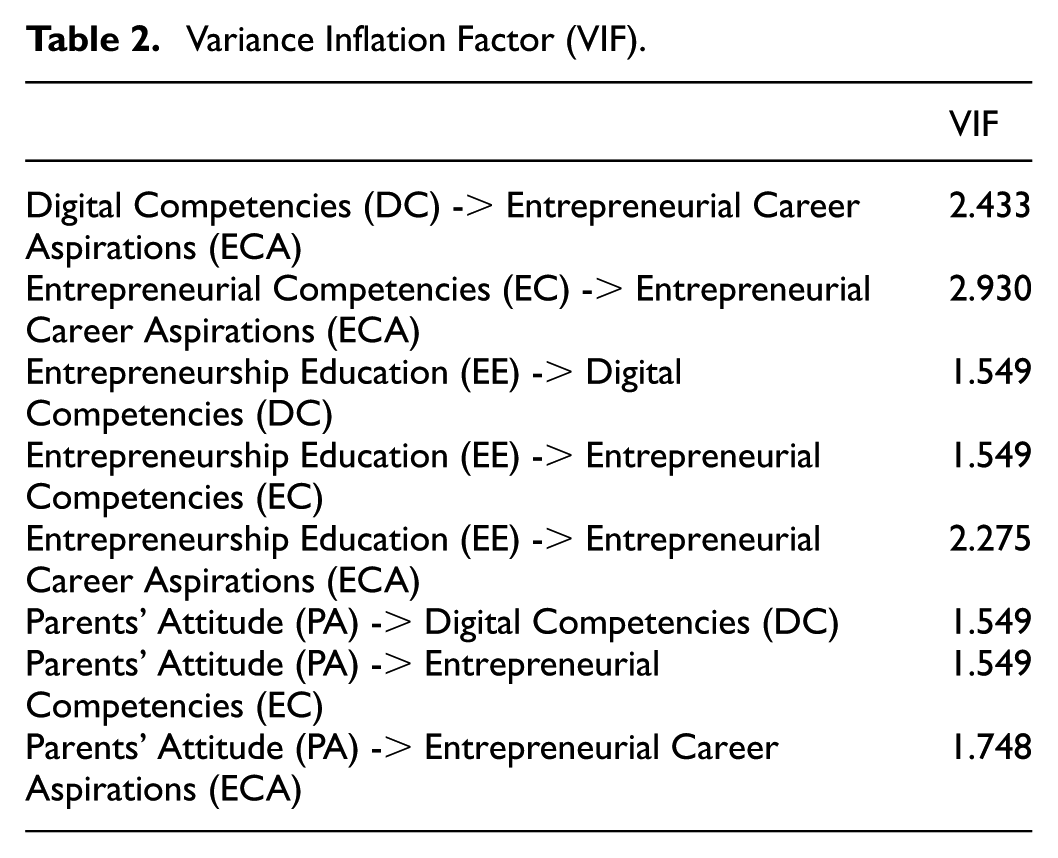
Because the self-reported data from survey might have been sensitive to common method bias, we assessed for common method bias by using Harman’s Single-Factor Test and full collinearity assessment approach (Kock, 2015). Harman’s Single-Factor Test is a statistical technique used to detect Common Method Bias (CMB) in survey-based research by examining whether a single factor accounts for most variance in the dataset. If one factor explains more than 50% of the total variance, it suggests that CMB may be present (Podsakoff et al., 2003). As shown in Appendix 1, the results of our analysis showed that the first factor accounted for 43.504% of the total variance, which is below the critical threshold of 50%. This indicates that no single factor dominates the variance, suggesting that CMB is unlikely to significantly affect our findings (Podsakoff et al., 2003). We further examined the Variance Inflation Factor (VIF) for all independent variables to assess potential multicollinearity issues. A VIF value below 5 is considered acceptable (Hair et al., 2022) and referring to Kock (2015), a Variance Inflation Factor (VIF) resulting from a full collinearity test exceeding 3.3 is a potential sign of Common Method Bias (CMB). As shown in Table 2, the VIF values ranged from 1.549 to 2.930, all below the critical threshold of 5. Our results indicate that our model is free from common method bias and multicollinearity issues.
Variance Inflation Factor (VIF).
Measurement Model
The evaluation of convergent validity included three criteria put forward by Fornell and Larcker (1981). In order to ascertain the correlation coefficients between the constructs, we implemented factor loading. The loading values of the majority of items were either greater than 0.70 or fell within the range of 0.715 (EC11) to 0.879 (ECA2). However, several items, EC8, EC13, EC14, DC5, DC6, DC8, and DC9, were removed because the loading weights were below the threshold (Hair et al., 2019). Similarly, we observed that the composite reliability (CR) values were either higher than the recommended values (0.70) or ranged from 0.873 (ECA) to 0.945 (EC; refer to Table 3). To further assess and identify the elements, we calculated the average variance extracted (AVE) values. The results showed that the AVE construct values were all within the range of 0.610 to 0.696, which exceed the threshold of 0.50 (Hair et al., 2019). Lastly, we assessed the internal consistency of the elements using Cronbach’s alpha reliability. We found that Cronbach’s alpha values varied from .780 (for ECA) to .936 (EC). This indicates that all factors were reliable (>0.70).
Measurement Model.

Next, the methodology proposed by Fornell and Larcker (1981) was employed to evaluate discriminant validity. They recommend that the average variance retrieved for each construct should have a square root that is greater than its relationship with any other constructs. The results as shown in Table 4 were in accordance with the criteria that were previously described, indicating that the structures in the model showed a substantial discriminant capability.
Discriminant Validity.
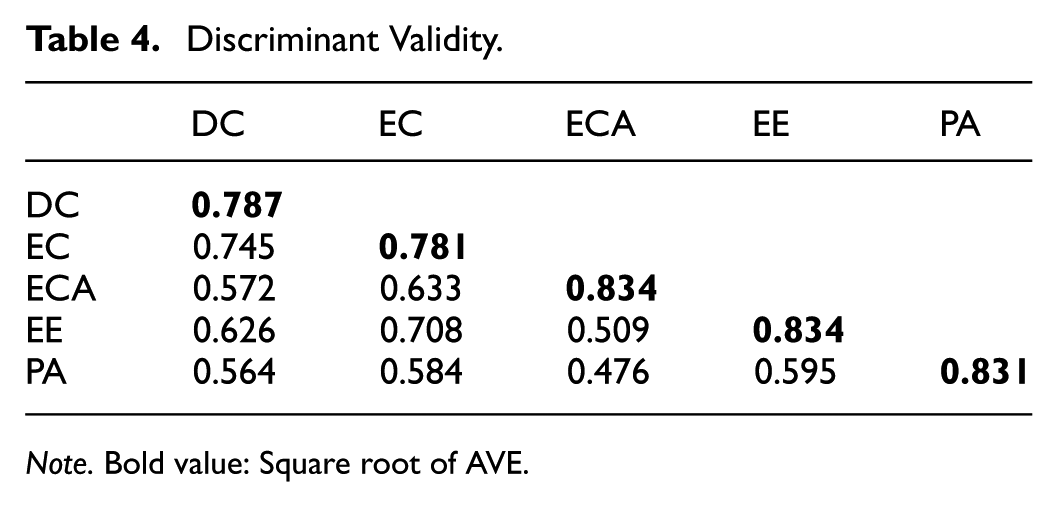
Note. Bold value: Square root of AVE.
The results in Table 5 showed that the square root of the AVE value of PA as the latent variable was 0.831. Compared to the correlation values of other variables, the values were lower, with .595 for EE, .584 for EC, .564 for DC, and .476 for ECA. The numbers indicate that PA, as the latent variable, had stronger internal consistency than its relationships with the other variables. Other latent variables (EE, EC, DC, and ECA) exhibited a correlation value that was less than the square root of the AVE value for their respective latent variables. This implies that the constructs could be classified as valid.
Correlations Between Variables.

To further examine discriminant validity, Table 6 presents the HTMT result, showing that all inter-construct correlations remain below the conservative 0.85 threshold, except for the relationship between Entrepreneurial Competencies (EC) and Digital Competencies (DC), which has an HTMT value of 0.836. The HTMT values were assessed against the commonly recommended threshold of 0.85, with a more relaxed threshold of 0.90 sometimes considered acceptable in specific contexts. The value of 0.836 was close to the cut-off but still within an acceptable range. The remaining construct pairs exhibit values between 0.581 and 0.790, further supporting discriminant validity. Additionally, the confidence intervals (2.5% and 97.5%) do not exceed 1.00 for any construct pairs, reinforcing that constructs are empirically distinct (Henseler et al., 2015). Given these results, our model demonstrates adequate discriminant validity, minimizing concerns of multicollinearity or construct overlap.
HTMT (Heterotrait-Monotrait Ratio of Correlations).

The cross-loading results in Table 7 demonstrate strong evidence of discriminant validity, as each indicator loads highest on its respective construct compared to all other constructs. with values all exceeding 0.70, a commonly accepted threshold for indicator reliability (Cheung et al., 2024). Such a loading structure satisfies a key criterion for discriminant validity in PLS-SEM (Henseler et al., 2015). This supports the integrity and reliability of the measurement model, aligning with methodological standards emphasized by Hair et al. (2019), where high item loadings on intended constructs and lower loadings elsewhere confirm construct distinctiveness.
Cross-Loading.

To evaluate the predictive relevance of a model, we examined The Q2 (Stone-Geisser’s Q-square) values. As shown in Table 8, the model shows great predictive significance for the endogenous components as all Q2 values in this table are somewhat above 0, ranging from 0.291 to 0.535. Q2 measures predictive relevance in PLS-SEM, assessing model accuracy in predicting missing data points during blindfolding. If the Q2 value is larger than zero, the model is predictive and can successfully recreate observed values. This shows that structural routes and measurement indicators accurately predict model endogenous components (Hair et al., 2019). The model explaining Entrepreneurial Competence (EC) performs the best, explaining approximately 54% of its variance. Meanwhile, models for Entrepreneurial Career Aspiration (ECA) and Digital Competence (DC) explain around 43% to 45%, which is still moderately strong in social science research.
Q2predict and R2.

Structural Equation Modeling Results
SEM path analysis was performed to evaluate the proposed hypotheses. The results provided partial support for Hypothesis 1 and Hypothesis 2. As Table 9 shows, Parents’ Attitude (PA) had a positive but not significant direct effect on entrepreneurial career aspirations (ECA; ß = 0.114, p > .05). Similar to the parents’ attitude (PA), entrepreneurship education (EE) had a positive but insignificant direct effect on entrepreneurial career aspirations (ECA; ß = 0.044, p > .05). Thus, Hypotheses 1 and Hypothesis 2 were rejected. Hypotheses 3-6 were examined by investigating the path coefficient between “parents’ attitude and entrepreneurial competencies” (H3; ß = 0.252, p < .05), “parents attitude and digital competencies” (H4; ß = 0.297, p < .05), “entrepreneurship education and entrepreneurial competencies” (H5; ß = 0.558, p < .05) and “entrepreneurship education and digital competencies” (H6; ß = 0.558, p < .05). Hypotheses 7 and Hypothesis 8 were examined by investigating the path coefficient between “entrepreneurial competencies and entrepreneurial career aspirations” (H7; ß = 0.400, p < .05) and “digital competencies and entrepreneurial career aspirations” (H8; ß = 0.183, p < .05). Based on these results, Hypotheses 3, 4, 5, 6, 7, and Hypothesis 8 were all accepted (Figure 2).
Direct Effects.


Structural equation model.
Meanwhile, as Table 10 illustrates, Parents’ Attitude (PA) had significant indirect effects on Entrepreneurial Career aspirations (ECA) through Entrepreneurial Competencies (EC; β = .101, p < .05). Parents Attitude toward entrepreneurship (PA) also had significant indirect effects on Entrepreneurial Career aspirations (ECA) through Digital Competencies (DC; β = .054, p < .05). Therefore, Hypothesis 9a and Hypothesis 9b were accepted. Table 10 also shows that Entrepreneurship Education (EE) had significant indirect effects on Entrepreneurial Career aspirations (ECA) through Entrepreneurial Competencies (EC; β = .223, p < .05). Entrepreneurship Education (EE) also had significant indirect effects on Entrepreneurial Career aspirations (ECA) through Digital Competencies (DC; β = .082, p < .05). Therefore, Hypothesis 10a and Hypothesis 10b were accepted. In summary, our results indicate that PA and EE displayed a positive but insignificant direct effect on entrepreneurial career aspirations (ECA). However, the results also indicate that both entrepreneurial and digital competencies could mediate these relationships, thus signifying the role of entrepreneurial and digital competencies as a full mediating variable in the relationship between PA and EE on ECA.
Indirect Effects.

Necessary Condition Analysis
In order to determine whether entrepreneurial competencies (EC) and digital competencies (DC) are essential and necessary for shaping entrepreneurial career aspirations, we performed necessary condition analyses. We used continuous linear ceiling envelopment and ceiling regression techniques with free disposal hull (CE-FDH and CR-FDH, respectively; Dul et al., 2023; Linder et al., 2023). This approach enables us to assess whether high levels of EC and DC are necessary conditions for high entrepreneurial career aspirations. Table 11 presents the estimated effect sizes and corresponding p-values. We observed small and significant effect sizes for EC (dCE-FDH = 0.092; dCR-FDH = 0.80), while DC had medium and significant effect sizes (dCE-FDH = 0.106; dCR-FDH = 0.092), demonstrating that both EC and DC were necessary predictors of entrepreneurial career aspirations.
Results of Necessary Condition Analyses (NCA).

NCA helps to reveal the minimum required levels of Entrepreneurial Competencies (EC) necessary for achieving certain levels of Entrepreneurial Career Aspirations (ECA). This approach is critical for understanding which competencies serve as the prerequisites for higher career aspirations in entrepreneurship. The Ceiling Envelopment-Free Disposal Hull (CE-FDH) indicates the minimum level of EC required to achieve certain levels of ECA. As shown in Figure 3, the area below the step line (yellow region) suggests where observations are feasible based on the condition of EC. The Ceiling Regression - Free Disposal Hull (CR-FDH) is the smooth line that approximates the relationship between EC and ECA; providing a more general view compared to CE-FDH. The line, as shown in Figure 3, was less conservative and gave a continuous estimate of how EC was related to higher levels of ECA. The blue dots represent the actual data points or observations. Each dot is a combination of EC score (x-axis) and the resulting ECA score (y-axis). Most observations fell below the ceiling lines, indicating that the levels of EC were sufficient to achieve the corresponding levels of ECA. The concentration of blue dots below the ceiling lines demonstrates that most observations complied with the necessary condition. The few dots near or above the CE-FDH line indicate data points where the condition was at its limit, meaning higher EC was needed to reach higher ECA.

Plots of Necessary Condition Analyses (NCA) for Entrepreneurial Competencies (EC–on the left) and Digital Competencies (DC-on the right).
Concerning DC, the yellow area below the step line indicates feasible combinations of DC and ECA, meaning that higher levels of ECA require a minimum threshold of DC. The CR-FDH was a smoother, linear representation of the relationship between DC and ECA. This line is less strict than the CE-FDH and generally approximates how DC contributes to ECA levels over a continuous range. The blue dots represent actual data points, each corresponding to the LV score of DC (x-axis) and the resulting LV score of ECA (y-axis). Most observations were located below the ceiling lines, indicating that the necessary condition (DC) was generally met for different levels of ECA. Most observations (blue dots) fall below the ceiling lines, showing that DC was generally a necessary condition for achieving various levels of ECA. The few data points near the ceiling suggest the limiting role of DC in reaching the upper bounds of ECA. Figure 3 (right-side) also shows that higher levels of Digital Competencies (DC) were required to achieve elevated levels of Entrepreneurial Career Aspirations (ECA).
We ran another round of analysis to further reveal the specific entrepreneurial and digital competencies necessary and sufficient to shape entrepreneurial career aspirations. We reported the results in Tables 12 and 13. As shown in Table 12, CE-FDH and CR-FDH are effect size measures that indicate how much each indicator of EC contributes to the NCA (Necessary Condition Analysis). The larger the value, the greater the contribution of the variable in achieving the outcome. The results indicated that EC5 (I can accept new ideas and approaches to develop a business) had the largest original effect size of 0.401, with a confidence interval lower bound of 0.215, making it the most influential variable. The p-value was .000, confirming its significance as a necessary condition. Next, EC2 (I am able to think creatively) followed closely with an effect size of 0.353 and a confidence interval of 0.116, with a highly significant p-value of .000. EC11 (I am able to collaborate with others) also showed a strong contribution, with an effect size of 0.321 and a confidence interval of 0.216, with a p-value of .001, making it significant as well. EC6 (I can identify customer needs) had the smallest original effect size (0.133) and a confidence interval of 0.000, indicating a very weak contribution. However, it still had a significant p-value of .000, suggesting it does have some influence, albeit minimal compared to other variables.
Results of CE-FDH and CR FDH for Entrepreneurial Competencies (EC).

Results of CE-FDH and CR FDH for Digital Competencies (DC).

As seen in Table 13, DC2 (I use digital technology to access the latest information in my field) had the highest CE-FDH effect size of 0.307 and a p-value of .000, making it the most influential variable in shaping ECA. This is further confirmed by its CR-FDH value of 0.232 with a p-value of .000, indicating its strong and significant contribution in both methods. DC4 (I leverage digital communities for academic tasks) also showed a notable contribution, with a CE-FDH of 0.257 and a CR-FDH of 0.171, although the p-value for CE-FDH is .140, which was slightly above the significance threshold. This means the result should be interpreted with caution, especially for CE-FDH, even though its CR-FDH remained statistically significant. DC1 (I can use appropriate digital resources to meet my information needs) and DC7 (I can identify information on social media) showed effect sizes of 0.252 and 0.251 respectively in CE-FDH, with significant p-values of .000. Their CR-FDH values were also significant (p-values of .000), indicating that both variables had a role as strong contributors. DC3 (I am able to express my thoughts and opinions through relevant social media) had the smallest CE-FDH value at 0.200 but with a p-value of .000. This indicates its significance, although its contribution was lower compared to other competencies.
Discussions
Results from our study reveal that both parents’ positive attitudes toward entrepreneurship and entrepreneurship education have positive but not significant direct effects on students’ entrepreneurial career aspirations (H1 and H2). This suggests that while both parents’ attitudes and entrepreneurship education trend positively toward influencing entrepreneurial career aspirations (ECA), their direct effects are not strong enough to be considered statistically meaningful. One possible explanation lies in the quality and substance of entrepreneurship education. Across many institutional settings, entrepreneurship education remains plagued by a gap between curriculum and practice. Consistent with our findings, its direct effect on ECA becomes weakened if pedagogical methods are too theoretically oriented or experience-poor. This supports the contention that the impact of education relies on the quality of teaching, pertinence to context, and student engagement (Fayolle & Gailly, 2015). Hands-on approaches beyond classrooms, such as business simulations, mentorship programs, and real-world start-up experiences, can be more effective in fostering entrepreneurial career aspirations.
The absence of a strong direct influence of parental attitudes prompts a more subtle interpretation. Although parents may encourage entrepreneurial career routes, this encouragement becomes ineffective in the absence of other factors, such as modeling behavior and access to networks of resources. It aligns with recent findings from the literature (Zhu et al., 2022), which stated that emotional encouragement and instrumental assistance are separated as different types of influence. Additionally, parents with limited digital business experience may lack appropriate guidance to impart, resulting in a lack of guidance in navigating a career in digital entrepreneurship. H1 and H2 rejection may also highlight structural and environmental factors in Indonesia where cultural preferences for public service or corporate roles may compel young Indonesians to pursue entrepreneurship (Setiawan, 2014). Cultural norms that favor stability over risk-taking mean that family support and entrepreneurial education are often less motivating. Students also face challenges in applying entrepreneurial skills due to institutional obstacles such as limited start-up funding, inadequate support networks outside major cities, and a theory-based education system (Shahzad et al., 2021). Lastly, another possible explanation for the lack of a direct significant statistical effect of EE and PA on ECA is their role as mediating variables. The results of our study showed that both entrepreneurial and digital competencies mediate these relationships (H9 and H10), thus signifying the role of entrepreneurial and digital competencies as a full mediating variable in the relationship between PA and EE on ECA. EE and PA do not directly lead to ECA but instead influence entrepreneurial competencies, which ultimately shaped students’ entrepreneurial career aspirations (Nabi et al., 2018).
The findings from Hypotheses 3 to 6 signify strong direct relationships between parents’ attitudes (PA) and entrepreneurial education (EE) with the development of entrepreneurial competencies (EC) and digital competencies (DC) among individuals. These results align with previous studies emphasizing the role of parental encouragement and formal entrepreneurial education in enhancing skill sets crucial for entrepreneurship (Fayolle & Gailly, 2015; Nabi et al., 2017). Parents can act as providers of learning resources in entrepreneurship, while entrepreneurial education provides structured knowledge, tools, and competencies. This dual impact confirms familial and institutional contexts’ synergistic role in influencing soft (entrepreneurial) and hard (digital) skills.
Further, the findings of our study also underscore the importance of mastering entrepreneurial and digital competencies for tourism and hospitality students in shaping their entrepreneurial career aspirations. First, Hypotheses 7 and 8 indicate both EC and DC significantly predict entrepreneurial career aspirations (ECA) and second, Hypotheses 9a, 9b, 10a, and 10b yield compelling evidence of full mediation where both EC and DC fully mediate PA’s effect on EE’s effect on ECA, as direct effects of PA and EE to ECA were not significant. The evidence aligns with social cognitive career theory (X. Liu et al., 2020; Peng et al., 2018; Tran & Von Korflesch, 2016), where environmental and learning influences indirectly impact career intentions through competency development in relevant areas.
In addition to our hypothesis testing by employing necessary condition analysis (NCA), our study shows that the two competencies are necessary conditions or critical factors of entrepreneurial career aspirations. These suggest that without the two competencies, the entrepreneurial career aspirations of hotel and tourism students will not occur. Moreover, our data show small yet significant effect sizes for EC and medium effect sizes for DC, highlighting the importance of digital mastery in shaping young people’s entrepreneurial career aspirations.
Further, our study also reveals the specific entrepreneurial competencies that are essentials in shaping entrepreneurial career aspirations for students in tourism, retail, and hotel management. Our result reveals that the ability to accept new ideas and approaches to develop a business (EC 5) is the most critical variable in shaping entrepreneurial career aspirations, as it shows a large effect size, robust confidence interval, and significant p-value. In addition, creativity and collaboration (EC 2 and EC 11) are also influential and necessary to shape entrepreneurial career aspirations based on their effect sizes and statistical significance. Next, the ability to identify customer needs (EC 6) has a small effect size but its p-value shows that it still plays a role in entrepreneurial career aspirations.
Regarding digital competencies, the ability to use digital technology to access the latest information in the field of hospitality management (DC 2) was found to be the most influential variable in the data with the highest CE-FDH and CR-FDH effect sizes. Next, the ability to use appropriate digital resources to get information and use information from social media (DC 1 & DC 7) also serve as crucial contributors, with robust effect sizes and significant p-values across both methods. In addition, the ability to leverage digital communities for academic tasks (DC 4) also indicates its important role, although should be interpreted with caution given that its CE-FDH effect size displays a non-significant p-value, while its CR-FDH remains significant. These findings imply that the ability to access and use information from digital resources including social media should be a primary focus in entrepreneurship education given their significant roles in shaping entrepreneurial career aspirations.
Our findings indicate that entrepreneurial competencies and digital skills should be central to entrepreneurship education, especially in industries where digital technology is integral to business growth (Nambisan et al., 2019; Paul et al., 2023). Digital competencies will allow students to better navigate and capitalize on opportunities in the growing digital economy (Liguori et al., 2020; Sitaridis & Kitsios, 2024), particularly within the hospitality industry. The findings also imply that the two competencies are inseparable in shaping the expected entrepreneurial behavioral (Ngoasong, 2018).
Conclusion
Our study highlights the role of entrepreneurial and digital competencies on entrepreneurial career aspirations. While both parents’ attitudes toward entrepreneurship and entrepreneurship education show no significant direct effect on entrepreneurial career aspirations, the two competencies can fully mediate the relationships between entrepreneurship education and parents’ attitudes toward entrepreneurship on entrepreneurial career aspirations. Furthermore, the two competencies are both a necessary condition, or a critical factor of entrepreneurial career aspirations. This implies that the career aspiration of hotel and tourism students will not occur without the two competencies. In addition, this study reveals that both competencies are shaped by parents positive attitudes toward entrepreneurship and entrepreneurship education received at the university, thus highlighting the importance of nurture or the situational factors surrounding young people in shaping entrepreneurial career aspirations.
Our study contributes to entrepreneurship education literature by answering the call to conduct more studies on the entrepreneurial career aspirations of students in tourism and hospitality management who are underrepresented in the literature (Horng et al., 2020Zhang & Chen, 2024). In addition, our study contributes to extend studies on the effect of entrepreneurship education that tends to focus on entrepreneurial competencies (Ferreras-Garcia et al., 2021); overlooking its effect on students’ digital competency. In doing so, the results of our study add to the findings from a recent study that shows the role of digital competency in shaping students’ entrepreneurial intention (Bachmann et al., 2024). Our study’s results suggest that entrepreneurial and digital competency are necessary conditions to pursue a career that involves founding and leading a business venture in the digital economy era.
In terms of practical implications, the results of our study imply that entrepreneurship education at higher education institutions needs to facilitate the development of students’ digital competency and not just focus on the development of entrepreneurial competencies. This is particularly important in Indonesia, where the expected outcomes of entrepreneurship education in higher education institutions still focus on developing knowledge and skills in business, marketing, and entrepreneurship (Amalia & von Korflesch, 2021). Policymakers in educational institutions, therefore, should start to renew entrepreneurship education programs to better suit the new digital economy, where advances in digital technology and business models have changed the entrepreneurial landscape (Sitaridis & Kitsios, 2024). One of the ways is by integrating the use of artificial intelligence to enhance various aspects of entrepreneurship education, such as exploring and validating new business ideas, conducting customer research, and performing financial analysis (Vecchiarini & Somià, 2023; Zhang & Chen, 2024).
Nonetheless, despite its contributions, this study has limitations. First, our study relies on cross-sectional data and does not distinguish between short- and long-term career aspirations. Future studies should consider using longitudinal data to assess changes in the strength of entrepreneurial career aspirations over time, as well as factors influencing these aspirations. Second, our study focuses solely on entrepreneurial and digital competency as mechanisms that explain the relationship between entrepreneurial education (EE) and parental support concerning entrepreneurial career aspirations. Future research should explore the possible serial mediation effect of entrepreneurial and digital competency on entrepreneurial self-efficacy to deepen our understanding of the antecedents of entrepreneurial self-efficacy (Newman et al., 2019) and the role of digital competency in shaping entrepreneurial careers.
Combining entrepreneurial and digital competencies is crucial because, in modern business, the environment increasingly depends on innovation through technology. Equipping individuals with these skills enables them to utilize digital tools effectively for creating, managing, and expanding new ventures. The emergence of digital entrepreneurship has created fresh opportunities in areas like e-commerce, digital marketing, and online services, highlighting the need for digital skills to drive innovation. Entrepreneurial ventures often require these digital competencies to develop innovative products and services (O’Toole et al., 2020; Zahidi, 2020). Employers are seeking professionals who can navigate both business strategy and digital technologies, meeting industry demand. Individuals with these combined competencies can adapt more readily to market changes and technological advancements, enhancing their competitiveness. Furthermore, integrating both competencies streamlines education, preparing students more effectively for modern challenges.
To empower students with entrepreneurial success in the digital economy, education about entrepreneurship must holistically incorporate both entrepreneurial competencies (EC) and digital competencies (DC). In order to achieve this goal, entrepreneurship education will need to integrate targeted e-commerce, AI tools for business, and digital marketing modules into education so students can gain skills needed in digitally-mediated markets (Kraus et al., 2021). Of similar essence is the integration of active and experiential methods of learning, including digital simulation, problem-based investigation, as well as technology-facilitated problem-solving, promoting students’ entrepreneurial self-efficacy through emulation of real-world decision-making contexts (Mbandje et al., 2023; Nambisan et al., 2019). Higher education institutions ought to build interdisciplinarity approach by implementing co-teaching programs with contributions from business, IT people, as well as other relevant sectors (Alfonzo & Batson, 2014), so that students are able to tackle entrepreneurially styled projects with real-world, cross-functional complexity. Policy-wise, integrating digital competencies and competency-based assessment frameworks into curricula at the national level can enhance the relevance of schooling in a rapidly changing digital environment (Bacigalupo et al., 2016; Lans et al., 2015). Policymakers must also facilitate innovation hubs, start-up incubation spaces, and ongoing digital reskilling programs for instructors to stay abreast with technological changes (Fayolle et al., 2014). Lastly, future studies need to explore longitudinal effects and serial mediation processes, specifically how EC and DC impact entrepreneurial self-efficacy and long-term aspirations, as entrepreneurship program designers to fully understand entrepreneurial motivation in an increasingly globalization-oriented, innovation-based economy (Newman et al., 2019).
Footnotes
Appendix

| Total variance explained | ||||||
|---|---|---|---|---|---|---|
| Factor | Initial Eigenvalues | Extraction sums of squared loadings | ||||
| Total | % of Variance | Cumulative % | Total | % of Variance | Cumulative % | |
| 1 | 14.791 | 43.504 | 43.504 | 14.242 | 41.890 | 41.890 |
| 2 | 1.681 | 4.945 | 48.449 | |||
| 3 | 1.603 | 4.715 | 53.164 | |||
| 4 | 1.286 | 3.782 | 56.946 | |||
| 5 | 1.129 | 3.320 | 60.266 | |||
| 6 | 1.042 | 3.063 | 63.329 | |||
| 7 | 0.907 | 2.669 | 65.998 | |||
| 8 | 0.817 | 2.403 | 68.402 | |||
| 9 | 0.717 | 2.108 | 70.510 | |||
| 10 | 0.680 | 2.001 | 72.510 | |||
| 11 | 0.648 | 1.907 | 74.418 | |||
| 12 | 0.614 | 1.806 | 76.224 | |||
| 13 | 0.596 | 1.753 | 77.977 | |||
| 14 | 0.563 | 1.656 | 79.633 | |||
| 15 | 0.539 | 1.585 | 81.217 | |||
| 16 | 0.533 | 1.569 | 82.786 | |||
| 17 | 0.492 | 1.447 | 84.233 | |||
| 18 | 0.476 | 1.399 | 85.633 | |||
| 19 | 0.443 | 1.302 | 86.935 | |||
| 20 | 0.417 | 1.226 | 88.161 | |||
| 21 | 0.388 | 1.141 | 89.302 | |||
| 22 | 0.382 | 1.124 | 90.426 | |||
| 23 | 0.374 | 1.100 | 91.526 | |||
| 24 | 0.348 | 1.025 | 92.551 | |||
| 25 | 0.328 | 0.965 | 93.516 | |||
| 26 | 0.313 | 0.920 | 94.436 | |||
| 27 | 0.308 | 0.905 | 95.341 | |||
| 28 | 0.294 | 0.866 | 96.207 | |||
| 29 | 0.281 | 0.828 | 97.035 | |||
| 30 | 0.236 | 0.695 | 97.729 | |||
| 31 | 0.232 | 0.681 | 98.410 | |||
| 32 | 0.207 | 0.608 | 99.018 | |||
| 33 | 0.173 | 0.509 | 99.527 | |||
| 34 | 0.161 | 0.473 | 100.000 | |||
Acknowledgements
The authors wish to extend their sincere appreciation to the Institute of Research and Community Outreach at Petra Christian University for their support and invaluable contributions to this research project.

Ethical Consideration
It did not collect any personal or sensitive information from respondents, so no ethical concerns arose in its use for research purposes. The study was conducted in compliance with institutional guidelines and did not violate any ethical standards.
Consent to Participate
Participants were thoroughly informed about the research objectives, procedures, and potential benefits, and they voluntarily agreed to take part.
Author Contributions
All authors contributed to the conception and design of the study. M.R.S. carried out data collection and statistical analysis, while M.R.S. and R.A. wrote the literature review and the initial draft of the manuscript. All authors provided feedback on previous versions of the manuscript. All authors read and approved the final version of the manuscript.
Funding
The authors disclosed receipt of the following financial support for the research, authorship, and/or publication of this article: his research is funded by the Directorate General of Higher Education, Research and Technology, Indonesian Ministry of Education, Culture, Research and Technology (Grant number: 20/SP2H/PT/LPPM-UKP/2024).
Declaration of Conflicting Interests
The authors declared no potential conflicts of interest with respect to the research, authorship, and/or publication of this article.
Data Availability Statement
Data available on request from the corresponding author.