




Abstract
The study was undertaken to identify the essential leadership capabilities and managerial competencies as the key leadership performance drivers in Malaysian focused universities. To collect data, the previously developed scales of capabilities, competencies, and leadership performance in the context of Malaysian Higher Education (HE) were distributed among the leaders in seven public focused and 12 private focused universities. In total, 172 completed surveys were collected among which 94 had been filled out by the leaders in Malaysian public focused and 78 had been completed by leaders in private focused universities. The data were screened and SmartPLS 3 was employed to analyze the data. Also, Finite Mixture Partial Least Squares (FIMIX-PLS) segmentation and Importance–Performance Map Analysis (IPMA) were run to extend the results. The outcome of FIMIX-PLS didn’t reveal unobserved heterogeneity within the data and, through IPMA, change-oriented capability was identified as the main improvement area to be addressed by management activities. Moreover, the implications of the findings were discussed and future directions were recommended.
Keywords
Overview
There are diverse philosophies behind the idea of university establishment (Soaib & Hussin, 2012). However, as universities have undergone significant internally generated and externally imposed turnarounds, the purpose of these entities have always been challenged (Ackroyd & Ackroyd, 1999). In fact, new issues and challenges, as addressed in numerous studies, such as Rostan and Ceravolo (2015), Fullan and Scott (2009), Shin (2015), Drew (2010), Black (2015), and Baker (2016), require new types, goals, and behaviors of leadership in universities (Ghasemy, Hussin, & Megat Daud, 2016). This implies the existence of a totally different HE industry, comparing with what it used to be in the past decades. For instance, university education, which once used to be for an elite, is now for everyone (Ramsden, 1998b), disclosing a new climate of competition in academic settings. That said, to provide a better HE in this era, the new features of universities and the characteristics of leaders who lead these entities need to be scrutinized. Among these characteristics, several main points have been proposed by Ramsden (1998a) which were related to modern effective academic leadership. These characteristics include
Leadership in teaching;
Leadership in research;
Having sound strategizing and networking skills;
Having collaborative and motivational leadership capacities;
Having fair and efficient management qualities;
Focusing on developmental issues and recognition of performance;
Having sound interpersonal skills.
Despite the fact that a few of these proposed characteristics, such as networking skills, collaborative capacities, and interpersonal skills are closely associated with the social skills of leaders, Goleman and Boyatzis (2008), in a more recent study in the area of leadership, focused on the recent research findings in the field of social neuroscience and emphasized the role of social intelligence of leaders for effective and productive leadership. On the grounds of the literature, seven constructs, namely, empathy, attunement, organizational awareness, influence, developing others, inspiration, and teamwork were proposed to operationalize the concept of social intelligence as one of the crucial determinants of leadership performance (Goleman & Boyatzis, 2008). This perspective of leadership, which is in alignment with the propositions of Ramsden (1998a) with respect to the characteristics of effective academic leadership, deems to be even more relevant to be exercised in HE organizations as the mature social entities. Notably, these characteristics as well as other essential qualities of leaders were later stressed in recent studies focusing on the identification of leadership capabilities and managerial competencies for effective academic leadership (Asif & Searcy, 2013; Black, 2015; Fullan & Scott, 2009; Ghasemy et al., 2016; Scott, Coates, & Anderson, 2008; Scott & McKellar, 2012; Scott, Tilbury, Sharp, & Deane, 2012).
This mirrors the significance of studying leadership characteristics not only in leading countries in terms of providing HE, but also in developing countries that are trying to compete and thrive in the uncertain market of HE through planning and launching numerous strategic programs. Among the developing countries, the multicultural and multilingual Malaysia, as the most successful educational hub in Asia-Pacific region (Knight & Sirat, 2011; Lee, 2014) and as an unexpectedly emerged player in the world market for international students in HE (Lee, 2014; Yean Tham, 2010), is the focus of this study.
With regard to the Malaysian HE system, it may be noted that public universities in this country have always been requested by the federal government to increase access, participation, research output, quality, and international ranking and reputation (Azman, Jantan, & Sirat, 2011). It is noticeable that the Ministry of Education Malaysia has some functions over public universities with more than 33,000 academic staff. These include budget allocations for operational and developmental purposes, direct involvement in the governance of universities, and auditing universities for ensuring accountability (Wan et al., 2015).
Also, private universities, which have been established and owned by financially sound corporations (Azman et al., 2011), are regulated by the Ministry of Education Malaysia. In addition, Malaysia has boasted a large number of foreign branch campuses (Lee, 2014). It is noticeable that on the grounds of the national education statistic published in 2014 by the Ministry of Education Malaysia, 2,500 academicians work in Malaysian private universities (Wan et al., 2015).
Even though the expansion of Malaysian HE has been illustrated in numerous national policy documents such as Malaysian National HE Strategic Plan (MNHESP) and considering the role of Malaysian HE Leadership Academy (AKEPT in Malay language) in training the current and fostering the future Malaysian academic leaders in both public and private sectors, Malaysian HE and particularly Malaysian public universities are still suffering from leadership crisis. According to Sirat, Ahmad, and Azman (2012), the main reason for the malaise underlying the public university leadership crisis in Malaysia was that there had been no proper system in place to appoint the most qualified academics to lead public Higher Education Institutions (HEIs). It was also argued that the leadership crisis in public universities was approaching such a critical stage that nothing less than a total reform, with a focus on best practices and culture that promote meritocracy, must be instituted. For this reason, and to provide a practical foundation for upgrading leadership training and development programs, the current study aims to identify the main leadership capabilities and managerial competencies for effective academic leadership performance not only in Malaysian public focused but also in private focused HEIs. Notably, public and private focused universities focus on limited number of undergraduate and graduate programs run by one or a few faculties in public and private sector, respectively. The second objective of this study is to identify the main areas of improvement to be addressed by management activities, as proposed by Ringle and Sarstedt (2016), in terms of enhancing leadership performance in the context under study. It is worth noting that insufficiency of research studies focusing on leadership performance in academic settings, as addressed by Bryman (2007), as well as methodological flaws in previous similar studies (Creswell, 2012) triggered the current study as well.
Theoretical Foundation
Among the major studies focusing on essential leadership capabilities and managerial competencies for leadership performance in universities, the research undertaken by Scott et al. (2008), known as Australian Learning and Teaching Council (ALTC) study, which was conducted in Australian HE context and was guided by a conceptual framework known as Academic Leadership Capability Framework, forms the foundation of the current study. It is notable that the framework was used to direct another study in the context of HE in Australia and New Zealand known as Association for Tertiary Education Management (ATEM) study (Scott & McKellar, 2012).
The conceptual framework in these studies, proposed to be consistent with HE leadership literature, had five interconnected components, namely, personal, interpersonal, and cognitive capabilities as well as generic and role-specific competencies. Also, these components, as displayed in Figure 1, were considered to be the ones that count in the turnaround leadership in the context of HE (Fullan & Scott, 2009) to enhance leadership performance.

Academic Leadership Capability Framework (Scott, Coates, & Anderson, 2008).
Even though the majority of the indicators of the components of Academic Leadership Capability Framework were consistent with the concept of social intelligence (Goleman & Boyatzis, 2008), a number of indicators of change-oriented capabilities (Arvonen, 2008; Yukl, 2012), as the most crucial capacities of effective leadership in turmoil and competitive environments, were not included in the instrument that had been developed on the grounds of this framework.
Consequently, as suggested in previous research studies (Ekvall & Arvonen, 1991; Yukl, 2004) and given the importance of implementing significant turnarounds in university organizations in the current turmoil environment, change-oriented capability (Arvonen, 2008; Yukl, 2012) was focused and added to the framework to form a new conceptual framework for the current study. As a matter of fact, while the significance of Academic Leadership Capability Framework, as one of the main contributions to the area of academic leadership, is not questioned through the current study, it is suggested that there is a wide range of crucial behaviors that must be exercised to anticipate, interpret, and respond to the demands of the evolving environment of HE. Hence, being guided by the new conceptual framework, the current study investigates the extent to which four types of leadership capabilities and two types of managerial competencies determine leadership performance in Malaysian public and private focused universities, as shown in Figure 2.

The Conceptual Framework.
Method
Approach, Design, Instrument, and Software
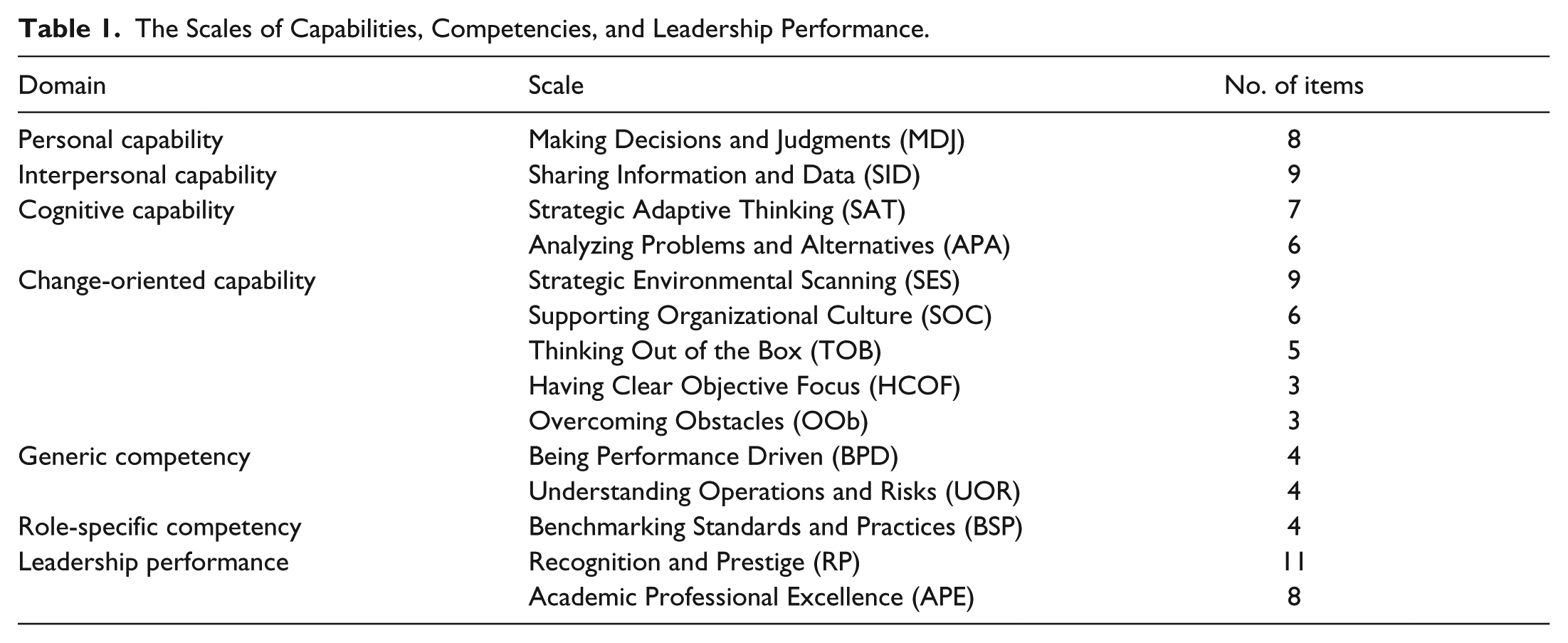
The measures of leadership capabilities, competencies, and performance (Ghasemy, Hussin, & Megat Daud, 2015; Ghasemy, Hussin, Megat Daud, Ghavifekr, & Kenayathulla, 2016; Ghasemy, Hussin, Megat Daud, & Md Nor, 2015; Ghasemy, Hussin, Zabidi Abul Razak, Maah, & Megat Daud, 2016) developed in the context of Malaysian HE were used to collect data for this quantitative study. It is noticeable that except for the change-oriented capability scale, other scales had been developed on the grounds of ALTC study instrument. The scales under each measure have been displayed in Table 1. Also, the selected items are listed in the appendix.
The Scales of Capabilities, Competencies, and Leadership Performance.
It is notable that prior to the main analysis, the data were screened using IBM SPSS Statistics 23 and partial least squares–structural equation modeling (PLS-SEM) was considered as the main approach (Hair, Hult, Ringle, & Sarstedt, 2017) to analyze the data. Furthermore, SmartPLS 3 software package (Ringle, Wende, & Becker, 2015) was employed for the purpose of data analysis.
Sample
This study has focused on academic leaders, leading Malaysian public focused and private focused HEIs, as the target population. Academic leaders in this study refer to the vice-chancellors and their deputies, deans, deputy deans, directors, deputy directors, heads of department, and professors serving universities just as academic staff.
To collect data, seven public focused and 12 private focused HEIs were selected randomly and the online version of the instrument was sent to 1,117 academic leaders in these universities (638 leaders in public focused and 479 leaders in private focused HEIs). In total, 172 academic leaders (response rate = 15.3%) completed the survey, among whom 94 were leaders in Malaysian public focused and 78 were respondents from private focused HEIs. It is noticeable that based on the variance-based approach adopted to analyze the data, and considering the fact that there is no standard for a minimum acceptable response rate in online surveys (Hamilton, 2003), the sample appeared to be adequate for the analysis.
In Table 2, the selected demographic information of the respondents has been presented.
Main Demographic Information of the Participants in the Study.

Initial Data Screening Procedure
The issues of missing values were handled using Expectation–Maximization (EM) algorithm (Tabachnick & Fidell, 2013) as well as an accurate regression-based method. Next, the guiding principles proposed by Field (2013) to screen data for regression analysis were followed. Afterward, SmartPLS 3 was employed to reinvestigate the data set for the existence of outliers based on standardized factor scores (Garson, 2016). Through these procedures, 11 outlying cases were identified and eliminated prior to undertaking the main analysis. Therefore, PLS-SEM algorithm was run for a sample of 161 cases in the context of Malaysian focused HEIs.
Reflective Measurement Model Evaluation
The guidelines proposed by Hair et al. (2017) were followed to assess each of the items in the first order and second order measurement models. Through this procedure, 33 noncontributing items were identified and deleted from the models in the context of Malaysian focused HEIs. Upon deletion of these items, all the statistical requirements were met in terms of establishing reliability and validity of the model developed based on the aggregate data. While the factor loadings of the items have been displayed in Figure 3, Table 3 summarizes the outputs of the estimation of Cronbach’s alpha, composite reliability, and convergent validity for the developed model.

The Malaysian Focused HEIs Model Before Performing FIMIX-PLS.
Alpha, Composite Reliability, and Convergent Validity of the Constructs.
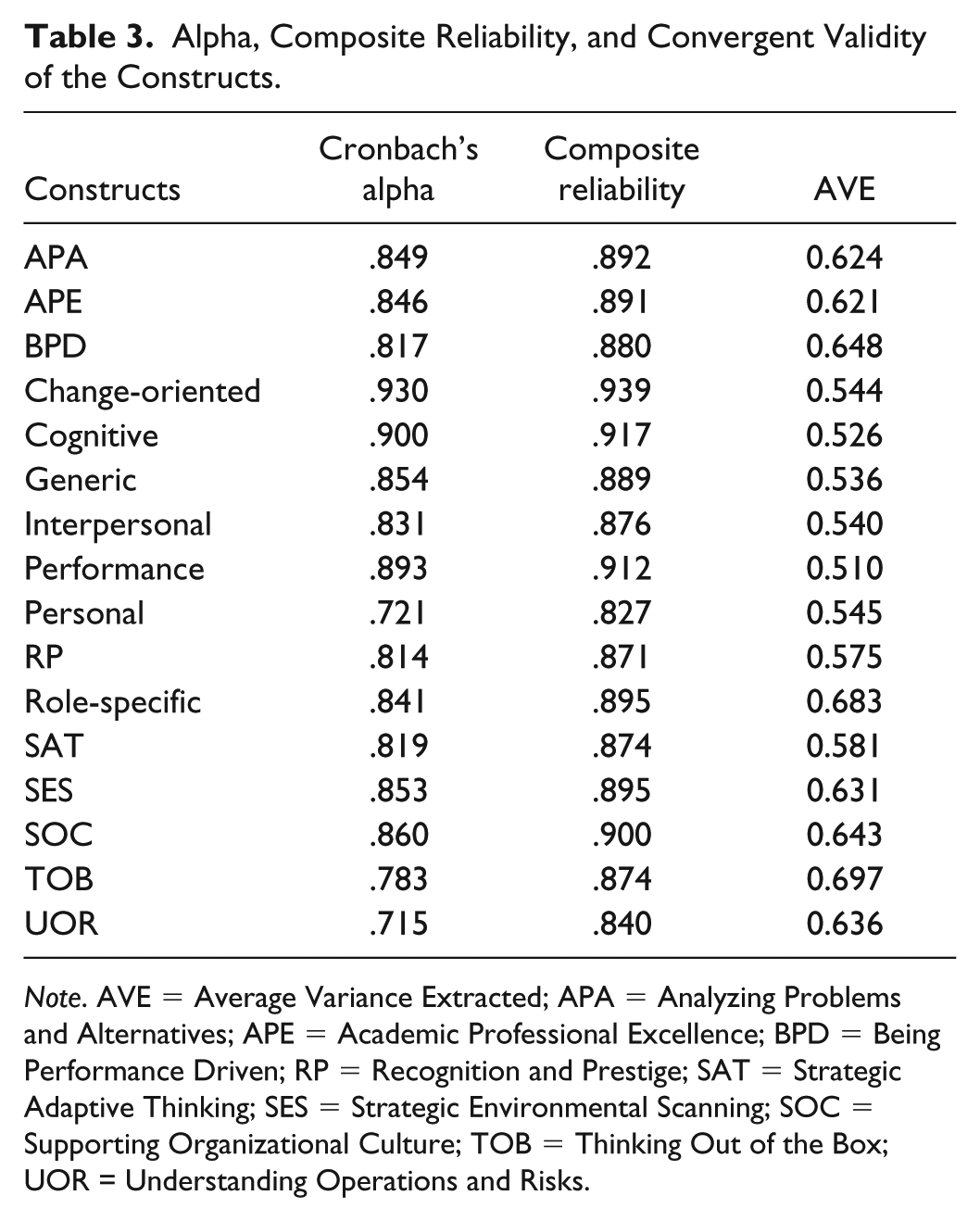
Note. AVE = Average Variance Extracted; APA = Analyzing Problems and Alternatives; APE = Academic Professional Excellence; BPD = Being Performance Driven; RP = Recognition and Prestige; SAT = Strategic Adaptive Thinking; SES = Strategic Environmental Scanning; SOC = Supporting Organizational Culture; TOB = Thinking Out of the Box; UOR = Understanding Operations and Risks.
These estimates implied no cause for concern in terms of establishing internal consistency. In addition, all the AVE values were above 0.5, indicating the establishment of convergent validity (Hair et al., 2017) for each construct in the model. Discriminant validity was also assessed through computing HeteroTrait-MonoTrait (HTMT) ratio as a newly proposed criterion to assess discriminant validity in Variance-Based Structural Equation Modeling (VB-SEM; Henseler, Ringle, & Sarstedt, 2015). In Table 4, the HTMT values of the constructs based on the original sample and 95% confidence intervals (two-tailed) have been presented, implying the establishment of discriminant validity based on HTMT0.9 and HTMTinference criteria as all the HTMT values were smaller than 0.9 and the upper level of the Bias-Corrected and Accelerated (BCa) bootstrap confidence intervals were below the value of 1.
Discriminant Validity of the Constructs Based on HTMT0.9 and HTMTinference Criteria.

Note. HeteroTrait-MonoTrait.
Structural Model Evaluation
The inner or structural models were evaluated on the grounds of the guiding principles suggested by Hair et al. (2017). This procedure encompassed the assessment of collinearity and path coefficients, model’s predictive accuracy and predictive relevance, as well as f2 and q2 effect sizes.
Collinearity and path coefficients
All of the VIF values for the latent variables constructing the inner models were below the critical value of 5, indicating that collinearity issues could not cause any serious problems in this analysis (Hair et al., 2017). This initial evaluation was followed by examining the significance of the path coefficients in the model, using the bootstrapping routine with BCa confidence intervals and 5,000 subsamples.
Based on the results in the context of Malaysian focused HEIs, the analysis revealed that the paths from three exogenous constructs, namely personal, interpersonal, and cognitive capabilities to leadership performance, were not statistically significant. Thereby, as proposed by Hair et al. (2017), the nonsignificant paths were eliminated from the model. In addition, the results showed that the effect of change-oriented capability on leadership performance was the greatest effect, followed by role-specific and generic competencies, as displayed in Table 5.
Final Path Coefficients.

Upon deletion of the exogenous constructs with nonsignificant paths to leadership performance, the model was reassessed for collinearity among the remaining exogenous constructs. The results of this analysis, shown in Table 6, indicated no cause for concern in terms of collinearity among the exogenous constructs.
Collinearity Assessment Among the Constructs.

Note. VIF = Variance Inflation Factor.
Model’s predictive accuracy and predictive relevance
As the next step, the measures of model’s predictive accuracy (R2), which presents the exogenous constructs’ combined effects on the endogenous construct (Hair et al., 2017), its adjusted version, and the measure of model’s predictive relevance (Q2; Geisser, 1974; Stone, 1974) were focused.
With respect to the issue of predictive accuracy of the structural model, the output of the analysis showed that 63% of the variance in leadership performance was explained by change-oriented capability, generic competency, and role-specific competency in the context of Malaysian focused HEIs. This indicated an almost substantial predictive accuracy of the model. It is worth noting that the Adjusted R2 in this analysis was 0.623. In addition, no cause for concern was detected in terms of model’s predictive relevance for the data points in the indicators of the ultimate endogenous reflective measurement model as the Q2 value was 0.299, which was greater than zero.
It is noticeable that as the sample size was 161, the omission distance in blindfolding module in SmartPLS 3 was changed to 8 to ensure that the number of observations in the data set divided by the omission distance was not an integer. Also, Q2 values based on constructs cross-validated redundancy were reported (Hair et al., 2017).
The f2 and q2 effect sizes
The contribution of each of the exogenous constructs on the predictive accuracy of the developed model or f2 effect sizes and also the effects of these constructs on models’ predictive relevance or q2 effect sizes (Hair et al., 2017) have been displayed in Table 7.
Effect Sizes of the Exogenous Constructs on Model’s Predictive Accuracy and Relevance.

Based on the guidelines proposed by Cohen (1988), the results implied that the size of the effect of change-oriented capability on predictive accuracy of the model was almost medium (0.116); the size of the effect of generic competency was small (0.065); and the size of the effect of role-specific competency was small (0.094) as well. Regarding the q2 effect sizes, while all the effect sizes were small, the results revealed that the size of the effect of change-oriented capability was greater on model’s predictive relevance.
Running Finite Mixture Partial Least Squares (FIMIX-PLS) to Detect Unobserved Heterogeneity
The results of the evaluations of the model developed based on the aggregate data have been presented in Figure 3.
However, as suggested by Hair, Sarstedt, Matthews, and Ringle (2016) and Matthews, Sarstedt, Hair, and Ringle (2016), FIMIX-PLS analysis was considered to detect unobserved heterogeneity within the data. As displayed in Figure 3, the number of the arrows from the exogenous constructs toward the endogenous construct was three in Malaysian focused HEIs model. Hence, following the guidelines proposed by Hair et al. (2017), the minimum sample sizes to evaluate the FIMIX-PLS results were considered to be 30.
The results of FIMIX-PLS module of SmartPLS 3 software for the model have been presented in Table 8.
Fit Indices and Relative Segment Sizes for FIMIX-PLS Solutions.

Note. FIMIX-PLS = Finite Mixture Partial Least Squares; HEIs = Higher Education Institutions; AIC = Akaike Information Criterion; BIC = Bayesian Information Criterion; CAIC = Consistent Akaike Information Criterion; MDL5 = Minimum Description Length with Factor 5; LnL = LogLikelihood; EN = Entropy statistic Normed.
For the purpose of evaluating the solutions and ex post analysis, the guidelines provided by Hair et al. (2016) and Matthews et al. (2016) were followed. Focusing on the model and based on the contents of the table of fit indices, selecting two-segment, three-segment, and four-segment solutions seemed to be unrealistic due to minimum sample size limitations. Hence, other quality criteria were not examined as unobserved heterogeneity didn’t appear to be a real cause for concern in this analysis. Therefore, ex post analysis was not run. In other words, the results of the FIMIX-PLS analysis shed light on the fact that there was no need to estimate any segment-specific model in the context of Malaysian focused HEIs and the model (displayed in Figure 3), which was analyzed for detecting unobserved heterogeneity, was the final valid and generalizable model.
Importance–Performance Map Analysis (IPMA)
IPMA was employed to evaluate the performance of the exogenous constructs as a method to extend the results of basic PLS-SEM (Ringle & Sarstedt, 2016; Völckner, Sattler, Hennig-Thurau, & Ringle, 2010). The analysis was carried out on the grounds of the guiding principles proposed by Hair et al. (2017). For this aim, leadership performance was set as the target construct. The results have been presented in Table 9 and Figure 4. In fact, while role-specific competency had the highest performance score, change-oriented capability was identified as the construct with the maximum relative importance in explaining the key target construct, followed by generic and role-specific competencies. This indicated that the improvement of change-oriented capability of academic leaders in the context of Malaysian focused HEIs must be at the focus of management activities.
IPMA Results for the Model in the Context of Malaysian Focused HEIs.

Note. IPMA = Importance Performance Map Analysis; HEIs = Higher Education Institutions.

IPMA for the Model in the Context of Malaysian Focused HEIs.
Discussion and Conclusion
Through this analysis, the extent to which leadership performance could be explained by different types of leadership capabilities and managerial competencies in the context of Malaysian focused HEIs was examined. The outcome of the analysis of the data at aggregate level indicated that personal, interpersonal, and cognitive capabilities were not significant predictors of leadership performance in Malaysian focused HEIs. Also, FIMIX-PLS (Hair et al., 2016) results did not indicate the existence of unobserved heterogeneity within the data. In addition, the results of IPMA (Hair et al., 2017) showed that change-oriented capability was the major area of improvement to be addressed by management activities.
Even though all of the constructs building Academic Leadership Capability Framework had been reported to be meaningful in determining leadership performance (Fullan & Scott, 2009; Scott et al., 2008; Scott & McKellar, 2012; Scott et al., 2012) and were supported by a few leadership theories (Ghasemy et al., 2016), as illustrated in the developed model in the context of Malaysian focused HEIs (R2 = 63%), the evidence did not support the contribution of personal, interpersonal, and cognitive capabilities to leadership performance. However, the role of change-oriented capability in determining leadership performance (Arvonen, 2008; Yukl, 2012) was supported in this context, implying that undergoing significant transformations might be a major concern for academic leaders in Malaysian focused HEIs. In addition, the outcome showed that academic leaders in Malaysian focused HEIs deemed to be more management-oriented as both generic and role-specific competencies were supported empirically. Arguably, these results may be a function of the way through which the ministry–university connections in terms of management, governance, and policy making have been created and managed.
It is noticeable that the importance and meaningfulness of most of the items in the developed model, which have been presented in the appendix, have been addressed and emphasized in the literature. For example, “Having sound administrative and resource management skills” and “Providing information showing how similar work units or competitors have better performance” have been emphasized by Ramsden (1998a). In addition, items “Being able to use IT effectively to communicate and perform key work functions and enhance my professional development,” “Having a high level of up-to-date knowledge of what engages university students in productive learning,” “Securing competitive funds related to learning and teaching as well as to the area of responsibility,” “Providing resources for the people to increase learning from mistakes and failures,” “Helping the people to better recognize failures,” and “Being able to help my staff learn how to deliver necessary changes effectively” are consonant with the academic qualities of leaders suggested by Black (2015).
Moreover, the items are in strong alignment with the encouraged practices through MNHESP as well as values, roles, purposes, and vision of AKEPT. For instance, items “Delivering successful team projects in learning and teaching” and “Bringing innovative policies and practices into action” are in line with the values of AKEPT. Also, the items “Producing future learning and teaching leaders,” “Creating an organizational culture that values creativity and entrepreneurial activities,” and “Supporting the activities to facilitate learning and acquire new knowledge from research, small-scale experiments and external resources” are related to the roles of AKEPT. In addition, the items “Explaining why the change is necessary and needed” and “Understanding of industrial relations issues and processes as they apply to higher education” are consistent with the encouraged practices through MNHESP.
In a nutshell, although these strong evidences suggest that the developed model is consistent with the literature, the concerns of Malaysian policy makers in HE organizations have also been reflected in the model, which makes the model a valid, reliable, and generalizable model in the context of Malaysian focused HEIs.
Implications
The main practical implication focuses on training and developing leaders in the context of Malaysian focused HEIs. As a matter of fact, policy makers in these organizations may be able to adjust and update the contents and processes of such programs and focus on the most pivotal dimensions of these qualities in training current and raising future leaders. In addition, this study emphasized on the leadership role of professors who do not have formal positions, but do influence on many practices and processes in academic settings.
From a theoretical lens, the integration of change-oriented capability into Academic Leadership Capability Framework may be highlighted, which is consistent with the arguments made by Fear, Adamek, and Imig (2002) regarding implementing change programs in HE organizations. Moreover, through this study, a new model was developed for the contribution of leadership capabilities and managerial competencies to leadership performance in the context of Malaysian focused HEIs, as a new contribution to expand the knowledge in academic leadership.
In terms of methodological implications, the output of the study emphasized that gaining quality results was a function of a few essential statistical procedures. These include missing values analysis (Ho, 2013) prior to running the main analysis, assessing discriminant validity on the basis of HTMT criterion in VB-SEM (Henseler et al., 2015), and extending the results of PLS-SEM through running FIMIX-PLS (Hair et al., 2016; Matthews et al., 2016) and IPMA (Hair et al., 2017; Ringle & Sarstedt, 2016).
Recommendations
From a practical perspective, replicating the study in other leading countries in terms of proving HE, especially in Asia Pacific, is recommended.
In terms of theoretical recommendations, integrating more meaningful constructs into Academic Leadership Capability Framework based on the results of recent research in HE leadership is suggested. Also, using this framework as a foundation for theory building in leadership in different educational contexts is proposed.
Finally, as a methodological recommendation, researchers are encouraged to perform segment-specific analysis using a combination of FIMIX-PLS and Partial Least Squares Prediction-Oriented Segmentation (PLS-POS), as advised by Matthews et al. (2016) and Hair, Sarstedt, Ringle, and Gudergan (2018).
Footnotes
Appendix
Items of the Model Developed in the Context of Malaysian Public and Private Focused HEIs.

| Item code | Item |
|---|---|
| APE_02 | Improving student satisfaction ratings for learning and teaching |
| APE_03 | Enhanced representation of equity groups |
| APE_06 | Producing successful learning systems or infrastructures |
| APE_07 | Delivering successful team projects in learning and teaching |
| APE_08 | Producing future learning and teaching leaders |
| BPD_01 | Being able to organize my work and manage time effectively |
| BPD_02 | Being able to make effective presentations to a range of different groups |
| BPD_03 | Having sound administrative and resource management skills |
| BPD_04 | Being able to use IT effectively to communicate and perform key work functions and enhance my professional development |
| BSP_01 | Understanding how to develop and evaluate an effective higher education learning program |
| BSP_02 | Knowing how to identify and disseminate good learning and management practice across the unit or university |
| BSP_03 | Having a high level of up-to-date knowledge of what engages university students in productive learning |
| BSP_04 | Being on top of current developments in learning and teaching |
| RP_01 | Achieving positive outcomes from external reviews of the area |
| RP_02 | Securing competitive funds related to learning and teaching as well as to the area of responsibility |
| RP_03 | Bringing innovative policies and practices into action |
| RP_04 | Achieving a high profile for your area of responsibility |
| RP_09 | Receiving positive user feedback for your area of responsibility |
| SOC_01 | Explaining why the change is necessary and needed |
| SOC_03 | Creating an organizational culture that values creativity and entrepreneurial activities |
| SOC_04 | Providing information showing how similar work units or competitors have better performance |
| SOC_05 | Providing resources for the people to increase learning from mistakes and failures |
| SOC_06 | Building confidence among the people that they will be successful in implementing change programs |
| SES_04 | Explaining about undesirable outcomes that are likely to occur if new opportunities are exploited by competitors |
| SES_05 | Influencing how new knowledge or a new technology is diffused and applied in the university by explaining why it is important |
| SES_06 | Identifying environmental threats and opportunities for the university and interpreting the collected information |
| SES_08 | Helping the people to better recognize failures |
| SES_09 | Encouraging the use of new technology and knowledge sharing programs among the people at the university |
| TOB_01 | Being willing to take risks in decisions |
| TOB_03 | Seeing possibilities rather than problems |
| TOB_05 | Supporting the activities to facilitate learning and acquire new knowledge from research, small-scale experiments, and external resources |
| UOR_01 | Understanding of industrial relations issues and processes as they apply to higher education |
| UOR_02 | Being able to help my staff learn how to deliver necessary changes effectively |
| UOR_03 | Understanding the role of risk management and litigation in my work |
Note. APE = Academic Professional Excellence; BPD = Being Performance Driven; BSP = Benchmarking Standards and Practices; RP = Recognition and Prestige; SOC = Supporting Organizational Culture; SES = Strategic Environmental Scanning; TOB = Thinking Out of the Box; UOR = Understanding Operations and Risks.
Acknowledgements
The authors would like to appreciate the Editors and the editorial staff of SAGE Open and the anonymous reviewers who greatly improved the quality of this article with their constructive comments.
Declaration of Conflicting Interests
The author(s) declared no potential conflicts of interest with respect to the research, authorship, and/or publication of this article.
Funding
The author(s) received no financial support for the research, authorship, and/or publication of this article.
