




Abstract
With economies and business becoming knowledge intensive, the role of education industry has immensely risen in significance. This has given rise to a highly competitive landscape in higher education, with faculty retention as a major challenge for the institutions leading to negative consequences in terms of education quality, stakeholder satisfaction and rankings. This paper discusses the factors influencing faculty retention in HEIs in India within the framework of Social Exchange Theory. The sub dimensions of HR climate were explored using Principal Components Analysis. The relative importance of sub dimensions in forming the overall climate was estimated and the effect of HR climate on faculty retention was studied with Organizational Commitment and Organizational Trust as mediators employing a hierarchical components model in the PLS-SEM analysis. The results indicate that HR climate has a significant positive effect on faculty retention through organizational commitment and organizational trust as partial complementary mediators. Findings have significant theoretical as well as practical implications in extending the present knowledge regarding the subdimensions and effect of HR climate on faculty retention and the suggested measures to be taken in implementing effective HR Management systems in the Higher Education Institutions.
Keywords
Introduction
Talent retention is a challenge in the current scenario with mobility of talent becoming more than ever fast paced due to technological disruptions making it easier to compare between organizations open to hiring for relevant positions. Higher education sector is no exception in this case with a massive dearth of quality teachers especially in the developing nations (Butt et al., 2020; Mbiti, 2016). Retention of effective faculty is the key to strategic advantage for Higher Education Institutions (HEIs) and therefore the factors influencing it need to be studied in detail. Faculty retention is of utmost importance for quality management in higher education and is currently one of the biggest challenges in front of the HEIs (Ababneh, 2020; Pandit & Paul, 2021). High turnover among faculty in the higher education sector leads to various negative consequences in terms of wastage of resources spent on recruitment, selection, and training of faculty members along with fall in productivity, and student dissatisfaction from the service quality of institution (Daly & Dee, 2006; Lawrence et al., 2014). These costs associated with high faculty turnover make it an important aspect in human resource management of HEIs and thus warrants careful investigation of the factors that can influence faculty retention.
Human Resource (HR) Climate which refers to the perception of individuals toward the HR programs, practices and policies and further determines the behavioral outcomes of the employees (Arthur & Boyles, 2007), has been found to be crucial in determining the turnover intentions of the employees in an organization by influencing their organizational commitment (C. Gilbert et al., 2011). A positive HR climate which is conducive for the employees’ wellbeing is expected to have a favorable effect on retention. HR systems that lay emphasis on proper compensation policies, fair recruitment and selection processes, transparent performance appraisals, career advancement and professional development of employees lead to enhanced employee engagement and lowers turnover intentions (Alfes et al., 2013; Juhdi et al., 2013; Kehoe & Wright, 2013; Ramsay et al., 2000; Sanders et al., 2014). On the contrary, an organization where the HR climate is not favorable for employees tends to have a higher turnover ratio among employees.
The HR climate in Indian higher education sector is plagued by various issues like lack of job security, comparatively low salaries, lack of autonomy as well as less emphasis on faculty development (Altbach, 2014; Raina & Khatri, 2015). These factors have led to disengagement and demotivation of faculty in higher education institutions increasing the turnover ratio in these institutions. There is a need to identify and analyze the relative importance of the various dimensions of HR climate and the effect it has on faculty retention in HEIs in India so as to build conducive University HR systems which aid in faculty retention. This study is an attempt to assess the impact of HR climate composed of its identified subdimensions on faculty retention in higher education sector in India. The mediating role played by organizational commitment and trust in this relationship has also been examined for analyzing the complete process through which HR climate influences turnover intentions.
Theoretical Foundation
This study is rooted in Social Exchange theory. Social Exchange Theory (SET) proposes that certain factors at workplace lead to interpersonal relationships, referred to as social exchange (Cropanzano et al., 2001) which evolve when employees reciprocate to their employers taking care of them with positive behaviors (Cropanzano & Mitchell, 2005; García-Rodríguez et al., 2020). As the theory assumes development of mutual dependence by exchange relations and the actors engaged, exchange such behaviors recurrently over a period of time. Therefore predictions of behaviors of actors are made based on the effects and outcomes of exchange, in this case effects being supportive HR Climate and Outcomes are Organizational Trust, Organizational Commitment and Retention (Figure 1) (Cook et al., 2013).

Depicting social exchange theory (Cook et al., 2013).
Research Framework and Hypotheses
HR Climate and Its Sub Dimensions
HR Climate is a part of the overall organizational climate and can be defined as a conducive workplace climate that emphasizes the importance of its human resources in terms of valuing human relations and focussing on employee engagement, empowerment, and accountability (Rondeau & Wagar, 2001).
HR climate is conceived as an overall environment with a tendency at all levels including the top management of treating people as an important resource and providing career development opportunities along with transparent appraisals and supportive personnel policies; a responsibility of supervisors to develop employee competencies and tendency of employees to help each other and collaborate with team spirit; faith in people’s capability of acquiring new competencies, openness of communication, encouragement to innovation and risk taking, and a general climate of trust where employees are helped in recognizing their strength and weakness (Majee, 2006; Rodrigues & Chincholkar, 2005).
This points to the fact that HR climate is a multidimensional concept and its subdimensions should be studied in detail in order to arrive at more meaningful conclusions regarding the effect which HR Climate has on various aspects of organizational performance including the employee retention. This study therefore was conducted in two parts wherein first an exploratory factor analysis was run to identify the specific subdimensions of HR climate using a comprehensive 43 item scale developed in the previous literature(Verma & Kaur, 2023). Details of the instrument, methods and results of EFA are presented in the following sections. Three subdimensions of HR climate emerged from the EFA, namely – Mentoring, Institutional Support and Employee Benefits. These subdimensions were therefore included in the hierarchical components model (HCM) as the lower order components of the higher order component of HR Climate in order to assess their relative importance in the overall HR climate.
The context for HR climate and its role in affecting organizational commitment, organizational trust and finally loyalty toward organization resulting in employee retention can be analyzed in the light of the Social Exchange Theory (Blau, 1964; Emerson, 1976). The economic side of social exchange theory places more emphasis on values like love, respect, and support than it does on money and goods. Social Exchange Theory (SET) proposes that certain factors at workplace lead to interpersonal relationships, referred to as social exchange (Cropanzano et al., 2001) which evolve when employees reciprocate to their employers taking care of them with positive behaviors (Cropanzano & Mitchell, 2005; García-Rodríguez et al., 2020). The relationships hypothesized in this study are thus grounded in SET in the organizational context.
HR Climate and Organizational Commitment
Organizational Commitment refers to the willingness of an employee to work positively in an organization (Mowday et al., 1982) and comprises of three components, namely - Affective, Continuance and Normative Commitment (Allen & Meyer, 1990). Affective Commitment can be defined as the attachment exhibited by an employee with his organization and its goals. Continuance Commitment refers to the commitment which employee feels toward the organization due to the work-relationships and benefits. Normative Commitment refers to the sense of obligation which an employee has toward the organization because of his own values and norms. Social exchange theory posits that employees tend to exchange their commitment for the support they receive from their employer (Eisenberger et al., 1990). Hence, a conducive HR climate which is reflected in the perceived organizational support is expected to have a positive effect on organizational commitment (Eisenberger et al., 2001; Rhoades et al., 2001; Wayne et al., 1997) leading to the following hypothesis:
HR Management systems which are instrumental in forming the HR climate of an organization are found to have a significant effect on affective organizational commitment (Ferreira-Oliveira et al., 2020). Organizational Commitment is also postulated to be a mediator between HR climate and Employee retention (Naz et al., 2020) because commitment has been found to lead to higher retention among employees in various settings including higher education (Manion, 2004; Quratulain et al., 2018; Sow et al., 2016; Xu & Payne, 2018). Thus, the following hypothesis has been framed for the study:
HR Climate and Organizational Trust
Organizational trust is defined as the confidence and support which an employee feels in an employer believing that the employer will stand true to the commitments made (J. A. Gilbert & Tang, 1998). Organizational trust can lead to positive employee attitudes leading to cooperative behavior (Hansen et al., 2011), innovative behavior (Yu et al., 2018), and employee loyalty (Chen et al., 2014).
Social exchange theory predicts that a favorable initial action would lead to an increase in trust, which in turn will promote positive behavioral responses (Hayfron et al., 2023). Therefore, if the HR climate of an organization is conducive, it will be perceived as a positive support from the employer leading to trust which in turn is expected to result in higher retention (Cho & Song, 2017; Ertürk & Vurgun, 2015). The following two hypothesis are framed based on the above discussion:
HR Climate and Retention
HR Climate is considered to be favorable by employees when they feel that they are valued by the organization which they perceive to be evident in the benefits they receive. Factors such as rewards, leadership, career advancement, training, and working conditions affect employee retention (Hytter, 2007). A pleasant and conducive environment at work along with valued employee contribution leads to higher intention to stay with the organization (Ramlall, 2003). Appreciation, motivation and stimulation to work have a positive effect on retention (Kyndt et al., 2009). Supportive work environment has been found to affect employee retention in a positive manner (Kundu & Lata, 2017). Inadequate time allocation between teaching and research also emerged as one of the major factor resorting to faculty retention (Griffith & Altinay, 2020). Various on the job factors also contributes toward retention, a study revealed that time spent on the mission/work areas, collegiality and workplace autonomy positively contributes toward employee intent to stay (Wai et al., 2014). Employer Branding and faculty participation in decision making stimulates faculty’s decision to remain with the insitutions for longer times (Khalid & Nawab, 2018; Matongolo et al., 2018) These subdimensions of HR climate combine to have a positive overall effect on employee commitment and trust as discussed above and further lead to increased employee retention. Thus, the following hypothesis is framed for the study:
Methodology
Sample and Procedure
Quantitative study was being conducted by taking faculty members into consideration from various departments of the Universities in Punjab State and Chandigarh Union Territory of India. Universities in the selected region comprise of Central universities, State universities, Private universities and Deemed universities and data was collected from all the types of universities to get a representative sample. There are 30 universities in Punjab and Chandigarh (All India Survey of Higher Education [AISHE], 2020) out of which 20 universities were included in the sample for giving equal weightage to all types of universities in the sample. Faculty of three major departments according to size of staff were included into the sample, namely: management, engineering and, social sciences.
Pilot survey was conducted with 25 faculty members from each type of university to check the designed instrument’s reliability forming a pilot sample of 100 respondents which is considered adequate for pilot testing (Hertzog, 2008). The participants of pilot study were not included in the final sample as the study has used self-designed instrument from various sources (Peat et al., 2001) See Appendix. Face validity of the instrument was assessed by academicians from various universities. Informed consent of the respondents was obtained after informing them the purpose of the study and assuring them of the confidentiality of their responses.
The target population of approximately 3,000(20 × 150) faculty from the selected 20 universities was stratified based on type of university and a random sample of 50 respondents per university were drawn randomly from each stratum. Out of the 900 distributed questionnaires 543 responses were received constituting a response rate of 60.3%. For determining the sample size, recommendations of Israel (1992) and, Tabachnick and Fidell (2013), were followed and a sample size similar to those of earlier studies conducted in the same context was adopted (Ababneh, 2020; Daly & Dee, 2006; Siyal et al., 2020).
Out of the received 543 responses, six unengaged responses were excluded as outliers (Osborne & Overbay, 2004) which made the final sample size as 537 responses for the analysis. Table 1 presents the demographic characteristics of the sample.
Sample Characteristics.

Measurement Instrument
The survey instrument to measure HR climate, Organizational Trust, Organizational Commitment and faculty retention were adopted, adapted from various sources in the existing literature provided in the last column of Table 2. Table 2 provides the details of the sources of items, no. of items and their reliability coefficients.
Sources of HR Climate Items in Higher Educational Institutions.

Note. The questionnaire items measure the responses on a five-point Likert scale ranging from 1 (Strongly disagree) to 5 (Strongly agree).
Analysis
The analysis was conducted at two levels – first an exploratory factor analysis was run on a sample of 300 respondents in order to identify the various sub dimensions of HR Climate and thereafter a Partial Least Square Structural Equation Modeling (PLS-SEM) was done on a different set of 237 respondents which included the confirmatory factor analysis for the measurement model assessment.
Exploratory Factor Analysis
To investigate the underlying factor structure of the HR climate as reported by professors, EFA was done on 43 items from data set 1 (300 respondents) The 43 elements were intended to represent the various aspects of the workplace in a collegiate setting. By merging the variables that have a similar variance and are unobservable, EFA minimizes the dimensionality. According to Beavers et al. (2013), this method entails the conversion of more quantifiable and observable variables into fewer latent variables.
For extracting the factors Principal Component Analysis (PCA) was used. PCA technique is most powerful when numbers of items are to be reduced to smaller number of components (Costello & Osborne, 2005). To check the sampling adequacy Kaiser-Meyer-Olkin (KMO) measure was reported 0.947. The desirable value of KMO should be greater than 0.70 which signifies sample size for this study is adequate (Hoelzle & Meyer, 2012; Lloret et al., 2017). Bartlett’s test of sphericity was also significant (x2 = 5413.740, df = 435; p ≤ .05)(Yong & Pearce, 2013). The number of components to be kept depends on a variety of factors. The criteria set forth by Kaiser (1960), which directs the retention of all components with eigenvalues greater than 1, are followed in this study. According to item size, the coefficients are presented, with figures below 0.060 were being suppressed (Beavers et al., 2013; Guadagnoli & Velicer, 1988).
Three components were retained named as Mentoring, Institutional Setup and Employee Benefits which explained the combined variance of 53.65%. The reliability of the extracted components was measured with the help of Cronbach’s alpha, which scored above .70.(details of the analysis can be provided by the author upon request).
Confirmatory Factor Analysis
The PLS-SEM analysis focussed on the measurement as well as structural model assessment to examine the hypothesized relationships in a hierarchical components model estimated through SmartPLS 4 software (Ringle et al., 2022). Mardia’s coefficient of skewness and kurtosis were found to be significant for the data, thus confirming the absence of multivariate normality. PLS-SEM technique does not rely on any distributional assumptions which makes it suitable for studies based on data which lacks multivariate normality (Hair et al., 2019). Besides, PLS-SEM is recognized for its predictive relevance (Shmueli et al., 2016) as it provides various measures for the same which can be obtained through procedures like PLSPredict in SmartPLS 4.
Before proceeding for the analysis, the data was examined for Common Method Bias (CMB) as it can affect the measurement of constructs through indicators on a similar Likert scale as used for this study. Full collinearity assessment through the process suggested in Kock and Lynn (2012) was conducted to rule out the presence of common method bias. All the inner VIF values were found to be less than 3.3 confirming that the collected data did not have a common method bias (Kock, 2015).
The PLS-SEM model consists of three Lower order Constructs (LOC) which form the Higher Order Construct of HR Climate. These lower order constructs were extracted through exploratory factor analysis as explained above. The three factors extracted through EFA are Mentoring (MENTOR), Institutional Support (INSTSUP) and Employee Benefits (EMPBEN) and these form the lower order components in the final PLS-SEM model. These three LOCs form the HR Climate which is the Higher Order Component in the model. Thus, the hypothesized model is of Reflective-Formative type. The Organizational Trust (ORGTRST) and Organizational Commitment (ORGCOMT) are hypothesized to be mediating the relationship between HR Climate (HRCLIM) and Faculty Retention (FACRET).
Results
The Disjoint Two-Stage Approach was used for analyzing the Higher Order Structural Model applied in the paper as recommended by Sarstedt et al. (2019). The first step was to evaluate the Measurement Model of the Lower Order Constructs and the dependent variable FACRET by running PLS algorithm without including HR Climate (HOC). The second stage included the evaluation of the measurement model of HOC using latent variable scores of MENTOR, INSTSUP and EMPBEN as indicators and finally the structural model assessment. Figures 2 and 3 exhibit the two stages of the model run.

Stage I results of disjoint two stage analysis.
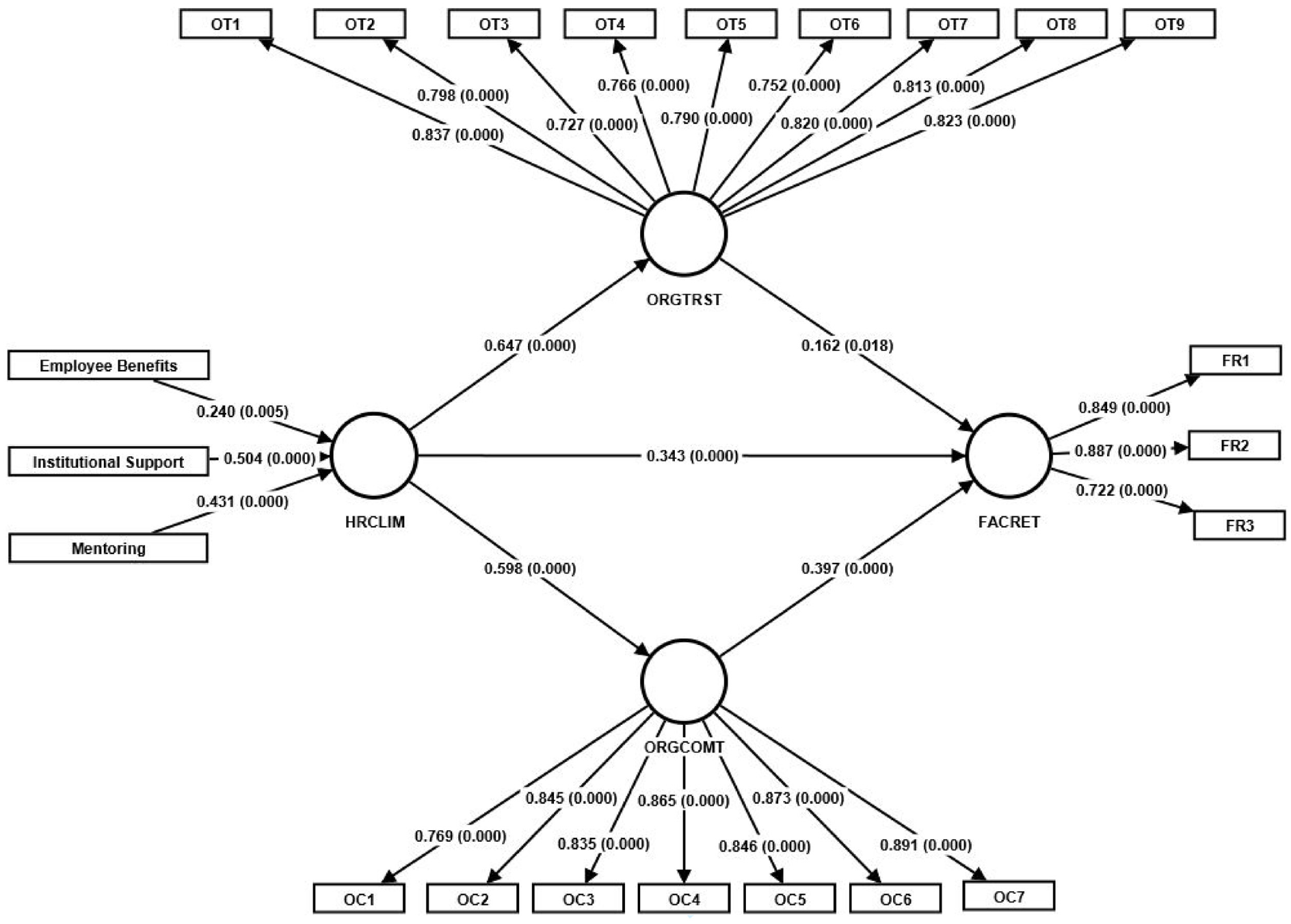
Stage II results of disjoint two stage analysis.
Measurement Model Assessment
Results of Stage I Measurement Model Assessment are presented in Table 3. All factor loadings of individual items of the reflective constructs retained were found to be above 0.7 with Cronbach’s Alpha, Rho_A and Composite Reliability values also above .7 establishing the internal consistency reliability for all the lower order exogenous constructs and the endogenous constructs of ORGTRST, ORGCOMT, and FACRET. One item each from MENTOR and EMPBEN, two items from FACRET and three items each from ORGTRST and ORGCOMT constructs which had factor loadings less than 0.6 were dropped from the model after initial analysis. Average Variance Extracted (AVE) for all constructs after dropping these items was found to be above 0.5 confirming Convergent Validity for all the constructs in the Stage I of the model (Hair et al., 2019).
Reliability and Convergent Validity.
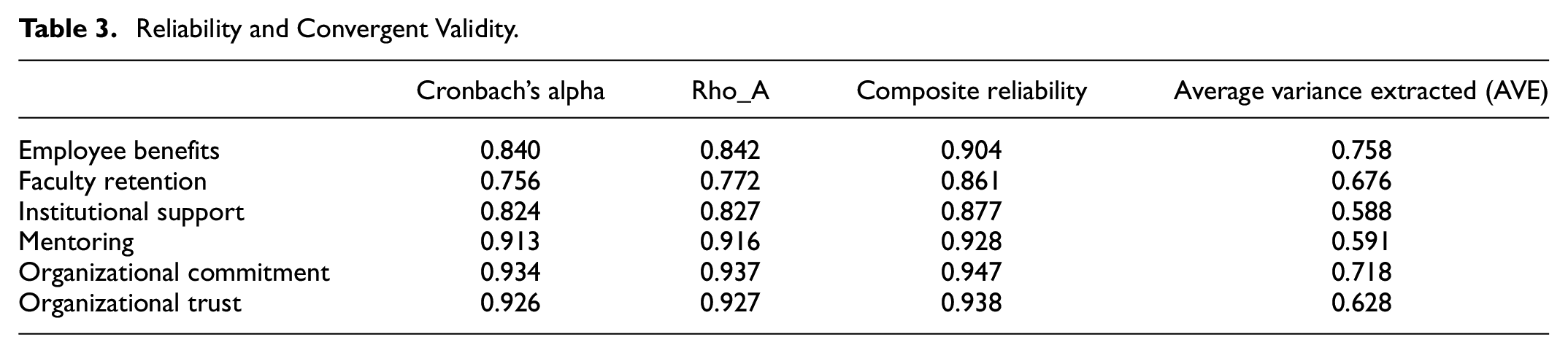
Table 4 shows the results of Discriminant Validity Analysis. It can be seen that discriminant validity of the constructs is established with all HTMT values below 0.85 (Hair et al., 2022; Henseler et al., 2015).
HTMT Ratio.

For assessing the Measurement Model of HR Climate which is the formative HOC, the process of redundancy analysis (Chin, 1998) was followed. A global single item was used to capture the general assessment of the HR Climate by the respondents for the concept as a criterion construct. The path coefficient of the global item with the HR Climate HOC was found to be 0.678 which was not significantly different from 0.7 and hence establishes convergent validity for the higher order construct (Chin, 1998, 2010).
For assessing the collinearity issues, the Variance Inflation Factor (VIF) was calculated for the LOCs and all outer VIF values were found to be less than 3, thus eliminating the possibility of collinearity issues (Hair et al., 2022) and proving the validity of the formative construct.
The outer weights estimated for the model along with their significance are given in Table 5 and it can be seen from the table that all weights are significant showing the validity of the formative HOC of HR Climate. All the subdimensions of HR Climate identified through exploratory factor analysis were found to be significant contributors in the HR Climate higher order construct with institutional support having the highest relative weight followed by mentoring and employee benefits respectively.
Outer Weights and Their Significance for HOC Measurement Model.

Note.* significant at 1%.
Structural Model Assessment
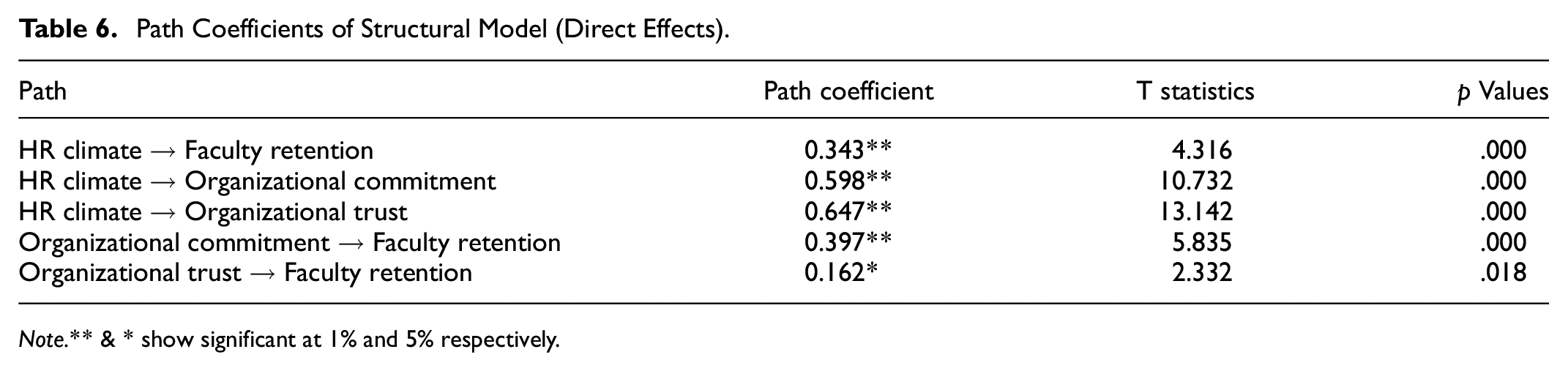
Table 6 presents the Structural Model Path Coefficients and Table 7 presents the Quality Criteria for the Model’s explanatory power using the coefficient of determination R square and the effect size f square. It also gives the Model Fit Assessment for the model based on the Standardized Root Mean Square Residual (SRMR) value.
Path Coefficients of Structural Model (Direct Effects).
Note.** & * show significant at 1% and 5% respectively.
Quality Criteria & Model Fit.

It can be seen from Table 6 that all the path coefficients are coming out to be significant at 5% or 1% level. The R2 and Adjusted R2 values of the final dependent construct Faculty Retention are above .6 which exhibit a good explanatory power of the model. From f2 values, it is evident that organizational commitment has large effect size, HR Climate has medium effect size and Organizational Trust has small effect size as per the threshold values of 0.02, 0.15 and 0.35 given by Cohen (1988) for small, medium and large effects respectively. The SRMR value is 0.070 which is below the threshold value of 0.085 as suggested by Hair et al. (2022) and exhibits that the model is a good fit.
Mediation Analysis
The analysis for evaluating the mediation effect of Organizational Commitment and Organizational Trust on Faculty Retention was conducted following Zhao et al. (2010).
The direct effect of HR Climate on Faculty Retention is found to be positive as seen Table 6 and both the specific indirect effects in the model are also found to be significant as can be seen from Table 8. This implies that Organizational Commitment as well as Organizational Trust partially mediate the relationship between HR Climate and Faculty Retention. As the direction of both the direct and indirect relationships is positive, therefore it is a case of complementary mediation. The joint effect of parallel mediation by the two variables is also positive and significant as seen from the total indirect effect.
Structural Model Indirect Effects.

Note.** & * show significant at 1% and 5% respectively.
Predictive Power Assessment
Predictive accuracy of the PLS model used for the study, was assessed using the Q2 value and prediction errors estimation obtained from the PLSPredict procedure in SmartPLS 4 (Ringle et al., 2022).
The Q2 measure is a combination of out-of-sample prediction and in-sample explanatory power (Sarstedt et al., 2017). Tables 9 and 10 give the results of the Q2 values and prediction errors for the PLS model compared to a naïve linear model for examining the out of sample predictive power of the model.
Latent Variables Q2.

PLSPredict Results for Measured Variables.

Conventionally, Q2 values higher than 0, 0.25, and 0.50 depict small, medium and large predictive relevance of the PLS-path model (Hair et al., 2019). Q2 values in Table 9 depict large predictive power for Faculty Retention through the PLS model used in the study while the predictive power of the model for Organizational Commitment and Organizational Trust is medium. All the Q2 values for the measured variables were also found to be greater than 0, exhibiting satisfactory out of sample prediction. Further, the Root Mean Square Error (RMSE) and Mean Absolute Error (MAE) values for all indicators in PLS-SEM model are less than those for the naïve LM benchmark, showing high out of sample predictive power of the model (Hair et al., 2022) as given in Table 10.
Importance-Performance Map Analysis (IPMA)
IPMA was used to analyze the relative importance and performance of the predictor variables on Faculty Retention. IPMA helps in decision making by bringing out the variables that are more important in influencing the dependent variable and comparing their performance vis a vis their importance in the model (Hair et al., 2022). The IPMA chart for Faculty Retention as the dependent variable is given in Figure 4. HR Climate which comprises of the Employee Benefits, Institutional Support and Mentoring as lower order constructs is found to exhibit the highest importance as the predictor of faculty retention. It is also found that the performance of this variable is below average and hence there is need for making efforts to improve the same considering the high importance of HR Climate in faculty retention. Organizational Commitment is the second important variable and it is also high on performance. Organizational trust has a low relative importance in influencing faculty retention and is also quite low on performance. Building organizational trust among faculty may not have a relatively significant influence on faculty retention but its overall contribution is significant and hence organizations should focus on building trust after the HR Climate performance has been improved.
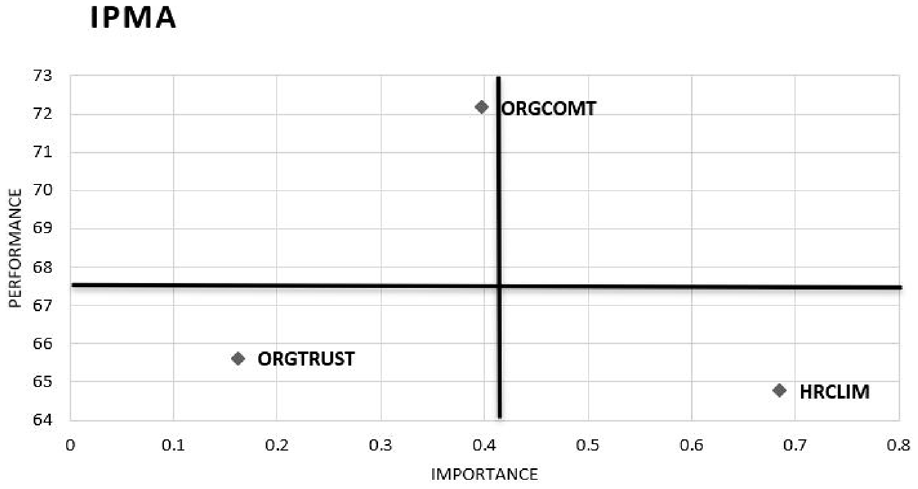
IPMA chart.
Discussion and Implications
Theoretical Implications
This study attempted to discover the subdimensions of HR climate using an exploratory factor analysis and the relative importance of each of the subdimensions of HR Climate was also analyzed using a hierarchical components model with HR climate as a reflective-formative higher order construct. The structural model analyzed the relationship between HR climate and faculty retention with the mediation mechanism taking organizational commitment and organizational trust as parallel mediators. The findings of this study have important theoretical research implications.
First, the exploratory factor analysis revealed that there are three major subdimensions of the HR Climate, namely – Benefits, Institutional Support, and Mentoring with institutional support having the highest relative weight in HR climate followed by mentoring and benefits. This is a significant contribution to the existing literature on HR climate as previous researches have not delved into the subdimensions of HR climate (AISHE, 2020).
Second, the results of empirical analysis show that favorable HR climate has a significant positive influence on faculty retention in the higher education setting, with this relationship being mediated by organizational commitment and organizational trust. These results are supported by the foundations of Social exchange theory (Blau, 1964) which predicts that organizations which provide positive inducements to employees can achieve positive employee attitudes and resultant behaviors. Our theoretical implication is in line with studies like Ababneh (2020), Daly and Dee (2006), Malik et al. (2019), Purang (2008) and Sanders et al. (2008) which found that positive HR climate leads to organizational commitment and trust.
Further, the mediation results are consistent with the findings of studies like Paillé et al. (2013) which found that perceived supervisor support leads to lower turnover intention among employees through commitment and trust based on the reciprocity proposed by Social Exchange Theory (Cropanzano & Mitchell, 2005). Similarly, Armstrong and Taylor (2020), Murray and Holmes (2021) found that employee empowerment through institutional support leads to organizational commitment and lowers the intention to quit the organization, thus having a positive effect on employee retention which is in line with the findings of this study. Our findings present valuable insights on the relationship between HR climate, organizational commitment, organizational trust, and faculty retention in higher education sector, which has not been studied in an integrated manner by previous researchers.
Practical Implications
The findings of this study also have significant practical implications. Firstly, the results of this study reveal that overall HR climate is composed of the perceived benefits, institutional support and mentoring with institutional support and mentoring having relatively higher importance as compared to benefits. This is interesting in terms of practical implementation of HR systems because it implies that rather than explicit benefits employees attach more value to the support they receive from their mentors or supervisors and the institution.
Secondly, the results show that positive HR climate leads to higher faculty retention. Therefore, higher education institutions must focus on building a conducive HR climate in order to enhance talent retention. HR systems have a considerable effect on the occupational satisfaction of the faculty members therefore universities must invest in building more meaningful HR activities and strategies (Alam, 2022). Retaining talent is important for higher education institutions as experienced faculty is not only an asset in terms of achieving student satisfaction and education quality but also significant in acting as mentors to young faculty members who join the institution. Given the importance of mentoring in the overall HR climate as found through the results of the HCM analysis, this implies that faculty retention has a circular effect on the overall sustainability and performance of the higher education system.
Thirdly, we find that organizational commitment and trust mediate the relationship between HR climate and faculty retention. It is therefore recommended that higher education institutions must encourage faculty members to participate in academic transformation by contributing new ideas, and promote a fair and transparent system of career progression for them in order to develop organizational trust and commitment. Employers must value the employees and provide them institutional support along with monetary and non-monetary benefits to generate trust and commitment which can further contribute to faculty retention.
Limitations and Scope for Further Research
There are few limitations in this study which call for further research in this area. First, this study uses cross-sectional data, therefore, the effect of HR climate which may evolve over time could not be tested. Future studies can collect data over different time periods to compare the effects of the independent variables on retention over time. Secondly, as suggested by literature, all the variables including faculty retention were measured as self-reported measures. Further research may take into account the data of actual employee retention and corroborate the results with the intention to stay reported by employees to get a clearer account of the actual relationships. Thirdly, this study was conducted for higher education institutions in India, thus, the generalizability of conclusions need to be further tested for settings in developed nations. Nevertheless, the study has been found to have a high out of sample predictive power which makes the results valuable even for settings outside the Indian context.
Conclusion
In the present scenario where education industry is becoming highly competitive, faculty retention is a major challenge for higher education institutions. This study explored the factors influencing faculty retention in HEIs in India employing the tenets of Social Exchange Theory. The subdimensions of HR climate and their relative importance in forming the overall climate was explored and the effect of HR climate on faculty retention was studied. It was found that there exists a significant positive effect of the exogenous variable HR Climate on the endogenous variable Faculty Retention as well as organizational Commitment and Organizational Trust act as parallel mediators in the relation between HRCLIM and FACRET. Employee retention has been widely studied in the literature but the HR climate in the context of its subdimensions and its effect in retention in the higher education sector have not been explored much by the researchers in the past. The paper contributes theoretically and practically to the existing body of knowledge and authors strongly recommend incorporating formal HR offices in the universities so that it would help in building strong HR Climate and a continued research in future related to Human Resource Climate and faculty occupational engagement so that to ensure that higher education sector in the nation and the world be regarded as the most favorable profession.
Footnotes
Appendix
Declaration of Conflicting Interests
The author(s) declared no potential conflicts of interest with respect to the research, authorship, and/or publication of this article.
Funding
The author(s) received no financial support for the research, authorship, and/or publication of this article.
Ethical Approval
Approval was obtained from the Institute. The procedures used in this study adhere to the tenets of the Declaration of Helsinki.
Informed Consent
Informed consent was obtained from all the participants involved in this study.

Data Availability Statement
The datasets generated during and/or analyzed during the current study are available from the corresponding author on reasonable request.