




Abstract
The aim of the study is to examine whether job satisfaction mediates and strengthens the relationship between administrative empowerment and organizational commitment among academic staff in Higher Education - Palestinian universities. A questionnaire was implemented during the data collection process. The study sample consisted of academic staff in Higher Education. Two hundred eighty-seven academic staff from seven different universities participated in the study. Data analysis involved calculating descriptive statistics, t-test, (ANOVA) test, correlation, and regression analysis. The results of the study indicated that administrative empowerment, Organizational commitment, and job satisfaction were statistically significant; moreover, it was found that administrative empowerment through job satisfaction impacts Organizational commitment. Management of universities should appreciate these results as good empowerment practices can increase employee job satisfaction. The current study model that has been developed provides that administrative empowerment through job satisfaction helps universities positively influence the organizational commitment of academic staff in universities.
Plain Language Summary
The purpose of the study is to examine whether job satisfaction mediates and strengthens the relationship between administrative empowerment and organizational commitment among academic staff in Higher Education - Palestinian universities. Data analysis involved calculating descriptive statistics, t-test, (ANOVA) test, correlation and regression analysis. The results of the study showed that enhancing administrative empowerment will affect the performance of Palestinian universities, and thus may increase the confidence of academic staff in the universities, which means increase level of JS. As a result, academic staff will be show positive behaviors at work, such as their participation in making decisions and developing strategic plans when they have a high level of JS. In addition, a possible implication is that higher education institutions need to have solid academic staff development programs. Academic staff should be rewarded when developing scientific research. Furthermore, they should encourage the teachers to take the initiative and contribute innovative ideas to the organization while appreciating their capabilities and talents. This study is limited to academic staff in higher education working in universities in Palestine. Therefore, the relationship between AE, OC and JS is not the same as in other countries. In addition, the results were obtained through the higher education sector; this means that the results cannot be generalized to a larger population
Keywords
Introduction
Organizations face a common challenge in their need to raise the level of their performance, in order to adapt to the requirements of rapid change (Mishra, 2019). For this reason, organizations tend to develop the human component which is considered the most successful source of investment and which can be considered as a resource that exceeds material wealth (Montani & Dagenais-Desmarais, 2018). Purnell and Johnson (2008) emphasized that organizations benefit by retaining employees; for this reason, their primary goal is to increase profits, productivity, and competition; however, they emphasize that retaining employees well satisfied brings benefits that is good for both the organization and its employees. Therefore, many organizations’ efforts are based on adopting modern management concepts like “administrative empowerment (AE), organizational commitment (OC), and job satisfaction (JS)” (Al-Magableh & Otoum, 2014; Al-Ta’ani & Al-Soai’e’, 2013). The AE of employees have been strongly linked to enhancing the importance of work and increasing their JS, loyalty, performance, level of service delivery, and OC. In addition, it also increases productivity at work/effectiveness, creates an organizational culture that encourages the implementation of managerial AE and creativity (Al-Madi & Nseirat, 2011; Alrqub et al., 2010; Orgambídez-Ramos & Borrego-Alés, 2014).
Administrative empowerment (AE) emphasizes various issues on teacher empowerment (Dierking & Fox, 2012). the teachers must possess confidence in influencing all aspects of their students’ lives by participating in decision-making (DM), Professional growth (PG), Self-efficacy (SE), Autonomy (AU), Status (ST), and Impact (IM), which in turn, affects teaching to fulfill universities goals. This comes through reinforcing employees’ behaviors, which is directly linked to enhancing the importance of work and increasing loyalty performance. In addition, it also increases productivity at work/effectiveness, creates an organizational culture that encourages the implementation of managerial AE and creativity (Al-Madi & Nseirat, 2011; Alrqub et al., 2010; Orgambídez-Ramos & Borrego-Alés, 2014).
Organizational commitment (OC) is viewed as a more positive individual orientation toward the organization. OC is determined by two different approaches. The first approach is known as behavior, while the second approach is referred to as; the attitude (Steers & Porter, 1983). OC increases organizational productivity, and as such, it enhances the stability of high-performing employees in the organization who are able to make quick and accurate decisions, and also able to deal with the work pressures (Al Dmour et al., 2017; AlHarrasi & AL-Lozi, 2015; AlHrassi et al., 2016).
Job satisfaction (JS) is as important as AE and OC when it comes down to better performance in a wide variety of academic sectors (Al-Ta'ani & Al-Soai’e’, 2013; Ameer et al., 2014; Oshagbemi, 1997). Thus, job satisfaction toward increasing employee self-efficacy includes a sense of satisfaction, greater motivation, heightened commitment, improved performance, improved employee attitude, increased organizational effectiveness (Conger & Kanungo, 1988), improved level of employee productivity and increased innovation (Al Shareef, 2012; Conger & Kanungo, 1988).
Lack of resources constitutes a major challenge for higher education institutions seeking organizational effectiveness. Human resources is the most important one of these challenges (Holeche, 2017). OC can enhance loyalty; which supports the improvement of joint work and increase productivity and effectiveness. OC supports enhancing the capabilities of higher education institutions, which can be done by recruiting qualified faculty members as well as retaining them and providing them with the requirements of organizational stability. All this in return, will enhance JS (Organ et al., 2006). The higher education sector is one of the most important sectors; simply because it is a mean to increase the cognitive productivity of a community (Hirsch et al., 2006; Oshagbemi, 1997). Despite that, the studies on these variables is insufficient; especially in many developing countries such as Palestine (Iriqat, 2016). Numerous studies have investigated variables in manufacturing organizations, and companies; however, investigation of the effects of these variables within the academic realm and faculty members has been ignored (Qureshi et al., 2011; Rana & Singh, 2016; Saridakis et al., 2020). The effectiveness of the employees within these institutions is influenced by AE, which takes place through OC. However, JS is another variable that plays a critical role in the effectiveness of faculty members working in a higher education institution (Al-Magableh & Otoum, 2014; Hasani & Sheikhesmaeili, 2016; Mirkamaly et al., 2010)
JS has been ignored in many studies as a mediating variable and therefore JS will be chosen as a mediator to investigate the effect of JS on AE and OC. Therefore, the main objective of this study was to research the effect JS in terms of its relationship between AE and OC in higher educational institutions in Palestine. As the education sector is one of the most vital sectors of a society, this study aimed to bridge the gap in literature concerning AE, OC, and JS between member staff in higher education. Moreover, the faculty members of the universities are a major element of organizational framework. Based on the above discussions, the objective of this research was to effect administrative empowerment dimensions (decision making (DM); professional growth (PG); status (ST); self-efficacy (SE); autonomy (AU); and impact (IM)) on JS and OC in Palestinian universities. Therefore, this research’s purpose is to examine the mediating role of JS on AE and OC of the academic staff at universities in Palestine.
Literature Review
Administrative Empowerment
The concept of empowerment is modern in management practices and one of the methods that help management grant powers to employees (Bateman & Snell, 2002). Empowerment is a key strategy that enhances the performance of managers in organizations (Al Maani et al., 2020). Collings et al. (2018) argue that administrative empowerment is to empower the members of teamwork to perform their duties without any feelings of stress. Furthermore, it motivates and assists the employees improve their performance and reduces risks that may arise during work. In addition, administrative empowerment helps organizations attain long-term sustainability (Wilkinson, 1998). Administrative empowerment can be defined as “giving employees the ability to make decisions and solve work-related problems within the limits of the responsibilities and powers delegated to them” (Littrell, 2003). Administrative Empowerment (AE) an internal state of mind that requires an attitude to be adopted by the individual, in order to obtain self-confidence and satisfaction, with capabilities he has, to help him in making decisions and considering the outcomes (Melhem, 2009).
According to Short and Rinehart (1992), the Administrative Empowerment Scale (AES) consists of six sub-dimensions; Decision making (DM), professional growth (PG), status (ST), self-efficacy (SE), autonomy (AU), and impact (IM). According to Irechukwu (2010), AE principles enable teachers, students, and parents to engage positively. Therefore, AE contributes to turning teachers into successful educational leaders. According to a study carried out by Liszt (2008), when school officials possess AE, This means that they are responsible for the students’ academic process, and thus leads to an increment in their DM power. Furthermore, the managers believed that having decision-making power aided them in achieving educational distinction, which had a significant impact on the academic growth of the students’ academic achievements. Affana (2013) looked into the connection between AE and team performance. The results of the study showed a discrepancy in approval ratings among the five variables identified by the managerial empowerment survey. According to a study by Al Otaibi (2004), promoting AE decreased the turnover of skilled nursing staff. Al-Sharif (2015) stressed the importance of the AE mechanism for a number of reasons, including the organization’s need to respond to changing circumstances and contingency factors.
Due to the recent technological developments, the current business philosophy is based on AE (Mishra, 2019). The issue of AE is sensitive because managers and organizations believe that they have a prior understanding when it comes to importance of the effect of AE. However, this is doubtful as only a few initially understand and grasp its impact while most realize it through practice and experience (Rana & Singh, 2016; Yaghoobi et al., 2011). AE is part of a broader concept, which is referred to as employee involvement (Ameer et al., 2014; Shahril et al., 2013). Most scholars regard AE as a concept that is based on building bridges of trust between management and employees (Al-Madi & Nseirat, 2011; El-Telbani et al., 2013). Scholars maintain that senior managers have a big role in employees success by providing them with “authority” and enabling them to participate in the decision-making (Hasani & Sheikhesmaeili, 2016). Many researchers have indicated that investing in individuals increases confidence in them, which means enhancing productivity in organizations (Habibi et al., 2015). Research has shown that AE had a significant impact on the performance and OC at work (Cho et al., 2006).
Organizational Commitment
The OC occupied a prominent place in organizational behavior research, which aimed to find the relationship between individuals and organizations (Lamba & Choudhary, 2013). Mowday et al. (1982) suggested that the OC of people is achieved through (1) satisfaction with the objectives of the organization, (2) devote efforts to support the organization, (3) maintaining membership in the organization. OC gives individuals the ability to adhere to the organization and its goals, which in turn reduces stress and promotes well-being in organizations (Siu, 2002). OC is the psychological condition that characterizes the employee’s relationship with the organization, and the state, which helps employees decide as to whether they wish to stay or leave the organization (Allen & Meyer, 1990). In essence, OC calculation is a comparison of an individual’s values and beliefs to the values and beliefs of the company (Swailes, 2002). The OC was described by Colquitt et al. (2009) as an employee’s desire to remain as a part of the organization. OC is described as an emotional connection that an employee feels while performing their job and from which they may gain a sense of loyalty because of being associated with the company (Rothmann & Cooper, 2008). It is also regarded as the employees’ commitment to the business (Macaulay, 2006). According to Thabo et al. (2018), OC happens when the employee-organization relationship is improved.
OC is an assurance that workers are capable of meeting organizational objectives, which is critical for completing organizational tasks. OC looks after the organization and employee’s relationship (Sharma, 2016). According to Thabo et al. (2018), researchers must concentrate on the factors that affect OC appropriately. When workers are certain that they can get the job done, they are more efficient (Mathur & Salunke, 2012). Some of the researchers suggest that the employee’s achievement of the goals of the organization and its full adoption is due to communication with the organization and to the effective communication of employees (Qureshi et al., 2011; Tashtoush & Eyupoglu, 2020).
Job Satisfaction
JS is an important topic in the science of management (Giannikis & Mihail, 2011; Markovits et al., 2014; Mohr & Puck, 2007). Despite its being an important subject and vast research has been carried out on, no consensus on what the nature of JS is has been arrived at. Kalleberg and Mastekaasa (2001) showed that even though some employees are satisfied and have high commitment, they still decide to leave their work, and vice versa (Norizan, 2012). Locke’s definition is the most commonly used description; it is a state that depends on the evaluation of the job or job experience (Locke, 1976). According to Mirkamaly et al. (2010) JS is the collection of employees’ positive attitudes and feelings about their place of employment, which is believed to lead to higher performance. JS contributes greatly to determining job performance and, accordingly, JS determines the behavior of individuals in an organization (Eyupoglu et al., 2018).
Intrinsic, extrinsic, and overall job satisfaction are the three dimensions of JS. Intrinsic satisfaction is comprised of the ability, authority, achievement, activity, creativity, independence, responsibility, social service, and variety (Okediji et al., 2011). Extrinsic satisfaction includes the organization policies, practices, progress, supervision, human relations, supervision, compensation, variety, and recognition (Mosadeghrad et al., 2008). Several studies have shown a positive relationship and correlation between JS and OC. Malik et al. (2010) and Suma and Lesha (2013), that meaning an increase in OC will be increase JS, and vice versa (Daneshfard & Ekvaniyan, 2012). Moreover, the employees who stay in one organization have a high level of organizational commitment (Aamodt, 2007). Likewise, university professors who had a balance in their work and lives had greater JS with their jobs, as well as their commitment to their universities (Arif & Farooqi, 2014). According to Marta et al. (2021), the result shows that employees are not satisfied with their situation at work. The organization should have logical considerations in deciding where to work for the employees.
According to Eklund (2008), AE is important for teachers’ JS. Many researchers have discovered that JS has a substantial correlation with job efficiency. According to Bentley et al. (2013), JS has the high relationship when it comes to jobs that require flexibility and independence. Since autonomy is a component of AE, the study concluded that there is a positive relationship between AE and JS. Hanaysha and Tahir (2016) found that AE has a positive impact on JS. In a survey of nurses, Engström et al. (2010) discovered that six of the eight JS variables have a positive association with overall AE. In a study of bank employees in Pakistan, Sarwar and Khalid (2011) discovered that AE has a positive impact on JS. Hechanova et al. (2006) investigated the relationship between AE and JS and performance in five sectors in the Philippines, and discovered a positive connection between AE and JS. In a study conducted by Cypriot teachers, Zembylas and Papanastasiou (2005) discovered that the level of JS was linked to the level of AE. The findings of Fernandez and Moldogaziev’s (2015) empirical study, which was based on 2010 data from the Federal Employee Viewpoint Survey (FEVS), indicate that AE activities (i.e., exchanging information about goals and success, providing access to job-related expertise and skills, and encouraging employees to work from home), have a positive impact on employee satisfaction.
Theoretical Linkages and Hypothesis Development
Administrative Empowerment and Organizational Commitment
Numerous researches have shown that employees with high levels of AE tend to enjoy high levels of OC and flexibility (Ganjinia et al., 2013; Khalayleh et al., 2017). Naeem and Saif (2010) maintain that employee empowerment will be an increment toward employee loyalty for the organization. Also, Liu et al. (2006) found that OC is achieved when teachers are given, in of their daily work, the power to make decisions. According to Norbu and Wetprasit (2021) and Andika and Darmanto (2020), the workers most committed to their organizations are the empowered ones because they provide them with jobs in which they are treated fairly. A study by AlKahtani et al. (2021) found that Organizational Commitment is positively affected by employee empowerment. In addition, research has been conducted by Kraimer et al. (1999) who they indicated that the power to make decisions were reflected on employee’s performance and increased their OC within the organization. Bhatnagar (2007) and Chen and Chen (2008) shown that the results of AE dimensions had impact on OC. Porter et al. (1996) shown that participation in decision-making promotes OC in different contexts. As for self-efficacy, the results obtained by Somech and Drach-Zahavy (2000) showed that it was not about OC, but about the student, thus the results did not reflect a relation between them. On the other hand, autonomy was strongly related to the teachers OC toward their organization. In addition, autonomy has shown a positive relationship with OC (Blau & Boal, 1989). Therefore, AE helps employees focus on achieving the highest possible, which in turn increase the level of the OC within the organization. Therefore, the hypothesis is as follows:
H1: Administrative empowerment positively influences organizational commitment
Job Satisfaction and Organizational Commitment
JS reflects emotional reactions to the job while OC in the organization develops slowly after the individual determines more comprehensive assessments that establish their own expectations for their future; therefore, JS is an important factor in shaping OC (Mannheim et al., 1997). The concept of JS and OC has received the attention of researchers because OC is achieved in the presence of JS; accordingly, they contribute to increasing productivity (Oshagbemi, 1997; Yousef, 2000). The results of the researches between variables (JS and OC) shows mixed findings (Kalleberg & Mastekaasa, 2001).
Najeeb et al. (2018) focused in his study in which was on the banking industry, where the results showed that EJS was positively related to OC. Malik et al. (2010) agreed with these results. Similarly, Tosun and Ulusoy (2017) concluded that extrinsic satisfaction has an effect on OC, as his studies focused on doctors and nurses in Turkey.
In addition, a study conducted by Tella et al. (2007) found that there was a clear connection between work satisfaction and OC. Maxwell and Steele (2003), on the other hand, claimed that the company is concerned with the needs of its workers. It is clear that there is a direct relationship between the level of experience and OC. Ćulibrk et al. (2018), Feinstein and Vondrasek (2006), Freund (2005), Mannheim et al. (1997), and Saridakis et al. (2020) found a significant relationship between variables. However, Curry et al. (1986) found no relationship between variables. A study by Dirani and Kuchinke (2011) showed that JS and OC were correlated. Arif and Farooqi (2014) found that university professors who had a balance between their work and everyday lives had greater JS with their jobs, as well as their commitment to their universities. Therefore, the hypothesis is as follows:
H2: Job satisfaction positively influences organizational commitment
Administrative Empowerment, Organizational Commitment, and Job Satisfaction
Several studies showed that AE is correlated and positive relationship with JS (Hechanova et al., 2006; Seibert et al., 2004; Snipes et al., 2005; Spreitzer et al., 1997). Connolly et al. (2018) and Savery and Luks (2001) shown that AE was a cause of effective JS. Liden et al. (2000) suggest that empowering employees achieves high levels of JS and OC, thus achieving high levels of performance. A study (Ornoy, 2010), showed that employees who have high levels of JS who participate in decision-making process. The results for a study (Gebremichael & Rao, 2013) indicated positive yet weak relationship between JS and OC among member staff in Wolaita Sodo University, Ethiopia. The results of a study (Aldaihani, 2019) have found significant relations between AE, decision making, “DM” group work, and self-motivation with JS.
Studies have shown that PG contributes to achieving JS in educational work settings (Subasi et al., 2017). Caprara et al. (2006) assert that teachers’ sense of SE contributes to enhancing JS. Nguyen et al. (2003) found that the degree of AU is highly correlated with JS. Menon (2001) determined that AE led to increased JS. Most studies conducted on the relationship between AE and JS answered the question of how AE could be an indication of JS (Hoy & Miskel, 2001). In other words, higher levels of AE will increase JS and vice versa. Literature review indicates there is a lack of related studies: AE, OC, and JS and therefore, the present study aims to fill this gap by providing data on the mediating role of JS between AE and OC. Therefore, the hypothesis is as follows:
H3: Job satisfaction mediates the relationship between administrative empowerment and organizational commitment
Decision-making
Decision-making refers to teachers’ participation in important decisions in an organization, such as curriculum, budgets, teacher selection, scheduling, planning, personnel selection, and goal setting (Davidson & Dell, 2003; Short, 1994; Sweetland & Hoy, 2000). Allowing teachers in decision-making in organizations will lead to their ability to solve problems and not just identify them (Short, 1994; Whitaker & Moses, 1990). Studies and researches have shown that the participation of teachers in decision-making has a positive correlation with JS achievement (Pearson & Moomaw, 2005; Rice & Schneider, 1994; Rinehart & Short, 1994).
A study (Ornoy, 2010) indicated that employee participation in decision-making is related to the level of job satisfaction. This gives indications that JS is achieved when employees feel that their organizations are acting in their best interest (Parnell & Crandall, 2003). The results of a study conducted in New Jersey showed that teachers’ participation in decision-making is affected by how empowered they feel in the organization (Sweetland & Hoy, 2000). A study (Klecker & Loadman, 1998) emphasized the importance of participation in decision-making. The results indicated that although the administration supported the teachers’ professional growth and encouraged them to participate in decision-making, the rating of empowerment remained unclear due to the lack of teacher participation in the decision-making process. Previous studies indicated a positive association between DM and OC (Johnson, 1992; Martin et al., 1995). Perceptions of jobs related to organizational commitment are stronger among employees who can participate in DM (Jermier & Berkes, 1979; Rhodes & Steers, 1981). Therefore, the participation of employees in decision-making gives them the advantage of acquiring independence, respect, and equality, as well as demonstrating self-expression.
H3a: Job satisfaction mediates the relationship between Decision-making and organizational commitment
Professional Growth
Refers to the extent to -which teachers realize that the educational institution gives them and opens the way for them to develop, and expand their capabilities while working at the university (Short, 1994). Empowerment is related to the extent to which teachers are aware of their work (Short, 1994). The level of confidence is higher when teachers are good at their profession (Short, 1994; Whitaker & Moses, 1990). A study (Berry et al., 2010) has shown that the effectiveness of teachers in teaching will improve if they are allowed to collaborate with their co-workers. Findings also show that teachers want to be able to exchange ideas by collaborating with other professionals (Berry et al., 2010). Finally, the Carolina Teacher Condition Survey (Hirsch et al., 2006) found that teachers need time to contribute to professional development.
Molaee and Dortaj (2015) emphasized that participation in professional growth activities increases JS, and therefore the presence of professional growth means enhancing JS among workers in the organization (Subasi et al., 2017). Educators feel enriched through career advancement, so providing opportunities for professional development and growth increases their JS (Rinehart & Short, 1994). Weng and Hu (2009) suggested that career growth attainment focuses on four factors: career goal advancement, career enhancement, promotion, and reward growth. This perception indicates that career growth is a function of employees’ efforts toward achieving their personal career goals and working to gain increased number of new skills, in order to achieve better promotions and salaries. Therefore, the hypothesis is as follows:
H3b: Job satisfaction mediates the relationship between Professional growth and organizational commitment
Impact
Impact dimension includes the power and influence of work to modify and develop the educational process. Teachers need to know that the organization gives them value for their work (Short, 1994; Whitaker & Moses, 1990). The impact of employees is related to JS (Van Loon et al., 2015). The results of a survey conducted by and Hirsch et al. (2006) emphasized the importance of teachers’ participation in the teaching process as teachers are very influential over their students. A study (Klecker & Loadman, 1998) conducted with 10,544 teacher participants in Ohio found that the empowerment dimensions were rated neutral when they were not allowed to impact the training process.
Hirst et al. (2008) argued that an organization that seeks to empower employees, bridges the distance between managers and workers and works to reduce procedures. Researches have demonstrated the role of a leader for empowerment of university faculty (Wenner & Campbell, 2017). These results lead to JS for teachers, improvement of social and emotional conditions, giving the teacher the confidence and strength to be the decision-maker, as well as feelings of enthusiasm and optimism (Cheon et al., 2015; Pimmer et al., 2010). Therefore, the hypothesis is as follows:
H3c: Job satisfaction mediates the relationship between Impact and organizational commitment
Status
The respect and admiration job professional that teachers perceive they gain from their colleagues and peers (Short, 1994; Whitaker & Moses, 1990). Therefore, empowering teachers to make decisions that affect their careers (Whitaker & Moses, 1990) improves the profession’s status. Toropova et al. (2019) explained that JS is not just, about how employees stay in the organization but rather work to create working conditions that enhance the welfare of teachers. Leiter and Maslach’s (1988) show that the higher level of job satisfaction, the more positive the interactions between colleagues will be. The results of the study, which included the participation of 8,500 teachers, indicated that expert teachers had a positive impact on student achievement (Hirsch et al., 2006). In fact, the results of previous studies that investigated the level of OC among tentured employees, and non-tentured employees within the environment of the organization did not give clear and decisive results. However, studies have shown that permanent employees are more committed than non-regular employees (Ellingson et al., 1998; Feldman et al., 1995). It is therefore important to improve the status of teachers’ profession by empowering teachers to participate in decision-making and this will have an impact on their careers (Whitaker & Moses, 1990). Therefore, the hypothesis is as follows:
H3d: Job satisfaction mediates the relationship between Status and organizational commitment
Self-efficacy
The self-efficacy dimension indicates that teachers have the ability to help students learn through skills and abilities that allow them to develop the curriculum. Short (1994), Soto and Rojas (2019), and Whitaker and Moses (1990) shows that SE positively influences JS. In a study by Wang et al. (2015), which was implemented on 523 Canadian teachers, found that teachers who have a high level of self-efficacy in classroom management and students will have greater satisfaction with their jobs. Caprara et al. (2006) assert that teachers’ sense of self-efficacy contributes to enhancing their JS.
The relationship between SE and OC did not receive attention from researchers, as the number of studies was few, but Salami (2007), in his research of high school teachers, concluded that the relationship between SE and OC was positive. In turn, Luthans et al. (2006) emphasized that employees will be more prone to OC in their organizations and they will have confidence and not leave work if they have a good level of competence and JS. Therefore, the hypothesis is as follows:
H3e: Job satisfaction mediates the relationship between self-efficacy and organizational commitment
Autonomy
The teachers’ feeling that they have an influence in various aspects of their work includes the schedule of lectures, curricula, textbooks and planning instruction (Short, 1994; Whitaker & Moses, 1990). According to the results of a study by Nguyen et al. (2003), the degree of autonomy is highly correlated with JS. In fact, the results showed that autonomy and JS are inseparable. These results came in the research conducted by (Dou et. al., 2017) in China regarding the relationship between satisfaction and autonomy and the mediating role. Results presented in research conducted by Morgeson and Humphrey (2006) and Nguyen et al. (2003) show that JS is the result of achieving autonomy, then job autonomy and JS can be determined as indicators on which to base the measurement process. Malik & Dhar, (2017) conducted a study that focused on measuring the impact of work overload and autonomy on OC and JS. The case of Kosovo” The study showed that JS mediates the relationship between autonomy and OC. Therefore, the hypothesis is as follows:
H3f: Job satisfaction mediates the relationship between Autonomy and organizational commitment
Based on the above discussion, Figure 1 shows the research model.

Research model.
Methodology
Participants
This study aimed to examine the mediating role of JS on AE and OC of the academic staff at universities in Palestine. According to the statistical report of the Higher Education in Palestine for the period 2019 to 2020, the total population of academic staff working at these universities was 1,390 (Supplemental Material 1—Full Time Staff at Higher Education). According to Sekaran and Bougie (2016), a sample size of 300 is suitable for a population of 1,400 see Table 1 which summarizes the sample size selection. The participants, who were selected using the convenience-sampling method, returned 287 valid questionnaires out of the 300 that the researcher had distributed. The response rate, which reached 95.6%, was high. The study population consists of 56 educational institutions in Palestine. The researchers chose seven institutional universities because these universities depend on traditional teaching and face-to-face lectures. Furthermore, they are accredited by the Ministry of Education and Scientific Research and grant bachelors, masters, and doctoral degrees. Moreover, the study was limited to the Gaza strip without moving into the west bank because of prevailing Israeli occupation constraints (Supplemental Material 2—University List). The questionnaire was distributed between January and March 2020. A total of 287 valid copies were retrieved, which is a 90% retrieval rate. The researchers handed out the questionnaires to the participants in person, and participation was voluntary. The questionnaire form stated that the research was for experimental purposes and that the names of the respondents would be kept exclusively confidential.
Sample Size Selection.
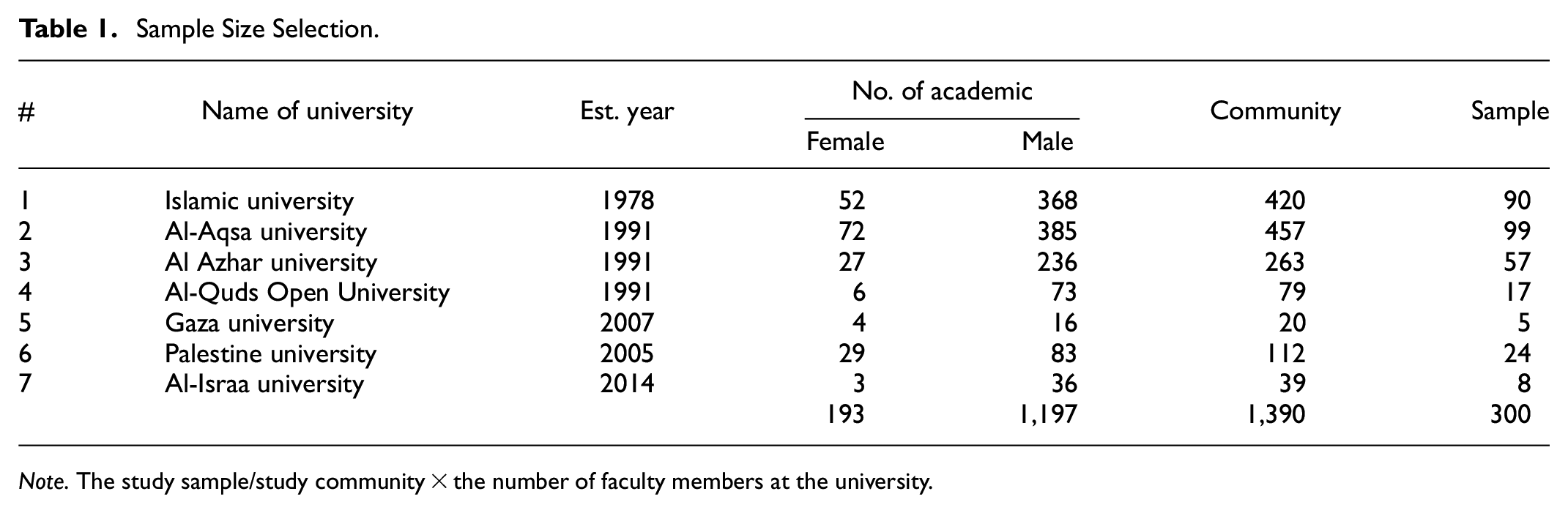
Note. The study sample/study community × the number of faculty members at the university.
Study Variables and Instrument
For the present study, an analytical descriptive approach was applied using a questionnaire consisting of four parts (Supplemental Material 3—Questionnaire): demographic information, the Administrative Empowerment Scale (AES), the OC Scale (OCS), and the Job satisfaction scale (JSS) (Supplemental Material 4—Spss Data).
Personal Information Form consist of six items (items 1–6).: Included gender (1 = male, 2 = female), marital status (1 = married, 2 = not married), age (1 = 21–25, 9 = 61 and above), education (1 = Bachelor Degree, 2 = Master, 3 = PhD), experience in higher education (1 = 1–3, 6 = 15 and more) and experience in your present workplace (1 = 1–3, 6 = 15 and more). Administrative Empowerment Scale (AES), this scale consists of 38 questions and six sub-dimensions—DM, PG, ST, SE, AU, and IM, which was developed by Short and Rinehart (1992). The Cronbach’s alpha of (37 items) for the AE dimensions, measured at .794. This value is considered reliable. In addition, Cronbach’s Alpha was measured for all dimensions of AE. Decision-making, which consisted of 10 questions (items 7–16), was measured and a Cronbach’s alpha of .793 was obtained. Professional growth, which consisted of five questions (items 17–21), was measured and the Cronbach’s alpha was found to be .783. Status, consisting of six questions (items 22–27), was measured, and its Cronbach’s alpha was found to be .922. The measurement of Self-efficacy, which had six questions (items 28–33), found a Cronbach’s alpha of .837. Autonomy, consisting of five questions (items 34–39), was found to have a Cronbach’s alpha of .818. A Cronbach’s alpha of .740 was obtained when we measured impact, which consisted of six questions (items 39–44).
Organizational Commitment Scale (OCS), consists of 24 questions which developed by Allen and Meyer (1990). The Cronbach’s alpha of (24 items) for the OCS, measured at .806. This value is considered reliable. Job satisfaction scale (JSS), consists of 20 items and was developed by Weiss et al. (1967). The Cronbach’s alpha of (20 items) for the JSS, measured at .839. This value is considered reliable. The Cronbach’s alpha for the whole model of (81 items) was measured at .862. We utilized Cronbach’s Alpha to assess the internal consistency of the scales, and the results came back with an alpha value >.70, which means the questionnaire is considered reliable.
Results
Profile of Respondents
Table 2, pertaining respondent profile, shows that 77% of the participants were male. It also shows that 24% were between the ages of 31 and 35, while the percentage of married males was 87.5%. It also shows that 52.6% held a PhD degree. About 32% of the participants’ years of experience in the higher education was between 10 and 14 years by 27.2%. Also, 32.8% had a 4–6-year experience at their current place of employment (Supplemental Material 5—Spss Output).
Demographic Characteristics of Respondents.

Factor Analysis
Exploratory Factor Analysis (EFA) enables the researchers to reduce the observed variables to smaller numbers and identify the relationship between them (Hinkin, 1998). The principal components analysis (PCA) technique following the Promax with Kaiser normalization rotation method was used to extract the factors. Hair et al. (2014) suggest that only those items with a load of 0.4 or above on a single item be included. The KMO was 0.716, and Bartlett’s Test was significant at (p < .05), which effectively complies with required sample value.
The EFA analysis was obtained from eight different factors that explain 54.49% of the total variance for Palestinian universities. ST possessed six items that showed a loading range from 0.777 to 0.862 and explained 11.90% of the total variance. SF has six items that showed a loading range between 0.658 and 0.833, and the construct explained 8.07% of the total variance. The construct of AU had five items that explained 7.181% of the total variance, which loaded between 0.551 and 0.948. The IM had six items, two of which were deleted, thus resulting in four items loaded between 0.781 and 0.824, which explained 6.90% of the total variance. The original construct of the DM had 10 items, three of which were deleted, and the remaining seven items were loaded between 0.546 and 0.709 and explained 6.388% of the total variance. The OC had 24 items, of which 17 were deleted, which resulted in seven items loaded from 0.522 to 0.734 and explained 5.29% of the total variance. The construct of PQ had five items that loaded between 0.674 and 0.773 and explained 4.721% of the total variance. The JS had 20 items, 13 of which we deleted, which resulted in seven items loaded from 0.543 to 0.682 and explained 4.037% of the total variance. Table 3 shows the result of the exploratory factor analysis.
Exploratory Factor Analysis Result.

Note. DM = decision making; PG = professional growth; ST = status; SE = self-efficacy; AU = autonomy; IM = impact; JS = job satisfaction; OC = organizational commitment.
We utilized the Confirmatory factor analysis (CFA) unidimensional in which the presence of a single dimension was used on a set of measures. CFA was conducted using SPSS AMOS v 24. We implemented the convergent validity test to check the validity of the study. It is possible to carry out a Convergent validity analysis through factor loading (Awang, 2012; Hair et al., 2014). The average variance extracted (AVE) from all constructs was above 0.5, and composite reliability (CR) was above 0.6, which means acceptable convergent validity. Table 4 (CFA) shows that all formulations are reliable and meet the criteria for validity.
Confirmatory Factor Analysis Result.

Note. DM = decision making; PG = professional growth; ST = status; SE = self-efficacy; AU = autonomy; IM = impact; JS = job satisfaction; OC = organizational commitment.
Mean Scores and Reliabilities
The suitability of the study sample was determined through The Kolmogorov–Smirnov test, the results of which ascertained that the variables follow the normal distribution (p > .05) as shown in Table 5.
Mean Scores of the Study Variables.

Note. Table 2 shows that the mean for AE was 3.44, with SD of 0.55, JS was 3.34, with SD of 0.59, and finally, the total scores for OC was 3.33, while the standard deviation was (SD = 0.56). Therefore, the respondent’s perceptions of the variables were moderate.
Correlation Study
Table 6 shows the correlation analysis which found that the relationship between AE and JS was (R = .457, p = .00) and that it was (R = .468, p = .01) between AE and OC. These results prove that there is a positive yet weak significant correlation. The results of the study found that the correlation coefficient of JS had a positive and very high correlation with OC (R = .908, p = .01). The correlation coefficients between ST, AU, IM, and OC were all very weak but positive (R = .194, R = .252, and R = .285, p = .00) respectively. However, the correlation coefficients between DM, PG, SE, and OC showed a strong and positive correlation (R = .821, R = .764, and R = 0. 730, p = .00), respectively. ST, AU, IM, and JS showed very small but positive correlations (R = .114, R = .163, and R = .245, p = .00), respectively. However, the correlation coefficient between DM, PG, SE, and JS revealed a strong and constructive relationship (R = .767, R = .754 and R = .762, p = .00), respectively (Supplemental Material 5—Spss Output).
Correlation Between Variables.

Note. N = 287. AE = administrative empowerment; DM = decision making; PG = professional growth; ST = status; SE = self-efficacy; AU = autonomy; IM = impact; JS = job satisfaction; OC = organizational commitment.
Significant at the .05 level (two tailed).
Hypotheses Testing
The PROCESS procedure for SPSS Version 3.5 was used to validate the hypothesis. The findings of the hypothesis research have been summarized in Table 7.
Results of Hypothesis Testing.

Note. AE = administrative empowerment; DM = decision making; PG = professional growth; ST = status; SE = self-efficacy; AU = autonomy; IM = impact; JS = job satisfaction; OC = organizational commitment.
The H1 showed that the interaction between AE and OC was positive, but with a very small correlation (R-square = .2187; F = 79.754; p = .000). Similarly, H2 revealed a positive and significant association between JS and OC (R-square = 0.825; F = 1341.985; p = .000). JS, according to Hypothesis H3, mediates the interaction between AE and OC. The findings revealed that JS mediates the interaction between AE and OC and has a favorable and strong effect (R-square = 0.8282, p = .000); as seen in Table 6. Hypotheses 3a, 3b, 3c, 3d, 3e, and 3f indicated that JS has also mediated the relationship between DM, PG, ST, SE, AU, and IM, and OC and that it has positive high impact (R-square = 0.8622, 0.8393, 0.8330, 0.8282, 0.8358, and 0.8291, p = .000) respectively. Therefore, the results show that all hypotheses and sub-hypotheses are positively significant and supported (Supplemental Material 5—Spss Output).
Discussion
This study aimed to examine the mediating role of JS on AE and OC within higher education institutions operating in Palestine. Furthermore, it aimed to determine the role of AE among the academic staff. These results of this study showed that academic members in Palestinian universities must appreciate the implications of AE, OC, and JS and to take necessary actions to create conditions to AE and OC is actualized to reinforce JS within the institutions. In general, the data, which was collected and analyzed, found that there were positive correlations between the variables.
The current study showed the relationship between AE and OC is weak. Substantive literature review shows that employee empowerment is significantly effective on organizational commitment (AlKahtani et al., 2021). So, universities must empower employees by increasing their level of organizational commitment. By creating a suitable atmosphere characterized by decentralization of decision-making power and encouraging academic staff to solve their problems, OC allows organizations to retain high-performing employees who perform creative and innovative duties (Ganjinia et al., 2013; Khalayleh et al., 2017).
The result of this study suggests that academic staff who have JS affect OC among their colleagues to a great extent. The findings of this study support the existing literature, which found that university professors who had a balance between their work and everyday lives had greater JS with their jobs (Arif & Farooqi, 2014). Therefore, this requires university management to have training programs to enhance creativity and decision-making skills and to further enhance teacher job satisfaction by adopting the principle of reward. These will motivate academic staff to be more empowered and committed to their organizations (Feinstein & Vondrasek, 2006; Freund, 2005; Mannheim et al., 1997). Moreover, the results of this study demonstrate that JS significantly mediates the interaction between AE and OC. The findings of this study correspond with the existing literature, which suggests that empowering employees achieves high levels of JS and OC, thus achieving high levels of performance (Liden et al., 2000). These policies should strive to ensure the availability of JS to meet the target of increasing OC levels by increased participation in training courses and symposiums to serve university objectives (Ameer et al., 2014; Hasani & Sheikhesmaeili, 2016; Shahril et al., 2013).
Based on the test results for H3a, H3b, H3c, H3d, H3e, and H3f, Job satisfaction mediates the relationship between dimensions (decision making (DM); professional growth (PG); status (ST); self-efficacy (SE); autonomy (AU); and impact (IM) and organizational commitment). These dimensions have a positive impact on employees as it gives higher degrees of confidence and results in higher levels of JS and OC (Al Dmour et al., 2017; AlHarrasi & AL-Lozi, 2015; AlHrassi et al., 2016; Orgambídez-Ramos & Borrego-Alés, 2014; Sweetland & Hoy, 2000). The “DM” dimension had the highest percentage in the present study. The results of previous studies indicate that teachers feel empowered when they participate in decision-making (Davidson & Dell, 2003; Sweetland & Hoy, 2000; Whitaker & Moses, 1990). The current study’s results correspond with previous studies, as they showed that decision-making has a significant role in strengthening the relationship between administrative empowerment and organizational commitment. The teachers in the current study indicated that their participation in decision-making gives them strength and self-confidence.
These results are also supported by Molaee and Dortaj’s (2015) findings which state that participation in professional growth activities increases JS, and, therefore, the presence of professional growth means enhancing JS among workers in the organization. Based on our findings, university administrations should continue their operations by empowering teachers to make decisions affecting their careers because this will enhance JS and OC (Chambel & Castanheira, 2007; Toropova et al., 2019). As a result, universities should support academic staff decisions and initiatives, respect, and encourage their capabilities and talents by empowering academic staff to carry out their work, make changes in the teaching and learning processes, and enhance knowledge among colleagues. Teachers should be able to monitor their daily lives and their working conditions.
The present study analyzed the mediating role of JS in strengthening and relationship between OC and AE. The study concludes that when academic staff within universities are satisfied, this will increase innovative behaviors related to AE and OC, and this encourages decision-makers in universities to instill confidence among academic staff in their workplaces. Overall, the results showed positive correlations between the variables. Therefore, Palestinian universities must develop a suitable environment to increase JS. As such, they must assign more power over to the academic staff by increasing their involvement in policy-making and decision-making whether through work teams or committees. Furthermore, empowerment based on the values and traditions of the organization should be amongst the academic staff. Increasing the effectiveness of the communication system at the universities, and developing a computerized management information system to facilitate decision-making paradigm should be prioritized as well. By giving academic staff the necessary confidence and authority, universities will provide an opportunity for their staff to implement new methods of teaching. Thus, JS will help harness all the potential within a higher education institution.
The results emphasize the important role of the AE in Palestinian universities in the context of the academic sector in a developing country. Furthermore, researchers in Arab countries can adapt the scales of the AE, JS, OC because this study confirms the validity and reliability of the scales.
Conclusions
The primary purpose of this study was to empirically examine the mediating role of JS with AE and OC amongst academic staff at Palestinian universities. As per the current findings, this study has demonstrated the contribution of significant elements of AE dimensions. It also showed the importance of OC at educational institutes because faculty members are in constant contact with students. The commitment of faculty members can lead to improving or reducing the institution’s performance. The results of this study indicate that JS is a critical and fundamental variable, so Palestinian universities should be developing plans and policies to ensure JS by improving their financial conditions, working conditions, moral values, achieving job security in their workplace, and enhancing the academic staff through promotion decision-making culture in universities. All these practices will have a positive impact on AE. Moreover, the results show that DM will also impact OC if Palestinian educational institutions concentrate more on JS.
Practical and Managerial Implications
The results of the study showed that enhancing administrative empowerment will affect the performance of Palestinian universities, and thus may increase the confidence of academic staff in the universities, which means increase level of JS. As a result, academic staff will be show positive behaviors at work, such as their participation in making decisions and developing strategic plans when they have a high level of JS.
In addition, a possible implication is that higher education institutions need to have solid academic staff development programs. Academic staff should be rewarded when developing scientific research. The reward system will encourage the research culture in universities. The administrations should also encourage and allow academic staff to continue learning by empowering teachers to make decisions affecting their careers. Furthermore, they should encourage the teachers to take the initiative and contribute innovative ideas to the organization while appreciating their capabilities and talents. In light of global competition, university administrations should approach all creative ideas with an open mind and consider academic staff participation an indispensable part of the university. This will encourage faculty members’ willingness to develop themselves and their university, thus displaying organizational commitment. Universities that seek to increase their performances must develop training programs that provide employees with sufficient skills to promote belonging to the university, alongside programs that are compatible with the objectives and policies of the university. In addition, training programs must be designed by taking into account the functional needs that enhance the skills of faculty members until they reach career development. Other implications of this study are that university management should focus on self-efficacy, recognizing and encouraging teachers. These require administrators to adopt the reward and recognition system at the university. Finally, university administrators should consider strategies that impact the academic staff more.
Limitations and Future Research
Despite the present study’s contribution to the literature in the field of management, it has some limitations. Firstly, this study is limited to academic staff in higher education working in universities in Palestine. Therefore, the relationship between AE, OC and JS is not the same as in other countries. Moreover, it was limited to Gaza strip without moving into the west bank, because of prevailing Israeli occupation constraints. In addition, the west bank was not included in the study since there are too many universities and it would not be possible to collect scientific and logical data from such a large sample. Second, the results were obtained through the higher education sector; this means that the results cannot be generalized to a larger population. Finally, the participants’ native tongue was Arabic; therefore, even though a professional translator was commissioned, some terminologies might have been lost in translation while being transferred from L1 into L2. Future research studies should examine more dependent, independent, moderating/mediating variables affecting organizational commitment, such as organizational or individual difference variables (organizational culture or structure, leadership behaviors, personality). The data was collected from only seven universities in Palestine; therefore, for better generalizability of the results, future researchers should collect data from all universities in Palestine. Future research should continue to examine the impact of personal factors on the workplace environment. Furthermore, future research can expand the study to include demographic data. It is also possible to research the level of empowerment of teachers with more experience and compare it with new teachers or teachers with higher credentials.
Supplemental Material
sj-docx-1-sgo-10.1177_21582440231218229 – Supplemental material for The Relationship Between Administrative Empowerment and Organizational Commitment: The Mediating Role of Job Satisfaction Amongst Academic Staff in Higher Education
Supplemental material, sj-docx-1-sgo-10.1177_21582440231218229 for The Relationship Between Administrative Empowerment and Organizational Commitment: The Mediating Role of Job Satisfaction Amongst Academic Staff in Higher Education by Husameddin Khalil Harb, Serife Zihni Eyupoglu and Laith Tashtoush in SAGE Open
Supplemental Material
sj-sav-2-sgo-10.1177_21582440231218229 – Supplemental material for The Relationship Between Administrative Empowerment and Organizational Commitment: The Mediating Role of Job Satisfaction Amongst Academic Staff in Higher Education
Supplemental material, sj-sav-2-sgo-10.1177_21582440231218229 for The Relationship Between Administrative Empowerment and Organizational Commitment: The Mediating Role of Job Satisfaction Amongst Academic Staff in Higher Education by Husameddin Khalil Harb, Serife Zihni Eyupoglu and Laith Tashtoush in SAGE Open
Supplemental Material
sj-spv-3-sgo-10.1177_21582440231218229 – Supplemental material for The Relationship Between Administrative Empowerment and Organizational Commitment: The Mediating Role of Job Satisfaction Amongst Academic Staff in Higher Education
Supplemental material, sj-spv-3-sgo-10.1177_21582440231218229 for The Relationship Between Administrative Empowerment and Organizational Commitment: The Mediating Role of Job Satisfaction Amongst Academic Staff in Higher Education by Husameddin Khalil Harb, Serife Zihni Eyupoglu and Laith Tashtoush in SAGE Open
Supplemental Material
sj-xlsx-4-sgo-10.1177_21582440231218229 – Supplemental material for The Relationship Between Administrative Empowerment and Organizational Commitment: The Mediating Role of Job Satisfaction Amongst Academic Staff in Higher Education
Supplemental material, sj-xlsx-4-sgo-10.1177_21582440231218229 for The Relationship Between Administrative Empowerment and Organizational Commitment: The Mediating Role of Job Satisfaction Amongst Academic Staff in Higher Education by Husameddin Khalil Harb, Serife Zihni Eyupoglu and Laith Tashtoush in SAGE Open
Supplemental Material
sj-xlsx-5-sgo-10.1177_21582440231218229 – Supplemental material for The Relationship Between Administrative Empowerment and Organizational Commitment: The Mediating Role of Job Satisfaction Amongst Academic Staff in Higher Education
Supplemental material, sj-xlsx-5-sgo-10.1177_21582440231218229 for The Relationship Between Administrative Empowerment and Organizational Commitment: The Mediating Role of Job Satisfaction Amongst Academic Staff in Higher Education by Husameddin Khalil Harb, Serife Zihni Eyupoglu and Laith Tashtoush in SAGE Open
Footnotes
Acknowledgements
This study is based on the first author’s (H.H) doctorate degree dissertation entitled “Exploring the impact of administrative empowerment on organizational commitment and job satisfaction in Palestine universities” which is due to be submitted in September 2022. The first co-author of this study (S.Z.E.) is the supervisor of the dissertation.
Contribution of Authors

| Contribution | Husameddin Khalil harb | Serife Eyupoglu | Laith Tashtoush |
|---|---|---|---|
| 1. Definition of research problem | √ | √ | |
| 2. Development of hypotheses or research questions (empirical studies) | √ | √ | |
| 3. Development of theoretical propositions (Theoretical work) | √ | √ | √ |
| 4. Theoretical foundation/Literature review | √ | √ | √ |
| 5. Definition of methodological procedures | √ | √ | √ |
| 6. Data collection | √ | ||
| 7. Statistical analysis | √ | ||
| 8. Analysis and interpretation of data | √ | √ | √ |
| 9. Critical revision of the manuscript | √ | √ | √ |
| 10. Manuscript writing | √ | √ | √ |
| 11. Other (please specify) |
Declaration of Conflicting Interests
The author(s) declared no potential conflicts of interest with respect to the research, authorship, and/or publication of this article.
Funding
The author(s) received no financial support for the research, authorship, and/or publication of this article.

Supplemental Material
Supplemental material for this article is available online.
Data Availability Statement
The data of this study are available from the corresponding author upon reasonable request.
References
Supplementary Material
Please find the following supplemental material available below.
For Open Access articles published under a Creative Commons License, all supplemental material carries the same license as the article it is associated with.
For non-Open Access articles published, all supplemental material carries a non-exclusive license, and permission requests for re-use of supplemental material or any part of supplemental material shall be sent directly to the copyright owner as specified in the copyright notice associated with the article.
