




Abstract
This study, grounded in the social exchange theory, examined how employees’ perceptions of organizational justice affect their innovative work behavior and explored the mediating role of organizational commitment and the moderating role of self-leadership in this relationship. We collected data through a survey of Korean workers and performed statistical analyses using SPSS 27.0 and Macro 4.1. The results showed that employees’ perceptions of organizational justice positively affected both organizational commitment and innovative work behavior. Furthermore, organizational commitment positively affected innovative work behavior and partially mediated the relationship between organizational justice and innovative work behavior. This supports the principle of reciprocity in social exchange theory, demonstrating that a fair organizational environment promotes positive attitudes and behaviors among members. Additionally, individual self-leadership strengthened the relationship between organizational justice and innovative work behavior, indicating that personal self-management capabilities are important in encouraging innovative work behavior within organizations. This study provides theoretical value by empirically identifying the complex interactions that affect innovative work behavior and presents an integrated framework for enhancing innovation capabilities in modern organizations. It also offers practical value by emphasizing the importance of respecting the psychological contract between organizations and members and maintaining sufficient exchange relationships.
Keywords
Introduction
In the 21st-century knowledge-based economy, innovation is a key factor in the survival and development of companies. The success of innovation-driven companies such as Apple, Google, and Tesla highlights the significance of continuous innovation. Apple revolutionized the smartphone market with the introduction of the iPhone, and Tesla redefined the electric vehicle industry. However, these innovations are not simply technical elements, but come from the creativity and innovative behavior of the organization members (Zhao et al., 2025). In particular, fairness and trust among employees serve as important foundations for promoting creative thinking and collaborative behavior within an organization (Chang et al., 2024). This is evaluated as an essential element for sustaining and strengthening innovation activities in various organizations, including Korea. Trust among employees can activate collaboration and idea sharing, leading to creative solutions and the development of new technologies (Zhang et al., 2025). Recently, however, corporate injustice has been pointed out as a major reason for the decline in creativity and innovation activities. According to a survey by the Korea Institute for Health and Social Affairs (2023), 57.4% of domestic workers expressed skepticism about the fairness of performance evaluations, while 43.4% pointed out unfairness in recruitment processes. This reveals distrust in procedural fairness from the organizational entry stage to evaluation processes. Such skepticism erodes trust and can hinder the creative and innovative behaviors necessary for organizational success. In this situation, employees may respond to perceived unfairness by adjusting their input levels, reevaluating outcomes, or, in extreme cases, choosing to leave or resign (Chang et al., 2024; Dulac et al., 2008; Fugate et al., 2012; Kiazad et al., 2014; Lee et al., 2022; Zeng et al., 2020).
Social exchange theory offers a framework for understanding how increased distrust in organizational justice within Korean society affects its members’ innovation activities. According to this theory, individuals establish and maintain exchange relationships by weighing the benefits and costs of their interactions with others (Loi et al., 2006). During these interactions, a psychological contract—an implicit mutual expectation and obligation—forms between the organization and its members, playing a crucial role in the stability of their relationship. Specifically, individuals continuously assess their inputs, such as effort, time, and dedication, against the rewards they receive, including wages, promotions, and recognition, to evaluate the fairness of the exchange (Aselage & Eisenberger, 2003). Organizational justice (OJ) serves as a vital component in this relationship. When members perceive fair and valuable treatment from the organization, fulfilling the psychological contract, they are likely to reciprocate with positive attitudes and behaviors toward the organization (Colquitt et al., 2001). This reciprocity increases organizational commitment (OC) and, consequently, promotes innovative work behavior (IWB).
To understand this process more comprehensively, additional research must consider individual characteristics because behaviors influenced by fairness can vary based on personal traits. Specifically, an individual’s self-leadership (SL) tendency plays a crucial role in strengthening the link between fairness perception and IWB. Scholars such as Jung et al. (2003) have emphasized that leadership is vital for organizations to effectively respond to changing environments and shape the future. Individuals with high SL excel in self-management and motivation, potentially adding more value to their organizations. According to the social exchange theory, this can be seen as an individual’s contribution, and organizations are likely to reciprocate with additional resources and opportunities. This reciprocal relationship can further promote IWB. Individual IWB may vary depending on organizational justice and leadership styles (Odoardi et al., 2019). Moreover, leadership, along with the organizational culture, plays a significant role in enhancing this behavior (Khan et al., 2020). Because IWB originates from the creative thinking of organizational members, individual leadership is an important factor in its development.
According to previous studies, OJ is known to be an important factor that promotes various positive outcomes such as job satisfaction, organizational commitment, and creative behavior (Akram et al., 2016; Rbiaa & Dextras-Gauthier, 2024; Lönnqvist et al., 2022; Nazir et al., 2019). In particular, IWB has been consistently verified to be significantly affected by the perception of fairness that members experience within the organization (Chang et al., 2024; Suliman, 2013; Young, 2012). However, since most studies have been conducted in Western societies, empirical analysis of how this relationship manifests in the context of Korean society, where OJ is emerging as an important social issue, is insufficient. In addition, existing studies have mainly focused on the relationship between OJ and IWB through single factors or simple mediating or moderating effects and have not sufficiently explained the complex interactions within organizations. In other words, although psychological responses and behavioral traits of individuals may play an important role in the relationship between OJ and IWB, studies that analyze these factors multidimensionally are lacking.
To complement this research gap, this study aims to investigate the psychological mechanism through which OJ leads to IWB in a multi-layered manner. Guided by the principles of social exchange, OC acts as a key mediating path through which members fulfill their psychological contracts with the organization when the organization provides fair treatment to its members, and as a result, the resulting OC is converted to IWB. Particularly in collectivist cultures like Korea, where loyalty-driven reciprocity dominates (Nazir et al., 2019). Within this theoretical framework, SL operates as an individual’s self-directed capacity in organizational exchange relationships, enhancing psychological contract efficiency and accelerating innovation conversion. In the vertical hierarchical structure and authoritarian environment of Korean organizations, SL can act as an intrinsic resource that promotes innovation, overcoming organizational constraints and promoting innovation.
Therefore, this study aims to comprehensively analyze the mediating role of OC and the moderating effect of SL in the process through which OJ leads to IWB. Specifically, we explore the psychological mechanism by which OJ promotes members’ positive attitudes and behaviors, and examine how individuals’ self-directed characteristics affect these relationships. Through this, we aim to fill the gaps in previous research by comprehensively analyzing interactions at the organizational and individual levels, and to gain a deeper understanding of the unique processes that create innovation in the context of Korean society.
This study highlighted the significance of psychological contracts between organizations and their members, emphasizing the need to maintain fair exchange relationships. The results of the empirical analysis indicated the importance of a multidimensional approach to promoting innovation within organizations and offer practical implications for enhancing corporate systems and human resource development. Ultimately, this study aimed to boost the innovation capabilities and global competitiveness of companies by suggesting practical measures for sustainable growth in the rapidly evolving global competitive landscape.
Theoretical Background
Social Exchange Theory
Social exchange theory offers a conceptual basis for examining the relationship between organizations and their members, emphasizing the role of reciprocity, which is grounded in mutual trust and benefits. This principle suggests that when one party prov Sulimanides benefits to another, it establishes an implicit reciprocal relationship, prompting the other party to reciprocate with helpful actions. Gergen (1985) analyzed the principle of reciprocity in interpersonal relationships from a psychological perspective, explaining the nature of exchange relationships in terms of psychological and social aspects (Cropanzano & Mitchell, 2005).
Blau (1964) applied the social exchange theory to organizational environments, highlighting the distinction between social exchange and economic exchange. Social exchange involves relationships built on mutual trust, where individuals feel a sense of obligation to reciprocate future benefits received from their exchange partners. The main proposition of this theory is that trust and mutual reciprocity are fundamental to social interactions. In contrast, economic exchange pertains to clearly defined relationships, such as transactions or commodity exchanges. Social exchange encourages long-term relationships rooted in trust and fairness within organizations, whereas economic exchange involves short-term transactions based on explicit contracts (Ahmad et al., 2022).
In social exchange relationships, perceptions of fairness are closely linked to psychological contract violations, which occur when members feel that their implicit expectations with the organization have not been met (Lee et al., 2022). These violations can lead to negative outcomes such as decreased trust in the organization, reduced job satisfaction, and weakened OC (Bordia et al., 2017; Liao et al., 2010). The social exchange theory serves as a useful framework for understanding various relationships and concepts within organizations. It effectively explains organizational exchange relationships such as leader–member exchange, which describes the interactions between leaders and members; team–member exchange, which represents exchanges among team members; and various other forms of exchanges that occur within organizations, along with the resulting perceptions of justice (Robinson, 2024).
Organizational Justice
The theory of OJ has developed through efforts to identify suitable reward criteria that enhance task efficiency within organizations (Adams, 1963). This theory is rooted in the social exchange theory, which posits that high levels of perceived fairness within an organization lead members to develop positive emotions toward it, subsequently triggering reciprocal behaviors. Caspar (1961) argued that individuals in society establish exchange relationships, striving to minimize exchange costs and maximize rewards through social behavior. He maintained that fairness is the expectation individuals have regarding the balance between rewards and sacrifices in these relationships. Thus, OJ is a crucial concept concerning how members perceive their organization, and research in this area has evolved accordingly.
Early research on organizational justice (OJ) primarily focused on distributive justice, which pertains to the perceived fairness in the allocation of organizational resources such as pay, promotions, and benefits (Akgunduz & Eryilmaz, 2018; Greenberg, 1990). Employees perceive unfairness when there is an imbalance between their contributions and rewards, such as unequal pay for individuals performing the same job (Cohen-Charash & Spector, 2001; Sainz et al., 2023). Subsequent studies expanded the scope to include procedural justice, which examines fairness in the processes used to determine resource distribution (Thibaut, 1975). Procedural justice emphasizes consistent, transparent, and inclusive decision-making practices (Roch & Shanock, 2006; Widlak & Peeters, 2025). Unfairness arises when these processes are biased or lack clarity, as seen in opaque promotion criteria or inconsistent performance evaluations (Baird et al., 2022). Later research introduced interactional justice, which focuses on the quality of interpersonal treatment during decision-making processes (Bies & Moag, 1986). This dimension highlights fairness in communication and respect shown by supervisors or colleagues. Employees perceive unfairness when they are treated disrespectfully or dishonestly, such as during feedback sessions (Kee & Chung, 2021). These three dimensions of OJ—distributive, procedural, and interactional—affect attitudes such as pay satisfaction, job satisfaction, justice, and trust, as well as behaviors such as turnover, organizational citizenship, and performance (Colquitt et al., 2001; HO, 2025; Rai, 2013; Schierholt et al., 2023). Research on OJ continues to evolve, playing a crucial role in understanding and predicting various phenomena within organizations.
Organizational Commitment
OC represents the degree of psychological attachment and identification an individual has with an organization. Ferris and Aranya (1983) described OC as the extent to which an individual identifies with an organization, willingly exerts effort to remain in it, and continues to participate in it. Wiener (1982) defined OC as an internalized normative force that drives behavior toward achieving organizational goals, stemming from moral and normative motives rather than the expectation of rewards. Organizational commitment can be categorized into three types: affective, continuance, and normative commitment. Affective commitment involves emotional attachment and a sense of belonging to the organization (Mercurio, 2015). According to Meyer and Allen (1991), members with high affective commitment align with the organization’s goals and values and have a strong desire to stay, leading to high job satisfaction and organizational citizenship behavior. Continuance commitment reflects the willingness to stay in the organization because of the economic and social costs associated with leaving (Wang et al., 2020), such as lost opportunities or benefits and the effort required to adapt to a new organization. This commitment increases when members consider the time and effort invested and the skills and experiences gained, judging that leaving would be disadvantageous. Finally, normative commitment is based on a sense of obligation or responsibility toward the organization (Alomran et al., 2024). For example, if an organization has invested in a member’s growth and development, the member may feel obligated to stay as a form of reciprocation.
The degree of OC is influenced by various factors, such as personal characteristics, job characteristics, organizational structure, and work experiences (Chayomchai et al., 2023; Mathieu & Zajac, 1990). Additionally, OC is closely related to positive organizational behaviors, including reduced turnover intention, improved job performance, and increased organizational citizenship behavior (Battistelli et al., 2019; Dar et al., 2022; Meyer & Allen, 1991; Zeng et al., 2020).
Self-Leadership
SL, an expanded concept of self-management, was first introduced by Manz in 1986. It emerged during the 1980s when shifts in organizational environments and workers’ values prompted questions about the effectiveness of traditional leadership. Self-leadership is defined as the process through which individuals control their own behavior and thoughts to achieve their goals (Carmeli et al., 2006). This concept is crucial not only for executives, managers, and professionals in positions of authority but also for all members of an organization. This is because when members at every level exercise SL, they can improve the overall organizational performance and innovation.
SL is divided into three main strategies: behavior-focused, natural reward, and constructive thought strategies (Breevaart et al., 2015). Behavior-focused strategies aim to increase individual self-awareness and facilitate behavior management, particularly for necessary but unpleasant tasks (Sjöblom et al., 2022). These strategies include self-observation, self-goal setting, self-reward, self-punishment, and self-cueing (Wang et al., 2021). Organizational members with high SL often set their own goals, voluntarily identify job-related problems, and possess intrinsic motivation to address these issues (DiLiello & Houghton, 2006). Natural reward strategies involve creating situations where the work itself provides motivation or reward by identifying inherently beneficial and enjoyable aspects of tasks. Constructive thought strategies influence one’s thought patterns and habits to positively affect work and behavior and include self-dialogue, imagination, and the evaluation of beliefs and assumptions (Singh et al., 2022). Houghton and Yoho (2005) showed that organizational members who find enjoyment in their tasks and work diligently face more challenges and achieve higher performance levels when engaging in job-related behaviors. This success is likely a result of effectively applying natural reward and constructive thought strategies. Thus, SL enhances individual self-direction and intrinsic motivation, contributing to an overall improvement in organizational performance.
Innovative Work Behavior
IWB involves the intentional creation, promotion, and implementation of new ideas essential for organizational survival (Chang et al., 2024). It includes a multi-stage process in which individuals generate, promote, and develop new ideas and solutions into applicable models within the organization. This process demands several competencies, including individual creativity, problem-solving abilities, communication and networking skills, execution ability, and perseverance (Srirahayu et al., 2023). Thus, IWB is the most effective when supported by an organizational culture that encourages these activities.
IWB can be broadly divided into three stages. First, the idea generation stage involves recognizing problems or improvement possibilities within the organization and devising creative solutions. In this stage, employees’ creativity and problem-solving abilities play a crucial role. Second, the idea promotion stage requires individuals to persuasively convey their ideas and gain support within the organization. Communication and networking skills are important in this process. Particularly, Leader-Member Exchange (LMX) can contribute to increasing the acceptability of ideas, which positively affects job performance and OC (Breevaart et al., 2015). In high-level LMX relationships, trust is built between leaders and members, creating an environment in which members can suggest and pursue ideas more actively. Finally, the idea realization stage involves applying and implementing the proposed ideas in the actual work environment (Ismail & Rodzalan, 2021). Organizational culture and leadership support that encourage innovation are especially important in this stage. Organizations should provide appropriate resources and support for innovative ideas to be realized (Ren & Zhang, 2015).
Hypothesis Development
Effect of Organizational Justice on Organizational Commitment
According to the social exchange theory, organizational members view their relationship with the organization as a mutually reciprocal exchange. The perception of justice serves as a crucial factor in determining the quality of exchange relationship. When members feel that they are treated fairly, it leads to the fulfillment of the implicit psychological contract and strengthens their willingness to provide positive rewards to the organization (Bies & Moag, 1986). This perception of fairness allows members to trust the organization and feel a sense of belonging, ultimately influencing their attitudes and behaviors toward the organization (Chang et al., 2024). Particularly, the three dimensions of fairness perception—distributive, procedural, and interactional justice—affect organizational commitment in independent yet complementary ways. Distributive justice promotes the perception of “input-output balance” through fair distribution, and fair rewards serve as the foundation for building long-term trust beyond mere material exchange (Greenberg, 1990). Procedural justice enhances organizational trust by ensuring fairness in decision-making processes, leading to sustained commitment (Thibaut & Walker, 1975). Interactional justice improves the quality of relationships between the organization and its members by fostering a sense of respect among members (Bies & Moag, 1986). The study conducted by Donglong et al. (2020) on universities in Shandong Province, China, and the research by Aguiar-Quintana et al. (2020) on the hotel industry verified that all three dimensions of fairness have a significant positive impact on commitment. Additionally, the study by Lönnqvist et al. (2022) on nurses revealed that job satisfaction and commitment dramatically increase in environments with high levels of organizational justice. Therefore, we proposed the following hypothesis:
Effect of Organizational Justice on Innovative Work Behavior
Although innovation is widely regarded as beneficial for organizations, it can entail significant resource expenditure for members who create and implement new ideas (Janssen, 2004). The social exchange theory suggests that individuals determine their actions by evaluating the costs and benefits of social interactions. Consequently, members who view procedures as unfair are less likely to demonstrate IWB while using their resources because they anticipate that the rewards for their innovative efforts will not be fair. Conversely, when fairness prevails in an organization, members can expect equitable compensation for their current and future IWB (Brockner & Wiesenfeld, 1996), which is consistent with the principle of reciprocity central to the social exchange theory. As long as an organization maintains fairness, its members can build trust in the employment relationship (Brockner, 2002). OJ strengthens psychological safety (Janssen, 2004) and trust (Hameed et al., 2019) between members and the organization, providing a foundation for them to continuously express IWB. In an environment where trust is established, members can attempt various tasks without fear of failure, significantly enhancing the organization’s capacity for innovation (Hameed et al., 2019). Prior studies demonstrate that the three dimensions of organizational justice foster innovative behavior. All forms of organizational justice have been found to have a strong and positive effect on employees’ innovative work behavior (Akram et al., 2016; Suliman, 2013). Lather & Kaur (2024) demonstrated that the multidimensional characteristics of organizational justice (distributive, procedural, and interactional justice) have a significant impact on innovative behavior and emphasized the necessity of an integrated approach. Rbiaa and Dextras-Gauthier (2024) meta-analysis confirmed that organizational justice is a key antecedent of innovation and highlighted the importance of considering cultural contexts in research. Based on this, we proposed the following hypothesis:
Effect of Organizational Commitment on Innovative Work Behavior
OC represents an employee’s emotional attachment to, identification with, and willingness to work hard for the organization (Meyer & Allen, 1991). Employees who exhibit high levels of commitment to their organization typically have a greater passion for their work and exert more effort toward achieving organizational goals. This attitude can lead to creative problem-solving and the proposal of innovative ideas. Battistelli et al. (2019) found that organizational members with higher OC tend to actively explore and implement new ideas to achieve goals. Employees with high OC experience a sense of stability within the organization, which can lead to psychological safety, enabling them to take risks and try new ideas (Zeng et al., 2020). This sense of stability can be an important facilitating factor for IWB because it allows employees to try new approaches without fear of failure (Dar et al., 2022). Therefore, this study proposed the following hypothesis:
Mediating Effect of Organizational Commitment
Because a fair organizational environment is an important component of the psychological contract, organizations must establish a fair environment that encourages members to engage in and be satisfied with their work. This should include a fair compensation system, transparent decision-making processes, and equal opportunity provision. However, when members perceive the organization as unfair, they feel that the psychological contract has been violated, which decreases their work commitment and job satisfaction, ultimately negatively affecting both organizational and individual performance (lee et al., 2022). According to Folger and Cropanzano (1998), the theory of justice suggests that employees’ perceptions of fairness trigger specific reactions, either negative or positive, which may lead to the corresponding outcomes. Furthermore, numerous studies have shown that positive perceptions of fairness lead to positive outcomes through employees’ constructive behaviors, whereas negative perceptions of fairness can result in negative outcomes through employees’ destructive behaviors (Kerwin et al., 2015; Priesemuth et al., 2013). Therefore, we proposed the following hypothesis:
Moderating Effect of Self-Leadership
OJ determines the quality of the social exchange relationship between members and the organization, and a high level of fairness leads members to perceive that the norm of reciprocity is maintained in their relationship with the organization (Colquitt et al., 2001). Members who perceive high OJ expect that their innovative efforts will be fairly recognized and rewarded, motivating them to contribute to the organization through IWB. Self-leadership plays a significant role in these social exchange processes (Miao et al., 2014). Members with high SL possess strong self-motivation and self-management skills, enabling them to take a more active role in their exchange relationship with the organization (Carmeli et al., 2006). They can detect signals of OJ more sensitively and invest in IWB by effectively using their abilities and resources (Houghton & Neck, 2002). Furthermore, the interaction between OJ and SL can enhance the quality of social exchange. In a fair organizational environment, members with high SL develop strong trust that their innovative efforts will be properly recognized and rewarded, leading them to engage in more innovative behaviors and creating a virtuous cycle that elicits positive responses from the organization. Based on this, the study proposed the following hypothesis:
Even with high OC, members who lack SL may struggle in the process leading to IWB. They often show limitations in effectively linking organizational goals with their own and may lack the self-direction and execution skills necessary to implement innovative ideas. Conversely, members with high SL can actively pursue IWB, driven by a strong commitment to the organization (Gatling et al., 2016). They excel in managing and controlling their behavior, which enables them to demonstrate the patience and perseverance required to implement innovative ideas when they are highly committed to the organization (DiLiello & Houghton, 2006). Furthermore, individuals with high SL can effectively align organizational goals with their own, allowing OC to manifest as active IWB beyond mere loyalty (Rehman & Iqbal, 2020). Therefore, we proposed the following hypothesis:
The research model summarizing the above hypotheses is shown in Figure 1.

Research model.
Research Method
Research Participants
This study conducted a survey targeting Korean employees, as organizational justice has emerged as a significant social issue in the workplace. The survey was carried out in the form of an online questionnaire using convenience sampling, a non-probability sampling method. The survey link was distributed through employee communities and social media platforms. The survey was conducted over approximately 3 months, from August to October 2023. The required sample size for the study was calculated using the G*Power 3.1 program, based on an effect size of .05, a statistical power of 80%, a significance level of .05, and multiple regression analysis criteria. As a result, the minimum required sample size was determined to be 295 participants. Considering the potential dropout rate and the possibility of invalid responses, a total of 340 questionnaires were collected, of which 337 valid responses were used for the final analysis after excluding insincere responses. The demographic characteristics of the participants are shown in Table 1.
Demographic Characteristics of Research Participants (N = 337).

Questionnaire Composition
To measure OJ, we developed items based on those used in the studies by Moorman (1991) and Niehoff and Moorman (1993). For measuring OC, we used items from Allen and Meyer’s (1990) study. Additionally, we used items from the Revised Self-Leadership Questionnaire by Houghton and Neck (2002) to measure SL and items from the studies by Scott and Bruce (1994) and Janssen (2000) to measure IWB. All scales used a 5-point Likert scale. The questionnaire items are shown in Table 2.
Questionnaire Items.

Data Analysis
Statistical analyses were performed using SPSS 27.0 and Macro 4.1. First, we conducted a frequency analysis to identify the participants’ demographic characteristics. Second, we performed an exploratory factor analysis to evaluate the measurement tool’s validity and calculated the Cronbach’s α coefficient to confirm the measurement items’ reliability. Third, we conducted a descriptive statistical analysis to identify the levels of major variables and confirm the association between these variables, applying Pearson’s product-moment correlation analysis. Fourth, we performed a confirmatory factor analysis to verify the convergent and discriminant validity and calculated the factor loadings, average variance extracted (AVE), and construct reliability (CR). Fifth, we applied bootstrapping (2,000 times) to verify the mediating effect (Shrout & Bolger, 2002) and conducted a multiple regression analysis to verify the moderating effect. The statistical significance was judged at a significance level of 5%.
Results
Validity and Reliability of Measurement Tools
In this study, we utilized a measurement scale that has been verified in previous studies. However, considering the unique cultural and social characteristics of Korean workers and the work environment, we judged that it was essential to ensure the reliability and validity of the survey tool beyond relying solely on existing scales, so we conducted exploratory factor analysis (EFA). We applied a principal component analysis as the factor extraction method and used varimax, an orthogonal rotation, as the factor rotation method. An item was considered part of a corresponding factor if its factor loading was .5 or higher (Hair et al., 1998) We also calculated the internal consistency coefficient for each variable derived from the exploratory factor analysis to confirm the reliability. A coefficient of .6 or higher was deemed acceptable (Nunnally, 1978).
Table 3 presents the results of the exploratory factor analysis. The KMO measure, which assesses sample size adequacy, was .895, surpassing the minimum criterion of .6. Bartlett’s test of sphericity, which checks whether the matrix is a unit matrix, was significant at the 5% significance level. This confirmed that the data collected were suitable for conducting an exploratory factor analysis. The analysis identified five factors with eigenvalues of 1.0 or higher, where the explanatory power for each factor was 28.22% for distributive or procedural justice, 11.40% for interactional justice, 14.05% for OC, 11.20% for SL, and 14.04% for IWB. All items exhibited factor loadings of .5 or higher, and the internal consistency coefficients were .95 for distributive or procedural justice, .88 for interactional justice, .84 for OC, and .77 for SL, confirming the validity and reliability of the measurement tool.
Validity and Reliability.

Descriptive Statistics and Correlation Analysis
Table 4 presents the results of the descriptive statistics and correlation analysis. To examine the general tendency and normality assumption of the main variables in this study (OJ, OC, SL, and IWB), we calculated the means and standard deviations and confirmed the skewness and kurtosis values. The mean was 3.15 for OJ, 3.10 for distributive or procedural justice, 3.25 for interactional justice, 3.60 for OC, 3.75 for SL, and 3.75 for IWB. The skewness ranged from –.56 to –.14, and kurtosis ranged from –.36 to .35. Because the skewness and kurtosis were less than 3 and 7, respectively, all variables met the normal distribution assumption (Kline, 2023). Additionally, we conducted Pearson’s product-moment correlation analysis to explore the associations between the main variables. Organizational justice showed positive correlations with OC (r = .53, p < .001), SL (r = .38, p < .001), and IWB (r = .19, p < .001). Additionally, OC showed positive correlations with SL (r = .41, p < .001) and IWB (r = .31, p < .001), and SL correlated positively with IWB (r = .53, p < .001). Furthermore, the variance inflation factor for the variables ranged from 1.51 to 2.78, all below 10, indicating no multicollinearity issues.
Descriptive Statistics and Correlation Analysis.

Measurement Model Verification
We conducted a confirmatory factor analysis to verify the convergent and discriminant validity of the measurement model. To assess the model fit, we examined the chi-square test statistic, incremental fit index (IFI), Tucker–Lewis index (TLI), comparative fit index (CFI), and root mean squared error of approximation (RMSEA). The acceptance criteria for model fit are as follows: IFI, TLI, and CFI should be .9 or higher, and RMSEA should be less than .10 to be considered acceptable (Bentler, 1990; Browne & Cudeck, 1992). The model fit indices showed satisfactory results with IFI = .958, TLI = .942, CFI = .958, and RMSEA = .076, indicating that the model was acceptable. Table 5 shows the model fit indices.
Model Fit Indices.

p < .001.
Table 6 shows the standardized regression coefficients, AVE, and CR. Convergent validity is considered satisfactory when the standardized regression coefficients and AVE are .5 or higher, and CR is .7 or higher (Anderson & Gerbing, 1988). The data showed that the standardized regression coefficients ranged from .66 to .91, AVE ranged from .56 to .78, and CR ranged from .85 to .90, demonstrating convergent validity.
Standardized Regression Coefficients, Average Variance Extracted (AVE), and Construct Reliability (CR) of the Measurement Model.

Discriminant validity is considered satisfactory when the square root of the AVE exceeds the absolute values of the correlation coefficients between latent variables (Fornell & Larcker, 1981). The correlation coefficients of the latent variables and the square root of the AVE are presented in Table 7. We confirmed that discriminant validity was demonstrated because the square root of the AVE was higher than all the correlation coefficients in the corresponding row and column.
Correlation Coefficients between Latent Variables and the Square Root of Average Variance Extracted (AVE).
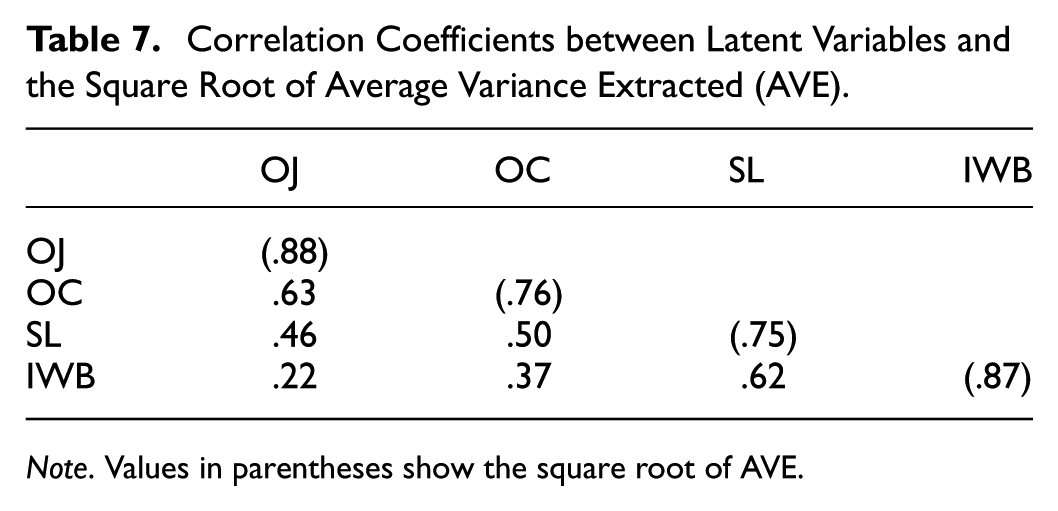
Note. Values in parentheses show the square root of AVE.
Hypothesis Testing
Verification of the Mediating Effect of Organizational Commitment in the Relationship Between Organizational Justice and Innovative Work Behavior
To examine the mediating effect of OC on the relationship between OJ and IWB, we conducted an analysis using Macro Model 4 (Hayes, 2015). We set sex, age, education, type of employment contract, and tenure as the control variables. The results of the analysis are presented in Table 8.
Mediating Effect of Organizational Commitment (OC) in the Relationship between Organizational Justice (OJ) and Innovative Work Behavior (IWB).

In direct effects, sex (B = .24, CI = 0.05–0.42) and OJ (B = .46, CI = 0.38–0.55) had positive effects on OC. Specifically, males exhibited higher OC than females, and higher OJ resulted in increased OC. Consequently, Hypothesis 1, which posited that OJ would positively affect OC, was accepted. Additionally, age (B = .22, CI = 0.02–0.41), education (B = .28, CI = 0.01–0.54), OJ (B = .17, CI = 0.08–0.13), and OC (B = .24, CI = 0.12–0.36) positively affected IWB. Accordingly, individuals aged 40 and above, those with at least a bachelor’s degree, and those experiencing higher OJ and OC demonstrated increased IWB. Thus, Hypothesis 2, which posited that OJ would positively affect IWB, and Hypothesis 3, which posited that OC would positively affect IWB, were accepted.
The study found that the indirect path from OJ to IWB through OC was significant (B = .11, CI = 0.04–0.17), indicating that OJ not only directly affected IWB but also indirectly affected it through OC. Thus, Hypothesis 4, which posited that OC would mediate the relationship between OJ and IWB, was accepted.
Verification of the Moderating Effect of Self-Leadership
To verify the moderating effect of SL on the relationship between OJ and IWB, we conducted an analysis using Macro Model 1 (Hayes, 2015). To prevent multicollinearity, we mean-centered both the independent and moderating variables.
The analysis results, presented in Table 9, showed that OJ (B = .09, CI = 0.06–0.11), SL (B = .59, CI = 0.48–0.70), and the interaction term between OJ and SL (B = .16, CI = 0.05–0.26) were statistically significant. This confirmed that SL moderated the relationship between OJ and IWB, supporting Hypothesis 5-1. Conversely, the interaction term between OC and SL was not statistically significant, leading to the rejection of Hypothesis 5-2, which posited that SL would moderate the relationship between OC and IWB.
Moderating Effect of Self-leadership.

p < .001; control variables are omitted.
We conducted a simple slope analysis to determine the significance of the effect of OJ on IWB according to SL. Specifically, we estimated the effect of OJ on IWB at points ±1 standard deviation from the mean of SL. The analysis results, shown in Table 10 and Figure 2, indicated that when SL was low, OJ did not significantly affect IWB. However, when SL was high, OJ had a positive effect on IWB.
Results of Simple Slope Analysis.


Moderating effect of self-leadership.
Conclusion
Discussion
This study confirmed that OJ has a positive effect on both OC and IWB, supporting Hypotheses 1 and 2. These findings correspond with prior research (Aguiar-Quintana et al., 2020; Donglong et al., 2020; Lönnqvist et al., 2022), which has established a strong association between OJ and OC. OJ fosters trust and a sense of fairness that motivates employees to reciprocate with greater organizational commitment and higher engagement in innovative behaviors, consistent with the principle of reciprocity. By encompassing distributive, procedural, and interactional justice, OJ shapes an environment conducive to creativity and risk-taking, and thus enhances IWB (Hameed et al., 2019; Janssen, 2004). These results further reinforce the notion that perceptions of fairness are foundational for developing not only favorable attitudes but also proactive work behaviors within organizations. From a theoretical standpoint, these findings align with social exchange theory, which proposes that perceptions of fairness do more than just build trust and also reduce psychological barriers to risk-taking, enabling employees to undertake spontaneous and creative action.
A key contribution of this study is clarifying the mediating role of OC in the relationship between OJ and IWB, supporting Hypothesis 4. supporting Hypothesis 4. In addition, Hypothesis 3, which posits that OC positively affects IWB, was also empirically confirmed. Fair and just treatment fulfills employees’ psychological contracts, which fosters a stronger emotional attachment to and identification with the organization. Such heightened commitment does not merely result in passive compliance, but actively motivates employees to exceed formal job requirements and to embrace innovative, risk-oriented behavior. In this sense, OC acts as a motivational bridge between affective engagement and proactive behavioral outcomes. This mechanism is consistent with theories that highlight the reciprocal interplay among cognition, emotion, and behavior envisioned within social exchange frameworks. Previous research (Battistelli et al., 2019; Zeng et al., 2020) similarly recognizes OC as a pivotal mechanism connecting perceptions of justice to organizational outcomes such as creativity, knowledge sharing, and proactive work behavior. Our results further corroborate that OC is a vital pathway by which perceived fairness translates into sustained, innovative efforts; moreover, OJ can be seen as a fundamental antecedent to both attitudinal and behavioral outcomes across diverse organizational and cultural contexts (Colquitt et al., 2001; Folger & Cropanzano, 1998).
Furthermore, the findings demonstrate that SL significantly amplifies the positive effect of OJ on IWB, supporting Hypothesis 5-1. Employees with high levels of SL do not simply accept fairness passively, but instead they interpret and utilize organizational justice as a motivational resource for innovation. Self-leadership is characterized by high self-motivation, effective self-management, and strong goal-setting skills, all of which enable individuals to capitalize on the opportunities afforded by a just organizational environment. In this context, employees with strong SL are more likely to trust that their innovative actions will be recognized and rewarded, thereby reinforcing a virtuous cycle of trust, autonomy, and creativity that bolsters overall organizational capacity for innovation. This perspective integrates findings from previous studies (Carmeli et al., 2006; Houghton & Neck, 2002), which emphasize the role of self-leadership in enabling employees to transform positive organizational climates into higher levels of creativity and innovative behavior. The present study extends these insights by providing empirical evidence that the psychological resources associated with SL interact with contextual cues of fairness to maximize innovative outcomes. The synergistic effect arising from the combination of perceived organizational justice and intrinsic motivation underscores the importance of fostering both equitable systems and personal leadership capabilities.
However, SL did not moderate the relationship between OC and IWB, leading to the rejection of Hypothesis 5-2. This can be understood in two ways. First, OC and SL are both individual-level characteristics related to self-directed motivation and commitment to goals. For employees who already exhibit high OC, the additional influence of SL may be minimal, as their strong commitment alone sufficiently motivates them to go beyond routine duties and engage in innovative behaviors. Second, particular contextual factors such as the hierarchical and conservative structure of Korean organizations—may serve as constraints, limiting employees’ autonomy and full exercise of self-leadership, regardless of their individual propensities. This interpretation is consistent with literature indicating that the impact of individual abilities on innovation can be reduced in settings characterized by limited autonomy and pronounced authority structures (Atkinson & Singer, 2021). The lack of a statistically significant moderating effect of SL on the OC-IWB relationship may therefore reflect a kind of motivational saturation, where high levels of OC account for most of the variance in innovative action and cultural & structural constraints further diminish the potential for additional effects.
Implications
Academic Implications
This study offers several important academic contributions by addressing notable gaps in the existing body of literature concerning OJ, OC, SL, and IWB, particularly within the Korean cultural context.
First, although previous research has extensively examined the relationship between OJ and IWB, the majority of these studies have been conducted in Western, individualistic, and egalitarian settings (Aguiar-Quintana et al., 2020; Lönnqvist et al., 2022). These environmental and cultural contexts differ markedly from East Asian societies like Korea, which are characterized by collectivism, hierarchical organizational structures, and loyalty-driven reciprocity (Nazir et al., 2019). While some Western-centric studies highlight positive effects of fairness on commitment and innovation, their generalizability to non-Western cultures remains limited. By empirically investigating these relationships in Korea, this study fills this critical gap and demonstrates that foundational organizational behavior theories can be effectively extended to hierarchical and collectivist contexts. This cultural specificity is crucial for better understanding how employees’ perceptions of fairness translate into commitment and innovation in markedly different social environments.
Second, previous research frequently focused on simple direct relationships or isolated mediating or moderating effects, often neglecting the complex interactions between individual-level psychological processes and organizational factors. Addressing this limitation, our study simultaneously tested the mediating role of OC and the moderating influence of SL, offering a more integrative perspective. Our findings elucidate how perceptions of OJ enhance employee commitment, which in turn fosters innovative behavior, and crucially, how self-leadership amplifies the benefits of fairness for innovation. This multidimensional approach advances theoretical understanding by clarifying the psychological pathways and boundary conditions under which OJ influences innovative outcomes.
Third, the study highlights the importance of individual self-directed traits, particularly SL, in shaping the extent to which fairness perceptions translate into innovation. Prior studies have recognized self-leadership as an important factor in enhancing motivation and self-regulation (Carmeli et al., 2006; Houghton & Neck, 2002), yet its role as a moderator in the OJ-IWB relationship has received limited empirical attention in collectivist and hierarchical cultures. Our research suggests that despite structural constraints characteristic of such cultures, developing employees’ SL capacities can significantly boost innovation by empowering individuals to leverage fair organizational environments. This offers a novel contribution by integrating individual psychological empowerment with OJ to explain innovation dynamics in complex cultural settings.
Finally, by comprehensively examining interactions at both organizational and individual levels, this study contributes to refining and extending key theoretical models such as social exchange theory, psychological contract theory, and organizational justice theory. Our findings underscore that the psychological contract shaped by fairness perceptions and strengthened by SL is central to promoting sustained innovative work behaviors. This integrated, multi-level perspective expands the explanatory power of existing theories and stresses the necessity of considering cultural, organizational, and personal factors collectively when investigating and fostering innovation in workplace settings.
In summary, this study fills significant research gaps by empirically validating the mechanisms through which OJ leads to IWB in a Korean context. It emphasizes the mediating role of OC and the moderating effect of SL, thus advocating for culturally sensitive and multidimensional approaches in future organizational research.
Practical Implications
The practical implications of this study offer concrete guidance for organizational leaders and policymakers in Korea, tailored to the realities of different industries. First, the mediating effect of OC suggests that enhancing fairness is essential for fostering positive attitudes and IWB. Organizations should focus on implementing fair and transparent human resource practices and decision-making processes that align with their specific operational contexts. This includes establishing clear and objective criteria for promotions and rewards, encouraging meaningful employee participation in organizational decisions, and fostering open communication channels to build trust and a sense of belonging among employees. By adapting these principles to their unique industry environments, organizations can enhance perceptions of fairness and motivate innovative behaviors among their workforce.
Second, given that SL positively moderates the relationship between OJ and IWB, customized SL capacity-building programs and policy support are needed for each industry. For example, in high-tech fields, SL education that enhances creative problem-solving and autonomous work performance can be expanded, while the healthcare industry can introduce patient-centered self-management skills and leadership training. In the cultural and startup industries, a certification system for SL capacity can be considered to promote rapid decision-making and innovation. At the government level, it is necessary to support SL education costs, activate certification systems, and promote industry-academia collaboration projects focused on key growth industries to study and disseminate best practices. Internally, SL development should be integrated into talent development processes and mentoring and peer coaching networks should be established to promote continuous capacity improvement.
Finally, to ensure long-term cultural and structural change, collaboration between industry and academia should be promoted to co-develop research and training programs that address sector-specific needs in fairness and self-leadership. Industry associations can facilitate the sharing of best practices, and government-led pilot projects can help refine and scale effective initiatives. By adopting these targeted and actionable strategies, Korean organizations and authorities can more effectively translate fairness and self-leadership into sustained innovation and competitive advantage across diverse sectors.
Study Limitations and Future Research
Despite its strengths, this study has some limitations that should be acknowledged. First, the use of non-probability convenience sampling may limit the representativeness of the findings. Although the sample size of 340 respondents satisfies widely recognized statistical guidelines for factor analysis and quantitative social science research (e.g., Comrey & Lee, 1992; Hair et al., 2010), relying solely on power calculations (G*Power 3.1) does not ensure the sample fully reflects the diverse Korean workforce across industries and demographics. This sampling approach may introduce bias and restrict the generalizability of the results. Future research should consider probability or stratified random sampling with larger, more representative samples to improve robustness and external validity. Second, generalizing these results to countries or organizations with different cultural backgrounds is challenging. This is because Korea’s collectivistic and hierarchical organizational culture might have uniquely influenced the relationship between OJ, OC, SL, and IWB. Future research should focus on cross-cultural studies targeting various countries and cultures to analyze how relationships between variables change according to cultural differences. For example, research could explore whether the moderating effect of SL is stronger in Western cultures characterized by strong individualism or how the influence of OJ varies in cultures with large power distances. Through such additional research, it will be possible to verify the generalizability of this study’s results and gain a deeper understanding of the differences in organizational behavior across cultural contexts.
Footnotes

Ethical Considerations
Ethical review and approval were waived for this study, due to the research falling under the category of human subject research exempt from Institu-tional Review Board review according to the Enforcement Rule of the Bioethics and Safety Act, Ministry of Health and Welfare Ordinance No. 1048 of the Republic of Korea.
Consent to Participate
Informed consent was obtained from all subjects involved in the study.
Funding
The authors received no financial support for the research, authorship, and/or publication of this article.
Declaration of Conflicting Interests
The authors declared no potential conflicts of interest with respect to the research, authorship, and/or publication of this article.
Data Availability Statement
The data that support the findings of this study are available from the corresponding author upon reasonable request.